

Crystal Chemistry of the Microporous Zirconosilicate Na6Zr3[Si9O27], a Product of High-Temperature Transformation of Catapleiite, and Its Ag-Exchanged Form



 and
and
Abstract
1. Introduction
2. Materials and Methods
3. Results
3.1. Chemical Composition
3.2. Infrared Specroscopy
3.3. X-Ray Diffraction Data and Crystal Structures
4. Discussion
Author Contributions
Funding
Conflicts of Interest
References
- Chukanov, N.V.; Pekov, I.V.; Rastsvetaeva, R.K. Crystal chemistry, properties and synthesis of microporous silicates containing transition elements. Rus. Chem. Rev. 2004, 73, 227–246. [Google Scholar] [CrossRef]
- Zubkova, N.V.; Pushcharovsky, D.Y. New Data on the Crystal structures of natural zirconosilicates: structure refinements and ion-exchange behavior. Zeit. Kristallogr. 2008, 223, 98–108. [Google Scholar] [CrossRef]
- Brunowsky, B. Die Struktur des Katapleits (Na2ZrSi3O9·2H2O). Acta physicochim. URSS 1936, 5, 863–892. [Google Scholar]
- Ksenofontov, D.A.; Grebenev, V.V.; Zubkova, N.V.; Pekov, I.V.; Kabalov, Y.K.; Chukanov, N.V.; Pushcharovsky, D.Y.; Artamonova, A.A. Behavior of catapleiite under heating and crystal structure of its high-temperature transformation product, a new phase Na6Zr3[Si9O27] with nine-membered rings of SiO4 tetrahedra. Geol. Ore Depos. 2019, 61, 696–705. [Google Scholar] [CrossRef]
- Ksenofontov, D.A.; Artamonova, A.A.; Zubkova, N.V.; Pekov, I.V.; Bychkov, A.Y.; Yapaskurt, V.O.; Pushcharovsky, D.Y. Ion-exchanged forms of the microporous zirconosilicate Na6Zr3[Si9O27], a product of catapleiite annealing. In Proceedings of the XIX International Meeting on Crystal Chemistry, X-ray Diffraction and Spectroscopy of Minerals, Apatity, Russia, 2–5 July 2019; p. 73. [Google Scholar]
- Chao, G.Y.; Rowland, J.R.; Chen, T.T. The crystal structure of catapleiite. Abstr. Programs Geol. Soc. Am. 1973, 5, 572. [Google Scholar]
- Ilyushin, G.D.; Voronkov, A.A.; Ilyukhin, V.V.; Nevsky, N.N.; Belov, N.V. The crystal structure of the native monoclinic catapleiite Na2ZrSi3O9·2H2O. Dokl. Akad. Nauk SSSR 1981, 260, 623–627. (In Russian) [Google Scholar]
- Zubkova, N.V. Comparative Crystal Chemistry of New and Rare Zirconosilicates, Silicates of Alkaline and Alkaline Earth Elements and Minerals with Isolated Tetrahedral and Triangular Oxocomplexes. Ph.D. Thesis, Lomonosov Moscow State University, Moscow, Russia, 2012; p. 307. (In Russian). [Google Scholar]
- Yakubovich, O.V.; Karimova, O.V.; Ivanova, A.G.; Yapaskurt, V.O.; Chukanov, N.V.; Kartashov, P.M. Ordering of cations in the voids of the anionic framework of the crystal structure of catapleiite. Crystallogr. Rep. 2013, 58, 401–411. [Google Scholar] [CrossRef]
- Merlino, S.; Pasero, M.; Bellezza, M.; Pushcharovsky, D.Y.; Gobechia, E.R.; Zubkova, N.V.; Pekov, I.V. Crystal structure of calcium catapleiite. Can. Mineral. 2004, 42, 1037–1045. [Google Scholar] [CrossRef]
- Baussy, G.; Caruba, R.; Baumer, A.; Turco, G. Minéralogie expérimentale dans le système ZrO2-SiO2-Na2O-H2O. Corrélations pétrogénétiques. Bull. Minéral. 1974, 97, 433–444. [Google Scholar] [CrossRef]
- Zubkova, N.V.; Pekov, I.V.; Turchkova, A.G.; Pushcharovsky, D.Y.; Merlino, S.; Pasero, M.; Chukanov, N.V. Crystal structures of potassium-exchanged forms of catapleiite and hilairite. Crystallogr. Rep. 2007, 52, 65–70. [Google Scholar] [CrossRef]
- Rigaku Oxford Diffraction. CrysAlisPro Software System, Version 1.171.39.46; Rigaku Corporation: Oxford, UK, 2018. [Google Scholar]
- Sheldrick, G.M. Crystal structure refinement with SHELXL. Acta Crystallogr. 2015, C71, 3–8. [Google Scholar]
- Chukanov, N.V. Infrared Spectra of Mineral Species: Extended Library; Springer-Verlag GmbH: Dordrecht, The Netherlands, 2014; p. 1716. ISBN 9400771274, 978-9400771277. [Google Scholar]
- Sitarza, M.; Handke, M.; Mozgawa, W.; Galuskin, E.; Galuskina, I. The non-ring cations influence on silicooxygen ring vibrations. J. Mol. Struct. 2000, 555, 357–362. [Google Scholar] [CrossRef]
- Jonsen, O.; Grice, J.D. The crystal chemistry of the eudialyte group. Can. Mineral. 1999, 37, 865–891. [Google Scholar]
- Johnsen, O.; Ferraris, G.; Gault, R.A.; Grice, J.D.; Kampf, A.R.; Pekov, I.V. The nomenclature of eudialyte-group minerals. Can. Mineral. 2003, 41, 785–794. [Google Scholar] [CrossRef]
- Pekov, I.V.; Chukanov, N.V. Microporous framework silicate minerals with rare and transition elements: Minerogenetic aspects. Rev. Mineral. Geochem. 2005, 57, 145–171. [Google Scholar] [CrossRef]
- Fleet, M.E. Sodium tetrasilicate: a complex high-pressure framework silicate (Na6Si3[Si9O27]). Amer. Mineral. 1996, 81, 1105–1110. [Google Scholar] [CrossRef]
- Zubkova, N.V.; Nikolova, R.P.; Chukanov, N.V.; Kostov-Kytin, V.V.; Pekov, I.V.; Varlamov, D.A.; Larikova, T.S.; Kazheva, O.N.; Chervonnaya, N.A.; Shilov, G.V.; et al. Crystal chemistry and properties of elpidite and its Ag-exchanged forms. Minerals 2019, 9, 420. [Google Scholar] [CrossRef]

| Sample/Locality | Sp.Gr., Z | a (Å) | b (Å) | c (Å) | β/γ (°) | V (Å3) | Ref. |
|---|---|---|---|---|---|---|---|
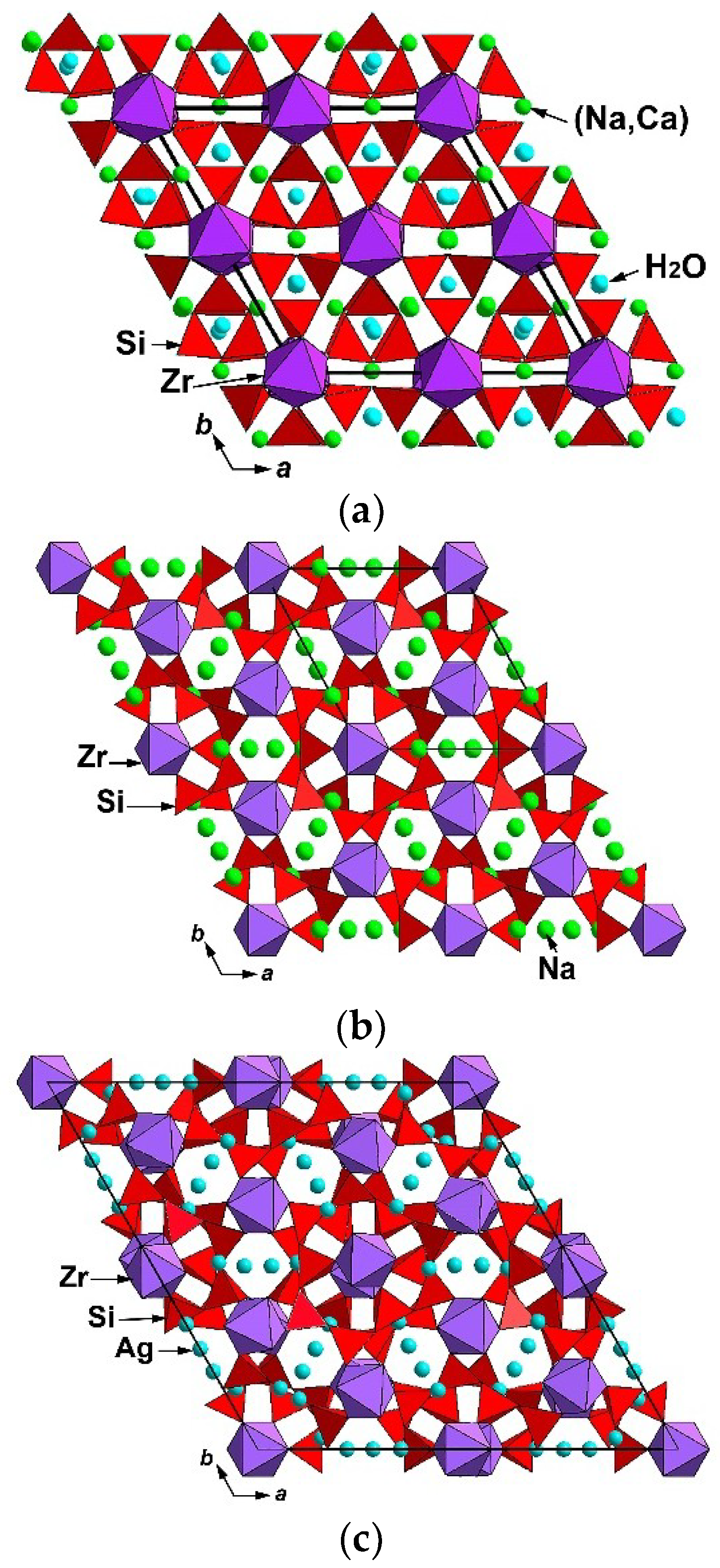
| Catapleiite/Khibiny, Kola peninsula, Russia | P63/mmc, 2 | 7.40 | 10.05 | 478.2 | [3] | ||
| Catapleiite/Mont Saint-Hilaire, Québec | I2/c, 8 | 12.779 | 7.419 | 20.157 | 90.41 | 1911.0 | [6] |
| Catapleiite */Khibiny, Kola peninsula, Russia | B2/b, 8 * | 23.917 | 20.148 | 7.432 | 147.46 (1) | 1926.4 | [7] |
| Catapleiite/Khibiny, Kola peninsula, Russia | P3c1, 16 | 14.820 | 20.074 | 3818.2 | [8] | ||
| Catapleiite/Khibiny, Kola peninsula, Russia | Fdd2, 32 | 20.100 | 25.673 | 14.822 | 7649 | [9] | |
| Calciocatapleiite/Burpala, Siberia, Russia | Pbnn, 4 | 7.378 | 12.779 | 10.096 | 951.89 | [10] | |
| synthetic Na2ZrSi3O9·2H2O | P63/mmc, 2 | 7.388 | 10.068 | 475.9 | [11] | ||
| K-exchanged form of catapleiite | P63/mmc, 2 | 7.344 | 9.984 | 466.3 | [12] | ||
| Na6Zr3[Si9O27] ** | P63/mcm, 2 | 11.5901 | 9.9546 | 1158.1 | [4] | ||
| Ag-exchanged form of Na6Zr3[Si9O27] | P63cm, 8 | 23.3462 | 10.1064 | 4770.5 | This work |
| Formula | (Ag5Ca0.5)Zr3[Si9O27] * |
|---|---|
| Formula weight ** | 1535.84 |
| Temperature, K | 293 |
| Radiation and wavelength, Å | MoKα; 0.71073 |
| Crystal system, space group, Z | Hexagonal, P63cm, 8 |
| Unit–cell dimensions, Å | a = 23.3462(3) c = 10.10640(10) |
| V, Å3 | 4770.45(13) |
| Absorption coefficient μ, mm−1 ** | 4.277 |
| F000 ** | 5709 |
| Crystal size, mm | 0.19 × 0.20 × 0.26 |
| Diffractometer | Xcalibur S CCD |
| θ range for data collection, ° | 3.023–28.254 |
| Index ranges | −31 ≤ h ≤ 31, –31 ≤ k ≤ 31, −13 ≤ l ≤ 13 |
| Reflections collected | 43,863 |
| Independent reflections | 4098 (Rint = 0.0413) |
| Independent reflections [I > 2σ(I)] | 4089 |
| Absorption correction | Gaussian |
| Refinement method | Full-matrix least-squares on F2 |
| Number of refined parameters | 238 |
| Final R indices [I > 2σ(I)] R1/wR2 | 0.0677/0.1299 |
| R indices (all data) R1/wR2 | 0.0678/0.1300 |
| GoF | 1.299 |
| Largest diff. peak and hole, e/Å3 *** | 2.750 and −2.037 |
| Constituent | wt.% | Constituent | Apfu |
|---|---|---|---|
| Ag2O | 37.99 | Ag | 5.04 |
| CaO | 1.40 | Ca | 0.38 |
| SiO2 | 35.52 | Si | 9.10 |
| ZrO2 | 23.66 | Zr | 2.95 |
| Total | 98.57 | ||
| Site | x | y | z | Ueq | s.o.f | Q |
|---|---|---|---|---|---|---|
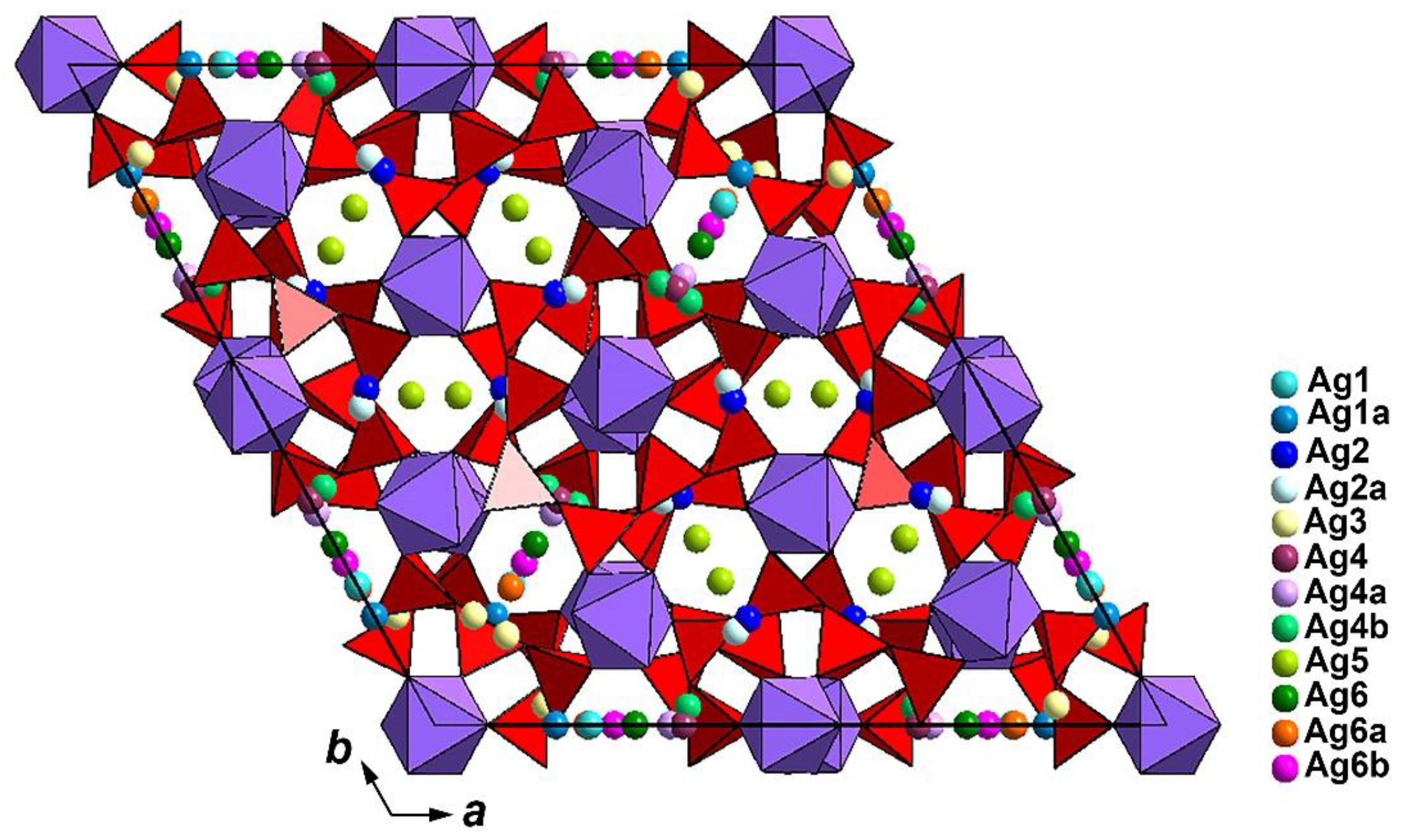
| Ag1 | 0.7881(2) | 0.0 | 0.4520(4) | 0.0238(12) | 0.650(12) | 6 |
| Ag1a | 0.8349(5) | 0.0 | 0.3966(10) | 0.0238(12) | 0.249(8) | 6 |
| Ag2 | 0.6525(3) | 0.1608(4) | 0.3681(5) | 0.0471(19) | 0.74(3) | 12 |
| Ag2a | 0.6596(11) | 0.1412(10) | 0.3680(19) | 0.0471(19) | 0.24(2) | 12 |
| Ag3 | 0.8341(5) | −0.1359(7) | 0.3931(9) | 0.064(5) | 0.260(11) | 12 |
| Ag4 | 0.6602(4) | 0.0 | 0.3895(8) | 0.021(2) | 0.68(4) | 6 |
| Ag4a | 0.6778(13) | 0.0 | 0.361(3) | 0.021(2) | 0.19(2) | 6 |
| Ag4b | 0.641(3) | −0.027(3) | 0.382(4) | 0.021(2) | 0.060(13) | 12 |
| Ag5 | 0.78275(9) | 0.28171(10) | 0.32106(19) | 0.0201(4) | 1 | 12 |
| Ag6 | 0.72647(16) | −0.27353(16) | 0.4322(4) | 0.0175(12) | 0.681(13) | 6 |
| Ag6a | 0.792(2) | −0.208(2) | 0.345(6) | 0.0175(12) | 0.040(7) | 6 |
| Ag6b | 0.755(3) | −0.245(3) | 0.373(8) | 0.0175(12) | 0.039(6) | 6 |
| Zr1 | 0.82375(9) | 0.15803(9) | 0.3859(3) | 0.0102(4) | 1 | 12 |
| Zr2 | 1/3 | 2/3 | 0.3604(3) | 0.0024(6) | 1 | 4 |
| Zr3 | 0.50930(10) | 0.0 | 0.3768(3) | 0.0051(4) | 1 | 6 |
| Zr4 | 0.0 | 0.0 | 0.3954(6) | 0.0254(14) | 1 | 2 |
| Si1 | 0.5771(3) | −0.1415(3) | 0.1104(6) | 0.0091(11) | 1 | 12 |
| Si2 | 0.4995(3) | −0.1072(3) | 0.6375(6) | 0.0062(9) * | 1 | 12 |
| Si3 | 0.8927(4) | −0.1073(4) | 0.1422(11) | 0.023(2) | 1 | 6 |
| Si4 | 0.8566(3) | 0.0779(3) | 0.1426(7) | 0.0151(13) | 1 | 12 |
| Si5 | 0.7201(3) | 0.0782(3) | 0.6592(6) | 0.0057(10) | 1 | 12 |
| Si6 | 0.6075(3) | 0.0 | 0.1061(8) | 0.0061(14) * | 1 | 6 |
| Si7 | 0.3586(3) | −0.2185(3) | 0.6113(6) | 0.0084(11) | 1 | 12 |
| O1 | 0.6229(8) | 0.1828(8) | 0.6189(14) | 0.014(3) * | 1 | 12 |
| O2 | 0.9350(13) | 0.1203(14) | 0.136(2) | 0.046(6) * | 1 | 12 |
| O3 | 0.7515(8) | 0.0870(8) | 0.5107(17) | 0.018(3) * | 1 | 12 |
| O4 | 0.6632(10) | 0.0 | 0.681(2) | 0.014(4) * | 1 | 6 |
| O5 | 0.5923(9) | 0.2598(9) | 0.4738(15) | 0.019(4) | 1 | 12 |
| O6 | 0.5888(8) | 0.0701(8) | 0.4973(17) | 0.019(3) * | 1 | 12 |
| O7 | 0.6208(7) | −0.3166(7) | 0.5810(13) | 0.007(3) * | 1 | 12 |
| O8 | 0.5848(8) | 0.0 | 0.2598(18) | 0.006(4) * | 1 | 6 |
| O9 | 0.4444(10) | 0.0 | 0.504(2) | 0.017(5) | 1 | 6 |
| O10 | 0.8805(7) | 0.3183(7) | 0.1769(14) | 0.010(3) * | 1 | 12 |
| O11 | 0.7544(7) | 0.1575(8) | 0.2529(15) | 0.012(3) | 1 | 12 |
| O12 | 0.4418(7) | −0.0728(7) | 0.2565(14) | 0.007(3) * | 1 | 12 |
| O13 | 0.7431(8) | −0.0846(8) | 0.2788(15) | 0.014(3) | 1 | 12 |
| O14 | 0.9035(7) | 0.2273(7) | 0.2744(14) | 0.009(3) * | 1 | 12 |
| O15 | 0.2628(7) | −0.3262(7) | 0.2427(14) | 0.010(3) * | 1 | 12 |
| O16 | 0.4998(8) | 0.1598(7) | 0.6136(13) | 0.009(3) * | 1 | 12 |
| O17 | 0.5855(8) | −0.2316(8) | 0.4892(17) | 0.018(3) * | 1 | 12 |
| O18 | 0.8980(8) | 0.1695(8) | 0.5146(16) | 0.015(3) * | 1 | 12 |
| O19 | 0.8355(10) | 0.0 | 0.119(2) | 0.016(5) * | 1 | 6 |
| O20 | 0.9277(12) | −0.0723(12) | 0.275(3) | 0.032(6) * | 1 | 6 |
| O21 | 0.9266(17) | −0.0734(17) | 0.005(3) | 0.066(12) * | 1 | 6 |
| Framework | Extra-framework Cations * | ||||
|---|---|---|---|---|---|
| Ag1 | - O13 | 2.448(17) × 2 | |||
| Zr-centred octahedra | - O3 | 2.634(18) × 2 | |||
| - O2 | 2.66(3) × 2 | ||||
| Zr1 | - O13 | 2.068(15) | |||
| - O18 | 2.075(16) | Ag1a | - O13 | 2.383(17) × 2 | |
| - O17 | 2.081(17) | - O21 | 2.41(4) | ||
| - O14 | 2.084(14) | - O2 | 2.76(2) × 2 | ||
| - O3 | 2.096(17) | - O19 | 2.81(2) | ||
| - O11 | 2.099(15) | ||||
| <Zr1 | - O> | 2.08 | Ag2 | - O6 | 2.290(18) |
| - O15 | 2.518(17) | ||||
| Zr2 | - O5 | 2.072(17) × 3 | - O16 | 2.579(14) | |
| - O15 | 2.105(14) × 3 | - O11 | 2.684(17) | ||
| <Zr2 | - O> | 2.09 | - O1 | 2.742(16) | |
| - O12 | 3.040(15) | ||||
| Zr3 | - O9 | 1.99(2) | |||
| - O12 | 2.042(13) × 2 | Ag2a | - O6 | 2.11(2) | |
| - O8 | 2.123(18) | - O11 | 2.36(3) | ||
| - O6 | 2.138(17) × 2 | - O16 | 2.61(2) | ||
| <Zr3 | - O> | 2.08 | - O15 | 2.97(3) | |
| - O1 | 2.99(3) | ||||
| Zr4 | - O21 | 2.04(3) × 3 | - O8 | 3.06(2) | |
| - O20 | 2.08(3) × 3 | - O12 | 3.14(3) | ||
| <Zr4 | - O> | 2.06 | |||
| Ag3 | - O20 | 2.27(3) | |||
| Si-centred terahedra | - O19 | 2.38(2) | |||
| - O18 | 2.503(19) | ||||
| Si1 | - O11 | 1.613(16) | - O2 | 2.70(2) | |
| - O16 | 1.626(16) | - O21 | 3.03(2) | ||
| - O7 | 1.625(15) | - O2 | 3.12(3) | ||
| - O17 | 1.631(18) | - O13 | 3.13(2) | ||
| <Si1 | - O> | 1.62 | |||
| Ag4 | - O8 | 2.19(2) | |||
| Si2 | - O12 | 1.571(15) | - O3 | 2.416(18) × 2 | |
| - O6 | 1.603(17) | - O4 | 2.95(2) | ||
| - O1 | 1.619(17) | - O6 | 3.06(2) × 2 | ||
| - O10 | 1.673(16) | ||||
| <Si2 | - O> | 1.62 | Ag4a | - O8 | 2.40(3) |
| - O3 | 2.42(2) × 2 | ||||
| Si3 | - O20 | 1.57(3) | - O13 | 3.15(3) × 2 | |
| - O21 | 1.593(14) | - O7 | 3.16(2) × 2 | ||
| - O2 | 1.69(3) × 2 | ||||
| <Si3 | - O> | 1.64 | Ag4b | - O8 | 2.11(4) |
| - O3 | 2.17(4) | ||||
| Si4 | - O13 | 1.575(17) | - O6 | 2.76(5) | |
| - O2 | 1.59(3) | - O3 | 2.93(7) | ||
| - O18 | 1.644(17) | - O11 | 2.98(6) | ||
| - O19 | 1.647(10) | - O4 | 3.08(5) | ||
| <Si4 | - O> | 1.61 | - O7 | 3.13(4) | |
| Si5 | - O14 | 1.588(15) | Ag5 | - O17 | 2.416(17) |
| - O10 | 1.623(15) | - O5 | 2.440(18) | ||
| - O3 | 1.637(18) | - O10 | 2.471(15) | ||
| - O4 | 1.649(8) | - O15 | 2.484(14) | ||
| <Si5 | - O> | 1.62 | - O11 | 2.720(15) | |
| - O1 | 2.826(16) | ||||
| Si6 | - O9 | 1.59(2) | |||
| - O8 | 1.64(2) | Ag6 | - O14 | 2.520(14) × 2 | |
| - O7 | 1.660(14) × 2 | - O18 | 2.546(16) × 2 | ||
| <Si6 | - O> | 1.64 | - O7 | 2.623(14) × 2 | |
| - O4 | 2.94(2) | ||||
| Si7 | - O15 | 1.619(15) | - O19 | 3.17(2) | |
| - O5 | 1.626(16) | ||||
| - O16 | 1.632(16) | Ag6a | - O14 | 2.61(4) × 2 | |
| - O1 | 1.654(17) | - O18 | 2.70(4) × 2 | ||
| <Si7 | - O> | 1.63 | - O2 | 2.80(6) × 2 | |
| - O19 | 2.94(6) | ||||
| Ag6b | - O14 | 2.30(4) × 2 | |||
| - O18 | 2.57(5) × 2 | ||||
| - O4 | 2.89(7) | ||||
| - O19 | 3.11(7) | ||||
© 2020 by the authors. Licensee MDPI, Basel, Switzerland. This article is an open access article distributed under the terms and conditions of the Creative Commons Attribution (CC BY) license (http://creativecommons.org/licenses/by/4.0/).
Share and Cite
Zubkova, N.V.; Ksenofontov, D.A.; Chukanov, N.V.; Pekov, I.V.; Artamonova, A.A.; Koshlyakova, N.N.; Bychkov, A.Y.; Pushcharovsky, D.Y. Crystal Chemistry of the Microporous Zirconosilicate Na6Zr3[Si9O27], a Product of High-Temperature Transformation of Catapleiite, and Its Ag-Exchanged Form. Minerals 2020, 10, 243. https://doi.org/10.3390/min10030243
Zubkova NV, Ksenofontov DA, Chukanov NV, Pekov IV, Artamonova AA, Koshlyakova NN, Bychkov AY, Pushcharovsky DY. Crystal Chemistry of the Microporous Zirconosilicate Na6Zr3[Si9O27], a Product of High-Temperature Transformation of Catapleiite, and Its Ag-Exchanged Form. Minerals. 2020; 10(3):243. https://doi.org/10.3390/min10030243
Chicago/Turabian StyleZubkova, Natalia V., Dmitry A. Ksenofontov, Nikita V. Chukanov, Igor V. Pekov, Anna A. Artamonova, Natalia N. Koshlyakova, Andrey Yu. Bychkov, and Dmitry Yu. Pushcharovsky. 2020. "Crystal Chemistry of the Microporous Zirconosilicate Na6Zr3[Si9O27], a Product of High-Temperature Transformation of Catapleiite, and Its Ag-Exchanged Form" Minerals 10, no. 3: 243. https://doi.org/10.3390/min10030243
APA StyleZubkova, N. V., Ksenofontov, D. A., Chukanov, N. V., Pekov, I. V., Artamonova, A. A., Koshlyakova, N. N., Bychkov, A. Y., & Pushcharovsky, D. Y. (2020). Crystal Chemistry of the Microporous Zirconosilicate Na6Zr3[Si9O27], a Product of High-Temperature Transformation of Catapleiite, and Its Ag-Exchanged Form. Minerals, 10(3), 243. https://doi.org/10.3390/min10030243

