

Abstract
Background/Objectives: The detection of anti-Coxiella antibodies using serological methods is essential for identifying exposed ruminants and preventing this important zoonotic disease in livestock. In recent years, numerous attempts have been made to increase diagnostic performance as well as simplify the production of serological assays. Commercially available tests often use whole-cell antigens, which can decrease specificity and require high-level biosafety facilities for manufacturing. The aim of this work was to produce three Coxiella burnetii (C. burnetii) antigens in recombinant form and assess them for the detection of anti-Coxiella antibodies in ruminants. Methods: Three recombinant C. burnetii antigens (Com-1, MceB, AdaA) were selected among immunodominant antigens and produced in a heterologous system (Escherichia coli). Following purification, the proteins were utilized to coat ELISA plates and evaluated for seroreactivity against sera from both negative and positive cattle. Results: Com-1 demonstrated the greatest agreement with the commercial test, albeit moderate. MceB exhibited nonspecific reactivity against a large number of sera, while the AdaA showed reactivity against only a few positive sera. Conclusions: Our findings are consistent with previous research, indicating that utilizing a single antigen to identify exposed animals is unfeasible with current knowledge, most likely due to the complex immunological response following C. burnetii infection in cattle. Consequently, it is critical to continue testing and identifying immunoreactive antigens in order to further investigate them and, potentially, select the most appropriate.
1. Introduction
Coxiella burnetii (C. burnetii) is the etiological agent of Q fever in humans, a globally reported public health concern, and Coxiellosis in ruminants, which causes economic losses in the cattle industry [1,2]. This intracellular and Gram-negative bacterium has a wide host range, including almost all mammals, and has been identified as one of the most common abortive agents in ruminants [1,3]. Coxiellosis in ruminants is often asymptomatic, with the sole symptoms being reproductive problems such as abortion, metritis, and placental retention [4,5]. Ruminants are considered the primary source of infection for humans, as they shed Coxiella in high concentrations through vaginal fluids and abortion products [6,7]. Other species, although susceptible to infection, appear to have a minor role in transmission [8,9,10]. Humans become infected through inhalation or ingestion of contaminated materials (some professionals, such as veterinarians and farmers, are at high risk) and may develop an acute form, characterized by fever and flu-like symptoms, or a chronic form, which is more dangerous due to Coxiella colonization in various organs such as the liver, lungs, and heart [1,11,12].
Ruminants are the main target for surveillance and monitoring programs due to their crucial role in the epidemiological cycle of Coxiella [11,13,14]. Surveillance strategies involve the detection of Coxiella DNA through direct methods, such as polymerase chain reaction testing on milk or aborted materials [15,16]. Additionally, serological tests are used to detect specific antibodies to assess the level of exposure within a herd [5,17]. Direct approaches are typically more expensive and are mainly recommended in outbreak situations, as intermittent shedding of Coxiella can impair diagnostic sensitivity [18,19]. Serology, on the other hand, is more suitable for rapid, large-scale screening. Previously, the complement fixation test (CFT) was the preferred serological tool, but it has largely been replaced by the immunofluorescence assay (IFA) and the enzyme-linked immunosorbent assay (ELISA) [18,20]. IFA is regarded as the gold standard for human diagnosis. It allows differentiation between recent and past exposure by detecting antibodies against two distinct antigenic phases of Coxiella: phase II (typical of recent and acute infection) and phase I (indicative of chronic infection) [1,21]. However, since no commercial IFA is currently available for veterinary use, ELISA is the most commonly used tool in ruminants and is also recommended by the World Organization for Animal Health (WOAH) [22]. These tests are relatively rapid, accessible, and easily applied to herd assessment, but they also have several drawbacks. In fact, commercial ELISAs are mostly based on whole-cell antigens of a single isolate, whose manufacturing requires a biosafety level 3 laboratory (BSL3) [23,24]. Furthermore, diagnostic performance may vary depending on the ruminant species or matrix used and may be influenced by antigenic homology between C. burnetii and other common ruminant pathogens, as well as the diversity of genotypes circulating in a given area [20,23,25,26].
Improving detection tools is essential for effective infection control, and numerous efforts have been made in recent years to develop recombinant ELISAs to address performance limitations and reduce the need for high-level biosafety procedures. Important immunodominant C. burnetii antigens (Ybgf, SucB, Hstp, etc.) have been employed in recombinant ELISAs. Comparative studies with commercial ELISAs have shown high concordance rates, although these alternatives have not been deemed suitable to fully replace existing commercial tests [24,27,28,29].
For these reasons, it is critical to continue identifying novel recombinant candidates, as the control of Q fever and Coxiellosis necessitates constant improvement of the assay used.
Several studies have proposed that major immunodominant proteins might be used to produce novel serological assays and vaccines, as they are often associated with a specific antigenic phase or form of infection [30,31]. These immunoreactive antigens include an outer membrane-associated protein (Com-1, CBU1910), acute disease antigen A (AdaA, CBU0952), and the mitochondrial Coxiella effector protein B (MceB, CBU0937) [32,33,34]. Com-1 is an outer membrane protein that participates in post-translational modification and protein turnover [35]. This antigen has been identified as immunodominant in multiple studies, demonstrating strong reactivity for both phases, and has already been used to detect anti-Coxiella antibodies in ruminants [36]. MceB and AdaA are two proteins that have demonstrated strong reactivity to phase II and are considered biomarkers of acute Coxiella infection [33].
The aim of this study was to produce these three antigens in a heterologous system (Escherichia coli), purify them, and employ them to coat ELISA plates in order to compare their diagnostic performance by testing positive and negative bovine sera.
2. Materials and Methods
2.1. Antigen Selection, Amplification, Ligation
A C. burnetii Nine Mile RSA 493 phase I strain was cultivated in axenic medium in a BSL3 laboratory in the department of Rickettiology, Slovak Academy Science, Bratislava (Slovakia) as described previously [37]. The bacteria were centrifuged at 15,000× g for 1 h at 4 °C, and genomic DNA was extracted using DNeasy blood and tissue kit (Qiagen, Venlo, The Netherlands) following the manufacturer’s instructions. Specific primers were designed according to the gene sequences available in the NCBI database (https://www.ncbi.nlm.nih.gov/; accessed on 1 October 2023), excluding the signal peptide region (Table 1). The primers included recognition sites for the restriction enzymes BamHI and EcoRI for cloning. However, since a restriction site for EcoRI was present in the sequence encoding for Com-1, this enzyme was replaced with XhoI (Supplementary Table S1). Each amplification was performed using a commercial kit (HotStarTaq DNA Polymerase, Qiagen) in a total volume of 50 μL including 2.5 μL of each primer (10 μM), 5 μL of buffer 10×, 1.5 μL of MgCl 2 (50 mM), 1 μL of dNTPs (10 mM), 0.25 μL of Taq DNA polymerase, and RNase-free water. PCR amplification was carried out under the following conditions: an initial denaturation at 95 °C for 5 min, followed by 35 cycles of denaturation at 95 °C for 45 s, annealing at 52–60 °C for 30 s, and elongation at 72 °C for 1–2 min depending on the amplicon length. A final elongation step at 72 °C for 10 min was also performed. Amplicons were visualized on agarose gel to confirm the presence and size of the expected bands. Digestion was performed at 37 °C for 3 h using appropriate restriction enzymes (BamHI, EcoRI, XhoI; Thermo Scientific, Waltham, MA, USA), followed by purification and quantification assessed using NanoDrop 2000/2000c spectrophotometer (Thermo Fisher, Waltham, MA, USA). Ligation was carried out as described in previous works [24] using specific plasmid vectors (pSER or pGEX 6P-1) previously digested with the same restriction enzymes. The ligation product was utilized for transforming competent Escherichia coli BL21 C43 (DE3) cells grown in Luria–Bertani (LB) media (Thermo Scientific, Waltham, MA, USA). Positive colonies were cultivated in ampicillin-supplemented liquid LB and stimulated with 1 mM isopropyl D-1-thiogalactopyranoside (IPTG) during the mid-exponential phase. The insert’s features and in-frame orientation were confirmed by colony PCR and by Sanger sequencing of the plasmid DNA extracted from a positive clone using the QIAprep Spin Miniprep kit (Qiagen, Venlo, The Netherlands).
Table 1.
Positive and negative cattle serum samples tested using a commercial ELISA (IDEXX) and the three recombinant ELISAs (MceB, AdaA and Com-1).
2.2. Expression and Purification
Bacterial cells were collected by centrifugation (6000× g 10 min at 4 °C) and processed with 100 µL of lysozyme (50 mg/mL) in 10 mL of STE buffer (NaCl at 100 mM, Tris HCl at 10 mM, and Na2EDTA at 1 mM; Sigma-Aldrich, Burlington, MA, USA). Proteins were extracted and purified differently based on their solubility (presence or absence in the supernatant) using either denaturing or native conditions coupled to column-based chromatography. Specifically, MceB and AdaA (cloned into pSER vector) were purified using 1 M urea (from pellet) and a nickel-affinity resin (HisPur Ni-NTA resin; Thermo Scientific). Com-1, on the other hand, was cloned into the pGEX-6P-1 plasmid and purified from the supernatant using glutathione affinity chromatography (Glutathione Sepharose 4B resin; Merck, Rahway, NJ, USA), which also allowed the cut of the fusion GST tag from purified proteins directly on-column using PreScission protease (Merck, Rahway, NJ, USA) [24]. Each purification was carried out in three steps, after 30 min of resin incubation with protein extract and 5 min of incubation with a specific elution buffer, and visualized in Sodium Dodecyl Sulfate Polyacrylamide Gel Electrophoresis (SDS-PAGE) stained with Coomassie brilliant blue R250 (Sigma-Aldrich, Burlington, MA, USA).
2.3. Recombinant ELISAs
Each recombinant antigen was used (100 ng for Com-1; 50 ng for MceB and AdaA) to coat the wells of 96-well plates (Nunc Maxisorp; Millipore Sigma, Burlington, MA, USA) overnight at 4 °C, followed by a blocking phase with 2.5% bovine casein to prevent non-specific binding. Serum samples were diluted 1:20 for Com-1 and 1:100 for MceB/AdaA, and incubated for 1 h at room temperature. After three washes with a specific wash buffer, a monoclonal anti-bovine IgG-peroxidase was used as previously described [14]. After a final wash step, the enzymatic reaction was developed by adding 3,3′,5,5′-tetramethylbenzidine (TMB) for 15 min and then stopped with 0.2 M H2SO4 (Thermo Scientific, Waltham, MA, USA). Optical density was measured at 450 nm (OD450). A threshold for positivity was established as the mean OD of negative control sera plus four standard deviations (mean + 4SD). These operating conditions were determined by evaluating various antigen concentrations and dilutions of positive and negative control sera (crisscross serial dilution study with an initial panel of negative and positive serum samples) [14]. A panel of well-characterized sera belonging to apparently healthy ruminants and/or ruminants with a history of abortion was selected from a previous work [24] to investigate the diagnostic potential of recombinant antigens against a commercial ELISA (Q fever Ab test kit; IDEXX, Westbrook, ME, USA). The Ethics Committee of the Department of Veterinary Medicine and Animal Production (Centro Servizi Veterinari, Turin, Italy), University of Naples, Federico II, authorized the animal study protocol (PG/2022/0093419) on 20 July 2022. A total of 120 positive and 281 negative sera were selected from samples stored for other similar studies by choosing those best preserved and not thawed more than three times. The commercial ELISA was performed following the manufacturer’s instructions. Briefly, serum was diluted 1:100 to each well, incubated for 1 h at 37 °C, and, after three washes, 100 µL of anti-ruminant IgG conjugate was added. After further incubation and washing, the reaction was read by adding TMB for 15 min and stopping solution.
2.4. Statistical Analysis
The commercial ELISA (Q fever Ab test kit; IDEXX) was considered as the reference assay in our statistical analysis (MedCalc v.18.11.3, https://www.medcalc.org/; accessed on 1 December 2023). The level of agreement among assays was determined by the kappa Cohen coefficient (0.81–1.00 = almost perfect agreement; 0.61–0.80 = substantial agreement; 0.41 0.60 = moderate agreement; 0.21–0.40 = fair agreement; 0.01–0.20 = slight agreement; 0.00 = no agreement).
3. Results
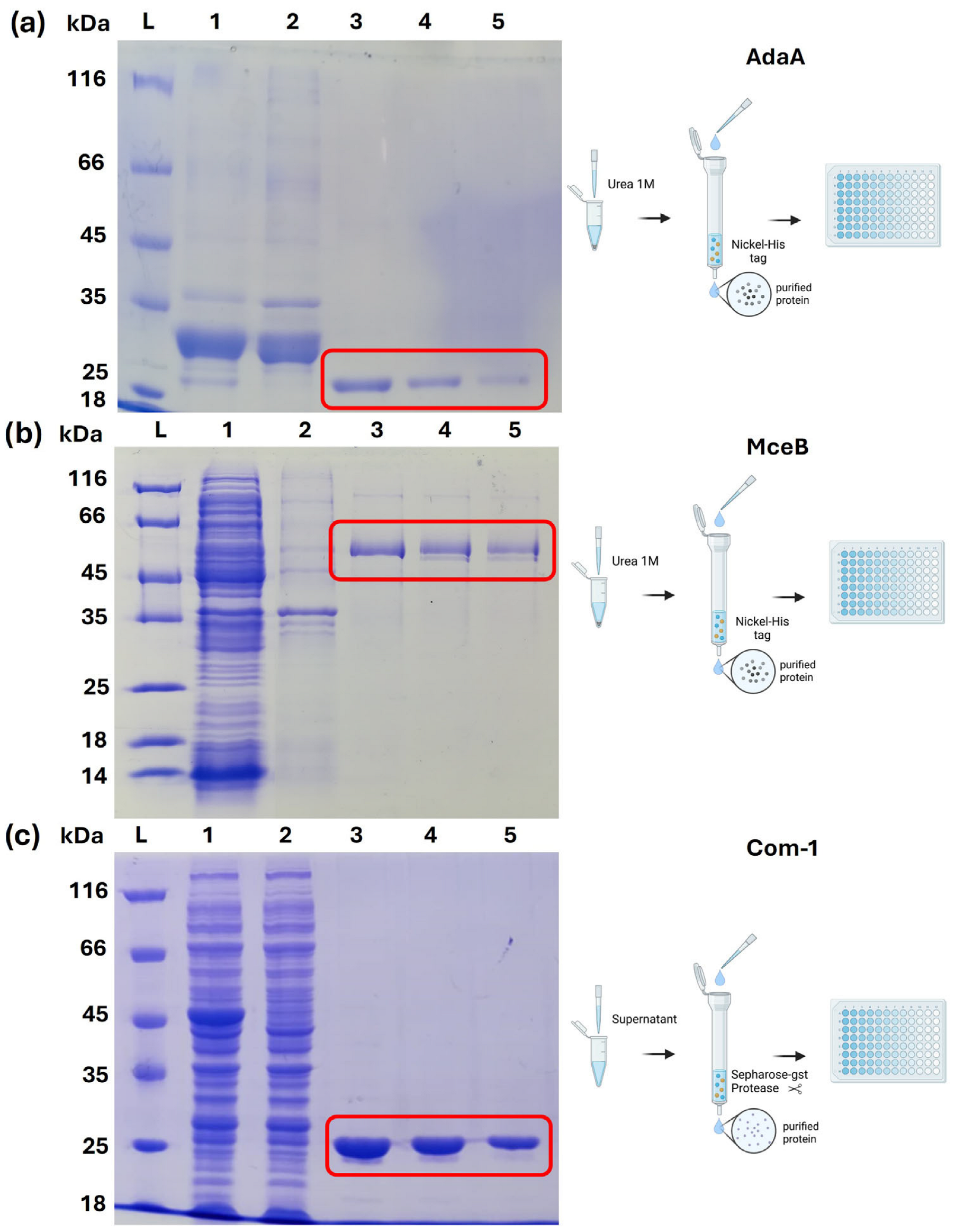
All three recombinant antigens were successfully expressed and purified in sufficient quantities for use in ELISAs. Protein concentrations, as determined by the Bradford assay, were 1.2 mg/mL for Com-1, 0.4 mg/mL for MceB, and 0.55 mg/mL for AdaA. Purification of the target proteins for ELISA preparation was successful, as evidenced by SDS-PAGE electrophoresis (Figure 1a–c), which revealed a certain level of purity despite the presence of some additional protein residues in the final eluates. For Com-1, which was expressed as a GST fusion protein, proteolytic cleavage was performed directly on-column, allowing efficient removal of the fusion tag (Figure 1c). Among the three candidates, Com-1 showed the most promising diagnostic performance, demonstrating clear reactivity with both positive and negative serum samples, and was selected for further evaluation (and tested with a larger number of serum samples). In contrast, the concordance for AdaA was poor (overall agreement of 0.54) as the antigen only reacted with 17/55 positive sera (Table 1 and Table 2). Similarly, MceB demonstrated a low concordance (0.56), largely due to a high number of false positives (37/60) (Table 1 and Table 2). In both cases, Cohen’s kappa values ranged between 0 and 0.2, revealing poor agreement with the commercial test. Com-1 achieved an overall agreement of 0.83 with a Cohen’s kappa value of 0.58 which was considered a moderate agreement. Furthermore, the Com-1-based ELISA appeared to be more specific than sensitive, as fewer false positives (28/281) than false negatives (40/120) were observed.
Figure 1.
(a) SDS-PAGE analysis of the protein fractions obtained (AdaA): L = Ladder, 1 = 1 M urea extract, 2 = 1 M urea extract post-resin adsorption, 3, 4, 5 = fractions of the eluted protein. In well 1, a band can be observed corresponding to approximately 25 kDa. The intensity of this band is reduced in well 2 due to protein adsorption to the resin. In wells 3, 4, and 5, the protein purified under denaturing conditions is observed in three different eluates (indicated in red). (b) SDS-PAGE analysis of the protein fractions obtained (MceB): L = Ladder, 1 = 1 M urea extract, 2 = 1 M urea extract post-resin adsorption, 3, 4, 5 = fractions of the eluted protein. In well 1, a band can be observed corresponding to approximately 50 kDa. The intensity of this band is reduced in well 2 due to protein adsorption to the resin. In wells 4, 5, and 6, the protein purified under denaturing conditions is observed in three different eluates (indicated in red). (c) SDS-PAGE analysis of the fraction obtained (Com-1): L = Ladder, 1 = total extract, 2 = total extract after resin adsorption, 3, 4, and 5 = purified and cleaved protein eluates. Well 1 shows overexpression of a Com1 band around 50 kDa, corresponding to the fusion protein. Protein adsorption to resin reduces the intensity of this band in wells 2. Wells 3, 4, and 5 showed pure and cleaved proteins (indicated in red). After removing GST, the protein returns to its original molecular weight of 25 kDa. This figure has been created with the support of Biorender (Biorender.com, accessed on 1 May 2025).
Table 2.
Comparison of performance of recombinant ELISAs (MceB, AdaA and Com-1) and a commercial ELISA (IDEXX) using cattle serum samples.
4. Discussion
Three immunodominant antigens of C. burnetii were produced in recombinant form in this work and were evaluated for their ability to detect specific antibodies in bovine sera. Among the candidates, Com-1 was the only antigen that yielded promising results, correctly identifying 80 out of 120 positive animals and 253 out of 281 negative animals. This antigen reached a moderate agreement (0.83) when it was compared to a commercial ELISA kit. For this reason, it was evaluated with a greater number of serum samples.
These results are consistent with a previous study in which Com-1 was produced in recombinant form, albeit with different production and purification methods. Reported diagnostic sensitivity and specificity ranged between 65 and 85% depending on the species, with better diagnostic performance in goats than in cattle [38]. A further study described the increase in diagnostic performance for the Com-1 antigen (around 83% sensitivity and 80% specificity) when it was produced synthetically and utilized in the latex agglutination test (LAT) [39].
Studies focusing on other antigens have found similar results, regardless of the test format or ruminant species. Although reported to be immunodominant in both humans and animals, antigens such as cell division coordinator CpoB (Ybgf) or dihydrolipoyllysine-residue succinyltransferase (SucB) have achieved high specificities (around 90%) but lower sensitivity (70–80%) in various ELISA formats [24,27,40]. The reported concordance values were 0.83 for SucB and 0.86 and 0.88 for Ybgf when used in double-antigen ELISA or indirect ELISA, respectively [24,41]. Currently, the most effective recombinant antigen described was heat shock protein B (HspB) with sensitivity around 80–90% and high specificity (97%) [28]. However, this antigen has only been tested in experimentally infected goats [28].
All these findings should be interpreted in the context of the complex immune response elicited by Coxiella infection. As in humans, ruminants typically generate antibodies to phase II antigens during acute infection and seroconvert to phase I antigens as the infection becomes chronic [42]. For this reason, commercial kits consist of antigen mixtures from both phases to maximize detection, although this feature can reduce specificity due to potential cross-reactivity with other pathogens. Conversely, single recombinant antigens, while potentially more specific, may lack sensitivity if they only represent one phase or stage of the immune response [27]. However, it is noteworthy that the performance of the commercial test utilized as a reference in this study was not without limitations. In the absence of a true gold standard or validated reference sera, the reliability of commercial tests has been questioned, in particular considering the high rates of false-positive and false-negative results reported in several studies [43,44,45]. This is a common issue in the evaluation of recombinant antigens for the detection of anti-Coxiella antibodies in veterinary medicine. The WOAH manual recommends ELISA as the reference test for serology, despite its limitations associated with false positives caused by cross-reactions with organisms that share Coxiella’s antigenic profile (such as Bartonella, Rickettsiae, etc.) [14].
Another explanation for the low concordance of recombinant antigens could be associated with the inability of Escherichia coli (used as the expression system) to perform post-translational modifications, such as glycosylation or methylation, that can be important for the correct epitope conformation and immune recognition [24].
Furthermore, the genetic diversity of C. burnetii strains and their association with different ruminant species and the enzootic areas may affect reactivity. For instance, more virulent strains possess the AdaA gene, while others lack it. Additionally, the AdaA gene has been identified predominantly in sheep, which could explain its low diagnostic performance in cattle sera [30].
While none of the tested antigens are yet suitable for immediate use in routine screening, Com-1 stands out as a promising candidate for further research and development. Further studies should evaluate this antigen using a larger number of well-characterized sera, including samples from experimentally infected/vaccinated animals or reference sera.
Com1 is an outer membrane protein that displays reactivity for both phases, although its specificity may be compromised by cross-reactions with some rickettsial species [34,46]. It is described in the literature as being more reactive in chronic forms, and to date, more than 15 articles have highlighted its immunoreactive properties, identifying it as a major immunodominant antigen in humans and a strong candidate for future applications in serology and vaccinology [33,36]. One human investigation showed Com-1 reacted with sera from individuals with chronic Q fever, agreeing with 92.4% (122/132) of negative clinical diagnoses and 72.2% (26/36) of positive clinical diagnoses [47]. However, veterinary research on Com-1 remains limited, and its full potential in animal diagnostics has yet to be fully explored. Improving ruminant screening tests is a veterinary priority for Q fever prevention. It is a significant concern that, despite advances in human serology (with IFA and chemiluminescent assays), which allows for fine-tuned diagnosis, differentiation of vaccinated from infected patients, determination of the infection stage, and assessment of treatment efficacy, veterinary serology still lacks reliable and standardized tools [22]. More attempts are clearly necessary, both to develop new assays and to enhance existing ones.
5. Conclusions
In this work, the potential of three recombinant antigens to detect specific anti-Coxiella antibodies in ELISA was tested using cattle serum samples. Com-1 showed the best agreement with a commercial ELISA kit and demonstrated potential as a candidate for further investigation. Although the data do not support the use of this Com-1-based ELISA as a screening test in ruminants at this time, they justify additional research into its applicability for serodiagnosis in veterinary medicine.
Supplementary Materials
The following supporting information can be downloaded at: https://www.mdpi.com/article/10.3390/antib14040107/s1, Table S1: Primers used.
Author Contributions
Conceptualization, G.F. and B.C.; methodology, G.F. and G.F.-R.; software, C.L.; validation, G.F., B.C. and C.L.; formal analysis, G.F. and L.S.; investigation, G.F. and C.N.; resources, G.F.-R. and L.S.; data curation, G.F.; writing—original draft preparation, G.F.; writing—review and editing, B.C., L.S. and G.F.-R.; visualization, C.L., C.N. and G.F.-R.; supervision, G.F.; project administration, G.F. and B.C. All authors have read and agreed to the published version of the manuscript.
Funding
Partially funded by the Recovery and Resilience Plan of the Slovak Republic 09I03-V04_00556.
Institutional Review Board Statement
Not applicable.
Informed Consent Statement
Not applicable.
Data Availability Statement
The original contributions presented in this study are included in the article/Supplementary Material. Further inquiries can be directed to the corresponding author.
Conflicts of Interest
The authors declare no conflicts of interest.
Abbreviations
The following abbreviations are used in this manuscript:
| CFT | Complement fixation test |
| ELISA | Enzyme-linked immunosorbent assay |
| IFA | Immunofluorescence Assay |
| LAT | Latex agglutination test |
| GST | Glutathione S-Transferase |
| TMB | 3,3′,5,5′-tetramethylbenzidine |
| IPTG | Isopropyl β-d-1-thiogalactopyranoside |
| WOAH | World Organisation for Animal Health |
References
- Angelakis, E.; Raoult, D. Q Fever. Vet. Microbiol. 2010, 140, 297–309. [Google Scholar] [CrossRef] [PubMed]
- Guatteo, R.; Seegers, H.; Taurel, A.F.; Joly, A.; Beaudeau, F. Prevalence of Coxiella burnetii Infection in Domestic Ruminants: A Critical Review. Vet. Microbiol. 2011, 149, 1–16. [Google Scholar] [CrossRef] [PubMed]
- Bauer, B.U.; Knittler, M.R.; Andrack, J.; Berens, C.; Campe, A.; Christiansen, B.; Fasemore, A.M.; Fischer, S.F.; Ganter, M.; Körner, S.; et al. Interdisciplinary Studies on Coxiella burnetii: From Molecular to Cellular, to Host, to One Health Research. Int. J. Med. Microbiol. 2023, 313, 151590. [Google Scholar] [CrossRef]
- Gisbert, P.; Garcia-Ispierto, I.; Quintela, L.A.; Guatteo, R. Coxiella burnetii and Reproductive Disorders in Cattle: A Systematic Review. Animals 2024, 14, 1313. [Google Scholar] [CrossRef]
- Ferrara, G.; Longobardi, C.; Pagnini, U.; Iovane, G.; D’Ausilio, F.; Montagnaro, S. Evaluation of the Phase-Specific Antibody Response in Water Buffalo (Bubalus bubalis) after Two Doses of an Inactivated Phase I Coxiella burnetii Vaccine. Vet. Immunol. Immunopathol. 2024, 277, 110840. [Google Scholar] [CrossRef]
- Zheng, Z.M.; Zadoks, R.N.; Kim, P.S.; Bosward, K.L.; Brookes, V.J. A Scoping Review of Coxiella burnetii Transmission Models in Ruminants. Prev. Vet. Med. 2026, 246, 106715. [Google Scholar] [CrossRef]
- Pexara, A.; Solomakos, N.; Govaris, A. Q Fever and Seroprevalence of Coxiella burnetii in Domestic Ruminants. Vet. Ital. 2018, 54, 265–279. [Google Scholar]
- Ferrara, G.; Pagnini, U.; Improda, E.; Iovane, G.; Montagnaro, S. Pigs in Southern Italy Are Exposed to Three Ruminant Pathogens: An Analysis of Seroprevalence and Risk Factors Analysis Study. BMC Vet. Res. 2024, 20, 183. [Google Scholar] [CrossRef]
- Ferrara, G.; Flores-Ramirez, G.; Palkovicova, K.; Ferrucci, F.; Pagnini, U.; Iovane, G.; Montagnaro, S. Serological and Molecular Survey of Q Fever in the Dog Population of the Campania Region, Southern Italy. Acta Trop. 2024, 257, 107299. [Google Scholar] [CrossRef]
- Epelboin, L.; De Souza Ribeiro Mioni, M.; Couesnon, A.; Saout, M.; Guilloton, E.; Omar, S.; De Santi, V.P.; Davoust, B.; Marié, J.L.; Lavergne, A.; et al. Coxiella burnetii Infection in Livestock, Pets, Wildlife, and Ticks in Latin America and the Caribbean: A Comprehensive Review of the Literature. Curr. Trop. Med. Rep. 2023, 10, 94–137. [Google Scholar] [CrossRef]
- Ullah, Q.; Jamil, T.; Saqib, M.; Iqbal, M.; Neubauer, H. Q Fever—A Neglected Zoonosis. Microorganisms 2022, 10, 1530. [Google Scholar] [CrossRef]
- Eldin, C.; Mélenotte, C.; Mediannikov, O.; Ghigo, E.; Million, M.; Edouard, S.; Mege, J.L.; Maurin, M.; Raoult, D. From Q Fever to Coxiella burnetii Infection: A Paradigm Change. Clin. Microbiol. Rev. 2017, 30, 115–190. [Google Scholar] [CrossRef]
- Toledo-Perona, R.; Contreras, A.; Gomis, J.; Quereda, J.J.; García-Galán, A.; Sánchez, A.; Gómez-Martín, Á. Controlling Coxiella burnetii in Naturally Infected Sheep, Goats and Cows, and Public Health Implications: A Scoping Review. Front. Vet. Sci. 2024, 11, 1321553. [Google Scholar] [CrossRef]
- Gisbert, P.; Hurtado, A.; Guatteo, R. Efficacy and Safety of an Inactivated Phase I Coxiella burnetii Vaccine to Control Q Fever in Ruminants: A Systematic Review. Animals 2024, 14, 1484. [Google Scholar] [CrossRef]
- WOAH. Manual of Diagnostic Tests and Vaccines for Terrestrial Animals, 13th edition. World Organisation for Animal Health (WOAH). 2024. Available online: https://www.woah.org/fileadmin/Home/eng/Health_standards/tahm/A_summry.htm (accessed on 29 May 2025).
- García-Pérez, A.L.; Zendoia, I.I.; Ferrer, D.; Barandika, J.F.; Ramos, C.; Vera, R.; Martí, T.; Pujol, A.; Cevidanes, A.; Hurtado, A. Combination of Serology and PCR Analysis of Environmental Samples to Assess Coxiella burnetii Infection Status in Small Ruminant Farms. Appl. Environ. Microbiol. 2025, 91, e00931-25. [Google Scholar] [CrossRef]
- Bauer, A.E.; Hubbard, K.R.A.; Johnson, A.J.; Messick, J.B.; Weng, H.Y.; Pogranichniy, R.M. A Cross Sectional Study Evaluating the Prevalence of Coxiella burnetii, Potential Risk Factors for Infection, and Agreement between Diagnostic Methods in Goats in Indiana. Prev. Vet. Med. 2016, 126, 131–137. [Google Scholar] [CrossRef]
- Szymańska-Czerwińska, M.; Niemczuk, K.; Jodełko, A. Evaluation of QPCR and Phase I and II Antibodies for Detection of Coxiella burnetii Infection in Cattle. Res. Vet. Sci. 2016, 108, 68–70. [Google Scholar] [CrossRef]
- Walraph, J.; Zoche-Golob, V.; Weber, J.; Freick, M. Decline of Antibody Response in Indirect ELISA Tests during the Periparturient Period Caused Diagnostic Gaps in Coxiella burnetii and BVDV Serology in Pluriparous Cows within a Holstein Dairy Herd. Res. Vet. Sci. 2018, 118, 91–96. [Google Scholar] [CrossRef] [PubMed]
- Horigan, M.W.; Bell, M.M.; Pollard, T.R.; Sayers, A.R.; Pritchard, G.C. Q Fever Diagnosis in Domestic Ruminants: Comparison between Complement Fixation and Commercial Enzyme-Linked Immunosorbent Assays. J. Vet. Diagn. Investig. 2011, 23, 924–931. [Google Scholar] [CrossRef] [PubMed]
- Wood, C.; Muleme, M.; Tan, T.; Bosward, K.; Gibson, J.; Alawneh, J.; McGowan, M.; Barnes, T.S.; Stenos, J.; Perkins, N.; et al. Validation of an Indirect Immunofluorescence Assay (IFA)for the Detection of IgG Antibodies against Coxiella burnetii in Bovine Serum. Prev. Vet. Med. 2019, 169, 104698. [Google Scholar] [CrossRef] [PubMed]
- Sahu, R.; Rawool, D.B.; Vinod, V.K.; Malik, S.V.S.; Barbuddhe, S.B. Current Approaches for the Detection of Coxiella burnetii Infection in Humans and Animals. J. Microbiol. Methods 2020, 179, 106087. [Google Scholar] [CrossRef]
- Emery, M.P.; Ostlund, E.N.; Schmitt, B.J. Comparison of Q Fever Serology Methods in Cattle, Goats, and Sheep. J. Vet. Diagn. Investig. 2012, 24, 379–382. [Google Scholar] [CrossRef] [PubMed]
- Ferrara, G.; Colitti, B.; Pagnini, U.; Iovane, G.; Rosati, S.; Montagnaro, S. Characterization of Recombinant Ybgf Protein for the Detection of Coxiella Antibodies in Ruminants. J. Vet. Diagn. Investig. 2022, 34, 646–653. [Google Scholar] [CrossRef] [PubMed]
- Paul, S.; Toft, N.; Agerholm, J.S.; Christoffersen, A.B.; Agger, J.F. Bayesian Estimation of Sensitivity and Specificity of Coxiella burnetii Antibody ELISA Tests in Bovine Blood and Milk. Prev. Vet. Med. 2013, 109, 258–263. [Google Scholar] [CrossRef]
- Hogerwerf, L.; Koop, G.; Klinkenberg, D.; Roest, H.I.J.; Vellema, P.; Nielen, M. Test and Cull of High Risk Coxiella burnetii Infected Pregnant Dairy Goats Is Not Feasible Due to Poor Test Performance. Vet. J. 2014, 200, 343–345. [Google Scholar] [CrossRef]
- Ferrara, G.; Colitti, B.; Flores-Ramirez, G.; Pagnini, U.; Iovane, G.; Rosati, S.; Montagnaro, S. Detection of Coxiella Antibodies in Ruminants Using a SucB Recombinant Antigen. J. Vet. Diagn. Investig. 2023, 35, 721–726. [Google Scholar] [CrossRef] [PubMed]
- Fernandes, I.; Rousset, E.; Dufour, P.; Sidi-Boumedine, K.; Cupo, A.; Thiéry, R.; Duquesne, V. Evaluation of the Recombinant Heat Shock Protein B (HspB) of Coxiella burnetii as a Potential Antigen for Immunodiagnostic of Q Fever in Goats. Vet. Microbiol. 2009, 134, 300–304. [Google Scholar] [CrossRef]
- Miller, H.K.; Kersh, G.J. Analysis of Recombinant Proteins for Q Fever Diagnostics. Sci. Rep. 2020, 10, 20934. [Google Scholar] [CrossRef]
- Sam, G.; Chen, S.; Plain, K.; Marsh, I.; Westman, M.E.; Stenos, J.; Graves, S.R.; Rehm, B.H.A. Diphtheria Toxoid Particles as Q Fever Vaccine. Adv. Funct. Mater. 2024, 34, 2309256. [Google Scholar] [CrossRef]
- Bach, E.; Fitzgerald, S.F.; Williams-MacDonald, S.E.; Mitchell, M.; Golde, W.T.; Longbottom, D.; Nisbet, A.J.; Dinkla, A.; Sullivan, E.; Pinapati, R.S.; et al. Genome-Wide Epitope Mapping across Multiple Host Species Reveals Significant Diversity in Antibody Responses to Coxiella burnetii Vaccination and Infection. Front. Immunol. 2023, 14, 1257722. [Google Scholar] [CrossRef]
- Xiong, X.; Wang, X.; Wen, B.; Graves, S.; Stenos, J. Potential Serodiagnostic Markers for Q Fever Identified in Coxiella burnetii by Immunoproteomic and Protein Microarray Approaches. BMC Microbiol. 2012, 12, 35. [Google Scholar] [CrossRef] [PubMed]
- Gerlach, C.; Škultéty, L.; Henning, K.; Neubauer, H.; Mertens, K. Coxiella burnetii Immunogenic Proteins as a Basis for New Q Fever Diagnostic and Vaccine Development. Acta Virol. 2017, 61, 377–390. [Google Scholar] [CrossRef]
- Beare, P.A.; Chen, C.; Bouman, T.; Pablo, J.; Unal, B.; Cockrell, D.C.; Brown, W.C.; Barbian, K.D.; Porcella, S.F.; Samuel, J.E.; et al. Candidate Antigens for Q Fever Serodiagnosis Revealed by Immunoscreening of a Coxiella burnetii Protein Microarray. Clin. Vaccine Immunol. 2008, 15, 1771–1779. [Google Scholar] [CrossRef]
- Jiao, J.; Xiong, X.; Qi, Y.; Gong, W.; Duan, C.; Yang, X.; Wen, B. Serological Characterization of Surface-Exposed Proteins of Coxiella burnetii. Microbiology 2014, 160, 2718–2731. [Google Scholar] [CrossRef]
- Vigil, A.; Ortega, R.; Nakajima-Sasaki, R.; Pablo, J.; Molina, D.M.; Chao, C.C.; Chen, H.W.; Ching, W.M.; Felgner, P.L. Genome-Wide Profiling of Humoral Immune Response to Coxiella burnetii Infection by Protein Microarray. Proteomics 2010, 10, 2259–2269. [Google Scholar] [CrossRef] [PubMed]
- Palkovicová, K.; Flores-Ramírez, G.; Quevedo-Diaz, M.; Csicsay, F.; Skultety, L. Innovative Antigens for More Accurate Diagnosis of Q Fever. J. Microbiol. Methods 2025, 232–234, 107106. [Google Scholar] [CrossRef]
- Stellfeld, M.; Gerlach, C.; Richter, I.G.; Miethe, P.; Fahlbusch, D.; Polley, B.; Sting, R.; Pfeffer, M.; Neubauer, H.; Mertens-Scholz, K. Evaluation of the Diagnostic Potential of Recombinant Coxiella burnetii Com1 in an Elisa for the Diagnosis of q Fever in Sheep, Goats and Cattle. Microorganisms 2020, 8, 1235. [Google Scholar] [CrossRef]
- Yadav, J.P.; Malik, S.V.S.; Dhaka, P.; Kumar, M.; Sirsant, B.; Gourkhede, D.; Barbuddhe, S.B.; Rawool, D.B. Comparison of Two New In-House Latex Agglutination Tests (LATs), Based on the DnaK and Com1 Synthetic Peptides of Coxiella burnetii, with a Commercial Indirect-ELISA, for Sero-Screening of Coxiellosis in Bovines. J. Microbiol. Methods 2020, 170, 105859. [Google Scholar] [CrossRef]
- Zhang, G.; Kiss, K.; Seshadri, R.; Hendrix, L.R.; Samuel, J.E. Identification and Cloning of Immunodominant Antigens of Coxiella burnetii. Infect. Immun. 2004, 72, 844–852. [Google Scholar] [CrossRef]
- Ferrara, G.; Colitti, B.; Gabriela, F.R.; Rosati, S.; Iovane, G.; Pagnini, U.; Montagnaro, S. Efficiency of Recombinant Ybgf in a Double Antigen-ELISA for the Detection of Coxiella Antibodies in Ruminants. Vet. Anim. Sci. 2024, 25, 100366. [Google Scholar] [CrossRef] [PubMed]
- Bauer, B.U.; Schwecht, K.M.; Jahnke, R.; Matthiesen, S.; Ganter, M.; Knittler, M.R. Humoral and Cellular Immune Responses in Sheep Following Administration of Different Doses of an Inactivated Phase I Vaccine against Coxiella burnetii. Vaccine 2023, 41, 4798–4807. [Google Scholar] [CrossRef]
- Lucchese, L.; Capello, K.; Barberio, A.; Zuliani, F.; Stegeman, A.; Ceglie, L.; Guerrini, E.; Marangon, S.; Natale, A. IFAT and ELISA Phase I/Phase II as Tools for the Identification of Q Fever Chronic Milk Shedders in Cattle. Vet. Microbiol. 2015, 179, 102–108. [Google Scholar] [CrossRef] [PubMed]
- Lurier, T.; Rousset, E.; Gasqui, P.; Sala, C.; Claustre, C.; Abrial, D.; Dufour, P.; de Crémoux, R.; Gache, K.; Delignette-Muller, M.L.; et al. Evaluation Using Latent Class Models of the Diagnostic Performances of Three ELISA Tests Commercialized for the Serological Diagnosis of Coxiella burnetii Infection in Domestic Ruminants. Vet. Res. 2021, 52, 56. [Google Scholar] [CrossRef] [PubMed]
- Rivière, L.; Rousset, E.; Jourdain, E.; Delignette-Muller, M.L.; Lurier, T. Harmonisation of the Diagnostic Performances of Serological ELISA Tests for C. Burnetii in Ruminants in the Absence of a Gold Standard: Optimal Cut-Offs and Performances Reassessment. Prev. Vet. Med. 2025, 239, 106509. [Google Scholar] [CrossRef] [PubMed]
- Deringer, J.R.; Chen, C.; Samuel, J.E.; Brown, W.C. Immunoreactive Coxiella burnetii Nine Mile Proteins Separated by 2D Electrophoresis and Identified by Tandem Mass Spectrometry. Microbiology 2011, 157, 526–542. [Google Scholar] [CrossRef]
- Vranakis, I.; Mathioudaki, E.; Kokkini, S.; Psaroulaki, A. Com1 as a Promising Protein for the Differential Diagnosis of the Two Forms of q Fever. Pathogens 2019, 8, 242. [Google Scholar] [CrossRef]
Disclaimer/Publisher’s Note: The statements, opinions and data contained in all publications are solely those of the individual author(s) and contributor(s) and not of MDPI and/or the editor(s). MDPI and/or the editor(s) disclaim responsibility for any injury to people or property resulting from any ideas, methods, instructions or products referred to in the content. |
© 2025 by the authors. Licensee MDPI, Basel, Switzerland. This article is an open access article distributed under the terms and conditions of the Creative Commons Attribution (CC BY) license (https://creativecommons.org/licenses/by/4.0/).