Article

Phosphorus Removal from Real Wastewater Using Biochar Derived from Sewage Sludge Pretreated with Zero-Valent Iron Nanoparticles in a Fixed-Bed Column


by
Aušra Mažeikienė
*,
Tomas Januševičius
,
Luiza Usevičiūtė
,
Vaidotas Danila
,
Mantas Pranskevičius
and
Eglė Marčiulaitienė
Research Institute of Environmental Protection, Vilnius Gediminas Technical University, Sauletekio Ave. 11, 10223 Vilnius, Lithuania
*
Author to whom correspondence should be addressed.
Water 2026, 18(8), 930; https://doi.org/10.3390/w18080930
Submission received: 11 March 2026 / Revised: 3 April 2026 / Accepted: 9 April 2026 / Published: 13 April 2026

Highlights

What are the main findings?
  • Sewage sludge biochar (600 °C) contains high amounts of Ca (8–12%) and Fe (4–5%).
  • Adding 3% (w/w TS) nZVI to sewage sludge before anaerobic digestion increased the PO4-P removal of the resulting biochar by 7%.
  • The PO4-P retention capacity in the columns was three times higher than the sorption capacity observed in the batch experiment.
  • The maximum achieved phosphorus retention capacity was 7.8 mg/g.
What is the implication of the main finding?
  • Biochar derived from sewage sludge is suitable for the removal of PO4-P from real wastewater.
  • The HLR (1 m/h) and EBCT (0.5 h) allow for a PO4-P removal efficiency 80–90%.
  • In columns, PO4-P is accumulated via adsorption, bioaccumulation, and chemical precipitation.

Abstract

The aim of this study was to investigate the ability of sewage sludge-derived biochar to remove PO4-P from real biologically treated wastewater. Biochar was produced via the pyrolysis of anaerobically digested sewage sludge pretreated with nanoscale zero-valent iron (nZVI) at concentrations of 3%, 1.5%, and 0.5% (w/w, based on total solids). A sample without nZVI addition was used as a control. The properties of biochar samples were analyzed, including elemental composition, specific surface area, and pore size. PO4-P removal was evaluated using both batch adsorption and column experiments. The highest adsorption capacity determined in the batch experiment was 2.5 mg/g. When wastewater was passed through columns packed with 0.3–0.6 mm biochar particles at a hydraulic loading rate of 1 m/h, a 3-fold-higher phosphorus retention capacity was obtained in the range of 7.26–7.82 mg/g. The column containing biochar derived from sewage sludge with 3% nZVI accumulated 7% more PO4-P than the biochar without nZVI. All columns effectively removed phosphates from wastewater (efficiency > 80%) due to the chemical composition of biochar, which mainly contained Fe and Ca elements. In contrast to the batch experiment, the columns were subject to the biological sorption of phosphates via microorganisms, physical retention between particles, and the formation of precipitates on the surface of a column.

1. Introduction

Using standard technological schemes, urban wastewater treatment plants produce two main waste products: primary and secondary sludge. These byproducts must be managed and utilized as efficiently as possible from both an economic and environmental perspective. Today, sewage sludge (SS) disposal is an expensive process; sludge management technologies must prioritize the maximum possible reduction in the final waste volume [1]. Additionally, the direct agricultural use of SS remains controversial [2,3]; therefore, alternative solutions are being sought, including composting, anaerobic digestion (AD), and thermochemical conversion. One of the most effective ways to treat SS is AD [4]. Typically, a mixture of dewatered primary and secondary SS is digested in anaerobic digesters, resulting in the release of biogas. To maximize biogas production and methane concentration during the digestion process, various additives are used [5], with nanoscale zero-valent iron (nZVI) representing a promising one [6,7]. Additives are introduced prior to the sludge digestion process and positively influence the activity of anaerobic microorganisms during the treatment [8,9,10]. Following digestion, iron additives accumulate in the digested sludge. Since organic matter is not completely degraded during AD, approximately 40% of the initial sludge dry matter typically remains in the resulting digestate [11]. The management of these residues is essential, and the conversion of digested solids into biochar via pyrolysis represents a promising treatment approach.
Due to their porosity and surface reactivity, biochars are extensively investigated as adsorbents for the removal of pollutants from wastewater [12,13]. In line with the circular economy, sewage sludge-derived biochars can be utilized for wastewater treatment [14]. These sorbents are cost-effective and capable of removing metals, organic compounds, and nutrients from wastewater [15,16]. Typically, sorbents are used in the final stage of the wastewater treatment process, once the majority (>95%) of organic matter and suspended solids has already been removed, thereby reducing the risk of clogging adsorbent-filled filters [17]. Organic matter and suspended solids are effectively removed through primary and biological treatment stages. However, after biological treatment, wastewater discharged into natural water bodies often contains residual nitrogen and phosphorus (P) compounds. Among these, orthophosphates (PO4-P) are particularly hazardous due to the eutrophication they induce [18]. At a sufficiently high pyrolysis temperature (600–700 °C), biochar derived from SS can effectively sorb PO4-P without contaminating the wastewater itself. According to literature data, the PO4-P adsorption capacity of unmodified biochar is low (1–5 mg/g) due to its negative surface charge and limited number of functional groups [19,20]. The PO4-P adsorption capacity of biochar can be significantly enhanced (by 10–20 times) through modification with lanthanum, magnesium, iron, or aluminum [20,21,22,23]. Biochar derived from SS exhibits a higher PO4-P sorption capacity than lignocellulosic biochar due to the naturally occurring metal oxides it contains. In addition, modifying this biochar with iron increases its adsorption capacity for phosphates [24,25].
There is still a lack of research on the use of sewage sludge-derived biochar for the removal of PO4-P from wastewater, particularly studies involving the treatment of real wastewater that has already undergone biological treatment. However, several studies have already documented and established specific nZVI dosages tested during the AD of SS to accelerate the release of biogas and increase its methane content [6]. There are no data regarding whether biochar derived from sludge previously treated with nZVI during the digestion process will exhibit superior sorption properties or more effectively remove P from filtered wastewater compared to biochar produced without nZVI. The authors of this study aimed to evaluate the properties of SS-derived biochar within the context of the circular economy, with a focus on the following topics: wastewater treatment, SS accumulation, AD with and without nZVI, the pyrolysis of the resulting digestate (600 °C), and the subsequent application of the produced biochar for PO4-P removal from wastewater.
This research evaluates PO4-P removal from real wastewater using biochar derived from SS that was pretreated with 0.5, 1.5, and 3% nZVI prior to AD. The batch study focuses on the reaction time, while the column study accounts for the initial PO4-P concentration, hydraulic loading rate, and biochar fraction size. It was hypothesized that the nanoparticles incorporated into SS prior to digestion and retained within the digestate would enhance the batch and column adsorption capacities of the resulting biochar and that an optimal nZVI dosage for the most effective removal of PO4-P from real wastewater would be determined.

2. Materials and Methods

2.1. Feedstock Collection and AD Process

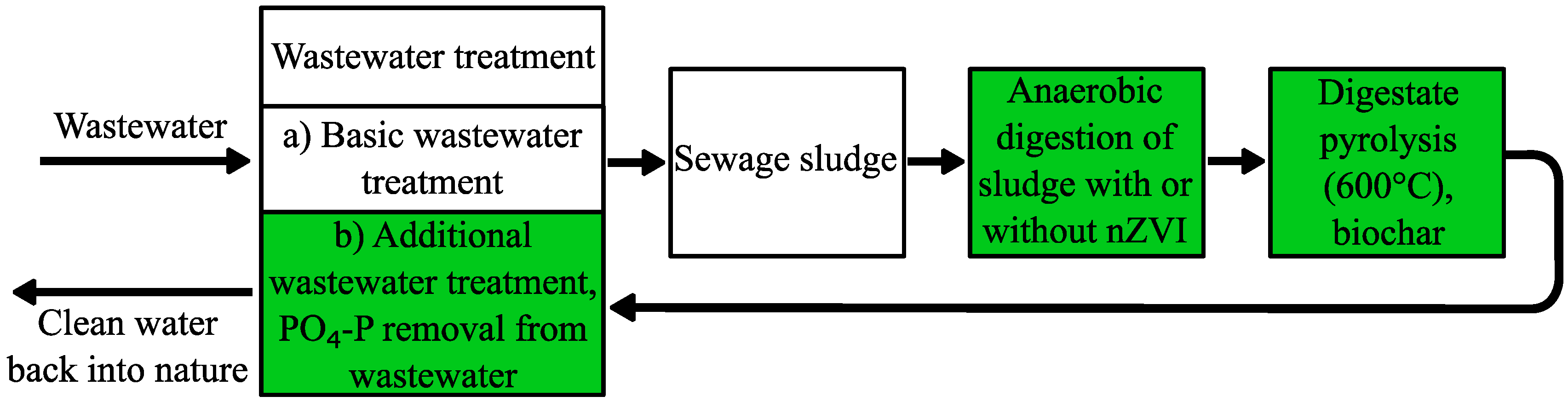
This study is a continuation of previous research, which examined the AD of nZVI-pretreated SS and its impact on CH4 yield [26]. In contrast, this article focuses on the properties of the biochar derived after digestion and its application for PO4-P removal from wastewater. Thus, a broader part of the circular process is examined, as shown in Figure 1.
A mixture of primary and secondary sludge obtained from a WWTP in Lithuania was digested in four bench-scale bioreactors. Before digestion, nZVI was added to three bioreactors to achieve final concentrations of 0.5%, 1.5%, and 3.0%. The fourth bioreactor served as a control, in which sludge was digested without the addition of nZVI particles. A study previously conducted by the same authors [26] evaluated the influence of nZVI dosage on biogas yield and its methane concentration. Sludge digestion was carried out for 41 days at 37 ± 1 °C, followed by the pyrolysis of digested sludge at 600 °C.

2.2. Production and Fractionation of Sewage Sludge Biochar

The pyrolysis temperature for biochar production was selected based on a previous study of SS-derived biochar [27]. The pyrolysis of the SS digestate, including both the control and nZVI-pretreated samples (at dosages of 0.5–3%), was performed in a laboratory-scale muffle furnace (E5CC-T, SNOL, Utena, Lithuania). Digested sludge samples (300 g) were wrapped in a double layer of aluminum foil and transferred to the furnace. Pyrolysis was carried out under oxygen-limited conditions at 600 ± 5 °C with a residence time of two hours. The biochar yield was determined by comparing the mass of the digestate before and after pyrolysis, resulting in values ranging from 57% to 63%. The resulting biochar was mechanically crushed and sieved to obtain particle size fractions of <0.3, 0.3–0.6, and 1.0–1.6 mm for its characterization and application in column studies.

2.3. Real Wastewater Collection and Characterization

Wastewater for the experiments was sourced from real-scale, individual, low-flow WWTPs. A quality analysis of the collected wastewater samples was performed in the laboratory. The initial pH, temperature, suspended solids, ammonium nitrogen (NH4-N), nitrate nitrogen (NO3-N), and PO4-P parameters of the wastewater were measured.
NO3-N, NH4-N, and PO4-P concentrations were determined using Merck Spectroquant® (Merck KGaA, Darmstadt, Germany) test kits. The detection ranges were 0.10–25.0 mg/L (0.4–110.7 mg/L NO3) for NO3-N, 0.01–3.0 mg/L or 2.0–150 mg/L for NH4-N, and 0.50–30.0 mg/L for PO4-P. Absorbance measurements were performed using a Genesys 10 UV–Vis spectrophotometer (Thermo Fisher Scientific, Waltham, MA, USA) with 10 mm Hellma cuvettes at wavelengths of 340 nm (after 10 min), 690 nm, and 410 nm, respectively. The conversion factors used for NO3-N, NH4-N, and PO4-P determination were 19.6, 27.6, and 18.0, respectively.
Ammonium and nitrate nitrogen were determined in the initial wastewater samples to more fully characterize the wastewater composition and to assess the possible influence of competing ions on phosphorus sorption. Since their concentrations were low, the concentrations of these compounds in the filtrates were not further investigated.
Wastewater temperature was measured using a SevenGo pro SG6 meter (Mettler To-ledo, Greifensee, Switzerland). The pH was determined potentiometrically according to the ISO 10523:2008 standard [28] using a WTW pH 330i meter. For quality control, the device was calibrated using Hamilton (Bonaduz, Switzerland)-certified reference buffer solutions with pH values of 7.00 ± 0.01 and 9.21 ± 0.02. The concentration of suspended solids was determined using the gravimetric method by filtering the wastewater through a glass fiber filter (LAND 46-2007) and weighing them with a KERN (Bolingen, Germany) ABJ 220-4M electronic analytical balance. The initial parameters of the wastewater used for the experiments are presented in Table 1.
Table 1 shows that all samples of the collected biologically treated wastewater contained ammonium, nitrate nitrogen, and phosphates. The wastewater pH was near-neutral (7.44–7.63). PO4-P concentrations in all samples exceeded the most stringent limit for treated wastewater (1 mg/L), as specified in the Lithuanian Wastewater Management Regulation [29]. The emission limit value for phosphorus in small-scale treatment plants (flow rate up to 5 m3/d) is 5 mg/L, which was exceeded in all wastewater samples. The concentration of suspended solids in the wastewater was low, ranging from 5.7 to 16.2 mg/L, which is advantageous for tertiary filtration treatments, as it minimizes the risk of filter medium clogging [18].

2.4. Characterization Techniques for Biochars

The pyrolyzed sludge samples were prepared for X-ray fluorescence (XRF) analysis in accordance with ISO 5667-13:2011 [30], ISO 11464:2006 [31], EN 15309:2007 [32], and ISO 11466:1995 [33]. The samples were dried at 40 °C, ground, sieved to <2 mm, and pressed into pellets. The elemental composition of the biochar samples was determined using an XRF spectrometer (ZSX Primus IV, Rigaku Corp., Tokyo, Japan). The device was operated under vacuum; the spectrometer tube power was maintained below 4 kW. Adequate counting times were assigned to each element to ensure a high signal-to-noise ratio, with acquisition times ranging from 20 to 100 s for heavy metals. For trace elements (e.g., Cd), extended counting times were employed to minimize statistical error and improve precision. Heavy metals in SS were measured multiple times until consistent results were obtained under repeatability conditions (e.g., relative standard deviation < 5%). The following chemical elements were measured: Ba, Cu, Mn, Ni, Ca, Fe, K, P, S, Ti, and Zn.
The textural properties of the biochar samples were measured using a surface area and pore size analyzer (Sync 440A, 3P Instruments, Odelzhausen, Germany), and they included the specific surface area, total pore volume, and average pore size. Biochar morphology and local elemental composition were characterized via scanning electron microscopy equipped with an energy-dispersive X-ray spectrometer (SEM-EDS) (FlexSEM 1000 II, Hitachi High-Tech Corporation, Hitachinaka, Japan). The accumulated surface sediments and spent biochar fillers from the columns were analyzed using the aforementioned methods. Prior to analysis, samples were dried at 20 °C for 24 h. The surface functional groups of the biochar samples were identified via Fourier transform infrared (FTIR) spectroscopy across a spectral range between the 4000 and 400 cm−1 wavenumbers (Invenio R, Bruker, Billerica, MA, USA) [8]. The point of zero charge (pHPZC) of the optimal biochar was determined using the pH drift method by Chandi et al. [34]. pH drift experiments were conducted by mixing 0.1 g of the sample with 50 mL of 0.1 M NaCl. Prior to sample addition, the initial pH of the solution was adjusted from 1 to 12 using HCl and NaOH at concentrations of 0.1 M or 1 M. After 24 h of rotary shaking, the final pH values were determined.

2.5. Batch Adsorption Kinetics

To evaluate adsorption kinetics (dependence of adsorption capacity, qt, on contact time), a 0.3–0.6 mm powder fraction of ADSSBC-600 (Shanghai Yiheng Scientific Instrument Co., Ltd., Shanghai, China) with varying nZVI dosages was prepared for batch experiments. The experimental procedure followed the methods described by Biswas et al. [35] and Xu et al. [36]. Batch adsorption tests were conducted in 100 mL glass bottles by adding 0.2 g of biochar to 50 mL of real biologically treated sewage. The initial PO4-P concentration was adjusted to 25.5 mg/L. The samples were agitated using a rotary mixer at a rotational speed of 12 rpm for predetermined contact times (0.25, 0.5, 1, 3, and 23 h) (Rotoshake RS12, Gerhardt GmbH, Königswinter, Germany). Following agitation, the residual PO4-P concentration in the supernatant was determined. Equation (3) was used to calculate the biochar adsorption capacity at different times t (qt) [37]:
qt = (C0Ct) × V/m,
where C0 and Ct are, respectively, the initial and final concentrations of phosphates, mg/L; V is the volume of the phosphate solution, L; and m is the mass of the adsorbent, g.
The adsorption kinetics were analyzed using nonlinear pseudo-first-order (PFO), pseudo-second-order (PSO), and intraparticle diffusion (IPD) models to elucidate the reaction mechanism and distinguish between physisorption and chemisorption processes [36]. The equations for the applied models are provided in the Supplementary Materials (Table S1 [37,38]).

2.6. Experimental Set-Up for Phosphate Removal in Fixed-Bed Columns

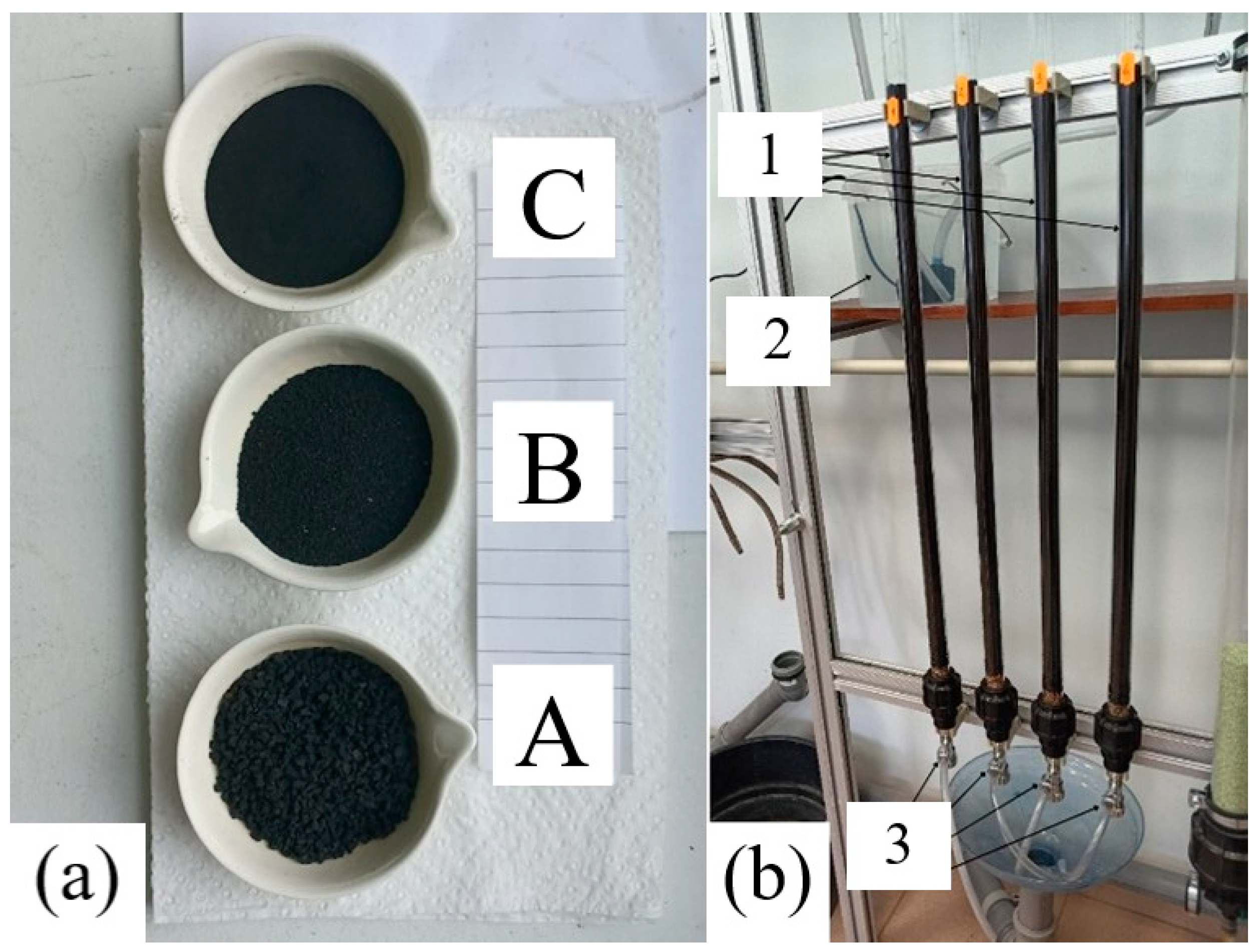
Studies were carried out using a set-up of 4 fixed-bed columns with a diameter of 22 mm (Figure 2). The columns were filled with pyrolyzed sludge containing different concentrations of nZVI: 3%, 1.5%, 0.5%, and 0% (control). At the bottom of the columns, there was a 2–3 cm supporting layer of quartz sand. The filtration experiments were not continuous; instead, they were conducted for 5–6 h each day, then paused and resumed the following day. Initially, a preliminary study was conducted. A solution was prepared by dissolving K2HPO4 salt in distilled water to achieve a PO4-P concentration of 5–9 mg/L, which is similar to that of real wastewater after biological treatment. The solution was filtered through four columns at a hydraulic loading rate (HLR) of 1.0 ± 0.1 m/h or 2.0 ± 0.1 m/h. The empty bed contact time (EBCT) ranged from 0.1 ± 0.05 h to 0.5 ± 0.05 h. The bed height, column packing mass, and biochar fraction sizes for the individual experiments are presented in Table 2.
The wastewater was stored in a reservoir, from which it was fed into four columns at a constant flow rate using a peristaltic pump. The flow rate (and HLR) was regulated by valves positioned at the base of the columns. Filtration tests were conducted by passing wastewater through all columns at two different flow rates: a lower (6 ± 1 mL/min) and higher rate (12 ± 1 mL/min). The HLR (v, m/h) was calculated using the following formula:
v = Q/A,
where v is the hydraulic loading rate, m/h; Q is the volumetric flow rate, m3/h; and A is the cross-sectional area of the column, m2.
The PO4-P removal efficiency (%) was calculated using the following formula:
E(t) = ((Cin(t) − Cout(t))/Cin(t)) × 100,
where E(t) is the PO4-P removal efficiency, %, and Cin and Cout are the orthophosphate concentrations before and after treatment, respectively, mg/L.
The total amount of phosphorus retained in the adsorbent bed was calculated using the following formula [39]:
M p =   Ʃ i ( C i n , i C o u t , i ) × V i ,
where MP is the accumulated phosphorus content, mg; Cin and Cout are the influent and effluent orthophosphate concentrations, mg/L; Vi is the volume of the i-th collected fraction of the solution, L.
The sorption capacity of the biochar (mg P/g) was calculated using the following formula:
q = MP/mf,
where MP is the accumulated phosphorus content, mg P/g, and mf is the mass of biochar, g.
Orthophosphate concentrations in raw domestic wastewater are commonly found to be up to 10 mg/L. Following biological treatment, PO4-P concentrations can occasionally reach 30 mg/L or higher if the process is disrupted. Therefore, this study examines wastewater with relatively low PO4-P levels (up to 30 mg/L). To achieve this range, real wastewater (initially 10 mg/L) was spiked with K2HPO4 salt to obtain final concentrations between 20 and 30 mg/L. A batch kinetic study was conducted using wastewater with a PO4-P concentration of 25.5 mg/L, while the column study employed PO4-P concentrations ranging from approximately 10 mg/L (real) to 30 mg/L (spiked).

2.7. Microscopic Analysis

The precipitate formed on the surface of the columns was collected with a pipette. The samples were searched for activated sludge microorganisms. The methods used are described as follows. Fungi and lactophenol blue: The microscopic observation of mycelial morphology involves preparing a slide from fresh fungal material mixed with lactophenol blue between the slide and the coverslip and then observing it under a microscope. Bacteria and yeast: The microscopic examination of bacteria and yeast involves preparing a slide from a fresh culture mixed with water, staining it using the Gram method, and then examining it under a microscope. A Nikon ECLIPSE E100 (Nikon Corporation, Tokyo, Japan) biological light microscope was used for the observation and imaging of microorganisms.

2.8. Statistical Analysis

All physical and chemical analyses, as well as adsorption experiments, were performed in triplicate; the results are presented as the mean value ± standard deviation (SD). Data processing and graphical illustrations were performed using Microsoft Excel (2016, Microsoft Corporation, Redmond, WA, USA), while kinetic modeling was conducted with Origin software (version 2019b, OriginLab Corporation, Northampton, MA, USA).

3. Results

3.1. Elemental Composition of Sewage Sludge Biochar Samples

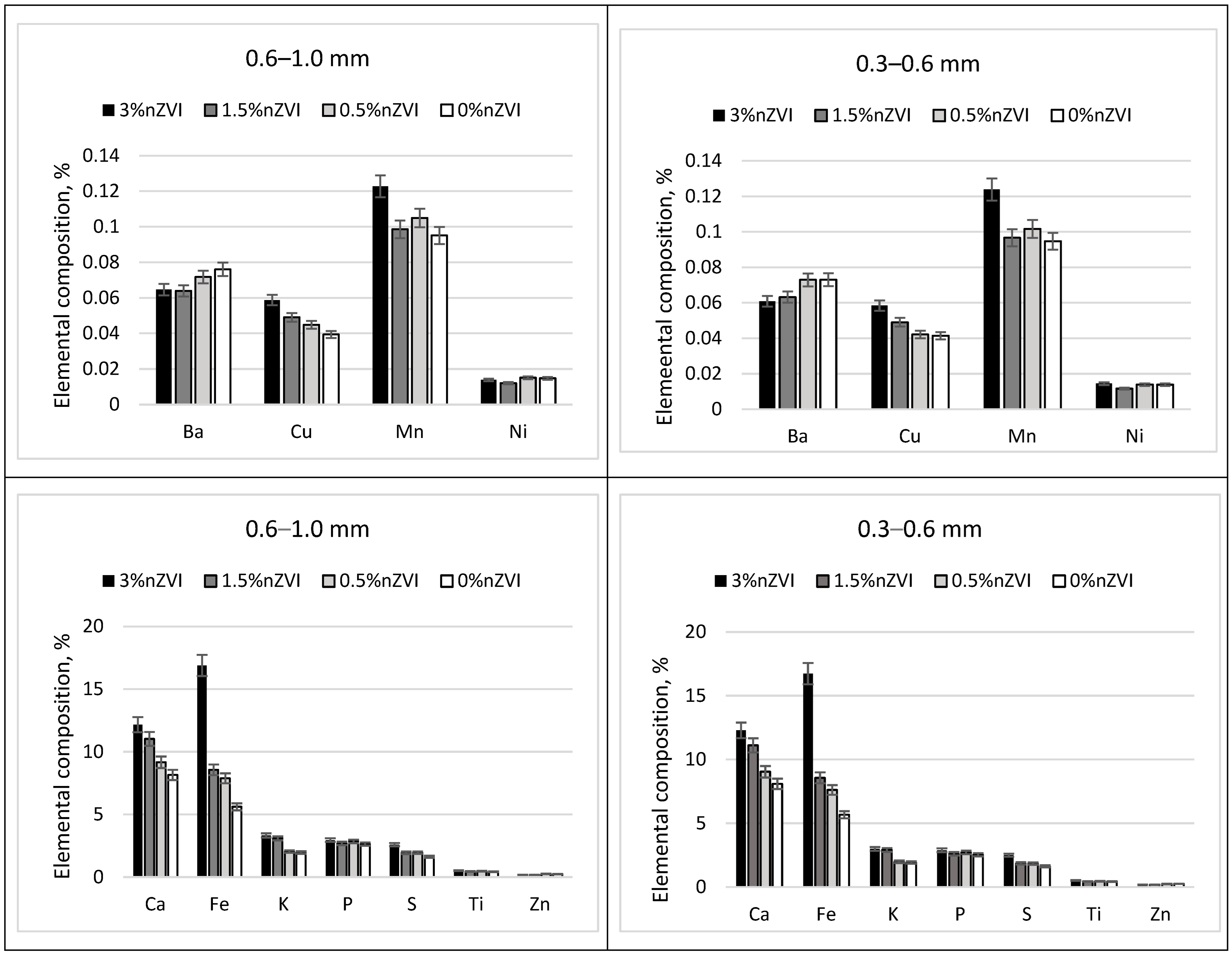
The most abundant chemical elements identified in the samples via XRF analysis are shown in Figure 3. It was observed that the chemical composition of both the coarser (0.6–1.6 mm) and finer fractions (0.3–0.6 mm) of the samples is almost the same; the differences are within 0.1% (Figure 3).
The results indicate that the predominant elements in the biochar samples were Fe, Ca, P, S, Ti, and Zn. The biochar derived from sludge treated with 3% nZVI prior to digestion contained the highest proportions of Fe, Ca, K, P, S, Ti, Cu, and Mn in both the coarser and finer fractions. The concentrations of iron and calcium in this sample were 3 and 1.5 times higher, respectively, than those in the control (0% nZVI) samples. In the biochar samples derived from sludge pretreated with 1.5% and 0.5% nZVI, iron concentrations were 1.5- and 1.4-fold higher than those in the control, respectively, while calcium concentrations were 1.3- and 1.1-fold higher. The lowest concentrations of Fe, Ca, K, P, S, Ti, Cu, and Mn were measured in the control sewage sludge biochar samples (0% nZVI).
Compared with previous studies [27], the control sewage sludge biochar samples differed in composition by up to 30% from the biochar obtained by pyrolyzing anaerobically digested sludge at 600 °C in a municipal wastewater treatment plant. In this study, biochar samples without additives (0% nZVI) contained 50% more iron than those reported by Januševičius et al. [27]. Since Ca and Fe dominate in the biochar samples, it is possible to predict the mechanism of phosphorus retention. Phosphorus removal using Ca-modified biochar occurs through chemical processes, including precipitation and complex formation, as shown in experimental biochar studies [40,41]. If the sorbent contains higher amounts of both calcium and iron, the main mechanism of phosphorus removal from wastewater may be the formation of Ca3(PO4)2 via precipitation [42]. Conversely, if the sorbent is dominated by iron, it attracts phosphorus by forming Fe–P complexes [18]. Ansari et al. [43] found that modifying straw biochar with iron increased the efficiency of phosphorus removal from water, and the phosphate adsorption capacity reached 13.7 mg/g. Even 1–3% of zero-valent nano-iron in biochar often creates many active Fe–OH surface sites due to the large specific surface area of nano-iron [44].
The results of the BET studies are presented in Table 3.
As shown in Table 3, the surface areas of all samples are relatively low on average [45]. The largest surface area is observed in the samples with 3% nZVI, while the smallest is found in those with 0% nZVI, with a difference of 38%. The surface area values for the samples with 1.5% and 0.5% nZVI are intermediate. The Langmuir surface areas of all samples are very close to the BET results, thus indicating a fairly uniform distribution of sorption sites. The total pore volume of all samples (0.017–0.027 cm3/g) is low, with the highest value observed in the samples containing 3% nZVI. The studied materials are clearly microporous (typical micropore size of 1.5 nm), and their porosity is moderate [46]. Due to the moderate surface area and low pore volume, all samples can be considered medium-quality adsorbents. According to the data in Table 2, the most effective adsorbent is the sample with 3% nZVI, as it has the largest surface area and the highest micropore volume.

3.2. Results of Batch Kinetic Adsorption Study

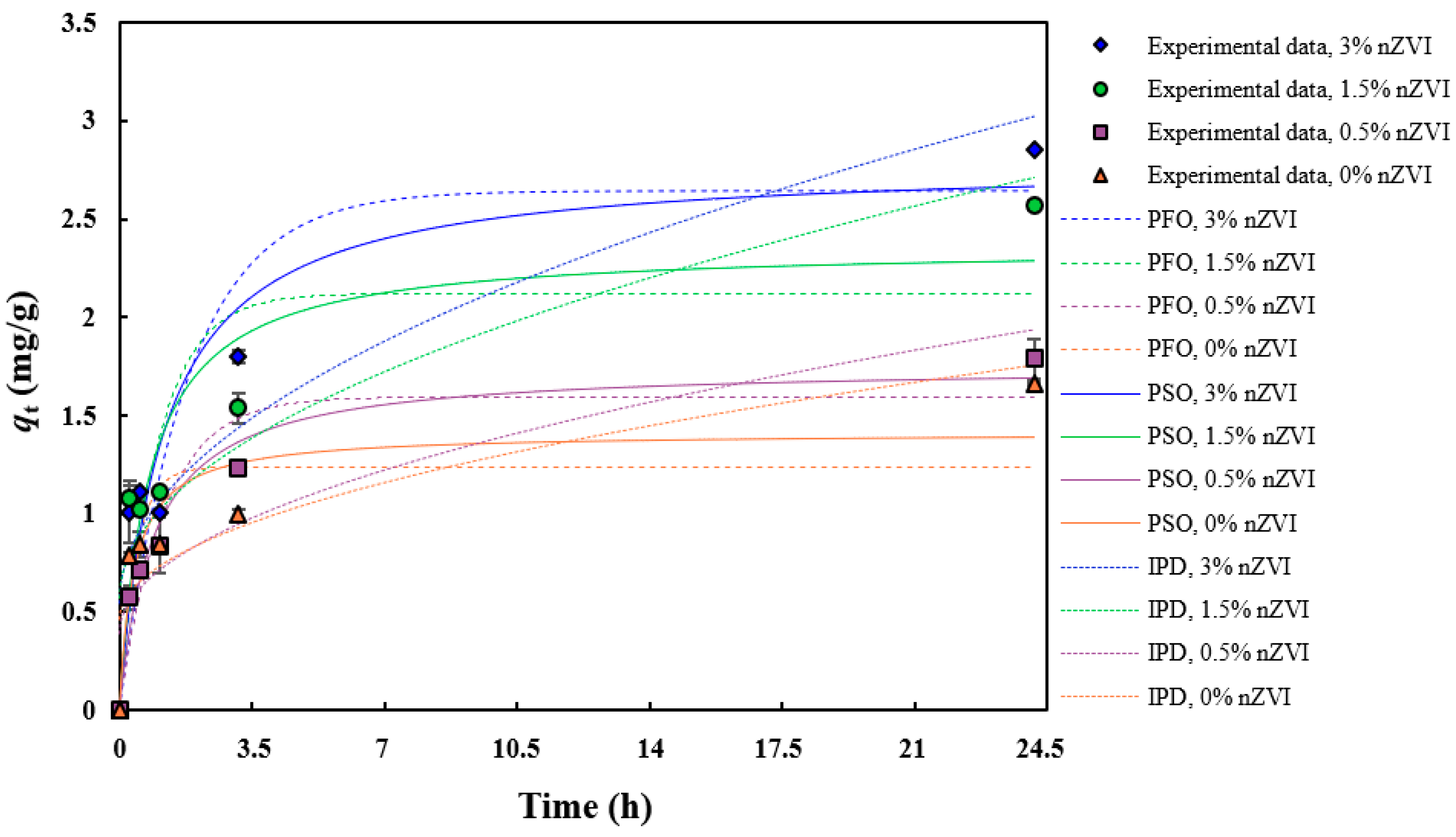
The adsorption kinetics of biochar derived from anaerobically digested sewage sludge, pretreated with 0–3% nZVI, were evaluated at an initial phosphate concentration of 25.5 mg/L, and the results are presented in Figure 4. qt exhibited a rapid initial increase within the first 3 h, followed by a plateau, indicating that equilibrium was attained by 23 h. The best model fit to the experimental data was achieved for the 0.5% nZVI group, in which the R2 for the PSO kinetic model reached 0.95. Generally, the PSO model provided the best fit for nearly all experimental groups (R2 ranging from 0.80 to 0.95), thus suggesting a chemisorption mechanism. Only in the 1.5% nZVI group was a slightly better fit observed for the IPD model compared to the PSO (R2 = 0.825 and R2 = 0.819, respectively). Similarly, in the 3% nZVI group, the difference between the R2 values obtained from the PSO and IPD models was minor (R2 = 0.863 and R2 = 0.852, respectively). This indicates that physisorption (pore diffusion) had an equivalent influence on the adsorption rate in the 3% and 1.5% nZVI groups compared to pure chemisorption; however, it can be concluded that a mixed adsorption mechanism occurred in these groups. The BET analysis results confirmed that the 3% nZVI biochar exhibited more developed porosity, possessing the highest specific surface area (68.9 m2/g), which enabled a higher adsorption capacity for phosphates.

3.3. Studies on the Reduction in Phosphate Concentration in Wastewater via Filtration

A preliminary study (using distilled water and K2HPO4 salt solution) showed that columns 1 and 2 retain only 20–50% of phosphorus, while phosphorus is leached from columns 3 and 4, and the PO4-P concentration in their filtrates is higher than the initial value. It is concluded that distilled water dissolves phosphorus, especially from the packing of columns 3 and 4. Comparing the Fe/Ca ratio in the packing samples of columns 1–4, a decrease was observed from 1.39 to 0.69. Khedr et al. [47] found that the calcium silicate-based sealers had significantly greater solubility. Conversely, iron phosphates are only slightly soluble, and in an acidified medium, Ca-bound phosphate is more soluble than Fe-bound phosphate [48]. This may explain why the phosphorus concentrations in the filtrates from columns 1 and 2 (which contained more iron) were lower than those in the filtrates from columns 3 and 4.
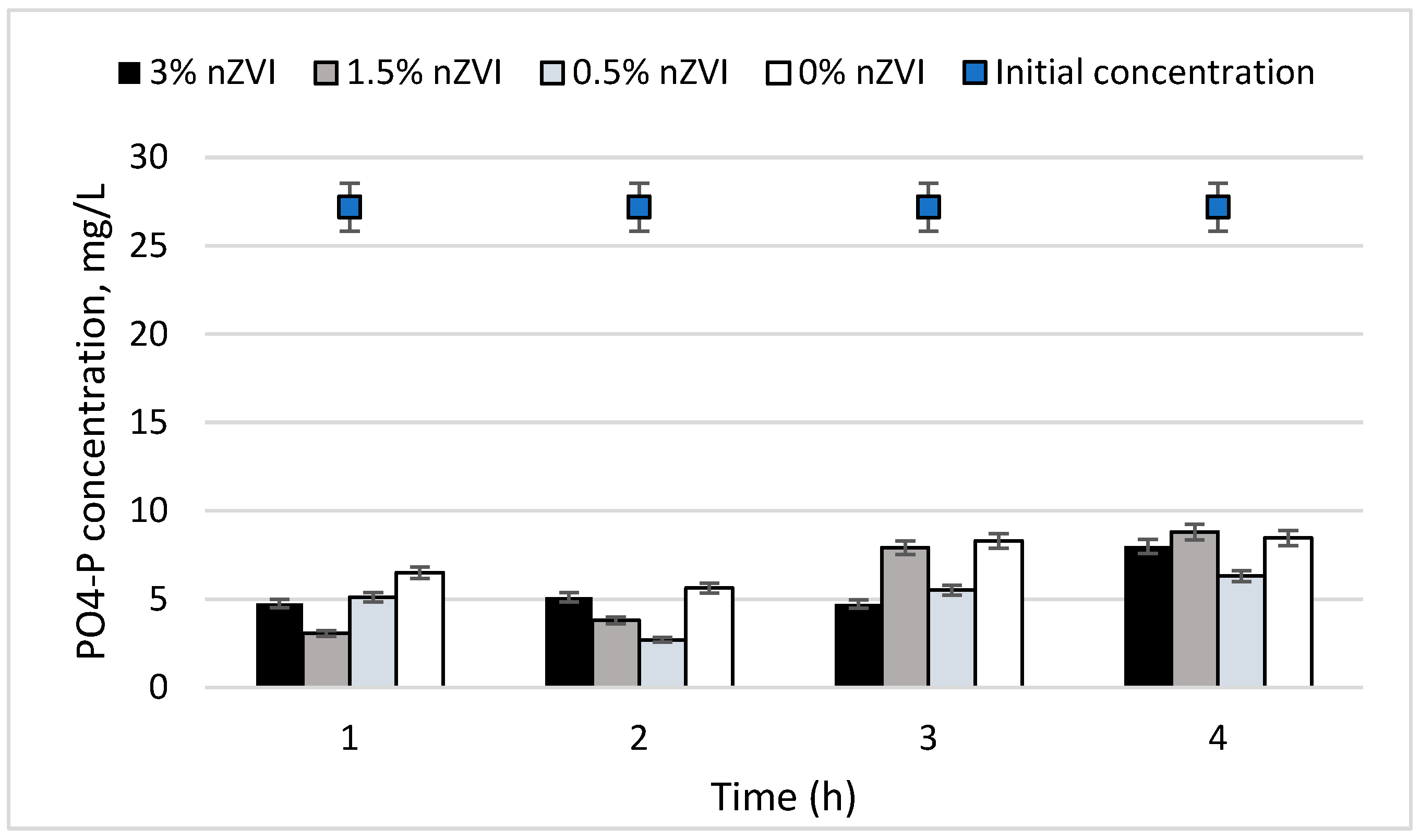
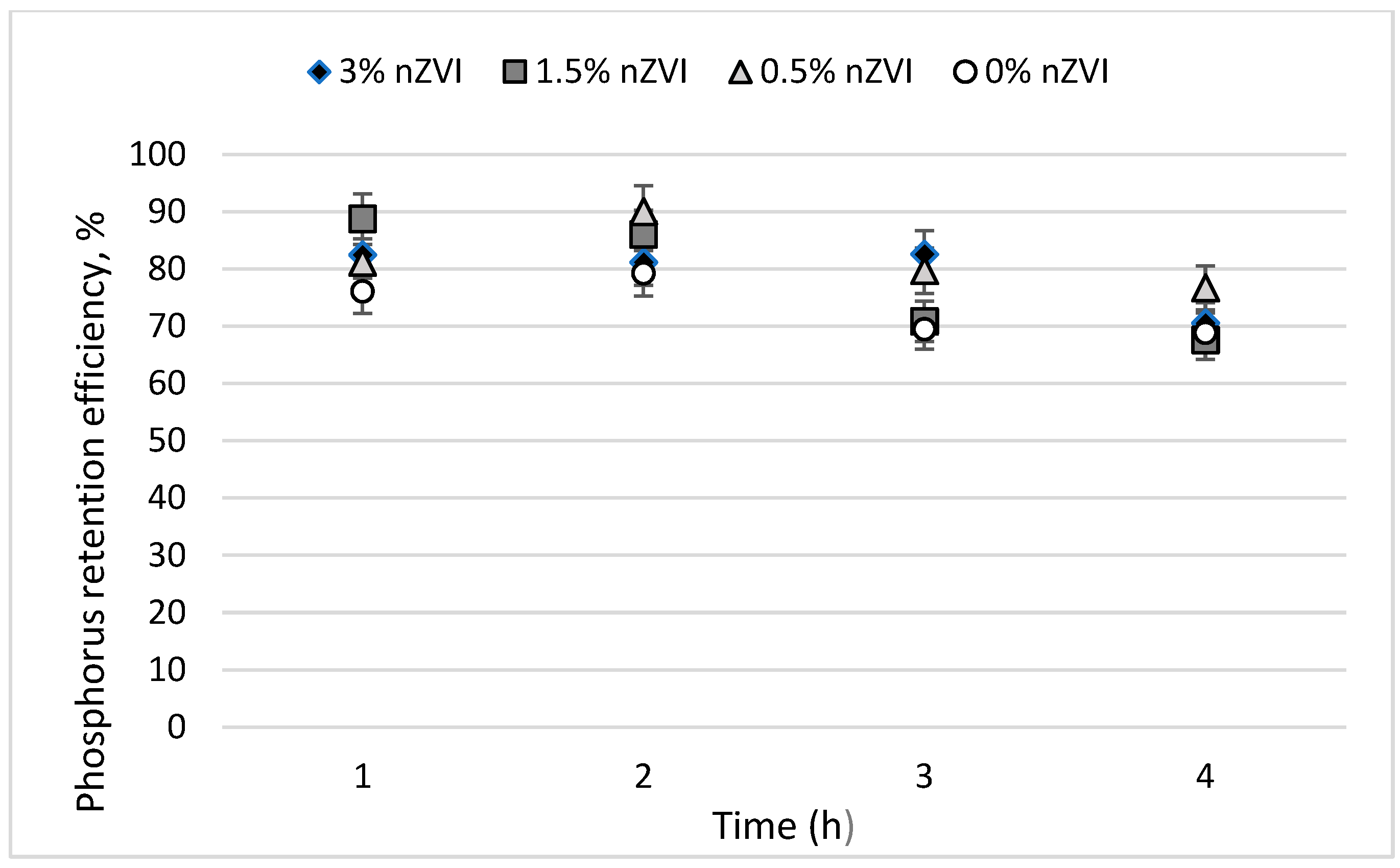
In the first study, using a finer (0.3–0.6 mm) fraction of biochar, 30 g of which was placed in each column, filtration was carried out at a rate of 1.0 ± 0.1 m/h (Table 3). Thus, the residence time of wastewater in the columns was about 0.1 h. The results of phosphorus retention are presented in Figure 5 and Figure 6.
The results presented in Figure 5 and Figure 6 show that at an initial concentration of 27 mg/L, phosphate phosphorus was retained with an efficiency of 68–90%. As phosphorus’s initial concentration in wastewater increases, its retention efficiency also generally increases [49]. Figure 7 and Figure 8 show the results of phosphorus removal from wastewater when a coarser fraction (0.6–1.6 mm) was used and the mass of the column packing was 160 g.
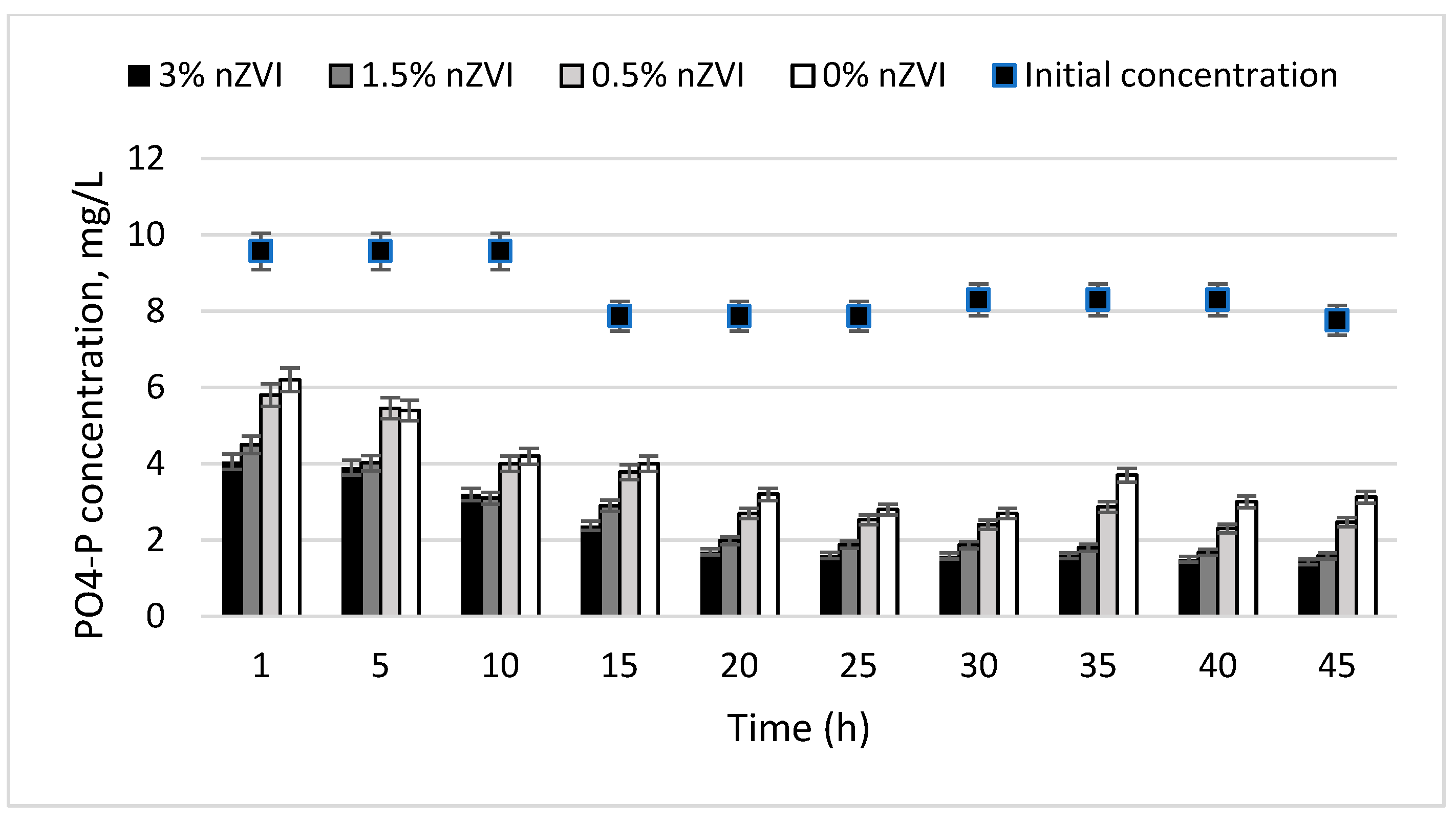
Figure 7 and Figure 8 show that the PO4-P concentration in the filtrates of all four columns exceeded 5 mg/L; therefore, it is concluded that the mass of the fillers is too small to remove phosphorus from the treated wastewater to reach the regulated value.
With an initial PO4-P concentration of 9.5 mg/L in wastewater, at the beginning of filtration, the filtrates from columns 1 and 4 contained 4–6 mg/L PO4-P concentration, and the phosphorus retention efficiency reached 57 and 37%, respectively. The highest and lowest phosphorus retention efficiency was seen in the first and fourth columns, respectively. With further filtration of the wastewater (from 5 to 45 h), the phosphorus retention efficiency in columns 1 and 4 increased to 82 and 64%, respectively (Figure 8).
It is thus concluded that the column packings “matured” for phosphorus retention and that the PO4-P concentrations in the filtrates from all four columns decreased over time due to not only physical or chemical adsorption but also possible microbiological processes. Shahraki and Mao [50] observed that as an adsorbent, biochar can also act as a growth medium that promotes biodegradation, thus improving available alkalinity. It was found that biofilms on biochar effectively remove heavy metals and organic pollutants by combining adsorption and biodegradation processes [51]. It was also observed that biochar has great potential as an alternative filter material to improve system performance by removing various pollutants at low cost [50]. Additionally, Lai et al. [52] suggested that the addition of biochar increases the nutrient content of soil and creates good conditions for indigenous microorganisms to thrive.
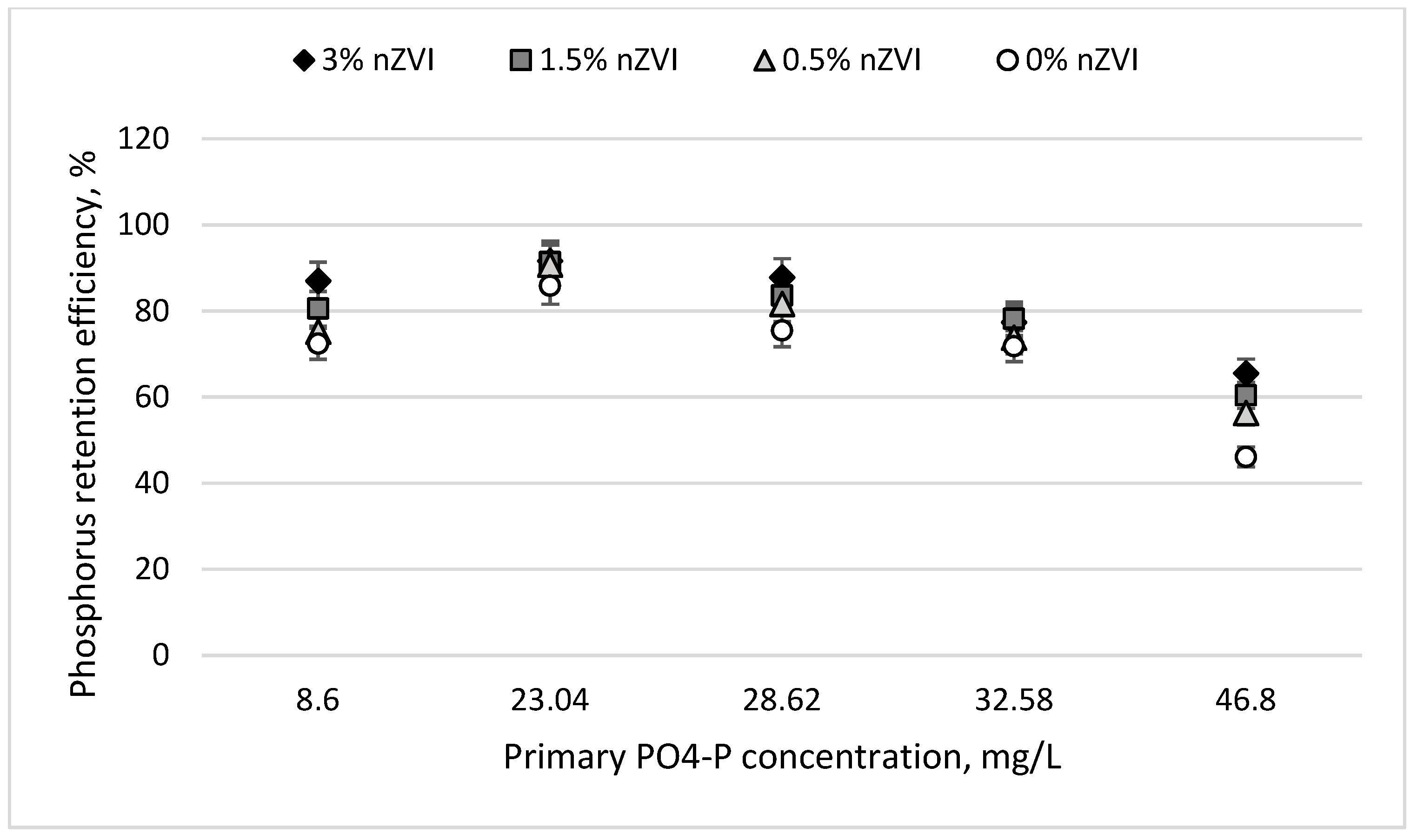
Figure 8 shows how the phosphorus retention efficiency changed with the initial PO4-P concentration in wastewater.
The results in Figure 8 show that at an initial PO4-P concentration in wastewater from 8.6 to 32.6 mg/L, the phosphorus retention efficiency in all columns is higher than 70%. The first column retains phosphorus the most efficiently (77–92%), while column 4 is the least efficient (72–89%). At an initial PO4-P concentration of 46.8 mg/L in wastewater, the phosphorus retention efficiency decreases, reaching 66% and 46% in columns 1 and 4, respectively. Meanwhile, the efficiency of the second and third columns is intermediate. Fe-based mechanisms often work better in flow systems, in which oxidation occurs in real time [53]. In this study, real wastewater after biological treatment was filtered through the columns, which contained residual activated sludge microorganisms that accumulated on the surface of the column packings, thus forming sediments. This sediment was the medium that contributed to phosphorus retention. Biologically treated wastewater usually has a low orthophosphate concentration (1–10 mg/L), high levels of carbonates and bicarbonates, and neutral pH (7–8), and under such conditions, Fe3+ phosphates are insoluble. Additionally, the EBCT was 0.5 h. During the entire 45 h filtration period, the following amounts of phosphate phosphorus were retained per gram of filler in columns 1–4: 1.75, 1.68, 1.43, and 1.31 mg/g. It should be noted that the phosphorus retention capacity of the columns was not fully utilized, as the filters could still operate.
The pH values measured in the filtered wastewater and filtrates from column 4 are shown in Table 4.
Table 4 shows that biochar fillers in all columns increase the pH of the filtered effluent. This is due to the high alkalinity and ash content [54]. During biochar production, as the pyrolysis temperature increases, acidic surface groups (carboxylic, phenolic, and hydroxyl groups) break down and volatilize acidic compounds, thus increasing the alkalinity of the biochar [55]. The alkaline and porous biochar surface is very favorable for mineral precipitation: Ca2+ + PO43− → Ca–P. The columns not only retain particles but also undergo the chemical immobilization of phosphorus. The absorption mechanisms mainly include hydrophobic interaction, pore filling, electrostatic adsorption, and hydrogen bonding [56,57].
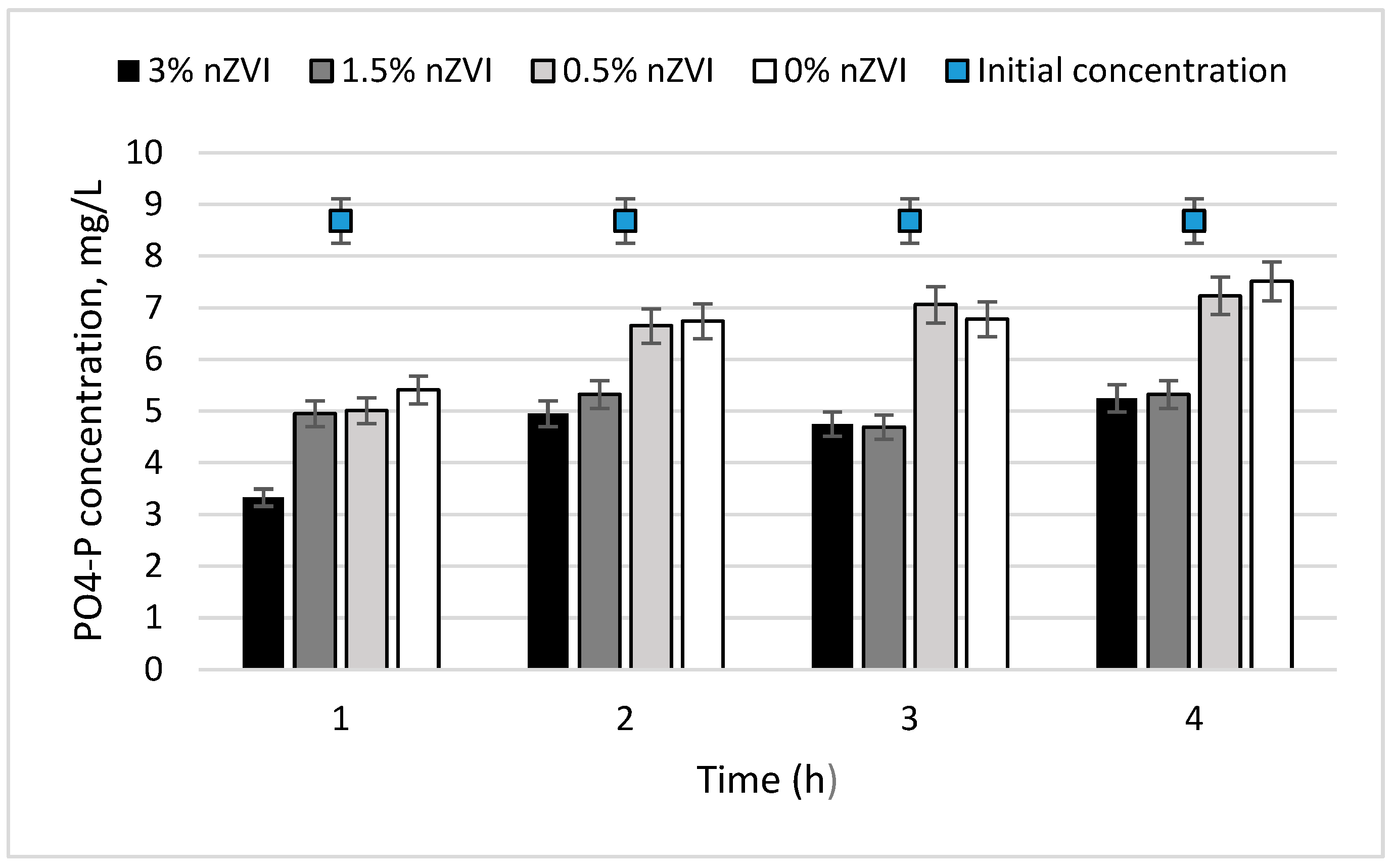
When the wastewater filtration speed was increased to 2 m/h, the phosphate concentration in the filtrates of all columns remained higher than when filtering at a speed of 1 m/h (Figure 9).
The phosphorus retention efficiency in columns 1–4 reached 47, 42, 25, and 24%, respectively. The observed decrease was due to the insufficient residence time of wastewater in the column fillings, which was about 0.25 h when filtering at a speed of 2 m/h. It is concluded that even with 160 g of column fillings of the 0.6–1.6 mm fraction, the residence time of treated wastewater in the fillings is insufficient when filtering at a speed of 2.0 ± 0.1 m/h.
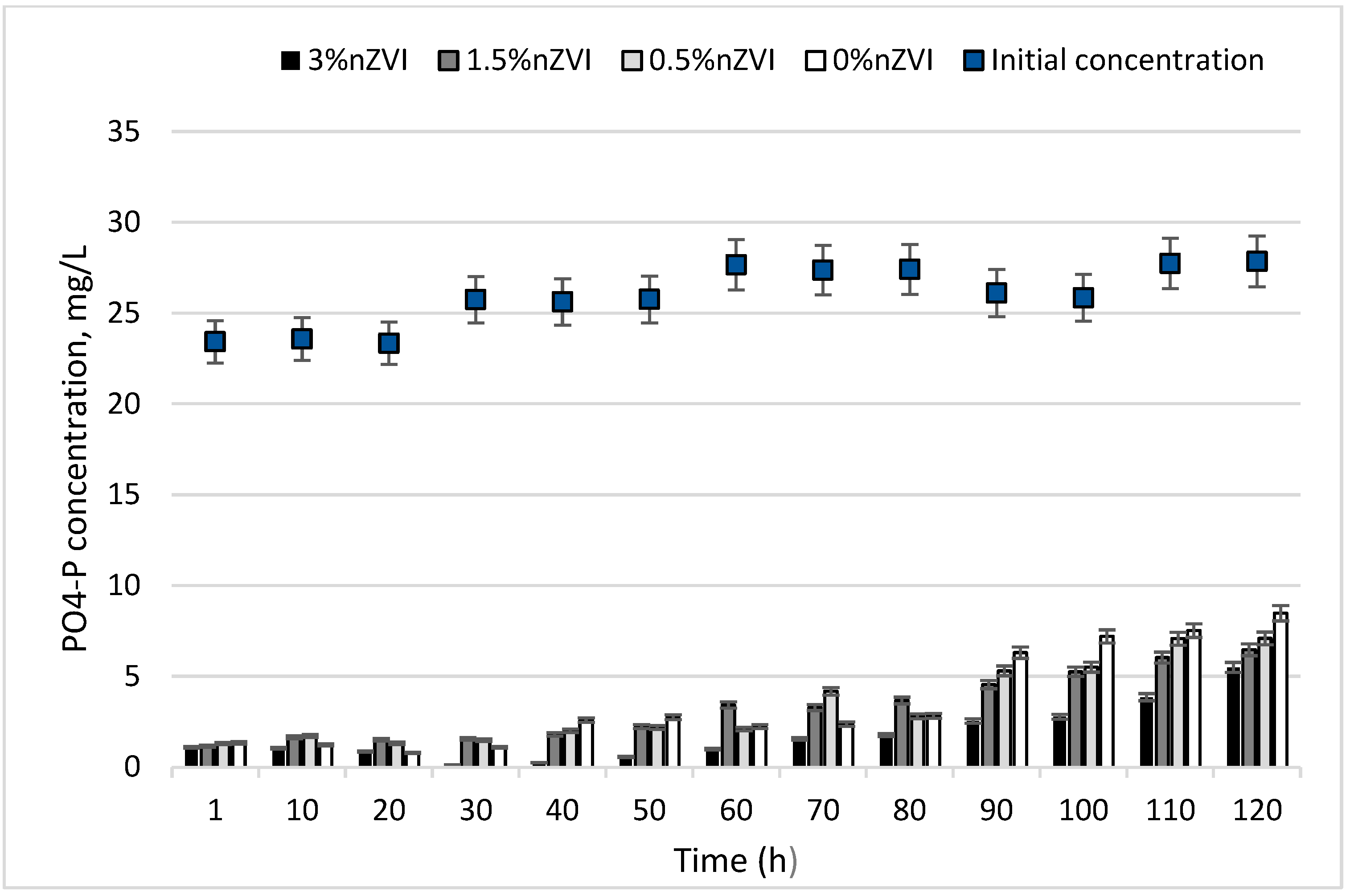
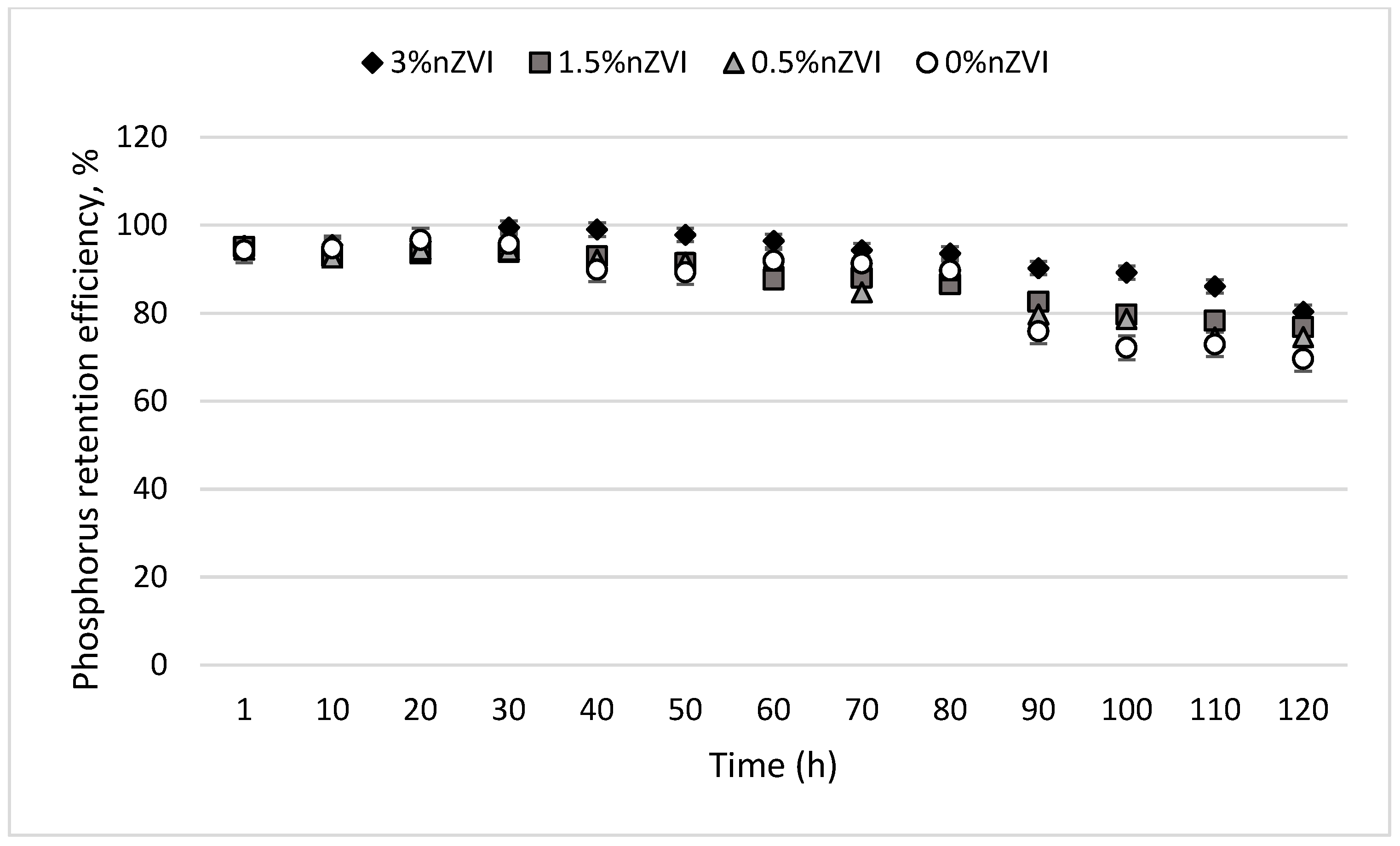
Using a 0.3–0.6 mm fraction with a 160 g column packing mass, the last experiment lasted 120 h (Figure 10 and Figure 11). Initially, the phosphorus removal efficiency in all columns was 94–95%, with the first column being the most efficient.
With an increase in filtration time, the phosphorus retention efficiency decreased in the first column from 95 to 80%, the second from 95 to 77%, the third from 94 to 75%, and the fourth from 94 to 70%. After 120 h of filtration, the concentration of phosphate phosphorus in the filtrates from columns 1–4 was 5.49, 6.46, 7.09, and 8.47 mg/L. Only the filtrate from the first column met the regulatory value (5 mg/L). During the 120 h filtration period, columns 1–4 removed phosphorus (PO4-P) from the wastewater and accumulated it in the filter media. The amounts accumulated in the media containing 3% nZVI, 1.5% nZVI, 0.5% nZVI, and 0% nZVI were 7.82, 7.41, 7.17, and 7.26 mg/g, respectively. Filtration was not continued further, as under the conditions of this study, the filtration rate decreased after 120 h due to the onset of filter clogging, and it was no longer possible to maintain the target hydraulic loading rate.
It was observed that as the filtration time increased, the pH in the filtrates decreased. The pH values measured in the filtrates of the four columns after 50 h of filtration are presented in Table 5.
As the pH of the filtrates decreased, the differences in columns 1–4 decreased, but the pH remained weakly alkaline.

3.4. Microscopy, SEM, and EDS Results

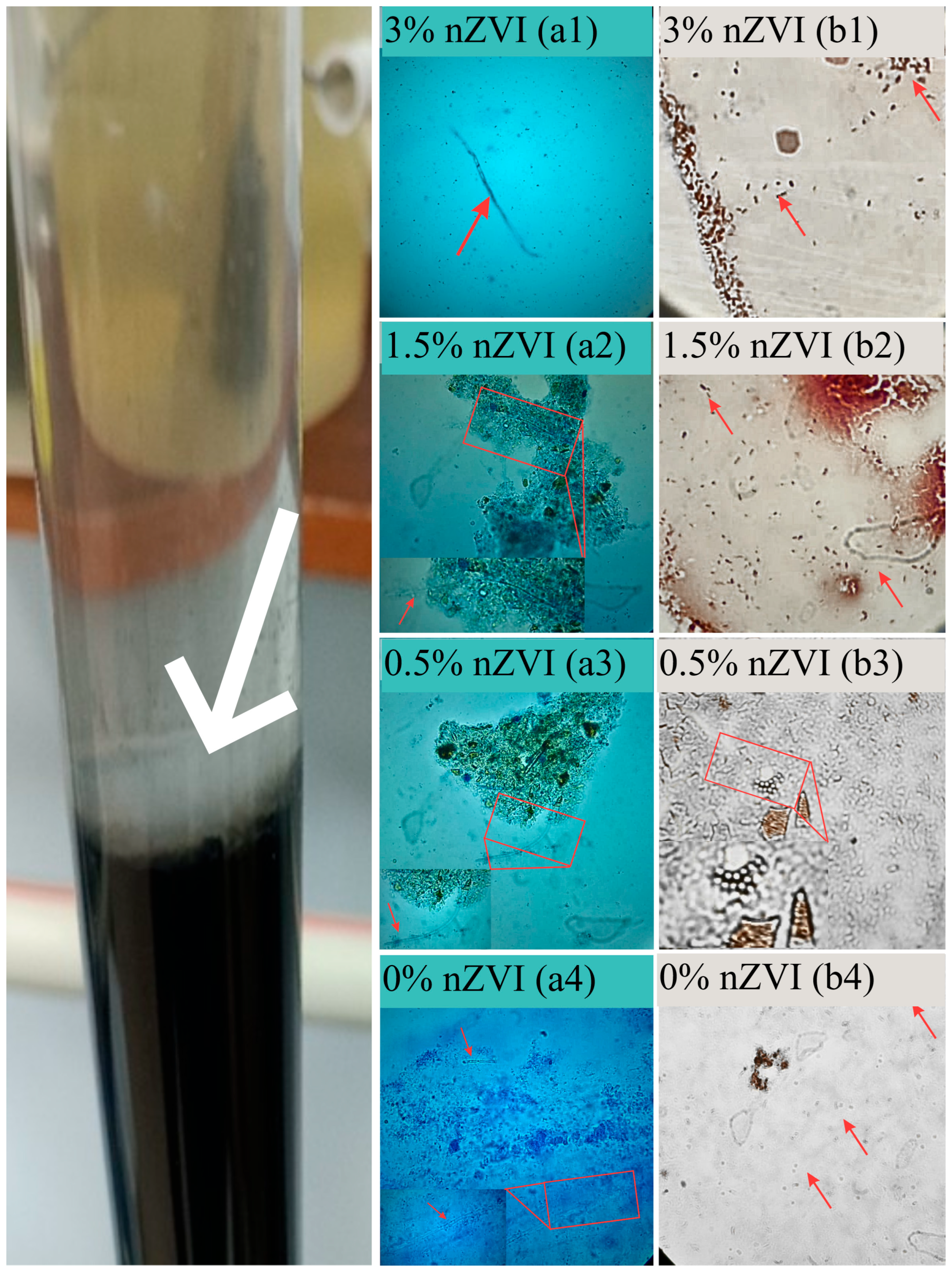
During the filtration of real wastewater after biological treatment through the columns, precipitates gradually accumulated on the surface of the media in all four columns, as shown in Figure 12.
Microorganisms characteristic of activated sludge were observed on the surface of all columns, comprising Gram-positive diplococci, yeast, and filamentous fungi. Enlarged images are presented in Figure 12. The 3% nZVI sample contains Gram-positive diplococci and filamentous fungi; the 1.5% nZVI sample contains Gram-positive diplococci, yeast, and filamentous fungi; and the 0.5% and 0% nZVI samples both contain mainly yeast and filamentous fungi.
The elemental composition (weight, %) of the sediments from the four columns is shown in Table 6.
The data presented in Table 6 show that the studied material contains the highest amounts of O (37–44%) and C (13–22%), as well as a lot of Ca (12–20%) and P (9–17%). The high content of Ca and P indicates that calcium phosphate deposits formed on the surface of the biochar; such a composition is characteristic of calcareous deposits of biological origin. Since real wastewater after biological treatment was filtered through the columns, the wastewater contained microorganisms that were retained on the surface of the biochar fillers and eventually formed a biofilm. The microorganisms formed a complex, microporous network of channels that not only adsorbed orthophosphate but also physically retained it as a particle. With the help of the biofilm, mineralized calcium phosphate deposits with impurities of organic matter and trace elements were formed on the surface of the filters. This indicates that biochar fillers with biofilm acted as a reactive sorbent, thus promoting phosphorus precipitation [58].
In the columns, wastewater continuously flows through the biochar layer, which results in the formation of a biofilm on the surface of the biochar, in which microorganisms can actively bind or metabolize phosphates so that biological sorption occurs simultaneously with physical/chemical sorption. Such biological processes do not have time to prevail during batch mixing; the efficiency of orthophosphate retention in the columns is higher. The batch method can only measure sorption on the biochar surface, and it does not assess biological sorption via microorganisms, physical retention between particles, the dynamics of precipitate formation, or additional chemical precipitation phenomena in the columns [22,27]. This may explain why the sorption capacity of orthophosphates in the columns can be much higher than the capacity calculated in the batch experiment.
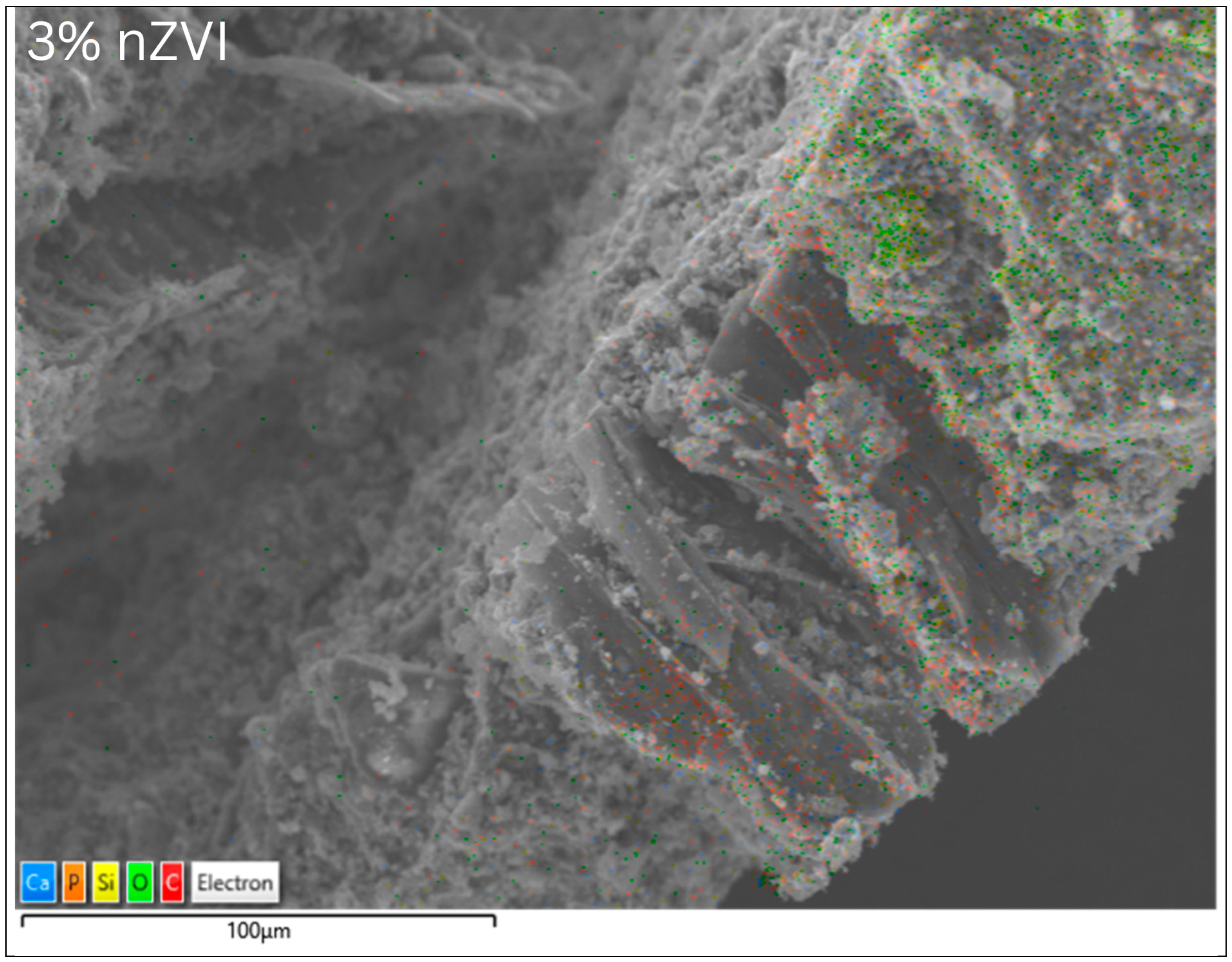
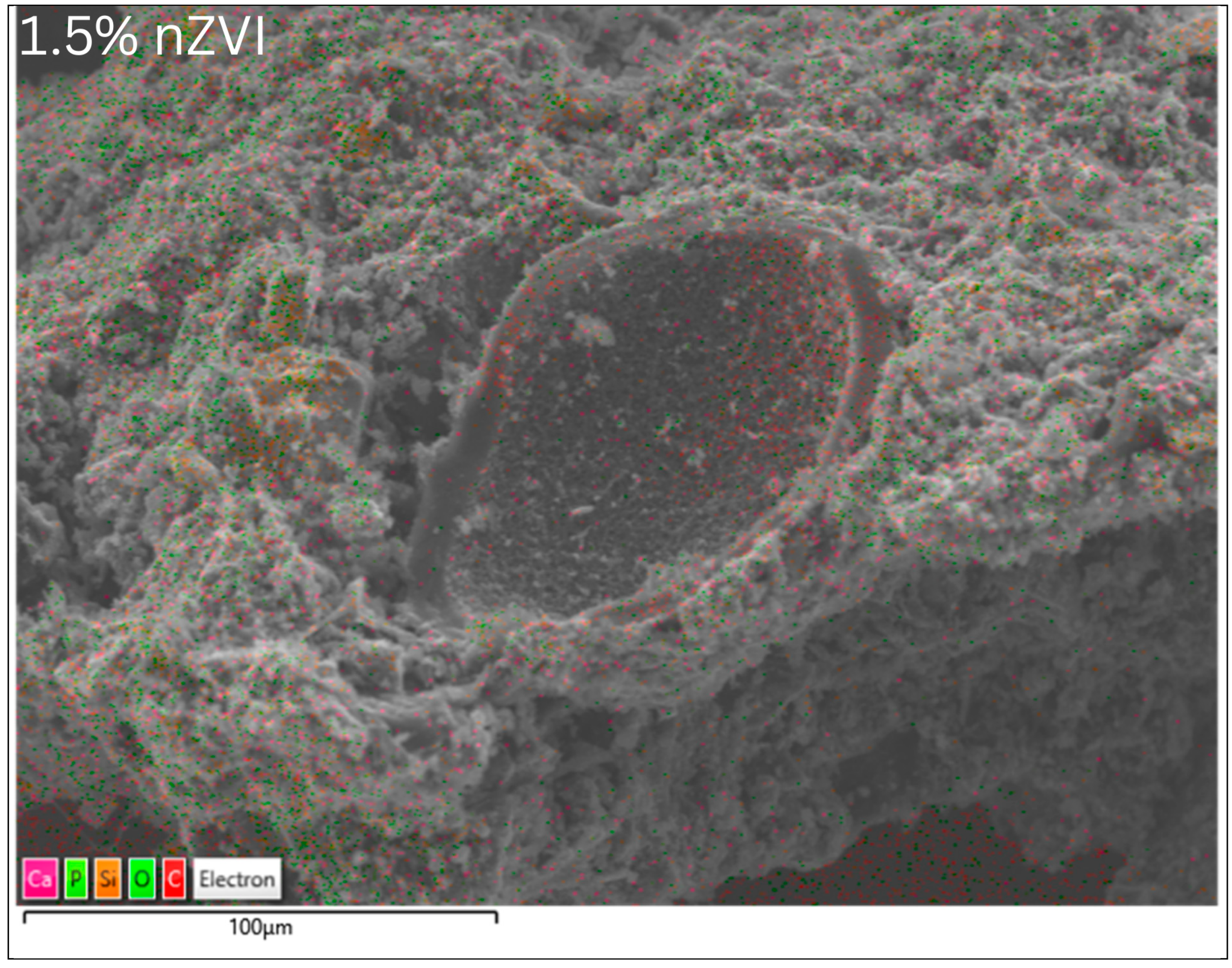
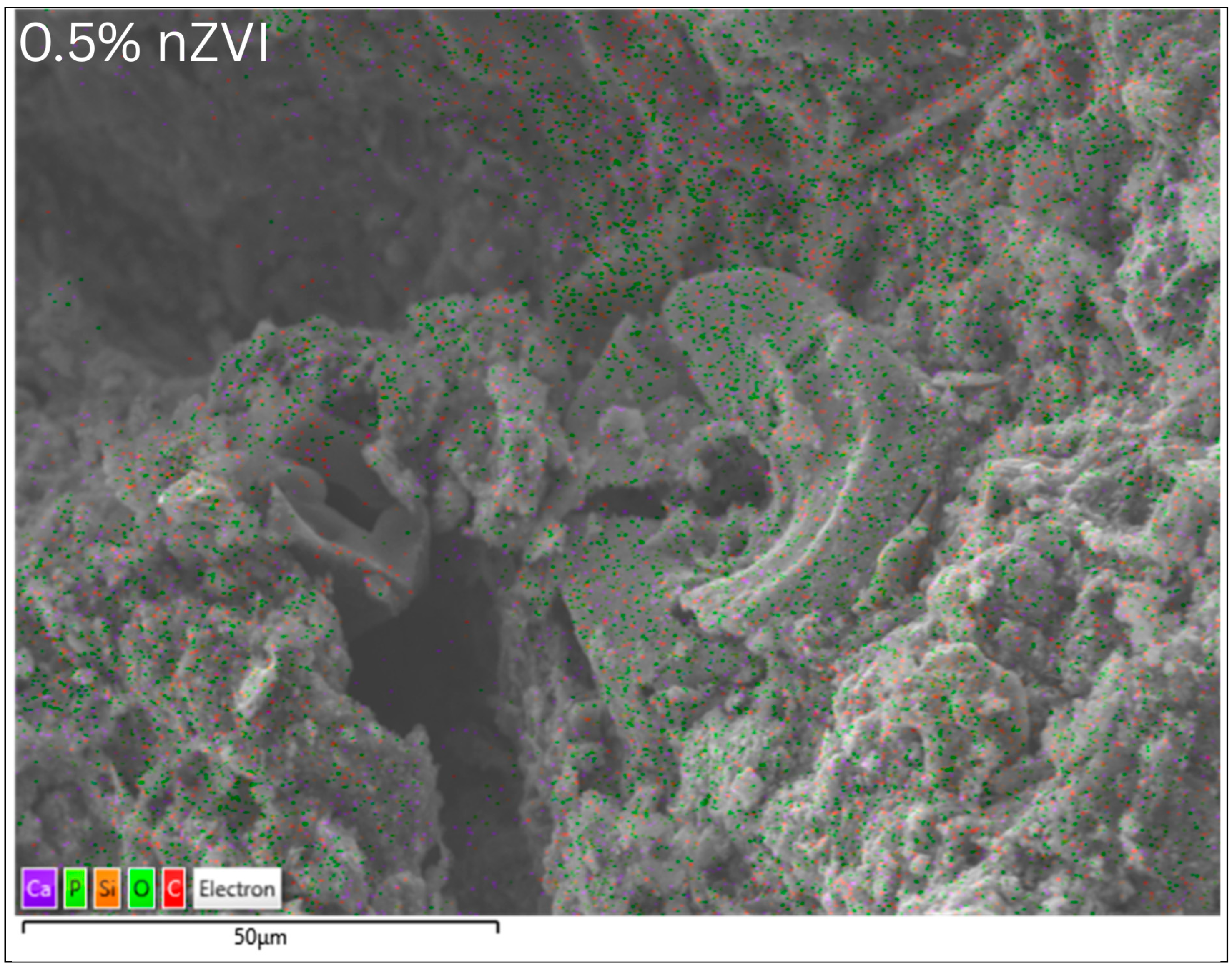
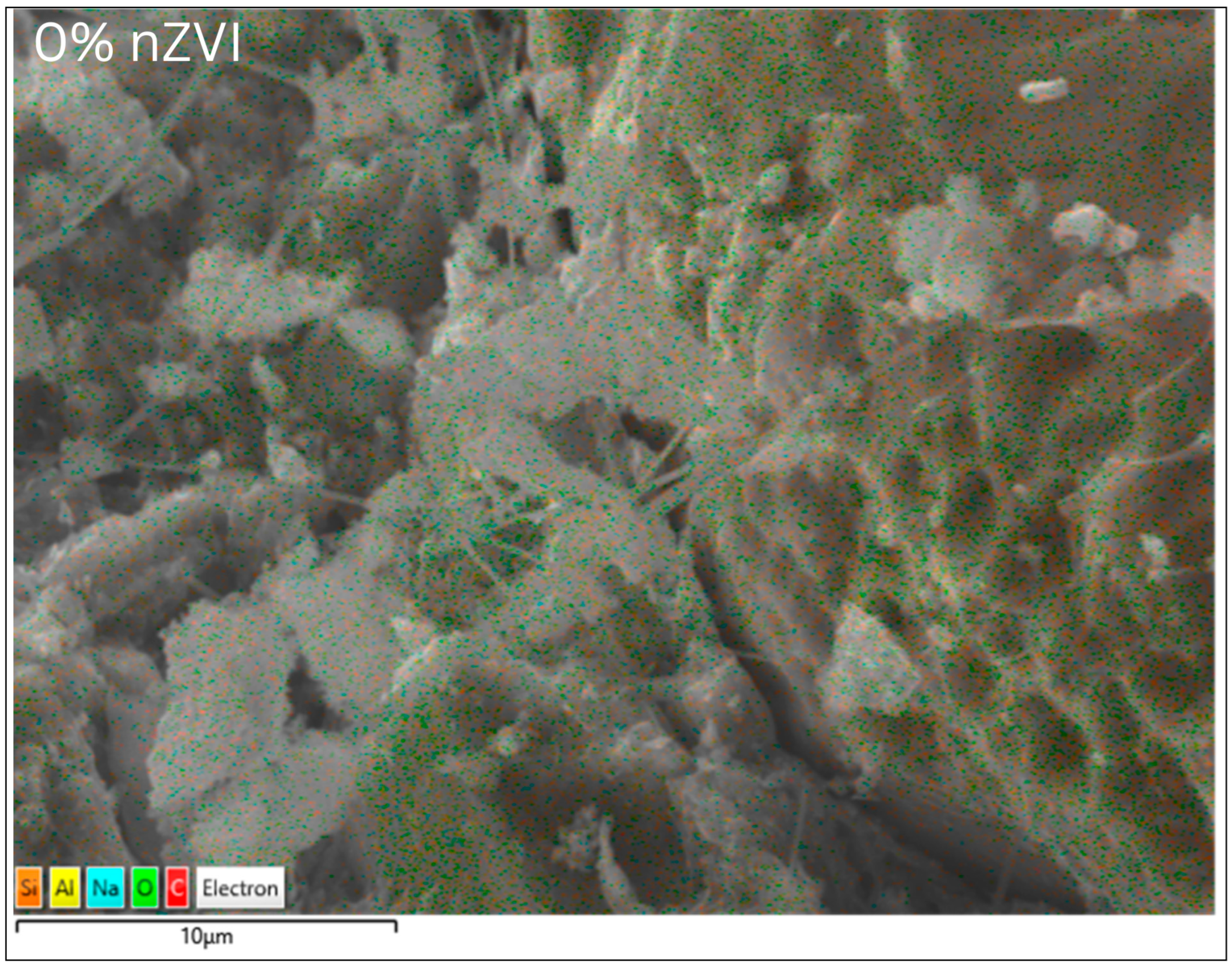
Scanning electron microscopy images and the results from the energy-dispersive spectroscopy of the biochar samples used in the columns are shown in Figure 13.
As illustrated in the figure, the surface of all samples is heterogeneous and porous. In three of the samples (3% nZVI, 1.5% nZVI, and 0.5% nZVI), calcium (Ca) is extensively distributed throughout the biochar structure, frequently co-locating with phosphorus (P). The presence of oxygen on the surface of the biochar samples suggests that precipitates exist in the form of oxides or hydroxides. Given the predominance of Ca and P, it can be inferred that these are calcium phosphates. However, the 0% nZVI sample is characterized by elevated levels of Si, O, and C, featuring distinct inorganic silicate structures with a thread-like morphology.
Analyzing the data in Table 7 reveals that the amount of elemental phosphorus in the column fills is about 3 times less than that in the surface precipitates (Table 6). There is no significant difference between the phosphorus content in the fills of columns 1–3, and the composition of 0% nZVI differs from that of 3% nZVI by only 20%. The data also shows that the column fills contain different amounts of iron, according to which the composition of 0% nZVI differs from that of 3% nZVI by as much as 76%. These data support the claim in [42] that phosphorus removal is mainly due to the formation of Ca3(PO4)2 even when Fe oxides are present in biochar.

3.5. Proposed Mechanisms of Phosphate Sorption on Optimal Biochar

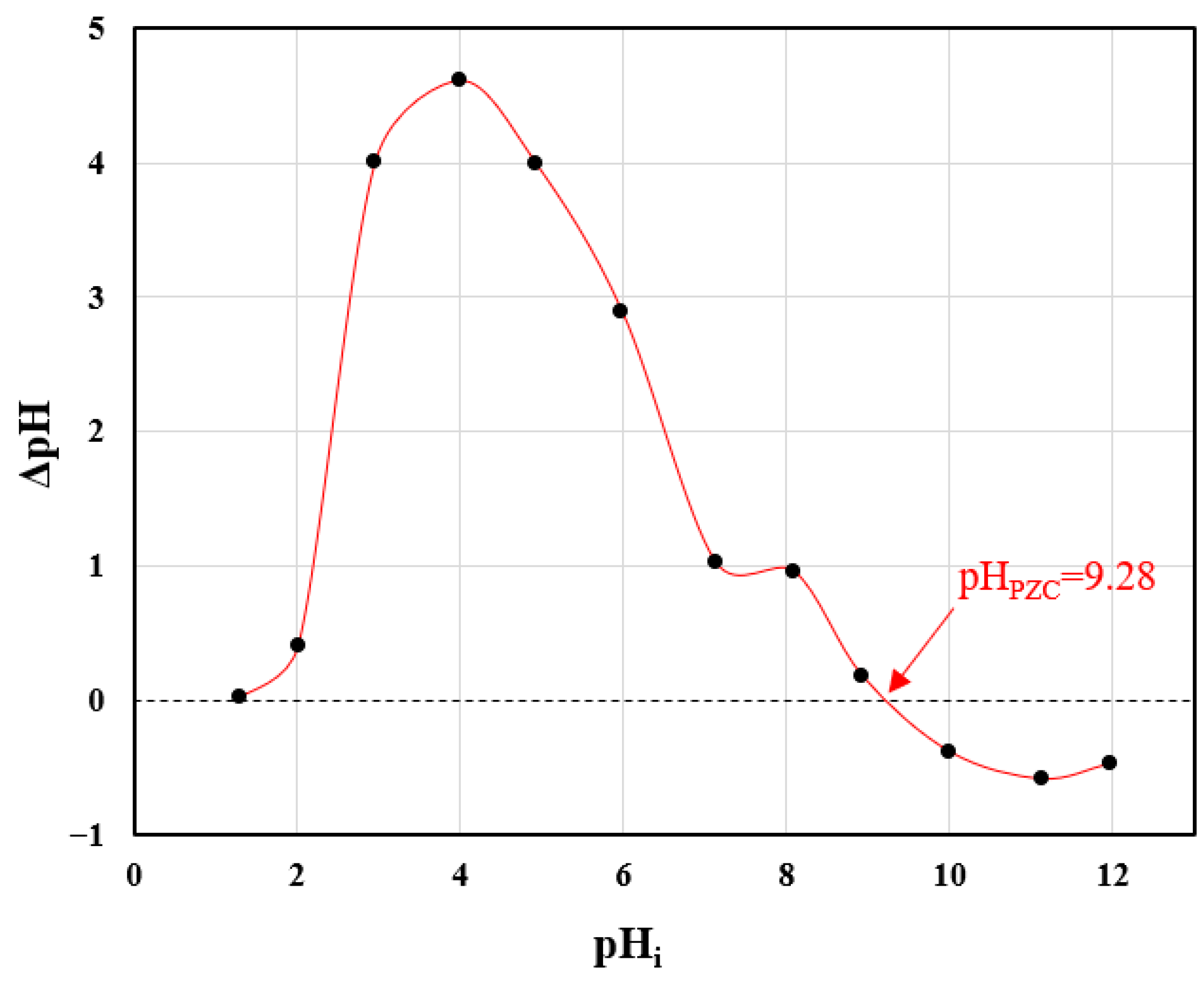
The determination of pHPZC is shown in Figure 14, revealing the intersection point of the initial and pH change (difference between final and initial pH) values. The pHPZC of the optimal biochar (pretreated with 3% nZVI) was determined to be 9.28. When the solution pH is lower than pHPZC, the biochar surface is positively charged, which favors the adsorption of anions. Based on the pH values (7.5–7.7) of the solutions used in the batch and column studies, the surface charge of the biochar remained positive within this range. Consequently, electrostatic attraction occurred between the positively charged biochar surface and negatively charged phosphate species (e.g., HPO42−). Another study reported similar results for biochar derived from SS gasification [59]; with a pHPZC of 10, its surface remained positively charged throughout the tested pH range (3–7), which strongly favored phosphate adsorption. Consequently, electrostatic interaction between the positive biochar surface and phosphate anions represents a significant mechanism for phosphate removal.
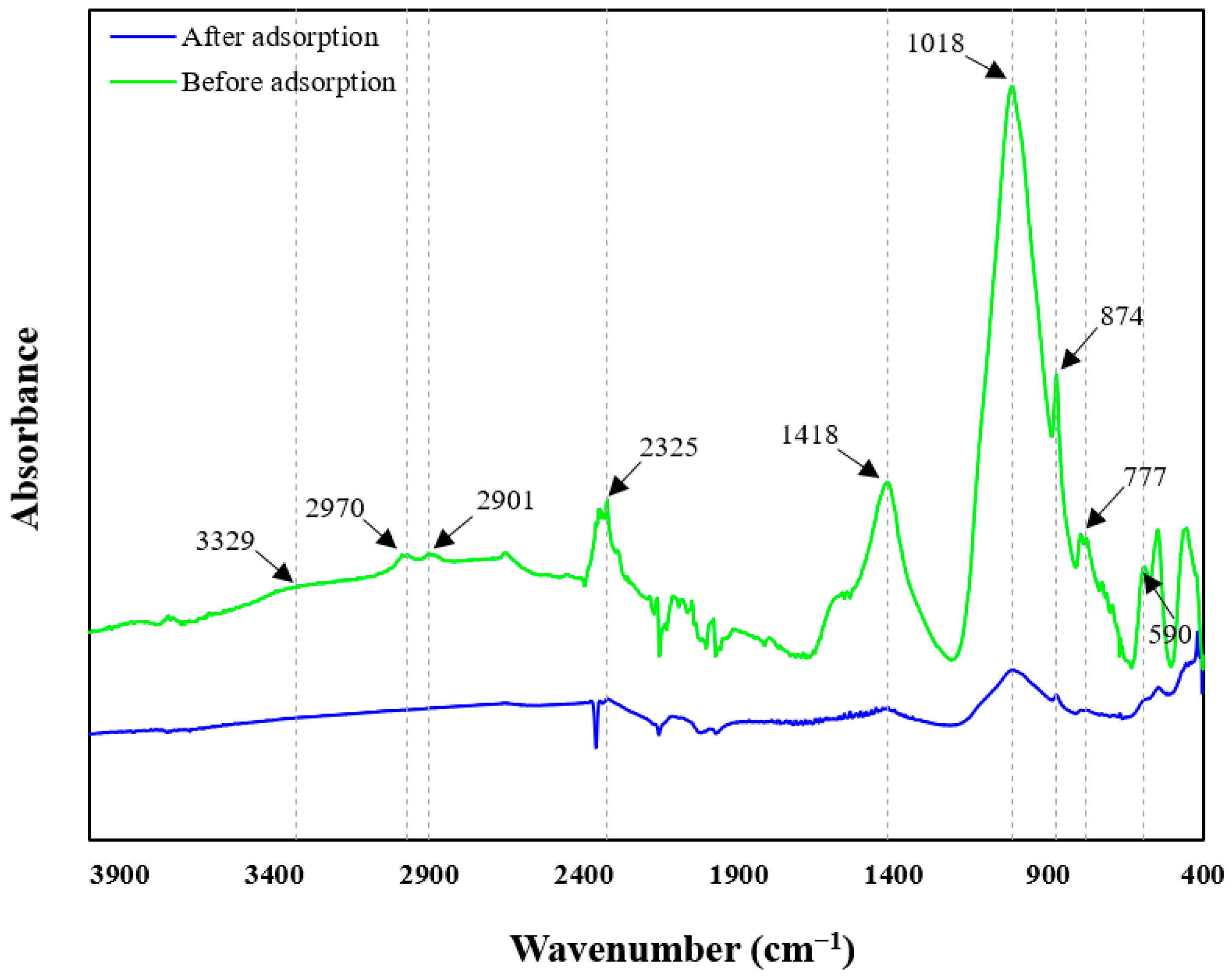
To evaluate the changes in surface functional groups resulting from phosphate adsorption, an FTIR analysis of the optimal biochar (derived from digested sludge pretreated with 3% nZVI) was performed both before and after phosphate adsorption, revealing significant spectral modifications (Figure 15). The peak near 3329 cm−1 is due to an O–H bond, which disappeared after phosphate adsorption [60]. This indicates that ligand exchange occurred [61,62]. The small peaks at 2970 cm−1 and 2901 cm−1 represent aliphatic C–H stretching vibrations. Additionally, the peak near 2325 cm−1 indicates the presence of goethite (Fe2O3∙H2O) [63]. The peak at 1418 cm−1 is attributed to a carboxylate group (–COO–) or the O–H bending of carboxylic acid [64], which weakened after adsorption. The reduction in the intensity of the very sharp peak at 1018 cm−1 after adsorption suggests the formation of Fe–O–P complexes on the biochar surface [43]. Moreover, the reduction in peak intensity at 874 cm−1 (attributed to C–O vibrations [65]) after phosphate adsorption indicates that these functional sites contributed significantly to the removal of phosphate ions. The disappearance of the peak at 777 cm−1 suggests that surface Fe-O and Fe-OH groups interacted with phosphate ions. The presence of a band at 590 cm−1 corresponds to Fe–O vibrations in Fe2O3 and Fe3O4, thus confirming that the nZVI on the digested SS-derived biochar was partially oxidized [63,66]. The reduction in this peak’s intensity after phosphate loading suggests that surface Fe sites were actively involved in the adsorption process through complexation. The involvement of surface Fe–O and O–H moieties in phosphate adsorption is supported by the observed spectral changes in biochar produced from anaerobically digested sewage sludge pretreated with 3% nZVI. Alignment between the FTIR spectral changes and the PSO kinetic fit suggested that the rate-limiting step involves chemical bonding between phosphate and the nZVI-BC surface.

4. Discussion

The orthophosphate sorption capacity achieved in this study is not high. In the batch experiment, biochar with 0–3% nZVI achieved an adsorption capacity ranging from 1.7 to 2.7 mg/g. Considering the research results of Wang et al. [67], in which the iron-enriched SS used for phosphorus adsorption from digestate liquid achieved a sorption capacity of 1.843 mg P/g, the results of both their and our studies are similar.
Currently, there is a lack of scientific literature on the use of adsorbents for phosphorus removal from real wastewater, in which the typical phosphate–phosphorus concentration is not high (30 mg/L). Most adsorption studies are conducted using solutions or synthetic wastewater with higher phosphate concentrations. In a study by Lan et al. [68], a phosphate solution with a phosphorus concentration range of 1–100 mg/L was used to develop adsorption isotherms. Phosphates were adsorbed by sludge chemically modified with Fe salts, which achieved an adsorption capacity of 0.85 mg/g; the primary mechanisms involved were the formation of Fe–P complexes and the development of FePO4. In a study by Xu et al. [14], nZVI-modified biochar demonstrated a very high theoretical phosphate adsorption capacity of 294.12 mg/g. However, this high phosphorus adsorption capacity was obtained under high-concentration conditions (500–1000 mg/L) designed to determine the maximum capacity [14].
It should be noted that to improve the sorption properties of biochar, it is most commonly modified with nZVI particles through post-pyrolysis modification methods. Modification of biochar with iron and its compounds can increase its specific surface area, the number of adsorption sites, and the number and types of surface functional groups, thereby enhancing the adsorption of phosphate by the modified biochar [25].
Unlike other studies, this research involved adding nZVI particles to SS before AD, with pyrolysis being performed after the digestion process. nZVI was introduced into the sludge to effectively stimulate methanogenic activity and boost methane production during AD, which is consistent with the findings reported by other researchers [10].
The biochar produced from the digestion and pyrolysis stages is subjected to further evaluation within this work. During anaerobic degradation, nZVI could be converted into Fe(II)/Fe(III) compounds or bound to sulfides and organic matter. The addition of nZVI before AD leads to its transformation and subsequent oxidation during pyrolysis, thus yielding iron oxide phases comparable to those typically found in biochar derived from sludge [11]. At 600 °C, nanoparticle agglomeration is likely to occur, which leads to a reduction in specific surface area [69].
As indicated by the XRF analysis, relatively high concentrations of Fe, Ca, P, S, Ti, and Zn are present in the sewage sludge-derived biochar (0–3% nZVI) samples. The 0% nZVI samples contained 5.5% Fe and 8% Ca by dry weight. Iron oxides exhibit a high affinity for phosphates, with phosphorus adsorption primarily occurring through the formation of Fe–P complexes. Sufficient Ca levels in the biochar can lead to phosphorus precipitation as Ca–P compounds [41,70], thus potentially offsetting the expected performance difference between the 0% and 3% nZVI samples.
Iron oxide modification can increase the phosphate adsorption capacity of biochar derived from sewage sludge by several times, depending on the modification conditions [24]. In most cases, iron modification is applied to cellulose-derived biochar, which lacks significant natural iron content.
The relatively small difference in phosphorus adsorption between the 0% and 3% nZVI samples can be attributed to the substantial inherent iron content (~5%) already present in the SS-derived biochar. The addition of 3% nZVI did not significantly alter the final adsorption. Therefore, the slight improvement in adsorption capacity indicates that iron content was not a limiting factor.
In evaluating the adsorption mechanisms of the biochar in this study, it is shown that the electrostatic interaction between the positively charged biochar surface and phosphate anions likely played a role, as this is considered a significant mechanism for phosphate removal. Both the FTIR results and PSO kinetics indicate that phosphate removal via nZVI-pretreated sludge biochar is a chemisorption process governed by the formation of chemical bonds at the surface.
In fixed-bed columns, wastewater flows intermittently through the biochar layer, thus leading to the development of a biofilm on the sorbent surface. Phosphorus removal from wastewater was highly efficient (exceeding 90% removal efficiency), driven by not only adsorption but also precipitation and microbial activity mechanisms. Biosorption may occur alongside physical and chemical sorption throughout the treatment process.
In summary, this study demonstrates that biochar derived from an SS digestate and prepared at 600 °C is a suitable material for the removal of orthophosphates from filtered municipal wastewater. The recommended HLR for the columns is 1 m/h, with an EBCT of 0.5 h and a biochar particle size ranging from 0.3 to 0.6 mm. Pretreating SS with 3% nZVI prior to AD and the subsequent pyrolysis increases phosphorus retention efficiency by approximately 7%. Such biochar can be utilized in the tertiary wastewater treatment stage; once its sorption capacity is exhausted, the spent biochar can be repurposed as a nutrient-rich soil amendment in agriculture. In [27], it was demonstrated that no leaching of Zn, Cu, Cr, Mn, Ni, or Pb was detected from the SS biochar produced at 600 °C when using a 0.01 M CaCl2 solution. As calcium phosphates accumulate on the surface of the filter media, which can subsequently release phosphate ions to plants, the spent filter material holds significant potential as a slow-release fertilizer.

5. Conclusions

In the context of the circular economy, this study examines a practical approach in which zero-valent iron nanoparticles (nZVI) are added to sewage sludge prior to anaerobic digestion to enhance biogas production, while the remaining digestate is not discarded but further utilized. Although biogas production is not the main focus of this work, the iron-containing digestate is subsequently pyrolyzed to produce biochar, which is then investigated for phosphorus removal from wastewater. This approach enables the reuse of residual iron and the application of the resulting material for wastewater treatment. This study demonstrates that biochar derived from sewage sludge and produced at 600 °C is an effective material for the removal of orthophosphates from real filtered wastewater under flow conditions. Despite the relatively low adsorption capacities observed in batch experiments (1.7–2.7 mg/g), high phosphorus removal efficiencies exceeding 80–90% were achieved in column studies, thus highlighting the importance of dynamic system conditions. Phosphorus retention was governed by not only adsorption but also precipitation and microbial activity. Biochar acted as a reactive medium supporting simultaneous physicochemical and biological processes. The addition of 0–3% nZVI to sewage sludge prior to anaerobic digestion and pyrolysis increased phosphorus retention by approximately 7%. Due to the already high iron content in the biochar, the additional 3% did not result in a significant difference. Suitable operational parameters for efficient performance were identified as a hydraulic loading rate of 1 m/h, an empty bed contact time of 0.5 h, and a particle size of 0.3–0.6 mm. The resulting biochar contained significant amounts of Fe, Ca, and other elements that contribute to phosphorus binding, thus promoting the formation of Fe–P and Ca–P compounds. Overall, the results highlight the potential of sewage sludge-derived biochar as a sustainable material for tertiary wastewater treatment and subsequent resource recovery.

Supplementary Materials

The following supporting information can be downloaded at https://www.mdpi.com/article/10.3390/w18080930/s1: Table S1: Kinetic models; Figure S1: Biochar images taken with a Scanning Electron Microscope (SEM) (before use in the columns); Figure S2: SEM images of dried precipitates from the column (1–4) surfaces; Figure S3: EDS of dried precipitates from the column (1–4) surfaces; Figure S4: EDS analysis of biochar samples (prior to use in the columns); Figure S5: EDS analysis of biochar samples (after use in the columns).

Author Contributions

A.M.: Methodology, Formal analysis, Visualization, Writing—original draft, Writing—review and editing. T.J.: Funding acquisition, Conceptualization, Supervision, Project administration, Resources. L.U.: Methodology, Software, Formal analysis, Writing—review and editing. V.D.: Investigation, Data curation, Validation, Participation in discussions. M.P.: Investigation, Data curation. E.M.: Data curation. All authors have read and agreed to the published version of the manuscript.

Funding

This research was conducted as part of the execution of Project “Mission-driven Implementation of Science and Innovation Programmes” (No. 02-002-P-0001), funded by the Economic Revitalization and Resilience Enhancement Plan “New Generation Lithuania”.

Data Availability Statement

The raw data supporting the conclusions of this article will be made available by the authors on request.

Conflicts of Interest

The authors declare no competing interests. The funders had no role in the design of this study; in the collection, analyses, or interpretation of data; in the writing of the manuscript; or in the decision to publish the results.

Abbreviations

The following abbreviations are used in this manuscript:
ADAnaerobic digestion
SSSewage sludge
nZVINanoscale zero-valent iron
PO4-POrthophosphate–phosphorus
VD-XRFWavelength-dispersive X-ray fluorescence
SEMScanning electron microscopy
EDSEnergy-dispersive spectroscopy
BET(Brunauer–Emmett–Teller) Theory, Surface Area Analysis
EBCTEmpty bed contact time
HLRHydraulic loading rate
FTIRFourier transform infrared spectroscopy

References

  1. Sangamnere, R.; Misra, T.; Bherwani, H.; Kapley, A.; Kumar, R. A Critical Review of Conventional and Emerging Wastewater Treatment Technologies. Sustain. Water Resour. Manag. 2023, 9, 58. [Google Scholar] [CrossRef]
  2. Olejnik, D. Evaluation of the Heavy Metals Content in Sewage Sludge from Selected Rural and Urban Wastewater Treatment Plants in Poland in Terms of Its Suitability for Agricultural Use. Sustainability 2024, 16, 5198. [Google Scholar] [CrossRef]
  3. Ekman Burgman, L. What Sewage Sludge Is and Conflicts in Swedish Circular Economy Policymaking. Environ. Sociol. 2022, 8, 292–301. [Google Scholar] [CrossRef]
  4. Ferrer, I.; Passos, P.; Romero, E.; Vázquez, F.; Font, X. Optimising Sewage Sludge Anaerobic Digestion for Resource Recovery in Wastewater Treatment Plants. Renew. Energy 2024, 224, 120123. [Google Scholar] [CrossRef]
  5. Elsayed, A.; Kakar, F.L.; Marcus, A.; AlSayed, A.; Zagloul, M.S.; Muller, C.; Bell, K.Y.; Santoro, D.; Norton, J.; Elbeshbishy, E. Application of Additives for Anaerobic Digestion Intensification: A Comprehensive Review on Improving Biogas Production and Methane Yield. Appl. Energy 2025, 381, 125202. [Google Scholar] [CrossRef]
  6. Zhang, M.; Wang, Y. Impact of Biochar-Supported Nano Zero-Valent Iron Nanocomposite on the Anaerobic Digestion of Sewage Sludge: Methane Production, Performance Stability and Microbial Community Structure. Bioresour. Technol. 2021, 340, 125715. [Google Scholar] [CrossRef] [PubMed]
  7. Li, J.; Zhou, L.; Zhao, J.; Zhang, W.; Pan, B.; Hua, M. Enhanced methanogenesis of wastewater anaerobic digestion by nanoscale zero-valent iron: Mechanism on intracellular energy conservation and amino acid metabolism. Bioresour. Technol. 2025, 423, 132243. [Google Scholar] [CrossRef]
  8. Wang, S.; Yuan, R.; Liu, C.; Zhou, B. Effect of Fe2+ Adding Period on Biogas Production and Microbial Community Distribution during Dry Anaerobic Digestion. Process Saf. Environ. Prot. 2020, 136, 234–241. [Google Scholar] [CrossRef]
  9. Dauknys, R.; Mažeikienė, A. Process Improvement of Biogas Production from Sewage Sludge Applying Iron Oxides-Based Additives. Energies 2023, 16, 3285. [Google Scholar] [CrossRef]
  10. Zhang, M.; Li, J.; Wang, Y. Impact of Biochar-Supported Zerovalent Iron Nanocomposite on the Anaerobic Digestion of Sewage Sludge. Environ. Sci. Pollut. Res. 2019, 26, 10292–10305. [Google Scholar] [CrossRef]
  11. Wang, Z.; Hu, Y.; Wang, S.; Wu, G.; Zhan, X. A Critical Review on Dry Anaerobic Digestion of Organic Waste: Characteristics, Operational Conditions, and Improvement Strategies. Renew. Sustain. Energy Rev. 2023, 176, 113208. [Google Scholar] [CrossRef]
  12. Olugbenga, O.S.; Adeleye, P.G.; Oladipupo, S.B.; Adeleye, A.T.; John, K.I. Biomass-Derived Biochar in Wastewater Treatment—A Circular Economy Approach. Waste Manag. Bull. 2024, 1, 1–14. [Google Scholar] [CrossRef]
  13. Tadesse, A.W.; Huang, M.; Zhou, T. Biochar for Wastewater Treatment: Preparation, Modification, Characterization, and Applications. Molecules 2025, 30, 4288. [Google Scholar] [CrossRef]
  14. Xu, D.; Fan, X.; Chen, Q.; Qiao, S.; Zhang, J.; Yang, Y.; Wang, H.; Zhang, L.; Hou, J. Removal of Nitrogen and Phosphorus from Water by Sludge-Based Biochar Modified by Montmorillonite Coupled with Nano Zero-Valent Iron. Water Sci. Technol. 2022, 85, 2114–2128. [Google Scholar] [CrossRef]
  15. Hao, J.; Zhang, X.; Zong, S.; Zhuo, Y.; Zhang, Y.; Wang, S.; Deng, Y.; Zhang, X.; Li, J. Biochar as a Highly Efficient Adsorption Carrier for Sewage Sludge-Derived Nutrients and Biostimulants: Component Fixation and Mechanism. Biochar 2024, 6, 42. [Google Scholar] [CrossRef]
  16. Mian, M.M.; Ao, W.; Xiao, L.; Xiao, J.; Deng, S. Preparation of Low-Cost Sludge-Based Highly Porous Biochar for Efficient Removal of Refractory Pollutants from Agrochemical and Pharmaceutical Wastewater. J. Hazard. Mater. 2024, 478, 135572. [Google Scholar] [CrossRef] [PubMed]
  17. Mažeikienė, A.; Vaiškūnaitė, R.; Šarko, J. Sand from Groundwater Treatment Coated with Iron and Manganese Used for Phosphorus Removal from Wastewater. Sci. Total Environ. 2021, 764, 142915. [Google Scholar] [CrossRef] [PubMed]
  18. Li, C.; Shen, J.; Feng, J.; Chi, L.; Wang, X. Variations of Phosphorus in Sediments and Suspended Particulate Matter of a Typical Mesotrophic Plateau Lake and Their Contribution to Eutrophication. Sci. Rep. 2024, 14, 26551. [Google Scholar] [CrossRef]
  19. Liang, L.; Zhang, X.; Liu, Y.; Chen, J.; Wang, H.; Zhao, Y. Enhanced Adsorption of Phosphate by Rice Straw-Based Biochar Prepared via Metal Impregnation and Bio-Template Technology. Environ. Sci. Pollut. Res. 2024, 31, 39177–39193. [Google Scholar] [CrossRef]
  20. Mo, J.; Li, Q.; Sun, X.; Zhang, H.; Xing, M.; Dong, B.; Zhu, H. Capacity and Mechanisms of Phosphate Adsorption on Lanthanum-Modified Dewatered Sludge-Based Biochar. Water 2024, 16, 418. [Google Scholar] [CrossRef]
  21. Elkhlifi, Z.; Hussain Lahori, A.; Ibran Shahib, I.; Iftikhar, J.; Wang, S.; He, L.; Meili, L.; Gendy, E.A.; Sharma, P.; Chen, Z. Comparative assessment of phosphate adsorption properties and mechanisms on Mg/Al-engineered sewage sludge biochar in aqueous solution. J. Water Process Eng. 2023, 56, 104443. [Google Scholar] [CrossRef]
  22. Zeng, S.; Lan, X.; Liu, P.; Zhang, Z.; Cheng, X.; Xu, N.; Yin, H. Removal of Phosphate from Water by Iron/Calcium Oxide-Modified Biochar: Removal Mechanisms and Adsorption Modeling. Water 2024, 16, 3245. [Google Scholar] [CrossRef]
  23. Gong, W.; Qi, C.; Huang, L.; Tian, Z.; Huang, Z.; Tao, C.; Lin, H.; Guo, L.; Yu, Z. Adsorption of phosphorus in wastewater by lanthanum-modified magnetic sewage sludge biochar. Desalination Water Treat. 2024, 320, 100603. [Google Scholar] [CrossRef]
  24. Liu, L.; He, N.; Borham, A.; Zhang, S.; Xie, R.; Zhao, C.; Hu, J.; Wang, J. The effect of iron-modified biochar on phosphorus adsorption and the prospect of synergistic adsorption between biochar and iron-oxidizing bacteria: A review. Water 2023, 15, 3315. [Google Scholar] [CrossRef]
  25. Huang, R.; Lu, X.; Li, W.; Xiong, J.; Yang, J. Progress on the adsorption characteristics of nZVI and other iron-modified biochar for phosphate adsorption in water bodies. Circ. Econ. 2024, 3, 100112. [Google Scholar] [CrossRef]
  26. Usevičiūtė, L.; Januševičius, T.; Danila, V.; Mažeikienė, A.; Zagorskis, A.; Pranskevičius, M.; Marčiulaitienė, E. Performance and Kinetics of Anaerobic Digestion of Sewage Sludge Amended with Zero-Valent Iron Nanoparticles. Energies 2025, 18, 1425. [Google Scholar] [CrossRef]
  27. Januševičius, T.; Mažeikienė, A.; Danila, V.; Paliulis, D. The Characteristics of Sewage Sludge Pellet Biochar Prepared Using Two Different Pyrolysis Methods. Biomass Convers. Biorefinery 2024, 14, 891–900. [Google Scholar] [CrossRef]
  28. ISO 10523:2008; Water Quality—Determination of pH. International Organization for Standardization: Geneva, Switzerland, 2008. Available online: https://www.iso.org/standard/51994.html (accessed on 12 March 2026).
  29. Ministry of Environment of the Republic of Lithuania. Lithuanian Wastewater Management Regulation (Order No. D1-236, 17 May 2006; as Amended by Order No. D1-515, 8 October 2007). 2006. Available online: https://www.e-tar.lt/portal/it/legalAct/966b8a60c25d11ec8d9390588bf2de65?csrt=847483903043320180 (accessed on 12 March 2026).
  30. ISO 5667-13:2011; Water Quality—Sampling—Part 13: Guidance on Sampling of Sludges. International Organization for Standardization: Geneva, Switzerland, 2011.
  31. ISO 11464:2006; Soil Quality—Pretreatment of Samples for Physico-Chemical Analysis. International Organization for Standardization: Geneva, Switzerland, 2006.
  32. EN 15309:2007; Characterization of Waste and Soil—Determination of Elemental Composition by X-Ray Fluorescence. European Committee for Standardization: Brussels, Belgium, 2007.
  33. ISO 11466:1995; Soil Quality—Extraction of Trace Elements Soluble in Aqua Regia. International Organization for Standardization: Geneva, Switzerland, 1995.
  34. Chandi, K.; Udomkun, P.; Boonupara, T.; Kaewlom, P. Enhancing soil health, microbial count, and hydrophilic methomyl and hydrophobic lambda-cyhalothrin remediation with biochar and nano-biochar. Sci. Rep. 2024, 14, 19551. [Google Scholar] [CrossRef] [PubMed]
  35. Biswas, B.; Adhikari, S.; Jahromi, H.; Ammar, M.; Baltrusaitis, J.; Torbert, A.; Linhoss, J.; Lamba, J. Magnesium Doped Biochar for Simultaneous Adsorption of Phosphate and Nitrogen Ions from Aqueous Solution. Chemosphere 2024, 358, 142130. [Google Scholar] [CrossRef]
  36. Xu, G.; Zhang, Z.; Deng, L. Adsorption Behaviors and Removal Efficiencies of Inorganic, Polymeric and Organic Phosphates from Aqueous Solution on Biochar Derived from Sewage Sludge of Chemically Enhanced Primary Treatment Process. Water 2018, 10, 869. [Google Scholar] [CrossRef]
  37. Yin, Q.; Wang, R.; Zhao, Z. Application of Mg–Al-modified biochar for simultaneous removal of ammonium, nitrate, and phosphate from eutrophic water. J. Clean. Prod. 2018, 176, 230–240. [Google Scholar] [CrossRef]
  38. Gao, W.; Li, Z.; Yin, S.; Zhang, M.; Liu, X.; Liu, Y. Phosphate removal from aqueous solutions with a zirconium-loaded magnetic biochar composite: Performance, recyclability, and mechanism. Environ. Sci. Pollut. Res. 2023, 30, 1938–1948. [Google Scholar] [CrossRef]
  39. Kaykhaii, S.; Herrmann, I.; Gelfgren, M.; Hedström, A.; Heidfors, I.; Viklander, M. Mass flow distribution of stormwater pollutants in ultrafiltration treatment system and permeate reuse. Desalination Water Treat. 2025, 322, 101101. [Google Scholar] [CrossRef]
  40. Wang, Q.; Zhuo, G.; Xue, D.; Zhu, G.; Wang, C.-Y. Sustainable phosphate recovery using novel Ca–Mg bimetallic modified biogas residue-based biochar. Sustainability 2025, 17, 5049. [Google Scholar] [CrossRef]
  41. Nan, H.; Yang, F.; Li, D.; Cao, X.; Xu, X.; Qiu, H.; Zhao, L. Calcium enhances phosphorus reclamation during biochar formation: Mechanisms and potential application as a phosphorus fertilizer in a paddy soil. Waste Manag. 2025, 162, 83–91. [Google Scholar] [CrossRef] [PubMed]
  42. Hu, A.; Jiang, Y.; An, J.; Huang, X.; Elgarhy, A.H.; Cao, H.; Liu, G. Novel Fe/Ca oxide co-embedded coconut shell biochar for phosphorus recovery from agricultural return flows. RSC Adv. 2024, 14, 27204–27214. [Google Scholar] [CrossRef] [PubMed]
  43. Ansari, S.; Bello-Mendoza, R.; O’Sullivan, A. Iron-modified barley straw biochar for nitrate and phosphate removal from water. Environ. Sci. Pollut. Res. Int. 2026, 33, 2319–2333. [Google Scholar] [CrossRef] [PubMed]
  44. Yang, X.; Tian, X.; Xue, Y.; Wang, C. Application of iron-modified biochar in the fields of adsorption and degradation of antibiotics. J. Environ. Manag. 2025, 380, 124875. [Google Scholar] [CrossRef]
  45. Ramimoghadam, D.; Gray, E.M.A.; Webb, C.J. Review of polymers of intrinsic microporosity for hydrogen storage applications. Int. J. Hydrogen Energy 2016, 41, 16944–16965. [Google Scholar] [CrossRef]
  46. Scherdel, C.; Reichenauer, G.; Wiener, M. Relationship between pore volumes and surface areas derived from the evaluation of N2-sorption data by DR-, BET- and t-plot. Microporous Mesoporous Mater. 2010, 132, 572–575. [Google Scholar] [CrossRef]
  47. Khedr, H.A.; Ebraheem, M.O.; Zayed, A.M. Comprehensive Insights into Phosphorus Solubility and Organic Matter’s Impact on Black Phosphate Leaching. Sci. Rep. 2024, 14, 19159. [Google Scholar] [CrossRef]
  48. Han, L.; Wang, X.; Li, B.; Shen, G.; Tao, S.; Fu, B.; Han, Y.; Li, W.; Long, S.; Peng, S.; et al. Enhanced Fe-Bound Phosphate Availability by the Combined Use of Mg-Modified Biochar and Phosphate-Solubilizing Bacteria. J. Environ. Chem. Eng. 2022, 10, 107232. [Google Scholar] [CrossRef]
  49. Peng, Z.; Wang, J.; Niu, N.; Liu, A.; Niu, Y.; Qin, J.; Liu, M.; Li, Y. The effect of PO43−-P concentration on sludge settleability and nutrients removal performance. Water Sci. Technol. 2022, 86, 1108–1121. [Google Scholar] [CrossRef] [PubMed]
  50. Shahraki, Z.M.; Mao, X. Biochar application in biofiltration systems to remove nutrients, pathogens, and pharmaceutical and personal care products from wastewater. J. Environ. Qual. 2022, 51, 129–151. [Google Scholar] [CrossRef]
  51. Wu, H.; Huo, Y.; Qi, F.; Zhang, Y.; Li, R.; Qiao, M. Biochar-Supported Microbial Systems: A Strategy for Remediation of Persistent Organic Pollutants. Biochar 2025, 7, 113. [Google Scholar] [CrossRef]
  52. Lai, W.; Wu, Y.; Zhang, C.; Dilinuer, Y.; Pasang, L.; Lu, Y.; Wang, Y.; Chen, H.; Li, Z. Combination of biochar and phosphorus solubilizing bacteria to improve the stable form of toxic metal minerals and microbial abundance in lead/cadmium-contaminated soil. Agronomy 2022, 12, 1003. [Google Scholar] [CrossRef]
  53. Lanet, P.; Deluchat, V.; Seiberras, E.; Paing, J.; Baudu, M. Phosphorus removal with zero-valent iron: Fixed-bed experiments with long-term monitoring and solid analysis. J. Water Process Eng. 2023, 55, 104239. [Google Scholar] [CrossRef]
  54. Anastasiou, M.; Sakkas, V.; Sleiman, M. Activated Biochar from Sewage Sludge: A Sustainable Solution for Effective Removal of Emerging Water Contaminants. Molecules 2025, 30, 3514. [Google Scholar] [CrossRef]
  55. Khan, S.; Irshad, S.; Mehmood, K.; Hasnain, Z.; Nawaz, M.; Rais, A.; Gul, S.; Wahid, M.A.; Hashem, A.; Abd_Allah, E.F.; et al. Biochar production and characteristics, its impacts on soil health, crop production, and yield enhancement: A review. Plants 2024, 13, 166. [Google Scholar] [CrossRef]
  56. Zhao, L.; Sun, Z.-F.; Pan, X.-W.; Tan, J.-Y.; Yang, S.-S.; Wu, J.-T.; Chen, C.; Yuan, Y.; Ren, N.-Q. Sewage sludge derived biochar for environmental improvement: Advances, challenges, and solutions. Water Res. X 2023, 18, 100167. [Google Scholar] [CrossRef]
  57. Qiu, B.; Shao, Q.; Shi, J.; Yang, C.; Chu, H. Application of biochar for the adsorption of organic pollutants from wastewater: Modification strategies, mechanisms and challenges. Sep. Purif. Technol. 2022, 300, 121925. [Google Scholar] [CrossRef]
  58. Takaya, C.A.; Fletcher, L.A.; Singh, S.; Anyikude, K.U.; Ross, A.B. Phosphate and ammonium sorption capacity of biochar and hydrochar from different wastes. Chemosphere 2016, 145, 518–527. [Google Scholar] [CrossRef]
  59. Nakić, D.; Licht, K.; Posavčić, H.; Halkijević, I. Biochar from experimental sewage sludge gasification as an adsorbent for phosphate removal. Results Eng. 2025, 27, 106077. [Google Scholar] [CrossRef]
  60. Wystalska, K.; Grosser, A. Sewage sludge-derived biochar and its potential for removal of ammonium nitrogen and phosphorus from filtrate generated during dewatering of digested sludge. Energies 2024, 17, 1310. [Google Scholar] [CrossRef]
  61. Qin, Y.; Wu, X.; Huang, Q.; Beiyuan, J.; Wang, J.; Liu, J.; Yuan, W.; Nie, C.; Wang, H. Phosphate removal mechanisms in aqueous solutions by three different Fe-modified biochars. Int. J. Environ. Res. Public Health 2022, 20, 326. [Google Scholar] [CrossRef] [PubMed]
  62. Meng, X.; Shen, Y.; Wang, L.; Song, Y.; Yuan, C. Efficient phosphate adsorption by ball-milled Fe3O4–modified biochar derived from agricultural waste. ACS Omega 2026, 11, 11094–11103. [Google Scholar] [CrossRef] [PubMed]
  63. Yang, Q.; Wang, X.; Luo, W.; Sun, J.; Xu, Q.; Chen, F.; Zhao, J.; Wang, S.; Yao, F.; Wang, D.; et al. Effectiveness and mechanisms of phosphate adsorption on iron-modified biochars derived from waste activated sludge. Bioresour. Technol. 2018, 247, 537–544. [Google Scholar] [CrossRef] [PubMed]
  64. Liu, Z.; Liu, H.; Zhang, Y.; Lichtfouse, E. Efficient phosphate recycling by adsorption on alkaline sludge biochar. Environ. Chem. Lett. 2023, 21, 21–30. [Google Scholar] [CrossRef]
  65. Xu, J.; Fu, M.; Ma, Q.; Zhang, X.; You, C.; Shi, Z.; Lin, Q.; Wang, X.; Feng, W. Modification of biochar by phosphoric acid via wet pyrolysis and using it for adsorption of methylene blue. RSC Adv. 2023, 13, 15327–15333. [Google Scholar] [CrossRef]
  66. Ma, F.; Zhao, B.; Diao, J.; Jiang, Y.; Zhang, J. Mechanism of phosphate removal from aqueous solutions by biochar supported nanoscale zero-valent iron. RSC Adv. 2020, 10, 39217–39225. [Google Scholar] [CrossRef] [PubMed]
  67. Wang, H.; Xiao, K.; Yang, J.; Yu, Z.; Yu, W.; Xu, Q.; Wu, Q.; Liang, S.; Hu, J.; Hou, H.; et al. Phosphorus recovery from the liquid phase of anaerobic digestate using biochar derived from iron-rich sludge: A potential phosphorus fertilizer. Water Res. 2020, 174, 115629. [Google Scholar] [CrossRef]
  68. Lan, G.; Yan, X.; Deng, P.; Li, T.; Xia, Y.; Zhu, Z.; Wu, Y.; Fu, C. Preparation of iron salt-modified sludge biochar and its uptake behavior for phosphate. Processes 2022, 10, 2122. [Google Scholar] [CrossRef]
  69. Kasi, G.; Stalin, N.; Rachtanapun, P.; Jantanasakulwong, K.; Halder, J.N.; Phongthai, S.; Worajittiphon, P.; Seo, J.; Thanakkasaranee, S. Effect of calcination temperatures on crystallite size, particle size, and antimicrobial activity of synthesized MgO and its cytotoxicity. Int. J. Mol. Sci. 2025, 26, 4868. [Google Scholar] [CrossRef] [PubMed]
  70. Yu, J.; Li, X.; Wu, M.; Lin, K.; Xu, L.; Zeng, T.; Shi, H.; Zhang, M. Synergistic role of inherent calcium and iron minerals in paper mill sludge biochar for phosphate adsorption. Sci. Total Environ. 2022, 834, 155193. [Google Scholar] [CrossRef] [PubMed]
Figure 1. Research in the context of the circular process. The process of obtaining raw materials for biochar production and the biochar production and phosphate removal stages conducted in this study are highlighted in green.
Water 18 00930 g001
Figure 2. Biochar particle size fractions and the four-column filtration system. (a) Biochar fractions: A—0.6–1.6 mm; B—0.3–0.6–0 mm; C—0.01–0.3 mm. (b) The four-column experimental set-up: 1—columns; 2—a feed tank connected to a pump for wastewater distribution to the columns; 3—valves for filtrate discharge and flow rate regulation.
Water 18 00930 g002
Figure 3. Percentage of chemical elements in different fractions (0.6–1.0 mm and 0.3–0.6 mm) of sewage sludge biochar samples.
Water 18 00930 g003
Figure 4. Adsorption kinetics and modeling of phosphate uptake using nZVI-modified biochar derived from anaerobically digested sewage sludge. Reaction conditions: biochar dosage = 4 g/L; C0 = 25.5 mg/L; pH = 7.60.
Water 18 00930 g004
Figure 5. The reduction in PO4-P concentration in wastewater via filtration at a HLR of 1.0 ± 0.1 m/h (column packing mass: 30 g, 0.3–0.6 mm fraction).
Water 18 00930 g005
Figure 6. Efficiency of reducing PO4-P concentration by filtering wastewater at HLR of 1.0 ± 0.1 m/h (column packing mass: 30 g, 0.3–0.6 mm fraction).
Water 18 00930 g006
Figure 7. The reduction in PO4-P concentration in natural wastewater via filtration at a HLR of 1.0 ± 0.1 m/h (column packing mass: 160 g, 0.6–1.6 mm fraction).
Water 18 00930 g007
Figure 8. Efficiency of reducing PO4-P concentration depending on initial concentration in filtered wastewater at HLR of 1.0 ± 0.1 m/h (column packing mass: 160 g, 0.6–1.6 mm fraction).
Water 18 00930 g008
Figure 9. Reduction in PO4-P concentration in natural wastewater via filtration at HLR of 2.0 ± 0.1 m/h (column packing mass: 160 g, 0.6–1.6 mm fraction).
Water 18 00930 g009
Figure 10. Reduction in PO4-P concentration in natural wastewater via filtration at HLR of 1.0 ± 0.1 m/h (column packing mass: 160 g, 0.3–0.6 mm fraction).
Water 18 00930 g010
Figure 11. Efficiency of reducing PO4-P concentration depending on initial concentration in filtered wastewater at HLR of 1.0 ± 0.1 m/h (column packing mass: 160 g, 0.3–0.6 mm fraction).
Water 18 00930 g011
Figure 12. Precipitates on the surface of the filtration columns: (a1a4)—the microscopic observation of fungi (magnification ×400); (b1,b2)—the microscopic observation of bacteria and (b3,b4) yeast (magnification ×1000 (using emersion oil).
Water 18 00930 g012
Figure 13. SEM and EDS images of used column packings.
Water 18 00930 g013aWater 18 00930 g013bWater 18 00930 g013cWater 18 00930 g013d
Figure 14. Point of zero charge (pHPZC) of biochar produced from anaerobically digested sewage sludge pretreated with 3% nZVI.
Water 18 00930 g014
Figure 15. FTIR spectra of biochar derived from 3% nZVI-pretreated anaerobic digestate before and after phosphate adsorption.
Water 18 00930 g015
Table 1. The initial parameters of the wastewater used in this study.
Wastewater SampleIndicatorpHT, °CNO3–N,
mg/L
NH4–N, mg/LPO4-P,
mg/L
SS,
mg/L
IAvg. ± SD7.53 ± 0.0718.3 ± 0.51.8 ± 0.516.2 ± 1.59.57 ± 1.76.7 ± 3.0
IIAvg. ± SD7.35 ± 0.0618.5 ± 0.512.4 ± 1.53.04 ± 1.07.87 ± 1.59.8 ± 3.5
IIIAvg. ± SD7.56 ± 0.0718.6 ± 0.519.85 ± 1.51.7 ± 0.58.3 ± 1.516.2 ± 3.5
IVAvg. ± SD7.62 ± 0.0618.8 ± 0.814.52 ± 1.53.8 ± 1.07.76 ± 1.88.8 ± 3.0
VAvg. ± SD7.58 ± 0.0719.0 ± 0.612.74 ± 1.50.53 ± 0.59.0 ± 1.757.6 ± 3.0
VIAvg. ± SD7.44 ± 0.0519.0 ± 0.610.52 ± 2.52.55 ± 0.66.75 ± 1.26.5 ± 2.0
VIIAvg. ± SD7.63 ± 0.0718.8 ± 0.512.6 ± 1.83.45 ± 0.85.27 ± 1.55.7 ± 3.0
Note(s): Suspended solids, SS; average value, Avg.; standard deviation, SD.
Table 2. Operational parameters and phosphate concentrations in column experiments.
Experiment No.Fraction Size, mmBed Depth, mPacking Mass, gEBCT, hHLR, m/hAverage PO4-P Conc., mg/L
Real in WastewaterIncreased by Adding K2HPO4
1.0.3–0.60.1130 ± 10.1 ± 0.051.0 ± 0.16.527.0
2.0.6–1.60.51160 ± 10.5 ± 0.051.0 ± 0.18.0–9.623.0–46.8
3.0.6–1.60.51160 ± 10.25 ± 0.052.0 ± 0.18.7-
4.0.3–0.60.51160 ± 10.5 ± 0.051.0 ± 0.15.323.3–28.0
Table 3. Results of BET studies of biochar with 0.3–0.6 mm fraction size (average data of three measurements).
SampleBET Surface Area, m2/gLangmuir Surface Area, m2/gTotal Pore Volume at p/p0 = 0.99000, cm3/gDR Micropore Volume, cm3/gAverage Pore Diameter, nm
3% nZVI68.972.10.0270.0381.52
1.5% nZVI44.746.60.0180.0261.49
0.5% nZVI49.651.70.0200.0241.51
0% nZVI42.844.90.0170.0291.50
Table 4. The initial pH in the effluent and that in the filtrates from the columns (after 1 h of filtration).
Sample No.pH
PrimaryIn Filtrates
1234
1.7.78.348.438.58.27
2.7.638.328.38.288.27
3.7.538.238.258.238.33
4.7.688.148.318.48.26
Table 5. Initial pH in wastewater and that in column filtrates after 50 h of filtration.
Sample No.pH
PrimaryIn Filtrates
1234
1.7.477.957.977.817.87
2.7.537.867.847.867.85
3.7.577.777.827.887.80
4.7.557.817.847.907.82
Table 6. Elemental composition (%) of surface precipitates (from four columns).
Map Sum SpectrumWeight, %
ElementPrecipitates from Column
1 (3% nZVI)
Precipitates from Column
2 (1.5% nZVI)
Precipitates from Column
3 (0.5% nZVI)
Precipitates from Column
4 (0% nZVI)
C13.3322.5319.8421.16
O39.7844.3742.0537.56
Na0.930.461.840.01
Mg1.831.861.611.29
Si-0.477.00-
P17.1112.939.8513.9
S0.780.281.030.71
Cl2.190.722.051.66
K1.180.761.981.09
Ca19.8915.6112.419.72
Zn3.00--2.91
Fe--0.35-
Total100.00100.00100.00100.00
Table 7. Elemental composition (%) of biochar from four columns.
Map Sum SpectrumWeight, %
Element1 (3% nZVI)2 (1.5% nZVI)3 (0.5% nZVI)4 (0% nZVI)
C44.7648.2945.0340.1
O25.125.7425.5733.53
Na-0.321.652.51
Mg0.921.040.90.6
Al1.231.391.541.28
Si3.864.15.510.89
P3.003.043.022.37
S1.020.780.840.46
Cl-0.330.520.21
K0.811.591.321.11
Ca5.15.545.533.18
Ti--0.410.35
Fe14.197.828.183.4
Total100.00100.00100.00100.00
Disclaimer/Publisher’s Note: The statements, opinions and data contained in all publications are solely those of the individual author(s) and contributor(s) and not of MDPI and/or the editor(s). MDPI and/or the editor(s) disclaim responsibility for any injury to people or property resulting from any ideas, methods, instructions or products referred to in the content.