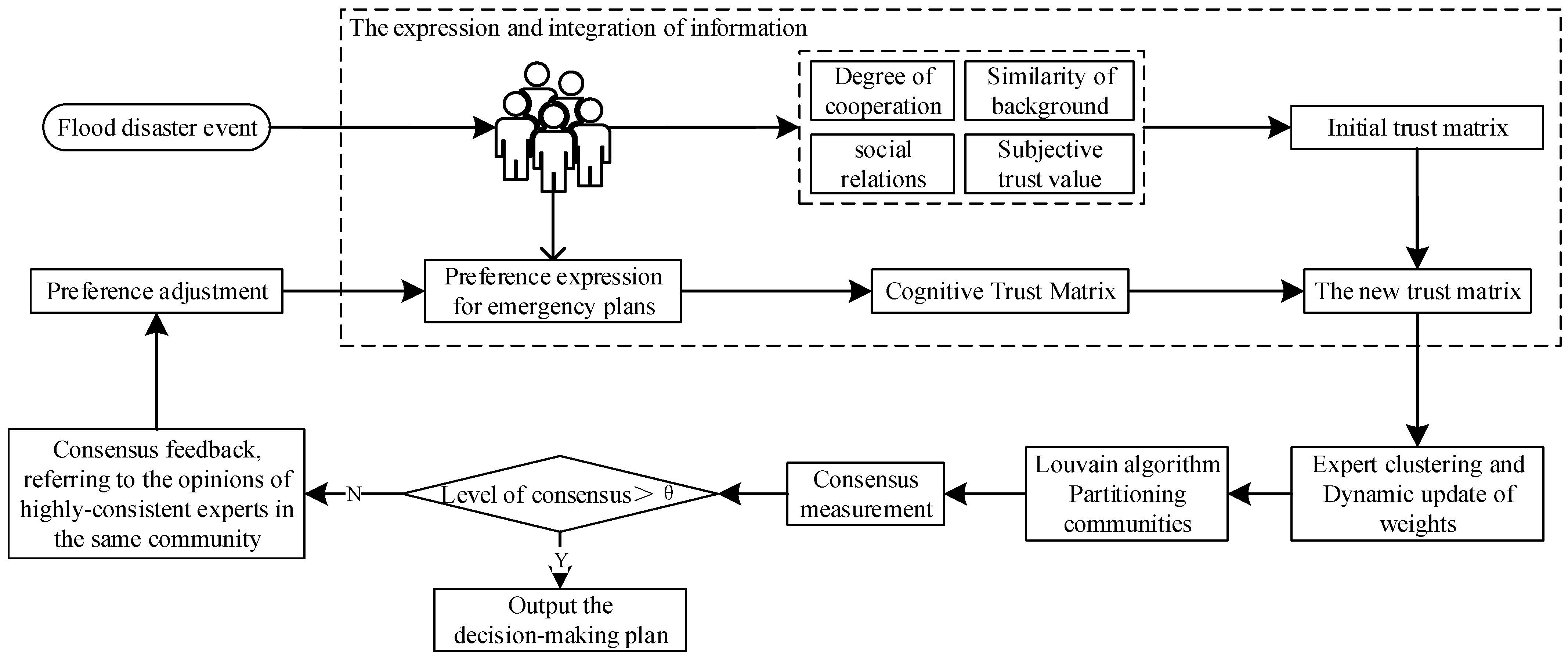
In the traditional large-scale emergency decision-making process, the trust relationships among decision members are usually maintained in a static manner based on social networks, ignoring the fact that the trust relationships between experts may strengthen or weaken as the decision-making process changes, and new trust connections may also be formed during the decision-making process. This paper constructs a trust relationship network driven by preference distance, enabling the dynamic calculation of trust relationships during the group interaction process. It uses social network relationships to study the dynamic changes in trust relationships and realizes the temporal clustering of experts and the update of expert weights.
3.3.1. Establish the Initial Social Network Relationships and Determine the Initial Weights of Experts
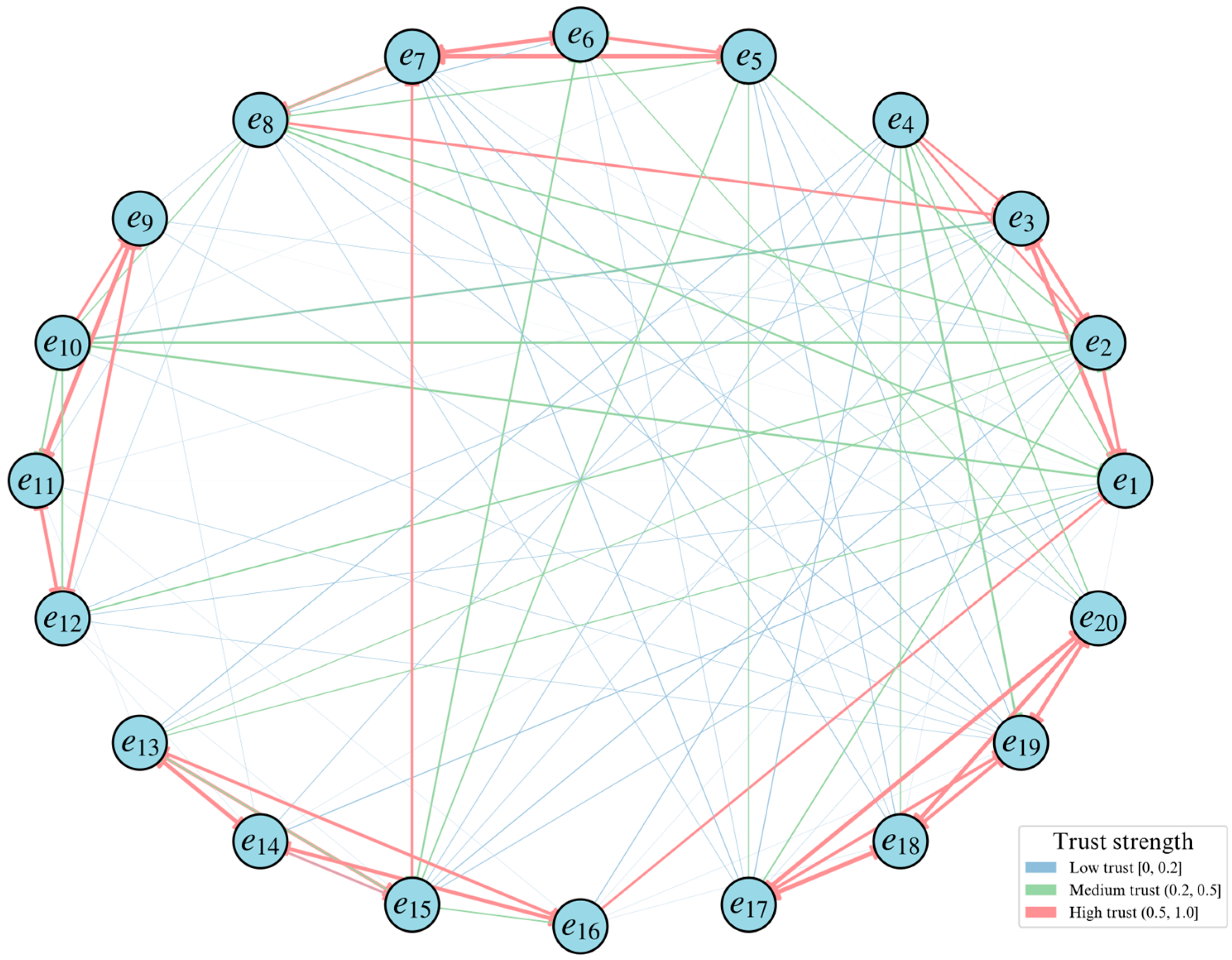
The experts in flood disaster emergency decision-making come from various fields and possess different research backgrounds, social experiences, etc. Their social relationships with each other also vary to some extent. Determining the initial relationships and initial weight relationships among the decision-making members is the starting point of large-scale group decision-making in a social network environment. Quantifying the complex social relationships among experts provides a good basis for studying the dynamic evolution process of trust relationships.
(1) Acquisition of the initial trust matrix. The initial trust matrix
serves as the basis for subsequent calculation of the weights of experts. Its elements
represent the initial trust level of expert
towards expert
, satisfying
, and
. This section obtains the initial trust matrix by deriving from the data of historical relationships among experts. In the social network relationship of experts, objective factors such as cooperation intensity, social relationship, and background similarity all have an impact on the trust relationship between experts. At the same time, the subjective trust evaluation score between experts is introduced. Based on these factors, the trust relationship between experts is measured, and the trust value between experts is obtained through a linear weighting model:
Among them,
represents the intensity of cooperation among experts, the degree of collaboration reflects the frequency of past scientific research collaboration among experts. It maps the number of paper collaborations
and project collaborations
of experts within five years to the interval [0, 1] through range normalization:
Here, “⊕” represents taking the maximum value, which is used to highlight the strongest cooperative relationship. If there is not any cooperative record among the experts, then
;
represents the social relationship among experts, social relationship profiling experts to measure the strength of their personal bonds. Starting from the general social situation, the relationships are classified into three levels and assigned values: “Teacher–student relationship = 1”, this relationship often involves long-term guidance and frequent interaction, with a solid foundation of trust; “Colleague relationship = 0.8” This relationship involves stable work collaboration but lacks deep personal connection; “No connection = 0”, for experts with no intersection, the initial trust is 0. For experts with multiple relationships, the maximum value is taken as
to reflect the dominant role of the strongest relationship;
represents the similarity index of experts’ backgrounds, The similarity measurement of background measures the degree of alignment of experts in a specific research field. By obtaining the keywords of the experts’ backgrounds and calculating the cosine similarity between experts
and
based on the keyword vectors, corresponding data is obtained;
represents the initial subjective trust value among experts, which reflects the experts’ subjective assessment of each other’s capabilities and reliability. Each expert is assigned a trust value of 5 points, and this value is directly assigned and distributed to all other experts (with some or no distribution possible). Parameters η1, η2, η3, η4 are assigned corresponding weights by experts and , finally the value of is normalized to the interval [0, 1].
(2) Calculate the initial weights of experts. The initial weights of experts are determined by their relative influence in the social network relationship. Given the directionality of the trust relationship, the degree of influence is measured by in-degree centrality. The calculation of this indicator is through the cumulative sum of the trust values of all other experts towards this expert, which is
By calculating this indicator, the total amount of trust that the expert
has gained within the group can be effectively obtained as the initial reputation, and the initial weight of the expert can be obtained through normalization processing.
3.3.2. Dynamic Trust Relationship Measurement
The characteristics of floods, such as diversity and suddenness, make it necessary for emergency decision-makers to make judgments under conditions of high risk, incomplete information, and tight time constraints [
28]. The previous experience and knowledge capabilities of experts are insufficient to fully address the problems arising during the decision-making process. In existing studies, only the static trust based on social networks and social relationships of experts in the emergency decision-making process is considered. This paper, on the basis of comprehensively considering the emotional trust brought by experts’ historical experience and social relationships, fully takes into account the changes in trust caused by experts’ cognition during the decision-making process. Through the changes in cognitive trust, the dynamic update of the trust relationship between experts is achieved.
(1) Collection of preference information and supplementation of incomplete information. To facilitate experts to express their judgments quickly and intuitively under high-pressure situations, and considering the fuzziness of experts when expressing evaluation information, this paper adopts the “direct numerical scaling method” based on the intuitive fuzzy term set. Experts directly provide numerical values of membership degree and non-membership degree within the interval [0, 1], and satisfy , ultimately forming the intuitive fuzzy decision matrix of all experts. Through the direct replication method, it avoids the additional language conversion process, and can more accurately capture the subtle attitude differences in experts towards the schemes. However, considering that there are situations where experts partially express their preferences during the expression process, this paper adopts the weighted average method based on the trust network for supplementation:
Among them, represents the set of neighboring experts who have a trust connection with expert ; represents the experts who reached the threshold of individual consensus in the previous round as references, thereby ensuring the reliability of the reference opinions; is the trust value of expert towards expert in the previous round; is the preference value of expert for scheme in the previous round.
By using the historical preferences of the expert group that expert trusts the most and whose opinions are the most reliable to reasonably estimate the missing values, the transmission effect of the trust network is achieved, while avoiding the interference of experts with low consensus. For evaluations that have not submitted any schemes, it is considered that their current preferences are completely missing. At this time, this expert does not directly participate in the expression of current preferences, but remains as a node in the trust network, and the preference information expression of this round is temporarily replaced by their previous valid preference.
(2) Calculate cognitive trust. Changes in experts’ preferences can lead to differences or convergence in opinions regarding the same solution, and thus also result in changes in the distance between experts’ social networks. This paper uses the intuitive fuzzy Hamming distance to calculate the preference differences between experts and between two rounds, and calculates the distances between the k-1 round and the kth round in the decision-making process:
By calculating the distances of two rounds, the changes in trust due to cognition and behavior were fully captured, and the amount of trust change was calculated based on the distance of the two rounds of preferences:
The changes therein fully reflect the shifts in the preferences of the experts between the two rounds. If , it indicates that the opinions of the experts and the experts are more aligned in this round, and the cognitive trust has increased; if , it indicates that the opinions of the experts and the experts are in disagreement in this round, and the cognitive trust has decreased; if , it indicates that the relative positions of the experts and the experts remain unchanged in this round, and the cognitive trust does not change at all.
(3) Update dynamic trust values. After comprehensively considering the dynamic changes in the trust relationships among experts, it is also necessary to incorporate historical trust into the process of trust change. Cognitive trust should be regarded as an element that regulates the initial emotional trust. Using the exponential smoothing method, the changes in historical trust and current cognitive trust are integrated to form a dynamic trust matrix :
Among them,
is the forgetting factor. When ρ approaches 1, this model is more dependent on historical trust; when ρ approaches 0, the model is more dependent on recent cognitive trust. In the exponential smoothing model, the stable range of the smoothing parameter is [0, 2] [
29]. Therefore, the value of ρ within the interval [0, 1] is theoretically feasible. Considering the emergency decision-making scenario for flood disasters, the expert trust relationship needs to maintain a certain continuity while moderately responding to changes in preferences. At the same time, the symmetry of the previous trust relationship and the dominant role of the initial trust relationship should be taken into account. Thus, the determination of
ρ is often made by experts, and it is adjusted within the range of 0.6–0.8. And at the beginning of trust, a lower value can be taken, and based on the first fusion, τ = 1, which is the dynamic fusion of the initial matrix and the first preference adjustment. Finally, boundary processing is carried out for
to ensure that its range is between 0 and 1:
3.3.3. Expert Clustering and Weight Update Under Dynamic Trust
(1) Expert clustering. The Louvain community discovery algorithm is an efficient community discovery algorithm that automatically identifies the community structure in a trust network based on the principle of modularity optimization [
30]. It has the characteristics of fast execution speed, obvious clustering effect, and high accuracy. The Louvain community discovery algorithm is used to achieve dynamic clustering of experts. It includes two stages of iterations: the first stage, the local optimization stage, traverses all expert nodes in the community and calculates the modularity gain when moving to the neighboring community, and performs the movement to maximize the modularity; the second stage, the network aggregation stage, treats each community as a super node, reconstructs the network and repeats the optimization process. The algorithm finally outputs a hierarchical community division where experts in the same community have a high degree of mutual trust.
During the process of realizing the dynamic changes in expert trust relationships, after each round of k-trust matrix Tk is calculated, it needs to be traversed by the algorithm. Based on modularity optimization, experts are divided into several communities where the experts within each community have closely connected internal connections and sparse external connections.
(2) Update of individual expert weights. The update of expert weights is also a core part of the dynamic trust-driven model, aiming to incorporate the behavioral performance of experts during the decision-making process into the trust adjustment process. For the expert trust value
calculated in the current period, based on the average trust value
obtained by the current expert
i, it is normalized to obtain the current expert’s weight, and the current expert weight
is fused with the previous round’s weight to obtain the comprehensive weight in the current state:
Among them, the parameter
. When
λ approaches 1, it indicates that the model is relatively conservative and the weight changes slowly. When λ approaches 0, it indicates that the model is sensitive and the weight changes drastically. Taking into account Gardner’s description of the exponential smoothing model, namely that the stable range of the smoothing parameter is [0, 2] [
29], and considering the flood emergency decision-making scenario, while also avoiding the lag in weight updates caused by excessive conservatism; therefore, the current performance of experts is given priority over their qualifications. Therefore, the selection of parameter
λ can be between 0.2 and 0.4.
(3) Calculation of the weights of the expert group. The aggregation of experts is carried out to simplify the diverse opinions existing in the decision-making process. Therefore, based on the similarity of preferences shown by experts for the decision-making plan, experts with similar preferences are grouped together, and the opinions are integrated. At the same time, a corresponding weight is assigned to each group generated, and the weights of each group tribe are obtained to better express the expert opinions.