Article

Enhancing Stable Electricity Generation and Assimilative Ammonium-N Removal in Photosynthetic Algae–Microbial Fuel Cells Using a Chlorella Biofilm-Loaded ZnO-NiO@rGO Carbon-Fiber Composite Cathode


1
State Key Laboratory of Water Pollution Control and Green Resource Recycling, College of Environmental Science and Engineering, Tongji University, 1239 Siping Road, Shanghai 200092, China
2
Department of Environmental Science and Engineering, University of Science and Technology of China, Hefei 230026, China
*
Authors to whom correspondence should be addressed.
Water 2026, 18(6), 733; https://doi.org/10.3390/w18060733
Submission received: 3 February 2026 / Revised: 7 March 2026 / Accepted: 17 March 2026 / Published: 20 March 2026
(This article belongs to the Special Issue Advanced Biological Wastewater Treatment and Nutrient Removal)

Abstract

Photosynthetic algae–microbial fuel cells (PAMFCs) are attractive for energy-positive wastewater treatment and carbon mitigation. However, PAMFC performance under continuous flow is often constrained by limited cathodic electron-acceptor supply and unstable photosynthetic biofilms, while the extent to which cathode interfacial engineering can stabilize diurnal power output and assimilative NH4+–N removal remains unclear. In this study, the sponge-like and petal-like ZnO0.2-NiO@rGO-modified carbon fibers (ZnO0.2-NiO@rGO-pCFs and ZnO0.2-NiO@rGO-pCFp) and pre-fabricated carbon felt (pCF) were used as cathode materials to construct three sets of PAMFC systems. Under light–dark cycling, the engineered cathodes reached steady operation within about 6.5 d and increased the steady-state voltage to approximately 0.35 V, compared with approximately 0.08 V for pCF. Under continuous-flow conditions, cathodic NH4+–N removal exhibited a stable diurnal rhythm, with higher removal during illumination at about 43–51% than in the dark at about 29–30%, consistent with algal assimilation as the primary nitrogen sink, while cathode modification mainly improved the cathodic microenvironment and response stability. Compared with pCF, the ZnO0.2–NiO@rGO cathode enriched a more even, Chlorophyta-dominated algal biofilm with an approximate relative abundance of 80%, indicating that its selective interfacial environment favors biofilm stabilization and sustains in situ oxygen production and cathodic electron-acceptor supply. Consequently, the composite cathode enhanced voltage output and stabilized light-enhanced, assimilative NH4+–N removal under aeration-free operation, while establishing an interpretable link between electrochemical performance and 18S rDNA-derived community assembly features, thereby providing a low-cost cathode design basis for nitrogen removal in wastewater treatment.

1. Introduction

Driven by energy scarcity and carbon reduction targets, environmental bioelectrochemical technologies with the potential for pollution control, energy recovery, and carbon emission mitigation have attracted broad attention [1]. Environmental bioelectrochemical technologies refer to a class of systems in which electroactive microorganisms mediate electron transfer at electrode interfaces, thereby driving energy conversion and substance transformation. They encompass multiple configurations, such as microbial fuel cells (MFCs) and microbial electrolysis cells (MECs) [2,3]. In wastewater characterized by high ammonium nitrogen, such as urine, livestock manure wastewater, and their anaerobic digestate, these systems have been used for ammonium removal and recovery. They have further evolved into device types including microbial desalination cells and bioelectroconcentration units [4]. Compared with MEC-based configurations that typically require an externally applied voltage, MFCs can simultaneously generate electrical power during pollutant removal, enabling the coupling of pollution control with energy recovery [5,6]. However, in most MFC configurations that use oxygen as the cathodic electron acceptor, maintaining a continuous electron-acceptor supply still often relies on external aeration or oxygen delivery, which increases energy consumption and weakens the advantage of energy recovery [7,8]. To address this bottleneck, photosynthetic microbial fuel cells with photosynthetic biocathodes can use photosynthesis to provide the cathodic electron acceptor in situ, offering a feasible route to reduce dependence on external oxygen supply [9].
Photosynthetic algae–microbial fuel cells (PAMFCs) introduce microalgae at the cathode. They rely on photosynthesis to achieve in situ oxygen production and concurrent CO2 fixation, thereby providing a sustainable electron-acceptor source for the cathode without external aeration [6]. A PAMFC was built with Chlorella as the photosynthetic biocathode. Anode-derived CO2 drove photosynthetic in situ oxygen production to supply cathodic electron acceptors, reaching a maximum power density of 187 mW·m−2 under illumination [10]. At the same time, the assimilative demand of algae for nitrogen may cause a periodic response of ammonium–nitrogen removal under light–dark alternating conditions [8]. In a microalgae-assisted cathodic MFC, ammonium removal showed a periodic response under different light and dark cycles [11]. The 12 h light and 12 h dark regime achieved the highest NH4+-N removal rate of 95.5%. Ammonium removal was also reported to increase with increasing photon flux density, indicating that light-driven algal processes can induce a diurnal removal response under alternating light and dark conditions [11]. In practical operation, in situ oxygen supply by algal biocathodes and the associated cathodic reactions are highly sensitive to light conditions, so system performance often fluctuates with light intensity and dissolved oxygen level; moreover, an imbalance among electron transfer, proton supply, and oxygen supply can induce cathodic pH gradients, which weakens oxygen reduction reaction kinetics and aggravates mass-transfer limitations, thereby reducing power-generation stability and affecting nitrogen assimilation processes [12]. A bacterium–Chlorella photosynthetic biocathode MFC treated diluted synthetic wastewater. Under illumination, cathodic dissolved oxygen (DO) increased from 250 to 750 μmol·L−1 and pH from 6.7 to 8.8, restricting proton diffusion and thereby limiting oxygen reduction reaction (ORR), power output, and denitrification efficiency [13]. Algae-assisted cathodes can reduce the need for external aeration by enabling photosynthetic in situ oxygen production, but PAMFC performance is still affected by coupled fluctuations in light, CO2 and nutrient supply, and pH, and the cathodic ORR is readily limited by oxygen solubility and three-phase interfacial mass transfer [14]. Moreover, insufficient algal biofilm immobilization and cathode durability make it difficult to simultaneously maintain high-efficiency power generation and nitrogen-pollutant removal during continuous operation [15], so strengthening cathodic algal biofilm immobilization and stability remains a key bottleneck for sustainable operation and scale-up of PAMFCs.
Transition metal oxides such as NiO and ZnO are considered candidate materials to replace precious-metal catalysts because of their low cost and potential ORR catalytic activity [16,17]. NiO–CuO/G composite transition metal oxides were used as the cathode catalyst in an air-cathode MFC. The maximum power density was about 21.3 mW·m−2, and the catalyst showed stronger ORR electrocatalytic activity [18]. Reduced graphene oxide (rGO) can build conductive networks and promote the dispersion of active components [19]. The N-doped FeCo/rGO composite catalyst reached a current density of 5.2 mA·cm−2 at 0.85 V, and rGO promoted the dispersion of active components, thereby improving ORR catalytic performance [20]. A graphite felt cathode with a three-dimensional fibrous porous architecture achieved a maximum current density of 350 mA·m−2 and a maximum power density of 109.5 mW·m−2, thus enhancing power generation efficiency [21]. These results suggest that a higher specific surface area and porous structure can expand the effective reaction interface and alleviate mass-transfer constraints. However, existing studies have largely relied on electrochemical metrics, such as ORR activity, charge-transfer characterization, and power output, as the primary evaluation criteria. Systematic evidence is still lacking for community assembly driven by interfacial conditions and for the feedback mechanisms linking community changes to electricity generation and ammonium–nitrogen removal [22].
Microbial community succession is closely associated with both contaminant removal and electricity generation in MFC-based systems. A 240-day tidal-flow constructed wetland coupled with an MFC (TFCW-MFC) showed that 10 μg·L−1 sulfamethoxazole (SMX) achieved 63.8% NH4+-N removal and a 524.5 mV peak voltage, coinciding with enrichment of electroactive bacteria [23]. An MFC-constructed wetland (MFC-CW) packed with coke achieved 79.89% NH4+-N removal and a 207 mV average voltage, with enrichment of electrogenic functional taxa [24]. A membrane-less photosynthetic MFC with a revolving algal–bacterial (RAB) biofilm cathode achieved 98.0 ± 0.6% NH4+-N removal and 136.1 mA·m−2 max current; 18S profiling linked biofilm assembly to coupled removal and power output [25]. Although PAMFCs show promise for in situ oxygen supply, reduced aeration demand, and coupled nitrogen removal, the coupled mechanisms linking cathode interfacial enhancement to nitrogen removal processes remain insufficiently understood. Existing studies largely evaluate cathode materials using ORR-related electrochemical parameters and power output, whereas the diurnal response patterns and stability of cathodic NH4+-N removal under continuous-flow operation have rarely been systematically quantified [26]. Meanwhile, morphology-controlled, high-surface-area composite cathodes are believed to improve electron-acceptor availability and promote stable attachment of algal biofilms; however, comparative studies conducted within a unified operational framework to verify their overall effects are still limited [27]. In addition, mechanistic evidence remains scarce regarding how the cathode interfacial microenvironment shapes eukaryotic biofilm community assembly and how the resulting community shifts, in turn, regulate the coupled performance of electricity generation and light-enhanced nitrogen assimilation [28].
Accordingly, we constructed photosynthetic algae–microbial fuel cells (PAMFCs) using Chlorella as the cathodic biofilm and explicitly compared three cathode conditions, including sponge-like and petal-like ZnO0.2–NiO@rGO-modified carbon fibers and a conventional carbon felt cathode as the benchmark. Under light–dark alternating operation, we quantitatively evaluated the start-up behavior and diurnal stability of voltage output; under continuous-flow conditions, we systematically characterized the periodic response patterns and stability of cathodic NH4+-N removal. In parallel, 18S rDNA high-throughput sequencing was used to resolve changes in the composition and diversity of the cathodic eukaryotic biofilm community, and to relate these community dynamics to cathode interfacial conditions and performance fluctuations. By integrating cathode material configuration, operational responses, and community-level evidence, this study provides verifiable mechanistic support for low-cost cathode enhancement and offers a basis for achieving stable energy recovery and nitrogen removal without external aeration.

2. Materials and Methods

2.1. PAMFC Setup and Operating Conditions

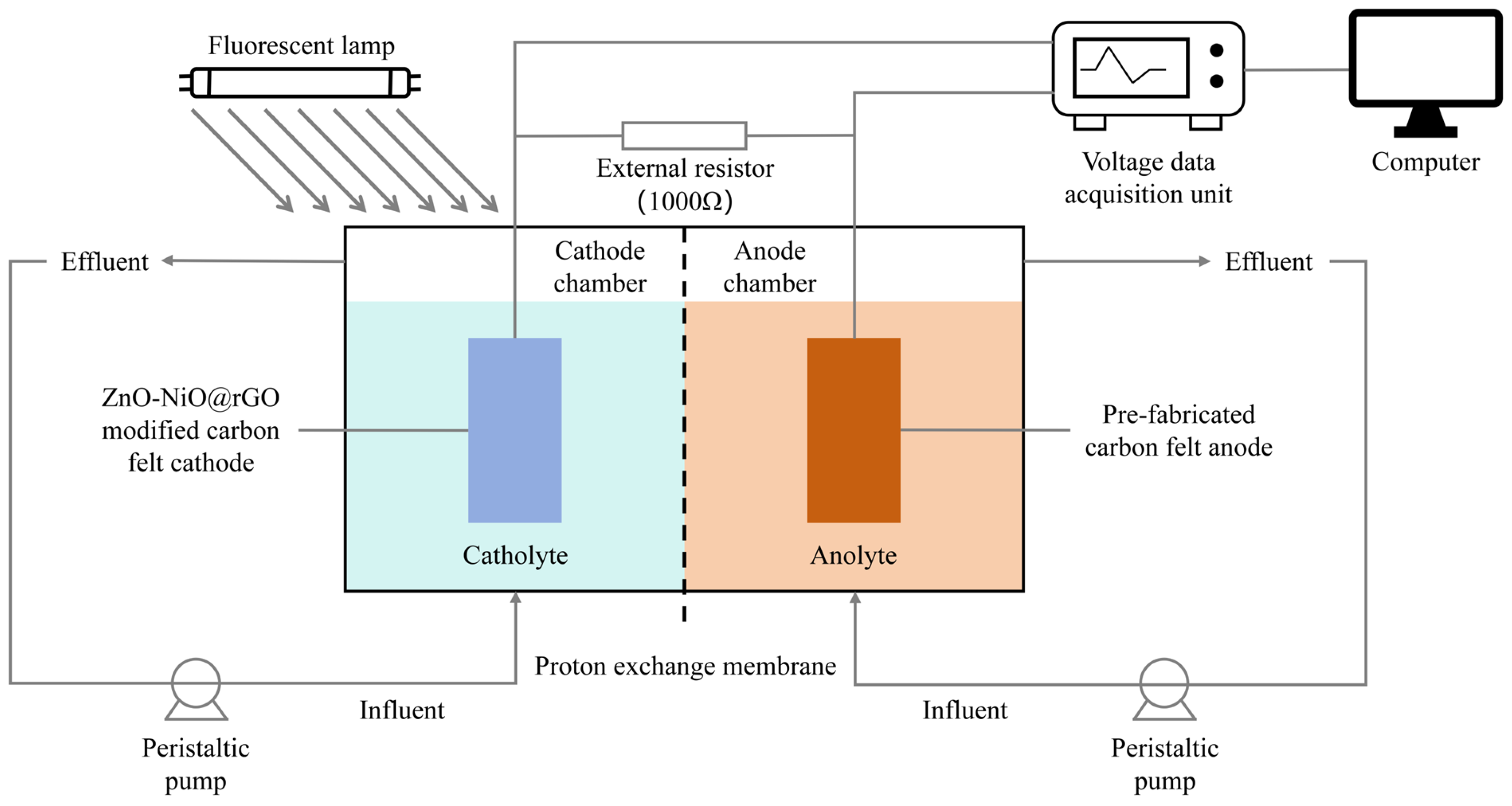
The anode chamber was maintained as a sealed anaerobic environment. The cathode chamber was operated under continuous flow, with influent introduced from the bottom and effluent discharged by overflow at the top. The anode chamber was also operated in continuous-flow mode with influent and effluent. The schematic system is shown in Figure 1. One control group and two experimental groups were established, and each group included three parallel reactors. The anodes in all three groups were pre-fabricated carbon felt (pCF). The cathode of the control group was also pCF and was denoted as R1. The cathodes of the experimental groups were modified carbon fibers prepared in our previous work [12]. The cathode in R2 was sponge-like ZnO0.2-NiO@rGO-pCFs, while the cathode in R3 was petal-like ZnO0.2-NiO@rGO-pCFp. The morphology and microstructure of the sponge-like and petal-like ZnO0.2–NiO@rGO-modified carbon fibers were characterized in our previous work [12] (e.g., scanning electron microscopy (SEM) and transmission electron microscopy (TEM)), and are therefore not repeated here. SEM imaging of the cathodic algal biofilm after PAMFC operation was not performed in this work. In the present study, the textural properties of the cathodes were quantified by N2 adsorption-desorption analysis based on the Brunauer-Emmett-Teller (BET) method using an ASAP 2460 surface area and porosity analyzer (Micromeritics, Norcross, GA, USA). The specific surface areas of pCF, ZnO0.2–NiO@rGO-pCFs, and ZnO0.2–NiO@rGO-pCFp were 1.45, 213.53, and 234.36 m2·g−1, respectively; the corresponding pore volumes were 0.002, 0.056, and 0.032 cm3·g−1, and the average pore sizes were 5.58, 7.36, and 4.42 nm, respectively [12]. All electrodes had dimensions of 3 cm × 3 cm × 0.3 cm. The two electrodes were connected with titanium wires to form an external circuit, and a fixed external resistance of 1000 Ω was applied. The catholyte was a modified BG11 medium (BG11) supplemented with trace elements (1 mL·L−1). The anolyte contained CH3COONa·7H2O at 2.13 g·L−1, NH4Cl at 0.1 g·L−1, and CaCl2·2H2O at 0.015 g·L−1. In addition, 50 mL of phosphate buffer solution (PBS) was added, and the pH was maintained at 7.4. The formulations of the catholyte and trace elements are listed in Table 1. A Nafion 117 proton exchange membrane (DuPont, Wilmington, DE, USA) was used. Before use, it was boiled in 5% H2O2 at 80 °C for 1 h, rinsed with deionized water, and then boiled in 1 mol·L−1 H2SO4 for 1 h to convert it to the H+ form. It was subsequently soaked in deionized water and boiled for another 1 h. Finally, it was stored in deionized water until use. The operating temperature of the PAMFC was controlled at 25 ± 2 °C. The cathode side was illuminated by Philips MASTER TL-D Super 80 36W/865 fluorescent lamps (Signify, Eindhoven, The Netherlands) under a 12 h/12 h light–dark cycle; the lamp specifications were T8, 6500 K, and G13. The manufacturer-reported emission spectrum of the lamp is provided as Figure S1 (Supplementary Information). The illuminance at the cathode surface was 3000 ± 250 lux. No additional stirring was applied during operation.

2.2. Microalgal Cultivation and Inoculation of Cathodic Biofilms

The microalga used in this study was Chlorella vulgaris, which was purchased from the Freshwater Algae Culture Collection of the Wild Biological Germplasm Bank, Chinese Academy of Sciences, Wuhan, China. For scale-up cultivation, the algal suspension was inoculated into BG11 medium at a ratio of 1:20 (v/v). Cultivation was conducted at 25 ± 2 °C with an illuminance of 3000 ± 250 lux and a 12 h/12 h light–dark cycle. Sterile procedures were maintained during inoculum preparation to ensure a reproducible starting culture. It should be noted that the subsequent PAMFC operation was not conducted under axenic conditions, and the practical goal is to maintain a Chlorella-dominant attached biofilm rather than strict culture purity. During cultivation, the Erlenmeyer flasks were shaken three times per day to enhance mass transfer and promote uniform growth. When the culture reached the target cell density, it was used for cathode inoculation. Cathode inoculation was performed using a static immersion method. The prepared ZnO-NiO@rGO-modified carbon-felt cathodes were immersed in the algal culture and incubated under static conditions for approximately 36 h. The electrodes were then removed and used for PAMFC operation tests.

2.3. Synthetic Wastewater

The influent used in the experiments was mainly synthetic ammonium–nitrogen wastewater. It was prepared by adding NH4HCO3 to tap water as the nitrogen source. NaHCO3 was added as the inorganic carbon source and as a pH buffer. To ensure sufficient alkalinity, the main components of the synthetic water followed the BG11 medium formulation. When the effect of an organic carbon source was investigated, CH3COONa was used as the organic carbon source. For each 1 L of the synthetic wastewater, 1 mL of a trace-element stock solution was added. The compositions and contents of the synthetic wastewater and the trace-element stock solution are listed in Table 2.

2.4. Electrochemical Monitoring and Analytical Methods

Cell voltage was monitored in real time using a Keithley 2700 data acquisition system (Keithley Instruments, Solon, OH, USA). The system consisted of an acquisition terminal and PC-based acquisition software, ExceLINX-1A (Version C06). The recorded signal was defined as the overall cell voltage between the anode and cathode electrodes (cell voltage). The sampling interval was set to 5 min, and the data were saved automatically. All groups were tested in triplicate (n = 3). For water-quality parameters, NH4+-N was determined using the Nessler reagent spectrophotometric method using a UV-1800 UV-Vis spectrophotometer (Shimadzu, Kyoto, Japan). In this study, nitrogen removal was evaluated based on NH4+-N only; other nitrogen species were not monitored. Pore-structure parameters, including pore size and specific surface area, were measured using the BET method. Polarization and power density curves for the morphology-defined ZnO0.2–NiO@rGO cathodes were reported in our previous work [12].

2.5. Microbial Community Structure Analysis

After stable operation was achieved, algal biofilms were scraped from the surfaces of the PAMFC cathodes and the biomass was collected by centrifugation. The homogenized pellets were aliquoted into sterile centrifuge tubes. They were centrifuged at 10,000 rpm for 3 min, and the supernatant was discarded to obtain biomass for DNA extraction. Genomic DNA was extracted using an E.Z.N.A. Mag-Bind Soil DNA Kit (Omega Bio-tek, Inc., Norcross, GA, USA) according to the manufacturer’s instructions. Integrity was evaluated by agarose gel electrophoresis, and DNA was quantified with a Qubit 3.0 fluorometer (model Q32866, Invitrogen, Carlsbad, CA, USA). The V4 region of the 18S rRNA gene was selected for amplification. Polymerase chain reaction (PCR) was performed on an ETC811 thermal cycler (Beijing Dongsheng Chuangxin Biotechnology Co., Ltd., Beijing, China) using primers 18SV4F (GGCAAGTCTGGTGCCAG) and 18SV4R (ACGGGTATCTRATCRTCTTCG). The PCR volume was 30 μL and contained 15 μL of 2× Hieff Robust PCR Master Mix (Yeasen Biotechnology, Shanghai, China), 1 μL of each primer, and 10–20 ng of template DNA. Nuclease-free water was added to reach the final volume. After confirmation by electrophoresis, the amplicons were used for library construction. Illumina-compatible adapters and index sequences were introduced. Library size was verified by 2% agarose gel electrophoresis, and the libraries were quantified prior to sequencing. Sequencing data were demultiplexed by barcodes using Illumina BCL Convert (v4.4.6) and subjected to quality control using fastp (v0.24.2). Low-quality sequences were removed, and chimeric sequences were subsequently filtered out before OTU clustering. Operational taxonomic unit (OTU) clustering using VSEARCH (v2.30.3), followed by taxonomic annotation using q2-feature-classifier in QIIME 2 (2024.10). Alpha diversity was characterized using abundance-based coverage estimator (ACE), Chao1, Shannon, Simpson, and Coverage indices. For community composition, the relative abundance of taxa at the phylum level was calculated and visualized. This analysis was used to compare community differences between algal biofilms on different cathode materials and the original inoculated algal suspension.

3. Results and Discussion

3.1. Electricity Generation Performance of PAMFCs

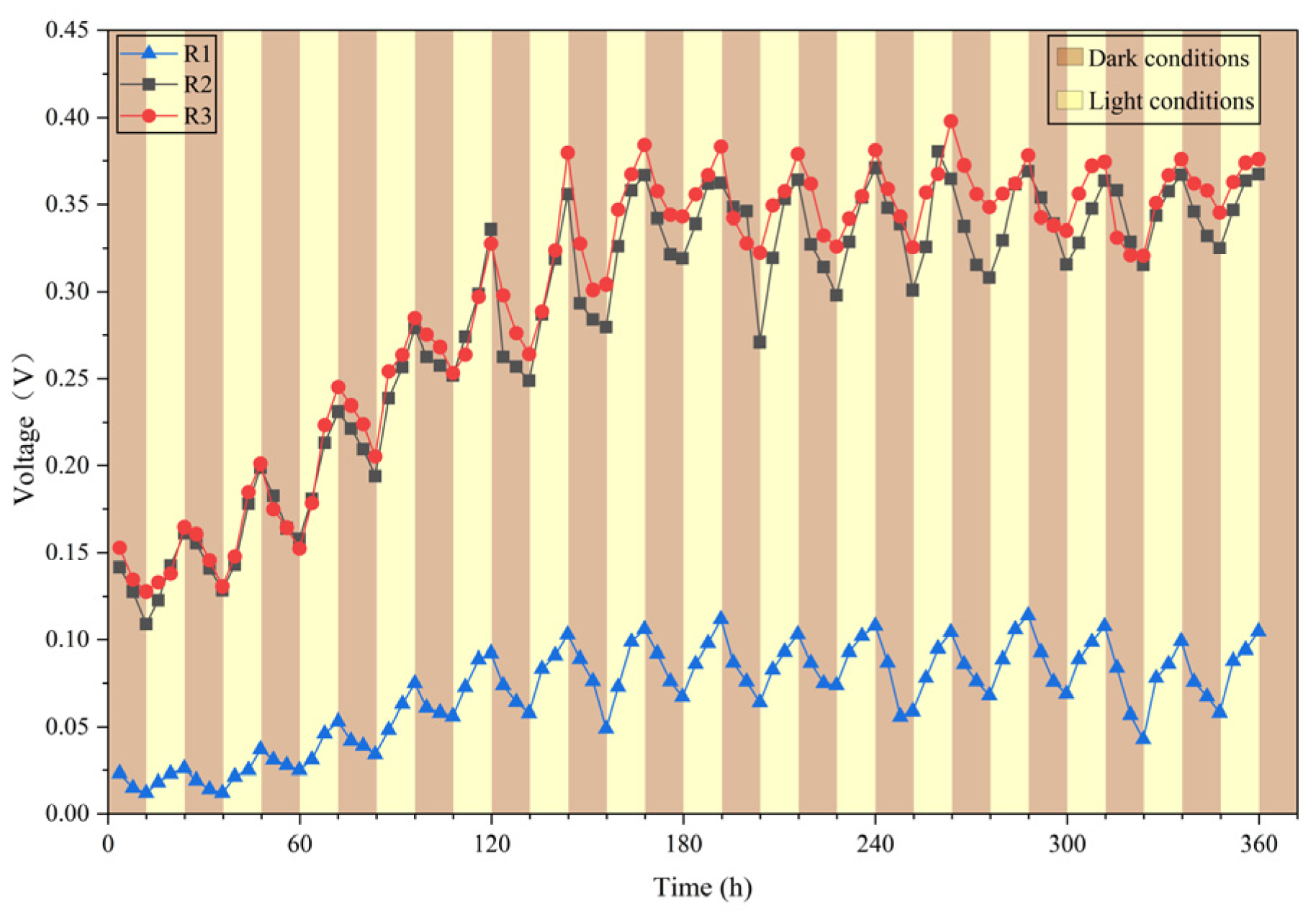
The electricity generation performance of the PAMFCs is shown in Figure 2. For the same cathode material, the output voltage differed markedly between light and dark conditions. It fluctuated periodically with the light–dark alternation. During the light period, Chlorella vulgaris carried out photosynthesis and increased the dissolved oxygen level in the cathode chamber. This provided the terminal electron acceptor for cathodic reactions. As a result, protons and electrons were continuously consumed through the external circuit, the circuit was gradually established, and the voltage increased. As dissolved oxygen accumulated to a relatively high level in the closed cathode chamber, the voltage further approached a quasi-steady state. In contrast, photosynthesis was suppressed during the dark period. Dissolved oxygen was continuously consumed, and the supply of cathodic electron acceptors became relatively insufficient. The voltage therefore decreased. Accordingly, the overall voltage curve exhibited a stable rise–fall fluctuation pattern. In this study, stability refers to the reproducible diurnal (light–dark) periodic response observed during the present ~360 h (15 d) continuous-flow operation, rather than long-term durability over months. A comparison among different electrode materials showed that R2 and R3 reached stable output at approximately day 6.5, whereas R1 became stable at around day 7.5. This indicates that the modified cathodes helped shorten the start-up period and accelerated the transition of PAMFCs from start-up to stable electricity generation. During the stable-output stage, the voltage of R2 was maintained at 0.34–0.38 V, and that of R3 was 0.35–0.37 V. By contrast, the pre-fabricated carbon felt was only 0.06–0.09 V. Relative to the pre-fabricated carbon felt, the modified cathodes substantially increased the steady-state voltage. The improved electrochemical output of ZnO0.2–NiO@rGO cathodes is consistent with the polarization curves and power density characterization reported previously [12]. This result suggests that, under closed and non-aerated conditions, the in situ oxygen supplied solely by Chlorella vulgaris photosynthesis can still provide a sustained electron-acceptor source for the cathode and maintain system operation. Therefore, this system has potential advantages in reducing dependence on external aeration for oxygen supply and thereby lowering operational energy consumption. Given the improved voltage output, we further examined whether cathode interfacial engineering also stabilizes the diurnal response of cathodic NH4+-N removal under continuous-flow operation.

3.2. Analysis of Ammonium-N Uptake at the PAMFC Cathode

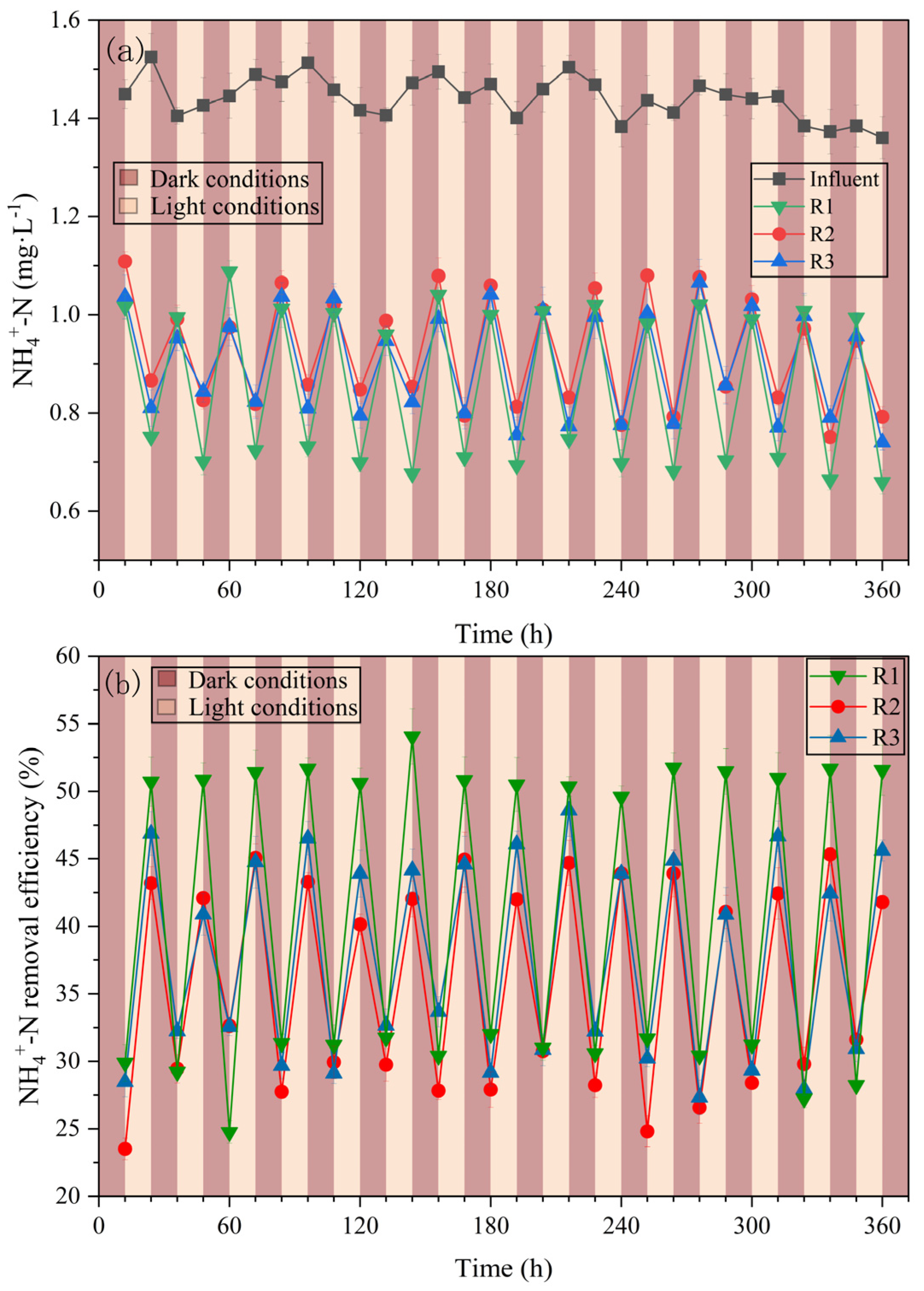
Compared with conventional microbial fuel cells, PAMFCs introduce photosynthetic microalgae at the cathode. This enables enhanced cathodic electron-acceptor supply via photosynthetic oxygen production. It also provides additional nitrogen removal pathways through algal assimilative uptake of nitrogen sources, thereby leading to a characteristic response to light–dark alternation. Under illumination, Chlorella vulgaris assimilates ammonium–nitrogen and inorganic carbon for growth and reproduction, while releasing oxygen. This supplies a more sufficient source of electron acceptors for cathodic reactions [29]. As shown in Figure 3a, under continuous-flow operation with an hydraulic retention time (HRT) of 1.0 d, influent NH4+-N fluctuated within 1.36–1.52 mg·L−1, with an average of 1.44 mg·L−1. The cathode effluent NH4+-N in the control group R1 and in the experimental groups R2 and R3 all exhibited periodic fluctuations with light–dark switching. The corresponding NH4+-N removal efficiencies are presented in Figure 3b, and the values in the light period were clearly higher than those in the dark period. When one light–dark cycle was considered, the average removal efficiencies of R2, R3, and R1 during the light period were 43.1 ± 1.6%, 44.7 ± 2.2%, and 51.2 ± 1.0%, respectively. The corresponding effluent NH4+-N concentrations were 0.820 ± 0.034, 0.796 ± 0.032, and 0.703 ± 0.027 mg·L−1, respectively. During the dark period, the removal efficiencies decreased to 28.6 ± 2.4%, 30.4 ± 1.9%, and 30.1 ± 2.0% for R2, R3, and R1, respectively, and the effluent NH4+-N increased to 1.031 ± 0.049, 1.004 ± 0.036, and 1.009 ± 0.029 mg·L−1, respectively. Notably, although the control R1 exhibited a higher mean and peak NH4+-N removal during the light period (peak 54.1% at 144 h) than R2 and R3, it also showed a larger diurnal fluctuation, with a light–dark difference of 21.1%. By contrast, the modified cathodes reduced this light–dark difference to 14.5–14.3% (32% lower), indicating that the primary advantage of the ZnO0.2–NiO@rGO cathodes lies in improving the stability of the diurnal response under continuous-flow operation rather than increasing the peak removal capacity. This difference may be associated with the influence of electrode surface properties on the proportions of attached algae and suspended algae [12,28,29,30], which warrants further verification by combining indicators such as SEM imaging of biofilm architecture, algal biofilm biomass on the cathode surface, suspended algal concentration in the effluent, and time-series measurements of dissolved oxygen and pH [30,31]. It should be noted that, in this study, nitrogen removal was assessed as the net decrease in NH4+-N between the influent and cathode effluent. Other nitrogen pools, biomass-bound nitrogen, and potential gaseous losses were not quantified; therefore, a complete nitrogen mass balance and a quantitative partitioning of algal assimilation versus other possible pathways are beyond the scope of the present dataset. Accordingly, we interpret the enhanced removal during illumination mainly as light-driven algal assimilation, whereas the ZnO0.2–NiO@rGO cathodes primarily contribute by improving electron-acceptor availability and stabilizing the cathodic microenvironment. Because the diurnal stability differed among cathodes, we next investigated whether interfacial conditions reshaped eukaryotic biofilm assembly on the cathode surface using 18S rDNA profiling.

3.3. Characteristics of the Cathodic Microbial Community Structure in PAMFCs

3.3.1. Microbial Diversity Analysis in PAMFCs

To evaluate the selective effects of different cathode materials on the formation of cathodic algal-biofilm communities, 18S rDNA sequencing was performed for the original inoculated algal suspension and for algal biofilm samples collected from each cathode surface. Alpha diversity indices were calculated, and the results are presented in Table 3. The coverage index of all samples ranged from 0.969 to 0.982, indicating sufficient sequencing depth and good representativeness of community information [30,31]. Compared with the original inoculated algal suspension, richness-related indices in cathodic biofilm samples showed a pronounced convergence. ACE and Chao1 are nonparametric estimators of community species richness, and higher values generally indicate a greater estimated number of species or OTUs [32]. When both indices decrease simultaneously, it often suggests a decline in richness and a more pronounced convergence of the community. ACE decreased from 36,694.416 to 8356.122–13,448.323, corresponding to a reduction of 63.4–77.2%. Chao1 declined from 11,887.185 to 1768.500–6018.602, representing a decrease of 49.4–85.1%. These results suggest that, after the algal community shifted from a suspended state to the electrode surface and experienced PAMFC operation, the community species pool was substantially compressed. This reflects a filtering effect of the cathodic electrochemical microenvironment and the material interface conditions on community composition.
Differences in alpha diversity among cathode materials further indicate that interfacial conditions may alter the assembly process and organizational pattern of cathodic algal-biofilm communities [33]. R2 exhibited the lowest richness, with an ACE of 8356.122 and a Chao1 of 1768.500. Its Chao1 value was reduced by about 68.5% compared with R3 (Chao1 = 5609.420) and by about 70.6% compared with R1 (Chao1 = 6018.602), indicating a stronger convergence in richness. Meanwhile, the Shannon index of R2 was 2.996, which was markedly higher than that of the original suspension (1.065) and R3 (0.961). The Simpson index of R2 was 0.156, which was lower than that of the original suspension (0.559) and R3 (0.635). These results indicate that, while richness decreased, community dominance weakened and evenness increased, leading to a restructured diversity pattern. Notably, the Chao1 index is highly sensitive to low-abundance OTUs; therefore, the marked decrease in Chao1 may reflect selective effects imposed by the cathode interfacial conditions and biofilm attachment process, leading to the gradual exclusion of some low-abundance taxa during operation [34,35]. By contrast, Shannon diversity may increase when the relative abundances of the remaining taxa become more evenly distributed [36,37], which is further supported in this study by the lower Simpson index in R2. We also note that this pronounced community filtering process may arise from adaptation to the cathodic microenvironment and/or inhibition of sensitive taxa [38,39]. This supports that the R2 interface imposed stronger selection pressure on biofilm formation [40]. It may drive community succession toward taxa better adapted to the cathodic microenvironment, and it may provide an ecological basis for subsequent process performance [10,11,41,42]. The Shannon index integrates community diversity and evenness, and higher values generally indicate a more even species distribution and greater overall diversity [37]. The Simpson index is expressed in the dominance form, and a higher value indicates that the community is more readily dominated by a few taxa [43]. In contrast, R3 showed the lowest Shannon value and the highest Simpson value, implying that its community may be more readily dominated by a few taxa. R1 exhibited intermediate values, with a Shannon index of 2.017 and a Simpson index of 0.477. This suggests that its influence on community organization differs from that of the modified electrodes. It should be emphasized that alpha diversity indices mainly reflect overall changes in richness and evenness. They cannot be directly equated with the bio-affinity of materials or the strength of functional contributions [41]. To interpret the functional implications of these diversity shifts, we further compared phylum-level community compositions across cathodes and related them to cathodic performance.

3.3.2. Phylum-Level Community Abundance Changes

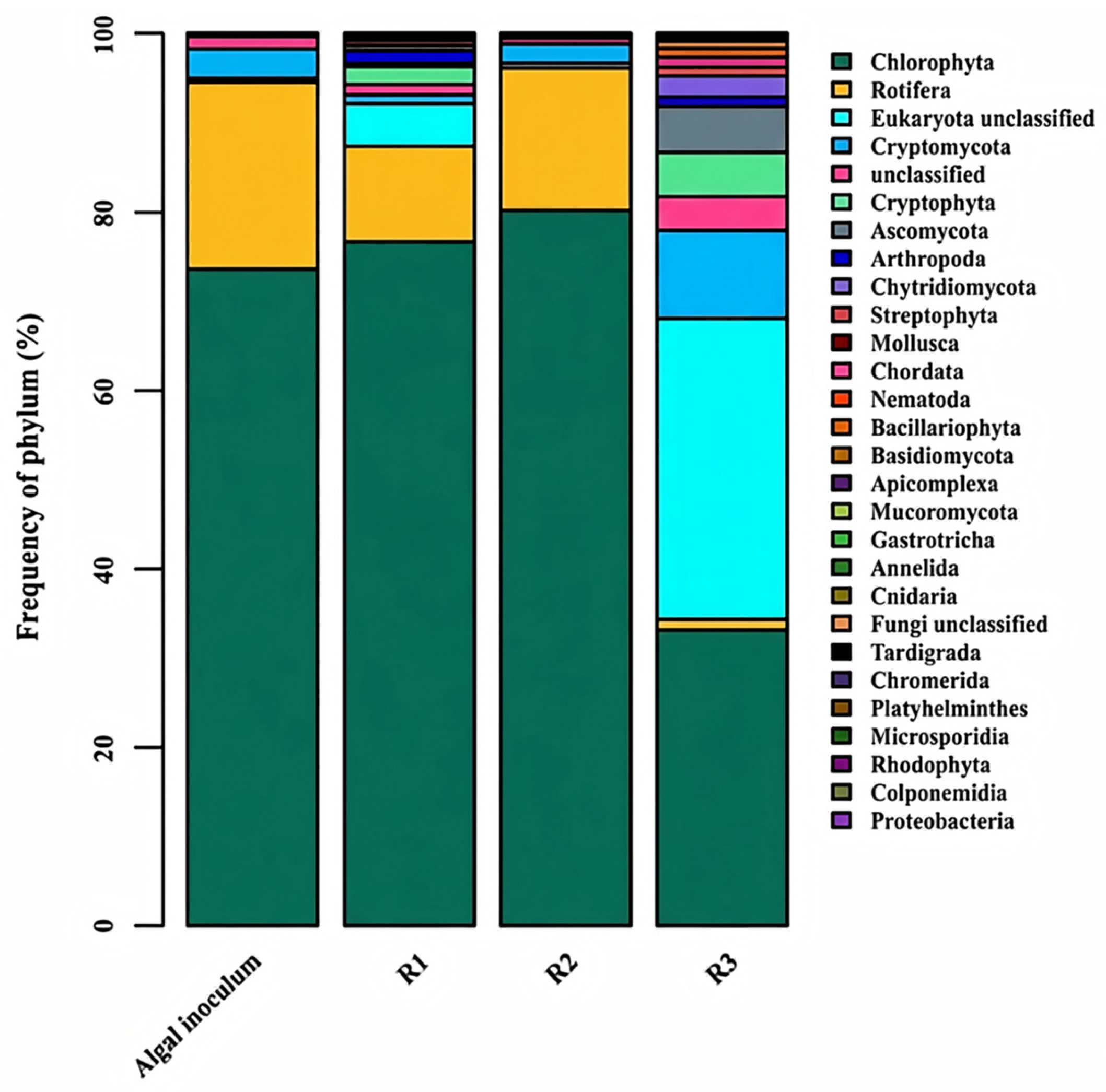
As shown in Figure 4., the algal suspension community before inoculation was dominated by Chlorophyta at the phylum level, with a relative abundance of about 72.8%. Rotifera accounted for about 21.2%, followed by Cryptomycota at about 2.9%. After a period of operation, the biofilm communities formed on different cathode materials diverged. This differentiation indicates that material interface conditions exert selective effects on community assembly. On the surface of the R2 cathode, Chlorophyta remained the dominant phylum, increasing to approximately 79.9%. Meanwhile, Rotifera decreased to about 16.1%, and Cryptomycota was about 2.2%. The R1 cathode surface was also dominated by Chlorophyta, with a relative abundance of approximately 77.2%. In this case, Eukaryota increased to about 4.5%, while Rotifera decreased to about 11.1%. By contrast, the community composition on the R3 cathode surface shifted more markedly, with similar relative abundances of Eukaryota and Chlorophyta at approximately 32.9% and 33.1%, respectively, and Cryptomycota also increasing to about 9.6%. From a functional perspective, enrichment of Chlorophyta at the phylum level generally implies stronger photosynthetic activity in the cathodic algal biofilm [25]. This can enhance dissolved oxygen supply at the interface and provide more favorable electron-acceptor conditions for cathodic oxygen reduction and stable electricity generation [44]. In contrast, an increased proportion of higher-trophic groups such as Eukaryota may impose grazing pressure [45]. Such pressure could reduce biofilm biomass and weaken sustained oxygen production. It may further lead to differences in dissolved oxygen fluctuations under light–dark cycles and in the stability of electricity generation [46]. Therefore, to establish a more direct link between changes in community composition and process performance, it is recommended that future experiments quantify the biofilm status and monitor cathodic microenvironment dynamics in parallel. Examples include chlorophyll a or biomass per unit area, as well as time-series measurements of dissolved oxygen and pH for cross-validation [44,47]. From an implementation perspective, Maintaining a strictly axenic algal culture is challenging in real wastewater matrices [48]. PAMFCs are therefore more likely to operate as mixed-community systems, where performance depends largely on sustaining a functionally dominant photosynthetic biofilm [25]. A cathode-attached biofilm provides retention and competitive advantages; its stability can be promoted by controlling illumination and hydraulic conditions to reduce washout and, when necessary, by periodically renewing the biofilm [49]. In addition, simple pretreatment can be applied to mitigate interference from grazers and large particulates, thereby helping maintain Chlorella dominance [50].

3.4. Benchmarking Against Literature and Implications

To benchmark prior studies, Table S1. summarizes key pollutant removal and electricity-generation metrics reported for representative MFC/PAMFC systems. As shown in Table S1, coupling bioelectrochemical processes with wetland media or photosynthetic biocathodes can achieve high nitrogen removal over extended operation periods while producing measurable electrical output. Notably, many studies emphasize high overall removal efficiencies or peak electrochemical outputs, demonstrating the feasibility of synchronizing wastewater treatment with energy recovery. However, in a number of reports, discussion is largely centered on aggregate performance metrics, whereas systematic quantification of the stability of cathodic nitrogen removal under light–dark alternation during continuous-flow operation, and comparative assessment across different cathode interfaces, remain relatively limited. By contrast, this study treats diurnal stability as a process-relevant performance attribute in PAMFC operation. Under continuous-flow conditions with a defined light–dark cycle, we quantified the periodic response of cathodic NH4+-N removal and demonstrated that morphology-controlled ZnO0.2–NiO@rGO cathodes markedly increased the steady-state voltage while stabilizing the light–dark NH4+-N removal response. More importantly, by integrating electrochemical performance with 18S rDNA-based eukaryotic biofilm profiling, this work provides interface-level evidence that cathode engineering can reshape biofilm community assembly and thereby enhance the robustness of light-enhanced, assimilative nitrogen removal without external aeration. This interface-to-biofilm-to-function linkage complements existing studies that largely remain at endpoint performance descriptions and provides a more mechanistic basis for cathode design in photosynthetic biocathode systems.

4. Conclusions

PAMFCs equipped with Chlorella biofilm-loaded ZnO–NiO@rGO carbon-fiber composite cathodes achieved simultaneous improvement in aeration-free electricity generation and light-responsive, assimilative NH4+–N removal under continuous-flow operation. After ~6.5 d of start-up, the modified cathodes delivered stable voltages of 0.34–0.38 V and 0.35–0.37 V, markedly higher than the carbon-felt control. Although R1 showed a slightly higher light-period peak, the modified cathodes reduced the light–dark removal difference from 21.1% to 14.3–14.5%, indicating improved diurnal stability. Eukaryotic community profiling further revealed that cathode modification reshaped the algal biofilm community, suggesting an interface-enabled pathway to stabilize photosynthetically active biofilms. The ZnO–NiO@rGO composite cathodes represent a low-cost cathode-enhancement strategy that improves operational stability under aeration-free conditions. The consistency between electrochemical performance trends and 18S rDNA-based community shifts further suggests that interfacial tuning can regulate biofilm assembly and the associated stability of system performance, providing useful guidance for the design of photosynthetic biocathodes. Future work should evaluate long-term durability against biofilm aging and electrode fouling, establish nitrogen mass balance to quantify pathway contributions, and directly resolve cathodic microenvironment and biofilm status via online DO and pH monitoring together with biofilm imaging and areal biomass and chlorophyll a measurement under non-sterile conditions and real-water matrices.

Supplementary Materials

The following supporting information can be downloaded at https://www.mdpi.com/article/10.3390/w18060733/s1, Figure S1: Spectral power distribution of the fluorescent lamp used for cathode illumination; Table S1: Comparison of N removal and electricity generation in MFC/PAMFC-related systems.

Author Contributions

H.Z.—Conceptualization, methodology, writing—original draft preparation, and writing—review and editing; H.W.—writing—original draft preparation, writing—review and editing, supervision, and funding acquisition; Y.L.—validation and investigation; S.L.—formal analysis, supervision, and funding acquisition; S.Y.—visualization and investigation; X.D.—supervision and project administration. All authors have read and agreed to the published version of the manuscript.

Funding

This work was supported by the National Natural Science Foundation of China (524B2137, 52500191), the National Key Research and Development Program of China (2023YFC3905501), the State Key Laboratory of Materials Low-Carbon Recycling (MLCR-2025KF-012), and the Open Research Fund Program of Key Laboratory for Water Ecology Management and Protection in River Source Areas (2025slbsy06).

Data Availability Statement

The original contributions presented in this study are included in the article. Further inquiries can be directed to the corresponding authors.

Conflicts of Interest

The authors declare no conflicts of interest.

References

  1. Uggetti, E.; Puigagut, J. Photosynthetic Membrane-Less Microbial Fuel Cells to Enhance Microalgal Biomass Concentration. Bioresour. Technol. 2016, 218, 1016–1020. [Google Scholar] [CrossRef] [PubMed]
  2. Gul, M.M.; Ahmad, K.S. Bioelectrochemical Systems: Sustainable Bio-Energy Powerhouses. Biosens. Bioelectron. 2019, 142, 111576. [Google Scholar] [CrossRef] [PubMed]
  3. Corona-Martínez, D.A.; Martínez-Amador, S.Y.; Rodríguez-De la Garza, J.A.; Laredo-Alcalá, E.I.; Pérez-Rodríguez, P. Recent Advances in Scaling up Bioelectrochemical Systems: A Review. BioTech 2025, 14, 8. [Google Scholar] [CrossRef] [PubMed]
  4. Galeano, M.B.; Sulonen, M.; Ul, Z.; Baeza, M.; Baeza, J.A.; Guisasola, A. Bioelectrochemical Ammonium Recovery from Wastewater: A Review. Chem. Eng. J. 2023, 472, 144855. [Google Scholar] [CrossRef]
  5. Rodríguez Arredondo, M.; Kuntke, P.; Jeremiasse, A.W.; Sleutels, T.H.J.A.; Buisman, C.J.N.; Ter Heijne, A. Bioelectrochemical Systems for Nitrogen Removal and Recovery from Wastewater. Environ. Sci. Water Res. Technol. 2015, 1, 22–33. [Google Scholar] [CrossRef]
  6. Akçay, G.H.; Ar, İ. Investigation of Domestic Wastewater Treatment and Electricity Generation Using A Two Chambered Microbial Fuel Cell with Composite Anode Electrode. Afyon Kocatepe Univ. J. Sci. Eng. 2023, 23, 177–185. [Google Scholar] [CrossRef]
  7. Yan, H.; Saito, T.; Regan, J.M. Nitrogen Removal in a Single-Chamber Microbial Fuel Cell with Nitrifying Biofilm Enriched at the Air Cathode. Water Res. 2012, 46, 2215–2224. [Google Scholar] [CrossRef]
  8. Yang, Z.; Pei, H.; Hou, Q.; Jiang, L.; Zhang, L.; Nie, C. Algal Biofilm-Assisted Microbial Fuel Cell to Enhance Domestic Wastewater Treatment: Nutrient, Organics Removal and Bioenergy Production. Chem. Eng. J. 2018, 332, 277–285. [Google Scholar] [CrossRef]
  9. Venkata Mohan, S.; Srikanth, S.; Chiranjeevi, P.; Arora, S.; Chandra, R. Algal Biocathode for in Situ Terminal Electron Acceptor (TEA) Production: Synergetic Association of Bacteria–Microalgae Metabolism for the Functioning of Biofuel Cell. Bioresour. Technol. 2014, 166, 566–574. [Google Scholar] [CrossRef]
  10. Liu, T.; Rao, L.; Yuan, Y.; Zhuang, L. Bioelectricity Generation in a Microbial Fuel Cell with a Self-Sustainable Photocathode. Sci. World J. 2015, 2015, 864568. [Google Scholar] [CrossRef]
  11. Kakarla, R.; Min, B. Sustainable Electricity Generation and Ammonium Removal by Microbial Fuel Cell with a Microalgae Assisted Cathode at Various Environmental Conditions. Bioresour. Technol. 2019, 284, 161–167. [Google Scholar] [CrossRef] [PubMed]
  12. Liu, S.; Wang, R.; Ma, C.; Yang, D.; Li, D.; Lewandowski, Z. Improvement of Electrochemical Performance via Enhanced Reactive Oxygen Species Adsorption at ZnO–NiO@rGO Carbon Felt Cathodes in Photosynthetic Algal Microbial Fuel Cells. Chem. Eng. J. 2020, 391, 123627. [Google Scholar] [CrossRef]
  13. Commault, A.S.; Laczka, O.; Siboni, N.; Tamburic, B.; Crosswell, J.R.; Seymour, J.R.; Ralph, P.J. Electricity and Biomass Production in a Bacteria-Chlorella Based Microbial Fuel Cell Treating Wastewater. J. Power Sources 2017, 356, 299–309. [Google Scholar] [CrossRef]
  14. Montoya-Vallejo, C.; Quintero Díaz, J.C.; Yepes, Y.A.; Fernández-Morales, F.J. Microalgal Microbial Fuel Cells: A Comprehensive Review of Mechanisms and Electrochemical Performance. Appl. Sci. 2025, 15, 3335. [Google Scholar] [CrossRef]
  15. Koltysheva, D.; Shchurska, K.; Kuzminskyi, Y. Microalgae and Cyanobacteria as Biological Agents of Biocathodes in Biofuel Cells. BioTechnologia 2021, 102, 437–444. [Google Scholar] [CrossRef]
  16. Elangovan, K.; Saravanan, P.; Campos, C.H.; Sanhueza-Gómez, F.; Khan, M.M.R.; Chin, S.Y.; Krishnan, S.; Viswanathan Mangalaraja, R. Outline of Microbial Fuel Cells Technology and Their Significant Developments, Challenges, and Prospects of Oxygen Reduction Electrocatalysts. Front. Chem. Eng. 2023, 5, 1228510. [Google Scholar] [CrossRef]
  17. Ippili, S.; Jella, V.; Eom, J.-H.; Kim, J.; Hong, S.; Choi, J.-S.; Tran, V.-D.; Van Hieu, N.; Kim, Y.-J.; Kim, H.-J.; et al. An Eco-Friendly Flexible Piezoelectric Energy Harvester That Delivers High Output Performance Is Based on Lead-Free MASnI3 Films and MASnI3-PVDF Composite Films. Nano Energy 2019, 57, 911–923. [Google Scholar] [CrossRef]
  18. Khater, D.Z.; Amin, R.S.; Zhran, M.O.; Abd El-Aziz, Z.K.; Mahmoud, M.; Hassan, H.M.; El-Khatib, K.M. The Enhancement of Microbial Fuel Cell Performance by Anodic Bacterial Community Adaptation and Cathodic Mixed Nickel–Copper Oxides on a Graphene Electrocatalyst. J. Genet. Eng. Biotechnol. 2022, 20, 12. [Google Scholar] [CrossRef]
  19. Liu, Y.; Liu, H.; Wang, C.; Hou, S.-X.; Yang, N. Sustainable Energy Recovery in Wastewater Treatment by Microbial Fuel Cells: Stable Power Generation with Nitrogen-Doped Graphene Cathode. Environ. Sci. Technol. 2013, 47, 13889–13895. [Google Scholar] [CrossRef]
  20. Dong, J.; Wang, S.; Xi, P.; Zhang, X.; Zhu, X.; Wang, H.; Huang, T. Reduced Graphene Oxide-Supported Iron-Cobalt Alloys as High-Performance Catalysts for Oxygen Reduction Reaction. Nanomaterials 2023, 13, 2735. [Google Scholar] [CrossRef]
  21. Zhang, Y.; Sun, J.; Hu, Y.; Li, S.; Xu, Q. Bio-Cathode Materials Evaluation in Microbial Fuel Cells: A Comparison of Graphite Felt, Carbon Paper and Stainless Steel Mesh Materials. Int. J. Hydrogen Energy 2012, 37, 16935–16942. [Google Scholar] [CrossRef]
  22. Shukla, M.; Kumar, S. Algal Growth in Photosynthetic Algal Microbial Fuel Cell and Its Subsequent Utilization for Biofuels. Renew. Sustain. Energy Rev. 2018, 82, 402–414. [Google Scholar] [CrossRef]
  23. Zhu, X.; Shen, C.; Huang, J.; Wang, L.; Pang, Q.; Peng, F.; Hou, J.; Ni, L.; He, F.; Xu, B. The Effect of Sulfamethoxazole on Nitrogen Removal and Electricity Generation in a Tidal Flow Constructed Wetland Coupled with a Microbial Fuel Cell System: Microbial Response. Chem. Eng. J. 2022, 431, 134070. [Google Scholar] [CrossRef]
  24. Xu, W.; Yang, B.; Wang, H.; Zhang, L.; Dong, J.; Liu, C. Simultaneous Removal of Antibiotics and Nitrogen by Microbial Fuel Cell-Constructed Wetlands: Microbial Response and Carbon–Nitrogen Metabolism Pathways. Sci. Total Environ. 2023, 893, 164855. [Google Scholar] [CrossRef]
  25. Zhang, H.; Yan, Q.; An, Z.; Wen, Z. A Revolving Algae Biofilm Based Photosynthetic Microbial Fuel Cell for Simultaneous Energy Recovery, Pollutants Removal, and Algae Production. Front. Microbiol. 2022, 13, 990807. [Google Scholar] [CrossRef]
  26. Pengadeth, D.; Prakash Naik, S.; Sasi, A.; Mohanakrishna, G. Revisiting the Role of Algal Biocathodes in Microbial Fuel Cells for Bioremediation and Value-Addition. Chem. Eng. J. 2024, 496, 154144. [Google Scholar] [CrossRef]
  27. Nagendranatha Reddy, C.; Nguyen, H.T.H.; Noori, M.T.; Min, B. Potential Applications of Algae in the Cathode of Microbial Fuel Cells for Enhanced Electricity Generation with Simultaneous Nutrient Removal and Algae Biorefinery: Current Status and Future Perspectives. Bioresour. Technol. 2019, 292, 122010. [Google Scholar] [CrossRef]
  28. Luo, S.; Berges, J.A.; He, Z.; Young, E.B. Algal-Microbial Community Collaboration for Energy Recovery and Nutrient Remediation from Wastewater in Integrated Photobioelectrochemical Systems. Algal Res. 2017, 24, 527–539. [Google Scholar] [CrossRef]
  29. Arun, S.; Manikandan, N.A.; Pakshirajan, K.; Pugazhenthi, G. Novel Shortcut Biological Nitrogen Removal Method Using an Algae-Bacterial Consortium in a Photo-Sequencing Batch Reactor: Process Optimization and Kinetic Modelling. J. Environ. Manag. 2019, 250, 109401. [Google Scholar] [CrossRef]
  30. Good, I.J.; Toulmin, G.H. The Number of New Species, and The Increase in Population Coverage, when a Sample is Increased. Biometrika 1956, 43, 45–63. [Google Scholar] [CrossRef]
  31. Tang, Y.; She, Y.; Chen, D.; Zhou, Y.; Xie, D.; Liu, Z. 16S rRNA Sequencing-Based Evaluation of the Protective Effects of Key Gut Microbiota on Inhaled Allergen-Induced Allergic Rhinitis. Front. Microbiol. 2025, 15, 1497262. [Google Scholar] [CrossRef] [PubMed]
  32. Gotelli, N.J.; Colwell, R.K. Estimating species richness. In Biological Diversity: Frontiers in Measurement and Assessment; Magurran, A.E., McGill, B.J., Eds.; Oxford University Press: Oxford, UK, 2011; pp. 39–54. [Google Scholar]
  33. Kim, L.; Pagaling, E.; Zuo, Y.Y.; Yan, T. Impact of Substratum Surface on Microbial Community Structure and Treatment Performance in Biological Aerated Filters. Appl. Env. Microbiol. 2014, 80, 177–183. [Google Scholar] [CrossRef] [PubMed]
  34. Chiu, C.-H. A More Reliable Species Richness Estimator Based on the Gamma–Poisson Model. PeerJ 2023, 11, e14540. [Google Scholar] [CrossRef] [PubMed]
  35. Shen, F.-Y.; Ding, T.-S.; Tsai, J.-S. Comparing Avian Species Richness Estimates from Structured and Semi-Structured Citizen Science Data. Sci. Rep. 2023, 13, 1214. [Google Scholar] [CrossRef]
  36. Nagendra, H. Opposite Trends in Response for the Shannon and Simpson Indices of Landscape Diversity. Appl. Geogr. 2002, 22, 175–186. [Google Scholar] [CrossRef]
  37. Morris, E.K.; Caruso, T.; Buscot, F.; Fischer, M.; Hancock, C.; Maier, T.S.; Meiners, T.; Müller, C.; Obermaier, E.; Prati, D.; et al. Choosing and Using Diversity Indices: Insights for Ecological Applications from the German Biodiversity Exploratories. Ecol. Evol. 2014, 4, 3514–3524. [Google Scholar] [CrossRef]
  38. Slater, F.C.; Fish, K.E.; Boxall, J.B. Similarity of Drinking Water Biofilm Microbiome despite Diverse Planktonic Water Community and Quality. Front. Microbiol. 2025, 16, 1567992. [Google Scholar] [CrossRef]
  39. Baek, Y.-W.; An, Y.-J. Microbial Toxicity of Metal Oxide Nanoparticles (CuO, NiO, ZnO, and Sb2O3) to Escherichia Coli, Bacillus Subtilis, and Streptococcus Aureus. Sci. Total Environ. 2011, 409, 1603–1608. [Google Scholar] [CrossRef]
  40. Ishii, S.; Suzuki, S.; Norden-Krichmar, T.M.; Phan, T.; Wanger, G.; Nealson, K.H.; Sekiguchi, Y.; Gorby, Y.A.; Bretschger, O. Microbial Population and Functional Dynamics Associated with Surface Potential and Carbon Metabolism. ISME J. 2014, 8, 963–978. [Google Scholar]
  41. Sun, Y.; Wei, J.; Liang, P.; Huang, X. Microbial Community Analysis in Biocathode Microbial Fuel Cells Packed with Different Materials. AMB Express 2012, 2, 21. [Google Scholar] [CrossRef]
  42. Graham, E.B.; Knelman, J.E.; Schindlbacher, A.; Siciliano, S.; Breulmann, M.; Yannarell, A.; Beman, J.M.; Abell, G.; Philippot, L.; Prosser, J.; et al. Microbes as Engines of Ecosystem Function: When Does Community Structure Enhance Predictions of Ecosystem Processes? Front. Microbiol. 2016, 7, 214. [Google Scholar] [CrossRef] [PubMed]
  43. Herrmann, B.; Cerbule, K.; Brčić, J.; Grimaldo, E.; Geoffroy, M.; Daase, M.; Berge, J. Accounting for Uncertainties in Biodiversity Estimations: A New Methodology and Its Application to the Mesopelagic Sound Scattering Layer of the High Arctic. Front. Ecol. Evol. 2022, 10, 775759. [Google Scholar] [CrossRef]
  44. Agüero-Quiñones, R.; De La Cruz-Noriega, M.; Rojas-Villacorta, W. Electric Potential of Chlorella sp. Microalgae Biomass in Microbial Fuel Cells (MFCs). Bioengineering 2025, 12, 635. [Google Scholar] [CrossRef] [PubMed]
  45. Day, J.G.; Gong, Y.; Hu, Q. Microzooplanktonic Grazers—A Potentially Devastating Threat to the Commercial Success of Microalgal Mass Culture. Algal Res. 2017, 27, 356–365. [Google Scholar] [CrossRef]
  46. Pulgarin, A.; Decker, J.; Chen, J.; Giannakis, S.; Ludwig, C.; Refardt, D.; Pick, H. Effective Removal of the Rotifer Brachionus Calyciflorus from a Chlorella Vulgaris Microalgal Culture by Homogeneous Solar Photo-Fenton at Neutral pH. Water Res. 2022, 226, 119301. [Google Scholar] [CrossRef]
  47. Lin, C.-C.; Wei, C.-H.; Chen, C.-I.; Shieh, C.-J.; Liu, Y.-C. Characteristics of the Photosynthesis Microbial Fuel Cell with a Spirulina Platensis Biofilm. Bioresour. Technol. 2013, 135, 640–643. [Google Scholar] [CrossRef]
  48. Di Caprio, F. Methods to Quantify Biological Contaminants in Microalgae Cultures. Algal Res. 2020, 49, 101943. [Google Scholar] [CrossRef]
  49. Kilbane, J.J. Shining a Light on Wastewater Treatment with Microalgae. Arab. J. Sci. Eng. 2022, 47, 45–56. [Google Scholar] [CrossRef]
  50. Lam, T.P.; Lee, T.-M.; Chen, C.-Y.; Chang, J.-S. Strategies to Control Biological Contaminants during Microalgal Cultivation in Open Ponds. Bioresour. Technol. 2018, 252, 180–187. [Google Scholar] [CrossRef]
Figure 1. Schematic diagram of the PAMFC system.
Water 18 00733 g001
Figure 2. Voltage response curves of PAMFCs with different cathode materials under light and dark cycle operation.
Water 18 00733 g002
Figure 3. Diurnal variation in cathodic NH4+–N in PAMFCs under light–dark cycling. (a) Cathode effluent NH4+–N concentration. (b) Cathodic NH4+–N removal efficiency.
Water 18 00733 g003
Figure 4. Microbial community composition at the phylum level in algal biofilms on different cathode materials and in the original inoculated algal suspension.
Water 18 00733 g004
Table 1. Formulations of the PAMFC catholyte, cathodic trace element solution, and anodic trace element solution.
CatholyteConcentration (g·L−1)Cathodic Trace Element SolutionConcentration (g·L−1)Anodic Trace Element SolutionConcentration (g·L−1)
NH4HCO31.39H3BO32.86FeCl3·6H2O1.5
K2HPO40.04MnCl2·4H2O1.86H3BO30.15
MgSO4·7H2O0.07ZnSO4·7H2O0.22CuSO4·5H2O0.03
CaCl2·2H2O0.03Na2MoO4·2H2O0.39KI0.18
Citric acid0.006CuSO4·5H2O0.08MnCl2·4H2O0.12
Ferric ammonium citrate0.006Co(NO3)2·6H2O0.05Na2MoO4·2H2O0.06
EDTA-Na20.001 ZnSO4·7H2O0.12
Na2CO30.04 CoCl2·6H2O0.15
EDTA-Na210
Note: Unless otherwise specified, all chemicals listed in this table were purchased from Shanghai Aladdin Biochemical Technology Co., Ltd. (Shanghai, China).
Table 2. Composition and concentrations of the synthetic wastewater and the trace element stock solution.
Synthetic Wastewater ComponentsConcentration
(g·L−1)
Trace Element Stock Solution CompositionConcentration
(g·L−1)
NH4HCO31.45H3BO32.86
K2HPO40.45MnCl2·4H2O1.86
MgSO4·7H2O0.70ZnSO4·7H2O0.22
CaCl2·2H2O0.35Na2MoO4·2H2O0.39
Na2CO30.25CuSO4·5H2O0.08
Co(NO3)2·6H2O0.05
Note: Unless otherwise specified, all chemicals listed in this table were purchased from Shanghai Aladdin Biochemical Technology Co., Ltd. (Shanghai, China).
Table 3. Microbial diversity indices of the algal inoculum and PAMFC cathodic biofilms with different cathode materials (97% similarity).
SampleShannonACEChao1CoverageSimpson
Algal inoculum1.06536,694.41611,887.1850.9810.559
R12.01712,161.7376018.6020.9690.477
R22.9968356.1221768.5000.9750.156
R30.96113,448.3235609.4200.9820.635
Disclaimer/Publisher’s Note: The statements, opinions and data contained in all publications are solely those of the individual author(s) and contributor(s) and not of MDPI and/or the editor(s). MDPI and/or the editor(s) disclaim responsibility for any injury to people or property resulting from any ideas, methods, instructions or products referred to in the content.