


Abstract
Landslides, often triggered by intense or prolonged rainfall, pose significant risks to communities and infrastructure. Identifying accurate rainfall thresholds is crucial for predicting landslide events and developing effective early warning systems. This study, conducted on São Miguel Island (Azores), aimed to improve the predictive capability of rainfall thresholds by integrating both rainfall preparatory and rainfall trigger thresholds. Using data from 61 landslide events and rainfall measurements recorded at four stations between 1977 and 2020, the study applied the Generalised Extreme Value (GEV) distribution with Maximum Likelihood Estimation (MLE) to identify the cumulative rainfall–duration pair with the highest return period for each event, thereby establishing a preparatory threshold. The trigger threshold was determined by analysing the rainfall amount recorded on the day of the event while also accounting for the duration of the preparatory rainfall period. The final threshold combines both the preparatory and trigger thresholds, and an event is detected when both thresholds are exceeded. Preparatory thresholds showed similar patterns across the stations, with Sete Cidades and Furnas recording the highest cumulative rainfall values, while Santana and Ponta Delgada exhibited lower thresholds. The trigger thresholds at Furnas reflected the highest daily rainfall intensities. The analysis also indicated that the rainfall intensity required to trigger landslides decreases with increasing durations of the antecedent rainfall. Performance of the thresholds using ROC metrics revealed that the combined threshold outperformed the preparatory threshold alone by reducing false positives (FPs) and improving predictive accuracy. In all cases, the combined threshold demonstrated superior performance in detecting landslide events, highlighting its effectiveness in landslide prediction. This study provides a detailed analysis of rainfall thresholds for landslides on São Miguel Island and underscores the advantages of the combined threshold approach for improving landslide prediction and supporting the development of robust early warning systems.
1. Introduction
Rainfall is one of the most important factors triggering landslides (e.g., [1,2]). For the same region, the triggering of different types of landslides can be related to different critical hydrological conditions for failure due to the diversity of triggering conditions and physical phenomena involved (e.g., [3,4]). Although there have been previous studies trying to identify the amount of rainfall required for landslide triggering, the work of Caine (1980) [5] was the first to propose global minimum thresholds for triggering shallow landslides, using a power-law equation based on rainfall intensity-duration conditions. Since then, the identification of rainfall thresholds has been the focus of numerous scientific studies (e.g., [1,6,7,8]), frequently in relation to the development of landslide early warning systems.
Rainfall thresholds can be defined using physical (process-based, conceptual) or empirical (historical, statistical) approaches (e.g., [9,10]). Empirical models, which are the focus of this study, rely on historical records of instability events and statistical analysis of rainfall data. Intensity-duration (ID) thresholds are the most common in the literature (e.g., [6,11,12,13]) and relate the total rainfall of an event to the instantaneous rainfall. These ID thresholds cover a wide range of rainfall durations and intensities, with most thresholds covering the intervals of 1 to 100 h and 1 to 200 mm/h. These thresholds exhibit asymptotic behaviour during very short rainfall durations [1]. Rainfall thresholds based on the amount of rainfall during landslide triggering events have been defined using different rainfall variables including: (i) daily rainfall (R), (ii) antecedent rainfall; (iii) cumulative event rainfall (E); and (iv) normalised cumulative event rainfall. The latter type of threshold states that landslides are likely to occur, or occur frequently, if the total rainfall during a rainfall event exceeds a predetermined percentage of the mean annual precipitation (MAP) [1]. Normalisation allows one to compare thresholds across different areas, since in most cases, regional and local thresholds are specific to each area [14].
Empirical ID thresholds are used to predict landslide occurrence based on a power-law equation. This approach is based on two main assumptions [15]: (i) the probability of landslide initiation increases non-linearly with the intensity of rainfall, identified by a threshold value that, when reached or exceeded, indicates a high probability of these events being triggered; (ii) as the duration of rainfall increases, the intensity required to trigger landslides decreases. For these ID thresholds to be effective predictors, they must meet specific criteria: accurately represent the rainfall intensities that trigger landslide events; be activated at the correct time or shortly after; and minimise both the instances of landslides occurring below the threshold (false negatives) and conditions exceeding the threshold that do not result in landslides (false positives). Traditionally, their definition has been subjective, making them difficult to replicate and compare results across different studies. A common approach is the “lower limit” (LL) method (e.g., [16]), which defines the threshold as the lowest rainfall intensity that resulted in landslide events. While this method provides a conservative estimate, it is prone to a large number of false positives.
Recent advances incorporate soil moisture and hydrological information into hydrometeorological thresholds, improving the predictive performance by accounting for pre-conditioning factors that enhance slope susceptibility [17]. Studies show that integrating modelled soil moisture from reanalysis datasets can substantially reduce false alarms while maintaining detection accuracy [18]. Additionally, machine learning techniques are better suited to capturing nonlinear relationships than traditional empirical models, with hybrid artificial intelligence methods demonstrating superior accuracy [19]. Beyond traditional empirical and physical approaches, probabilistic methods have been developed to quantify landslide occurrence uncertainty more rigorously [20]. Hybrid artificial intelligence models, including support vector machines, random forests, and deep learning approaches, consistently demonstrate higher predictive accuracy than simpler empirical models by capturing nonlinear dynamics often missed by traditional approaches [19]. Recent advances in the field also suggest that combining multiple complementary threshold types may offer improved prediction performance compared to traditional single-threshold approaches [21].
Despite this progress, operational challenges persist: false alarms reduce public confidence, while missed alarms represent critical failures with potential risk to human life. Recent research has therefore focused on optimising these dual objectives through multi-source validation and calibration procedures that explicitly minimise false alarm rates while maintaining acceptable detection performance [21]. In this study, we propose the use of two thresholds that, when combined, maximise landslide event prediction while reducing the number of false positives compared to the traditional single-threshold approach. To achieve this, six steps were established: (i) identify the landslide events that occurred within the area of influence of four rainfall stations during the 44-year period 1977–2020; (ii) define a cumulative rainfall-duration (Rcum − D) function corresponding to the best discrimination between days with and without landslides (preparatory threshold); (iii) define a 1-day rainfall intensity-duration (ID1 − D) function, using the same criteria, based on the rainfall recorded on the day of the event (trigger threshold); (iv) assess the performance of the preparatory and combined thresholds using a back-analysis method; (v) normalise the rainfall thresholds by the MAP; and (vi) estimate the monthly probability of exceedance and return period of the combined thresholds. This methodology is expected to enhance the precision and reliability of rainfall thresholds in predicting landslides.
2. Study Area
2.1. Geology and Climate
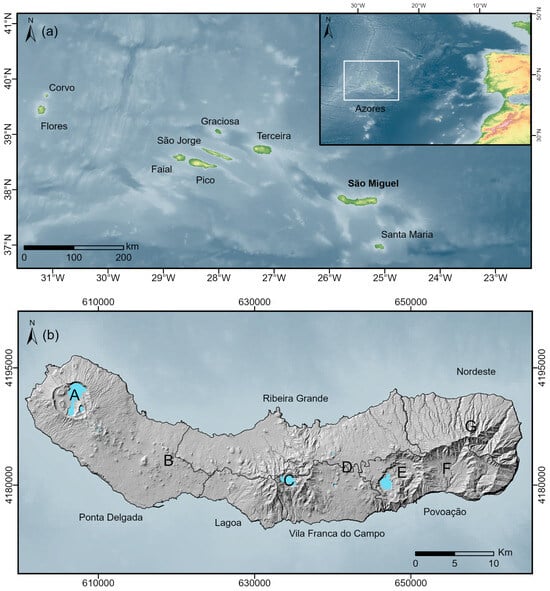
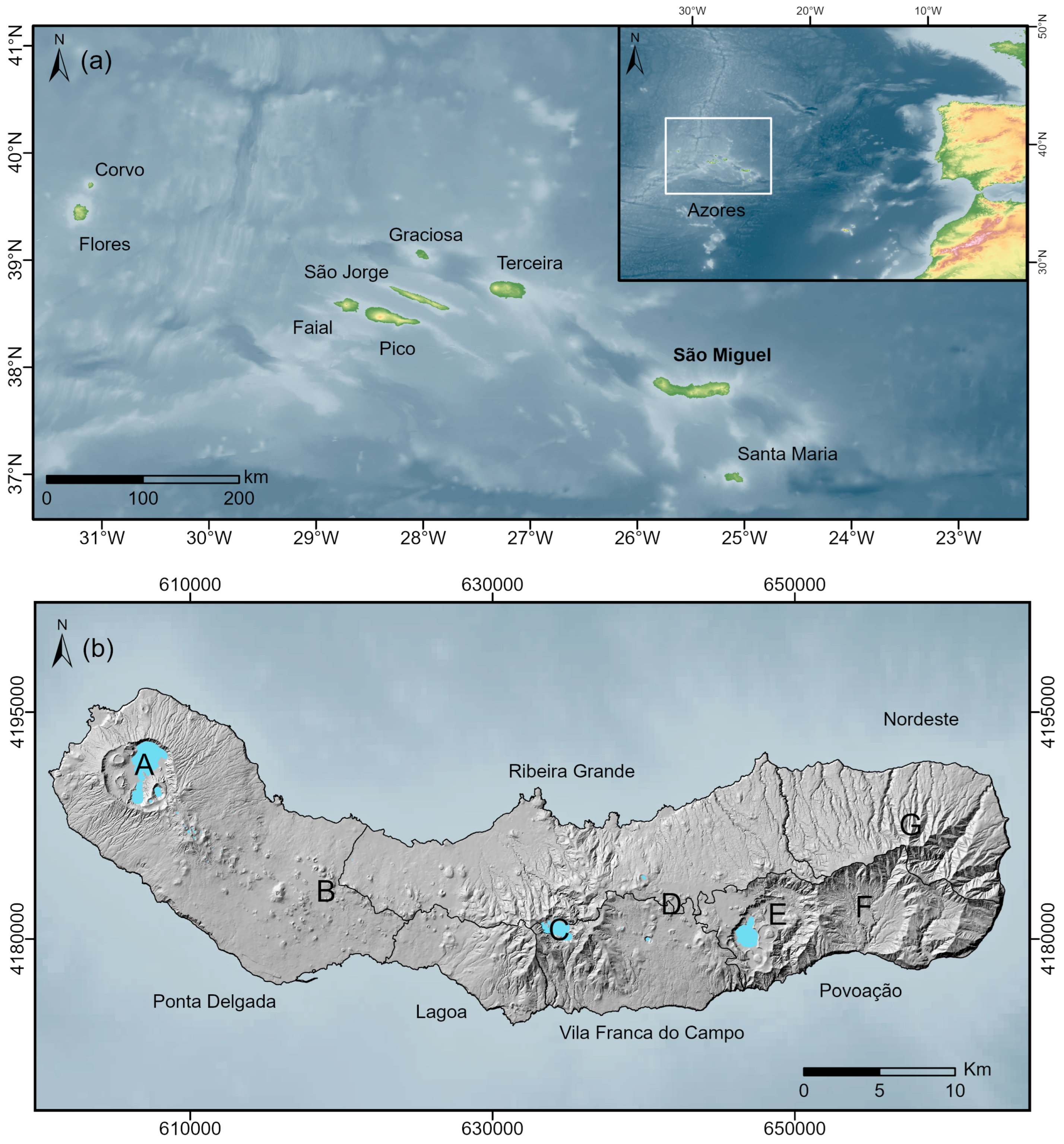
The Azores are located in the North Atlantic Ocean, at the meeting point of the Eurasian, African, and North American tectonic plates (Figure 1a). This complex geodynamic setting results in recurrent seismic and volcanic activity [22], which often triggers significant landslide events. However, rainfall-triggered landslides are the most prevalent geological hazard in the region, driven by the physical, mechanical, and hydrological properties of volcanic materials as well as the island’s geomorphology.
Figure 1.
(a) Geographical position and (b) municipalities (black lines) and morphostructural units of São Miguel Island: A—Sete Cidades Volcano; B—Picos Fissural Volcanic System; C—Fogo Volcano; D—Congro Fissural Volcanic System; E—Furnas Volcano; F—Povoacão Volcano; and G—Nordeste Volcanic Complex.
São Miguel Island spans 744.6 km2, with elevations ranging from sea level to 1143 m a.s.l. Administratively, it is divided into 6 municipalities, comprising a total of 64 parishes (Figure 1b). The island has three active central volcanoes with summit calderas: Sete Cidades [23], Fogo [24], and Furnas [25] (Figure 1b). Landslides are prevalent in several morphological formations characterised by steep slopes, including the inner walls of caldera volcanoes, fault scarps, coastal cliffs, and stream valleys [26]. These formations are predominantly composed of non-cohesive materials, such as pumice deposits.
The central volcanoes are linked by two fissural volcanic systems: Picos [27] and Congro [28]. Extensive outcrops of basaltic lava flows and scoria heavily influence the morphology of the Picos Fissural Volcanic System, which is characterised by mild slopes and a limited drainage network. Landslides in this area primarily concentrate along the coastal cliffs [26]. Scoria cones and their associated lava flows are the primary features of the Congro Fissural Volcanic System, which also includes pumice cones, domes, and maars. The entire region is blanketed by thick pumice fallout deposits from the explosive eruptions of the Fogo and Furnas Volcanoes. Positioned as an elevated zone in the axial area, with elevations surpassing 500 m above sea level, gentle slopes ascend towards the north and south coastlines. Landslides are prevalent in this region, particularly along coastal cliffs and within deep narrow valleys [26].
The Nordeste Volcanic System and Povoação Volcano [29] represent the island’s earliest geological formations. The Nordeste Volcanic System is characterised by a shield volcano primarily comprised of basaltic lavas, which underwent extensive erosion during and after volcanic activity. Conversely, Povoação Volcano initially formed as a lava shield, followed by explosive trachytic activity and subsequent caldera collapse. Landslides in the Nordeste Volcanic System are concentrated in areas where weathered basaltic lava flows intersect steep slopes and deep narrow valleys experiencing intense fluvial erosion. In Povoação Volcano, landslides are linked to non-cohesive materials, mainly pumice, which underwent significant erosion both during and after volcanic activity [26].
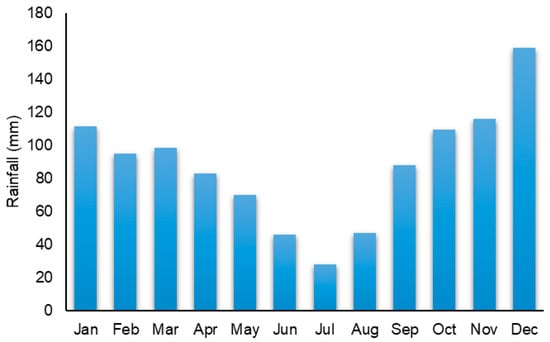
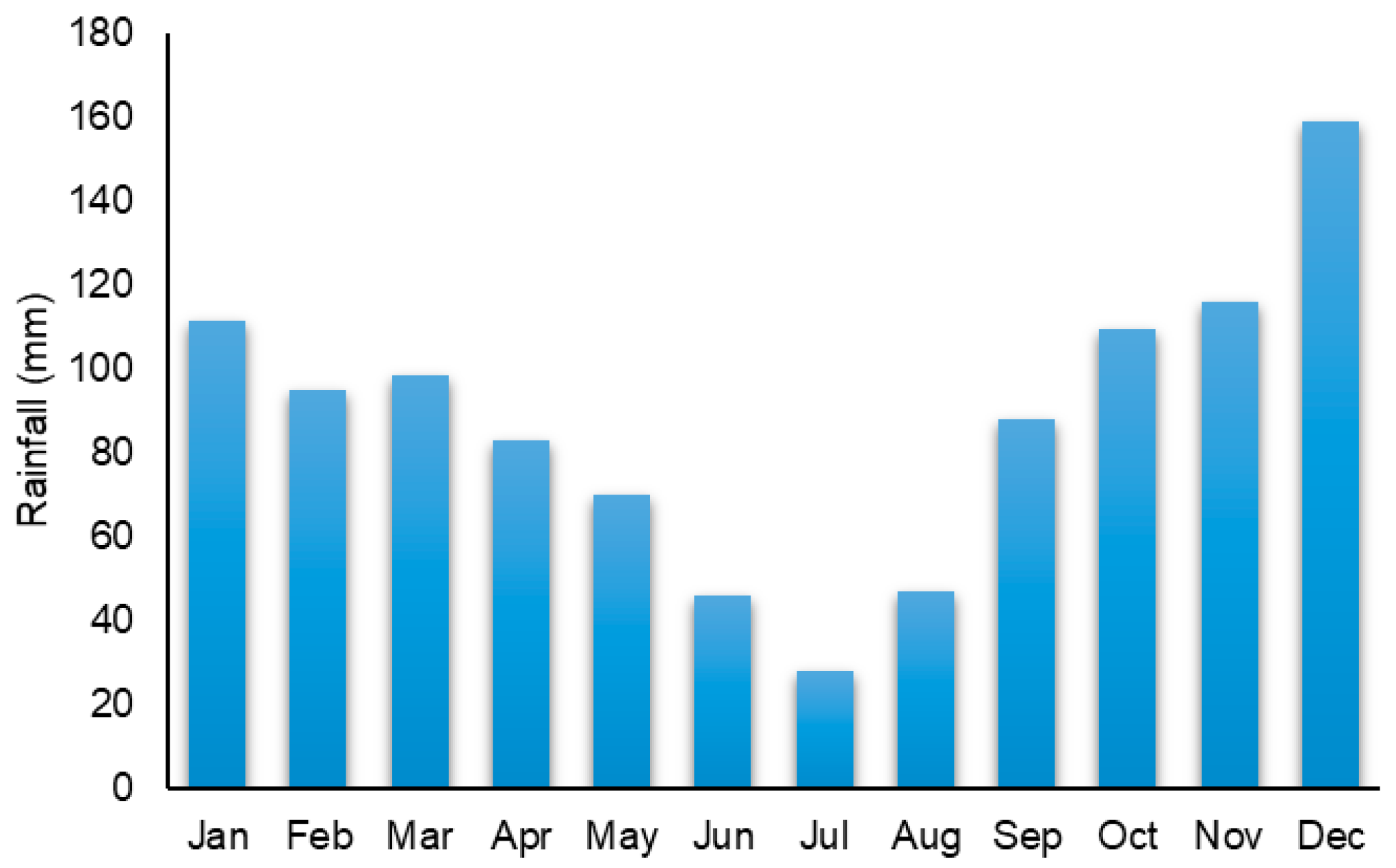
The climate of the Azores is essentially influenced by the geographical location of the islands [30]. Rainfall is distributed across the year, with a notable reduction during the summer period. The annual rainfall pattern exhibits distinct seasonal variations, with the “wettest period” occurring from October to March. Conversely, the summer months constitute the “driest period”, with July typically experiencing the lowest levels of rainfall (Figure 2).
Figure 2.
Average monthly rainfall at the Ponta Delgada meteorological station for the period of 1981–2010 (climate normal data from the Portuguese Institute for Sea and Atmosphere).
The fluctuation in yearly rainfall patterns is associated with the archipelago’s proximity to the North Atlantic Subtropical Anticyclone, commonly referred to as the Azores High [31,32]. Mean annual rainfall (MAP) ranges from approximately 800–1000 mm in low-altitude coastal areas to more than 2900 mm at higher elevations, with extreme annual totals locally exceeding 4000 mm in the central volcanic highlands [33]. Rainfall shows a strong positive correlation with altitude, with average increases of about 180–200 mm per 100 m of elevation gain, which reflects the dominant influence of orographic forcing [33].
Long-term trend analyses reveal a general decrease in both annual and seasonal rainfall over recent decades, particularly after 2010 [33]. The most pronounced reductions are observed in autumn and winter. Stormy periods are more frequent in winter, although late summer and autumn can also experience them due to sporadic cyclones and tropical storms passing near the archipelago [30]. These weather systems, often in their weakening stages, can produce some of the most intense storms affecting the Azores, potentially triggering significant and destructive hydro-geomorphological events.
2.2. Landslide Incidence
Landslides have historically resulted in numerous fatalities and substantial socio-economic disruption on São Miguel Island [34]. The most devastating incident took place on 31 October 1997, when intense rainfall triggered nearly 1000 shallow landslides [26,35,36] and caused 29 fatalities in the village of Ribeira Quente.
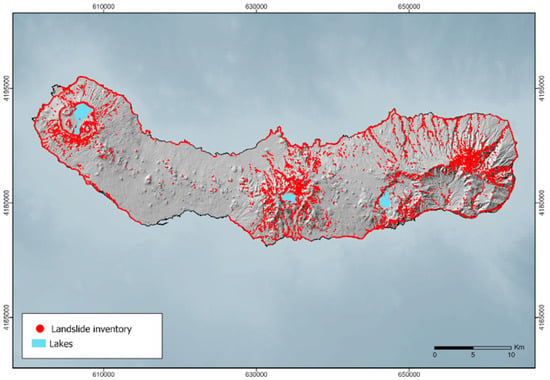
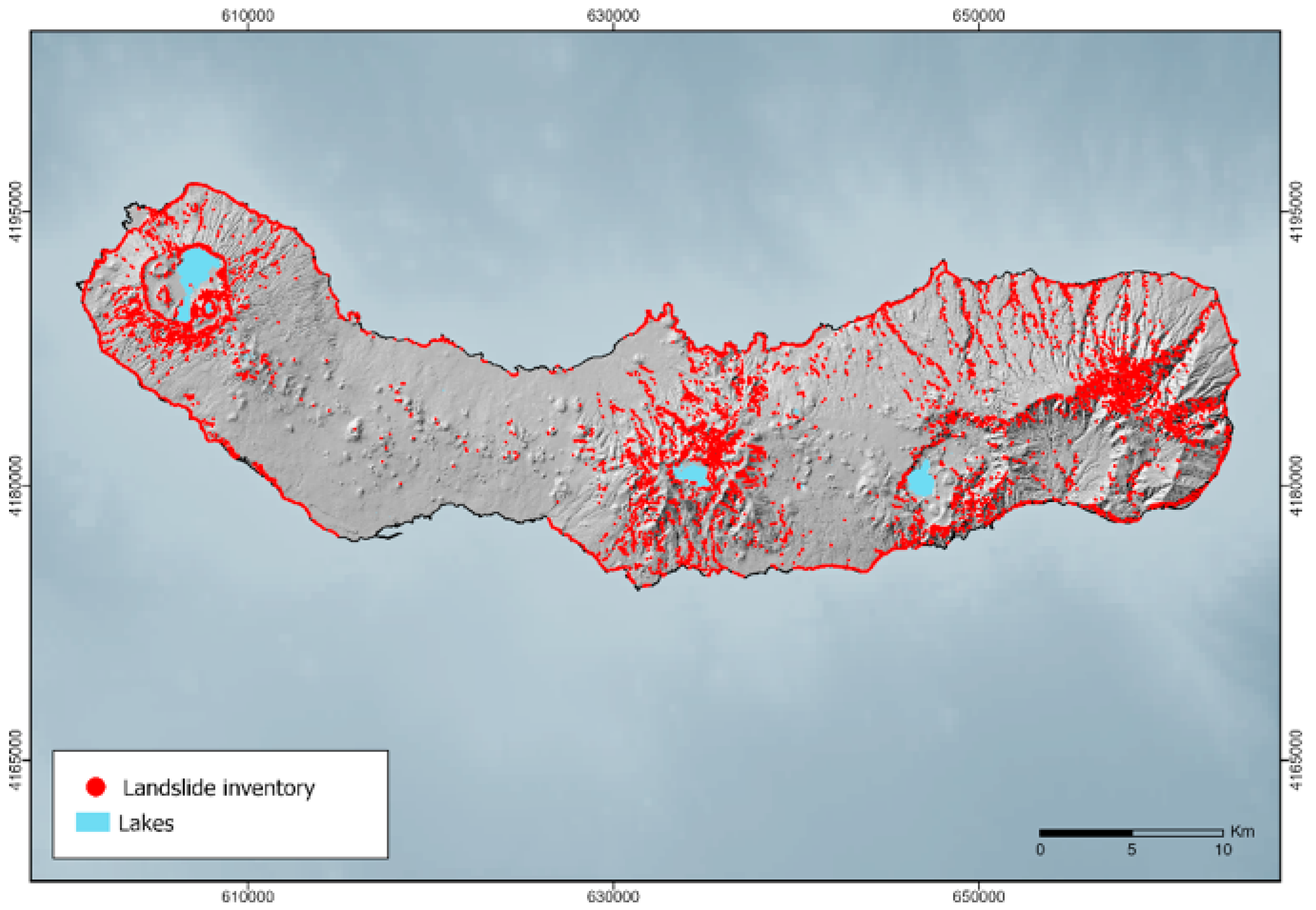
Marques et al. (2015) [26] carried out a systematic inventory of landslides on São Miguel Island based on the interpretation of high-resolution geo-referenced digital orthophoto maps, supplemented with topographic data. The photointerpretation was conducted at the 1:1000 scale, identifying slope instabilities through morphological changes, vegetation patterns, and modifications to surface drainage conditions. The inventory includes 9890 landslide scars, represented as polygons in a GIS environment, with a total planimetric area of approximately 13.16 km2 (Figure 2).
Landslides on São Miguel Island predominantly consist of shallow translational slides and soil slips, which frequently evolve into debris flows [26]. Most landslides are typically narrow—rarely wider than 30–40 m—and originate on steep slopes where the slip surfaces generally do not exceed depths of 2–3 m. Most failures initiate near the crest of steep slopes and often extend downslope across the full length of the slope, effectively defining the total area of depletion. These slopes are commonly composed of unsaturated, cohesionless pyroclastic materials, where matric suction plays a critical role in slope stability by contributing apparent cohesion and enhancing shear strength [37,38].
The spatial distribution of landslides shows a clear concentration along the flanks of the island’s young central volcanoes and along coastal sea cliffs (Figure 3). These regions are typified by vertical caldera walls, steep inclines, deeply incised valleys, and fault scarps, all covered by unconsolidated pyroclastic deposits from recent explosive eruptions—conditions highly conducive to landslide activity [26]. In the eastern part of the island, the Nordeste Volcanic System also exhibits significant landslide occurrence due to the presence of deep gullies incised into thick, weathered lava flows. Notably, larger landslides tend to occur on slopes with extended slope lengths, especially those associated with deeply entrenched, narrow valleys, further emphasising the role of topography in landslide susceptibility [26].
Figure 3.
Landslide inventory of São Miguel Island carried out by Marques et al. (2015) [26].
2.3. Previous Thresholds Studies in Study Area
On São Miguel Island, rainfall is the main trigger for landslides [34]. Over the past few years, researchers have studied the correlation between rainfall and landslides in this region. In a study conducted by Marques et al. (2008) [35], the role of rainfall in triggering landslides in Povoação (São Miguel Island) was assessed. The researchers reconstructed both the absolute and calibrated antecedent rainfall data. For each landslide event, they identified the critical combinations of rainfall accumulation and duration, which were subsequently used to establish the corresponding thresholds. Building on this work, Marques et al. (2010) [39] established the foundation for the implementation of an empirical landslide warning system in Povoação (ELEWS-Pov). This system automates the reconstructing of the absolute accumulated rainfall for various durations, enabling the real-time monitoring of meteorological conditions. Researchers have also examined the connection between the North Atlantic Oscillation (NAO) and landslide occurrence in the Azores. Marques et al. (2008) [35] identified an inverse relationship between landslides in the Povoação region and the NAO index. However, this relationship was less evident than the one observed in the northern area of Lisbon, Portugal [40]. Zêzere et al. (2015) [3] compared several empirical rainfall thresholds established for different Portuguese regions, examining thresholds for the Lisbon area, Douro Valley, NW Mountains, and Povoação on São Miguel Island. More recently, Marques et al. (2021a; 2021b) [41,42] developed an early warning system to generate alerts and alarms based on empirical rainfall thresholds. This application was designed to mitigate landslide risks during the construction of a semi-tunnel on the only road leading to Ribeira Quente, located on São Miguel Island.
3. Data and Methods
3.1. Landslide Events
In this study, a landslide event is defined by the date of slope instability and may include multiple individual landslides. The landslide events were extracted from the NATHA database [36], which was constructed through a systematic review of daily and weekly newspapers published on São Miguel Island between 1900 and 2020 [34]. The available information is generally limited to the date, landslide type, and its reported impacts. Furthermore, in the NATHA database, location data are most often provided only at the parish level (the smallest administrative unit).
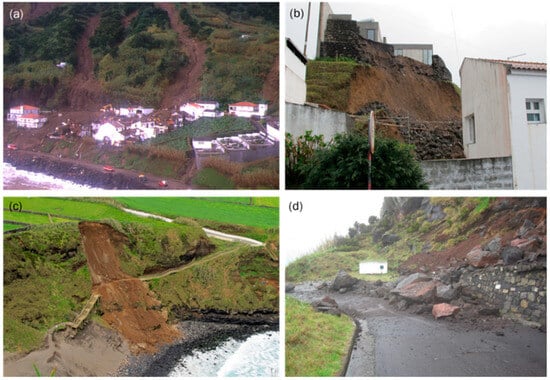
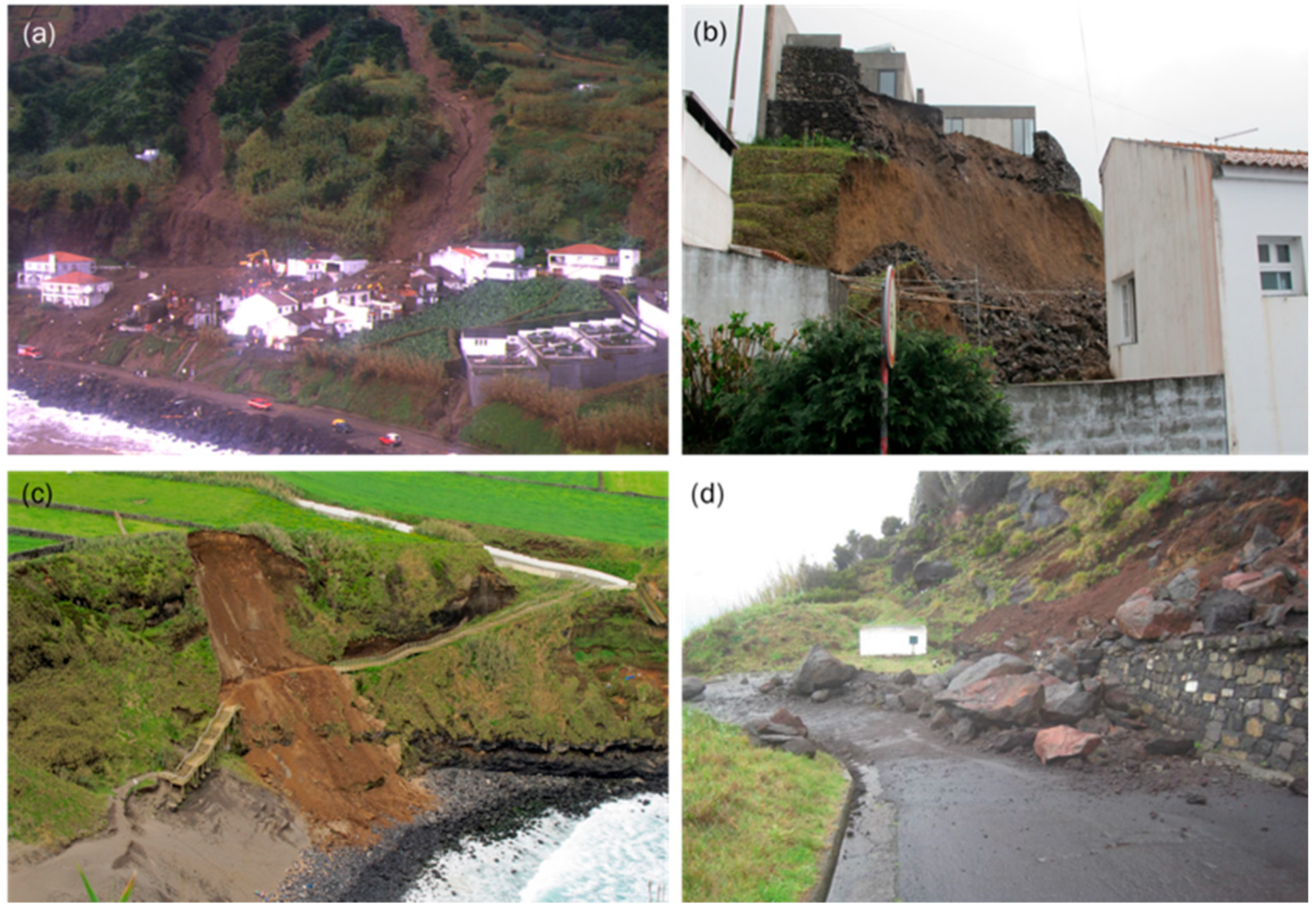
Although the type of landslide is occasionally unspecified, the most frequent types are shallow slides and debris flows (Figure 4). On São Miguel Island, landslide events are widespread throughout the climatological year but are concentrated in the rainiest months of the year, particularly between December and March, which account for 67% of the total landslide events.
Figure 4.
Examples of landslides on São Miguel Island: (a) debris flow that caused 29 fatalities in 1997; (b) shallow landslide that caused one fatality in 2012; (c) shallow landslide that destroyed access to a beach in 2013; and (d) rockfall that blocked a road in 2013.
Table 1 summarises the 61 landslide events considered in this study. For each event, the table presents the date, affected municipality, spatial extent, and the estimated number of individual landslides. The affected municipality corresponds to the municipality or municipalities where landslides were recorded during a given event. The spatial extent is defined as the cumulative area of the parishes affected by each event. The number of landslides represents the estimated total of individual landslides that occurred during each event.
Table 1.
Date, affected municipality, spatial extent and estimated number of landslides for each recorded landslide event.
3.2. Rainfall Data
The rainfall data used in this study were collected from four rainfall stations (analysed by Silva et al. 2025 [33]): three owned by the Government of the Autonomous Region of the Azores (GRAA) and one by the Portuguese Institute for Sea and Atmosphere (IPMA). These rainfall stations were selected for their long time series of daily rainfall data, their representative coverage of the island’s rainfall distribution and morphostructural units; and the extensive catalogue of landslide events within their areas of influence. Unfortunately, hourly rainfall records in the Azores are only available from 2012 onward, covering just 16% of the landslide events listed in Table 1. Moreover, most of these events lack precise timing information. These limitations prevented the use of hourly precipitation data for establishing rainfall thresholds for landslide triggering. Indeed, a long-term rainfall time series, together with a comprehensive landslide event catalogue, are essential requirements for developing robust rainfall thresholds for landslide triggering using probabilistic approaches.
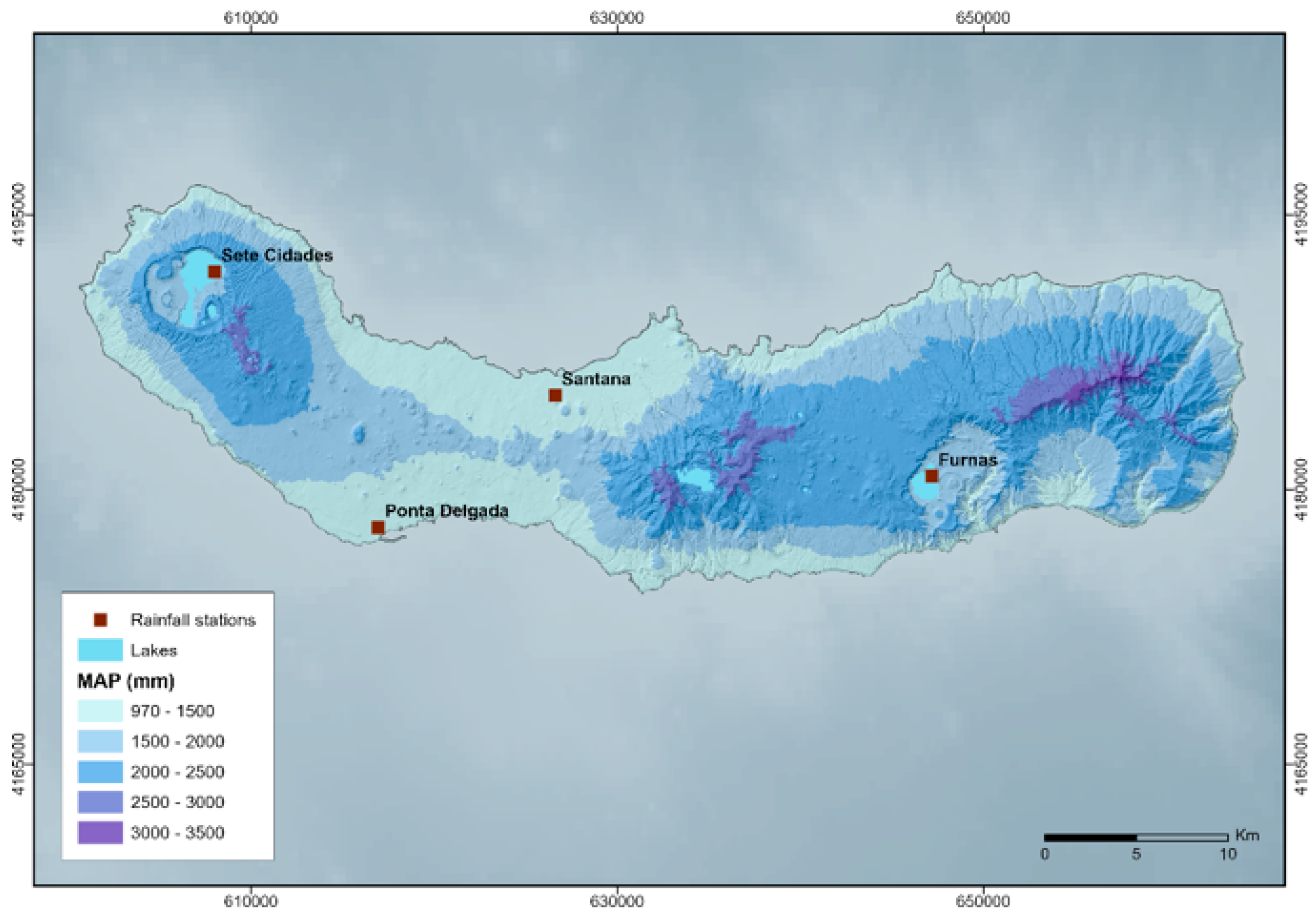
Details regarding the altitude, MAP, data periods and ownership of rainfall stations are provided in Table 2. The distribution of MAP and the location of these rainfall stations are illustrated in Figure 5.
Table 2.
Rainfall stations used in the analysis.
Figure 5.
Geographic location of rainfall stations and the distribution of the MAP (mm).
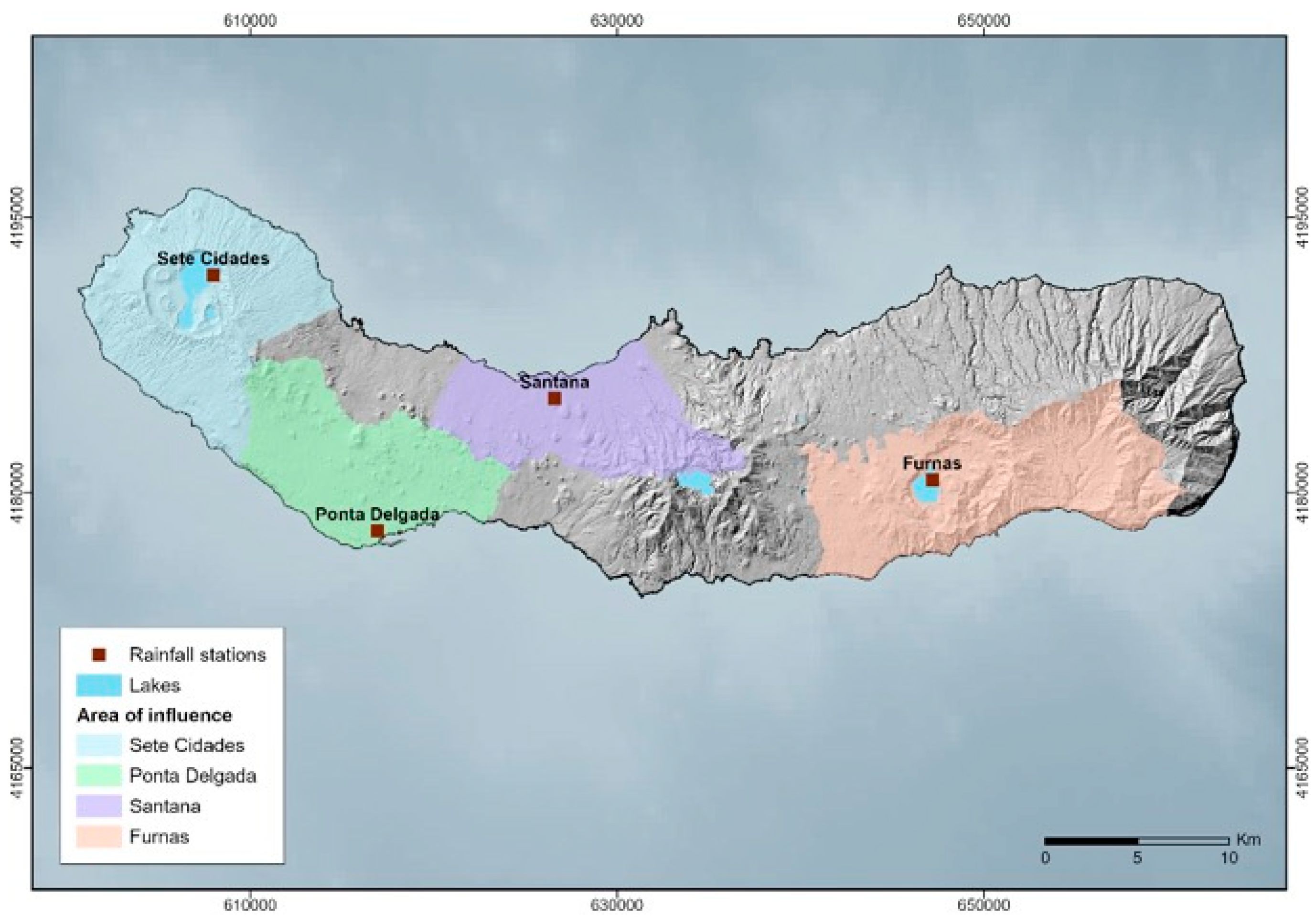
The method of selecting reference rainfall stations for defining rainfall thresholds, based on the nearest rainfall station, remains one of the simplest and most widely used approach [7]. Since landslide events in the NATHA database are typically geolocated only at the parish level (the smallest administrative division), spatial analysis was limited to this resolution. To address this, four areas of influence were defined around the rainfall stations by grouping nearby parishes (within a 10 km radius), considering both geographic and geomorphologic context (Figure 6). Each landslide event was then associated with the nearest rainfall station within these areas. When a landslide event extended across two or more areas of influence, this overlap was accounted for in the analysis. Landslide events occurring outside the defined areas of influence were excluded from the analysis.
Figure 6.
Areas of influence of each reference rainfall station.
The area of influence of the Sete Cidades rainfall station essentially corresponds to the Sete Cidades Volcano and covers an area of 112.1 km2. The Ponta Delgada and Santana rainfall stations represent areas of influence within the Picos Fissural Volcanic System, to the south and north, respectively, with areas of 85.4 km2 and 77.1 km2. The area of influence of Furnas rainfall station mainly corresponds to the Furnas and Povoação Volcanoes and the southwestern part of the island, covering an area of 123.2 km2. Overall, 346.8 km2 (47%) of the island lie outside the areas of influence defined for the four selected rainfall stations.
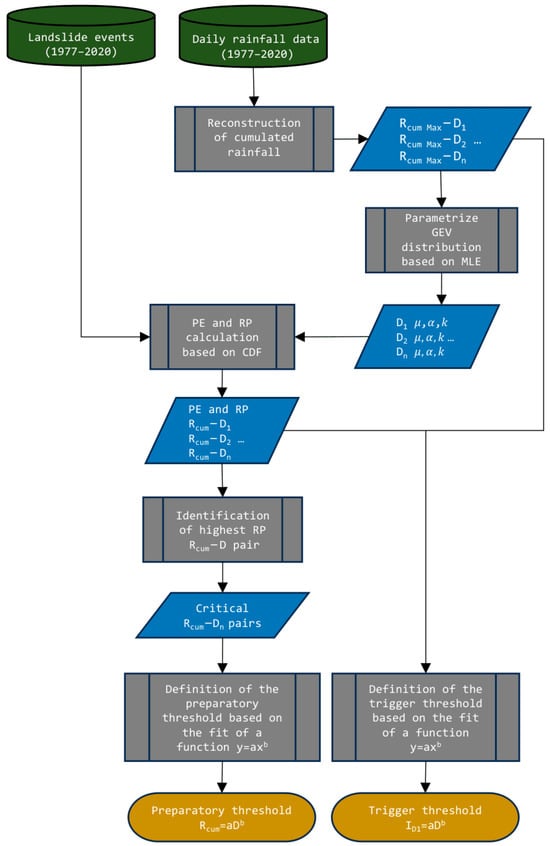
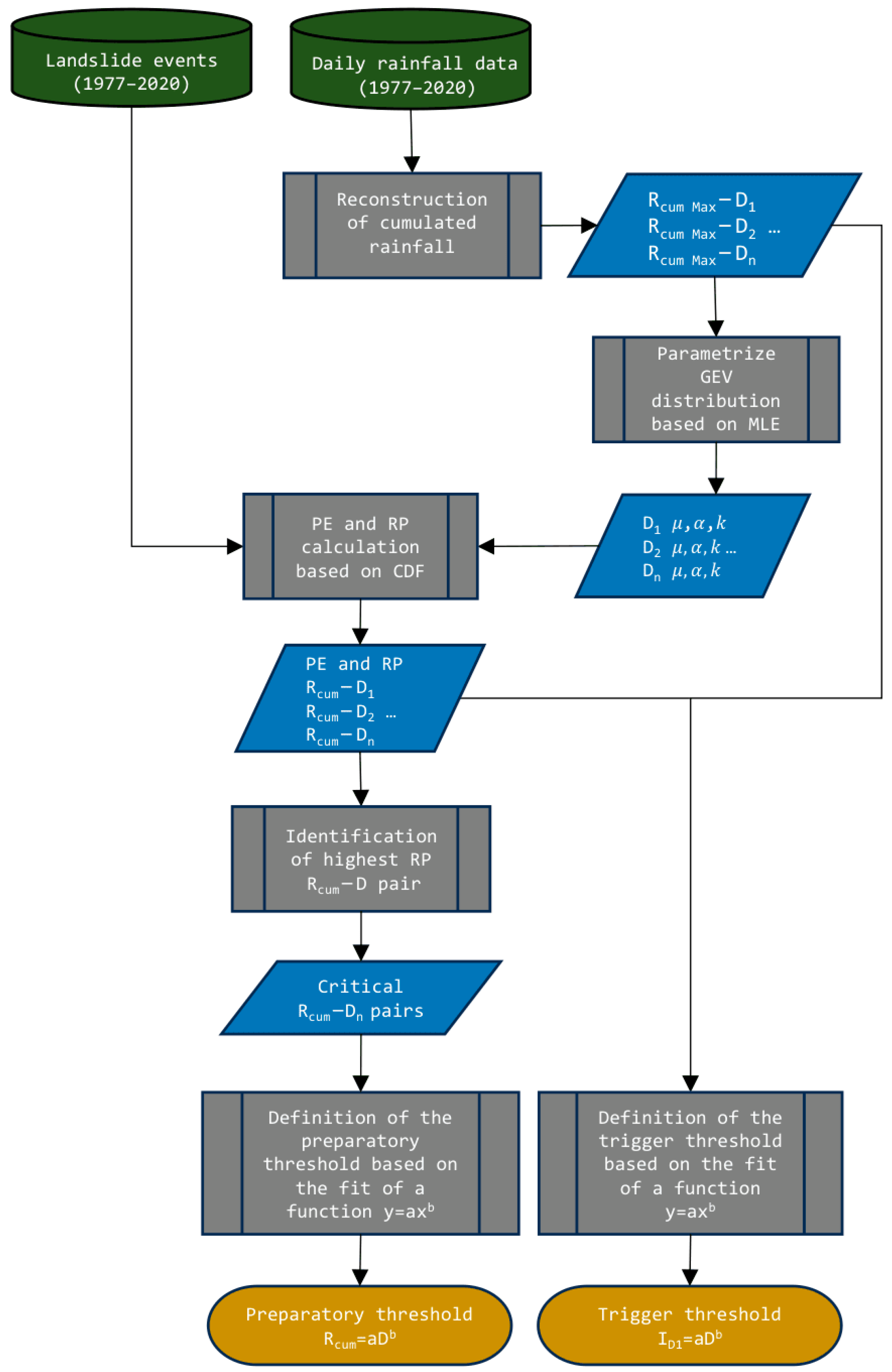
Figure 7 presents a summary of the steps used in this study to define the preparatory and trigger thresholds. In the workflow diagram, green boxes represent the input data, grey rectangles correspond to the processing steps, blue trapezoids indicate intermediate outputs, and yellow boxes represent the final outputs. The reconstruction of cumulated rainfall in this study follows the methodology proposed by Zêzere et al. (2005) [40]. The daily rainfall data recorded on the rainfall stations were organised by climatological year, which spans from September to August. Rainfall daily data from the climatological years 1977/78 to 2019/2020 were considered, corresponding to the period from 1 September 1977 to 31 August 2020. This approach was chosen instead of the hydrological year (October–September) because the rainfall regime in the study area justifies it. By starting the analysis in September, following the typically dry months of July and August, the complete transition to the wet season is captured in each climatological year.
Figure 7.
Workflow for defining preparatory and trigger thresholds.
For each data period from each rainfall station, the cumulated antecedent rainfall was calculated over various durations. Field observations on São Miguel Island indicate that typically a water table is generally absent close to the ground surface at most landslide sites. The rapid variation and evolution of pore pressures at the top of the slope are not directly linked to the evolution and elevation of the groundwater level. Therefore, the water infiltration process and the development of a percolation front are considered the main triggering mechanisms for landslides [38]. In this context, durations from 1 to 20 consecutive days were considered.
3.3. Generalised Extreme Value (GEV) Distribution
Extreme value analysis allows for predictions of future extreme event probabilities based on historical data [43]. One common method used in extreme value analysis is the block maxima approach, which involves modelling a sequence of maximum values taken from blocks (or periods) of equal duration. In this study, the maximum annual rainfall values, for all the cumulated rainfall periods considered, were extracted and analysed using the generalised extreme value (GEV) distribution [44]. The Generalised Extreme Value (GEV) distribution comprises three distinct categories: type I (Gumbel distribution), type II (Fréchet distribution), and type III (Weibull distribution). Let X denote the annual maximum cumulative rainfall for a given duration D, obtained using the block maxima approach. The variable X is assumed to follow a Generalised Extreme Value (GEV) distribution. The probability density function (PDF) for the GEV is represented as Equation (1):
The cumulative distribution function (CDF), resultant from the integration of the PDF, is given by Equation (2):
where is the location parameter, is the scale parameter and is the shape parameter. The three scenarios are as follows: (i) when = 0, resulting in the Extreme Value type I distribution; (ii) when < 0, yielding the Extreme Value type II distribution; and (iii) when > 0, producing the Extreme Value type III distribution [45]. In each of these cases, the value of remains positive.
3.4. Parameter Estimation
The GEV parameters were estimated using the Maximum Likelihood Estimation (MLE) method. The goal of MLE is to find the values of that maximise the likelihood function. This is typically achieved by taking the natural logarithm of the likelihood function (log-likelihood) and then applying optimisation techniques to maximise it. For ≠ 0, the likelihood function is given by Equations (3) and (4) [44,46]:
where:
If = 0, the GEV distribution reduces to the Gumbel distribution, and the resulting log-likelihood function is given by Equation (5):
Coles (2001) [44] notes that ML estimates exhibit typical asymptotic behaviours when ≥ −0.5. When = [−1, −0.5], ML estimates are attainable but lack standard asymptotic properties. For < −1, ML estimates are non-existent, and for > 0.5, second and higher moments are not definable. Additionally, MLE introduces minimal bias for sample sizes ranging from 30 to 100. However, caution is advised when estimating parameters near = 0, as emphasised by Kotz and Nadarajah (2000) [47].
3.5. Probability of Exceedance and Return Period
The temporal probability of a landslide event is estimated by the probability that the rainfall event will exceed the defined rainfall threshold [48,49,50]. The probability () of exceeding the specified rainfall threshold within a given year is determined by applying Equation (6):
where is the cumulative distribution function.
Due to the extension of the results for all four stations and multiple durations, the corresponding graphical representations of the PDF and CDF/Probability of Exceedance curves are provided in the Supplementary Materials (Figures S1–S4).
The return period (RP) is the average time between events that exceed a particular threshold. It is calculated as the reciprocal of the probability of exceedance, as shown in Equation (7):
For each landslide event, the cumulated rainfall–duration (Rcum − D) pair with the highest RP was selected. This approach ensures that the rarest (most extreme) rainfall periods are chosen for each event, allowing for the maximum distinction between rainfall periods associated with landslide events and those not related with landslide events, similar to the criteria used by Marques et al. (2008) [35] and Zêzere et al. (2005, 2015) [3,40].
Based on the Rcum − D pair for each landslide event, a preparatory threshold was plotted, corresponding to the best distinction between days with recorded landslides and days without landslides. The parameters of the preparatory threshold were adjusted so that all landslide events remained above the function while minimising the number of false positives.
For values of D > 1, the Rcum values tend to attenuate the importance of the rainfall recorded on the day of the landslide event (RD1), and this problem worsens with increasing duration. To address this issue, a function relating rainfall intensity on the day of the landslide event (ID1) and the duration (D) was tested, and a trigger threshold was also defined, aiming to achieve the best distinction between days with recorded landslides and days without landslides, considering the previously established criteria.
The combined rainfall threshold responsible for triggering landslides corresponds, therefore, to a combination of two distinct power functions: the preparatory threshold and the trigger threshold, with the parameter shared by both functions. Landslide triggering conditions are detected when the preparatory threshold is exceeded for a certain Rcum − D pair and, simultaneously, for the same rainfall duration, the trigger threshold is exceeded, thus properly emphasising the rainfall intensity recorded on the day of the event.
The MAP from the 44 years of rainfall records was used to normalise the amount and intensity of the calculated thresholds, by computing the ratio between the amount and intensity of rainfall and the MAP.
The monthly probability of exceedance and return period of the combined thresholds are calculated by first determining the maximum rainfall values for all durations in each month of each year, followed by fitting the GEV distribution to the maximum rainfall data for each month and duration. Finally, the combined probabilities of exceedance for different months and durations are obtained by multiplying the probability of exceedance of the preparatory and trigger thresholds.
3.6. Criteria for Thresholds Validation
The receiver operating characteristic (ROC) analysis was used to assess the performance of empirical rainfall thresholds. These analytical techniques can also be applied for calibrating rainfall thresholds (e.g., [3,12,51]). To avoid an overestimation of threshold performance due to the large proportion of non-rainy days, only days with daily rainfall ≥ 10 mm were considered in the validation procedure. This approach follows recommendations in the literature (e.g., [52]), which suggest excluding non-rainfall days when computing confusion matrix elements and ROC-based performance metrics. By restricting the analysis to rainfall days above this threshold, the validation focuses on meteorologically relevant conditions for landslide triggering, resulting in a more conservative and realistic assessment of predictive capability.
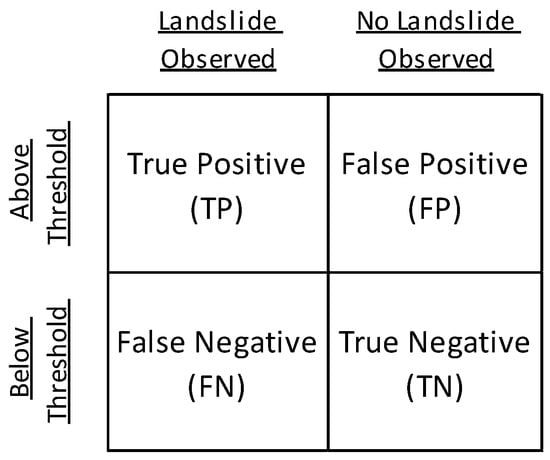
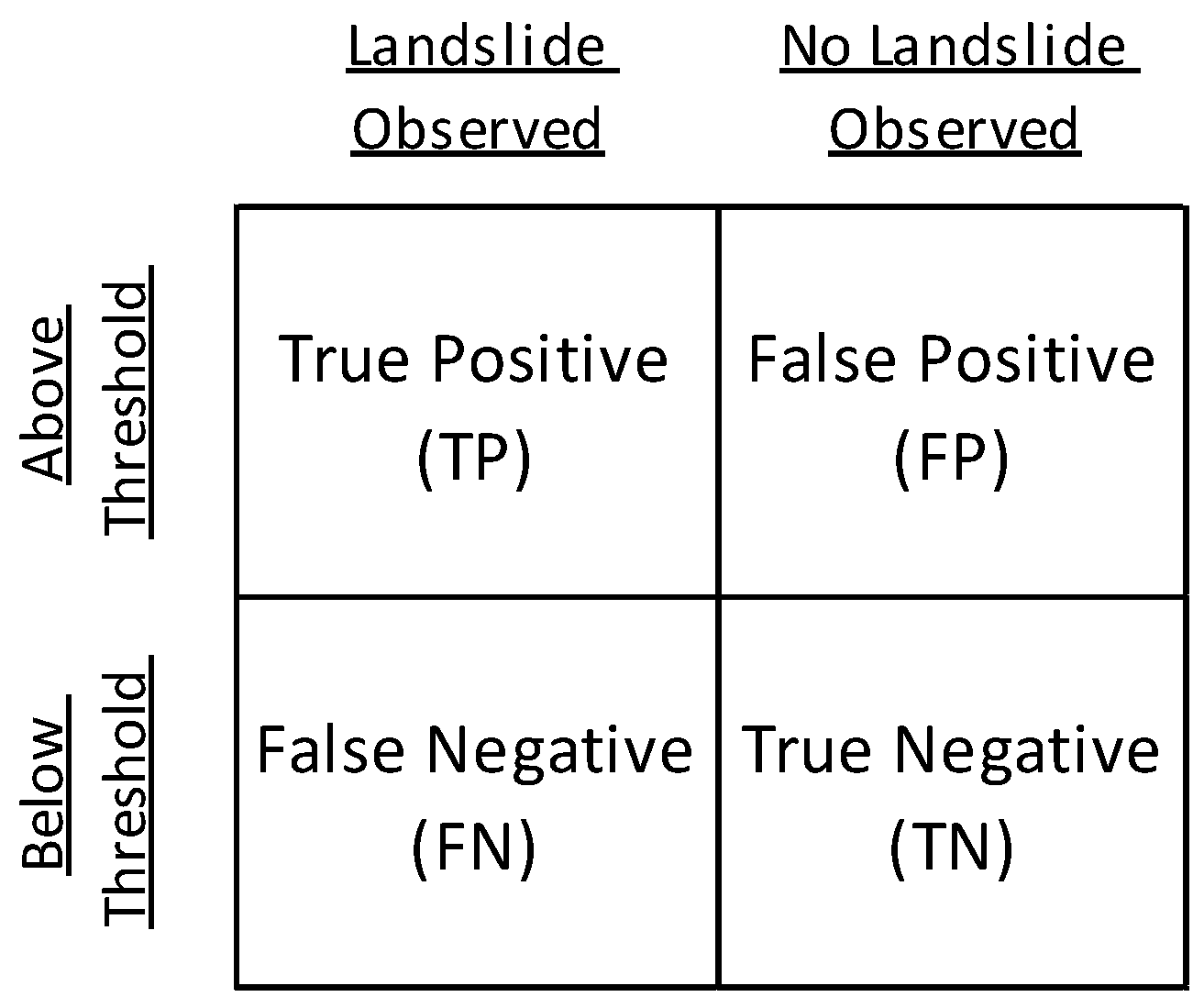
The confusion matrix evaluates prediction accuracy by classifying outcomes as true positives (TPs), false negatives (FNs), true negatives (TNs), and false positives (FPs). For rainfall thresholds, TPs are landslides exceeding the threshold, FNs are landslides below the threshold, TNs correspond to non-landslide rainfall conditions below the threshold, and FPs are non-landslide conditions exceeding the threshold [53]. Furthermore, this study employed four ROC metric functions outlined by Staley et al. (2013) [12], as illustrated in Figure 8 and Equations (8)–(11). The proportion of correctly identified landslide occurrences based on the threshold is referred to as the true positive rate (TPrate). The false positive rate (FPrate) represents the percentage of rainfall events exceeding the threshold for which no landslide occurrence data are reported. The false alarm rate (FArate) represents the proportion of incorrect predictions in relation to the total number of rainfall events exceeding the specified threshold. The threat score (TS) is used to assess the threshold for optimising correct predictions while minimising the false positive (FP) and false negative (FN) rates.
Figure 8.
Confusion matrix illustrating the four possible outcomes of a binary classification model and the metrics used to assess classifier performance in ROC analysis.
4. Results and Discussion
4.1. Thresholds for Landslide
Over the 44-year study period, a total of 61 landslide events were recorded. For each event, the rainfall duration (D), the cumulated rainfall (Rcum), and the 1-day rainfall intensity (ID1) were calculated. The respective return periods (RPs) and the combined return period were determined for each landslide event, following the methodology described in the previous section. The results were grouped by the four rainfall stations considering their respective areas of influence (Table 3, Table 4, Table 5 and Table 6).
Table 3.
Landslide events triggered by rainfall within the influence area of the Sete Cidades rainfall station.
Table 4.
Landslide events triggered by rainfall within the influence area of the Ponta Delgada rainfall station.
Table 5.
Landslide events triggered by rainfall within the influence area of the Santana rainfall station.
Table 6.
Landslide events triggered by rainfall within the influence area of the Furnas rainfall station.
The abundance of landslide events varies among the stations, reflecting the interplay of specific topographic, geomorphological, and geological factors combined with local rainfall patterns. Sete Cidades and Furnas influence areas concentrated most of the events, accounting for 38, 7% and 45, 2% respectively, which suggests that these areas have a higher landslide activity.
For all meteorological stations, two distinct rainfall patterns could be recognised as being associated with landslide activity: (i) short-duration, high-intensity rainfall and (ii) long-duration, low-intensity rainfall. Landslide events characterised by short-duration and high-intensity rainfall typically occur during storms or convective weather events (e.g., the 31 October 1997 landslide event in the Furnas rainfall station influence area; Table 5). These events are linked to lower values of Rcum, which indicates that less demanding cumulative rainfall is required for preparation, but higher ID1 values, which signal more demanding high intensity conditions on the day of the event. In contrast, landslide events typically associated with long-duration rainfall periods are generally triggered by the accumulation of rainfall over extended periods (up to 20 consecutive days), which saturates the soil and destabilises slopes (e.g., the 30 December 1996 landslide event in the Sete Cidades rainfall station influence area; Table 2). These events are characterised by higher Rcum values, indicating the importance of prolonged rainfall in preparing the slopes for failure, but lower ID1 values, indicating less demanding high intensity conditions on the day of the event. The distinction between these two rainfall patterns underscores the complex interplay between rainfall characteristics and landslide susceptibility across different regions and climatic conditions [54].
The recurrence of landslide events, as indicated by the combined RP, highlights the variability in their frequency across different regions. The combined RP is a key metric, integrating both the cumulative rainfall (Rcum) and 1-day rainfall intensity (ID1), to provide a comprehensive assessment of landslide likelihood under specific rainfall conditions. Landslide events associated with longer combined RP are typically associated with rare extreme weather events. However, events with shorter combined RP, often driven by more common rainfall patterns, can still pose substantial risks to the affected areas.
For Sete Cidades rainfall station (Table 2), 21 landslide events were recorded, with nearly half (48%) exhibiting a combined RP of less than 2 years, indicating a high recurrence of events in this area. These frequent events suggest a strong susceptibility of the region to landslides under relatively common rainfall conditions. Notably, the events on 23 December 1983 and 15 December 2006 stood out for their rarity, with combined RP values of 32.3 years and 36.3 years, respectively. These events were likely associated with exceptional rainfall conditions.
Within the Ponta Delgada rainfall station influence area (Table 3), 12 landslide events were documented, making it the station with the fewest events among the four analysed. Of these, 4 events (approximately 33%) had a combined RP of less than 2 years, indicating a moderate recurrence of events. The event with the longest combined RP was triggered on 30 December 1996, with a value of 36.3 years, highlighting a rare instance of extreme rainfall conditions affecting this area.
For the Santana rainfall station (Table 4), a total of 22 landslide events were recorded, with 10 of these events (approximately 42%) exhibiting a combined RP of less than 2 years. This indicates a relatively high frequency of landslide occurrence in this region, comparable to Sete Cidades. The event with the longest combined RP occurred on 21 October 1996, with a value of 13.3 years, significantly lower than the rarest events recorded in other stations. This suggests that while landslides are frequent in Santana, they are generally less extreme compared to other areas.
The Furnas rainfall station influence area recorded the highest number of landslide events, with 41 occurrences documented (Table 5). Despite the abundance of events, only 11 of these (approximately 27%) had a combined RP of less than 2 years, indicating a slightly lower recurrence compared to Sete Cidades and Santana. This lower frequency may reflect a combination of unique geomorphological, geological, and hydrological conditions that require more specific rainfall patterns for landslide triggering. The event on 30 November 2000 is particularly noteworthy, as it represents the rarest landslide event in the entire dataset, with a combined RP of 42.2 years. This exceptional event likely reflects extreme weather conditions and underscores the vulnerability of the region to rare but impactful landslide occurrences.
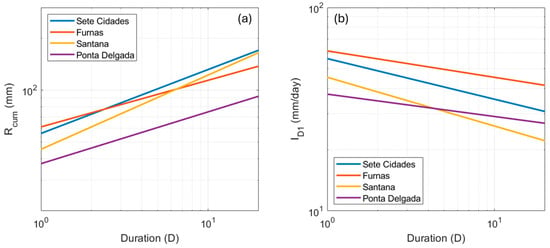
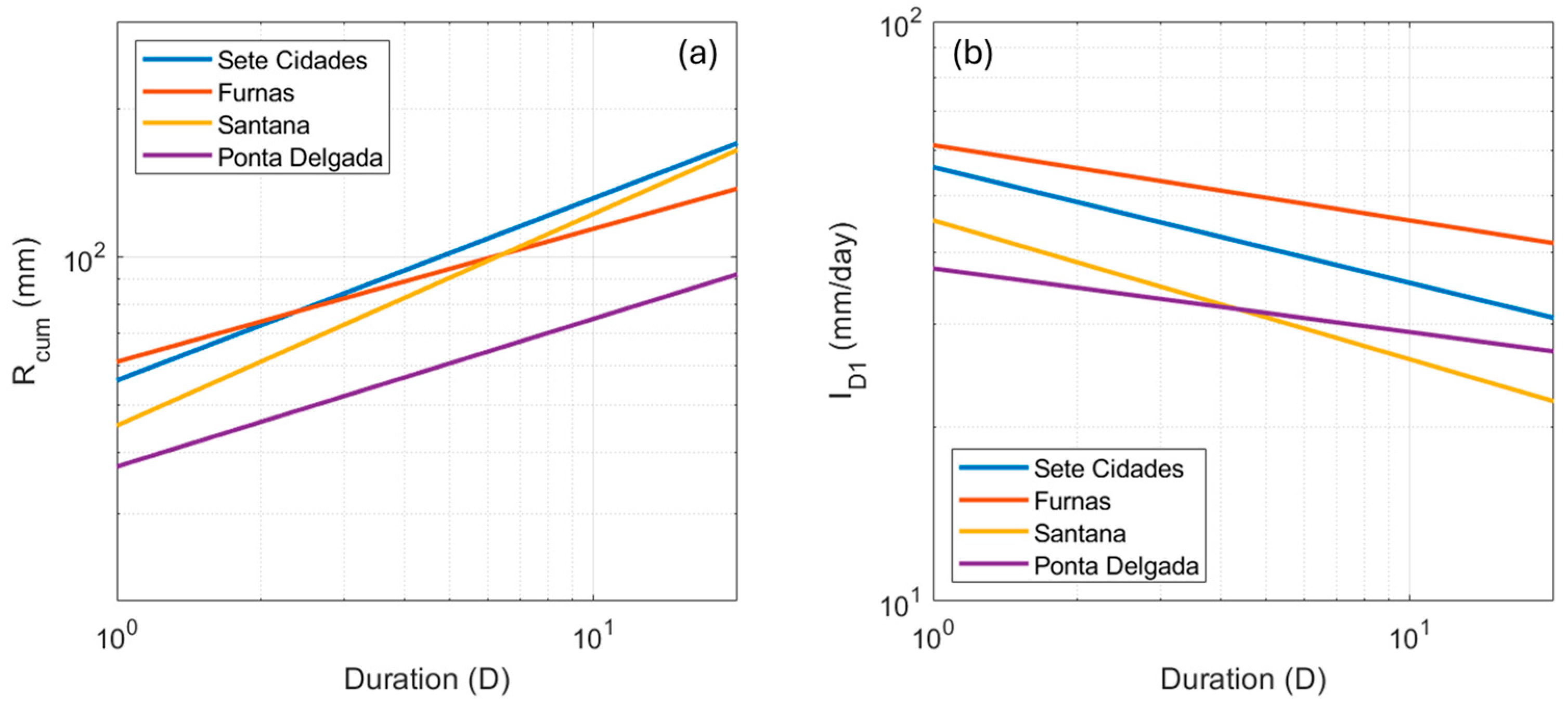
Figure 9 and Table 7 present the preparatory and trigger thresholds for landslide occurrence at the four rainfall station influence areas.
Figure 9.
(a) Preparatory thresholds and (b) trigger thresholds for the four rainfall stations.
Table 7.
Preparatory and trigger thresholds equations for the four rainfall stations.
The preparatory threshold (Rcum = aDb) indicates the cumulative rainfall required over a certain duration to prepare the terrain for a potential landslide. In the equation, a and b are constants specific to each station.
At Sete Cidades, the preparatory threshold was notably higher than those associated with the other stations. This suggests that the region requires more accumulated rainfall to reach the threshold. In contrast, Santana exhibited a lower preparatory threshold for shorter rainfall durations compared to Sete Cidades. However, as the duration extended, Santana’s threshold became slightly more demanding. Ponta Delgada showed the lowest preparatory threshold among all stations. The preparatory threshold for Furnas was slightly higher than Sete Cidades for shorter durations; yet, for longer durations, the threshold rose more gradually.
The trigger threshold (ID1 = aDb) refers to the rainfall intensity on the event day required to trigger a landslide, considering the duration of the preparatory period. In this equation, a and b are constants specific to each station.
For all stations, the trigger threshold indicates that high rainfall intensity is required to trigger landslides when the duration of the preparatory period is shorter. However, as the rainfall duration increases, the intensity required to trigger a landslide event decreases, implying that prolonged rainfall events, even with lower intensity on the event day, can still trigger landslides. Furnas consistently recorded the highest rainfall intensity values on the day of the event for the entire range of durations of the preparatory period. Sete Cidades also showed high intensity values, but with a steeper slope, indicating that for longer durations of the preparatory period, the intensity required on the event day to trigger landslides decreases notably. Santana and Ponta Delgada displayed similar patterns. Santana had higher thresholds for durations up to 3 days, but for longer durations, Ponta Delgada’s threshold surpassed Santana’s, suggesting a change in the relative strength of these areas based on event rainfall duration.
4.2. Rainfall Thresholds Validation
The ROC metrics associated with the preparatory and combined rainfall thresholds for the four rainfall stations are shown in Table 8 and Table 9, respectively.
Table 8.
ROC metrics associated with the preparatory threshold for each rainfall station.
Table 9.
ROC metrics associated with combined rainfall thresholds for each rainfall station.
For both thresholds (preparatory and combined), the TPrate was 1 across all stations, indicating that both thresholds correctly detected all the rainfall events that generated landslide activity (FN = 0 in both cases). This result was due to the criteria used to define the thresholds, ensuring accurate landslide event identification.
The combined threshold showed a significant reduction in FP values across all stations compared to the preparatory threshold, indicating greater effectiveness in reducing false positives. This improvement suggests that the combined threshold is more reliable in detecting landslide events and minimising false alarms. The FPrate dropped considerably across all stations when using the combined threshold, reaching values between 0.14 and 0.15, whereas with the preparatory threshold, it ranged from 0.27 to 0.60. For example, at the Furnas station, the FPrate decreased from 0.60 to 0.14, representing a substantial improvement.
Additionally, the FArate also decreased with the use of the combined threshold, although it remained relatively high due to the low number of catalogued landslide events in each station’s influence area. This reduction indicates that the combined threshold is more effective at filtering out false alarms, especially in Furnas, where the FArate dropped from 0.97 to 0.89. This improvement suggests that the model is becoming more proficient at distinguishing rainfall patterns associated with landslide activity from those that are not.
The TS remained low across all stations when using only the preparatory threshold, ranging from 0.02 at Sete Cidades and Ponta Delgada to 0.06 at Santana and 0.03 at Furnas. However, the TS improved significantly with the combined threshold, reaching 0.06 for Sete Cidades and Ponta Delgada, and 0.10 and 0.11 for Santana and Furnas, respectively. This increase indicates that the combined threshold improves the proportion of correct predictions (true positives) relative to total predictions (including false positives), resulting in more robust overall performance.
The combined threshold demonstrates clear advantages over the preparatory threshold alone, particularly in reducing false positives and increasing accuracy in detecting landslide events, providing more efficient performance across all stations. While the TS remained modest, the reduction in false positives and the improvement in FPrate and FArate signify that the combined threshold is a more reliable and efficient tool for landslide prediction, making it a promising approach for early warning systems.
4.3. Rainfall Thresholds Normalised by the MAP
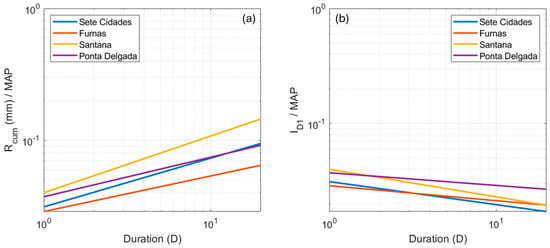
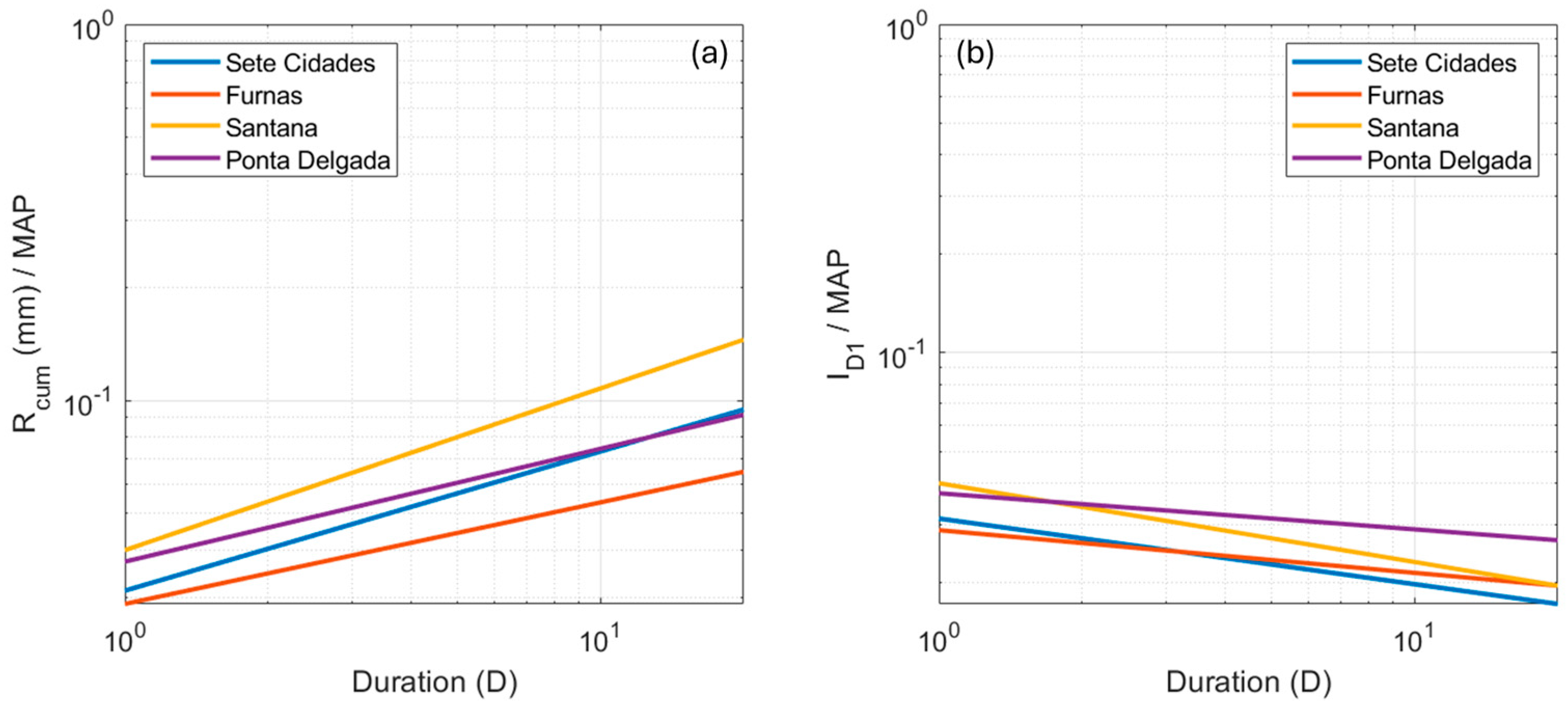
One widely accepted approach for linking the threshold to the total rainfall received in the area is normalising the amount and intensity of rainfall by the MAP. This normalisation makes the thresholds more comparable and applicable across different geomorphologic and geologic settings, highlighting the importance of accounting for local precipitation patterns [1,55]. The thresholds normalised by the MAP are presented in Figure 10 and Table 10, revealing that the thresholds were generally similar, with only minor differences across stations.
Figure 10.
(a) Preparatory thresholds and (b) trigger thresholds, both normalised by the MAP for the four rainfall stations.
Table 10.
Equations for preparatory and trigger thresholds normalised by the MAP for the four rainfall stations.
The normalised preparatory and trigger thresholds reflect the specific rainfall pattern in each area, but also the influence of other preparatory factors, such as geomorphology and geology.
Stations with higher MAP, such as Sete Cidades and Furnas, showed lower normalised thresholds. This reflects their high annual rainfall, where smaller percentages of MAP are sufficient to trigger landslides. Ponta Delgada and Santana, with lower MAP, exhibited higher thresholds. This indicates that they require relatively greater rainfall amounts or intensities (as a percentage of MAP) to reach critical landslide conditions.
In general, the rainfall amount and intensity required to trigger landslides were approximately 3–4% of the MAP for rainfall durations equal to 1 day (Table 9). For both normalised thresholds, Sete Cidades and Furnas shared the lowest a coefficient (0.03), reflecting a lower rainfall requirement relative to their MAP for slope preparation and landslide triggering. In contrast, Santana and Ponta Delgada had a slightly higher a coefficient (0.04), indicating more demanding rainfall conditions relative to MAP in these areas.
The b coefficient for the preparatory thresholds, which reflects the sensitivity of cumulative rainfall to duration, varied across stations. Sete Cidades (0.37) and Furnas (0.27) had lower coefficients, with Furnas exhibiting a steeper decline in threshold demand over longer durations. Santana, with the highest b coefficient (0.43), indicates that more demanding conditions of rainfall accumulated values are required for longer rainfall durations to prepare slopes for landslide occurrence compared to the other stations.
For the trigger thresholds, the negative b coefficient values highlight how threshold intensity decreases with increasing rainfall duration. Sete Cidades (−0.20) and Furnas (−0.13) exhibited slower declines in intensity requirements for landslide triggering, with Sete Cidades being less demanding for longer durations. Santana’s exponent (−0.24) indicated the steepest decline, where short-duration rainfall events had higher intensity requirements. Ponta Delgada (−0.11) showed the slowest decrease in intensity requirements with increasing rainfall durations, reflecting a lower influence of the cumulative rainfall over time in reducing the necessary rainfall intensity for trigger landslides.
The geomorphology of the Sete Cidades and Furnas areas, characterised by relatively “young” landscapes with steep slopes that are still adjusting to their rainfall regime, plays a significant role in their lower threshold requirements. These areas contain friable materials such as pumice and loose volcanic deposits, which are less resistant to weathering and erosion. This geological composition, coupled with their steep topography, makes these regions more susceptible to landslides, requiring smaller rainfall amounts and intensities to reach critical thresholds.
In contrast, the influence areas of Ponta Delgada and Santana stations are located on the Picos Fissural Volcanic System. This region is dominated by basaltic lava flows and scoria, which are more resistant to weathering processes. The terrain in these areas is characterised by moderate slopes and a limited drainage network, contributing to relatively higher normalised threshold values. These regions require higher rainfall amounts and intensities, as a percentage of MAP, to trigger landslides, reflecting their drier climate and more stable geological setting.
Furthermore, the alignment between threshold variability and local climatic and geomorphologic characteristics highlights the necessity of site-specific calibration of rainfall thresholds. Understanding the geomorphological and geological context of each region is essential for accurately predicting and mitigating landslide risk, as these factors directly influence the terrain response to rainfall. This study demonstrates the effectiveness of a combined threshold approach that integrates antecedent and event-day rainfall into a single predictive model. By reducing false positives and improving overall prediction accuracy on landslide prediction across all rainfall stations, this approach offers a suitable tool for early-warning systems.
4.4. Monthly Probability of Exceedance and Return Period of the Combined Thresholds
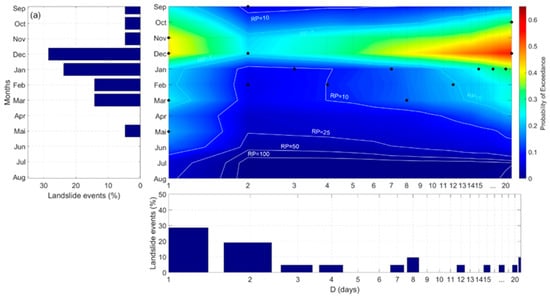
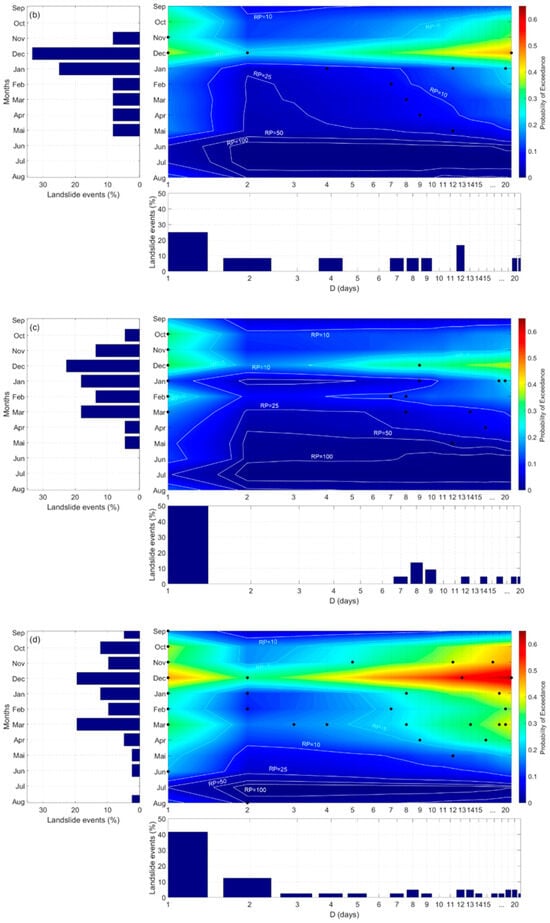
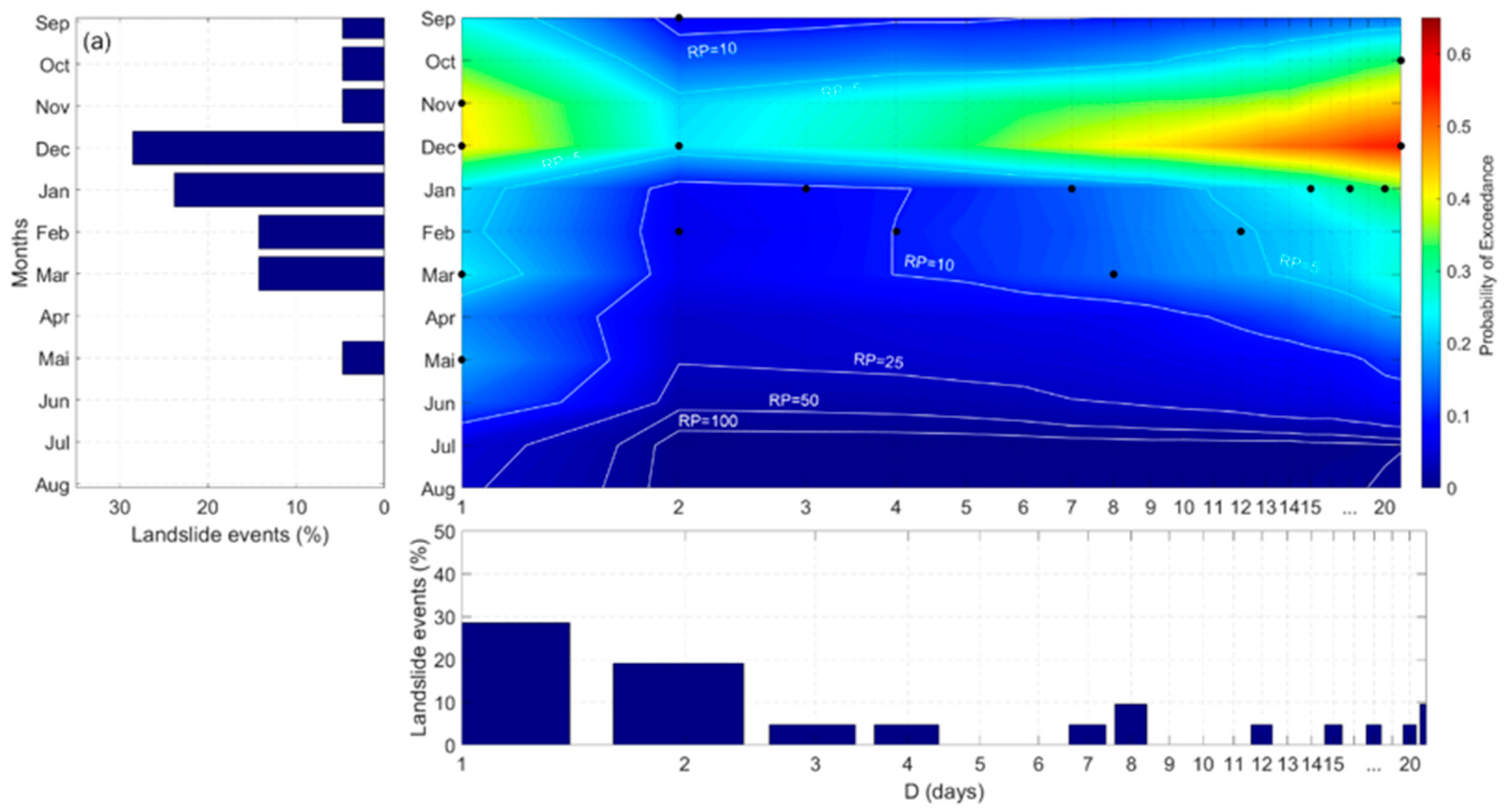
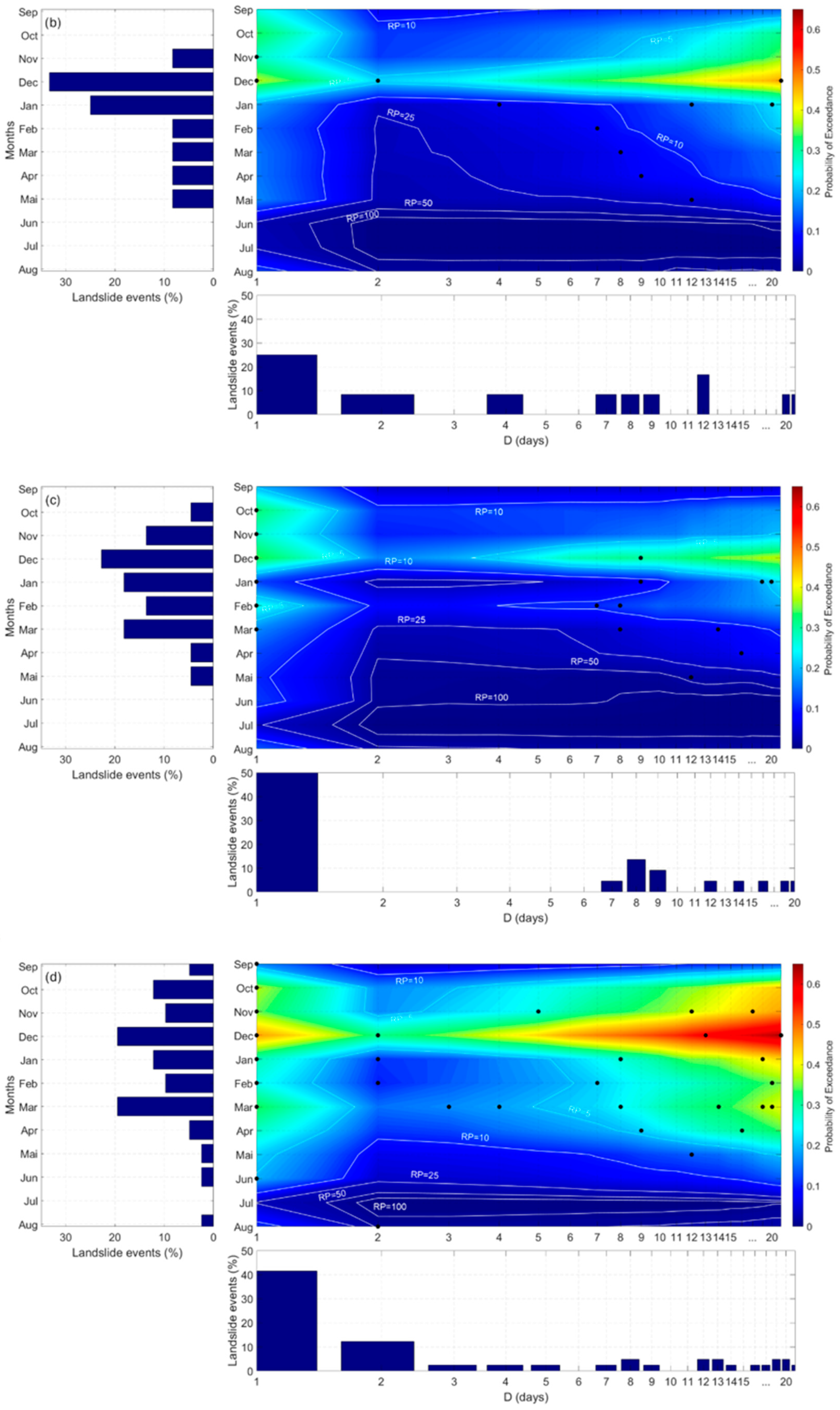
This section provides a detailed analysis of the monthly patterns of landslide occurrences and the respective probability of exceeding the combined rainfall thresholds. The primary objective was to explore the relationship between seasonality, rainfall event duration, and intensity in relation to the established thresholds while emphasising the specific return periods (RPs). A total of 240 GEV distributions were fitted using the MLE method. The monthly probability of exceeding the combined rainfall threshold for landslide occurrence along with the corresponding RP and monthly frequencies of catalogued landslide events are shown in Figure 11.
Figure 11.
Monthly probability of exceeding the combined rainfall threshold for landslide occurrence, along with the corresponding return periods (RPs) for: (a) Sete Cidades, (b) Ponta Delgada, (c) Santana, and (d) Furnas. The figure also includes the monthly percentages of catalogued landslide events. The black dots represent landslide events.
All stations demonstrated a clear seasonal pattern, with the highest concentration of landslide events occurring during the winter months, particularly in December and January. This trend reflects the influence of increased rainfall during this period. Sete Cidades and Ponta Delgada exhibited pronounced peaks in December, with over 30% of the events occurring in this month. Santana and Furnas showed a broader distribution, with notable contributions in November, December and January.
Across all stations, most landslide events were associated with short-duration rainfall events lasting 1–3 days, highlighting the critical role of intense, short-lived storms as primary triggers. However, notable differences emerged between stations. Furnas stood out with a relatively higher proportion of landslide events associated with longer rainfall durations (>10 days). This indicates that prolonged periods of moderate to heavy rainfall significantly contribute to landslide triggering in this area, possibly due to cumulative soil saturation effects. In contrast, Sete Cidades, Santana, and Ponta Delgada showed a more pronounced reliance on shorter-duration events, with limited contributions from rainfall lasting longer than 5–6 days. This suggests that these regions are more sensitive to the intensity of rainfall rather than to its cumulative duration.
A strong correlation was observed between the landslide events and periods of higher probabilities of rainfall threshold exceedance. For short rainfall durations (1 day) characterised by high rainfall intensities, the probability of triggering landslides was particularly high between October and December for all stations. Sete Cidades and Furnas rainfall stations showed an additional peak in March, likely driven by early spring rainfall. At Santana station, an additional increase occurred in February, reflecting regional variations in seasonal rainfall distribution.
For cumulated rainfall periods exceeding 6 days, rainfall stations showed distinct seasonal trends. Sete Cidades showed a higher probability of exceedance between October and April, with the most critical period being October to January. At Ponta Delgada station, the highest probabilities of exceedance were concentrated between October and January, while at Santana station, it occurred between November and January. At Furnas station, the highest probabilities of exceedance were recorded between October and April, particularly from October to January.
At all stations, exceeding the combined rainfall threshold with an RP < 5 years was highly probable, underscoring the frequent nature of rainfall events capable of triggering slope failures. However, the temporal distribution varied by station and rainfall duration. At Sete Cidades station, for short-duration events, high probabilities occurred between September and January, with an additional peak in March. For longer-duration events, the high-probability period extended from September to May, reflecting the dual contribution of both intense storms and cumulative rainfall. At Ponta Delgada station, regardless of rainfall duration, the probability of landslides with a RP < 5 years was highest between September and January. At Santana station, for short-duration rainfall, the probability was higher between September and December, with an additional peak in February. For long-duration rainfall, the critical period spanned November to January, reflecting the role of prolonged rainfall events in landslide occurrence. At Furnas station, a high probability of landslides with an RP < 5 years was observed between September and May, regardless of the rainfall duration. This highlights the station’s broad vulnerability to both intense and prolonged precipitation events.
The results align with observed patterns of MAP. Stations with lower MAP values, such as Ponta Delgada and Santana, showed lower probabilities of exceedance due to more demanding thresholds in relative terms. This suggests that these regions require higher-intensity or longer-duration rainfall to trigger landslides. In contrast, at stations with higher MAP values, such as Furnas and Sete Cidades, the thresholds were less demanding, resulting in higher probabilities of exceedance.
4.5. Study Limitations and Future Perspectives
Despite the promising results, this study has some limitations that should be acknowledged. The landslide database was compiled through a review of local newspapers, which may lead to underreporting, particularly for events with limited impacts or those occurring in remote or sparsely populated areas. The absence of a report does not necessarily imply the absence of an event, potentially reducing the dataset’s representativeness and, consequently, the reliability of the defined rainfall thresholds. In addition, the temporal distribution of the documented landslide events was not homogeneous, with identifiable gaps in certain periods. These gaps likely reflect temporal variations in reporting practices, media coverage, and institutional monitoring capacity rather than a true absence of landslide activity. Specifically, missing or undocumented landslide events may lead to an overestimation of FNs and an underestimation of TPs, leading to conservative performance metrics. Nonetheless, the inventory was considered sufficiently representative to capture the dominant rainfall-triggering conditions and seasonal patterns of rainfall-induced landslides in the study area.
Another limitation concerns the scarcity of long-term hourly rainfall records and the absence of precise timing for most landslide events, which prevented the integration of high-resolution precipitation data into the definition of rainfall thresholds. The spatial resolution of the rainfall stations also constitutes a constraint, potentially affecting the precision of localised rainfall estimates. With only four stations, the rainfall data may not have accurately captured the local conditions at specific landslide sites, particularly in regions characterised by complex geomorphology and rainfall variability.
Although the thresholds have not yet been validated in real-time, retrospective performance (back-analysis) showed good predictive performance of the combined thresholds, with a high success rate in detecting events and a significant reduction in false positives. These results support the robustness of the adopted methodology and its potential for operational application. Future research should focus on expanding the rainfall and landslide datasets and testing real-time implementation within an operational early warning system for São Miguel Island.
5. Conclusions
This study demonstrates that the use of a combined rainfall threshold, integrating antecedent rainfall with event-day rainfall, significantly improved the landslide prediction on São Miguel Island. Compared to traditional single-threshold approaches, the combined model reduced false positives, increased predictive accuracy, and showed consistent performance across all rainfall stations.
Two main rainfall patterns were identified as responsible for triggering landslides: (i) long-duration events, characterised by significant rainfall accumulation over several consecutive days, and (ii) short-duration events, driven by extreme rainfall intensity within a single day. For short preparatory periods, high daily rainfall is required to trigger landslides, whereas longer preparatory rainfall reduces the intensity needed on the event day.
Normalising thresholds by mean annual precipitation (MAP) provided a more consistent basis for regional comparisons. Results indicate that in wetter areas, such as Sete Cidades and Furnas, the required rainfall amounts to trigger landslides are less demanding, whereas in drier regions, such as Ponta Delgada and Santana, higher rainfall values are required. This emphasises the combined influence of climatic and geological settings on slope response to rainfall and reinforces the importance of the site-specific calibration of thresholds.
Overall, the combined threshold approach proved to be a robust and operationally relevant tool for landslide early warning systems. By reducing false alarms and improving predictive reliability, it contributes to more effective risk mitigation and provides a methodological framework that can be adapted to other regions affected by rainfall-induced landslides.
Supplementary Materials
The following supporting information can be downloaded at: https://www.mdpi.com/article/10.3390/w18060673/s1. Figure S1: GEV probabilistic models for Sete Cidades station for all considered rainfall durations (D ∈ ℤ, D = [1, 20]). Left panel: Probability Density Function (PDF) of the random variable Racum. Right panel: Cumulative Distribution Function (CDF) and Exceedance Probability (1-F).; Figure S2: GEV probabilistic models for Santana station for all considered rainfall durations (D ∈ ℤ, D = [1, 20]). Left panel: Probability Density Function (PDF) of the random variable Racum. Right panel: Cumulative Distribution Function (CDF) and Exceedance Probability (1-F); Figure S3: GEV probabilistic models for Ponta Delgada station for all considered rainfall durations (D ∈ ℤ, D = [1, 20]). Left panel: Probability Density Function (PDF) of the random variable Racum. Right panel: Cumulative Distribution Function (CDF) and Exceedance Probability (1-F); Figure S4: GEV probabilistic models for Furnas station for all considered rainfall durations (D ∈ ℤ, D = [1, 20]). Left panel: Probability Density Function (PDF) of the random variable Racum. Right panel: Cumulative Distribution Function (CDF) and Exceedance Probability (1-F).
Author Contributions
R.F.S.: Conceptualisation, methodology, formal analysis, writing—original draft, and writing—review and editing. R.M.: Methodology, supervision, formal analysis, writing—original draft, and writing—review and editing. J.L.Z.: Methodology, supervision, formal analysis, writing—original draft, and writing—review and editing. All authors have read and agreed to the published version of the manuscript.
Funding
This work was supported by the Fundação para a Ciência e Tecnologia (FCT) through the scholarship UI/BD/152207/2021 (https://doi.org/10.54499/UI/BD/152207/2021). J.L.Z. was supported by the Fundação para a Ciência e a Tecnologia (FCT) through Research Unit UID/00295/2025 (DOI: https://doi.org/10.54499/UID/00295/2025).
Data Availability Statement
The data presented in this study are available on request from the corresponding author, as they are the exclusive property of the entities.
Acknowledgments
The authors are thankful to the Portuguese Institute for Sea and Atmosphere (IPMA) and to the Direção Regional do Ambiente e Ação Climática-Secretaria Regional do Ambiente e Ação Climática do Governo Regional dos Açores (DRAAC-SRAAC-GRA) for providing the data and information from the rainfall stations used in this study.
Conflicts of Interest
The authors declare that they have no known competing financial interests or personal relationships that could have appeared to influence the work reported in this paper.
References
- Guzzetti, F.; Peruccacci, S.; Rossi, M.; Stark, C.P. Rainfall thresholds for the initiation of landslides in central and southern Europe. Meteorol. Atmos. Phys. 2007, 98, 239–267. [Google Scholar] [CrossRef] [Scilit]
- Petley, D. Global patterns of loss of life from landslides. Geology 2012, 40, 927–930. [Google Scholar] [CrossRef] [Scilit]
- Zêzere, J.L.; Vaz, T.; Pereira, S.; Oliveira, S.C.; Marques, R.; Garcia, R.A.C. Rainfall thresholds for landslide activity in Portugal: A state of the art. Environ. Earth Sci. 2015, 73, 2917–2936. [Google Scholar] [CrossRef] [Scilit]
- Zêzere, J.L. Geohazards in Portugal: A state of the art. Finisterra 2023, 58, 7–27. [Google Scholar]
- Caine, N. The rainfall intensity–duration control of shallow landslides and debris flows. Geogr. Ann. A 1980, 62, 23–27. [Google Scholar]
- Guzzetti, F.; Peruccacci, S.; Rossi, M.; Stark, C.P. The rainfall intensity–duration control of shallow landslides and debris flows: An update. Landslides 2008, 5, 3–17. [Google Scholar] [CrossRef] [Scilit]
- Segoni, S.; Piciullo, L.; Gariano, S.L. A review of recent literature on rainfall thresholds for landslide occurrence. Landslides 2018, 15, 1483–1501. [Google Scholar] [CrossRef] [Scilit]
- Gonzalez, F.C.G.; Cavacanti, M.D.C.R.; Ribeiro, W.N.; de Mendonça, M.B.; Haddad, A.N. A systematic review on rainfall thresholds for landslides occurrence. Heliyon 2024, 10, e23247. [Google Scholar] [CrossRef] [Scilit]
- Bogaard, T.; Greco, R. Invited perspectives: Hydrological perspectives on precipitation intensity–duration thresholds for landslide initiation: Proposing hydro-meteorological thresholds. Nat. Hazards Earth Syst. Sci. 2018, 18, 31–39. [Google Scholar] [CrossRef] [Scilit]
- Frattini, P.; Sosio, R.; Crosta, G. Approaches for defining thresholds and return periods for rainfall-triggered shallow landslides. Hydrol. Process. 2009, 23, 1444–1460. [Google Scholar] [CrossRef] [Scilit]
- Brunetti, M.T.; Peruccacci, S.; Rossi, M.; Luciani, S.; Valigi, D.; Guzzetti, F. Rainfall thresholds for the possible occurrence of landslides in Italy. Nat. Hazards Earth Syst. Sci. 2010, 10, 447–458. [Google Scholar] [CrossRef] [Scilit]
- Staley, D.M.; Kean, J.W.; Cannon, S.H.; Schmidt, K.M.; Laber, J.L. Objective definition of rainfall thresholds for post-fire debris flows. Landslides 2013, 10, 547–562. [Google Scholar] [CrossRef] [Scilit]
- Ma, T.; Li, C.; Lu, Z.; Bao, Q. Rainfall intensity–duration thresholds for landslide initiation in Zhejiang Province, China. Geomorphology 2015, 245, 193–206. [Google Scholar] [CrossRef] [Scilit]
- Dahal, R.K.; Hasegawa, S. Representative rainfall thresholds for landslides in the Nepal Himalaya. Geomorphology 2008, 100, 429–443. [Google Scholar] [CrossRef] [Scilit]
- Marin, R.J. Physically based and distributed rainfall intensity and duration thresholds for shallow landslides. Landslides 2020, 17, 2907–2917. [Google Scholar] [CrossRef] [Scilit]
- Vaz, T.; Zêzere, J.L.; Pereira, S.; Oliveira, S.C.; Garcia, R.A.C.; Quaresma, I. Regional rainfall thresholds for landslide occurrence using a centenary database. Nat. Hazards Earth Syst. Sci. 2018, 18, 1037–1054. [Google Scholar] [CrossRef] [Scilit]
- Palau, R.M.; Berenguer, M.; Hürlimann, M.; Sempere-Torres, D. Implementation of hydrometeorological thresholds for regional landslide warning in Catalonia (NE Spain). Landslides 2023, 20, 2039–2054. [Google Scholar] [CrossRef] [Scilit]
- Palazzolo, N.; Cancelliere, A.; Zofei, R.D.; Peres, D.J. Use of delayed ERA5-Land soil moisture products for improving landslide early warning. Nat. Hazards Earth Syst. Sci. 2025, 25, 4907–4924. [Google Scholar] [CrossRef] [Scilit]
- Ebrahim, K.M.P.; Gomaa, S.M.M.H.; Zayed, T.M.; Alfalah, G. Rainfall-Induced Landslide Prediction Models, Part I: Empirical–Statistical and Physically Based Causative Thresholds. Water 2025, 17, 3273. [Google Scholar] [CrossRef] [Scilit]
- Zhang, L.M.; Lü, Q.; Deng, Z.H.; Zhang, J. Probabilistic approach to determine rainfall thresholds for rainstorm-induced shallow landslides using long-term local precipitation records. Eng. Geol. 2025, 353, 108139. [Google Scholar] [CrossRef] [Scilit]
- Nocentini, N.; Medici, C.; Barbadori, F.; Gatto, A.; Franceschini, R.; Soldato, M.D.; Rosi, A.; Segoni, S. Optimization of rainfall thresholds for landslide early warning through false alarm reduction and a multi-source validation. Landslides 2023, 21, 557–571. [Google Scholar] [CrossRef] [Scilit]
- Gaspar, J.L.; Queiroz, G.; Ferreira, T.; Medeiros, A.R.; Goulart, C.; Medeiros, J. Earthquakes and volcanic eruptions in the Azores region. In Volcanic Geology of São Miguel Island (Azores Archipelago); Geological Society, London, Memoirs: London, UK, 2015; Volume 44, pp. 33–49. [Google Scholar] [CrossRef] [Scilit]
- Queiroz, G.; Gaspar, J.L.; Guest, J.E.; Gomes, A.; Almeida, M.H. Eruptive history and evolution of Sete Cidades volcano. In Volcanic Geology of São Miguel Island (Azores Archipelago); Geological Society, London, Memoirs: London, UK, 2015; Volume 44, pp. 87–104. [Google Scholar] [CrossRef] [Scilit]
- Wallenstein, N.; Duncan, A.; Guest, J.E.; Almeida, M.H. Eruptive history of Fogo Volcano. In Volcanic Geology of São Miguel Island; Gaspar, J.L., Guest, J.E., Duncan, A.M., Barriga, F.J.A.S., Chester, D.K., Eds.; Geological Society, London, Memoirs: London, UK, 2015; Volume 44, pp. 105–123. [Google Scholar] [CrossRef] [Scilit]
- Guest, J.E.; Pacheco, J.M.; Cole, P.D.; Duncan, A.M.; Wallenstein, N.; Queiroz, G.; Gaspar, J.L.; Ferreira, T. The volcanic history of Furnas volcano. In Volcanic Geology of São Miguel Island; Gaspar, J.L., Guest, J.E., Duncan, A.M., Barriga, F.J.A.S., Chester, D.K., Eds.; Geological Society, London, Memoirs: London, UK, 2015; Volume 44, pp. 125–134. [Google Scholar] [CrossRef] [Scilit]
- Marques, R.; Amaral, P.; Araújo, I.; Gaspar, J.L.; Zêzere, J.L. Landslides on São Miguel Island (Azores): Susceptibility analysis and validation. In Volcanic Geology of São Miguel Island; Gaspar, J.L., Guest, J.E., Duncan, A.M., Barriga, F.J.A.S., Chester, D.K., Eds.; Geological Society, London, Memoirs: London, UK, 2015; Volume 44, pp. 167–184. [Google Scholar] [CrossRef] [Scilit]
- Ferreira, T.; Gomes, A.; Gaspar, J.L.; Guest, J. Distribution and significance of basaltic eruptive centres: São Miguel, Azores. In Volcanic Geology of São Miguel Island; Gaspar, J.L., Guest, J.E., Duncan, A.M., Barriga, F.J.A.S., Chester, D.K., Eds.; Geological Society, London, Memoirs: London, UK, 2015; Volume 44, pp. 135–146. [Google Scholar] [CrossRef] [Scilit]
- Guest, J.E.; Gaspar, J.L.; Cole, P.D.; Queiroz, G.; Duncan, A.M.; Wallenstein, N.; Ferreira, T.; Pacheco, J.M. Volcanic geology of Furnas Volcano, São Miguel, Azores. J. Volcanol. Geotherm. Res. 1999, 92, 1–29. [Google Scholar] [CrossRef] [Scilit]
- Duncan, A.M.; Guest, J.E.; Wallenstein, N.; Chester, D.K. The older volcanic complexes of São Miguel, Azores: Nordeste and Povoação. In Volcanic Geology of São Miguel Island; Gaspar, J.L., Guest, J.E., Duncan, A.M., Barriga, F.J.A.S., Chester, D.K., Eds.; Geological Society, London, Memoirs: London, UK, 2015; Volume 44, pp. 147–153. [Google Scholar] [CrossRef] [Scilit]
- Azevedo, E.B. Condicionantes dinâmicas do clima no arquipélago dos Açores: Elementos para o seu estudo. Açoreana 2001, 9, 309–317. [Google Scholar]
- Hernández, A.; Kutiel, H.; Trigo, R.M.; Valente, M.A.; Sigró, J.; Cropper, T.; Santo, F.E. New Azores archipelago daily rainfall dataset and its links with climate variability. Int. J. Clim. 2016, 36, 4439–4454. [Google Scholar] [CrossRef] [Scilit]
- Carvalho, F.S.; Meirelles, M.G.; Henriques, D.; Porteiro, J.; Navarro, P.; Vasconcelos, H.C. Climate change and extreme events in Northeast Atlantic and Azores Islands Region. Climate 2023, 11, 238. [Google Scholar] [CrossRef] [Scilit]
- Silva, R.F.; Marques, R.; Zêzere, J.L.; Fragoso, M. Rainfall Patterns and Trends on São Miguel Island (Azores, Portugal): A Hierarchical Clustering and Trend Analysis Approach. Climate 2025, 13, 238. [Google Scholar] [CrossRef] [Scilit]
- Silva, R.F.; Marques, R.; Zêzere, J.L. Spatial distribution, temporal trends and impact of landslides on São Miguel Island (1900–2020). Nat. Hazards 2024, 120, 2617–2638. [Google Scholar] [CrossRef] [Scilit]
- Marques, R.; Zêzere, J.L.; Trigo, R.; Gaspar, J.; Trigo, I. Rainfall patterns and critical values associated with landslides in Povoação County. Hydrol. Process. 2008, 22, 478–494. [Google Scholar] [CrossRef] [Scilit]
- Marques, R. Estudo de Movimentos de Vertente no Concelho da Povoação (Ilha de São Miguel, Açores). Ph.D. Thesis, University of the Azores, Ponta Delgada, Portugal, 2013. [Google Scholar]
- Amaral, P. Caracterização Geotécnica e Hidrológica de Depósitos Vulcânicos: Modelação da Estabilidade de Taludes no Concelho da Povoação (Ilha de S. Miguel–Açores). Ph.D. Thesis, University of the Azores, Ponta Delgada, Portugal, 2010. [Google Scholar]
- Amaral, P.; Marques, R.; Zêzere, J.L.; Queiroz, G.; Marques, F. Distributed transient response modeling of rainfall-triggered shallow landslide for susceptibility assessment in Ribeira Quente valley (S. Miguel Island, Azores). In Landslide Processes: From Geomorphologic Mapping to Dynamic Modeling; Bogaard, T.A., Malet, J.-P., Van Beek, L.P.H., Jong, S.M., Remaître, A., Eds.; Centre d’Études de Risques Géologiques: Geneva, Switzerland, 2009; pp. 89–94. [Google Scholar]
- Marques, R.; Zêzere, J.L.; Amaral, P.; Gaspar, J.; Queiroz, G. Desenvolvimento de um sistema empírico de alerta para movimentos de vertente (ELEWS-Pov). In Proceedings of theV Congresso Nacional de Geomorfologia, Porto, Portugal, 28–30 October 2010; pp. 327–332. [Google Scholar]
- Zêzere, J.L.; Trigo, R.; Trigo, I. Shallow and deep landslides induced by rainfall in Lisbon. Nat. Hazards Earth Syst. Sci. 2005, 5, 331–344. [Google Scholar] [CrossRef] [Scilit]
- Marques, R.; Silva, R.F.; Montalvo, A.; Oliveira, S. Memória descritiva—Sistema de monitorização, aviso e alerta; IVAR/CIVISA. Doc. Técnico-Científico 025/IVAR/CIVISA/2021.
- Marques, R.; Silva, R.F.; Montalvo, A.; Oliveira, S.; Amaral, P.; Malheiro, A.; Marques, F. Parecer técnico à segurança da obra do semitúnel da Ribeira Quente; IVAR/CIVISA. Doc. Técnico-Científico 021/IVAR/CIVISA/2021.
- El Adlouni, S.; Ouarda, T.B.M.J.; Zhang, X.; Roy, R.; Bobée, B. Generalized maximum likelihood estimators for the nonstationary generalized extreme value model. Water Resour. Res. 2007, 43, W03410. [Google Scholar] [CrossRef] [Scilit]
- Coles, S. An Introduction to Statistical Modeling of Extreme Values; Springer: London, UK, 2001. [Google Scholar] [CrossRef] [Scilit]
- Chow, V.T.; Maidment, D.R.; Mays, L.W. Applied Hydrology; McGraw-Hill: New York, NY, USA, 1988. [Google Scholar]
- Clarke, R.T. How should trends in hydrological extremes be estimated? Water Resour. Res. 2013, 49, 6756–6764. [Google Scholar] [CrossRef] [Scilit]
- Kotz, S.; Nadarajah, S. Extreme Value Distributions: Theory and Applications; Imperial College Press: London, UK, 2000. [Google Scholar]
- Jaiswal, P.; van Westen, C.J.; Jetten, V. Quantitative landslide hazard assessment along a transportation corridor in southern India. Eng. Geol. 2010, 116, 236–250. [Google Scholar] [CrossRef] [Scilit]
- Tien Bui, D.; Pradhan, B.; Lofman, O.; Revhaug, I.; Dick, Ø. Regional prediction of landslide hazard using probability analysis of intense rainfall in Hoa Binh Province, Vietnam. Nat. Hazard. 2013, 66, 707–730. [Google Scholar] [CrossRef] [Scilit]
- Afungang, R.N.; Bateira, C.V. Temporal probability analysis of landslides triggered by intense rainfall in the Bamenda Mountain Region, Cameroon. Environ. Earth Sci. 2016, 75, 1032. [Google Scholar] [CrossRef] [Scilit]
- Mathew, J.; Babu, D.G.; Kundu, S.; Kumar, K.V.; Pant, C.C. Integrating intensity–duration rainfall threshold and antecedent conditions for landslide early warning. Landslides 2014, 11, 575–588. [Google Scholar] [CrossRef] [Scilit]
- Piciullo, L.; Tiranti, D.; Pecoraro, G.; Cepeda, J.M.; Calvello, M. Standards for the Performance Assessment of Territorial Landslide Early Warning Systems. Landslides 2020, 17, 2533–2546. [Google Scholar] [CrossRef] [Scilit]
- Beguería, S. Validation and evaluation of predictive models in hazard assessment and risk management. Nat. Hazards 2006, 37, 315–329. [Google Scholar] [CrossRef] [Scilit]
- Marotti, J.C.; Gomes, G.J.C.; Velloso, R.Q.; Vargas Júnior, E.A.; Nunes, R.S.; Fernandes, N.F. Exploring extreme rainfall-triggered landslides using 3D unsaturated flow and spatially distributed soil depth. Catena 2023, 229, 107241. [Google Scholar] [CrossRef] [Scilit]
- Alam, A.; Ahmed, B.; Sammonds, P.; Kamal, A.M. Applying rainfall threshold estimates and frequency ratio model for landslide hazard assessment in the coastal mountain setting of South Asia. Nat. Hazards Res. 2023, 3, 531–545. [Google Scholar] [CrossRef] [Scilit]

Disclaimer/Publisher’s Note: The statements, opinions and data contained in all publications are solely those of the individual author(s) and contributor(s) and not of MDPI and/or the editor(s). MDPI and/or the editor(s) disclaim responsibility for any injury to people or property resulting from any ideas, methods, instructions or products referred to in the content. |
© 2026 by the authors. Licensee MDPI, Basel, Switzerland. This article is an open access article distributed under the terms and conditions of the Creative Commons Attribution (CC BY) license.