Article

Tritium and Plutonium Time Series from the Puruogangri Ice Field, Tibetan Plateau, China

1
Isotope Climatology and Environmental Research Centre (ICER), HUN-REN Institute for Nuclear Research, 4026 Debrecen, Hungary
2
Departement of Chemistry, Faculty of Informatics and Sciences, University of Oradea, 410169 Oradea, Romania
3
Institute of International Rivers and Eco-Security, Yunnan University, Kunming 650091, China
4
Isotoptech Ltd., 4026 Debrecen, Hungary
5
Department of Mineralogy and Geology, University of Debrecen, 4032 Debrecen, Hungary
*
Author to whom correspondence should be addressed.
Water 2026, 18(3), 425; https://doi.org/10.3390/w18030425
Submission received: 7 January 2026 / Revised: 31 January 2026 / Accepted: 3 February 2026 / Published: 5 February 2026
(This article belongs to the Section Water and Climate Change)

Abstract

Ice cores retrieved from the Third Pole provide invaluable information about past and present environmental changes. Here we present, for the first time, a continuous tritium and plutonium isotope profile of the Puruogangri ice field, Tibetan Plateau, China, for the last 70 years. The age-depth profile has been composed by different time anchors such as the onset of thermonuclear weapon tests, the so-called bomb peak of tritium, the Chernobyl event, and the time of ice coring. The accumulation rate of ice calculated from the age-depth relation shows a decrease after 1963. It was 57, 15, and 22 cm/year in the periods of 1954–1963, 1963–1986, and 1986–2023, respectively. The concentrations of plutonium isotopes (239Pu: up to 2.7 fg/g) are slightly lower than those of the Belukha ice core, Siberian Altai, Russia, and almost the same as the Miaoergou glacier, eastern Tien Shan, China. Contrary to this latter ice core profile, the Puruogangri plutonium profile reflects that the Chinese weapon test started in 1966. This is confirmed by the tritium time series as well. 240Pu/239Pu atomic ratios vary between 0.14 and 0.23, with an average of 0.177 ± 0.024. The overall obtained local fallout of 239Pu and 240Pu is 13.2 and 9.0 Bq/m2 (4.0 and 1.1 ng/m2), respectively.

1. Introduction

Glaciers all across the world store important information necessary to understand atmospheric hydrological processes, water resources, historical events, and possible threats that climate change can unleash from these frozen masses of water [1]. With its extremely high elevation and intricate terrain, the Tibetan Plateau and surrounding mountains represent one of the largest ice masses on Earth. Referred to as The Third Pole, it stands as one of Earth’s most unchanged high-altitude landscapes, distinguished by its exceptional sensitivity to climatic fluctuations, which provide considerable feedback on global environmental changes [2]. Ice is one of the most reliable archives for retrieving pristine, pre-industrial samples, because glacier ice can preserve atmospheric fallout with minimal post-depositional alteration [3]. Annually layered ice accumulations are invaluable tools for studying environmental, atmospheric, and hydrological processes at various temporal resolutions. Ice core research helps study the sustainable management of glacierized catchments [4].
Ice can preserve artificial elements and isotopes emitted to the atmosphere. During the late 1940s through the 1980s, the world powers showed interest in nuclear weapons. In 1945, the USA started testing atomic weapons with the Trinity test. This represented the beginning of a new era dominated by nuclear weapons that left its mark on humanity for centuries to come [5]. The peak of this period was achieved in the late 1950s-early 1960s, when the United States and the former USSR conducted the majority of the detonations that deposited large quantities of radionuclides (including 137Cs, 90Sr, tritium (3H), and plutonium isotopes (239,240Pu)) into the atmosphere and biosphere [6]. Subsequent test programs by China, France, and the United Kingdom further contributed to the worldwide fallout of nuclear radiation. In addition to weapons testing, accidental releases from nuclear reactors and discharges from reprocessing facilities have added localized radionuclide sources [6]. On the one hand, the distribution of these artificial isotopes is not known in remote areas. On the other hand, the signal of the weapon test and nuclear incident can be used for dating geological archives.
Although several investigations have examined ice and snow in the Tibetan Plateau, no published study has yet reported a high-resolution time series of plutonium and tritium in the area. This work presents tritium and plutonium time series of the Puruogangri ice field, a first 3H and 239,240Pu record for the Tibetan Plateau. The isotope records are subsequently compared to regional ones such as the Belukha glacier, Altai mountains [7], Miaoergou Glacier, eastern Tien Shan mountain range [8], Longxia Zailongba glacier, Tanggula Mountains, Tibetan Plateau [9], and Tsambagarav ice cap, Mongolian Altai [10], as well as other records around the world. Additionally, we provide estimations of the variation in the accumulation rate at the ice field, which helps to qualify weather and climate patterns across the entire plateau, where the distribution of meteorological monitoring stations is scarce.

2. Materials and Methods

2.1. Study Site

Encompassing an area of approximately 370 km2, Puruogangri (Purog Kangri) is recognized as the largest ice field in the Tibetan Plateau and is located in the central part of it. In response to the ongoing climate change, the ice field has exhibited a marked reduction in its extent. The ice core in this study was retrieved in the central part of the ice field (33.922° N, 89.103° E) at 5896 m above sea level (Figure 1). The central Tibetan Plateau is characterized by continental climatic conditions, low annual precipitation, and pronounced seasonal variability in atmospheric circulation. Precipitation occurs mainly during the summer months, while persistently low temperatures dominate at glacier elevations. The Puruogangri ice field consists predominantly of cold glacier ice formed under these conditions, with limited surface melt and meltwater percolation at the drilling site. Such characteristics favor the preservation of primary stratigraphy and deposited atmospheric tracers within the ice.

2.2. Ice Coring and Handling

After removing the top 1.3 m of firn and ice, a 31.1 m-long ice core was drilled with an electric corer on 25 June 2023. The complete ice core was a continuous solid ice without firn layers. Altogether 35 dust layers could be identified, although these layers did not seem to be annually sedimented. The ice core segments were stored in a cold laboratory at −18 °C in Yunnan University, Kunming, China, until it was cut into 25 cm subsamples for further analysis. The depths of the subsamples refer to the middle of the ice core. The subsamples were melted, poured into HDPE bottles, and then shipped to the HUN-REN Institute for Nuclear Research, Debrecen, Hungary. The upper 21 m of the ice core was analyzed for tritium (3H), radiocesium (137Cs), and plutonium isotopes (239,240Pu) for this study. Unfortunately, three samples from depths 3.00, 6.00, and 6.25 m were destroyed during shipping to Hungary.

2.3. Isotope Analyses

Before the onset of the tritium analysis, the melted ice samples were filtered through a cellulose acetate filter of 0.45 μm mesh size. The water samples were then poured into stainless steel vessels equipped with all-metal valves. The headspace and the dissolved gases were completely removed by vacuum pumping. After degassing, the samples were stored for 3He production from tritium decay for 2–4 months. The absolute amount of tritiogenic helium was then determined by a Helix SFT helium mass spectrometer, Thermo Fisher Scientific, Waltham, MA, USA [11]. The accuracy was improved by adding a well-known aliquot of ultrapure 4He to each sample before the mass spectrometric analysis [12,13]. The entire measurement process was calibrated with air aliquots and quality controlled with standard water samples of known tritium concentrations. The detection limit is lower than 0.02 TU, while the uncertainty is better than 2% above 1 TU (1 TU equals a 3H/1H isotope ratio of 10−18, or activity concentration of 0.119 Bq/kg). The sensitivity of the measurement depends on the storage time and the size of the sample, with longer storage time and larger sample volumes improving the sensitivity of the method.
In the atmosphere, PuO2 or Pu(IV)-dominated material is often attached to aerosol dust. In ice cores, fallout plutonium is usually particle-associated in the form of PuO2. After melting, almost all of the plutonium will end up associated with particles (dust or Pu-oxide colloids), not as freely dissolved ions in the water. Minor fractions in higher oxidation states (Pu(V), Pu(VI)) are not very stable in natural circumstances. In low-ionic-strength freshwater, such as meltwater, Pu(IV) is dominant and extremely insoluble at neutral pH. At the pH of the melted ice samples (7.05–7.20), cesium and plutonium are supposed to be adsorbed on the surface of the dust particles. Therefore, the dust samples were subjected to the analyses of radiocesium (137Cs) and plutonium (239,240Pu) isotopes. Despite plutonium, cesium is soluble in water, but it might be adsorbed by clay colloids in water. We expect the plutonium analysis from the dust fraction to be a quantitative analysis for ice, while the radiocesium measurement is just qualitative. 137Cs was analyzed with gamma-spectrometry (Canberra-Packard BE50307915-30ULB (Canberra Industries, Meriden, CT, USA) thin-windowed planar HPGe detector, 35% relative efficiency). The energy and efficiency calibration was carried out using a reference isotope mixture. The uncertainty of the measurements are originating mainly from the counting statistics. Each sample was analyzed for at least 24 h. The detection limit was 0.005 Bq/kg.
The amount and ratio of plutonium isotopes were determined by the isotope dilution technique. The filters containing the dust were placed in ceramic crucibles. To increase the sensitivity, filters of multiple subsamples were handled as individual samples for plutonium analysis. Each sample was spiked with 2.2 mBq (10.4 pg) of 242Pu tracer, and then was combusted in a muffle furnace at 600 °C for 12 h to get rid of the organic matter and the filter material. The combusted dust samples were topped off with 3 mL 8 M nitric acid and left on the hot plate at 180 °C for 10 min. After 10 min, the crucible was removed from the hot plate, and then the liquid aliquot was poured into a separate beaker. This procedure was repeated two more times to ensure a higher plutonium uptake from the dust samples. The 9 mL liquid solution was then filtered and evaporated to dryness at 180 °C. After the complete evaporation, the residue was taken up with 2 mL 9 M hydrochloric acid. Subsequently, each sample solution was treated with 10 μL 0.2 M hydroxylamine hydrochloride solution (NH2OH·HCl). The mixture was gently agitated for 20 min to ensure homogeneity and to facilitate the reduction and oxidation of the plutonium, before being transferred to a hotplate at 70 °C for 5 min. The oxidation state adjustment is mandatory because the extraction chromatography resin (TEVA) demonstrates high selectivity for tetravalent plutonium in HNO3 or HCl media, due to the formation of stable anionic complexes with nitrate and chloride ions [14]. Under the acid concentrations utilized, the resin, which enables an effective separation of plutonium from other actinides, poorly retains hexavalent uranium and trivalent americium [15]. Therefore, prior to chromatographic separation, it is essential to adjust the oxidation state of as much plutonium as possible in the sample to Pu(IV). Cylindrical PMMA (polymethyl methacrylate) columns (internal diameter of 6 mm, length of 7 cm) were filled with 0.7 g of TEVA resin (100–150 μm). The chromatographic procedure began by rinsing the columns with 1.5 M HNO3 and 9 M HCl to eliminate any residual interferences. Subsequently, the columns were thoroughly washed with ultrapure water and conditioned with 10 mL 9 M HCl. The 2 mL sample solutions were loaded onto the columns. The columns were then rinsed with 5 mL 9 M HCl to remove thorium, americium, and other matrix elements, followed by 5 mL 1.5 M HNO3 to eliminate residual uranium [16]. The plutonium fraction was eluted by adding 10 mL solution of 0.2 M NH2OH·HCl and 0.5 M HCl. The eluted fraction was evaporated to dryness at 160 °C. The residue was then treated with concentrated HNO3 to decompose the NH2OH·HCl. This treatment was repeated twice to ensure a complete destruction of NH2OH·HCl and to stabilize the plutonium. Following this process, the Pu fraction was taken up with 1 mL of a solution of 3% HNO3 and 0.025% HF. The isotope ratios of 239Pu, 240Pu, and 242Pu were determined with a Neptune Plus multicollector ICP-MS (Thermo Scientific, Bremen, Germany) equipped with an Aridus 3 desolvating nebuliser (Teledyne CETAC Technologies, Omaha, NE, USA). We used 40 cycles in one block with integration times of 2.097, 2.097 and 1.049 s, respectively. The mass discrimination of the instrument was controlled by measuring an internal standard solution of 239Pu/242Pu having an isotope ratio of 1.08 (±0.04) after each sample run.

3. Results

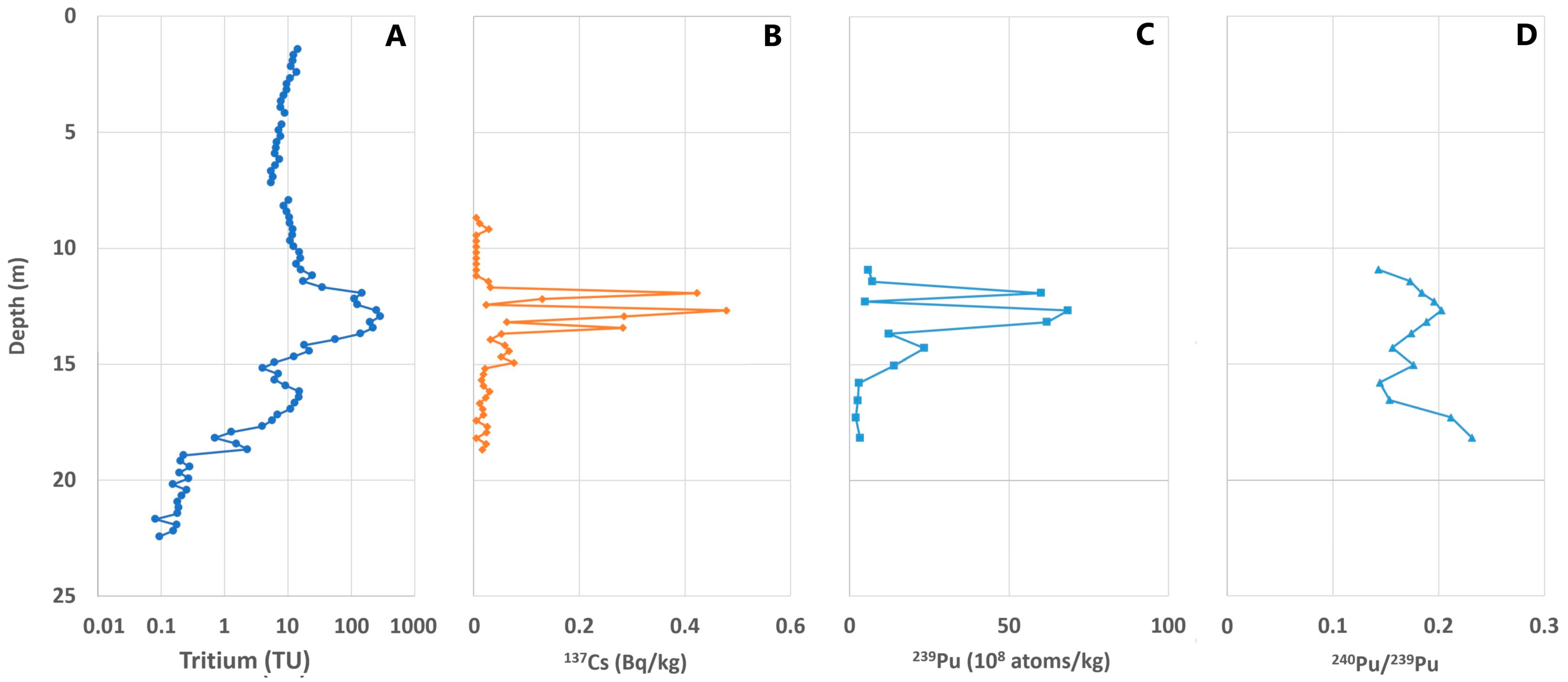
The tritium, cesium, and plutonium isotope depth profile can be seen in Figure 2. Below 18.8 m, the tritium concentration of the ice subsamples is lower than 0.28 TU at the time of sampling (Figure 2A). Above this depth, the next layer is 2.30 TU, significantly higher than below. From this point, tritium is increasing with decreasing depth until the depth of 12.9 m having 287 TU. Above this depth, tritium is decreasing until the depth of 6.9 m, and then starts increasing again.
137Cs can be detected in the depth of 8.93 to 9.18 m, and 11.43 to 18.68 (Figure 2B). High 137Cs concentrations can be found at depths of 11.93, 12.68, and 13.43 m. A low, but detectable amount of 137Cs can be seen at 8.93–9.18 m.
Plutonium isotopes can be detected in each subsamples, which have been analyzed (between 10.9 and 18.2 m). Between the depths of 15.8 and 18.2 m, 239Pu concentration is around 2.7·108 atoms/kg (0.35 mBq/kg, 0.11 fg/g). Above 15.8 m, a significant increase in plutonium concentration is observed. As illustrated in Figure 2C, the maximum plutonium concentration of 68.5·108 atoms/kg (9.0 mBq/kg, 2.72 fg/g) occurs at a depth of 12.7 m. The subsequent layer above has a low 239Pu content (4.9·108 atoms/kg, 0.64 mBq/kg, 0.19 fg/g), while at a depth of 11.9 m, a secondary peak can be seen having 60.1·108 atoms/kg of 239Pu (7.9 mBq/kg, 2.38 fg/g). The 240Pu/239Pu ratio is changing between 0.14 and 0.23 with an average of 0.180 (±0.027) (Figure 2D). The highest isotope ratio can be found in the deepest samples, while the lowest ratio is in the shallowest layer investigated.

4. Discussion

4.1. Age Depth Profile and Accumulation Rate

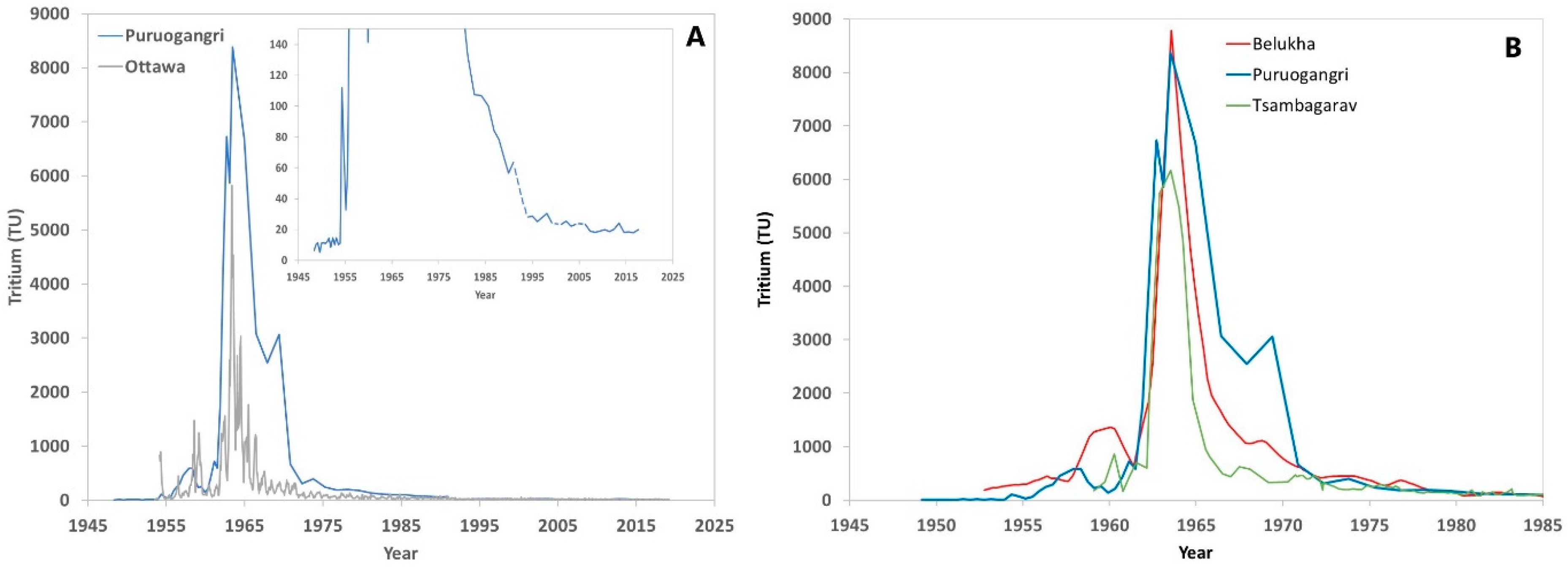
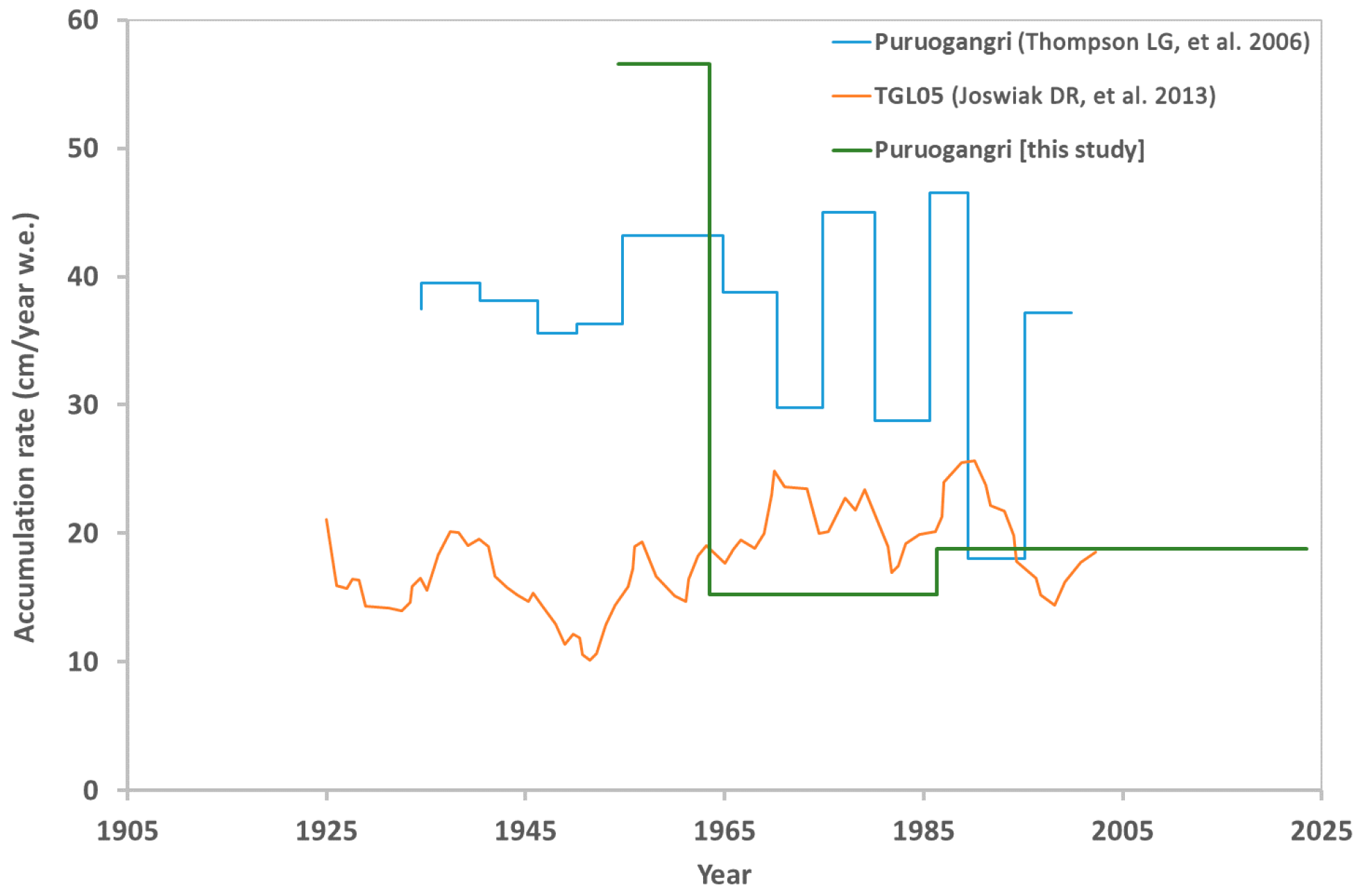
This study focuses on the tritium and plutonium profiles of the last 70 years. To calculate the tritium concentrations at the time of accumulation, the age of the ice layers, i.e., the time elapsed since accumulation, is required. Additionally, the age of the layers helps identify the origin of these isotopes. Ice cores retrieved from the Tibetan Plateau are often dated by annual layer counting with dissolved cations and anions, or dust amounts [9,17,18,19]. This might be labor-intensive. An alternative method is to identify peaks in the radioactivity of beta-emitting isotopes [20,21]. To estimate the age of the ice layers, a few unequivocal time markers have been used in our study: the time of sampling (25 June 2023), the Chernobyl event (April/May 1986), the tritium bomb-peak (middle of 1963), and the date of the first thermonuclear weapon tests (1952/53/54). The highest concentration of tritium, located at a depth of 12.93 m, is attributed to the tritium bomb-peak (Figure 2A). High 137Cs and 239Pu concentrations are located around the maximum tritium intensity. Additionally, radiocesium can also be seen in two shallower layers (at 8.93 and 9.18 m). The presence of 137Cs in these two subsamples can be explained by the fallout from the Chernobyl event, although the radioactive cloud from the explosion of the Chernobyl nuclear power station first went to the Scandinavian peninsula, Central Europe, and then to the East. Increased beta-activities could also be detected in ice layers of 1986 in the Chongce ice cap, north-western Tibetan Plateau [22], so the presence of the Chernobyl event at the Puruogangri can be expected. The last time marker is the sudden rise of the tritium concentration above the depth of 18.93 m, where 3H concentration jumps from 0.22 TU to 2.30 TU. The question is which year can be attributed to this layer. The first thermonuclear weapon test (hydrogen bomb) was executed on 1 November 1952 in the middle of the Pacific Ocean, and it resulted in an elevated tritium concentration of 70 TU in precipitation in Chicago, IL, USA, but then the tritium concentration went down suddenly to close to the natural level of ~10 TU until March 1954 [23]. The tritium load of Operation Castle (overall 47 Mt, in the Bikini Atoll) into the atmosphere increased the tritium concentration of precipitation events to 450 TU in Chicago and to 2500 TU in Ottawa between March and May 1954 [23]. In the ice cap of Colle Gnifetti (Swiss-Italian Alps), the significant increase of tritium started after 1954 [11]. Similarly, the tritium concentration of German wine increased in the 1950’s [24]. Until 1953, the tritium concentration of wine samples was around 5 TU, while from 1954 to 1957 it rose from 11 to 23 TU. Therefore, we consider that the first increase in tritium (above 18.93 m) must be attributed to the weapon test of the Castle series in March–May 1954. Additionally, if we compare the shape of the tritium time series of our study to the Ottawa tritium time series, we can identify similar patterns. The tritium concentration jumped from 0.2 TU to 2.3 TU from the depth of 18.93 m to 18.68 m. If we attribute this latter depth to the March–May 1954 period, this jump is from 11 TU to 112 TU. In early 1954, Ottawa rain was 830 TU (Figure 3A). After the following short period of low tritium concentration, the tritium went up to 1200–1400 TU in Ottawa in 1958–1959. This increase can also be seen in the Puruogangri tritium record. The similarity of the two tritium time series excludes two effects: (1) meltwater intrusion, (2) re-accumulation, since both effects would change the isotope distribution of the ice layers. Unfortunately, the age profile cannot be confirmed with independent dating methods since neither the oxygen isotope signature (to be published elsewhere) nor the dust distribution reflects seasonality and annual lamination. More accurate dating methods, like identifying volcanic events, are not available for the period of the 1950s and 1960s; tritium is the best option. Using the four time markers mentioned above, accumulation rates can be calculated for three time periods of 1954 to 1963, 1963 to 1986, and 1986 to 2023, which correspond to 56.6, 15.3, and 21.9 cm/yr (in water equivalent, w.e.), respectively. The overall accumulation rate of the studied period (1954–2023) was 24.3 cm/yr (w.e.). It is conspicuous that the ice accumulation was much stronger between 1954 and 1963 than later. The accumulation rate calculated from our ice core is compared to that of a previous ice core from the same ice field [18] and the TGL05 ice core, Longxia Zailongba glacier, Tanggula Mountains, ~280 km to the east of Puruogangri [9]. Figure 4 shows that the accumulation rate slightly decreased at the Puruogangri ice field, as deduced from Thompson et al. (2006) between 1935 and 2000 [17]. Our study shows a huge reduction in accumulation rate. The different behaviour might be explained by the different locations of the ice cores. Nevertheless, caution is needed when evaluating a single ice core, as it might not be sufficient to interpret climate indicators in a regional scale. Overall, in this part of the Tibetan Plateau, the precipitation amount, and hence accumulation as well, are decreasing since the 1960s, while both are increasing in the northern part of the plateau [25,26,27].

4.2. Tritium Time Series

The tritium time series helps not only with estimating the accumulation rate but also for identifying the sources and changes in the global distribution of artificial tritium. From the early thermonuclear weapon tests, the entire atmosphere was contaminated with tritium [28]. Atmospheric injections associated with mid-20th-century thermonuclear weapons testing led to orders-of-magnitude increases in atmospheric tritium inventories, with Northern Hemisphere concentrations reaching several thousand tritium units. The pattern of tritium depends on the geographical location and the main moisture sources. For sites where the monitoring of precipitation is not possible, geological records are used to reconstruct the tritium distribution. Continuously accumulated ice layers are excellent records of tritium in precipitation [7,11,29,30,31,32,33,34]. The Puruogangri tritium record in our study can be seen in Figure 3A. Before 1954, the tritium concentration of 10.9 (±2.7) TU could be considered as the natural level. Although the tritium concentration almost stopped decreasing in the last 20 years, it seems to be slightly higher than the natural average of the late 1940s and early 1950s. The average tritium concentration of the years 2006–2017 is 19.7 (±2.0) TU. The maximum tritium concentration exceeds 8300 TU in 1963, far above the maximum intensity in the Ottawa time series, where the peak is only 5800 TU. Comparing the Puruogangri tritium record to two other ice cores from Central Asia, the peak intensities of Puruogangri and Belukha are pretty similar: the maximum intensity in Belukha is 8780 TU [7], while the Tsambagarav peak intensity is only 6200 TU [10]. The ice core of our study has higher tritium concentrations in the late 1960s than the Belukha and Tsambagarav ice cores have (Figure 3B). Similarly, from 1963 to 1970, the tritium concentration was significantly higher than in Ottawa. A secondary tritium peak can be observed in each ice core time series at around 1968–1970; the largest peak belongs to the Puruogangri ice core. The explanation might be related to the Chinese weapon test, and will be discussed in the next section with the plutonium isotopes.

4.3. Deposition of Plutonium Isotopes

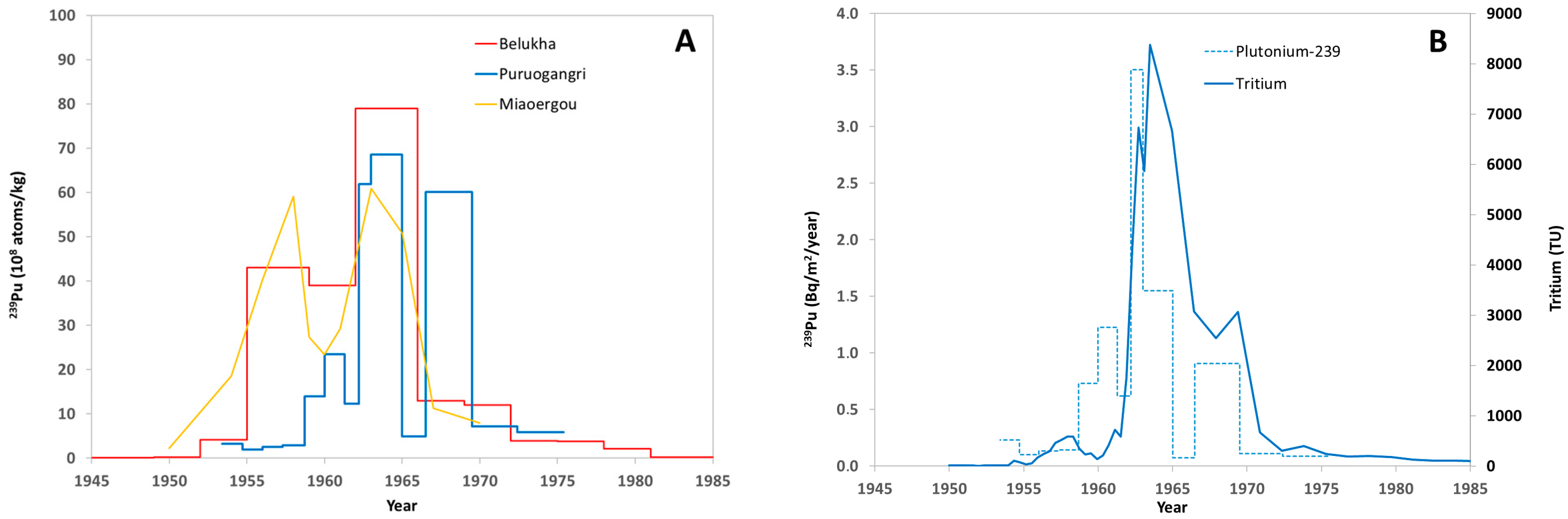
Using the measured concentrations of the plutonium isotopes and the age-depth profile revealed from the time markers, the time series of plutonium isotope concentrations, isotope ratios, and deposition rates (fallout) can be calculated. When comparing with the Belukha [7] and Miaoergou [8] plutonium records (Figure 1A), the temporal evolution of plutonium deposition at Puruogangri shows both common features and notable differences (Figure 5A). In the middle of the 1950s, a slow increase in deposition of plutonium at Puruogangri aligns with one of the peaks reported in Belukha and Miaoergou. In the case of Belukha, that peak is most likely associated with regional fallout from atmospheric nuclear testing at the Semipalatinsk Test Site. However, plutonium concentrations at Puruogangri remain lower than those measured at the two ice cores during this interval, indicating a weaker local influence. In contrast, from 1962 onward, Puruogangri exhibits its highest plutonium concentrations, coinciding with the period following the signing of the Partial Test Ban Treaty, when the global fallout became the dominant source until 1966. Unlike Belukha, Puruogangri also displays a secondary increase beginning around 1966. The Puruogangri ice field is located in relative proximity to the Lop Nor nuclear test site of China, around 700 km to the south. Between 1966 and 1979, twelve atmospheric nuclear detonations were conducted at this site, with an average explosive yield of approximately 1149 kt. The timing of this feature suggests a possible contribution from atmospheric tests at the Lop Nor test site, highlighting the regional differences in fallout sources and transport pathways across Central and High Asia. The intense plutonium concentration of the ice layers, as well as high fallout values in the late 1960s, coincide with the high tritium amount during the same period (Figure 5B). These latter also indicate that the weapon tests at Lop Nor might be responsible for the higher tritium and plutonium fallout after 1966. The overall local fallout of 239Pu and 240Pu has been obtained to be 13.2 and 9.0 Bq/m2 (4.0 and 1.1 ng/m2), respectively, which is much lower than the global average. The reason might be low precipitation and therefore low wet deposition, which causes the atmospheric aerosol to sediment.
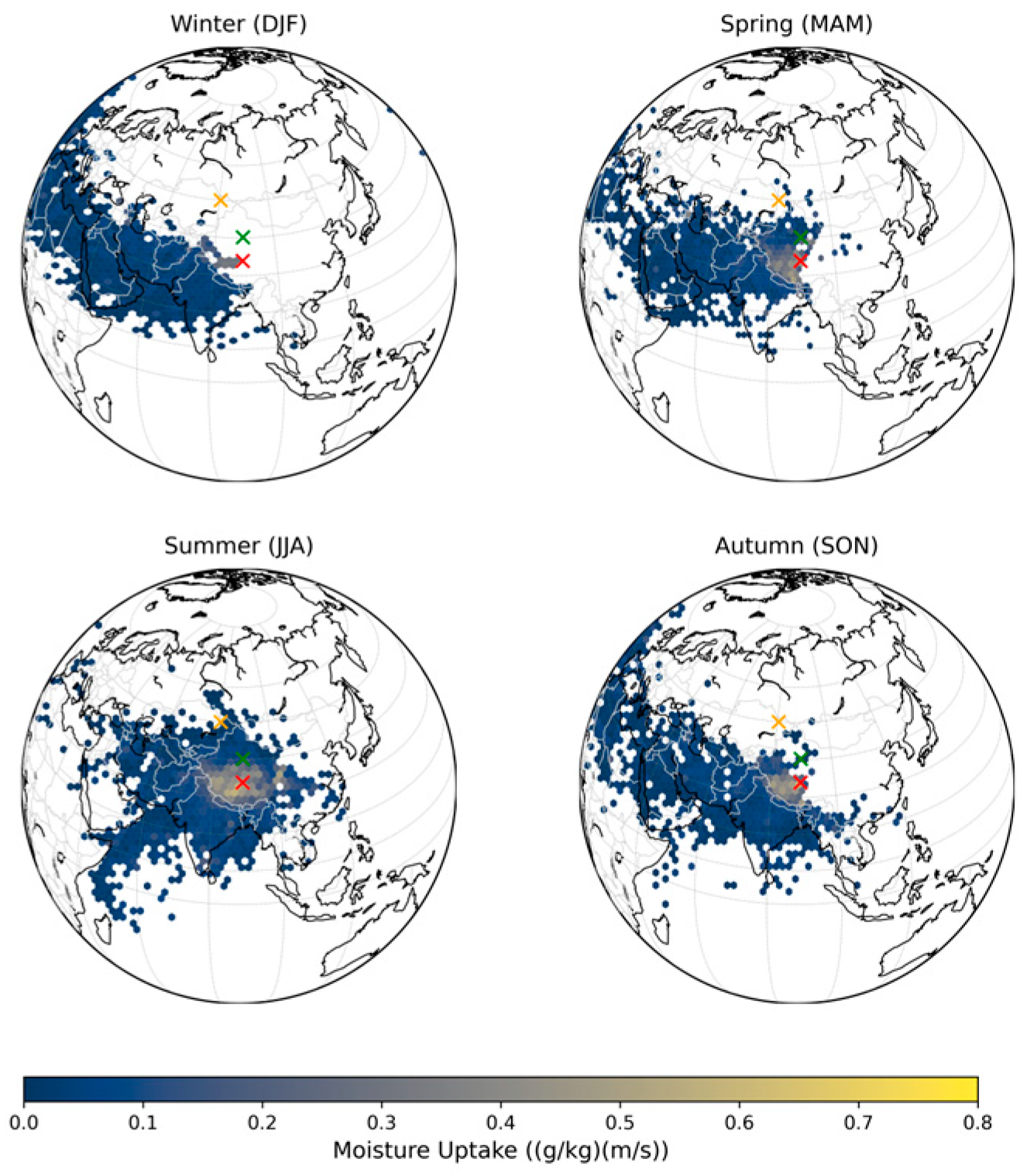
In the southern Tibetan Plateau, the main precipitation occurs during the South Asian monsoon season from June to September [35]. However, the moisture source might come from northern regions as well. Indeed, the HYSPLIT back-trajectory analysis with the GDAS meteorological data for the Puruogangri ice field (2005–2023, 10 days back, 3000 m above ground level, at 00 and 12 h) depicted in a global projection, shows the moisture source distributions in different seasons (Figure 6). In general, Puruogangri (red cross) receives and uptakes moisture from Lop Nor (green) and Semipalatinsk (yellow) mainly in the summer months. The Lop Nor contribution is particularly ubiquitous during spring and summer. Semipalatinsk influence is most enhanced during the summer time.
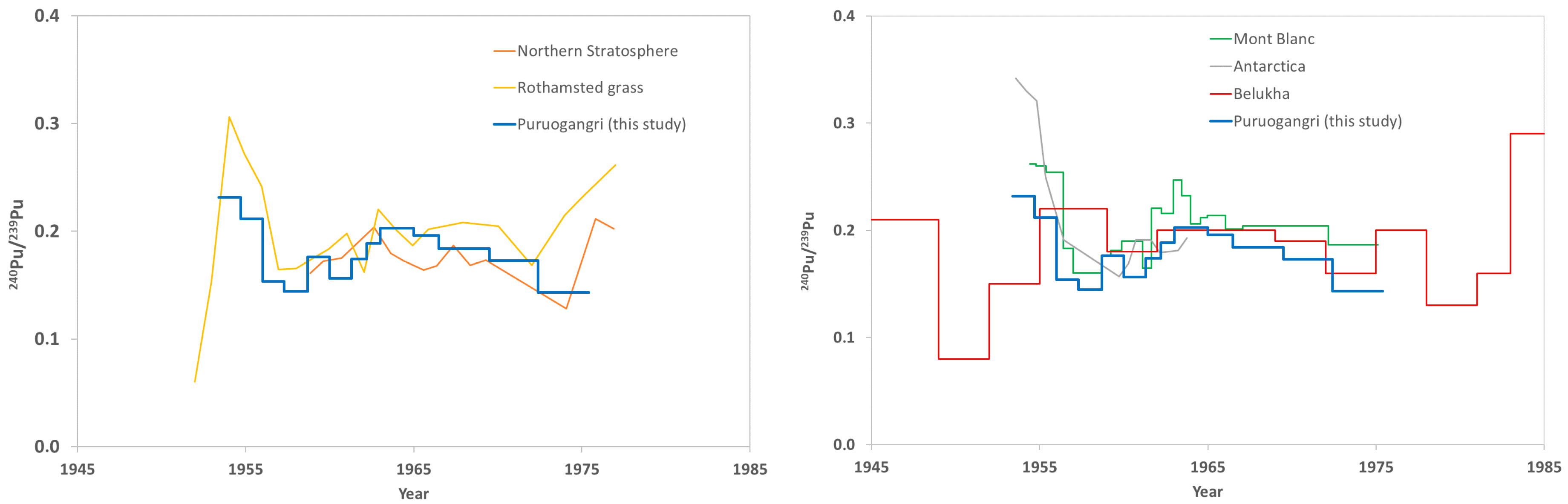
The isotopic profile of the Puruogangri ice field is consistent with datasets from European sites (Dome du Gouter, Mont Blanc; Rothamsted grass), Antarctic Ice (J9 Ross Ice Shelf) and Asian Records (Belukha), as well as Northern Hemisphere records, supporting the interpretation that stratospheric fallout represents the principal source of plutonium (Figure 7) [7,36,37]. The 240Pu/239Pu atomic ratios vary between 0.14 and 0.23, with an average of 0.177 ± 0.024. The 240Pu/239Pu ratios are clearly different from the values observed in the releases of the Chernobyl accident (0.403–0.412), Fukushima accident (0.323–0.330) and nuclear power plants (0.23–0.67) [36,38]. The 240Pu/239Pu ratios are highest during the 1950s, when the Operation Castle emitted plutonium of high isotope ratios of 0.32–0.37 [38]. In the Tibetan Plateau, the 240Pu/239Pu ratio in soil varies between 0.146 and 0.225 with an average of 0.185 [39], which is similar to the global fallout of the northern hemisphere (0.182 ± 0.005) [38] and that of our ice core at Puruogangri.

5. Conclusions

The combined use of tritium, plutonium, and 137Cs provides a robust multi-tracer framework for dating recent ice layers and for reconstructing the history of artificial radionuclide deposition in one of the most remote high-altitude regions of the world. Evident radioactive time markers, such as the onset of thermonuclear weapons testing in the mid-1950s, the global tritium bomb peak in 1963, and the Chernobyl accident in 1986, acknowledged the establishment of a well-defined age-depth model. Derived accumulation rates exhibit a noticeable decrease after the early 1960s, from ~57 cm/yr during 1954–1963 to ~15 cm/yr in 1963–1986, followed by a partial recovery to ~22 cm/yr since 1986.
The tritium time series shows a notable bomb peak exceeding 8300 TU, comparable to or higher than values observed in other Central Asian ice cores, and a clear secondary maximum in the late 1960s. Elevated tritium concentrations during this period, persisting longer than in many Northern Hemisphere records, point to regional influences superimposed on global fallout. The plutonium record corroborates the following interpretation: while early deposition reflects dominant global stratospheric fallout, increased 239Pu and 240Pu concentrations after 1966 mark an additional contribution from atmospheric nuclear tests conducted at the Lop Nor test site in China. Back-trajectory analyses further support the plausibility of radionuclide transport from Lop Nor and Semipalatinsk to the Puruogangri region, particularly during spring and summer. The 240Pu/239Pu atomic ratios (0.14–0.23, average 0.177 ± 0.024) are consistent with Northern Hemisphere global fallout values and clearly distinct from signatures associated with nuclear reactor accidents or civil nuclear activities. The total local fallout of plutonium at Puruogangri is lower than global averages, likely reflecting low precipitation and limited wet deposition in this arid, high-elevation environment.
The Puruogangri ice core preserves a coherent and interpretable record of both global and regional radioactive fallout, demonstrating the value of combined tritium and plutonium measurements for dating and source attribution in ice archives. These results contribute new insights into post-1950s atmospheric circulation, radionuclide transport, and hydroclimatic change over the central Tibetan Plateau, and they underscore the importance of expanding multi-site ice core investigations to better capture the spatial heterogeneity of climatic and environmental signals in the Third Pole.

Supplementary Materials

The following supporting information can be downloaded at: https://www.mdpi.com/article/10.3390/w18030425/s1, Table S1: raw measurement data.

Author Contributions

Conceptualization, L.P. and L.T.; field sampling, L.T., C.W., L.F., X.C. and Y.S.; investigation, L.P., L.T., D.V. and M.T.; laboratory analyses, L.P., M.C., M.S., L.Z. and Z.D.; writing—original draft preparation, L.P. and M.C.; writing—review and editing, L.T., M.T. and D.V.; visualization, L.P. and D.V.; supervision, L.P. and L.T. All authors have read and agreed to the published version of the manuscript.

Funding

This work was supported by the National Research, Development and Innovation Office in the project K-142807 entitled “Past in the ice: Studying Continental Ice with Isotopes and Environmental Tracers”. The research was also supported by the Hungarian-Chinese Bilateral project No. 2019-2.1.11-TÉT-2020-00255 and the IAEA Coordinated Research Project F33031 (Research contract 28599).

Data Availability Statement

The original contributions presented in this study are included in the Supplementary Materials. Further inquiries can be directed to the corresponding author.

Acknowledgments

The authors thank Marianna Túri and Lajos Illés for their help with cutting the ice cores in the cold laboratory of Yunnan University.

Conflicts of Interest

Authors Zoltán Dezső and Zákány Loránd were employed by the company Isotoptech Ltd. The remaining authors declare that the research was conducted in the absence of any commercial or financial relationships that could be construed as a potential conflict of interest.

References

  1. He, X.; Zhou, S. An Assesment of Glacier Inventories for the Third Pole Region. Front. Earth Sci. 2022, 10, 848007. [Google Scholar] [CrossRef]
  2. Yao, T.; Thompson, L.G.; Mosbrugger, V.; Zhang, F.; Ma, Y.; Luo, T.; Xu, B.; Yang, X.; Joswiak, D.R.; Wang, W.; et al. Third Pole Environment (TPE). Environ. Dev. 2012, 3, 52–64. [Google Scholar] [CrossRef]
  3. Gabrieli, J.; Cozzi, G.; Vallelonga, P.; Schwikowski, M.; Sigl, M.; Eickenberg, J.; Wacker, L.; Boutron, C.; Gäggeler, H.; Cescon, P.; et al. Contamination of Alpine snow and ice at Colle Gnifetti, Swiss/Italian Alps, from nuclear weapons tests. Atmos. Environ. 2011, 45, 587–593. [Google Scholar] [CrossRef]
  4. Wade, A.J.; Yapiyev, V.; Shahgedanova, M.; Saidaliyeva, Z.; Madibekov, A.; Kapitsa, V.; Kasatkin, N.; Ismukhanova, L.; Kulbekova, R.; Sultanbekova, B.; et al. Cryosphere and land cover influence on stream water quality in Central Asia’s glacierized catchments. Sci. Total Environ. 2024, 939, 173525. [Google Scholar] [CrossRef]
  5. Ackland, L.; McGuire, S. Assessing the Nuclear Age; University of Chicago Press: Chicago, IL, USA, 1985. [Google Scholar]
  6. Glasstone, S.; Dolan, P.J. The Effects of Nuclear Weapons; United States Department of Defense and the United States Department of Energy: Washington, DC, USA, 1977. [Google Scholar]
  7. Olivier, S.; Bajo, S.; Keith, L.K.; Gäggeler, H.W.; Papina, T.; Santschi, P.H.; Schotterer, U.; Schwikowski, M.; Wacker, L. Plutonium from Global Fallout Recorded in an Ice Core from the Belukha Glacier, Siberian Altai. Environ. Sci. Technol. 2004, 38, 6507–6512. [Google Scholar] [CrossRef]
  8. Wang, C.; Hou, S.; Pang, H.; Liu, Y.; Gäggeler, H.W.; Christl, M.; Synal, H.A. 239,240Pu and 236U records of an ice core from the eastern Tien Shan (Central Asia). J. Glaciol. 2017, 63, 929–935. [Google Scholar] [CrossRef]
  9. Joswiak, D.R.; Yao, T.; Wu, G.; Tian, L.; Xu, B. Ice-core evidence of westerly and monsoon moisture contributions in the central Tibetan Plateau. J. Glaciol. 2013, 59, 56–66. [Google Scholar] [CrossRef]
  10. Herren, P.A.; Eichler, A.; Machguth, H.; Papina, T.; Tobler, L.; Zapf, A.; Schwikowski, M. The onset of Neoglaciation 6000 years ago in western Mongolia revealed by an ice core from the Tsambagarav mountain range. Quat. Sci. Rev. 2013, 69, 59–68. [Google Scholar] [CrossRef]
  11. Palcsu, L.; László, E.; Surányi, G.; Túri, M.; Vargas, D.; Veres, M.; Cauquoin, A.; Zákány, L.; Janovics, R.; Csige, I.; et al. Solar cycle detected in natural tritium of Ice layers before the nuclear era. J. Geophys. Res. Atmos. 2025, 130, e2024JD042678. [Google Scholar] [CrossRef]
  12. Palcsu, L.; Major, Z.; Köllő, Z.; Papp, L. Using an ultrapure 4He spike in tritium measurements of environmental water samples by the 3He-ingrowth method. Rapid Commun. Mass Spectrom. 2000, 24, 698–704. [Google Scholar] [CrossRef]
  13. Papp, L.; Palcsu, L.; Major, Z.; Rinyu, L.; Tóth, I. A mass spectrometric line for tritium analysis of water and noble gas measurements from different water amounts in the range of microlitres and millilitres. Isot. Environ. Health Stud. 2012, 48, 494–511. [Google Scholar] [CrossRef] [PubMed]
  14. Lee, M.H.; Kim, J.Y.; Kim, W.H.; Jung, E.C.; Jee, K.Y. Investigation of the oxidation states of Pu isotopes in a hydrochloric acid solution. Appl. Radiat. Isot. 2008, 66, 1975–1979. [Google Scholar] [CrossRef] [PubMed]
  15. Dowell, S.M.; Barlow, T.S.; Chenery, S.R.; Humphrey, O.S.; Isaboke, J.; Blake, W.H.; Osano, O.; Watts, M.J. Optimisation of plutonium separations using TEVA cartridges and ICP-MS/MS analysis for applicability to large-scale studies in tropical soils. Anal. Methods 2023, 15, 4226–4235. [Google Scholar] [CrossRef]
  16. Grate, J.W.; O’Hara, M.J.; Farawila, A.F.; Douglas, M.; Haney, M.M.; Petersen, S.L.; Maiti, T.C.; Aardahl, C.L. Extraction chromatographic methods in the sample preparation sequence for thermal ionization mass spectrometric analysis of plutonium isotopes. Anal. Chem. 2011, 83, 9086–9091. [Google Scholar] [CrossRef]
  17. Thompson, L.G.; Tandong, Y.; Davis, M.E.; Mosley-Thompson, E.; Mashiotta, T.A.; Lin, P.N.; Mikhalenko, V.N.; Zagorodnov, V.S. Holocene climate variability archived in the Puruogangri ice cap on the central Tibetan Plateau. Ann. Glaciol. 2006, 43, 61–69. [Google Scholar] [CrossRef]
  18. Yao, T.; Li, Z.; Thompson, L.G.; Mosley-Thompson, E.; Wang, Y.; Tian, L.; Wang, N.; Duan, K. δ18O records from Tibetan ice cores reveal differences in climatic changes. Ann. Glaciol. 2006, 43, 1–7. [Google Scholar] [CrossRef]
  19. Yang, B.; Bräuning, A.; Liu, J.; Davis, M.E.; Yajun, S. Temperature changes on the Tibetan Plateau during the past 600 years inferred from ice cores and tree rings. Global Planet. Change 2009, 69, 71–78. [Google Scholar] [CrossRef]
  20. Zheng, W.; Yao, T.; Joswiak, D.R.; Xu, B.; Wang, N.; Zhao, H. Major ions composition records from a shallow ice core on Mt. Tanggula in the central Qinghai-Tibetan Plateau. Atmos. Res. 2010, 97, 70–79. [Google Scholar] [CrossRef]
  21. Shao, L.; Tian, L.; Wu, G.; Naftz, D.; Cai, Z.; Wang, C.; Li, Y.; Palcsu, L. Dating of an alpine ice core from the interior of the Tibetan Plateau. Quat. Int. 2020, 544, 88–95. [Google Scholar] [CrossRef]
  22. Hou, S.; Jenk, T.M.; Zhang, W.; Wang, C.; Wu, S.; Wang, Y.; Pang, H.; Schwikowski, M. Age ranges of the Tibetan ice cores with emphasis on the Chongce ice cores, western Kunlun Mountains. Cryosphere 2018, 12, 2341–2348. [Google Scholar] [CrossRef]
  23. Begemann, F.; Libby, W.F. Continental water balance, ground water inventory and storage times, surface ocean mixing rates and world-wide circulation patterns from cosmic-ray and bomb tritium. Geochim. Cosmochim. Acta 1957, 12, 277–296. [Google Scholar] [CrossRef]
  24. Roether, W. Estimating the tritium input to groundwater from wine samples: Groundwater and direct run-off contribution to Central European surface waters. In Proceedings of the Symposium on Isotopes in Hydrology, Vienna, Austria, 14–18 November 1966; pp. 73–91, ISSN 0074-1884. [Google Scholar]
  25. Wang, N.; Jiang, X.; Thompson, L.G.; Davis, M.E. Accumulation Rates over the Past 500 Years Recorded in Ice Cores from the Northern and Southern Tibetan Plateau, China. Arct. Antarct. Alp. Res. 2007, 39, 671–677. [Google Scholar] [CrossRef][Green Version]
  26. Du, W.; Qin, X.; Kang, S.; Cui, X.; Sun, W. Variations in annual accumulation recorded in a Laohugou ice core from the northeastern Tibetan Plateau and their relationship with atmospheric circulation. Environ. Earth Sci. 2016, 75, 845. [Google Scholar] [CrossRef]
  27. Wang, X.; Pang, G.; Yang, M. Precipitation over the Tibetan Plateau during recent decades: A review based on observations and simulations. Int. J. Climatol. 2018, 38, 1116–1131. [Google Scholar] [CrossRef]
  28. Rozanski, K.; Gonfiantini, R.; Araguas-Araguas, L. Tritium in the global atmosphere: Distribution patterns and recent trends. J. Phys. G Nucl. Part. Phys. 1991, 17, 523–536. [Google Scholar] [CrossRef]
  29. Schwikowski, M.; Brütsch, S.; Gäggeler, H.W.; Schotterer, U. A high-resolution air chemistry record from an Alpine ice core: Fiescherhorn glacier, Swiss Alps. J. Geophys. Res. Atmos. 1999, 104, 13709–13719. [Google Scholar] [CrossRef]
  30. Fritzsche, D.; Wilhelms, F.; Savatyugin, L.M.; Pinglot, J.F.; Meyer, H.; Hubberten, H.W.; Miller, H. A new deep ice core from Akademii Nauk ice cap, Severnaya Zemlya, Eurasian Arctic: First results. Ann. Glaciol. 2002, 35, 25–28. [Google Scholar] [CrossRef]
  31. Van der Wel, L.G.; Streuerman, H.J.; Isaksson, E.; Helsen, M.M.; Van de Wal, R.S.W.; Martma, T.; Pohjola, V.A.; Moore, J.C.; Meijer, H.A.J. Using high-resolution tritium profiles to quantify the effects of melt on two Spitsbergen ice cores. J. Glaciol. 2011, 57, 1087–1097. [Google Scholar] [CrossRef]
  32. Neff, P.D.; Steig, E.J.; Clark, D.H.; McConnell, J.R.; Pettit, E.C.; Menounos, B. Ice-core net snow accumulation and seasonal snow chemistry at a temperate-glacier site: Mount Waddington, southwest British Columbia, Canada. J. Glaciol. 2012, 58, 1165–1175. [Google Scholar] [CrossRef]
  33. Mikhalenko, V.; Sokratov, S.; Kutuzov, S.; Ginot, P.; Legrand, M.; Preunkert, S.; Lavrentiev, I.; Kozachek, A.; Ekaykin, A.; Faïn, X.; et al. Investigation of a deep ice core from the Elbrus western plateau, the Caucasus, Russia. Cryosphere 2015, 9, 2253–2270. [Google Scholar] [CrossRef]
  34. Kaspari, S.D.; Pittenger, D.; Jenk, T.M.; Morgenstern, U.; Schwikowski, M.; Buenning, N.; Stott, L. Twentieth century black carbon and dust deposition on South Cascade Glacier, Washington State, USA, as reconstructed from a 158-m-long ice core. J. Geophys. Res. Atmos. 2020, 125, e2019JD031126. [Google Scholar] [CrossRef]
  35. Tian, L.; Yao, T.; Numaguti, A.; Sun, W. Stable isotope variations in monsoon precipitation on the Tibetan Plateau. J. Meteorol. Soc. Jpn. 2001, 79, 959–966. [Google Scholar] [CrossRef]
  36. Warneke, T.; Croudace, I.W.; Warwick, P.E.; Taylor, R.N. A new ground-level fallout record of uranium and plutonium isotopes for northern temperate latitudes. Earth Planet. Sci. Lett. 2002, 203, 1047–1057. [Google Scholar] [CrossRef]
  37. Koide, M.; Bertine, K.K.; Chow, T.J.; Goldberg, E.D. The 240Pu/239Pu ratio, a potential geochronometer. Earth Planet. Sci. Lett. 1985, 72, 1–8. [Google Scholar] [CrossRef]
  38. Thakur, P.; Khaing, H.; Salminen-Paatero, S. Plutonium in the atmosphere: A global perspective. J. Environ. Radioact. 2017, 175–176, 39–51. [Google Scholar] [CrossRef]
  39. Zhao, X.; Hou, X.; Huang, Z.; Liu, H.; Jiang, H. Plutonium isotopes in the Qinghai-Tibet Plateau: Sources, distribution, and their environmental behaviors. Environ. Pollut. 2022, 306, 119401. [Google Scholar] [CrossRef] [PubMed]
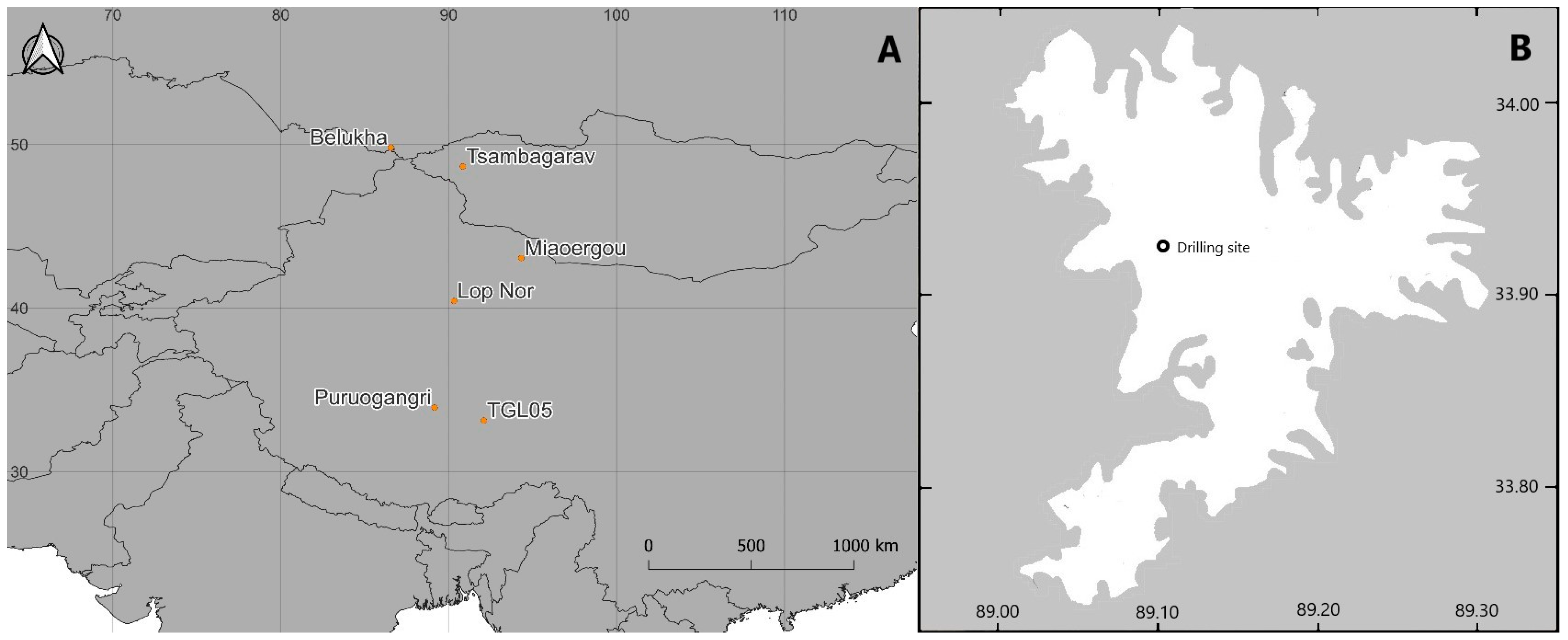
Figure 1. Locations of the ice cores discussed in this study (A). The drilling location of our ice core at the Puruogangri ice field (B).
Water 18 00425 g001
Figure 2. Radioactive isotope profiles of the Puruogangri ice core at the time of sampling. Depth is measured from the surface of the ice field. Note that tritium is plotted in a logarithmic scale (A), while the other isotopes, such as 137Cs (B), 239Pu (C), and 240Pu/239Pu ratio (D), are shown in a linear scale.
Water 18 00425 g002
Figure 3. Comparison of tritium time series of the Puruogangri ice core to the precipitation record of Ottawa (A) and two other ice core studies (B).
Water 18 00425 g003
Figure 4. Net accumulation rates in two Tibetan glaciers: Puruogangri ice field and Longxia Zailongba glacier, Tanggula Mountains (TGL05 ice core) [9,17].
Water 18 00425 g004
Figure 5. Plutonium time series of three study sites (A), and comparison of the tritium concentration and plutonium fall-out at Puruogangri (B).
Water 18 00425 g005
Figure 6. Moisture uptake distribution of the site Puruogangri in different seasons with the Puruogangri (red), Lop Nor (green) and Semipalatinsk (yellow) sites marked with crosses.
Water 18 00425 g006
Figure 7. Plutonium isotope ratios of the Puruogangri ice core compared to a few archives.
Water 18 00425 g007
Disclaimer/Publisher’s Note: The statements, opinions and data contained in all publications are solely those of the individual author(s) and contributor(s) and not of MDPI and/or the editor(s). MDPI and/or the editor(s) disclaim responsibility for any injury to people or property resulting from any ideas, methods, instructions or products referred to in the content.