Article

Environmental Evolution Recorded by Tamarix Nebkhas in the Qaidam Basin

1
Key Laboratory of Tibetan Plateau Land Surface Processes and Ecological Conservation (Ministry of Education), Qinghai Normal University, Xining 810008, China
2
Qinghai Province Key Laboratory of Physical Geography and Environmental Process, College of Geographical Science, Qinghai Normal University, Xining 810008, China
3
Academy of Plateau Science and Sustainability, People’s Government of Qinghai Province and Beijing Normal University, Xining 810016, China
*
Author to whom correspondence should be addressed.
Water 2026, 18(3), 416; https://doi.org/10.3390/w18030416
Submission received: 25 December 2025 / Revised: 23 January 2026 / Accepted: 3 February 2026 / Published: 5 February 2026

Abstract

A typical Tamarix nebkha was studied in the southern Qaidam Basin, China. K-feldspar pIRIR dating was applied to establish a reliable chronological framework, and an Undatable age–depth model was constructed. Accumulation rates (AR) declined in stages: rapid (~1.33 cm/a; ~370–260 yr BP), slower (~0.75 cm/a; ~260–130 yr BP), and slowest (~0.31 cm/a; ~130 yr BP-present). This dynamic pattern is likely influenced by a combination of regional aeolian activity variations, geomorphological evolution, and the intrinsic growth dynamics of the nebkha itself. To further understand the relationship between nebkha development and climatic conditions, a δ13C sequence was reconstructed using Tamarix plant remains preserved within the sediments. Based on shifts in leaf-level δ13C values, which indicate changes in water use efficiency, water availability over the past 370 years was inferred and divided into three main phases: relatively sufficient from 1650 to 1690, gradually decreasing during 1690–1870, and increasing again after 1870. The δ13C trend closely correlates with temperature variations derived from δ18O records of the Malan ice core. This suggests that in this hyper-arid region, the development of Tamarix nebkhas is primarily controlled by glacial meltwater and snowmelt runoff from the Kunlun Mountains, rather than by local precipitation.

1. Introduction

Nebkhas (also known as vegetated dunes, shrub dunes, or coppice dunes) are aeolian landforms formed through the accumulation of wind-blown sediments around shrubs, where vegetation acts as an obstacle to aeolian transport [1,2,3,4]. They are commonly dis-tributed in arid, semi-arid, and sub-humid regions [5,6,7]. The formation of nebkhas is con-trolled by climate change, vegetation degradation, anthropogenic activities, and local hydrogeological conditions [8,9,10,11,12,13,14,15,16,17]. Consequently, the initial and subsequent development of nebkhas reflects local environmental changes, demonstrating complex interactions among multiple environmental factors. However, it is still not clear exactly how these factors work together to control nebkha development in hyper-arid basins.
The Qaidam Basin is located in the northern part of the Qinghai–Tibet Plateau in China. It is a large tectonic depression situated north of the modern East Asian summer monsoon boundary, making it highly sensitive to climate change [18,19,20]. In this arid environment, traditional paleoclimate proxies such as pollen and lake sediments are often limited due to incomplete preservation or insufficient resolution, highlighting the need for a well-preserved indicator that can directly record climatic changes [21]. The well-preserved Tamarix nebkhas distributed along the Kunlun Mountains in the southern Qaidam Basin provide such a proxy through the δ13C values of in situ plant remains, which can reflect historical water use efficiency and water availability [22,23,24,25,26]. This proxy has been widely used in environmental studies in arid and semi-arid regions. Its advantages lie in its ability to maintain good preservation in arid sedimentary environments and to provide continuous, high-resolution environmental proxy records. This biogeomorphological feature is well-preserved. Nebkhas are widely developed along the northern foothills of the Kunlun Mountains in the southern Qaidam Basin, with Tamarix nebkhas being particularly representative.
Preliminary studies have been conducted on nebkhas in the Qaidam Basin. For example, the sediment-trapping capacities of different shrubs were analyzed [27]. The establishment of mixed-species shelterbelt systems was proposed for enhanced erosion control. In another study, quartz-based dating was applied to regional nebkhas [28]. Tamarix nebkhas in the Qaidam Basin were suggested to be products of cold or cold–arid climates. However, two critical research gaps remain unresolved. First, a reliable chronological framework is lacking. This framework is needed for accurately characterizing nebkha development. The absence hinders the integration of nebkha records into regional paleoclimatic models. Second, the relationship between nebkha formation dynamics and paleoclimate evolution is poorly studied. This is especially true for quantitative assessments. Such assessments should be based on geochemical proxies from the same sedimentary sequence.
OSL dating has been completed by our research on 14 samples collected from seven profiles in the Dagele area of the Qaidam Basin. Results showed that quartz optically stimulated luminescence (OSL) signals were too weak for reliable dating. This is attributed to the relatively short transport distance and limited cycles of reworking of coarse-grained quartz in desert sediments, leading to low sensitivity of the quartz signals. Similar phenomena have also been observed in aeolian sediment studies from other regions of the Tibetan Plateau [29]. Therefore, to obtain more reliable chronological results, this study employed the K-feldspar pIR50IR170 dating method. Compared to quartz, K-feldspar minerals exhibit a higher signal saturation dose, making them particularly suitable for dating relatively young sediments. Furthermore, the pIRIR dating technique effectively overcomes the unstable “anomalous fading” signal in K-feldspar, thereby yielding more precise and reliable chronological results [30,31,32], whereas K-feldspar pIR50IR170 ages were consistent with AMS14C dates, and the stratigraphic sequences followed the principle of younger-over-older deposition. Synthesis of existing nebkha ages in the region indicates that Tamarix nebkhas mainly formed between 800 and 400 years ago (13th–15th and 16th–17th centuries). Their development coincided with periods of intense dust storm activity and occurred predominantly during cold phases, showing no clear response to precipitation changes [33].
In this study, a complete Tamarix nebkha located in the alluvial fan of the northern Kunlun Mountains is investigated. The primary objectives are to establish a reliable chronological framework for this nebkha in the Qaidam Basin and to reveal the relationship be-tween its development and regional environmental changes. To achieve this, a series of analyses was conducted: first, a reliable chronological sequence was constructed using K-feldspar pIRIR dating; second, the grain size characteristics of the nebkha sediments were analyzed to further understand its developmental processes and patterns; third, changes in historical water use efficiency were reconstructed by utilizing the δ13C of well-preserved Tamarix leaves. Finally, the coupling mechanism between nebkha development phases and regional environmental evolution was systematically clarified through the synthesis of chronological, sedimentological, and geochemical data.

2. Materials and Methods

2.1. Study Area, Section and Samples

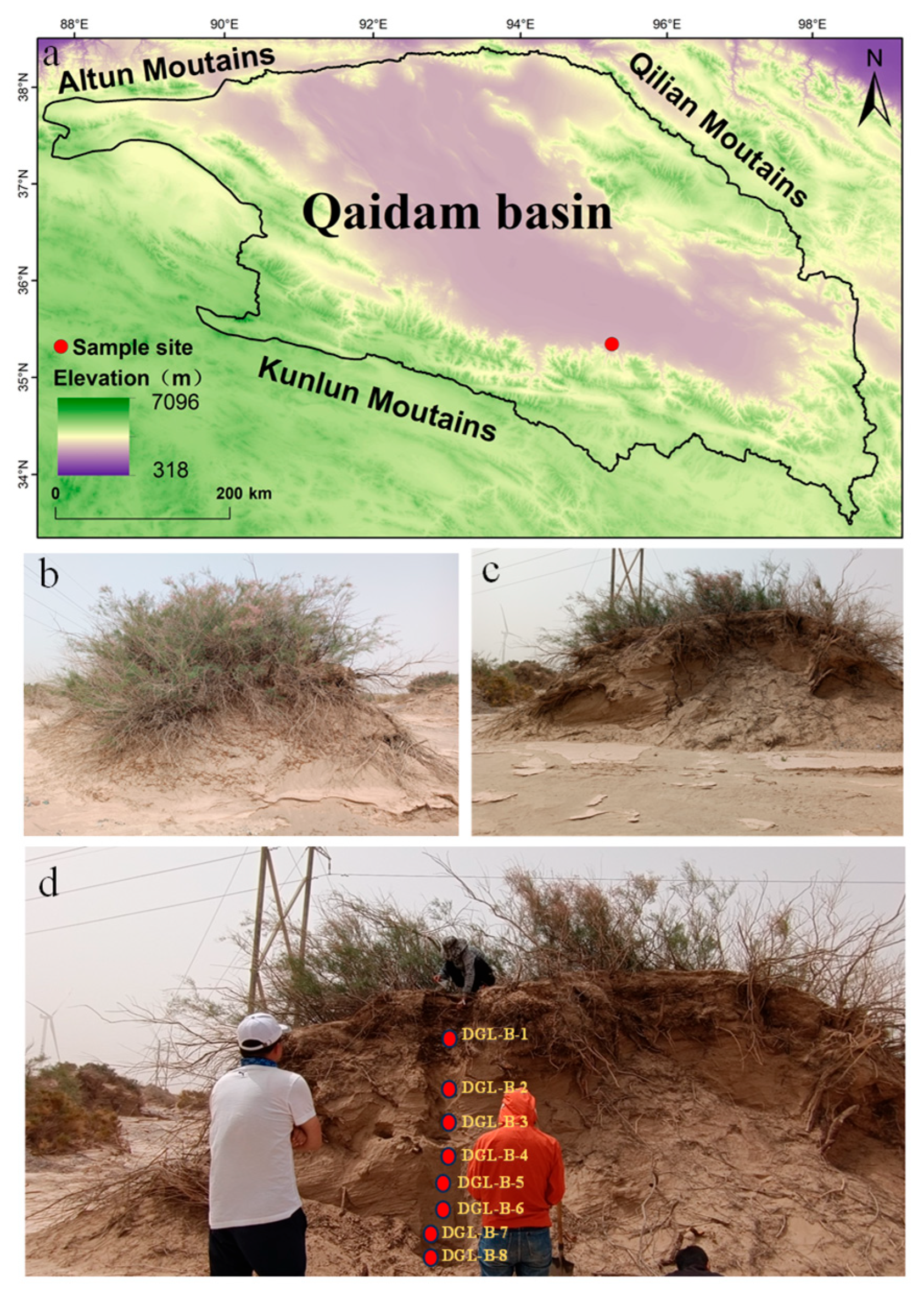
The Qaidam Basin (34°45′~39°20′ N, 87°49′~99°17′ E) is located in the north of the Qinghai–Tibet Plateau, China, which lies north of the current northern limit of the East Asian summer monsoon, with an altitude of about 2800 m (Figure 1). The Qaidam Basin is surrounded by the tall Qilian Mountains, Kunlun Mountains and Altun Mountains, and the landform transitions from the yardang in the west to the eastward salt lake landform and the aeolian sand accumulation landform [34,35]. The region is characterized by a typical extreme arid continental climate with pronounced spatial heterogeneity in precipitation: average annual precipitation is approximately 100 mm in the southeast, decreasing sharply to less than 20 mm in the northwest. Precipitation occurs predominantly as short-duration, high-intensity convective events, which are insufficient to generate effective surface runoff and contribute minimally to soil moisture and shallow groundwater recharge. High evaporation potential (annual potential evaporation of 3000–3200 mm) further exacerbates the regional water deficit, creating a severe hydrological imbalance [36].
Within this climatic context, two distinct moisture sources and recharge pathways exist in the region: (1) limited local atmospheric precipitation, which contributes minimally to the direct recharge of soil water and shallow groundwater, and (2) dominant recharge from alpine snow and ice melt. Moisture transported by westerly and monsoon air masses accumulates as glaciers and snowpack in the surrounding high mountains (e.g., Kunlun and Qilian Mountains). During warm seasons, meltwater feeds surface runoff, which subsequently infiltrates and recharges groundwater systems, serving as a stable water source for both the basin’s aquifers and vegetation on alluvial fans. This implies that the piedmont alluvial fans sustain unique ecohydrological processes supported primarily by meltwater recharge [37].
Notably, the water use patterns of deep-rooted vegetation significantly influence the interpretation of environmental proxies. For example, Tamarix, widely distributed in the mid-to-distal parts of the alluvial fans, primarily relies on deep groundwater recharged by snow and ice melt. Therefore, the δ13C signal preserved in Tamarix leaf organic matter essentially reflects temperature-regulated meltwater dynamics and groundwater level fluctuations, rather than local precipitation variability. This understanding provides a critical theoretical basis for accurately interpreting the environmental significance of the δ13C record. The region is persistently dominated by westerly winds, with an average annual wind speed > 3.7 m/s. Strong wind energy coupled with abundant sediment supply promotes frequent aeolian activity. Detrital materials weathered and transported from the northern foothills of the Kunlun Mountains are trapped and deposited by Tamarix shrubs. Under the coupled effects of vegetation, topography, sediment supply, and wind dynamics, extensive Tamarix nebkhas have formed across the alluvial fans. These nebkhas not only record the history of regional aeolian activity but also preserve δ13C sequences from plant remains that may serve as a unique archive for reconstructing alpine meltwater recharge dynamics.
Our study area is located in the northern Kunlun Mountains in the middle of a large alluvial fan, and the long axis direction is exposed vertically due to construction. The Dagele profile was developed on a dry, braided channel, surrounded by a similarly extensive nebkha, with the elevation at the base of the DGL-B profile being 2877 m. The entire nebkha was about 3 m high, and the nebkha was still in a continuous accumulation stage, with growing Tamarix overlying it and dead Tamarix twigs and roots in the middle part of the nebkha, where the AMS14C samples of the profile were obtained from the fine twig remnants of the plants. The vegetation of the nebkha is mainly Tamarix chinensis Lour, the sampling time is July, which is the growing period of Tamarix, and its vegetation cover is more than 70%; almost no wind erosion occurred on the nebkha. The height of the nebkha is about 310 cm, vertically, the nebkha profile shows obvious cross-layering of Tamarix apoptotic material and aeolian sediment, and the obviousness of the cross-layering is decreasing from the top to the bottom. the collection process of the OSL samples is as follows: firstly, the fresh profile is dug up to remove the profile, and the AMS14C sample is obtained in the middle of the profile. The fresh profile was first dug to remove the surface sediments, and then a stainless steel pipe with a length of 25 cm and a diameter of 5 cm was pounded parallel to the surface until it was completely driven into the stratum, and the whole sampling process was sealed by black cotton cloth and opaque tape and wrapped around the ends to keep out of the light. OSL samples were primarily collected at intervals of 30 cm, resulting in a total of 8 OSL samples. At the same time, 61 environmental bulk samples were collected from top to bottom in profile DGL-B for particle size analysis and δ13C testing of Tamarix leaf residues in the sedimentary layer, and one AMS14C Tamarix twig sample was selected at a depth of about 130 cm in profile DGL-B.

2.2. Methods

The pre-processing and on-line testing of all 8 OSL samples were done at the Qinghai Provincial Key Laboratory of Natural Geography and Environmental Processes, and the pre-processing process followed the previous method [33]. Sample equivalent dose tests were performed using a Risø TL/OSL-DA-20-C/D photoluminescence meter (DTU Nutech, Roskilde, Denmark), and De values were determined according to the steps in Table 1. The concentrations of U, Th, and K were measured by inductively coupled plasma–mass spectrometry (ICP–MS) and inductively coupled plasma–atomic emission spectrometry (ICP–AES), respectively, using an iCAP RQ ICP-MS and an iCAP 7400 Duo ICP spectrometer (Thermo Fisher Scientific, Waltham, MA, USA). The contribution of cosmic rays to the dose rate was calculated using the method proposed by Prescott [38]. The altitude and burial depth of the samples were measured in the field, and the moisture content was estimated at 5 ± 3%.
Reconstruction of the continuous accumulation process of nebkhas with the help of the Undatable age–depth model was based on the results of 8 OSL chronological data sets of the DGL-B profile, combined with the Undatable age–depth model [39], and the parameters were set as follows: xfactor as 0.1 and bootpc as 30.
AMS14C dating was completed by Guangzhou Carbon Year Technology Co., Ltd. (Guangzhou, China). The only sample was acid washed to remove carbonate, using the OxCal v4.4.4. program [40]; calibrated with an IntCal 20 calibration curve [41] to age in calendar years relative to AD 1950 (cal a BP) in order to derive the dating report; and compared to stratigraphic OSL age.
The sediment grain size analysis was conducted at the Key Laboratory of Physical Geography and Environmental Processes in Qinghai Province. Environmental bulk samples collected from the field were treated with HCl and H2O2 on a heating plate to eliminate carbonates and organic matter. After overnight soaking, a dispersant (NaPO3)6 was added, and the samples were dispersed using an ultrasonic cleaner. Grain size distribution was then measured with a Malvern 2000 laser particle size analyzer (Malvern Panalytical Ltd., Malvern, UK), covering a range from 0.02 to 2000 μm.
The organic carbon isotope (δ13C) analysis of a total of 61 Tamarix leaves was conducted at the Beijing Academy of Agriculture and Forestry Sciences. Plant leaves were tested for δ13C by Flash HT2000 elemental analyser-MAT253 stable isotope ratio mass coupled spectrometer (Thermo Fisher Scientific, Waltham, MA, USA). The sieved leaf residues of the year-old Tamarix were soaked and washed with distilled water, dried in a low-temperature oven and ground to less than 120 μm, weighed 0.200~300 mg of the sample in a tin cup wrapped and compacted, and placed in an enzyme plate to be analyzed. The sample was put into the Flash2000 left-furnace high-temperature converter by a MAS 200R solid autosampler under the protection of helium gas (99.999%) (Thermo Fisher Scientific, Waltham, MA, USA). Under the protection of helium gas (99.999%), the temperature of the combustion furnace was 980 °C, and under the condition of oxygen injection, the samples were rapidly burned and converted into CO2 gas through the reaction tube, which was separated by the chromato-graphic column. The carbon isotope ratios were obtained by a MAT253 stable isotope ratio mass spectrometer (SIRMS), that was controlled by a Conflo IV coupler.

3. Results

3.1. Stratigraphy and Grain Size Variations with Nebkha Height

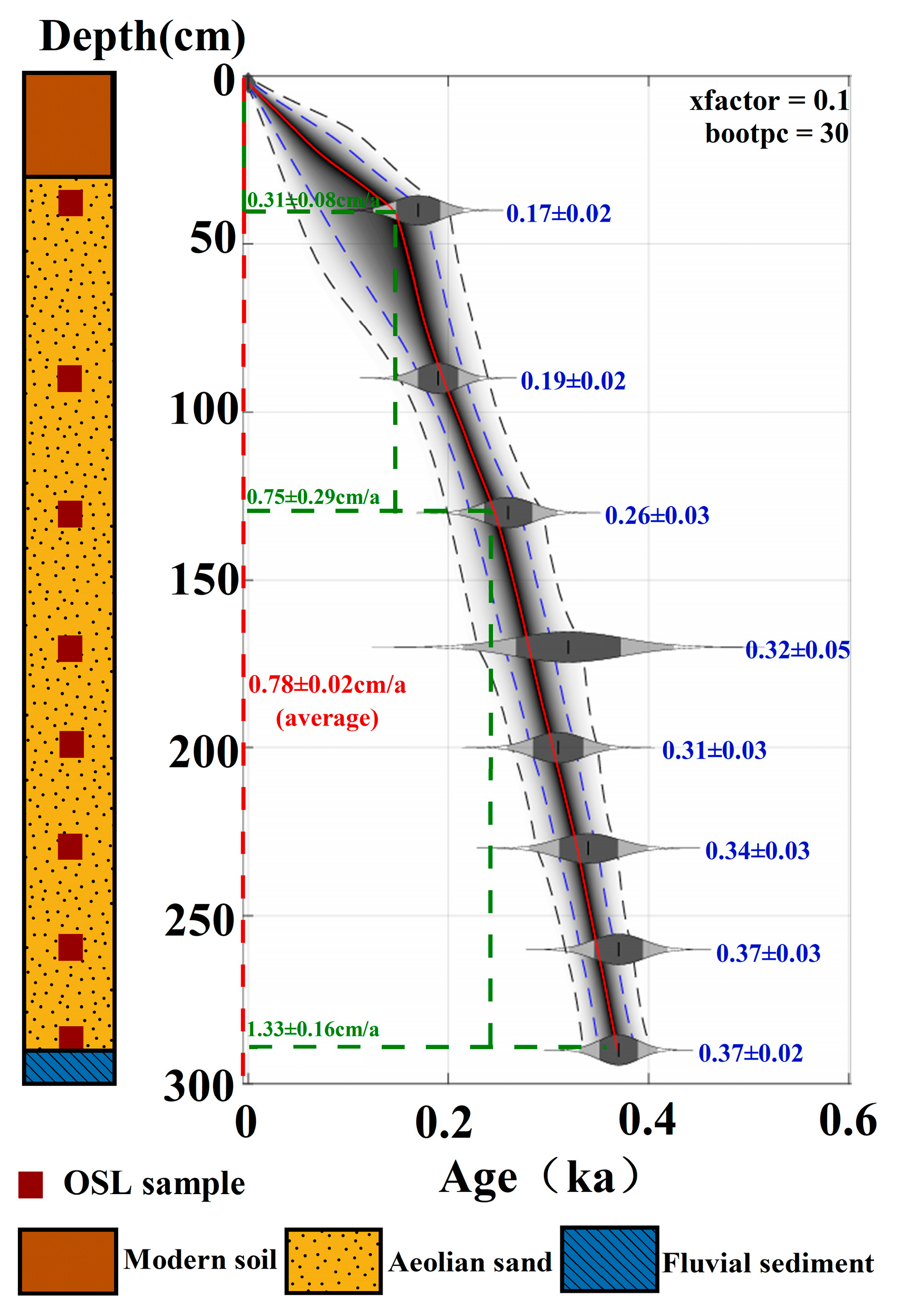
Based on the stratigraphic description, the DGL-B profile can be broadly divided into three lithological units from top to bottom: the modern soil layer, the aeolian sand layer, and the fluvial deposit layer. The fluvial sediment layer is located approximately at and below 305 cm depth. The aeolian sand layer (40–305 cm) exhibits loose soil texture with occasional presence of dead branches and leaf fragments. The modern soil layer (0–40 cm) is rich in contemporary plant roots (Figure 2).
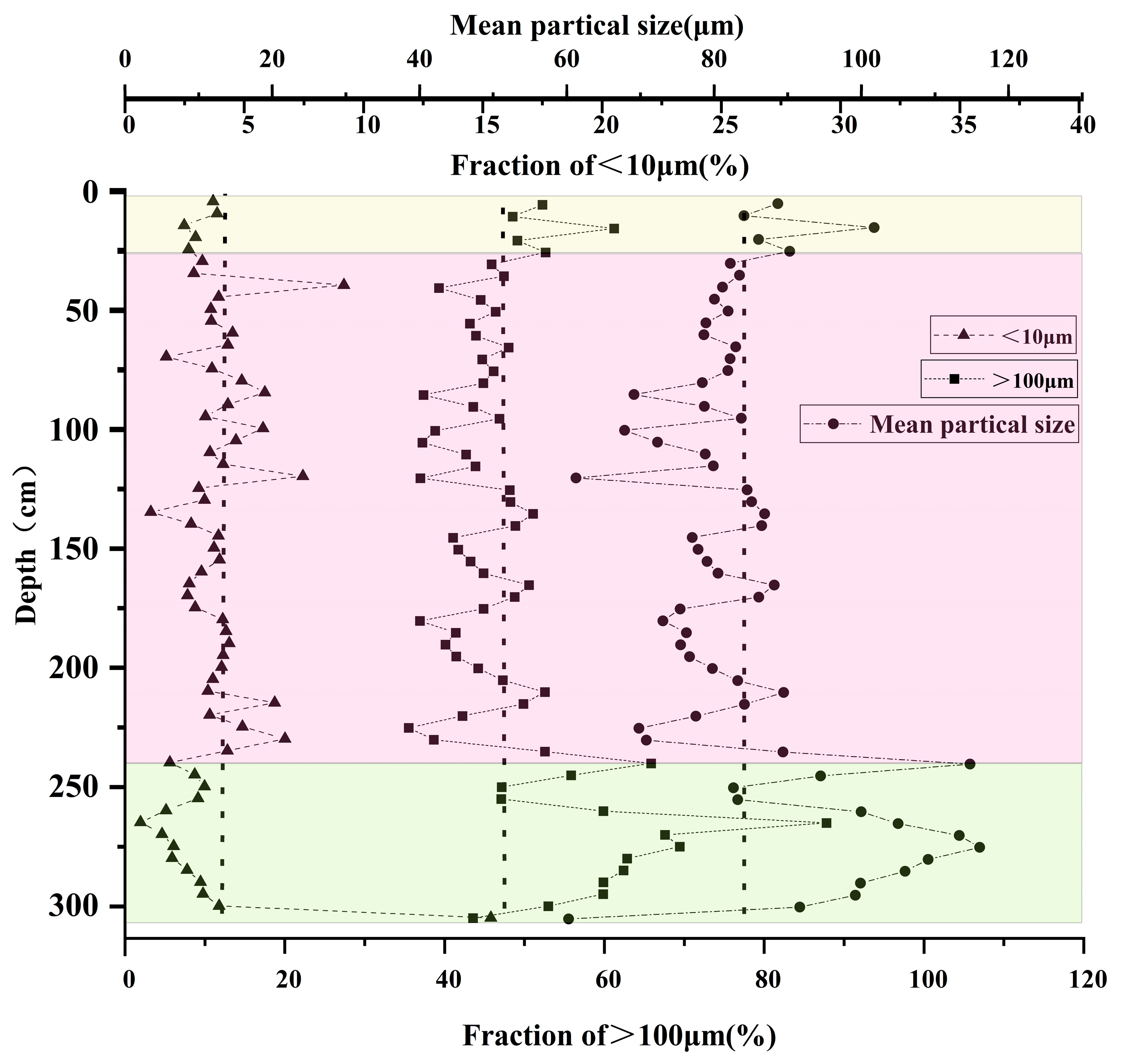
Within the DGL-B profile, the content of fine-grained particles (<10 μm), mean grain size, and the content of coarse-grained particles (>100 μm) were recorded. These parameters show significant variations throughout the depositional process (Figure 3). During the earliest stage, the sediments generally display coarse-grained characteristics, with the exception of the deposit precisely at 305 cm depth. After the nebkha accumulated to a height of 60–70 cm, the mean grain size initially decreased, accompanied by a gradual reduction in coarse-grained content and an increase in fine-grained content. Subsequently, as the nebkha continued to accumulate to approximately 280 cm, the mean grain size increased, and the coarse-grained content rose accordingly.

3.2. Chronology Results of the Nebkha and Its Accumulation Rates (AR)

The mutual corroboration and comparative analysis of multiple dating methods are the prerequisite and guarantee for accurate dating [42]. The age results of the OSL sample DGL-B-3 and AMS14C sample TN20254 of the same stratigraphic level are compared, and the results match (Table 2 and Table 3). While the age results of the section following the stratigraphic sequence of the upper new and lower old, and the section as a whole, is in line with the sedimentary chronological sequence, and the age of the lower strata is greater than that of the upper strata. This further indicates that the K-feldspar pIR50IR170 dating method is suitable for the dating of the Tamarix nebkha in this study area.
The age–depth model of the DGL-B profile is as shown in Figure 2. Because the vegetation cover of the DGL-B profile in this study is high enough, we determined that wind erosion has not occurred at the top of the profile for the time being, so we set the top of the profile to the sampling time of AD 2022, the age of the bottom to 0.37 ± 0.02 ka, and the accumulation rate (AR) value of the profile to be 0.78 ± 0.02 cm/a. According to the results of the age–depth model, we obtained a final age–depth model of the DGL-B profile as shown. The results of the age–depth model and the stratigraphic thickness, the AR value of the stratigraphy at each depth, was calculated, and based on the vertical change in the AR, the accumulation process of the DGL-B profile was mainly divided into the following three phases: in the lower part of the DGL-B profile (~0.37 ka~0.26 ka), the AR was ~1.33 ± 0.16 cm/a, and thereafter the AR of the nebkha gradually slowed down in the middle and upper part of the DGL-B profile (~0.26 ka to present). There was an AR of ~0.75 ± 0.29 cm/a in the upper-middle part of profile B (~0.26 ka~0.13 ka) and at the top of the profile (~0.13 ka to present), the AR was 0.31 ± 0.08 cm/a.

3.3. Variability in Tamarix Leaf δ13C with Depth

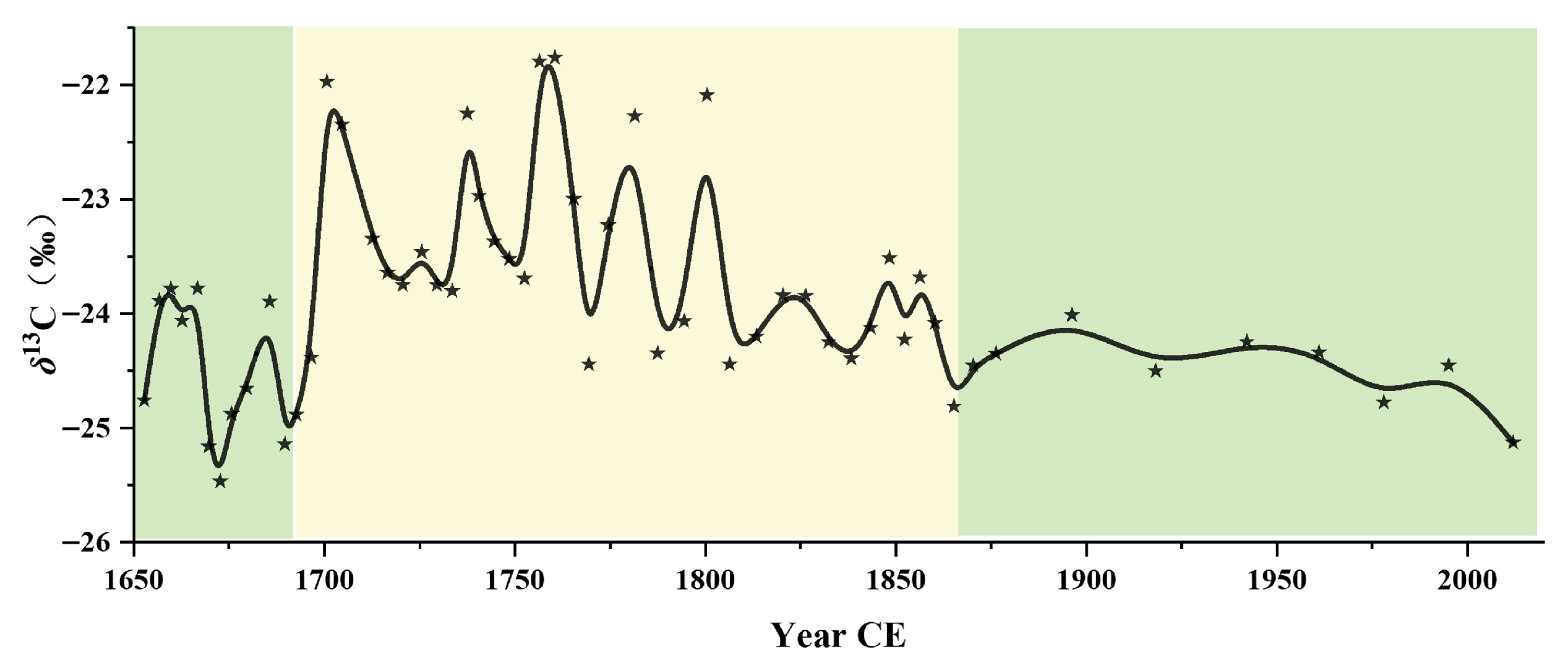
During the development of the nebkha, the climatic environment of the region changed continuously. By analyzing the trend of δ13C of Tamarix leaves at different depths in the DGL-B profile, it was found that the δ13C content of Tamarix leaves in the DGL-B profile had gone through three main stages of change (Figure 4). A comparison between the established age–depth framework and the stratigraphic δ13C record revealed a dynamic pattern in δ13C values during the nebkha’s development: values were relatively negative in the initial phase (AD 1650–AD 1690; mean: −24.53‰), became significantly more positive in the middle phase (AD 1690–AD 1870; mean: −23.53‰), and shifted back to negative values in the late phase (AD 1870–present; mean: −24.52‰).

4. Discussion

4.1. Nebkha Growth Pattern

Nebkha growth starts with a fast deposition stage. Then the accumulation rates (AR) slowly become slower. This continues until stability is reached. This slowing development pattern was also recorded. It was found in the chronological accumulation rates of Nitraria tangutorum nebkhas which are located on the Ordos Plateau [32]. That study believes that the fast accumulation stage of such nebkhas was closely related to strong regional aeolian activity. It was also related to dry and cold climate conditions in the early period. However, Tamarix nebkha is a landform type. It is formed through sediment capture by shrubs. Vegetation interception is very likely the most direct controlling factor. In the early stage of nebkha formation, shrub branches create wind barriers. These barriers are near the surface. Wind speed is significantly reduced. This causes sand particles transported by wind to lose kinetic energy. Then deposition occurs. At the same time, vegetation cover is sparse in this initial stage. This allows greater availability of near-surface sediments. That means more sediment sources are available. Later, shrub vegetation increases quickly. Surface coverage also increases quickly. This reduces the supply of these near-surface sediments. This can explain the high initial AR. Moreover, Tamarix has an intrinsic growth pattern. Its plant height growth rate gradually declines with age. Its crown width growth rate also gradually declines with age [43]. This provides a reasonable explanation. It explains the observed slowing in nebkha accumulation. Therefore, in summary, the initial fast accumulation at nebkha base may not be attributed only to changes in regional aeolian activity intensity. It may not be attributed only to regional dry and cold climate either. This process involves the coupling of multiple factors. More verification is needed. This verification should come from reconstructing accumulation rates of more typical nebkhas.

4.2. Stratigraphic Grain Size Changes and Driving Mechanisms in the Nebkha

Sediment grain size in the DGL-B profile exhibits significant variations with depth. Below the depth corresponding to the OSL sample DGL-B-8, at approximately 305 cm, the sediments are characterized by a high fine-grained content and extremely low coarse-grained content (Figure 3). Field observations of sedimentary structures confirm that this interval represents typical fluvial deposits (Figure 2). This fundamental shift in depositional facies is critical for defining the initial formation time of the Tamarix nebkha. The termination of fluvial sedimentation occurred during this environmental transition period. At this stage, the deep root system of the pioneer plant Tamarix effectively anchored the underlying fine-grained fluvial sediments, creating a stable, wind-resistant substrate. Simultaneously, the shrub canopy acted as a surface obstacle, significantly reducing near-ground wind speed [44], thereby efficiently intercepting and capturing wind-transported sand particles and initiating the accretion process of the nebkha. Consequently, the interface between fluvial and aeolian sand deposits in the profile essentially records the initial moment when Tamarix shrubs began to colonize and shape the aeolian landform. Based on the OSL age of the oldest aeolian sand layer near this interface (approximately 370 years before present), we determine that the initial formation of this Tamarix nebkha occurred around 370 years ago. Since then, the Tamarix nebkha has initiated and continued to develop.
During the initial stage of nebkha formation, vegetation coverage is low and shrub stature is limited. Through direct physical interception, the shrubs primarily capture coarse-grained creep and saltation loads from near-surface aeolian sand flows (Figure 3). Simultaneously, as airflow reaches the toe of the windward slope, changes in surface roughness and topography induce upward motion, enabling a small fraction of fine sand to be transported in suspension while coarser sand particles remain in situ [45,46], resulting in sediment dominated by coarse-grained components.
As the nebkha develops and the shrubs grow, increased foliage density reduces overall canopy permeability, allowing for the effective interception and capture of suspended materials distributed in higher layers of the sand-laden airflow [47]. The canopy structure becomes more complex, enhancing its windbreak effect and turbulence–interference capacity, which significantly improves the capture efficiency of fine suspended particles [48]. Consequently, the mean grain size of the sediments shows a fining trend (Figure 3).
A notable coarsening of grain size is observed in the upper section of the nebkha profile (approximately 280–305 cm in height) (Figure 3). This phase coincides with periods of intensive human activity in the Golmud region, including early 20th-century settlement and reclamation, the opening of the Qinghai–Tibet Highway in 1954, and subsequent urban expansion and agricultural development. These activities significantly altered surface cover and local aeolian conditions, leading to increased input of proximal coarse-grained sediments [49]. Human activities have thus also influenced, to some extent, the natural development processes of nebkhas [50].
Nebkha formation is dependent on sediment trapping by shrubs. Therefore, vertical grain size changes in the Tamarix nebkha are believed to be influenced by multiple factors. Regional aeolian activity is considered one factor. Climate is regarded as another factor. The growth of the Tamarisk plant is identified as an additional factor. The development of the nebkha itself is also recognized as important. Therefore, regional wind activity and environmental change may not fully explain sediment changes in the nebkha. The reasons for these grain size variations need to be further investigated. The investigation should focus on the nebkha’s development model.

4.3. Water Use Efficiency as Indicated by δ13C of Tamarix Leaves

Tamarix nebkha vegetation exhibits homogeneous structure, and its organic residues are relatively simple and uniform. Consequently, variations in the δ13C values of leaf organic matter from Tamarix nebkhas are frequently employed to infer changes in the regional climate and environment. Based on previous research, plant leaf δ13C values, to a certain extent, reflect leaf water use efficiency (WUE), thereby indicating regional water availability [22]. An age–depth model for the stratigraphic sequence was reconstructed using the Undatable model [39]. By integrating this with δ13C values from Tamarix residues within the same strata, environmental information captured by Tamarix shrub branches and leaves over the past ~370 years was obtained (Figure 5c). During the continuous accumulation of the nebkha, the δ13C values of Tamarix branches and leaves roughly underwent one period of low water availability and two periods of high water availability.
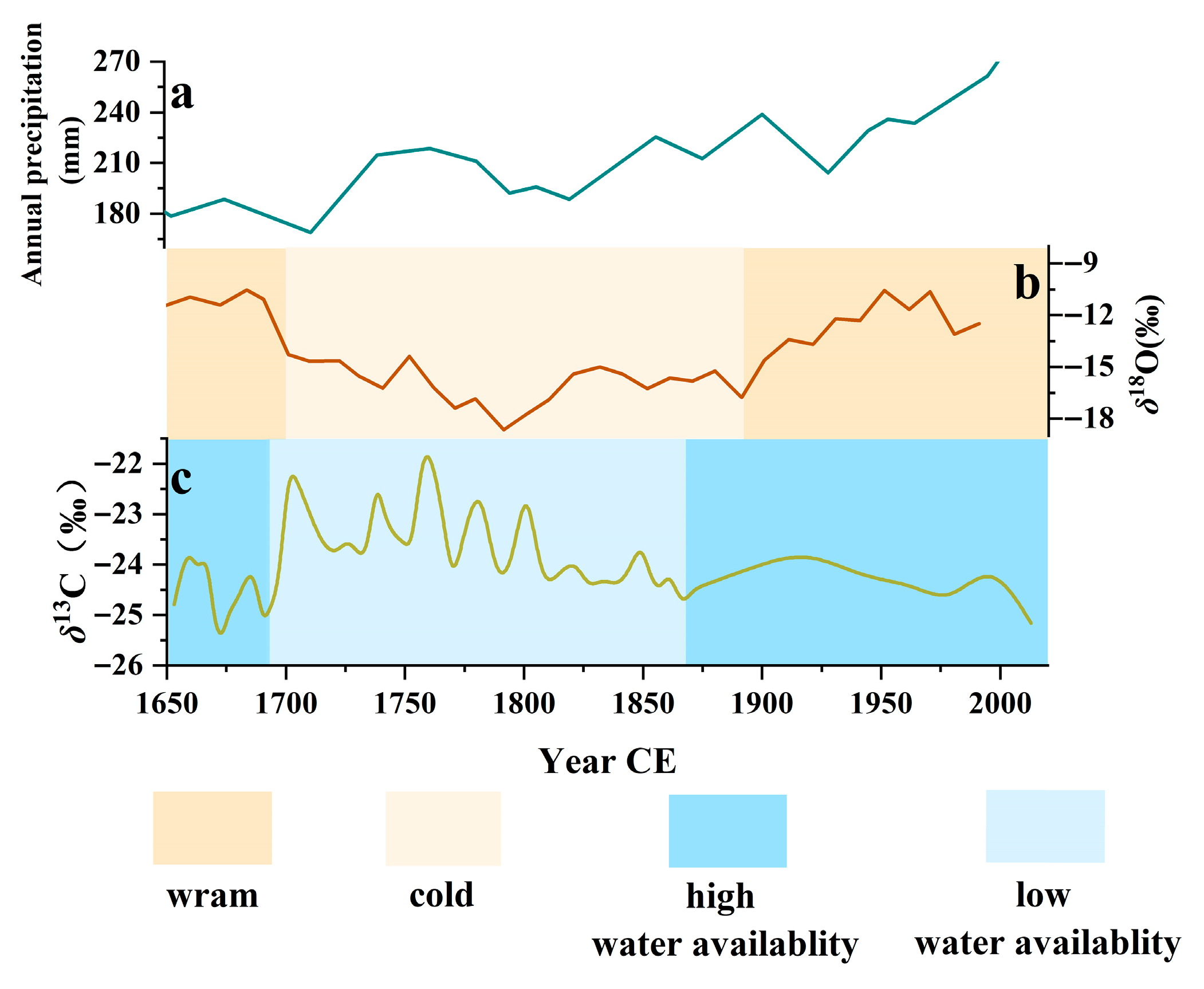
To clarify the primary controlling factors of δ13C variations, regional water use efficiency changes, as indicated by Tamarix leaf δ13C (Figure 5c), were compared with the annual precipitation sequence reconstructed from high-altitude Qilian Mountain tree rings in the study area (Figure 5a) [51] and the trend of δ18O values from the Malan ice core (Figure 5b) [52]. The results show that periods of high water availability in the Qaidam Basin largely coincide with warm periods identified in the comparison of various indicators. Temperature changes in the study region from AD 1650 to AD 2000, reconstructed from δ18O values in the Malan ice core, reveal that the region roughly experienced a fluctuating “warm-cold-warm” change. This fluctuation shows a high degree of agreement with the trend of Tamarix δ13C changes. The age–depth model for the nebkha sediments reconstructed by the Undatable model is considered to have high dating accuracy. Therefore, the trend comparison between the reconstructed δ13C and the ice core record is deemed reliable. In contrast, tree rings from the Qilian Mountains in the northeastern part of the region have effectively recorded regional precipitation changes over the past approximately 370 years. This record indicates a slowly increasing trend in regional precipitation since the late 16th century. This pattern of regional precipitation appears inconsistent with the trend of water availability changes in the Qaidam Basin.
Based on the results of the above indicator comparisons, and combined with an understanding of the Tamarix nebkha formation process and its regional geographical setting, it is concluded that regional water availability changes recorded by Tamarix leaf δ13C are primarily controlled by regional air temperature variations and have little relationship with regional precipitation. The nearby Golmud area has a modern average annual precipitation of less than 50 mm [53]. Although its precipitation trend may be similar to that of the Qilian Mountains region and could potentially increase moderately, this cannot alter the overall extreme aridity of the region. Therefore, the growth of Tamarix depends on groundwater. Field surveys also show that Tamarix shrubs in the Qaidam Basin are mostly distributed around lakes and river channels, as well as at the edges of alluvial fans, strongly confirming their groundwater-dependent characteristics. With annual precipitation amounting to only a few tens of millimeters, and most of it likely evaporating before reaching the ground surface or infiltrating only to very shallow depths, it is difficult for deep-rooted plants like Tamarix to utilize it effectively. Therefore, Tamarix growth primarily relies on groundwater or glacial meltwater recharge, and its water use efficiency, reflected in δ13C values, is naturally insensitive to precipitation changes. Consequently, regional temperature changes indirectly regulate Tamarix water use efficiency by influencing regional glacial meltwater. The regional water availability indicated by the Tamarix nebkhas largely constitutes an effective record of regional temperature change.

4.4. Driving Factors and Underlying Mechanisms of δ13C Variability

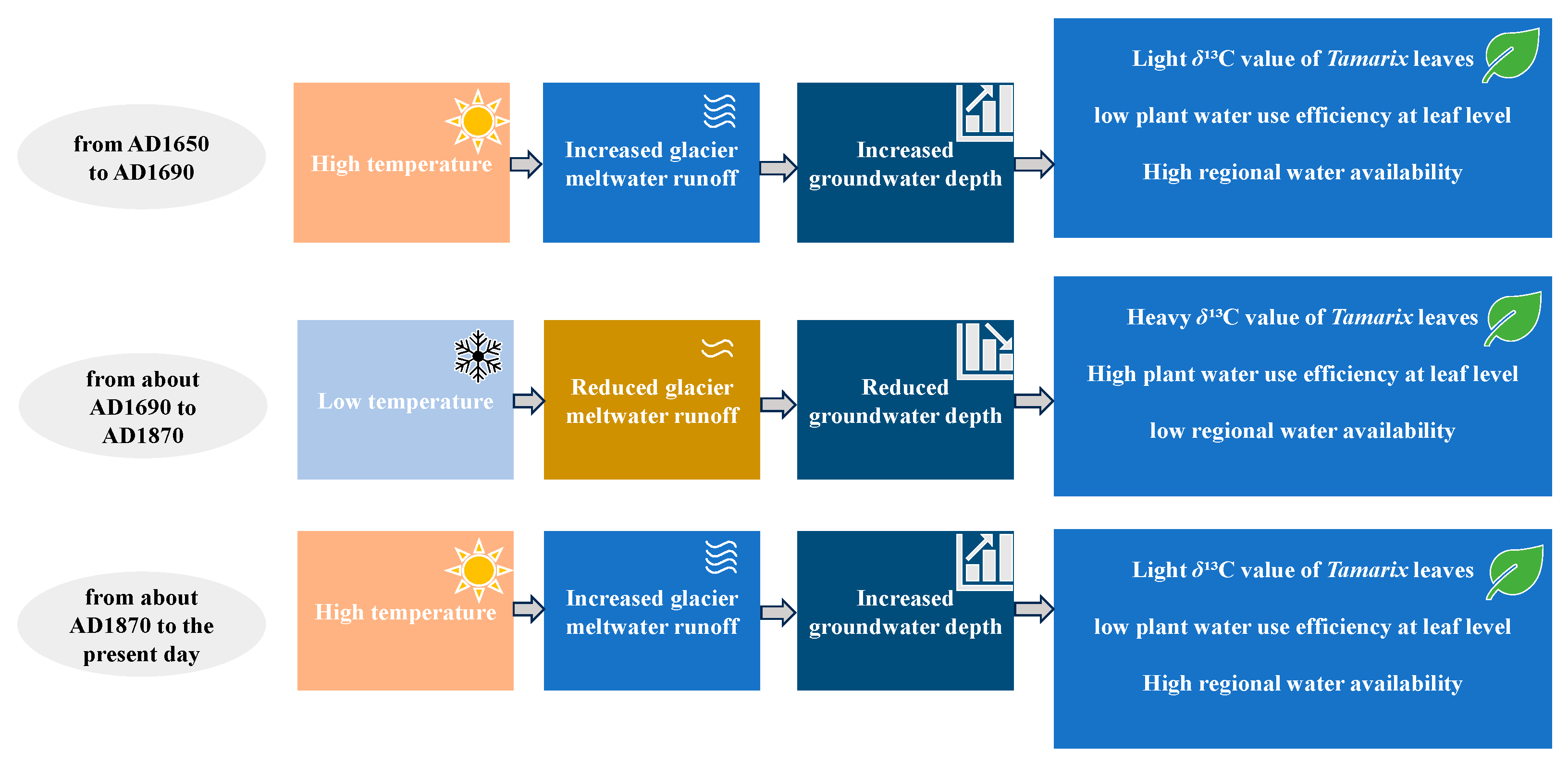
Based on our understanding of the research findings, and in conjunction with existing similar studies on Tamarix nebkhas in the Taklimakan Desert [23], we propose a mechanism dominated by “temperature-glacial meltwater-groundwater level” to explain regional water availability in this area (Figure 6). This mechanism exhibits differences from the driving modes revealed by nebkha records in other arid regions of China, which may originate from the spatial heterogeneity present in the hydroclimatic systems of arid zones. For instance, a recent high-resolution study of Tamarix nebkhas in the lower Heihe River Basin [54] demonstrated that these variations in effective moisture were strongly influenced by the North Atlantic Oscillation and solar activity cycles. This differs considerably from the mechanism proposed in this study, where the regional water availability reflected by the δ13C of Tamarix leaves in the nebkha is dependent on glacier/snowmelt (temperature-regulated meltwater).
The fundamental reason for this difference lies in the distinct moisture sources and dominant climate systems of the two locations. The lower Heihe River Basin is situated at the confluence of the westerly wind and monsoon climate zones and is directly influenced by westerly circulation. Its atmospheric precipitation and moisture transport are sensitive to large-scale circulation anomalies such as the NAO. In contrast, the Qaidam Basin is an enclosed inland basin, located deep in the continental interior. Its regional hydrology relies more on inland hydrological processes—specifically, increased meltwater from glaciers and snowpack in the surrounding high mountains (Kunlun Mountains) during warm periods, which recharges groundwater and rivers in the basin, thereby further influencing water availability for vegetation on the alluvial fans. Therefore, the Tamarix nebkha δ13C sequence may essentially record different hydrological processes under distinct arid regimes: in the lower Heihe River Basin, it primarily responds to atmospheric humidity regulated by remote atmospheric circulation; in the Qaidam Basin, it mainly responds to alpine ice/snow meltwater recharge regulated by regional temperature.
In summary, δ13C values of Tamarix leaves from the nebkha can effectively reveal temperature changes in the study area during its formative developmental stage, while their significance in indicating precipitation changes in the study area is not apparent (Figure 6). The comparison between the results of this study and the Heihe record indicates that although nebkhas record regional paleoclimatic and environmental changes, the underlying mechanisms are often complex. The type of hydroclimatic system to which they belong must first be identified to enable a more reasonable interpretation of the climatic dynamics signified by the proxy indicators. This study focuses on the Qaidam Basin, an extremely arid inland region where vegetation growth is mainly controlled by groundwater level. The primary source of groundwater recharge is temperature-driven glacial and snowmelt runoff from the surrounding mountains. Consequently, extremely low local precipitation is unlikely to exert a dominant influence on Tamarix water use efficiency.

5. Conclusions

Based on a comprehensive study of Tamarix nebkhas in the northern Kunlun Mountains alluvial fan of the Qaidam Basin, this research presents the following key conclusions. First, a reliable chronological framework for the nebkhas has been successfully established using K-feldspar pIRIR dating, revealing that their development initiated around AD 1650 and followed an accumulation pattern characterized by initially rapid growth that gradually slowed down. Second, the Tamarix nebkha chronology, combined with δ13C records of Tamarix leaves, demonstrates that regional water availability over the past 370 years underwent three distinct phases: relatively high water availability from AD 1650 to AD 1690, a progressive decline during AD 1690–AD 1870, and a recovery phase after AD 1870. Comprehensive analysis confirms that temperature variation served as the key controlling factor in this process—under extreme aridity, precipitation played a limited role, while temperature-driven glacial and snowmelt runoff from the Kunlun Mountains, by influencing groundwater dynamics, emerged as the dominant environmental factor determining both nebkha development and water availability.

Author Contributions

Conceptualization, C.E.; methodology, C.E.; software, M.T.; validation, Q.T.; formal analysis, J.W.; investigation, Y.Z.; data curation, K.L.; writing—original draft preparation, Y.Z.; writing—review and editing, C.E.; supervision, C.E. All authors have read and agreed to the published version of the manuscript.

Funding

This research was funded by the National Natural Science Foundation of China, grant no. 42171011.

Data Availability Statement

The data presented in this study are available on request from the corresponding author. The data are not publicly available due to privacy.

Acknowledgments

We extend our sincere gratitude to Li Hailin for his assistance in field excavation and to Zhang Zhaokang for his support and contributions to data analysis.

Conflicts of Interest

The authors declare no conflicts of interest.

References

  1. Tengberg, A. Nebkha dunes as indicators of wind erosion and land degradation in the Sahel zone of Burkina Faso. J. Arid Environ. 1995, 30, 265–282. [Google Scholar] [CrossRef]
  2. Hesp, P.A.; McLachlan, A. Morphology, dynamics, ecology and fauna of Arctotheca populifolia and Gazania rigens nabkha dunes. J. Arid Environ. 2000, 44, 155–172. [Google Scholar] [CrossRef]
  3. Nield, J.M.; Baas, A.C.W. Investigating parabolic and nebkha dune formation using a cellular automaton modelling approach. Earth Surf. Process. Landf. 2008, 33, 724–740. [Google Scholar] [CrossRef]
  4. Goudie, A.S. Nebkhas: An essay in aeolian biogeomorphology. Aeolian Res. 2022, 54, 100772. [Google Scholar] [CrossRef]
  5. Nickling, W.G.; Wolfe, S.A. The morphology and origin of nabkhas, region of Mopti, Mali, West Africa. J. Arid Environ. 1994, 28, 13–30. [Google Scholar] [CrossRef]
  6. Parsons, A.J.; Wainwright, J.; Schlesinger, W.H.; Abrahams, A.D. The role of overland flow in sediment and nitrogen budgets of mesquite dunefields, southern New Mexico. J. Arid Environ. 2003, 53, 61–71. [Google Scholar] [CrossRef]
  7. Thomas, D.S.G.; Knight, M.; Wiggs, G.F.S. Remobilization of southern African desert dune systems by twenty-first century global warming. Nature 2005, 435, 1218–1221. [Google Scholar] [CrossRef]
  8. Gile, L.H. Holocene Soils and Soil-Geomorphic Relations in an Arid Region of Southern New Mexico. Quat. Res. 1975, 5, 321–360. [Google Scholar] [CrossRef]
  9. Zhu, Z.; Liu, S.; Xiao, L. Desertification and its control in grasslands-a case study in Wulanchabu. J. Desert Res. 1981, 1, 2–12. [Google Scholar]
  10. Tengberg, A.; Chen, D.L. A comparative analysis of nebkhas in central Tunisia and northern Burkina Faso. Geomorphology 1998, 22, 181–192. [Google Scholar] [CrossRef]
  11. Yan, Q.L.; Liu, Z.M.; Zhu, J.J.; Luo, Y.M.; Wang, H.M.; Jiang, D.M. Structure, pattern and mechanisms of formation of seed banks in sand dune systems in northeastern Inner Mongolia, China. Plant Soil 2005, 277, 175–184. [Google Scholar] [CrossRef]
  12. Wang, X.M.; Zhang, C.X.; Zhang, J.W.; Hua, T.; Lang, L.L.; Zhang, X. Nebkha formation: Implications for reconstructing environmental changes over the past several centuries in the Ala Shan Plateau, China. Palaeogeogr. Palaeoclimatol. Palaeoecol. 2010, 297, 697–706. [Google Scholar] [CrossRef]
  13. Luo, W.C.; Zhao, W.Z.; Liu, B. Growth stages affect species richness and vegetation patterns of nebkhas in the desert steppes of China. Catena 2016, 137, 126–133. [Google Scholar] [CrossRef]
  14. Cabrera-Vega, L.L.; Cruz-Avero, N.; Hernández-Calvento, L.; Hernández-Cordero, A.I.; Fernández-Cabrera, E. Morphological changes in dunes as an indicator of anthropogenic interferences in arid dune fields. J. Coast. Res. 2013, 65, 1271–1276. [Google Scholar] [CrossRef]
  15. Hesp, P.A.; Hernández-Calvento, L.; Hernández-Cordero, A.I.; Gallego-Fernández, J.B.; Ruz, M.H. Nebkha development and sediment supply. Sci. Total Environ. 2021, 773, 144815. [Google Scholar] [CrossRef] [PubMed]
  16. Lang, L.L.; Wang, X.M.; Hasi, E.; Hua, T. Nebkha (coppice dune) formation and significance to environmental change reconstructions in arid and semiarid areas. J. Geogr. Sci. 2013, 23, 344–358. [Google Scholar] [CrossRef]
  17. Lang, L.L.; Zhu, B.; Wang, P.; Chen, H.; Shi, Y.; Dong, Q.; Wang, X. Physicochemical indicators of hydro-ecological conditions in a nebkha sedimentary profile in the arid Shule River Basin, northwestern China. J. Geogr. Sci. 2025, 35, 1351–1364. [Google Scholar] [CrossRef]
  18. Chen, K.Z.; Bowler, J.M. Late Pleistocene evolution of salt lakes in the Qaidam Basin, Qinghai province, China. Palaeogeogr. Palaeoclimatol. Palaeoecol. 1986, 54, 87–104. [Google Scholar] [CrossRef]
  19. Huang, J.P.; Zhou, X.J.; Wu, G.X.; Xu, X.D.; Zhao, Q.Y.; Liu, Y.M.; Duan, A.M.; Xie, Y.K.; Ma, Y.M.; Zhao, P.; et al. Global climate impacts of land-surface and atmospheric processes over the Tibetan Plateau. Rev. Geophys. 2023, 61, e2022RG000771. [Google Scholar] [CrossRef]
  20. Chiang, J.C.; Fung, I.Y.; Wu, C.H.; Cai, Y.; Edman, J.P.; Liu, Y.; Labrousse, C.A. Role of seasonal transitions and westerly jets in East Asian paleoclimate. Quat. Sci. Rev. 2015, 108, 111–129. [Google Scholar] [CrossRef]
  21. Li, N.; Xie, M.; Sack, D.; Dubois, N.; Yang, X.; Gao, G.; Li, D.; Liu, L.; Liu, H.; Leng, C.; et al. Continuous aridification since the mid-Holocene as the main cause of C3/C4 dynamics in the grasslands of northeastern China. Eur. J. Soil Sci. 2021, 72, 356–371. [Google Scholar] [CrossRef]
  22. Cao, S.K.; Feng, Q.; Si, J.H.; Chang, Z.Q.; Zhuoma, C.; Xi, H.Y.; Su, Y.H. Summary on the plant water use efficiency at leaf level. Acta Ecol. Sin. 2009, 29, 3882–3892. [Google Scholar]
  23. Lang, L.L.; Wang, X.M.; Hua, T.; Zhang, C.X. Moisture availability over the past five centuries indicated by carbon isotopes of Tamarix taklamakanensis leaves in a nebkha profile in the Central Taklimakan Desert, NW China. Aeolian Res. 2013, 11, 101–108. [Google Scholar] [CrossRef]
  24. Liu, W.G.; Liu, Z.H.; An, Z.S.; Wang, X.L.; Chang, H. Wet climate during the ‘Little Ice Age’ in the arid Tarim Basin, northwestern China. Holocene 2010, 21, 409–416. [Google Scholar] [CrossRef]
  25. Xia, X.C.; Zhao, Y.J.; Wang, F.B.; Mu, G.J.; Zhao, J.F. Stratification features of Tamarix cone and its possible age significance. Chin. Sci. Bull. 2004, 49, 1539–1540. [Google Scholar] [CrossRef]
  26. Xia, X.C.; Zhao, Y.J.; Wang, F.B.; Cao, Q.Y. Environmental significance exploration to Tamarix cone age layer in Lop Nur lake region. Chin. Sci. Bull. 2005, 50, 2395–2397. [Google Scholar] [CrossRef]
  27. Cao, X.; Jiao, J.; Li, J.; Qi, H.; Bai, L.; Wang, X.; Sun, X. Morphometric characteristics and sand intercepting capacity of dominant perennial plants in the Eastern Qaidam Basin: Implication for aeolian erosion control. Catena 2022, 210, 105939. [Google Scholar] [CrossRef]
  28. Li, J.C.; Zhao, W.X.; Zhou, N.; Zhang, C.L. Wind erosion caused clustered development and rapid growth of nebkhas in the eastern Qaidam Basin of the Tibetan Plateau. J. Arid Environ. 2022, 197, 104665. [Google Scholar] [CrossRef]
  29. Zheng, C.X.; Zhou, L.P.; Qin, J.T. Difference in luminescence sensitivity of coarse-grained quartz from deserts of northern China. Radiat. Meas. 2009, 44, 534–537. [Google Scholar] [CrossRef]
  30. Yang, S.L.; Liu, X.J.; Zan, J.B.; Li, P.S.; Xu, X.C.; Li, D.X.; Li, Q.; Liu, L.; Wen, C.; Fang, X.M. Multi-method luminescence dating of young aeolian dunes in the central Tibetan Plateau. Quat. Geochronol. 2024, 83, 101595. [Google Scholar] [CrossRef]
  31. Li, G.Q.; Wen, L.J.; Xia, D.S.; Duan, Y.W.; Rao, Z.G.; Madsen, D.B.; Wei, H.T.; Fang, L.J.; Jia, J.; Chen, F.H. Quartz OSL and K-feldspar pIRIR dating of a loess/paleosol sequence from arid central Asia, Tianshan Mountains, NW China. Quat. Geochronol. 2015, 28, 40–53. [Google Scholar] [CrossRef]
  32. Du, Y.; Lu, R.J.; Ma, L.; Liu, X.; Chen, D.; Liu, Y. A formation record of modern Nitraria tangutorum nebkhas on the Ordos Plateau of northern China based on optically stimulated luminescence dating. Quat. Geochronol. 2024, 82, 101550. [Google Scholar] [CrossRef]
  33. Zeng, Y.X.; E, C.Y.; Shi, Y.K.; Sun, Y.J.; Wang, J.W.; Zhang, Z.K. Luminescence chronology record of Tamarix Chinensis nebkhas in the Qaidam Basin. J. Desert Res. 2026; in press. [Google Scholar]
  34. Yu, J.Q.; Gao, C.L.; Cheng, A.Y.; Liu, Y.; Zhang, L.; He, X. Geomorphic, hydroclimatic and hydrothermal controls on the formation of lithium brine deposits in the Qaidam Basin, northern Tibetan Plateau, China. Ore Geol. Rev. 2013, 50, 171–183. [Google Scholar] [CrossRef]
  35. Wang, J.; Xiao, L.; Reiss, D.; Hiesinger, H.; Huang, J.; Xu, Y.; Zhao, J.N.; Xiao, Z.Y.; Komatsu, G. Geological features and evolution of yardangs in the Qaidam Basin, Tibetan Plateau (NW China): A terrestrial analogue for Mars. J. Geophys. Res. Planets 2018, 123, 2336–2363. [Google Scholar] [CrossRef]
  36. Du, S.S.; Wu, Y.Q.; Tan, L.H. Geochemical evidence for the provenance of aeolian deposits in the Qaidam Basin, Tibetan Plateau. Aeolian Res. 2018, 32, 60–70. [Google Scholar] [CrossRef]
  37. Tian, E.Z. Distribution characteristics and comprehensive utilization of groundwater resources at the northern piedmont of Kunlun Mountains. Hydrogeol. Eng. Geol. 1986, 13, 49–51. [Google Scholar]
  38. Prescott, J.R.; Hutton, J.T. Cosmic ray contributions to dose rates for luminescence and ESR dating: Large depths and long-term time variations. Radiat. Meas. 1994, 23, 497–500. [Google Scholar] [CrossRef]
  39. Lougheed, B.C.; Obrochta, S.P. A rapid, deterministic age-depth modeling routine for geological sequences with inherent depth uncertainty. Paleoceanogr. Paleoclimatol. 2019, 34, 122–133. [Google Scholar] [CrossRef]
  40. Bronk Ramsey, C. OxCal 4.4.4. 2021. Available online: http://c14.arch.ox.ac.uk/oxcal (accessed on 11 October 2024).
  41. Reimer, P.J.; Austin, W.E.N.; Bard, E.; Bayliss, A.; Blackwell, P.G.; Bronk Ramsey, C. The IntCal20 Northern Hemisphere Radiocarbon Age Calibration Curve (0–55 cal kBP). Radiocarbon 2020, 62, 725–757. [Google Scholar] [CrossRef]
  42. Long, H.; Shen, J.; Wang, Y.; Gao, L.; Frechen, M. High-resolution OSL dating of a late Quaternary sequence from Xingkai Lake (NE Asia): Chronological challenge of the “MIS 3a Mega-paleolake” hypothesis in China. Earth Planet. Sci. Lett. 2015, 428, 281–292. [Google Scholar] [CrossRef]
  43. Xia, J.B.; Lu, Z.H.; Kong, X.H.; Liu, J.T.; Han, R.D.; Zhu, J.H. The Response Characteristic of Growth Dynamics of Tamarix Chinensis Stand to Density Structure in Wetlands of Yellow River Delta. Wetl. Sci. 2012, 10, 332–338. [Google Scholar]
  44. Leenders, J.K.; van Boxel, J.H.; Sterk, G. The effect of single vegetation elements on wind speed and sediment transport in the Sahelian zone of Burkina Faso. Earth Surf. Process. Landf. 2007, 32, 1454–1474. [Google Scholar] [CrossRef]
  45. Li, Z.Z.; Wu, S.L.; Xiao, C.X.; Liu, L.M.; Sun, Q.M.; Zhang, Z.H. Experimental Study on Wind Tunnel Flow Field of Nebkhas in the Hotan River Basin, Xinjiang (Part II). J. Desert Res. 2007, 27, 15–19. [Google Scholar]
  46. Wu, S.L.; Li, Z.Z.; Hai, Y.; Hui, J. Experimental Study on the Flow Field Around a Single Tamarix Shrub in the Hotan River Basin, Xinjiang. Arid Zone Res. 2006, 23, 539–543. [Google Scholar] [CrossRef]
  47. Finnigan, J. Turbulence in Plant Canopies. Annu. Rev. Fluid Mech. 2000, 32, 519–571. [Google Scholar] [CrossRef]
  48. Xiao, J.Q.; Wu, S.L.; Chen, P.P. Grain-size and fractal characteristics of surface sediments of nebkhas in the lower reaches of the Hotan River. J. Desert Res. 2024, 44, 24–36. [Google Scholar] [CrossRef]
  49. Golmud Local Chronicles Compilation Committee. Golmud City Chronicle, 1st ed.; Local Records Press: Beijing, China, 2005; pp. 2–3. [Google Scholar]
  50. Yang, L.; Shi, Z.; Zhang, S.; Lee, H.F. Climate Change, Geopolitics, and Human Settlements in the Hexi Corridor over the Last 5000 Years. Acta Geol. Sin. 2020, 94, 612–623. [Google Scholar] [CrossRef]
  51. Yang, B.; Qin, C.; Wang, J.L.; He, M.; Melvin, T.M.; Osborn, T.J.; Briffa, K.R. A 3,500-year tree-ring record of annual precipitation on the northeastern Tibetan Plateau. Proc. Natl. Acad. Sci. USA 2014, 111, 2903–2908. [Google Scholar] [CrossRef]
  52. Wang, N.L.; Yao, T.D.; Pu, J.C.; Zhang, Y.L.; Sun, W.Z. Climatic and environmental changes over the last millennium recorded in the Malan ice core from the northern Tibetan Plateau. Sci. China Ser. D 2006, 49, 1079–1089. [Google Scholar] [CrossRef]
  53. Huo, A.D.; Li, J.G.; Jiang, G.Z.; Yang, Y. Temporal and spatial variation of surface evapotranspiration based on remote sensing in Golmud Region, China. Appl. Math. Inf. Sci. 2013, 7, 519–524. [Google Scholar] [CrossRef]
  54. Cui, X.Y.; Liu, X.K.; Liang, A.M.; Liu, B.; Li, T.Y.; Chen, G.X.; Wang, A.Q.; Yang, L.H.; Liu, Z.Y.; Yang, X.D.; et al. Moisture evolution during the Little Ice Age from shrub dune records in the lower Heihe River Basin, China. Quat. Sci. Rev. 2026, 374, 109773. [Google Scholar] [CrossRef]
Figure 1. (a) Topographic units in and around the Qaidam Basin; (b) DGL-B leeward slope; (c) DGL-B profile morphology; (d) schematic representation of profile sampling.
Water 18 00416 g001
Figure 2. Lithology of DGL-B profile: Undatable age–depth model based on OSL age and its accumulation rates (AR) map for DGL-B profile.
Water 18 00416 g002
Figure 3. Variations in mean particle size and the proportions of coarse (>100 μm) and fine (<10 μm) particles across the various layers of the sampled nebkha.
Water 18 00416 g003
Figure 4. Trends in δ13C values of Tamarix residues (The star symbols correspond to the δ13C values of Tamarix leaves from different historical periods). The light green color indicates phases with lighter δ13C values; the light yellow color indicates phases with heavier δ13C values.
Water 18 00416 g004
Figure 5. The plant carbon isotopic record from the Qaidam Basin (c) compared with precipitation series from tree rings in the Qilian Mountains [51] (a) and Malan ice core δ18O record [52] (b).
Water 18 00416 g005
Figure 6. Link between Tamarix leaf δ13C in nebkhas and past 370-year climate change in the Qaidam Basin.
Water 18 00416 g006
Table 1. Measurement methods and sample preparation for luminescence dating.
StepTreatmentObserved
1Regenerative dose, Ri (i = 0, 1, 2, 3 …)
2Preheat at 200 °C for 60 s
3IRSL measurement at 50 °C for 200 sLx,IR50
4IRSL measurement at 170 °C for 200 sLx,pIRIR170
5Test dose
6Preheat at 200 °C for 60 s
7IRSL measurement at 50 °C for 200 sTx,IR50
8IRSL measurement at 170 °C for 200 sTx,pIRIR170
9IRSL measurement at 205 °C for 200 s
10Return to step 1
Table 2. Dose rates and OSL datings of samples.
Sample IDDepth
(m)
K
(%)
Th
(ppm)
U
(ppm)
H2O
(%)
CupDose Rate
(Gy/ka)
De
(Gy)
Age
(ka)
DGL-B-10.41.60 ± 0.049.96 ± 0.61.49 ± 0.35 ± 393.28 ± 0.130.55 ± 0.070.17 ± 0.02
DGL-B-20.91.64 ± 0.048.11 ± 0.61.61 ± 0.35 ± 393.16 ± 0.130.58 ± 0.060.19 ± 0.02
DGL-B-31.31.58 ± 0.0410.26 ± 0.71.66 ± 0.35 ± 393.25 ± 0.140.84 ± 0.070.26 ± 0.03
DGL-B-41.71.43 ± 0.048.79 ± 0.61.57 ± 0.35 ± 392.96 ± 0.130.94 ± 0.150.32 ± 0.05
DGL-B-521.59 ± 0.048.82 ± 0.61.44 ± 0.35 ± 393.35 ± 0.141.04 ± 0.070.31 ± 0.03
DGL-B-62.31.51 ± 0.0411.19 ± 0.71.97 ± 0.35 ± 393.27 ± 0.141.10 ± 0.080.34 ± 0.03
DGL-B-72.61.56 ± 0.049.70 ± 0.61.66 ± 0.35 ± 393.14 ± 0.131.17 ± 0.050.37 ± 0.03
DGL-B-82.91.65 ± 0.049.29 ± 0.61.72 ± 0.35 ± 393.16 ± 0.141.15 ± 0.030.37 ± 0.02
Table 3. AMS14C dating result for plant residues.
ProfileLab IDDepth (cm)Material14C Date ± Error (a BP)Calibrated Age
(cal a BP)
Calibrated Age
(cal a AD)
DGLTN20254130Plant residues155 ± 20229–1671721–1783
Disclaimer/Publisher’s Note: The statements, opinions and data contained in all publications are solely those of the individual author(s) and contributor(s) and not of MDPI and/or the editor(s). MDPI and/or the editor(s) disclaim responsibility for any injury to people or property resulting from any ideas, methods, instructions or products referred to in the content.