

Organic Carbon Pools and Their Association with Cadmium in Sediments of Small Freshwater Ecosystems

 ,
,  ,
,  , , ,
, , ,  and
and
Abstract
1. Introduction
1.1. Small Waterbodies as Components of the Global Carbon Cycle
1.2. Climatic and Hydrological Drivers of Carbon Accumulation
1.3. Landscape Controls and Land-Use Impacts
1.4. The Baltic Region: Spatial Patterns and Environmental Risks
1.5. Coupling Between OC and Heavy Metals
1.6. Knowledge Gaps in Small Ponds and Drainage Systems
1.7. Contemporary Trends and Remaining Uncertainties
1.8. Objectives of This Study
- (1)
- Quantify TOC, WEOC, and Cd concentrations in sediments of small freshwater ecosystems during 2022–2024;
- (2)
- Examine spatial differences in TOC, WEOC, and Cd among waterbody types (streams, natural ponds, and drying ditches) and across regions with contrasting land-use intensity;
- (3)
- Assess interannual variability in sediment OC fractions and their association with Cd;
- (4)
- Evaluate the relative roles of bulk and water-extractable OC in shaping Cd distribution patterns in freshwater sediments.
2. Materials and Methods
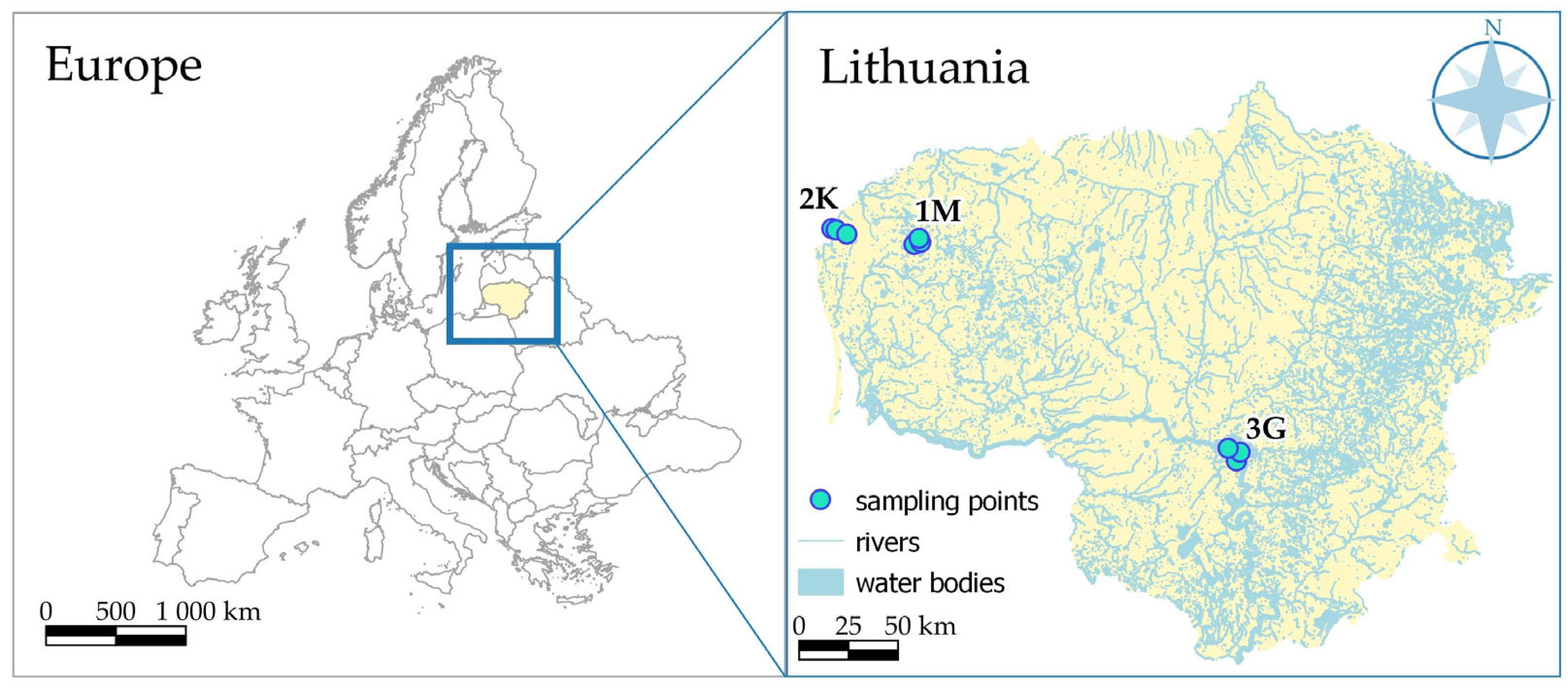
2.1. Study Area
2.2. Sampling Design
- Three littoral points (1–3 m from the shoreline),
- Two central points located within the flow or open-water zone.
2.3. Laboratory Analyses
2.4. Quality Assurance and Quality Control (QA/QC)
2.5. Statistical Analysis
3. Results
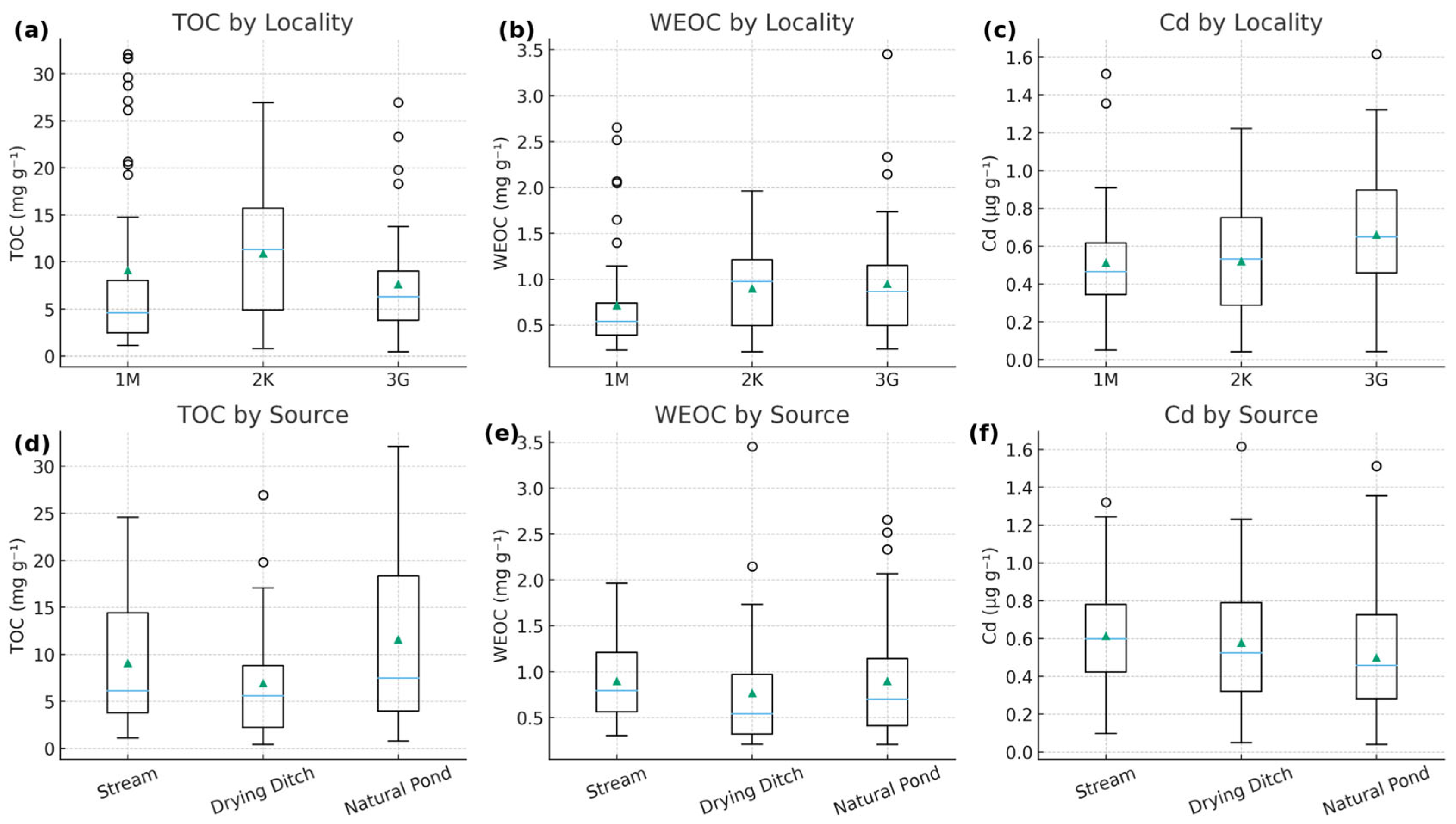
3.1. Spatial Patterns of TOC, WEOC and Cd
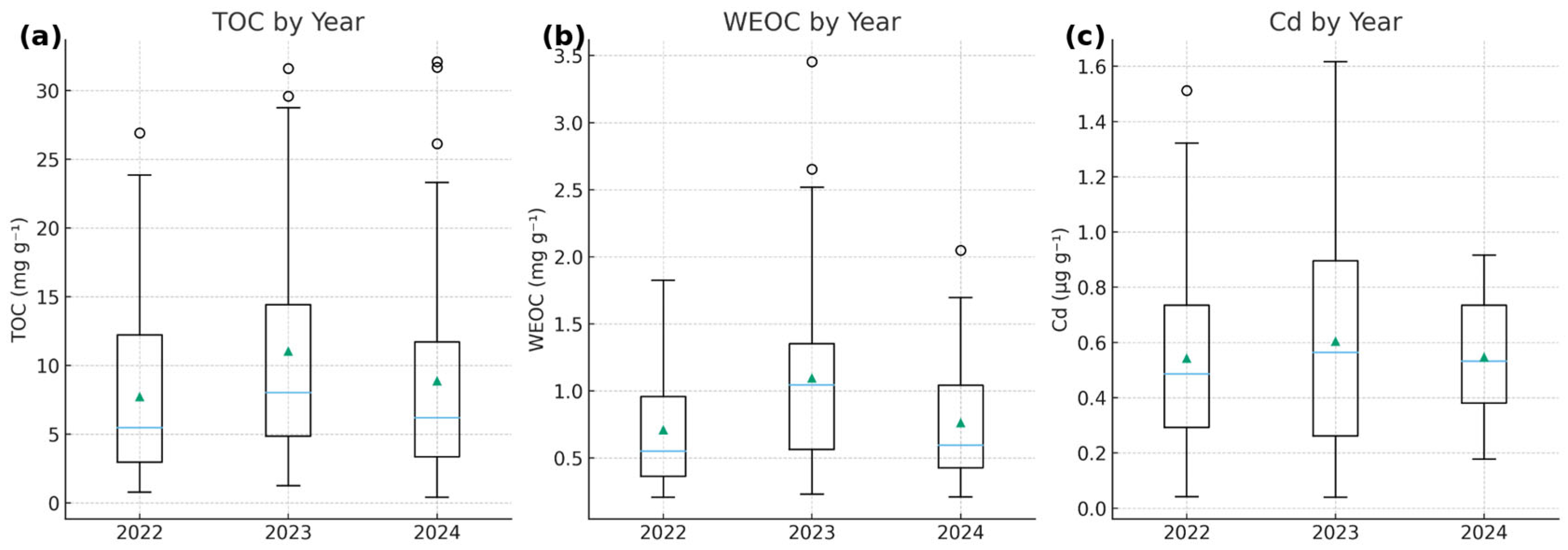
3.2. Temporal Variation (2022–2024)
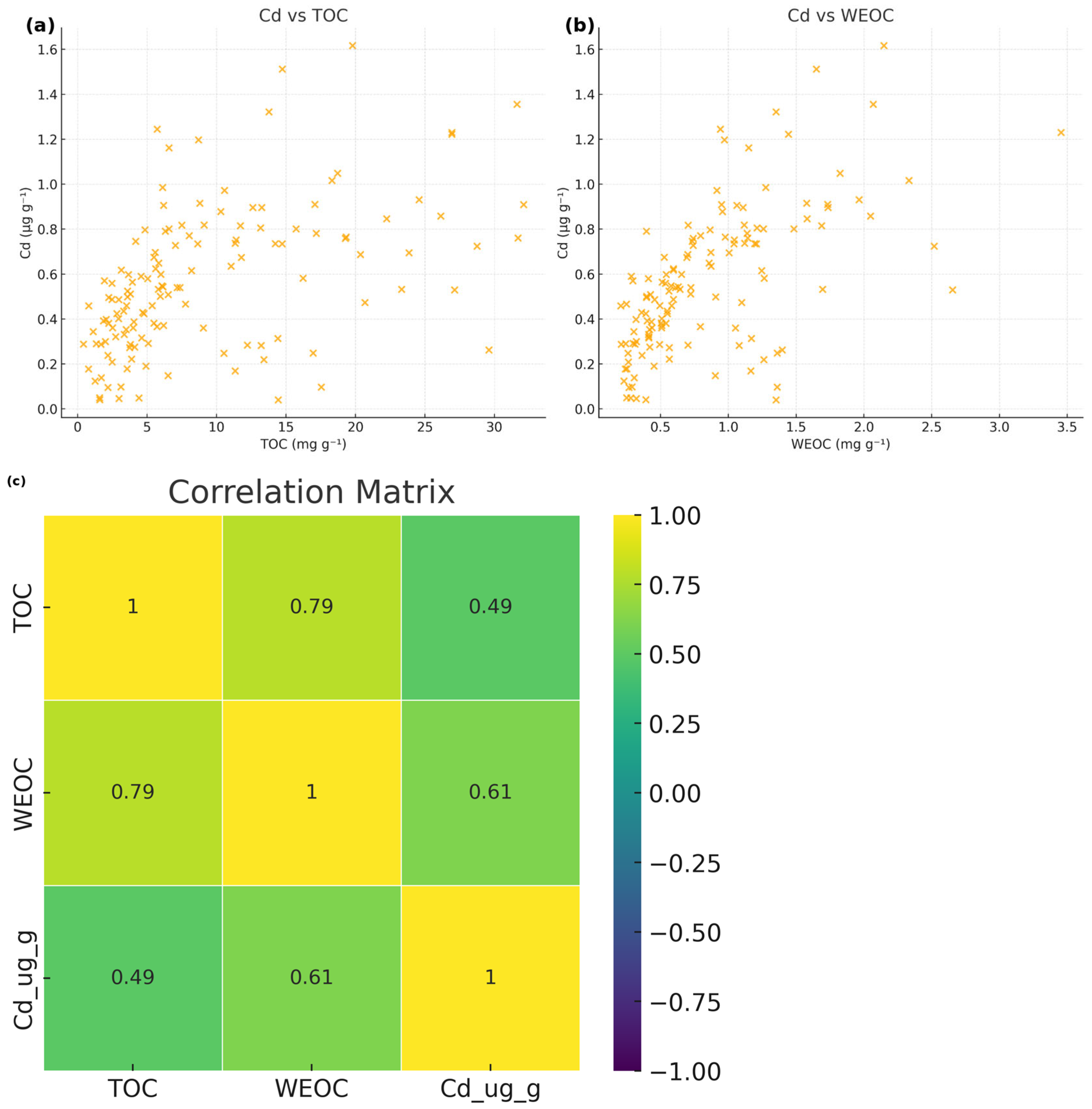
3.3. Bivariate Relationships Between Carbon Forms and Cd
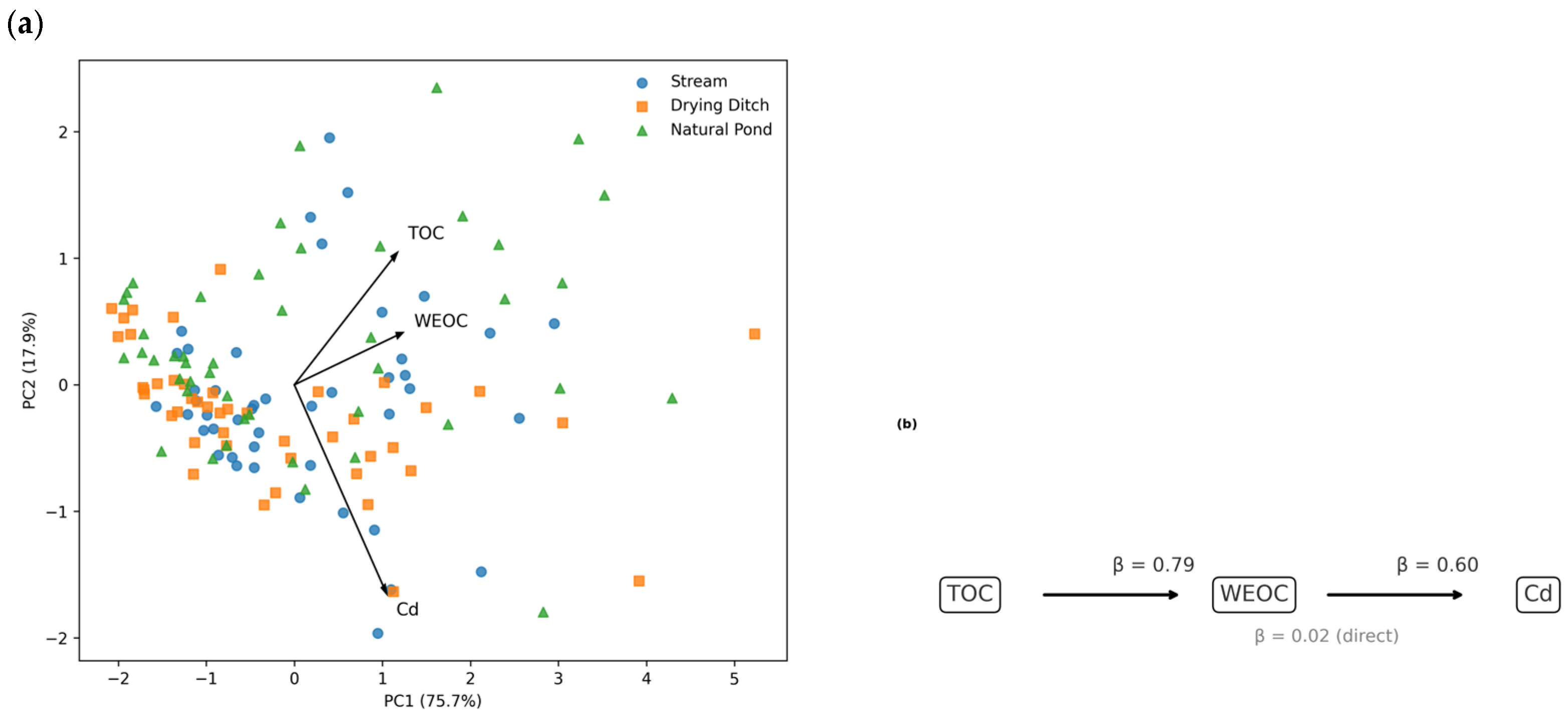
3.4. Principal Component Analysis (PCA) and Structural Equation Model (SEM)
3.5. Multiple Regression Modelling
4. Discussion
4.1. Spatial Controls and Landscape Drivers
4.2. Hydrological and Interannual Variability
4.3. Mechanistic Links Between WEOC and Cd Association
4.4. Multivariate Evidence and Conceptual Interpretation
4.5. Implications for Monitoring, Management, and Environmental Policy
4.6. Methodological Considerations and Study Limitations
5. Conclusions
6. Patents
Supplementary Materials
Author Contributions
Funding
Data Availability Statement
Acknowledgments
Conflicts of Interest
References
- Mendonça, R.; Müller, R.A.; Clow, D.; Verpoorter, C.; Raymond, P.; Tranvik, L.J.; Sobek, S. Organic carbon burial in global lakes and reservoirs. Nat. Commun. 2017, 8, 1694. [Google Scholar] [CrossRef]
- Dean, W.E.; Gorham, E. Magnitude and significance of carbon burial in lakes, reservoirs, and peatlands. Geology 1998, 26, 535–538. [Google Scholar] [CrossRef]
- Jiang, Q.; Xiaohua, M.; Zhichun, L.; Shuaidong, L.; Changchun, H.; Tao, H.; Bin, X.; Hao, Y. New perspectives on organic carbon storage in lake sediments based on classified mineralization. Catena 2024, 237, 107811. [Google Scholar] [CrossRef]
- Gudasz, C.; Bastviken, D.; Steger, K.; Premke, K.; Sobek, S.; Tranvik, L.J. Temperature-controlled organic carbon mineralization in lake sediments. Nature 2010, 466, 478–481. [Google Scholar] [CrossRef] [PubMed]
- Sobek, S.; Anderson, N.J.; Bernasconi, S.M.; Del Sontro, T. Low organic carbon burial efficiency in Arctic lake sediments. J. Geophys. Res. Biogeosci. 2014, 119, 1231–1243. [Google Scholar] [CrossRef]
- Zhou, S.; Long, H.; Chen, W.; Qiu, C.; Zhang, C.; Xing, H.; Zhang, J.; Cheng, L.; Zhao, C.; Cheng, J.; et al. Temperature seasonality regulates organic carbon burial in lakes. Nat. Commun. 2025, 16, 1049. [Google Scholar] [CrossRef]
- Kritzberg, E.S.; Maher Hasselquist, E.; Škerlep, M.; Löfgren, S.; Olsson, O.; Stadmark, J.; Valinia, S.; Hansson, L.-A.; Laudon, H. Browning of freshwaters: Consequences to ecosystem services, underlying drivers, and potential mitigation measures. Ambio 2020, 49, 375–390. [Google Scholar] [CrossRef]
- Anderson, N.J.; Bennion, H.; Lotter, A.F. Lake eutrophication and its implications for organic carbon sequestration in Europe. Glob. Change Biol. 2014, 20, 2741–2751. [Google Scholar] [CrossRef]
- Piwowarska, D.; Kiedrzyńska, E.; Jaszczyszyn, K. A global perspective on the nature and fate of heavy metals polluting water ecosystems, and their impact and remediation. Crit. Rev. Environ. Sci. Technol. 2024, 54, 1436–1458. [Google Scholar] [CrossRef]
- Kot, A.; Norton, U.; Kulczycki, G.; Guðmundsson, J.; Medyńska-Juraszek, A.; Mattilio, C.M.; Waroszewski, J. Stable and Mobile (Water-Extractable) Forms of Organic Matter in High-Latitude Volcanic Soils under Various Land Use Scenarios in Southeastern Iceland. Agriculture 2025, 15, 1255. [Google Scholar] [CrossRef]
- Séguin, V.; Gagnon, C.; Courchesne, F. Changes in water extractable metals, pH and organic carbon concentrations at the soil-root interface of forested soils. Plant Soil 2004, 260, 1–17. [Google Scholar] [CrossRef]
- Wei, L.; Wang, K.; Noguera, D.R.; Jiang, J.; Oyserman, B.; Zhao, N.; Zhao, Q.; Cui, F. Transformation and speciation of typical heavy metals in soil aquifer treatment system during long time recharging with secondary effluent: Depth distribution and combination. Chemosphere 2016, 165, 100–109. [Google Scholar] [CrossRef]
- Yang, B.; Ljung, K.; Ning, W.; Filipsson, H.L.; Nielsen, A.B. Relationships Between Land Use and Terrestrial Organic Matter Transfer to the Baltic Sea Over the Last 500 Years. J. Geophys. Res. Biogeosci. 2024, 129, e2023JG007477. [Google Scholar] [CrossRef]
- Wang, X.; Liu, J.; Kitch, J.; Tang, F.; Xue, B.; Yang, H. Evaluating the effectiveness of sediment retention by comparing the spatiotemporal burial of sediment carbon, nitrogen and phosphorus in a plateau lake and its affiliated reservoirs. CATENA 2023, 223, 106896. [Google Scholar] [CrossRef]
- Ignatavičius, G.; Satkūnas, J.; Grigienė, A.; Nedveckytė, I.; Hassan, H.R.; Valskys, V. Heavy Metals in Sapropel of Lakes in Suburban Territories of Vilnius (Lithuania): Reflections of Paleoenvironmental Conditions and Anthropogenic Influence. Minerals 2022, 12, 17. [Google Scholar] [CrossRef]
- Raulinaitis, M.; Ignatavičius, G.; Sinkevičius, S.; Oškinis, V. Assessment of heavy metal contamination in surface and subsurface layers of bottom sediments—Lake Babrukas (Lithuania). Ekologija 2012, 58, 33–43. [Google Scholar] [CrossRef]
- Senze, M.; Kowalska-Góralska, M.; Pokorny, P.; Dobicki, W.; Polechoński, R. Accumulation of Heavy Metals in Bottom Sediments of Baltic Sea Catchment Rivers Affected by Operations of Petroleum and Natural Gas Mines in Western Pomerania, Poland. Pol. J. Environ. Stud. 2015, 24, 2167–2175. [Google Scholar] [CrossRef]
- Struck, U. Changes in the C, N, P burial rates in some Baltic Sea sediments over the last 150 years—Relevance to P regeneration rates and the phosphorus cycle. Mar. Geol. 2000, 167, 43–59. [Google Scholar] [CrossRef]
- Remeikaitė-Nikienė, N.; Garnaga-Budrė, G.; Lujanienė, G.; Jokšas, K.; Stankevičius, A.; Malejevas, V.; Barisevičiūtė, R. Distribution of metals and extent of contamination in sediments from the south-eastern Baltic Sea (Lithuanian zone). Oceanologia 2018, 60, 193–206. [Google Scholar] [CrossRef]
- Paliulis, D. Assessment of lake bottom sediment pollution by lead and cadmium (Lithuania). Pol. J. Environ. Stud. 2014, 23, 1273–1279. [Google Scholar]
- Rzętała, M.A. Cadmium contamination of sediments in the water reservoirs in Silesian Upland (southern Poland). Soils Sediments 2016, 16, 2458–2470. [Google Scholar] [CrossRef]
- Fastovetska, K.; Belova, O.; Šlepetienė, A. Lead Fixation in Sediments of Protected Wetlands in Lithuania. Land 2025, 14, 737. [Google Scholar] [CrossRef]
- Belova, O.; Fastovetska, K.; Vigricas, E.; Urbaitis, G.; Šlepetienė, A. Beaver Wetland Buffers as Ecosystem-Based Tools for Sustainable Water Management and Lead (Pb) Risk Control. Sustainability 2025, 17, 9892. [Google Scholar] [CrossRef]
- HELCOM. Hazardous Substances in the Baltic Sea—Fact Sheets and Data on Sediment Concentrations (As, Cd, Cr, Co, Cu, Ni, Zn) 2003–2008; Baltic Sea Environment Proceedings 120B; HELCOM: Helsinki, Finland, 2009. [Google Scholar]
- State Scientific Research Institute Nature Research Centre (NRC). Lake sediment composition and human impact in small lakes of Latvia & Lithuania—Multi-proxy investigation. Baltica 2015, 28, 99–114. Available online: https://gamtostyrimai.lt/en/leidiniai/baltica-vol-28-2-2015/ (accessed on 17 December 2025).
- Zerbe, J.; Sobczyński, T.; Elbanowska, H.; Siepak, J. Speciation of Heavy Metals in Bottom Sediments of Lakes. Pol. J. Environ. Stud. 1999, 8, 331–339. [Google Scholar]
- Mao, K.; Wang, X.; Yu, K.; Li, M.; Wang, Y.; Gao, G.; Geng, S.; Song, H.; Ning, W.; An, H.; et al. Source apportionment and ecological risk assessment of heavy metals in sediments of Dongping lake based on PCA-PMF model. Sci. Rep. 2025, 15, 32026. [Google Scholar] [CrossRef]
- Kuriata-Potasznik, A.; Szymczyk, S.; Skwierawski, A.; Glińska-Lewczuk, K.; Cymes, I. Heavy Metal Contamination in the Surface Layer of Bottom Sediments in a Flow-Through Lake: A Case Study of Lake Symsar in Northern Poland. Water 2016, 8, 358. [Google Scholar] [CrossRef]
- Manzetti, S. Heavy metal pollution in the Baltic Sea, from the North European coast to the Baltic States, Finland and the Swedish coastline to Norway. Tech. Rep. 2020, 6, 9. [Google Scholar]
- Chałabis-Mazurek, A.; Rechulicz, J.; Pyz-Łukasik, R. A Food-Safety Risk Assessment of Mercury, Lead and Cadmium in Fish Recreationally Caught from Three Lakes in Poland. Animals 2021, 11, 3507. [Google Scholar] [CrossRef]
- Li, G.; Chen, R.; Li, Z.; Wu, X.; Xiang, K.; Wang, C.; Peng, Y. Ecological Risk and Human Health Assessment of Heavy Metals in Sediments of Datong Lake. Toxics 2025, 13, 560. [Google Scholar] [CrossRef]
- Eklöf, K.; von Brömssen, C.; Huser, B.; Åkerblom, S.; Augustaitis, A.; Veiteberg Braaten, H.F.; de Wit, H.A.; Dirnböck, T.; Elustondo, D.; Grandin, U.; et al. Trends in mercury, lead and cadmium concentrations in 27 European streams and rivers: 2000–2020. Environ Pollut. 2024, 360, 124761. [Google Scholar] [CrossRef]
- Gubri, B.; Hansen, J.P.; Wikström, S.A.; Snickars, M.; Dahl, M.; Gullström, M.; Rydin, E.; Masqué, P.; Garbaras, A.; Björk, M.; et al. Shallow Coastal Bays as Sediment Carbon and Nutrient Reservoirs in the Baltic Sea. Estuaries Coasts 2025, 48, 136. [Google Scholar] [CrossRef]
- Downing, J.A.; Cole, J.J.; Middelburg, J.J.; Striegl, R.G.; Duarte, C.M.; Kortelainen, P.; Prairie, Y.T.; Laube, K.A. Sediment organic carbon burial in agriculturally eutrophic impoundments over the last century. Global Biogeochem. Cyc. 2008, 22, GB1018. [Google Scholar] [CrossRef]
- Downing, J.A. Emerging global role of small lakes and ponds: Little things mean a lot. Limnetica 2010, 29, 9–24. [Google Scholar] [CrossRef]
- Gilbert, P.J.; Taylor, S.; Cooke, D.A.; Deary, M.E.; Jeffries, M.J. Quantifying organic carbon storage in temperate pond sediments. J. Environ. Manag. 2021, 280, 111698. [Google Scholar] [CrossRef] [PubMed]
- Harjung, A.; Sabater, F.; Butturini, A. Hydrological Connectivity Drives Dissolved Organic Matter Processing in an Intermittent Stream. Limnologica 2017, 68, 71–81. [Google Scholar] [CrossRef]
- Reverey, F.; Großkopf, T.; Mohr, J.F.; Herrmann, M.; Lischeid, G.; Premke, K. Dry–Wet Cycles of Kettle Hole Sediments Leave a Microbial and Biogeochemical Legacy. Sci. Total Environ. 2018, 627, 985–996. [Google Scholar] [CrossRef]
- Chen, M.; Ding, S.; Li, C.; Tang, Y.; Fan, X.; Xu, H.; Tsang, D.C.W.; Zhang, C. High cadmium pollution from sediments in a eutrophic lake caused by dissolved organic matter complexation and reduction of manganese oxide. Water Res. 2021, 190, 116711. [Google Scholar] [CrossRef]
- Khalifa, A.M.; ElBaghdady, K.Z.; Abdel-Karim, S.; El Kafrawy, S.B.; Nafea, E.M.; El-Zeiny, A.M. Geospatial assessment of heavy metal contamination and metal-resistant bacteria in Qarun Lake, Egypt. Environ. Sci. Eur. 2025, 37, 106. [Google Scholar] [CrossRef]
- FAO. Standard Operating Procedure for Soil Organic Carbon: Tyurin Spectrophotometric Method; Food and Agriculture Organization of the United Nations: Rome, Italy, 2021; Available online: http://www.wipo.int/amc/en/mediation/rules (accessed on 21 October 2025).
- Nikitin, B.A. A method for soil humus determination. Agric. Chem. 1999, 3, 156–158. [Google Scholar]
- Šlepetienė, A.; Liaudanskienė, I. Dirvožemio organinės medžiagos modernių tyrimo metodų taikymas ir vystymas šalies dirvožemių tvarumui įvertinti agrarinėje žemėnaudoje. In Mokslinės Metodikos Inovatyviems Žemės ir Miškų Mokslų Tyrimams; Lietuvos Agrarinių ir Miškų Mokslų Centras; Lututė: Kaunas, Lithuania, 2013; pp. 406–415. ISBN 978-9955-37-149-6. [Google Scholar]
- Gershey, R.M.; Mackinnon, M.D.; Williams PJle, B.; Moore, R.M. Comparison of three oxidation methods used for the analysis of the dissolved organic carbon in seawater. Mar. Chem. 1979, 7, 289–306. [Google Scholar] [CrossRef]
- Volungevičius, J.; Amalevičiūtė, K.; Liaudanskienė, I.; Šlepetienė, A.; Šlepetys, J. Chemical properties of Pachiterric Histosol as influenced by different land use. Zemdirb. Agric. 2015, 102, 123–131. [Google Scholar] [CrossRef]
- ISO 11047:1998; Soil Quality—Determination of Cadmium, Chromium, Cobalt, Copper, Lead, Manganese, Nickel and Zinc—Flame and Electrothermal Atomic Absorption Spectrometric Methods. International Organization for Standardization: Geneva, Switzerland, 1998.
- Turek, A.; Wieczorek, K.; Wolf, W.M. Digestion Procedure and Determination of Heavy Metals in Sewage Sludge—An Analytical Problem. Sustainability 2019, 11, 1753. [Google Scholar] [CrossRef]
- NIST. Standard Reference Material 2709a: San Joaquin Soil; National Institute of Standards and Technology: Gaithersburg, MD, USA, 2019. Available online: https://www.nist.gov/srm (accessed on 21 October 2025).
- Tranvik, L.J.; Downing, J.A.; Cotner, J.B.; Loiselle, S.A.; Striegl, R.G.; Ballatore, T.J.; Dillon, P.; Finlay, K.; Fortino, K.; Knoll, L.B.; et al. Lakes and reservoirs as regulators of carbon cycling and climate. Limnol. Oceanogr. 2009, 54, 2298–2314. [Google Scholar] [CrossRef]
- Raymond, P.A.; Saiers, J.E.; Sobczak, W.V. Hydrological and biogeochemical controls on watershed dissolved organic matter transport: Pulse–shunt concept. Ecology 2016, 97, 5–16. [Google Scholar] [CrossRef]
- Tao, M.; Ke, X.; Ma, J.; Liu, L.; Qiu, Y.; Hu, Z.; Liu, F. Dissolved Organic Matter (DOM)–Driven Variations of Cadmium Association and Bioavailability in Waterlogged Paddy Soil. J. Hazard. Mater. 2025, 492, 138065. [Google Scholar] [CrossRef]
- Kothawala, D.N.; Stedmon, C.A.; Müller, R.A.; Weyhenmeyer, G.A.; Köhler, S.J.; Tranvik, L.J. Controls of dissolved organic matter quality: Evidence from a large-scale boreal lake survey. Glob. Change Biol. 2014, 20, 1101–1114. [Google Scholar] [CrossRef]
- Monteith, D.T.; Stoddard, J.L.; Evans, C.D.; de Wit, H.A.; Forsius, M.; Høgåsen, T.; Wilander, A.; Skjelkvåle, B.L.; Jeffries, D.S.; Vuorenmaa, J.; et al. Dissolved organic carbon trends resulting from changes in atmospheric deposition chemistry. Nature 2007, 450, 537–540. [Google Scholar] [CrossRef]
- Prijac, A.; Gandois, L.; Taillardat, P.; Bourgault, M.-A.; Riahi, K.; Ponçot, A.; Tremblay, A.; Garneau, M. Hydrological connectivity controls dissolved organic carbon exports in a peatland-dominated boreal catchment stream. Hydrol. Earth Syst. Sci. 2023, 27, 3935–3953. [Google Scholar] [CrossRef]
- Evans, C.D.; Chapman, P.J.; Clark, J.M.; Monteith, D.T.; Cresser, M.S. Alternative explanations for rising dissolved organic carbon export from organic soils. Glob. Change Biol. 2006, 12, 2044–2053. [Google Scholar] [CrossRef]
- Creed, I.F.; Bergström, A.-K.; Trick, C.G.; Grimm, N.B.; Hessen, D.O.; Karlsson, J.; Kidd, K.A.; Kritzberg, E.S.; Paterson, M.J.; Rusak, J.A.; et al. Global change–driven effects on dissolved organic matter composition: Implications for for food webs of northern lakes. Glob. Change Biol. 2018, 24, 3692–3713. [Google Scholar] [CrossRef]
- Perminova, I.V.; Frimmel, F.H.; Kudryavtsev, A.V.; Kulikova, N.A.; Abbt-Braun, G.; Hesse, S.; Petrosyant, V.S. Molecular weight characteristics of humic substances from different environments as determined by size exclusion chromatography and their statistical evaluation. Environ. Sci. Technol. 2003, 37, 2477–2485. [Google Scholar] [CrossRef] [PubMed]
- Tipping, E.; Lofts, S.; Sonke, J.E. Humic Ion-Binding Model VII: A Revised Parameterisation of Cation-Binding by Humic Substances. Environ. Chem. 2011, 8, 225–235. [Google Scholar] [CrossRef]
- Aiken, G.R.; McKnight, D.M.; Wershaw, R.L.; MacCarthy, P. Influence of Dissolved Organic Matter on the Environmental Fate of Metals, Nanoparticles, and Colloids. Environ. Sci. Technol. 2011, 45, 3196–3201. [Google Scholar] [CrossRef]
- European Commission. Directive 2000/60/EC Establishing a Framework for Community Action in the Field of Water Policy. Off. J. Eur. Communities 2000, L327, 1–73. [Google Scholar]
- European Parliament and Council. Regulation (EU) 2024/1991 of the European Parliament and of the Council of 24 June 2024 on Nature Restoration and Amending Regulation (EU) 2022/869. Off. J. Eur. Union 2024, 1–55. Available online: https://eur-lex.europa.eu/eli/reg/2024/1991/oj/eng (accessed on 21 October 2025).


Disclaimer/Publisher’s Note: The statements, opinions and data contained in all publications are solely those of the individual author(s) and contributor(s) and not of MDPI and/or the editor(s). MDPI and/or the editor(s) disclaim responsibility for any injury to people or property resulting from any ideas, methods, instructions or products referred to in the content. |
© 2026 by the authors. Licensee MDPI, Basel, Switzerland. This article is an open access article distributed under the terms and conditions of the Creative Commons Attribution (CC BY) license.
Share and Cite
Fastovetska, K.; Belova, O.; Gmitrowicz-Iwan, J.; Futa, B.; Skersiene, A.; Slepetiene, A.; Vigricas, E. Organic Carbon Pools and Their Association with Cadmium in Sediments of Small Freshwater Ecosystems. Water 2026, 18, 332. https://doi.org/10.3390/w18030332
Fastovetska K, Belova O, Gmitrowicz-Iwan J, Futa B, Skersiene A, Slepetiene A, Vigricas E. Organic Carbon Pools and Their Association with Cadmium in Sediments of Small Freshwater Ecosystems. Water. 2026; 18(3):332. https://doi.org/10.3390/w18030332
Chicago/Turabian StyleFastovetska, Kateryna, Olgirda Belova, Joanna Gmitrowicz-Iwan, Barbara Futa, Aida Skersiene, Alvyra Slepetiene, and Egidijus Vigricas. 2026. "Organic Carbon Pools and Their Association with Cadmium in Sediments of Small Freshwater Ecosystems" Water 18, no. 3: 332. https://doi.org/10.3390/w18030332
APA StyleFastovetska, K., Belova, O., Gmitrowicz-Iwan, J., Futa, B., Skersiene, A., Slepetiene, A., & Vigricas, E. (2026). Organic Carbon Pools and Their Association with Cadmium in Sediments of Small Freshwater Ecosystems. Water, 18(3), 332. https://doi.org/10.3390/w18030332