Article

Synergistic Coupling of In Situ Oxygenation and Advanced Oxidation Processes Using a Novel Lime-Based Composite for Water Quality Management in Litopenaeus vannamei Ponds

by
Muhammad Irfan Afif
1,2,
Hanifah Widi Astuti
1,
Niken Tunjung Murti Pratiwi
1,*,
Bambang Widigdo
1,
Mohammad Khotib
2,3,
Nia Rosiana
4 and
Muhammad Faisal
5
1
Department of Aquatic Resources Management, Faculty of Fisheries and Marine Sciences, IPB University, Bogor 16680, Indonesia
2
Integrated Laboratory and Advanced Research, IPB University, Bogor 16680, Indonesia
3
Department of Chemistry, Faculty of Mathematics and Natural Sciences, IPB University, Bogor 16680, Indonesia
4
Department of Agribusiness, Faculty of Economics and Management, IPB University, Bogor 16680, Indonesia
5
Department of Physics, Faculty of Mathematics and Natural Sciences, Brawijaya University, Malang 65145, Indonesia
*
Author to whom correspondence should be addressed.
Water 2026, 18(3), 296; https://doi.org/10.3390/w18030296
Submission received: 13 December 2025 / Revised: 20 January 2026 / Accepted: 21 January 2026 / Published: 23 January 2026

Abstract

Effective management of water quality is critical for Litopenaeus vannamei aquaculture, yet it remains a significant technological hurdle for traditional farmers facing benthic anaerobiosis and toxic metabolite accumulation. This study introduces a novel approach by synergistically integrating calcium peroxide (CaO2), titanium dioxide (TiO2), and peracetic acid (PAA) encapsulated within Fe–alginate granules. Unlike conventional methods that treat oxygen depletion and toxicity separately, this composite is designed to simultaneously facilitate in situ oxygenation and advanced oxidation processes (AOPs) directly at the sediment–water interface. The physicochemical properties and radical generation mechanisms of the synthesized composites were characterized using FTIR, XRD, SEM, and ESR. In laboratory simulations of pond conditions, the synergistic efficacy of these composites was evaluated against critical parameters, including dissolved oxygen (DO), ammonia, and sulfide. Experimental results revealed that the application of 5 mg/L CP-T-PAA product to the sediment with an AOP system exhibited superior performance, generating the highest intensity of hydroxyl (•OH) and superoxide (•O2) radicals. This optimized treatment effectively maintained DO levels above ~2 mg/L at the sediment–water interface for 21 days (3 weeks) and achieved removal efficiencies of 94% for ammonia, 89% for sulfide, and 93% for turbidity. Multi-criteria decision analysis (TOPSIS) validated this formulation as the ideal solution. Consequently, this novel composite presents a sustainable, user-friendly strategy for enhancing environmental stability in traditional shrimp farming.

1. Introduction

Water quality management in aquaculture, particularly in Pacific white shrimp (Litopenaeus vannamei) ponds, is a fundamental and evolving challenge addressed through various treatments. Water quality in these ponds can fluctuate rapidly due to factors such as overfeeding, meteorological conditions, unregulated influent water from rivers, and organismal respiration. Critical water quality parameters include dissolved oxygen (DO) and ammonia, which necessitate rigorous monitoring [1]. The deterioration of water quality, driven by fluctuations in these parameters, is a significant determinant of cultured shrimp health [2]. Indeed, recent cases of diminished aquacultural productivity have been attributed to the difficulty of controlling pond water quality to maintain shrimp health [3].
Although numerous disease control strategies centered on water quality management have been explored, such as biofloc technology [4] and recirculating aquaculture system [5], significant limitations persist in technological adoption among farmers. Several studies highlight gaps in current practices, such as inconsistent monitoring, difficulty understanding advanced methods, and various socioeconomic barriers [6]. The consequences of these gaps are particularly evident for traditional shrimp farmers, such as those in Indonesia, who still account for a substantial proportion—approximately 90%—of national shrimp production [7]. Consequently, there is a significant and unmet demand for user-friendly technologies that farmers can readily implement in their shrimp ponds.
Self-supplying oxygen-releasing materials are recognized for their ability to release oxygen over a sustained period. Calcium peroxide (CaO2), for instance, have been explored due to their controlled oxygen release kinetics [8], which have potential to maintain DO levels in shrimp ponds, ensuring that both aquatic organisms and aerobic bacteria have sufficient oxygen for respiration and the decomposition of toxic contaminants [9]. The efficiency of these oxygen-releasing materials can be enhanced by coupling them for synergistic effect with reactive oxygen generators involved in advanced oxidation processes (AOPs) [10]. AOPs are water treatment technologies that utilize physicochemical procedures to generate highly reactive species, most notably hydroxyl radicals (OH•), which can degrade pollutants and disinfect pathogenic bacteria [11]. This reaction can be initiated with strong oxidants and ultraviolet photocatalysis. Pathogen disinfection is achieved through a cascade of free radical formation initiated by the AOP, which involves the production of reactive oxygen species (ROS) to cycle oxygen utilization from the self-supplying material through to the generation of the superoxide radical anion, O2•. Superoxide is then rapidly converted to hydrogen peroxide (H2O2) by superoxide dismutase. These free radicals can destroy microorganisms or other foreign bodies within the biota through the activation of NADPH oxidase (NOX) in the cells [12,13]. Furthermore, O2• and H2O2 react to produce OH•, which can simultaneously and directly cleave the bonds of organic matter in the water via primary, propagation, and termination reactions [14]. The reduction in toxicants from anaerobic organic matter decomposition through AOP treatment can occur as an abstraction reaction in which the hydroxyl radical attacks a covalent bond, resulting in the formation of water [15].
This study investigated the synergistic effects of a self-supplying oxygen-releasing material combined with an advanced oxidation process generator on seawater samples designed to simulate shrimp aquaculture conditions. The specific objectives were to elucidate the physicochemical properties and radical generation mechanisms (•OH and O2) of the composite using characterization techniques, assess its synergistic efficacy in sustaining dissolved oxygen levels and degrading critical pollutants (ammonia and sulfide) under simulated aquaculture conditions via coupled in situ oxygenation and an advanced oxidation process (AOP), and determine the optimal formulation for practical application to address technological gaps in traditional Litopenaeus vannamei shrimp farming.

2. Methodology

2.1. Experiments

This research was completed over a period of 6 months from May to November 2024 at the Advanced Research and Integrated Laboratory of IPB University. While these laboratory-scale simulations utilize static aquariums—which differ from the dynamic hydraulic and biological complexity of commercial shrimp ponds—the experimental setup was designed to rigorously evaluate the physicochemical efficacy of the composite. The use of authentic alluvial soil from traditional ponds and standardized artificial seawater ensures that the sediment–water interface conditions closely mimic the chemical environment faced by benthic organisms in actual farming scenarios. This study was conducted experimentally and comprised three stages: product preparation, characterization, and laboratory-scale testing.
The product preparation stage involved the preparation of various products for subsequent study. A self-supplying oxygen material was synthesized using pro-analytical grade Ca(OH)2 (ACS reagent, ≥95.0%, Sigma-Aldrich, St. Louis, MO, USA), H2O2 (30% w/w, MilliporeSigma, Darmstadt, Germany), TiO2 nanopowder (21 nm primary particle size (TEM), ≥99.5%, Merck KGaA, Darmstadt, Germany), and CH3CO3H (38–40 wt.% in acetic acid, Merck KGaA, Darmstadt, Germany). The manufacture of CaO2 followed the method of Dong et al. [16]. There were three additional target products. First, CaO2 (hereafter referred to as CP) was composited with CH3CO3H (hereafter referred to as PAA) at a 3:1 ratio to create CP-PAA. CP was then composited with TiO2 (hereafter referred to as T) at a 3:3 ratio to form CP-T. Finally, CP was composited with T and PAA at a 3:3:1 ratio to form CP-T-PAA. A total of 1 kg of each product was prepared. Subsequently, a portion of each product underwent dry granulation, as detailed by Zhang et al. [17], and was formulated with Fe–alginate 5% in the proportion process to form 2 mm tablets. The synthesized products proceeded to the characterization stage.
The characterization stage aimed to examine the crystal structure, chemical composition, and physical properties of the products, which were subsequently monitored for quality and evaluated for performance. At this stage, characterization included a surface morphology study using a Thermo Scientific Prisma E Scanning Electron Microscope (SEM, Eindhoven, The Netherlands), crystal phase analysis using a Malvern Panalytical Aeris X-ray Diffractometer (XRD, Malvern Panalytical B.V., Almelo, The Netherlands), functional group analysis using a Shimadzu IRPrestige-21 Fourier Transform Infrared (FTIR) Spectroscope (Kyoto, Japan), and an estimation of radical production using a Tektronix TDS1001B (Tektronix, Inc., Shanghai, China) for electron spin resonance (ESR) analysis. The reference methods for the surface morphology study, FTIR analysis, and XRD analysis were adapted from Piyarat et al. [18], while the electron spin resonance analysis followed the procedure described by Faisal et al. [19], with calculations to estimate the free radicals based on Equations (1) and (2). The characterized target product was subsequently tested artificially on a laboratory scale.
g = h f μ B B
where
  • g = g-factor;
  • μ B = Bohr magneton ( μ B = 9.274078 × 10 24 Am2);
  • h = Planck’s constant ( h = 6.625 × 10 34 W s2);
  • f = Resonant frequency (Hz);
  • B = External magnetic field (T).
B = μ 0 4 5 3 / 2 n r I
where
  • B = External magnetic field (T);
  • μ 0 = 1.2566 × 10 6   V s/A m;
  • n = Number of Helmholtz ( n = 320 );
  • r = Helmholtz coil radius ( r = 6.8 cm);
  • I = Current in Helmholtz coil (A).
The purpose of the laboratory-scale testing stage was to test various target products as precursors to validate their ability to produce dissolved oxygen and minimize the toxicants produced by anaerobic organic matter decomposition. The experiments were organized into four sets as follows:
  • Set 1 involved a control treatment (no product applied) and evaluations of CP, CP-PAA, CP-T, and CP-T-PAA powders without the application of an advanced oxidation process (non-AOP).
  • Set 2 included the same control and powdered materials as Set 1, but all were subjected to an advanced oxidation process (AOP).
  • Set 3 consisted of a control treatment and evaluations of the materials in granular form—CP, CP-PAA, CP-T, and CP-T-PAA granules—without an advanced oxidation process (non-AOP).
  • Set 4 set included the same control and granulated materials as Set 3, but all were subjected to an advanced oxidation process (AOP).
The experimental setup consisted of glass aquariums (45 cm × 30 cm × 15 cm). To strictly control the sediment–water ratio, the bottom of each aquarium was lined with 3 cm of alluvial soil, and the system was filled with exactly 5 L of artificial seawater. The artificial seawater was made following Alkhadra et al.’s method [20]. The treatment dosage was set at 5 mg/L (w/v) relative to the total water volume (i.e., 25 mg of product per 5 L aquarium). This dosage was selected based on safety thresholds for aquaculture, which suggest maintaining CaO2 concentrations below 0.1% [21]. The products pre-mixed with alluvial soil before seawater filling. A Philips UV-C Hg low pressure 4 W lamp (Signify, Pila, Poland) was used during the test and installed inside the cover as an AOP treatment (Figure 1). Several measurements were performed by carefully sampling and measuring the water at the surface of the substrate weekly (for 3 weeks in total), as shown in Table 1.
Physicochemical parameters, including dissolved oxygen (DO), pH, oxidation reduction potential (ORP), and turbidity, were measured in situ using calibrated portable water, quality meters. All measurements were conducted in triplicate to minimize experimental error. Ammonia analysis was performed using the phenate method on 25 mL samples. In this method, ammonia reacts with hypochlorite and phenol in the presence of a sodium nitroprusside catalyst to form an intense indophenol blue compound. The absorbance of the resulting complex was measured spectrophotometrically using a Hach DR 1900 (Hach Company, CO, USA) at a wavelength of 640 nm. Sulfide concentrations were determined using the methylene blue method. A sample of 7.5 mL was used for sulfide analysis. This analysis relies on the reaction of sulfide with N,N-dimethyl-p-phenylenediamine in the presence of ferric chloride to produce methylene blue dye. The intensity of the blue color, which is proportional to the sulfide concentration, was quantified using a Hach DR 1900 spectrophotometer at a wavelength of 665 nm.

2.2. Data Analysis

Statistical analysis for each treatment was conducted separately using ANOVA to determine the correlation between sampling results. The fingerprinting method was employed to determine whether the experimental factors within the given treatments induced any changes. If the fingerprinting results led to the rejection of the null hypothesis, further analysis was performed. This subsequent analysis was necessary to identify the specific factors that significantly contributed to the research treatment. Tukey’s Test was used post hoc. Statistical data processing was carried out using IBM SPSS 6.
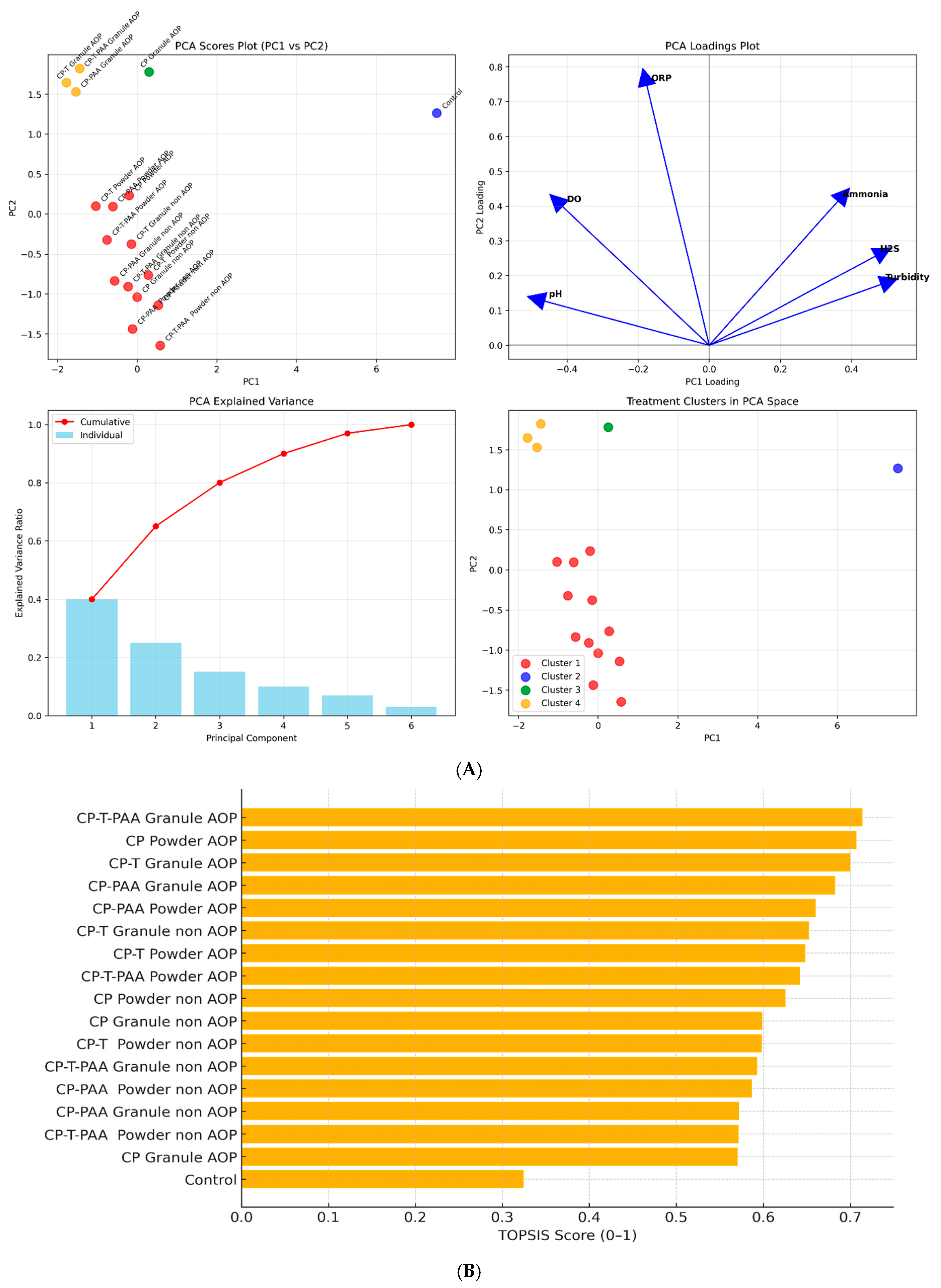
To elucidate the underlying structure and relationships within the multivariate water quality dataset, Principal Component Analysis (PCA) was performed using R software 4.5.0. This analysis was performed to reduce the dimensionality of the data, which included all measured parameters (pH, DO, ORP, turbidity, ammonia, and sulfide). The primary objective was to transform the correlated variables into a set of uncorrelated principal components (PCs) that captured the maximum variance [23]. The results were visualized using score plots to identify clustering patterns among the different treatments and loading plots to determine the influence and contribution of each original water quality parameter to the observed separation along the principal components. This allowed for a comprehensive assessment of how the treatments grouped based on their overall impact on water quality.
Multi-criteria decision analysis (MCDA) was performed using the Technique for Order Preference by Similarity to Ideal Solution (TOPSIS), following Uzun et al.’s modified approach [24] to integrate all measured water quality parameters into a single performance index for each treatment. The parameters included dissolved oxygen (DO), oxidation reduction potential (ORP), pH, ammonia (NH3), hydrogen sulfide (H2S), and turbidity. Prior to analysis, the mean values of each parameter per treatment were computed from the experimental replicates. The results were visualized as a horizontal bar chart, where each bar represented the TOPSIS score (Cᵢ) for a given treatment. This graphical representation facilitated a clear comparison of the overall effectiveness of each treatment in improving wastewater quality. Treatments with consistently high TOPSIS scores were interpreted as exhibiting superior multi-parameter performance and considered optimal candidates for practical wastewater management applications.

3. Results and Discussion

3.1. Product Characterization

The experimental phase successfully yielded powder and granulated versions of four distinct products: CP, CP-PAA, CP-T, and CP-T-PAA. These materials were subsequently advanced to the characterization stage. The products were characterized using Fourier Transform Infrared (FTIR) Spectroscopy, Scanning Electron Microscopy (SEM), X-ray Diffraction (XRD), and reactive oxygen species analysis via electron spin resonance (ESR). The FTIR spectroscopic analysis was conducted on eight distinct CaO2-based composite materials, which included pure CaO2 powder (CP), binary composites with TiO2 (CP-T) and peracetic acid (CP-PAA), ternary composites (CP-T-PAA), and a granulated form with Fe–alginate. The spectral data revealed the characteristic functional groups and molecular interactions within the composite matrices.
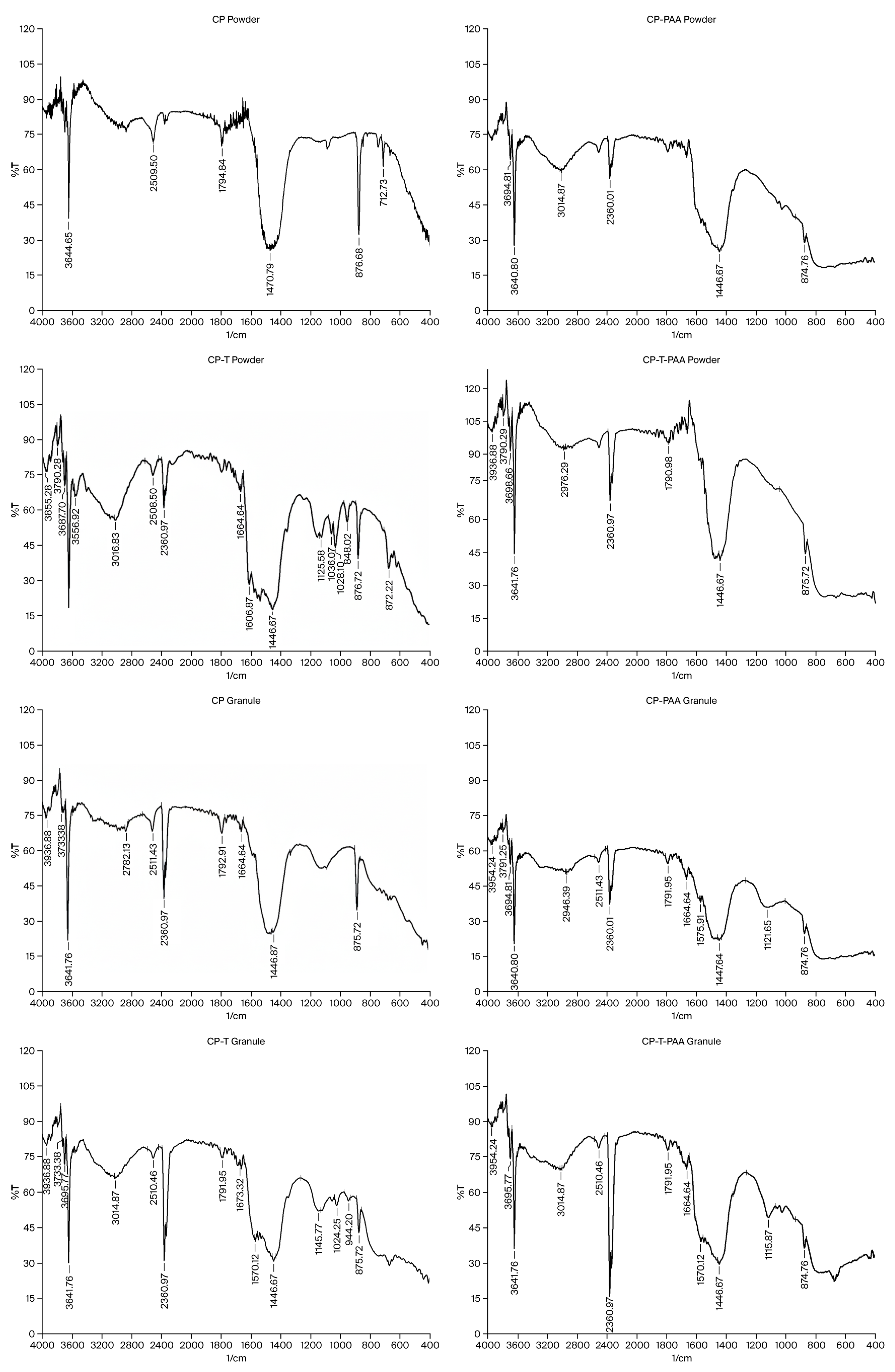
The FTIR spectra of all products are shown in Figure 2. The pure CaO2 powder exhibited several characteristic absorption bands, indicating the presence of surface hydroxyl groups, peroxide functionalities, and a degree of carbonation, which is typical for CaO2 materials exposed to atmospheric conditions. The addition of TiO2 to CaO2 introduced new spectral features. In accordance with Subbotina and Barsukov [25], TiO2 (anatase) displayed characteristic peroxo absorptions at approximately 852 and 912 cm−1, along with a broad surface OH band in the 3400–3650 cm−1 region. The bands observed at 3694.81 and 3640.80 cm−1 were consistent with this assignment, confirming the incorporation of TiO2 and its surface hydroxylation.
The incorporation of peracetic acid also significantly altered the spectral profile. The spectrum clearly demonstrated the successful integration of peracetic acid, evidenced by its characteristic carbonyl (C=O) stretching vibration around 1660–1670 cm−1 and C-O stretching modes in the 1000–1150 cm−1 region. Furthermore, the inclusion of Fe–alginate introduced biopolymer characteristics to the spectrum. As reported by Mollah et al. [26], Huamani-Palomino et al. [27], and Yu et al. [28], alginate exhibits distinctive carboxylate absorptions in the 1080–1400 cm−1 range, pyranose ring vibrations at 1200–1000 cm−1, and fingerprint features at 820–860 cm−1. The granulated system with Fe–alginate demonstrated the successful incorporation of all components while retaining the identity of the individual functional groups. This indicated successful encapsulation of the active components to provide controlled release properties, as evidenced by the characteristic carboxylate (1400–1600 cm−1) and glycosidic (1000–1200 cm−1) bands, consistent with the findings of Elhoudi et al. [29].
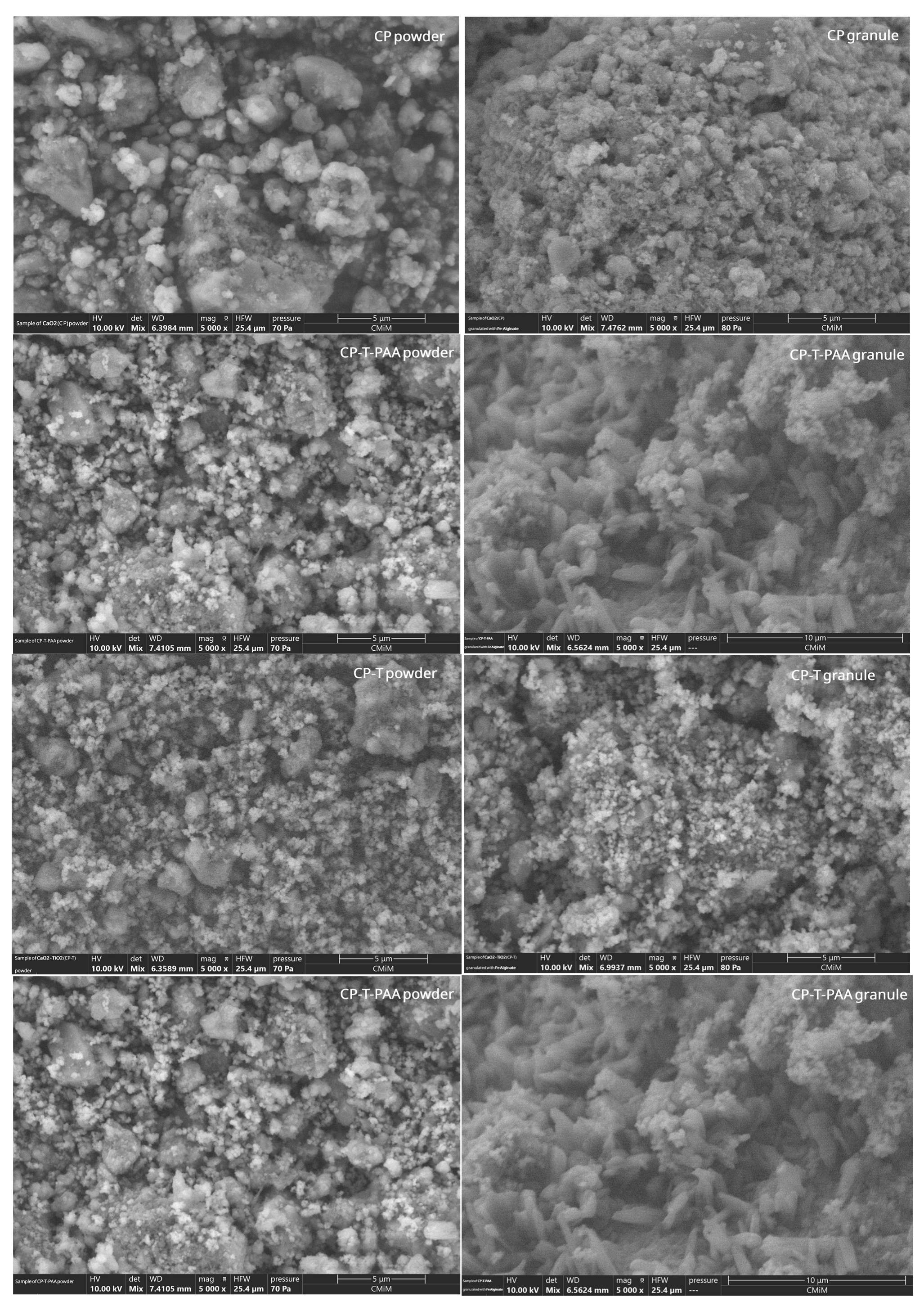
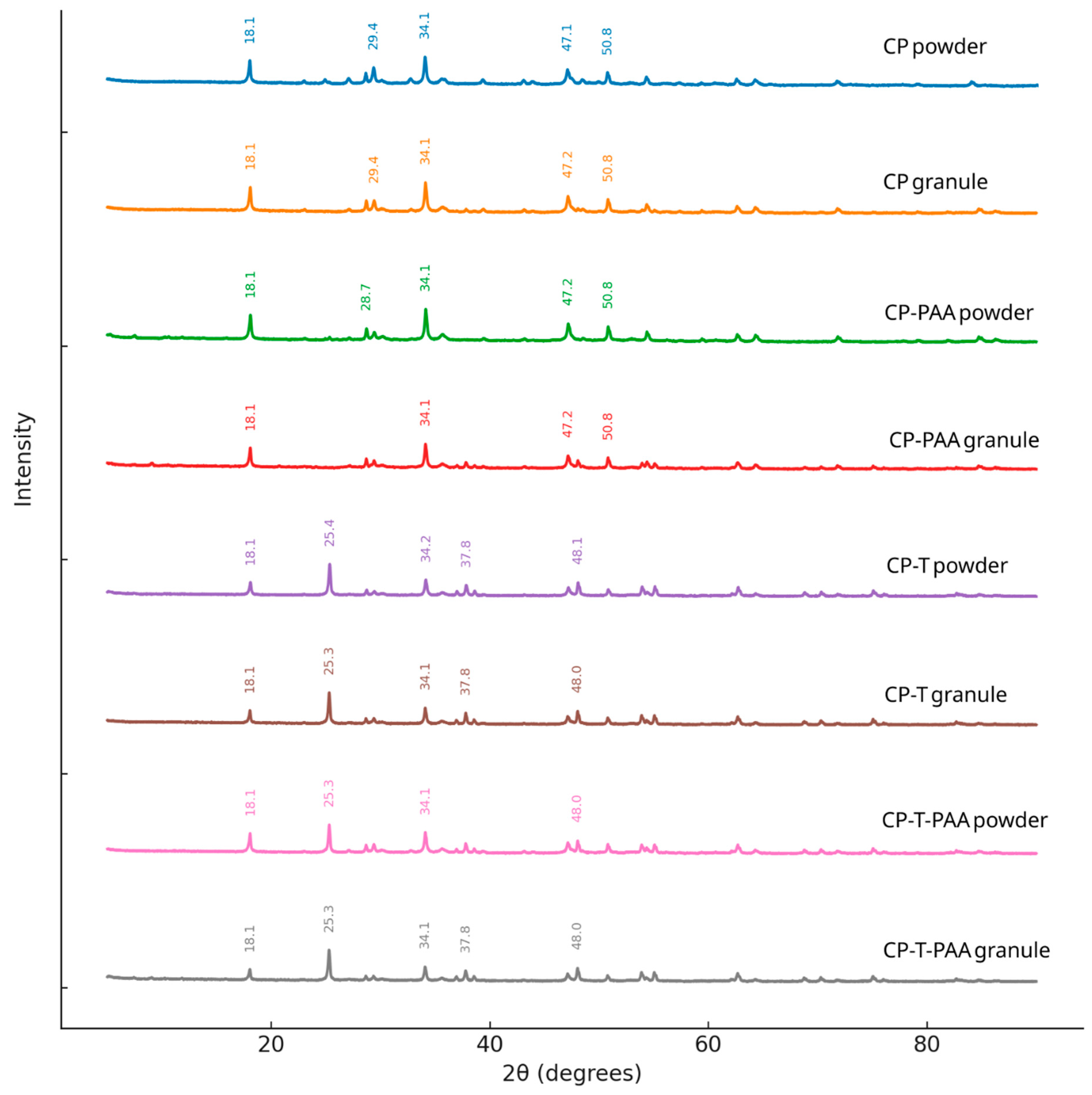
X-ray diffraction (XRD) analysis results, depicted in Figure 3, revealed that the characteristics of calcium peroxide were consistent with its tetragonal crystal structure. The primary peaks observed at 18.1° and 34.1° corresponded to the tetragonal CaO2 phase, in agreement with the Joint Committee on Powder Diffraction Standards (JCPDS)’s pattern. Additional peaks at 47.1–48.1° and 50.8° further confirmed the presence of calcium peroxide [30]. This crystallinity directly correlated with the coarse crystalline surface morphology observed via scanning electron microscopy (SEM), as depicted in Figure 4, which displayed irregular aggregates (0.5–3.0 μm) with discernible porosity [31]. The granulation of CP demonstrated how the Fe–alginate coating influenced its structure and morphology. The XRD pattern showed a slight decrease in peak intensity while the tetragonal structure was retained, indicating that the coating preserved the crystalline core while creating a protective layer. SEM analysis confirmed this relationship through a morphological transformation into smooth, spherical clusters (1.0–5.0 μm) with reduced porosity [32]. The crystalline core remained intact beneath the alginate matrix, as evidenced by the preserved XRD peak positions with only minor changes in intensity.
The CP-PAA products, in both powder and granular forms, exhibited only a difference in intensity compared to the unmodified CP. This suggested a structural disruption of the regular tetragonal CaO2 lattice due to the addition of peracetic acid. This structural modification was directly correlated with the SEM observations of smaller, more uniform aggregates (0.3–2.5 μm in powder form) with a slightly coarse surface. The structure–function relationship in CP-PAA was evident: the modified crystal structure resulted in enhanced stability and improved compatibility with the alginate coating matrix [30]. SEM imaging showed that the CP-PAA granules achieved remarkable uniformity (2.0–8.0 μm) with a smooth surface and a 3.2-fold increase in size. This superior coating efficiency was a direct outcome of the structural modifications that enhanced surface–coating interactions, as confirmed by the retained XRD patterns with consistent peak positions but altered intensities.
XRD analysis results for the binary CP-T composite showed CaO2 peaks identical to those of anatase at 25.3°, indicating a partial structural modification resulting from the incorporation of TiO2 [33,34]. The SEM morphology directly reflected this structural complexity through a heterogeneous surface texture and a mixed-phase appearance (0.4–2.8 μm). The correlation between the phase mixing observed in XRD and the morphological heterogeneity in SEM demonstrated how structural diversity manifested at the microscopic level. The CP-T granules (1.5–6.0 μm) exhibited a uniform coating that successfully encapsulated the heterogeneous structure beneath, creating a smooth outer surface while maintaining the functionality of the dual-phase core.
The CP-T-PAA composite represented the most sophisticated structure–morphology relationship. XRD analysis revealed a complex diffraction pattern that combined the effects of both TiO2 and peracetic acid modification, resulting in moderate overall crystallinity. The fine structure observed in SEM, characterized by particles of 0.3–2.0 μm with a very smooth texture, correlated directly with this structural complexity. The synergistic effect of the dual modification created optimal conditions for the alginate coating. Consequently, the CP-T-PAA granules achieved exceptional uniformity (3.0–10.0 μm), with the highest size increase factor of 5.0. This performance stemmed from the combined structural modifications, which created optimal surface chemistry for alginate interaction, as evidenced by the preserved structural integrity observed in the XRD results of the coated matrix [30].
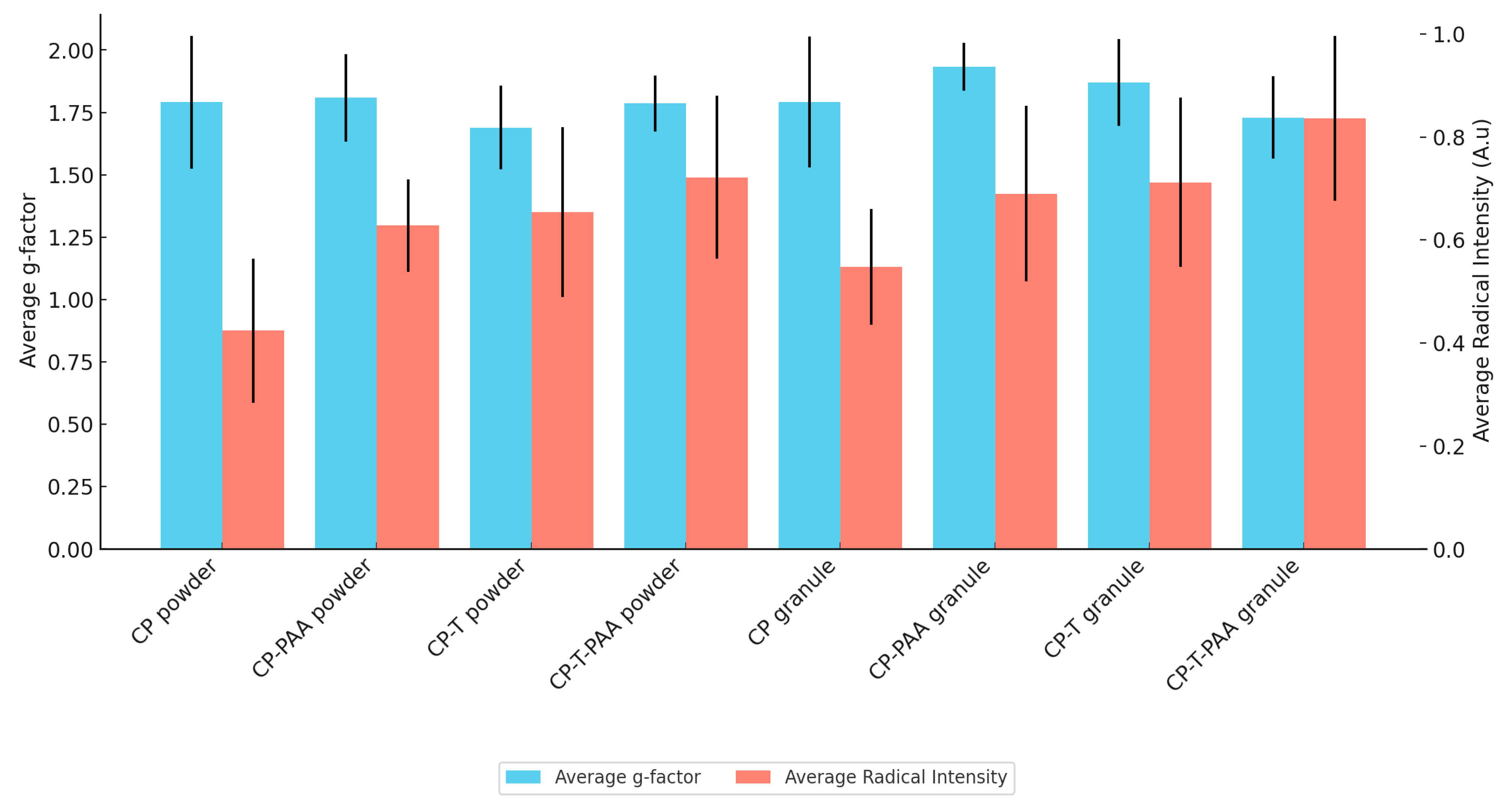
Subsequent product characterization focused on radical formation. Figure 5 illustrates the mean g-factor values (blue bars) and radical intensities (red/orange bars). The observed g-factor values, which ranged from 1.6 to 2.0, were characteristic of oxygen-centered radicals, specifically hydroxyl radical (•OH) and superoxide radical (O2•) [35,36]. These species were identified as dominant in this advanced oxidation process.
The fundamental mechanism was initiated by the dissolution of calcium peroxide, which yielded hydrogen peroxide (Equation (3)). This hydrogen peroxide served as a precursor for hydroxyl radical formation through various pathways, including Fenton-like reactions in the presence of iron (Equation (4)). Concurrently, calcium peroxide was capable of direct oxygen release (Equation (5)), from which superoxide (Equations (6)–(8)) radicals can form under suitable electron-accepting conditions [35].
CaO2 + 2H2O → Ca(OH)2 + H2O2
Fe2+ + H2O2 → Fe3+ + OH + OH
2 H 2 O 2   a u t o d e c o m p o s i t i o n   d u e   t o   b a s e   o f   C a ( O H ) 2   2 H 2 O   +   O 2
Fe2+ + O2 → Fe3+ + O2•−
H2O2 + OH → H2O + HO2, propagation
HO2 ⇌ H+ + O2•−, propagation
The incorporation of peracetic acid into the CP-PAA system enhanced radical generation. Peracetic acid acted as both an independent oxidant and a source of organic peroxy radicals, particularly acetyl peroxy radical. More significantly, the co-present hydrogen peroxide from calcium peroxide dissolution had a synergistic effect [37] that enriched the formation pathways and diversified the types of reactive species generated. This synergistic interaction was particularly evident in the iron-containing systems, where PAA facilitated Fe(III)/Fe(II) cycling (Equations (9) and (10)), dramatically amplifying hydroxyl radical production through enhanced Fenton chemistry.
Fe3+ + CH3C(O)OOH → Fe2+ + CH3C(O)OO + H+
Fe2+ + H2O2 → Fe3+ + OH + OH
The addition of titanium dioxide to the CP-T system introduced a photocatalytic enhancement that altered the radical formation profile. Under UV light activation, which provided photon energy (hv), TiO2 generated electron–hole pairs ( e c b and   h v b + , Equation (11)) that participated in distinct radical formation reactions: electrons reduced molecular oxygen to form superoxide radicals (Equation (12)), while holes oxidized water molecules to produce hydroxyl radicals (Equation (13)). Furthermore, the photocatalytic process accelerated the decomposition of hydrogen peroxide derived from calcium peroxide, creating an additional pathway for hydroxyl radical formation, as shown in Equations (14)–(16) [38]. The ternary combination system, CP-T-PAA, exhibited the highest radical intensity due to multi-pathway synergy that integrated all individual mechanisms into a comprehensive oxidative system. This formulation concurrently generated hydroxyl, superoxide, and organic peroxide radicals through the photocatalytic activation of both hydrogen peroxide and peracetic acid. The titanium dioxide facilitated electron transfer processes that not only enhanced individual radical formation pathways but also created novel reaction routes through the interaction of a diverse range of radical species.
TiO 2 + h v     e c b + h v b +
O 2 + e c b     O 2
H 2 O + h v b +     OH 2   +   H +
H 2 O 2 + e c b     OH   +   OH
H2O2 + O2•−OH + OH + O2
OH + h v b +     OH
A crucial observation was that the granular formulations consistently demonstrated higher radical intensities compared to the powder formulations across all systems (Figure 5). This enhancement is attributed to the Fe–alginate encapsulation, which provided diffusion-controlled release of active components, thereby maintaining optimal reactant concentrations over an extended period. The iron component within the Fe–alginate coating served as a Fenton catalyst, promoting additional hydroxyl radical formation via the catalytic cycle shown in Equation (4). Moreover, the encapsulation matrix afforded protection against radical scavenging by environmental components, prevented premature degradation, and sustained the radical-generating capacity for a longer duration [39]. A more detailed discussion is provided in the next section.

3.2. The Laboratory-Scale Testing Stage

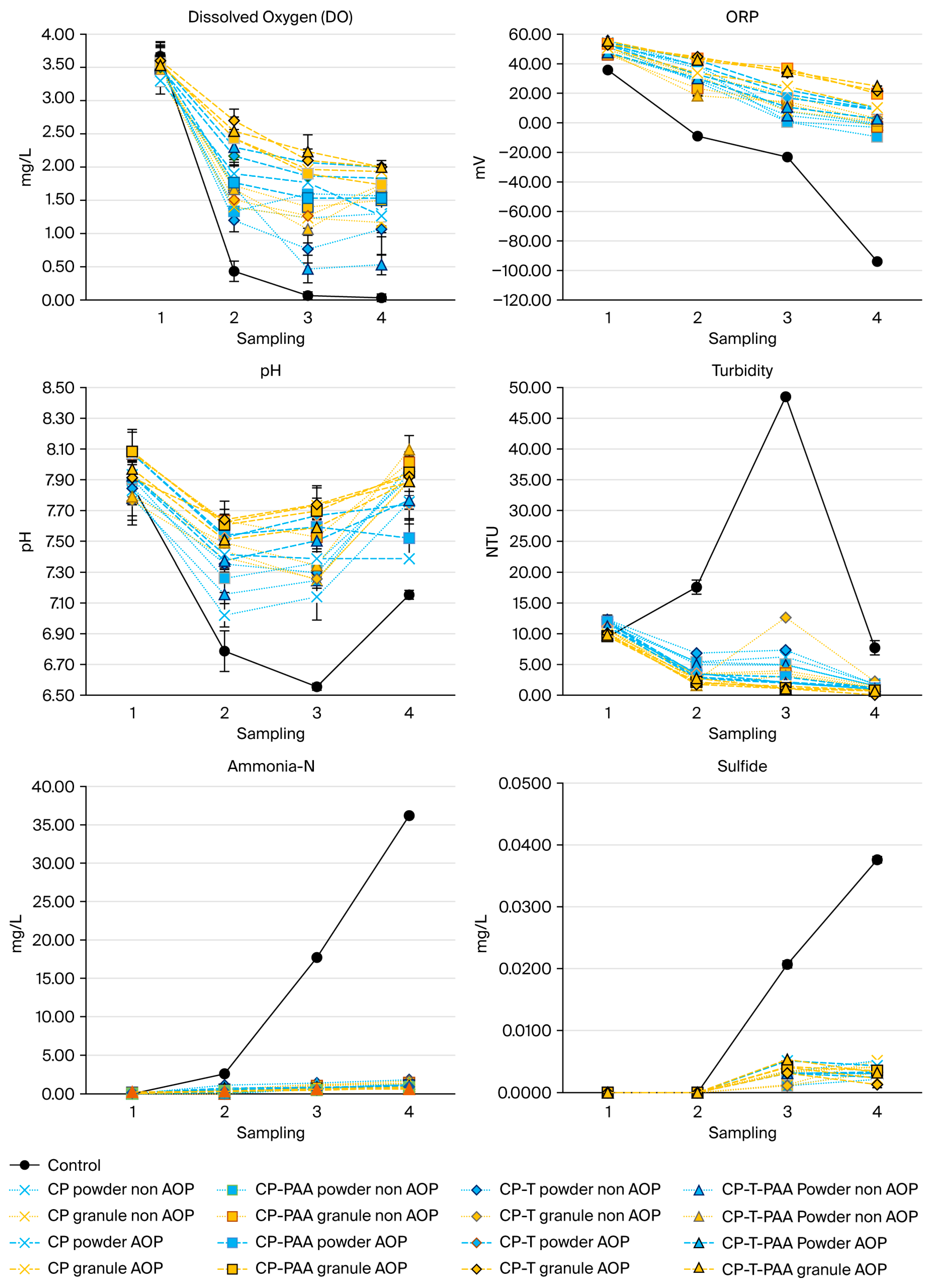
The laboratory-scale water quality testing results indicated that each treatment had a significant effect on key parameters (DO and ORP), as illustrated in Figure 6. The dissolved oxygen (DO) showed a highly significant difference (p < 0.001) among treatments (detailed in Supplementary Materials). Formulations utilizing AOPs consistently demonstrated superior performance. The CP-T-PAA Powder AOP and CP-T Granule AOP treatments successfully achieved the highest mean DO concentrations. The ORP values also exhibited a significant increase following AOP treatment (p < 0.001) compared to the control and non-AOP treatments (details are provided in the Supplementary Materials). This increase in ORP indicates more oxidative environmental conditions, which strongly support the degradation of organic matter and the detoxification of harmful compounds in the water [37]. The AOP mechanism, which generates reactive oxygen species (ROS), particularly hydroxyl radicals (OH) with a high oxidation potential, was crucial to effectively degrading organic pollutants and toxic compounds. Other parameters, such as pH, turbidity, ammonia, and H2S, revealed that the composite lime granule treatment with an AOP significantly improved the aquatic environmental conditions. For instance, a trend towards pH stability was observed with the AOP-treated lime granule. In terms of clarity, the CP-T Granule AOP treatment showed the best performance, with a turbidity removal efficiency reaching 92–93%. This treatment was also highly effective in reducing toxic compounds. The ammonia (NH3-N) concentration was successfully lowered by up to 94% through an enhanced nitrification process supported by the dissolved oxygen supply, while hydrogen sulfide (H2S) was reduced by 89%. The removal of ammonia and sulfide is directly driven by the oxidative capability of the generated radical species. Hydroxyl radicals (•OH) attack ammonia molecules typically via hydrogen abstraction, forming amide radicals (•NH2) which are subsequently oxidized through a series of reactions to form nitrite and ultimately stable nitrate (NO3) [40]. Similarly, sulfide species (H2S and HS) undergo electrophilic attack by •OH and superoxide radicals (•O2), leading to their sequential oxidation into elemental sulfur (S0) and finally to sulfate (SO42−) [41]. This radical-mediated oxidation rapidly transforms toxic reduced metabolites into their less harmful oxidized forms, thereby mitigating toxicity in the water column.
Based on Figure 7A, the granule formulations consistently outperformed the powders and clustered among the top AOP treatments. The TOPSIS score integrating all six parameters confirmed that triple synergy achieved the most balanced improvement in water quality improvement. The combination of CP-T-PAA granules and an AOP system emerged as the optimal treatment (Figure 7B) due to its triple synergy, combining (1) passive O2/H2O2 release from CaO2, (2) TiO2 photocatalysis, and (3) PAA activation. The order of chemical reactions was briefly mentioned in Equations (4)–(16).
Empirical evidence of the effectiveness of this composite has been discussed in several previous studies, though further research is needed. Acetylperoxyl (CH3COOO•) and acetyloxyl (CH3COO•) radicals exhibit distinct reactivity, showing enhanced selectivity toward electron-rich organics and superior near-neutral pH performance [42]. Recent studies demonstrated that an PAA-based AOP achieved 96.2% pharmaceutical removal in 15 min (k = 0.241 min−1), with •OH contributing ~86.8% oxidative activity when iron catalysts were present [35].
Synergistic interactions are critical. PAA-CaO2 synergy provides temporal complementarity, which immediate high-intensity oxidation from PAA and sustained H2O2 generation from CaO2, PAA-TiO2’s synergy enhances charge carrier separation and prevents active site blocking [43], and PAA-UV synergy creates a radical cocktail (•OH, CH3COO•, CH3COOO•, O2) with complementary reactivity patterns, reducing incomplete oxidation.
Granules encapsulated within Fe–alginate provided controlled release, which is fundamentally different from the immediate dispersion of the powder formulations. Alginate hydrogels exhibit pH-responsive swelling and diffusion-controlled release [39]. Upon immersion, gradual hydration creates tortuous diffusion pathways moderating oxidant release, as described by Fick’s law (Equation (17)):
J   =   D ( d C d x ) ,   where   d C d x = C o u t C i n d x
where J represents the diffusive flux, D represents the diffusion coefficient of the product, and dC/dx represents the concentration gradient. Theoretical estimates based on Fick’s law suggest that the Fe–alginate matrix reduces the effective diffusion coefficient to the order of 10−12 m2/s, which is consistent with the observed sustained release time of over 24 h compared to the rapid dissolution (D approx. 10−9 m2/s) typically seen with non-encapsulated powders. This offers three advantages: (1) sustained availability over 24 h versus burst release, satisfying continuous oxygen demand; (2) localized hot spots with elevated oxidant concentrations, enhancing local kinetics while maintaining moderate bulk concentrations; and (3) improved utilization efficiency by matching supply with demand, reducing non-productive consumption.
The Fe–alginate layer is an integral catalytic component and not merely passive carrier. Iron ionically cross-linked with alginate carboxylates creates heterogeneous catalysts in which Fe centers are immobilized yet accessible to diffusing H2O2 [44]. As H2O2 transits the Fe–alginate shell, it encounters immobilized Fe sites, triggering Fenton reactions (Equations (18) and (19)):
≡Alg-COO-Fe2+ + H2O2 → ≡Alg-COO-Fe3+ + •OH + OH
≡Alg-COO-Fe3+ + H2O2 → ≡Alg-COO-Fe2+ + HO2• + H+
This built-in Fenton system ensures that every H2O2 molecule participates in radical generation before exiting, dramatically improving radical yield [45]. Fe–alginate also catalyzes PAA decomposition, generating Fe(IV) species with 4.2–10.8 higher degradation rates [46]. Unlike homogeneous systems, immobilized iron cycles repeatedly without loss, improving economic viability. Alginate carboxylates provide pH buffering, enabling effective Fenton catalysis at the neutral pH (7–8) typical of Litopenaeus vannamei culture.

3.3. Practical Implication

The CP-T-PAA granules address critical gaps in aquaculture water treatment by providing simultaneous multi-parameter improvement through integrated AOP mechanisms. As outlined in the Introduction, a critical challenge in aquaculture—particularly for traditional farmers—is the gap between available technologies and practical implementation. The CP-T-PAA Granule AOP formulation addresses this gap through several user-friendly features. First, unlike complex aeration systems, chemical dosing pumps, or biofloc management protocols that require technical expertise and continuous monitoring, granule application involves straightforward broad-casting into ponds, similar to the conventional liming practices already familiar to farmers. Second, the formulation simultaneously addresses multiple water quality challenges (low DO, high organic matter, ammonia, H2S, and turbidity) with a single treatment, eliminating the need for multiple separate interventions and their associated complexity. Third, the sustained-release nature of granules provides an extended treatment duration (demonstrated in this study to be over 24 h; likely longer under field conditions), reducing the frequency of application and monitoring compared to short-acting interventions. Fourth, unlike pure oxygen systems (explosion risk), ozone generators (toxicity concerns), or strong acids/bases (handling hazards), the encapsulated formulation presents minimal safety risks during transport, storage, and application, increasing accessibility for small-scale farmers.
In traditional aquaculture systems lacking mechanical aeration, the sediment–water interface frequently exhibits anoxic conditions. This environment inhibits bacterial nitrification, shifting the process toward sulfate reduction and resulting in ammonia accumulation through ammonification. However, the administration of 5 mg/L of the CP-T-PAA granule with an AOP system demonstrated the ability to maintain dissolved oxygen (DO) levels of approximately 2 mg/L at the substrate surface, thereby facilitating the decomposition of organic matter by benthic bacteria.
While it is widely established that the optimal DO level for Litopenaeus vannamei survival exceeds 4 mg/L, this standard primarily applies to the water column and is often unattainable at the bottom of the pond due to strong anoxic tendencies. Maintaining a DO level of 2 mg/L within the substrate establishes a habitable resting zone. Although this concentration is below the saturation required for high metabolic activity, it meets the basal metabolic requirements for resting phases and effectively mitigates sulfide toxicity. This allows the shrimp to maintain their natural benthic orientation, thereby maximizing the volumetric utilization of the culture system and minimizing density-dependent stress.
Throughout the 21 days of experimental period, a preliminary safety assessment was conducted by monitoring specific biological endpoints in the test aquariums. Daily observations showed no acute mortality and no behavioral abnormalities (e.g., lethargy or loss of appetite) in the test organisms exposed to the 5 mg/L dosage. This implies that the residual by-products of the AOP reaction (primarily water and oxygen) and the stable Fe-alginate carrier are chemically benign at this concentration.
A primary concern regarding the application of AOP-based materials in aquaculture is the potential ecotoxicity of residual oxidants and reaction by-products on the cultured species. In this study, the safety of the CP-T-PAA composite is ensured through two key mechanisms: chemical compatibility and release kinetics. Chemically, the decomposition products of composite components are environmentally benign. Calcium peroxide and peracetic acid dissociate into oxygen rapidly [47,48]; moreover, the products used in this study were limited to the substrate, and peroxide residues rapidly decomposed with the AOP system in the water column. In recent years, titanium dioxide has emerged as a multifunctional agent in aquaculture, where it is utilized both for water quality remediation and the improvement of aquatic organism health [49]. Regarding dosage safety, the applied concentration of 5 mg/L is substantially below the toxicity thresholds reported in the literature. Previous toxicological assessments have indicated that calcium peroxide concentrations of up to 1000 mg/L (0.1%) are safe for sensitive aquatic organisms [21]. Furthermore, the Fe–alginate encapsulation plays a critical role in mitigating oxidative stress due to kinetical aspects. Unlike free powder application, which causes a rapid surge in hydrogen peroxide, the granule form facilitates a controlled, zero-order release profile. This prevents acute exposure shocks to the shrimp, ensuring that radical generation remains localized to the granule surface and sediment interface where benthic remediation is most needed, rather than dispersing aggressively into the water column. However, it is important to distinguish these acute observations from chronic impacts. Future studies should incorporate histopathological analysis of shrimp gills and hepatopancreas to rule out potential microscopic tissue damage from long-term exposure to reactive radical species.
Economically, the synthesis of CP-T-PAA granules entails higher initial raw material costs compared to conventional products. To provide a rational economic justification, a cost-efficiency analysis was modeled based on a standard $1000 m3 aquaculture pond over monthly operational cycle (Table 2). The conventional approach typically requires frequent application of agricultural lime (e.g., dolomite) to buffer pH, combined with commercial probiotics and oxygen tablets. While the raw material cost of the synthesized CP-T-PAA composite is estimated to be significantly higher than lime due to the precursors (TiO2, PAA, and coated with Fe-Alginate), the dosage-to-efficacy ratio offers a competitive advantage. However, the economic justification lies in its dual functionality and operational efficiency. The granules’ controlled-release mechanism enables them to significantly outperform conventional peroxide treatments, which are often limited by rapid decomposition rates. Furthermore, the enhanced generation of reactive radicals by the AOP system suppresses toxic metabolites detrimental to the cultured biota. Consequently, when evaluated on a cost-per-unit-efficiency basis, this composite offers a feasible, user-friendly alternative for maintaining optimal water quality over extended periods, particularly in traditional aquaculture systems constrained by limited resources and technical expertise.

4. Conclusions

This study describes the successful synthesis and evaluation of a novel multifunctional lime-based composite designed to address critical water quality challenges in Litopenaeus vannamei aquaculture. The combination of 5 mg/L of CP-T-PAA product added to the sediment with an AOP system demonstrated superior performance, characterized by the highest intensity hydroxyl (•OH) and superoxide (•O2) radical generation due to the synergistic coupling of photocatalysis and chemical oxidation, which was also validated through TOPSIS analysis. This composite effectively maintained dissolved oxygen levels at ~2 mg/L at the sediment–water interface for 21 days while significantly elevating the oxidation reduction potential (ORP) and water clarity, and achieving high removal efficiencies for ammonia (94%) and sulfide (89%). Furthermore, the Fe–alginate encapsulation successfully addressed slow-release material challenges. Consequently, this novel composite offers a promising, user-friendly, and sustainable strategy for traditional shrimp farmers to enhance pond productivity and stability without the need for complex infrastructure, thereby contributing to the advancement of the blue economy.
However, this study is subject to certain limitations. The experiments were conducted in a controlled laboratory environment which does not fully capture the complex hydrodynamic fluctuations, biological interactions, and variable nutrient loads typical of open shrimp ponds. Therefore, the next steps for this research should focus on conducting pilot-scale field trials to validate the composite’s efficacy under dynamic pond conditions. Additionally, a comprehensive cost–benefit analysis is recommended to assess the economic feasibility of mass-producing this composite for widespread adoption by traditional shrimp farmers.

Supplementary Materials

The following supporting information can be downloaded at: https://www.mdpi.com/article/10.3390/w18030296/s1, Table S1. Temporal variation of Dissolved Oxygen (mg/L) across different treatments over 21 days; Table S2. Temporal variation of pH across different treatments over 21 days; Table S3. Temporal variation of Oxidation Reduction Potential (mV) across different treatments over 21 days; Table S4. Temporal variation of Turbidity (NTU) across different treatments over 21 days; Table S5. Temporal variation of Ammonia (mg/L) across different treatments over 21 days; Table S6. Temporal variation of Sulfide (mg/L) across different treatments over 21 days.

Author Contributions

M.I.A.: conceptualization, methodology, formal analysis, writing—original draft and editing. N.T.M.P.: supervision, validation, and writing—review. B.W.: supervision and conceptualization. M.K.: methodology and data interpretation. N.R.: validation. M.F.: data interpretation. H.W.A.: research assistant and draft editing. All authors have read and agreed to the published version of the manuscript.

Funding

The authors gratefully acknowledge financial support from the Korea–Indonesia MTCRC Joint Research Initiative 2024 [Contract Number: 10/MTCRC/VII/2024]. The APC was funded by the authors.

Data Availability Statement

The original contributions presented in this study are included in the article/Supplementary Materials. Further inquiries can be directed to the corresponding author.

Acknowledgments

The authors would like to thank the Advanced Research and Integrated Laboratory of IPB University for facilitating the experiments and providing the necessary instrumentation.

Conflicts of Interest

The authors declare no conflict of interest.

Abbreviations

The following abbreviations are used in this manuscript:
AOP(s)Advanced Oxidation Processes
ANOVAAnalysis of Variance
CPCalcium Peroxide
CP-TComposited Calcium Peroxide and Titanium Dioxide
CP-PAAComposited Calcium Peroxide and Peracetic Acid
CP-T-PAAComposited Calcium Peroxide, Titanium Dioxide, and Peracetic Acid
DODissolved Oxygen
ESRElectron Spin Resonance
FTIRFourier Transform Infrared Spectroscopy
JCPDSJoint Committee on Powder Diffraction Standards
MCDAMulti-Criteria Decision Analysis
NADPHNicotinamide Adenine Dinucleotide Phosphate Hydrogen
NOXNADPH Oxidase
NTUNephelometric Turbidity Unit
ORPOxidation Reduction Potential
PAAPeracetic Acid
PCAPrincipal Component Analysis
ROSReactive Oxygen Species
SEMScanning Electron Microscopy
TEMTransmission Electron Microscope
TOPSISTechnique for Order Preference by Similarity to Ideal Solution
UVUltraviolet
XRDX-ray Diffraction

References

  1. Boyd, C.E. General Relationship between Water Quality and Aquaculture Performance in Ponds. In Fish Diseases; Elsevier: Amsterdam, The Netherlands, 2017; pp. 147–166. [Google Scholar]
  2. Zheng, M.; Gao, B.; Zhang, J.; El-Din, M.G.; Snyder, S.A.; Wu, M.; Tang, L. In-Situ Chemical Attenuation of Pharmaceutically Active Compounds Using CaO2: Influencing Factors, Mechanistic Modeling, and Cooperative Inactivation of Water-Borne Microbial Pathogens. Environ. Res. 2022, 212, 113531. [Google Scholar] [CrossRef]
  3. Seethalakshmi, P.; Rajeev, R.; Kiran, G.S.; Selvin, J. Shrimp Disease Management for Sustainable Aquaculture: Innovations from Nanotechnology and Biotechnology. Aquac. Int. 2021, 29, 1591–1620. [Google Scholar] [CrossRef]
  4. Lara, G.; Krummenauer, D.; Abreu, P.C.; Poersch, L.H.; Wasielesky, W. The Use of Different Aerators on Litopenaeus vannamei Biofloc Culture System: Effects on Water Quality, Shrimp Growth and Biofloc Composition. Aquac. Int. 2017, 25, 147–162. [Google Scholar] [CrossRef]
  5. Luan, Y.; Wang, Y.; Liu, C.; Lv, L.; Xu, A.; Song, Z. Effects of Potassium Monopersulfate on Nitrification Activity and Bacterial Community Structure of Sponge Biocarrier Biofilm in Litopenaeus vannamei Aquaculture System. Environ. Technol. 2024, 45, 3354–3366. [Google Scholar] [CrossRef]
  6. Betanzo-Torres, E.A.; MdlÁ, P.-Á.; Sandoval-Herazo, L.C.; Molina-Navarro, A.; Rodríguez-Montoro, I.; González-Moreno, R.H. Factors That Limit the Adoption of Biofloc Technology in Aquaculture Production in Mexico. Water 2020, 12, 2775. [Google Scholar] [CrossRef]
  7. Deni, A. The development of shrimp culture in Indonesia. In Proceedings of the Korean Society of Fisheries and Aquaculture Sciences Aquaculture Division Academic Conference, Jeju Island, Republic of Korea, 3–4 November 2022. [Google Scholar]
  8. Cao, Y.; Gu, D.; Li, G.; Huang, M.; He, W. A Review on the Application of Slow-Release Oxygen Materials in the Remediation of Polluted Rivers and Lakes. J. East China Norm. Univ. Nat. Sci. 2024, 2024, 9. [Google Scholar]
  9. Ma, Z.; Ge, Z.; Liu, K.; Wang, C.; Wu, T.; Zhang, J. Application of Calcium Peroxide for Efficient Treatment of Surface Water Turbidity: Mechanisms and Microbial Community Responses. J. Environ. Chem. Eng. 2023, 11, 110905. [Google Scholar] [CrossRef]
  10. Hou, Z.; Wang, W.; Dong, N.; Chen, P.; Ge, L.; Tan, F.; Wong, P.K. A Dual-Oxidant Advanced Oxidation Process System Containing CaO2 and Peroxymonosulfate for Organic Pollutant Degradation: High Adaptability and Synergistic Effect. Sep. Purif. Technol. 2023, 308, 122909. [Google Scholar] [CrossRef]
  11. Zulkarnaini, Z.; Gumelar, G.; Zainuddin, E. Anaerobic Ammonium Oxidation Performance in Shrimp Pond Wastewater Treatment. Andalasian Int. J. Appl. Sci. 2022, 2, 51–56. [Google Scholar] [CrossRef]
  12. Checa, J.; Aran, J.M. Reactive Oxygen Species: Drivers of Physiological and Pathological Processes. J. Inflamm. Res. 2020, 13, 1057–1073. [Google Scholar] [CrossRef]
  13. Vermot, A.; Petit-Härtlein, I.; Smith, S.M.E.; Fieschi, F. NADPH Oxidases (NOX): An Overview from Discovery, Molecular Mechanisms to Physiology and Pathology. Antioxidants 2021, 10, 890. [Google Scholar] [CrossRef]
  14. Stefan, I. Advanced Oxidation Processes for Water Treatment Fundamentals and Applications; IWA Publishing: London, UK, 2018. [Google Scholar]
  15. Kuntari, C. Uji Aktivitas Penangkapan Radikal Hidroksil Oleh Ekstrak Etanol the Hijau Dan the Hitam Dengan Metode Deoksiribosa. Master’s Thesis, Universitas Sanata Dharma, Yogyakarta, Indonesia, 2007. [Google Scholar]
  16. Dong, G.; Zhang, L.; Hua, X. Calcium Peroxide Powder and Its Making Method. CN1104996A, 12 July 1995. [Google Scholar]
  17. Zhang, Q.; Wei, Y.; Zhang, T.; Han, B.; Liu, K.; Chen, B. Preparation of CaO Granules Using the Granulation Method. Adv. Appl. Ceram. 2018, 117, 334–339. [Google Scholar] [CrossRef]
  18. Piyarat, V.; Tunlawit, S.; Chanat, C.; Chalor, J.; Chainarong, S.; Ann, K.; Rattana, B. Remediating Oxytetracycline-Contaminated Aquaculture Water Using Nano Calcium Peroxide (nCaO2) Produced from Flue Gas Desulfurization (FGD) Gypsum. Environ. Technol. Innov. 2021, 24, 101861. [Google Scholar]
  19. Faisal, M.; Juswono, U.P.; Santoso, D.R.; Widodo, C.S. The Effectiveness of Herbal Medicine Mangosteen Peel Extract (Garcinia Mangostana) to Prevent Free Radicals Occurrence and Decrease in Hemoglobin Levels in the Blood Caused by Diabetes Mellitus. Trends Sci. 2025, 22, 9250. [Google Scholar] [CrossRef]
  20. Alkhadra, M.A.; Gao, T.; Conforti, K.M.; Tian, H.; Bazant, M.Z. Small-Scale Desalination of Seawater by Shock Electrodialysis. Desalination 2020, 476, 114219. [Google Scholar] [CrossRef]
  21. Wang, C.; Qi, C.; Li, Z. Evaluation of Calcium Peroxide as a New Water Purifying and Oxygen Releasing Agent in Aquaculture. Life Sci. Res. 2012, 16, 345–349. [Google Scholar]
  22. Bridgewater, L.L. Standard Methods for the Examination of Water and Wastewater; American Public Health Association: Washington, DC, USA, 2017. [Google Scholar]
  23. Greenacre, M.; Groenen, P.J.; Hastie, T.; d’Enza, A.I.; Markos, A.; Tuzhilina, E. Principal Component Analysis. Nat. Rev. Methods Primer 2022, 2, 100. [Google Scholar]
  24. Uzun, B.; Taiwo, M.; Syidanova, A.; Uzun Ozsahin, D. The Technique For Order of Preference by Similarity to Ideal Solution (TOPSIS). In Application of Multi-Criteria Decision Analysis in Environmental and Civil Engineering; Professional Practice in Earth Sciences; Uzun Ozsahin, D., Gökçekuş, H., Uzun, B., LaMoreaux, J., Eds.; Springer: Cham, Switzerland, 2021. [Google Scholar]
  25. Subbotina, I.R.; Barsukov, D.V. Direct Evidence of the Key Role of UV-Formed Peroxide Species in Photocatalytic Gas-Solid Oxidation in Air on Anatase TiO2 Particles. Phys. Chem. Chem. Phys. 2020, 22, 2200–2211. [Google Scholar] [CrossRef] [PubMed]
  26. Mollah, M.; Faruque, M.R.I.; Bradley, D.A.; Khandaker, M.U.; Al-Assaf, S. FTIR and Rheology Study of Alginate Samples: Effect of Radiation. Radiat. Phys. Chem. 2022, 202, 110500. [Google Scholar] [CrossRef]
  27. Huamani-Palomino, R.G. Functionalization of an Alginate-Based Material by Oxidation and Reductive Amination. Polymers 2021, 13, 255. [Google Scholar] [CrossRef]
  28. Yu, Z.; Zhou, Z.; Huang, G. Two-Dimensional FTIR Spectroscopic Characterization of Functional Groups of NaOCl-Exposed Alginate. ACS Appl. Bio Mater. 2018, 1, 593–603. [Google Scholar] [CrossRef] [PubMed]
  29. Elhoudi, M. Comparison of Green Bio-Based Cerium/Alginate vs. Copper/Alginate Beads: A Study of Vibrational and Thermal Properties Using Experimental and Theoretical Methods. J. Mol. Model. 2022, 28, 37. [Google Scholar] [CrossRef]
  30. Bîrcă, A.C.; Gherasim, O.; Niculescu, A.G.; Grumezescu, A.M.; Vasile, B.Ș.; Mihaiescu, D.E.; Neacșu, I.A.; Andronescu, E.; Trușcă, R.; Holban, A.M.; et al. Infection-Free and Enhanced Wound Healing Potential of Alginate Gels Incorporating Silver and Tannylated Calcium Peroxide Nanoparticles. Int. J. Mol. Sci. 2024, 25, 5196. [Google Scholar] [CrossRef] [PubMed]
  31. Wu, X.; Han, X.; Guo, Y.; Liu, Q.; Sun, R.; Wen, Z.; Dai, C. Application Prospect of Calcium Peroxide Nanoparticles in Biomedical Field. Rev. Adv. Mater. Sci. 2023, 62, 20220308. [Google Scholar] [CrossRef]
  32. Machida-Sano, I.; Ogawa, S.; Hirakawa, M.; Namiki, H. Evaluation of Three-Dimensional Porous Iron-Cross-Linked Alginate as a Scaffold for Cell Culture. Int. Sch. Res. Not. 2014, 2014, 375758. [Google Scholar] [CrossRef]
  33. Nemr, O.T.; Abdel-wahab, M.S.; Hamza, Z.S.; Ahmed, S.A.; El-Bassuony, A.A.; Abdel-Gawad, O.F.; Mohamed, H.S. Investigating the Anticancer and Antioxidant Potentials of a Polymer-Grafted Sodium Alginate Composite Embedded with CuO and TiO2 Nanoparticles. J. Polym. Environ. 2024, 32, 2713–2728. [Google Scholar] [CrossRef]
  34. Naveed, A.B.; Javaid, A.; Zia, A.; Ishaq, M.T.; Amin, M.; Farooqi, Z.U.R.; Mahmood, A. TiO2/g-C3N4 Binary Composite as an Efficient Photocatalyst for Biodiesel Production from Jatropha Oil and Dye Degradation. ACS Omega 2022, 8, 2173–2182. [Google Scholar] [CrossRef]
  35. Xue, Y.; Sui, Q.; Brusseau, M.L.; Zhang, X.; Qiu, Z.; Lyu, S. Insight on the Generation of Reactive Oxygen Species in the CaO2/Fe(II) Fenton System and the Hydroxyl Radical Advancing Strategy. Chem. Eng. J. 2018, 353, 657–665. [Google Scholar] [CrossRef]
  36. Samoilova, R.I.; Dikanov, S.A. Superoxide Radical Formed on the TiO2 Surface Produced from Ti(OiPr)4 Exposed to H2O2/KOH. Inorganics 2023, 11, 274. [Google Scholar] [CrossRef]
  37. Li, S.; Zou, J.; Wu, J.; Sun, B.; Zhao, M.; Liu, D.; Cheng, Q.; Tan, H.; Ma, J. New Insights into Natural Polyphenol-Enhanced Fe (III)/Peracetic Acid System under Acidic pH Conditions: The Overlooked Role of Coexisting Hydrogen Peroxide. Environ. Sci. Technol. 2025, 59, 10608–10619. [Google Scholar]
  38. Bizirtsakis, P.A.; Anagnostopoulou, K.; Sarasidis, V.C.; Petsi, P.; Moschona, A.; Plakas, K.V.; Lambropoulou, D.A. A Comparative Study of Advanced Oxidation Processes for the Removal of the Antibiotic Sulfadoxine from Water—Transformation Products and Toxicity. Appl. Sci. 2025, 15, 793. [Google Scholar] [CrossRef]
  39. Pedrali, D.; Scarafoni, A.; Giorgi, A.; Lavelli, V. Binary alginate-whey protein hydrogels for antioxidant encapsulation. Antioxidants 2023, 12, 1192. [Google Scholar] [CrossRef]
  40. Yang, X.; Tao, Y.; Murphy, J.G. Kinetics of the Oxidation of Ammonia and Amines with Hydroxyl Radicals in the Aqueous Phase. Environ. Sci. Process. Impacts 2021, 23, 1906–1913. [Google Scholar] [CrossRef]
  41. Olson, K.R. Are Reactive Sulfur Species the New Reactive Oxygen Species? Antioxid. Redox Signal. 2020, 33, 1125–1142. [Google Scholar]
  42. Zhan, H.; Liu, X.; Huang, J.; Wang, Y.; Zhou, Y.; Chen, W.; Tang, J. Iron Electrocoagulation Activated Peracetic Acid for Efficient Degradation of Sulfamethoxazole. Chem. Eng. Res. Des. 2024, 201, 182–194. [Google Scholar] [CrossRef]
  43. Zheng, F.; Cheng, Y.; Dong, H.; Meng, Q.; Cai, J.; Gao, Y.; Zhang, T. Insights into the Novel Oxidation Process of Ozone/Peracetic Acid: Kinetics Evaluation, Degradation Pathways, and Toxicity Assessment. Chem. Eng. J. 2023, 473, 145964. [Google Scholar] [CrossRef]
  44. Dong, Z.; Li, Z.; Zhang, J.; Sun, Y.; Zhao, S.; Yang, Y.; Wang, L. EDTA-Modified Zero-Valent Iron Activated Peracetic Acid for Sulfamethazine Removal: Performance and Mechanism. Sep. Purif. Technol. 2024, 330, 125574. [Google Scholar] [CrossRef]
  45. Lu, X.; Chen, Y.; Li, R.; Shao, B.; Zhang, X.; Gao, J.; He, Q. Insight into the Activation of Peracetic Acid by Cobalt-Nitrogen-Doped Porous Carbon for Efficient Norfloxacin Degradation: Performance and Mechanism. Sep. Purif. Technol. 2024, 338, 126572. [Google Scholar] [CrossRef]
  46. Garrido-Ramírez, E.G.; Theng, B.K.G.; Mora, M.L. Clays and Oxide Minerals as Catalysts and Nanocatalysts in Fenton-like Reactions—A Review. Appl. Clay Sci. 2010, 47, 182–192. [Google Scholar] [CrossRef]
  47. Das, A.; Sun, Y.; Sarkar, D.J.; Kumar, V.S.; Das, B.K. Biopolymer-Encapsulated Calcium Peroxide Tablets for Slow Sustained Release of Dissolved Oxygen in Fish Tank. Aquac. Eng. 2025, 110, 102524. [Google Scholar] [CrossRef]
  48. Liu, D.; Straus, D.L.; Pedersen, L.F.; Good, C.; Lazado, C.C.; Meinelt, T. Towards Sustainable Water Disinfection with Peracetic Acid in Aquaculture: A Review. Rev. Aquac. 2024, 16, 1621–1646. [Google Scholar] [CrossRef]
  49. Lin, Y.L.; Zheng, N.Y.; Chen, Y.S.; Chang, C.C. Electro-Forward Osmosis through a Titanium-Dioxide-Modified Membrane to Enhance Aquaculture Wastewater Recovery. Desalination 2024, 570, 117078. [Google Scholar] [CrossRef]
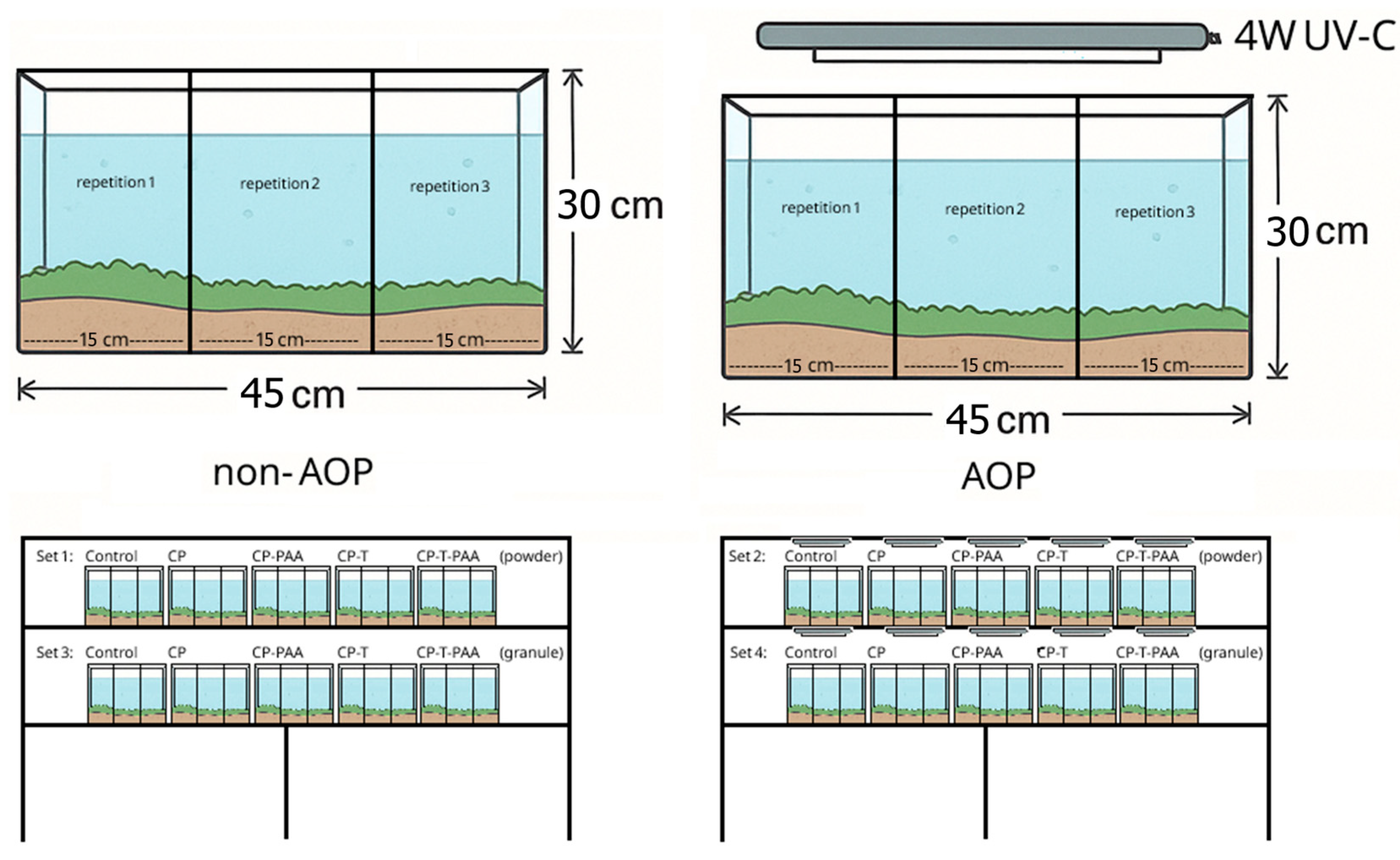
Figure 1. Illustration of non-UV treatment with UV treatment at laboratory-scale test stage.
Water 18 00296 g001
Figure 2. Results of FTIR analysis of products.
Water 18 00296 g002
Figure 3. Results of XRD analysis of products.
Water 18 00296 g003
Figure 4. Results of SEM analysis of products.
Water 18 00296 g004
Figure 5. Characterization of free radicals by electron spin resonance (ESR).
Water 18 00296 g005
Figure 6. Water quality measurement following each treatment (4 sampling times).
Water 18 00296 g006
Figure 7. (A) Principal Component Analysis (PCA) of the water quality measurement; (B) TOPSIS score ranking for all treatments based on multi-criteria water quality parameters (DO, pH, ORP, Ammonia, Sulfide, Turbidity). The TOPSIS score (Ci) ranges from 0 to 1, where a higher score indicates a closer proximity to the ideal solution—representing the optimal balance between high oxygenation efficacy and low toxic metabolite accumulation. The CP-T-PAA Granule AOP treatment achieved the highest score, validating it as the most effective formulation.
Water 18 00296 g007
Table 1. Parameters measured at the laboratory test stage.
No.ParametersUnitsMethods/Instruments
Water quality in situ parameter
1. pH-Calibrated Instruments Hanna HI2002-02 (Hanna Instruments, Inc., Smithfield, RI, USA)
2. Dissolved oxygen (DO).mg/LCalibrated Instruments Lutron DO-5510 (Lutron Electronic Enterprise Co., Ltd., Taipei, Taiwan)
3. Oxidation Reduction Potential (ORP)mVCalibrated Instruments Hanna HI2002-02 (Hanna Instruments, Inc., Nușfalău, Romania)
4. TurbidityNTUCalibrated Instruments HACH 2100q (Hach Company, Loveland, CO, USA)
Water quality ex situ parameter
5. Ammoniamg/LPhenate-Spectrophotometers, Bridgewater [22]
6. Sulfidemg/LMethylene Blue-Titrimetry, Bridgewater [22]
Table 2. Estimated operational cost comparison between Conventional Treatment and CP-T-PAA Composite for a 1000 m3 pond over monthly cycle.
Cost ComponentConventional Treatment (Lime + Probiotics)CP-T-PAA Composite with AOP System
1. Material Inputs
    Primary AgentAgricultural Lime (dolomite)CP-T-PAA Composite
    Application FrequencyOnce a weekOnce a month
    Dosage per Application20 mg/L (2 kg)5 mg/L (5 kg)
    Total Quantity Required80 kg5 kg
    Est. Unit Price *0.5 USD/kg12 USD/kg (synthesized estimate)
    Subtotal Material Cost40 USD60 USD
2. Additional
    Secondary MaterialProbiotics and Oxygen TabletsUV installation and electricity costs/month
    Total Quantity RequiredEach 3 L/week and 2 kg/monthEach 1 package and 16.2 kWh
    Est. Unit Price *Each 2.5 USD/L and 8.8 USD/kgEach 18.5 USD/package and 0.080 USD/kWh
    Subtotal Additive Cost47.6 USD19.8 USD
    Total Estimated Cost87.6 USD79.8 USD
Note: * Prices are based on average price in Indonesia markets.
Disclaimer/Publisher’s Note: The statements, opinions and data contained in all publications are solely those of the individual author(s) and contributor(s) and not of MDPI and/or the editor(s). MDPI and/or the editor(s) disclaim responsibility for any injury to people or property resulting from any ideas, methods, instructions or products referred to in the content.