Water Quality and Sediment Microbial Community Differences Between Sea Urchin Monoculture and Sea Urchin–Shrimp IMTA Systems
 ,
,
Abstract
1. Introduction
2. Materials and Methods
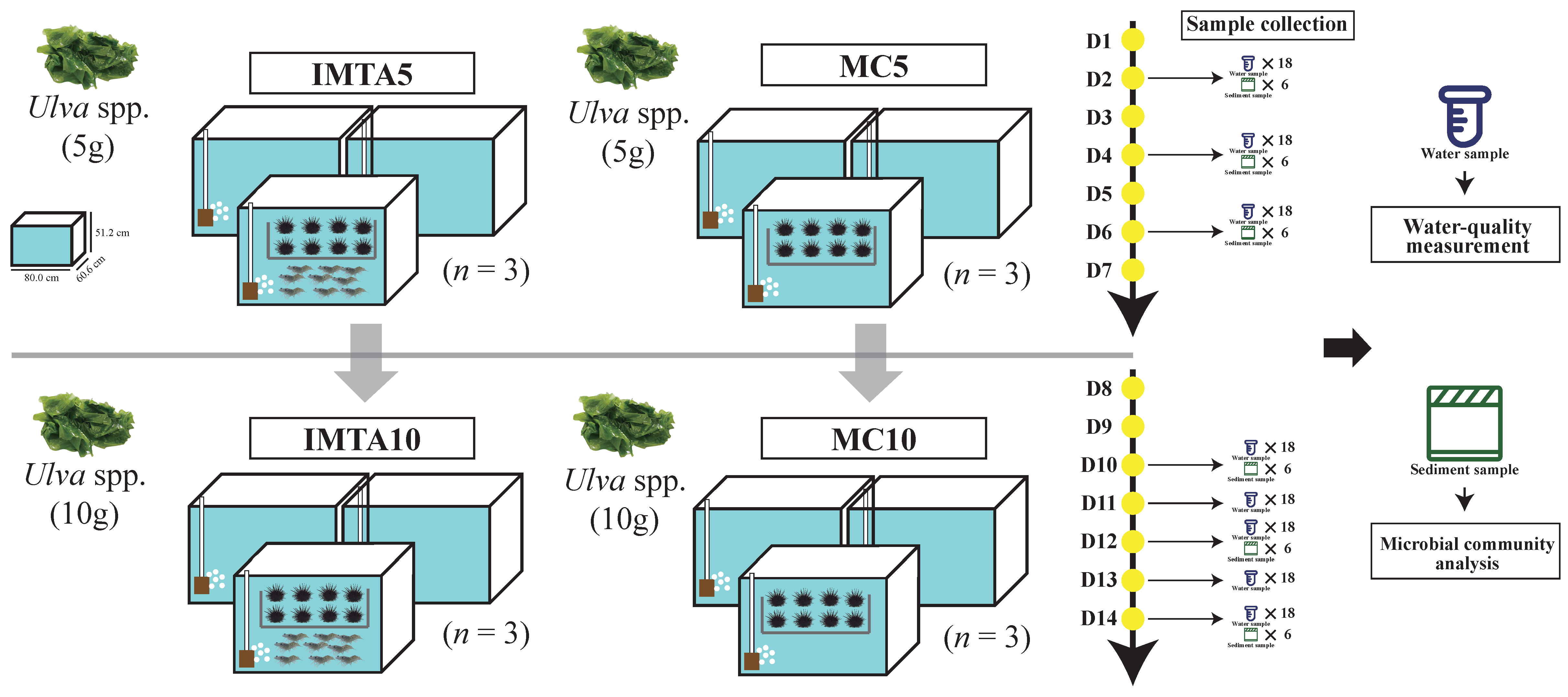
2.1. Experimental Site, System Setup and Treatments
2.2. Sampling and Water Renewal Procedures
2.3. Water Quality Monitoring Instruments and Analytical Standards
2.4. 16S rRNA Gene Sequencing and Microbial Analysis
2.5. Environmental–Microbial Correlation Analysis
3. Results
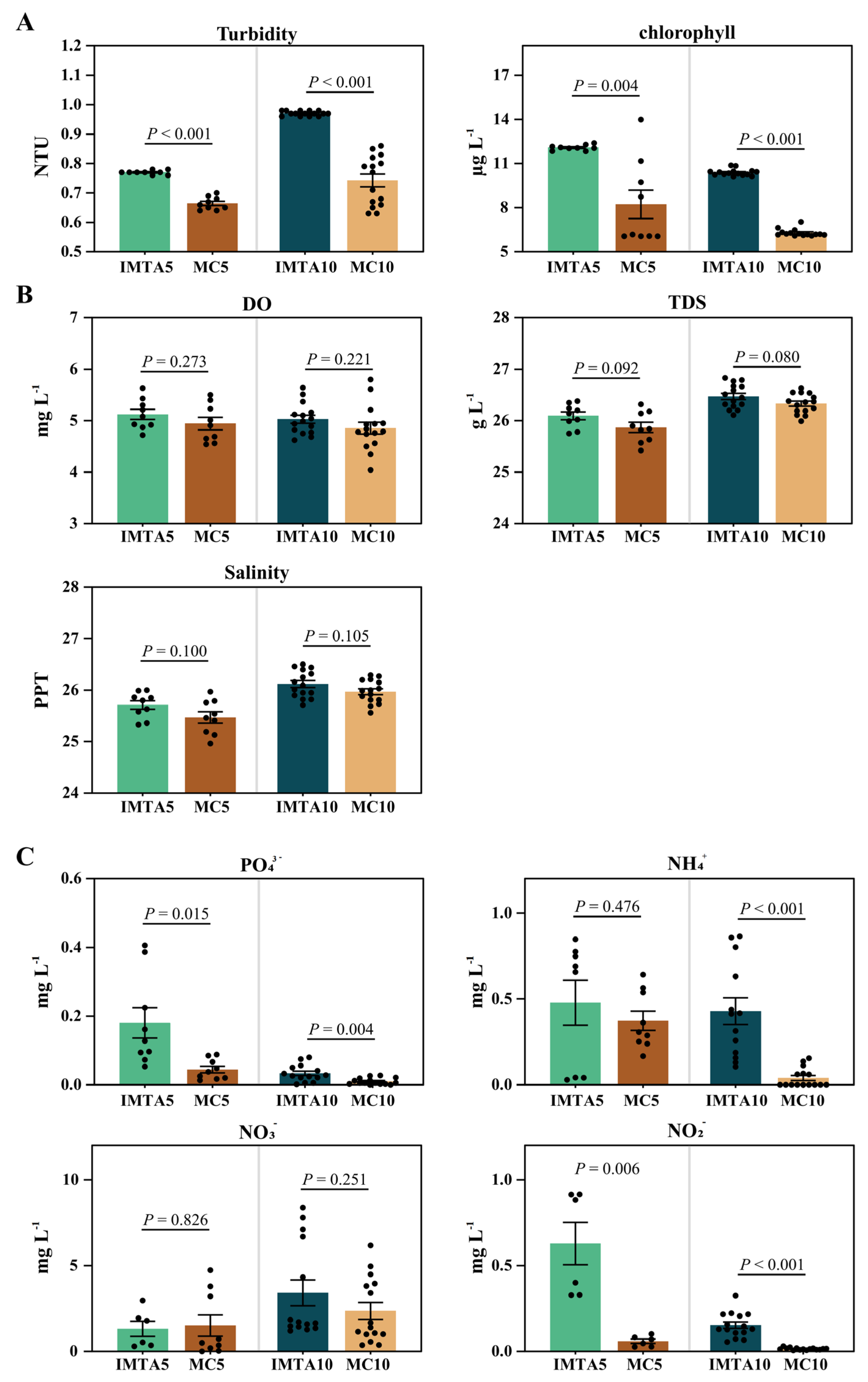
3.1. Water Quality
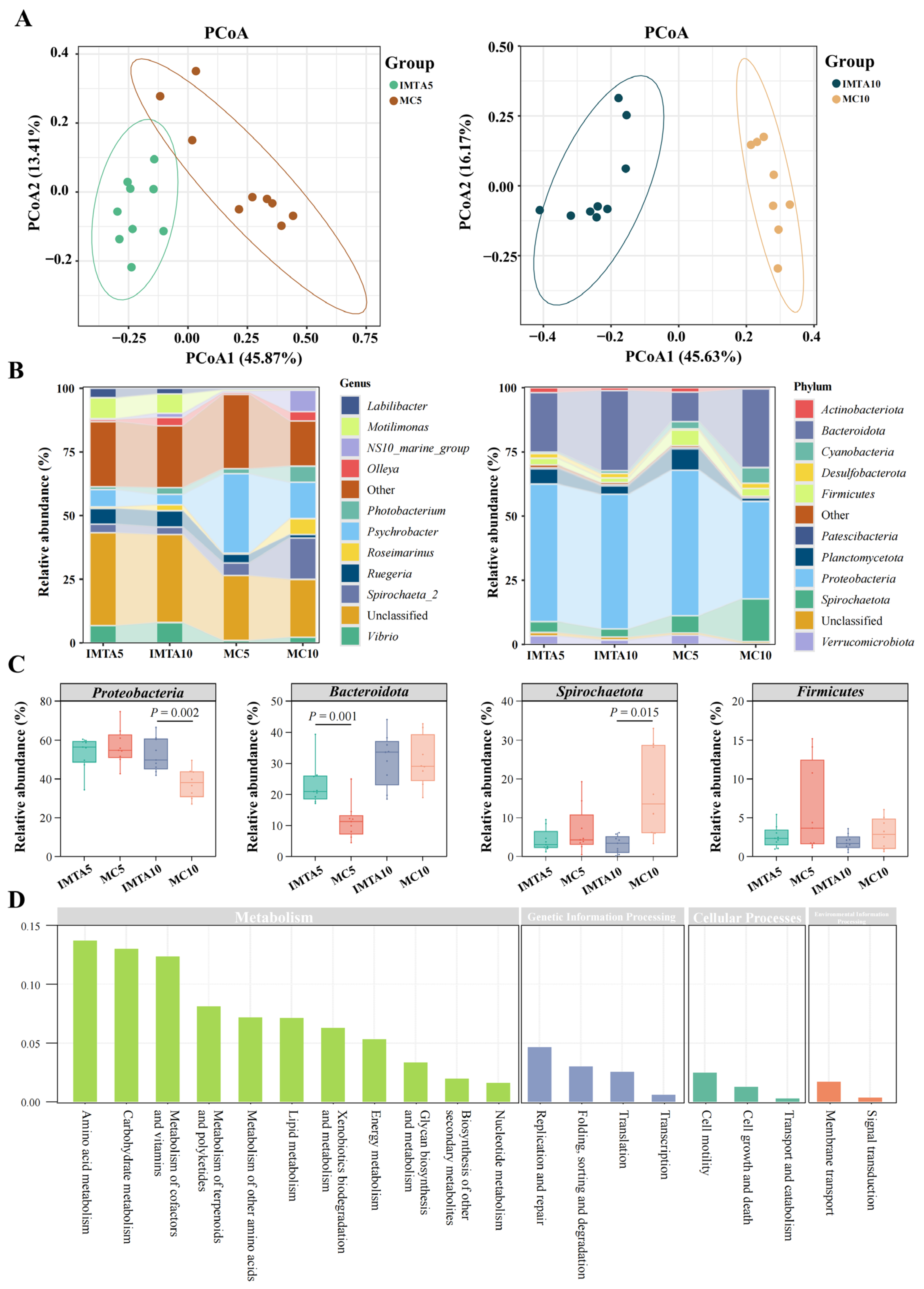
3.2. Microbial Community Structure and Bacterial Diversity in IMTA and Sea Urchin
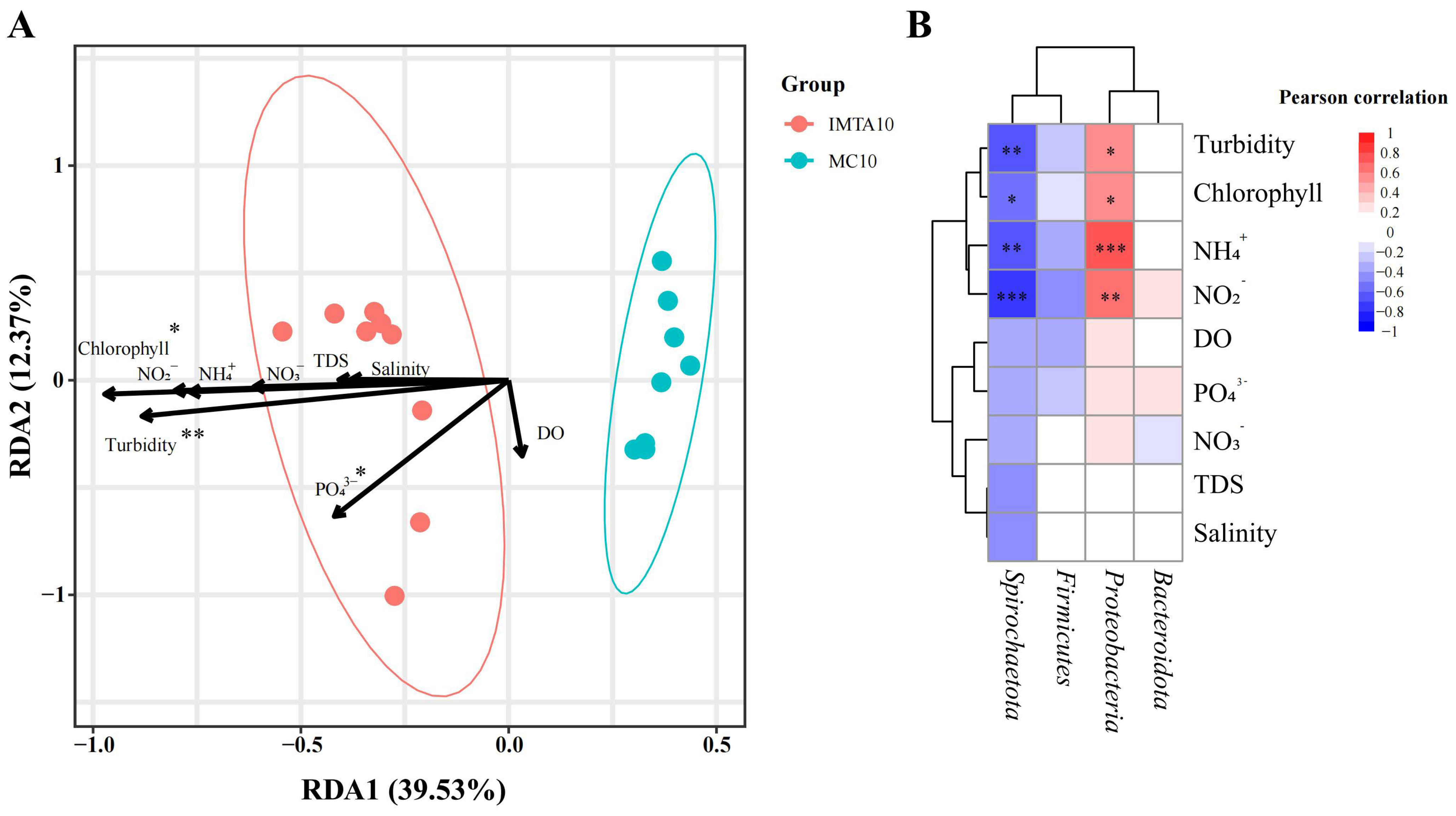
3.3. Relationships Between Microbial Community and Water Quality
4. Discussion
4.1. Linking Water Quality and Microbial Responses
4.2. Microbial Drivers of Nutrient Transformations
5. Conclusions
Supplementary Materials
Author Contributions
Funding
Data Availability Statement
Acknowledgments
Conflicts of Interest
References
- Wang, X.; Cuthbertson, A.; Gualtieri, C.; Shao, D. A review on mariculture effluent: Characterization and management tools. Water 2020, 12, 2991. [Google Scholar] [CrossRef]
- Sellars, L.; Franks, B. How mariculture expansion is dewilding the ocean and its inhabitants. Sci. Adv. 2024, 10, eadn8943. [Google Scholar] [CrossRef]
- Biswas, G.; Kumar, P.; Ghoshal, T.; Kailasam, M.; De, D.; Bera, A.; Mandal, B.; Sukumaran, K.; Vijayan, K. Integrated multi-trophic aquaculture (IMTA) outperforms conventional polyculture with respect to environmental remediation, productivity and economic return in brackishwater ponds. Aquaculture 2020, 516, 734626. [Google Scholar] [CrossRef]
- Lukwambe, B.; Zhao, L.; Nicholaus, R.; Yang, W.; Zhu, J.; Zheng, Z. Bacterioplankton community in response to biological filters (clam, biofilm, and macrophytes) in an integrated aquaculture wastewater bioremediation system. Environ. Pollut. 2019, 254, 113035. [Google Scholar] [CrossRef]
- Yu, L.Q.; Mu, Y.; Zhao, Z.; Lam, V.W.; Sumaila, U.R. Economic challenges to the generalization of integrated multi-trophic aquaculture: An empirical comparative study on kelp monoculture and kelp-mollusk polyculture in Weihai, China. Aquaculture 2017, 471, 130–139. [Google Scholar] [CrossRef]
- Dong, X.; Lv, L.; Zhao, W.; Yu, Y.; Liu, Q. Optimization of integrated multi-trophic aquaculture systems for the giant freshwater prawn Macrobrachium rosenbergii. Aquac. Environ. Interact. 2018, 10, 547–556. [Google Scholar] [CrossRef]
- Cotou, E.; Miliou, H.; Chatzoglou, E.; Schoina, E.; Politakis, N.; Kogiannou, D.; Fountoulaki, E.; Androni, A.; Konstantinopoulou, A.; Assimakopoulou, G.; et al. Growth performance and environmental quality indices and biomarkers in a co-culture of the European sea bass with filter and deposit feeders: A case study of an IMTA system. Fishes 2024, 9, 69. [Google Scholar] [CrossRef]
- Nederlof, M.A.J.; Verdegem, M.C.J.; Smaal, A.C.; Jansen, H.M. Nutrient retention efficiencies in integrated multi-trophic aquaculture. Rev. Aquac. 2022, 14, 1194–1212. [Google Scholar] [CrossRef]
- Qiu, X.; Carter, C.G.; Hilder, P.E.; Hadley, S. A dynamic nutrient mass balance model for optimizing waste treatment in RAS and associated IMTA system. Aquaculture 2022, 555, 738216. [Google Scholar] [CrossRef]
- Zhan, Y.; Sun, J.; Li, Y.; Cui, D.; Zhang, W.; Yang, L.; Chang, Y. Distant hybrids of Heliocidaris crassispina (♀) and Strongylocentrotus intermedius (♂): Identification and mtDNA heteroplasmy analysis. BMC Evol. Biol. 2020, 20, 101. [Google Scholar] [CrossRef]
- Feng, W.; Nakabayashi, N.; Narita, K.; Inomata, E.; Aoki, M.N.; Agatsuma, Y. Reproduction and population structure of the sea urchin Heliocidaris crassispina in its newly extended range: The Oga Peninsula in the Sea of Japan, northeastern Japan. PLoS ONE 2019, 14, e0209858. [Google Scholar] [CrossRef] [PubMed]
- Mak, K.K.-Y.; Chan, K.Y.K. Interactive effects of temperature and salinity on early life stages of the sea urchin Heliocidaris crassispina. Mar. Biol. 2018, 165, 57. [Google Scholar] [CrossRef]
- Dorey, N.; Maboloc, E.; Chan, K.Y.K. Development of the sea urchin Heliocidaris crassispina from Hong Kong is robust to ocean acidification and copper contamination. Aquat. Toxicol. 2018, 205, 1–10. [Google Scholar] [CrossRef]
- Stief, P. Stimulation of microbial nitrogen cycling in aquatic ecosystems by benthic macrofauna: Mechanisms and environmental implications. Biogeosciences 2013, 10, 7829–7846. [Google Scholar] [CrossRef]
- Marshall, A.J.; Longmore, A.; Phillips, L.; Tang, C.; Hayden, H.L.; Heidelberg, K.B.; Mele, P. Nitrogen cycling in coastal sediment microbial communities with seasonally variable benthic nutrient fluxes. Aquat. Microb. Ecol. 2021, 86, 1–19. [Google Scholar] [CrossRef]
- Kong, S.; Chen, Z.; Ghonimy, A.; Li, J.; Zhao, F. Bivalves improved water quality by changing bacterial composition in sediment and water in an IMTA system. Aquac. Res. 2023, 2023, 1930201. [Google Scholar] [CrossRef]
- Chang, Z.; Neori, A.; He, Y.; Li, J.; Qiao, L.; Preston, S.I.; Liu, P.; Li, J. Development and current state of seawater shrimp farming, with an emphasis on integrated multi-trophic pond aquaculture farms, in China—A review. Rev. Aquac. 2020, 12, 2544–2558. [Google Scholar] [CrossRef]
- Zheng, X.; Yan, Z.; Zhao, C.; He, L.; Lin, Z.; Liu, M. Homogeneous environmental selection mainly determines the denitrifying bacterial community in intensive aquaculture water. Front. Microbiol. 2023, 14, 1280450. [Google Scholar] [CrossRef]
- Zhang, G.; Luo, M.; Xu, C.; Pan, X.; Yi, G.; Xiao, W.; Wang, C.; Zhao, Z.; Li, R. Microbial and Functional Gene Dynamics in Long-Term Fermented Mariculture Sediment. J. Mar. Sci. Eng. 2025, 13, 975. [Google Scholar] [CrossRef]
- GB/T 12763.4-2007; Specifications for Oceanographic Survey—Part 4: Survey of Chemical Parameters in Sea Water. Standards Press of China: Beijing, China, 2007.
- Klindworth, A.; Pruesse, E.; Schweer, T.; Peplies, J.; Quast, C.; Horn, M.; Glöckner, F.O. Evaluation of general 16S ribosomal RNA gene PCR primers for classical and next-generation sequencing-based diversity studies. Nucleic Acids Res. 2013, 41, e1. [Google Scholar] [CrossRef]
- Chen, S.; Zhou, Y.; Chen, Y.; Gu, J. fastp: An ultra-fast all-in-one FASTQ preprocessor. Bioinformatics 2018, 34, i884–i890. [Google Scholar] [CrossRef]
- Magoč, T.; Salzberg, S.L. FLASH: Fast length adjustment of short reads to improve genome assemblies. Bioinformatics 2011, 27, 2957–2963. [Google Scholar] [CrossRef]
- Edgar, R.C. UPARSE: Highly accurate OTU sequences from microbial amplicon reads. Nat. Methods 2013, 10, 996–998. [Google Scholar] [CrossRef] [PubMed]
- Edgar, R.C.; Haas, B.J.; Clemente, J.C.; Quince, C.; Knight, R. UCHIME improves sensitivity and speed of chimera detection. Bioinformatics 2011, 27, 2194–2200. [Google Scholar] [CrossRef]
- Wang, Q.; Garrity, G.M.; Tiedje, J.M.; Cole, J.R. Naive Bayesian classifier for rapid assignment of rRNA sequences into the new bacterial taxonomy. Appl. Environ. Microbiol. 2007, 73, 5261–5267. [Google Scholar] [CrossRef] [PubMed]
- Quast, C.; Pruesse, E.; Yilmaz, P.; Gerken, J.; Schweer, T.; Yarza, P.; Peplies, J.; Glöckner, F.O. The SILVA ribosomal RNA gene database project: Improved data processing and web-based tools. Nucleic Acids Res. 2012, 41, D590–D596. [Google Scholar] [CrossRef] [PubMed]
- Caporaso, J.G.; Kuczynski, J.; Stombaugh, J.; Bittinger, K.; Bushman, F.D.; Costello, E.K.; Fierer, N.; González Peña, A.; Goodrich, J.K.; Gordon, J.I.; et al. QIIME allows analysis of high-throughput community sequencing data. Nat. Methods 2010, 7, 335–336. [Google Scholar] [CrossRef]
- Arnosti, C. Microbial extracellular enzymes and the marine carbon cycle. Annu. Rev. Mar. Sci. 2011, 3, 401–425. [Google Scholar] [CrossRef]
- Hornick, K.M.; Buschmann, A.H. Insights into the diversity and metabolic function of bacterial communities in sediments from Chilean salmon aquaculture sites. Ann. Microbiol. 2018, 68, 63–77. [Google Scholar] [CrossRef]
- Quero, G.M.; Ape, F.; Manini, E.; Mirto, S.; Luna, G.M. Temporal changes in microbial communities beneath fish farm sediments are related to organic enrichment and fish biomass over a production cycle. Front. Mar. Sci. 2020, 7, 524. [Google Scholar] [CrossRef]
- Feng, L.; Zhang, Z.; Yang, G.; Wu, G.; Yang, Q.; Chen, Q. Microbial communities and sediment nitrogen cycle in a coastal eutrophic lake with salinity and nutrients shifted by seawater intrusion. Environ. Res. 2023, 225, 115590. [Google Scholar] [CrossRef]
- Fernández-Gómez, B.; Richter, M.; Schüler, M.; Pinhassi, J.; Acinas, S.G.; González, J.M.; Pedrós-Alió, C. Ecology of marine Bacteroidetes: A comparative genomics approach. ISME J. 2013, 7, 1026–1037. [Google Scholar] [CrossRef]
- Zhang, X.; Wu, K.; Han, Z.; Chen, Z.; Liu, Z.; Sun, Z.; Shao, L.; Zhao, Z.; Zhou, L. Microbial diversity and biogeochemical cycling potential in deep-sea sediments associated with seamount, trench, and cold seep ecosystems. Front. Microbiol. 2022, 13, 1029564. [Google Scholar] [CrossRef]
- Dong, X.; Greening, C.; Brüls, T.; Conrad, R.; Guo, K.; Blaskowski, S.; Kaschani, F.; Kaiser, M.; Abu Laban, N.; Meckenstock, R.U. Fermentative Spirochaetes mediate necromass recycling in anoxic hydrocarbon-contaminated habitats. ISME J. 2018, 12, 2039–2050. [Google Scholar] [CrossRef] [PubMed]
- Hink, L.; Gubry-Rangin, C.; Nicol, G.W.; Prosser, J.I. The consequences of niche and physiological differentiation of archaeal and bacterial ammonia oxidisers for nitrous oxide emissions. ISME J. 2018, 12, 1084–1093. [Google Scholar] [CrossRef] [PubMed]
- Hassan, J.; Qu, Z.; Bergaust, L.L.; Bakken, L.R. Transient accumulation of NO2− and N2O during denitrification explained by assuming cell diversification by stochastic transcription of denitrification genes. PLoS Comput. Biol. 2016, 12, e1004621. [Google Scholar] [CrossRef] [PubMed]



| Feeding | Treatment | Sobs | Ace | Chao1 | Shannon |
|---|---|---|---|---|---|
| 5 g/day | IMTA5 | 1030 ± 90 * | 1285 ± 92 * | 1221 ± 86 * | 6.7 ± 0.4 * |
| MC5 | 841 ± 192 | 987 ± 202 | 1044 ± 194 | 5.2 ± 1.3 | |
| 10 g/day | IMTA10 | 1038 ± 201 * | 1181 ± 213 * | 1120 ± 201 * | 6.4 ± 0.4 * |
| MC10 | 782 ± 56 | 931 ± 55 | 883 ± 57 | 5.2 ± 0.3 |
Disclaimer/Publisher’s Note: The statements, opinions and data contained in all publications are solely those of the individual author(s) and contributor(s) and not of MDPI and/or the editor(s). MDPI and/or the editor(s) disclaim responsibility for any injury to people or property resulting from any ideas, methods, instructions or products referred to in the content. |
© 2026 by the authors. Licensee MDPI, Basel, Switzerland. This article is an open access article distributed under the terms and conditions of the Creative Commons Attribution (CC BY) license.
Share and Cite
Wang, C.; Guo, Y.; Gu, X.; Elisee, N.; Jiang, B.; Zhao, B. Water Quality and Sediment Microbial Community Differences Between Sea Urchin Monoculture and Sea Urchin–Shrimp IMTA Systems. Water 2026, 18, 268. https://doi.org/10.3390/w18020268
Wang C, Guo Y, Gu X, Elisee N, Jiang B, Zhao B. Water Quality and Sediment Microbial Community Differences Between Sea Urchin Monoculture and Sea Urchin–Shrimp IMTA Systems. Water. 2026; 18(2):268. https://doi.org/10.3390/w18020268
Chicago/Turabian StyleWang, Cuicui, Yongyao Guo, Xinli Gu, Nshimiyimana Elisee, Bingbing Jiang, and Bo Zhao. 2026. "Water Quality and Sediment Microbial Community Differences Between Sea Urchin Monoculture and Sea Urchin–Shrimp IMTA Systems" Water 18, no. 2: 268. https://doi.org/10.3390/w18020268
APA StyleWang, C., Guo, Y., Gu, X., Elisee, N., Jiang, B., & Zhao, B. (2026). Water Quality and Sediment Microbial Community Differences Between Sea Urchin Monoculture and Sea Urchin–Shrimp IMTA Systems. Water, 18(2), 268. https://doi.org/10.3390/w18020268