Article

High-Resolution Monitoring of Badland Erosion Dynamics: Spatiotemporal Changes and Topographic Controls via UAV Structure-from-Motion


Department of Geography, National Changhua University of Education, No. 1 Jin-De Road, Changhua 500207, Taiwan
Water 2026, 18(2), 234; https://doi.org/10.3390/w18020234 (registering DOI)
Submission received: 21 December 2025 / Revised: 8 January 2026 / Accepted: 13 January 2026 / Published: 15 January 2026
(This article belongs to the Section Water Erosion and Sediment Transport)

Abstract

Mudstone badlands are critical hotspots of erosion and sediment yield, and their rapid morphological changes serve as an ideal site for studying erosion processes. This study used high-resolution Unmanned Aerial Vehicle (UAV) photogrammetry to monitor erosion patterns on a mudstone badland platform in southwestern Taiwan over a 22-month period. Five UAV surveys conducted between 2017 and 2018 were processed using Structure-from-Motion photogrammetry to generate time-series digital surface models (DSMs). Topographic changes were quantified using DSMs of Difference (DoD). The results reveal intense surface lowering, with a mean erosion depth of 34.2 cm, equivalent to an average erosion rate of 18.7 cm yr−1. Erosion is governed by a synergistic regime in which diffuse rain splash acts as the dominant background process, accounting for approximately 53% of total erosion, while concentrated flow drives localized gully incision. Morphometric analysis shows that erosion depth increases nonlinearly with slope, consistent with threshold hillslope behavior, but exhibits little dependence on the contributing area. Plan and profile curvature further influence the spatial distribution of erosion, with enhanced erosion on both strongly concave and convex surfaces relative to near-linear slopes. The gully network also exhibits rapid channel adjustment, including downstream meander migration and associated lateral bank erosion. These findings highlight the complex interactions among hillslope processes, gully dynamics, and base-level controls that govern badland landscape evolution and have important implications for erosion modeling and watershed management in high-intensity rainfall environments.

1. Introduction

Badlands are highly eroded landscapes characterized by steep slopes, sparse vegetation, and soft rock formations [1]. These regions, such as the Henry Mountains in the USA [2], the Mediterranean badlands [3,4], central and Himalayan in India [5,6], and the mudstone areas in Taiwan [7,8], typically feature rugged surfaces and dense gully networks driven by intense rainfall and weak lithology. Because of their rapid morphological changes, badlands serve as ideal “natural laboratories” for studying landscape evolution and erosion processes [1,9,10]. However, beyond their scientific value, badlands pose significant environmental challenges. Under high-intensity rainfall, these rapidly eroding terrains become critical sources of extreme sediment yields, posing severe threats to downstream infrastructure and water resources [11]. For instance, massive sediment export from badlands has been documented to cause negative consequences, specifically leading to reservoir siltation and degradation of soil nutrient and [12] water quality [3]. To mitigate these impacts, effective watershed management requires not just an estimate of total sediment yield, but a comprehensive understanding of the spatiotemporal distribution of erosion sources across the landscape.
Soil erosion in mudstone badlands results from a combination of interacting physical processes, including weathering, rain splash, sheet erosion, rill and gully erosion, subsurface piping, and slope collapse [13,14]. Erosion typically initiates with rapid weathering and slaking cycles induced by repeated wetting and drying, which generate a loose regolith layer available for transport [7,15,16]. During rainfall events, rain splash acts as a diffuse process detaching particles across inter-rill areas, whereas concentrated overland flow promotes rill incision and gully development [17,18]. As gullies deepen, mass-movement processes such as sidewall collapse and block failure often become increasingly important, driving lateral channel expansion [19].
The spatial expression of erosion in badland landscapes is commonly interpreted through topographic attributes, particularly slope gradient and contributing area [8,20]. However, surface curvature provides an additional and critical morphometric indicator for distinguishing erosion domains [21,22,23,24]. Convex hillslopes are generally associated with diffusive transport processes, such as rain splash and soil creep, which are often modeled as linearly dependent on curvature [25]. In contrast, concave planforms and profiles promote flow convergence and mark the transition to advective erosion domains, where channelization and gully incision occur once critical slope–area thresholds are exceeded [26]. Curvature has therefore been widely used to identify zones susceptible to shallow slope failures and bank erosion. However, how surface curvature modulates the mechanisms and spatial patterns of erosion in mudstone badlands has received relatively limited attention.
Furthermore, badland environments are typically characterized by dense gully networks and sinuous drainage channels, which play a critical role in controlling surface erosion processes [27,28]. However, a recent study [29] in badland environments indicates that erosion is evenly distributed along badland hillslopes, whereas elevation changes within drainage networks are negligible, which may reflect the development of armored gully beds that limit further vertical incision. In contrast, erosion patterns on relatively flat surfaces, the transition from rain-splash-dominated hillslopes to gully-dominated channels, and the geomorphic mechanisms governing the partitioning between vertical incision and lateral erosion remain insufficiently resolved. In particular, the role of rill-gully network development in mediating hillslope-channel connectivity has received limited quantitative attention. Addressing this gap requires high-resolution observational datasets capable of capturing the spatiotemporal distribution of erosion from inter-rill areas to actively evolving gully networks.
However, investigating these processes requires detailed spatially explicit erosion data, which remains challenging due to spatial and temporal constraints. Traditional direct measurements, such as erosion pins for point-scale monitoring [30] and bounded field plots [31], provide precise local data but are difficult to scale up to represent the spatial variability of erosion across larger, rugged landscapes. In contrast, indirect morphometric approaches, such as reservoir sedimentation surveys [11], provide catchment-scale data but often lack the spatial resolution to identify specific erosion hotspots. Consequently, these approaches may underestimate the spatial variability of erosion, and inter-method comparisons frequently reveal discrepancies of several-fold [32,33]. Advances in remote sensing techniques have provided flexible and efficient tools for constructing digital elevation models (DEMs) and monitoring multi-temporal topographic changes [34,35]. While technologies like Terrestrial Laser Scanning (TLS) and airborne LiDAR offer high-resolution topographic data [10,18,36,37,38,39,40], they are often limited by line-of-sight obstructions in rugged terrain [41] or high costs. Recent advances in Unmanned Aerial Vehicle (UAV) photogrammetry have transformed geomorphic monitoring by providing a cost-effective solution capable of generating high-resolution DEMs (Digital Elevation Models) or DSMs (Digital Surface Models) and orthophotos through Structure-from-Motion with Multi-View Stereo (SfM-MVS) techniques [3,42,43,44,45]. UAV surveys allow for flexible, repeated monitoring at centimeter-level resolution [17,29], thereby effectively filling the observational gap between traditional field methods and landscape-scale remote sensing [3,46].
This study applied UAV-based SfM-MVS photogrammetry to monitor erosion dynamics and landform evolution on a mudstone badland platform in Tianliao, southwestern Taiwan. Five UAV surveys were conducted over a 22-month period, capturing the topographic response to distinct hydrological conditions, including dry seasons and typhoon-triggered rainfall events. By generating multi-temporal, centimeter-resolution DSMs, this study aimed to (1) quantify spatiotemporal topographic changes with high vertical accuracy; (2) determine the relative contributions of rain splash and gully incision; and (3) analyze the topographic controls (slope, contributing area, and curvature) on erosion patterns. These results highlight the complex interplay between rain splash and gully dynamics, revealing how topography regulates erosion in these rapidly evolving landscapes.

2. Materials and Methods

2.1. Study Area

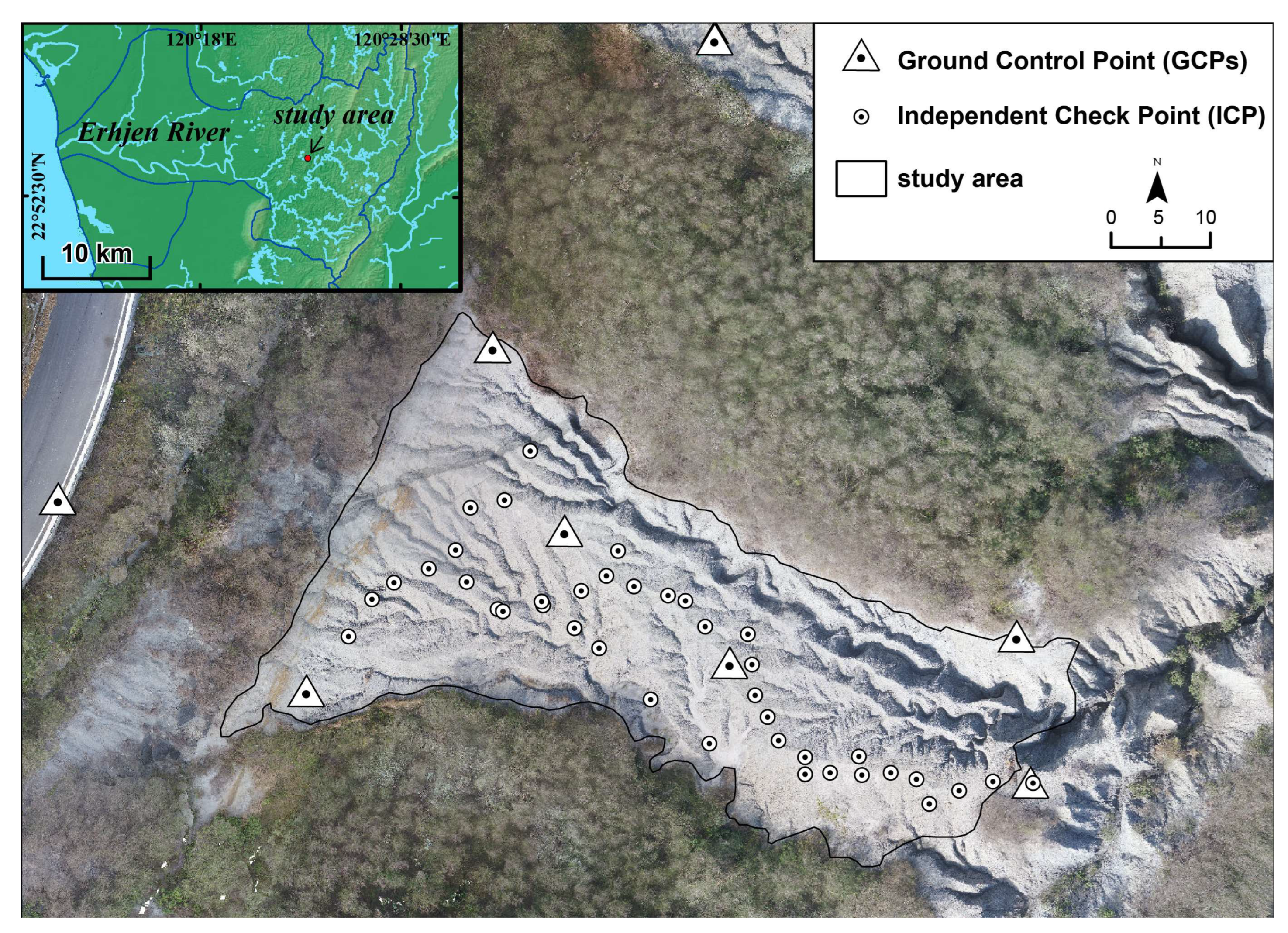
The study area is located in the upstream catchment of the Erren River in southwestern Taiwan (Figure 1), a region renowned for its rapid landscape evolution driven by active orogeny and intense tropical hydrometeorology [10,17]. Geologically, the area is underlain by the Plio–Pleistocene Gutingkeng Formation [47], a massive marine mudstone sequence with a thickness exceeding 4 km. The lithology is characterized by poor cementation, high clay mineral content (illite and chlorite), and high salinity, making it extremely susceptible to physicochemical weathering [7].
Tectonically, this region represents one of the most active sectors of the Taiwan mountain belt. Recent analysis of high-resolution topography indicates that badland distribution correlates strongly with rapid uplift rates, which exceed 7 mm yr−1 in the core of the study area [7,10]. This rapid tectonic forcing continually rejuvenates the landscape, maintaining steep slopes despite intense erosion.
Morphologically, the landscape is sculpted by a synergistic interplay of slaking and hydraulic erosion. The distinct wet and dry seasons drive intense physical weathering [8]. During dry periods, desiccation forms a network of shrinkage cracks and a loose, 2–5 cm thick “popcorn-like” crust on the surface [48]. Upon wetting, this regolith rapidly slakes into a cohesive paste, which is readily detached by rain splash and evacuated by surface runoff. These processes have created a rugged topography featuring knife-edge ridges, V-shaped gullies, and steep hillslopes often exceeding 30°.
The region exhibits a tropical monsoon climate, with an average annual precipitation of 2064 mm recorded at the Gutingkeng meteorological station (ID: 1660P003) [49]. Rainfall is highly seasonal, with approximately 89% (1846 mm) occurring during the wet season from May to September. Monthly precipitation rises sharply from 197 mm in May to a peak of 537 mm in August, while the dry season (October to April) receives less than 70 mm/month on average. Driven by this intense hydrological forcing and weak lithology, the Erren River basin exhibits one of the highest erosion rates in Taiwan (~65.0 mm yr−1), with an annual sediment discharge of approximately 30.2 Mt [50].
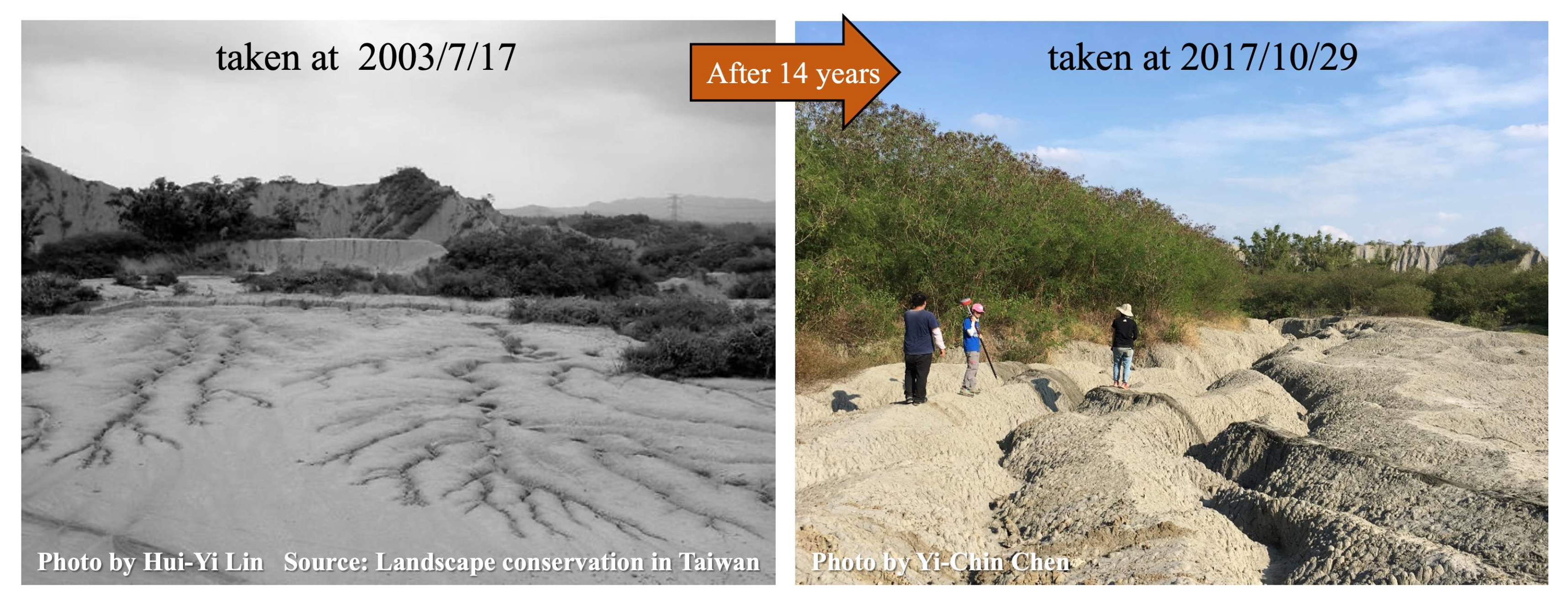
The specific study site is a mudstone badland platform covering an area of approximately 5000 m2 (Figure 1). The black polygon delineates the bareland area, covering 2004 m2, which serves as the focus area of this study. Originally excavated for land development prior to 2003 (Figure 2) [51], the site was subsequently abandoned without further anthropogenic intervention. This exposure subjected the bare mudstone surface to progressive erosion by intense rainfall and surface overland flow. Over time, fluvial processes transformed the platform into a miniature drainage basin characterized by well-developed dendritic gully networks, meandering channels, and distinct lateral and vertical incision. These geomorphic features provide an ideal setting for monitoring gully initiation, channel incision, and meander migration under the influence of seasonal monsoons and typhoon events.

2.2. UAV Surveys and Ground Control Points

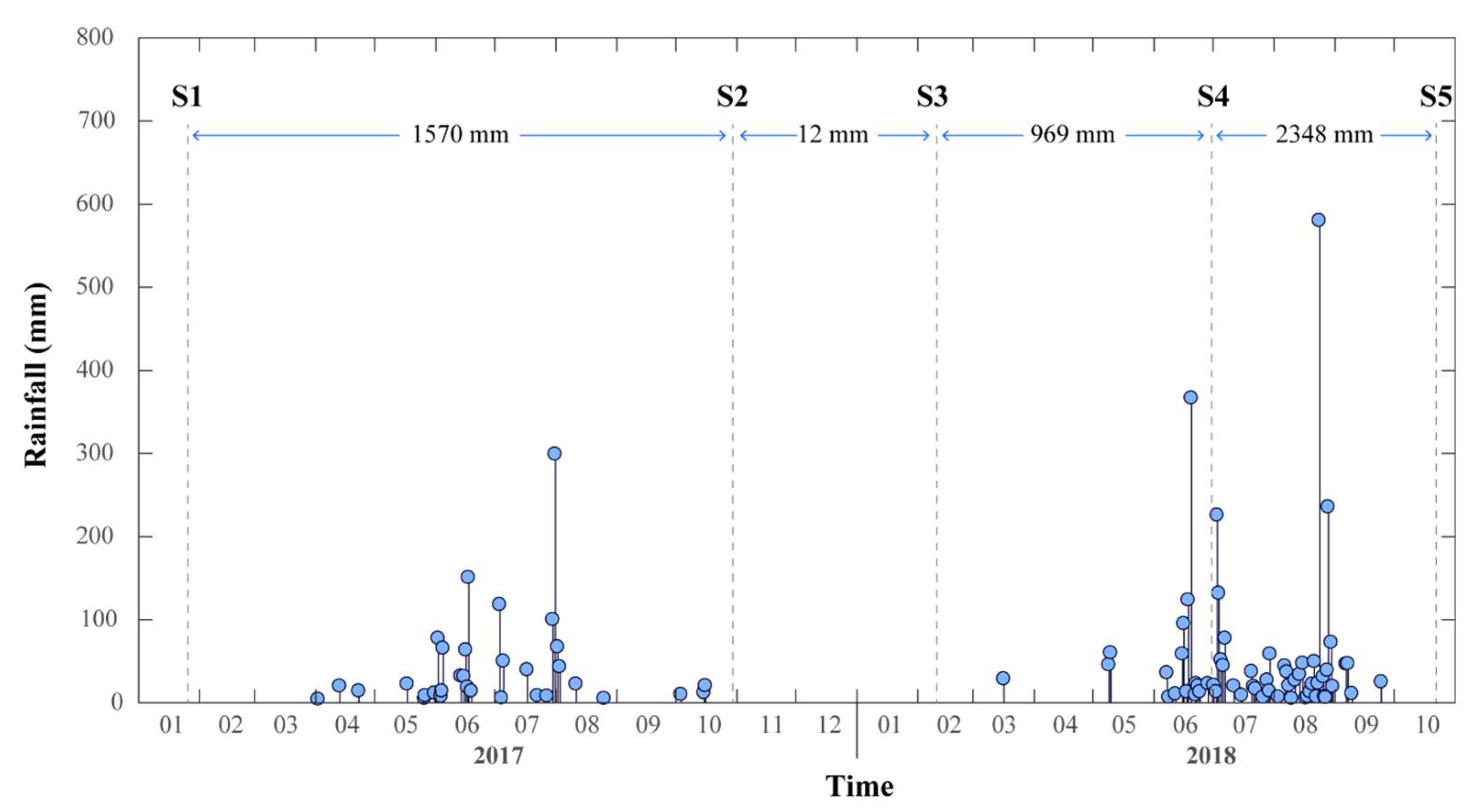
To quantify topographic changes, five UAV photogrammetric surveys were conducted between January 2017 and October 2018 to construct high-resolution DSMs of the mudstone platform (Table 1; Figure 3). The data acquisition campaigns were executed on 20 January 2017 (S1), 29 October 2017 (S2), 10 February 2018 (S3), 27 June 2018 (S4), and 19 October 2018 (S5). The monitoring period encompassed distinct high-intensity rainfall events, including Typhoon Nesat (28–30 July 2017), a heavy rainstorm on 19 June 2018, and a tropical depression event during 23–28 August 2018. This temporal design covered both dry and wet seasons, ensuring that the observed surface changes captured a wide spectrum of hydrological conditions and allowed for the isolation of erosion dynamics following individual high-intensity rainfall events.
UAV surveys were conducted using a DJI Phantom 3 Professional (DJI, Shenzhen, China) for the initial survey (S1) and a DJI Phantom 4 Professional for subsequent campaigns (S2–S5). The Phantom 3 Pro was equipped with a 12 MP camera (3820 × 2160 pixels), whereas the Phantom 4 Pro featured a higher-resolution 20 MP sensor (5472 × 3648 pixels). Flight missions followed a systematic grid pattern with >80% forward overlap and >60% side overlap to ensure comprehensive coverage. Operations were conducted at low altitudes (approximately 20–30 m above ground level), yielding ultra-high spatial resolution imagery with Ground Sampling Distances (GSDs) ranging from 0.51 to 0.94 cm.
To ensure geometric accuracy and consistent georeferencing across multi-temporal surveys, Ground Control Points (GCPs) were established prior to the initial survey (Figure 1). GCPs were marked using 18 cm stainless-steel nails with flat circular heads driven into the mudstone surface to withstand erosion. Their coordinates (Northing, Easting, Height) were measured using a Real-Time Kinematic (RTK) GNSS system, with one receiver operating as a base station on a stable paved road and the other as a rover. GCPs showing evidence of exposure or instability were re-installed and re-surveyed prior to each campaign using RTK-GNSS to ensure a consistent vertical reference. This setup achieved horizontal and vertical accuracies of approximately 1.2 cm and 1.9 cm, respectively. To correct for potential systematic biases, the previously established GCPs on the concrete road were re-measured before each campaign. Additionally, independent check points (ICPs) were surveyed directly on the mudstone surface using RTK-GNSS during all survey campaigns to facilitate rigorous accuracy validation.

2.3. SfM-MVS Process

The UAV image datasets were processed using Pix4Dmapper (v4.7.5, Pix4D S.A., Lausanne, Switzerland) to generate dense point clouds, DSMs, and orthophotos. This software implements Structure-from-Motion Multi-View Stereo (SfM-MVS) algorithms to reconstruct three-dimensional coordinates from overlapping image pairs [52]. Homologous key points were automatically identified using a Scale-Invariant Feature Transform (SIFT) algorithm, achieving a sub-pixel matching accuracy of approximately 0.3 pixels, which is sufficient for high-precision aerial triangulation [53].
To ensure geometric accuracy and correct georeferencing, the coordinates of the GCPs measured in the field were incorporated into the bundle adjustment process. This step simultaneously calibrated the camera interior and exterior orientation parameters, ensuring accurate model scaling and orientation. Subsequently, dense point clouds were generated and interpolated to produce high-resolution DSMs and orthophotos suitable for quantitative geomorphic analysis.
Model accuracy was assessed by comparing the derived DSM elevations with the RTK-measured coordinates of Independent Check Points (ICPs). The validation process involved overlaying the ICP coordinates onto the generated DSMs and calculating the elevation residuals. Since vertical uncertainty typically exceeds horizontal error in UAV photogrammetry and is critical for erosion quantification, the accuracy assessment focused primarily on the vertical (Z) component.

2.4. Uncertainty Analysis

To distinguish meaningful elevation changes from measurement noise in the DSMs of Difference (DoD), we applied a minimum level of detection (minLoD) threshold based on the probabilistic error propagation method [42,54]. Vertical uncertainty for each DoD was quantified using the root mean square error (RMSE) derived from ICPs and DSM alignment quality. The propagated error was calculated as
m i n L o D = t · δ z D S M , p r e 2 + δ z D S M , p s t 2
where t denotes the critical t-value corresponding to the chosen confidence level, and δ z D S M , p r e and δ z D S M , p s t represent vertical RMSEs of the pre- and post-event DSMs, respectively. In this study, a t-value of 1 (corresponding to a 68% confidence level) [55] as the primary uncertainty threshold. This threshold provides a robust statistical criterion while minimizing the risk of excluding real, low-magnitude topographic changes typical of sheet erosion (Type II errors). For comparison, results using a t-value of 1.96 (95% confidence level) [54] are also reported as Supplementary Information. DoD values within the minLoD were regarded as noise and excluded from subsequent statistical analyses. This approach ensures that the specific geometric quality of each survey is accurately reflected in the change detection threshold.

2.5. Topographic Analysis and Gully Morphology

To analyze the relationship between erosion and topographic factors on the badland, we derived two primary morphometric parameters: slope gradient and contributing area [1]. These calculations were performed using the high-resolution DSM from the final survey (S5), which was down-sampled to a uniform 1 cm grid using bilinear interpolation. The slope gradient was calculated based on the steepest descent method using the TauDEM module. The contributing area was estimated using the D-infinity (D-inf) algorithm [56], which partitions flow proportionally between downslope directions based on the flow angle. Unlike traditional single-flow-direction methods, the D-inf algorithm reduces artificial flow concentration (grid bias) and better represents divergent flow over convex hillslopes, resulting in a more realistic representation of drainage patterns in complex badland terrain.
Additionally, curvature provides a quantitative description of local surface geometry and plays a key role in regulating surface runoff pathways and erosion processes [21,22,23,24]. In this study, curvature analyses were conducted using the Curvature tool in ArcGIS Desktop 10.2, which computes second-order derivatives of elevation to describe surface shape. Plan curvature reflects the convergence or divergence of overland flow, with concave planforms promoting flow concentration and convex planforms favoring divergent and diffuse runoff [57]. In this study, negative plan curvature values indicate concave planform geometry associated with flow convergence, whereas positive values represent convex planform geometry corresponding to flow divergence. Profile curvature represents the curvature of the surface parallel to the direction of maximum slope and controls flow acceleration and deceleration along the slope. Negative profile curvature values denote convex profiles associated with flow acceleration, while positive values indicate concave profiles related to flow deceleration.

3. Results

3.1. Accuracy Assessment of DSMs

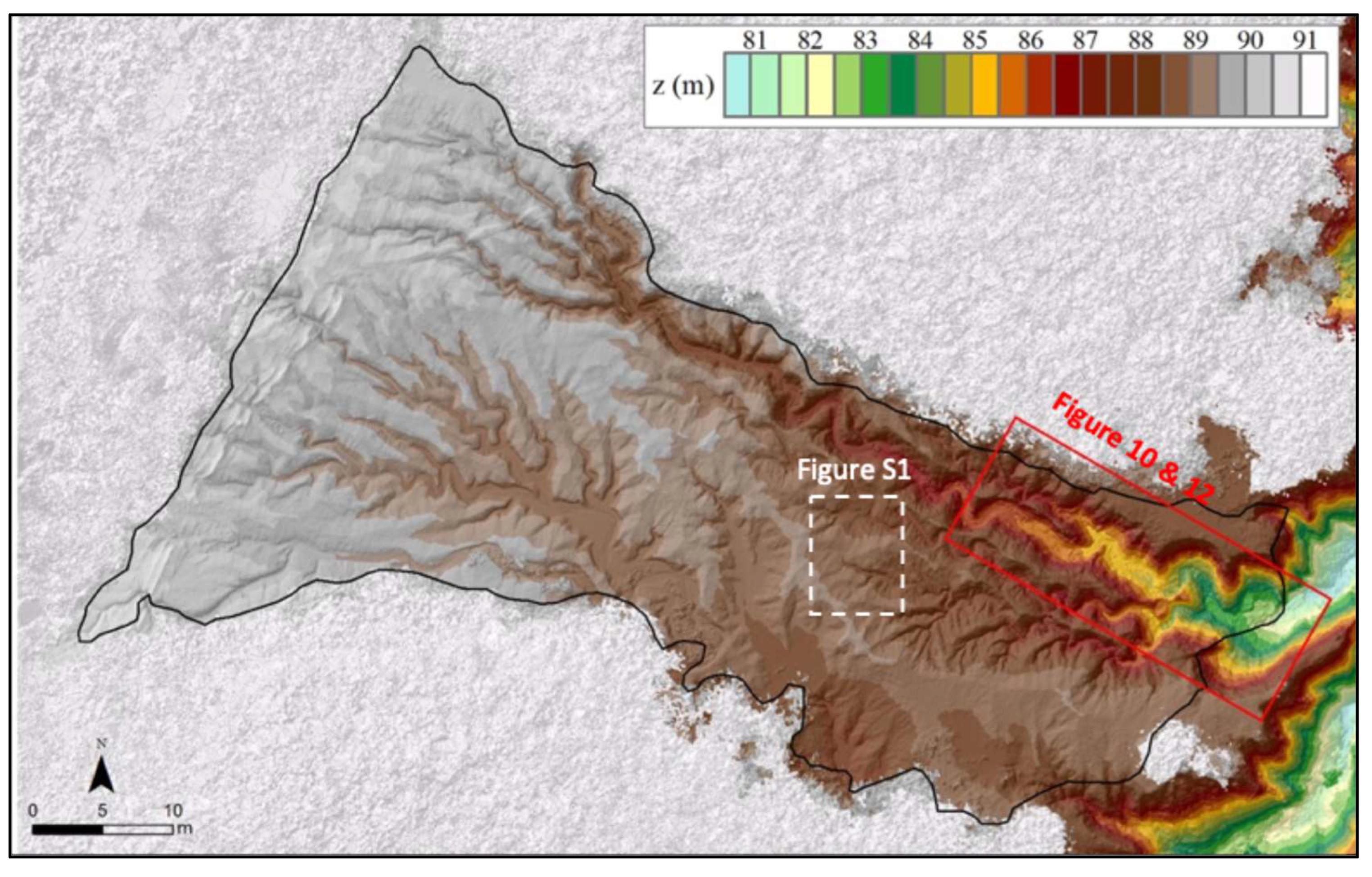
Figure 4 shows the digital surface model (DSM) derived from UAV photogrammetry acquired on 19 October 2018 (S5). Dense point clouds were generated for all five surveys, with point cloud density from 3839 pts/m2 in the initial survey (S1, 12 MP) to a peak of 44,587 pts/m2 in Survey S4 (S2–S5, 20 MP) (Table 2). High-resolution DSMs were generated from the dense point clouds, with GSD ranging from 0.51 to 0.94 cm (Table 2). Geometric accuracy, evaluated using both GCPs and ICPs, demonstrated consistent reliability. The initial survey (S1) yielded a vertical GCP RMSE of 6.2 cm and an ICP RMSE of 5.3 cm. Subsequent surveys (S2–S5), acquired with the upgraded sensor, achieved higher accuracy, with GCP RMSEs ranging from 0.8 to 5.0 cm and ICP RMSEs maintained between 1.8 and 4.3 cm. Owing to the lower point cloud density, the topography derived from S1 appears slightly smoother than that from Surveys S2–S5 (Figure S1). However, the magnitude of this difference is small relative to the observed topographic changes. Overall, these results confirm that all derived DSMs achieved centimeter-level accuracy and are suitable for robust quantitative analysis.
Based on these ICP uncertainties, the minimum level of detection (minLoD) thresholds were calculated to distinguish real topographic changes from measurement noise. Using a 68% confidence interval (t = 1), the specific thresholds for DoD in consecutive monitoring intervals were: 5.58 cm (S1–S2), 3.20 cm (S2–S3), 3.56 cm (S3–S4), and 4.94 cm (S4–S5). For the cumulative topographic change over the entire study period (S1–S5), the threshold was defined at 6.84 cm. For comparison, minLoD thresholds were also calculated using a 95% confidence interval (t = 1.96) and are reported as Supplementary Information. In both cases, DoD values within the minLoD were treated as noise and excluded from subsequent volumetric analyses. This approach ensures that the derived erosion metrics are robust to measurement uncertainty while retaining sensitivity to small but geomorphically meaningful changes.

3.2. Topographic Changes Driven by Rainfall Events

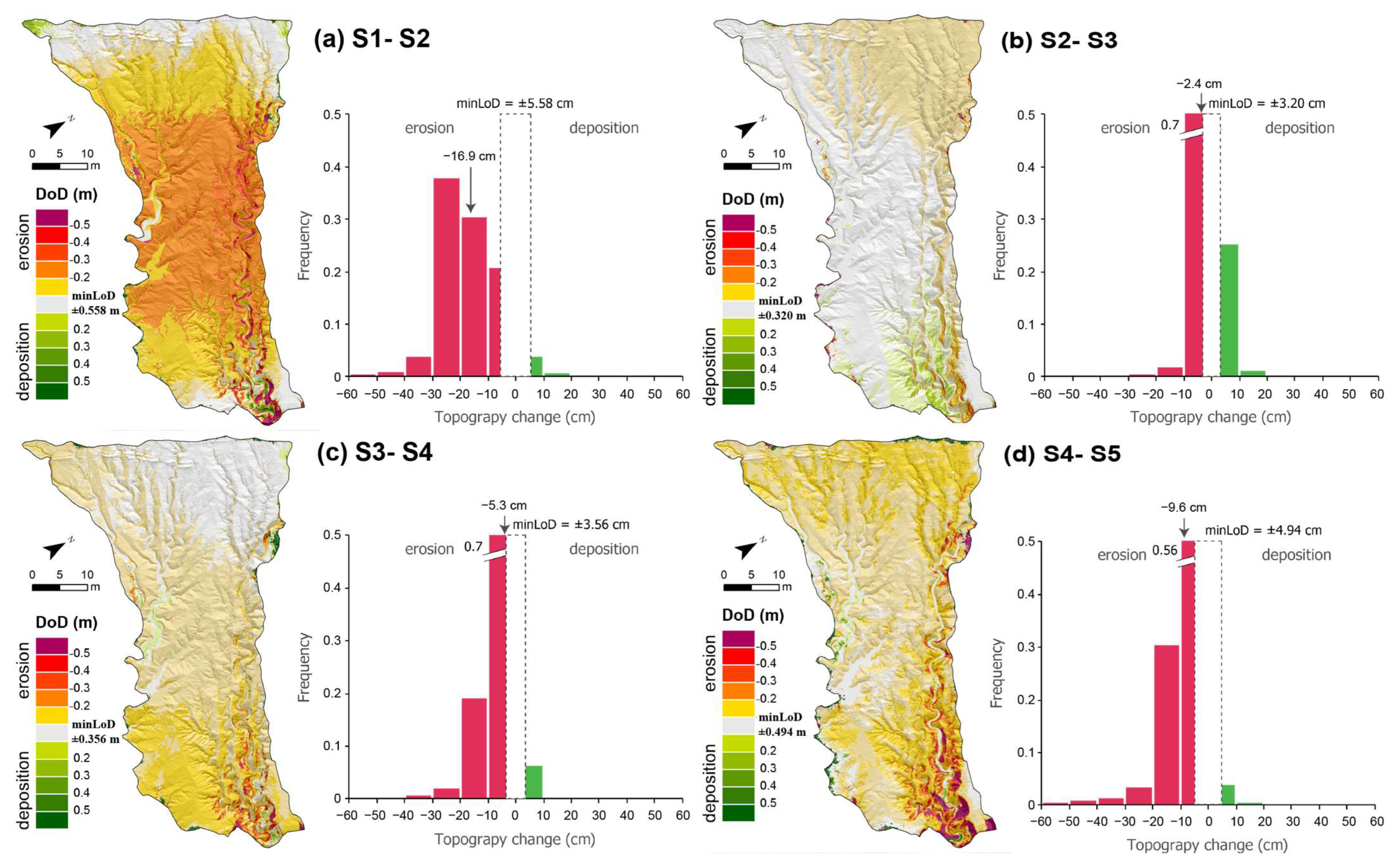
Topographic changes were quantified by generating DoDs for consecutive survey intervals (Figure 5). The spatial distribution of erosion and deposition, along with the frequency distribution of elevation changes, varied distinctly with hydrological forcing.
Period S1–S2 (Typhoon Event): The interval between 20 January and 29 October 2017 was dominated by Typhoon Nesat and subsequent heavy rainfall (cumulative precipitation: 1570 mm). This intense hydrological forcing triggered significant geomorphic changes. At the 68% confidence level, the average erosion depth of 16.9 cm significantly exceeded the corresponding minLoD of 5.6 cm, confirming widespread surface lowering. At the 95% confidence level, the average erosion depth of 21.3 cm likewise exceeded the corresponding minLoD of 11.0 cm. The northern gully exhibited the most intense incision, with vertical deepening exceeding 40 cm along valley flanks, while the southern gully showed comparatively lower erosion depths of 20–30 cm (Figure 5a).
Period S2–S3 (Dry Season): The subsequent period (29 October 2017–10 February 2018) corresponded to the dry season, characterized by negligible rainfall (12 mm). Consequently, geomorphic activity was minimal. The average surface lowering was 2.4 cm, which falls within the measurement uncertainty range (minLoD ≈ 3.20 cm at the 68% confidence level and ≈6.27 cm at 95 confidence level). At the 68% confidence level, only 43% of the pixels exhibited detectable changes (only 12% at the 95% confidence level), quantitatively confirming that the badland landscape remained stable in the absence of significant precipitation (Figure 5b).
Period S3–S4 (Meiyu Season): Erosion activity increased during the S3–S4 interval (10 February–27 June 2018), driven by the Meiyu frontal rainfall (969 mm). The average erosion depth rose to 5.3 cm. At the 68% confidence level, approximately 58% of the study area showed topographic changes exceeding the minLoD (≈3.56 cm). At the 95% confidence level, only 24% of the pixels exhibited detectable changes. Spatially, erosion was not uniform; high erosion rates were concentrated along the downstream cutbanks of the northern gully, whereas the southern gully exhibited localized deposition of 3–10 cm in its downstream reaches (Figure 5c).
Period S4–S5 (Tropical Storms): The final interval (27 June–19 October 2018) was influenced by multiple tropical depressions, resulting in the highest cumulative rainfall of 2348 mm. This period exhibited widespread and intense erosion, with an average depth of 9.6 cm. At the 68% confidence level, a significant portion of the platform (79% of pixels) showed detectable changes exceeding the minLoD (≈4.94 cm). At the 95% confidence level, only 18% of the pixels exhibited detectable changes. The frequency distribution indicates that while 56% of elevation changes were moderate (3–10 cm), 30% represented deep incision (10–20 cm). Intense gully widening (30–100 cm) continued along the northern gully margins, and headward rill erosion at gully heads reached depths of 10–15 cm (Figure 5d).
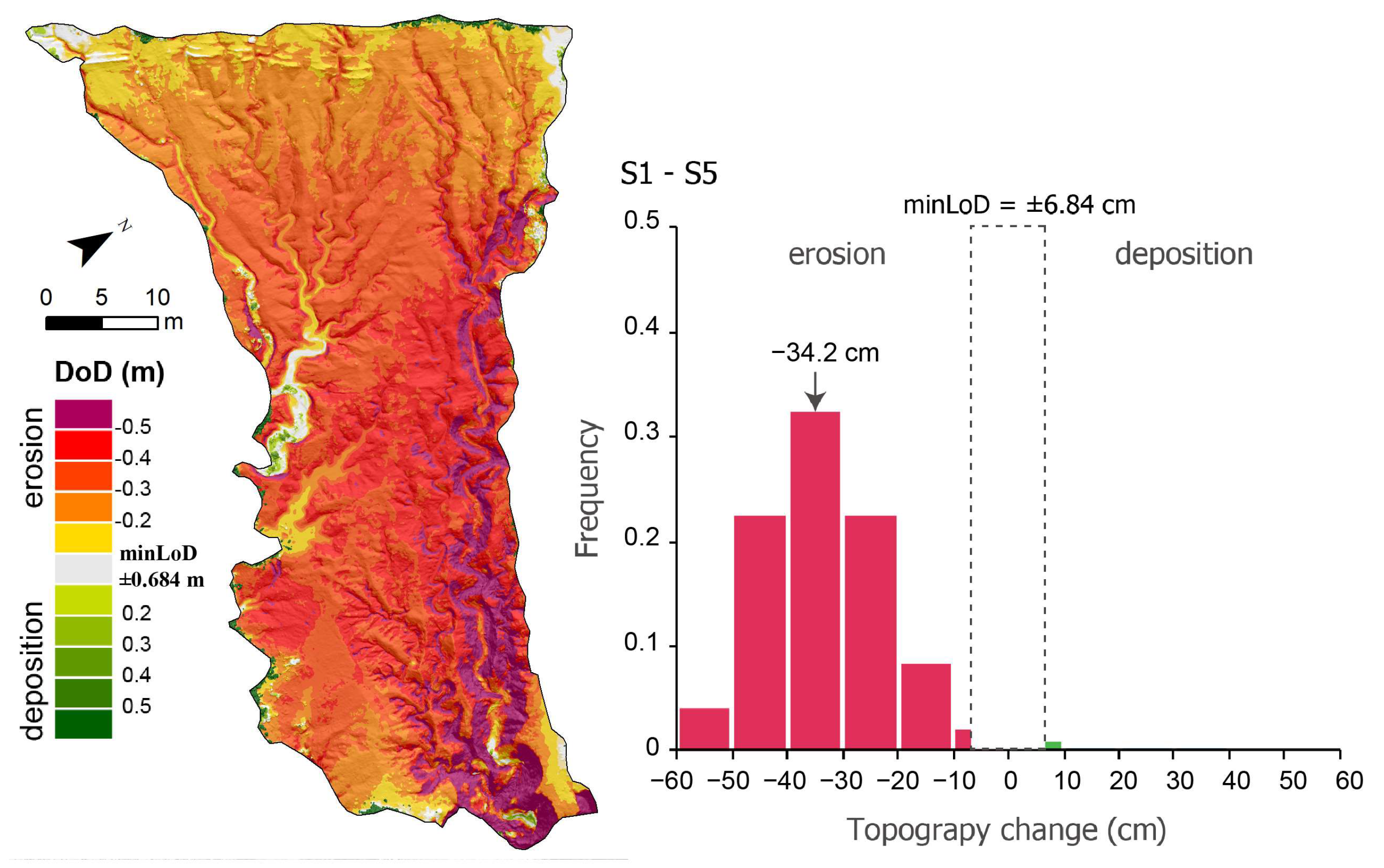
Period S1–S5 (total period): Over the entire 22-month monitoring period, the platform exhibited substantial net surface erosion (Figure 6). At the 68% confidence level, the mean erosion depth reached 34.2 cm, corresponding to an annual erosion rate of 18.7 cm yr−1. At the 95% confidence level, a similar mean erosion depth of 35.5 cm was obtained. The spatial pattern of erosion hotspots was strongly controlled by the development of the gully network and local base-level adjustments.

3.3. Topographic Factors on Erosion

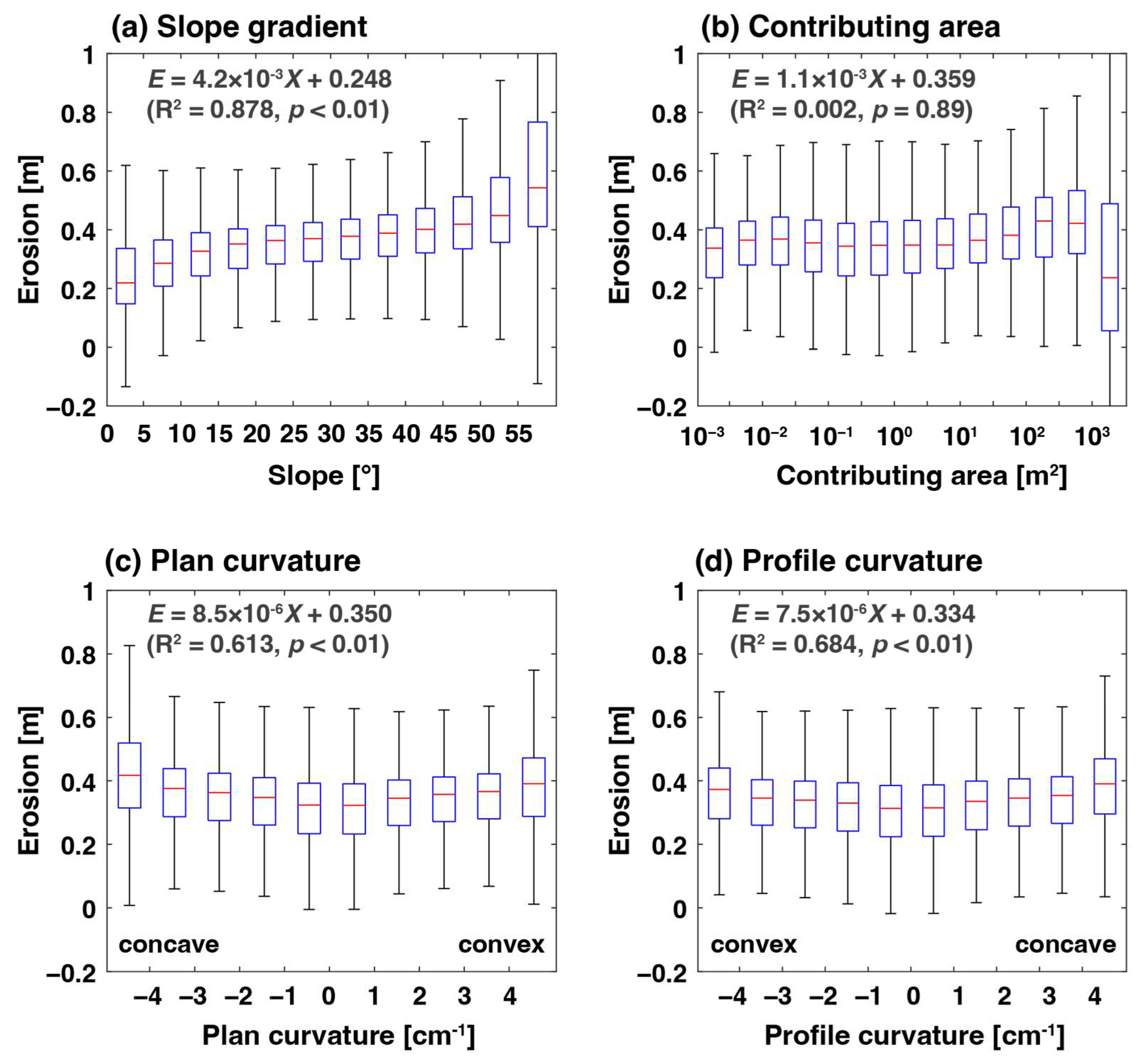
Figure 7 illustrates the statistical relationship between erosion depth and two primary topographic attributes: local slope gradient and contributing area. First, a robust positive correlation (R2 = 0.878, p < 0.01) is observed between erosion depth and slope gradient (Figure 7a). The median erosion depth increases monotonically from approximately 20 cm on gentle slopes (<5°) to over 40 cm on steep gradients (>45°). On average, erosion depth intensifies by ~4 cm for every 10° increase in slope. Furthermore, the variability of erosion magnitude, indicated by the expanding interquartile range, increases significantly on steeper slopes. This pattern mirrors the nonlinear erosion response observed in threshold hillslopes [58], where erosion rates become highly sensitive to small perturbations as gradients approach stability limits. This trend suggests that while steep gradients generally promote higher sediment detachment rates, they also host a wider spectrum of erosional behaviors depending on local micro-topography.
In contrast, the relationship between erosion depth and drainage contributing area exhibits a distinct decoupling (R2 = 0.002, p = 0.89) (Figure 7b). Although the contributing area spans six orders of magnitude (from 10−3 to 103 m2), the median erosion depth remains spatially uniform between 35 and 40 cm, showing no statistical dependence on flow accumulation. High erosion depths are frequently observed even in inter-rill areas with negligible contributing areas (<10−1 m2). Conversely, at larger contributing areas (>102 m2), which correspond to the main gully channels, the variance in erosion depth increases dramatically. This high variability may reflect the complex dual nature of gully morphodynamics.
The relationship between erosion depth and plan curvature reveals a statistically significant, moderate positive correlation (R2 = 0.613, p < 0.01) (Figure 7c). Plan curvature characterizes the convergence or divergence of overland flow, with negative values indicating concave planforms and positive values indicating convex planforms. The analysis demonstrates that surface geometry exerts an important control on erosion magnitude. A closer inspection of the boxplot distributions shows that both concave and convex slopes exhibit higher median erosion depths than planar (near-zero curvature) surfaces.
A similar pattern is observed for profile curvature, which also shows a statistically significant, moderate positive correlation with erosion depth (R2 = 0.684, p < 0.01) (Figure 7d). Profile curvature controls flow acceleration and deceleration along the slope direction. Although the regression analysis indicates a positive relationship, the boxplots reveal that both convex (negative values) and concave (positive values) profiles are associated with greater erosion depths relative to linear profiles. Convex profiles tend to accelerate flow and increase erosive power downslope, whereas concave profiles promote flow deceleration and sediment accumulation but are also prone to episodic mass wasting and sidewall collapse in gully environments.
In addition to the well-established controls of slope gradient and contributing area, both plan and profile curvature exert a measurable influence on the spatial distribution of erosion depth. Higher erosion depths are consistently observed on surfaces with pronounced concave or convex curvature in both planform and profile directions, whereas relatively linear slopes exhibit lower erosion depths. This contrast indicates that microtopographic variability, as captured by curvature metrics, modifies overland flow pathways and promotes localized enhancement of erosion.
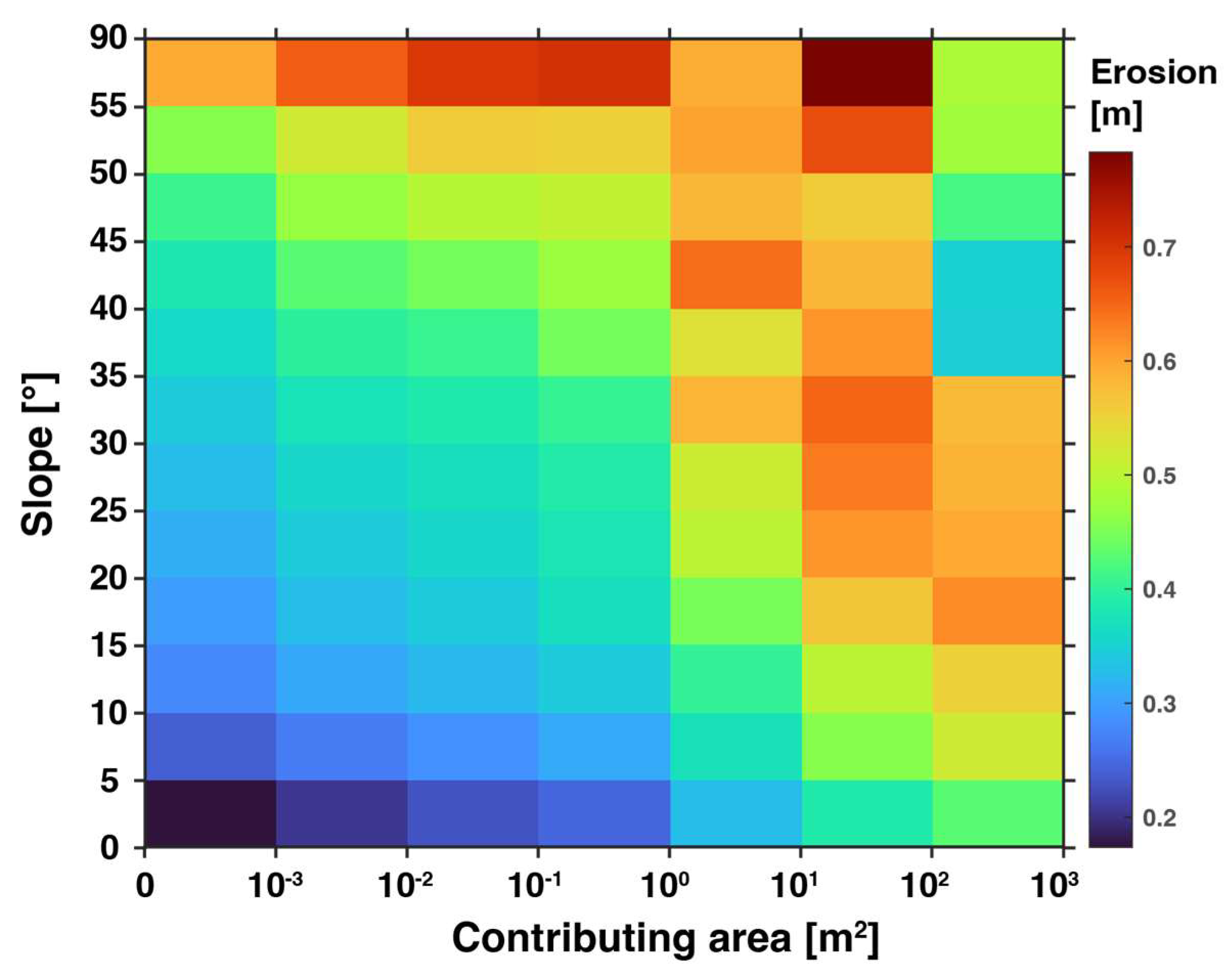
Figure 8 presents a matrix of spatially averaged erosion depths classified by local slope gradient and contributing area, revealing how these two topographic attributes interact to regulate erosion on mudstone badland. The spatial distribution of erosion magnitude indicates a dominant control of slope steepness. A pronounced vertical gradient is evident across the matrix, where erosion depth increases monotonically with slope gradient independent of contributing area, with the exception of the geomorphically rare domain characterized by both high slope and high contributing area. Gentle slopes (<15°) are generally characterized by minimal surface erosion (<0.3 m), whereas steep gradients (>45°) exhibit maximum erosion depths exceeding 0.7 m. This trend confirms that slope gradient is primarily a control on the detachment of surface on mudstone badland.
The influence of contributing area, however, exhibits a distinct regime-dependent pattern. In the hillslope domain (contributing area < 1 m2), erosion is strictly slope-dependent; low-gradient areas show minor erosion (≈0.2 m), suggesting that rain splash alone produces limited surface lowering on flat terrain. In contrast, within the gully domain (defined as contributing area > 1 m2), the erosion pattern shifts. As shown in the bottom-right sector of the matrix, moderate erosion depths (0.4–0.6 m) occur even on relatively gentle slopes (<20°). Notably, the zone of maximum erosion intensity progressively migrates toward gentler slopes as contributing area increases. This indicates that within the gully network, concentrated flow provides consistent hydraulic shear stress, enabling channel incision to persist even as the bed gradient decreases downstream.

4. Discussion

4.1. Erosion Rate on the Mudstone Badlands

This study used high-resolution UAV photogrammetry to quantify the rapid landscape evolution of a mudstone badland platform. Our results reveal an exceptionally high rate of geomorphic change: over the 22-month monitoring period, the platform exhibited a mean surface erosion of 34.2 cm, corresponding to an annual denudation rate of approximately 18.7 cm yr−1. These findings align with previous plot-scale studies, which have documented similarly rapid erosion rates ranging from 9 to 13 cm yr−1 [7,8,17]. The slightly higher rates observed in our study can be attributed to our monitoring period capturing multiple extreme rainfall events (including intense rainfall triggered by Typhoon Nesat and tropical depressions) and the inclusion of active gully incision zones, which erode faster than inter-rill hillslopes.
However, when compared to broader, catchment-scale estimates, our measured rates are significantly higher. Dadson et al. [50] estimated basin-wide erosion rates of 6.5 cm yr−1 to 8.1 cm yr−1 from the suspended sediment records in the downstream of the Erren River. This magnitude discrepancy highlights the scale-dependency of erosion measurements [32]. Catchment-scale values represent a spatial average that includes vegetated, stable terrains and depositional sinks [11], which dilute the signal of extreme erosion. In contrast, our UAV monitoring focused exclusively on a bare, unvegetated badland hotspot. This demonstrates that badland landscapes act as a critical sediment source area, producing sediment yields nearly 2–3 times higher than the catchment-wide average.
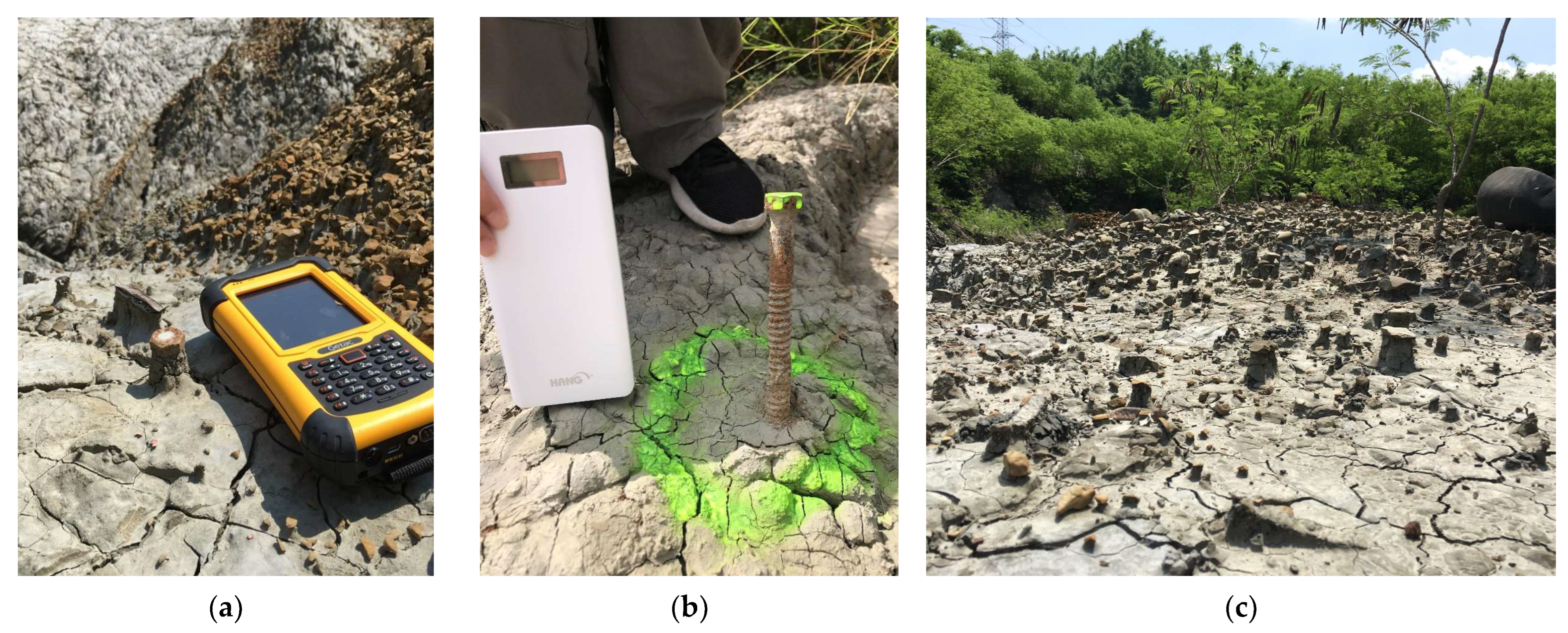
Furthermore, the validity of these high erosion rates is corroborated by direct field evidence (Figure 9). The progressive exposure of GCPs (18 cm steel reinforcement bars), which protruded by approximately 4–5 cm at the time of survey S4 (Figure 9a) and up to 12 cm by survey S5 (Figure 9b), provides tangible physical proof of rapid surface erosion. This physical observation confirms that the topographic changes detected by UAV photogrammetry represent genuine morphological evolution rather than measurement artifacts. This phenomenon of GCP exhumation offers critical insight into the dominant erosion mechanisms on hillslopes. Since most GCPs were installed on ridge crests and inter-rill areas, where overland flow accumulation is negligible, their substantial vertical exposure (up to 12 cm) cannot be attributed to concentrated gully incision. Instead, it highlights the pervasive role of rain splash as a primary denudation agent in these upstream zones.
Field observations further corroborate this mechanism. As shown in Figure 9c, the differential erosion between soft mudstone and resistant sandstone clasts has led to the formation of erosion pedestals (earth pillars) [59], indicating that raindrop impact energy actively detaches exposed mudstone while sandstone caps provide localized shielding. Quantitative analysis reveals that these rain-splash-dominated zones, where sheet and rill flows are absent, exhibited an average erosion depth of 26.0 ± 2.6 cm. By defining areas with erosion magnitudes falling within this range as the rain-splash zone, which occupies approximately 20.3% of the study area, we estimate that these specific zones contribute 18.5% of the total eroded volume. Furthermore, assuming that rain splash operates as a widespread background process causing a uniform surface erosion (~26.0 cm) across the entire study area, it would account for approximately 53% of the total sediment supply. This finding highlights the substantial contribution of rain splash in high-intensity rainfall environments, establishing it as a principal driver of denudation capable of stripping the landscape surface prior to runoff concentration.
To evaluate the reliability of the detected erosion patterns, the geometric accuracy of each UAV survey was assessed using both ground control points (GCPs) and independent check points (ICPs). The initial survey (S1) achieved vertical RMSEs of 6.2 cm for GCPs and 5.3 cm for ICPs, while subsequent surveys (S2–S5) showed improved accuracy, with GCP RMSEs ranging from 0.8 to 5.0 cm and ICP RMSEs between 1.8 and 4.3 cm. A 68% probabilistic minLoD threshold was applied in the DoD analysis to filter elevation changes attributable to measurement uncertainty. Given that the observed mean erosion (34.2 cm) substantially exceeds the vertical uncertainties, and that topographic patterns are temporally consistent across multiple survey intervals (Figure S1), a commonly used criterion for assessing the reliability of multi-temporal DSMs [60]. The detected elevation changes are therefore interpreted as representing genuine erosion processes rather than processing artifacts, providing a robust basis for subsequent analyses of erosion patterns and controlling topographic factors.

4.2. Morphological Dynamics of Gully Network

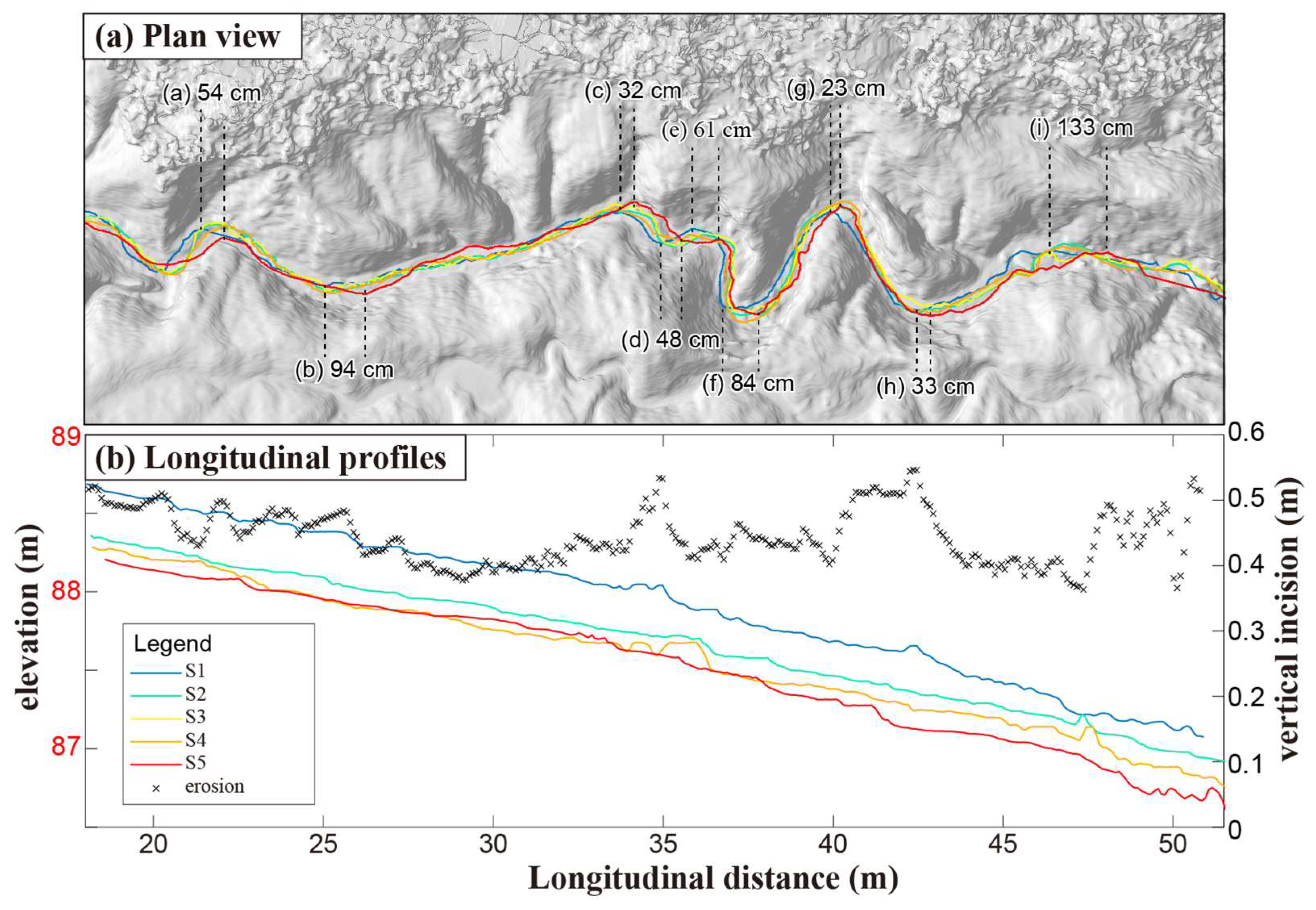
The spatial and temporal evolution of the gully network reveals that erosion in mudstone badlands is governed by complex channel dynamics that extend beyond simple slope-dependent detachment. By tracking the gully thalweg, extracted from multi-temporal DSMs using a single-flow direction algorithm, we quantified the rapid morphological shifts in the channel system. As shown in Figure 10a, the gully network exhibits a meandering pattern that mimics alluvial rivers but evolves at a highly accelerated rate. The analysis of thalweg trajectories from S1 to S5 reveals a distinct downstream migration of meander bends. The migration distances of individual bends ranged from 23 to 133 cm, with an average downstream shift of 62 cm over the 22-month period. This indicates that the gully system exhibits transient behavior, actively translating downstream rather than maintaining a stable configuration.
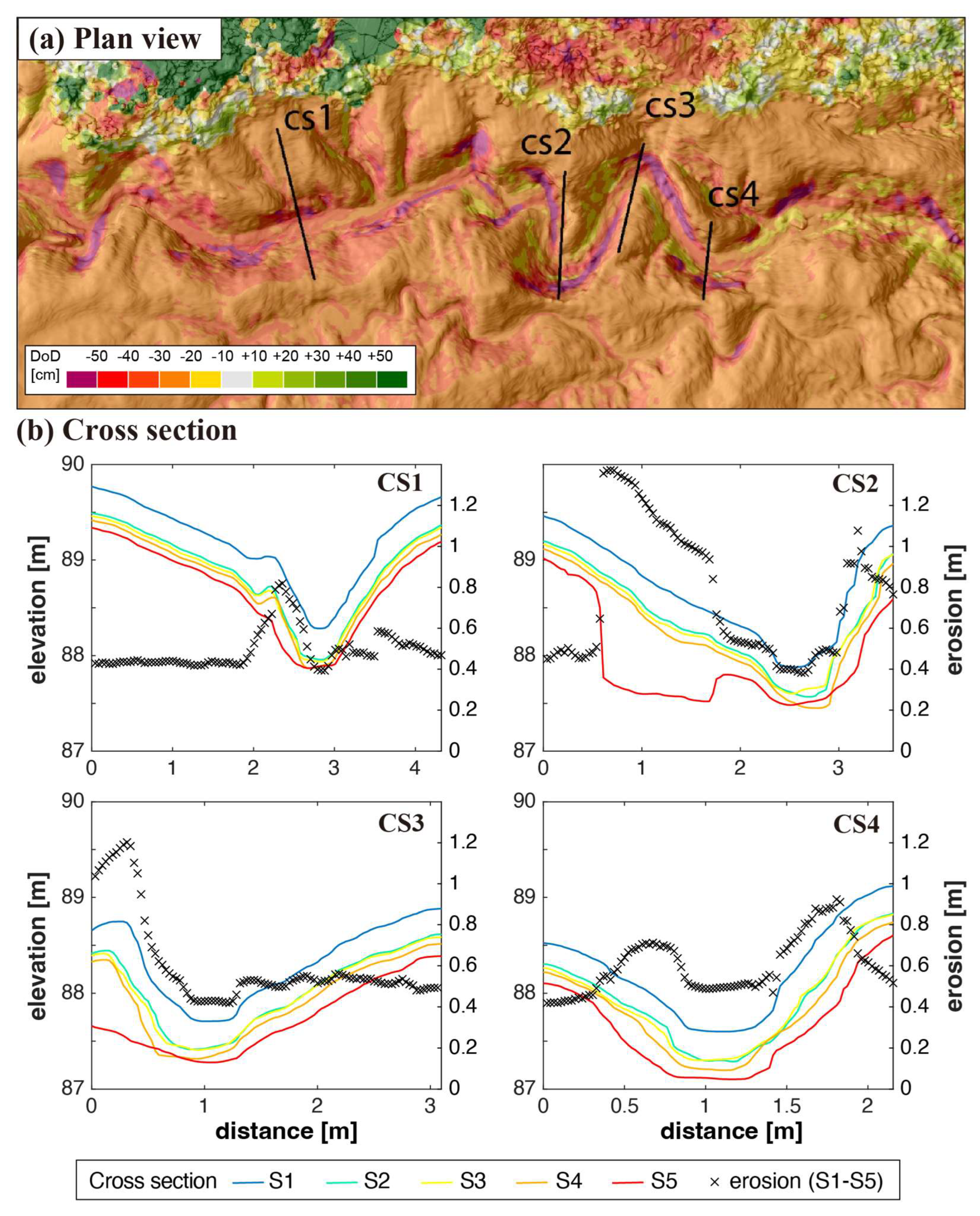
This migration is driven by intense lateral erosion, as evidenced by the spatial distribution of erosion hotspots (Figure 11a). The highest erosion rates (50–120 cm) are concentrated along the concave outer banks of meanders. Cross-sectional analysis (Figure 11b) further reveals that erosion is not limited to the outer bends; while concave banks exhibit high-magnitude material loss, convex banks also undergo moderate erosion. This pattern suggests that the channel evolution is driven by basal undercutting, which destabilizes steep channel banks and triggers subsequent block failures [61]. These findings highlight that lateral migration and bank collapse are critical erosion mechanisms in mudstone badlands, processes often overlooked in models that focus solely on vertical incision.
This discrepancy, characterized by a stable erosion depth despite increasing contributing area (Figure 10b), aligns with the fundamental slope-area scaling relationship observed in equilibrated fluvial systems [62]. As evidenced in Figure 8, the zone of maximum erosion intensity progressively migrates toward gentler slopes as the contributing area increases. This pattern indicates a morphometric self-adjustment governed by the stream power incision model, where erosion rate (E) is a function of both drainage area (A) and channel gradient (S) (EAm × Sn) [1,63]. In our study area, the downstream increase in discharge (represented by contributing area) is effectively counterbalanced by the simultaneous reduction in channel gradient. Consequently, the potential increase in erosive energy is offset by the decrease in slope gradient, resulting in a relatively uniform distribution of vertical incision depth throughout the gully network. This suggests that the badland gully system has rapidly adjusted towards a state of dynamic equilibrium, leading to the observed decoupling between erosion magnitude and contributing area.
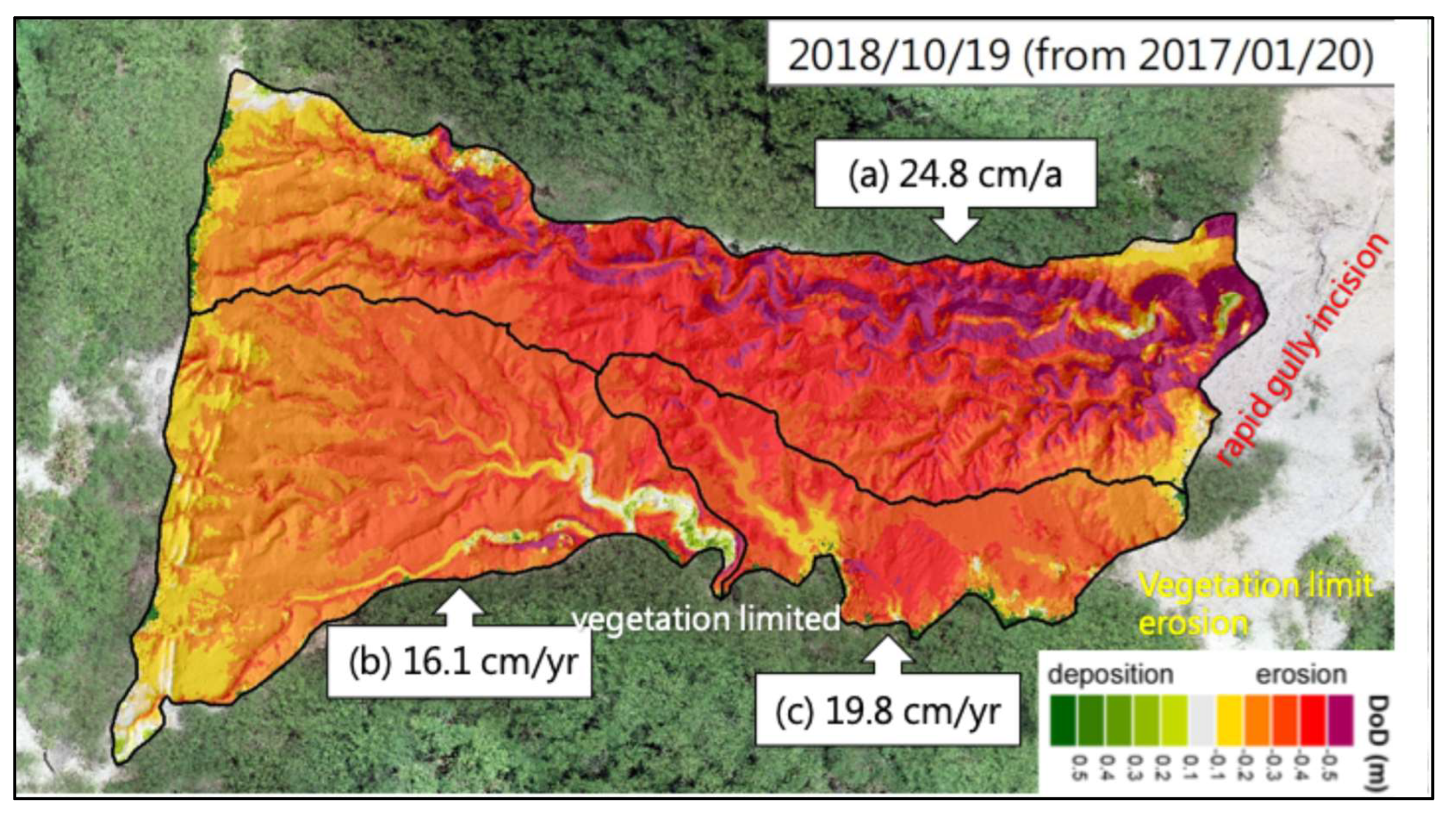
Finally, the spatial heterogeneity of erosion rates across the platform highlights the dominant control of the local base level. As illustrated in Figure 12, the study area can be divided into three sub-catchments (a–c) based on their downstream boundary conditions, resulting in distinct erosional responses:
  • Watershed (a): This largest sub-catchment connects directly to the rapidly incising main channel, providing the lowest local base level. Devoid of vegetation barriers, it exhibits the highest average erosion rate of 24.8 cm yr−1, driven by downstream channel incision.
  • Watershed (b): Although the second largest in area, its outlet is obstructed by dense vegetation. This creates a raised local base level that impedes sediment export and promotes localized deposition in the downstream reaches. Consequently, this watershed shows the lowest erosion rate of 16.1 cm yr−1, demonstrating how vegetation can decouple upstream production from downstream export.
  • Watershed (c): This intermediate watershed drains near the active gully zone but is partially constrained by vegetation. It exhibits an intermediate erosion rate of 19.8 cm yr−1.
These findings demonstrate that landscape denudation in mudstone badlands is not solely a function of local topographic attributes (slope, contributing area, and curvature) but is significantly regulated by the connectivity to the downstream base level. The transmissivity of base-level signals, whether facilitated by open channels or dampened by vegetation, determines the overall pace of landscape lowering. Therefore, effective erosion modeling in such environments must account for these systemic boundary conditions. This behavior is consistent with the catchment-scale observations of Vergari et al. [64], who showed that reductions in hillslope–channel connectivity following land reclamation substantially suppressed sediment delivery and altered long-term landscape evolution in Mediterranean badlands.
The results indicate that measurable surface erosion of approximately 20 mm occurs even in low-slope areas with negligible contributing area, accounting for about 53% of the total erosion. This background erosion is primarily driven by rain splash and diffuse hillslope processes, and is independently confirmed by the exhumation of 18 cm stainless-steel erosion pins and the formation of earth pillar landforms. Such diffuse hillslope erosion cannot be effectively mitigated by gully-blocking interventions alone. However, as shown in Figure 12, disrupting base-level connectivity through gully-blocking measures can substantially reduce gully erosion by limiting channel incision and lateral erosion. Together, these results demonstrate that while gully-blocking interventions are effective for suppressing channel-driven erosion, they must be complemented by hillslope surface treatments, such as vegetation restoration or surface protection, to address the dominant contribution from rain splash–driven erosion processes.
Despite the high spatiotemporal resolution achieved in this study, several limitations should be acknowledged. First, the monitoring period covers less than two years, which may not fully capture longer-term erosion dynamics. Second, the analysis focuses on a single mudstone badland platform, and caution is required when extrapolating the results to other badland settings with different topographic, lithological, or climatic conditions. Third, the absence of direct measurements of overland flow limits the ability to quantitatively link observed erosion patterns to specific hydrological drivers. Future research should therefore extend the monitoring duration, incorporate in situ hydrological observations, and apply similar UAV-based approaches across multiple badland sites to improve process understanding.

5. Conclusions

This study demonstrates the efficacy of UAV-based photogrammetry for monitoring rapid landscape evolution in mudstone badlands, achieving centimeter-level resolution that was physically validated using GCPs, ICPs, and field observations. Over the 22-month monitoring period, the platform exhibited a substantial mean surface erosion of 34.2 cm, equivalent to 18.7 cm yr−1. This intense erosion is driven by a synergistic regime where widespread rain splash operates as a dominant background process (contributing ≈53% of sediment yield), while concentrated flow drives localized but deep gully erosion.
Spatial analysis confirms that erosion magnitude is primarily controlled by local topography, exhibiting a robust nonlinear dependence on slope gradient. Consistent with the behavior of threshold hillslopes, erosion depth increases nonlinearly with steepness. In contrast, a fundamental decoupling is observed with contributing area; despite the expanding drainage network, erosion depth shows no significant correlation with flow accumulation. This decoupling suggests that downstream increases in discharge are counterbalanced by concurrent reductions in channel gradient. Plan and profile curvature further influence the spatial pattern of erosion depth, with higher erosion observed on both strongly concave and convex surfaces compared to near-linear slopes. Overall, these morphometric adjustments suggest that the gully network is evolving toward dynamic equilibrium, maintaining relatively uniform incision depths. Together, these results indicate that microtopographic configuration, rather than drainage area alone, plays a critical role in governing erosion intensity and spatial variability in mudstone badlands.
The gully network exhibits pronounced morphological dynamics, characterized by rapid downstream meander migration averaging 62 cm over the 22 months and intense lateral undercutting along concave banks. Importantly, variations in erosion rates among sub-watersheds demonstrate that landscape denudation is strongly influenced by connectivity to the local base level. Watersheds connected to rapidly incising main channels exhibited the highest erosion rates, whereas those obstructed by vegetation barriers showed reduced erosion due to a raised local base level, demonstrating that downstream boundary conditions play a critical role in modulating the overall pace of badland erosion. This highlights the role of gully base-level connectivity in mediating sediment transfer and regulating the overall pace of badland erosion.
The findings of this study have implications for watershed management and land degradation mitigation in the region characterized by mudstone badland. The quantified erosion rates and identified controls on gully expansion provide a practical basis for identifying erosion hotspots and prioritizing mitigation measures, such as vegetation restoration or sediment control strategies, and for improving the spatial representation of erosion processes in process-based or spatially distributed erosion models. Moreover, the UAV-based monitoring framework offers a cost-effective and transferable tool for supporting erosion risk assessment and adaptive land management in rapidly evolving landscapes.

Supplementary Materials

The following supporting information can be downloaded at: https://www.mdpi.com/article/10.3390/w18020234/s1, Figure S1: Hillshaded DSMs for Surveys S1–S5 and the corresponding DoD between S1 and S5.

Funding

This research was supported by a grant from the National Science and Technology Council (MOST 105-2119-M-018-002 and MOST 106-2119-M-018-003).

Data Availability Statement

The data presented in this study are available on request from the corresponding author due to ongoing research and the continuous expansion of the dataset.

Acknowledgments

The author thanks Cing-Jia Lin, Chao-Jung Chiang, and En-Ru Liu for their assistance with field surveys and data acquisition. The author thanks Hui-Yi Lin for providing photograph. The authors appreciate the anonymous reviewers for their critical reviews and constructive comments.

Conflicts of Interest

The author declares no conflicts of interest. The funders had no role in the design of the study; in the collection, analyses, or interpretation of data; in the writing of the manuscript; or in the decision to publish the results.

Abbreviations

The following abbreviations are used in this manuscript:
SfM-MVSStructure-from-Motion Multi-View Stereo
GCPGround Control Point
IGPindependent check point
minLoDminimum level of detection
DoDDSMs of Difference
RMSEroot mean square error

References

  1. Howard, A.D.; Kerby, G. Channel changes in badlands. Geol. Soc. Am. Bull. 1983, 94, 739–752. [Google Scholar] [CrossRef]
  2. Davis, W. The convex profile of bad-land divides. Science 1892, 20, 245. [Google Scholar] [CrossRef]
  3. Smith, M.W.; Vericat, D. From experimental plots to experimental landscapes: Topography, erosion and deposition in sub-humid badlands from Structure-from-Motion photogrammetry. Earth Surf. Process. Landf. 2015, 40, 1656–1671. [Google Scholar] [CrossRef]
  4. Phillips, C.P. The badlands of Italy: A vanishing landscape? Appl. Geogr. 1998, 18, 243–257. [Google Scholar] [CrossRef]
  5. Majhi, A.; Harris, A.; Evans, M.; Shuttleworth, E. Gullies and badlands of India: Genesis, geomorphology and land management. Earth Surf. Process. Landf. 2024, 49, 82–107. [Google Scholar] [CrossRef]
  6. Ghosh, R.; Srivastava, P.; Kumar, K.; Yadav, M.; Sharma, A. Control on the evolution of badlands and their erosional dynamics, Central Narmada Basin, India. Catena 2024, 238, 107867. [Google Scholar] [CrossRef]
  7. Higuchi, K.; Chigira, M.; Lee, D.-H. High rates of erosion and rapid weathering in a Plio-Pleistocene mudstone badland, Taiwan. Catena 2013, 106, 68–82. [Google Scholar] [CrossRef]
  8. Yang, C.-J.; Turowski, J.M.; Hovius, N.; Lin, J.-C.; Chang, K.-J. Badland landscape response to individual geomorphic events. Nat. Commun. 2021, 12, 4631. [Google Scholar] [CrossRef]
  9. Schumm, S.A. Evolution of drainage systems and slopes in badlands at Perth Amboy, New Jersey. Geol. Soc. Am. Bull. 1956, 67, 597–646. [Google Scholar] [CrossRef]
  10. Yang, C.-J.; Turowski, J.M.; Gailleton, B.; Tseng, C.-W.; Chao, C.-M.; Chuang, R.Y. Badland distribution as a marker of rapid tectonic activity. Sci. Rep. 2025, 15, 15912. [Google Scholar] [CrossRef]
  11. Yang, C.-J.; Tsai, C.-H.; Lin, Y.-T. Anthropogenic disruption of sediment connectivity by embankment dams in the fast-eroding badland basin. Geomorphology 2025, 488, 109981. [Google Scholar] [CrossRef]
  12. Majhi, A.; Bhattacharjee, P.; Harris, A.; Evans, M.; Shuttleworth, E. Gully erosion is a serious obstacle in India’s land degradation neutrality mission. Sci. Rep. 2025, 15, 6384. [Google Scholar] [CrossRef]
  13. Nadal-Romero, E.; Torri, D.; Yair, A. Updating the badlands experience. Catena 2013, 106, 1–3. [Google Scholar] [CrossRef]
  14. Vergari, F.; Della Seta, M.; Del Monte, M.; Barbieri, M. Badlands denudation “hot spots”: The role of parent material properties on geomorphic processes in 20-years monitored sites of Southern Tuscany (Italy). Catena 2013, 106, 31–41. [Google Scholar] [CrossRef]
  15. Avcıoğlu, A.; Kašanin-Grubin, M.; Antić, N.; Moreno de las Heras, M.; Mohammadi, A.; Schwanghart, W.; Yetemen, O.; Tosti, T.; Dojčinović, B.; Görüm, T. How does climate seasonality influence weathering processes in badland landscapes? Catena 2024, 243, 108136. [Google Scholar] [CrossRef]
  16. Antić, N.; Kašanin-Grubin, M.; Bertalan, L.; Gajić, V.; Kaluđerović, L.; Mijatović, N.; Jovančićević, B. Are volcaniclastics bad enough to make badlands? Catena 2024, 246, 108448. [Google Scholar] [CrossRef]
  17. Yang, C.-J.; Yeh, L.-W.; Cheng, Y.-C.; Jen, C.-H.; Lin, J.-C. Badland Erosion and Its Morphometric Features in the Tropical Monsoon Area. Remote Sens. 2019, 11, 3051. [Google Scholar] [CrossRef]
  18. Torra, O.; Puig-Polo, C.; Hürlimann, M.; Latron, J. Analysis of erosive processes and erosion rate by in-situ measurements and multi-temporal TLS surveys in a mountainous badland area, Vallcebre (Spain). Catena 2025, 249, 108622. [Google Scholar] [CrossRef]
  19. Piccarreta, M.; Prosser, G.; Bentivenga, M. Morphometric Analysis and Evolutionary Implications of Badland Basins in Southern Italy. Water 2026, 18, 107. [Google Scholar] [CrossRef]
  20. Guida, G.; Nicosia, A.; Palmeri, V.; Ferro, V. Evaluating the effect of the actual eroded badland area on the estimate of eroded volume in Italian calanchi areas. Land Degrad. Dev. 2024, 35, 4081–4092. [Google Scholar] [CrossRef]
  21. Stefano, C.D.; Ferro, V.; Porto, P.; Tusa, G. Slope curvature influence on soil erosion and deposition processes. Water Resour. Res. 2000, 36, 607–617. [Google Scholar] [CrossRef]
  22. Hurst, M.D.; Mudd, S.M.; Walcott, R.; Attal, M.; Yoo, K. Using hilltop curvature to derive the spatial distribution of erosion rates. J. Geophys. Res. Earth Surf. 2012, 117, F02017. [Google Scholar] [CrossRef]
  23. Clubb, F.J.; Mudd, S.M.; Attal, M.; Milodowski, D.T.; Grieve, S.W.D. The relationship between drainage density, erosion rate, and hilltop curvature: Implications for sediment transport processes. J. Geophys. Res. Earth Surf. 2016, 121, 1724–1745. [Google Scholar] [CrossRef]
  24. Struble, W.T.; Clubb, F.J.; Roering, J.J. Regional-scale, high-resolution measurements of hilltop curvature reveal tectonic, climatic, and lithologic controls on hillslope morphology. Earth Planet. Sci. Lett. 2024, 647, 119044. [Google Scholar] [CrossRef]
  25. Heimsath, A.M.; Dietrich, W.E.; Nishiizumi, K.; Finkel, R.C. The soil production function and landscape equilibrium. Nature 1997, 388, 358–361. [Google Scholar] [CrossRef]
  26. Montgomery, D.R.; Dietrich, W.E. A physically based model for the topographic control on shallow landsliding. Water Resour. Res. 1994, 30, 1153–1171. [Google Scholar] [CrossRef]
  27. Bryan, R.; Yair, A. Badland Geomorphology and Piping; Geo Books: Norwich, UK, 1982; p. 408. [Google Scholar]
  28. Olivier, G.; Van De Wiel, M.J.; De Clercq, W.P. Intersecting views of gully erosion in South Africa. Earth Surf. Process. Landf. 2023, 48, 119–142. [Google Scholar] [CrossRef]
  29. Palmeri, V.; Di Stefano, C.; Guida, G.; Nicosia, A.; Ferro, V. Monitoring the temporal evolution of a Sicilian badland area by unmanned aerial vehicles. Geomorphology 2024, 466, 109443. [Google Scholar] [CrossRef]
  30. Kearney, S.P.; Fonte, S.J.; García, E.; Smukler, S.M. Improving the utility of erosion pins: Absolute value of pin height change as an indicator of relative erosion. Catena 2018, 163, 427–432. [Google Scholar] [CrossRef]
  31. Gholami, V.; Sahour, H.; Amri, M.A.H. Soil erosion modeling using erosion pins and artificial neural networks. Catena 2021, 196, 104902. [Google Scholar] [CrossRef]
  32. Nadal-Romero, E.; Martínez-Murillo, J.F.; Vanmaercke, M.; Poesen, J. Scale-dependency of sediment yield from badland areas in Mediterranean environments. Prog. Phys. Geogr. Earth Environ. 2011, 35, 297–332. [Google Scholar] [CrossRef]
  33. Beach, T. Estimating soil loss from medium-size drainage basins. Phys. Geogr. 1992, 13, 206–224. [Google Scholar] [CrossRef]
  34. Normand, J.C.L.; Heggy, E. Measuring soil moisture change and surface erosion from sparse rainstorms in hyper-arid terrains. Int. J. Appl. Earth Obs. Geoinf. 2025, 142, 104642. [Google Scholar] [CrossRef]
  35. Colacicco, R.; La Salandra, M.; Lapietra, I.; Refice, A.; Capolongo, D. Remote sensing techniques to assess badlands dynamics: Insights from a systematic review. GIScience Remote Sens. 2025, 62, 2516347. [Google Scholar] [CrossRef]
  36. Saez, J.L.; Corona, C.; Stoffel, M.; Rovéra, G.; Astrade, L.; Berger, F. Mapping of erosion rates in marly badlands based on a coupling of anatomical changes in exposed roots with slope maps derived from LiDAR data. Earth Surf. Process. Landf. 2011, 36, 1162–1171. [Google Scholar] [CrossRef]
  37. Hu, J.; Fu, H.; Li, P.; Wang, J.; Yan, L. Comparative Assessment Using Different Topographic Change Detection Algorithms for Gravity Erosion Quantification Based on Multi-Source Remote Sensing Data. Water 2025, 17, 2309. [Google Scholar] [CrossRef]
  38. Qin, K.; Li, J.; Zlatanova, S.; Wu, H.; Gao, Y.; Li, Y.; Shen, S.; Qu, X.; Yang, Z.; Zhang, Z.; et al. Novel UAV-based 3D reconstruction using dense LiDAR point cloud and imagery: A geometry-aware 3D gaussian splatting approach. Int. J. Appl. Earth Obs. Geoinf. 2025, 140, 104590. [Google Scholar] [CrossRef]
  39. Li, D.; Li, P.; Hu, J.; Yao, W.; Yan, L.; Fassnacht, F.E.; Latifi, H.; Dan, Y.; Liu, L.; Gao, J.; et al. Comparing methods of assessing uncertainty in DEM of difference for soil erosion detection based on UAV laser scanning data. Geomorphology 2025, 491, 110034. [Google Scholar] [CrossRef]
  40. Li, D.; Li, P.; Hu, J.; Bai, X.; Latifi, H.; Liu, L.; Yao, W. Mapping Catchment-Scale Soil Erosion and Deposition Using an Improved DoD Method Based on Multitemporal UAV-Borne Laser Scanning. IEEE Trans. Geosci. Remote Sens. 2025, 63, 5701113. [Google Scholar] [CrossRef]
  41. Ouédraogo, M.M.; Degré, A.; Debouche, C.; Lisein, J. The evaluation of unmanned aerial system-based photogrammetry and terrestrial laser scanning to generate DEMs of agricultural watersheds. Geomorphology 2014, 214, 339–355. [Google Scholar] [CrossRef]
  42. Chen, W.-T.; Chen, Y.-C. Channel aggradation decelerates downstream sweep erosion in Daan river Gorge, Taiwan. Geosci. Lett. 2025, 12, 62. [Google Scholar] [CrossRef]
  43. Jen, W.-H.; Chen, Y.-C. Photogrammetric Reconstruction of Multi-decadal Topographic Changes from Historical Aerial Imagery for Landslide and Debris-flow Hazard Assessment. Remote Sens. Appl. Soc. Environ. 2026, 41, 101866. [Google Scholar] [CrossRef]
  44. Duan, Y.; Wu, K.; Zhou, J.; Yang, X.; Gao, D.; Liu, S. Automated high-resolution 3D crevasse extraction and dynamic linkages: An integrated UAV-LiDAR, photogrammetry, and C-TransUNet framework. Int. J. Appl. Earth Obs. Geoinf. 2025, 144, 104881. [Google Scholar] [CrossRef]
  45. Belloni, V.; Fugazza, D.; Hanson, K.; Scaioni, M.; Di Rita, M. Assessing glacier thickness changes with multi-temporal UAV-derived DEMs: The evolution of Forni Glacier over the period 2014–2022. Int. J. Appl. Earth Obs. Geoinf. 2025, 140, 104547. [Google Scholar] [CrossRef]
  46. Wang, J.; Yang, J.; Li, Z.; Ke, L.; Li, Q.; Fan, J.; Wang, X. Research on Soil Erosion Based on Remote Sensing Technology: A Review. Agriculture 2025, 15, 18. [Google Scholar] [CrossRef]
  47. Lee, D.-H.; Lin, H.-M.; Wu, J.-H. The basic properties of mudstone slopes in southwestern Taiwan. J. Geoengin. 2007, 2, 81–95. [Google Scholar]
  48. Chu, H.-J.; Chen, Y.-C.; Ali, M.Z.; Höfle, B. Multi-Parameter Relief Map from High-Resolution DEMs: A Case Study of Mudstone Badland. Int. J. Environ. Res. Public Health 2019, 16, 1109. [Google Scholar] [CrossRef]
  49. Water Resources Agency. Hydrological Yearbook 2024 Part I—Rainfall; Water Resource Agency of Ministry of Economic Affair: Taipei, Taiwan, 2024.
  50. Dadson, S.J.; Hovius, N.; Chen, H.; Dade, W.B.; Hsieh, M.-L.; Willett, S.D.; Hu, J.-C.; Horng, M.-J.; Chen, M.-C.; Stark, C.P.; et al. Links between erosion, runoff variability and seismicity in the Taiwan orogen. Nature 2003, 426, 648–651. [Google Scholar] [CrossRef]
  51. Lin, H.-Y. Erosion on Mudstone Badland. Landsc. News 2005, 22, 23–28. [Google Scholar]
  52. Pix4D SA. Pix4Dmapper 4.1 User Manual; Pix4D SA: Lausanne, Switzerland, 2017; pp. 1498–1511. [Google Scholar]
  53. Küng, O.; Strecha, C.; Fua, P.; Gurdan, D.; Achtelik, M.; Doth, K.-M.; Stumpf, J. Simplified building models extraction from ultra-light UAV imagery. ISPRS-Int. Arch. Photogramm. Remote Sens. Spat. Inf. Sci. 2011, 3822, 217–222. [Google Scholar] [CrossRef]
  54. Wheaton, J.M.; Brasington, J.; Darby, S.E.; Sear, D.A. Accounting for uncertainty in DEMs from repeat topographic surveys: Improved sediment budgets. Earth Surf. Process. Landf. 2010, 35, 136–156. [Google Scholar] [CrossRef]
  55. Wiggins, M.; Scott, T.; Masselink, G.; Russell, P.; McCarroll, R.J. Coastal embayment rotation: Response to extreme events and climate control, using full embayment surveys. Geomorphology 2019, 327, 385–403. [Google Scholar] [CrossRef]
  56. Tarboton, D.G. A new method for the determination of flow directions and upslope areas in grid digital elevation models. Water Resour. Res. 1997, 33, 309–319. [Google Scholar] [CrossRef]
  57. Moore, I.D.; Grayson, R.B.; Ladson, A.R. Digital terrain modelling: A review of hydrological, geomorphological, and biological applications. Hydrol. Process. 1991, 5, 3–30. [Google Scholar] [CrossRef]
  58. Larsen, I.J.; Montgomery, D.R. Landslide erosion coupled to tectonics and river incision. Nat. Geosci. 2012, 5, 468–473. [Google Scholar] [CrossRef]
  59. Francek, M. Earth pillar formation on the mountain pine ridge, Belize. Earth Surf. Process. Landf. 1988, 13, 183–186. [Google Scholar] [CrossRef]
  60. Chen, Y.-C.; Wang, S.-F. LogiTide2DEM: A method for reconstructing intertidal topography in complex tidal flats using logistic regression with multi-temporal Sentinel-2 and Landsat imagery. Int. J. Appl. Earth Obs. Geoinf. 2025, 139, 104561. [Google Scholar] [CrossRef]
  61. Chen, Y.-C.; Chang, K.-T.; Wang, S.-F.; Ho, J.-Y.; Chen, J.-P. Influences of channel-hillslope characteristics on landslide erosion in meandering bedrock rivers. Catena 2024, 245, 108327. [Google Scholar] [CrossRef]
  62. Montgomery, D.R. Slope distributions, threshold hillslopes, and steady-state topography. Am. J. Sci. 2001, 301, 432–454. [Google Scholar] [CrossRef]
  63. Whipple, K.X.; Tucker, G.E. Dynamics of the stream-power river incision model: Implications for height limits of mountain ranges, landscape response timescales, and research needs. J. Geophys. Res. Solid Earth 1999, 104, 17661–17674. [Google Scholar] [CrossRef]
  64. Vergari, F.; Troiani, F.; Cavalli, M.; Faulkner, H.; Del Monte, M. Shifts in hillslope-channel connectivity after land reclamation in a Mediterranean semi-humid badland landscape. Catena 2025, 254, 108921. [Google Scholar] [CrossRef]
Figure 1. Location and orthoimages of the mudstone badland platform in Tianliao, southwestern Taiwan, showing the study area and distribution of ground control points (GCPs, triangles) and independent check points (ICPs, circles).
Water 18 00234 g001
Figure 2. Photographs of the study site in 2003 (left) and 2017 (right).
Water 18 00234 g002
Figure 3. Rainfall events and survey dates in the study area between January 2017 and October 2018. Rainfall data were obtained from the Gutingkeng meteorological station (ID: C0V370) of the Central Weather Agency.
Water 18 00234 g003
Figure 4. DSM derived from UAV photogrammetry acquired on 19 October 2018 (Period 5). The dashed white polygon shows the extent of Figure S1. The red polygon shows the extent of the gully analyzed shown in Figures 10 and 12.
Water 18 00234 g004
Figure 5. DSMs of Difference (DoDs) and corresponding elevation change histograms for the four monitoring intervals: (a) S1–S2, (b) S2–S3, (c) S3–S4, and (d) S4–S5. Red and green areas on the maps represent erosion and deposition, respectively. Histograms quantify the frequency of vertical topographic changes, with arrows indicating the mean erosion depth.
Water 18 00234 g005
Figure 6. DSMs of Difference (DoDs) and corresponding elevation change histogram representing the net topographic evolution over the entire 22-month monitoring period (S1–S5).
Water 18 00234 g006
Figure 7. Relationships between topographic factors, (a) slope, (b) contributing area, (c) plan curvature, and (d) profile curvature, and erosion depth in the mudstone badland. The boxplots were derived from a high-resolution dataset comprising approximately 20 million pixels. To account for spatial autocorrelation and sample-size effects, linear regression analyses were performed using the median erosion depth of each bin rather than individual pixel values. The equations shown represent linear relationships between median erosion depth and the corresponding topographic factor for each bin.
Water 18 00234 g007
Figure 8. Matrix heatmap showing the relationship between spatially averaged erosion depth (color scale), slope gradient (y-axis), and contributing area (x-axis).
Water 18 00234 g008
Figure 9. Field evidence of rapid surface erosion mechanisms. (a) Progressive exhumation of Ground Control Points (GCPs) due to surface erosion. (a) photo taken on 27 June 2018 (S4) showing steel nails exposed by ~4–5 cm. (b) photo taken on 19 October 2018 (S5) showing exposure increasing to ~12 cm. (c) Rain-splash erosion forming microtopography (earth pillars) beneath resistant sandstone layers in the mudstone platform (photograph taken on 27 June 2018).
Water 18 00234 g009
Figure 10. Channel migration and longitudinal profiles. (a) Plan view showing the cumulative DSM of Difference (S1–S5) and the trajectory of the gully channel from S1 to S5. The annotated numbers indicate the downstream migration distance of specific meander bends and knickpoints over the monitoring period. (b) Longitudinal profiles of the gully thalweg from Survey S1 (blue) to S5 (red). The black crosses (secondary y-axis) quantify the net vertical erosion depth along the flow path, revealing the spatial variability of channel incision.
Water 18 00234 g010
Figure 11. Erosion patterns in the downstream meandering gully reach. (Top) Cumulative DSM of Difference (S1–S5) overlaid on the shaded relief, showing the locations of four cross-sectional profiles (cs1–cs4). (Bottom) Temporal evolution of cross-sectional geometry from S1 (blue) to S5 (green) and the distribution of net vertical erosion.
Water 18 00234 g011
Figure 12. Patterns of average erosion rates across three sub-watersheds and the impact of vegetation cover.
Water 18 00234 g012
Table 1. Summary of the UAV photogrammetric surveys and data acquisition parameters for the five monitoring campaigns (S1–S5).
IDDateUAVNum. of PhotosGSD [cm]Cover Area [m2]
S12017/01/20DJI P3 Pro1540.946035
S22017/10/29DJI P4 Pro4510.5111,269
S32018/02/10DJI P4 Pro23030.5232,899
S42018/06/27DJI P4 Pro16200.5522,915
S52018/10/19DJI P4 Pro20890.5323,780
Table 2. Statistics of SfM-MVS and accuracy assessment for the five UAV survey campaigns (S1–S5). Accuracy is reported as Root Mean Square Error (RMSE) for both Ground Control Points (GCPs) and Independent Check Points (ICPs).
IDDatePoint Density
[pts/m2]
GCPs RMSE [cm]ICPs RMSE [cm]
ENZZ
S12017/01/2038395.896.086.195.29
S22017/10/2993020.940.971.211.79
S32018/02/1021,2424.984.484.972.65
S42018/06/2744,5872.522.862.812.37
S52018/10/1922,5682.101.820.794.33
Disclaimer/Publisher’s Note: The statements, opinions and data contained in all publications are solely those of the individual author(s) and contributor(s) and not of MDPI and/or the editor(s). MDPI and/or the editor(s) disclaim responsibility for any injury to people or property resulting from any ideas, methods, instructions or products referred to in the content.