3.2. Construction of Sentinel-2 Multispectral Inversion Models
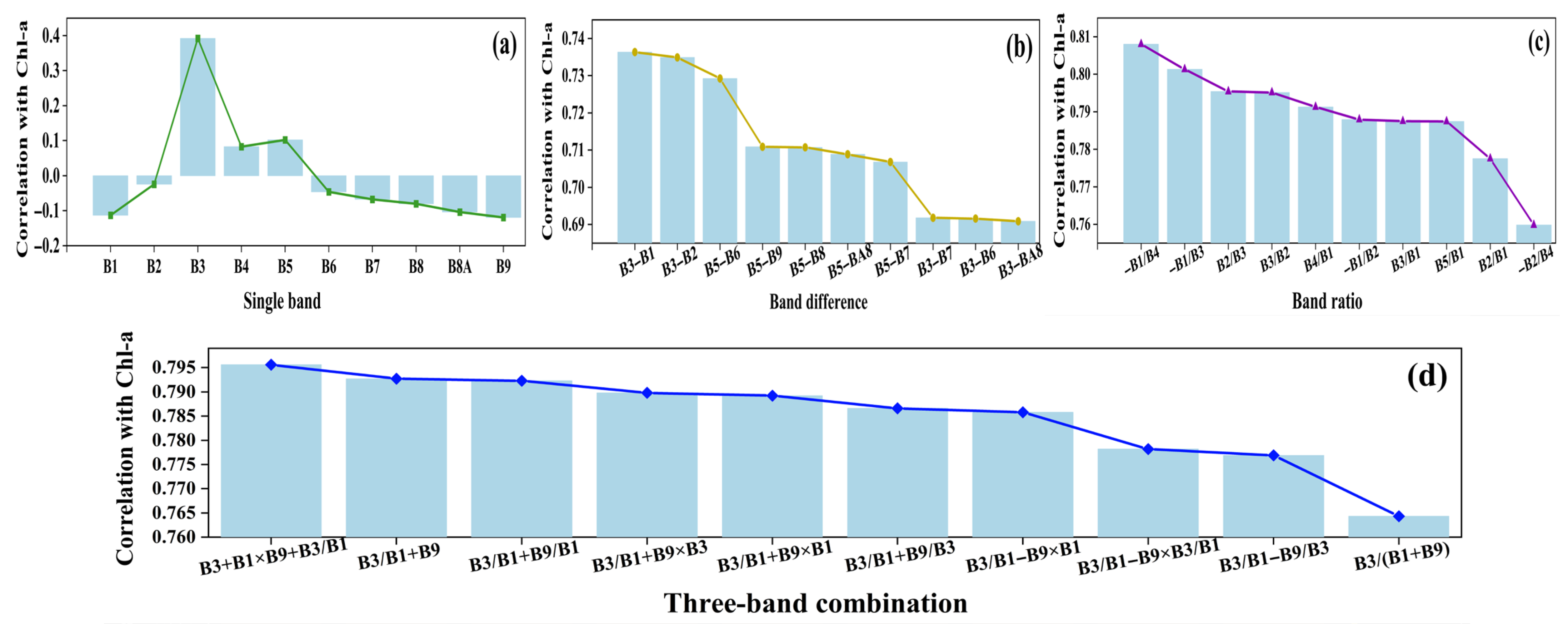
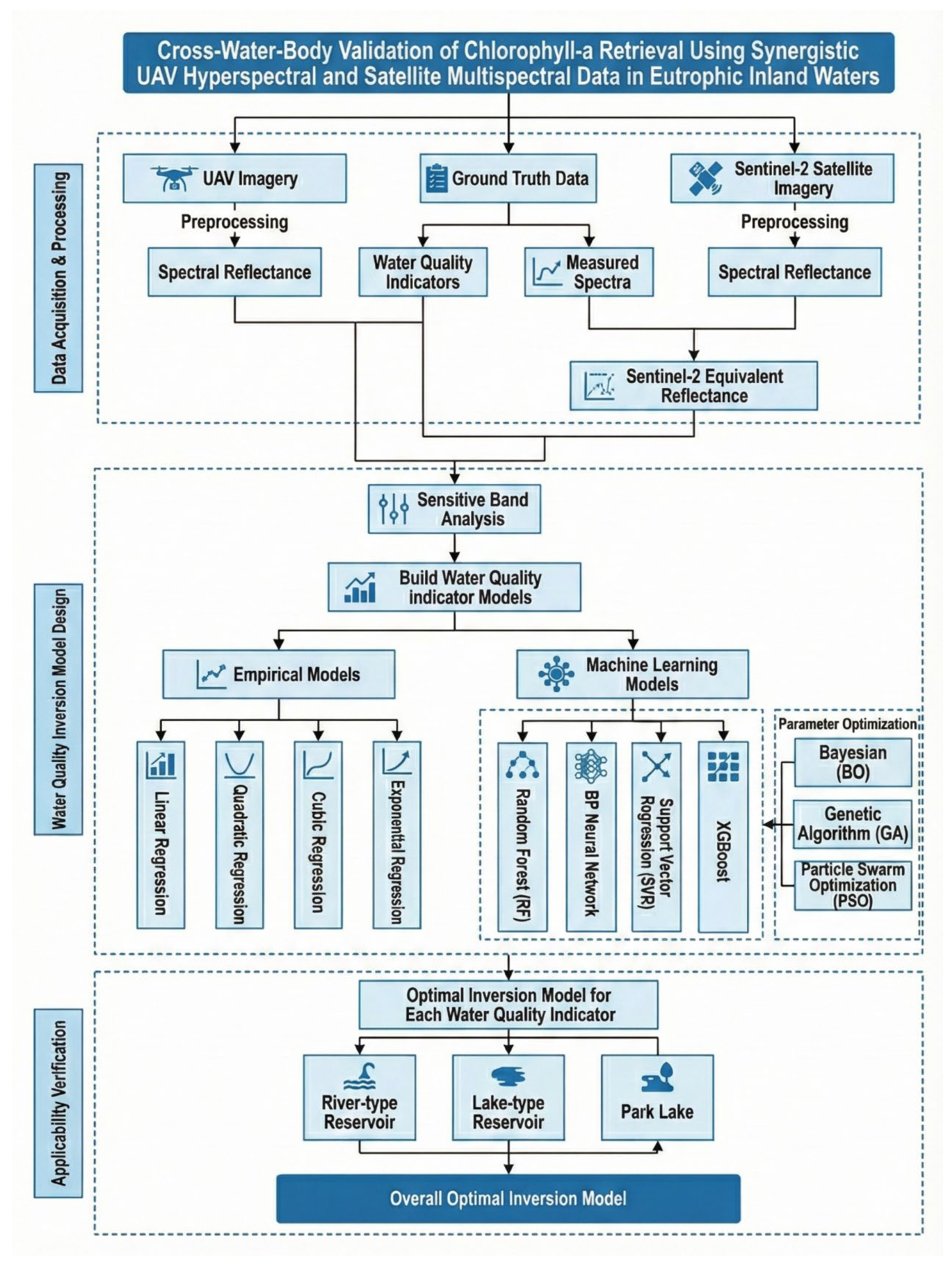
Empirical Models for the Sentinel-2 multispectral inversion selected the bands/band combinations with the highest correlation with Chl-a concentration as sensitive bands and constructed models using four regression methods.
The four empirical models with the highest Chl-a inversion accuracy are shown in
Table 3. The simple linear regression model achieved the highest accuracy when using the band ratio (−B1/B4) as the sensitive band; The other three models reached the highest accuracy when using the three-band combination (B3 + B1 × B9 + B3/B1) as the sensitive band. All four empirical models exhibited relatively high inversion accuracy, with R
2 values greater than 0.6. Among them, the simple cubic regression model achieved the best performance, with an R
2 of 0.71.
RF selected the bands/band combinations with the highest correlation with Chl-a concentration as sensitive bands. Parameter tuning for this RF model was conducted using two methods: BO and PSO. The optimized parameters for both BO and PSO included n_estimators, max_depth, and min_samples_leaf, with their respective search spaces set as 50–200, 10–30, and 1–5.
The fitting results of BO-RF and PSO-RF are shown in
Table 4. In BO-RF: Single bands exhibited the weakest predictive ability for Chl-a and the largest error (R
2 = 0.44); multi-band combinations were significantly superior to single bands, with R
2 values of 0.68 (band difference combinations), 0.72 (band ratio combinations), and 0.76 (three-band combinations), respectively. In PSO-RF: The fitting performance of single bands was significantly improved compared to that in BO-RF (R
2 = 0.62); additionally, the performance of band difference combinations, band ratio combinations, and three-band combinations in PSO-RF was also better than that in BO-RF. For BO-RF, the highest accuracy was achieved when using three-band combinations as sensitive bands (R
2 = 0.76). For PSO-RF, the highest accuracy was obtained with band ratio combinations as sensitive bands (R
2 = 0.79). Overall, the fitting results of PSO-RF were better than those of BO-RF.
Parameter tuning for this BPNN was performed using two methods: BO and GA. The optimization ranges for the parameters of both BO and GA were set as follows: learning_rate: (10−5, 10−1), weight_decay: (10−8, 10−3).
The fitting results of BO-BPNN and GA-BPNN are shown in
Table 5. In BO-BPNN: Single bands exhibited the weakest predictive ability for Chl-a and the largest error (R
2 = 0.42); band difference combinations, band ratio combinations, and three-band combinations were significantly superior to single bands (all R
2 > 0.60), among which three-band combinations achieved the best performance (R
2 = 0.73). In GA-BPNN: Single bands also showed the weakest ability to predict Chl-a concentration (R
2 = 0.39); similarly, band difference combinations, band ratio combinations, and three-band combinations were significantly better than single bands (all R
2 > 0.60), with three-band combinations being the optimal (R
2 = 0.86).
Both BO-BPNN and GA-BPNN achieved the highest accuracy when using three-band combinations as sensitive bands. Compared with single bands, multi-band combinations significantly improved the predictive ability of the models.
Parameter tuning for this SVR was conducted using two methods: BO and SAPSO. The optimization ranges for the SVR parameters (applicable to both tuning methods) were set as follows: C: (0.01, 1000); gamma: (0.0001, 1); epsilon: (0.01, 1).
The fitting results of BO-SVR and SAPSO-SVR are shown in
Table 6. In BO-SVR: Single bands exhibited the weakest ability to predict Chl-a concentration and the largest error (R
2 = 0.15); band difference combinations, band ratio combinations, and three-band combinations were significantly superior to single bands, with R
2 values of 0.54, 0.65, and 0.69, respectively. In SAPSO-SVR: Single bands also showed the weakest predictive ability for Chl-a concentration and the largest error (R
2 = 0.37); similarly, band difference combinations, band ratio combinations, and three-band combinations outperformed single bands significantly, with R
2 values of 0.62, 0.70, and 0.74, respectively. Except for single bands, the other three types of band combinations achieved relatively high fitting accuracy (all R
2 > 0.60). Both BO-SVR and SAPSO-SVR reached the highest accuracy when using three-band combinations as sensitive bands, with R
2 values of 0.69 and 0.74, respectively.
In general, the information from single bands is insufficient for accurate Chl-a prediction, while multi-band combinations can significantly improve the model’s predictive ability. Although the model errors are relatively large, except for single bands, the R2 values of all other combinations are >0.50, indicating that the accuracy of Chl-a inversion using the SVR model is relatively high.
Parameter tuning for this XGB model was performed using two methods: BO and GA. The parameter optimization ranges were set separately as follows: For BO optimization: n_estimators: (20, 2000); max_depth: (1, 18); For GA optimization: n_estimators: (20, 500); max_depth: (1, 6).
The fitting results of BO-XGB and GA-XGB are shown in
Table 7. In BO-XGB: Single bands exhibited the weakest ability to predict Chl-a concentration and the largest error (R
2 = 0.43); band difference combinations, band ratio combinations, and three-band combinations were significantly superior to single bands, with R
2 values of 0.74, 0.74, and 0.65, respectively. This indicates that the information from single bands is insufficient for accurate Chl-a prediction, while multi-band combinations can significantly improve the model’s predictive ability. In GA-XGB: Single bands also showed the weakest predictive ability for Chl-a concentration and the largest error (R
2 = 0.64); similarly, band difference combinations, band ratio combinations, and three-band combinations outperformed single bands significantly, with R
2 values of 0.86, 0.84, and 0.84, respectively.
Overall, the fitting results of the XGB models achieved relatively high accuracy. BO-XGB reached the highest accuracy when using band ratio combinations as sensitive bands (R2 = 0.74), while GA-XGB achieved the highest accuracy with band difference combinations as sensitive bands (R2 = 0.86).
3.3. Construction of UAV Hyperspectral Inversion Models
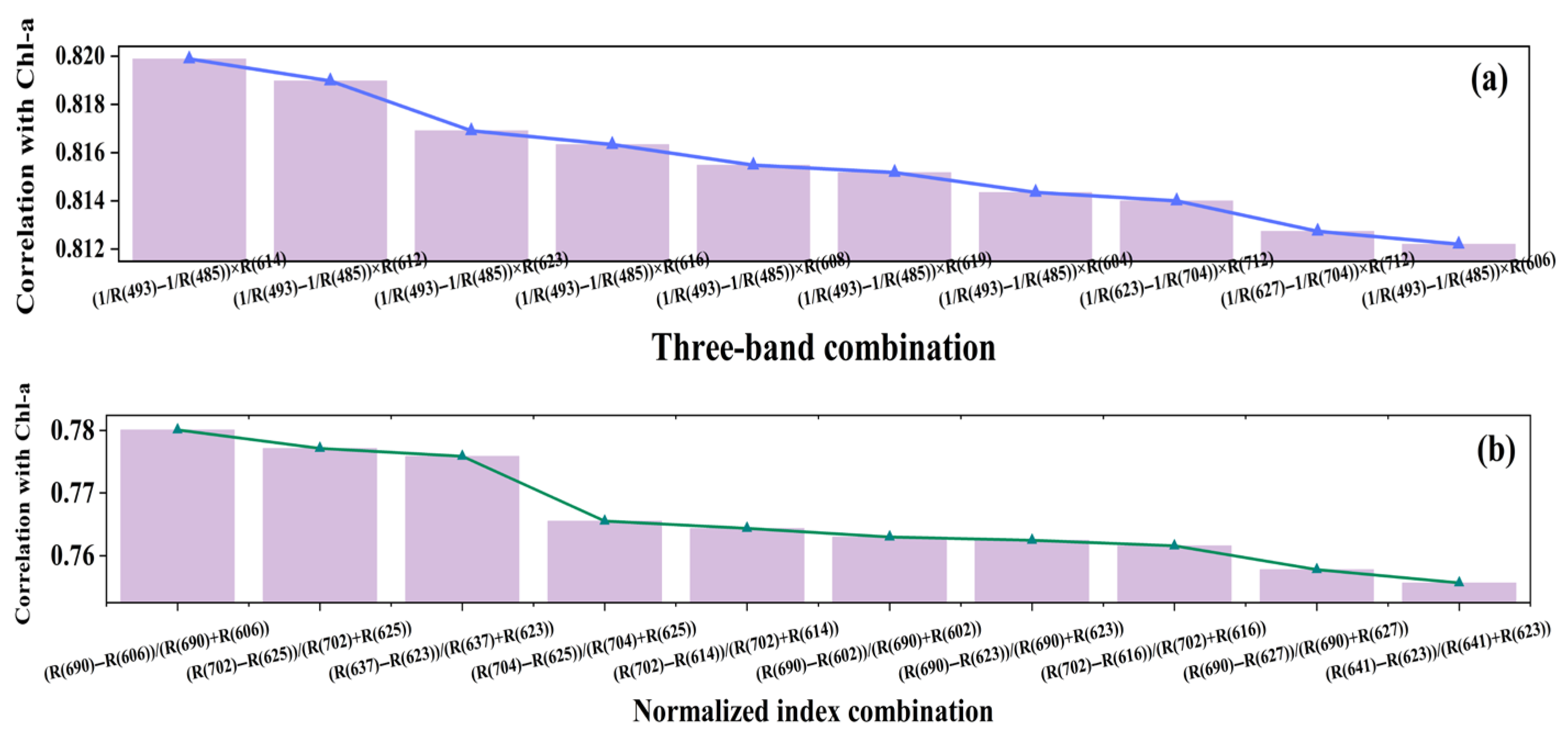
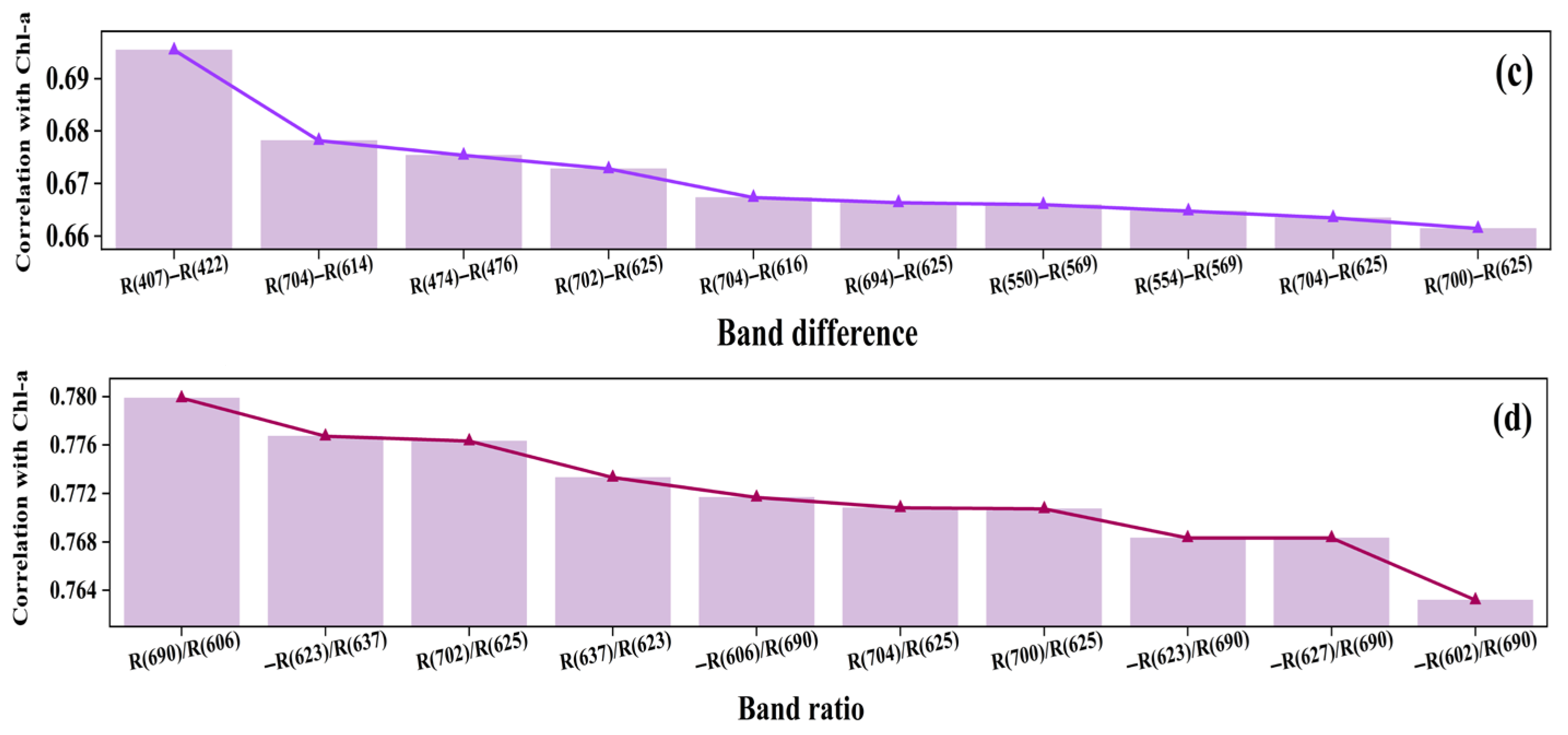
Empirical Models for the UAV hyperspectral Chl-a inversion selected the bands/band combinations with the highest correlation with Chl-a concentration as sensitive bands, constructed models using four regression methods. The four empirical models with the highest Chl-a inversion accuracy are shown in
Table 8. The simple cubic regression model achieved the best performance (R
2 = 0.74). Although the R
2 values of the four empirical models are relatively high, their errors are also relatively large.
BO and PSO were adopted to optimize the model parameters of this RF. For this RF using three-band combinations as sensitive bands: The optimal parameters obtained via BO optimization were n_estimators = 50, max_depth = 10, min_samples_leaf = 2; The optimal parameters obtained via PSO optimization were n_estimators = 81, max_depth = 5, min_samples_leaf = 1.
The fitting results of BO-RF and PSO-RF are presented in
Table 9. For BO-RF: Band ratio combinations exhibited relatively the weakest ability to predict Chl-a concentration and the largest error (R
2 = 0.82); For PSO-RF: Band difference combinations showed relatively the weakest predictive ability for Chl-a concentration and the largest error (R
2 = 0.80); Three-band combinations, normalized indices, and band ratio combinations outperformed band difference combinations, with R
2 values of 0.96, 0.94, and 0.94, respectively. Both BO-RF and PSO-RF achieved the highest accuracy when three-band combinations were used as sensitive bands, with R
2 values reaching 0.91 and 0.96, respectively. Overall, the fitting results of the two models were of relatively high accuracy, with all R
2 values exceeding 0.80.
BO and GA were employed to optimize the parameters of this BPNN. Specifically, for the BPNN model using three-band combinations as sensitive bands: The optimal parameters obtained via BO optimization were learning_rate = −1.0, weight_decay = −8.0; The optimal parameters obtained via GA optimization were learning_rate = 0.0240, weight_decay = 2.4702.
The fitting results of BO-BPNN and GA-BPNN are presented in
Table 10. For BO-BPNN: Band difference combinations exhibited the weakest ability to predict Chl-a concentration and the largest error (R
2 = 0.58); three-band combinations, normalized indices, and band ratio combinations were significantly superior to band difference combinations, with R
2 values of 0.78, 0.60, and 0.70, respectively. For GA-BPNN: Band difference combinations also showed the weakest predictive ability for Chl-a concentration and the largest error (R
2 = 0.52); three-band combinations, normalized indices, and band ratio combinations were significantly better than band difference combinations, with R
2 values of 0.75, 0.68, and 0.67, respectively. The fitting results of normalized indices and band ratio combinations were relatively close.
Overall, the fitting accuracy of the two models was relatively high, with all R2 values exceeding 0.50. Both BO-BPNN and GA-BPNN achieved the highest accuracy when three-band combinations were used as sensitive bands, with R2 values of 0.78 and 0.75, respectively.
BO and SAPSO were employed to optimize the parameters of this SVR. Specifically, for the SVR model using three-band combinations as sensitive bands: The optimal parameters obtained via BO optimization were C = 101,743.0170, gamma = 10, and epsilon = 2.1315; The optimal parameters obtained via SAPSO optimization were C = 877.5624, gamma = 0.0458, and epsilon = 0.5905.
The fitting results of the BO-SVR and SAPSO-SVR are presented in
Table 11. For BO-SVR: Band difference combinations exhibited the weakest ability to predict Chl-a concentration and the largest error (R
2 = 0.56); three-band combinations were significantly superior to band difference combinations (R
2 = 0.75). For SAPSO-SVR: Normalized indices, band difference combinations, and band ratio combinations showed relatively weak predictive ability for Chl-a concentration with larger errors, all having an R
2 of 0.61; three-band combinations were significantly superior to other combinations (R
2 = 0.74).
Overall, except for the BO-SVR model using band difference combinations as sensitive bands (which showed relatively low fitting performance), the overall fitting effect of the models was good. Both BO-SVR and SAPSO-SVR achieved the highest accuracy when three-band combinations were used as sensitive bands, with R2 values of 0.75 and 0.74, respectively.
BO and GA were employed to optimize the parameters of this XGB. Specifically, for the XGB model using normalized indices as sensitive bands: The optimal parameters obtained via BO optimization were n_estimators = 1226 and max_depth = 11; The optimal parameters obtained via GA optimization were n_estimators = 107 and max_depth = 3.
The fitting results of BO-XGB and GA-XGB are presented in
Table 12. For BO-XGB: Band difference combinations exhibited relatively weaker predictive ability for Chl-a concentration with slightly larger errors (R
2 = 0.92); three-band combinations, normalized indices, and band ratio combinations were slightly superior to band difference combinations, with R
2 values of 0.95, 0.96, and 0.96, respectively. For GA-XGB: Band ratio combinations showed the weakest predictive ability for Chl-a concentration and the largest error (R
2 = 0.90); three-band combinations, normalized indices, and band difference combinations were slightly better than band ratio combinations, with R
2 values of 0.97, 0.98, and 0.98, respectively.
Overall, the fitting accuracy of the models was relatively high, with all R2 values exceeding 0.90; however, this high training accuracy may be attributed to model overfitting. Both BO-XGB and GA-XGB achieved the highest accuracy when normalized indices were used as sensitive bands, with R2 values of 0.96 and 0.98, respectively.
Optimal Chl-a Inversion Models for Different Data Sources as indicated in
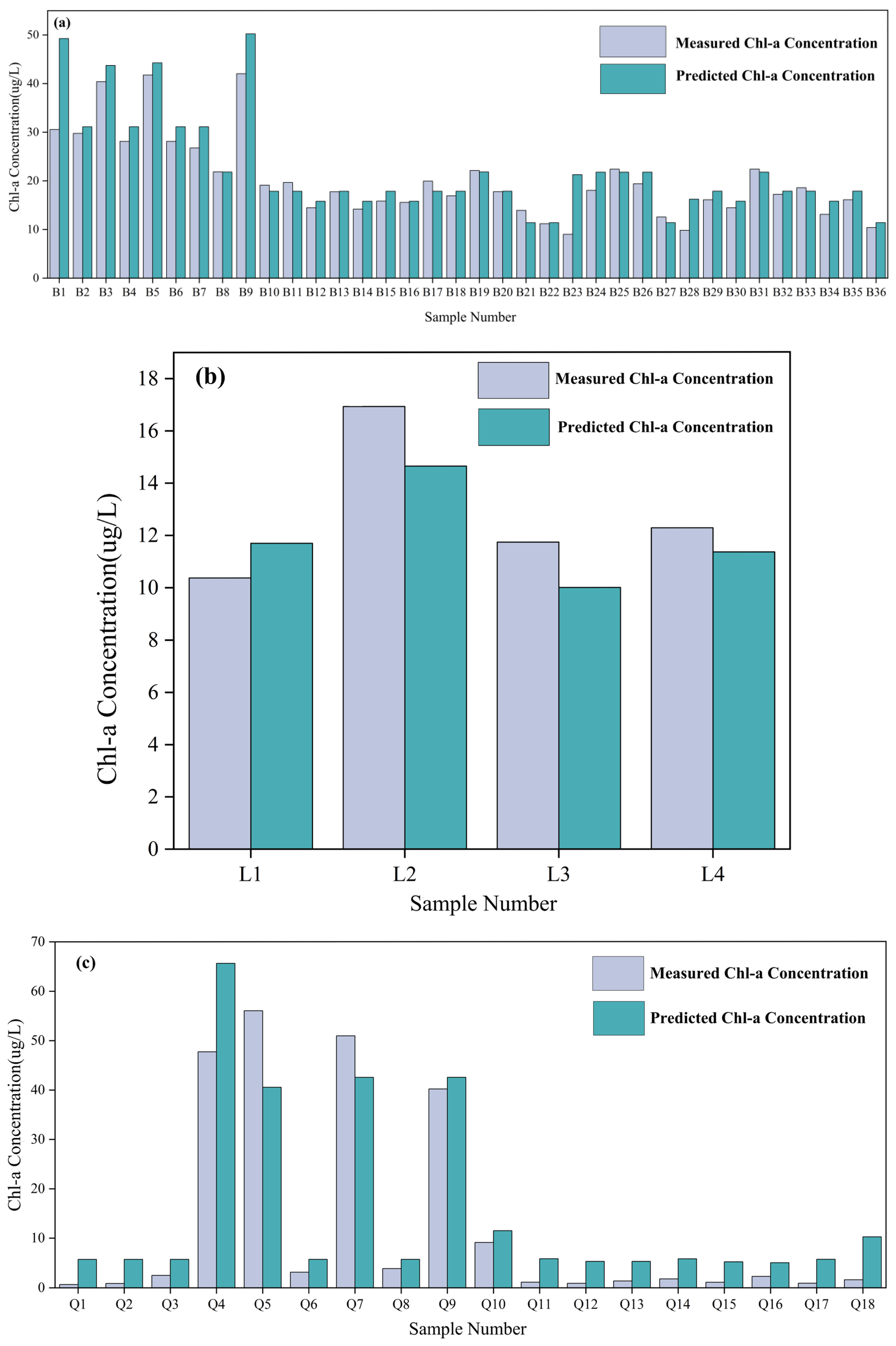
Table 13, under the Sentinel-2 satellite data source, the GA-optimized XGB (using three-band combinations as sensitive bands) achieved the optimal Chl-a inversion performance (R
2 = 0.86, MAPE = 50.03%, RMSE = 7.89 μg/L). Under the UAV data source, the GA-optimized XGB (using normalized indices as sensitive bands) exhibited the best inversion effect (R
2 = 0.98, MAPE = 18.59%, RMSE = 2.15 μg/L).