Article

Hydrological Response of an Enclosed Karst Groundwater System to Drainage Induced by Tunnel Excavation in a Typical Anticline Geo-Structure


1
Chongqing Nanjiang Survey and Design Co., Ltd., Chongqing 401121, China
2
College of Environment and Civil Engineering, Chengdu University of Technology, Chengdu 610059, China
3
Chongqing High-Speed Rail Construction Wan Kai Da Expressway Co., Ltd., Chongqing 401121, China
4
China Railway Changjiang Transport Design Group Co., Ltd., Chongqing 401121, China
*
Authors to whom correspondence should be addressed.
These authors contributed equally to this work.
Water 2026, 18(1), 87; https://doi.org/10.3390/w18010087
Submission received: 23 November 2025 / Revised: 21 December 2025 / Accepted: 22 December 2025 / Published: 29 December 2025

Abstract

The drainage of groundwater in mountainous tunnel projects always leads to substantial decline of the regional water table, which may induce numerous environmental issues, such as spring depletion, surface subsidence, vegetation degradation, and impacts on local water supplies, especially in the enclosed karst aquifers of anticlines in the area, such as the Jura mountain type. A systematic hydrological monitoring was conducted during the excavation of the Wufu Tunnel in Chongqing, China. The monitoring data includes discharge rate and water level collected from tunnels, boreholes, coal mines, springs, and ponds, respectively. Hydrological responses of karst aquifers and surface water bodies to tunnel drainage and precipitation were investigated by statistical analysis, Mann–Kendall test, heat map, and wavelet analysis. Results show that the enclosed karst water system has strong hydraulic connections and good water storage conditions. Tunnel drainage is the dominant factor causing dynamic changes at monitoring points, while the influence of rainfall is relatively limited. Borehole water levels and coal mine drainage have a close correlation with tunnel inflow, while springs are influenced by both rainfall and tunnel drainage. Few pond monitoring points are related to rainfall. Tunnel drainage has transformed the regional groundwater dynamic conditions, causing local groundwater flow direction reversal and reconstructing the groundwater recharge-flow-discharge pattern.

1. Introduction

Tunnel construction has greatly facilitated public transportation, and an increasing number of tunnel projects have been constructed in mountainous areas of countries in Asia, Europe, and other regions. However, groundwater drainage in tunnel engineering gives rise to numerous hydro-environmental problems, which have been fully verified by many typical cases. Gokdemir et al. (2022) found that drainage from the Mingtang Tunnel in Anhui, China, induced irregular groundwater level declines, with significant impacts observed in the central section, where the maximum drawdown reached 163.3 m [1]. Xu et al. (2022) demonstrated that the construction of the Yuelongmen Tunnel of the Chengdu-Lanzhou Railway disrupted the balance of the groundwater flow system, resulting in seepage and gushing water. Surface runoff in river sections sharply decreased and even dried up temporarily, while it faces long-term risks of aquifer dewatering and drying up of surrounding springs and wells [2]. Chiu and Chia (2012) demonstrated that the excavation of the Xueshan Tunnel in Taiwan, China, poses potential impacts on the Feitsui Reservoir. Numerical simulation analysis indicates an average inflow loss of approximately 1.74% to the reservoir [3]. Kim et al. (2019) demonstrated that during the excavation period of a certain road tunnel in South Korea, the maximum drawdown of the groundwater level reached 27 m [4]. Golian et al. (2020) noted that the regional decline in groundwater level caused by the excavation of the Qomroud Tunnel in Iran resulted in the drying up of a well 164 m away from the tunnel, as well as the Darbmal and Nesar springs located 3 km away [5]. In Europe, Gisbert et al. (2009) pointed out that during the excavation of the Malaga-Córdoba high-speed railway double tunnels located in the Abdalajís Mountains in southern Spain, a sudden water inrush with a maximum peak flow rate of 800 L/s was exposed in the carbonate rock fracture zone, which directly led to the drying up of high-altitude springs and a sharp decrease in the flow rate of low-altitude springs [6]. Vincenzi et al. (2008, 2013) demonstrated that the excavation of the Firenzuola Tunnel in Italy exposed fault zones, leading to water gushing. The groundwater level dropped below the valley elevation, causing recharge-type rivers to transform into discharge-type rivers or even dry up, with numerous springs drying up. Additionally, the influence radius of drainage from the Bologna-Florence high-speed railway tunnel can reach 2.3–4.0 km in limestone and thick-bedded sandy turbidites [7,8]. Kværner and Snilsberg (2011) found that the construction of the Romeriksporten Railway Tunnel in Norway caused a groundwater level drawdown of up to 3 m in the peatland above the tunnel. A drawdown of 1.39–1.59 m was still observed 340 m away from the tunnel, resulting in 0.4 m of land subsidence [9].
The eastern margin of the Sichuan Basin in China is a Jurassic mountainous area with an anticlinorium-type structure, where anticlines form mountain ranges, and synclines form wide valleys, giving rise to the distinctive parallel ridge-valley geomorphology of eastern Sichuan. Tunnel projects in this region commonly traverse water-rich Triassic or Permian karst formations, often triggering hydrogeological environmental issues. Based on monitoring of water inflows of the Zhongliangshan tunnel group in Chongqing, Li et al. (2023) reported that large-scale tunnel construction results in a continuous decline in regional groundwater levels. Their analysis revealed that soluble rock formations constitute the primary aquifers for water inrush. The western limb exhibits larger inflow rates than the eastern limb due to the steep dip of strata, indicating that anticline structures exert significant control on groundwater flow paths [10]. In the study of the Nanshan Tunnel, Hu (2016) found that tunnel water inflow mainly originates from surface water and karst aquifers, with karst fractures and roof water-conducting zones serving as the principal conduits [11]. Field tests and predictive model calculations showed that the groundwater drawdown radius could extend up to 642 m, inducing surface water leakage and karst collapses. Research by Chi et al. (2015) on karst development in the Tongluoshan area demonstrated that the regional karst system exhibits pronounced vertical zonation and anisotropy [12]. The drainage-induced drawdown effects caused by tunnel excavation are spatially asymmetric, with more pronounced impacts on the western limb and northern sector. In severely affected areas, wells and springs dried up, surface water bodies experienced leakage, and ground collapse occurred, suggesting that tunnel drainage has substantially altered the circulation pathways and discharge pattern of the karst groundwater system. From an environmental perspective, Cheng et al. (2016) established an evaluation system for the negative hydrogeological impacts of tunnel drainage using a fuzzy analytic hierarchy process. Their results indicated that tunnel construction induces a Grade IV (strong) level of negative groundwater environmental effects, manifested as groundwater level decline, reduction or cessation of spring discharge, surface-water depletion, and elevated risk of karst collapse; these findings agreed with field observations [13]. Using a variable-weight cloud model, Li et al. (2023) assessed the risk of water inrush hazards in the Zhongliangshan Tunnel. They found that high-risk zones are primarily distributed along the contact belt between soluble and insoluble rocks. When tunnel excavation intercepts water-bearing fractures or water-conducting conduits, high-pressure water inrush is likely to occur, disrupting groundwater system equilibrium and intensifying environmental degradation [14]. Collectively, these studies demonstrated that tunnel excavation and drainage activities deeply disturb groundwater circulation processes, induce regional drawdown effects, and amplify system instability and environmental risks in the enclosed karst aquifer systems constrained by anticline structures.
Given the profound impact of tunnel engineering on the water environment, necessary hydrological monitoring has become an important means to evaluate the extent of influence and study the influence mechanism. During the construction period of the Xueshan Tunnel in Taiwan, China, a monitoring system consisting of six measurement stations was installed to measure the flow along the tunnel, which could clearly identify the distribution characteristics of groundwater infiltration, reflect the changes in groundwater infiltration volume, assess its impact on regional water resources, and ensure the safety of the tunnel structure [3]. During the excavation of the Xie Ma Tunnel in the Zhongliangshan Mountain, water inflow at the tunnel’s entrance and exit was monitored, and a total of 31 groundwater level monitoring points were arranged in the tunnel site area, forming a monitoring network that covered the direction of maximum variation in regional hydrogeological conditions [15]. In Oslo, Norway, the Romeriksporten railway tunnel passes under the Puttjern Lake area and adjacent catchment. Researchers installed piezometers in peat and the underlying moraine to measure the groundwater level in the piezometers and boreholes in the bedrock [9]. These hydrological monitoring values are usually time series data, and wavelet analysis is an effective tool for analyzing time series from different time scales [16,17,18]. Many researchers [19,20,21,22] have used correlation analysis and cross-wavelet methods to evaluate the response of groundwater to precipitation. Kværner and Snilsberg (2011) explored the advantages of using wavelet analysis in karst environments for analyzing experimental sequences and generating data sequences [9]. Zhang et al. (2025) took the ground subsidence caused by the Chengdu Metro as an example and used cross-wavelet and wavelet coherence to analyze the relationship between subsidence, rainfall changes, and groundwater depth changes, indicating that engineering activities and population factors show a high degree of correlation in the etiology of GS and are closely related to metro and construction activities [23].

2. General Situation of Study Area

2.1. Geographical Background

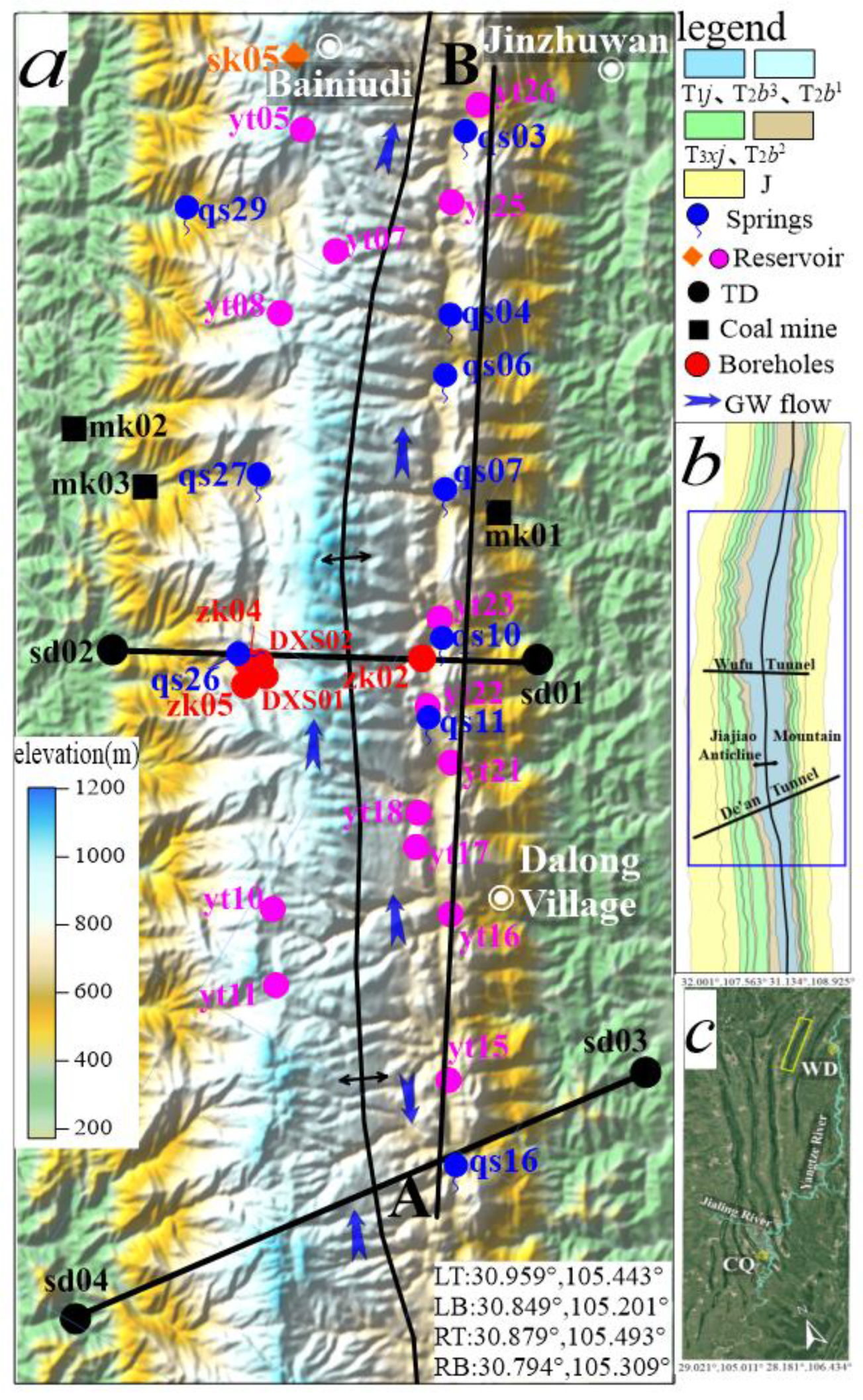
The study area features a subtropical humid monsoon climate in Central China, characterized by a mild climate, plentiful precipitation, distinct four seasons, and a long frost-free period. It is located in the “Western China Autumn Rain” region, with distinct vertical climate characteristics and an annual average temperature of 12.2 to 18.4 °C. The rainfall within the study area is unevenly distributed and controlled by topography, with large rainfall in high and middle mountain areas, and relatively small rainfall in low mountain hills and river valley areas. The surface water systems of the study area belong to the tributaries of the Yangtze River, distributed in a dendritic pattern and locally in a feathery pattern. The axis of the mountain range, controlled by the NE-SW trending Jiajiao Mountain Anticline structure, serves as the water divide. Most gullies on both sides are perpendicular to the mountain range and are mostly seasonal. Tributaries on the northwest limb flow into the Nanhe River, and those on the southeast limb flow into the Puli River. The two rivers converge into the Xiaojiang River, which finally flows into the Yangtze River. The surface elevation in the area ranges from 483 to 1256 m, with a maximum relative height difference of approximately 773 m. The natural slope is generally 20 to 35°. Ridges and the gorges between them are approximately NE-trending, with steeply dipping ridge lines. The objective tunnel crosses the Jiajiaoshan anticline in a nearly vertical direction. The section from Bainiudi to Jinzhuwan of the Jiajiaoshan anticline presents a landform of “one mountain with three ridges and two troughs”, while the areas on both sides (north of Bainiudi and south of Jinzhuwan) present a landform of “one mountain with two ridges and one trough”. Especially in the area south of Jinzhuwan, the landform characteristic of “one mountain with two ridges and one trough” is particularly obvious, and its features are shown in Figure 1 below.

2.2. Geological Condition

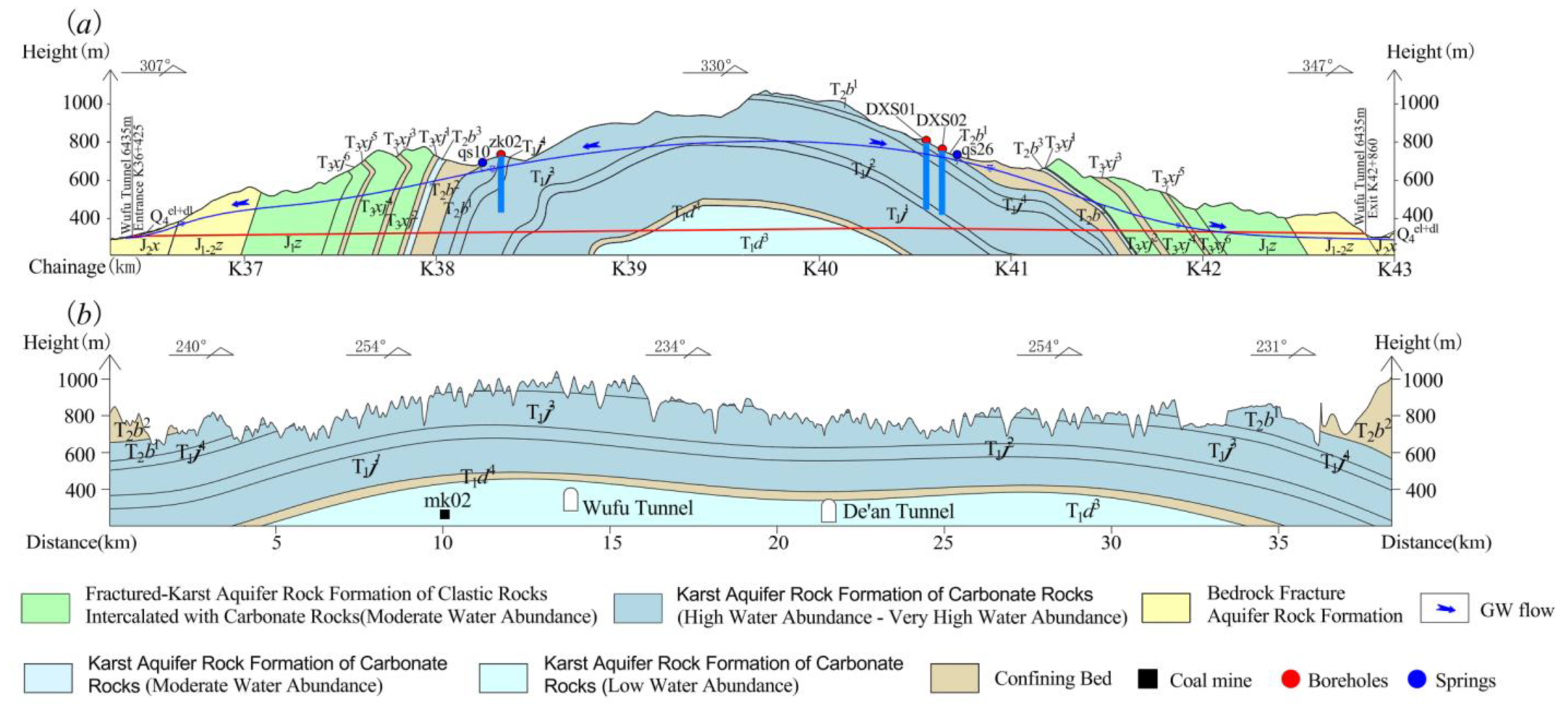
The Wufu tunnel traverses the Jurassic System, specifically the Middle Jurassic Shaximiao Formation (J2s), Lower Shaximiao Formation (J2xs), and Xintiangou Formation (J2x), as well as the Lower Jurassic Ziliujing Formation (J1–2z) and Lower Jurassic Zhenzhuchong Formation (J1z). Additionally, it passes through the Upper Triassic Xujiahe Formation of the Triassic system (T3xj), the Middle Triassic Badong Formation (T2b), the Lower Triassic Jialingjiang Formation (T1j), and the Daye Formation (T1d). The lithology encountered primarily consists of shale, mudstone, sandstone, limestone, marl, dolomite, dolomitic limestone, breccia, and so on. The tunnel crosses the Jiajiaoshan anticline, which is oriented in a northeast-southwest direction. The southeastern flank exhibits dip angles ranging from 50° to 86°, with some areas presenting vertical or overturning characteristics. In contrast, the northwestern flank dips more gently, with angles between 20° and 51°. The axial region of the anticline shows undulatory variations, overall dipping to the northeast. The structural features of the Jiajiaoshan anticline and the strata that the tunnel traversed are illustrated in Figure 2a.
Soluble rocks in the tunnel site area are primarily distributed in the core zone and along the flanking valleys. They mainly form a closed strip exposed at the surface along the axial zone of the anticline between Shanzi Mountain and Jiajiaoshan Mountain. The strata consist mainly of T2b1, T2b3, and T1j formations, with lithologies dominated by limestone, brecciated limestone, and dolomite. Non-soluble rocks are concentrated in the wings and axial inclination terminus of the anticline, with strata primarily consisting of T2b2 and T3xj formations. Lithologies are dominated by mudstone interbedded with dolomite and sandstone interbedded with shale. In the core of the Jiajiaoshan anticline, soluble rocks are structurally confined by non-soluble rocks, forming a closed water storage structure, as shown in Figure 2b. Major karst features include solifluction depression, karst depressions, sinkholes, caves, and large karst springs.
Figure 1. Maps of the study area, (a) topography of the tunnel site and locations of hydrological monitoring points, coordinates of the 4 corners were put out, denoted as LT, LB, RT, and RB respectively, (b) spatial distribution of geological strata, (c) distribution of the Jura type mountains in Eastern Sichuan Basin, CQ stands for Chongqing Municipality, and WZ for Wanzhou District.
Water 18 00087 g001
The karst development in the tunnel site area can be divided into three zones along the structural axis: strong, moderate, and weak. The strongly developed zone is distributed from the terminal dipping section of the soluble rocks on the northeastern side to the Dalong Village area. Karst trough valleys are developed on both sides, and numerous dissolution gullies are present in the core, forming dense karst negative landforms. The trough valleys on the southeastern side are more developed, with open-type features on both sides, serving as shallow groundwater discharge channels. Groundwater moves longitudinally along the structural lines and is discharged in the form of springs. The moderately developed zone is located between Dalong Village and Xiangjiaying Village. Karst trough valleys are discontinuously developed, accompanied by numerous karst ridges, which are controlled by the asymmetric anticline folding. The weakly developed zone is situated at the terminal dipping section. Surface features such as dissolution gullies are nearly absent, karst trough valleys are discontinuously developed with karst ridges as the main landform, and karst springs are rarely observed.
Figure 2. Hydrogeological profiles in tunnel site area, (a) Longitudinal cross section along the Wufu tunnel, (b) Transverse cross section along the axis of Jiajiaoshan anticline.
Water 18 00087 g002
Based on the survey of springs and karst caves in the tunnel site area, the distribution area of the third member of the Jialingjiang Formation limestone is 20.6 km2, with 36 various karst geological points distributed, resulting in a distribution density of 1.06 points/km2. The fourth member of the Jialingjiang Formation covers a large area of 37.7 km2, featuring a relatively high density of sinkholes and depressions. Statistics indicate that there are 61 various karst geological points in the fourth member of the Jialingjiang Formation, with a distribution density of 1.13 points/km2. Overall, the number and distribution density of karst geological points in the fourth member of the Jialingjiang Formation within the study area are higher than those in the third member of the Jialingjiang Formation limestone strata. The average karst development density in the area is 1.1 points/km2, indicating a moderate level of karst development. Meanwhile, karst caves and sinkholes are rarely developed in the first member of the Badong Formation, where the karst development degree is relatively weak. The karst characteristics of the tunnel site area are shown in Figure 1.

3. Methods

3.1. Mann–Kendall Test

To investigate the relationships among rainfall, tunnel excavation, and groundwater loss, as well as the temporal evolution and mutual interactions of multiple datasets, including borehole water-level elevation, coal-mine drainage discharge, spring flow, and reservoir (weir-pond) water-level elevation, it is necessary to apply the Mann–Kendall (M-K) abrupt change test to each dataset (MATLAB (version R2025a)). This test is used to identify long-term trends and determine the timing of potential abrupt changes. The Mann–Kendall method is a classical technique in time-series analysis, commonly employed to examine the significance of monotonic trends and detect the locations of abrupt change points, thereby determining whether a series has undergone structural variation.
The analysis begins by calculating the rank series and its corresponding statistics to examine whether the sequence exhibits a significant upward or downward trend. The rank sequence is constructed such that the cumulative count for the i-th sample is given by:
s k = i = 1 k r i , r i   = 1 , x i   >   x j 0 , x i   <   x j , k   =   2 ,   3 ,   ,   n ,
Subsequently, forward (UFk) and backward (UBk) statistical curves are generated. Abrupt change points are identified by evaluating the intersection time of these two curves. The statistical quantity is defined as:
U F k   =   s k E ( s k ) v a r ( s k ) ,   k   =   1 ,   2 ,   ,   n ,   U F 1   =   0 ;   U B k   =   - U F k ( k   =   x n ,   x n - 1 ,   ,   x 1 ) ,   U B 1   =   0 ,
where
E S k = k ( k 1 ) 4 ,   v a r S k = k ( k 1 ) ( 2 k + 5 ) 72 ,   1     k     n

3.2. Principle of Heatmat

The principle of the Heatmap is to calculate the Pearson correlation coefficient using the flow/discharge/water surface elevation data from different hydrological monitoring points and the factors influencing these data (rainfall and tunnel drainage) for correlation analysis.
The definition of the Pearson Correlation Coefficient is: the covariance of two variables divided by the product of their respective standard deviations, and the formula for the overall correlation coefficient is: ρ X , Y = cov X , Y σ X σ Y . Where ρ is the overall correlation coefficient; cov X , Y is the covariance of variables X and Y; σ X is the standard deviation of variable X; σ Y is the standard deviation of variable Y.
In practical applications, we usually have sample data, so the sample correlation coefficient r is used to estimate the overall correlation coefficient, and the formula for the correlation coefficient is r = ( x x ¯ ) ( y y ¯ )   ( x x ¯ ) 2   ( y y ¯ ) 2   .

3.3. Wavelet Analysis

The Cross-Wavelet Transform (XWT) is a method that combines the wavelet transform with cross-spectrum analysis to study the multi-time-scale interrelationship between two time series in the time-frequency domain. The Cross-Wavelet Transform defines two time series X n and Y n as W X Y = W X W Y , where ∗ represents the complex conjugate, and the corresponding cross−wavelet power spectral density is W X Y . The background power spectra P k X and P k Y of the two time series X n and Y n are defined as: D W n X s W n Y s σ X σ Y < p = Z v p v P k X P k Y . Where Z v ( p ) is the confidence level of probability P, derived from the square root of the product of two X 2 distributed wavelet spectra.
Wavelet coherence analysis (WTC) can make up for the deficiency of cross-wavelet transform and reflect the degree of local correlation between two time series in the time-frequency domain through the wavelet coherence spectrum. Even in the low-energy value area corresponding to the cross-wavelet transform, the correlation between the two in the wavelet coherence spectrum may still be significant. The wavelet coherence spectrum (density) of two time series is defined as: R n 2 s = S s 1 W n X Y s 2 S s 1 W n X s 2 × S s 1 W n Y s 2 . Where S s 1 W n X Y s 2 represents the cross-product of the wave amplitudes of the two timeseries at a certain frequency; S s 1 W n X s 2 represents the amplitude of the vibration wave.

4. Hydrological Monitoring During Tunnel Excavation

The Wufu Tunnel is an extra-long tunnel that traverses the hydrogeological system of an enclosed aquifer structure associated with the Jiajiaoshan anticline. The site exhibits highly complex hydrogeological conditions, and tunnel excavation may induce substantial risks of water inrush, potentially leading to adverse impacts on the local hydrogeological environment. To assess the influence of tunnel construction on regional groundwater and surface water systems, comprehensive monitoring has been implemented within the influential area of the tunnel. This monitoring provides a scientific basis for the prevention and mitigation of environmental hydrogeological hazards.

4.1. Monitoring Networks

A total of 37 field hydrogeological monitoring points were set up in the study area, specifically including: 4 water inflow outlets at the entrances and exits of the Wufu Tunnel and its adjacent De’an Tunnel (marked as sd), 5 groundwater level monitoring points in boreholes (marked as zk or DXS), 3 monitoring points for coal mines (marked as MK), 14 monitoring points for ponds (marked as yt), and 1 monitoring point for a reservoir (marked as sk). Rainfall was monitored by an automatic rain gauge near the tunnel. The specific distribution of the monitoring points is shown in Figure 1a. Divided by the Wufu Tunnel, there are 9 monitoring points in the southwest of the tunnel, with sd04, located 9.8 km away, being the farthest, and a water seepage monitoring point adjacent to the De’an Tunnel. There are 8 monitoring points in the northeast of the tunnel, with sk05, located 8.4 km away, being the farthest. Divided by the axis of the Jiajiaoshan anticline, there are 11 monitoring points in the southwest wing, qs16 is the farthest, located 7.4 km away; and 11 monitoring points in the southeast wing, yt26 is the farthest in this wing, 8 km away from the tunnel. All these monitoring points together form a systematic groundwater monitoring network, with an area of approximately 120 square kilometers, and centered on Wufu Tunnel, covering the complete hydrogeological unit of the Jiajiaoshan anticline. The construction of the Wufu Tunnel began in January 2024. Most of the monitoring points collected data from January 2024 to July 2025, a total of 18 months. DXS01 and DXS02 had a longer monitoring period, collecting data from August 2022 to August 2025. The monitoring values for tunnel inflow, coal mines, and springs are flow rates (unit: m3/d), while those for boreholes, ponds, and reservoirs are water levels (unit: m).

4.2. Monitoring Results

  • Precipitation and tunnel drainages
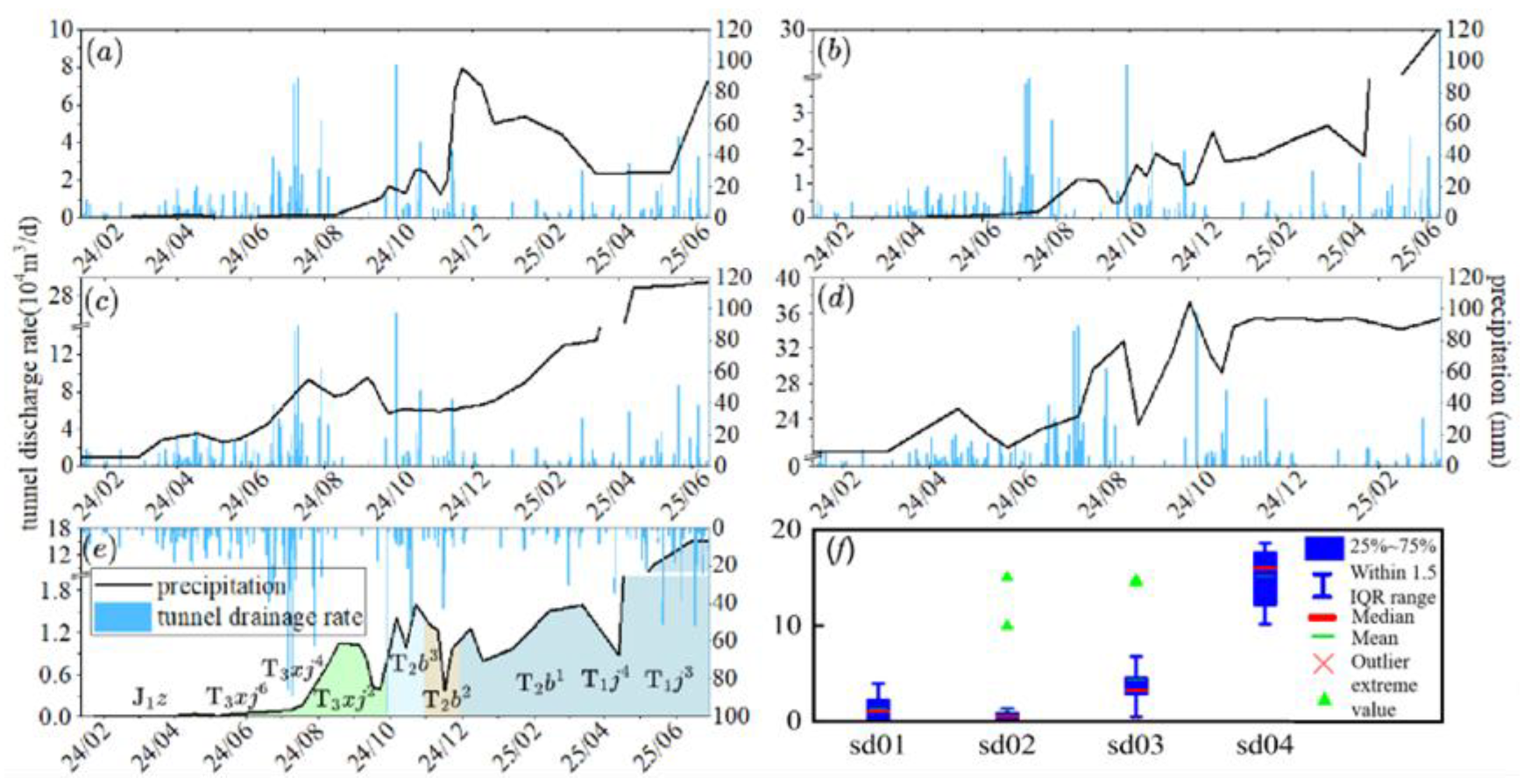
The Wufu Tunnel was excavated in a bidirectional four-lane manner with simultaneous progress on the left and right tunnels. Water inflow at the entrance and exit of the Wufu Tunnel was monitored and recorded as sd01 and sd02, respectively. The De’an Tunnel is located about 10 km southwest of the Wufu Tunnel. Water inflows at the entrance and exit of the De’an Tunnel were also monitored and recorded as sd03 and sd04, respectively. The locations of the water inflow monitoring points in the tunnels are shown in Figure 1a, and the dynamic changes in water inflows in both tunnels are provided in Figure 3.
The rainfall in 2024 reached two peaks in July and October, with the maximum rainfall of 97.5 mm on September 30th. From the beginning of 2024 to June, the water inflow of Wufu Tunnel fluctuated gently and moderately, with a relatively low volume. However, the water inflows of sd03 and sd04 of De’an Tunnel showed slight fluctuations due to the rainfall peak in July. Due to the excavation into the water-rich stratum, the water inflow sd01 at the entrance of Wufu Tunnel increased sharply in November 2024, reaching the maximum volume of 39,648 m3 on November 24th, while the water inflow sd02 at the exit increased slightly. The water inflow sd03 at the entrance of De’an Tunnel fluctuated remarkably due to the rainfall in July; the water inflow sd04 at the exit also showed significant fluctuations after the strong rainfall replenishment, reaching the maximum volume of 186,000 m3 on 24 September 2024, when the tunnel also exposed the water-rich stratum at the exit section. From January to June 2025, as both the entrance and exit sections of the tunnel were excavated into the water-rich stratum, the overall water inflow showed an upward trend. After that, the impact of rainfall on the tunnel water inflow was minimal. The data throughout the observation period indicated that rainfall was a key factor influencing the dynamics of water inflow in the early and middle periods. The fluctuation of rainfall in the middle period was mainly correlated with the tunnel water inflow, while in the later period, the impact of rainfall on the tunnel was weak.
Taking sd02 as an example, the relationship between the tunnel water inflow and the exposed strata is shown in Figure 3e. At the initial stage of tunnel excavation, when it entered the bedrock fracture aquifer (J1z), the water inflow was relatively small. When it entered the interlayer confined aquifer of the clastic rock fracture-pore (T3xj6, T3xj4, T3xj2), the water inflow still changed greatly. The water inflow gradually increased from July and then gradually decreased after September. Combined with the variation in rainfall, it can be inferred that the water inflow of the tunnel at this stage was mainly controlled by rainfall. When the excavation entered the clastic rock intercalated with carbonate rock fracture-karst aquifer (T2b3), it was again the rainy season, and the water inflow of the tunnel increased greatly and was highly consistent with the fluctuation of rainfall. After entering the relatively impermeable layer (T2b2), the water inflow rapidly decreased. Subsequently, when the excavation entered the carbonate rock karst aquifer (T2b1, T1j4, T1j3), the water inflow increased sharply and showed the characteristic of no longer being affected by rainfall.
2.
Water table in boreholes and discharge rates of coalmine adits
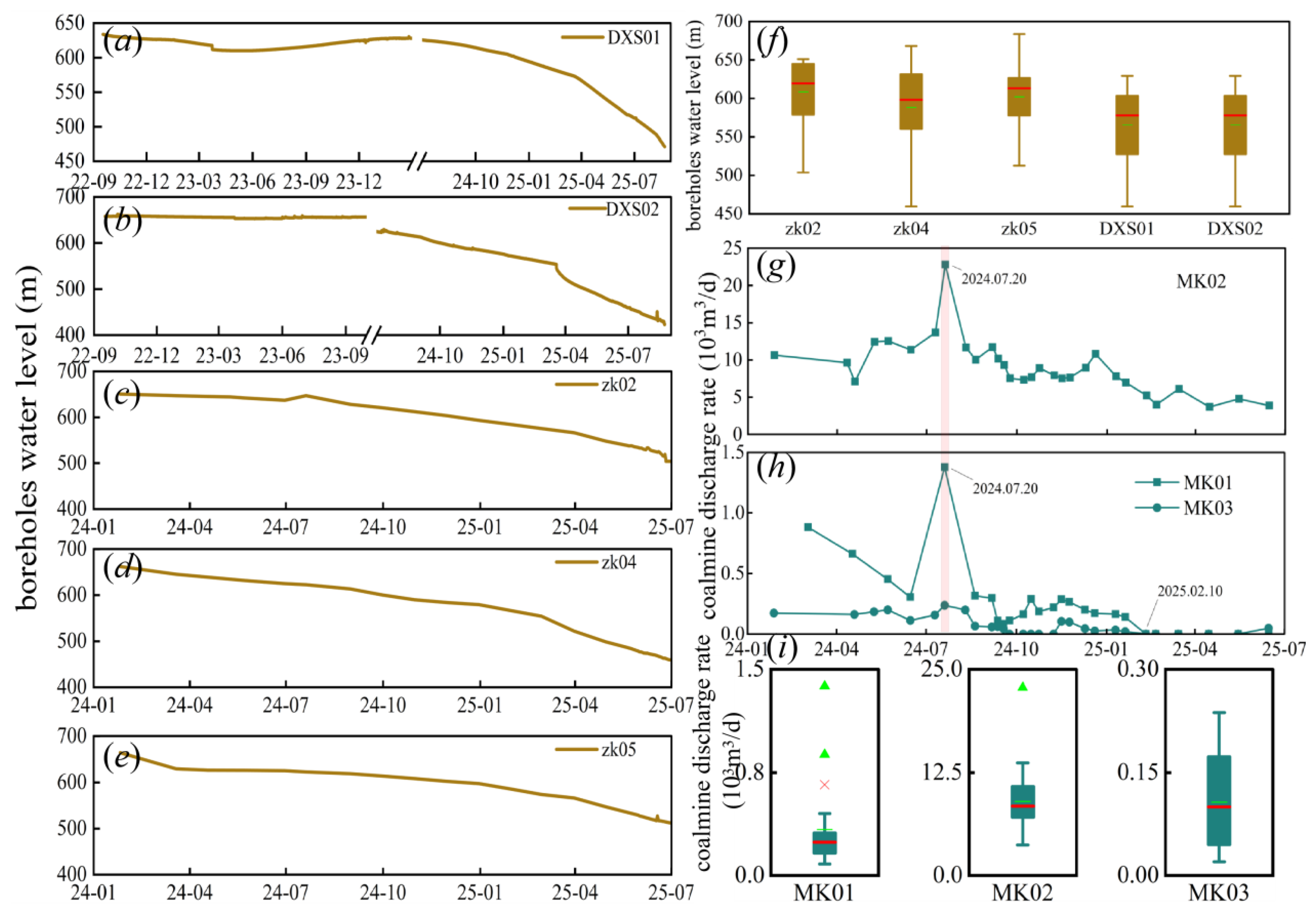
Five boreholes, namely DXS01, DXS02, zk02, zk04, and zk05, were arranged in the study area, all located in the T1j stratum and close to the alignment. Among them, zk02 is located in the southeast wing of the Jiaojiaoshan anticline, while the other four are in the northwest wing. The distribution of the boreholes is shown in Figure 1a, with depths ranging from 340 m to 400 m. The water level variation curves within the boreholes are presented in Figure 4a–e.
The data of DXS01 and DXS02 can be generally divided into two phases: a stable period and a continuous decline period, as detailed in Figure 4a,b. Before the construction of the Wufu Tunnel began, the water levels at DXS01 and DXS02 were stable without showing any obvious trend of change. However, with the excavation of the tunnel, abnormal fluctuations occurred in the data. After the data stabilized, when the tunnel advanced into the water-rich stratum in September 2024, the water levels at the two points dropped dramatically. The changing trends of DXS01 and DXS02 reflect the formation of a groundwater drawdown cone due to the tunnel excavation.
For zk02, zk04, and zk05, since the beginning of the data collection in January 2024, the groundwater levels have generally shown a downward trend, as depicted in Figure 4c–e. The initial water levels of the boreholes ranged from 650 m to 665 m. Under the influence of the tunnel, the water levels of all boreholes dropped to varying degrees, eventually falling between 535 m and 478 m, with zk04 experiencing the greatest decline to 478.04 m. Despite zk02 and zk05 being on opposite wings of the anticline, their consistent downward trends indicate that they are within the same hydrological unit, and the anticline geological structure did not cause the groundwater to flow towards the two wings. A comprehensive analysis reveals that the water levels of the five boreholes almost dropped simultaneously, indicating that the decline in groundwater levels due to tunnel water inflow in this area is widespread and synchronous.
The three coal mine monitoring points are denoted as MK01, MK02, and MK03, all located in the T3xj stratum. MK01 is situated on the southeast wing of the Jiaojiaoshan anticline, while the other two points are on the northwest wing. The distribution of the coal mine drainage points is detailed in Figure 1a, and the drainage volume change process lines are shown in Figure 5g,h. The elevations of the mine entrances are 440 m, 240 m, and 359 m, respectively. Due to MK02 being the lowest, its drainage volume is relatively larger. The drainage volumes of the three coal mines generally show a downward trend, reflecting the reduction in coal mine drainage volumes due to the increase in tunnel drainage. MK02 has the largest decline, from a peak of 22,800 m3/d to 387 m3/d in June 2025. Meanwhile, the coal mine drainage is highly affected by rainfall, and all three coal mines responded to the heavy rainfall in July 2024, shows in the red areas of (g) and (h) in Figure 4.
3.
Discharge rates of springs
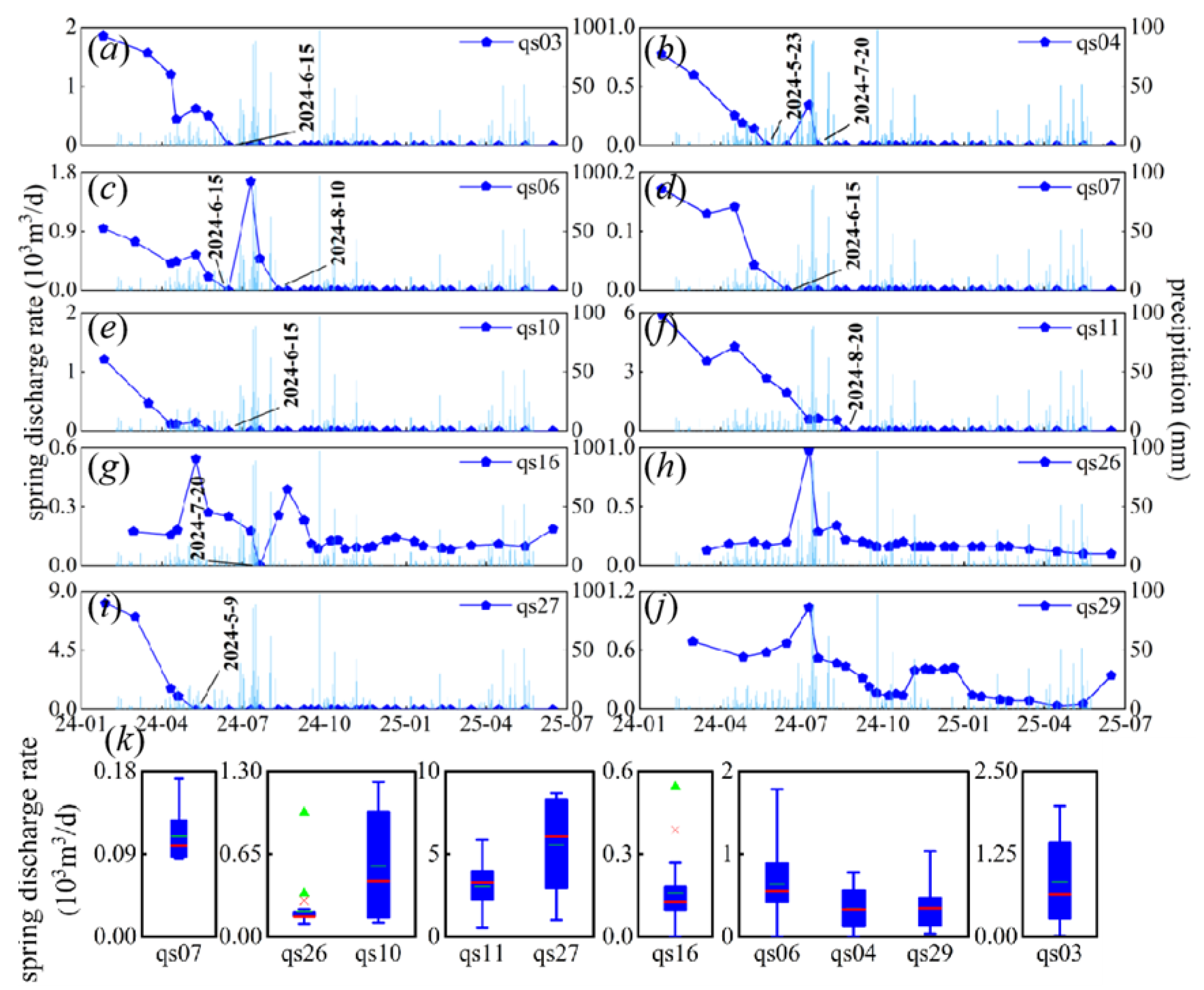
Ten spring monitoring points were set up in the study area, located on both wings of the mountain. Except for qs29, which is in the T3xj stratum, the rest are all at the junction of the T2b and T1j strata. Among them, qs11 and qs16 are on the southwest wing of the False Horn Mountain anticline, qs26, qs27, and qs29 are on the northeast wing, and the rest are on the southeast wing. The distribution of the springs is shown in Figure 1a, and the spring flow process curves during the tunnel construction period are shown in Figure 5a–j.
Compared with the initial flow rates of the springs, the flow rates of springs qs27 and qs11 are relatively higher, with the peak flow rate of qs27 reaching up to 8078 m3/d, while the flow rates of springs such as qs26 and qs16 are relatively lower. Overall, all 10 springs show a downward trend in water volume. Except for springs qs16, qs26, and qs29, which have not dried up, all other springs have dried out. The drying-up dates occurred between May and August 2024, which coincides with the start of the increase in water inflow of Wufu Tunnel.
There is a certain correlation between the drying-up dates of the springs and the distance from the monitoring points to the tunnel. For example, qs10 is adjacent to the tunnel exit sd02 and dried up in June 2024, while qs11, being farther from the tunnel, had a delayed drying-up time. This phenomenon reflects the characteristic that the scope of influence spreads outward with the tunnel as the center, as shown in Figure 5d,f.
qs29 is the only spring not located in the karst area, so the impact of the tunnel’s water inflow on it is relatively small. Some springs show a noticeable response to rainfall. For instance, springs qs16, qs26, and qs29 once experienced a sharp drop in flow rate due to the drainage and discharge of the tunnel. Later, their water volumes surged due to rainfall recharge in July 2024, but then declined rapidly afterward. This change indicates that the recharge effect of rainfall is limited, while the tunnel drainage plays a dominant role, as shown in Figure 5g,h,j.
4.
Surface water levels
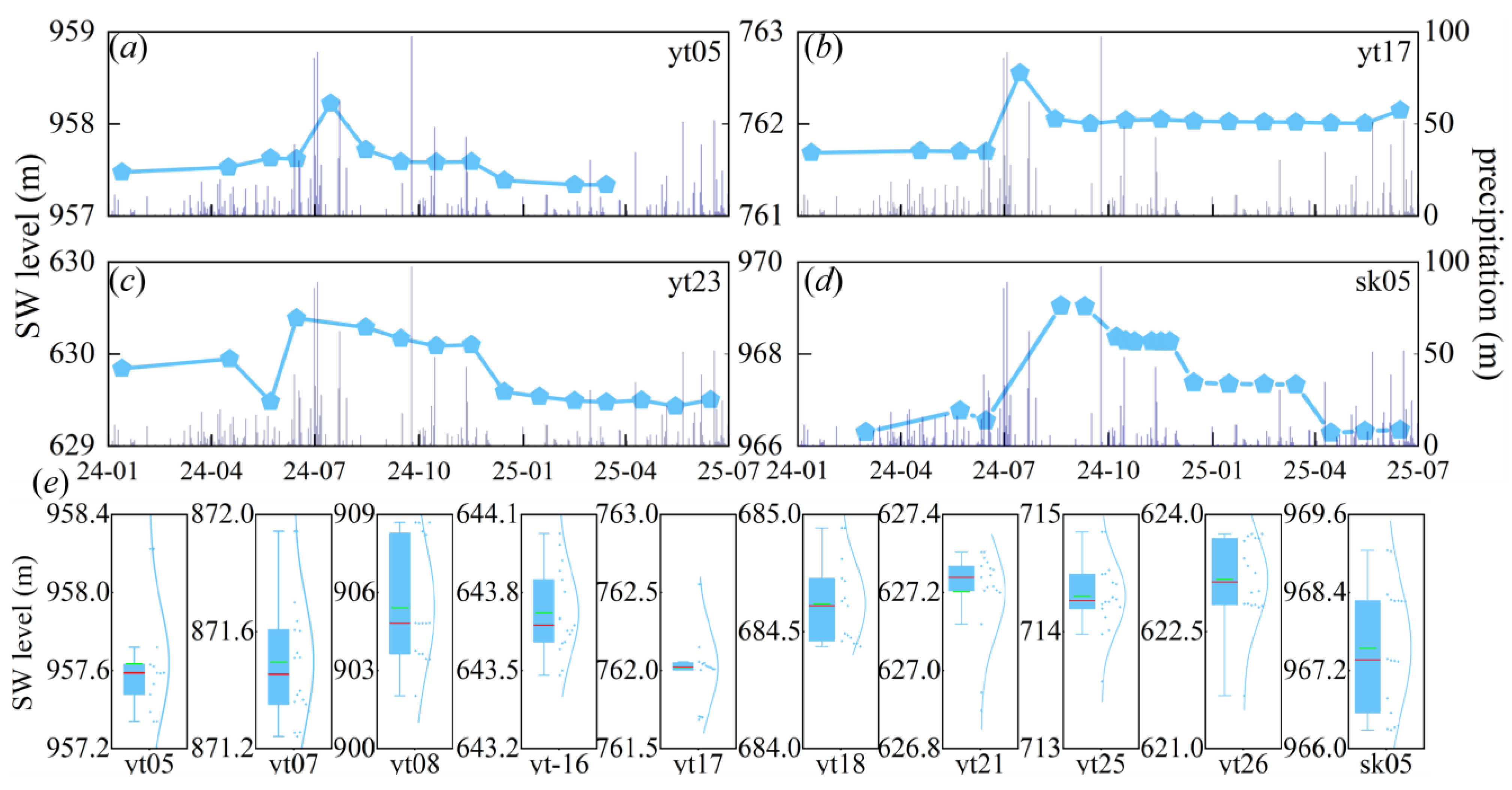
Fifteen surface water monitoring points were set up in the study area. Except for yt05 and sk05, which were in the T3xj stratum, the rest were in the T1j stratum. sk05, yt05, yt07, yt08, yt10, and yt11 were located on the northwest wing of the Jiaojiaoshan anticline, while the rest were on the southeast wing. The distribution is shown in Figure 1a, and the typical water level change curves are shown in Figure 6a–d. Although there is some correlation between water levels and rainfall, the overall fluctuation is relatively small, and the impact of rainfall on the pond water levels is limited. Take yt05, yt17, yt22, and sk05 as examples. From the beginning of 2024 to June, the water levels of all ponds were in an initial stable state. The water levels of yt05, yt17, and sk05 fluctuated gently, and yt23 had some fluctuations during June but was replenished by rainfall. During this period, the rainfall fluctuated slightly and had little impact on the water levels of the ponds. All ponds showed some response to this event, but the fluctuations in water levels were moderate. Excluding the extreme rainfall from last year, the rainfall during the same period in 2025 has increased compared to the previous year, but the overall fluctuation is small, which still indicates a weak impact of rainfall on the pond water levels. Overall, the fluctuation range of the pond water levels was small, with most ponds fluctuating by less than 1 m, as shown in Figure 6e. The correlation with the tunnel water inflow was negligible, and the tunnel water inflow did not cause the ponds to dry up.

5. Characteristics of Groundwater Dynamics

5.1. Mann–Kendall Abrupt Change Test

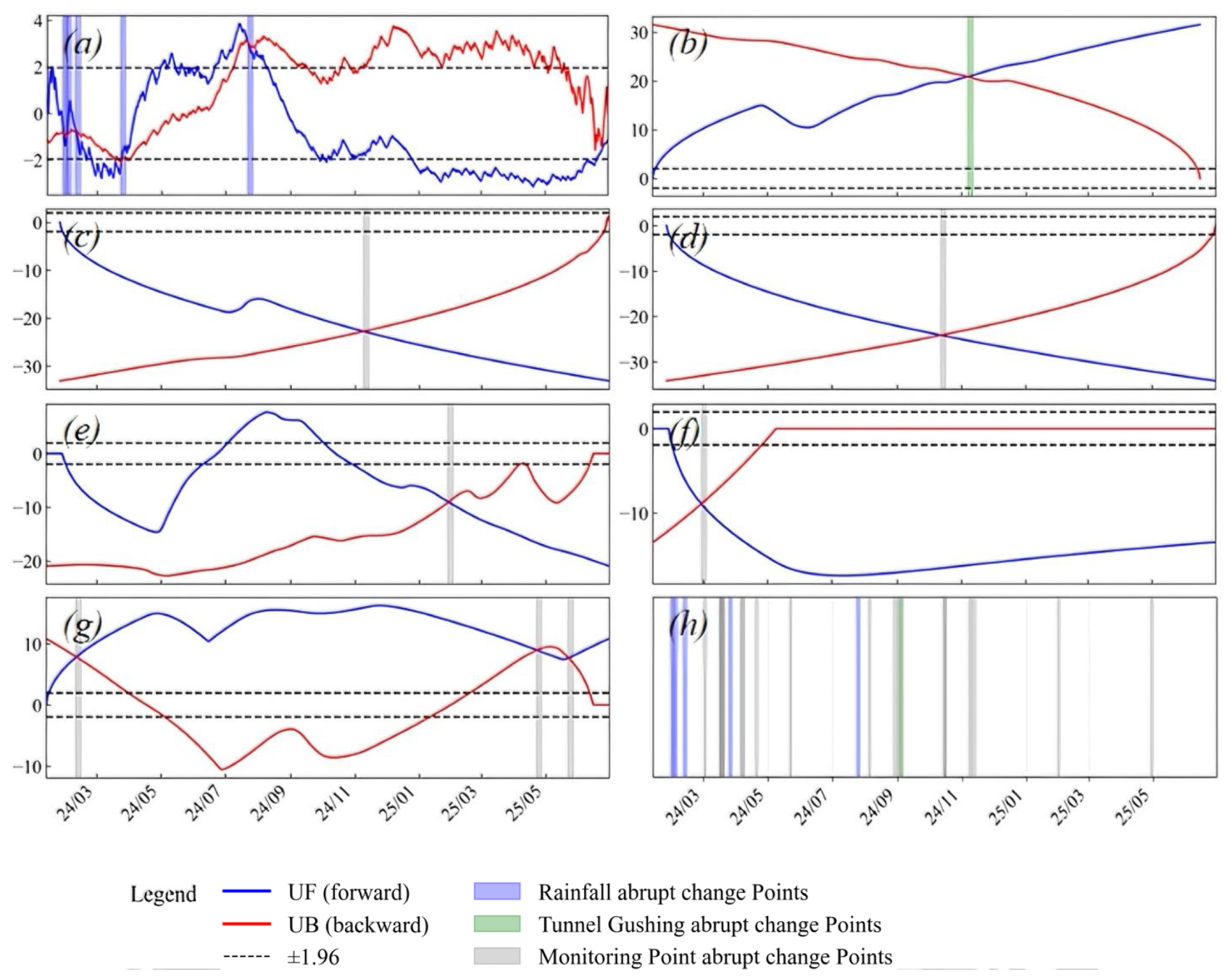
Figure 7 illustrates the results of the Mann–Kendall (M–K) abrupt change test for rainfall, tunnel inflow, and representative monitoring points. Owing to the diversity and large number of monitoring sites, only representative points are selected for display. Figure 7h presents a comprehensive analysis of all abrupt change times, in which the M–K results of different monitoring points are integrated along a unified time axis for comparison. The data of the pond monitoring points exhibit poor fitting performance and therefore are not included in Figure 7h. As shown in Figure 7a, the abrupt changes in rainfall primarily occur between February and March 2024. Figure 7b indicates that the abrupt change in tunnel inflow is concentrated around September 2024. In Figure 7h, different colors are used to distinguish the types of abrupt changes: blue denotes rainfall-related abrupt change points, green represents tunnel-inflow abrupt change points, and gray corresponds to abrupt changes in other monitoring datasets. A comprehensive comparison reveals that the abrupt change events are mainly concentrated within two periods: the first from March to May 2024, which is inferred to be predominantly influenced by rainfall processes; and the second from September to December 2024, which is probably associated with tunnel inflow dynamics.

5.2. Correlations Between Measurements by Heatmaps

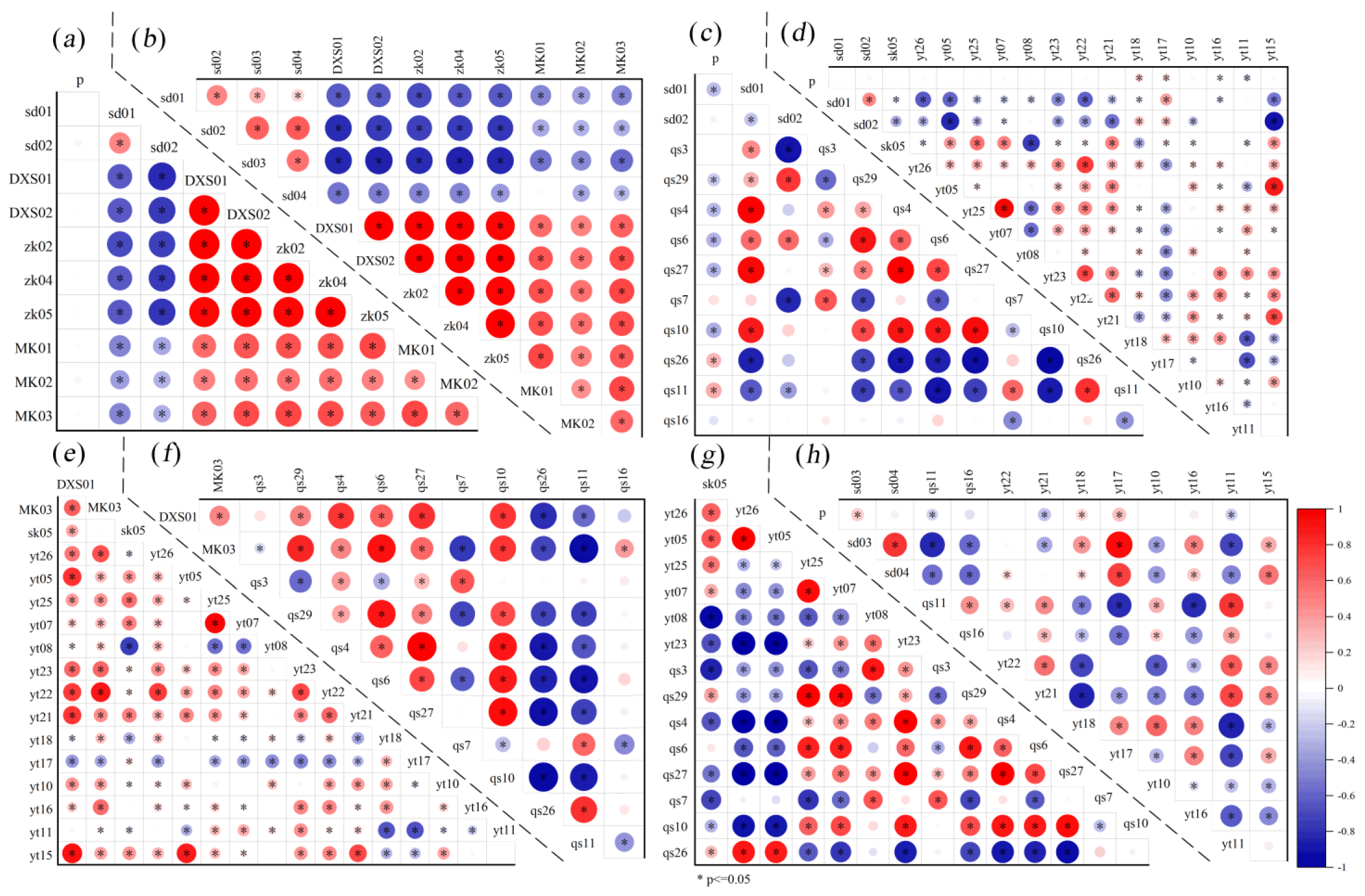
Figure 8a shows the correlation heat maps among rainfall, tunnel inflows, groundwater levels of boreholes, and coal mine drainage. It can be seen from the figure that the groundwater level of boreholes and tunnel drainage, as well as coal mine drainage and tunnel drainage, all show a notable negative correlation (as shown in rows 3 to 10 and columns 2 to 10 in Figure 8a), indicating that an increase in tunnel inflow is accompanied by a decrease in the groundwater level of boreholes and a reduction in coal mine drainage, suggesting that tunnel drainage has caused a large drop in the regional groundwater level. On the other hand, the correlation between rainfall and tunnel drainage, groundwater level of boreholes, and coal mine drainage is not significant, indicating that the impact of rainfall on regional groundwater is weak, especially on deep groundwater. Drainage of De’an tunnel was added to Figure 8a, to become Figure 8b, and it also demonstrated that tunnel drainage has caused a major drop in the regional groundwater level (as shown in rows 3 to 4 and columns 4 to 8 in Figure 8b).
Figure 7. Mann–Kendall abrupt change analysis of measured values, (a) rainfall, (b) total tunnel water inflow, (c) ZK02, (d) DXS01, (e) MK-02, (f) qs27, (g) yt17, (h) comprehensive analysis of the abrupt change dates.
Water 18 00087 g007
Figure 8c,d show the correlation heat maps among rainfall, tunnel drainage, springs, and surface water bodies (ponds, reservoirs). The larger the circle, the stronger the correlation between the two monitoring points. It can be analyzed from the figures that the correlation coefficients between rainfall and surface water bodies are relatively low, indicating that the impact of rainfall on surface water bodies is small. The springs qs26 and qs11, which are closer to the Wufu tunnel, show an evident negative correlation with the drainage sd01 and sd02 of the Wufu tunnel (as shown in rows 10 to 11 and column 2 in Figure 8c), also indicating that tunnel drainage has caused large decline of the regional groundwater level, resulting in substantial reduction in spring flow; on the other hand, yt15, which is closer to the De’an tunnel, and yt26 and yt05, which are closer to the Wufu tunnel, show a relatively high positive correlation (as shown in rows 2 to 3 and columns 4 to 5 in Figure 8d), suggesting that the impact of tunnel construction on yt15, yt26, and yt05 is relatively large.
Figure 8e,f,g show the correlation heat maps among the monitoring points after excluding rainfall and tunnel drainage, mainly reflecting the hydrological connection among the monitoring points without considering recharge and discharge. It can be seen from Figure 8e that the water levels of yt23, yt22, and yt21, which are closer to the Wufu tunnel, show a strong correlation with the water level of borehole DXS01 (as shown in rows 8 to 10 and column 11 in Figure 8e), and the relatively close qs4 and qs6 show a certain correlation in the correlation map (as shown in row 5 and column 5 in Figure 8f). Moreover, it can be seen from Figure 8g that adjacent yt and qs points generally show a relatively high positive correlation (as shown in rows 5 to 14 and columns 4 to 12 in Figure 8g). All these indicate that the adjacent monitoring points are in the same or adjacent groundwater flow systems, and thus have similar water level change characteristics. In Figure 8h, qs16, which is relatively close to the De’an Tunnel, shows a negative correlation with the tunnel drainage sd03 and sd04 (see the second to third rows and the fourth column in Figure 8h), which also indicates that the tunnel drainage leads to the attenuation of the spring flow.
Figure 8. Monitoring point correlation heatmap; (a) P + WFSD + ZK + MK; (b) WFSD + DASD + ZK + MK; (c) P + WFSD + QS; (d) P + WFSD + YT + SK; (e) ZK + MK + YT + SK; (f) ZK + MK + QS; (g) QS (north)+ YT (north) + SK; (h) P + DASD + QS (south) + YT (south); herein, the “north” means the monitoring points are in the north of WF tunnel, likewise the “south”; P: rainfall; WFSD: Wufu Tunnel monitoring point; ZK: borehole monitoring point; DASD: De’an Tunnel monitoring point; MK: coal mine monitoring point; QS: spring monitoring point; YT: dam and pond monitoring point.
Water 18 00087 g008

5.3. Wavelet Analysis Results

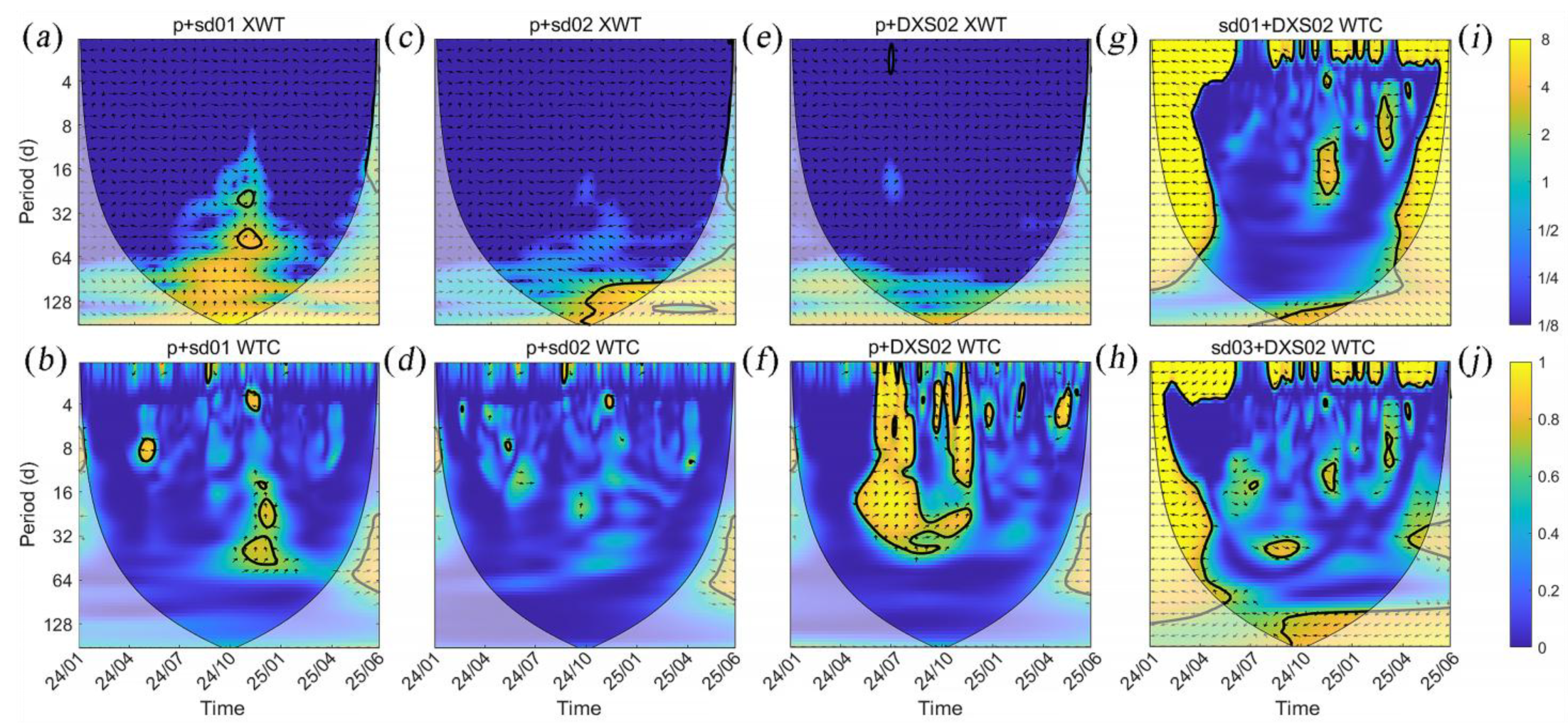
Figure 9a–f present the cross-wavelet and wavelet coherence diagrams of rainfall and the water levels of tunnel drainage sd01, tunnel drainage sd02, and borehole DXS02. The arrow direction indicates the phase relationship between the two. The black thick solid line indicates that the two have passed the 95% red noise test. The XWT (cross-wavelet) diagrams of rainfall and the water levels of tunnel drainage sd01 and sd02 are shown in Figure 9a,c, and the WTC (wavelet coherence) diagrams are shown in Figure 9b,d. Both show that the areas passing the 95% significance test are very scattered at different time scales, and the phase relationship between the two within the areas passing the 95% significance test is quite diverse, indicating that the evolution characteristics of rainfall and borehole water levels are relatively inconsistent during the corresponding periods.
Figure 9e shows the XWT (cross-wavelet) diagram of rainfall and the water level of DXS01. Although the area passing the 95% significance test is very small, the time of the area passing the 95% significance test is consistent with that in Figure 9f, which shows the WTC (wavelet coherence) diagram of rainfall and the water level of DXS01. Figure 9f indicates that the 3–40d period passed the 95% significance test from the beginning of July 2024 to the end of December 2024, and the response of the borehole water level to rainfall is a lag relationship, suggesting that rainfall has a certain degree of influence on the change in the borehole water level during this period, and this period is consistent with the two peak periods of rainfall (see Figure 3e).
Figure 9g,h show the wavelet coherence diagrams of tunnel drainage sd01, sd03 and the water level of borehole DXS02. The diagrams show that tunnel drainage sd01, sd03, and the water level of borehole DXS02 have coherence at a smaller time scale (1–4 d), and most of the periods have passed the 95% significance test. The phase relationship between the two is mainly negative, indicating that the evolution characteristics of tunnel drainage and borehole water levels are relatively consistent at the corresponding time scale and period. Moreover, tunnel drainage sd01 of Wufu Tunnel and sd03 of De’an Tunnel have a certain coherence with the water level of borehole DXS02 at the time scale of 10–30 d and 36–46 d, respectively. The 10–30 d period of Wufu Tunnel drainage sd01 passed the 95% significance test from the beginning of December 2024 to the beginning of January 2025 (see Figure 9g), indicating that the coherence between tunnel drainage sd01 of Wufu Tunnel and the water level of borehole DXS02 is relatively strong during the corresponding period, and this period is consistent with the time when the tunnel excavation enters the carbonate karst aquifer rock group (T2b1, T1j4, T1j3) (see Figure 3e); the 36–46 d period of De’an Tunnel drainage sd03 passed the 95% significance test from the beginning of September 2024 to mid-October 2024 (see Figure 9h), indicating that the coherence between tunnel drainage sd03 of De’an Tunnel and the water level of borehole DXS02 is relatively strong during the corresponding period, and this period is consistent with the time when the tunnel excavation enters the clastic rock intercalated with carbonate rock fracture-karst aquifer rock group (T2b3) (see Figure 3e).

6. Discussion

6.1. Spatial Pattern of Responses by Monitoring Point

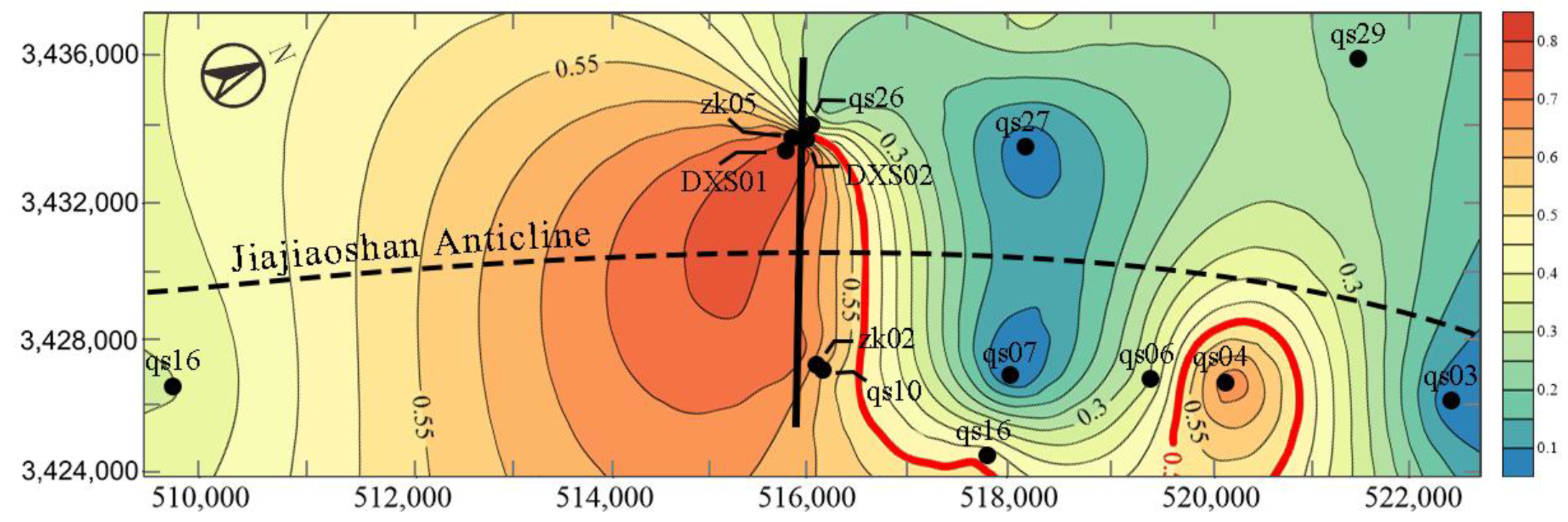
To analyze the spatial variation in the response of groundwater monitoring points to tunnel water drainage, the correlation distribution map is provided as shown in Figure 10. The correlation values are derived from the r values of the correlation coefficient in the correlation heat map in Section 5.2, and then the absolute values are taken, that is, the positive and negative correlations are not considered, only the degree of correlation is considered. Monitoring points of the pond type (i.e., yt and sk) were not included in the analysis due to their unclear correlation patterns with tunnel water gushing. As shown in Figure 10, the areas with higher correlation coefficients are mainly concentrated around the boreholes. The southern side of the Wufu Tunnel has a higher coefficient while the northern side has a lower one. However, there are fewer monitoring points on the southern side, so the distribution pattern on the northern side is more valuable for reference. The contour lines near the tunnel axis and the qs07 and qs27 spring points are roughly symmetrically distributed along the anticline axis, reflecting the consistency of the responses of the monitoring points on both wings of the anticline to tunnel drainage and the close hydraulic connection of the aquifers on both wings, this result differs significantly from the parameter estimation performance observed in the eastern and western karst trough valleys of the Guanyinxia anticline in the Xiemashan Tunnel, located in the Zhongliang Mountain area of Chongqing [15]. However, an abnormal high-value area of the correlation coefficient appears near the qs04 area, which might be due to the premature drying up of the qs04 spring, resulting in abnormal data. Figure 10 highlights the contour corresponding to a correlation coefficient of 0.5. This contour primarily extends within a range of approximately 50 to 400 m north of the tunnel alignment, indicating a significant correlation between groundwater dynamics and tunnel-induced drainage. The anomalously high correlation zone observed at monitoring point qs04 may suggest the presence of a preferential hydraulic pathway. It should be noted that this discussion pertains only to the north side of the tunnel; data from the south side are sparse and are not included in this analysis. The correlation coefficients between rainfall and various types of monitoring points (boreholes, coal mines, spring points, and ponds) are all relatively low, so such spatial variation analysis was not conducted.

6.2. Groundwater Dynamics Revealed by Observations

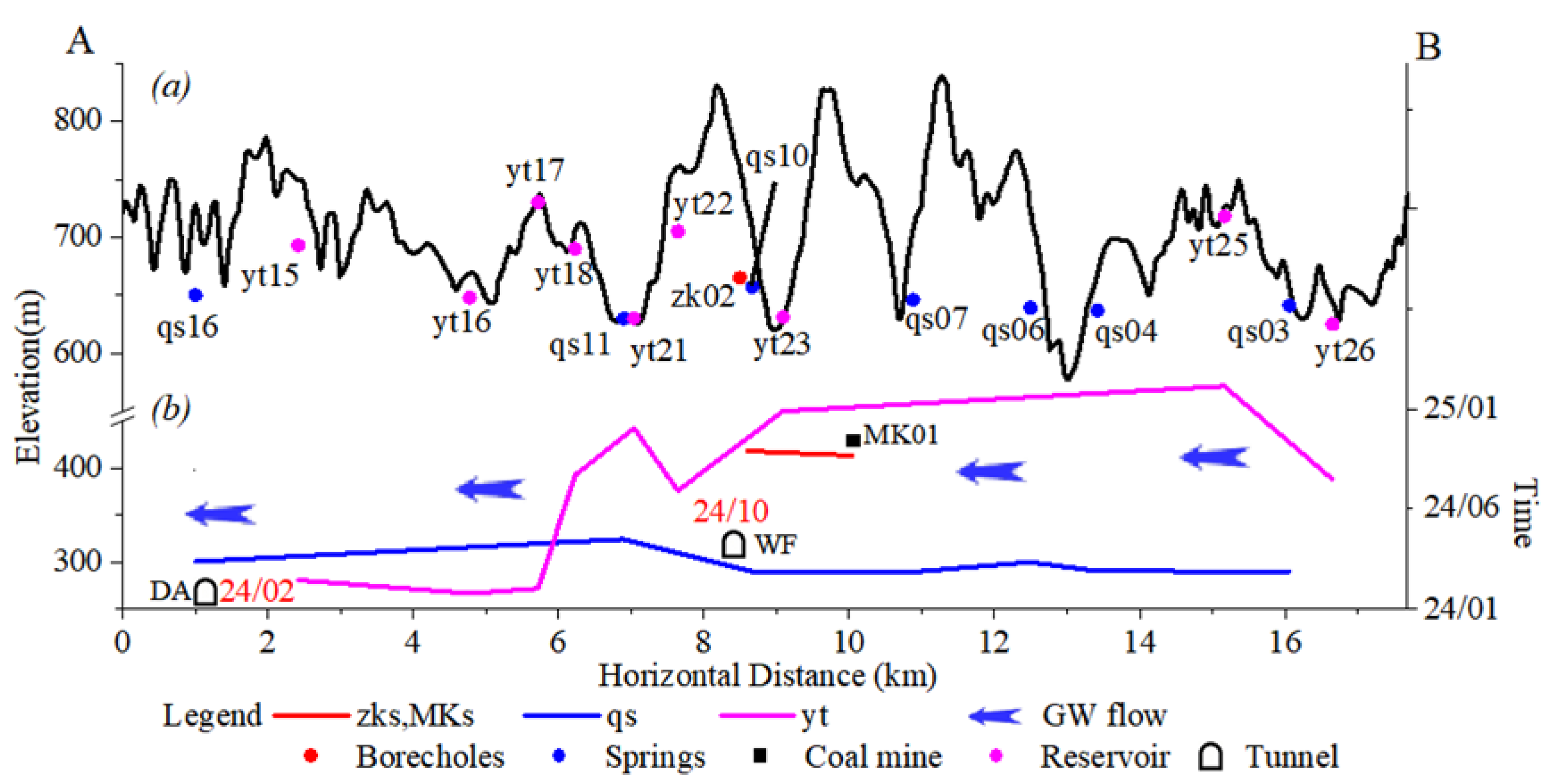
To investigate the disturbance characteristics of tunnel excavation on the regional groundwater dynamic system, an A–B profile intersecting the majority of monitoring points was selected, as shown in Figure 11. Figure 11a illustrates the spatial distribution of the monitoring sites. Based on the results of the Mann–Kendall abrupt change test for each dataset, the identified abrupt change times were extracted and plotted in groups for boreholes, coal-mine drainage, springs, and weir-pond reservoirs, as shown in Figure 11b.
The profile reveals that the elevations of the monitoring points gradually decrease with increasing distance, indicating that the regional topography slopes from point A toward point B. Consequently, surface runoff primarily converges from A to B. However, the temporal distribution of abrupt changes at spring sites does not strictly follow the topographic gradient. Most spring abrupt changes occurred between March and May 2024, suggesting that spring responses are predominantly controlled by hydrological processes rather than elevation differences.
A more detailed examination of representative spring sites further reveals distinct response lag characteristics under the combined influence of the De’an (DA) and Wufu (WF) tunnels. Using the DA Tunnel as the spatial reference point, spring qs16 located ad-jacent to the DA Tunnel responded almost synchronously on 1 February 2024, whereas qs11, located approximately 6 km away, exhibited a delayed response on 1 March 2024, corresponding to a lag of about 30 days. In contrast, qs10 near the WF Tunnel (approxi-mately 8.5 km from the DA Tunnel) responded earlier on 15 February 2024, and qs06 lo-cated further downstream (approximately 11.5 km from the DA Tunnel) responded on 25 February 2024, with lag times of approximately 15–25 days. These results indicate that spring response timing is not governed by distance to a single tunnel, but rather by the dominant hydraulic control exerted by the nearest or most influential tunnel.
In contrast, the abrupt change times of the weir-pond monitoring sites exhibit a clear spatial pattern: abrupt changes occur earlier in the upstream portion of the profile and progressively later downstream. Near the De’an Tunnel, abrupt changes occur obviously earlier; with increasing distance, the abrupt change times are gradually delayed; yet near the Wufu Tunnel, they again appear earlier. This pattern indicates that tunnel drainage exerts a staged and spatially superimposed effect on the groundwater system. Borehole zk02 and coal-mine drainage point MK01, both located near the Wufu Tunnel, are particularly sensitive to the big water-inrush events after October 2024, confirming that tunnel excavation plays a dominant role in controlling groundwater-level variations.
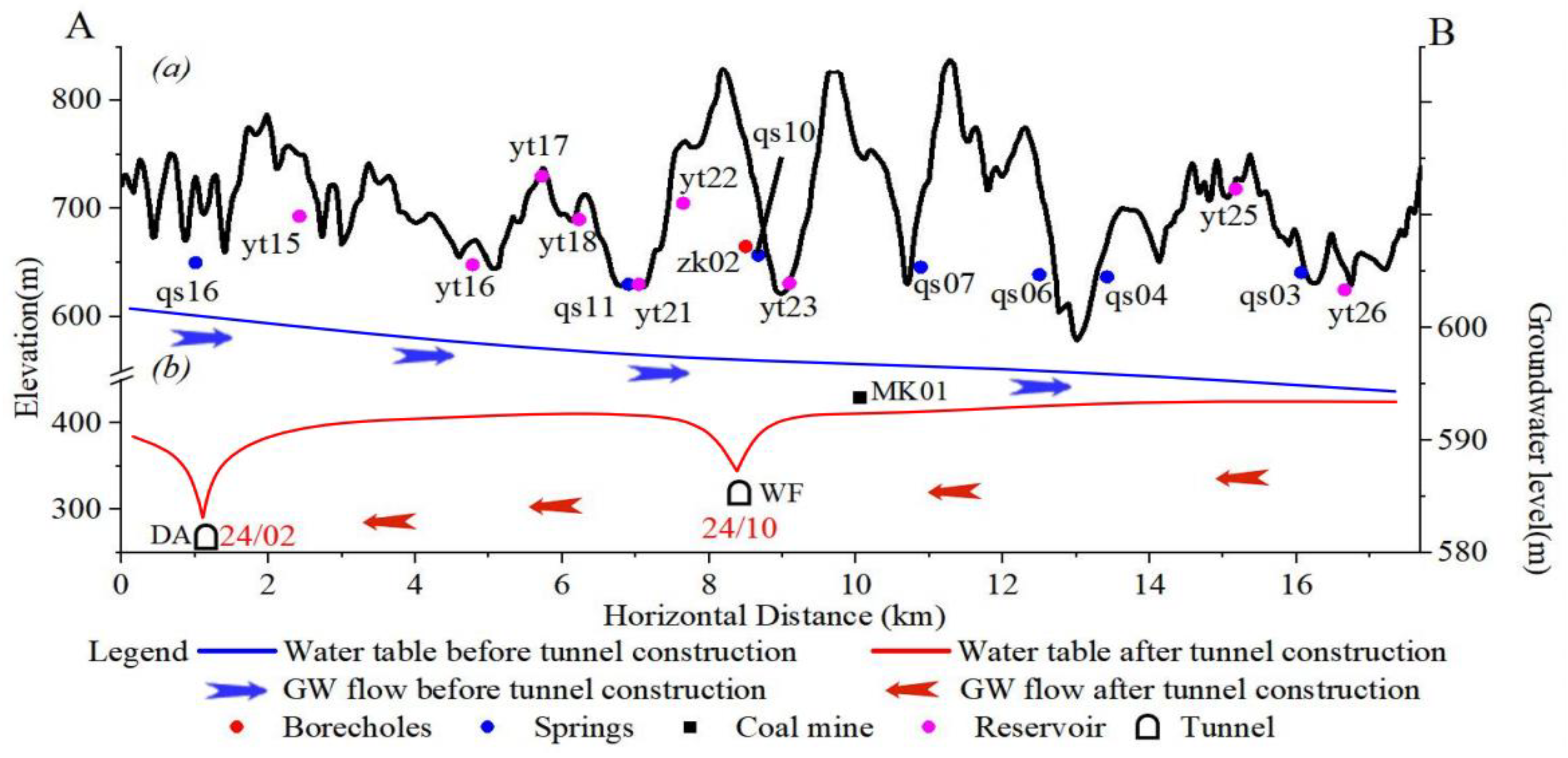
After tunnel excavation, sustained large-scale drainage causes the tunnels to act as strong discharge boundaries, leading to the formation of pronounced groundwater draw-down cones in their surrounding areas, as shown in Figure 12. Owing to the substantially greater drainage capacity of the De’an Tunnel compared with the Wufu Tunnel, the drawdown cone developed around the De’an Tunnel exhibits a wider spatial extent and greater drawdown depth, thereby exerting a more significant disturbance on the regional groundwater system. The drawdown cones induced by drainage from the two tunnels spatially overlap and act in a coupled manner, markedly modifying the original distribution of the groundwater hydraulic gradient. Consequently, groundwater flow gradually shifts from a topography-controlled unidirectional runoff regime to a tunnel-centered convergent flow regime. In localized areas, the original hydraulic gradient is weakened or even reversed, ultimately giving rise to a pronounced reorientation of groundwater flow.
Integrating the spatial distribution of abrupt change times with geological and hydro-hydrological conditions, the regional groundwater flow direction is inferred to be from northeast to southwest (i.e., from B to A). This direction is opposite to surface runoff, im-plying that tunnel drainage has reshaped the groundwater flow field, producing an out-ward-propagating drawdown effect centered on the tunnels. Tunnel drainage alters the original hydraulic gradient, causing partial reversals in groundwater flow direction and largely disturbing the regional recharge–discharge pattern. Similar tunnel-induced groundwater flow reorganization has been reported by Yang et al. (2009) [24] in the Tseng-Wen Reservoir tunneling project, where intensive tunnel drainage transformed the tunnel into a dominant hydraulic sink and caused groundwater to converge toward the tunnel, leading to a reconfiguration of the pre-existing flow field. The consistency between the reported results and the observations in this study further confirms that sustained tunnel drainage can exert first-order control on groundwater dynamics and induce groundwater flow reorientation in complex aquifer systems.

7. Conclusions

The construction of the Wufu Tunnel under the condition of an enclosed aquifer re-sulted in significant water inflow, with an average inflow of 13,000 m3/d, and the maxi-mum inflow up to 150,000 m3/d. The water level recorded in the boreholes near the tunnel line decreased by 167.4 m on average, the discharge rate of the local coal mine decreased by more than 65%, and 70% of the springs have dried up in the tunnel site area.
The process curves of tunnel drainage show obvious phased characteristics, with the change in the rock types of the excavated strata during the excavation. At the beginning, when the tunnel depth of the entrance and exit sections are relatively shallow, it is easily affected by rainfall, but after entering the karst aquifer, the drainage volume increases sharply, and the influence of rainfall became weak, reflecting the strong hydraulic connection and good water storage conditions of the enclosed karst water system.
Correlation analysis and wavelet analysis reveal the spatiotemporal variation patterns of the responses of various types of monitoring points to rainfall and tunnel drainage. The correlation between rainfall and various types of monitoring points is relatively low, indicating that the impact of rainfall is little; while tunnel drainage shows a tight correlation with most of the monitoring points. Taking a correlation coefficient of 0.5 as the threshold, monitoring points within a range of 400 m from the tunnel have a high correlation with tunnel water inflow, reflecting a strong hydraulic connection.
The Mann–Kendall test of groundwater dynamics indicates that the abrupt changes in borehole water levels and coal mine drainage are closely correlated with tunnel inflow, while spring points have a high correlation with both rainfall and tunnel inflow. Few pond monitoring points are affected by rainfall. The response lag time of the spring point is approximately 15–30 d, generally increases with distance.
Based on the analysis of the distribution of abrupt change times and geological-hydrological conditions, it is indicated that tunnel drainage has reshaped the regional groundwater flow field, forming a drainage effect that spreads outward from the tunnel, causing local groundwater flow direction reversal and greatly disturbing the regional recharge-discharge pattern. It exerts impacts on the ecological environment and disrupts the hydrological system. In conclusion, tunnel engineering drainage has the primary control effect on the enclosed karst water system, and becomes the main driving force leading to the significant changes in groundwater dynamics.

Author Contributions

Funding acquisition, X.X., T.Y. and X.Z. (Xiaowei Zhang); Data curation, X.K.; Project administration, L.Z. and T.Y.; Writing—original draft, Q.Z. and X.Z. (Xiaojie Zhang); Writing—review and editing, Q.Z. and Q.X.; Supervision, L.Z. and Q.X. All authors have read and agreed to the published version of the manuscript.

Funding

This research was funded by the Chongqing Transportation Science and Technology Project (Grant No. 2022-05), Science and Technology Program of Xizang Autonomous Region (Grant No. XZ202501ZY0073), National Natural Science Foundation of China (Grant No. 42072283, 41502237), Independent project of the State Key Laboratory of Geohazard Prevention and Geo-environment Protection (Grant No. SKLGP2017Z014), Open project of Chongqing Groundwater Resource Utilization and Environmental Protection Laboratory (Grant No. MX-3138NC_20191113_104244).

Data Availability Statement

The data presented in this study are available on request from the corresponding author due to the data source is not a publicly available repository.

Conflicts of Interest

Authors Xiantao Xu, Xiangsheng Kong, and Lei Zhang were employed by the company Chongqing Nanjiang Survey and Design Co., Ltd. Author Tao Yu was employed by the company Chongqing High-Speed Rail Construction Wan Kai Da Expressway Co., Ltd. Author Xiaowei Zhang was employed by the company China Railway Changjiang Transport Design Group Co., Ltd. The remaining authors declare that the research was conducted in the absence of any commercial or financial relationships that could be construed as a potential conflict of interest.

References

  1. Gokdemir, C.; Li, Y.D.; Rubin, Y.; Li, X.J. Stochastic modeling of groundwater drawdown response induced by tunnel drainage. Eng. Geol. 2022, 297, 106529. [Google Scholar] [CrossRef]
  2. Xu, G.; Chen, Y.; Cui, H.; Li, N.; Ren, S. A Study on the Hydrogeological Effects and Environmental Impacts of Tunnel Construction: A Case Study of the Gaochuan Slope Section of the Yuelongmen Tunnel on the Chengdu—Lanzhou Railway. J. West. Resour. 2022, 52–56. [Google Scholar] [CrossRef]
  3. Chiu, Y.C.; Chia, Y. The impact of groundwater discharge to the Hsueh-Shan tunnel on the water resources in northern Taiwan. Hydrogeol. J. 2012, 20, 1599–1611. [Google Scholar] [CrossRef]
  4. Kim, M.G.; Kim, M.; Jeong, G.; Lee, J.; Chung, I.-M. Evaluation of Groundwater Level Decline and Water Quality Due to Tunnel Excavation. J. Eng. Geol. 2019, 29, 113–122. [Google Scholar]
  5. Golian, M.; Katibeh, H.; Singh, V.P.; Ostad-Ali-Askari, K.; Rostami, H.T. Prediction of tunnelling impact on flow rates of adjacent extraction water wells. Q. J. Eng. Geol. Hydrogeol. 2020, 53, 236–251. [Google Scholar] [CrossRef]
  6. Gisbert, J.; Vallejos, A.; González, A.; Pulido-Bosch, A. Environmental and hydrogeological problems in karstic terrains crossed by tunnels: A case study. Environ. Geol. 2009, 58, 347–357. [Google Scholar] [CrossRef]
  7. Vincenzi, V.; Gargini, A.; Goldscheider, N. Using tracer tests and hydrological observations to evaluate effects of tunnel drainage on groundwater and surface waters in the Northern Apennines (Italy). Hydrogeol. J. 2008, 17, 135–150. [Google Scholar] [CrossRef]
  8. Vincenzi, V.; Gargini, A.; Goldscheider, N.; Piccinini, L. Differential Hydrogeological Effects of Draining Tunnels Through the Northern Apennines, Italy. Rock Mech. Rock Eng. 2013, 47, 947–965. [Google Scholar] [CrossRef]
  9. Kværner, J.; Snilsberg, P. Groundwater hydrology of boreal peatlands above a bedrock tunnel—Drainage impacts and surface water groundwater interactions. J. Hydrol. 2011, 403, 278–291. [Google Scholar] [CrossRef]
  10. Li, J.; Cao, C.; Xu, M.; Fan, W.; Xia, Q. Spatiotemporal Characteristics of Water Inrush Events in the Zhongliangshan Tunnel Group, Chongqing. People’s Yangtze River 2023, 54, 119–127+135. [Google Scholar] [CrossRef]
  11. Hu, L. Hydrogeological Characteristics of the Nanshan Tunnel and Prediction of Tunnel Water Inflow and the Influence Range of Groundwater Drawdown. Diqu (Earth). 2016, pp. 106–109. Available online: https://kns.cnki.net/kcms2/article/abstract?v=IPzr95zWmwSnquXOxf6-xuIPRuPvriaTYeIGlOvbJChFxDvJ5d9kMhkT-Qs-vvIS-wd-fzIk516373iXem0tsbqMdIDP6Ex65ENHcjGlItsmqL5uO3YZoofSIK5ucrmmryXhJrZgQiruwNRPY4dtTljFQ2tahuqrsfX-rzw3D_AmDvs6qCgdWevrmenDB8VY&uniplatform=NZKPT&language=CHS (accessed on 20 December 2025).
  12. Chi, Y.; Li, Q.; Chen, P. Karst Development in the Tongluoshan Area and the Characteristics of Tunnel-Induced Groundwater Drainage. Shanxi Archit. 2015, 41, 86–87. [Google Scholar] [CrossRef]
  13. Cheng, Y.; Feng, L.; Gong, J.; Liu, Y.; Liu, X.; Song, K. Evaluation of the Negative Effects of Tunnel Drainage on the Groundwater Environment Based on the Fuzzy Analytic Hierarchy Process: A Case Study of the Mingyue Mountain Tunnel. In Proceedings of the Annual Academic Conference of the Chinese Society for Environmental Sciences 2016, Haikou, China, 13–14 October 2016; p. 6. [Google Scholar]
  14. Li, H.; Wei, X.; Liu, C.; Li, L. Risk Assessment of Water Inrush Hazards in Karst Tunnels Based on a Variable-Weight Cloud Model: A Case Study of the Zhongliangshan Tunnel. Carsologica Sin. 2023, 42, 548–557+572. [Google Scholar]
  15. Teng, H. Dynamic Characteristics of Groundwater and Estimation of Aquifer Parameters During the Construction Period of Chongqing Xiema Tunnel. Master’s Dissertation, Chengdu University of Technology, Chengdu, China, 2019. [Google Scholar]
  16. Sang, Y.-F. A Practical Guide to Discrete Wavelet Decomposition of Hydrologic Time Series. Water Resour. Manag. 2012, 26, 3345–3365. [Google Scholar] [CrossRef]
  17. Wu, Z. Signal de-noising method based on particle swarm algorithm and wavelet transform. Teh. Vjesn. 2014, 21, 1001–1008. [Google Scholar]
  18. Guo, G.; Bao, H.; Lan, H.; Yan, C.; Zheng, H.; Tang, M. Research on the correlation between shallow surface moisture of loess high fill based on cross wavelet and wavelet coherence. J. Eng. Geol. 2022, 30, 1389–1402. [Google Scholar] [CrossRef]
  19. Cui, Y.; Liao, Z.; Wei, Y.; Xu, X.; Song, Y.; Liu, H. The Response of Groundwater Level to Climate Change and Human Activities in Baotou City, China. Water 2020, 12, 1078. [Google Scholar] [CrossRef]
  20. Li, H.; Lu, Y.; Zheng, C.; Zhang, X.; Zhou, B.; Wu, J. Seasonal and Inter-Annual Variability of Groundwater and Their Responses to Climate Change and Human Activities in Arid and Desert Areas: A Case Study in Yaoba Oasis, Northwest China. Water 2020, 12, 303. [Google Scholar] [CrossRef]
  21. Qi, P.; Zhang, G.; Xu, Y.J.; Wang, L.; Ding, C.; Cheng, C. Assessing the Influence of Precipitation on Shallow Groundwater Table Response Using a Combination of Singular Value Decomposition and Cross-Wavelet Approaches. Water 2018, 10, 598. [Google Scholar] [CrossRef]
  22. Qi, X.; Jiang, Z.; Luo, W. Cross wavelet analysis of precipitation and spring flow in typical surface karst water systems. Earth Environ. 2012, 40, 561–567. [Google Scholar] [CrossRef]
  23. Zhang, Z.; Lin, Q.; Yan, H.; Zhu, X.; Zhang, X.; Yang, S.; Huang, C.; Shi, Y.; Hu, J.; Li, X.; et al. Ground subsidence monitoring and prediction based on InSAR and CNN-BiGRU-Attention: A case study of Chengdu. Eng. Geol. 2025, 357, 108336. [Google Scholar] [CrossRef]
  24. Yang, F.-R.; Lee, C.-H.; Kung, W.-J.; Yeh, H.-F. The impact of tunneling construction on the hydrogeological environment of “Tseng-Wen Reservoir Transbasin Diversion Project” in Taiwan. Eng. Geol. 2009, 103, 39–58. [Google Scholar] [CrossRef]
Figure 3. Tunnel drainage versus precipitation process curves at (a) sd01, (b) sd02, (c) sd03, (d) sd04, (e) relationship between water inflow at sd02 and the exposed stratum, (f) box plots of tunnel drainage flow rates.
Water 18 00087 g003
Figure 4. The boreholes and coal mine monitoring points. (ae) present the trend changes in borehole water levels, (f) boxplots of borehole water levels, (g,h) show the trend changes in coal mine drainage flow rates, (i) boxplot of coal mine drainage. (Note: The blank sections in (a,b) are anomalous values and were abandoned in this study).
Water 18 00087 g004
Figure 5. Spring Flow Monitoring Points: (aj) are trend charts of spring flow variations, and (k) is a box-and-whisker plot of spring flow. The drying-up dates of the springs are marked in each figure.
Water 18 00087 g005
Figure 6. Surface water monitoring results, (ad) trend change diagrams for 4 typical points, (e) box plots of water levels for all points.
Water 18 00087 g006
Figure 9. Cross wavelet and wavelet coherence between rainfall, tunnel drainage, and borehole water level, (a) XWT: p and sd01; (b) WTC: p and sd01; (c) XWT: p and sd02; (d) WTC: p and sd02; (e) XWT: p and DXS02; (f) WTC: p and DXS02; (g) WTC: sd01 and DXS02; (h) WTC: sd03 and DXS02; (i) Color maps for XWT; (j) Color maps for WTC.
Water 18 00087 g009
Figure 10. Contour map of correlation coefficient of selected monitoring points.
Water 18 00087 g010
Figure 11. The A–B profile and monitoring point abrupt change time curve of the southeast wing of the Jiaiiaoshan mountain anticline, the year/month marked in red font near the tunnel indicates the date of large-scale water inflow. (a) A–B geological profile; (b) Abrupt change time curve of monitoring points.
Water 18 00087 g011
Figure 12. Conceptual model of groundwater flow reorganization induced by tunnel drainage along the A–B profile. (a) A–B geological profile; (b) Schematic diagram of formation mechanism of groundwater flow direction change.
Water 18 00087 g012
Disclaimer/Publisher’s Note: The statements, opinions and data contained in all publications are solely those of the individual author(s) and contributor(s) and not of MDPI and/or the editor(s). MDPI and/or the editor(s) disclaim responsibility for any injury to people or property resulting from any ideas, methods, instructions or products referred to in the content.