Article

Hydrogeochemical and GIS-Integrated Evaluation of Drainage Water for Sustainable Irrigation Management in Al-Jouf, Saudi Arabia


1
Department of Civil Engineering, College of Engineering, Jouf University, Sakakah 72388, Saudi Arabia
2
Environmental Engineering Department, Faculty of Engineering, Zagazig University, Zagazig 44519, Egypt
3
Construction Engineering & Utilities Department, Faculty of Engineering, Zagazig University, Zagazig 44519, Egypt
*
Author to whom correspondence should be addressed.
Water 2026, 18(1), 78; https://doi.org/10.3390/w18010078 (registering DOI)
Submission received: 16 November 2025 / Revised: 17 December 2025 / Accepted: 24 December 2025 / Published: 27 December 2025
(This article belongs to the Section Water Quality and Contamination)

Abstract

This study evaluates the quality and irrigation suitability of drainage water in the Al-Jouf Region, Saudi Arabia, where water scarcity necessitates the reuse of nonconventional resources. Eighteen drainage water samples were analyzed for physicochemical parameters and irrigation indices, including electrical conductivity (EC), sodium percentage (Na+%), sodium adsorption ratio (SAR), magnesium hazard (MH), Kelly’s ratio (KR), permeability index (PS), and irrigation water quality index (IWQI). Multivariate statistical tools were applied to identify dominant hydrogeochemical processes. Inverse Distance Weighting (IDW) interpolation in ArcGIS Desktop 10.8 was employed to map significant physicochemical data and irrigation indicators. Results revealed that while EC values indicated low to moderate salinity (0.74–25.2 μS/cm), most samples showed high Na+%, SAR, and KR, classifying them as doubtful to unsuitable for irrigation. The IWQI ranged from 84.47 to 1617.87, indicating poor to inferior quality due to evaporation, fertilizer leaching, and sodium accumulation. Furthermore, the results highlight the importance of precise geographic modeling in determining whether drainage water is suitable for long-term agricultural use in arid regions such as Al-Jouf. Sustainable reuse of such drainage water requires freshwater blending, gypsum application, and the cultivation of salt-tolerant crops, aligning with Saudi Vision 2030 objectives for sustainable water management in arid regions.

1. Introduction

Water scarcity is a defining environmental challenge in arid and semi-arid regions, where limited rainfall, high evaporation rates, and expanding human activities place immense pressure on freshwater resources [1]. In the Kingdom of Saudi Arabia (KSA), the hydrological cycle is dominated by extremely low precipitation, averaging less than 100 mm annually, combined with potential evapotranspiration exceeding 2500 mm per year [2]. Consequently, renewable surface and groundwater resources are limited, compelling the nation to rely on non-conventional water sources, including treated wastewater, desalinated seawater, and agricultural drainage water, to meet domestic, industrial, and farming demands [3,4].
Among these alternatives, drainage water, produced from irrigation return flows and periodic rainfall runoff, represents an underutilized yet strategically vital resource for water reuse [5]. It plays a dual role: contributing to ecological balance by maintaining soil moisture regimes in cultivated lands and serving as a supplementary irrigation source that can alleviate the pressure on overexploited aquifers [6]. However, the suitability of such water depends mainly on its chemical composition, which is influenced by factors such as soil type, water interactions, fertilizer residues, agrochemical inputs, and the nature of the irrigated crops [7]. Inadequate monitoring and management of drainage water quality can accelerate soil salinization, sodicity buildup, and nutrient leaching, thereby reducing crop productivity and degrading soil structure [8].
The Al-Jouf Region, situated in northwestern Saudi Arabia, is one of the country’s most prominent agricultural zones, thanks to its fertile soils and extensive irrigation infrastructure. The region’s agricultural expansion is sustained primarily by groundwater extraction from the Saq Aquifer, one of the largest and most productive aquifers in the Arabian Peninsula [9]. Yet, continuous groundwater abstraction has led to declining water tables and deteriorating water quality, necessitating the exploration of alternative water resources [3]. Drainage water reuse offers a viable pathway to partially offset water deficits, improve irrigation efficiency, and contribute to sustainable agricultural practices [5].
Hydrochemical investigations are critical for understanding the spatial and temporal dynamics of water quality [1]. Parameters such as pH, electrical conductivity (EC), total dissolved solids (TDSs), Hardness, and concentrations of major cations (Ca2+, Mg2+, Na+, K+) and anions (Cl, SO42−, NO2, NO3) serve as key indicators of salinity, alkalinity, and ionic balance, factors that directly affect soil permeability and plant growth [5,10]. For irrigation water assessment, specific indices, including the Sodium Adsorption Ratio (SAR), Sodium Percentage (Na+%), Kelly’s Ratio (KR), Magnesium Hazard (MH), and Permeability Index (PI), provide a quantitative basis for classifying water quality and identifying potential hazards [11]. These indices help determine whether water can be used directly for irrigation, needs to be blended with freshwater, or requires soil management interventions such as gypsum amendments or periodic leaching.
Recent hydrological studies in Saudi Arabia have underscored the growing need for integrated water-quality management frameworks. For example, Alazba et al. [2] demonstrated that rainfall-driven wadis and ephemeral streams play an important role in regional hydrology but are vulnerable to rapid infiltration and evaporation losses. Similarly, Alrowais et al. [7] analyzed groundwater hydrochemistry across Al-Jouf and reported dominant Na+–Cl and Ca2+–SO42− facies, reflecting the influence of both natural rock–water interactions and anthropogenic inputs. In the Al-Ahsa Oasis, Badr et al. [5] found that mixed irrigation sources combining treated wastewater, groundwater, and agricultural drainage exhibited substantial spatial and seasonal variation in irrigation water quality indices (IWQIs), highlighting the necessity for GIS-based spatial monitoring.
Advancements in water quality assessment methodologies have further facilitated the monitoring and management of drainage water pollution. The implementation of remote sensing and GIS technologies has enhanced large-scale surveillance of water bodies, enabling the identification of pollution hotspots [7,12]. Moreover, the application of water quality indices (WQIs) provides a standardized approach for evaluating the ecological health of drainage water systems [13]. However, despite these technological advancements, persistent challenges remain in enforcing regulatory frameworks and fostering public awareness of water conservation imperatives. Collectively, these findings and technological developments demonstrate that drainage water quality in Saudi Arabia is highly variable and influenced by both natural and anthropogenic factors. Therefore, region-specific assessment supported by GIS-based modeling and WQI analysis is essential to guide effective reuse strategies aligned with Saudi Vision 2030, which emphasizes sustainable water management and circular economy principles.
Recent advances in GIS-based spatial analysis and multivariate statistical techniques have significantly enhanced water-quality assessment, hydrogeochemical interpretation, and irrigation suitability evaluation in both arid and semi-arid environments [14]. GIS has been widely applied to visualize spatial variability, delineate risk hotspots, and support sustainable water-management decisions, while multivariate techniques such as principal component analysis (PCA), factor analysis (FA), and correlation analysis have been extensively used to identify dominant hydrogeochemical processes and pollution sources [7]. Several recent studies have demonstrated the effectiveness of combining these tools with irrigation water quality indices (IWQIs) for decision-making under water-scarce conditions [1,5,7].
In this context, the present study provides a comprehensive assessment of drainage water quality for irrigation purposes in the Al-Jouf Region. The objectives are to (i) characterize the physicochemical properties of drainage water samples; (ii) evaluate irrigation suitability using established hydrochemical indices; and (iii) develop spatial distribution maps of key parameters and water quality indices through GIS analysis. The study applies Pearson’s correlation analysis, PCA, and FA to identify relationships among parameters and dominant geochemical processes influencing water composition. The novelty of this research lies in the integration of multivariate statistical techniques and geospatial modeling to evaluate drainage water reuse potential; an approach rarely applied to arid-zone drainage networks in Saudi Arabia. Previous studies in Al-Jouf and comparable arid regions have primarily focused on conventional hydrochemical assessment and basic irrigation indices, often without integrating multivariate statistics and spatial uncertainty analysis [2,5,7]. In contrast, the present study advances the existing knowledge by coupling IWQI-based irrigation assessment with PCA, Pearson correlation, Gibbs and Piper hydrogeochemical interpretation, and cross-validated GIS interpolation. This integrated framework enables a process-based and spatially explicit evaluation of irrigation suitability under arid agricultural conditions. The results are expected to assist policymakers and water resource managers in developing strategies for the safe and efficient reuse of drainage water, mitigating risks associated with salinity and sodicity, and promoting the rational utilization of non-conventional water resources. Moreover, the study supports national and global sustainability agendas, including Saudi Vision 2030, UN Sustainable Development Goal 6 (Clean Water and Sanitation), and SDG 12 (Responsible Consumption and Production), by advancing evidence-based approaches for water resource resilience in desert environments.

2. Materials and Methods

2.1. Study Area Overview

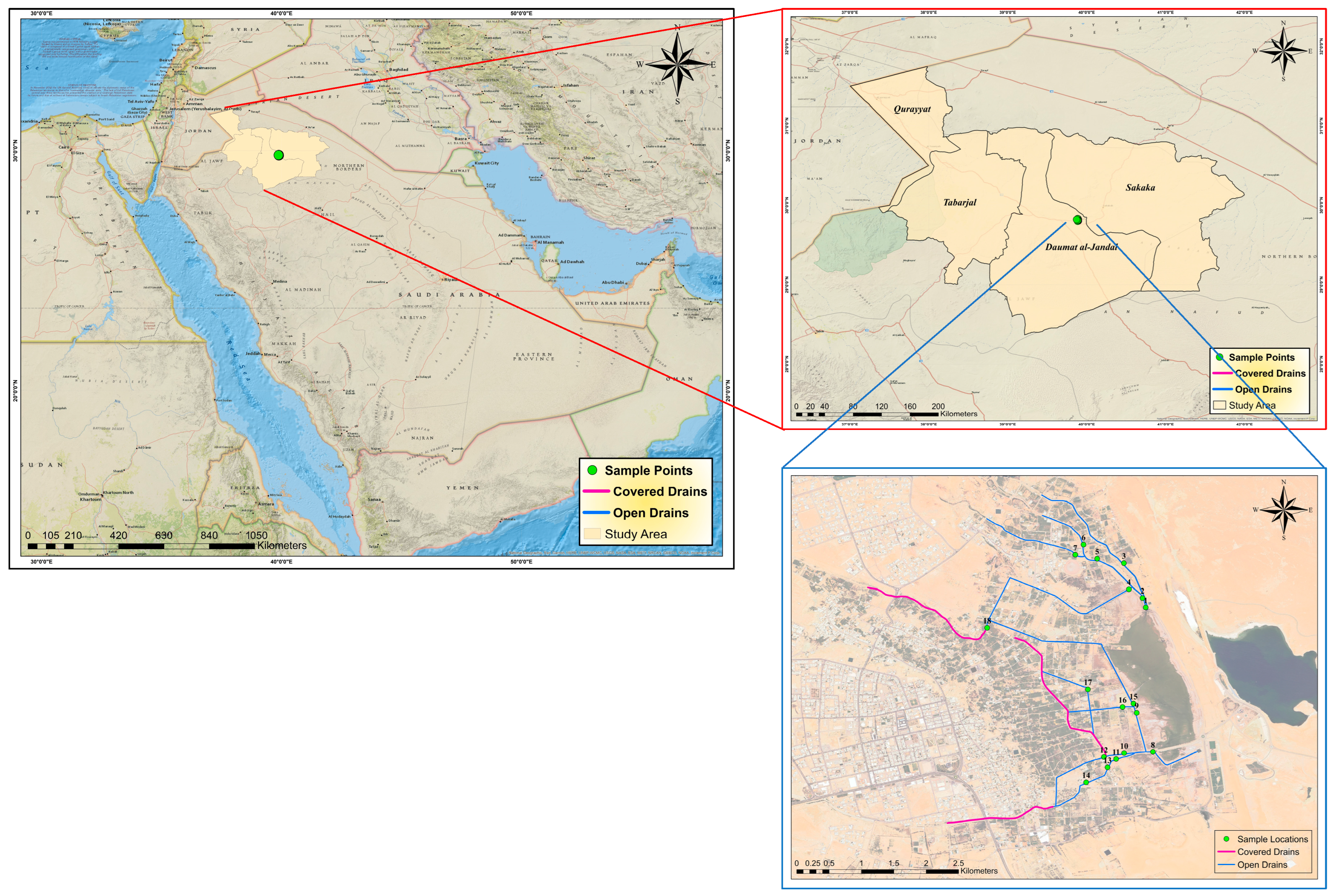
In the vicinity of Dumat al-Jandal, in the Al-Jouf region in northwest Saudi Arabia, the study area is located between 29.79° and 29.83° N and 39.88° and 39.90° E. Gently sloping plains with sporadic rocky outcrops and seasonal drainage canals (wadis) that catch surface runoff and release it into nearby irrigation networks are the region’s defining features [15]. The dry environment, which has severe temperature swings and little annual rainfall, has an impact on evaporation rates and water availability [16]. A possible source for supplemental irrigation is drainage water from agricultural fields, although groundwater is a crucial resource for irrigation, especially in regions that are supplied by the Saq aquifer [9]. Since most of Al-Jouf’s agriculture is centered on Dumat al-Jandal and includes crops like date palms and grains, the area is very important for determining the quality of the water for irrigation [17]. Al-Jouf is ideally situated for research on drainage water quality and irrigation appropriateness due to its desert environment, scarce water supplies, and intensive agricultural usage. Figure 1 illustrates the study area and water sampling locations in Al-Jouf region.

2.2. Water Sampling and Analysis

Sampling was carried out during a single hydrological period representing post-irrigation conditions under a dry, high-evaporation climate (July 2024), to capture the heightened salinity and sodicity levels typically associated with irrigation return flows in arid agricultural systems. A total of eighteen drainage water samples were collected along the main agricultural drainage network in Dumat Al-Jandal, covering upstream, midstream, and downstream sections, as well as areas influenced by different cropping patterns and irrigation intensities. This sampling density was selected as a balance between adequate spatial coverage and logistical constraints under arid field conditions and provides a representative snapshot of irrigation return flows in the study area. All sampling locations were georeferenced using GPS and distributed to represent the main hydrochemical gradients expected along the drainage channels. At each site, three replicate measurements were collected and averaged, thereby reducing analytical uncertainty and enhancing the robustness of the dataset.
Each sample was placed in a sterile plastic bottle, tightly sealed, and stored in an icebox to preserve its integrity until it was analyzed in the laboratory. The concentrations of major cations (Ca2+, Na+, K+, Mg2+), anions (Cl, SO42−, NO3, and NO2), and Trace elements (F, B3+, Al3+, Ti4+, V3+, Sr2+, S2−, Rb+, Ga3+, Br) were analyzed using an Agilent Technologies 5110 ICP-OES (model G8015A; Agilent Technologies, Santa Clara, CA, USA). Additionally, pH, EC, TDS, and Hardness (mg/L CaCO3) was measured using a Thermo Scientific Orion 5-Star Plus multiparameter meter (Thermo Fisher Scientific, Waltham, MA, USA). A comprehensive quality assurance and quality control (QA/QC) protocol was implemented throughout sampling, laboratory preparation, and chemical analysis to ensure data accuracy and reliability. All analytical instruments were calibrated prior to measurements using certified standard solutions covering the expected concentration ranges. Instrument calibration curves showed coefficients of determination (R2) greater than 0.995 for all major ions and trace elements. Field blanks and laboratory procedural blanks were analyzed at a rate of one blank per ten samples to assess potential contamination during sampling, transport, and analysis. Blank concentrations were consistently below the method detection limits. For analytical precision control, all samples were measured in triplicate, and the repeatability of measurements showed a high degree of consistency, confirming the stability and reliability of the analytical results.

2.3. Quality Indicators for Irrigation Purposes

Table 1 presents the weighting system and desirable limits adopted to evaluate the suitability of drainage water for irrigation, based on a multi-parameter IWQI approach. Each physicochemical parameter was assigned a weight (wi) according to its relative importance in influencing irrigation water quality, following the method of Fuoco et al. [19] and FAO [20] irrigation water standards. The relative weight (Wi) for each parameter was then calculated by dividing the individual weight by the total weight (∑wi = 28), ensuring that the sum of all relative weights equals 1. This normalization process allows for balanced comparison and quantitative integration of parameters with different measurement units and magnitudes. The adopted weights reflect the relative importance of salinity, sodicity, specific ion toxicity, and nutrient-related parameters in determining irrigation suitability.
The desirable values listed according to FAO [20] standard serve as benchmark thresholds for determining whether the measured parameters fall within the acceptable range for safe irrigation use. By integrating these reference limits with the assigned parameter weights, the IWQI method enables the classification of drainage water into specific quality categories. This weighting framework, therefore, provides a systematic and quantitative approach to evaluating the irrigation suitability of drainage water.
The applicability of this weighting scheme to the Al-Jouf region is supported by the comparable hydroclimatic conditions and the shared dominance of salinity- and sodicity-driven irrigation constraints in arid agricultural systems. Therefore, although the original framework was developed for other arid and semi-arid environments, its transferability to the present study area is hydrogeochemically justified.
To assess the suitability of drainage water for irrigation, several key hydrochemical parameters are typically evaluated, including EC, Na+ %, MH, SAR, PS, and KR. EC reflects the concentration of dissolved salts and serves as an indicator of water salinity, which can directly influence crop growth [21]. Elevated sodium levels may deteriorate soil structure by reducing its permeability, leading to compaction and decreased aeration [6]. The MH accounts for the balance between calcium and magnesium ions, both essential for plant growth, though excessive magnesium can increase soil alkalinity and reduce productivity [8,22]. Collectively, these indices offer a comprehensive evaluation of irrigation water quality and are calculated based on established methods from previous studies [11,23,24], as presented in the following equations:
Na +   %   =   Na +   +   K + Ca 2 + +   Mg 2 + +   Na + +   K +   ×   100
MH = Mg 2 + Ca 2 + + Mg 2 +   ×   100
SAR = Na + Ca 2 + + Mg 2 + / 2
PS = Cl + 1 2 SO 4 2
KR = Na + Ca 2 + + Mg 2 +

2.4. Spatial Analysis Using GIS

The characteristics of drainage water samples, such as pH, EC, Turbidity, Hardness, Ca2+, Na+, K+, Mg2+, Cl, SO42−, NO3, NO2, TDS, F, B3+, Al3+, Ti4+, V3+, Sr2+, S2−, Rb+, Ga3+, Br, as well as parameters crucial for determining the water samples’ suitability for agricultural use, such as Na+%, SAR, KR, MH, PS and IWQI, were spatially interpolated in this study using Inverse Distance Weighting (IDW) tool from arcgis desktop 10.8 [25].

2.4.1. Inverse Distance Weighted Interpolation

IDW is a deterministic spatial interpolation technique that uses the weighted average of adjacent observed data points to estimate unknown values at unsampled places. Based on inverse distance relationships [26], the values at nearby known sites S i are used to calculate the expected value at an unsampled location S 0 , represented as Z ( S 0 ) calculated using the following equation:
Z ( S 0 )   = i = 1 n W i × Z ( S i )
The weights are determined by the following equation:
W i   = d i k   j = 1 n d j k
where Z ( S 0 ) : Estimated value at the unknown location S 0 , Z ( S i ) : observed value at the known location S i , W i : Weight assigned to the known location S i , d i : Distance between the known point S i and the unknown point S 0 , d j : Distance between the unknown point S 0 and any other known point S j within the neighborhood, k : Power parameter (controlling distance decay; 2 in common), n : Number of known neighboring points used in the estimation.
Moreover, the properties of the method are the sum of all weights equals 1, ensuring an unbiased weighted average and as d i decreases, W i increases (the greater influence for closer points).
The IDW interpolation technique is widely recognized in water quality research as a practical spatial interpolation technique, particularly for datasets with limited sample sizes or irregular distributions [27,28,29]. Because it is deterministic, it naturally retains the observed values at sampling locations that capture spatial extremes and localized irregularities, and it ensures accurate predictions even when the spatial pattern is not well-defined [27,28,29]. While Khouni et al. [27] demonstrated that IDW successfully produced distribution maps of surface water quality in Wadi El Bey, Tunisia, conserving local variability, Yang et al. [28] used IDW in conjunction with main components analysis to represent spatial changes in the Xin’anjiang River, China. Because variogram estimation is unreliable in irregularly dispersed datasets, deterministic interpolation techniques, such as IDW, are used [30]. Additionally, according to the Esri Official Geostatistical Analyst Guide, if the dataset is too limited or excessively dispersed to generate a semivariogram model, the interpolation outcomes might be less effective than simpler techniques, like IDW [31]. Li and Heap [32] further confirm that, in comparison to more sophisticated interpolation techniques, IDW produces reliable and consistent forecasts when sample sizes are limited. When considered as a whole, these studies demonstrate that IDW is a reliable, computationally effective, and widely used technique for environmental mapping, ensuring the accuracy of observed extremes and localized fluctuations in water quality data.

2.4.2. IDW Interpolation Uncertainties

While the IDW method exhibits more uncertainty in areas with unequal sampling; this disadvantage is not unique to IDW, but rather a typical problem in interpolation with small datasets. Since IDW does not rely on simulating spatial autocorrelation, which typically loses reliability when the sample size is small, it often stands out as the practical and dependable approach in these circumstances [30,32]. Measurement errors or outliers spread directly via the interpolation process [27], and the power parameter selection may affect how smooth or sharp the produced surface is [33]. However, when working with little or inconsistent environmental datasets, IDW typically yields more consistent and comprehensible findings than more data-demanding techniques [27,28,29].

2.4.3. Selected Buffer Zone

To restrict interpolation to hydraulically relevant zones and avoid unrealistic extrapolation into non-drained agricultural areas, a buffer zone was applied around the drainage channels. A sensitivity analysis was performed by testing several buffer distances, and a width of 100 m was selected as it provided the best balance between capturing the lateral influence of saline drainage water and minimizing spatial smoothing artifacts [29]. Narrower buffers underestimated lateral salinity dispersion, while wider buffers extended salinity patterns into areas not directly influenced by the drainage network. Accordingly, 100 m buffers were applied around the drainage channels to reduce interpolation artifacts, and the resulting maps should be interpreted as relative spatial risk surfaces rather than exact point predictions. The 100 m buffer thus represents a physically meaningful spatial scale for irrigation return-flow influence in the study area.
All spatial analyses were conducted using ArcGIS Desktop 10.8 software [25], ensuring precise geoprocessing and reliable spatial representation of water quality parameters. This approach not only provides a statistically sound interpolation framework but also supports the study’s objective of capturing the true spatial variability and extreme values present in the dataset, thereby enhancing the accuracy of hydrochemical mapping and interpretation.

2.5. Multivariate Statistical Techniques

Statistical analyses were performed using Microsoft Excel 365 and the Statistical Package for the Social Sciences (SPSS) version 22.0. Descriptive statistics, including minimum, maximum, mean, and standard deviation (SD), were computed for all measured parameters. Pearson’s correlation analysis was applied to identify relationships among the parameters. To reduce data dimensionality, PCA was conducted, followed by FA to interpret latent variables and extract principal factors based on eigenvalues. Prior to the application of Pearson correlation and PCA, the dataset was examined to ensure its suitability for multivariate statistical treatment. Descriptive statistics, including mean, standard deviation, and distribution patterns, were used to assess data behavior and identify potential outliers.
The term hydrogeochemical facies refers to the distinctive chemical characteristics of drainage water that reflect the prevailing geochemical and anthropogenic processes influencing its composition. These facies describe the dominant ionic relationships and the mechanisms responsible for the chemical evolution of the water as it interacts with soil and irrigation inputs. To interpret such variations, various analytical approaches, particularly statistical and graphical methods, are commonly applied, with the Piper and Gibbs diagrams serving as fundamental tools for identifying and classifying hydrogeochemical facies [11]. In this study, these diagrams were employed to evaluate the similarities and differences in the chemical composition of drainage water samples and to group them into specific chemical types that reflect their geochemical behavior. To identify the controlling mechanisms affecting the chemical composition of the drainage water, the ratio of major anions was calculated using Equation (6) and plotted against the TDS values [7]. This graphical approach was applied to distinguish between different geochemical processes such as evaporation, fertilizer leaching, and soil–water interactions, which are commonly observed in irrigated agricultural environments.
Major   anions = Na + + K + Ca 2 + + Na + + K +

2.6. Methodology Framework

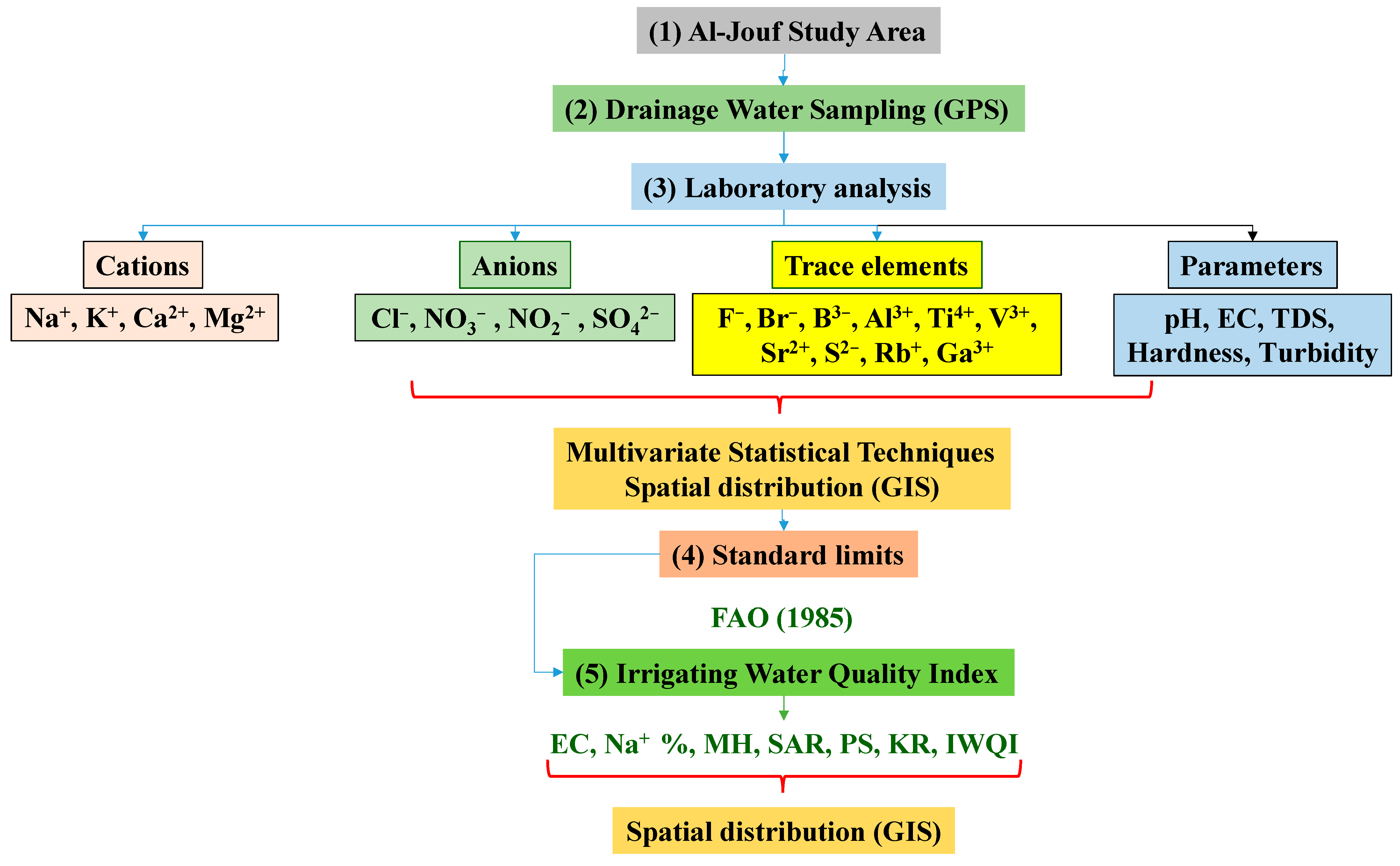
Based on the methodology illustrated in Figure 2, the present study followed a systematic workflow to assess the suitability of drainage water for irrigation in the Al-Jouf Region. The process began with field sampling of surface drainage water using GPS to ensure accurate spatial referencing. In the laboratory, samples were analyzed for major cations (Na+, K+, Ca2+, Mg2+), anions (Cl, NO3, NO2, SO42−), and Trace elements (F, Br, B3+, Al3+, Ti4+, V3+, Sr2+, S2−, Rb+, Ga3+), along with key physicochemical parameters such as pH, EC, TDS, Turbidity, and Hardness.
Subsequently, multivariate statistical techniques, including correlation analysis and PCA, were employed to explore relationships among the parameters and identify dominant hydrogeochemical processes. The results were then compared with FAO [20] irrigation water quality standards, which served as the benchmark for classification.
To quantify irrigation suitability, several indices were calculated, including Na+%, SAR, MH, PS, KR, and the IWQI. Finally, GIS tools were used to generate spatial distribution maps for the analyzed parameters and computed indices, providing a visual representation of the variability in drainage water quality across the study area. This integrated approach allowed for a comprehensive evaluation of the potential reuse of drainage water in sustainable irrigation management under arid climatic conditions.

3. Results and Discussion

3.1. Drainage Water Analysis

Table 2 summarizes the physicochemical characteristics of 18 drainage water samples collected from the Al-Jouf region to evaluate their suitability for irrigation. The measured parameters include pH, EC, Turbidity, Hardness, TDS, major cations (Ca2+, Mg2+, Na+, K+), and major anions (Cl, SO42−, NO2, NO3). The results reveal substantial variability among samples, indicating differences in hydrogeochemical composition, water–soil interactions, and the influence of agricultural practices such as fertilizer use and irrigation return flows. The spatial distribution of these parameters is illustrated in Figure 3a–m.
The pH values ranged from 7.49 to 8.23, with an average of 7.92, signifying slightly alkaline conditions typical of arid and semi-arid regions, consistent with observations reported by earlier study [34]. These pH levels fall within the optimal range for most crops and indicate the influence of bicarbonate–carbonate buffering processes within the drainage water system [35]. This buffering effect suggests interaction between irrigation return flows and soil minerals, which helps maintain near-neutral to slightly alkaline conditions typical of agricultural drainage environments [8]. The EC represents the dissolved salt concentration and reflects salinity levels of the water [6]. Elevated salinity could negatively impact soil structure and plant growth [11,21]. EC values exhibited a wide range, from 0.74 to 25.20 μS/cm, with a mean of 6.68 μS/cm, indicating large variations in salinity among sites. According to FAO irrigation water guidelines, EC values exceeding 3 μS/cm represent high salinity hazards that may restrict water use for irrigation without proper management. Samples 7, 8, 9, and 15 fall into this category, implying that long-term irrigation with such saline water could lead to soil salinization, osmotic stress on plants, and reduced crop productivity.
Turbidity values varied between 15.6 and 121 NTU (mean 66.56 NTU), reflecting fluctuations in suspended solids, organic matter, and fine sediment loads from agricultural runoff [36]. Elevated Turbidity (e.g., in samples 7, 8, and 17) may reduce irrigation system efficiency by causing sediment accumulation and emitter clogging, as well as diminishing light penetration in open channels [37]. Water Hardness ranged from 238.85 to 1766.06 mg/L with a mean of 713.76 mg/L, classifying most samples as very hard water according to the Sawyer–McCarty scale. Such Hardness is mainly attributed to the presence of calcium and magnesium carbonates and sulfates in the aquifer matrix and agricultural drainage [11].
The concentrations of calcium (35.81–204.19 mg/L; mean 118.37 mg/L) and magnesium (28.20–306.24 mg/L; mean 101.91 mg/L) in the drainage water indicate a Ca–Mg–Cl–SO4 hydrochemical facies. These moderate concentrations of Ca2+ and Mg2+ suggest partial dissolution of carbonate and gypsum minerals from the soil matrix, likely enhanced by percolating irrigation return flows. This composition reflects the mixing of irrigation return flow with salts leached from soils and fertilizers, a pattern commonly observed in drainage water influenced by agricultural activities and evaporation in arid environments [7,35]. High Hardness can contribute to scaling problems in irrigation systems and affect soil permeability when combined with high sodium levels [38]. Sodium concentration varied significantly, ranging from 39.62 to 2603.54 mg/L (mean 530.14 mg/L). High sodium concentrations (samples 7, 8, 9, and 15) may pose significant risks to soil health and crop productivity [6], as elevated Na+ levels can induce soil sodicity, resulting in particle dispersion, reduced infiltration, and limited soil aeration. Potassium ranged from 15.63 to 404.82 mg/L (mean 87.65 mg/L). Elevated K+ levels, as seen in samples 8 and 15, may originate from fertilizer runoff or organic matter decomposition, reflecting the influence of intensive agriculture in the study area. However, in most samples, potassium concentrations remain relatively low, as this ion is rapidly absorbed by plants or fixed within clay minerals, consistent with patterns typically observed in agricultural drainage under arid conditions [35].
Chloride concentration showed wide variation (10.32–4270.02 mg/L, mean 1048.91 mg/L), with several samples exceeding FAO’s threshold limit [20]. Elevated Cl concentrations are especially detrimental to fruit trees and vegetables, causing leaf burn, yield reduction, and potential salt stress in sensitive plants across certain areas [21,39]. Sulfate values (6.11–5557.79 mg/L, mean 1466.53 mg/L) were also elevated, likely due to gypsum dissolution, fertilizer residues, or oxidation of sulfide minerals [36]. Excessive SO42− contributes to scaling and soil salinization under arid conditions. NO3 concentrations ranged from 0.01 to 46.02 mg/L, with an average of 12.57 mg/L, indicating nutrient enrichment likely derived from nitrogen-based fertilizers or organic waste infiltration [35,36]. NO3 and NO2 exhibit noticeable variability among samples, reflecting localized agricultural influence from fertilizer inputs and organic matter oxidation in surface drainage channels [36,40]. TDS concentrations ranged from 371 to 12,600 mg/L, averaging 3335.6 mg/L, which classifies several samples as highly saline water (>2000 mg/L). High TDS levels are likely linked to evaporation concentration effects, fertilizer residues, and leaching of salts from irrigated soils [38]. Samples 7, 8, 9, and 15 exceeded the critical limits for irrigation, while samples 3, 6, and 10 showed acceptable TDS values for moderate-quality irrigation use.
The results presented in Table 3 indicate noticeable spatial variability in Trace element concentrations across the 18 drainage water samples, reflecting the combined effects of geogenic inputs, agricultural return flows, and evaporation concentration typical of arid regions like Al-Jouf. Fluoride (F) concentrations ranged from 0.82 to 2.47 mg/L with a mean value of 1.36 mg/L. Elevated F in a few samples (notably 11 and 1) suggests lithogenic contributions from fluorapatite-bearing sedimentary formations or fertilizer leaching [21]. Prolonged use of high-fluoride water could result in F-accumulation in soils, affecting fluoride-sensitive crops such as citrus and grapevine. Similar observations were reported and discussed by Panneerselvam et al. [10].
Boron (B3−) levels ranged from 0 to 2.82 mg/L with a mean value of 0.50 mg/L, like levels founded by previous research [38]. Aluminum (Al3+) concentrations were relatively stable (1.01–1.53 mg/L). The presence of Al3+ under mild alkaline conditions likely results from clay dissolution and the mobilization of aluminosilicates under fluctuating redox states. Titanium (Ti4+) and Vanadium (V3+) were detected at trace levels, with V3+ reaching up to 2.16 mg/L in samples 2 and 7, values that may reflect minor anthropogenic inputs, possibly linked to agrochemical residues or vehicular/industrial emissions deposited on cultivated land. Although these concentrations are low, continuous irrigation with trace-metal-bearing water may lead to long-term soil accumulation and potential phytotoxicity, particularly under high overconcentration.
In the drainage water samples, strontium (Sr2+) exhibited the widest variability (0–3.92 mg/L, mean = 1.32 mg/L), which is consistent with the Ca–Mg–Cl–SO4 facies identified in the regional hydrochemical composition. The presence of Sr2+ in drainage water is primarily attributed to the dissolution of carbonate and gypsum minerals from soil and sediment layers, as well as to the recycling of irrigation water, which enhances ion accumulation. The elevated Sr2+ concentrations in samples 7–9 likely result from repeated irrigation, capillary rise in saline groundwater, and poor leaching, which are typical conditions in intensively cultivated agricultural areas.
Similarly, the high sulfur (S2−) content (57–990 mg/L) reflects a strong agricultural influence, primarily derived from fertilizer runoff, notably ammonium sulfate and superphosphate, as well as the oxidation of pyritic materials in the soil [35]. Under the oxidizing conditions typical of surface drainage systems, dissolved sulfur species are rapidly transformed into sulfate (SO42−). Therefore, the measured S2− concentrations are interpreted as a precursor indicator of sulfate enrichment rather than a stable end member. This sulfur enrichment corresponds to the high SO42− concentrations observed in the major ion chemistry and may aggravate soil salinization when combined with elevated EC and TDS values.
In contrast, the trace alkali metals, including rubidium (Rb+) (5.28–6.15 mg/L) and gallium (Ga3+) (1.44–1.72 mg/L), showed limited spatial variation, suggesting that they primarily originate from natural lithological sources rather than anthropogenic activities. Although their concentrations are low and pose no direct irrigation hazard, they serve as useful geochemical tracers reflecting minor soil–water and mineral interactions within the drainage environment. Finally, bromide (Br) concentrations ranged from 0.06 to 3.52 mg/L, with an average value of 0.85 mg/L.
Comparatively, these results are consistent with recent drainage and groundwater assessments conducted across arid Saudi regions [1,5,41,42]. Overall, the trace-element signatures suggest that the dominant geochemical processes in the study area are (i) mineral dissolution from evaporite and carbonate lithologies, (ii) evaporative concentration under arid conditions, and (iii) fertilizer-driven enrichment of specific ions such as B3−, F, and S2−. In conclusion, the Trace element analysis indicates that drainage water in Al-Jouf is generally suitable for restricted irrigation, particularly for salt-tolerant crops; however, localized exceedances of fluoride, boron, and sulfur necessitate targeted mitigation. The spatial distribution of these parameters is illustrated in Figure 3n–w.

3.2. Multivariate Statistical Techniques

3.2.1. Correlation Analysis

The Pearson correlation matrix (Table 4) provides a clear statistical overview of the interrelationships among the major physicochemical parameters of the collected drainage water samples. The full Pearson correlation matrix among all hydrochemical parameters is presented in Table 4, including exact correlation coefficients (r) and their corresponding statistical significance levels. The strong positive correlations observed between EC, Na+, K+, Cl, SO42−, Mg2+, and TDS (r = 0.87–0.97, p ≤ 0.01) indicate that the ionic composition of the drainage water is primarily controlled by salinity accumulation resulting from evaporative concentration and agricultural return flows [34]. Strong positive correlations (p ≤ 0.01) were also observed between EC, TDS, Na+, Cl, SO42−, and Mg2+, confirming the common salinity control on drainage water chemistry. In agrarian drainage systems, high EC values typically reflect the leaching of fertilizers and soil salts from irrigated fields, especially under semi-arid conditions where evapotranspiration exceeds precipitation [7,35,38].
The significant correlations among Na+–Cl, Na+–SO42−, and K+–Na+ pairs suggest that the salts in the drainage water primarily originate from dissolution of soil minerals and residual fertilizer components [34]. Similarly, the strong correlation between Hardness, Ca2+, and Mg2+ (r > 0.85) suggests that carbonate dissolution and cation exchange processes are occurring within the topsoil and canal sediments [38]. Moderate correlations were also detected among hardness, Ca2+, and Mg2+, further reflecting carbonate mineral dissolution processes. The near-perfect correlation between TDS and EC (r ≈ 0.99) confirms that ionic salinity dominates the total dissolved load of the drainage water. Comparable correlations were reported in previous studies [1,7].
The strong correlations observed between EC, TDS, Na+, Cl, SO42−, Mg2+, and K+ (r = 0.87–0.99, p ≤ 0.01) have direct implications for irrigation water management. Elevated EC and TDS values indicate high salinity hazards that can induce osmotic stress in crops, reduce water uptake efficiency, and ultimately decrease agricultural productivity. The strong Na+–Cl and Na+–SO42− relationships reflect sodicity risks, which are known to deteriorate soil physical structure, reduce infiltration capacity, and increase surface crusting. Consequently, areas characterized by high loadings of these ions require soil reclamation measures such as gypsum application, periodic leaching, and blending with low-salinity freshwater prior to irrigation reuse.
Conversely, pH shows weak or negative correlations with most ionic parameters (r = –0.25 to –0.57), reflecting that the acid–base buffering system of drainage water is relatively independent of ionic enrichment. This stability suggests that carbon dioxide degassing and bicarbonate equilibria rather than mineral dissolution control the pH. Consistent relationships have been documented in earlier studies [5,7]. Moderate correlations between NO2, NO3, and major ions (r ≈ 0.45–0.58) indicate that NO3 enrichment originates from agricultural fertilizers, with partial retention or transformation in the soil column before reaching the drainage network [36]. Similar correlations have been found in previous research [37].

3.2.2. Principal Component Analysis

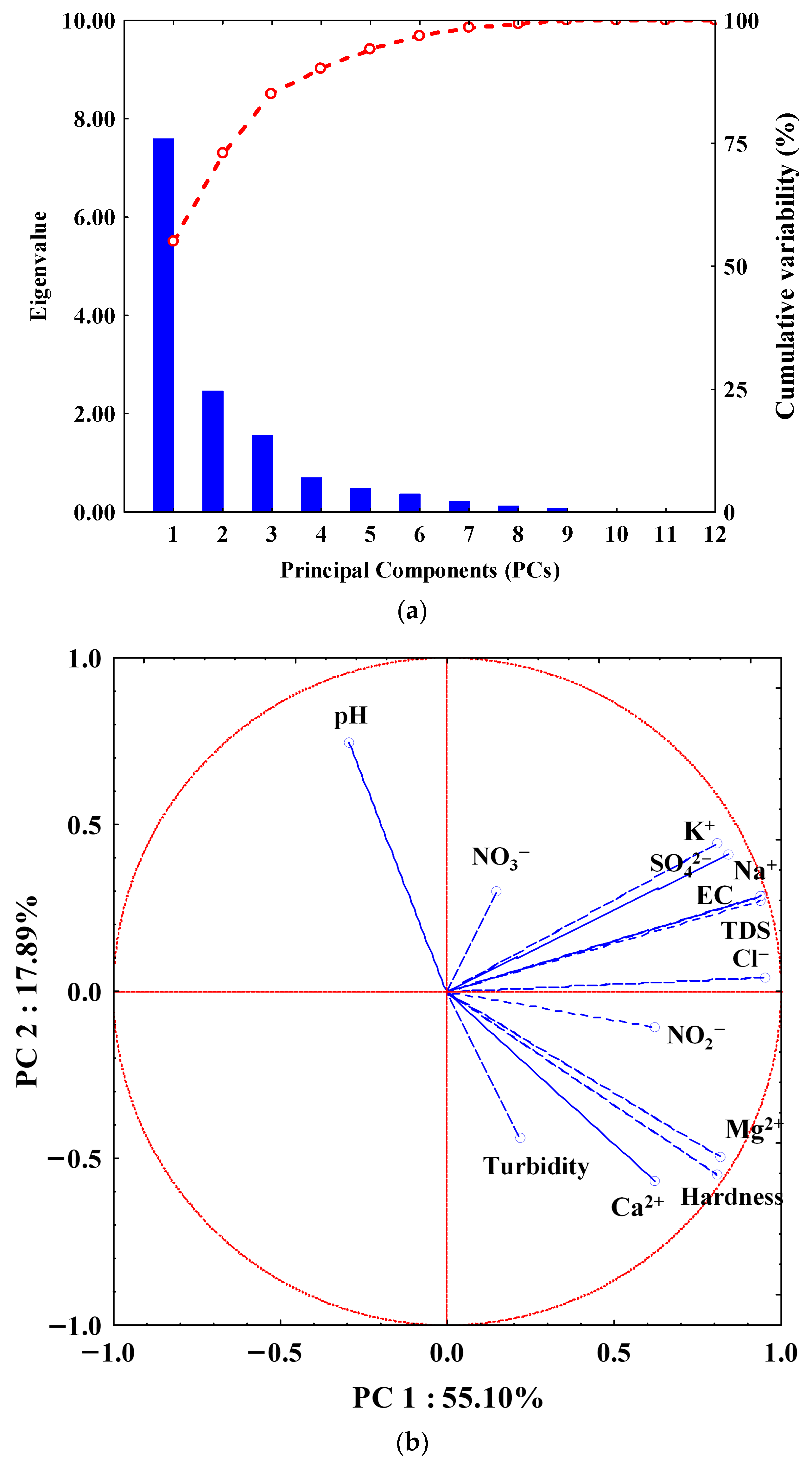
The validity of the PCA results was assessed using the Kaiser criterion (eigenvalues > 1), which confirmed the retention of the first two principal components as statistically significant. The complete PCA results, including eigenvalues, percentage of explained variance, and component loadings for each parameter, are summarized in Table 5. Additionally, high communality values (ranging from 0.70 to 0.94 for most major ions) indicate that the extracted components adequately represent the original dataset. The sharp decline in eigenvalues after the second component further confirms the robustness of the dimensionality reduction. Figure 4a indicates the relationship between factor number and eigenvalues. The scree plot illustrates the distribution of eigenvalues across the extracted factors, revealing that the first two principal components (PCs) account for the majority of data variance. The first two principal components explain more than 72% of the total data variance. PC1 exhibits an eigenvalue of 7.58, explaining 55.10% of the total variance, while PC2 contributes an additional 17.89%, raising the cumulative variance to approximately 72.99%. This marked decline in eigenvalues after the second component indicates that only these two factors capture the essential structure of the dataset, with subsequent components contributing negligibly to overall variability. Such a pattern aligns with the Kaiser criterion (eigenvalues > 1), confirming that PC1 and PC2 effectively summarize the multivariate relationships among the analyzed parameters.
The PCA biplot (Figure 4b) illustrates the multivariate relationships among the measured parameters and drainage water samples along the first two PCs. The spatial arrangement and grouping of variable vectors indicate that PC1 is primarily governed by EC, TDS, Na+, K+, Cl, SO42−, Mg2+, and Hardness, highlighting that salinity and ionic concentration are the main factors differentiating the samples. This component reflects evaporative enrichment and the accumulation of fertilizer-derived salts, as irrigation return flows cause the buildup of sodium and chloride, the dominant ions in recycled drainage water [36]. Such a pattern is characteristic of irrigated agricultural basins with limited drainage, where repeated evapotranspiration gradually increases the concentration of dissolved solids. PC1 is dominated by EC, TDS, Na+, Cl, and SO42−, representing a salinity–evaporation control.
In contrast, PC2, which accounts for approximately 17.9% of the total variance, is primarily associated with pH and NO3, representing anthropogenic influences and recharge effects. Elevated NO3 concentrations and slightly alkaline pH values suggest contamination from nitrogen-based fertilizers and oxidation of organic residues in surface canals [36]. The clear separation between nutrient-related variables (NO2, NO3) and salinity parameters (Na+, Cl, SO42−) implies that nutrient enrichment occurs independently from salinization processes. PC2 is mainly associated with NO3 and pH, reflecting fertilizer-derived nutrient influence.
Overall, samples positioned on the positive side of PC1 correspond to highly mineralized water typical of downstream drainage zones. In contrast, those with lower PC1 scores reflect fresher, less saline water from upstream agricultural areas. Thus, the PCA biplot demonstrates that the chemical evolution of the drainage water is predominantly controlled by evaporative concentration and salt accumulation, with secondary effects arising from fertilizer inputs and surface biochemical processes [39].
The PC1, dominated by EC, TDS, Na+, Cl, SO42−, Mg2+, Ca2+, and Hardness, represents a salinity–evaporation factor controlling the overall suitability of drainage water for irrigation. Samples with high positive PC1 scores correspond to highly mineralized drainage zones, where prolonged irrigation use would accelerate soil salinization and sodicity build-up. These zones are therefore recommended for restricted irrigation practices, cultivation of salt-tolerant crops (such as barley and date palms), and mandatory implementation of soil amendment strategies. In contrast, the PC2, characterized mainly by NO3 and pH, reflects fertilizer-driven nutrient contamination. Elevated NO3 loadings indicate excessive nitrogen leaching from agricultural fields, which may cause groundwater contamination, crop nitrate accumulation, and long-term environmental degradation. From an irrigation management perspective, this highlights the necessity of optimizing fertilizer application rates, adopting controlled fertigation systems, and enhancing drainage efficiency to minimize nutrient losses.
Table 5 presents numerical results of the two main (PC1 and PC2) and Corresponding Communalities. The numerical results of the PCA indicate that the first two components together explain about 73% of the total variance in the drainage water dataset, confirming that they capture the main hydrogeochemical processes controlling water composition. PC1, which accounts for 55.10% of the variance, is dominated by high positive loadings of EC, TDS, Na+, K+, Cl, SO42−, Mg2+, Ca2+, and Hardness, identifying it as the salinity–evaporation factor resulting from evaporative concentration, salt accumulation, and leaching of fertilizers and soil minerals. In contrast, PC2 (17.89%) shows strong associations with pH and NO3, reflecting an anthropogenic–nutrient factor linked to the use of nitrogen-based fertilizers and oxidation of organic matter in surface drainage channels. The high communality values for most major ions (0.70–0.94) indicate that the two extracted components well represent these variables. In contrast, lower communalities for Turbidity and NO2 suggest localized or short-term influences such as sediment input or microbial activity [37].

3.2.3. Hydrogeochemical Facies

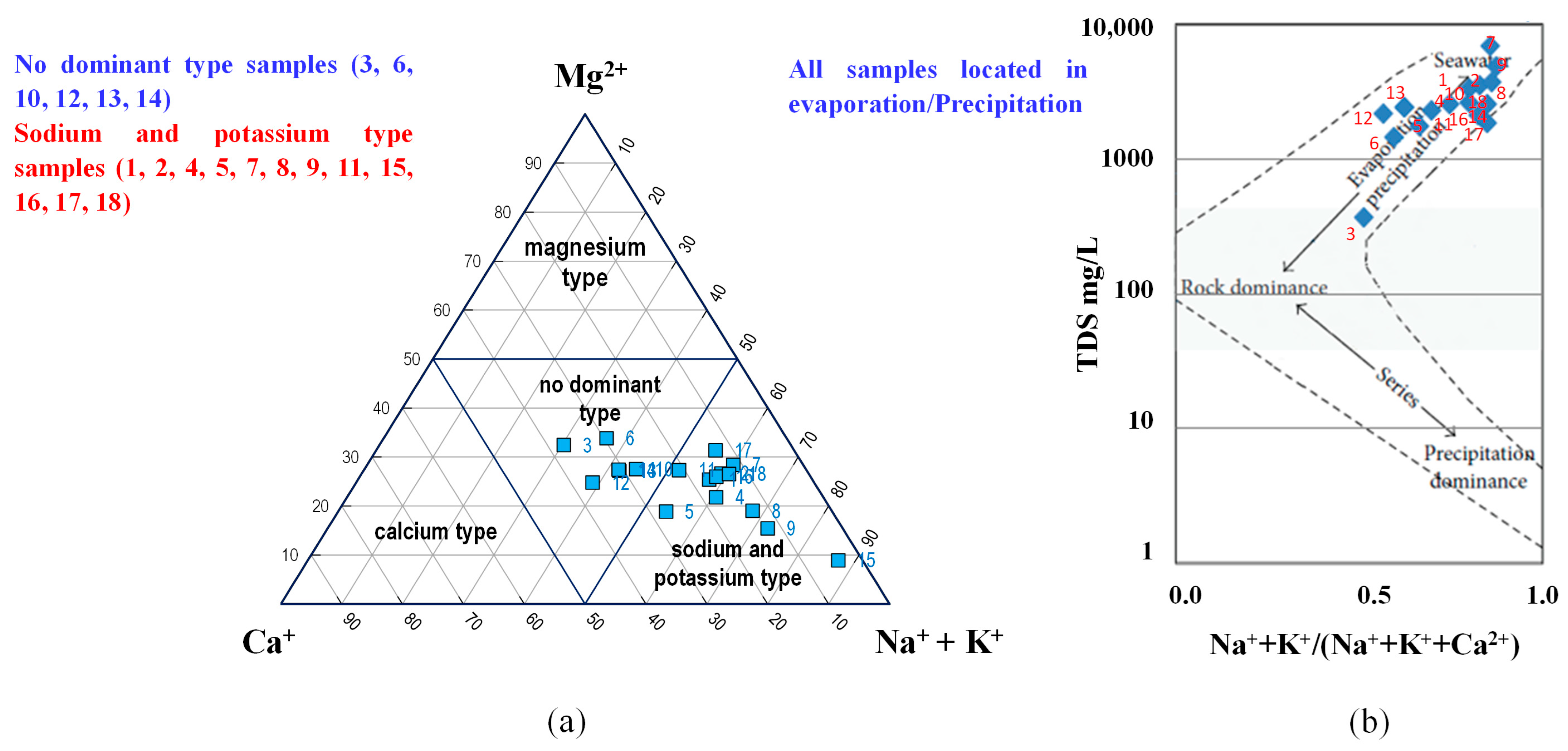
To ensure the reliability of the multivariate interpretation, PCA results were cross validated with Pearson correlation patterns and hydrogeochemical diagrams (Piper and Gibbs plots), which showed consistent geochemical behavior and process identification. This combined validation approach enhances confidence in the inferred hydrogeochemical processes controlling drainage water quality. The combined interpretation of the Piper cationic ternary diagram (Figure 5a) and the Gibbs plot (Figure 5b) provides valuable insights into the hydrogeochemical facies and dominant geochemical processes controlling the composition of the drainage water in the study area [43]. The cationic triangular field classifies the drainage water samples into two main hydrochemical facies. Most samples, specifically samples 1, 2, 4, 5, 7, 8, 9, 11, 15, 16, 17, and 18, fall within the sodium and potassium type, indicating that Na+ and K+ are the dominant cations in the drainage system. This dominance reflects the influence of ion exchange processes, fertilizer residue accumulation, and evaporative enrichment of dissolved salts in return irrigation water. The presence of Na+–K+ facies suggests that the hydrochemical evolution is primarily driven by the dissolution of evaporite minerals such as halite (NaCl) and sylvite (KCl), in addition to the leaching of alkali fertilizers commonly applied in agricultural areas [36].
A smaller subset of samples (3, 6, 10, 12, and 14) fall into the dominant type of zone, indicating mixed ionic composition and transitional chemistry. These samples likely represent diluted or freshly recharged drainage water with lower ionic strength, possibly resulting from recent irrigation or surface runoff that has undergone limited evaporation. None of the sample’s plot in the calcium or magnesium dominant zones, confirming that alkaline earth metals (Ca2+, Mg2+) play a secondary role compared to alkali metals in the drainage water chemistry [8]. Overall, the Piper diagram demonstrates that the studied water is mainly Na+–K+ enriched, reflecting strong evaporation and anthropogenic input rather than geogenic carbonate dissolution.
The Gibbs plot is a useful tool for identifying the mechanisms controlling the chemical composition of drainage water. In this study, most drainage water samples plot in the upper right sector of the diagram, within the evaporation–precipitation dominance field, and trend toward the seawater composition line. This distribution indicates that the high salinity and ionic concentrations in the drainage water are primarily influenced by evaporative concentration and salt accumulation resulting from repeated irrigation cycles, fertilizer residue buildup, and limited natural drainage [7,39]. These findings suggest that evaporation and agricultural return flows are the main factors governing the chemical evolution of drainage water in the study area.
The elevated TDS values of the drainage water (ranging from approximately 1000 to over 10,000 mg/L) provide strong evidence that evaporation and irrigation return flows are the primary processes controlling salinity and ionic composition [7,39]. The positioning of the samples within the evaporation-dominated field of the Gibbs plot indicates that soil–water and mineral interactions contribute only minimally to the overall ionic load. In contrast, anthropogenic and surface agricultural processes play a dominant role. This interpretation is consistent with the hydrochemical facies identified in the Piper diagram, which reveal that the enrichment of Na+ and K+ in the drainage water is mainly attributed to evaporative concentration, salt buildup, and fertilizer leaching, rather than to natural weathering of silicate or carbonate minerals. These findings confirm that salinization driven by agricultural practices and climatic evaporation is the principal mechanism shaping the chemical quality of drainage water in the study area.
Together, the Piper and Gibbs diagrams clearly demonstrate that the drainage water chemistry is controlled primarily by evaporation, agricultural return flow, and ion exchange reactions. The dominance of Na+–K+ facies and the Gibbs field positioning in the evaporation zone indicate that salinity build-up is the key hydrogeochemical feature, typical of irrigated agricultural basins in arid and semi-arid environments [35,38]. Evaporation mainly functions as a concentration mechanism that amplifies the impact of multiple salinity sources; consequently, the dissolved salts in the study area are most likely derived from the combined influence of lithogenic inputs associated with evaporite and carbonate mineral dissolution, anthropogenic contributions from fertilizers and soil amendments, and irrigation return flows that progressively accumulate salts through successive evapotranspiration cycles [1,5,7].
The integrated interpretation of PCA results and Gibbs plots indicates that the hydrochemical composition of the drainage water is primarily controlled by evaporation and evaporite mineral dissolution, as reflected by the PC1 dominated by EC, TDS, Na+, Cl, and SO42−. These processes are directly responsible for the development of salinity and sodicity hazards, which significantly restrict the long-term suitability of drainage water for irrigation. Prolonged irrigation under such conditions may accelerate soil salinization, reduce infiltration capacity, and impair soil structure. In contrast, the PC2, mainly associated with NO3 and pH, represents fertilizer-derived nutrient contamination, indicating that agricultural practices play a key role in nitrate enrichment. This dual hydrogeochemical control demonstrates that irrigation suitability in the study area is governed by both salinity–sodicity risks and nutrient pollution. Therefore, sustainable reuse of drainage water for irrigation requires freshwater blending, gypsum amendment, controlled irrigation scheduling, and optimized fertigation practices, together with the cultivation of salt-tolerant crops in highly affected zones.

3.3. Assessment of Drainage Water Quality for Irrigation

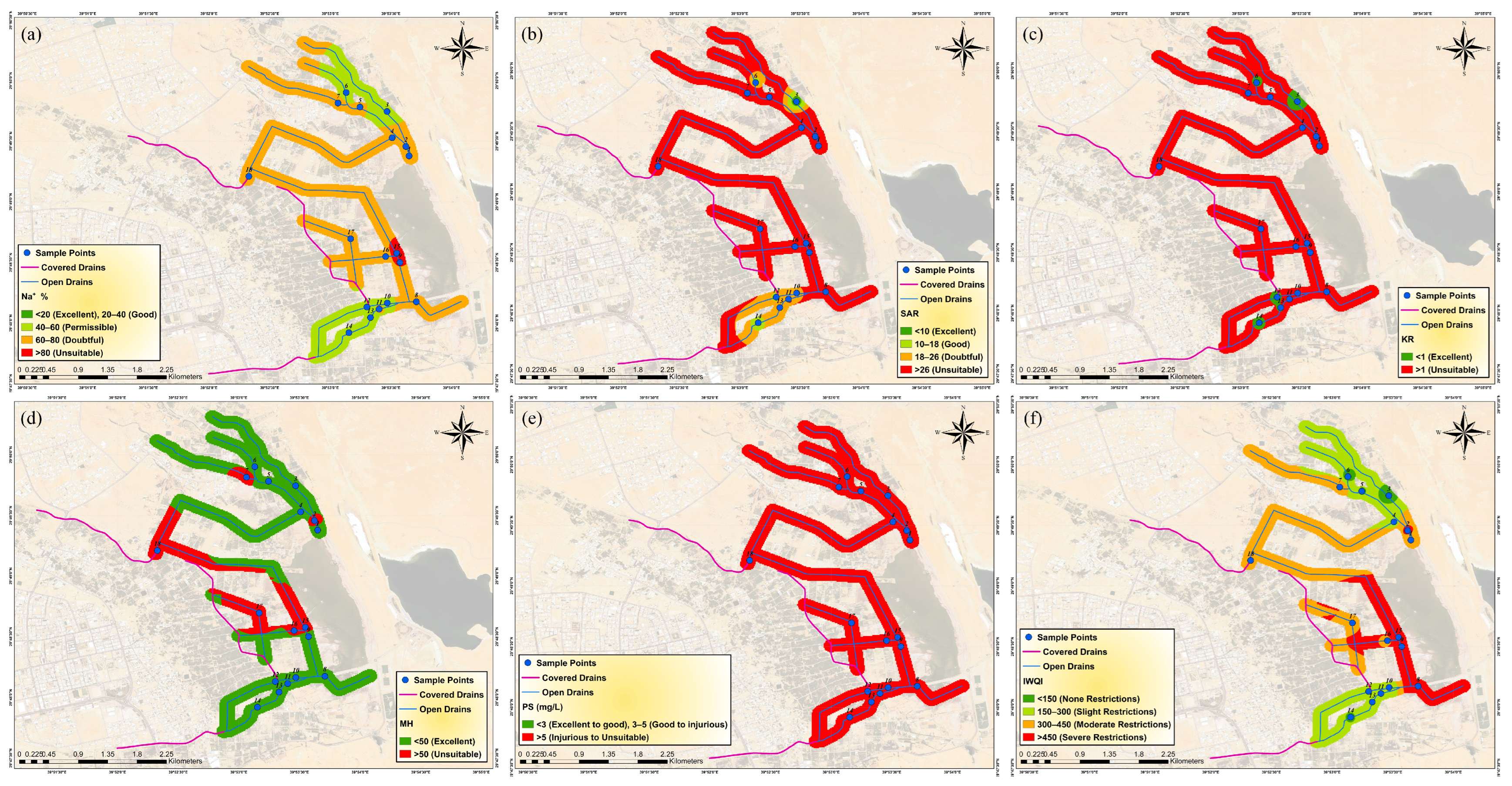
The analysis of major irrigation quality indices, Na+ %, SAR, KR, MH, PS, and IWQI (Table 6) provides a comprehensive evaluation of the suitability of drainage water for agricultural use. Furthermore, the spatial distribution of these indices is illustrated in Figure 6a–f. The Na+ % ranged from 41.10% to 91.86%, with a mean of 64.65%, indicating moderate to very high sodium enrichment. According to the FAO [20] classification, water with Na+ % > 60% pose a serious sodium hazard, as they may lead to soil dispersion and reduced infiltration. Approximately two-thirds of the samples (e.g., 1, 2, 4, 7–9, 15–18) exceed this limit, confirming that sodium accumulation, driven by evaporation and agricultural return flow, is a dominant process in the drainage system. The SAR values varied between 6.20 and 225.55, with an average of 46.15, placing most samples within the very high to unsuitable category for irrigation. High SAR values (especially in samples 7–9 and 15) suggest excessive sodium relative to calcium and magnesium, which promotes soil sodicity and poor structural stability [8]. The extremely high SAR in sample 15 (225.55) is consistent with its elevated TDS and Cl concentrations, indicating strong evaporative concentration and limited drainage.
KR values ranged from 0.48 to 9.77, averaging 2.09. Since KR > 1 denotes unsuitability for irrigation, most samples fall into the unsafe category. Elevated KR values correspond to sodium-dominated facies, consistent with the Piper diagram interpretation and confirming that Na+ is the prevailing cation due to ion exchange and fertilizer residue buildup. MH values (29.23–60.00%; mean = 44.54%) indicate that most drainage water samples are within the permissible range (MH < 50%), although a few (e.g., 7, 15, 17, 18) slightly exceed this limit. Elevated MH values are linked to dolomitic soil leaching and repeated irrigation cycles, which enhance Mg2+ concentrations.
The PS values ranged widely from 13.38 mg/L to 7048.92 mg/L, averaging 1782.18 mg/L, and indicating strong heterogeneity in the permeability potential of the soils irrigated with this drainage water. Higher PS values (samples 7–9, 15) denote saline water infiltration, which can reduce soil permeability and porosity through sodium-induced swelling of clay minerals. This is characteristic of evaporation-dominated drainage basins under semi-arid conditions. The IWQI ranged from 84.47 to 1617.87, with a mean of 386.48, classifying the drainage water as poor to very poor quality for irrigation according to Fuoco et al. [19]. Samples 7–9 and 15 exhibit extremely high IWQI values, reflecting severe salinity and sodicity stress that make the water unsuitable for most crops without treatment or blending. In contrast, samples 3, 6, 10–14 show moderate IWQI values, indicating marginal suitability for irrigation of salt-tolerant crops under controlled management.
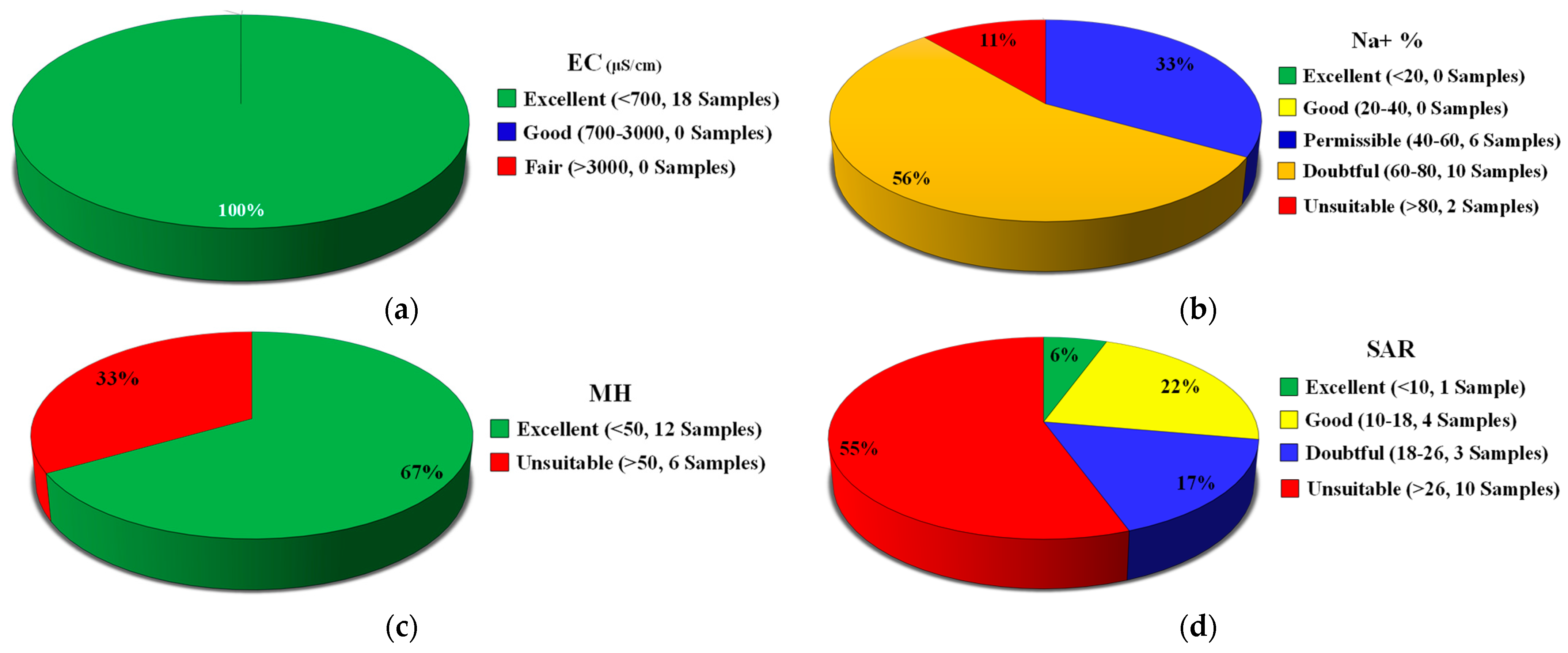
The classification of the irrigation water quality indices provides a clear overview of the suitability status of the drainage water in the study area for agricultural reuse, as illustrated in Figure 7a–g. All samples (100%) fall under the “excellent” class (EC < 700 μS/cm), indicating that the EC values are within acceptable limits for irrigation according to the FAO classification. However, this apparent suitability may mask the influence of localized salinity hotspots observed in other parameters (e.g., high TDS, Cl, and Na+ levels). The low EC values likely reflect dilution effects in certain drainage channels or short-term freshwater inflow, rather than an overall improvement in water quality. The Na+ % classification shows that only 33.33% of the samples fall within the permissible range (40–60%), while the majority (55.56%) are categorized as “doubtful” (60–80%), and 11.11% as “unsuitable” (>80%). This distribution indicates a widespread sodium hazard, which poses a risk of soil alkalinity and reduced infiltration capacity [22].
The MH results reveal that 66.67% of the samples fall within the “excellent” category (MH < 50%), while 33.33% are unsuitable. This indicates that magnesium enrichment is generally moderate, but certain samples, especially those exposed to evaporation and dolomitic soil leaching, show elevated Mg2+ levels. These findings align with previous hydrochemical interpretations that Mg2+ is a secondary contributor to overall water Hardness [11]. The SAR classification indicates that 55.56% of the samples are unsuitable (SAR > 26) for irrigation use, while only 5.56% are excellent and 22.22% fall within the good range (10–18). The predominance of high SAR values confirms a strong sodicity hazard, especially in areas affected by poor leaching and high evaporation, which concentrate sodium relative to calcium and magnesium [8]. This supports the earlier observation that Na+ dominance and ion exchange processes are major factors controlling soil–water interactions in the study area.
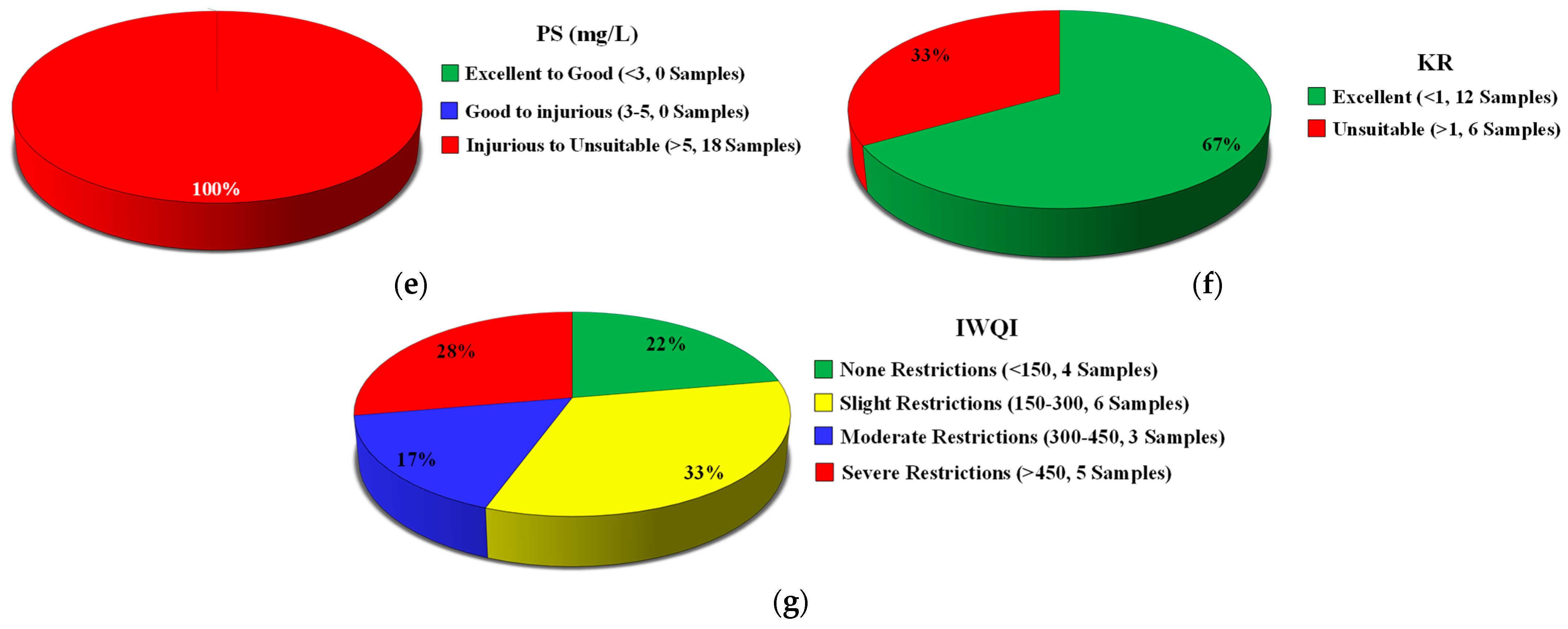
The PS results show that all samples (100%) fall within the “injurious to unsuitable” category (>5 mg/L), reflecting serious soil permeability problems associated with prolonged use of this drainage water for irrigation. High PS values are typically linked to clay swelling and reduced infiltration due to sodium accumulation and high salinity, confirming that soil structure degradation is a likely long-term consequence of continuous reuse of such water. Based on KR, 66.67% of the drainage water samples are unsuitable (KR > 1), whereas 33.33% are excellent (KR < 1). This further emphasizes the sodium dominance in the ionic balance, consistent with the results of Na+ %, SAR, and the Piper diagram. High KR values suggest that the water’s cationic composition is strongly skewed toward Na+, indicative of ion exchange reactions and salt accumulation from repeated irrigation cycles [22].
The IWQI classification provides an integrated assessment, showing that 22.22% of the samples exhibit no restriction (IWQI < 150), 33.33% have slight limits (150–300), 16.67% show moderate restrictions (300–450), and 27.78% face severe restrictions (>450). These results confirm that while a limited number of samples may be used safely for salt-tolerant crops under controlled management, nearly half of the drainage water samples are unsuitable for long-term irrigation without blending or treatment. The high IWQI values in several samples are consistent with salinity and sodicity hazards, as indicated by elevated Na+%, SAR, and KR values. The resulting IWQI maps showed only minor shifts at category boundaries, while the overall spatial distribution pattern and the dominance of poor-to-very-poor water quality classes remained unchanged. This demonstrates that the IWQI-based irrigation suitability assessment is robust to reasonable variations in parameter weighting.
Overall, the classification results demonstrate that the drainage water in the study area is of poor to marginal quality for irrigation, primarily constrained by sodium accumulation, high salinity, and permeability reduction. While some samples meet “excellent” or “permissible” criteria for individual parameters, the integrated indices (SAR, KR, IWQI, and PS) consistently highlight the dominant influence of evaporation, ion exchange, and fertilizer leaching as the main processes deteriorating water quality [39]. Therefore, sustainable use of such drainage water requires blending with freshwater, soil amendment with gypsum, and careful crop selection, as recommended by FAO guidelines for saline and sodic water management.

3.4. Suggestions and Recommendations

The assessment of drainage water quality in the Al-Jouf region demonstrated considerable spatial and compositional variability, emphasizing the need for sustainable and site-specific treatment solutions to ensure its safe and efficient reuse in agricultural applications. To improve efficiency and achieve conformity with environmental protection standards, the implementation of an integrated treatment framework that incorporates physical, chemical, and biological processes is highly recommended. Accordingly, the proposed approaches are outlined as follows:
(1)
Sedimentation and Filtration: Preliminary treatment through sedimentation basins followed by multi-layer sand filtration can effectively remove suspended solids and decrease Turbidity, thereby improving the operational reliability of irrigation systems [36,44,45,46].
(2)
Adsorption Using Bio-Based Activated Carbon: Locally available agricultural residues such as olive pomace, date-palm fronds, and rice husks can be converted into activated carbon to remove organic contaminants, phenolic compounds, and color efficiently [47,48]. This valorization approach promotes circular-economy principles while simultaneously reducing agricultural waste generation.
(3)
Constructed Wetlands and Phytoremediation: The use of engineered wetlands planted with native halophytic species (e.g., Phragmites australis, Typha domingensis) offers an effective biological polishing stage, capable of removing nutrients, heavy metals, and residual organic matter through natural biogeochemical processes [49,50].
(4)
Solar-Assisted Desalination and Membrane Systems: In areas affected by high salinity, hybrid systems combining solar distillation and low-pressure nanofiltration can produce high-quality irrigation water with reduced energy consumption and minimal brine generation, consistent with renewable-energy and sustainability goals [51,52,53].
(5)
Dilution with Freshwater: Blending drainage water with freshwater can significantly lower salinity concentrations. Complementary practices, such as applying gypsum to enhance soil structure and cultivating salt-tolerant crop varieties, can further promote soil productivity and long-term agricultural sustainability [44]. Blending drainage water with freshwater at ratios of 1:1–1:3 is recommended to reduce EC and SAR to FAO-acceptable limits for irrigation. For sodic soils (SAR > 13 and KR > 1), gypsum application at 3–8 t ha−1 is advised to improve soil structure and enhance sodium displacement, with higher rates required in severe IWQI zones (>450). Crop selection should follow IWQI classifications, where severe restriction zones are limited to highly salt-tolerant crops (e.g., barley, sorghum, date palm), moderate zones can support moderately tolerant crops under controlled management, and slight to no restriction zones are suitable for most conventional crops.
(6)
Environmental Awareness and Capacity Building: It is proposed to implement community engagement and environmental-awareness programs aimed at strengthening sustainability literacy among farmers, students, and local authorities, thereby fostering responsible and informed practices in the reuse of treated drainage water.
Integrating these modular treatment units within existing drainage networks will facilitate the sequential reduction in pollutants, thereby maximizing water reuse potential while safeguarding soil health and crop productivity.

4. Conclusions

The drainage water in the Al-Jouf Region exhibits strong spatial variability and is generally affected by high salinity and sodium hazards. While pH values remained within a neutral to slightly alkaline range (7.49–8.23), TDS varied widely from 371 to 12,600 mg/L, indicating intense evaporation and salt accumulation. Na+% averaged 64.65%, and SAR ranged from 6.20 to 225.55, with more than half of the samples exceeding safe irrigation limits. KR values averaged 2.09, confirming sodium dominance, and all PS values exceeded 5 mg/L, indicating serious soil permeability risks. The dominant Na+–Cl–SO42− hydrochemical facies confirms the influence of agricultural return flow, ion exchange, and limited natural drainage. The IWQI ranged from 84.47 to 1617.87, classifying most drainage water as poor to very poor for irrigation. Nevertheless, sustainable reuse remains feasible under controlled management, including freshwater blending, gypsum soil amendment, and salt-tolerant crop cultivation, in alignment with Saudi Vision 2030 goals.

5. Implications and Limitations

A key limitation of the present study is that sampling was conducted during a single hydrological period corresponding to post-irrigation conditions under a dry, high-evaporation climate. Consequently, seasonal variations in drainage water quality driven by changes in irrigation schedules, episodic rainfall events, and fertilizer application timing could not be fully captured. Nonetheless, sampling during this period is expected to represent a near worst-case scenario for salinity and sodicity accumulation in drainage water, which is highly relevant for irrigation suitability assessment in arid environments. Future research should incorporate multi-season sampling campaigns (e.g., winter versus summer and pre- versus post-irrigation) to better quantify temporal variability, enhance the stability of spatial interpolation surfaces, and further constrain interpolation uncertainties, thereby improving the long-term transferability of drainage water quality maps.
Additionally, although the IWQI weighting system was adopted from well-established international frameworks, full regional recalibration would require long-term local agronomic and crop-yield response data, which were not available within the scope of this study. Finally, quantitative source apportionment of salinity was not performed. While hydrochemical indicators, PCA, and Gibbs plots provide strong evidence for evaporation-driven concentration, isotope-based tracers and ion-ratio mixing models would be required to more precisely resolve the relative contributions of lithogenic, anthropogenic, and irrigation return-flow sources.

6. Future Works

Future investigations should address the following research and development priorities:
  • Temporal and Seasonal Monitoring: Assess fluctuations in ionic composition, salinity, and trace-metal concentrations throughout the agricultural cycle to understand water-quality dynamics better.
  • Quantitative Source Apportionment of Salinity: Apply isotopic tracers and ion-ratio mixing models to quantitatively distinguish between lithogenic, anthropogenic, and irrigation return-flow contributions to salinity, thereby reducing uncertainty in causal interpretations.
  • Pilot-Scale Demonstrations: Develop and evaluate hybrid treatment systems (e.g., wetland–adsorption–membrane configurations) under local climatic and operational conditions to determine technical feasibility and scalability.
  • Modeling and Artificial Intelligence Applications: Employ predictive modeling and machine-learning approaches to optimize treatment performance and irrigation management.
  • Economic and Life-Cycle Assessments: Quantify the cost-effectiveness, environmental benefits, and carbon-footprint reduction associated with proposed treatment technologies.
  • Policy and Regulatory Frameworks: Establish governance structures and incentive mechanisms aligned with Saudi Vision 2030, focusing on water circularity, resource efficiency, and sustainable agricultural development through public–private collaboration.

Author Contributions

All authors whose names appear on the submission made substantial contributions. Conceptualization, R.A., M.M.A.-D., M.A.M., W.O. and N.S. methodology, M.M.A.-D., M.A.M. and N.S. The first draft of the manuscript was written by M.M.A.-D., M.A.M. and N.S.; revised and presented with suggestive comments about the previous versions of the manuscript, R.A., M.M.A.-D., M.A.M., W.O. and N.S. All authors have read and agreed to the published version of the manuscript.

Funding

This research received no external funding.

Data Availability Statement

The original contributions presented in this study are included in the article. Further inquiries can be directed to the corresponding author.

Acknowledgments

The authors gratefully acknowledge all those who contributed to the success of this research.

Conflicts of Interest

The authors confirm that there is no conflict concerning the publication of this manuscript.

References

  1. Alogayell, H.M.; El-Bana, E.M.M.; Abdelfattah, M. Groundwater quality and suitability assessment for irrigation using hydrogeochemical characteristics and pollution indices: A case study of North Al-Quwayiyah Governorate, Central Saudi Arabia. Water 2023, 15, 3321. [Google Scholar] [CrossRef]
  2. Alazba, A.A.; Mossad, A.; Geli, H.M.E.; El-Shafei, A.; Alrdyan, N.; Ezzeldin, M.; Radwan, F. Long Term Rain Patterns of Major Watersheds in Saudi Arabia. Water 2025, 17, 3086. [Google Scholar] [CrossRef]
  3. Hamed, Y.; Ayadi, Y.; Khalil, R.; Al-Omran, A.; Lebdi, F.; Dhaouadi, L. Wastewater resources, agricultural practices management strategies, soil salinity predictions and artificial recharge in the Middle East-Saudi Arabia: A review. J. Saudi Soc. Agric. Sci. 2024, 23, 569–584. [Google Scholar] [CrossRef]
  4. Alodah, A. Towards sustainable water resources management considering climate change in the case of Saudi Arabia. Sustainability 2023, 15, 14674. [Google Scholar] [CrossRef]
  5. Badr, E.-S.A.; Tawfik, R.T.; Alomran, M.S. An Assessment of Irrigation Water Quality with Respect to the Reuse of Treated Wastewater in Al-Ahsa Oasis, Saudi Arabia. Water 2023, 15, 2488. [Google Scholar] [CrossRef]
  6. Naidu, S.; Gupta, G.; Singh, R.; Tahama, K.; Erram, V.C. Hydrogeochemical processes regulating the groundwater quality and its suitability for drinking and irrigation purpose in parts of coastal Sindhudurg District, Maharashtra. J. Geol. Soc. India 2021, 97, 173–185. [Google Scholar] [CrossRef]
  7. Alrowais, R.; Abdel daiem, M.M.; Li, R.; Maklad, M.A.; Helmi, A.M.; Nasef, B.M.; Said, N. Groundwater Quality Assessment for Drinking and Irrigation Purposes at Al-Jouf Area in KSA Using Artificial Neural Network, GIS, and Multivariate Statistical Techniques. Water 2023, 15, 2982. [Google Scholar] [CrossRef]
  8. Snousy, M.G.; Wu, J.; Su, F.; Abdelhalim, A.; Ismail, E. Groundwater quality and its regulating geochemical processes in Assiut Province, Egypt. Expo. Health 2022, 14, 305–323. [Google Scholar] [CrossRef]
  9. Seraphin, P.; Gonçalvès, J.; Hamelin, B.; Stieglitz, T.; Deschamps, P. Influence of intensive agriculture and geological heterogeneity on the recharge of an arid aquifer system (Saq–Ram, Arabian Peninsula) inferred from GRACE data. Hydrol. Earth Syst. Sci. 2022, 26, 5757–5771. [Google Scholar] [CrossRef]
  10. Panneerselvam, B.; Ravichandran, N.; Kaliyappan, S.P.; Karuppannan, S.; Bidorn, B. Quality and health risk assessment of groundwater for drinking and irrigation purpose in semi-arid region of India using entropy water quality and statistical techniques. Water 2023, 15, 601. [Google Scholar] [CrossRef]
  11. Kouser, B.; Bala, A.; Verma, O.; Prashanth, M.; Khosla, A.; Pir, R.A. Hydrochemistry for the assessment of groundwater quality in the Kathua region, Jammu and Kashmir, India. Appl. Water Sci. 2022, 12, 143. [Google Scholar] [CrossRef]
  12. Verma, P.; Singh, P.K.; Sinha, R.R.; Tiwari, A.K. Assessment of groundwater quality status by using water quality index (WQI) and geographic information system (GIS) approaches: A case study of the Bokaro district, India. Appl. Water Sci. 2020, 10, 1–16. [Google Scholar] [CrossRef]
  13. Chidiac, S.; El Najjar, P.; Ouaini, N.; El Rayess, Y.; El Azzi, D. A comprehensive review of water quality indices (WQIs): History, models, attempts and perspectives. Rev. Environ. Sci. BioTechnol. 2023, 22, 349–395. [Google Scholar] [CrossRef] [PubMed]
  14. Gomaa, H.E.; Alotibi, A.A.; Charni, M.; AlMarri, A.H.; Gomaa, F.A. Conceptual Evaluation of Factors Controlling Groundwater Chemistry in Ad-Dawadmi, Saudi Arabia, Using Visualization and Multiple Lines of Evidence. Water 2022, 14, 1857. [Google Scholar] [CrossRef]
  15. Kamruzzaman, M.M.; Alanazi, S.A.; Alruwaili, M.; Alshammari, N.; Siddiqi, M.H.; Huq, M.E. Water Resource Evaluation and Identifying Groundwater Potential Zones in Arid area using Remote Sensing and Geographic Information System. J. Comput. Sci. 2020, 16, 266–279. [Google Scholar] [CrossRef]
  16. Valencia, O.M.L.; Johansen, K.; Solorio, B.J.L.A.; Li, T.; Houborg, R.; Malbeteau, Y.; AlMashharawi, S.; Altaf, M.U.; Fallatah, E.M.; Dasari, H.P.; et al. Mapping groundwater abstractions from irrigated agriculture: Big data, inverse modeling and a satellite-model fusion approach. Hydrol. Earth Syst. Sci. Discuss. 2020, 2020, 1–41. [Google Scholar]
  17. Al-Omran, A.; Alshammari, F.; Eid, S.; Nadeem, M. Determination of date palm water requirements in Saudi Arabia. In Climate Change, Food Security and Natural Resource Management: Regional Case Studies from Three Continents; Springer: Berlin/Heidelberg, Germany, 2018; pp. 179–201. [Google Scholar]
  18. Esri; HERE; Garmin; UNEP-WCMC; USGS; NASA; ESA; METI; NRCAN; GEBCO; et al. National Geographic Society. 2025. Available online: https://www.arcgis.com/home/item.html?id=b9b1b422198944fbbd5250b3241691b6 (accessed on 3 December 2025).
  19. Fuoco, I.; Figoli, A.; Criscuoli, A.; Brozzo, G.; De Rosa, R.; Gabriele, B.; Apollaro, C. Geochemical modeling of chromium release in natural waters and treatment by RO/NF membrane processes. Chemosphere 2020, 254, 126696. [Google Scholar] [CrossRef]
  20. FAO Food and Agriculture Organization. Water Quality for Agriculture;Irrigation and Drainage Paper No. 29 Rev.1; FAO Food and Agriculture Organization: Rome, Italy, 1985. [Google Scholar]
  21. Mallick, J.; Singh, C.K.; AlMesfer, M.K.; Singh, V.P.; Alsubih, M. Groundwater quality studies in the kingdom of Saudi Arabia: Prevalent research and management dimensions. Water 2021, 13, 1266. [Google Scholar] [CrossRef]
  22. Al-humairi, B.A.J.; Rahal, N.S. Assessing drainage water quality for irrigation using the water quality index and DataFit software. Water Supply 2023, 23, 2349–2358. [Google Scholar] [CrossRef]
  23. Tahmasebi, P.; Mahmudy-Gharaie, M.H.; Ghassemzadeh, F.; Karimi Karouyeh, A. Assessment of groundwater suitability for irrigation in a gold mine surrounding area, NE Iran. Environ. Earth Sci. 2018, 77, 1–12. [Google Scholar] [CrossRef]
  24. Adimalla, N.; Li, P.; Qian, H. Evaluation of groundwater contamination for fluoride and nitrate in semi-arid region of Nirmal Province, South India: A special emphasis on human health risk assessment (HHRA). Hum. Ecol. Risk Assess. Int. J. 2018, 25, 1107–1124. [Google Scholar] [CrossRef]
  25. ESRI. Environmental Systems Research Institute, Redlands ArcGIS Desktop 10.8; ESRI: Redlands, CA, USA, 2021.
  26. Bartier, P.M.; Keller, C.P. Multivariate interpolation to incorporate thematic surface data using inverse distance weighting (IDW). Comput. Geosci. 1996, 22, 795–799. [Google Scholar] [CrossRef]
  27. Khouni, I.; Louhichi, G.; Ghrabi, A. Use of GIS based Inverse Distance Weighted interpolation to assess surface water quality: Case of Wadi El Bey, Tunisia. Environ. Technol. Innov. 2021, 24, 101892. [Google Scholar] [CrossRef]
  28. Yang, W.; Zhao, Y.; Wang, D.; Wu, H.; Lin, A.; He, L. Using principal components analysis and IDW interpolation to determine spatial and temporal changes of surface water quality of Xin’anjiang river in Huangshan, China. Int. J. Environ. Res. Public Health 2020, 17, 2942. [Google Scholar] [CrossRef] [PubMed]
  29. Heidkamp, L.C.; Christian, A.D. A case study evaluating water quality and reach-, buffer-, and watershed-scale explanatory variables of an urban coastal watershed. Urban Sci. 2022, 6, 17. [Google Scholar] [CrossRef]
  30. Burrough, P.A.; McDonnell, R.A.; Lloyd, C.D. Principles of Geographical Information Systems; Oxford University Press: Oxford, UK, 2015; ISBN 0198742843. [Google Scholar]
  31. ESRI. Esri Geostatistical Analyst User’s Guide; Environmental Systems Research Institute (ESRI): Redlands, CA, USA, 2016. [Google Scholar]
  32. Li, J.; Heap, A.D. A Review of Spatial Interpolation Methods for Environmental Scientists; Geoscience Australia: Canberra, Australia, 2008.
  33. Childs, C. Interpolating surfaces in ArcGIS spatial analyst. ArcUser July-Sept. 2004, 3235, 32–35. [Google Scholar]
  34. Murphy, R.R.; Curriero, F.C.; Ball, W.P. Comparison of spatial interpolation methods for water quality evaluation in the Chesapeake Bay. J. Environ. Eng. 2010, 136, 160–171. [Google Scholar] [CrossRef]
  35. Mammeri, A.; Tiri, A.; Belkhiri, L.; Salhi, H.; Brella, D.; Lakouas, E.; Tahraoui, H.; Amrane, A.; Mouni, L. Assessment of surface water quality using water quality index and discriminant analysis method. Water 2023, 15, 680. [Google Scholar] [CrossRef]
  36. El Maghraby, M.; Bamousa, A.O. Evaluation of groundwater quality for drinking and irrigation purposes using physicochemical parameters at Salilah area, Madinah Munawarah District, Saudi Arabia. J. Taibah Univ. Sci. 2021, 15, 695–709. [Google Scholar] [CrossRef]
  37. Albaggar, A.K.A. Investigation of some physical, chemical, and bacteriological parameters of water quality in some dams in Albaha region, Saudi Arabia. Saudi J. Biol. Sci. 2021, 28, 4605–4612. [Google Scholar] [CrossRef]
  38. Collave, C.X.M.; Bacilio, R.J.L.; Escobedo, A.E.G.; Espinoza, R.F.R.; Liza, Y.F.A.; Rona, J.M.I. Turbidity and color removal from irrigation water, with coagulants and activated carbon, controlled by an Arduino system. Case Stud. Chem. Environ. Eng. 2024, 10, 100978. [Google Scholar] [CrossRef]
  39. Al-Shemary, N.A.; Al-Otabi, K.D.; Al-Omran, A.M. Analytical Groundwater Quality Assessment for Drinking and Agriculture Purposes in Al-Jouf Region, Kingdom of Saudi Arabia. Int. J. Plant Soil Sci. 2022, 34, 1–17. [Google Scholar] [CrossRef]
  40. Mohamed, A.K.; Liu, D.; Song, K.; Mohamed, M.A.A.; Aldaw, E.; Elubid, B.A. Hydrochemical analysis and fuzzy logic method for evaluation of groundwater quality in the North Chengdu Plain, China. Int. J. Environ. Res. Public Health 2019, 16, 302. [Google Scholar] [CrossRef]
  41. Adimalla, N.; Dhakate, R.; Kasarla, A.; Taloor, A.K. Appraisal of groundwater quality for drinking and irrigation purposes in Central Telangana, India. Groundw. Sustain. Dev. 2020, 10, 100334. [Google Scholar] [CrossRef]
  42. Hakami, R.A.; Yonus, M.A.A.; Alalmie, A.Y.; Ghramh, H.A.; Awwad, N.S. Quantification of Pesticide Residues and Heavy Metals in Selected Fruit and Soil Samples from the Aseer Region, Saudi Arabia. Pol. J. Environ. Stud. 2025, 200710, 1–14. [Google Scholar] [CrossRef]
  43. Geetha, S.; Dharmendira, K.M. Investigation of hydrochemical dynamics of groundwater in coastal blocks of Tiruvallur district, Tamilnadu. India. J. Chil. Chem. Soc. 2021, 66, 5352–5357. [Google Scholar] [CrossRef]
  44. El-Saiad, A.A.; Abd-Elhamid, H.F.; Salama, Z.I.; Zeleňáková, M.; Weiss, E.; El-Gohary, E.H. Improving the Hydraulic Effects Resulting from the Use of a Submerged Biofiter to Enhance Water Quality in Polluted Streams. Int. J. Environ. Res. Public Health 2021, 18, 12351. [Google Scholar] [CrossRef]
  45. Awad, E.S.; Imran, N.S.; Albayati, M.M.; Snegirev, V.; Sabirova, T.M.; Tretyakova, N.A.; Alsalhy, Q.F.; Al-Furaiji, M.H.; Salih, I.K.; Majdi, H.S. Groundwater hydrogeochemical and quality appraisal for agriculture irrigation in greenbelt area. Iraq. Environ. 2022, 9, 43. [Google Scholar] [CrossRef]
  46. Anderson, L.E.; Tchonlla, M.; Earle, M.; Swinamer, R.; Gagnon, G.A. Adapting direct filtration to increasing source water dissolved organic carbon using clarification and granular activated carbon. AWWA Water Sci. 2023, 5, e1352. [Google Scholar] [CrossRef]
  47. Mian, M.M.; Zhu, J.; Jiang, X.; Deng, S. Recent advances in activated carbon driven PFAS removal: Structure-adsorption relationship and new adsorption mechanisms. Front. Environ. Sci. Eng. 2025, 19, 78. [Google Scholar] [CrossRef]
  48. Quintas Salamba, M.; Melo, R.L.F.; da Silva Aires, F.I.; de Matos Filho, J.R.; Nascimento Dari, D.; Luz Lima, F.L.; Ferreira Alcântara Araujo, S.; da Costa Silva, L.; Fernandes da Silva, L.; Alexandre Chirindza, E. Porosity of Activated Carbon in Water Remediation: A Bibliometric Review and Overview of Research Perspectives. ACS EST Water 2025, 5, 2070–2086. [Google Scholar] [CrossRef]
  49. El-Shatoury, S.; El-Baz, A.; Abdel Daiem, M.; El-Monayeri, D. Enhancing wastewater treatment by commercial and native microbial Inocula with factorial design. Life Sci. J. 2014, 11, 736–742. [Google Scholar]
  50. Koul, B.; Sharma, K.; Shah, M.P. Phycoremediation: A sustainable alternative in wastewater treatment (WWT) regime. Environ. Technol. Innov. 2022, 25, 102040. [Google Scholar] [CrossRef]
  51. Tripathy, D.B.; Tripathy, V. Recent Advances on Geothermal Integrated Water Desalination Techniques and Its Comparison with Other Renewable Resources. ACS EST Water 2025, 5, 6179–6199. [Google Scholar] [CrossRef]
  52. Essa, M.A.; Ibrahim, M.M.; Mostafa, N.H. Experimental parametric passive solar desalination prototype analysis. J. Clean. Prod. 2021, 325, 129333. [Google Scholar] [CrossRef]
  53. Abida, O.; Ouali, H.A.L.; Belkaid, N.; Essalhi, M.; Obeid, E.; Ali, N. Performance Enhancement and Integrating Renewable Energy into Reverse Osmosis Seawater Desalination System in the Moroccan Coastal Region. Clean. Eng. Technol. 2025, 27, 101017. [Google Scholar] [CrossRef]
Figure 1. Study area and water sampling locations [18].
Water 18 00078 g001
Figure 2. Research methodology of the current study.
Water 18 00078 g002
Figure 3. Spatial distribution of (a) pH, (b) EC, (c) Turbidity, (d) Hardness, (e) Ca2+, (f) Na+, (g) K+, (h) Mg2+, (i) Cl, (j) SO42−, (k) NO2−, (l) NO3−, (m) TDS, (n) F, (o) B3−, (p) Al3+, (q) Ti4+, (r) V3+, (s) Sr2+, (t) S2−, (u) Rb+, (v) Ga3+, and (w) Br concentrations in the study area.
Water 18 00078 g003aWater 18 00078 g003bWater 18 00078 g003cWater 18 00078 g003d
Figure 4. PCA (a) relationships between factor number and Eigenvalues, and (b) principal component biplot chart.
Water 18 00078 g004
Figure 5. Hydrogeochemical facies for the classification of drainage water (a) Piper diagram and (b) Gibbs plot.
Water 18 00078 g005
Figure 6. Spatial distribution of (a) Na+ %, (b) SAR, (c) KR, (d) MH, (e) PS, and (f) IWQI parameters in the study area.
Water 18 00078 g006
Figure 7. Irrigation Water Quality Classification Based on (a) EC, (b) Na+ %, (c) MH, (d) SAR, (e) PS, (f) KR, and (g) IWQIs.
Water 18 00078 g007aWater 18 00078 g007b
Table 1. Weight and relative weight of the used parameters, along with desirable values for FAO [20].
ParametersWeight (wi)
[19]
Relative Weight (Wi)Desirable Values
FAO [20]
pH30.118.50
Hardness (mg/L)30.11712.00
Ca2+ (mg/L)30.11400.00
Na+ (mg/L)20.11920.00
K+ (mg/L)20.072.00
Mg2+ (mg/L)30.0760.00
Cl (mg/L)40.141065.00
SO42− (mg/L)30.111920.00
NO3 (mg/L)50.1845.00
∑ wi = 28∑ Wi = 1
Table 2. Descriptive statistics for cautions, anions, pH, EC, Turbidity, Hardness, and TDS of drainage water samples.
Sample NumberpHEC
μS/cm
Turbidity
NTU
Hardness
mg/L CaCO3
Ca2+
mg/L
Na+
mg/L
K+
mg/L
Mg2+
mg/L
Cl
mg/L
SO42−
mg/L
NO2
mg/L
NO3
mg/L
TDS
mg/L
17.79 ± 0.746.78 ± 0.5492.40 ± 4.28826.71 ± 55.63132.81 ± 8.19478.77 ± 39.3869.05 ± 6.37120.66 ± 5.572180.43 ± 193.682453.06 ± 110.693.70 ± 0.245.35 ± 0.323360.00 ± 264.26
28.00 ± 0.517.13 ± 0.5575.30 ± 7.041204.99 ± 50.11168.74 ± 8.96735.88 ± 49.02111.74 ± 9.87191.01 ± 16.401366.36 ± 94.961177.02 ± 61.213.45 ± 0.235.02 ± 0.393550.00 ± 142.65
38.23 ± 0.580.74 ± 0.0515.60 ± 0.78249.53 ± 11.3053.57 ± 3.5039.62 ± 2.6817.43 ± 0.9528.20 ± 1.6938.62 ± 3.38143.82 ± 13.840.00 ± 0.000.01 ± 0.00371.00 ± 29.86
48.02 ± 0.665.36 ± 0.4079.60 ± 3.71679.24 ± 29.06121.93 ± 9.13445.12 ± 26.6761.49 ± 4.3391.32 ± 6.6010.32 ± 0.836.11 ± 0.353.82 ± 0.164.62 ± 0.292680.00 ± 266.61
57.89 ± 0.384.64 ± 0.3572.80 ± 5.02712.99 ± 62.56168.93 ± 14.18368.57 ± 24.9524.47 ± 1.6770.89 ± 6.26462.05 ± 45.32887.80 ± 67.160.00 ± 0.001.19 ± 0.072320.00 ± 92.82
67.69 ± 0.512.99 ± 0.1943.30 ± 4.24412.79 ± 29.6377.32 ± 6.59100.68 ± 7.8415.63 ± 1.0353.53 ± 3.05367.63 ± 16.02549.27 ± 39.010.00 ± 0.000.03 ± 0.001490.00 ± 106.34
77.49 ± 0.6914.01 ± 0.58105.00 ± 5.491766.06 ± 131.69204.19 ± 9.621179.08 ± 113.2383.90 ± 6.38306.24 ± 29.333604.51 ± 248.972133.32 ± 147.713.52 ± 0.337.21 ± 0.367010.00 ± 591.42
87.82 ± 0.397.66 ± 0.5590.00 ± 8.131139.16 ± 82.70185.68 ± 9.03996.64 ± 58.98203.08 ± 13.48164.62 ± 12.181301.99 ± 92.911587.90 ± 150.693.61 ± 0.3314.85 ± 1.213820.00 ± 371.50
97.92 ± 0.679.82 ± 0.5886.30 ± 8.47930.44 ± 89.35165.95 ± 9.301010.91 ± 61.38181.33 ± 15.88125.75 ± 12.241821.43 ± 115.432692.96 ± 123.783.45 ± 0.268.54 ± 0.364910.00 ± 220.94
107.92 ± 0.393.53 ± 0.3334.70 ± 2.39461.87 ± 32.7493.33 ± 7.76145.92 ± 8.5143.02 ± 1.8855.74 ± 3.46283.49 ± 13.37903.78 ± 60.120.00 ± 0.008.80 ± 0.661760.00 ± 164.44
117.96 ± 0.645.07 ± 0.3618.50 ± 1.85548.23 ± 35.7495.49 ± 4.96248.74 ± 18.6737.76 ± 3.6675.49 ± 3.10564.11 ± 54.531057.59 ± 59.084.12 ± 0.1928.60 ± 1.242530.00 ± 245.18
127.85 ± 0.414.43 ± 0.2453.00 ± 2.93567.41 ± 53.17135.32 ± 6.81146.40 ± 12.7932.91 ± 1.3755.88 ± 5.50429.20 ± 22.711629.91 ± 86.210.00 ± 0.0046.02 ± 2.442210.00 ± 201.85
137.85 ± 0.734.88 ± 0.2535.90 ± 1.53744.04 ± 72.31158.75 ± 8.22228.09 ± 15.9235.34 ± 2.9484.67 ± 5.29544.18 ± 45.881393.26 ± 135.513.63 ± 0.1827.70 ± 1.202440.00 ± 172.17
147.96 ± 0.494.88 ± 0.3119.70 ± 1.78421.43 ± 27.3389.46 ± 4.89126.18 ± 9.6422.19 ± 1.3748.24 ± 2.41635.86 ± 28.171629.74 ± 153.183.81 ± 0.1927.87 ± 2.292450.00 ± 181.76
158.10 ± 0.7425.20 ± 1.1545.20 ± 2.44911.34 ± 85.89113.27 ± 6.622603.54 ± 145.60404.82 ± 27.53153.21 ± 8.754270.02 ± 421.125557.79 ± 321.233.58 ± 0.3123.30 ± 1.2712,600.00 ± 805.89
167.99 ± 0.684.21 ± 0.41118.00 ± 8.52238.85 ± 15.1735.81 ± 2.88125.87 ± 9.7550.47 ± 2.4136.42 ± 3.38433.62 ± 34.301090.72 ± 88.740.00 ± 0.001.62 ± 0.072120.00 ± 138.28
178.04 ± 0.473.77 ± 0.31121.00 ± 10.31449.75 ± 31.9152.74 ± 3.85199.82 ± 16.80104.15 ± 7.3477.54 ± 5.25306.68 ± 20.201089.00 ± 54.240.00 ± 0.001.68 ± 0.091880.00 ± 76.15
188.00 ± 0.585.09 ± 0.4891.80 ± 4.66582.83 ± 35.9477.39 ± 3.74362.78 ± 25.4378.89 ± 7.6994.97 ± 7.20259.91 ± 22.70414.47 ± 27.930.00 ± 0.0013.82 ± 0.802540.00 ± 143.85
Mean7.92 ± 0.546.68 ± 5.3366.56 ± 33.80713.76± 405.6118.37 ± 46.90530.14 ± 632.5087.65 ± 94.90101.91 ± 70.501048.91 ± 1152.101466.53± 1246.302.04 ± 1.9512.57 ± 12.803335.61 ± 2734.90
Minimum7.49 ± 0.690.74 ± 0.0515.60 ± 0.78238.85 ± 15.1735.81 ± 2.8839.62 ± 2.6815.63 ± 1.0328.20 ± 1.6910.32 ± 0.836.11 ± 0.350.00 ± 0.000.01 ± 0.00371.00 ± 29.86
Maximum8.23 ± 0.5825.20 ± 1.15121.00 ± 10.311766.06 ± 131.69204.19 ± 9.622603.54 ± 145.60404.82 ± 27.53306.24 ± 29.334270.02 ± 421.125557.79 ± 321.234.12 ± 0.1946.02 ± 2.4412,600.00 ± 805.89
Table 3. Descriptive statistics for Trace elements of drainage water samples.
Sample NumberF
mg/L
B3−
mg/L
Al3+
mg/L
Ti4+
mg/L
V3+
mg/L
Sr2+
mg/L
S2−
mg/L
Rb+
mg/L
Ga3+
mg/L
Br
mg/L
12.31 ± 0.140.24 ± 0.021.17 ± 0.090.00 ± 0.000.52 ± 0.031.94 ± 0.12279.78 ± 12.795.78 ± 0.401.61 ± 0.07ND
21.21 ± 0.090.66 ± 0.051.23 ± 0.100.00 ± 0.001.96 ± 0.173.17 ± 0.24354.91 ± 16.915.59 ± 0.271.71 ± 0.11ND
31.03 ± 0.060.00 ± 0.001.09 ± 0.080.00 ± 0.000.16 ± 0.010.43 ± 0.0457.19 ± 5.495.98 ± 0.411.57 ± 0.080.06 ± 0.01
40.82 ± 0.060.01 ± 0.001.21 ± 0.100.13 ± 0.010.62 ± 0.031.40 ± 0.11275.84 ± 15.655.28 ± 0.491.51 ± 0.130.77 ± 0.04
51.06 ± 0.060.05 ± 0.001.10 ± 0.100.00 ± 0.000.29 ± 0.011.95 ± 0.16281.84 ± 19.215.47 ± 0.371.58 ± 0.110.42 ± 0.02
61.03 ± 0.090.00 ± 0.001.49 ± 0.100.00 ± 0.000.57 ± 0.041.36 ± 0.09101.52 ± 9.636.03 ± 0.441.53 ± 0.140.33 ± 0.03
71.50 ± 0.082.82 ± 0.231.53 ± 0.130.00 ± 0.002.16 ± 0.173.92 ± 0.25411.33 ± 38.755.99 ± 0.331.57 ± 0.153.52 ± 0.30
81.28 ± 0.121.85 ± 0.131.22 ± 0.070.00 ± 0.001.12 ± 0.092.15 ± 0.20497.60 ± 43.066.06 ± 0.511.72 ± 0.120.88 ± 0.04
91.08 ± 0.090.91 ± 0.051.27 ± 0.090.00 ± 0.001.14 ± 0.081.66 ± 0.14522.92 ± 32.146.15 ± 0.431.44 ± 0.140.38 ± 0.02
101.14 ± 0.090.42 ± 0.041.01 ± 0.100.00 ± 0.000.60 ± 0.040.68 ± 0.06174.99 ± 7.745.33 ± 0.311.60 ± 0.090.94 ± 0.06
112.47 ± 0.190.66 ± 0.061.14 ± 0.081.64 ± 0.080.36 ± 0.020.33 ± 0.03199.02 ± 13.085.45 ± 0.241.58 ± 0.13ND
121.39 ± 0.140.34 ± 0.021.28 ± 0.120.00 ± 0.000.00 ± 0.000.62 ± 0.04204.09 ± 10.215.61 ± 0.491.51 ± 0.110.38 ± 0.02
131.54 ± 0.140.51 ± 0.051.14 ± 0.100.00 ± 0.000.00 ± 0.000.86 ± 0.04254.94 ± 10.565.73 ± 0.461.53 ± 0.130.53 ± 0.05
141.62 ± 0.150.02 ± 0.001.29 ± 0.080.06 ± 0.000.14 ± 0.010.14 ± 0.01145.83 ± 10.755.50 ± 0.251.53 ± 0.120.55 ± 0.03
150.98 ± 0.060.12 ± 0.011.42 ± 0.080.00 ± 0.001.07 ± 0.090.86 ± 0.08989.87 ± 51.005.83 ± 0.521.46 ± 0.082.35 ± 0.11
161.08 ± 0.050.00 ± 0.001.13 ± 0.090.00 ± 0.000.00 ± 0.000.00 ± 0.00115.83 ± 9.845.90 ± 0.411.57 ± 0.130.40 ± 0.02
171.55 ± 0.120.22 ± 0.011.28 ± 0.060.00 ± 0.000.22 ± 0.020.48 ± 0.03214.51 ± 9.975.92 ± 0.381.66 ± 0.140.48 ± 0.03
181.38 ± 0.070.17 ± 0.011.40 ± 0.130.00 ± 0.000.71 ± 0.031.77 ± 0.12243.04 ± 11.175.54 ± 0.361.66 ± 0.120.80 ± 0.05
Mean1.36 ± 0.430.50 ± 0.711.25 ± 0.160.10 ± 0.370.65 ± 0.611.32 ± 1.04295.84± 226.55.73 ± 0.281.57 ± 0.080.85 ± 0.78
Minimum0.82 ± 0.060.00 ± 0.001.01 ± 0.100.00 ± 0.000.00 ± 0.000.00 ± 0.0057.19 ± 5.495.28 ± 0.491.44 ± 0.140.06 ± 0.01
Maximum2.47 ± 0.192.82 ± 0.231.53 ± 0.131.64 ± 0.082.16 ± 0.173.92 ± 0.25989.87 ± 51.006.15 ± 0.431.72 ± 0.123.52 ± 0.30
Note: ND is not detected value.
Table 4. Pearson correlation matrix among hydrochemical parameters of irrigation drainage water, where r represents the correlation coefficient for each pair of variables.
ParameterpHECTurbidityHardnessCa2+Na+K+Mg2+ClSO42−NO2NO3TDS
pH1.00−0.10−0.25−0.57−0.56−0.030.18−0.52−0.32−0.06−0.17−0.03−0.10
EC−0.101.000.110.590.370.970.870.630.920.900.480.181.00
Turbidity−0.250.111.000.350.150.140.180.410.190.02−0.09−0.450.11
Hardness−0.570.590.351.000.860.610.410.970.720.410.58−0.010.59
Ca2+−0.560.370.150.861.000.420.230.720.480.290.550.160.37
Na+−0.030.970.140.610.421.000.930.640.890.860.470.090.97
K+0.180.870.180.410.230.931.000.450.740.830.370.090.87
Mg2+−0.520.630.410.970.720.640.451.000.770.420.54−0.080.63
Cl−0.320.920.190.720.480.890.740.771.000.870.520.070.92
SO42−−0.060.900.020.410.290.860.830.420.871.000.430.310.90
NO2−0.170.48−0.090.580.550.470.370.540.520.431.000.260.48
NO3−0.030.18−0.45−0.010.160.090.09−0.080.070.310.261.000.18
TDS−0.101.000.110.590.370.970.870.630.920.900.480.181.00
Notes: Bold values indicate statistically significant correlations at p ≤ 0.05, while bold-underlined values indicate highly significant correlations at p ≤ 0.01.
Table 5. Numerical Results of the two main PCs (PC1 and PC2) and corresponding communalities.
ParametersPC1PC2Communality
pH−0.420.730.71
EC0.940.220.92
Turbidity0.33−0.110.12
Hardness0.850.240.78
Ca2+0.820.310.76
Na+0.950.190.94
K+0.890.210.84
Mg2+0.870.270.83
Cl0.930.250.91
SO42−0.900.180.85
NO20.510.450.46
NO30.190.820.70
TDS0.940.230.92
Eigenvalue7.582.46
% of Variance55.1017.89
Cumulative % of Variance55.1072.99
Note: Bold number indicates the most significant contributions.
Table 6. The parameters (Na+ %, SAR, KR, MH, PS, and IWQI) are essential for assessing the water samples’ suitability for agricultural use.
SampleNa+ %SARKRMHPS (mg/L)IWQI
168.37 ± 4.6842.53 ± 3.191.89 ± 0.1447.60 ± 3.993406.96 ± 177.40342.74 ± 20.17
270.20 ± 4.0254.87 ± 2.372.05 ± 0.2053.10 ± 3.871954.87 ± 79.96498.51 ± 25.29
341.10 ± 3.406.20 ± 0.530.48 ± 0.0434.49 ± 1.63110.54 ± 8.9184.47 ± 4.63
470.38 ± 3.3543.11 ± 2.292.09 ± 0.1242.82 ± 1.8013.38 ± 0.72264.99 ± 17.26
562.10 ± 2.9933.66 ± 2.581.54 ± 0.0729.56 ± 1.25905.95 ± 89.87139.74 ± 10.63
647.06 ± 2.7912.45 ± 0.620.77 ± 0.0640.91 ± 4.01642.27 ± 29.4492.14 ± 5.05
771.22 ± 5.3173.81 ± 7.072.31 ± 0.2260.00 ± 5.304671.17 ± 273.11468.09 ± 41.87
877.40 ± 6.3875.31 ± 4.072.85 ± 0.1446.99 ± 1.962095.94 ± 127.26826.60 ± 38.35
980.34 ± 3.2483.71 ± 4.123.47 ± 0.2143.11 ± 2.523167.91 ± 224.10749.19 ± 56.30
1055.90 ± 2.4216.90 ± 1.000.98 ± 0.0637.39 ± 2.81735.38 ± 48.71196.51 ± 9.51
1162.63 ± 2.7426.90 ± 2.471.45 ± 0.0644.15 ± 3.391092.90 ± 60.63195.92 ± 17.80
1248.40 ± 2.1114.97 ± 1.370.77 ± 0.0429.23 ± 2.081244.15 ± 49.96183.82 ± 17.03
1351.97 ± 2.8820.67 ± 1.230.94 ± 0.0434.78 ± 2.841240.81 ± 120.63194.51 ± 10.82
1451.86 ± 3.1515.21 ± 1.220.92 ± 0.0735.03 ± 2.811450.73 ± 96.32136.31 ± 5.58
1591.86 ± 5.02225.55 ± 12.409.77 ± 0.9257.49 ± 4.357048.92 ± 283.321617.87 ± 158.36
1670.94 ± 4.9620.94 ± 1.391.74 ± 0.1050.42 ± 2.88978.98 ± 81.13214.89 ± 19.66
1770.00 ± 4.2424.76 ± 1.741.53 ± 0.1259.52 ± 2.95851.18 ± 44.06416.52 ± 22.88
1871.93 ± 5.2939.08 ± 3.242.10 ± 0.1455.10 ± 2.35467.15 ± 33.45333.75 ± 16.94
Mean64.65 ± 13.546.15 ± 38.202.09 ± 2.0544.54 ± 9.501782.18 ± 1742.30386.48 ± 355.50
Minimum41.10 ± 3.406.20 ± 0.532.09 ± 0.1229.56 ± 1.2513.38 ± 0.7284.47 ± 4.63
Maximum91.86 ± 5.02225.55 ± 12.409.77 ± 0.9260.00 ± 5.307048.92 ± 283.321617.87 ± 158.36
Disclaimer/Publisher’s Note: The statements, opinions and data contained in all publications are solely those of the individual author(s) and contributor(s) and not of MDPI and/or the editor(s). MDPI and/or the editor(s) disclaim responsibility for any injury to people or property resulting from any ideas, methods, instructions or products referred to in the content.