A Flexible Python Module for Reservoir Simulations with Seasonally Varying and Constant Flood Storage Capacity


Abstract
1. Introduction
2. Materials and Methods
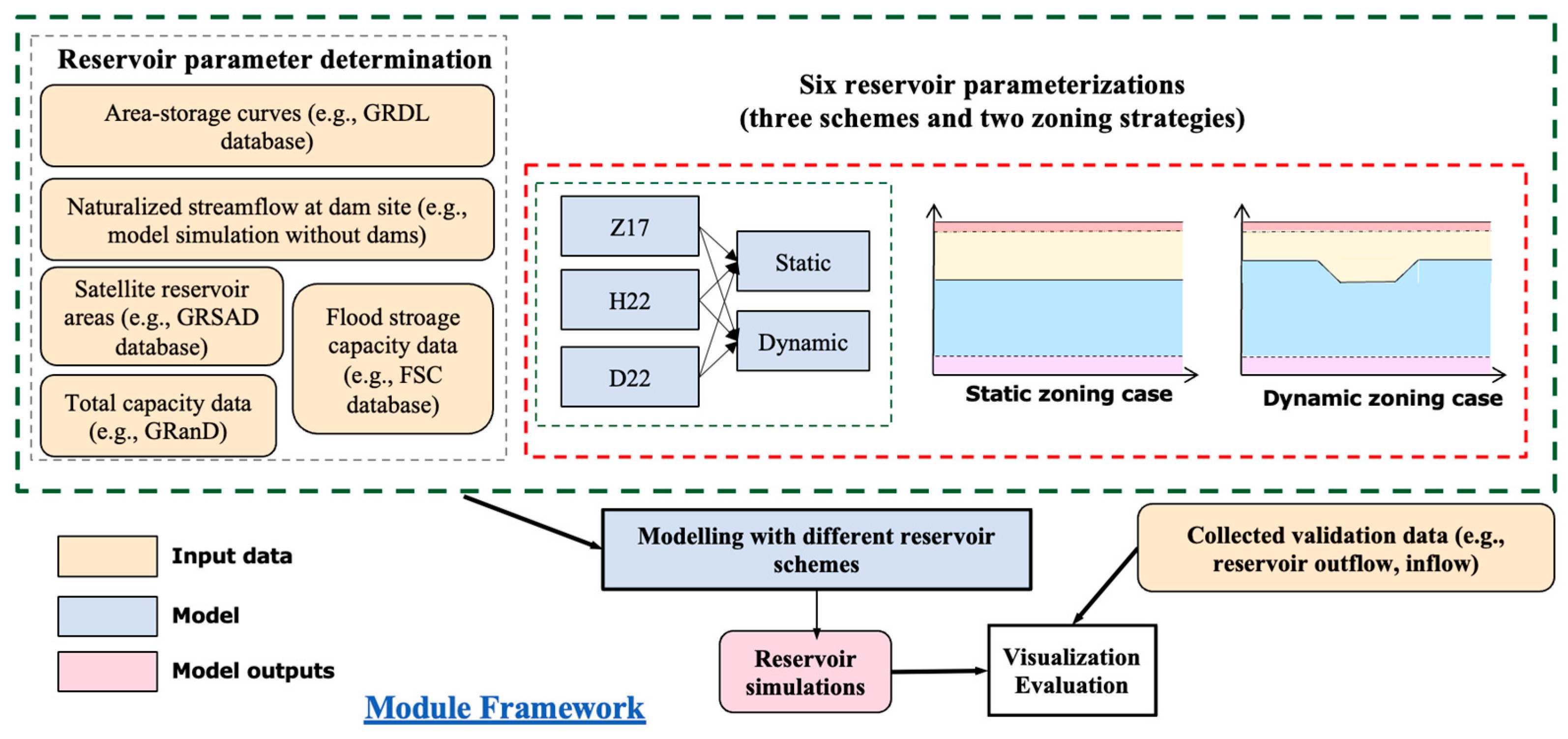
2.1. Overview of the Module Framework
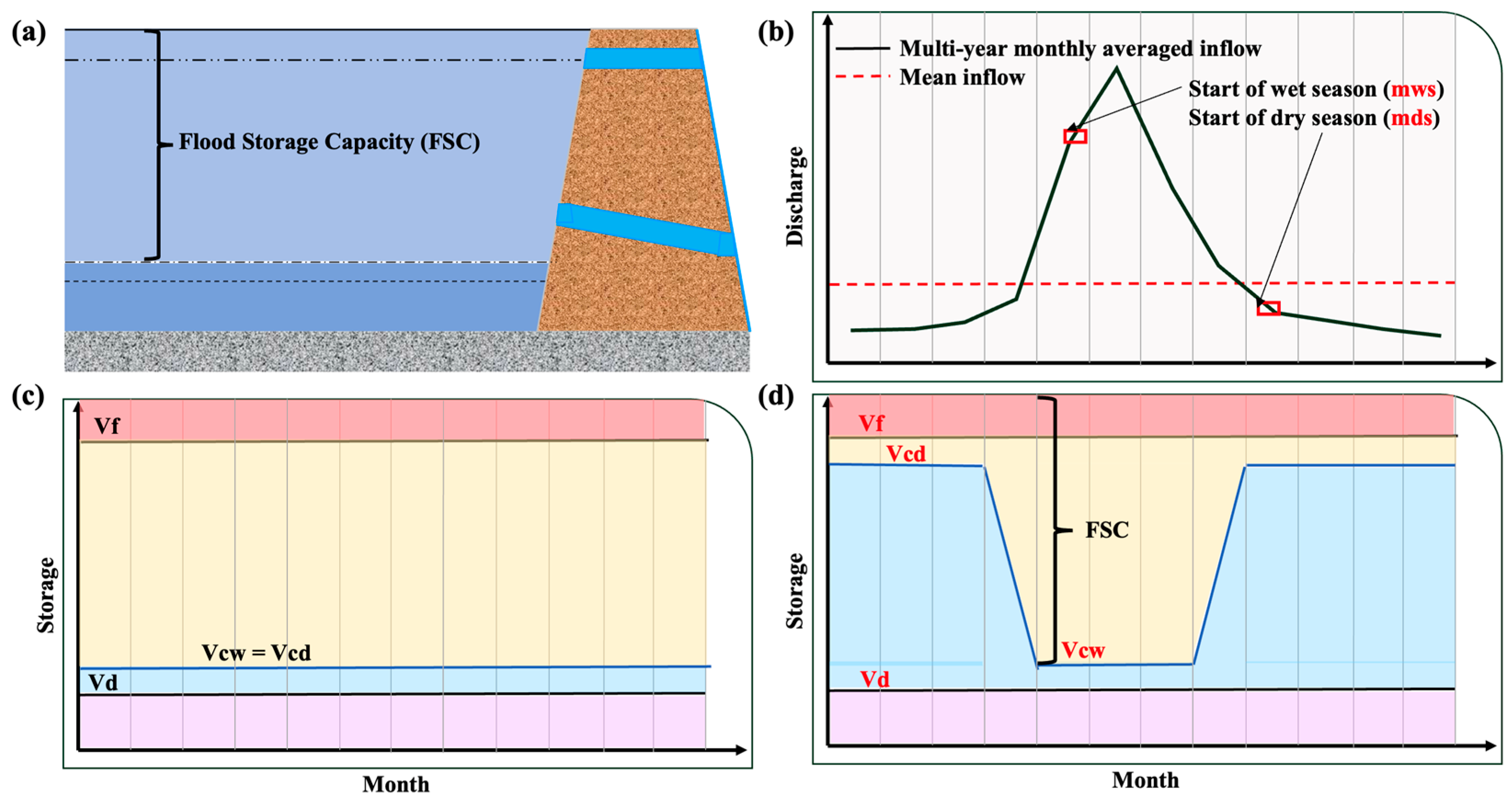
2.2. Development of the Reservoir Operation Module
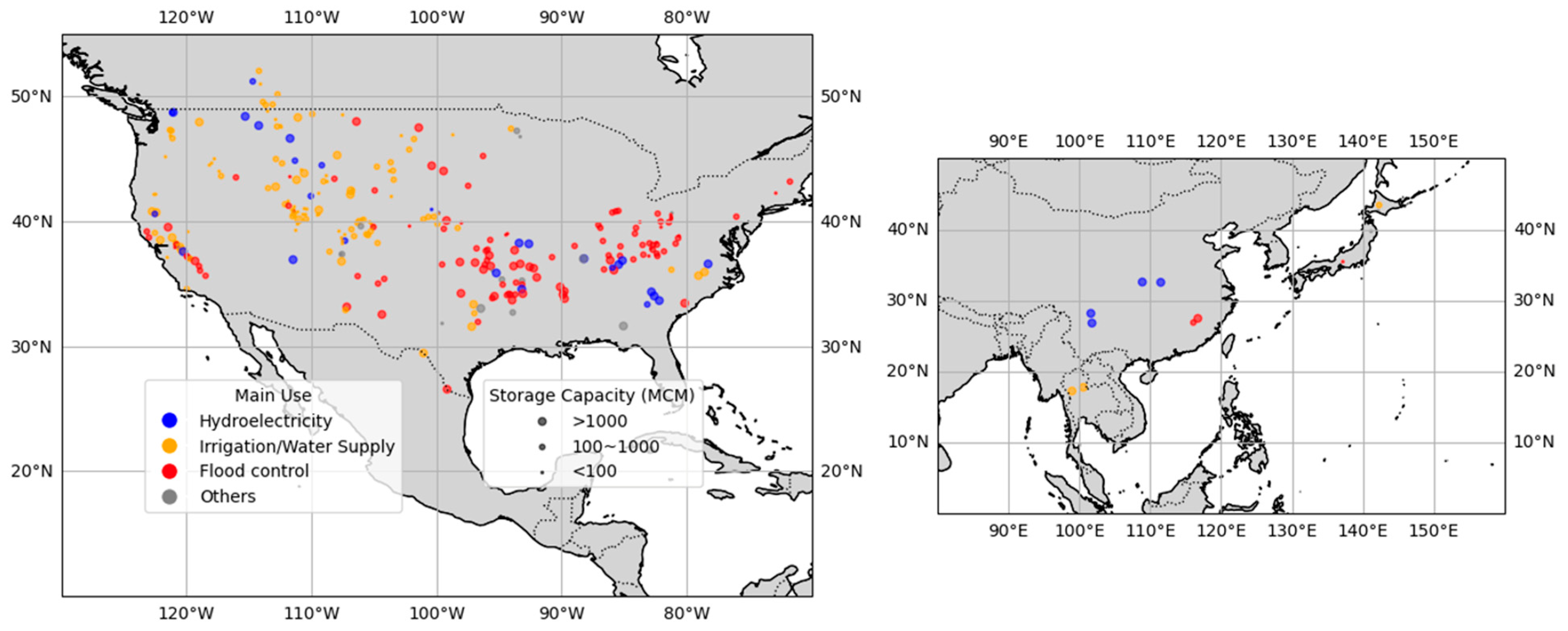
2.3. Datasets and Metrics for Model Evaluation
3. Results
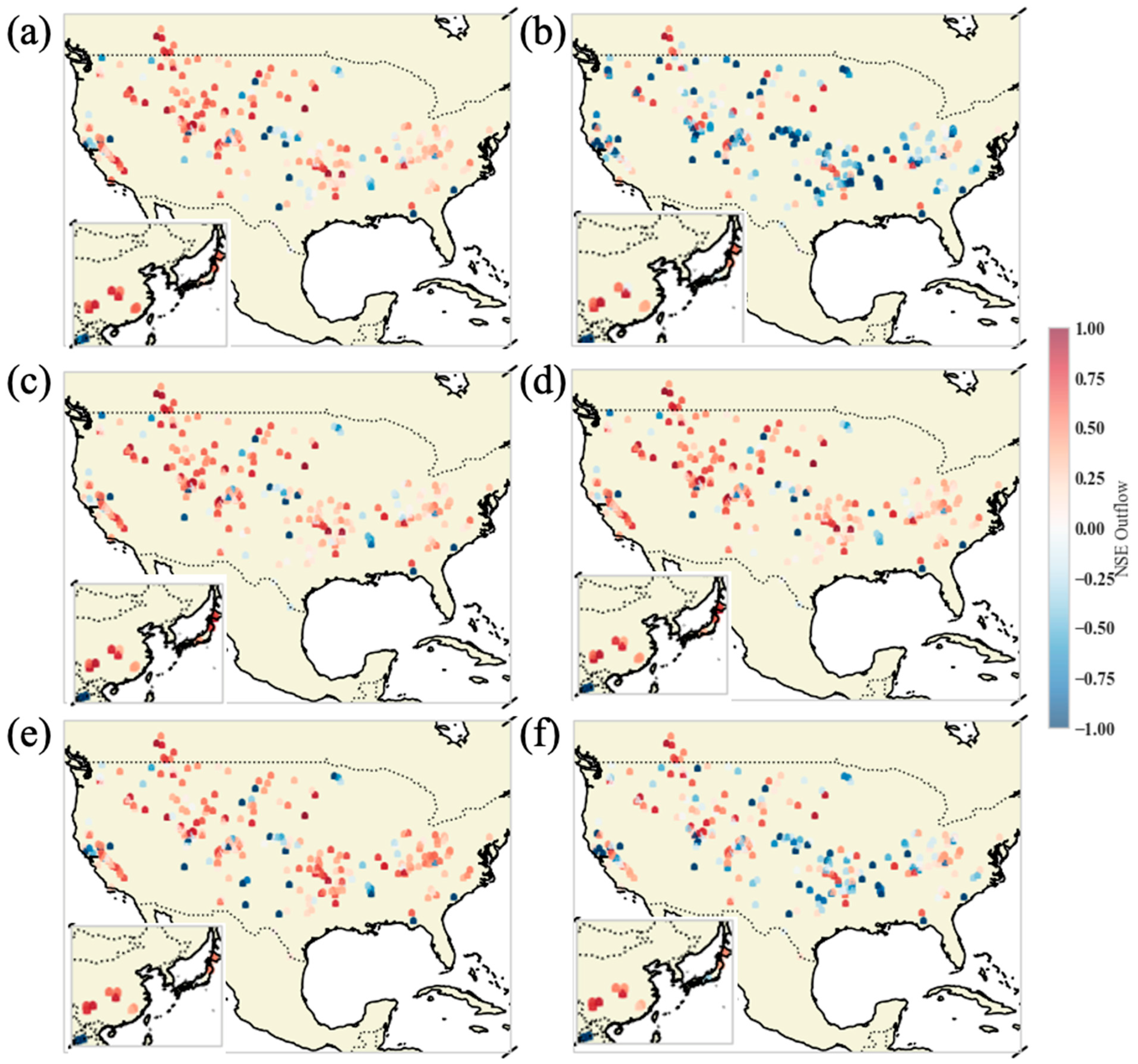
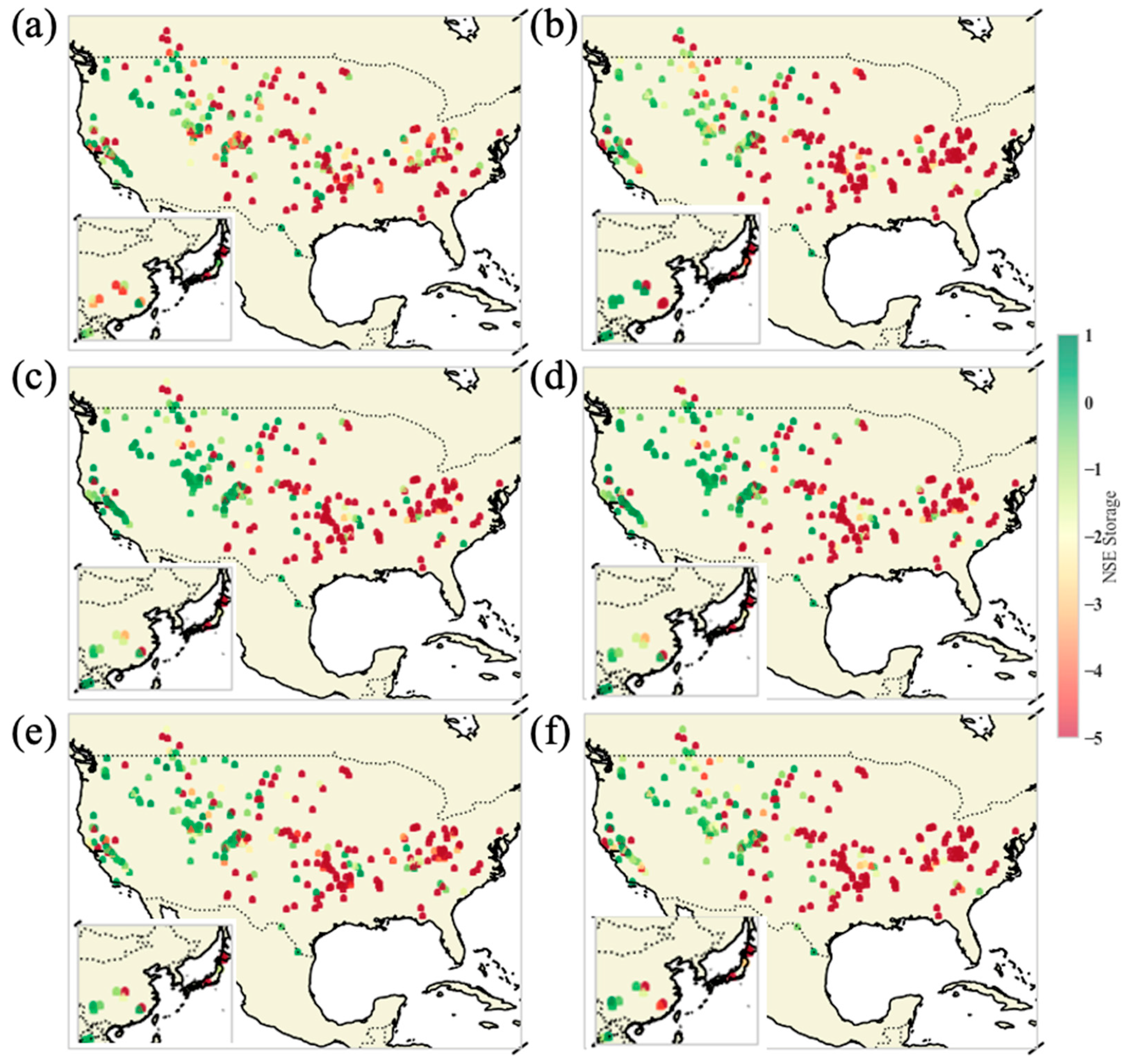
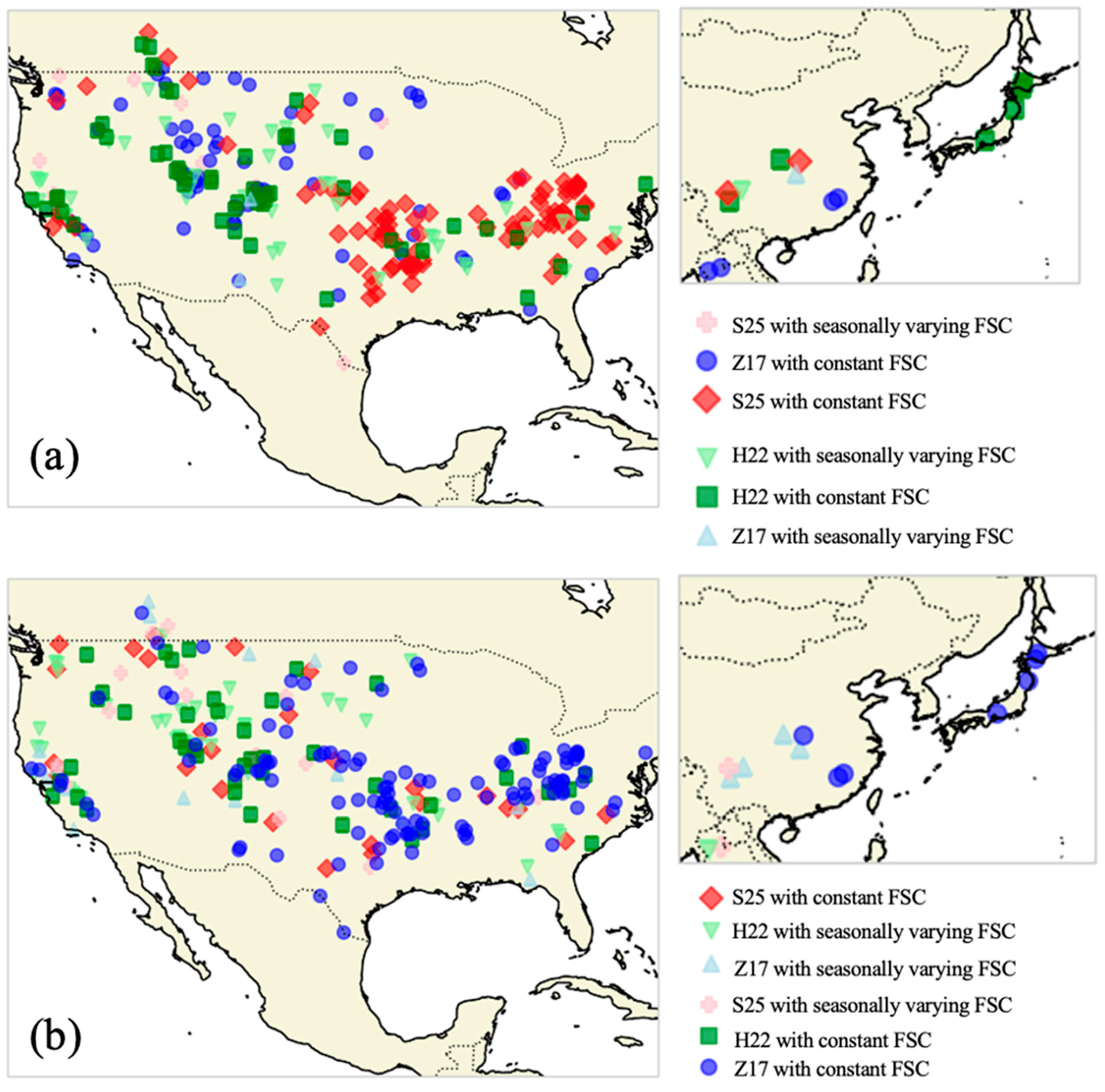
3.1. Spatial Distribution of Model Performance
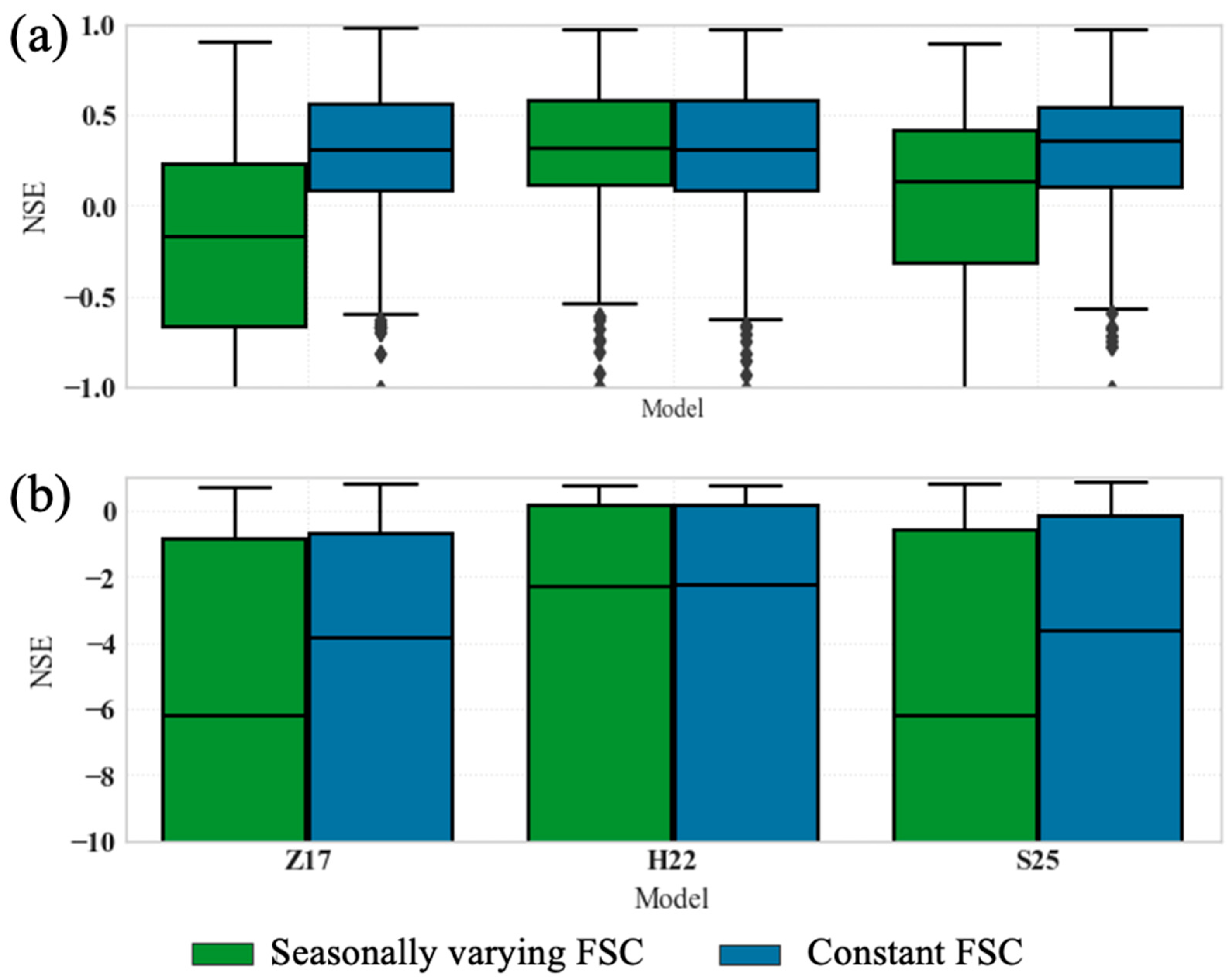
3.2. Overall Performance Among Models
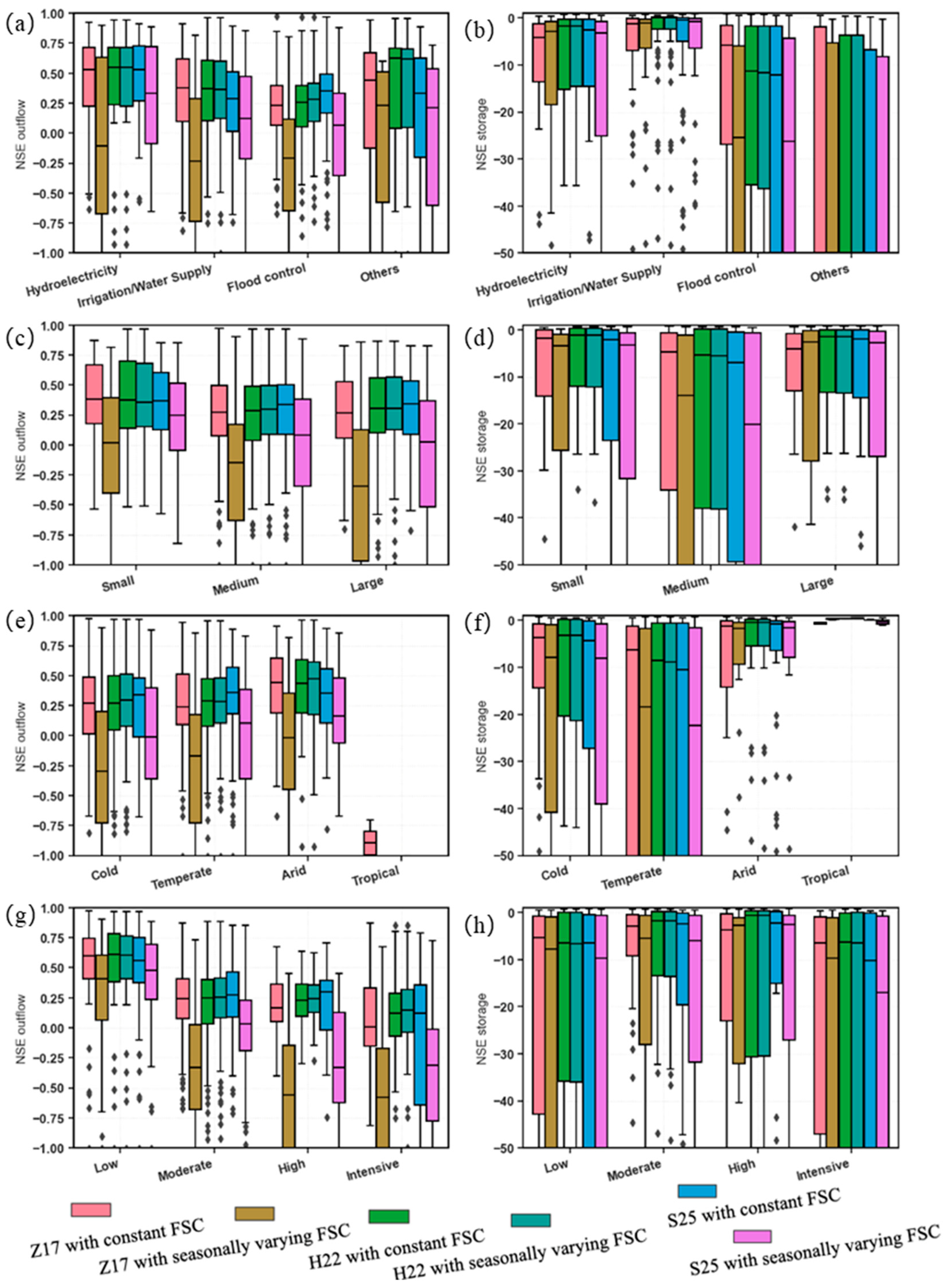
3.3. Performance by Reservoir Categories
3.4. Best-Performing Model Variant per Reservoir
4. Discussion
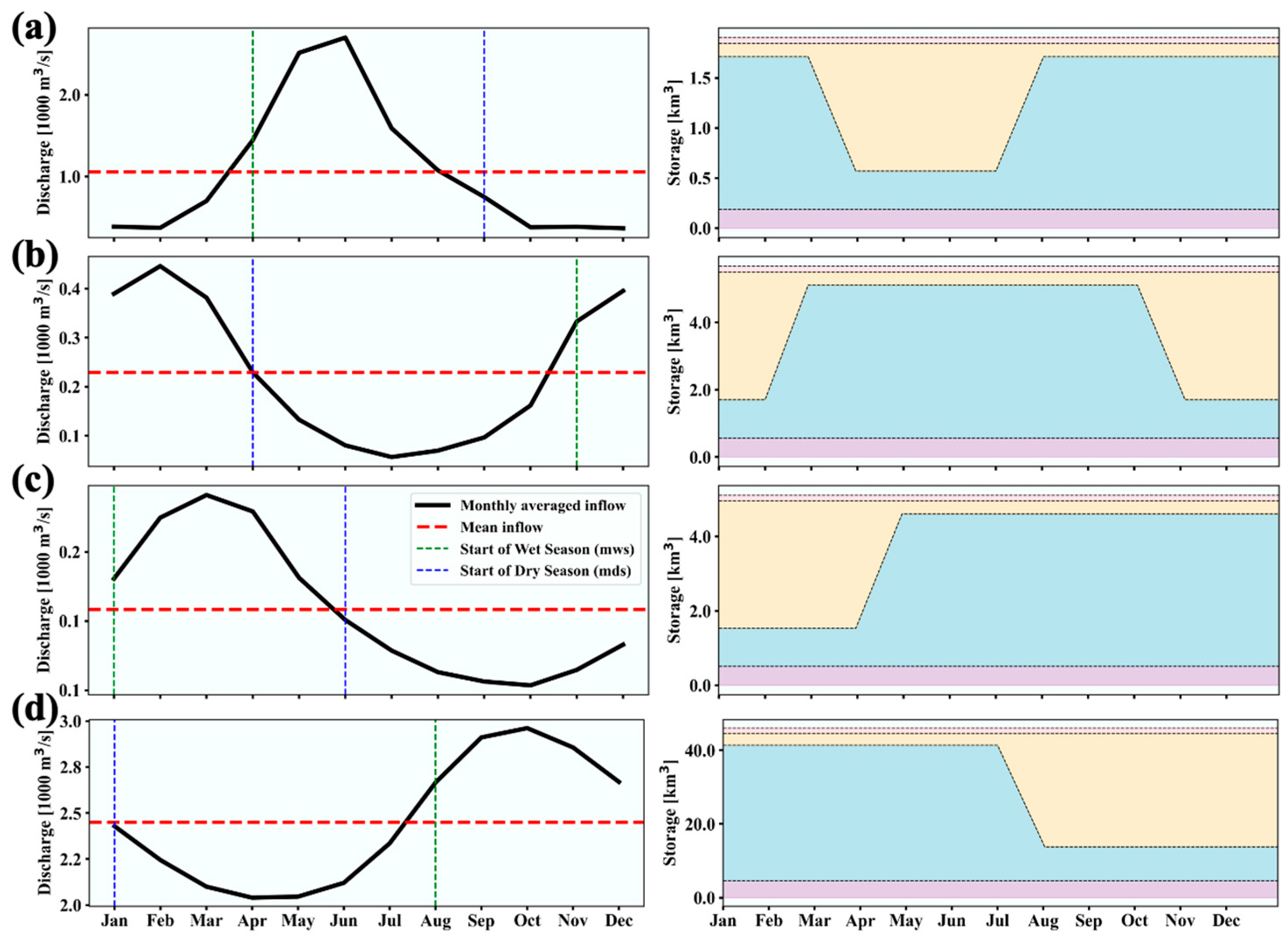
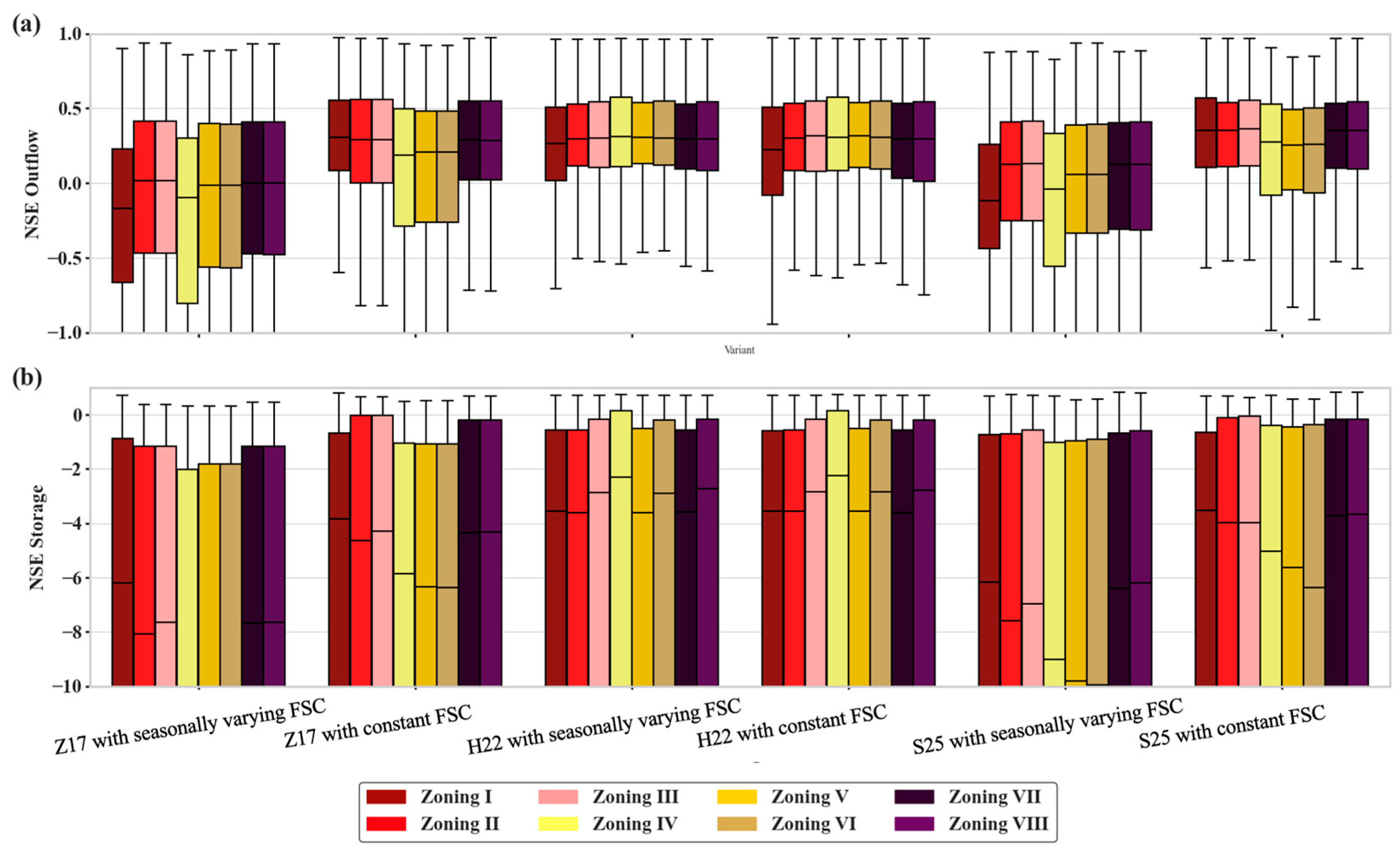
4.1. Sensitivity to Operational Zone Parameterization
4.2. Insights on Constant and Seasonally Varying Flood Storage Capacity Strategies
4.3. Implications and Future Directions
5. Conclusions
Author Contributions
Funding
Data Availability Statement
Acknowledgments
Conflicts of Interest
References
- Chao, B.F.; Wu, Y.H.; Li, Y.S. Impact of artificial reservoir water impoundment on global sea level. Science 2008, 320, 212–214. [Google Scholar] [CrossRef] [Scilit] [PubMed]
- Perera, D.; Smakhtin, V.; Williams, S.; North, T.; Curry, A. Ageing water storage infrastructure: An emerging global risk. UNU-INWEH Rep. Ser. 2021, 11, 25. [Google Scholar]
- Best, J. Anthropogenic stresses on the world’s big rivers. Nat. Geosci. 2019, 12, 7–21. [Google Scholar] [CrossRef] [Scilit]
- Cooley, S.W.; Ryan, J.C.; Smith, L.C. Human alteration of global surface water storage variability. Nature 2021, 591, 78–81. [Google Scholar] [CrossRef] [Scilit]
- Tian, W.; Liu, X.; Wang, K.; Bai, P.; Liu, C.; Liang, X. Estimation of global reservoir evaporation losses. J. Hydrol. 2022, 607, 127524. [Google Scholar] [CrossRef] [Scilit]
- Dang, T.D.; Chowdhury, A.F.M.K.; Galelli, S. On the representation of water reservoir storage and operations in large-scale hydrological models: Implications on model parameterization and climate change impact assessments. Hydrol. Earth Syst. Sci. 2020, 24, 397–416. [Google Scholar] [CrossRef] [Scilit]
- Döll, P.; Fiedler, K.; Zhang, J. Global-scale analysis of river flow alterations due to water withdrawals and reservoirs. Hydrol. Earth Syst. Sci. 2009, 13, 2413–2432. [Google Scholar] [CrossRef] [Scilit]
- Hosseini-Moghari, S.-M.; Araghinejad, S.; Tourian, M.J.; Ebrahimi, K.; Döll, P. Quantifying the impacts of human water use and climate variations on recent drying of Lake Urmia basin: The value of different sets of spaceborne and in situ data for calibrating a global hydrological model. Hydrol. Earth Syst. Sci. 2020, 24, 1939–1956. [Google Scholar] [CrossRef] [Scilit]
- Boulange, J.; Hanasaki, N.; Yamazaki, D.; Pokhrel, Y. Role of dams in reducing global flood exposure under climate change. Nat. Commun. 2021, 12, 417. [Google Scholar] [CrossRef] [Scilit]
- Donchyts, G.; Winsemius, H.; Baart, F.; Dahm, R.; Schellekens, J.; Gorelick, N.; Iceland, C.; Schmeier, S. High-resolution surface water dynamics in Earth’s small and medium-sized reservoirs. Sci. Rep. 2022, 12, 13776. [Google Scholar] [CrossRef] [Scilit]
- Grill, G.; Lehner, B.; Lumsdon, A.E.; MacDonald, G.K.; Zarfl, C.; Liermann, C.R. An index-based framework for assessing patterns and trends in river fragmentation and flow regulation by global dams at multiple scales. Environ. Res. Lett. 2015, 10, 015001. [Google Scholar] [CrossRef] [Scilit]
- Intralawan, A.; Wood, D.; Frankel, R.; Costanza, R.; Kubiszewski, I. Tradeoff analysis between electricity generation and ecosystem services in the Lower Mekong Basin. Ecosyst. Serv. 2018, 30, 27–35. [Google Scholar] [CrossRef] [Scilit]
- Li, R.; Xiong, L.; Xiong, B.; Li, Y.; Xu, Q.; Cheng, L.; Xu, C.-Y. Investigating the downstream sediment load change by an index coupling effective rainfall information with reservoir sediment trapping capacity. J. Hydrol. 2020, 590, 125200. [Google Scholar] [CrossRef] [Scilit]
- Steyaert, J.C.; Condon, L.E.; Turner, S.W.D.; Voisin, N. ResOpsUS, a dataset of historical reservoir operations in the contiguous United States. Sci. Data 2022, 9, 34. [Google Scholar] [CrossRef] [Scilit]
- Maavara, T.; Chen, Q.; Van Meter, K.; Brown, L.E.; Zhang, J.; Ni, J.; Zarfl, C. River dam impacts on biogeochemical cycling. Nat. Rev. Earth Environ. 2020, 1, 103–116. [Google Scholar] [CrossRef] [Scilit]
- Lehner, B.; Liermann, C.R.; Revenga, C.; Vörösmarty, C.; Fekete, B.; Crouzet, P.; Döll, P.; Endejan, M.; Frenken, K.; Magome, J.; et al. High-resolution mapping of the world’s reservoirs and dams for sustainable river-flow management. Front. Ecol. Environ. 2011, 9, 494–502. [Google Scholar] [CrossRef] [Scilit]
- Shen, Y.; Nielsen, K.; Revel, M.; Liu, D.; Yamazaki, D. Res-CN (reservoir dataset in China): Hydrometeorological time series and landscape attributes across 3254 Chinese reservoirs. Earth Syst. Sci. Data 2023, 15, 2781–2808. [Google Scholar] [CrossRef] [Scilit]
- Döll, P.; Kaspar, F.; Lehner, B. A global hydrological model for deriving water availability indicators: Model tuning and validation. J. Hydrol. 2003, 270, 105–134. [Google Scholar] [CrossRef] [Scilit]
- Hanasaki, N.; Kanae, S.; Oki, T. Areservoir operation algorithm for global river routing models. J. Hydrol. 2006, 327, 22–41. [Google Scholar] [CrossRef] [Scilit]
- Haddeland, I.; Skaugen, T.; Lettenmaier, D.P. Anthropogenic impacts on continental surface water fluxes. Geophys. Res. Lett. 2006, 33, L08406. [Google Scholar] [CrossRef] [Scilit]
- Sadki, M.; Munier, S.; Boone, A.; Ricci, S. Implementation and sensitivity analysis of the Dam-Reservoir OPeration model (DROP v1.0) over Spain. Geosci. Model Dev. 2023, 16, 427–448. [Google Scholar] [CrossRef] [Scilit]
- Rougé, C.; Reed, P.M.; Grogan, D.S.; Zuidema, S.; Prusevich, A.; Glidden, S.; Lamontagne, J.R.; Lammers, R.B. Coordination and control—Limits in standard representations of multi-reservoir operations in hydrological modeling. Hydrol. Earth Syst. Sci. 2021, 25, 1365–1388. [Google Scholar] [CrossRef] [Scilit]
- Neitsch, S.L.L.; Arnold, J.G.G.; Kiniry, J.R.R.; Williams, J.R.R. Soil and water assessment tool theoretical documentation version 2005. In Texas Water Resources Institute Technical Report; Texas Water Resources Institute: College Station, TX, USA, 2005. [Google Scholar]
- Wu, Y.; Chen, J. An operation-based scheme for a Mul-tiyear and multipurpose reservoir to enhance macroscale hydrologic models. J. Hydrometeorol. 2012, 13, 270–283. [Google Scholar] [CrossRef] [Scilit]
- Burek, P.; van der Knijff, J.; de Roo, A. LISFLOOD Distributed Water Balance and Flood Simulation Model e Revised User Manual 2013; JRC Technical Reports, Joint Research Centre of the European Commission; Publications Office of the European Union: Luxembourg, 2013. [Google Scholar]
- Hanazaki, R.; Yamazaki, D.; Yoshimura, K. Development of a reservoir flood control scheme for global flood models. J. Adv. Model. Earth Syst. 2022, 14, e2021MS002944. [Google Scholar] [CrossRef] [Scilit]
- Zajac, Z.; Revilla-Romero, B.; Salamon, P.; Burek, P.; Hirpa, F.A.; Beck, H. The impact of lake and reservoir parameterization on global streamflow simulation. J. Hydrol. 2017, 548, 552–568. [Google Scholar] [CrossRef] [Scilit]
- Yao, F.; Minear, J.T.; Rajagopalan, B.; Wang, C.; Yang, K.; Livneh, B. Estimating reservoir sedimentation rates and storage capacity losses using high-resolution Sentinel-2 satellite and water level data. Geophys. Res. Lett. 2023, 50, e2023GL103524. [Google Scholar] [CrossRef] [Scilit]
- Hou, J.; Van Dijk, A.I.J.M.; Renzullo, L.J.; Larraondo, P.R. GloLakes: Water storage dynamics for 27 000 lakes globally from 1984 to present derived from satellite altimetry and optical imaging. Earth Syst. Sci. Data 2024, 16, 201–218. [Google Scholar] [CrossRef] [Scilit]
- Tourian, M.J.; Elmi, O.; Shafaghi, Y.; Behnia, S.; Saemian, P.; Schlesinger, R.; Sneeuw, N. HydroSat: Geometric quantities of the global water cycle from geodetic satellites. Earth Syst. Sci. Data 2022, 14, 2463–2486. [Google Scholar] [CrossRef] [Scilit]
- Hosseini-Moghari, S.-M.; Döll, P. The value of observed reservoir storage anomalies for improving the simulation of reservoir dynamics in large-scale hydrological models. Hydrol. Earth Syst. Sci. 2025, 29, 4073–4092. [Google Scholar] [CrossRef] [Scilit]
- Steyaert, J.C.; Condon, L.E. Synthesis of historical reservoir operations from 1980 to 2020 for the evaluation of reservoir representation in large-scale hydrologic models. Hydrol. Earth Syst. Sci. 2024, 28, 1071–1088. [Google Scholar] [CrossRef] [Scilit]
- Dong, N.; Wei, J.; Yang, M.; Yan, D.; Yang, C.; Gao, H.; Arnault, J.; Laux, P.; Zhang, X.; Liu, Y.; et al. Model Estimates of China’s Terrestrial Water Storage Variation Due To Reservoir Operation. Water Resour. Res. 2022, 58, e2021WR031787. [Google Scholar] [CrossRef] [Scilit]
- Dong, N.; Yang, M.; Wei, J.; Arnault, J.; Laux, P.; Xu, S.; Wang, H.; Yu, Z.; Kunstmann, H. Toward Improved Parameterizations of Reservoir Operation in Ungauged Basins: A Synergistic Framework Coupling Satellite Remote Sensing, Hydrologic Modeling, and Conceptual Operation Algorithms. Water Resour. Res. 2023, 59, e2022WR033026. [Google Scholar] [CrossRef] [Scilit]
- Ehsani, N.; Fekete, B.M.; Vörösmarty, C.J.; Tessler, Z.D. A neural network based general reservoir operation algorithm. Stoch. Environ. Res. Risk Assess. 2016, 30, 1151–1166. [Google Scholar] [CrossRef] [Scilit]
- Shen, Y.; Yamazaki, D.; Pokhrel, Y.; Zhao, G. Improving global reservoir parameterizations by incorporating flood storage capacity data and satellite observations. Water Resour. Res. 2024, 61, e2024WR037620. [Google Scholar] [CrossRef] [Scilit]
- Li, M.; Liu, J.; Xia, Y. Risk prediction of gas hydrate formation in the wellbore and subsea gathering system of deep-water turbidite reservoirs: Case analysis from the south China Sea. Reserv. Sci. 2025, 1, 52–72. [Google Scholar] [CrossRef] [Scilit]
- Cao, L.; Lv, M.; Li, C.; Sun, Q.; Wu, M.; Xu, C.; Dou, J. Effects of crosslinking agents and reservoir conditions on the propagation of fractures in coal reservoirs during hydraulic fracturing. Reserv. Sci. 2025, 1, 36–51. [Google Scholar] [CrossRef] [Scilit]
- Wang, F.; Kobina, F. The influence of geological factors and transmission fluids on the exploitation of reservoir geothermal resources: Factor discussion and mechanism analysis. Reserv. Sci. 2025, 1, 3–18. [Google Scholar] [CrossRef] [Scilit]
- Tang, L.; Liu, G.; Sun, X.; Liu, P. Optimizing storage-based reservoir operation schemes for enhanced large-scale hydrological modeling: A comprehensive sensitivity analysis. J. Hydrol. 2025, 657, 133173. [Google Scholar] [CrossRef] [Scilit]
- Nash, J.E.; Sutcliffe, J.V. River flow forecasting through conceptual models part I—A discussion of principles. J. Hydrol. 1970, 10, 282–290. [Google Scholar] [CrossRef] [Scilit]


Disclaimer/Publisher’s Note: The statements, opinions and data contained in all publications are solely those of the individual author(s) and contributor(s) and not of MDPI and/or the editor(s). MDPI and/or the editor(s) disclaim responsibility for any injury to people or property resulting from any ideas, methods, instructions or products referred to in the content. |
© 2025 by the authors. Licensee MDPI, Basel, Switzerland. This article is an open access article distributed under the terms and conditions of the Creative Commons Attribution (CC BY) license.
Share and Cite
Hao, X.; Hao, Y.; Sun, X.; Tang, L. A Flexible Python Module for Reservoir Simulations with Seasonally Varying and Constant Flood Storage Capacity. Water 2026, 18, 68. https://doi.org/10.3390/w18010068
Hao X, Hao Y, Sun X, Tang L. A Flexible Python Module for Reservoir Simulations with Seasonally Varying and Constant Flood Storage Capacity. Water. 2026; 18(1):68. https://doi.org/10.3390/w18010068
Chicago/Turabian StyleHao, Xiaodong, Yali Hao, Xiaohui Sun, and Li Tang. 2026. "A Flexible Python Module for Reservoir Simulations with Seasonally Varying and Constant Flood Storage Capacity" Water 18, no. 1: 68. https://doi.org/10.3390/w18010068
APA StyleHao, X., Hao, Y., Sun, X., & Tang, L. (2026). A Flexible Python Module for Reservoir Simulations with Seasonally Varying and Constant Flood Storage Capacity. Water, 18(1), 68. https://doi.org/10.3390/w18010068