


Abstract
Groundwater characterization is seldom performed in countries with limited infrastructure and resources. A short-term solution is to use numerical simulation to study groundwater using the limited available data. We developed a GIS-integrated groundwater flow scheme based on the finite-difference method to numerically simulate flow using surface geological information. We performed groundwater simulations, using homogeneous and heterogeneous media to evaluate flow changes resulting from heterogeneities. The results show flow barriers in low hydraulic-conductivity zones that coincide with the administrative boundaries of the aquifer; however, in high hydraulic-conductivity zones, the administrative aquifer boundaries do not match the geological limits of the aquifer. This finding gives insight into reconsidering the boundaries of some aquifers in the region for their sustainability, with an integral understanding of groundwater.
1. Introduction
Water resources management is a critical issue, particularly in regions with growing populations. This directly affects the water demand for industrial, agricultural, commercial, and domestic use [1]. This issue is generally addressed without considering environmental implications or presenting sustainable water management, which directly affects regional development.
Recent studies on water availability [2,3] estimate that only 2–3% of all the Earth’s water is freshwater, whereas most of it is in the oceans. From the freshwater, nearly 30% is groundwater, 69% is in glaciers and ice caps, and ≈1% is in surface water bodies (lakes, rivers, dams, etc.). In particular, in arid or semi-arid regions, the greatest availability is in the subsurface. For this reason, groundwater exploitation has increased in Mexico, often with limited knowledge of its features [1]. There are many Mexican cities in semi-arid and arid regions where groundwater constitutes the only drinking water supply [4]. Overall, in Mexico, groundwater comprises almost 40% of the supply, according to the Mexican National Commission on Water [5] (CONAGUA).
Scientific tools have been continually developed within the hydrogeological community [4] to achieve optimal characterization of this vital resource. Such methods involve evaluating groundwater flow directions using chemical and piezometric data, sometimes to determine recharge zones or to analyze the quality of water extracted from the subsoil.
Despite significant contributions in the field of groundwater, there are still regions where water management agencies estimate water budgets using outdated techniques, with limited data, and often without considering a conceptual model that incorporates all the region’s hydrogeological variables [6]. This leads to the misclassification of an aquifer as over-exploited, as in Mexico, where groundwater is administered by aquifer limits defined using geopolitical factors.
Among the elements necessary for the optimal construction of a conceptual hydrogeological model are delineation of the basement, determination of water chemistry, identification of recharge and discharge zones, definition of saturated and unsaturated zones, and determination of subsurface heterogeneities in terms of hydraulic conductivity. For the determination of hydraulic parameters, such as conductivity, analytical techniques have been developed [7] based on ideal solutions that are generally not found in real aquifer scenarios: for example, a homogeneous, infinite-extent aquifer. Numerical techniques for determining this parameter can be statistical or involve a data inversion, which can lead to inadequate models due to the non-uniqueness of inverse problems.
In this work, we developed an integrated scheme that uses geographic information system (GIS) tools to obtain a heterogeneous conductivity model. This scheme allows for performing groundwater simulation without the need to switch between GUI interfaces for model preparation. This was subsequently applied to groundwater modeling to determine the implications for flow systems in a heterogeneous region. Furthermore, a simulation code for confined aquifers was developed that enables direct transition between GIS and groundwater modeling without requiring a graphical interface. This aims to facilitate hydrogeological data inversion under model constraints, informed by prior information on surface geology or geophysical data.
This paper is structured into four sections: a description of the study area; an overview of groundwater modeling and GIS integration; groundwater flow results and discussions for homogeneous and heterogeneous media in the Calera Aquifer; and our conclusions.
2. Study Area
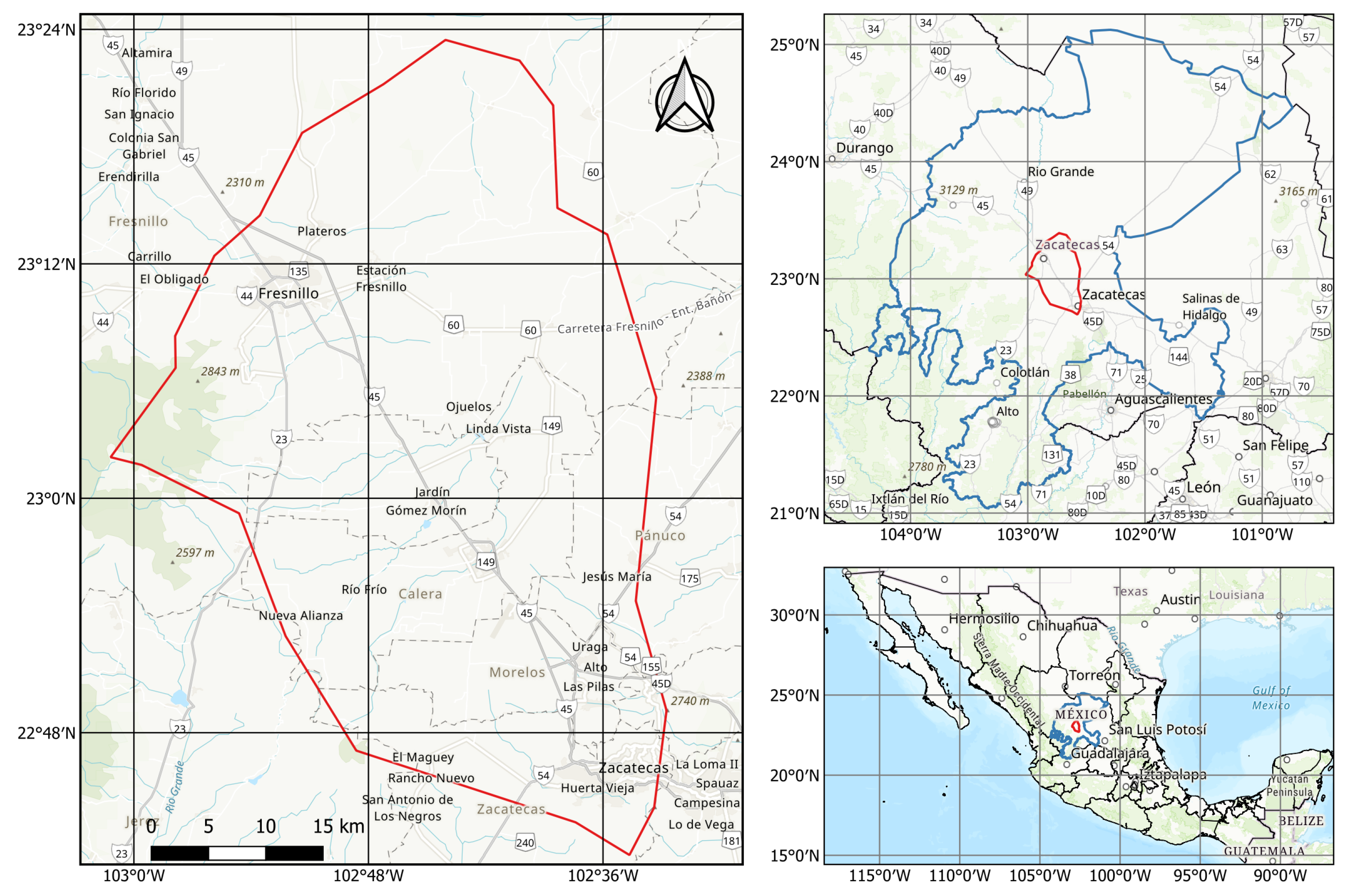
The Calera Aquifer is one of the administrative aquifers in the state of Zacatecas established by CONAGUA, which is the Mexican government-dependent organization that manages water resources in the country. Calera’s boundaries were primarily delineated based on geopolitical factors [5]. It is located on the Mexican Plateau, in the state of Zacatecas, Mexico (Figure 1). Geographically, the aquifer includes 3 of the region’s most populous cities: Zacatecas City (the state’s capital), Fresnillo, and Calera. Within its limits, the aquifer hosts extensive industrial, mining, commercial, and agricultural activities, alongside a dense population, making it one of the most studied aquifers in the State. This aquifer’s region also hosts most of the agricultural activity, with predominantly gravity- and trickle-irrigation methods. Moreover, this region is home to one of the most important breweries and one of the most important silver mines in the world.
Figure 1.
Calera administrative aquifer (Red line) in Zacatecas (Blue line), Mexico.
Most of the research in this aquifer is based on chemical water analyses, from water quality for human consumption [8], water quality for agricultural uses [9], identifying groundwater flow directions [5,10], to determining the presence of recharge zones [11]. Agricultural studies are also available [12], given the region’s extensive use of soil. However, groundwater modeling studies are scarce. The single study in the region, with 21 piezometric data points, dates back to 1994 [13]; therefore, the data is outdated and unreliable for comparison with modern-day data. Furthermore, geophysical prospecting studies in the region are scarce in the literature. There is a single work that employs Transient-Electromagnetic (TEM) measurements [14], which could lead to a 3D conceptual model in the future.
The main goal of this work is to contribute to the study of water resources in this region by providing a GIS-integrated tool and conceptual models to better understand the aquifer, with the aim of changing how water is managed in this region and increasing awareness of the water availability problem.
2.1. Hydrogeological Background
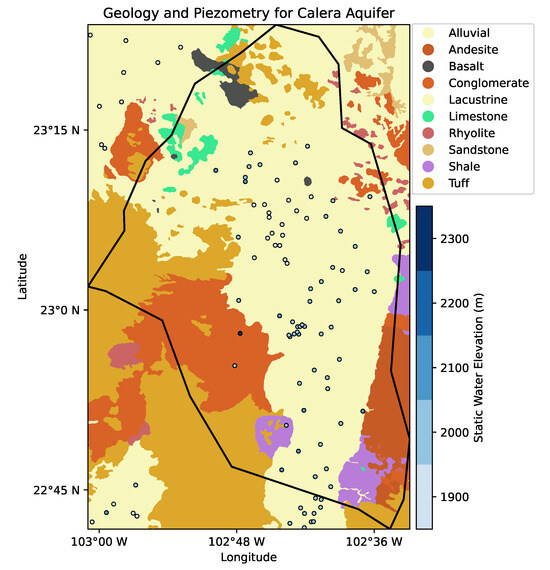
The Calera Aquifer is located in the Sierra Madre Oriental, which is a mountain range in the Mexican Plateau characterized by submarine volcanic and sedimentary deposits. In terms of tectono-stratigraphy, the aquifer lies near the triple junction of the Guerrero Composite, Central, and Oaxaquia Terranes [15], but is mostly within the Central Terrane, where the nature of the basement remains unknown. The geological map in Figure 2 was obtained from shapefiles downloaded from the Mexican Geological Services (SGM https://www.gob.mx/sgm, accessed on 8 November 2025).
Figure 2.
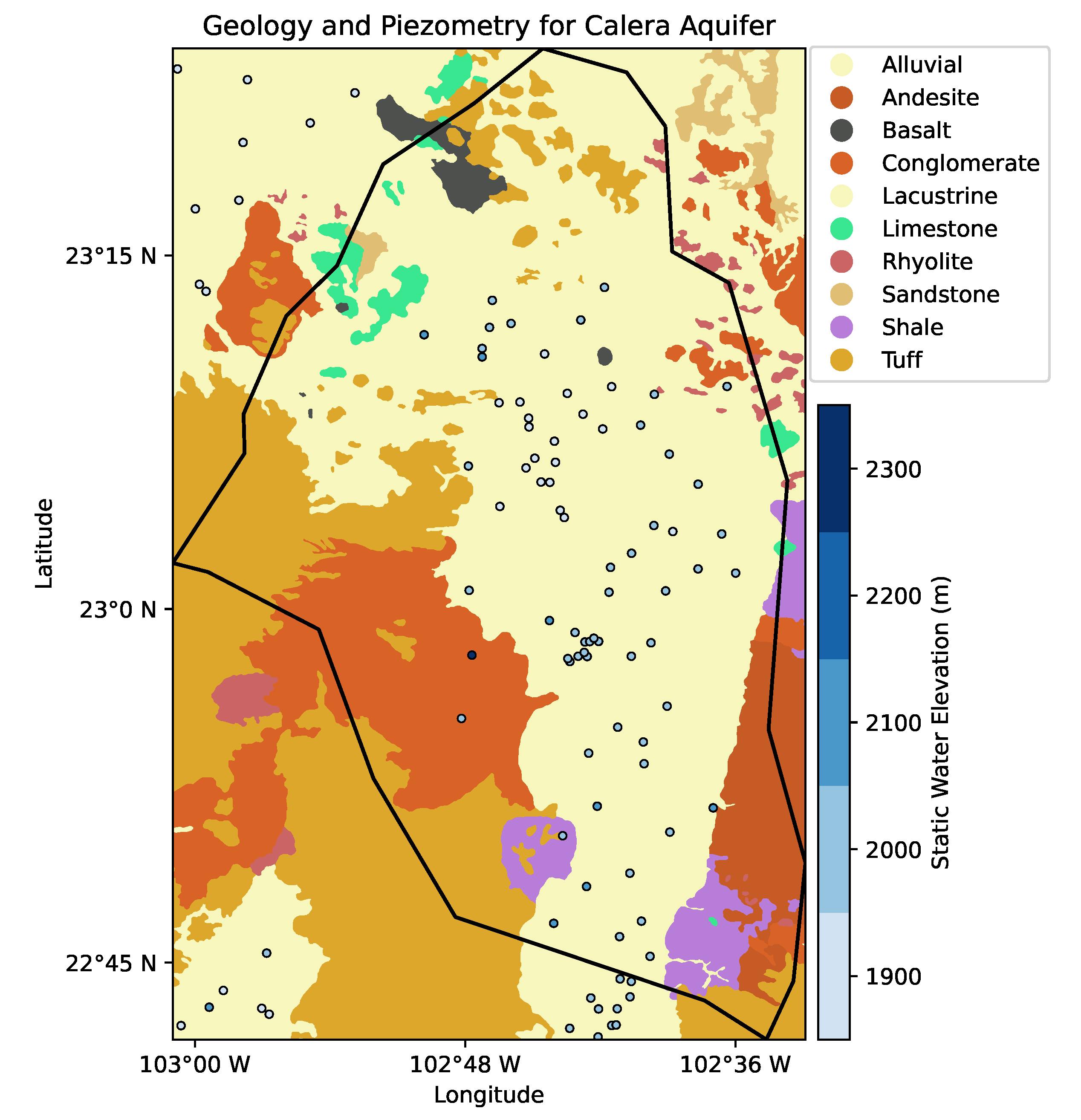
Geology of the Calera Aquifer and piezometric data (black outlined and blue circles) within the area of study.
Regionally, the aquifer presents a horst-graben system [14], with alluvial and lacustrine deposits in the central part of the valley, where almost all well data are located (Figure 2). The sedimentary basin is surrounded at the south by two important geological formations composed of igneous rocks such as Tuff, Rhyolite, and Andesite; the Chilitos Formation [16] at the southwest part of the aquifer and the Zacatecas formation [17] at the southeast, where recharge zones have been identified by isotope analysis [11].
There are no piezometers installed in the region for either time-dependent or stationary observations. Usually, all piezometric data are collected with level loggers or conventional water-level meters; hence, there is no information about the well properties in the region. Despite this, water budgets in the aquifer are often performed assuming homogeneous media, without information on the vertical component of flow directions, using simplified groundwater frameworks, such as homogeneous 1D media of infinite extension [7], and, sometimes, a single pumping test experiment with no observation well.
Static Water Level (SWL) data is available in the CONAGUA https://sigagis.conagua.gob.mx/Gas1/sections/RedesMonirtoreo_Piezometrico.html (accessed on 8 November 2025) databases, which provide a geographical viewer to download piezometric data for a single state and/or administrative aquifer. We downloaded the data within the limits shown in Figure 2, i.e., not only the inner data within the polygon but also the well data around the aquifer. The database contains sparse information for the years 1996 to 2025, with many missing data points. This is due to poorly organized data acquisition campaigns in the region, which occur at irregular intervals and at different well locations.
To estimate the hydraulic head, the well’s surface elevation is needed. For this, we consider the Digital Elevation Model (DEM) of Figure 3 for each data point, then we subtract the elevation from the SWL to obtain the Static Water Elevation (SWE) in meters, as presented in Figure 2, where SWE is shown in the well’s colors. This indicated that groundwater flows from south to north towards the central part of the basin, a hypothesis that will be explored through numerical modeling.
Figure 3.
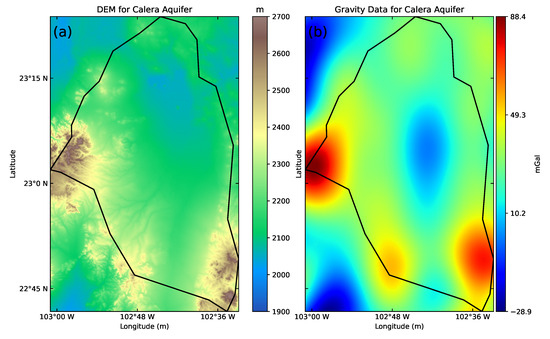
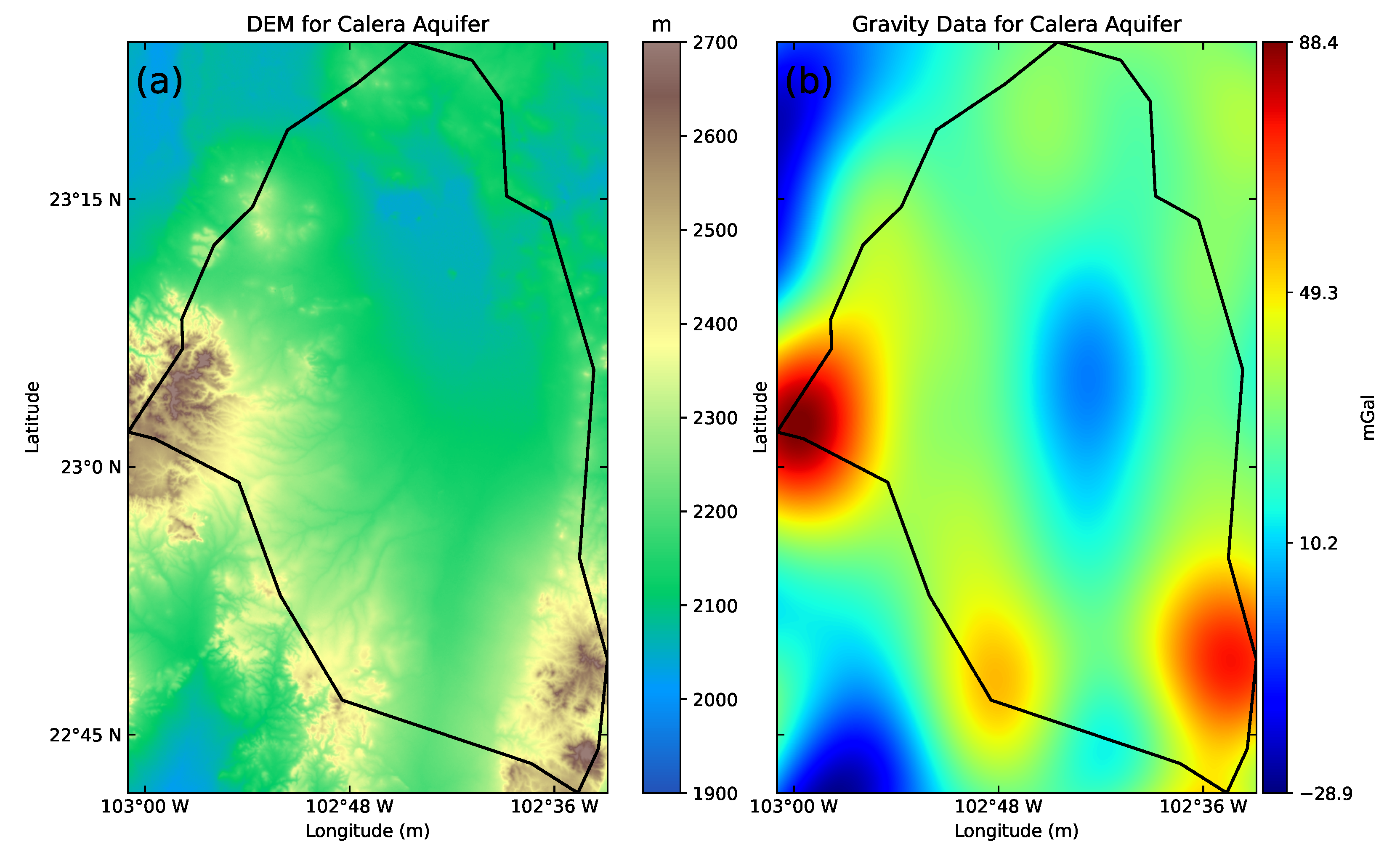
(a) Digital Elevation Model and (b) Satellite Gravity Data for the Calera aquifer (black line).
2.2. Digital Elevation Map and Gravity of Calera Aquifer
There are elevation points up to 2700 m.a.s.l. in the aquifer, and lower elevation points on the central part of the basin (2010 m.a.s.l.), as presented on the DEM of Figure 3, obtained from NASA https://www.earthdata.nasa.gov/topics/land-surface/digital-elevation-terrain-model-dem (accessed on 8 November 2025) Earthdata free repository [18]. The topography suggests that runoff flows toward the center of the aquifer, and the recharge zone can be located in the two principal higher parts of the area. The topography is consistent with satellite-gravity data downloaded from the Satellite Geodesy research group at Scripps https://topex.ucsd.edu/ (accessed on 8 November 2025) Institution of Oceanography, at the University of California, San Diego [19]. The higher altitudes in the region, with the higher-density igneous rocks, produce the highest gravity anomalies on the aquifer. This is an expected feature from a geophysical perspective. There is a negative gravity anomaly in the central part of the medium, where the density is constant (alluvial deposits) and the topography is relatively flat. This could be related to a mass deficit in the medium associated with the presence of extraction wells in the zone (Figure 2); however, at this time, we lack the data to support this hypothesis. Incorporation of additional geophysical information and well-logging data is required.
3. Methodology
3.1. Groundwater Flow Modeling
We consider the partial differential equation for a confined, heterogeneous, and anisotropic aquifer, given by
where is the hydraulic conductivity tensor, is the hydraulic head (m), is the source and/or sink term (s−1), is the specific storage of the porous material (m−1) and t is time (s). For non-orthogonal anisotropy, only the diagonal components of K are considered; therefore, Equation (1) can be written as
where , and are the hydraulic conductivities along the x, y and z directions (m/s), is the domain, is the boundary of , is the flow boundary, is the Dirichlet boundary, is a specified flux from Darcy’s Law [20], where a no flow boundary is obtained with for or z, and is the head along the boundary , which could be a constant head value. Equation (2) is the main equation for groundwater modeling, and can be solved using Finite Difference Methods [21] (FDM), Finite Element Methods [22] (FEM), or multiscale finite volume method [23] (MsVM); in this paper, we only consider FDM. The discretization of Equation (2) yields the following system:
where is hydraulic head (vectorized), is the vector containing all the source–sink terms, and and are matrices obtained from the application of the stencil on the grid (see Appendix A), and include the hydraulic conductivity, specific storage, and boundary conditions [24]. We solve the matrix system of Equation (3) using Biconjugate Gradient Stabilized Method (BiCGSTAB) [25] for the non-symmetric problem.
In practice, the transient-state model (Equation (3)) requires time stepping, which can be performed using implicit or explicit methods [26]. To realistically model a transient-state problem, data must be recorded over several time periods, sometimes in logarithmic increments from seconds to days, or from days to years, in well-known piezometric networks, sometimes requiring in situ pumping test data acquisition [7]. Nevertheless, in the Calera aquifer, there are regions where a well datum, i.e., SWL, is used instead of piezometric monitoring, with data collected every 5 years. Additionally, the z-component information (well screen and casing depths) is never provided. With respect to pumping test data, in our study area, often there are no available observational wells for the experiment, leading to measurement errors, and most of the time, only a single pumping test is performed across the entire aquifer region for water budget evaluations. Given the limited data availability, we limit our study to 2D steady-state modeling; hence, Equation (2) can be simplified as
Although our implementation is designed for 3D, anisotropic, and steady-state modeling, the 2D simulation is straightforward (see Appendix A).
3.2. Conductivity Model Creation
For the conductivity model, we used the geology of the area of interest (Figure 2), where alluvial deposits are most prevalent in the zone, and volcanic structures surround the southern part of the region. To obtain a conductivity model, Geographical Information System (GIS) software is required, such as ArcGIS https://www.arcgis.com/index.html (accessed on 8 November 2025) or QGIS https://qgis.org/ (accessed on 8 November 2025). An alternative for GUI software is Geopandas (v. 1.1.2) [27], which has recently become popular among code developers to avoid graphical interfaces [28]. Geopandas is an open-source Python 3 project that manipulates dataframes similarly to the Pandas package, with spatial operations on geometry types (points and polygons). This feature allows us to create a dataframe column with hydraulic conductivity values depending on the rock type in the zone. For this, we take the mean of the range of values of Bear [29] to obtain the hydraulic conductivities presented in Table 1.
Table 1.
Hydraulic Conductivities for the model construction. Modified from Bear [29].
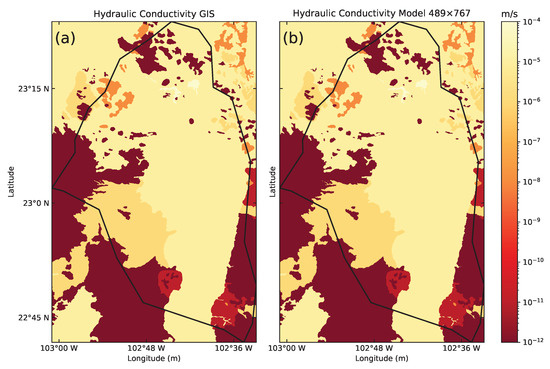
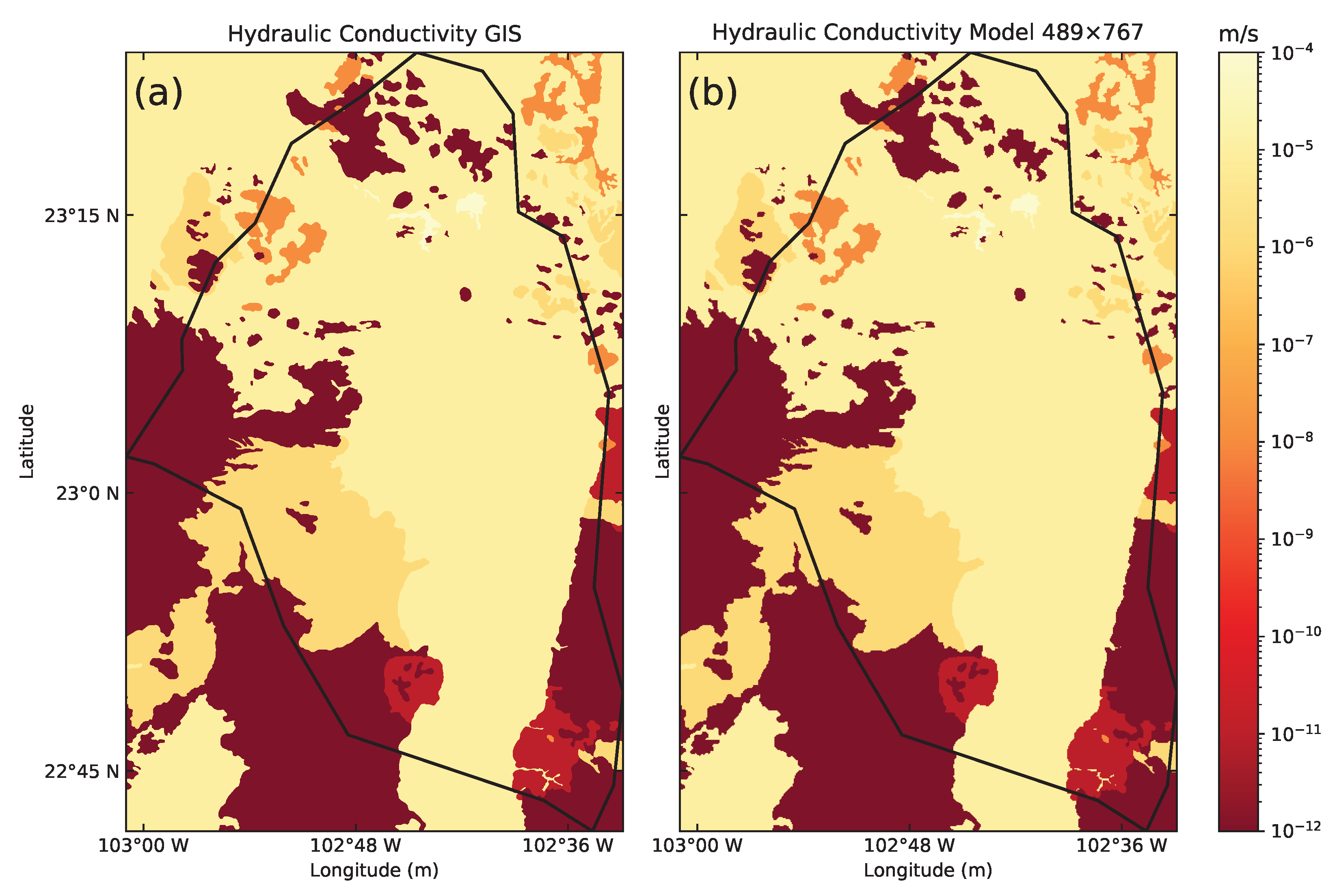
We consider mainly 3 hydrogeological environments in our region of study: (1) a high hydraulic conductivity zone for sedimentary deposits (Alluvial and Lacustrine deposits), (2) an intermediate hydraulic conductivity zone for conglomerate, sandstone, and limestone, and (3) a low conductivity region for igneous rocks(mostly rhyolite and andesite) and shale. All zones are based on the mean values of the ranges presented by Bear [29] (see Figure 4a).
Figure 4.
(a) Hydraulic conductivity GIS using the values of Table 1 and (b) Hydraulic Conductivity model () using a resolution of 100 m for the Calera aquifer (black line).
The alluvial region consists predominantly of coarse- to medium-grained sands, hence the high-conductivity values. In lacustrine settings, we assign high conductivity values because this region contains dry lakes and rivers within the Calera aquifer. For the intermediate zone, we chose a value that accounts for poor cementation and high porosity. Finally, igneous and non-fractured rocks yielded the lowest conductivity. However, fractured igneous rocks could have conductivities comparable to those of gravel deposits. This would require in situ cartography of faults or fractures in the region, or geophysical data acquisition and processing, such as aeromagnetic or seismic data, to identify fractured rocks. We consider only non-fractured rocks in this work, but the model creation can be easily updated in our workflow if additional information becomes available.
To determine the grid resolution, we examine piezometric data in the zone. To convert to metric units, we transform the coordinates to WGS 84 UTM Zone 13N. Then, we compute the minimal distance among all well data points in the aquifer, which is 273.31 m. Using a resolution of 250 m yields a grid size of , which we considered low-resolution compared with the geology map in Figure 2. Besides, the minimal distance would ignore effects between adjacent wells. For this reason, a resolution of 100 m was chosen, i.e., at least 1 cell will be computed between piezometric data points. This resolution yields a grid size of , which is negligible given our computational resources. To rasterize the model, a search for all x and y indexes is performed to define the value of each grid cell within a certain polygon. We wrote Python code using the Geopandas 1.1.2. package to transform the GIS file into a grid matrix (), using the hydraulic conductivity values from Table 1 and an external CSV file. The model obtained using this method is shown in Figure 4b and resembles the geology of the zone. This implementation provides a fast, accessible way to update the hydraulic conductivity value if additional information becomes available, such as well logging, geophysical inversion, in situ cartography, or even groundwater inverse modeling for K estimation [30]. The same procedure, with the same grid size, was repeated to compute the head-constant matrix at the locations of the wells, which was then used to feed the FDM code.
4. Results and Discussion
Here, we present results from 3 experiments: first, we test our implementation on a simple 2D homogeneous model for isotropic and anisotropic media, comparing the results with those of MODFLOW. Second, we simulate groundwater flow in the Calera Aquifer using a homogeneous conductivity model and compare the results with those from MODFLOW. Finally, we test our GIS-integrated groundwater model using FDM, accounting for heterogeneous conductivity.
4.1. Validation of Our Scheme
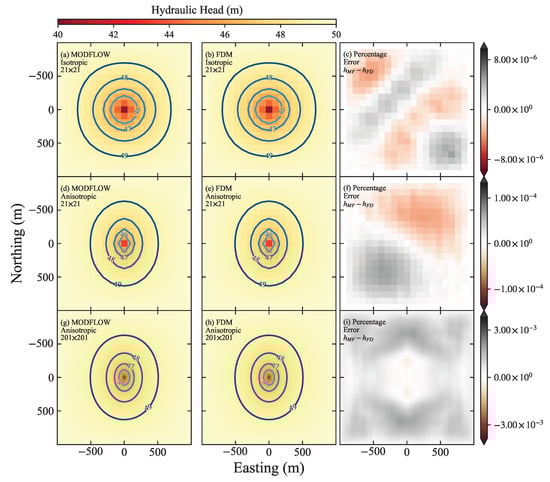
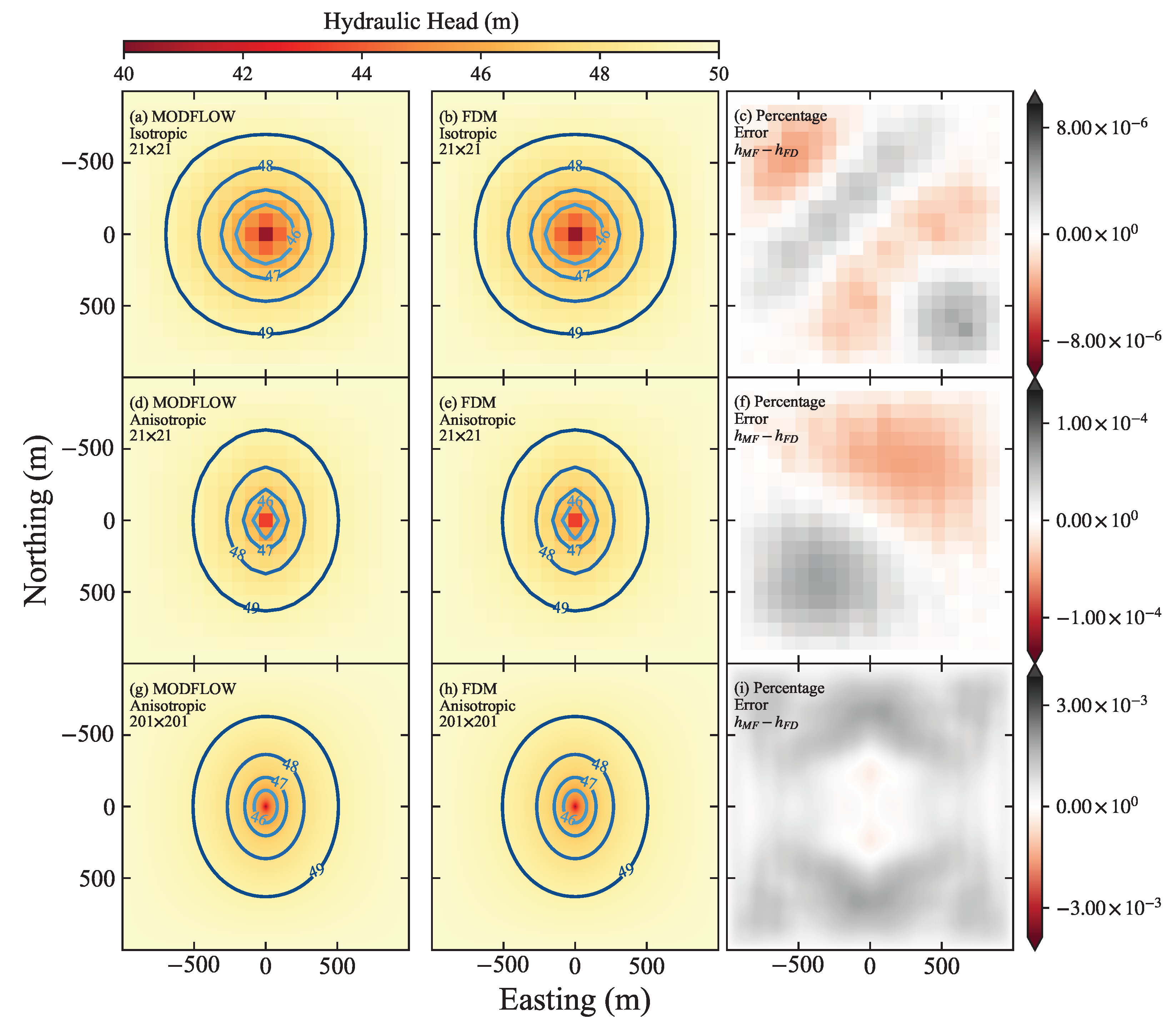
The main purpose of this experiment is to validate our FDM implementation by comparing it with simulations using MODFLOW 6 [31,32] for isotropic and anisotropic media with different grid sizes (Figure 5). The 2D domains of the following tests are m and m. For boundary conditions, we set a head-constant value m for , and a discharge rate m3/day in the center of the domain, hence the source term is
Figure 5.
Numerical head simulation comparing our FDM results with those of MODFLOW for homogeneous media, using isotropic and anisotropic hydraulic conductivity for different grid sizes.
In MODFLOW, the boundary conditions are implemented with the CHD package and the sink/source implementation with the WEL package [21]. Since we use a steady-state problem, the time units do not play an important role in the simulations; hence, we set the hydraulic conductivities to m/day. For a grid size of , the results for a homogeneous medium are almost the same using MODFLOW (Figure 5a) and our implementation (Figure 5b), where the contours present hydraulic conductivity circles centered at and . The differences between simulations are negligible, as seen in the percentage error in Figure 5c.
Then, we simulate for an anisotropic medium with m/day and m/day, with the same grid size and boundary conditions. Again, the results are similar using MODFLOW (Figure 5d) and our implementation (Figure 5e). In this example, the head contours clearly exhibit the hydraulic conductivity ellipsoid for an anisotropic medium, as presented by Freeze and Cherry [33], i.e., there is faster convergence to the drawdown point in the center along the y-direction than along the x-direction. The percentage error, Figure 5f, is still negligible (up to %).
Finally, we calibrate our code with a larger grid, , for the same anisotropic media. Because of the higher resolution, the head contours are smoother than in the lower-resolution examples (see Figure 5g,h). Although the percentage errors are larger than in the low-resolution examples, they are still negligible (Figure 5i).
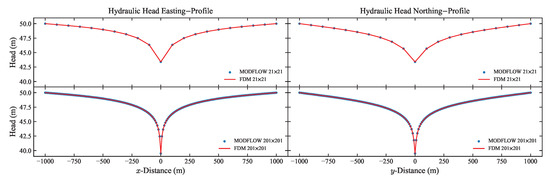
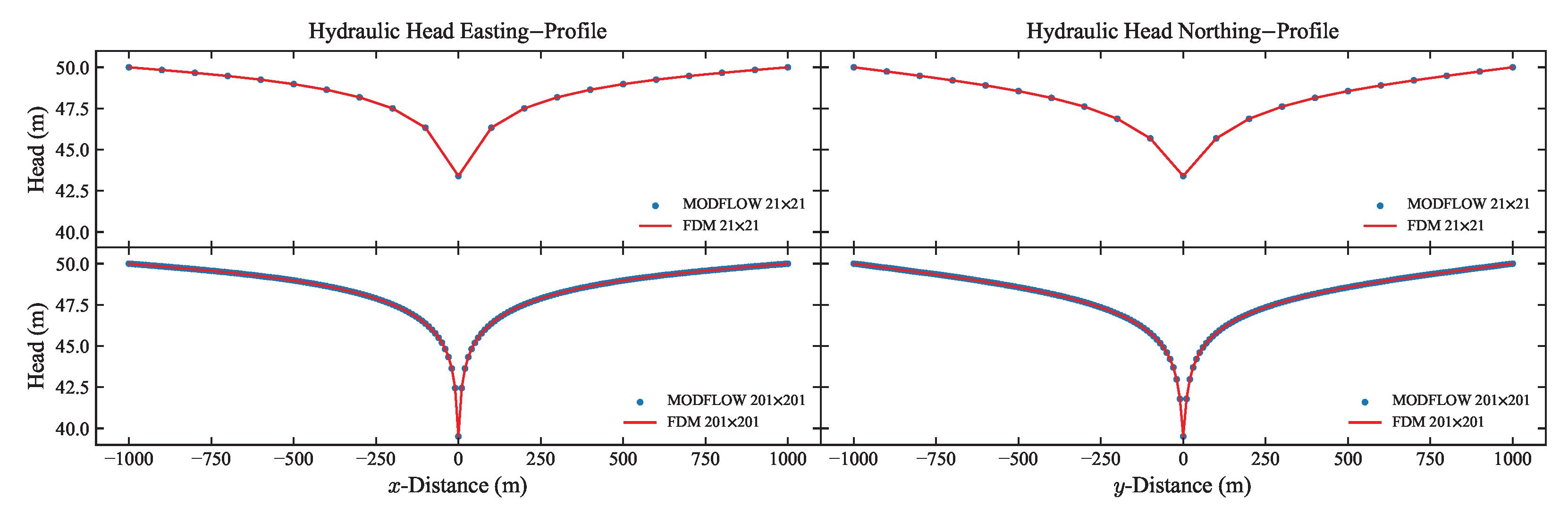
We present horizontal and vertical profiles of the head for the anisotropic case, using both lower- and higher-resolution simulations for a more detailed comparison. As shown in Figure 6, the results are indistinguishable. These profiles are not to be compared with pumping-test data, because they are for a steady-state regime and do not account for infinite boundaries [7]. We use the Root Mean Square Error (RMSE) to compare the numerical simulations, given as follows:
where is the head computed with MODFLOW and is the head computed with our implementation. For the homogeneous and isotropic example (Figure 5a,b), the RMSE value is m, whereas for anisotropic media (Figure 5d,e,g,h) the RMSE values are m and m for the and grids, respectively. These values are consistent with Figure 6.
Figure 6.
Vertical and horizontal profile of head results from Figure 5.
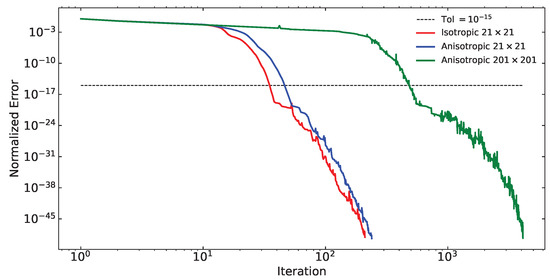
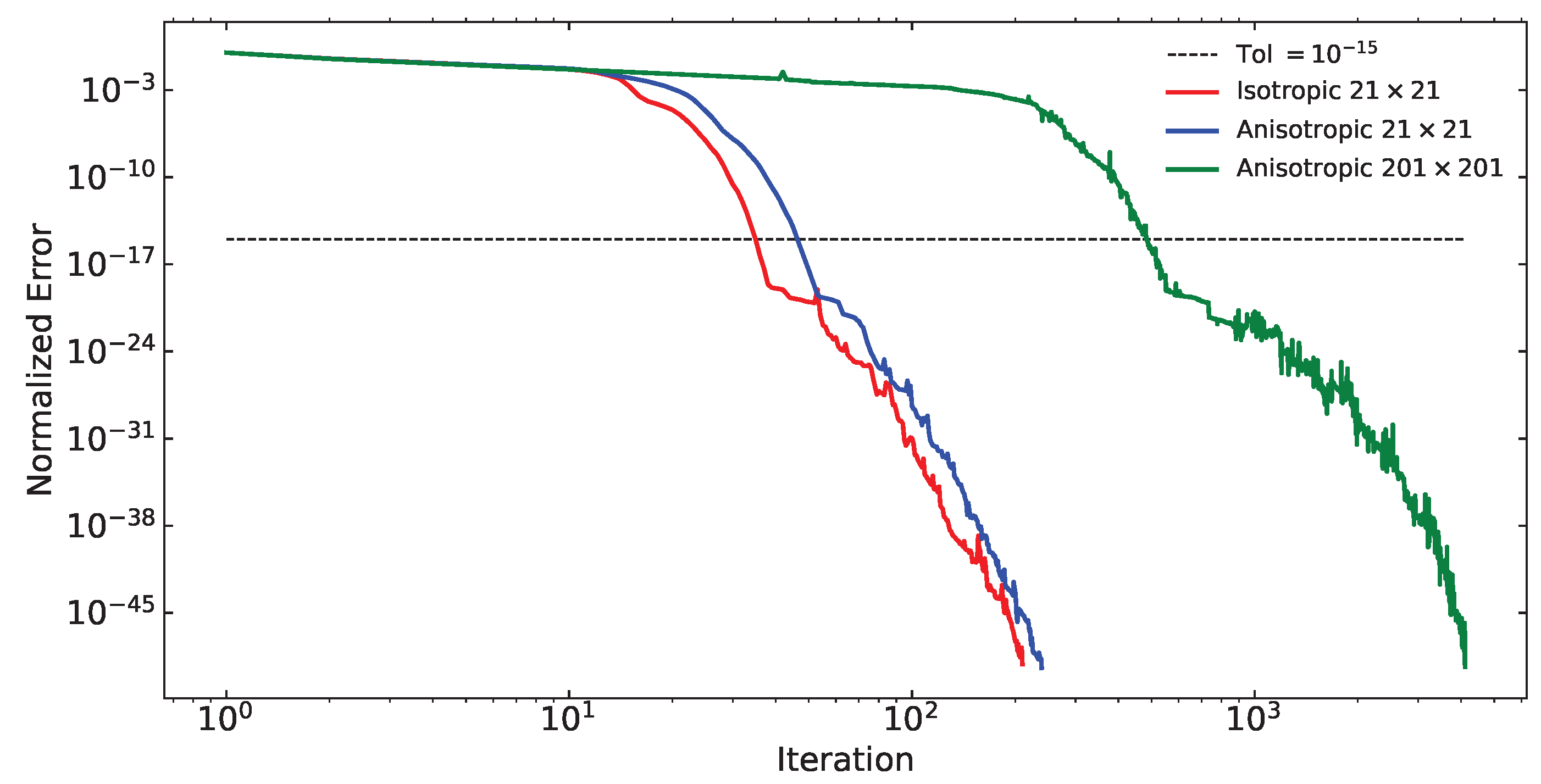
To evaluate the convergence of our scheme, we plot the FDM residuals for the isotropic and anisotropic media. To do this, we set a considerably low tolerance value (TOL ) to analyze its behavior over several iterations. The normalized error is shown in Figure 7. In all examples, the residual exhibited stable behavior across iterations, with similar curves. For the isotropic medium (red line), the tolerance value was reached after 210 iterations; for anisotropic with a grid (blue line), the tolerance was reached after 239 iterations; and for a grid, the convergence was slower, reaching the tolerance at 4017 iterations. If a tolerance TOL (black line) is chosen, the number of iterations for all examples would be 34, 46, and 486, respectively. This provides the basis for the tolerance value used in the aquifer simulations in the next section.
Figure 7.
Normalized error per iteration for isotropic (red) and anisotropic media for grids (blue) and (green). We plot a tolerance reference line (black) equal to .
4.2. Calera Aquifer Groundwater Modeling for Homogeneous Medium
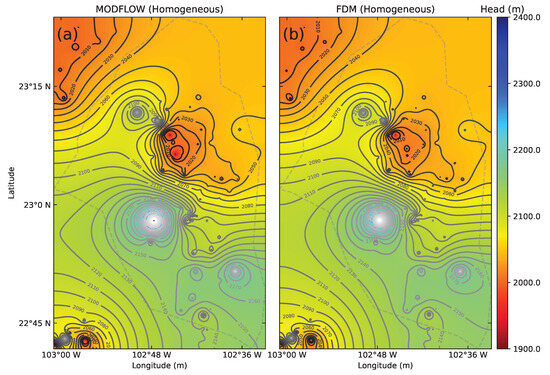
We performed steady-state groundwater modeling of the administrative aquifer in Calera, Zacatecas, Mexico (Figure 1), using the piezometric information from Figure 2 (Static Water Height) and a homogeneous hydraulic conductivity model with m/day. This consideration allows us to compare the experiment with MODFLOW, where homogeneous media are straightforward to implement. Mathematically and numerically, this setup is a Poisson problem; see Equation (2). We set the known piezometric data as the head-fixed value and applied no-flow boundary conditions on the boundaries in our code and in MODFLOW (using the CHD package).
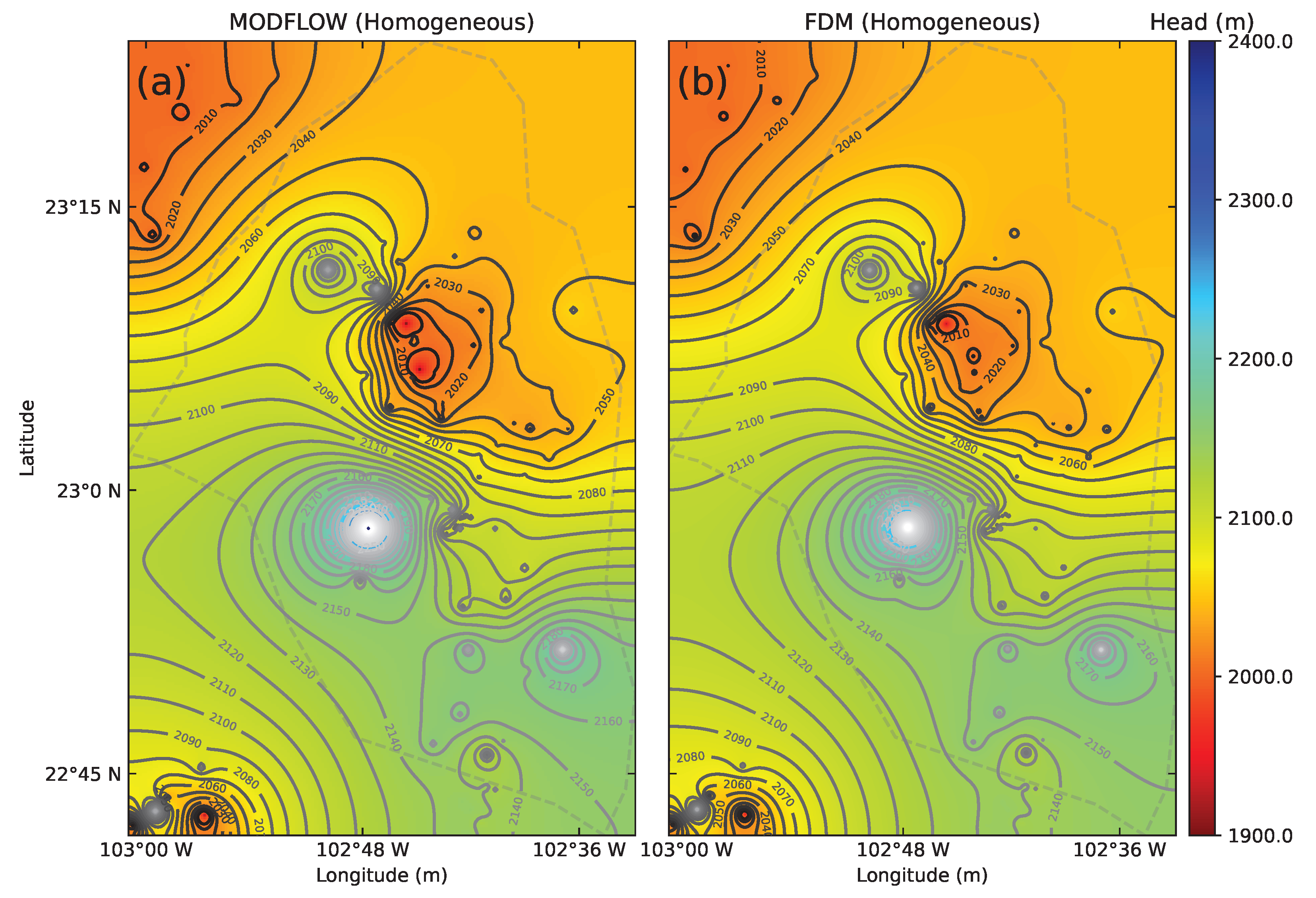
We present the groundwater results in Figure 8, using a uniform grid of . As in the previous experiment, the results are very similar for both methodologies, indicating flow from the center of the aquifer toward the northeast and southwest.
Figure 8.
Two-dimensional Groundwater simulation for homogeneous media using (a) MODFLOW and (b) our finite-differences implementation.
The flow towards NE (inner contour level of 2010 m) is due to the presence of the deepest water static levels in the region (around 2000 m). It is consistent with the topography and the gravity anomaly of Figure 3. The flow towards the southwestern part of the model is due to the interaction with the wells in that region (approximately at 22°45′ N and 103° W) for the contour levels 2130 m and outer 2100 m. The simulation results present the highest head value at 23° N and 102.48° W (approximately) on the aquifer, which will be interpreted in the following subsection. A RMSE value of m was obtained using Equation (6), which we consider acceptable under this criteria.
4.3. Calera Aquifer Modeling Heterogeneous Media
With the final calibration of our code, we proceeded to perform groundwater modeling for a heterogeneous medium, taking the hydraulic conductivity model of Figure 4b, based on Table 1. Changing the table values would not require changes to our implementation; hence, it can be easily modified for future work.
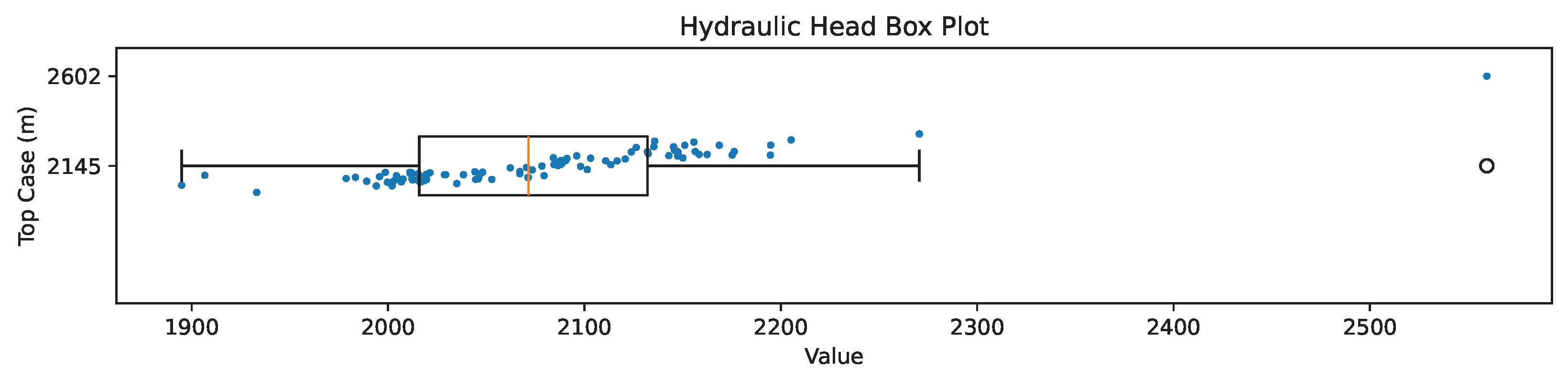
Before performing the numerical simulation, we note a head anomaly in the central region of the homogeneous result. This could be interpreted as a point source in the media, such as a recharge zone. However, this finding is inconsistent with the topography or with previous studies in the region [5,11]. For this reason, we perform an exploratory data analysis of the piezometric information using a box plot, as shown in Figure 9. The box plot presents a single outlier in the CONAGUA database. Since we cannot assess the veracity of this outlier (it could be measurement error or a spring well), we removed this datum from the piezometric database.
Figure 9.
Exploratory data analysis (Box plot) for the piezometric data (blue dots). The black circle represents the outlier.
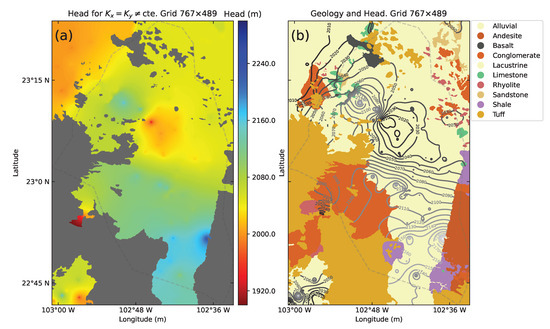
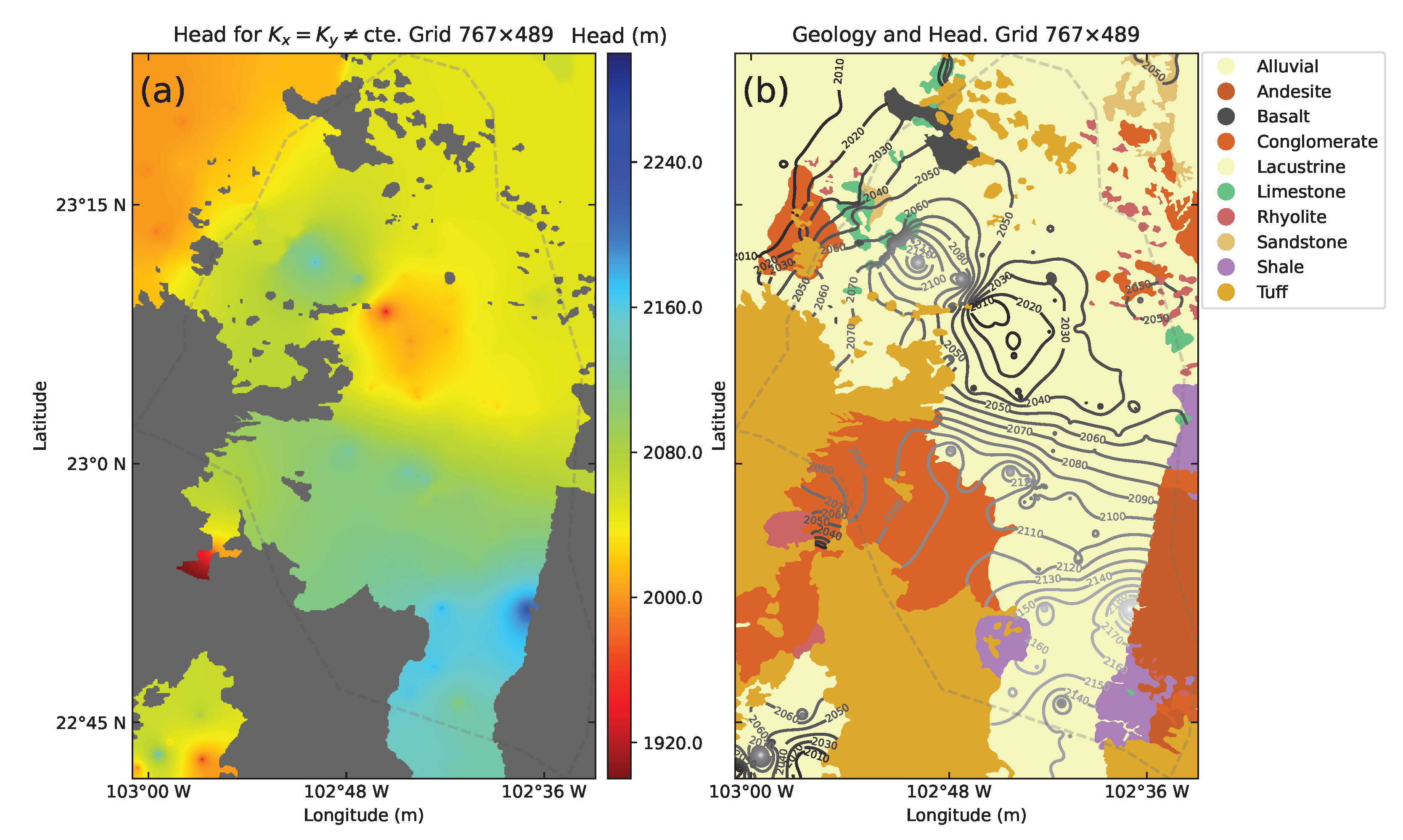
Then, we perform the modeling using our GIS-integrated code, as shown in the map in Figure 10a, for 2D heterogeneous media. To clarify, we do not set any cells to be inactive in our model; the simulation naturally shows inactive zones in the gray areas, where an umbral NaN is imposed for . This inactive area corresponds to regions with the lowest hydraulic conductivity values (Figure 4), which are associated with non-fractured igneous rocks and shale, especially in the southern part of the model.
Figure 10.
(a) Groundwater modeling on the administrative aquifer of Calera using our FDM implementation for heterogeneous media, and (b) Geology and head contours.
We consider this result the most important in our simulation, since geology provides natural limits for an aquifer, which should be necessary to define its administrative delimitation, but this is not always the case.
Hence, geology, through appropriate hydraulic-conductivity models, provides non-interaction zones where wells are separated by low h values, such as the region in the southwest part of the model, which is separated by tuff rocks. In this case, the numerical aquifer limit agrees with the administrative one, in combination with the low conductivity of the andesite rocks (southeast). These findings highlight the importance of using heterogeneous rather than homogeneous media in aquifer characterization, as the homogeneous simulation (Figure 8) shows groundwater interactions in zones where, in reality, there are none. On the other hand, in the northern part of the model, there is no numerical barrier in the simulation, which we interpret as a continuity of the geological aquifer outside the administrative aquifer of Calera.
With respect to the lowest contour values of head in the simulation, there is a drawdown zone in the north-center part of the domain, as mentioned in literature on the region and consistent with the mass deficit presented in the gravity anomaly of Figure 3b. This persistent result could support the hypothesis of Bredehoeft [6] that the aquifer is in an equilibrium state; however, z-component information is needed to ascertain this. A sensitivity analysis is presented in Appendix B to assess the importance of the hydrogeological parameters used in this work.
5. Conclusions
We developed an FDM groundwater modeling scheme to simulate flow in realistic aquifers. The FDM code was validated by comparing results with those of MODFLOW 6 for simple, homogeneous, and heterogeneous examples with different grid sizes. The scheme is integrated with GIS and provides a quick tool for creating hydraulic conductivity models based on surface outcropping geology, generating grid-sized, heterogeneous models tailored to simulation needs. The main goal of this work was to evaluate groundwater flow patterns in the Calera Aquifer. Using a homogeneous medium, numerical flow simulations can lead to an erroneous interpretation of groundwater movement in the subsoil, which is frequently the case in water-budget evaluations in this area by water-management organizations; namely, homogeneous, 1D, and full-horizontal flow are assumed. When heterogeneities are accounted for, the flows are more consistent with the geology and piezometry, yielding results similar to those from hydrogeochemical and hydraulic studies in the area. In low hydraulic zones, the simulations show numerical flow barriers corresponding to igneous rocks, consistent with the aquifer’s administrative boundary. On the other hand, in high hydraulic-conductivity zones, groundwater interactions are evident in piezometric data outside the aquifer’s administrative limits. We conclude that, geologically speaking, the aquifer does not align with the boundaries defined by the water organism, which considers only geopolitical factors. We recommend implementing our methodology to define these boundaries to better understand groundwater in the region and to use this vital resource more sustainably. Current limitations arise in the quality and availability of the piezometric data. There are no piezometers in the region, where hydrogeological vertical information is often missing. Although the code is written for 3D transient, anisotropic, and heterogeneous media, the limited data preclude running more realistic simulations. An important issue is the incorporation of faults and fractures into the model, which we leave to future work. It is also imperative to incorporate additional geophysical data to develop a 3D conceptual model and to perform groundwater modeling that accounts for the vertical component.
Author Contributions
R.U.S.-A. developed and tested the GIS integrated algorithm, remodeled and validated according to comments by H.E.J.-F., who also helped in the composition of the paper. J.G.-T. conceived the problem of groundwater management in the region. J.D.D.B. contributed to the discussions on the Finite Difference implementation and the writing of the manuscript. L.G.O.-A. provided the satellite gravity data in the region, including the processing and the discussions related to the topic. All authors have read and agreed to the published version of the manuscript.
Funding
SECIHTI under the project Fordecyt F003 FOP18- 2025-7 “Fortalecimiento de la infraestructura para la gestión y preservación de datos científicos en México”.
Data Availability Statement
The original contributions presented in this study are included in the article. Further inquiries can be directed to the corresponding authors.
Conflicts of Interest
The authors declare no conflicts of interest.
Abbreviations
The following abbreviations are used in this manuscript:
| MODFLOW | Modular hydrologic flow model |
| FDM | Finite Difference Method |
| DEM | Digital Elevation Model |
| GIS | Geographic Information System |
| CONAGUA | Mexican National Water Commission |
| SWL | Static Water Level |
| SWE | Static Water Elevation |
Appendix A. The Finite Difference Method
In this appendix, we describe our Finite Difference implementation for a general 3D groundwater flow problem in a heterogeneous, anisotropic medium, in steady state. First, we expand the derivatives in Equation (2) as follows:
renaming and , and similarly for x, y, and z, we get
Now, we applied the centered discretization following Spitzer [34], using
where is the grid spacing for the direction. The FD expression for y and z can be easily applied using or for j- or k-indexes, respectively. Equation (A3) is also applied to the derivatives , , and from above. Thus, Equation (A1) is rewritten as
Arranging the seven h-terms and applying the FDM to the time derivative, i.e., an implicit formulation, this leads to
where is the previous hydraulic head field, is the time step and is the source term for each t-time. Renaming the coefficients which multiply the h-terms,
where the letters in the stencil stand for Left, Right, Back, Front, Down, Up, and Center, respectively. Thus
and
This discretization results in a system of equations to be solved in the form
and we use Biconjugate Gradient Stabilized Method (BiCGSTAB) [25] for the non-symmetrical solution of Equation (A8), combined with large-sparse system storage.
Appendix B. Sensitivity Analysis
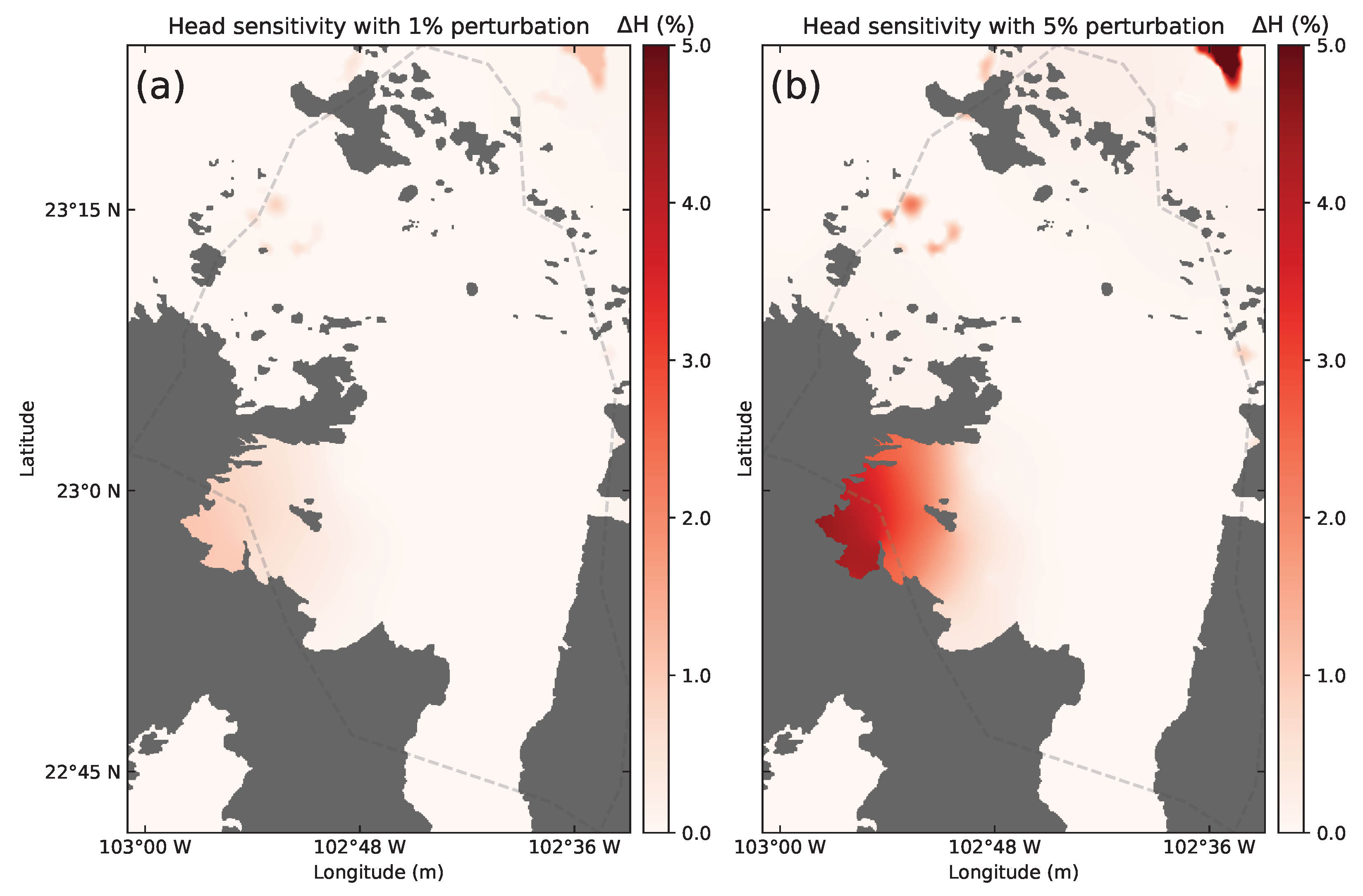
To assess the significance of the hydraulic conductivity, we performed a sensitivity analysis to evaluate how the head changes when the conductivity is perturbed. Since the values are in logarithmic scale, it is not feasible to perform a uniform perturbation; for example, adding a perturbation of will disproportionally perturb the low conductivity values up to 7 orders of magnitude (Figure 4), making the model practically homogeneous. For this reason, and due to the geological media where all the well data is located, we only perturbed the alluvial hydraulic conductivity zone as follows:
where is a percentage perturbation for the hydraulic conductivity and . We added perturbations of 1% and 5%, evaluating errors in the head for each grid point with the following expression:
where is the head simulation obtained by perturbing the hydraulic conductivity. The sensitivity analysis with these perturbations is shown in Figure A1. The maps show errors in the head, consistent with each percentage of conductivity perturbed.
Figure A1.
Hydraulic head percentage error varying the hydraulic conductivity (K) by 1% (a) and 5% (b) in the Calera aquifer (Black-dashed line).
References
- Giordano, M. Global groundwater? Issues and solutions. Annu. Rev. Environ. Resour. 2009, 34, 153–178. [Google Scholar] [CrossRef] [Scilit]
- Igor, S. World fresh water resources. In Water in Crisis: A Guide to the World’s; Oxford University Press, Inc.: Oxford, UK, 1993. [Google Scholar] [CrossRef] [Scilit]
- Sophocleous, M. Global and regional water availability and demand: Prospects for the future. Nat. Resour. Res. 2004, 13, 61–75. [Google Scholar] [CrossRef] [Scilit]
- Kinzelbach, W.; Bauer, P.; Siegfried, T.; Brunner, P. Sustainable groundwater management—Problems and scientific tools. Episodes J. Int. Geosci. 2003, 26, 279–284. [Google Scholar] [CrossRef] [Scilit] [PubMed]
- Navarro-Solis, O.; González Trinidad, J.; Junez-Ferreira, H.; Cardona, A.; Bautista Capetillo, C. Integrative methodology for the identification of groundwater flow patterns: Application in a semi-arid region of Mexico. Appl. Ecol. Environ. Res. 2016, 14, 645–666. [Google Scholar] [CrossRef] [Scilit]
- Bredehoeft, J.D. The Water Budget Myth Revisited: Why Hydrogeologists Model. Groundwater 2002, 40, 340–345. [Google Scholar] [CrossRef] [Scilit]
- Theis, C.V. The relation between the lowering of the Piezometric surface and the rate and duration of discharge of a well using ground-water storage. Eos Trans. Am. Geophys. Union 1935, 16, 519–524. [Google Scholar] [CrossRef] [Scilit]
- Navarro, O.; González, J.; Júnez-Ferreira, H.; Bautista, C.F.; Cardona, A. Correlation of arsenic and fluoride in the groundwater for human consumption in a semiarid region of Mexico. Procedia Eng. 2017, 186, 333–340. [Google Scholar] [CrossRef] [Scilit]
- Carrillo-Martinez, C.J.; Álvarez-Fuentes, G.; Aguilar-Benitez, G.; Can-Chulím, Á.; Pinedo-Escobar, J.A. Water quality for agricultural irrigation in the Calera aquifer region in Zacatecas, Mexico. Tecnol. Cienc. Agua 2021, 12, 1–58. [Google Scholar]
- Rivera Armendariz, C.A.; Banning, A.; Cardona Benavides, A. Geochemical evolution along regional groundwater flow in a semi-arid closed basin using a multi-tracing approach. J. Hydrol. 2024, 632, 130895. [Google Scholar] [CrossRef] [Scilit]
- González-Trinidad, J.; Pacheco-Guerrero, A.; Júnez-Ferreira, H.; Bautista-Capetillo, C.; Hernández-Antonio, A. Identifying groundwater recharge sites through environmental stable isotopes in an alluvial aquifer. Water 2017, 9, 569. [Google Scholar] [CrossRef] [Scilit]
- Garbrecht, J.; Mojarro, F.; Echavarria-Chairez, F.; Bautista-Capetillo, C.; Brauer, D.; Steiner, J. Sustainable utilization of the Calera aquifer, Zacatecas, Mexico. Appl. Eng. Agric. 2013, 29, 67–75. [Google Scholar] [CrossRef] [Scilit]
- Hernández, J.E.; Gowda, P.H.; Howell, T.A.; Steiner, J.L.; Mojarro, F.; Núñez, E.P.; Avila, J.R. Modeling Groundwater levels on the Calera aquifer region in central Mexico using ModFlow. J. Agric. Sci. Technol. B 2012, 2, 52–61. [Google Scholar]
- Krienen, L.; Cardona Benavides, A.; Lopez Loera, H.; Rüde, T.R. Understanding Deep Groundwater Flow Systems to Contribute to a Sustainable Use of the Water Resource in the Mexican Altiplano; Technical report; Lehr-und Forschungsgebiet Hydrogeologie: Aachen, Germany, 2019. [Google Scholar] [CrossRef]
- Centeno-García, E.; Guerrero-Suastegui, M.; Talavera-Mendoza, O. The Guerrero Composite Terrane of Western Mexico: Collision and Subsequent Rifting in a Supra-Subduction Zone; Geological Society of America: Boulder, CO, USA, 2008; Volume 436, pp. 279–308. [Google Scholar] [CrossRef] [Scilit]
- De Cserna, Z. Geology of the Fresnillo area, Zacatecas, Mexico. Geol. Soc. Am. Bull. 1976, 87, 1191–1199. [Google Scholar] [CrossRef] [Scilit]
- Bartolini, C.; Lang, H.; Cantú Chapa, A.; Barboza-Gudiño, R. The Triassic Zacatecas Formation in Central Mexico: Paleotectonic, paleogeo- graphic and paleobiogeographic implications. AAPG Mem. 2001, 75, 295–315. [Google Scholar] [CrossRef] [Scilit]
- Crippen, R.; Buckley, S.; Agram, P.; Belz, E.; Gurrola, E.; Hensley, S.; Kobrick, M.; Lavalle, M.; Martin, J.; Neumann, M.; et al. NASADEM global elevation model: Methods and progress. Int. Arch. Photogramm. Remote Sens. Spat. Inf. Sci. 2016, 41, 125–128. [Google Scholar] [CrossRef] [Scilit]
- Sandwell, D.T.; Müller, R.D.; Smith, W.H.; Garcia, E.; Francis, R. New global marine gravity model from CryoSat-2 and Jason-1 reveals buried tectonic structure. Science 2014, 346, 65–67. [Google Scholar] [CrossRef] [Scilit]
- Anderson, M.P.; Woessner, W.W.; Hunt, R.J. Applied Groundwater Modeling: Simulation of Flow and Advective Transport; Academic Press: Cambridge, MA, USA, 2015. [Google Scholar] [CrossRef] [Scilit]
- Harbaugh, A.W. MODFLOW-2005, the US Geological Survey Modular Ground-Water Model: The Ground-Water Flow Process; US Department of the Interior, US Geological Survey: Reston, VA, USA, 2005; 6. [CrossRef] [Scilit]
- Diersch, H.J.G. FEFLOW: Finite Element Modeling of Flow, Mass and Heat Transport in Porous and Fractured Media; Springer Science & Business Media: Berlin/Heidelberg, Germany, 2013. [Google Scholar] [CrossRef] [Scilit]
- Jenny, P.; Lee, S.; Tchelepi, H.A. Multi-scale finite-volume method for elliptic problems in subsurface flow simulation. J. Comput. Phys. 2003, 187, 47–67. [Google Scholar] [CrossRef] [Scilit]
- Asher, M.J.; Croke, B.F.W.; Jakeman, A.J.; Peeters, L.J.M. A review of surrogate models and their application to groundwater modeling. Water Resour. Res. 2015, 51, 5957–5973. [Google Scholar] [CrossRef] [Scilit]
- Van der Vorst, H.A. Bi-CGSTAB: A Fast and Smoothly Converging Variant of Bi-CG for the Solution of Nonsymmetric Linear Systems. SIAM J. Sci. Stat. Comput. 1992, 13, 631–644. [Google Scholar] [CrossRef] [Scilit]
- Dou, C.; Woldt, W.; Bogardi, I.; Dahab, M. Steady state groundwater flow simulation with imprecise parameters. Water Resour. Res. 1995, 31, 2709–2719. [Google Scholar] [CrossRef] [Scilit]
- Jordahl, K.; den Bossche, J.V.; Fleischmann, M.; Wasserman, J.; McBride, J.; Gerard, J.; Tratner, J.; Perry, M.; Badaracco, A.G.; Farmer, C.; et al. geopandas/geopandas: v0.8.1. 2020. Available online: https://zenodo.org/records/3946761 (accessed on 8 November 2025).
- Pulla, S.T.; Yasarer, H.; Yarbrough, L.D. GRACE downscaler: A framework to develop and evaluate downscaling models for GRACE. Remote Sens. 2023, 15, 2247. [Google Scholar] [CrossRef] [Scilit]
- Bear, J. Dynamics of Fluids in Porous Media; Courier Corporation: North Chelmsford, MA, USA, 2013. [Google Scholar] [CrossRef] [Scilit]
- Poeter, E.P.; Hill, M.C. Inverse models: A necessary next step in ground-water modeling. Groundwater 1997, 35, 250–260. [Google Scholar] [CrossRef] [Scilit]
- Hughes, J.D.; Langevin, C.D.; Banta, E.R. Documentation for the MODFLOW 6 Framework; Technical report; US Geological Survey: Reston, VA, USA, 2017. [CrossRef] [Scilit]
- Langevin, C.D.; Hughes, J.D.; Banta, E.R.; Niswonger, R.G.; Panday, S.; Provost, A.M. Documentation for the MODFLOW 6 Groundwater Flow Model; Technical report; US Geological Survey: Reston, VA, USA, 2017. [CrossRef] [Scilit]
- Freeze, R.A.; Cherry, J.A. Groundwater; Prentice-Hall: Englewood Cliffs, NJ, USA, 1979; Volume 176, pp. 161–177. Available online: https://gw-project.org/books/groundwater/ (accessed on 17 December 2025).
- Spitzer, K. A 3-D finite-difference algorithm for DC resistivity modelling using conjugate gradient methods. Geophys. J. Int. 1995, 123, 903–914. [Google Scholar] [CrossRef] [Scilit]

Disclaimer/Publisher’s Note: The statements, opinions and data contained in all publications are solely those of the individual author(s) and contributor(s) and not of MDPI and/or the editor(s). MDPI and/or the editor(s) disclaim responsibility for any injury to people or property resulting from any ideas, methods, instructions or products referred to in the content. |
© 2025 by the authors. Licensee MDPI, Basel, Switzerland. This article is an open access article distributed under the terms and conditions of the Creative Commons Attribution (CC BY) license.