Article

Hydroxylamine-Assisted Reactivation of Salinity-Inhibited Partial Denitrification/Anammox Systems: Performance Recovery, Functional Microbial Shifts, and Mechanistic Insights

1
Chongqing Research Institute, Beijing University of Technology, Chongqing 401121, China
2
College of Architecture and Civil Engineering, Beijing University of Technology, Beijing 100124, China
3
China Irrigation and Drainage Development Centre, Beijing 100054, China
4
National Engineering Laboratory for Advanced Municipal Wastewater Treatment and Reuse Technology, Beijing University of Technology, Beijing 100124, China
*
Author to whom correspondence should be addressed.
Water 2026, 18(1), 111; https://doi.org/10.3390/w18010111
Submission received: 8 December 2025 / Revised: 24 December 2025 / Accepted: 31 December 2025 / Published: 2 January 2026
(This article belongs to the Section Wastewater Treatment and Reuse)

Abstract

Salinity shock severely impairs the partial denitrification/anammox (PD/A) process, leading to prolonged functional deterioration and slow reactivation of anaerobic ammonium-oxidizing bacteria (anammox). To develop an effective strategy for mitigating salinity-induced inhibition, this study systematically examined the role of exogenous hydroxylamine (NH2OH) in accelerating PD/A recovery using short-term batch assays and long-term reactor operation. Hydroxylamine exhibited a clear concentration-dependent effect on system reactivation. In batch tests, low-dose hydroxylamine (10 mg/L) markedly enhanced anammox activity, increasing the ammonium oxidation rate to 5.5 mg N/(g VSS·h), representing a 42.5% increase, indicating its potential to stimulate key nitrogen-transforming pathways following salinity stress. During continuous operation, hydroxylamine at 5 mg/L proved optimal for restoring reactor performance, achieving stable nitrogen removal with 87% NH4+-N removal efficiency. The nitrite transformation ratio (NTR) reached approximately 80% within 13 cycles, 46 cycles ahead of the control, while simultaneously promoting the enrichment of key functional microbial taxa, including Thauera and Candidatus Brocadia. Hydroxylamine addition also triggered the production of tyrosine- and tryptophan-like proteins within extracellular polymeric substances, which enhanced protective and metabolic functionality during recovery. In contrast, a higher hydroxylamine dosage (10 mg/L) resulted in persistent NO2-N accumulation, substantial suppression of Candidatus Brocadia (declining from 0.67% to 0.09%), and impaired system stability, highlighting a dose-sensitive threshold between stimulation and inhibition. Overall, this study demonstrates that controlled low-level hydroxylamine supplementation can effectively reactivate salinity-inhibited PD/A systems by enhancing nitrogen conversion, reshaping functional microbial communities, and reinforcing stress-response mechanisms. These findings provide mechanistic insight and practical guidance for improving the resilience and engineering application of PD/A processes treating saline wastewater.

1. Introduction

The partial denitrification/anammox (PD/A) process has emerged as a promising technology for the treatment of ammonium- and nitrate-containing wastewater, owing to its intrinsic advantages, including low external organic carbon demand, minimal sludge production, and energy-efficient nitrogen removal without aeration [1,2,3]. Anaerobic ammonium-oxidizing bacteria (anammox) play a central role in this process, as their metabolic activity ultimately governs nitrogen conversion efficiency and system stability. However, anammox bacteria are highly sensitive to environmental perturbations, particularly salinity stress. With the increasing discharge of saline industrial effluents and the widespread adoption of seawater flushing practices, elevated salinity has become a growing challenge for both municipal and industrial wastewater treatment systems [4,5].
High salinity imposes severe osmotic stress on microbial cells, disrupting membrane integrity, inhibiting key enzymatic reactions, and significantly suppressing microbial growth and metabolic activity [6,7,8]. Anammox bacteria are particularly vulnerable to such stress, often resulting in sharp declines in nitrogen removal performance and, in extreme cases, complete process failure [9,10]. More critically, once inhibited, anammox-based systems exhibit notoriously slow natural recovery, frequently requiring weeks to months to regain stable performance [11,12]. This prolonged recovery severely limits the operational reliability and large-scale engineering application of PD/A processes for saline wastewater treatment. Consequently, the development of rapid and effective strategies to restore anammox activity following salinity shock is essential for enhancing process resilience.
Various recovery strategies have been explored for salinity-inhibited anammox systems [13], including sludge washing with buffering agents or EDTA in batch experiments, as well as reactor restart and bioaugmentation during long-term operation [14]. However, many of these approaches are operationally complex, lack sustained effectiveness, or provide limited mechanistic support for functional recovery. In recent years, the targeted use of metabolic intermediates to selectively activate key nitrogen-transforming pathways has attracted increasing attention as a potentially more efficient and robust recovery strategy [13].
Hydroxylamine (NH2OH), a critical intermediate in the anammox metabolic network, plays an essential role in nitrogen transformation and electron transfer within anammox bacteria [15,16]. Previous studies have shown that the addition of hydroxylamine can stimulate anammox activity, stabilize nitrite (NO2) supply, and accelerate nitrogen conversion rates [17,18,19]. Appropriate hydroxylamine dosing has been shown to shorten reactor start-up time and partially restore the performance of inhibited anammox systems, facilitating recovery from diverse stressors, including substrate inhibition, heavy metals, salinity/alkalinity, and antibiotics [20,21,22,23]. These beneficial effects are commonly attributed to hydroxylamine’s direct involvement in anammox metabolic pathways and its selective stimulation of key functional microbial populations. In parallel, hydroxylamine has also been reported to promote the growth of denitrifiers, accelerate partial denitrification start-up, enhance nitrite accumulation, and ultimately improve overall nitrogen removal efficiency [24].
Therefore, while it is reasonable to infer that the exogenous addition of hydroxylamine would be beneficial for simultaneously enhancing the metabolic activity of functional bacteria within the PD/A system, its transition to practical engineering applications still requires careful evaluation of feasibility and safety. Key challenges include the unpredictability of the dose–response relationship, increased operational costs due to chemical consumption and loss, and the risk of exacerbating greenhouse gas emissions such as N2O [19].
Despite these promising findings, the application of hydroxylamine in the more complex PD/A system remains largely unexplored, particularly under salinity-induced inhibition. Unlike single anammox systems, the PD/A process relies on tightly coupled interactions between denitrifiers and anammox, and hydroxylamine may therefore affect not only nitrogen transformation pathways but also microbial community structure, interspecies electron transfer, and extracellular polymeric substance (EPS) metabolism. Consequently, the optimal hydroxylamine dosage, its long-term effectiveness, and the mechanisms governing the recovery of salinity-inhibited PD/A systems remain poorly understood and warrant systematic investigation.
To address these knowledge gaps, this study investigated PD/A sludge subjected to prolonged inhibition under high salinity (10 g/L) and extended low-temperature storage. By integrating short-term batch assays with long-term reactor operation, this work aimed to: (i) assess the immediate stimulatory effects of hydroxylamine on nitrogen transformation following salinity inhibition; (ii) elucidate the recovery dynamics of PD/A performance under different hydroxylamine dosages during continuous operation; and (iii) clarify the mechanistic basis of hydroxylamine-assisted recovery, with particular emphasis on functional microbial shifts and EPS-mediated stress responses. The findings provide both mechanistic insight and practical guidance for improving the resilience and engineering applicability of PD/A processes in saline wastewater treatment systems.

2. Materials and Methods

2.1. Wastewater Characteristics and Seeding Sludge

The seeding sludge was obtained from a previously operated PD/A system that had experienced long-term inhibition under high salinity (10 g/L NaCl) and was subsequently stored at 4 °C for more than 100 days [25]. The sludge therefore represented salinity-stressed and metabolically suppressed biomass, enabling a direct assessment of hydroxylamine-assisted reactivation. After homogenisation, the initial mixed liquor suspended solids (MLSS) concentration was approximately 9.33 g/L.
Synthetic wastewater was used throughout all experiments to ensure stable and reproducible influent characteristics. Sodium nitrate (NaNO3, 120 mg NO3-N/L) and ammonium chloride (NH4Cl, 100 mg NH4+-N/L) were supplied to support partial denitrification and anammox reactions. Sodium acetate (CH3COONa) was added as the sole external carbon source at 300 mg COD/L to maintain consistent denitrification performance. Essential macronutrients and trace elements were supplemented according to standard anammox cultivation protocols, with detailed compositions provided in Table 1.

2.2. Reactor Configuration and Operational Strategy

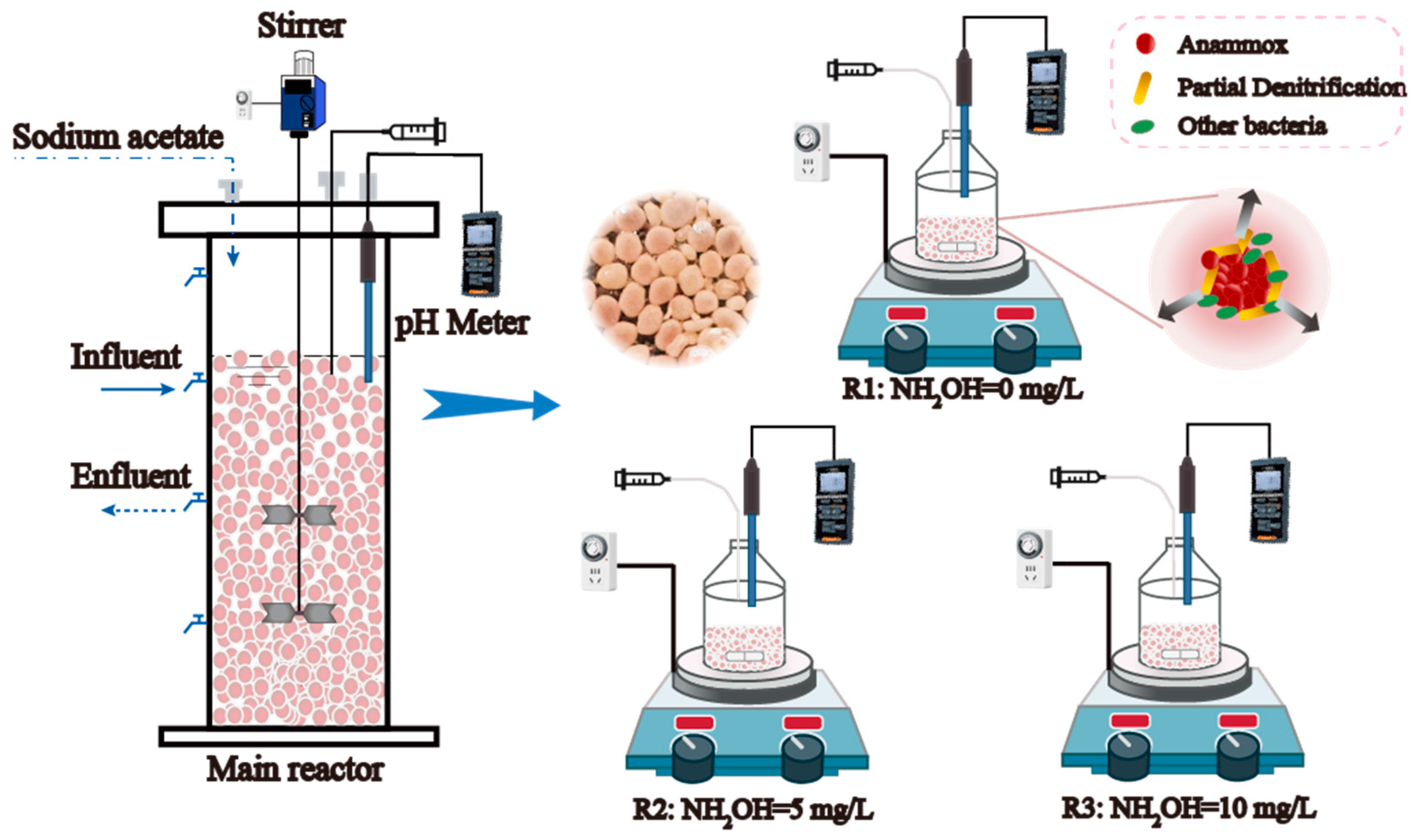
Three identical sequencing batch reactors (SBRs; effective volume: 1.0 L) were established to evaluate the effect of hydroxylamine on the recovery of salinity-inhibited PD/A systems. The reactors were designated as follows: R1: control without hydroxylamine addition; R2: dosing of 5 mg/L hydroxylamine, and R3: dosing of 10 mg/L hydroxylamine (see Figure 1 for the schematic diagram of the SBR setup).
The experiment was conducted at 25 ± 3 °C for 60 days. Each SBR performed two 6 h cycles per day, resulting in a total of 120 cycles. Each cycle consisted of the following sequential phases: influent feeding (200 mL), carbon source addition (manually injected using a micropipette), anaerobic reaction, settling (30 min), and effluent withdrawal (600 mL, resulting in a 60% exchange ratio per cycle). Throughout the operation, all reactors were continuously mixed using magnetic stirrers (300–400 rpm) to maintain homogeneity. To ensure strict anaerobic conditions, the headspace of each reactor was purged with nitrogen gas for 5 min at the beginning of every cycle and then sealed. At the end of each cycle, the supernatant was carefully decanted as effluent.
Effluent nitrogen species, COD, and pH were monitored throughout the operation to assess performance recovery. At the end of the operational period, sludge samples were collected from all reactors for extracellular polymeric substance (EPS) extraction and microbial community analysis.

2.3. In Situ Microbial Activity Assays

To evaluate the immediate metabolic response of salinity-inhibited sludge to hydroxylamine, in situ batch activity assays were conducted under strictly anaerobic and well-mixed conditions. Control sludge undergoing natural recovery was monitored over 180 min, with samples collected at 0, 5, 10, 20, 30, 45, 60, 90, 120, and 180 min. For hydroxylamine-amended sludge (5 and 10 mg/L), assays were extended to 360 min, with sampling at 0, 5, 10, 20, 30, 60, 120, 180, 240, 300, and 360 min.
Samples were filtered through 0.45 µm membranes, and NH4+-N, NO3-N, NO2-N, and COD concentrations were quantified. Nitrate reduction (rNO3), nitrite accumulation (rNO2), and anammox activity (rNH4) were calculated using established stoichiometric relationships:
r N O 3 = S N O 3 , i n     S N O 3 , t + 0.26 S N H 4 , i n     S N H 4 , t V S S · t = r N O 3 , o b s   +   0.26 r N H 4
r N O 2 = S N O 2 , t S N O 2 , i n + 1.32 S N H 4 , i n S N H 4 , t V S S · t = r N O 2 , o b s + 1.32 r N H 4
where the SNO3,in and SNO2,in was referred to the initial NO3-N and NO2-N concentration in a reaction cycle; SNO3,t and SNO2,t was referred to the NO3-N and NO2-N concentration at reaction time t. The NO2-N accumulation point time was used for these calculations in the present study.
The nitrate-to-nitrite transformation ratio (NTR) was calculated as:
N T R = r N O 2 r N O 3
The anammox activity (rNH4) was determined by:
r N H 4 = S N H 4 , i n     S N H 4 , t V S S · t
where the SNH4,in was referred to the initial NH4+-N concentration in the reaction cycle; SNH4,t was referred to the NH4+-N concentration at reaction time t.
All batch activity assays were conducted in duplicate. The mean values of the calculated rates (rNO3, rNO2, rNH4) and ratios (NTR) are reported in the results, with error bars in the corresponding figures representing the standard deviation (SD) between parallel runs. Statistical comparisons of key performance indicators (e.g., rNH4, NTR) between different treatment groups (Control, 5 mg/L NH2OH, 10 mg/L NH2OH) at specific time points were performed using Student’s t-test, with a significance level set at p < 0.05. The stoichiometric coefficients in Equations 1 and 2 (0.26 and 1.32) are based on standard anammox stoichiometry. While salinity and hydroxylamine could theoretically alter metabolic fluxes, this established calculation framework has been consistently applied in prior studies of PD/A systems under similar stress conditions, ensuring comparability [25,26].

2.4. EPS Extraction and Fluorescence Characterisation

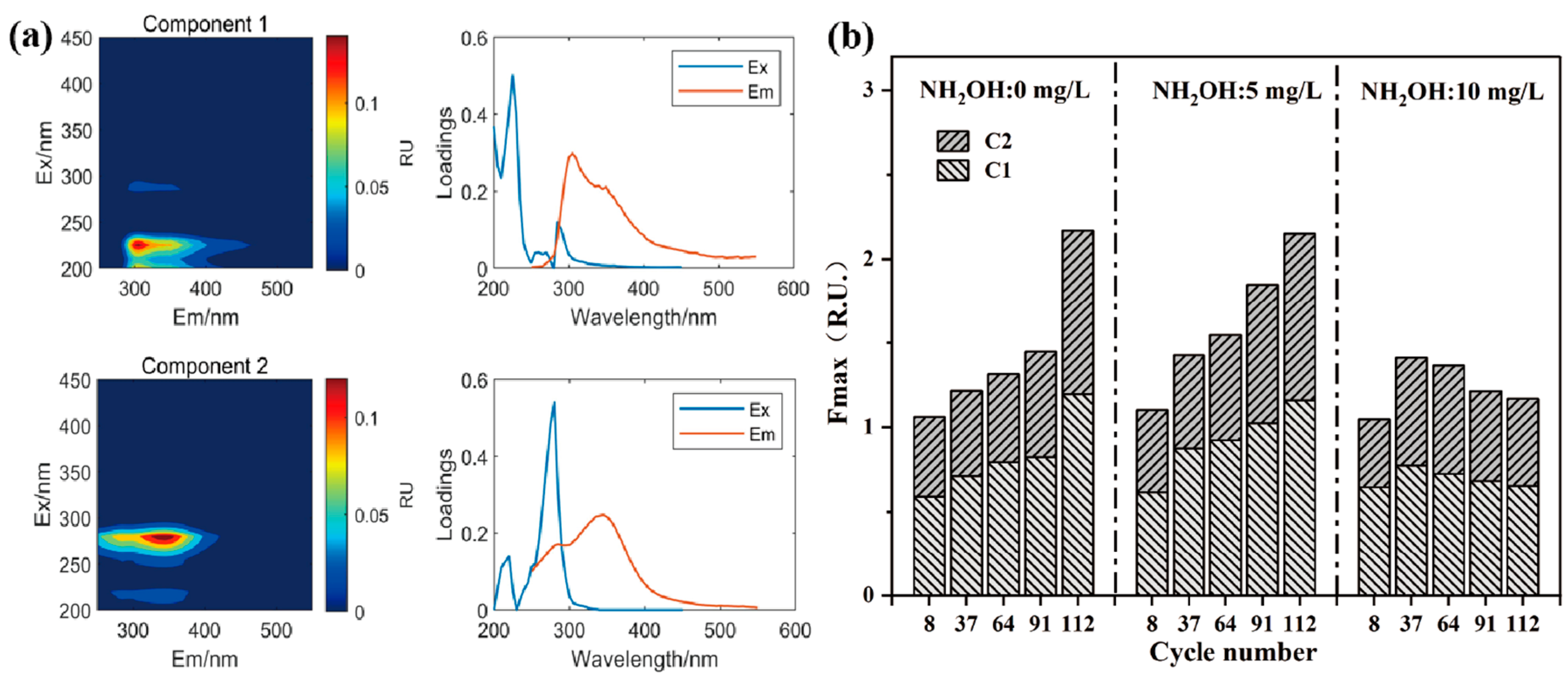
EPS were extracted from sludge samples using a modified thermal extraction method optimized for PD/A biomass. The extracted EPS were characterized using three-dimensional excitation–emission matrix (3D-EEM) fluorescence spectroscopy, followed by parallel factor analysis (PARAFAC) to resolve distinct fluorophore components [27]. Prior to modelling, Raman and Rayleigh scattering were removed by subtracting Milli-Q water blanks, and all spectra were normalised to Raman units to ensure comparability across samples [28]. The optimal PARAFAC model was selected based on split-half validation and minimisation of residual error. Fluorophore components were identified using the OpenFluor database, with particular emphasis on protein-like substances associated with stress mitigation, such as tyrosine- and tryptophan-like proteins. Changes in maximum fluorescence intensity (Fmax) were used to quantify EPS compositional shifts induced by hydroxylamine addition.

2.5. Chemical Analyses

The concentrations of NH4+-N, NO3-N, and NO2-N were analysed following Standard Methods [29]. COD was measured using a Lianhua LH-3BA rapid analyser (Lianhua Technology Co., Ltd., Beijing, China), with COD contributions from NO2-N corrected using a factor of 1.14 g COD/g NO2-N. pH and temperature were monitored using a WTW Multi 3620 m equipped with pH/Oxi 340i sensors (WTW, Weilheim, Germany).
Mixed liquor suspended solids (MLSS) and volatile suspended solids (MLVSS) were determined using gravimetric analysis. Briefly, 5 mL of sludge was filtered through pre-weighed 0.45 µm GF/C filters, dried at 105 °C for 4 h for MLSS determination, and combusted at 550 °C for 2 h for MLVSS. All measurements were performed in triplicate, maintaining a relative standard deviation below 5%.

2.6. Microbial Community Analysis

To elucidate the microbial response to long-term hydroxylamine dosing, genomic DNA was extracted from freeze-dried sludge samples using the FastDNA® Spin Kit for Soil (MP Biomedicals, Santa Ana, CA, USA). DNA purity and concentration were assessed using a NanoDrop® ND-1000 spectrophotometer (Thermo Fisher Scientific, Cambridge, MA, USA).
The V3–V4 region of the 16S rRNA gene was amplified using primers 338F and 806R, and sequencing was performed on an Illumina MiSeq platform. Raw reads underwent stringent quality control, merging, chimaera removal, and operational taxonomic unit (OTU) clustering at 97% similarity.
The V3–V4 region of the 16S rRNA gene was amplified using primers 338F and 806R, and sequenced on an Illumina MiSeq platform. Raw reads were processed through stringent quality control, merging, and chimera removal, followed by operational taxonomic unit (OTU) clustering at a 97% similarity threshold. Although amplicon sequence variant (ASV) methods are increasingly prevalent, the OTU-based approach remains a widely recognized and comparable standard in microbial ecology, facilitating direct comparison of our findings with a large body of published literature [6,30]. Alpha diversity indices (Chao1, Shannon) and taxonomic profiles at the phylum and genus levels were generated using the Majorbio Cloud Platform (https://cloud.majorbio.com, accessed on 5 December 2025). The analyses focused on functional groups relevant to PD/A, including Thauera, Candidatus Brocadia, and other denitrifiers or anammox-associated taxa.

3. Results and Discussion

3.1. Effects of Hydroxylamine Exposure on Microbial Activities of Salinity-Inhibited PD/A Biomass

Prior to evaluating hydroxylamine-assisted reactivation, the PD/A sludge was subjected to three consecutive salinity shocks using 10 g/L NaCl to induce a clearly inhibited state. This concentration is representative of saline wastewater, which is commonly defined at salinities below 10 g/L and is frequently encountered in coastal municipal systems (e.g., seawater toilet flushing) and various industries [31,32,33]. The influent contained 60 mg N /L each for NH4+-N and NO3-N. Each salinity shock lasted for one reaction cycle (3 h of anaerobic mixing), during which effluent nitrogen species were monitored to track the progression of functional deterioration.
As shown in Figure 2a, effluent NH4+-N and NO2-N concentrations increased progressively with repeated salinity exposure. After the third shock, NH4+-N, NO3-N, and NO2-N concentrations reached 33.4, 0.53, and 24.2 mg N/L, respectively. Correspondingly, the ammonium removal efficiency declined sharply from 69.16% to 32.00%, confirming substantial suppression of anammox activity. Therefore, the PD/A system after three salinity shocks provided a representative salinity-inhibited baseline for evaluating hydroxylamine-induced reactivation. These results indicate that anammox bacteria were severely inhibited under salinity stress, whereas denitrifiers remained relatively stable, leading to an imbalance between partial denitrification and anammox. This observation reflects the limited short-term adaptive capacity of anammox bacteria to abrupt salinity fluctuations and is consistent with previous reports [34,35].
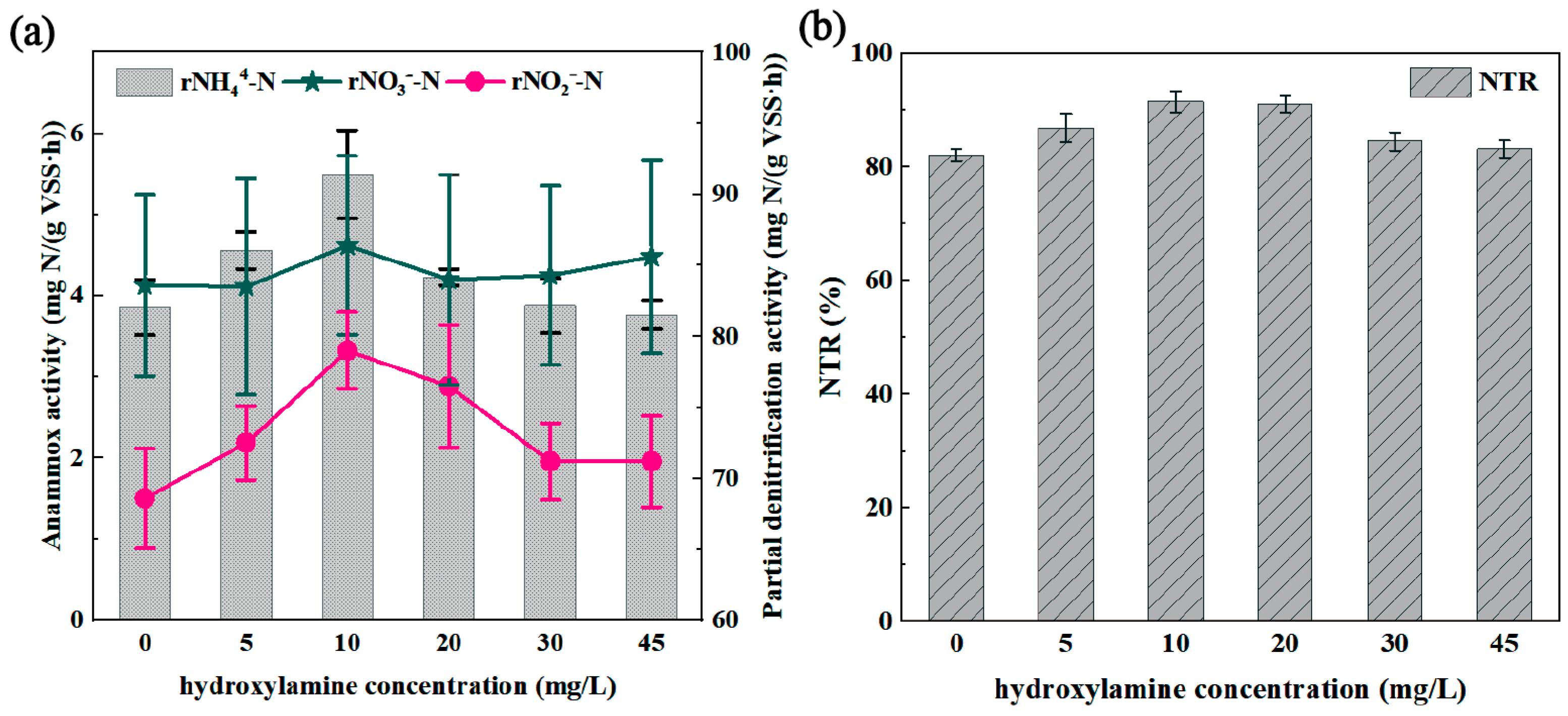
To evaluate the short-term restorative effects of hydroxylamine, batch activity assays were conducted with NH2OH concentrations ranging from 0 to 45 mg/L after removal of residual NaCl. Hydroxylamine supplementation exerted a pronounced influence on the metabolic activity of the inhibited biomass (Figure 2a). In the absence of NH2OH, the rates of ammonium oxidation (rNH4), nitrate reduction (rNO3), and nitrite accumulation (rNO2) were 3.86, 83.6, and 68.6 mg N/(g VSS·h), respectively. Compared with the control, NH2OH addition at 5, 10, and 20 mg/L enhanced nitrogen transformation to varying extents, increasing anammox activity by approximately 18%, 42.5%, and 9.6%, respectively. The strongest stimulation was observed at 10 mg/L NH2OH, where rNH4, rNO3, and rNO2 increased to 5.5, 86.4, and 79.0 mg N/(g VSS·h), respectively.
In contrast, further increasing the NH2OH concentration to 30–45 mg/L produced an inhibitory effect, with rNH4 declining to 3.8 and 3.7 mg N/(g VSS·h), respectively, indicating pronounced suppression of nitrogen removal activity. These results clearly demonstrate a dose-dependent response of salinity-inhibited PD/A biomass to hydroxylamine exposure, with a narrow concentration window between metabolic stimulation and inhibition.
The results above clearly demonstrate that the extent of anammox activity recovery is strongly dependent on NH2OH dosage. Optimal restoration was achieved at 10 mg/L NH2OH, resulting in a 42.5% increase in recovery efficiency (Figure 2a). Notably, further increases in hydroxylamine concentration did not lead to additional improvement, highlighting a pronounced concentration-dependent effect of NH2OH on anammox reactivation. This observation is consistent with the findings of Feng et al., who reported hydroxylamine-assisted recovery of anammox activity inhibited by Cr(VI) [21]. Excessive intracellular accumulation of NH2OH has been shown to inhibit hydrazine oxidase (HZO) activity [36], thereby limiting NH4+ oxidation. Moreover, the disproportionation of surplus NH2OH generates additional NH4+, reducing net ammonium consumption. Together, these effects impede the anammox pathway and ultimately suppress microbial activity.
As shown in Figure 2b, the activity of denitrifiers within the PD/A system was evaluated across a range of exogenous hydroxylamine concentrations (0–45 mg/L). The nitrite transformation ratio (NTR) increased from 82.1% in the absence of NH2OH to 86.8%, 91.4%, and 91.1% at 5, 10, and 20 mg/L NH2OH, respectively, before declining to 84.5% and 83.2% at 30 and 45 mg/L. In PD/A systems, NTR is a key indicator of the efficiency of nitrate-to-nitrite conversion. Higher NTR values reflect more efficient nitrate reduction by denitrifiers using organic carbon, thereby enhancing nitrite availability for subsequent anammox reactions. Adequate and stable NO2 supply enables anammox bacteria to more effectively couple NO2 and NH4+ oxidation, resulting in improved overall nitrogen removal performance and total nitrogen removal efficiency [37].
Hydroxylamine addition within an optimal concentration range (10–20 mg/L) significantly enhanced NTR, yielding increases of 9.3% and 9.1%, respectively, compared with the control. However, beyond this range, further increases in NH2OH concentration led to a clear decline in NTR, indicating inhibition of partial denitrification. This trend is consistent with the findings of Zhang et al., who reported that low concentrations of NH2OH enhance nitrate reduction in PD systems, whereas higher concentrations (>35 mg/L) become ineffective or inhibitory [38]. Similar dose-dependent behavior has also been observed in studies examining recovery from high-salinity shock, which highlighted the quantitative interplay between hydroxylamine and substrate concentrations in regulating nitrogen transformation pathways [39].
Overall, the short-term batch assays demonstrate that low-dose hydroxylamine (5–10 mg/L) effectively stimulates key functional microorganisms and shows strong potential for restoring PD/A activity following salinity-induced inhibition. In contrast, excessive hydroxylamine not only fails to enhance recovery but may impose additional metabolic stress by simultaneously inhibiting both anammox and partial denitrification processes. These findings underscore the necessity of carefully optimised hydroxylamine dosing strategies to fully exploit its reactivation potential in the engineering application of PD/A systems treating saline wastewater.

3.2. Long-Term Recovery of Nitrogen Removal Facilitated by Hydroxylamine Addition

3.2.1. Recovery Trajectories Under Different Hydroxylamine Dosages

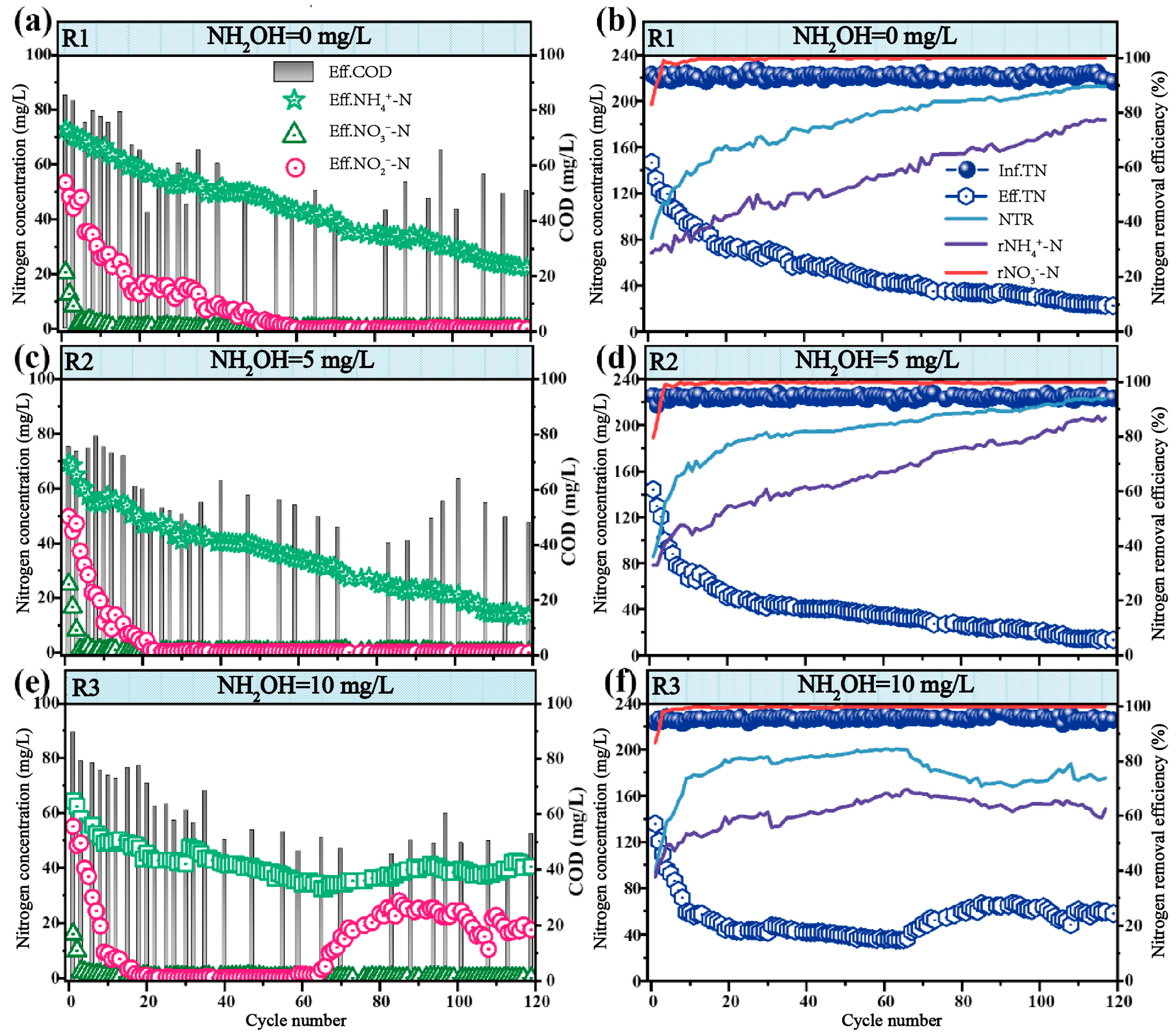
To elucidate the long-term restorative effects of hydroxylamine on salinity-inhibited PD/A systems, three parallel sequencing batch reactors (R1–R3) were operated for 120 cycles with NH2OH dosages of 0, 5, and 10 mg/L, respectively. This experimental design allowed for a systematic assessment of whether exogenous NH2OH could accelerate functional recovery and reshape the balance between denitrifiers and anammox microorganisms. The overall operational performance is summarised in Figure 3.
In the control reactor (R1; Figure 3a,b), the system exhibited a slow yet consistent spontaneous recovery following the removal of salinity stress. Denitrification activity recovered rapidly, as indicated by the decline in effluent NO3-N to 1.3 mg/L within the first four cycles. Subsequently, the nitrite transformation ratio (NTR) increased gradually, ultimately reaching approximately 90% by cycle 120. In parallel, NO2-N accumulation decreased progressively, while NH4+-N removal steadily improved as anammox activity began to re-establish. By cycle 120, effluent NH4+-N declined to 22.4 mg/L, accompanied by continuous increases in both NH4+-N and total nitrogen (TN) removal efficiencies. These results confirm that although salinity shock severely impaired anammox activity, the PD/A system retained intrinsic resilience and was capable of gradual self-restoration, consistent with previous observations of osmotic-stress adaptation in anammox-based systems [25].
The recovery trajectory was markedly altered following the introduction of low-dose hydroxylamine. In reactor R2 (5 mg/L NH2OH), denitrification recovered more rapidly than in the control, with effluent NO3-N decreasing to 1.1 mg/L within four cycles. Notably, the NTR reached approximately 80% after only 13 cycles, whereas R1 required 59 cycles to attain a comparable level, indicating accelerated adaptation of denitrifier bacteria under NH2OH-amended conditions. Concurrently, R2 exhibited substantially enhanced overall recovery (Figure 3c,d), achieving within 80 cycles the performance level that required 120 cycles in R1, corresponding to a ~33% reduction in recovery time. By cycle 120, effluent NH4+-N in R2 decreased to 13.4 mg/L, approximately 40% lower than that of the control. Both NH4+-N and TN removal efficiencies increased rapidly and remained consistently high throughout operation. These findings demonstrate that 5 mg/L NH2OH effectively shortened the reactivation period of salinity-inhibited denitrifiers, promoted rapid NTR establishment, and mitigated the suppressive effects of salinity on anammox activity. This observation aligns with batch-test results and is consistent with previous reports indicating that appropriate NH2OH dosing facilitates short-term nitrite accumulation and rapid stabilization of partial denitrification [24], as well as partial recovery of nitrogen removal capacity in salinity-stressed anammox systems [40].
The promoting effect of NH2OH on PD/A performance can be attributed to its dual functional roles: (i) serving as an auxiliary electron mediator that stimulates denitrification and (ii) acting as a metabolic intermediate that partially bridges the NO2-dependent anammox pathway. The enhancement observed here corroborates both short-term assays and previous studies demonstrating that low NH2OH concentrations alleviate stress effects and support metabolic reactivation of anammox bacteria [26].
In contrast, the reactor receiving the highest NH2OH dosage (R3, 10 mg/L) exhibited a fundamentally different long-term recovery pattern (Figure 3e,f). Effluent NO3-N declined to 1.1 mg/L within three cycles, representing the fastest initial recovery among all reactors, and the NTR reached 80% within nine cycles. During the first 63 cycles, effluent NH4+-N decreased steadily from 64 to 32 mg/L, with NTR peaking at 85.6%. However, under prolonged NH2OH exposure, progressive NO2-N accumulation and a rebound in NH4+-N concentrations became evident after cycle 64. By cycle 120, effluent NH4+-N and NO2-N increased to 40.3 mg/L and 23.6 mg/L, respectively, while the NTR declined to 73.4%, indicating substantial inhibition of both anammox and partial denitrification activities.
These long-term outcomes contrast sharply with short-term batch tests, in which 10 mg/L NH2OH initially enhanced PD/A performance. Sustained exposure to this concentration ultimately led to performance deterioration, suggesting a concentration-dependent dual effect of hydroxylamine. Similar trends have been reported by Zhang et al., who highlighted the “double-edged sword” nature of NH2OH in PD/anammox systems [41]. In the present study, continuous addition of 10 mg/L NH2OH resulted in a decline in nitrogen removal rate from 0.30 to 0.11 g N/L/d by day 59, indicating disruption of the synergistic balance between denitrifiers and anammox bacteria. Moreover, Harper et al. reported that prolonged NH2OH exposure can alter sludge particle-size distribution, reduce functional gene abundance, damage active biomass, and ultimately impair nitrogen removal performance [42].
Quantitative analysis suggests that the observed NO2-N accumulation (23.6 mg/L) alone is insufficient to fully explain the pronounced inhibition of anammox, as reported inhibitory thresholds typically exceed 100 mg/L, particularly in salinity-acclimated systems [43,44]. Therefore, while nitrite accumulation likely contributed to metabolic stress, the primary inhibitory mechanisms are more plausibly associated with sustained NH2OH exposure and its reactive intermediates. These include: (i) inhibition of hydrazine synthase and hydrazine oxidoreductase due to excessive intracellular NH2OH [21]; (ii) NH2OH disproportionation generating additional NH4+-N, thereby reducing net ammonium consumption; and (iii) excessive NO formation via hydroxylamine oxidation, which disrupts electron transport and diverts reducing power toward non-productive pathways [45]. The accumulation of NO, together with conditions favouring N2O formation (e.g., elevated NO2 and residual NH2OH) [46], may further exacerbate metabolic stress and toxicity, ultimately impairing functional biomass [47].
Overall, long-term reactor operation demonstrates that 5 mg/L NH2OH represents an optimal recovery dosage, enabling sustained enhancement of PD/A performance without secondary inhibition, while higher concentrations (≥10 mg/L) destabilise system function and accelerate performance deterioration.

3.2.2. Nitrogen Transformation Dynamics During Key Operational Phases

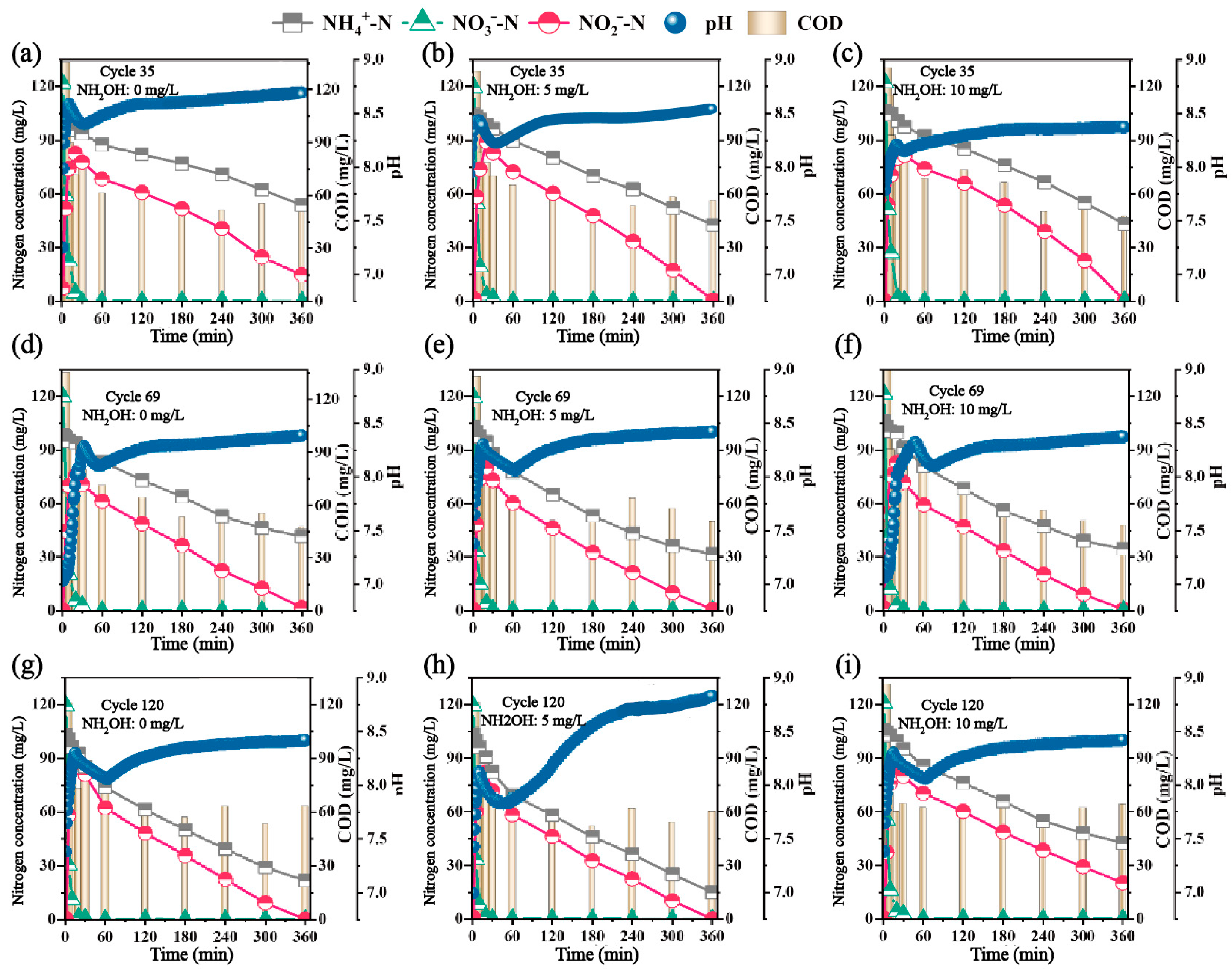
To elucidate the intrinsic mechanisms underlying hydroxylamine-mediated recovery of the PD/A system, in situ nitrogen transformation profiles were systematically characterised during representative operational cycles (Figure 4). The temporal evolution of nitrate (NO3-N) reduction, nitrite (NO2-N) accumulation, and ammonium (NH4+-N) removal clearly revealed the regulatory role of hydroxylamine in coordinating the functional interplay between denitrifiers and anaerobic ammonium-oxidising bacteria (anammox). Notably, these transformations were closely coupled with pH dynamics, reflecting synchronised microbial responses during different recovery stages.
During the early recovery phase (cycle 35; Figure 4a–c), rapid consumption of organic carbon was observed in all reactors, followed by stabilisation. Complete depletion of NO3-N occurred within 30 min in each reactor and was accompanied by a slight pH increase, indicating that denitrifiers remained high irrespective of hydroxylamine addition. At the end of this cycle, effluent NH4+-N concentrations in R1 (control), R2 (5 mg/L NH2OH), and R3 (10 mg/L NH2OH) were 53.8, 42.7, and 47.5 mg/L, respectively, while corresponding NO2-N concentrations were 14.8, 0.23, and 0.12 mg/L. Compared with R1, both hydroxylamine-amended reactors exhibited markedly lower NO2-N accumulation and slightly greater pH increases, indicating accelerated NO2 consumption by hydroxylamine-activated anammox bacteria. Accordingly, NH4+-N removal rates in R2 and R3 increased by approximately 14–25% relative to the control. These results demonstrate that low-dose hydroxylamine effectively promoted the re-initiation of NO2-dependent anammox metabolism during the early recovery stage, with pH variations closely reflecting enhanced microbial activity.
By the mid-recovery stage (cycle 69; Figure 4d–f), nitrogen removal performance improved in all reactors relative to the early phase, with pH remaining stable within an appropriate operational range (7.8–8.3). At this stage, distinct differences among hydroxylamine dosage groups became evident. Reactor R2 exhibited the most stable and balanced PD/A performance, characterised by minimal NO2-N accumulation (<0.5 mg/L), efficient NH4+-N removal (effluent NH4+-N of 31.2 mg/L), and comparable combined NO2-N and NO3-N concentrations (31.2 mg/L), along with the smallest pH fluctuation (±0.2). In contrast, R3 began to show noticeable NO2-N accumulation (approximately 5–8 mg/L) and a weaker pH increase than R2, suggesting the onset of inhibitory effects under prolonged exposure to higher hydroxylamine concentrations.
During the late operational stage (cycle 120; Figure 4g–i), R2 achieved optimal nitrogen removal performance, with effluent NH4+-N decreasing to 13.4 mg/L, near-complete elimination of NO2-N and NO3-N, and the largest pH increase (from 7.5 to 8.6). The control reactor R1 attained an effluent NH4+-N concentration of 22.4 mg/L, accompanied by a pH rise of approximately 0.8. In sharp contrast, R3 exhibited pronounced performance deterioration, with effluent NH4+-N and NO2-N accumulating to 42.7 mg/L and 20.2 mg/L, respectively, while pH remained near 7.6 with no discernible increase.
These observations clearly reveal two key patterns: First, the primary advantage of hydroxylamine addition lies in its ability to rapidly initiate system recovery in the short term, with its metabolic-promoting effect being particularly prominent during the critical early-to-mid recovery phase, where the extent of pH rise positively correlated with enhanced nitrogen-removal efficiency. Although the control (R1) might eventually achieve similar performance if operation were sufficiently extended, R2 reached optimal performance earlier than R1 and exhibited stronger resilience to loading shocks (≤5% decline in nitrogen-removal efficiency under fluctuating nitrogen loads) along with better pH stability. Second, the sustained deterioration observed in R3 confirms that prolonged exposure to high hydroxylamine concentrations induces chronic inhibition of both anammox and denitrifiers, thereby suppressing normal pH elevation—a finding consistent with long-term performance trends reported previously [48].
Overall, these results underscore the practical value of low-dose hydroxylamine in accelerating the recovery of salinity-stressed PD/A systems, aligning closely with the previously proposed principle of “short-term addition promotes recovery, while long-term adaptation leads to convergence.”

3.3. EPS Conversion Characteristics

To further elucidate the mechanisms by which hydroxylamine facilitates the reactivation of salinity-inhibited PD/A systems, the transformation of extracellular polymeric substances (EPS) was systematically investigated in reactors R1 (control), R2 (5 mg/L NH2OH), and R3 (10 mg/L NH2OH). EPS plays a pivotal role in microbial stress tolerance, cellular protection, and the maintenance of syntrophic interactions between denitrifiers and anammox organisms. Accordingly, variations in EPS composition provide critical insights into the resilience and functional stability of PD/A systems under hydroxylamine-stimulated recovery conditions [49].
EPS samples collected at representative operational stages were analysed using three-dimensional excitation–emission matrix (3D-EEM) fluorescence spectroscopy coupled with parallel factor analysis (PARAFAC). Two dominant fluorophores were resolved (Figure 5a). Component C1 (Ex/Em = 250/280 nm) was assigned to tyrosine-like protein substances [50,51], while Component C2 (Ex/Em = 230/350 nm) corresponded to tryptophan-like protein substances. These aromatic protein-like components are characteristic of proteinaceous EPS fractions and are closely associated with bioaggregate structural integrity, hydrophobic interactions, and redox functionality [52]. Their predominance is consistent with the established role of protein-rich EPS in mitigating osmotic and chemical stress in biological wastewater treatment systems.
The temporal evolution of the maximum fluorescence intensity (Fmax) for each component (Figure 5b) revealed a pronounced hydroxylamine dose-dependent response. In the control reactor (R1), both C1 and C2 increased gradually throughout the recovery period, reaching Fmax values of 1.19 and 0.97, respectively, by cycle 112. This slow but sustained enhancement indicates a self-driven adaptive response of the microbial consortium to salinity-induced stress. By contrast, reactor R2, supplemented with 5 mg/L NH2OH, exhibited accelerated and persistently elevated Fmax values for both components. Although the overall temporal patterns in R2 were similar to those in R1, the consistently higher fluorescence intensities suggest that moderate hydroxylamine dosing stimulated EPS biosynthesis pathways associated with osmotic regulation and cellular protection [21,53]. This enhanced EPS production is in line with the improved nitrogen removal performance and the increased abundance of key functional taxa (e.g., Thauera and Candidatus Brocadia) observed under this operational condition.
A distinctly different response was observed under excessive hydroxylamine addition in reactor R3. During the early recovery stage (cycles 8–37), both C1 and C2 initially increased, reflecting a short-term microbial stress response aimed at counteracting chemical and osmotic perturbations. However, beyond cycle 64, Fmax values declined sharply, decreasing to 0.65 for C1 and 0.52 for C2 by cycle 112. The pronounced attenuation of aromatic protein-like EPS under 10 mg/L NH2OH coincided with significant inhibition of anammox activity, as evidenced by deteriorated nitrogen removal performance and a reduced relative abundance of Candidatus Brocadia. These findings suggest that excessive hydroxylamine disrupts cellular redox homeostasis, interferes with protein synthesis or secretion, and/or accelerates EPS degradation [54,55], ultimately compromising bioaggregate integrity and weakening the syntrophic coupling between denitrifiers and anammox.
The mechanistic implications of these observations are twofold. First, tyrosine-like protein components (C1) enhance hydrophobic interactions and promote microgranule cohesion, thereby forming a physical barrier that regulates ion diffusion and buffers osmotic stress. Second, tryptophan-like protein components (C2) are closely linked to electron transfer and intracellular redox balancing, which are essential for maintaining metabolic stability in both heterotrophic denitrifiers and autotrophic anammox bacteria. Consequently, hydroxylamine-induced stimulation of these proteinaceous EPS fractions at 5 mg/L directly contributes to improved microbial resilience and efficient reactivation of salinity-inhibited PD/A systems. In contrast, the suppression of these components under high hydroxylamine dosing highlights a critical threshold beyond which chemical stress exceeds microbial tolerance capacity.
The above results demonstrate that moderate hydroxylamine supplementation reinforces the protective and functional protein-rich EPS matrix, thereby supporting microbial recovery and stabilising system performance. Conversely, excessive hydroxylamine addition undermines EPS integrity and destabilises the microbial consortium. Further validation using proteomic analyses or advanced molecular spectroscopic techniques would help to identify specific protein families and secretion pathways involved in hydroxylamine-mediated stress responses.

3.4. Hydroxylamine-Induced Microbial Community Shifts in PD/A

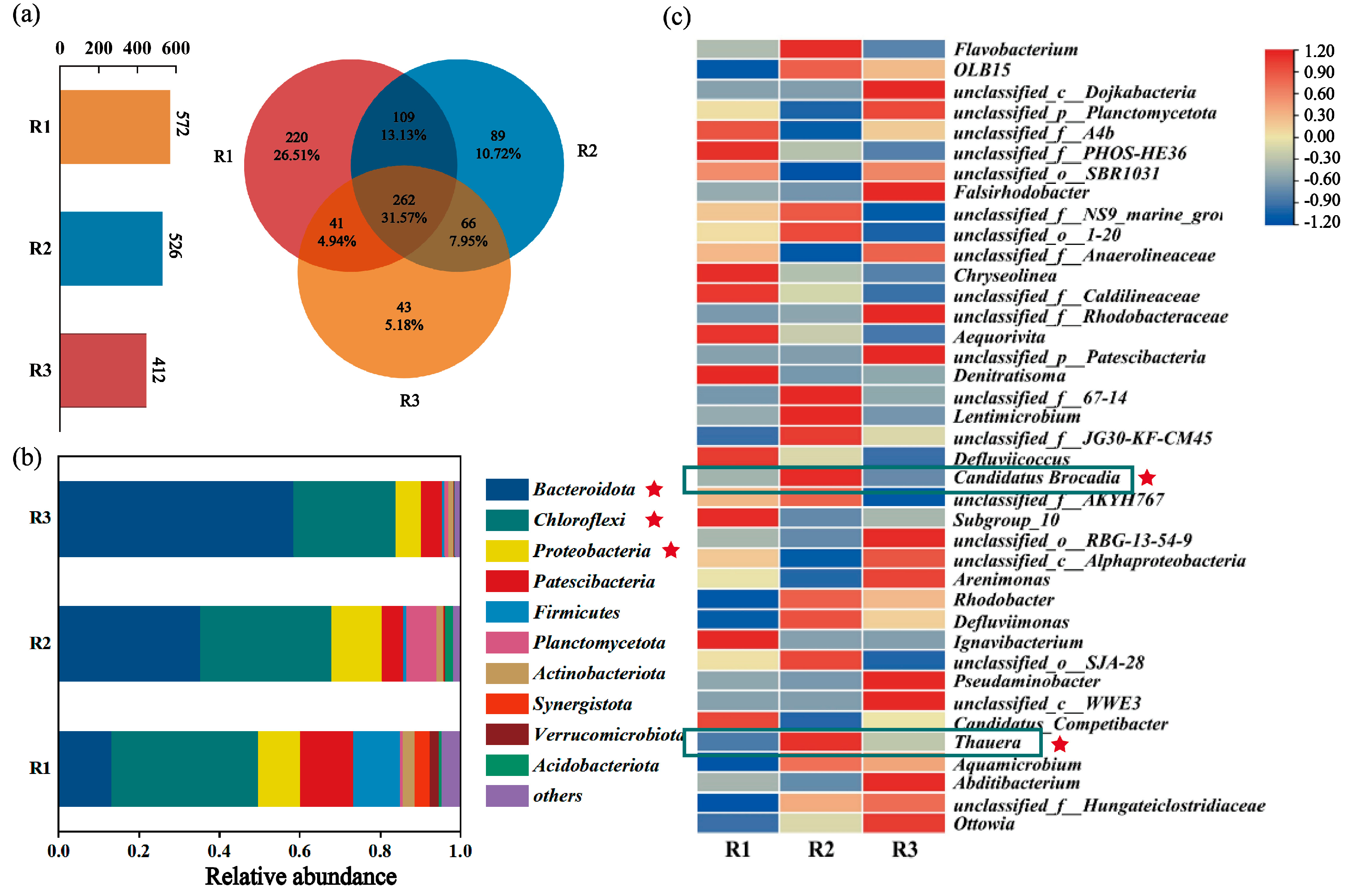
To further elucidate the biological mechanisms underlying hydroxylamine-assisted reactivation of salinity-inhibited PD/A systems, long-term microbial community structures were analysed using 16S rRNA gene sequencing. The operational taxonomic unit (OTU) Venn diagram (Figure 6a) revealed pronounced differences in community richness among the reactors. Reactors R1 and R2 harboured 572 and 526 OTUs, respectively, whereas R3 (10 mg/L NH2OH) exhibited a substantial reduction in OTU number to 412. Only 262 OTUs were shared among all three reactors, accounting for 45.8–63.6% of the total OTUs in each system. The numbers of unique OTUs were 229, 89, and 41 in R1, R2, and R3, respectively.
These results indicate that supplementation with 5 mg/L hydroxylamine promoted microbial diversification and facilitated the emergence of specialised or functionally adapted populations, thereby supporting rapid functional recovery of the PD/A system. In contrast, prolonged exposure to a higher hydroxylamine concentration imposed strong selective pressure, eliminating sensitive taxa and markedly reducing overall community diversity. This diversity loss likely arose from the combined effects of direct biochemical inhibition and indirect environmental stress, whereby sustained hydroxylamine exposure and its reactive by-products progressively reshaped the microbial niche and community assembly [48].
At the phylum level (Figure 6b), Bacteroidota and Chloroflexi dominated across all reactors, followed by Proteobacteria, Planctomycetota, and Patescibacteria. A clear dose-dependent trend was observed. The relative abundance of Bacteroidota increased from 13.2% in R1 to 35.2% in R2 and further to 58.5% in R3. Given the well-documented role of Bacteroidota in polysaccharide hydrolysis and EPS production, its enrichment suggests intensified EPS secretion under hydroxylamine exposure, particularly at elevated concentrations [56]. Conversely, Chloroflexi—key contributors to granular structural stability and degradation of recalcitrant organic matter [30,57]—declined progressively from 36.5% (R1) to 32.7% (R2) and 25.4% (R3). These opposing trends reflect a trade-off between EPS-producing and structure-supporting taxa, which may critically influence granule integrity and microbial aggregation during recovery. Notably, the balanced coexistence of these phyla in R2 implies that moderate hydroxylamine dosing preserved functional redundancy while simultaneously stimulating protective EPS-related pathways, representing an optimal ecological configuration for stress mitigation and PD/A synergy.
Genus-level heatmap analysis (Figure 6c) provided further mechanistic insights into functional community shifts. Thauera, a key denitrifier capable of efficient nitrate-to-nitrite reduction [58,59,60], was markedly enriched in R2 compared with R1 and R3. This enrichment corresponds well with the stabilised nitrite supply to the anammox pathway and the superior nitrogen removal performance observed in R2. Flavobacterium, another heterotrophic denitrifier, also responded positively to 5 mg/L hydroxylamine, suggesting that low-level hydroxylamine may act as a metabolic stimulant or co-factor enhancing denitrification activity.
The abundance of Candidatus Brocadia, the canonical anammox genus in mixed-culture PD/A systems [61,62], proved particularly diagnostic of system health. Its highest relative abundance (0.73%) was detected in R2, coinciding with the rapid recovery and sustained nitrogen removal efficiency of this reactor. Although anammox bacteria typically constitute only a minor fraction of the total biomass, their metabolic activity exerts a disproportionate control over overall PD/A performance [63,64]. In stark contrast, exposure to 10 mg/L hydroxylamine caused the relative abundance of Candidatus Brocadia to decline sharply to 0.08%, consistent with the collapse of nitrogen removal performance observed in R3. This pronounced suppression likely reflects cumulative metabolic stress, as excessive hydroxylamine may disrupt intracellular redox balance, interfere with hydrazine synthesis and oxidation pathways, or generate reactive intermediates detrimental to anammox cell integrity.
Overall, the microbial community analysis corroborates the performance and EPS results. Low-dose hydroxylamine (5 mg/L) functioned as a beneficial ecological stimulus, selectively enriching key functional taxa such as Thauera and Candidatus Brocadia, enhancing community diversity, and reinforcing EPS-mediated protection. Together, these effects restored the functional coupling between partial denitrification and anammox. Conversely, high-dose hydroxylamine (10 mg/L) imposed excessive selective pressure, reduced microbial diversity, disrupted essential functional guilds, and ultimately destabilised the microbial network required for PD/A cooperation. These findings demonstrate that microbial community restructuring constitutes a central mechanism through which hydroxylamine governs the recovery or failure of PD/A systems following salinity inhibition: appropriate dosing promotes a cooperative and metabolically resilient consortium, whereas excessive dosing collapses core nitrogen-transforming populations and undermines functional recovery.

4. Conclusions

This study demonstrates that low-dose hydroxylamine is an effective strategy to reactivate salinity-inhibited partial denitrification–anammox systems. Short-term batch assays showed that hydroxylamine rapidly enhanced nitrogen transformation, with 10 mg/L achieving a maximum ammonium removal rate of 5.5 mg N/(g VSS·h) and a nitrogen conversion efficiency of 91.4%. However, long-term operation revealed a pronounced dual effect. While continuous addition of 10 mg/L hydroxylamine led to progressive nitrite accumulation and deterioration of anammox activity, a dosage of 5 mg/L enabled stable performance recovery. Mechanistically, 3D-EEM analysis indicated that low-dose hydroxylamine promoted the secretion of protein-like EPS (tyrosine- and tryptophan-like substances), supporting microbial stability and metabolic resilience. In contrast, higher dosages suppressed protein-like EPS production, impaired community resilience, and caused a marked decline in Candidatus Brocadia abundance (from 0.67% to 0.09%). Overall, this work elucidates the dual promotional–inhibitory role of hydroxylamine in PD/A systems and provides practical guidance for process recovery. A short-term dosage of approximately 5 mg/L is recommended for salinity-inhibited PD/A systems, accompanied by close monitoring of nitrite accumulation and anammox population dynamics. These findings offer a mechanistic and operational basis for enhancing the resilience and stability of PD-anammox processes in saline wastewater treatment.

Author Contributions

Conceptualization, J.W. and S.C.; Methodology, J.W., Q.S. and S.C.; Software, J.W. and Q.S.; Validation, J.W., X.F. and R.D.; Formal analysis, J.W. and Q.S.; Investigation, J.W., Q.S. and X.F.; Resources, S.C. and R.D.; Data curation, J.W. and Q.S.; Writing—original draft preparation, J.W. and Q.S.; Writing—review and editing, S.C. and R.D.; Visualization, J.W.; Supervision, S.C.; Project administration, R.D.; Funding acquisition, R.D. All authors have read and agreed to the published version of the manuscript.

Funding

This research was supported by the Cooperation Program of Scientific and Technological Innovation in Sichuan and Chongqing (CSTB2024TIAD-CYKJCXX0012), Beijing Nova Program (20240484634), and the special fund of State Key Laboratory of Regional Environment and Sustainability.

Data Availability Statement

The original contributions presented in this study are included in the article. Further inquiries can be directed to the corresponding author.

Acknowledgments

The authors gratefully acknowledge the financial support from the Cooperation Program of Scientific and Technological Innovation in Sichuan and Chongqing (No. CSTB2024TIAD-CYKJCXX0012), the Beijing Nova Program (No. 20240484634), and the special fund of the State Key Laboratory of Regional Environment and Sustainability. Thanks are also extended to the Analytical and Testing Center of Beijing University of Technology for technical support, and to Majorbio (Majorbio Cloud Platform) for providing the sequencing analysis platform. The authors sincerely appreciate the valuable comments from the anonymous reviewers and the academic editor.

Conflicts of Interest

The authors declare that they have no known competing financial interests or personal relationships that could have appeared to influence the work reported in this paper.

References

  1. Kartal, B.; Kuenen, J.G.; van Loosdrecht, M.C.M. Sewage Treatment with Anammox. Science 2010, 328, 702–703. [Google Scholar] [CrossRef] [PubMed]
  2. Du, R.; Cao, S.; Zhang, H.; Li, X.; Peng, Y. Flexible Nitrite Supply Alternative for Mainstream Anammox: Advances in Enhancing Process Stability. Environ. Sci. Technol. 2020, 54, 6353–6364. [Google Scholar] [CrossRef] [PubMed]
  3. Cao, S.; Du, R.; Peng, Y.; Li, B.; Wang, S. Novel Two Stage Partial Denitrification (PD)-Anammox Process for Tertiary Nitrogen Removal from Low Carbon/Nitrogen (C/N) Municipal Sewage. Chem. Eng. J. 2019, 362, 107–115. [Google Scholar] [CrossRef]
  4. Kim, H.-C.; Choi, W.J.; Chae, A.N.; Park, J.; Kim, H.J.; Song, K.G. Evaluating Integrated Strategies for Robust Treatment of High Saline Piggery Wastewater. Water Res. 2016, 89, 222–231. [Google Scholar] [CrossRef]
  5. Chen, Y.; He, H.; Liu, H.; Li, H.; Zeng, G.; Xia, X.; Yang, C. Effect of Salinity on Removal Performance and Activated Sludge Characteristics in Sequencing Batch Reactors. Bioresour. Technol. 2018, 249, 890–899. [Google Scholar] [CrossRef]
  6. Liu, M.; Li, Q.; Sun, H.; Jia, S.; He, X.; Li, M.; Zhang, X.-X.; Ye, L. Impact of Salinity on Antibiotic Resistance Genes in Wastewater Treatment Bioreactors. Chem. Eng. J. 2018, 338, 557–563. [Google Scholar] [CrossRef]
  7. Chen, X.; Chen, S.; Chen, X.; Tang, Y.; Nie, W.-B.; Yang, L.; Liu, Y.; Ni, B.-J. Impact of Hydrogen Sulfide on Anammox and Nitrate/Nitrite-Dependent Anaerobic Methane Oxidation Coupled Technologies. Water Res. 2024, 257, 121739. [Google Scholar] [CrossRef]
  8. Jin, R.-C.; Zheng, P.; Mahmood, Q.; Hu, B.-L. Osmotic Stress on Nitrification in an Airlift Bioreactor. J. Hazard. Mater. 2007, 146, 148–154. [Google Scholar] [CrossRef]
  9. Qu, Z.; Tan, C.; Wang, X.; Zhao, N.; Li, J. Deciphering Performance and Microbial Characterization of Marine Anammox Bacteria-Based Consortia Treating Nitrogen-Laden Hypersaline Wastewater: Inhibiting Threshold of Salinity. Bioresour. Technol. 2024, 393, 130170. [Google Scholar] [CrossRef]
  10. Jin, R.-C.; Yang, G.-F.; Yu, J.-J.; Zheng, P. The Inhibition of the Anammox Process: A Review. Chem. Eng. J. 2012, 197, 67–79. [Google Scholar] [CrossRef]
  11. Zhang, Y.; He, S.; Niu, Q.; Qi, W.; Li, Y.-Y. Characterization of Three Types of Inhibition and Their Recovery Processes in an Anammox UASB Reactor. Biochem. Eng. J. 2016, 109, 212–221. [Google Scholar] [CrossRef]
  12. Zhang, Q.-Q.; Zhang, Z.-Z.; Guo, Q.; Chen, Q.-Q.; Jin, R.-C.; Jia, X.-Y. Variation in the Performance and Sludge Characteristics of Anaerobic Ammonium Oxidation Inhibited by Copper. Sep. Purif. Technol. 2015, 142, 108–115. [Google Scholar] [CrossRef]
  13. Wang, S.; Tian, Y.; Bi, Y.; Meng, F.; Qiu, C.; Yu, J.; Liu, L.; Zhao, Y. Recovery Strategies and Mechanisms of Anammox Reaction Following Inhibition by Environmental Factors: A Review. Environ. Res. 2024, 252, 118824. [Google Scholar] [CrossRef] [PubMed]
  14. Yang, G.-F.; Ni, W.-M.; Wu, K.; Wang, H.; Yang, B.-E.; Jia, X.-Y.; Jin, R.-C. The Effect of Cu(II) Stress on the Activity, Performance and Recovery on the Anaerobic Ammonium-Oxidizing (Anammox) Process. Chem. Eng. J. 2013, 226, 39–45. [Google Scholar] [CrossRef]
  15. Kuypers, M.M.M.; Marchant, H.K.; Kartal, B. The Microbial Nitrogen-Cycling Network. Nat. Rev. Microbiol. 2018, 16, 263–276. [Google Scholar] [CrossRef]
  16. Su, X.; Li, J.; Peng, Y.; Yuan, Y.; Wu, L.; Peng, Y. An Overlooked Effect of Hydroxylamine on Anammox Granular Sludge: Promoting Granulation and Boosting Activity. Sci. Total Environ. 2024, 921, 171176. [Google Scholar] [CrossRef]
  17. Xu, G.; Xu, X.; Yang, F.; Liu, S.; Gao, Y. Partial Nitrification Adjusted by Hydroxylamine in Aerobic Granules under High DO and Ambient Temperature and Subsequent Anammox for Low C/N Wastewater Treatment. Chem. Eng. J. 2012, 213, 338–345. [Google Scholar] [CrossRef]
  18. Soler-Jofra, A.; Pérez, J.; Van Loosdrecht, M.C.M. Hydroxylamine and the Nitrogen Cycle: A Review. Water Res. 2021, 190, 116723. [Google Scholar] [CrossRef]
  19. You, J.; Yu, B.; Liu, J. The Pivotal Role of Hydroxylamine in the Anammox-Based Processes: Mechanisms and Practical Applications. Chem. Eng. J. 2025, 515, 163562. [Google Scholar] [CrossRef]
  20. Van Der Star, W.R.L.; Van De Graaf, M.J.; Kartal, B.; Picioreanu, C.; Jetten, M.S.M.; Van Loosdrecht, M.C.M. Response of Anaerobic Ammonium-Oxidizing Bacteria to Hydroxylamine. Appl. Environ. Microbiol. 2008, 74, 4417–4426. [Google Scholar] [CrossRef]
  21. Feng, F.; Tang, X.; Qu, C.; Lu, X.; Liu, Z.; Tang, J.; Tang, C.-J.; Chai, L. Hydroxylamine Addition Enhances Fast Recovery of Anammox Activity Suffering Cr(VI) Inhibition. Bioresour. Technol. 2021, 329, 124920. [Google Scholar] [CrossRef]
  22. Bettazzi, E.; Caffaz, S.; Vannini, C.; Lubello, C. Nitrite Inhibition and Intermediates Effects on Anammox Bacteria: A Batch-Scale Experimental Study. Process Biochem. 2010, 45, 573–580. [Google Scholar] [CrossRef]
  23. Yang, J.-H.; Fu, J.-J.; Jia, Z.-Y.; Geng, Y.-C.; Ling, Y.-R.; Fan, N.-S.; Jin, R.-C. Microbial Response and Recovery Strategy of the Anammox Process under Ciprofloxacin Stress from Pure Strain and Consortia Perspectives. Environ. Int. 2024, 186, 108599. [Google Scholar] [CrossRef] [PubMed]
  24. Zhang, M.; Wang, S.; Ji, B.; Liu, Y. Towards Mainstream Deammonification of Municipal Wastewater: Partial Nitrification-Anammox versus Partial Denitrification-Anammox. Sci. Total Environ. 2019, 692, 393–401. [Google Scholar] [CrossRef] [PubMed]
  25. Su, Q.; Zhang, J.; Zeng, M.; Du, R.; Fan, X.; Cao, S. Adaptation of Freshwater Partial Denitrification/Anammox (PD/A) Granules to Low-Salt Conditions: Process Performance and Metabolic Insights. Chem. Eng. J. 2024, 493, 152592. [Google Scholar] [CrossRef]
  26. Zhang, X.; Zhang, X.; Wu, P.; Ma, L.; Chen, J.; Wang, C.; Li, X.; Liu, W.; Xu, L. Hydroxylamine Metabolism in Mainstream Denitrifying Ammonium Oxidation (DEAMOX) Process: Achieving Fast Start-up and Robust Operation with Bio-Augmentation Assistance under Ambient Temperature. J. Hazard. Mater. 2022, 421, 126736. [Google Scholar] [CrossRef]
  27. Bro, R.; Kiers, H.A.L. A New Efficient Method for Determining the Number of Components in PARAFAC Models. J. Chemom. 2003, 17, 274–286. [Google Scholar] [CrossRef]
  28. Lawaetz, A.J.; Stedmon, C.A. Fluorescence Intensity Calibration Using the Raman Scatter Peak of Water. Appl. Spectrosc. 2009, 63, 936–940. [Google Scholar] [CrossRef]
  29. American Public Health Association. Standard Methods for the Examination of Water and Wastewater; American Public Health Association: Washington, DC, USA, 1926; Volume 6. [Google Scholar]
  30. Cao, S.; Tao, Y.; Cheng, Z.; Li, X.; Fan, X.; Du, R. Temperature-Driven Mineral Accumulation Triggers Irreversible Failure in a High-Strength CANDAN System. Chem. Eng. J. 2025, 522, 167941. [Google Scholar] [CrossRef]
  31. Lin, L.; Pratt, S.; Crick, O.; Xia, J.; Duan, H.; Ye, L. Salinity Effect on Freshwater Anammox Bacteria: Ionic Stress and Ion Composition. Water Res. 2021, 188, 116432. [Google Scholar] [CrossRef]
  32. Wong, J.W.C.; Kaur, G.; Mehariya, S.; Karthikeyan, O.P.; Chen, G. Food Waste Treatment by Anaerobic Co-Digestion with Saline Sludge and Its Implications for Energy Recovery in Hong Kong. Bioresour. Technol. 2018, 268, 824–828. [Google Scholar] [CrossRef]
  33. Pernetti, M.; Palma, L.D. Experimental Evaluation of Inhibition Effects of Saline Wastewater on Activated Sludge. Environ. Technol. 2005, 26, 695–704. [Google Scholar] [CrossRef] [PubMed]
  34. Xu, A.; Yu, D.; Qiu, Y.; Chen, G.; Tian, Y.; Wang, Y. A Novel Process of Salt Tolerance Partial Denitrification and Anammox (ST-PDA) for Treating Saline Wastewater. Bioresour. Technol. 2022, 345, 126472. [Google Scholar] [CrossRef] [PubMed]
  35. Bi, C.; Yu, D.; Wang, X.; Du, S.; Wang, J.; Gong, X.; Du, Y.; Zhao, J. Performance and Microbial Structure of Partial Denitrification in Response to Salt Stress: Achieving Stable Nitrite Accumulation with Municipal Wastewater. Bioresour. Technol. 2020, 311, 123559. [Google Scholar] [CrossRef] [PubMed]
  36. Ma, X.; Feng, Z.-T.; Zhou, J.-M.; Sun, Y.-J.; Zhang, Q.-Q. Regulation Mechanism of Hydrazine and Hydroxylamine in Nitrogen Removal Processes: A Comprehensive Review. Chemosphere 2024, 347, 140670. [Google Scholar] [CrossRef]
  37. Du, R.; Cao, S.; Wang, S.; Niu, M.; Peng, Y. Performance of Partial Denitrification (PD)-ANAMMOX Process in Simultaneously Treating Nitrate and Low C/N Domestic Wastewater at Low Temperature. Bioresour. Technol. 2016, 219, 420–429. [Google Scholar] [CrossRef]
  38. Zhang, X.; Xia, Y.; Wang, C.; Li, J.; Wu, P.; Ma, L.; Wang, Y.; Wang, Y.; Da, F.; Liu, W.; et al. Enhancement of Nitrite Production via Addition of Hydroxylamine to Partial Denitrification (PD) Biomass: Functional Genes Dynamics and Enzymatic Activities. Bioresour. Technol. 2020, 318, 124274. [Google Scholar] [CrossRef]
  39. He, S.; Yang, W.; Li, W.; Zhang, Y.; Qin, M.; Mao, Z. Impacts of Salt Shocking and the Selection of a Suitable Reversal Agent on Anammox. Sci. Total Environ. 2019, 692, 602–612. [Google Scholar] [CrossRef]
  40. Xiong, X.; Li, Y.; Yang, X.; Huang, Z.; Wang, D.; Li, Z. Insights into the Response of Anammox Sludge to the Individual and Combined Stress of Neodymium and Salinity and the Role of Hydroxylamine Regulation. J. Environ. Chem. Eng. 2023, 11, 110536. [Google Scholar] [CrossRef]
  41. Zhang, Q.; Lin, L.; Chen, Y.; Wang, Y.; Li, X.; Li, L.; Cao, W.; Zhang, Y. Dual-Edged Effects and Mechanisms of Hydroxylamine in Partial Denitrification-Anaerobic Ammonium Oxidation System. Environ. Res. 2023, 235, 116664. [Google Scholar] [CrossRef]
  42. Harper, W.F.; Terada, A.; Poly, F.; Le Roux, X.; Kristensen, K.; Mazher, M.; Smets, B.F. The Effect of Hydroxylamine on the Activity and Aggregate Structure of Autotrophic Nitrifying Bioreactor Cultures. Biotech Bioeng. 2009, 102, 714–724. [Google Scholar] [CrossRef] [PubMed]
  43. Meng, Y.; Wang, D.; Wang, P.; Yu, Z.; Yuan, S.; Xia, L.; Meng, F. The Counteraction of Anammox Community to Long-Term Nitrite Stress: Crucial Roles of Rare Subcommunity. Sci. Total Environ. 2022, 822, 153062. [Google Scholar] [CrossRef] [PubMed]
  44. Strous, M.; Kuenen, J.G.; Jetten, M.S.M. Key Physiology of Anaerobic Ammonium Oxidation. Appl. Environ. Microbiol. 1999, 65, 3248–3250. [Google Scholar] [CrossRef] [PubMed]
  45. Irisa, T.; Hira, D.; Furukawa, K.; Fujii, T. Reduction of Nitric Oxide Catalyzed by Hydroxylamine Oxidoreductase from an Anammox Bacterium. J. Biosci. Bioeng. 2014, 118, 616–621. [Google Scholar] [CrossRef]
  46. Schreiber, F.; Wunderlin, P.; Udert, K.M.; Wells, G.F. Nitric Oxide and Nitrous Oxide Turnover in Natural and Engineered Microbial Communities: Biological Pathways, Chemical Reactions, and Novel Technologies. Front. Microbio. 2012, 3, 372. [Google Scholar] [CrossRef]
  47. Filonchyk, M.; Peterson, M.P.; Zhang, L.; Hurynovich, V.; He, Y. Greenhouse Gases Emissions and Global Climate Change: Examining the Influence of CO2, CH4, and N2O. Sci. Total Environ. 2024, 935, 173359. [Google Scholar] [CrossRef]
  48. Zhao, N.; Qiu, Y.; Qu, Z.; Li, J. Response of Marine Anammox Bacteria to Long-Term Hydroxylamine Stress: Nitrogen Removal Performance and Microbial Community Dynamics. Bioresour. Technol. 2024, 393, 130159. [Google Scholar] [CrossRef]
  49. Wang, T.; Guo, J.; Song, Y.; Lian, J.; Li, H.; Lu, C.; Han, Y.; Hou, Y. Efficient Nitrogen Removal in Separate Coupled-System of Anammox and Sulfur Autotrophic Denitrification with a Nitrification Side-Branch under Substrate Fluctuation. Sci. Total Environ. 2019, 696, 133929. [Google Scholar] [CrossRef]
  50. Chen, J.; Gu, B.; LeBoeuf, E.J.; Pan, H.; Dai, S. Spectroscopic Characterization of the Structural and Functional Properties of Natural Organic Matter Fractions. Chemosphere 2002, 48, 59–68. [Google Scholar] [CrossRef]
  51. Lee, D.; Kwon, M.; Ahn, Y.; Jung, Y.; Nam, S.-N.; Choi, I.; Kang, J.-W. Characteristics of Intracellular Algogenic Organic Matter and Its Reactivity with Hydroxyl Radicals. Water Res. 2018, 144, 13–25. [Google Scholar] [CrossRef]
  52. Chen, W.; Westerhoff, P.; Leenheer, J.A.; Booksh, K. Fluorescence Excitation−Emission Matrix Regional Integration to Quantify Spectra for Dissolved Organic Matter. Environ. Sci. Technol. 2003, 37, 5701–5710. [Google Scholar] [CrossRef] [PubMed]
  53. Jia, F.; Yang, Q.; Liu, X.; Li, X.; Li, B.; Zhang, L.; Peng, Y. Stratification of Extracellular Polymeric Substances (EPS) for Aggregated Anammox Microorganisms. Environ. Sci. Technol. 2017, 51, 3260–3268. [Google Scholar] [CrossRef] [PubMed]
  54. Yin, P.; Guo, J.; Xiao, S.; Chen, Z.; Song, Y.; Ren, X. Rapid of Cultivation Dissimilatory Perchlorate Reducing Granular Sludge and Characterization of the Granulation Process. Bioresour. Technol. 2019, 276, 260–268. [Google Scholar] [CrossRef] [PubMed]
  55. Mal, J.; Nancharaiah, Y.V.; Maheshwari, N.; Van Hullebusch, E.D.; Lens, P.N.L. Continuous Removal and Recovery of Tellurium in an Upflow Anaerobic Granular Sludge Bed Reactor. J. Hazard. Mater. 2017, 327, 79–88. [Google Scholar] [CrossRef]
  56. Wang, D.; Chen, Y.; Zheng, X.; Li, X.; Feng, L. Short-Chain Fatty Acid Production from Different Biological Phosphorus Removal Sludges: The Influences of PHA and Gram-Staining Bacteria. Environ. Sci. Technol. 2013, 47, 2688–2695. [Google Scholar] [CrossRef]
  57. Zheng, Z.; Li, J.; Chen, G.; Peng, Y. Exploring the Optimized Strategy in the Nitritation-Anammox Biofilm Process for Treating Low Ammonium Wastewater. Bioresour. Technol. 2021, 319, 124113. [Google Scholar] [CrossRef]
  58. Liu, B.; Mao, Y.; Bergaust, L.; Bakken, L.R.; Frostegård, Å. Strains in the Genus Thauera Exhibit Remarkably Different Denitrification Regulatory Phenotypes. Environ. Microbiol. 2013, 15, 2816–2828. [Google Scholar] [CrossRef]
  59. Cao, S.; Lan, Y.; Fan, X.; Xu, X.; Du, R.; Peng, Y.; Makinia, J. Selective Enrichment of Partial Denitrifying Bacteria Enabling High Nitrite Production under Stepwise Elevated Salinity: Sludge Granulation and Metagenomic Mechanisms. ACS EST Water 2025, 5, 1955–1965. [Google Scholar] [CrossRef]
  60. Cao, S.; Li, B.; Du, R.; Ren, N.; Peng, Y. Nitrite Production in a Partial Denitrifying Upflow Sludge Bed (USB) Reactor Equipped with Gas Automatic Circulation (GAC). Water Res. 2016, 90, 309–316. [Google Scholar] [CrossRef]
  61. Zhu, G.; Wang, S.; Wang, W.; Wang, Y.; Zhou, L.; Jiang, B.; Op den Camp, H.J.M.; Risgaard-Petersen, N.; Schwark, L.; Peng, Y.; et al. Hotspots of Anaerobic Ammonium Oxidation at Land–Freshwater Interfaces. Nat. Geosci. 2013, 6, 103–107. [Google Scholar] [CrossRef]
  62. Li, C.; Du, R.; Liu, Q.; Fan, J.; Peng, Y. Expansive Microbial Metabolic Versatility and Spatial Biodiversity of Anammox Coupling with Denitrification Granular Sludge under Different Feeding Strategies. Chem. Eng. J. 2024, 480, 148183. [Google Scholar] [CrossRef]
  63. Du, R.; Cao, S.; Li, X.; Wang, J.; Peng, Y. Efficient Partial-Denitrification/Anammox (PD/A) Process through Gas-Mixing Strategy: System Evaluation and Microbial Analysis. Bioresour. Technol. 2020, 300, 122675. [Google Scholar] [CrossRef] [PubMed]
  64. Tao, Y.; Shi, R.; Li, L.; Xia, S.; Ning, J.; Xu, W. Performance Optimization and Nitrogen Removal Mechanism of Up-Flow Partial Denitrification/Anammox Process. J. Environ. Manag. 2023, 348, 119191. [Google Scholar] [CrossRef] [PubMed]
Figure 1. Schematic diagram of the long-term experiments with different hydroxylamine additions.
Water 18 00111 g001
Figure 2. Effects of short-term hydroxylamine dosing on the PD/A system: (a) Short-term effects of different hydroxylamine concentrations on the recovery of denitrification performance of the PD/A process; (b) Nitrate-to-nitrite transformation ratio (NTR).
Water 18 00111 g002
Figure 3. Long-term operational performance of R1/R2/R3 reactors under gradient hydroxylamine concentrations: (a,c,e) Effluent profiles of nitrogen species (NH4+-N, NO3-N, NO2-N) and COD; (b,d,f) Temporal dynamics of TN concentration and nitrogen removal efficiencies.
Water 18 00111 g003
Figure 4. In situ Activity Profiles of Reactors under Gradient Hydroxylamine Concentrations (R1, R2, R3; 0 mg/L, 5 mg/L, 10 mg/L): (ac) Cycle 69; (df) Cycle 69; (gi) Cycle 120.
Water 18 00111 g004
Figure 5. Two components of EPS revealed by PARAFAC analysis. (a) Component 1-Tyrosine-like substance, component 2-Tryptophan-like substance; (b) Fmax values of fluorescence intensity of C1 and C2 at different hydroxylamine concentrations.
Water 18 00111 g005
Figure 6. Effects of different hydroxylamine concentrations on the microbial community in the PD/A system: (a) Venn diagram of OTUs; (b) Microbial composition at the phylum level; (c) Heatmap of microbial abundance at the genus level under different hydroxylamine concentrations. The red star(s) and green box(es) highlight statistically significant or key microbial taxa, respectively.
Water 18 00111 g006
Table 1. The composition of the mineral and trace element solution.
SolutionConcentration (g/L)
Mineral substancesMgSO4·7H2O0.14
CaCl2·2H2O0.14
KH2PO40.03
Trace element IEDTA·2Na5.78
FeSO4·7H2O9.15
Trace element IIEDTA·2Na17.36
ZnSO4·7H2O0.43
CuSO4·5H2O0.25
NaMoO4·2H2O0.22
NiCl2·6H2O0.19
H3BO40.014
MnCl2·4H2O0.99
CoCl2·6H2O0.24
Disclaimer/Publisher’s Note: The statements, opinions and data contained in all publications are solely those of the individual author(s) and contributor(s) and not of MDPI and/or the editor(s). MDPI and/or the editor(s) disclaim responsibility for any injury to people or property resulting from any ideas, methods, instructions or products referred to in the content.