Review

Research Status and Emerging Trends in the Comprehensive Impact of Inter-Basin Water Transfer Projects (IBWTs)

1
State Key Laboratory of Eco-Hydraulics in Northwest Arid Region of China, Xi’an University of Technology, Xi’an 710048, China
2
Yellow River Engineering Consulting Co., Ltd., Zhengzhou 450003, China
*
Author to whom correspondence should be addressed.
Water 2025, 17(20), 2981; https://doi.org/10.3390/w17202981
Submission received: 18 September 2025 / Revised: 13 October 2025 / Accepted: 14 October 2025 / Published: 16 October 2025
(This article belongs to the Section Hydrology)

Abstract

Research on the impact and response strategies of inter-basin water transfer projects (IBWTs) on regional hydrology, water resources, the ecological environment, the economy, and society holds significant strategic importance for the protection of the environment and long-term economic and social development throughout the entire lifecycle of IBWTs. In this study, the current state and trends in research on the comprehensive impact of IBWTs were explored using CiteSpace and HistCite, two analytical tools, to perform a bibliometric analysis on 498 studies (2002–2024) in the Web of Science Core Collection (WoSCC). The following aspects are addressed in depth: (1) The characteristics of publications on the comprehensive impact of IBWTs. (2) Critical information on the countries, institutions, and subjects engaged in research about the comprehensive impact of IBWTs. (3) The trends and hotspots of research on the comprehensive impact of IBWTs. In this study, we review and evaluate the results of research on the comprehensive impact of large-scale IBWTs, efficiently providing scholars an understanding of the existing research and new frontiers in this field. In addition, for domestic and foreign scholars who are about to delve into the assessment of IBWTs’ impacts and related research, this article can provide valuable information on hot topics and next steps in research from a global perspective.

1. Introduction

Water resources are invaluable natural and environmental assets, as well as strategic resources. As the socio-economic landscape rapidly evolves, regions facing water scarcity can no longer rely solely on internal water allocation within their watersheds to meet the growing demand for economic and social development [1]. Inter-basin water transfer projects (IBWTs) originated in the mid-19th century, and the construction of IBWTs has gradually become a fundamental approach to alleviating the supply–demand imbalance of water resources in water-receiving areas across the world [2,3]. Currently, over 350 IBWTs have been constructed in more than 40 countries and regions worldwide, with a combined water diversion volume exceeding 500 billion m3 [4]. Examples include the Central Valley Project and California Aqueduct in the USA, the James Bay Project in Canada, the Reed Water Diversion Project and Snowy Mountains Scheme in Australia, the North to South Water Diversion Project in Israel, and the South to North Water Diversion Project (SNWDP) in China [4,5]. As one of the earliest nations to undertake IBWTs, China has completed or is in the process of constructing 137 such projects [6]. Among them, the SNWDP is a significant strategic initiative for the construction of the “Four Horizontals and Three Verticals” backbone water network in China. It serves as a strategic measure to enhance and optimize the overall allocation of water resources [7,8]. The IBWTs that have been constructed or are under construction have effectively mitigated the severe water scarcity crisis in the receiving areas, playing a crucial role in fostering economic development, safeguarding regional water security, enhancing social stability and unity, and improving the ecological environment in these regions [9,10,11]. While it cannot be denied that the construction of IBWTs has altered the original water cycle, ecological balance, and socio-economic development in the water source areas to some extent, the impact of these projects on the ecological environment is becoming increasingly prominent and cannot be ignored, both domestically and internationally [12,13].
The impact of IBWTs on the natural environment can be delineated as follows: water diversion leads to alterations in the original hydrological conditions, which, in turn, cause changes in the natural environment and subsequently affect the socio-economic situation [14]. The construction of IBWTs, including the SNWDP and the Han-to-Wei River Diversion Project, has been associated with a decrease in biodiversity in the middle and lower reaches of the Han River, and has also resulted in aggravated water pollution and the emergence of new desertification risks in the region [15,16]. The East Route Project in China, the James Bay Project in Canada, and the Asheloos River Diversion Project in Greece have all resulted in water source areas becoming saltwater estuaries due to water diversion, severely impacting the cultivated land and ecological environment; additionally, water-receiving areas may face soil salinization and increased pollutant diffusion [4,17]. IBWTs can result in alterations to plant communities and may even facilitate the invasion of alien species [17]. Furthermore, the water environment of the water source area is vital for the operational success of IBWTs [18,19]. The Snowy Mountains Scheme in Australia is a typical high-altitude water diversion project, yielding substantial benefits in water transfer, power generation, tourism, and environmental conservation. However, the ecological environment of the Snowy River in the water source area has progressively deteriorated as a result of diminished river runoff and the ongoing mismanagement of the river [20]. The construction and operation of the East Route Project have resulted in significant ecological and environmental challenges, including the ecological impact of lake water storage, the degradation of water quality along the canal, secondary salinization in water-receiving areas, and the invasion of alien species [21]. Upon reviewing the research on the ecological impact of IBWTs [4,22,23,24], it is evident that the focus of such studies has shifted over time. Initially, in the 1940s, the emphasis was on the water diversion function. However, by the early 21st century, there has been a significant shift towards prioritizing the assessment of the ecological environmental impacts [25]. Moreover, IBWTs will inevitably influence the social and economic development of the areas surrounding the project. The economic vitality of water source regions is fundamental for safeguarding water resources. However, the protection of these areas often involves a complex interplay of interests, which may, to some extent, hinder their economic progress and potentially threaten the rights and interests of local governments and residents [26].
Consequently, IBWTs constitute a complex and multifaceted system that encompasses various dimensions, including resources, ecology, the environment, the economy, and society. These aspects are interconnected, with each influencing and constraining the others. Over the past few decades, substantial advancements have been achieved in the study of IBWT impact, both within the country and globally [27]. Given the substantial body of research in this field, it is imperative to conduct a systematic analysis that delineates the current status and future trajectory of IBWTs impact research. This will provide guidance for the high-quality construction and advancement of IBWTs.
The bibliometric method, which employs mathematical and statistical analysis, is widely utilized in numerous scientific and engineering disciplines to ascertain the developmental trends within a specific research field by examining the published scientific literature [28,29]. Duan et al. [30] performed a bibliometric analysis of the carrying capacity of global “ecology, environment, and resources” from 1990 to 2021 and found that research hotspots primarily focused on water environmental, ecological and resource carrying capacities and their interrelationships. Qin et al. [31] conducted a bibliometric analysis of research on distributed hydrological models from 1986 to 2019 and identified two directions: the development of distributed hydrological models suitable for alpine regions and the response of hydrological processes to climate change. Bibliometric analysis of field-specific literature enables researchers to track the evolution of research topics over time, thereby accelerating comprehension, enhancing scientific efficiency and effectiveness, and advancing future research careers.
CiteSpace, a Java-based scientometric visualization tool developed by Chen et al. [32], facilitates text mining and bibliometric visualization and, on the basis of the resulting evidence, proposes focal points and future research directions [33]. In addition, Eugene Garfield’s HistCite software has been applied to analyze Core Literature Data (CLD) by calculating metrics such as H-index, Total Local Citation Score (TLCS), Average TLCS (ATLCS), Total Global Citation Score (TGCS), and Average TGCS (ATGCS) in order to gain a deeper understanding of the journal’s impact [34].
Currently, there is a scarcity of articles that have conducted bibliometric analyses on the comprehensive impact, assessment, and response strategies of large-scale IBWTs. Moreover, there is an absence of comprehensive bibliometric analysis on the research status regarding the impact of IBWTs. The knowledge gap in understanding and addressing the latest developments, trends, and challenges related to the impact of IBWTs is highlighted. This research gap is narrowed by conducting comprehensive, interdisciplinary, and long-term analyses of existing literature in this study. A multidimensional synthesis of the current state of knowledge on IBWTs’ impacts is provided, enabling the academic community to systematically understand emerging trends and research priorities in this field. To address this demand, a bibliometric analysis and subsequent discussion of global publications over the past 23 years were carried out using the Web of Science database, along with the CiteSpace and HistCite tools. This analysis encompassed the volume and categories of international publications, the principal countries and research institutions involved in relevant research and their collaborative partnerships, key studies, and keyword clustering. In this study, we comprehensively investigated the hotspots in research on IBWTs, extracted the developmental trends in water transfer impact research, and proposed measures to mitigate the impact of water transfer and the high-quality development of IBWTs in the future.

2. Approach

2.1. Data Collection

The Web of Science Core Collection (WoSCC), provided by the Institute for Scientific Information (ISI) in the USA, was selected as the data source for this study. This database is renowned for offering the most comprehensive academic information and resources across various fields globally, which enhances the comprehensiveness and credibility of the bibliometric analysis results. It should be noted that limiting the search to the Web of Science Core Collection and English-language publications may overlook significant non-English literature and regional databases (e.g., CNKI).
In this study, the WoS advanced search formula was carefully crafted to focus on the target field’s quality, quantity, and coverage. The advanced formula used was as follows: TS = ((“water transfer * project” OR “South to North Water Diversion * Project” OR “inter-basin water transfer *”) AND (“impact” OR “assessment”)). The search period was set from 2002 to 2024. All records were retrieved as of 1 July 2024. Consequently, a total of 498 English-language publications were identified.

2.2. Analysis Methods

CiteSpace (version 6.3.R3) software was utilized for bibliometric analysis. Co-occurrence and co-citation analyses were employed to create network diagrams, while cluster analysis and burst detection were used to identify research hotspots and trends. The visualization of literature-related information was typically represented through links and nodes. Various types of research elements were represented by nodes and the connections between them signified collaborative, co-occurrence, and co-citation relationships. Thicker lines indicated stronger connections. Additionally, different colors represented different publication years, with warmer colors indicating closer years. Nodes with high betweenness centrality were identified as pivotal points, marking turning points or critical moments within the research field [35].
It is noteworthy that a cluster comprising multiple nodes may suggest an emerging trend or an active research area. The objective of this study was to identify abrupt changes in events by employing cluster analysis and burst detection, thereby identifying new trends in research concerning the impact of water diversion. Modularity (Q) and mean silhouette (S) serve as crucial metrics for evaluating clustering. Q is utilized to measure the effectiveness of clustering, where a value exceeding 0.3 indicates that clustering is effective. Additionally, S indicates the homogeneity of clusters, with higher values pointing to greater homogeneity within the clusters. Typically, an S value surpassing 0.7 is indicative of a reliable and trustworthy cluster [29,36]. Keyword clusters are generated using the logarithmic likelihood ratio (LLR) algorithm and are automatically labeled in CiteSpace with # + number + label. The color of the cluster labels corresponds to the average year of the cluster, where warmer colors like red, orange, and yellow denote younger clusters, while cooler colors such as cyan, blue, and green represent older clusters.
In CiteSpace, categories with high counts and centrality, respectively, indicate the high output efficiency of articles associated with these categories and the significant interest of the scholars who are active in these fields. Furthermore, the HistCite software was employed to analyze the core literature dataset and assess the information from multiple perspectives. HistCite calculates various indicators that reflect the influence of journals, including the TLCS, ATLCS, TGCS, and ATGCS [29]. The TLCS reflects the frequency of articles being cited within the local dataset, thereby directly indicating the level of peer attention and recognition that the cited literature receives. Consequently, papers with high TLCS values are considered to exert a more significant influence within their particular research fields [37].
Utilizing CiteSpace software, co-occurrence analysis and burst detection were employed to identify disciplinary categories associated with the impact of IBWTs. This analysis also aimed to pinpoint key subjects that influence the field’s development and progress, as well as to reveal active research topics within the field. Additionally, it sought to further expose the interdisciplinary characteristics of research on the impact of IBWTs.

3. Results and Discussion

3.1. Characteristics of Publication Outputs

Figure 1 illustrates the quantity and categories of publications on the impact of IBWTs from 2002 to 2024. The records concerned with the impact of IBWTs were categorized into three distinct types—articles, conference papers, and reviews. Notably, 86.6% of the publications were articles, followed by conference papers and reviews, which accounted for 11.8% and 1.6% of the total, respectively.
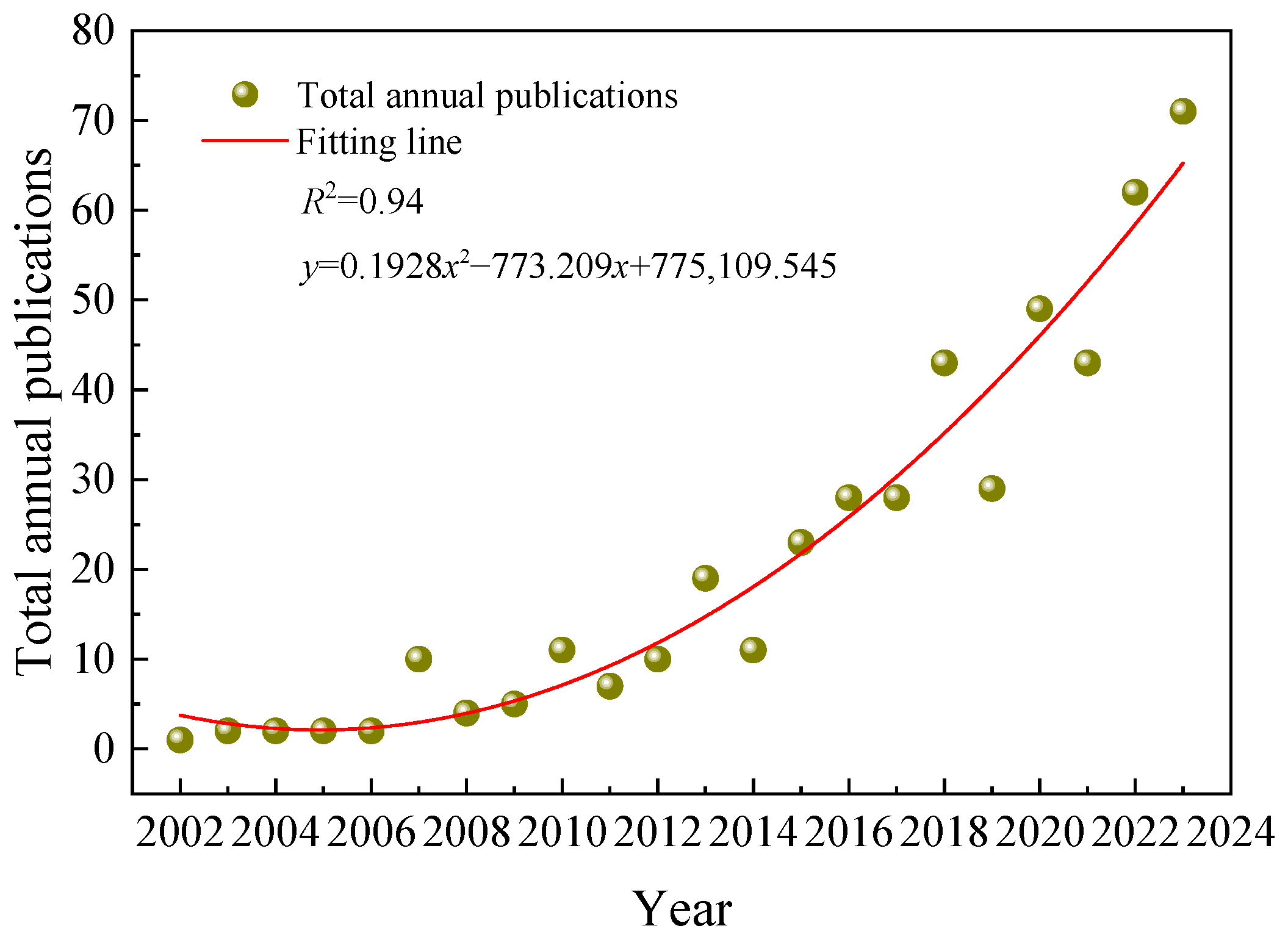
In addition, the increase in the number of total annual publications and cumulative publications indicates an upward trend in research on the impact of IBWTs. Prior to 2006, there were relatively few international publications dedicated to this field of research, with no more than five publications being published annually. Approximately 52.41% of the total number of publications were published in the past five years, indicating a growing scholarly interest in this field. This trend also highlights the growing importance of studying IBWTs in relation to their construction and achievement of high-quality development.
Figure 2 displays the fitting results of the relationship between the annual publications and time in the research on the impact of water diversion. The high degree of fit, as indicated by a value of 0.94, suggests a strong likelihood of ongoing research into the impact of water diversion. It is projected that dedication and interest in the field of water diversion impact research will persistently grow both domestically and internationally in the coming years, promising more significant discoveries.

3.2. Performance of Published Journals

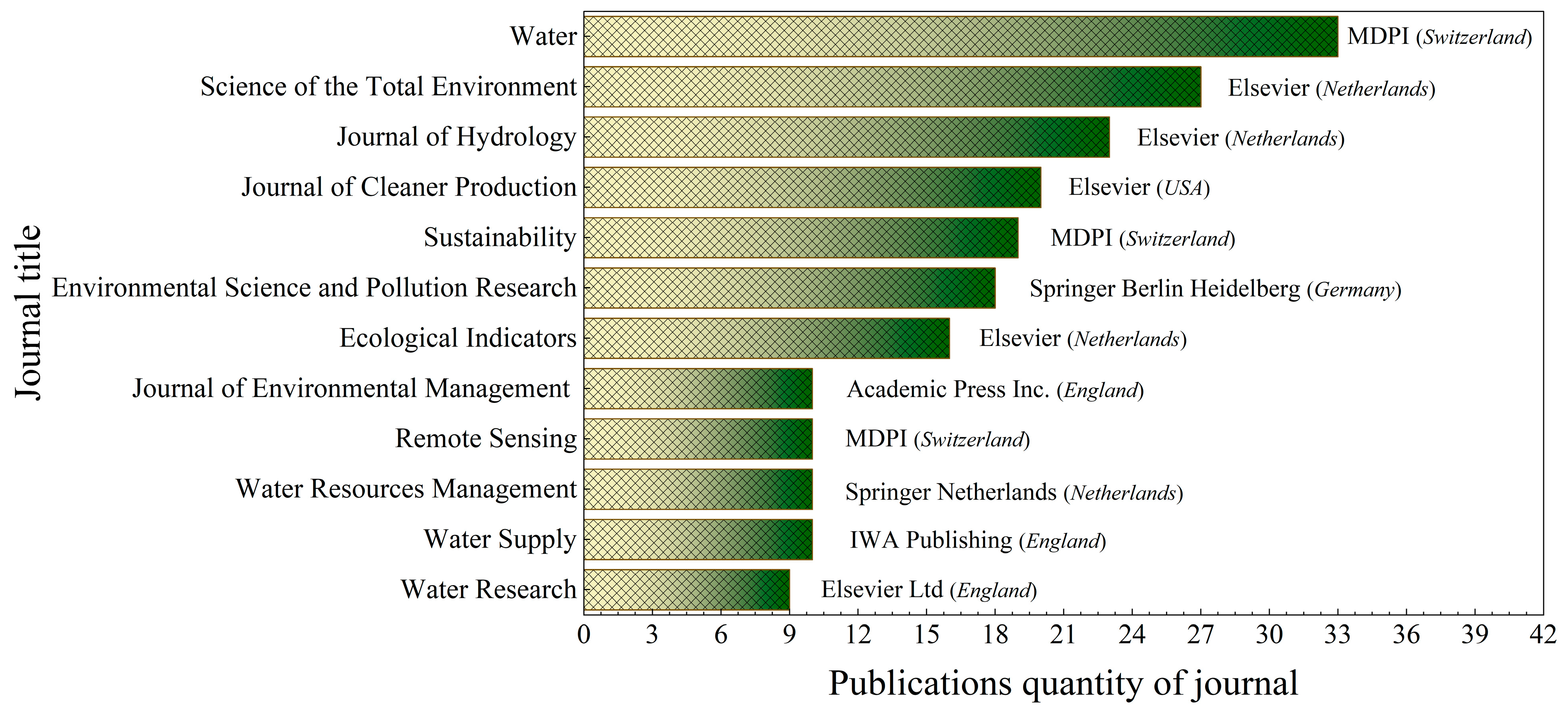
Figure 3 displays the main journals that have published information on IBWTs’ impact from 2002 to 2024. Among these, over 41.16% of the articles on the impact of IBWTs were published in the top 12 most prolific journals.
Among them, Water (IF: 3.3) from Multidisciplinary Digital Publishing Institute (MDPI) in Switzerland had the highest number of publications, primarily covering research relating to water science and technology, hydrology, ecology, and water resource management. Ranked second and third are both belong to Elsevier from the Netherlands. The Science of the Total Environment (IF: 8.7) ranked second, with a focus on research in ecohydrology, climate change, and land use. Its aim is to foster the healthy and sustainable development of the overall environment, encompassing the atmosphere, lithosphere, hydrosphere, biosphere, and anthroposphere. The third journal was the Journal of Hydrology (IF: 6.9), which encompasses disciplines such as water resource systems, hydraulics, civil engineering, and environmental engineering. It also addresses discussions on water resource management and policy issues that have economic and societal impacts. The fourth journal is Elsevier’s Journal of Cleaner Production (IF: 10.7), published in the USA and dedicated to enhancing the efficiency of energy, water, resources, and human capital utilization. It also addresses the fulfillment of sustainable development goals and conducts environmental and sustainability assessments. In summary, the majority of research on the impact of IBWTs has been predominantly published in leading hydrological and environmental science journals, with a significant concentration of these publications coming from Switzerland, the Netherlands, the USA, and the UK.
The Impact Factor (IF) and the H-index were considered when analyzing a journal’s characteristics. The IF serves as an important indicator reflecting a journal’s influence in recent years, whereas the H-index functions as a composite quantitative measure that can assess the quantity and quality of researchers’ academic output to a certain degree.
Table 1 presents the analysis results obtained from the HistCite software regarding the characteristics of the top 10 journals in the study of IBWTs’ impact, encompassing the disciplinary scope, impact factors, citation index, TLCS, and TGCS of the journals. The results indicate that in the research field of IBWT impact, the journals with the highest IF value are as follows: Journal of Cleaner Production, Science of the Total Environment, and Journal of Environmental Management. The top three journals in terms of H-index are Science of the Total Environment, Journal of Hydrology, and Journal of Cleaner Production. According to the TLCS, the three most significant publications in the research field of IBWT impact are identified as being included in the following journals: Environmental Science and Pollution Research, Science of the Total Environment, and Journal of Hydrology. Sinha et al. [38] discovered that the expansion of IBWTs has substantial social and ecological implications. They introduced an evaluation approach for IBWTs, which took into account both the water source and the water-receiving areas. This method effectively assesses current water demands and supplies, as well as potential future water transfer scenarios post-construction. The findings were published in Science of the Total Environment. In an article published in Environmental Science and Pollution Research, Jiang et al. [39] conducted an analysis of the types, concentrations, and origins of heavy metals present in the soil along the banks of the Han River basin, which is located within the water source area of the SNWDP in China. The study revealed that the heavy metals in the soil along the Han River and reservoirs in China pose a moderate ecological risk. The presence of Ba and Cd is likely attributed to industrial and mining activities, whereas Sr and Mn are primarily derived from natural rock weathering. The article advocates for increased efforts to mitigate the discharge of pollutants from mining and industrial sources into riverbanks and reservoir coastlines as a means to control heavy metal pollution in wetland soils. Zhang et al. [40] selected 19 assessment indicators across four dimensions, including the integrity of water-based ecosystems, water quality, water resource availability, and water resource utilization. A comprehensive index assessment model and a fuzzy recognition model for water cycle health were developed by utilizing the comprehensive index method and fuzzy mathematics theory. These models were applied to assess the health status of the water cycle in Beijing, as well as the water-receiving area of the SNWDP, for the period from 2010 to 2014 and the projected year (the end of 2014). The findings indicated that with the escalation of water diversion through the SNWDP and the adjustment of the industrial structure, it is anticipated that the water cycle health level in Beijing will experience further enhancement.

3.3. Cooperation Between Countries

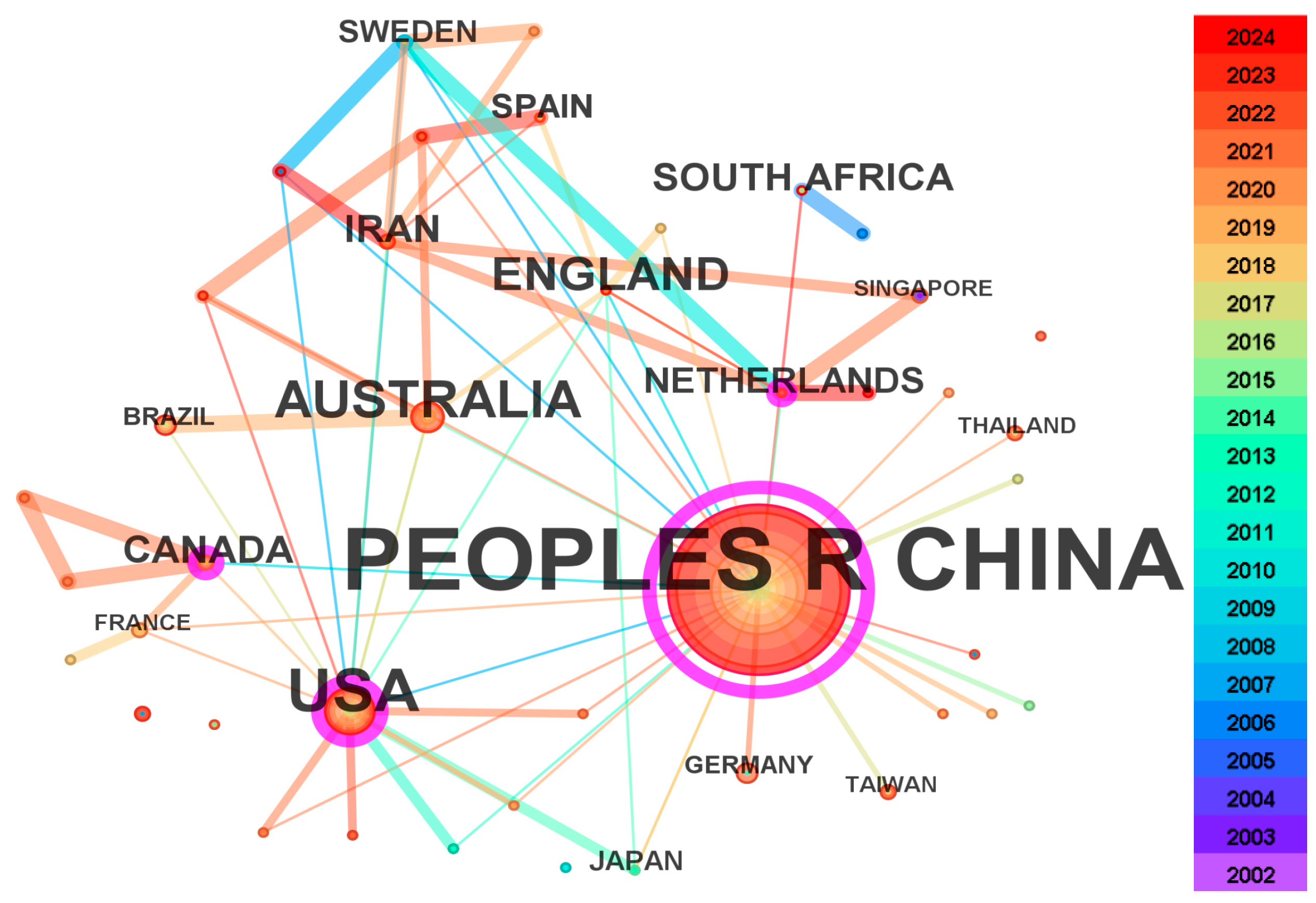
The level of research activity in a country is evaluated based on the number of publications. From 2002 to 2024, a total of 42 countries or regions published research publications on IBWTs’ impact. To further investigate the role of the country in studying the impact of IBWTs, a national cooperation network was constructed based on the co-authorship of research publications. The findings are depicted in Figure 4. All links and nodes in the network, as well as in Figure 4, are colored from purple to red, representing the time span from 2002 to 2024. Table 2 ranks the top 10 countries that have made the most significant contributions to international research on the impact of water transfer from 2002 to 2024 based on the count and centrality of their research output. As illustrated in Figure 4 and detailed in Table 2, the principal countries involved in research on the impact of IBWTs include China, the USA, Australia, the UK, and Canada, with China standing out due to its particularly large research circle. The larger the node, the greater the number of research subjects it signifies. Among them, countries such as the USA, Australia, and Canada, which were among the pioneers in conducting IBWT research, initiated large-scale water supply operations in the early 20th century. In contrast, China initiated the development of IBWTs and planning in 1965. The East Route and Middle Route projects of the SNWDP commenced construction in the early 21st century and were officially connected to the water supply in 2014 [4]. Consequently, these countries have conducted more extensive and systematic research on mitigating the adverse impacts of IBWTs. The thickness of the links between nodes indicates the frequency of cooperation between countries or regions. China has extensive cooperative relationships with numerous countries worldwide. There are close cooperative relationships among countries such as the Netherlands, Singapore, and Iran. Although Sweden and other countries have not published a substantial number of papers on the impact of IBWTs, they have engaged in close cooperation and exchanges with other nations in both the past and present. At the water conference convened by the United Nations in 2023, the “Water Action Agenda” was adopted. In response to the escalating global water resource situation, participants at the conference collectively addressed solutions, advocated for the strengthening of international cooperation, and committed to fostering the sustainable development of water resources, as well as enhancing the assessment and management of water crises, floods, and aquatic ecosystems [41].

3.4. Cooperation Between Institutions

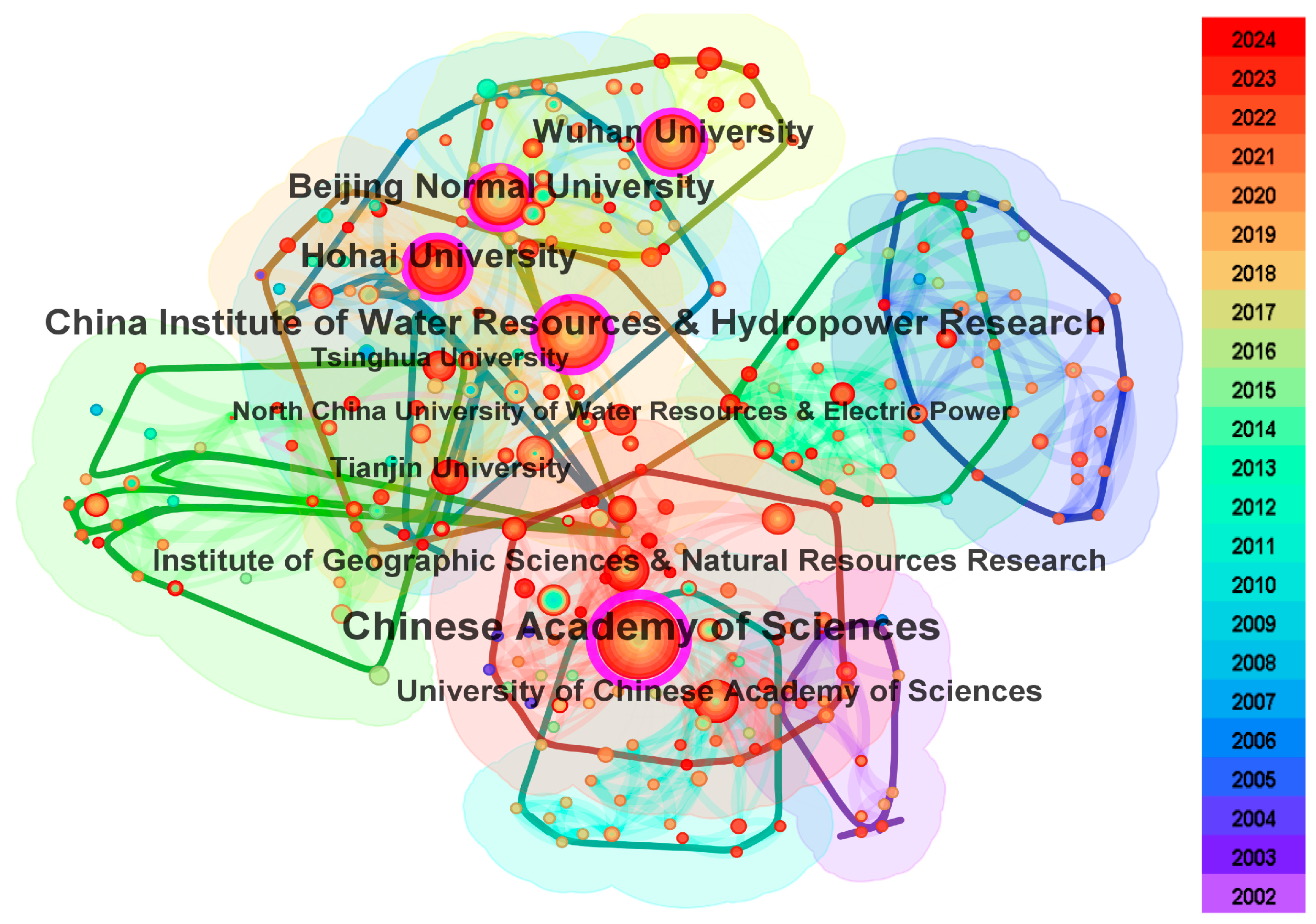
Figure 5 presents a map of research institutions engaged in the study of IBWTs’ impacts, generated using the CiteSpace software. The findings reveal that there are 557 institutions worldwide that are actively involved in researching the impact of IBWTs. The nodes within the network represent individual research institutions, with their size corresponding to the volume of publications produced by each institution. Table 3 shows that from 2002 to 2024, all of the top 10 institutions globally recognized for their publication counts in IBWTs’ impact research originated from China. In contrast, other significant teams were based in the USA, South Africa, Iran, and various other countries, including the University of California System and Arizona State University in the USA, Rhodes University in South Africa, and the University of Melbourne in Australia. Chinese academic institutions have emerged as leaders in the research field concerning the impact of IBWTs. Between 2002 and 2024, the Chinese Academy of Sciences alone published 93 papers on the subject. This outcome underscores the considerable challenges posed by IBWTs within China, highlighting an urgent need for research into IBWT initiatives. The SNWDP is an extensive water diversion initiative in China that encompasses the currently operational East Route and Middle Route projects, as well as the forthcoming construction of the West Route Project. These projects have led to a variety of issues, challenges, and response strategies that have provided Chinese experts and scholars with a wealth of practical experience and valuable lessons. Marked by the official initiation in 2009 of the Five Major Regional Key Industry Development Strategy Environmental Impact Assessment by the Ministry of Ecology and Environment of China, there has been a heightened focus on assessing regional, cumulative, and long-term environmental impacts and ecological risks. This approach emphasizes a forward-looking evaluation that begins at the early planning and demonstration stages of projects, and it involves a comprehensive multi-perspective assessment of the impacts of IBWTs. In summary, China’s SNWDP is a major national strategic project. The Middle and East Routes have been operational for only about 10 years. The issues that have gradually emerged during the operation, the demonstration of future projects (such as the West route Project), and relevant policies in China have fueled a rapidly expanding body of literature on large-scale IBWTs. However, this concentration of scholarly attention through a China-centric lens that is biased toward domestic demand in China narrows global perspectives and homogenizes research on the impacts of IBWTs. Therefore, China should draw on global best practices, scale up international cooperation.
As the institution with the highest publication counts and centrality, the Chinese Academy of Sciences has conducted an assessment of the ecological and environmental benefits associated with the Middle Route and West Route Projects of the SNWDP in China since 2004 [42,43]. A quantitative econometric model was recently introduced by the Chinese Academy of Sciences [7], and the related study revealed a significant disparity among these projects in terms of improving water use efficiency. It is widely acknowledged that China’s current IBWTs are primarily designed to satisfy the water requirements for further economic development in relatively developed areas [44]. However, provinces experiencing long-term water shortages should be incentivized to restructure their industrial structures and consequently improve their water use efficiency. The China Institute of Water Resources and Hydropower Research is dedicated to studying the impacts of IBWTs on the ecological environment, water resource protection, water ecological restoration, and conducting environmental impact assessments for water conservancy and hydropower projects. A collaborative study was jointly undertaken by South-Central Minzu University and the China Institute of Water Resources and Hydropower Research [45] that focused on the impact of the Han River’s hydrological environment within the water source area of the SNWDP in China. Utilizing an integrated model, the research delved into the genesis and progression of hydrological environmental shifts in the middle and lower reaches of the Hanjiang River. A theoretical foundation has been established by this endeavor, which supports the sustainable management of water resources and the health of the water environment in the Hanjiang River Basin. Furthermore, Yellow River Engineering Consulting Co., Ltd., which is dedicated to the high-quality development of the Yellow River Basin and the advancement of China’s national water network, has collaboratively published an achievement with the China Institute of Water Resources and Hydropower Research and Zhengzhou University [46]. All institutions jointly agree that scientific compensation for water rights trading warrants consideration from economic, social, and ecological perspectives. It is posited that the key to sustaining the development of the water market is to provide equitable compensation to water producers. Hohai University [47] has developed an emergency risk assessment model for water pollution within the SNWDP. The Water Transfer Energy Efficiency Index, developed by Yi [48] from the University of California, was employed to assess the energy efficiency of IBWTs. Serving as a critical indicator in thorough energy efficiency assessment, the index was applied to analyze the historical trends in water–energy relationships within 74 such projects worldwide. Utilizing the insights gained from this analysis, the management of water resources in these projects was subsequently optimized.

3.5. Subject Category Co-Occurrence Analysis

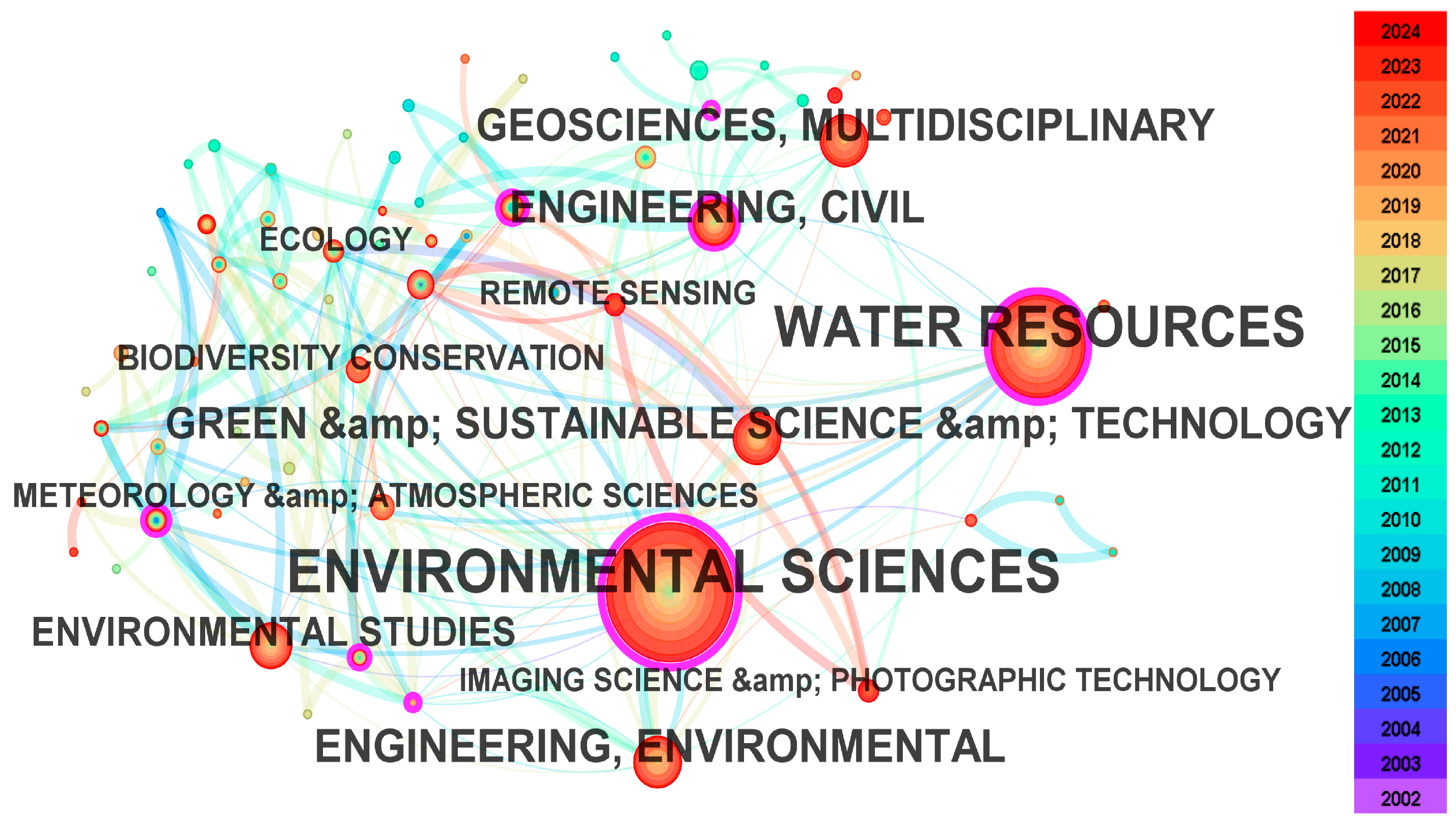
Figure 6 depicts a co-occurrence network of subject categories associated with the impact of IBWTs spanning from 2002 to 2024. Out of 498 search results, 80 topic categories were identified. The impact of IBWTs has been researched from various angles, encompassing a broad spectrum of subjects, such as “Environmental Sciences”, “Water Resources”, “Engineering, Environmental”, “Geosciences, Multidisciplinary”, “Engineering, Civil”, and “Green and Sustainable Science and Technology”, among others. From the co-occurrence analysis of subject categories, it is evident that nodes with significantly higher co-occurrence frequencies are indicative of research hotspots. The analysis revealed that nodes such as “Environmental Sciences”, “Water Resources”, “Engineering, Civil”, and “Meteorology and Atmospheric Sciences” are encircled by thick purple rings, signifying their centrality in the network. These nodes have been found to be connected to multiple others or to function as conduits, underscoring their pivotal role in bridging previous and current research.
In addition, Table 4 presents the top ten theme categories with the highest frequency of occurrence and centrality. In the domain of “Environmental Science”, a study by Zhuang [27] systematically analyzed the positive and negative impacts of IBWTs on basins. It was found that the ecological risks associated with IBWTs are substantial and challenging to accurately assess. The study emphasized the necessity of a comprehensive analysis of the water balance between basins, an enhanced assessment of ecological and environmental risks associated with IBWTs, and the implementation of ecological compensation measures to ensure the maximization of comprehensive benefits in both the water source and receiving areas. Concurrently, the study proposed raising awareness about water conservation in the region and actively seeking alternative water source solutions, such as seawater desalination and rainwater harvesting technologies. In the realm of “WATER RESOURCES”, Bozorg-Haddad et al. [49] utilized GRACE satellite data from 2002 to 2016 to assess the correlation between water scarcity and conflicts across various provinces in Iran. It was determined that if certain water source regions within Iran persist in diverting water, they may eventually become water-receiving areas. The study revealed that water diversion projects with a capacity of less than 500 Mm3/a were ineffective in Iran. Consequently, it was suggested that management strategies, including seawater desalination, water recycling, rainwater harvesting systems, and the protection and enhancement of agricultural water use systems, be considered to bolster Iran’s water supply system. In the arena of “Green and Sustainable Science and Technology”, Wilson et al. [50] assessed the economic, social, and environmental impacts of SNWDP in China. It was found that the overall sustainability of the project is a matter of debate due to the limitations in scale and discipline. The study underscored that regular sustainability assessments and adaptive management are pivotal to ensuring the long-term sustainability of IBWTs.
As part of the interdisciplinary research on the impact of IBWTs, categories within “Computer Science, Interdisciplinary Applications”, “Economics”, and “Remote Sensing” were also found to be essential. In the field of “Computer Science, Interdisciplinary Applications”, Zhang et al. [51] addressed the optimal water diversion problem for IBWTs under climate change conditions by employing the Non-Dominated Sorting Genetic Algorithm (NSGA-II). This approach has been very helpful in mitigating the potential impacts of climate change on the operation of IBWTs.
In the domain of “Economics”, Xiao et al. [52] qualitatively assessed the comprehensive impact of China’s water diversion projects on regional development, considering economic, social, and environmental perspectives, by employing the comprehensive index method. The study focused on a water transfer project from the Yangtze River to Taihu Lake, which was initiated in 2002 in China. The findings indicated that by 2016, the water transfer project had exerted a “huge positive impact”, with the full benefit of the increased water supply amounting to CNY 1.87 billion.
Table 5 also presents the top 10 subject categories that experienced explosive growth in citation numbers. Each colored line segment in Table 5 represents a yearly time slice. The red line segment depicts the explosion phase from the commencement to the culmination. Among these, “Engineering, Multidisciplinary”, “Geosciences, Multidisciplinary”, “Materials Science, Multidisciplinary”, and “Ecology” were the four subject categories that garnered the most attention. In recent years, the subjects of “Geochemistry and Geophysics”, “Geosciences, Multidisciplinary”, “Geography”, “Toxicology”, “Green and Sustainable Science and Technology”, and “Computer Science, Artificial Intelligence” have demonstrated explosive growth and significant development, emerging as important areas in the research and assessment of IBWTs. Research on the impact of IBWTs has transitioned from a single-discipline approach to multidisciplinary methods and technological applications. This shift has been particularly evident in moving from singular ecological and engineering research to a more systematic focus on green sustainable development and ecological protection. This trend signifies that an increasing number of subjects are converging to contribute positively to the assessment and research of IBWTs’ impacts. It also represents an opportunity and a challenge for the advancement of each subject involved.

3.6. Keyword Cluster Analysis

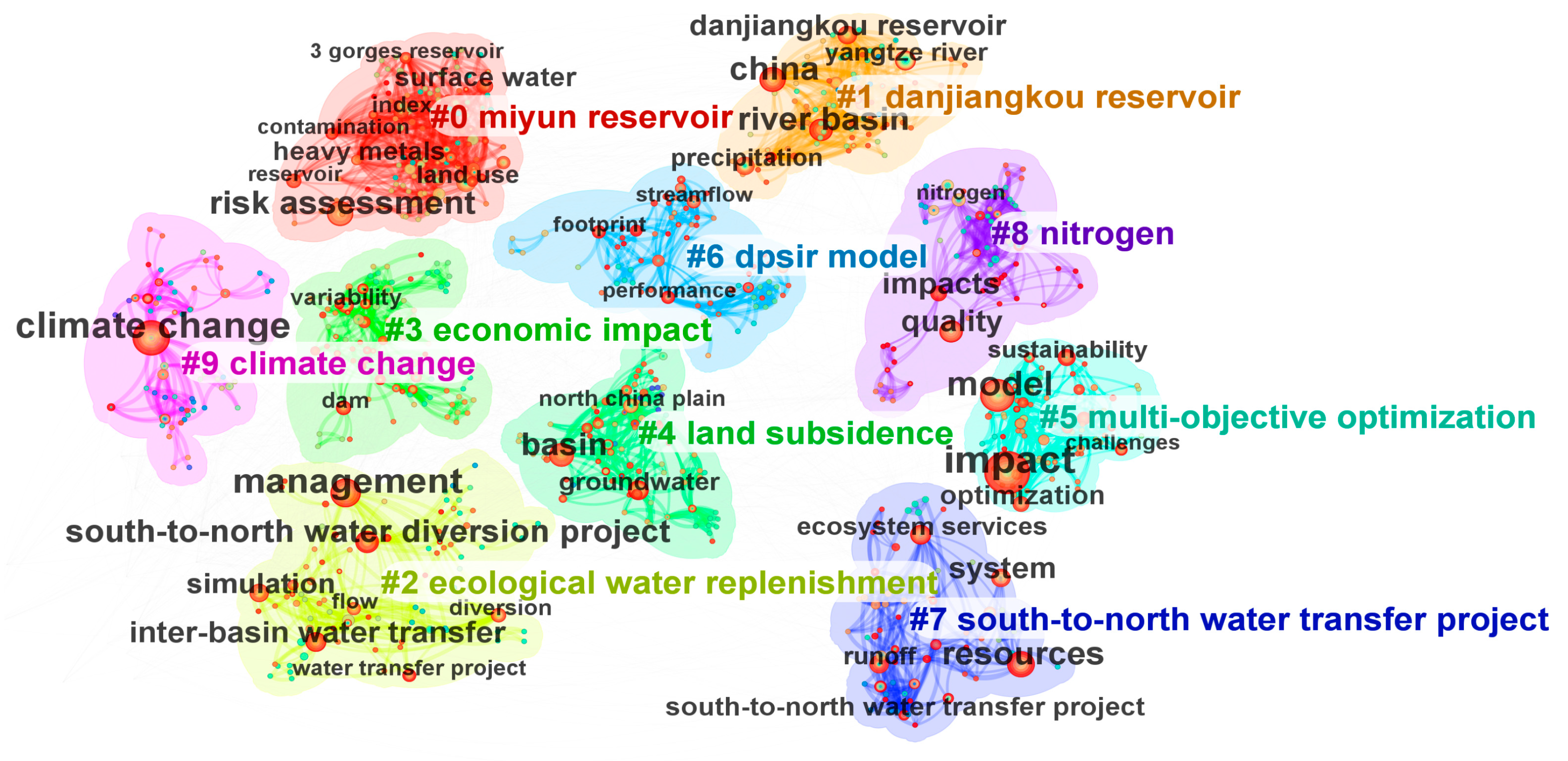
Keyword clustering analysis has proven to be a valuable technique for highlighting important research findings within specific domains. Figure 7 presents keyword information regarding the impact of IBWTs across 10 clusters. The largest cluster was denoted as #0. In this study, the values of Q and S were 0.65 and 0.85, respectively, which indicated the reliability of the research findings. Each cluster encompasses a range of themes that elucidate the research status and advancements in the impact of IBWTs across various dimensions. By categorizing these clusters and analyzing keywords and these clusters separately, scholars can attain a comprehensive understanding of the research directions within this domain.

3.6.1. Related Projects for Studying the Impact of IBWTs

Clusters #0, #1, and #7 represented specific target areas and projects for IBWTs’ impact research, with keywords encompassing Miyun Reservoir, Danjiangkou Reservoir, and the SNWDP. Collectively, Miyun Reservoir is associated with the Middle Route Project of the SNWDP, as it receives a portion of the incoming water from the project, whereas Danjiangkou Reservoir serves as the source of the Middle Route Project of the SNWDP. The planning and demonstration of IBWTs necessitate an exploration of the evolving trends in hydrological conditions within the water source areas.
The largest cluster (#0) is centered on “Miyun Reservoir” and encompasses keywords such as “risk assessment”, “heavy metals”, among others. The research findings indicate that the operation of the Middle Route Project of the SNWDP has led to a rise in the operating water level of Miyun Reservoir. Physical, biological, and chemical changes have been observed in the soil surrounding Miyun Reservoir, leading to alterations in the release of heavy metal ions from the soil. In their study, Han et al. [53] revealed that recreational land exhibited particularly high concentrations of Cr, Cu, Zn, and Cd. Coal combustion was identified as the primary anthropogenic source contributing to the levels of Zn, Cr, Cu, Cd, and Pb. Gao et al. [54] discovered that the highest Ni concentrations are present in areas designated for human recreation, and that the average soil Ni concentration along the banks of Miyun Reservoir exceeds the reported background values for both Beijing and China. Zang et al. [55] revealed that following the implementation of the SNWTP, the likelihood of elevated chlorophyll a (Chla) concentrations in Miyun Reservoir was found to escalate in conjunction with the augmentation of water storage capacity. These studies and their findings are instrumental in informing scientific risk assessments and adaptive management strategies for IBWTs.
The second principal cluster (#1) revolves around “Danjiangkou Reservoir”, encompassing keywords such as “river basin”, “precipitation”, “Yangtze River”, and “environment”, which collectively illustrate the impact of IBWTs on the water source area. The research findings indicate that Danjiangkou Reservoir serves as the water source area for the Middle Route Project of China’s SNWDP. Precipitation trends within the Danjiangkou Basin exhibited a decline around the year 2017. In response to this issue, Hu et al. [56] developed a variable parameter probability distribution function model to assess the variations in annual precipitation in the Danjiangkou region, thereby offering valuable insights for the water resource management and planning of the Middle Route Project. Liu et al. [57] determined that vegetation in the Danjiangkou reservoir area was significantly degraded, owing to the expansion of construction land. In addition, the capacity for carbon sequestration and oxygen release in the Danjiangkou reservoir has been weakened, and the organic matter production capacity within the reservoir and water level fluctuation areas has been diminished. Ma et al. [58] discovered that remote sensing data can serve as an alternative to direct sampling for assessing watershed water quality. The primary factors encompass land use classification, the proportion of source-sink landscape types, landscape flow path length, and landscape nutrient inputs.
Cluster #7, labeled “South to North Water Diversion Project”, predominantly encompasses keywords related to “resources”, “system”, “South-to-North Water Diversion Project”, “ecosystem services”. Ma et al. [59] revealed that the ecological condition of the water source area in southern Shaanxi has seen improvement following the operation of the Middle Route Project. The research indicated a shift in the center of ecological vulnerability from the southern region to the northeast and west. Li et al. [60] reported that the IBWTs have yielded positive effects on ecosystem services, which encompass hydrology, water quality, and climate, as delineated using the SWAT model. The connectivity of ecosystems should be strengthened to enhance and preserve the value and capacity of basin ecosystem services [57]. Hydrological connectivity is enhanced by IBWTs, which can readily result in biological invasion and promote homogenization among storage lakes [61]. It is believed that the transparency and nutrient load of water exert the most significant influence on the fish community structure within the lakes along the East Route Project of the SNWDP [21]. Zhang et al. [45] reported a significant decrease in runoff following the water transfer in the SNWDP, along with an increase in the duration of low-flow periods. This finding aligns with the conclusion reached by Wang et al. [62], who identified that the SNWDP would result in a reduction in runoff. As a compensatory measure, the Yangtze River-Han River Water Diversion Project (YHWD) was found to only partially mitigate the adverse effects of SNWDP on the water flow rate. The assessment should analyze the impacts on river runoff in these areas from the perspective of three key aspects—temperature, precipitation, and evaporation [63].

3.6.2. The Impact of IBWTs on the Region

Clusters #3, #4, #8, and #9 reflect the regional impacts of IBWTs, with an emphasis on terms such as “economy”, “land subsidence”, “nitrogen”, and “climate change”. These clusters highlight the multifaceted effects of such IBWTs on various aspects of the region.
Cluster #3, titled “Economic Impact”, encompasses keywords such as “variability”, “dam”, “economic impact”, and “operation”. Li et al. [64] determined that water scarcity in southern China was the result of a multitude of socio-economic factors, and that surface water pollution intensified the water shortage issue in both Southern and Northern China. Xu and Yang [65] discovered that the economic condition in regions impacted by the SNWDP in China had improved by 18%. Domestic water supply from the diversion shifted the recipient economy toward high-value services. By securing ample domestic water, the diversion project enabled the recipient region to restructure its economy around high-value services. Zhang et al. [66] revealed that under extreme weather conditions, the economic losses resulting from the diversion of 9.5 billion m3 and 14.5 billion m3 of water could amount to CNY 0.669–1.32 billion. The researchers concurred that the implementation of macroeconomic policies might enhance the sustainability of water use. Furthermore, Wilson et al. [50] posited that the economic benefits derived from IBWTs were largely contingent upon the assumptions made within their models. Matete and Hassan [67] developed the Multi-Country Ecological Social Accounting Matrix (MC-ESAM) to assess the economic costs and benefits of international IBWTs. Shumilova et al. [68] calculated that the construction costs of large-scale IBWTs globally had exceeded USD 2.7 trillion, which surpassed the estimated investment in 3700 large hydropower dams.
The fifth cluster (#4) is centered around “Land Subsidence”, with keywords including “basin”, “North China Plain”, “groundwater”, “assessment”, and “deformation”. Sun et al. [69] determined that the implementation of the SNWDP resulted in a 4% reduction in the area of the Beijing Plain experiencing a ground subsidence rate exceeding 50 mm/a. The operation of the Middle Route Project was found to have a positive impact on the overall ground subsidence of the Beijing Plain. Du et al. [70] identified three periods of surface displacement changes in the Middle Route Project—the pre-effect stage, the effective stage, and the post-effective stage. Furthermore, Bai et al. [71] determined that the reasons for the improvement in the changes in the groundwater level in Beijing also encompassed the reduction in groundwater extraction, the utilization of recycled water for environmental purposes, and the decrease in agricultural water usage. Hu et al. [72] determined that by adjusting the method of groundwater extraction and implementing total volume control, the economic losses caused by land subsidence in Tianjin Binhai New Area could be significantly mitigated. The researchers recommended enhancing land subsidence control through a combination of technical, administrative, and economic measures, as well as increasing investment in disaster prevention and mitigation to further reduce the economic losses attributable to land subsidence.
Cluster #8 centers around “Nitrogen”, encompassing topics such as “quality”, “impacts”, and “nitrogen”. It has been indicated by the research findings that water yield and total nitrogen constitute the two most significant indicators reflecting the impact of IBWTs on ecosystem services [60]. Zhang et al. [45] reported that the comprehensive assessment index of water quality in the lower reaches of the Han River saw a significant increase, while the allowable nutrient assimilation capacity experienced a significant decrease, which was attributed to the rise in concentrations of NH3-N, TP, and BOD5. Jiao et al. [73] observed that the residual water environmental capacity for total nitrogen (TN) in the Fen River Basin of the water-receiving area exhibited an increase during the rainy season and a decrease during the dry season. Tong et al. [74] have posited that the control of nitrogen and phosphorus fertilizer usage, as well as the discharge of nitrogen-containing organic compounds, constitutes one of the pivotal strategies for safeguarding the water quality of the Dongyu River and ensuring the water safety of the East Route Project. Furthermore, it is possible to establish a water quality model encompassing indicators such as TN, Chla, and permanganate value (CODMn) to effectively assess the overall water quality of IBWTs, which, in turn, facilitates the formulation and optimization of water quality management strategies [75]. By utilizing the Water Quality Index (WQI), Qu et al. [76] proposed that the effective management of the Middle Route Project should include strategies to mitigate the presence of high nitrogen levels during the active diversion periods and high phosphorus levels during the dormant seasons.
Cluster #9 (Climate Change) encompasses the topics of “climate change”, “system”, and “water resource control”. Xia et al. [77] revealed that the annual groundwater extraction and runoff in the Haihe River Basin have decreased under the combined effects of the SNWDP operation and climate change, while groundwater reserves and levels have increased. Ning et al. [78] discovered that climate change is projected to result in increased temperatures and precipitation levels in the water source area of the West Route Project. The findings could potentially provide some support for the planning of the West Route Project. Khadem et al. [79] discovered that even under the most arid climate conditions anticipated, the North–South Inter-Basin Transfer Project in the UK is capable of addressing London’s projected water deficit. Duan et al. [80] observed that the proportion of inefficient IBWTs in the USA had escalated to over 32% by the end of the 21st century. They posited that climate change and socio-economic factors significantly impact the efficiency of these transfers. Furthermore, an optimal water resource allocation model that incorporates the effects of climate change and human activities has been proposed by Liu et al. [81]. This model advocates for water conservation and the dynamic management of reservoir operation flood control levels (FLWL) to mitigate water scarcity and the adverse effects of the Midline Route Project. A proposal for constructing a resilient water system has been presented, with the objective of enhancing the resilience of water resources. The green solutions involve the preservation of forests and wetlands, while the gray solutions focus on increasing water supply through methods like seawater desalination and wastewater reuse, strengthening the storage of surface reservoirs and depleted aquifers, and transporting water [82].

3.6.3. Strategies and Methodologies for Mitigating the Impacts of IBWTs

Additionally, clusters #2, #5, and #6 delineate strategies and methodologies for mitigating the impacts of IBWTs. These clusters concentrate on employing driving force–pressure–state–impact–response (DPSIR) models to assess the degree of impact [83], executing ecological water replenishment to aid in water conservation, as well as engaging in multi-objective optimization [84,85]. These approaches are specifically manifested in the impact assessment, management, and simulation optimization of IBWTs.
The third cluster (#2) focuses on “Ecological Water Replenishment”, with keywords such as “management”, “South-to-North Water Diversion Project”, “diversion”, and “simulation”. Zhang et al. [86] applied the MIKE21 hydrodynamic water quality model to the ecological water replenishment plan for Baiguishan Reservoir, which is situated in the receiving area of the SNWDP. The study revealed that under the premise of a constant water replenishment volume, high-flow and short-duration water replenishment strategies exerted a more substantial impact on enhancing the water environment. Ding et al. [87] took into account the environmental risks associated with the comprehensive utilization of water age. Utilizing the two-dimensional lattice Boltzmann water age theory, they determined the optimal inlet position and flow velocity for water diversion. This determination was instrumental in ensuring the sustainability of ecological water replenishment schemes for wetlands. The planning and demonstration of IBWTs must incorporate hydrological risk assessment and regulatory research, particularly to safeguard the stable operation of these projects under extreme climate conditions [88].
Cluster number six (#5) centers on “Multi-Objective Optimization”, with a focus on “impact”, “model”, “sustainability”, “optimization”, “challenges”, and “policy”. Multi-objective models should effectively balance the interplay between water resources and the benefits accrued to society, economy, ecology, and the environment, thereby facilitating the optimal operation and scientific management of intricate water resource systems. For instance, multi-objective models that have concurrently taken into account the minimal ecological water shortage degree; maximal power generation; the maximization of the annual minimum output [89]; multi-objective reservoir optimal operation models predicated on Net Power Generation (NPG), Water Shortage Index of the Intake Areas (WSI-IA), and Water Shortage Index of the Ecosystem (WSI-E) [90]; as well as nexus system-weighted multi-objective models predicated on the trio of objectives concerning water resource utilization, energy production, and riverine environmental conservation [91], have been developed. The priority-based multi-objective programming (MOP) model incorporating fuzzy random variables (FRVs), established by Zhao et al. [84], optimizes various objectives in accordance with the established hierarchy of priorities. For the Middle Route Project, the hierarchy of priorities is as follows: social objective takes precedence, followed by ecological objective, environmental objective, and, finally, economic objective. It was found by Sunkara and Singh [92] that the strategy predicated on annual scale reliability assessments was considerably more effective than those predicated on seasonal and biweekly scales. Internationally recognized standards for the design, performance, and impact assessment of IBWTs on human and ecosystem health have not been established, despite their importance in national water resources management plans [68].
The seventh cluster (#6) revolves around the “DPSIR Model”, with keywords including “streamflow” and “performance”. The DPSIR model, which is recognized for its efficacy and comprehensiveness in analyzing and resolving the interplay between environmental factors and social development, has found extensive application across various domains, including environmental management, water and soil resource management, and sustainable development. Yang et al. [93] proposed a comprehensive risk assessment tool using the DPSIR model, which further provided decision support for the assessment and handling of emergency water pollution accidents in the Middle Route Project. Zhang et al. [47] established an emergency risk assessment index system for water pollution within the SNWDP, utilizing the DPSIR model. Using the DPSIR model, Sun et al. [83] meticulously constructed an ecological security evaluation index system for the water source area of Nanyang City and then proposed targeted safeguards.

3.7. Research Emphasis and Development Tendency of IBWT Impacts

A comprehensive summary has been created on the research focus and developmental trends concerning the impact of IBWTs over the past 23 years, drawing upon key studies and pressing issues within this domain.

3.7.1. The Impact Mechanism of IBWTs

The impact process of IBWTs on the natural environment is characterized by alterations to the original hydrological conditions, which subsequently induce changes in the natural environment and ultimately result in shifts within the socio-economic context. Consequently, the impacts of such IBWTs are primarily manifested in the realms of hydrology and water resources, the ecological environment, and socio-economic aspects. Within the scope of hydrological and water resources, factors such as water volume, runoff, and water level are considered. It is imperative to incorporate climate factors to analyze variations in river runoff and local precipitation. The ecological environment encompasses factors including the satisfactory ratio of eco-water demand, water quality, vegetation coverage, and the diversity of animal and plant species. Socio-economic aspects encompass changes in immigration impacts, population size, urbanization rates, per capita GDP, and industrial structure, among others. Furthermore, in water source areas with significant hydroelectric power generation capabilities, it is essential to account for the economic losses associated with the utilization of water energy [94]. For instance, the water source area of the West Route Project is situated in the upper reaches of the Yangtze River. Given the substantial river gradient and abundant water resources in this region, a reduction in water volume will inevitably result in the loss of hydropower resources within the basin.

3.7.2. Assessment of and Response to the Impact of IBWTs

The concept of ecological water conservancy has emerged, necessitating the construction of ecological civilization with a focus on ecological protection, ensuring the dialectical unity of resources, the environment, and ecological functions [95]. Suggestions and requirements for ecological water conservancy include considering IBWTs from an ecosystem-wide perspective, coordinating the development of water resources, the ecological environment, and economic construction across multiple dimensions. Furthermore, it is essential to integrate the entire process of engineering, planning, design, construction management, and operation scheduling at the current stage in order to achieve the dual goals of ecological environment protection and the high-quality development of the social economy.
Ecological remediation for existing IBWTs has predominantly employed a piecemeal remedial approach, akin to “treating the head when it hurts and the foot when it hurts”. For instance, the West–East Water Transfer Project in Pakistan addresses channel salinization through salinity control reclamation engineering. In Australia, the Snowy River achieves ecological flow maintenance by reconstructing the discharge outlet of the Jinde Dam. Meanwhile, the main canal section of the California Waterway Project has largely been kept fully open. In recent years, safety measures have been implemented to prevent personal injury and waste dumping that could affect water quality; however, their benefit has been minimal [4]. As our understanding of the impacts of IBWTs continues to deepen, proactive preventive planning prior to project construction has emerged as a crucial strategy for mitigating a range of impacts associated with such projects. This approach is in contrast to the reactive ecological environment restoration efforts typically undertaken for existing projects.
An evaluation index system and model have been constructed to assess the impact of IBWTs on regional hydrology and water resources, the ecological environment, and socio-economic development. These tools clarify the scope and degree of the impact that is associated with IBWT schemes, proposing proactive preventive measures to be implemented throughout the entire lifecycle of IBWTs. They provide valuable insights into the planning and design of such IBWTs, as well as for their subsequent high-quality development. Among them, scholars have proposed comprehensive assessment index systems based on the driving force–pressure–state–impact–response model, the water resource–economic society–ecological environment model, the pressure–state–response model, the resource–society–economy–environment–engineering technology model, the physical elements–biological elements–social production factors model, and others [47,54,76,96,97,98,99].

3.7.3. The Development Tendency of Research on the Impact of IBWTs

Drawing on disciplinary insights from citation-burst and keyword-cluster analyses, three priority topics for future research into the impacts of IBWTs are identified and delineated.
(1)
Long-term hydro-eco–economic linkages between donor and recipient basins remain poorly understood. In particular, how to ensure water supply safety and ecological integrity under extreme conditions is an urgent problem to be solved. IBWTs urgently necessitate an integration of the actual engineering plan for both the water source and water-receiving areas, as well as consideration of local climate characteristics, in order to conduct a systematic identification and analysis of the project’s influencing factors.
(2)
Internationally accepted standards are lacking in the design, performance, and ecological-impact assessment of IBWTs. A unified interdisciplinary framework should be established, integrating environmental science, water resources, and related fields, and then establish internationally recognized standards on both human and ecosystem health. And large-scale IBWTs should be integral to the national water resources management plan.
(3)
Real-time risk-warning models for IBWTs (e.g., heavy-metal pollution, land subsidence) should be incorporated with AI and remote-sensing technologies to support life-cycle adaptive management of projects. The incorporation of advanced technologies, such as machine learning algorithms, is essential for establishing correlations between the influencing factors of IBWTs. For instance, there is a significant correlation to be determined between indices like the fish community index and water quality indicators in lakes. This approach aids in gaining a comprehensive understanding and successfully managing the impacts of IBWTs on the environment and society.

4. Conclusions

4.1. Summary

In this study, the distribution characteristics, international cooperation among countries/regions and institutions, co-occurrence of disciplinary categories, research hotspots, and development trends within the field of IBWT impact research from 2002 to 2024 were analyzed using CiteSpace and HistCite. The principal findings of this study are as follows.
(1)
It has been observed that the total number of publications on the impact of IBWTs is positively correlated with time, indicating a potential for continued rapid growth in the coming years. Notably, the academic journals that have published research on the impact of IBWTs include Water, Science of the Total Environment, Journal of Hydrology, and Journal of Cleaner Production. Within the domain of IBWT impact research, China, the USA, Australia, the UK, and Canada have been prominent, engaging in high-level cooperation with other countries and regions. Institutions in China have been particularly active, with the Chinese Academy of Sciences being notably prominent. The SNWDP in China is expected to maintain a significant position in the study of IBWT impacts, both currently and in the future.
(2)
The study of IBWTs’ impacts encompasses a multitude of disciplinary fields, characterizing it as a quintessential interdisciplinary research area. These subject categories span 80 distinct groups, with notable representation in “Environmental Sciences”, “Water Resources”, “Engineering, Environmental”, “Geosciences, Multidisciplinary”, “Engineering, Civil” and “Green and Sustainable Science and Technology”, “Environmental Studies”, “Biodiversity Conservation”, and “Ecology”. In recent years, there has been a significant expansion in topics such as “Geosciences, Multidisciplinary”, “Green and Sustainable Science and Technology”, and “Computer Science, Artificial Intelligence”, which have emerged as pivotal areas for the study and assessment of water diversion impacts.
(3)
Research hotspots in the field of the impact of IBWTs are primarily concentrated on scientifically assessing the effects on water source areas, water-receiving areas, and areas along the transmission routes of such projects, as well as proposing viable response strategies and methods. The focus is predominantly on aspects such as “heavy metals”, “water quality”, “nitrogen”, “land subsidence”, “economy”, “climate change”, “modeling”, “control”, “ecological water replenishment”, and “evaluation”. A systematic study of the IBWTs’ impacts from hydrological and water resources, ecological environment, and economic and social perspectives remains a critical priority for future research. The models for studying the impacts of IBWTs mainly include DPSIR and multi-objective optimization, which aid in formulating response strategies.
This study presents new methodologies for analyzing the trends in research on the impact of IBWTs, and it can assist international scholars in gaining a more detailed understanding of the research hotspots and trends in this field. However, it should be noted that despite its value, CiteSpace analysis is currently limited.

4.2. Outlook

We outline the following forward-looking priorities that capture emerging hot topics and trends in whole-basin impact research on IBWTs.
(1)
Probe the long-term hydro-ecological–economic nexus between donor and recipient basins, with an emphasis on safeguarding both water-supply security and ecological integrity under extreme events. It is recommended to enhance water conservation measures and develop adaptive and flexible water transfer strategies that align with environmental shifts.
(2)
Forge an international consensus on design, performance and eco-impact benchmarks for IBWTs and embed these standards in national water resource governance.
(3)
Couple AI with remote-sensing technologies to create a real-time risk-warning platform that enables adaptive, life-cycle management of IBWTs.
To ensure the healthy operation of IBWTs and optimize the realization of their benefits, ongoing exploration and efforts are required in sustainable utilization, technological innovation, standard setting, and policy research. Strengthening cooperation among countries and institutions across various related disciplines is imperative to developing effective solutions that guarantee high-quality, sustainable IBWT development and advance the sustainable management of global water resources.
For the research community, consider establishing a dedicated fund or platform for IBWT technology that regularly hosts technical forums to share best practices and catalyze joint R&D on key technologies. Government agencies and international standards organizations should take the lead, working closely with water authorities and research institutes to build a comprehensive policy-and-case database that will inform better policy design for sustainable development. Concurrently, differences among national standards for water-quality safety, ecological assessment, and engineering operation and maintenance should be systematically mapped with the aim of producing a consensus reference list.

Author Contributions

T.H.: investigation, methodology, visualization, and writing—original draft. L.J.: writing—review and editing and funding acquisition. D.Y.: conceptualization, writing—review and editing, and funding acquisition. Y.L.: conceptualization, methodology, and writing—review and editing. X.F.: writing—review and editing. All authors have read and agreed to the published version of the manuscript.

Funding

The financial support of the National Key Research and Development Project of China (2022YFC3202405), the National Natural Science Foundation of China (52209038), and the Youth Talent Support Program of Henan Province (2023HYTP017) is gratefully acknowledged.

Data Availability Statement

The data pertaining to this study are available in the article’s Results Section; further inquiries can be directed to the corresponding author.

Conflicts of Interest

Authors Laihong Jing, Dengming Yan, Yisi Lu, and Xinying Fan were employed by the Yellow River Engineering Consulting Co., Ltd. The remaining authors declare that the research was conducted in the absence of any commercial or financial relationships that could be construed as a potential conflict of interest.

References

  1. Dou, X.S. China’s inter-basin water management in the context of regional water shortage. Sustain. Water Resour. Manag. 2017, 4, 519–526. [Google Scholar] [CrossRef]
  2. Yu, M.; Wang, C.R.; Liu, Y.; Olsson, G.; Wang, C.Y. Sustainability of mega water diversion projects: Experience and lessons from China. Sci. Total Environ. 2018, 619–620, 721–731. [Google Scholar] [CrossRef] [PubMed]
  3. Sun, S.A.; Zhou, X.; Liu, H.X.; Jiang, Y.Z.; Zhou, H.C.; Zhang, C.; Fu, G.T. Unraveling the effect of inter-basin water transfer on reducing water scarcity and its inequality in China. Water Res. 2021, 194, 116931. [Google Scholar] [CrossRef]
  4. Wang, G.Q.; Ouyang, Q.; Zhang, Y.D.; Wei, J.H.; Ren, Z.Y. World Water Diversion Project; Science Press: Beijing, China, 2009. [Google Scholar]
  5. Sheng, J.C.; Zhang, R.Z.; Yang, H.Q. Inter-basin water transfers and water rebound effects: The South-North water transfer Project in China. J. Hydrol. 2024, 638, 131516. [Google Scholar] [CrossRef]
  6. Gao, Y.Y.; Xu, Z.K.; Yao, J.W.; Yin, X.L. Water transfer projects and the regional distribution characteristics analysis of China. South North Water Divers. Water Sci. Technol. 2016, 14, 173–177. [Google Scholar]
  7. Ma, L.; Wang, Q. Do water transfer projects promote water use efficiency? Case study of South-to-North Water Transfer Project in Yellow River Basin of China. Water 2024, 16, 1367. [Google Scholar] [CrossRef]
  8. Jing, L.H. Research on allocation and effects of water diversion by Stage Ⅰ Project of the West Route of South-to-North Water Transfer. Yellow River 2016, 38, 122–125. [Google Scholar]
  9. Wang, Y.L.; He, W. Calculation of urban water resources utilization efficiency and analysis of its influencing fators in water affected areas of the South-to-North Water Diversion Project. Acta Sci. Circ. 2023, 44, 438–450. [Google Scholar]
  10. Long, D.; Yang, W.T.; Scanlon, B.R.; Zhao, J.S.; Liu, D.G.; Burek, P.; Pan, Y.; You, L.Z.; Wada, Y. South-to-North Water Diversion stabilizing Beijing’s groundwater levels. Nat. Commun. 2020, 11, 3665. [Google Scholar] [CrossRef]
  11. Zhang, Z.X.; Ma, C.M.; Zhang, D.; Ma, Y.H.; Huang, P. Integrating the impact of large-scale hydraulic engineering with a sustainable groundwater development strategy: A case study of Zhengzhou City, China. Sci. Total Environ. 2022, 838, 156579. [Google Scholar] [CrossRef]
  12. Faúndez, M.; Alcayaga, H.; Walters, J.; Pizarro, A.; Soto-Alvarez, M. Sustainability of water transfer projects: A systematic review. Sci. Total Environ. 2023, 860, 160500. [Google Scholar] [CrossRef]
  13. Nong, X.Z.; Shao, D.G.; Zhong, H.; Liang, J.K. Evaluation of water quality in the South-to-North Water Diversion Project of China using the water quality index (WQI) method. Water Res. 2020, 178, 115781. [Google Scholar] [CrossRef] [PubMed]
  14. Zuo, D.K.; Liu, C.M.; Xu, Y.X. Preliminary study of the impacts of water transfer from South to North on natural environment. Geogr. Res. 1982, 1, 31–39. [Google Scholar]
  15. Zhang, J.H.; Bing, J.P.; Li, X.C.; Guo, L.Q.; Deng, Z.M.; Wang, D.W.; Liu, L.S. Inter-basin water transfer enhances the human health risk of heavy metals in the middle and lower Han River, China. J. Hydrol. 2022, 613, 128423. [Google Scholar] [CrossRef]
  16. Xu, S.J.; Lin, D.C.; Zou, C.W. Impact of inter-basin water diversion on ecological environment of middle and lower reaches of Hanjiang River and countermeasure suggestion. Yangtze River 2010, 41, 1–4. [Google Scholar] [CrossRef]
  17. Yan, H.L.; Lin, Y.Q.; Chen, Q.W.; Zhang, J.Y.; He, S.F.; Feng, T.; Wang, Z.Y.; Chen, C.; Ding, J. A review of the eco-environmental impacts of the South-to-North Water Diversion: Implications for interbasin water transfers. Engineering 2023, 30, 161–169. [Google Scholar] [CrossRef]
  18. Masero, A.J.; Pérez-González, M.; Basadre, M.; Otero-Saavedra, M. Food supply for waders (Aves: Charadrii) in an estuarine area in the Bay of Cádiz (SW Iberian Peninsula). Acta Oecol. 1999, 20, 429–434. [Google Scholar] [CrossRef]
  19. Yuan, R.Q.; Zhang, W.X.; Wang, P.; Wang, S.Q. Impacts of water transfer from the Yellow River on water environment in the receiving area of the Fenhe River. J. Nat. Resour. 2018, 33, 1416–1426. [Google Scholar]
  20. Wei, C.L. Snow Mountain Water Diversion Project in Australian. World Agric. 2001, 271, 29–31. [Google Scholar]
  21. Guo, C.B.; Chen, Y.S.; Liu, H.; Lu, Y.; Qu, X.; Yuan, H.; Lek, S.; Xie, S.G. Modelling fish communities in relation to water quality in the impounded lakes of China’s South-to-North Water Diversion Project. Ecol. Model. 2019, 397, 25–35. [Google Scholar] [CrossRef]
  22. Luo, H.; Zhou, X.X. Analysis on ecological impact identification and evaluation index system of inter basin water diversion project. Environ. Sci. Manag. 2017, 42, 190–194. [Google Scholar]
  23. Lu, L.J.; Chen, Y.C.; Li, M.J.; Lei, X.H.; Ni, Q.W.; Liu, Z.W. Spatiotemporal characteristics and potential pollution factors of water quality in the eastern route of the South-to-North Water Diversion Project in China. J. Hydrol. 2024, 638, 131523. [Google Scholar] [CrossRef]
  24. Wu, Y.; Zhou, C.Y.; Hu, W.Y.; Li, M.Y.; Ding, L. Spatial distribution and driving force analysis of soil heavy metals in the water source area of the middle route of the South-to-North Water Diversion Project. Ecol. Indic. 2024, 163, 112126. [Google Scholar] [CrossRef]
  25. Fan, D.; Zeng, S.D.; Du, H.; Ren, Y.X.; Xia, J. Projected flow regimes and biodiversity changes under climate change in the planning western route source areas of the South-to-North Water Diversion Project. Ecol. Indic. 2023, 154, 110827. [Google Scholar] [CrossRef]
  26. Li, X.S.; Zhang, J.P. Evaluation on coordinated development between economic society and ecological environment of water resources district of the South-to-North Water Diversion Project. South North Water Divers. Water Sci. Technol. 2014, 12, 113–116, 141. [Google Scholar]
  27. Zhuang, W. Eco-environmental impact of inter-basin water transfer projects: A review. Environ. Sci. Pollut. Res. 2016, 23, 12867–12879. [Google Scholar] [CrossRef]
  28. Boros, A.; Gordos, B.; Tőzsér, D. A bibliometric analysis-based literature review of the relationship between sustainable water management and green innovations in the agricultural sector. Heliyon 2024, 10, e33364. [Google Scholar] [CrossRef]
  29. Cui, W.W.; Dong, X.Q.; Li, X.Q.; Zhang, J.Y.; Lu, Y.S.; Yang, F. Research status and emerging trends in remediation of contaminated sites: A bibliometric network analysis. Environ. Rev. 2023, 31, 542–564. [Google Scholar] [CrossRef]
  30. Duan, H.X.; Zeng, W.H.; Chen, J.J. Study on the carrying capacity of “ecology, environment and resources” based on visualization analysis. China Environ. Sci. 2023, 43, 5031–5040. [Google Scholar]
  31. Qin, F.L.; Zhu, Y.; Ao, T.Q.; Chen, T. The development trend and research frontiers of distributed hydrological models--visual bibliometric analysis based on Citespace. Water 2021, 13, 174. [Google Scholar] [CrossRef]
  32. Chen, C.M.; Chen, Y.; Horowitz, M.; Hou, H.Y.; Liu, Z.Y.; Pellegrino, D. Towards an explanatory and computational theory of scientific discovery. J. Informetr. 2009, 3, 191–209. [Google Scholar] [CrossRef]
  33. Irfan, M.; Liu, X.H.; Hussain, K.M.; Suraya, M.; Cabrera, J.; Zhang, P.P. The global research trend on cadmium in freshwater: A bibliometric review. Environ. Sci. Pollut. Res. 2023, 30, 71585–71598. [Google Scholar] [CrossRef] [PubMed]
  34. Zhang, Y.; Li, C.; Ji, X.H.; Yun, C.L.; Wang, M.L.; Luo, X.G. The knowledge domain and emerging trends in phytoremediation: A scientometric analysis with CiteSpace. Environ. Sci. Pollut. Res. 2020, 27, 15515–15536. [Google Scholar] [CrossRef] [PubMed]
  35. Chen, C.M. Searching for intellectual turning points: Progressive knowledge domain visualization. Proc. Natl. Acad. Sci. USA 2004, 101, 5303–5310. [Google Scholar] [CrossRef] [PubMed]
  36. Sun, Y.M.; Shen, J.L.; Sun, Z.Q.; Ma, F.J.; Jones, K.C.; Gu, Q.B. A bibliometric analysis and assessment of priorities for heavy metal bioavailability research and risk management in contaminated land. Environ. Geochem. Health 2023, 45, 2691–2704. [Google Scholar] [CrossRef]
  37. Bar-Ilan, J. Which h-index? - A comparison of WoS, Scopus and Google Scholar. Scientometrics 2008, 74, 257–271. [Google Scholar] [CrossRef]
  38. Sinha, P.; Rollason, E.; Bracken, L.J.; Wainwright, J.; Reaney, S.M. A new framework for integrated, holistic, and transparent evaluation of inter-basin water transfer schemes. Sci. Total Environ. 2020, 721, 137646. [Google Scholar] [CrossRef]
  39. Jiang, X.L.; Xiong, Z.Q.; Liu, H.; Liu, G.H.; Liu, W.Z. Distribution, source identification, and ecological risk assessment of heavy metals in wetland soils of a river–reservoir system. Environ. Sci. Pollut. Res. 2016, 24, 436–444. [Google Scholar] [CrossRef]
  40. Zhang, S.H.; Fan, W.W.; Yi, Y.J.; Zhao, Y.; Liu, J.H. Evaluation method for regional water cycle health based on nature-society water cycle theory. J. Hydrol. 2017, 551, 352–364. [Google Scholar] [CrossRef]
  41. Liu, Y. The United Nations adopts “the Water Action Agenda”. Ecol. Econ. 2023, 39, 1–4. [Google Scholar]
  42. Yang, R.J.; Liu, G.H.; Zhao, F.Z.; Fu, B.J. Eco-environmental benefit assessment of the western route in China’s South-North Water Transfer Project. Int. J. Sustain. Dev. World Ecol. 2005, 12, 461–470. [Google Scholar] [CrossRef]
  43. Duan, G.M.; Zhao, J.Z.; Liu, G.H.; Ke, B.; Xiao, H.; Wu, G.; Deng, H.B. Eco-environmental benefit assessment of China’s South-North Water Transfer Scheme--the middle route project. J. Environ. Sci. 2004, 16, 308–315. [Google Scholar]
  44. Liu, Y.B.; Han, B.L.; Lu, F.; Gong, C.; Ouyang, Z.Y.; Jiang, C.Q.; Zhang, X.L. Improving water efficiency is more effective in mitigating water stress than water transfer in Chinese cities. iScience 2024, 27, 109195. [Google Scholar] [CrossRef] [PubMed]
  45. Zhang, J.H.; Guo, L.Q.; Huang, T.; Zhang, D.D.; Deng, Z.M.; Liu, L.S.; Yan, T. Hydro-environmental response to the inter-basin water resource development in the middle and lower Han River, China. Hydrol. Res. 2022, 53, 141–155. [Google Scholar] [CrossRef]
  46. Lv, C.M.; Niu, J.L.; Ling, M.H.; Wu, Z.N.; Yan, D.H. Quantitative study on eco-economic compensation for water rights trading along the South-to-North Water Diversion Project in China. Water Supply 2022, 22, 8893–8906. [Google Scholar] [CrossRef]
  47. Zhang, X.Y.; Chen, J.F.; Yu, C.; Wang, Q.; Ding, T.H. Emergency risk assessment of sudden water pollution in South-to-North Water Diversion Project in China based on driving force–pressure–state–impact–response (DPSIR) model and variable fuzzy set. Environ. Dev. Sustain. 2023, 26, 20233–20253. [Google Scholar] [CrossRef]
  48. Yi, S.Y. Water Transfer Energy Efficiency Index for inter-basin water transfer projects. Water Environ. J. 2024, 38, 535–547. [Google Scholar] [CrossRef]
  49. Bozorg-Haddad, O.; Abutalebi, M.; Chu, X.F.; Loáiciga, H.A. Assessment of potential of intraregional conflicts by developing a transferability index for inter-basin water transfers, and their impacts on the water resources. Environ. Monit. Assess. 2019, 192, 40. [Google Scholar] [CrossRef]
  50. Wilson, M.; Li, X.Y.; Ma, Y.J.; Smith, A.; Wu, J.G. A review of the economic, social, and environmental impacts of China’s South–North Water Transfer Project: A sustainability perspective. Sustainability 2017, 9, 1489. [Google Scholar] [CrossRef]
  51. Zhang, C.; Zhu, X.P.; Fu, G.T.; Zhou, H.C.; Wang, H. The impacts of climate change on water diversion strategies for a water deficit reservoir. J. Hydroinform. 2014, 16, 872–889. [Google Scholar] [CrossRef]
  52. Xiao, Z.L.; Liang, Z.M.; Li, B.Q.; Hu, Y.M.; Wang, J. Integrated impact assessment method for the water transfer project on regional development. J. Hydroinform. 2019, 21, 638–651. [Google Scholar] [CrossRef]
  53. Han, L.F.; Gao, B.; Lu, J.; Zhou, Y.; Xu, D.Y.; Gao, L.; Sun, K. Pollution characteristics and source identification of trace metals in riparian soils of Miyun Reservoir, China. Ecotoxicol. Environ. Saf. 2017, 144, 321–329. [Google Scholar] [CrossRef]
  54. Gao, L.; Gao, B.; Yin, S.H.; Xu, D.Y.; Gao, J.J. Predicting Ni dynamic mobilization in reservoir riparian soils prior to water submergence using DGT and DIFS. Chemosphere 2018, 195, 390–397. [Google Scholar] [CrossRef]
  55. Zang, N.; Zhu, J.; Wang, X.; Liao, Y.; Cao, G.; Li, C.; Liu, Q.; Yang, Z. Eutrophication risk assessment considering joint effects of water quality and water quantity for a receiving reservoir in the South-to-North Water Transfer Project, China. J. Clean. Prod. 2022, 331, 129966. [Google Scholar] [CrossRef]
  56. Hu, Y.M.; Liang, Z.M.; Xiong, L.H.; Sun, L.; Wang, K.; Yang, J.; Wang, J.; Li, B.Q. Assessment on annual precipitation change in the headwater source of the middle route of China’s South to North Water Diversion Project. Theor. Appl. Climatol. 2019, 137, 2529–2537. [Google Scholar] [CrossRef]
  57. Liu, H.; Di, H.; Huang, Y.F.; Zheng, L.; Zhang, Y. A comprehensive study of the impact of large-scale landscape pattern changes on the watershed ecosystem. Water 2021, 13, 1361. [Google Scholar] [CrossRef]
  58. Ma, B.J.; Wu, C.G.; Ding, F.X.; Zhou, Z.X. Predicting basin water quality using source-sink landscape distribution metrics in the Danjiangkou Reservoir of China. Ecol. Indic. 2021, 127, 107697. [Google Scholar] [CrossRef]
  59. Ma, L.X.; Hou, K.; Tang, H.J.; Liu, J.W.; Wu, S.Q.; Li, X.X.; Sun, P.C. A new perspective on the whole process of ecological vulnerability analysis based on the EFP framework. J. Clean. Prod. 2023, 426, 139160. [Google Scholar] [CrossRef]
  60. Li, L.; Wang, L.F.; Liu, R.M.; Cao, L.P.; Wang, Y.; Liu, Y. Evaluating the impacts of inter-basin water transfer projects on ecosystem services in the Fenhe River Basin using the SWAT model. Environ. Monit. Assess. 2023, 195, 455. [Google Scholar] [CrossRef]
  61. Guo, C.B.; Chen, Y.S.; Gozlan, R.E.; Liu, H.; Lu, Y.; Qu, X.; Xia, W.T.; Xiong, F.Y.; Xie, S.G.; Wang, L.Z. Patterns of fish communities and water quality in impounded lakes of China’s south-to-north water diversion project. Sci. Total Environ. 2020, 713, 136515. [Google Scholar] [CrossRef]
  62. Wang, Y.G.; Zhang, W.S.; Zhao, Y.X.; Peng, H.; Shi, Y.Y. Modelling water quality and quantity with the influence of inter-basin water diversion projects and cascade reservoirs in the Middle-lower Hanjiang River. J. Hydrol. 2016, 541, 1348–1362. [Google Scholar] [CrossRef]
  63. Men, B.H.; Liu, C.M.; Xia, J.; Liu, S.X. Runoff and its impacting factors in the water-exporting rivers of the First Stage Project of the South-to-North Water Transfer Scheme via the Western Route: A case study in Daqu. Sci. Geogr. Sin. 2006, 26, 674–681. [Google Scholar]
  64. Li, M.S.; Yang, X.H.; Wang, K.W.; Di, C.L.; Xiang, W.Q.; Zhang, J. Exploring China’s water scarcity incorporating surface water quality and multiple existing solutions. Environ. Res. 2024, 246, 118191. [Google Scholar] [CrossRef] [PubMed]
  65. Xu, H.; Yang, R. The economic impact of water diversion: Evidence from China. Water Supply 2024, 24, 313–328. [Google Scholar] [CrossRef]
  66. Zhang, L.L.; Che, L.; Wang, Z.Z. Where are the critical points of water transfer impact on grain production from the middle route of the south-to-north water diversion project? J. Clean. Prod. 2024, 436, 140465. [Google Scholar]
  67. Matete, M.; Hassan, R. Integrated ecological economics accounting approach to evaluation of inter-basin water transfers: An application to the Lesotho Highlands Water Project. Ecol. Econ. 2006, 60, 246–259. [Google Scholar] [CrossRef]
  68. Shumilova, O.; Tockner, K.; Thieme, M.; Koska, A.; Zarfl, C. Global water transfer megaprojects: A potential solution for the water-food-energy nexus? Front. Env. Sci. 2018, 6, 150. [Google Scholar]
  69. Sun, H.R.; Zhu, L.; Guo, L.; Luo, Y.; Du, D.; Sun, Y. Understanding the different responses from the similarity between displacement and groundwater level time series in Beijing, China. Nat. Hazards 2021, 111, 1–18. [Google Scholar] [CrossRef]
  70. Du, Z.Y.; Ge, L.; Ng, A.H.M.; Lian, X.G.; Zhu, Q.G.Z.; Horgan, F.G.; Zhang, Q. Analysis of the impact of the South-to-North water diversion project on water balance and land subsidence in Beijing, China between 2007 and 2020. J. Hydrol. 2021, 603, 126990. [Google Scholar] [CrossRef]
  71. Bai, Z.C.; Wang, Y.P.; Balz, T. Beijing land subsidence revealed using PS-InSAR with long time series TerraSAR-X SAR data. Remote Sens. 2022, 14, 2529. [Google Scholar] [CrossRef]
  72. Hu, B.B.; Zhou, J.; Xu, S.Y.; Chen, Z.L.; Wang, J.; Wang, D.Q.; Wang, L.; Guo, J.F.; Meng, W.Q. Assessment of hazards and economic losses induced by land subsidence in Tianjin Binhai new area from 2011 to 2020 based on scenario analysis. Nat. Hazards 2013, 66, 873–886. [Google Scholar] [CrossRef]
  73. Jiao, L.J.; Liu, R.M.; Wang, L.F.; Li, L.; Cao, L.P. Evaluating Spatiotemporal Variations in the Impact of Inter-basin Water Transfer Projects in Water-receiving Basin. Water Resour. Manag. 2021, 35, 5409–5429. [Google Scholar] [CrossRef]
  74. Tong, S.Y.; Yang, L.W.; Wang, L.Y.; Yang, R.; Chen, S.Y. Water environment quality of Dongyu River and estuary area of Nansi lake (Shandong Province, China) based on the characteristics of diatom community. J. Freshw. Ecol. 2023, 38, 2274349. [Google Scholar] [CrossRef]
  75. Wang, Y.Z.; Wang, C.L.; Zhang, C.M.; Liang, J.K.; Mi, W.J.; Song, G.F.; Zhu, Y.X.; Wang, S.L.; Shang, Y.M.; Bi, Y.H. Water quality variation in the middle route of South-to-North Water Diversion Project, China. Front. Env. Sci. 2023, 11, 945884. [Google Scholar] [CrossRef]
  76. Qu, X.; Chen, Y.S.; Liu, H.; Xia, W.T.; Lu, Y.; Gang, D.D.; Lin, L.S. A holistic assessment of water quality condition and spatiotemporal patterns in impounded lakes along the eastern route of China’s South-to-North water diversion project. Water Res. 2020, 185, 116275. [Google Scholar] [CrossRef] [PubMed]
  77. Xia, J.; Wang, Q.; Zhang, X.; Wang, R.; She, D.X. Assessing the influence of climate change and inter-basin water diversion on Haihe River basin, eastern China: A coupled model approach. Hydrogeol. J. 2018, 26, 1455–1473. [Google Scholar] [CrossRef]
  78. Ning, Z.R.; Zhang, J.Y.; Yuan, S.S.; Wang, G.Q. Impact of Climate Change on Water Resources in the Western Route Areas of the South-to-North Water Diversion Project. Atmosphere 2022, 13, 799. [Google Scholar] [CrossRef]
  79. Khadem, M.; Dawson, R.J.; Walsh, C.L. The feasibility of inter-basin water transfers to manage climate risk in England. Clim. Risk Manag. 2021, 33, 100322. [Google Scholar] [CrossRef]
  80. Duan, K.; Caldwell, P.V.; Sun, G.; McNulty, S.G.; Qin, Y.; Chen, X.H.; Liu, N. Climate change challenges efficiency of inter-basin water transfers in alleviating water stress. Environ. Res. Lett. 2022, 17, 044050. [Google Scholar] [CrossRef]
  81. Liu, D.D.; Guo, S.L.; Shao, Q.X.; Liu, P.; Xiong, L.H.; Wang, L.; Hong, X.J.; Xu, Y.; Wang, Z.L. Assessing the effects of adaptation measures on optimal water resources allocation under varied water availability conditions. J. Hydrol. 2018, 556, 759–774. [Google Scholar] [CrossRef]
  82. Scanlon, B.R.; Fakhreddine, S.; Rateb, A.; Graaf, I.D.; Famiglietti, J.; Gleeson, T.; Grafton, R.Q.; Jobbagy, E.; Kebede, S.; Kolusu, S.R.; et al. Global water resources and the role of groundwater in a resilient water future. Nat. Rev. Earth Environ. 2023, 4, 351. [Google Scholar]
  83. Sun, K.; He, W.B.; Shen, Y.F.; Yan, T.S.; Liu, C.; Yang, Z.Z.; Han, J.M.; Xie, W.S. Ecological security evaluation and early warning in the water source area of the Middle Route of South-to-North Water Diversion Project. Sci. Total Environ. 2023, 868, 161561. [Google Scholar] [CrossRef]
  84. Zhao, S.W.; Liu, W.D.; Zhu, M.Y.; Ma, Y.F.; Li, Z.M. A priority-based multi-objective framework for water resources diversion and allocation in the middle route of the South-to-North Water Diversion Project. Socio. Econ. Plan. Sci. 2021, 78, 101085. [Google Scholar] [CrossRef]
  85. Shi, M.; Gao, M.L.; Chen, Z.; Lyu, M.Y.; Gong, H.L.; Zhai, Y.Z.; Pan, Y. Land subsidence in Beijing: Response to the joint influence of the South-to-North Water Diversion Project and ecological water replenishment, observed by satellite radar interferometry. GISci. Remote Sens. 2024, 61, 2315708. [Google Scholar]
  86. Zhang, X.Q.; Duan, B.S.; He, S.Y.; Lu, Y.H. Simulation study on the impact of ecological water replenishment on reservoir water environment based on Mike21-Taking Baiguishan reservoir as an example. Ecol. Indic. 2022, 138, 108802. [Google Scholar]
  87. Ding, Y.; Liu, H.F.; Yang, W.; Xing, L.M.; Tu, G.Q.; Ru, Z.M.; Xu, Z.H. The assessment of ecological water replenishment scheme based on the two-dimensional lattice-Boltzmann water age theory. J. Hydro-Environ. Res. 2022, 25, 25–34. [Google Scholar] [CrossRef]
  88. Matos, J.P.; Cohen Liechti, T.; Boillat, J.L.; Schleiss, A.; Portela, M.M. Analysis of flow regime changes due to operation of large reservoirs on the Zambezi River. In Environmental Hydraulics: Proceedings of the 6th International Symposium on Environmental Hydraulic; CRC Press: Boca Raton, FL, USA, 2010; pp. 337–342. [Google Scholar] [CrossRef]
  89. Yang, Y.; Chen, S.J.; Zhou, Y.R.; Ma, G.W.; Huang, W.B.; Zhu, Y.M. Method for quantitatively assessing the impact of an inter-basin water transfer project on ecological environment-power generation in a water supply region. J. Hydrol. 2023, 618, 129250. [Google Scholar] [CrossRef]
  90. Wu, L.Z.; Bai, T.; Huang, Q. Tradeoff analysis between economic and ecological benefits of the inter basin water transfer project under changing environment and its operation rules. J. Clean. Prod. 2020, 248, 119294. [Google Scholar] [CrossRef]
  91. Yin, D.Q.; Li, X.; Wang, F.; Liu, Y.; Croke, B.F.W.; Jakeman, A.J. Water-energy-ecosystem nexus modeling using multi-objective, non-linear programming in a regulated river: Exploring tradeoffs among environmental flows, cascaded small hydropower, and inter-basin water diversion projects. J. Environ. Manag. 2022, 308, 114582. [Google Scholar] [CrossRef]
  92. Sunkara, S.V.; Singh, R. Assessing the impact of the temporal resolution of performance indicators on optimal decisions of a water resources system. J. Hydrol. 2022, 612, 128185. [Google Scholar] [CrossRef]
  93. Yang, Y.L.; Lei, X.H.; Long, Y.; Tian, Y.; Zhang, Y.H.; Yao, Y.; Hou, X.S.; Shi, M.S.; Wang, P.W.; Zhang, C.L.; et al. A novel comprehensive risk assessment method for sudden water accidents in the Middle Route of the South–North Water Transfer Project (China). Sci. Total Environ. 2020, 698, 134167. [Google Scholar] [CrossRef]
  94. Li, Q.G.; Guo, B.T.; Duan, G.Y.; Yang, L.B. Analysis on the effect of the first phase water transfer of the West Route of the South-to-North Water Diversion Project on cascade power generation of Yellow River. Water Power 2020, 46, 90–92, 97. [Google Scholar]
  95. Deng, M.J.; Huang, Q.; Chang, J.X.; Huang, S.Z.; Guo, A.J. Connotation, process and dimensionality of generalized ecological water conservancy. Adv. Water Sci. 2020, 31, 775–792. [Google Scholar]
  96. Gao, Y.N.; Gao, J.F. Comprehensive assessment of eco-environment impact of the South-to-North Water Transfer Middle Route Project on the middle-lower Hanjiang River Basin. Prog. Geogr. 2010, 29, 59–64. [Google Scholar]
  97. Karamouz, M.; Mojahedi, S.A.; Ahmadi, A. Interbasin water transfer: Economic water quality-based model. J. Irrig. Drain. Div. 2010, 136, 90–98. [Google Scholar] [CrossRef]
  98. Wu, Q.S.; Ma, J.X.; Zuo, Q.T.; Han, S.Y. Quantitative analysis on harmony degree of water resources-economic society-ecological environment coupling system in the Tarim River Basin. Water Resour. Prot. 2021, 37, 55–62. [Google Scholar]
  99. Huang, Z.; Liu, J.H.; Mei, C.; Wang, H.; Shao, W.W. Water security evaluation based on comprehensive index in Jing-Jin-Ji district, China. Water Supply 2020, 20, 2698–2714. [Google Scholar] [CrossRef]
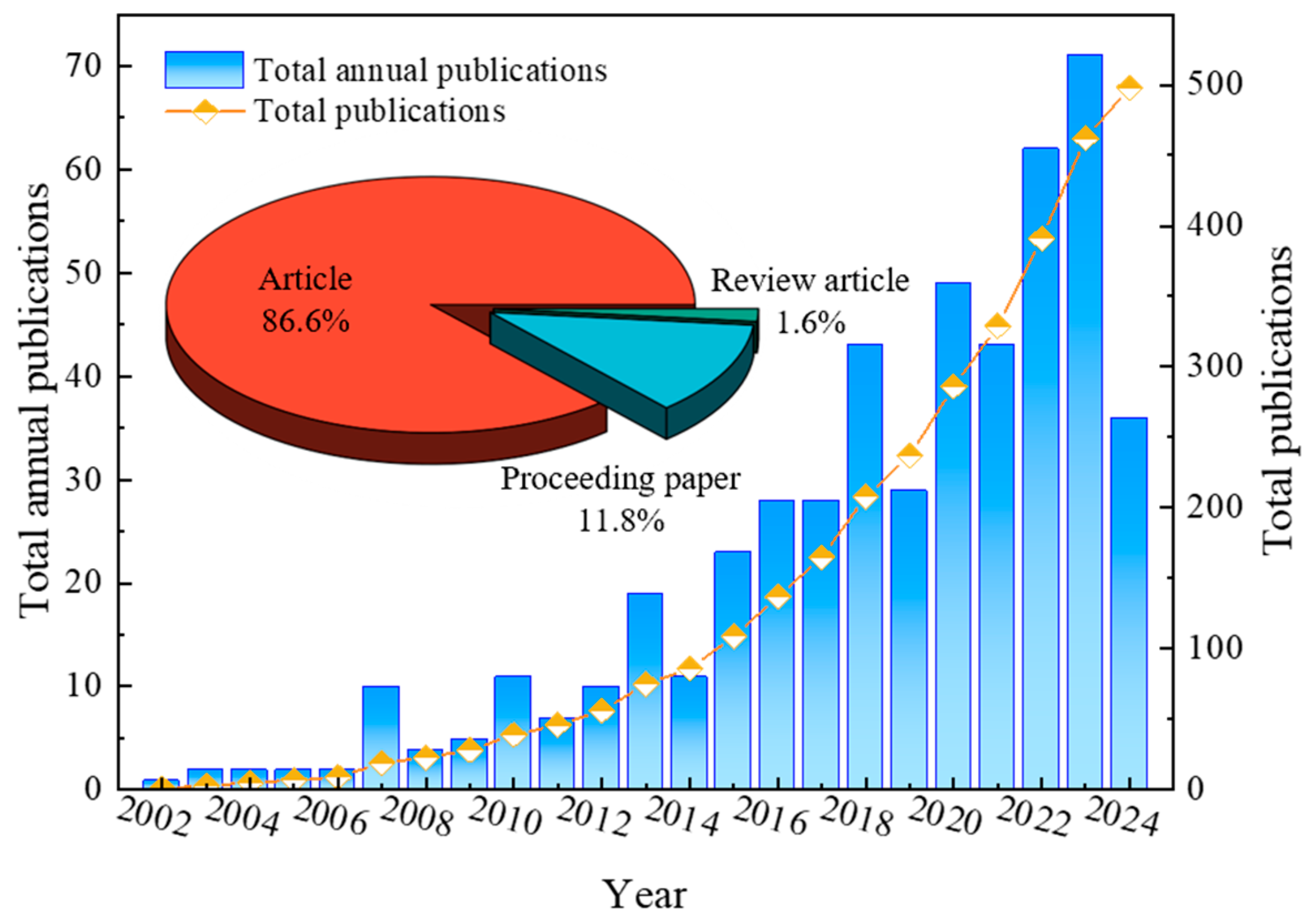
Figure 1. Performance of publications in the WoSCC on IBWTs’ impact from 2002 to 2024.
Water 17 02981 g001
Figure 2. The fitting results for total annual publications.
Water 17 02981 g002
Figure 3. The main journals publishing articles on IBWTs’ impact from 2002 to 2024.
Water 17 02981 g003
Figure 4. Cooperation network of productive countries/regions from 2002 to 2024.
Water 17 02981 g004
Figure 5. Cooperation network of productive institutions from 2002 to 2024.
Water 17 02981 g005
Figure 6. A network of subject category co-occurrence analysis from 2002 to 2024.
Water 17 02981 g006
Figure 7. A cluster map of research keywords on IBWTs’ impact from 2002 to 2024.
Water 17 02981 g007
Table 1. Top 10 journals ranked by the number of publications on the topic of IBWTs’ impact from 2002 to 2024 in the WoS.
RankingJournal TitleCategoryIFH-IndexTLCSTGCS
1WATERWATER RESOURCES3.3330173
2SCIENCE OF THE TOTAL ENVIRONMENTENVIRONMENTAL SCIENCES8.720541957
3JOURNAL OF HYDROLOGYGEOSCIENCE—MULTIPLE EARTH SCIENCE6.919238854
4JOURNAL OF CLEANER PRODUCTIONENVIRONMENTAL SCIENCES10.71508505
5SUSTAINABILITYENVIRONMENTAL SCIENCES3.6530196
6ENVIRONMENTAL SCIENCE AND POLLUTION RESEARCHENVIRONMENTAL SCIENCES5.88269474
7ECOLOGICAL INDICATORSENVIRONMENTAL SCIENCES7.29711273
8JOURNAL OF ENVIRONMENTAL MANAGEMENTENVIRONMENTAL SCIENCES8.61463345
9REMOTE SENSINGREMOTE SENSING4.8811129
10WATER RESOURCES MANAGEMENTENVIRONMENTAL SCIENCE—ENGINEERING/CIVIL ENGINEERING4.28229191
Table 2. Top 10 countries/regions in the cooperation network in relation to IBWTs’ impact (ranked by count or centrality).
RankingCountries/RegionsCountCentralityCountries/RegionsCentralityCount
1CHINA4241.11CHINA1.11424
2USA570.34USA0.3457
3AUSTRALIA290.03CANADA0.1712
4ENGLAND190.07THE NETHERLANDS0.159
5CANADA120.17SOUTH AFRICA0.0911
6SOUTH AFRICA110.09FRANCE0.093
7IRAN100.07SWEDEN0.086
8THE NETHERLANDS90.15ENGLAND0.0719
9SPAIN70.01IRAN0.0710
10SWEDEN60.08AUSTRALIA0.0329
Table 3. Top 10 institutions in the cooperation network in relation to IBWTs’ impact (ranked by count or centrality).
RankingInstitutionsCountCentralityInstitutionsCentralityCount
1Chinese Academy of Sciences930.46Chinese Academy of Sciences0.4693
2China Institute of Water Resources & Hydropower Research620.16China Institute of Water Resources & Hydropower Research0.1662
3Hohai University530.11Wuhan University0.1436
4Beijing Normal University460.13Beijing Normal University0.1346
5Wuhan University360.14Hohai University0.1153
6Institute of Geographic Sciences & Natural Resources Research280.05University of California System0.1012
7University of Chinese Academy of Sciences270.03Institute of Geographic Sciences & Natural Resources Research0.0528
8Tianjin University210.03Peking University0.0515
9Tsinghua University180.04China Agricultural University0.0511
10North China University of Water Resources & Electric Power160.03Texas A&M University System0.054
Table 4. Top 10 subject categories in the cooperation network relating to IBWTs’ impact (ranked by count or centrality).
RankingSubject CategoriesCountCentralitySubject CategoriesCentralityCount
1ENVIRONMENTAL SCIENCES2820.45ENVIRONMENTAL SCIENCES0.45282
2WATER RESOURCES1810.23WATER RESOURCES0.23181
3ENGINEERING, ENVIRONMENTAL670.04COMPUTER SCIENCE, INTERDISCIPLINARY APPLICATIONS0.2110
4GEOSCIENCES, MULTIDISCIPLINARY620.02ENGINEERING, CIVIL0.2059
5ENGINEERING, CIVIL590.20ECONOMICS0.177
6GREEN AND SUSTAINABLE SCIENCE AND TECHNOLOGY520.01ENGINEERING, MULTIDISCIPLINARY0.1510
7ENVIRONMENTAL STUDIES360.07ENGINEERING, ELECTRICAL AND ELECTRONIC0.158
8BIODIVERSITY CONSERVATION220.00COMPUTER SCIENCE, ARTIFICIAL INTELLIGENCE0.115
9ECOLOGY190.05OPERATION RESEARCH AND MANAGEMENT SCIENCE0.105
10REMOTE SENSING180.00PUBLIC, ENVIRONMENTAL AND OCCUPATIONAL HEALTH0.0813
Table 5. Top 20 subject categories with the strongest citation bursts in the co-occurrence network.
Subject CategoriesStrengthBeginEnd2002–2024
ENGINEERING, MULTIDISCIPLINARY4.1620102017Water 17 02981 i001
GEOSCIENCES, MULTIDISCIPLINARY3.0920212022Water 17 02981 i002
MATERIALS SCIENCE, MULTIDISCIPLINARY2.9720102013Water 17 02981 i003
ECOLOGY2.8420122016Water 17 02981 i004
COMPUTER SCIENCE, INTERDISCIPLINARY APPLICATIONS2.0020072011Water 17 02981 i005
GREEN AND SUSTAINABLE SCIENCE AND TECHNOLOGY1.8720172019Water 17 02981 i006
ENGINEERING, MECHANICAL1.8520112013Water 17 02981 i007
ENGINEERING, ELECTRICAL AND ELECTRONIC1.8220092010Water 17 02981 i008
MANAGEMENT1.6720102016Water 17 02981 i009
TOXICOLOGY1.6520172018Water 17 02981 i010
GEOGRAPHY1.620172020Water 17 02981 i011
ENERGY AND FUELS1.620102015Water 17 02981 i012
BUSINESS, FINANCE1.5720102015Water 17 02981 i013
GEOCHEMISTRY AND GEOPHYSICS1.5120222024Water 17 02981 i014
ENGINEERING, CIVIL1.3320122014Water 17 02981 i015
ENGINEERING, BIOMEDICAL1.3220092010Water 17 02981 i016
MATHEMATICS, APPLIED1.2920092011Water 17 02981 i017
MINING AND MINERAL PROCESSING1.2620122013Water 17 02981 i018
COMPUTER SCIENCE, ARTIFICIAL INTELLIGENCE1.1920142017Water 17 02981 i019
ECONOMICS1.1820062007Water 17 02981 i020
Disclaimer/Publisher’s Note: The statements, opinions and data contained in all publications are solely those of the individual author(s) and contributor(s) and not of MDPI and/or the editor(s). MDPI and/or the editor(s) disclaim responsibility for any injury to people or property resulting from any ideas, methods, instructions or products referred to in the content.