


Abstract
A novel framework is presented that aims to guide practitioners and decision makers toward a better understanding of the role of nature-based solutions (NBS) in the enhancement of resources management in cities, and the mainstreaming of NBS in the urban fabric. Existing frameworks describing the use of NBS to address urban challenges do not specifically consider circularity challenges. Thus, the new framework provides the following: (1) a comprehensive set of Urban Circularity Challenges (UCCs); (2) a set of more than fifty NBS units and NBS interventions thoroughly assessed in terms of their potential to address UCCs; and (3) an analysis of input and output resource streams, which are both required for and produced during operation of NBS. The new framework aims to facilitate the coupling of individual NBS units and NBS interventions with NBS that enable circular economy solutions.
1. Introduction
Despite significant efforts to become more sustainable in managing their resources, cities still represent a big burden to the environment. As the urban population grows, so does the demand for new resources (water, food, energy, materials), coupled with high levels of pollution and ecosystems degradation. Climate change impacts exacerbate the existing environmental problems. Many cities have adopted strategies for sustainable development and a sensible use of resources, e.g., Amsterdam, Copenhagen, Rotterdam [1,2], but unfortunately, the reality is that the majority of cities still follows the typical linear urban metabolism, causing a huge environmental footprint.
In pursuit of sustainability, cities are increasingly putting nature-based solutions (NBS) in the spotlight because of their high potential to address several urban challenges related to resources management in cities such as climate adaptation and mitigation, sustainable consumption and production, air quality, and water management [3,4,5]. In this work, we use the definition of the COST Action CA17133 Circular City [6] whereby NBS are defined as “concepts that bring nature into cities and those that are derived from nature. … As such, within this definition we achieve resource recovery using organisms (e.g., microbes, algae, plants, insects, and worms) as the principal agents. However, physical and chemical processes can be included for recovery of resources, as they may be needed for supporting and enhancing the performance of NBS”.
There are several frameworks assessing urban challenges and how they can be effectively addressed by NBS [3,4,7,8]. However, very few existing frameworks put forward urban challenges from the perspective of enhancing the circularity of resources management in cities and ensuring a sustainable urban development. While the framework from the EKLIPSE report [3,4] and the International Union for Conservation of Nature [7] identifies a series of general urban challenges mainly focused on societal, economic, and environmental urban challenges targeted by NBS, the Nature4Cities framework [9] fosters a set of urban challenges that embraces circularity topics in terms of the potential of NBS to promote resource efficiency (e.g., food, energy and water, raw materials, waste, recycling) and green economy (e.g., circular economy, bioeconomy activities, direct economic value of NBS). While this Nature4Cities framework is very valuable in terms of establishing much needed order in a burgeoning field, we believe there is room for the development of a comprehensive list of Urban Circularity Challenges (UCCs) in line with the detailed description of how and to which extent NBS can address such challenges.
Therefore, this research is aimed at narrowing down the list of relevant urban challenges and the interrelations between these frameworks while retaining the necessary information and level of complexity to adequately address the circularity issues at hand. For this purpose, we employ the concept of circular economy (CE), i.e., the circular management of resources in cities through the deployment of NBS. CE has three core principles [10]: (i) the first principle, ‘regenerate natural capital’, ensures functional environmental flows and stocks, by reducing the use of resources, preserving and enhancing ecosystems, and ensuring minimal disruptions from human interactions and use; (ii) the second principle of ‘keep resources in use’ is to close material loops and minimize energy loss within the system, which is achieved by optimizing resource yields, optimizing energy and resource extraction, and maximizing their recycling and reuse; and (iii) the third principle, ‘design out waste externalities’, focuses on the reduction and the residual waste of the system, including economic efficiency. The costs of reducing waste by one unit should be equal to the economic and environmental benefits of having one fewer unit of waste [10,11]. Circularity is viewed here as a strategic approach that helps cities shift from a linear to a circular metabolism, i.e., cities that thrive without demanding too many resources and/or producing waste [12,13] by the implementation of a circular framework for the design and operation of NBS in cities.
Therefore, we propose a framework for addressing UCCs with NBS, which aims to guide practitioners and decision makers toward a better understanding of the role of NBS in the enhancement of resources management in cities and the mainstreaming of NBS in the urban setting. The framework includes the following: (1) a comprehensive set of UCCs based on gaps identified in existing frameworks as proposed by [14]; (2) a set of more than fifty NBS units and interventions (NBS_u/i) assessed in terms of their potential to address UCCs and classified according to the following categories proposed by [15]: nature-based solutions units (NBS_u) defined as “stand-alone green technologies or green urban spaces, which can be combined with other solutions (nature-based or not)” and NBS interventions (NBS_i) defined as “the act of intervening in existing ecosystems and in NBS_u, by applying techniques to support natural processes”. This list also includes several Supporting units (S_u) that are required to create CE through NBS; and (3) a systematic approach for defining input and output (I/O) resource streams to and from NBS units/interventions that support creating CE through NBS. Such conceptual and empirical advancement is crucial in order to support the transition from current linear design paradigms to a more circular one when dealing with NBS in urban settlements.
2. Materials and Methods
2.1. A Novel Set of Urban Circularity Challenges (UCCs)
The existing urban challenges frameworks developed by EKLIPSE and Nature4Cities related to resource efficiency [3,4,9] were the starting point for identifying the UCCs used in this study [14]. When it comes to CE and the circular management of resources, a more specific targeted approach is required, and hence, the challenges are defined in a more detailed manner. The issues identified are mostly related to resources management according to the CE principles set by the Ellen MacArthur Foundation [10], namely ‘regenerate natural capital’, ‘keep resources in use’, and ‘design out waste externalities’.
Implementing these principles for the management of resources in cities would enable an urban transition to circularity. The two obvious challenges for this achievement are [14]:
- How to minimize the import and consumption of new resources; and
- How to minimize waste production.
Considering four vital resources, i.e., water, food, energy, and materials, a series of workshops with expert groups were held to break down the two major challenges into a feasible set of challenges related to the observed resources, and for implementing circular resources management in cities. The expert groups are interdisciplinary, and they include a diverse set of professionals and researchers ranging from civil, sanitary, and environmental engineers, architects, urban and landscape planners, natural scientists, agronomists, social scientists, etc. These experts make up the members of the five individual working groups (WGs) formed within the COST Action Circular City (https://circular-city.eu/ (accessed on 30 June 2021)): Built Environment (WG1), Sustainable Urban Water Utilization (WG2), Resource Recovery (WG3), Urban Farming (WG4), and Transformation Tools (WG5).
2.2. List of Nature-Based Solutions (NBS) Units and Interventions (NBS_u/i) for Addressing Urban Circularity Challenges (UCCs)
Implementing NBS for addressing circularity challenges requires the coupling of several units and/or interventions. The list of NBS_u/i addressing UCCs offers a systematic approach for defining the terminology related to and the classification of NBS. A list of thirty-two NBS_u/i proposed by Castellar et al. [15] was used in this study as a baseline for defining the set of NBS for addressing UCCs [14]. The development of the baseline list of thirty-two NBS included a comprehensive analysis of more than two hundred NBS described by four European Horizon 2020 projects: Urban GreenUP (https://www.urbangreenup.eu/ (accessed on 30 June 2021)), UNaLab (https://unalab.eu/en (accessed on 30 June 2021)), Nature4Cities (https://www.nature4cities.eu/ (accessed on 30 June 2021)), and ThinkNature (https://www.think-nature.eu/ (accessed on 30 June 2021)); coupled with mixed quantitative–qualitative approaches such as dedicated workshops, interviews with experts and surveys (for more details concerning the methodology, please consult [15]).
Next, a series of five elicitation workshops adapted from the IDEA (“investigate”, “discuss”, “estimate”, and “aggregate”) protocol [16,17] were carried out between June and December 2020 in order to achieve the following: (i) refine the list of NBS, and thus, provide a comprehensive list of NBS for addressing UCCs; (ii) evaluate the NBS according to their ability to address the UCC; and (iii) categorize the NBS. The elicitation workshops were prepared under the scope of the COST Action Circular City and brought together—in each workshop—more than sixty NBS experts with wide and diverse backgrounds (i.e., urban planners, architects, engineers, researchers, social scientists, etc.) from more than thirty countries. The following methodology was applied during the five elicitation workshops:
(i) Development of NBS list: The baseline list of thirty-two NBS_u/i [15] and new NBS_u/i proposed by participants of the workshops were evaluated according to the following eligibility criteria. First, in order to properly cover the scope of the current research, i.e., NBS for resources circularity in cities, the NBS should be in line with the definition of NBS proposed under the COST Action Circular City [6], which in contrast to existing definitions [7,18,19,20,21] “transfers the NBS concept into urban areas, putting a special emphasis on resource circularity” [15]. Additionally, physical and chemical processes/technologies for supporting NBS and enhancing their performance have been included as Supporting units (S_u). Second, to avoid duplication issues, the new NBS_u/i proposed by participants must not already be contained in the baseline list of thirty-two NBS_u/i, for example in the case of an already featured unit being listed under a different name. Finally, NBS_u/i should address at least one of the identified UCCs [14];
(ii) Evaluation of NBS potential to address UCCs: To assess the fulfillment of the final eligibility criterion, a special session was conducted, in which a qualitative evaluation of the NBS_u/i that had been selected up until that point was performed. Experts were divided into the COST Action’s WGs to discuss the potential of each NBS_u/i for addressing the identified UCCs. They were asked to decide by means of consensus to which degree a given NBS contributes to the achievement of a particular UCC. A four-point scale with respective criteria was defined to represent the degree of contribution to the UCC: (1) the NBS_u/i fully addresses the UCC (score = 1); (2) the NBS_u/i contributes to managing/overcoming the challenge (Score = 0.67); (3) the NBS_u/i—depending on the design—has the potential to contribute to overcoming a given UCC (Score = 0.33); and (4) the NBS_u/i does not address the UCC (Score = 0.0). If it was determined that a particular NBS_u/i failed to address any of the UCCs, it was excluded from the list. To assess the ability of NBS_u/i to address UCCs, we calculated the following global scores: the “UCC global score” is computed by a simple averaging of the NBS_u/i scores for each UCC, and the “NBS global score” is computed by a simple averaging of the UCC scores for each NBS_u/i. Additionally, we counted the number of NBS related to each UCC and the number of UCCs related to each NBS_u/i.
(iii) NBS classification: The resulting set of selected NBS_u/i was classified according to the two categories [15]: NBS_u, which includes NBS spatial units (NBS_su) and NBS technological units (NBS_tu); and NBS_i, which includes NBS soil and river interventions (NBS_is and NBS_ir). As mentioned above, S_u were considered in addition to the classification scheme described here [15]. Next, NBS_u/i including S_u were clustered into sub-categories based on similar technical features, characteristics, and properties for their design, implementation, and functioning in line with their specific purposes. Finally, in further sessions, participants refined the descriptions and nomenclature, and they suggested synonyms for the selected NBS_u/i according to existing standards and literature.
2.3. Nature-Based Solutions (NBS) Circularity: Input and Output (I/O) Streams
In order to overcome the existing deficiencies in urban resource management through the use of NBS in cities, their input and output (I/O) streams need to be defined [22]. Resources required, used, or produced during the operation and maintenance of NBS were identified by a consortium of experts, which included participants from all WGs of the COST Action Circular City. The identification and data collection were done in two stages. In stage one, each WG individually addressed the NBS recognized as relevant to their respective WG. The collection and definition of I/O followed a disciplinary approach, whereby each individual NBS was analyzed based on the state of the art of the individual field of application. The approach was grounded in the need to identify the I/O necessary for operation and maintenance, and the selection was based on physical, chemical, and biological properties. In the second stage, experts from all WGs collaborated in grouping the assembled I/Os into streams [22]. This stage was intentionally conceived to cut across all disciplines (WGs) in order to eliminate the disciplinary bias from step one.
3. Results and Discussion
3.1. Urban Circularity Challenges (UCCs)
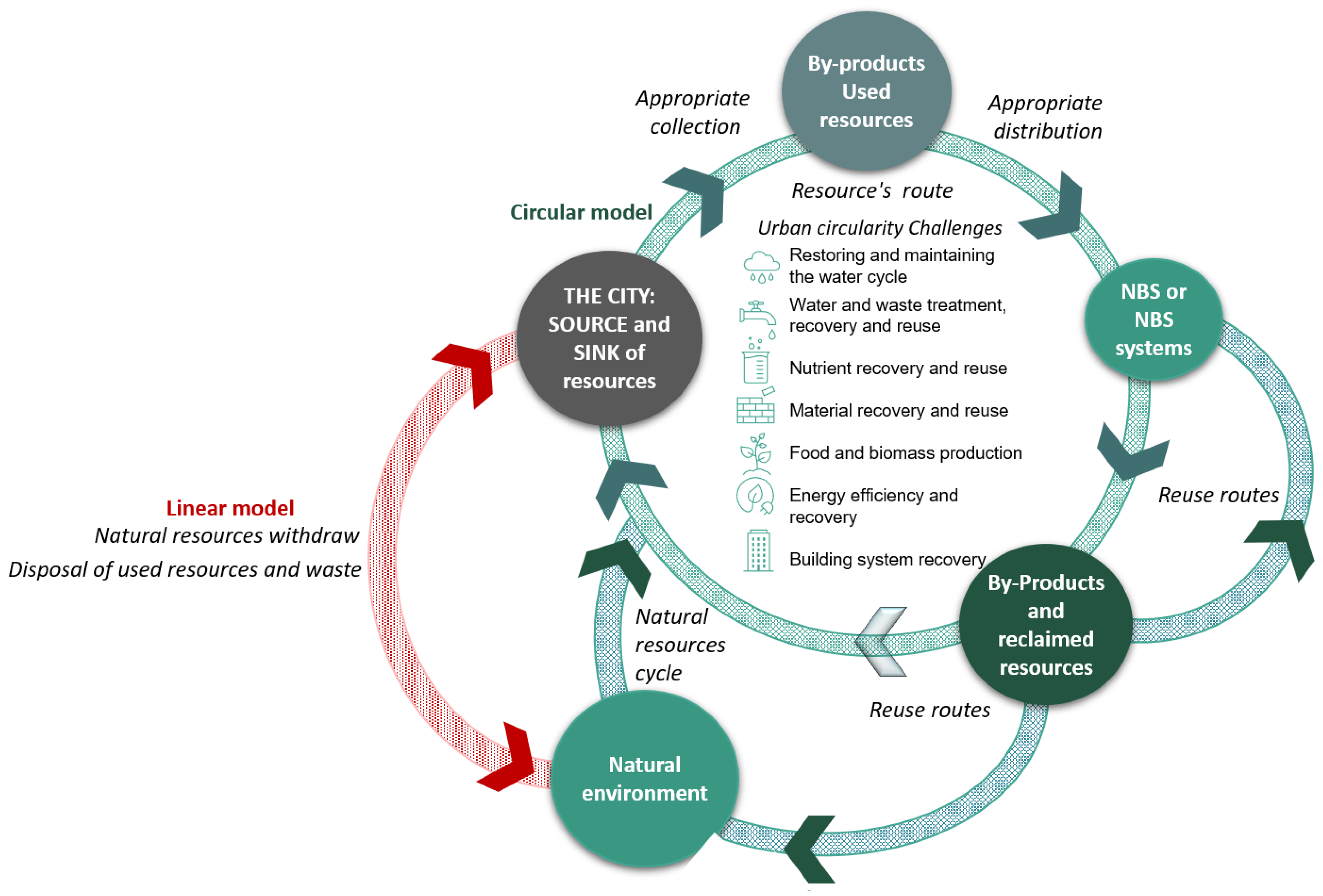
The UCCs identified by [14] for shifting to circular management of resources with NBS (Figure 1) are as follows:
Figure 1.
Urban circularity challenges addressed by NBS implemented under a circular framework (adapted from [14]).
- UCC1: Restoring and maintaining the water cycle;
- UCC2: Water and waste treatment, recovery and reuse;
- UCC3: Nutrient recovery and reuse;
- UCC4: Material recovery and reuse,
- UCC5: Food and biomass production;
- UCC6: Energy efficiency and recovery; and
- UCC7: Building system recovery.
During the participatory approaches carried out in the scope of the COST Action Circular City (see Section 2.1), the UCCs were refined. As a result, detailed descriptions for each UCC as well as the role of NBS_u/i (NBS_u/i) in addressing such challenges are presented in Table A1.
The societal challenges addressed by NBS are numerous, ranging from resource recovery to climate change mitigation, ecosystem restoration, and many more. Widespread and successive implementation of NBS will help in climate regulation, both on a micro and macro scale. Considering the limited space in urban areas and the competition for use of open spaces, it is of great importance to focus on providing NBS that contribute to resolving the widest possible range of the above-listed challenges. By implementing NBS in a purposeful way, with multifunctionality and interdisciplinarity in mind, a broader contribution can be made toward achieving a circular management of limited resources. This will also provide economic benefits, as the implementation of multipurpose NBS over single-purpose NBS frees up financial and material resources to be used elsewhere. It is important to ensure cooperation at all stages of NBS implementation, between engineers, architects, landscape planners, politicians, end-users, and any other stakeholder party that is willing and interested to be a part of the discussion. A concerted effort for the broad involvement of stakeholder groups, iterative co-design and implementation processes, and effective communication strategies should be emphasized.
3.2. List of Nature-Based Solutions Units and Interventions for Addressing Urban Circularity Challenges (UCCs)
Resulting from a series of elicitation workshops, we propose a comprehensive list of fifty-one NBS_u and NBS_i, and ten S_u for addressing the UCCs proposed by [14]. During the process, the following three NBS_u/i listed in Castellar et al. [15] were excluded, as they do not address any of the UCCs: “Create and preserve habitats and shelters for biodiversity”, “Heritage garden”, and “Use of pre-existing vegetation”. Moreover, we propose a set of sub-categories for NBS that facilitates the understanding of implicit, but sometimes subtle, relations between the purpose of NBS and some specific requirements concerning technical features for design and implementation.
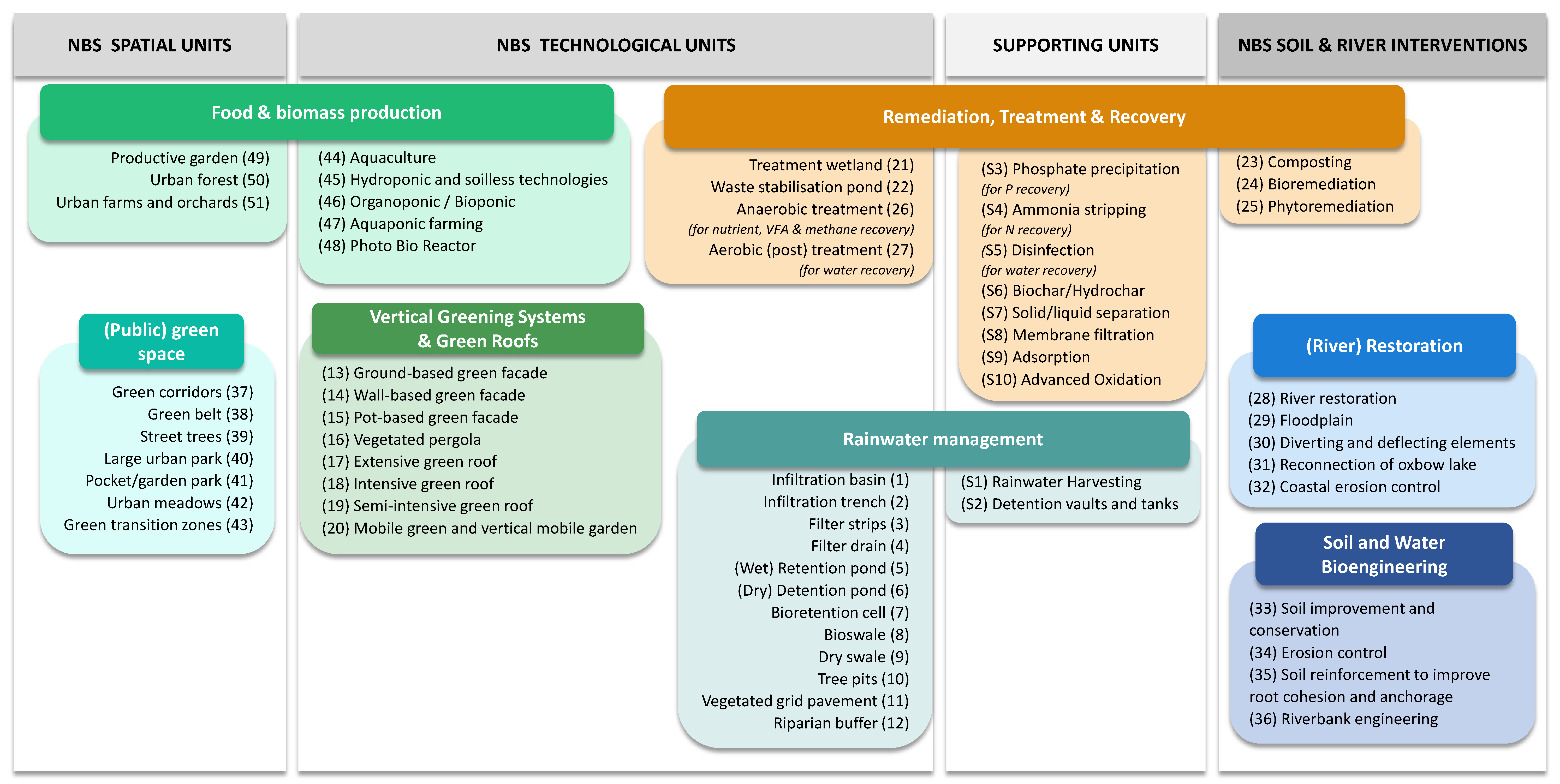
During the workshops, we determined that the purpose of an NBS_u/i can be related to the technological role/main application goal (e.g., urban rainwater management or food and biomass production), to their greening role at different scales (e.g., public green spaces or vertical greening systems and green roofs) or to their practical application (e.g., soil and water bioengineering). These interrelations were used as bases to cluster the NBS (Figure 2). The resulting NBS sub-categories are described below:
Figure 2.
NBS units (NBS_u), NBS interventions (NBS_i), and Supporting units (S_u) clustered into categories (dark gray squares, adapted from [15] and sub-categories proposed by consulted experts within the COST Action Circular City (colored squares).
- Rainwater Management: This sub-category contains all NBS for rainwater management. These NBS (mainly NBS_tu) are also known as sustainable urban drainage systems (SUDS), low impact development (LID), best management practices (BMPs), water-sensitive urban design (WSUD), etc. [23]. They enable stormwater management, increased infiltration, removal of pollutants, improved quality of runoff, mitigation of flash floods, increased biodiversity, and reduced urban heat island effect;
- Vertical Greening Systems and Green Roofs: This sub-category contains NBS_tu for the main types of vertical greening and green roofs. These NBS increase urban biodiversity, decrease the urban heat island effect, improve stormwater management, lower energy consumption, reduce noise, improve air quality, and provide relaxation and socialization areas;
- Remediation, Treatment, and Recovery: This group features NBS_u and NBS_i for remediation, treatment, and recovery, and it includes a high number of S_u. These S_u might be a particular requirement for the recovery of resources;
- (River) Restoration: This sub-category includes a set of NBS_i related to techniques for river restoration aimed at reducing flood risk and erosion, increasing channel storage capacity, redirecting the water flow, and improving the diversity of riverine species;
- Soil and Water Bioengineering: This sub-category includes a set of NBS_i related to soil and water bioengineering techniques. Such NBS_i enhance soil quality, increase carbon storage, decrease soil compaction, minimize/prevent soil erosion, and enhance riverbank protection and hillside stabilization;
- (Public) Green Space: This sub-category includes NBS_su that are mainly larger in size and aimed at renaturing cities, controlling urban sprawl, providing niches for urban wildlife and recreational areas for citizens, controlling stormwater, improving air quality, and increasing urban biodiversity; and
- Food and Biomass Production: This sub-category comprises NBS_tu and NBS_su for food and biomass production. Additionally, these technologies can generate income, decrease the use of resources and space, and enhance community building.
The presented categories are conceptually fine-tuned and concise enough to guide practitioners and experts in better understanding and assessing the role and relevance of individual NBS in the urban environment. Thus, it may facilitate the selection of the most suitable NBS units and interventions for specific needs and expectations. Moreover, the criteria used to classify the NBS are consistent, setting the proposed classification scheme apart from previous classification attempts [24,25,26,27] that are mostly based on hierarchical structures. The above-presented classification scheme adds value by cutting across different category levels, which is a feature that reflects the transversality and multifunctionality of NBS. For example, “Productive garden” and “Aquaponic farming” are both NBS from the “Food and biomass production” sub-category, but the former was considered as an NBS_su and the latter as a NBS_tu. The same is true for “Treatment wetland” and “Composting”, both NBS are considered to be part of sub-category “Remediation, Treatment, and Recovery”; however, the former is an NBS_tu and the latter is a soil intervention (NBS_is). Moving forward, the NBS_u, NBS_i, and S_u for addressing UCCs are sorted according to the sub-categories (described above) and presented in Figure 2 (synonyms and descriptions of NBS_u/i are provided in the Appendix A Table A2).
UCCs addressed by NBS_u/i and S_u are summarized in Table 1. From Table 1, it can be inferred that most NBS_u/i and S_u fully address the UCC1 (“Restoring and maintaining water cycle”), and UCC2 (“Water and waste treatment, recovery, and reuse”), while they address UCC3 (“Nutrient recovery and reuse”), and UCC4 (“Material recovery and reuse”) the least. In addition, WG experts found that the NBS contributions toward overcoming circularity challenges is most evident for UCC5 (“Food and biomass production”), while the potential contributions of NBS—depending on the design—are considered highest for UCC4 (“Material recovery and reuse”). The potential is also apparent for further addressing UCC6 (“Energy efficiency and recovery”), and UCC7 (“Building system recovery”), as most NBS do not yet fully address them. At the level of individual NBS_u, experts recognized that semi-intensive green roofs, urban farms and orchards, and intensive green roofs contribute the most to solving the recognized UCC. Conversely, diverting and deflecting elements, soil reinforcement to improve root cohesion and anchorage, and coastal erosion control interventions were identified as contributing the least to resolving the UCC. These results indicate the need for further improvement of NBS, especially in order to address the challenges related to nutrient and material recovery and reuse (UCC3 and UCC4) in urban areas, which are currently covered least by available solutions.
Table 1.
Urban Circularity Challenges (UCCs) addressed by NBS units (NBS_u), NBS interventions (NBS_i), and Supporting units (S_u) (● = addressing the challenge; ● = contribution to challenge mitigation; ○ = potential contribution, depending on the design; and as an “empty cell” = not addressing the challenge). NBS_tu = technological units; NBS_su = spatial units; NBS_is = interventions; NBS_ir = river interventions; and S_u = Supporting unit.
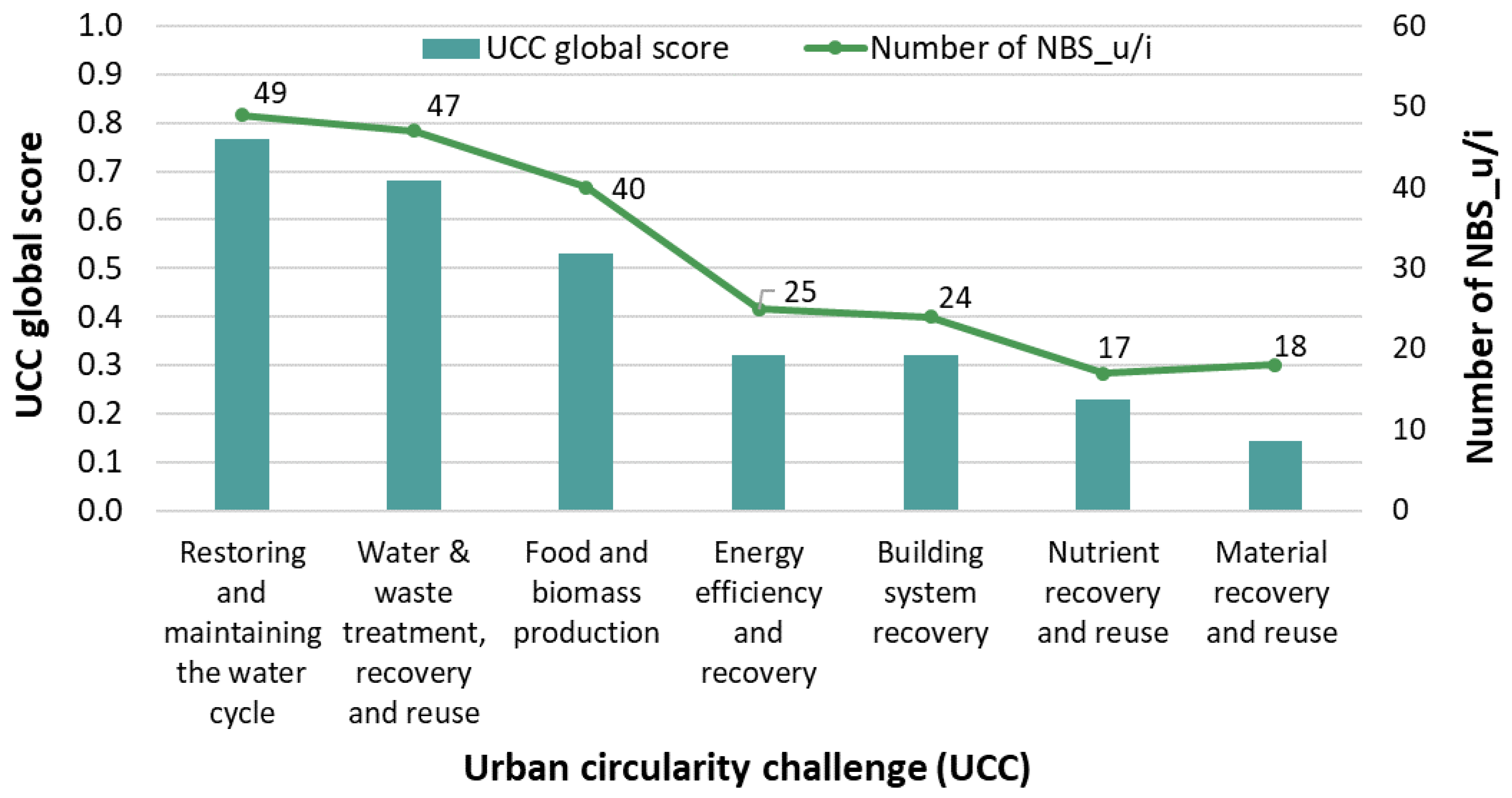
“Restoring and maintaining the water cycle” (UCC1), “Water and waste treatment, recovery, and reuse” (UCC2), and “Food and biomass production” (UCC5) received the highest UCC global scores: 0.77, 0.68, and 0.53, respectively (Figure 3). Moreover, almost all NBS_u/i were considered to have an impact on water-related UCC1 and UCC2, and approximately 78% of all NBS_u/i can address “Food/biomass-related issues” (UCC5). Indeed, almost all NBS_u/i addressing food and biomass production also address water-related challenges, except for NBS such as “Aquaculture”, “Composting”, and “(River) restoration”. This result highlights the multifunctionality of NBS as well as their great potential to restore the water cycle, promote water recovery and reuse, and, at the same time, provide food and biomass in urban settlements (e.g., “Aquaponic farming”). In contrast, the UCC “Material recovery and reuse” (UCC4) received the lowest UCC global score, and only 18 NBS_u/i were related to this challenge. The above-described results indicate that the “circularity” frame of NBS is more explicit regarding the goal of keeping natural resources in use, as is the case with water and biomass. This fact might be explained by the way that NBS_u/i inherently function, in the sense that all NBS_u/i need water to function, and they produce biomass as an output. In contrast, the recovery and reuse of materials is not something intrinsic/vital to the design or functioning of NBS. On the contrary, this approach pushes the conventional design linear frame to move toward a more circular framework in terms of the management of material flows (input and outputs), thus encouraging the consideration of potential interactions between NBS_u/i and their surrounding environment, either by reusing/recovering material from local urban production chains (local INPUTs) or by providing valuable materials as, for example, organic compost to be used by urban farmers (local OUPUT).
Figure 3.
Performance of NSB_u/i in addressing Urban Circularity Challenges.
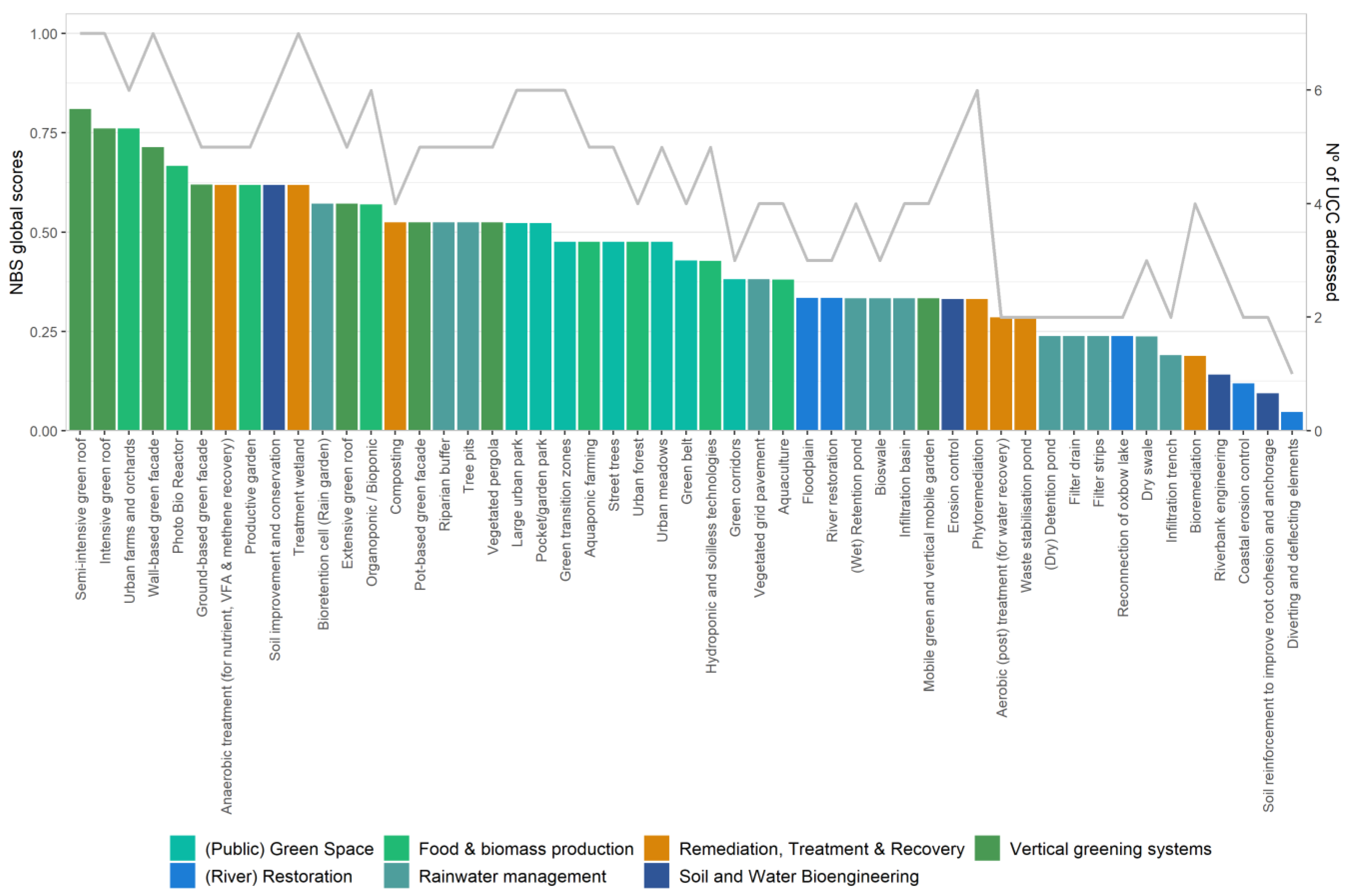
The NBS global score for all NBS_u/i is shown in Figure 4. All NBS_u/i scores ranged between 0.05 and 0.80. Such an “extreme” range indicates that some NBS_u/i might be very generally applicable and address multiple UCCs, while other NBS_u/i might be more specific and address only a small number of UCCs. In this sense, approximately 40% of all NBS_u/i scored higher than 0.5, thus demonstrating good overall performance in addressing several UCC. The majority of NBS_u/i from “Food and biomass production” and “Vertical greening systems and green roofs” revealed high scores, varying from 0.57 to 0.81, showing that these NBS_u/i tend to be more versatile and generalist (address well multiple UCCs). Whereas NBS_u/i from “(River) Restoration”, “Soil and Water Bioengineering” to “Rainwater management” might be better suited for addressing specific UCCs, since the majority of NBS_u/i from these sub-categories had low scores, varying between 0.05 and 0.33. In fact, as expected, all NBS from these subcategories scored for water related UCC1 and UCC2. It should be noted that no NBS_u/i from these sub-categories addressed all seven UCCs, and only eight NBS_u/i (out of 21) addressed more than four UCCs.
Figure 4.
NBS global scores for UCC (colored bars) and number of UCC addressed per each NBS_u/i (gray line). Obs: The bars are colored as a function of pre-established sub-categories.
3.3. Nature-Based Solutions’ (NBS) Circularity: An Analysis of Inputs (I) and Outputs (O)
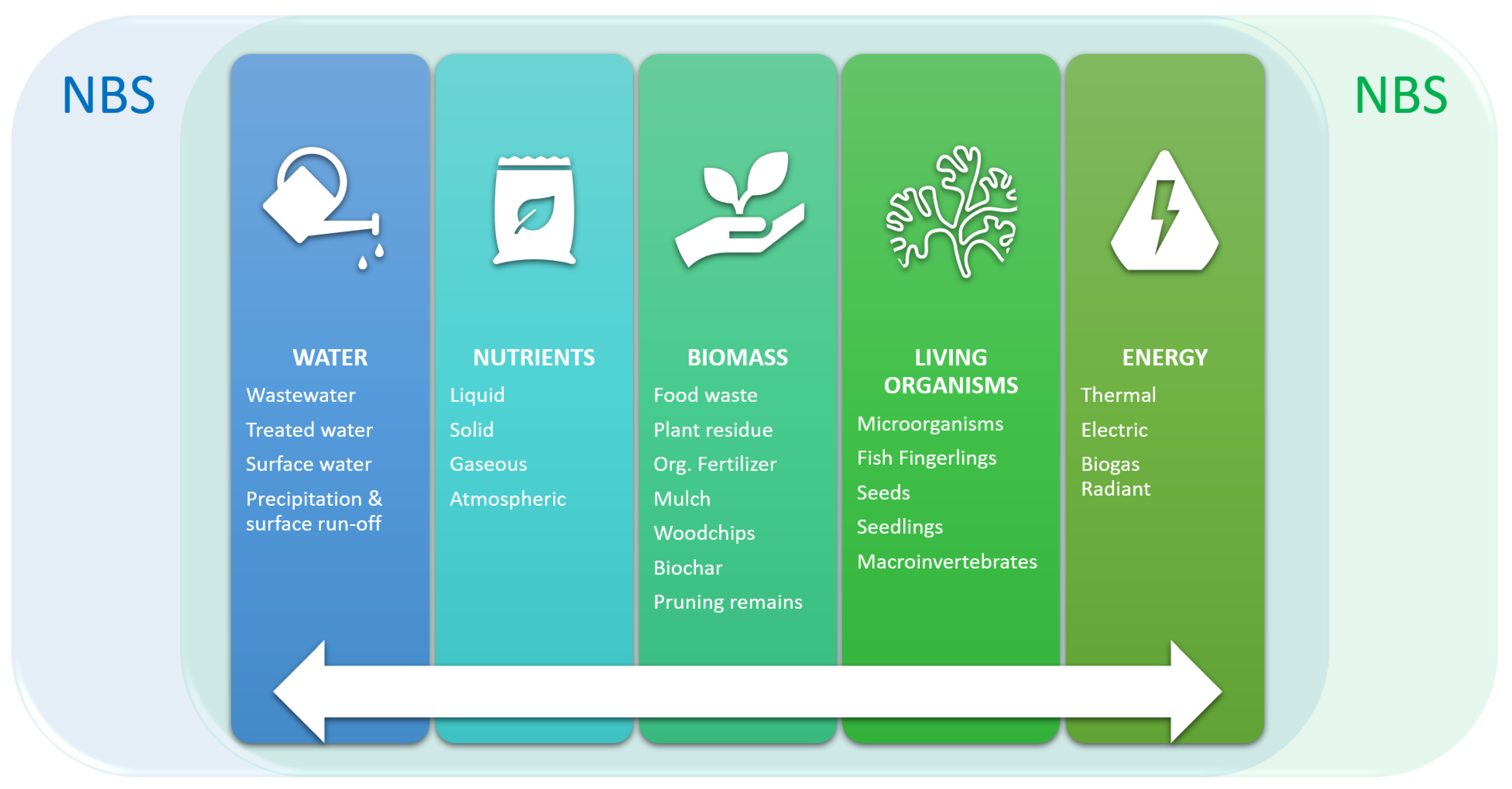
In this article, Inputs (I) required for operation and maintenance of NBS_u/i and S_u and potential Outputs (O) produced by NBS_u/i and S_u are considered as streams (elements and resources flowing through NBS). As inputs, these streams are required for the operation and maintenance of NBS, and thus, they can come from or be produced by other NBS or from other parts of the urban system. As outputs, the streams present resources to be recovered and provided for holistically operating NBS in circular cities, and thus, they are essentially produced by NBS and can flow to other NBS or to other parts of the urban production chain. In the course of the elicitation workshops, five streams were identified (water, nutrients, biomass, living organisms, and energy), comprising over 20 categories (Figure 5).
Figure 5.
Main types of streams and respective categories of inputs required for the operation and maintenance of NBS and/or outputs potentially produced by NBS in circular cities.
Understanding the role of NBS in optimizing the flow of different streams is a very important step to promote their implementation for circular cities. However, an equally important aspect is the potential interactions between streams that can be expedited through the implementation of NBS in cities. Streams and their respective categories as shown in Figure 5 are described below:
- Water: NBS can play an important role in establishing a more efficient and more circular management of water streams in urban settlements. Moreover, all plant-based systems, such as NBS, rely on a sufficient water supply to permit their full multifunctional properties. The stream categorisation is based on the main elements of urban water management. Precipitation and surface runoff are key categories in urban water management. Precipitation can be directly used as an input without the need for human interference and should be considered for assessing potential hydric deficits that may need to be compensated by other water streams. Surface runoff is generated by precipitation falling onto sealed areas (e.g., roofs, streets) and thus requires retention, transportation, treatment, and storage for reuse. However, the management of surface runoff using NBS [23] follows the conventions of urban drainage where the primary focus lies in removing water from the city as quickly as possible. This way of thinking needs to be reformed by CE concepts to foster a culture of reuse. Wastewater is a valuable but often overlooked water stream. While wastewater in the urban environment is mainly thought of as originating from domestic or industrial activities, specific NBS can also be a source of wastewater (i.e., aquaculture or urban farms), meaning this category can be represented as either an input or an output. The main concerns surrounding the flow of wastewater streams in the urban context are the potential health risks related to reuse practices as well as bureaucratic burdens (i.e., permissions), a lack of common agreement regarding reuse standards required for various different final uses, and structural requirements for practices such as source separation (graywater and blackwater). Even though these concerns are valid, scientific research has demonstrated that the collection of graywater followed by on-site treatment using NBS can present a valuable source of non-potable water [28].
- Nutrients: Nutrients can be categorized as solid, liquid, or gaseous. Their management is linked to managing water and biomass streams. The recovery of nutrients from the wastewater stream also promotes the practice of decentralized source separation. While graywater plays an important role in ensuring sufficient water quantity, black water presents a source of nutrients for various uses [29]. An important factor for the recovery of specific nutrients is the S_u in Table A2. An often overlooked fact is the introduction of nutrients via the atmosphere [30].
- Biomass and living organisms: Biomass and living organisms are streams related to NBS_u/i associated with urban agriculture and the establishment of an interconnected, sustainable urban food system. Biomass includes categories such as organic fertilizer (compost, manure), organic crop protection products, soil conditioners (mulch, woodchips, or biochar), and a wide range of organic wastes (food waste, crop residues, or pruning remains). Living organisms are the backbone of urban agriculture because they are either prerequisites for food production or constitute food themselves, from plants to vertebrates and microorganisms. Biomass and living organisms can be inputs as well as outputs of various NBS_u/i for urban agriculture and thus have high potential to contribute to circularity in the city. Parts of both streams cross the circular city system boundary, for agriculture and aquaculture are sectors where economies of scale are significant and often cannot be fully exploited by NBS_u/i for urban agriculture due to space constraints in cities. Another reason for this is the need for an external NBS_u/i due to specialization, e.g., the need for fish hatchery rearing fingerlings used in urban aquaponics.
- Energy: Energy production and energy savings are key aspects of NBS. While the shading, cooling, and insulation effects can lower the energy demand of a building, source separation, as discussed with the water stream, can provide energy in the form of biogas. Heat exchange from graywater or wastewater has also been identified as an important potential source of energy in circular economies.
To illustrate the interaction of streams, one can analyze the potential of building integrated NBS_u, namely green roofs and pot-based green facades. At the building scale, source separation is generally applicable. By using a two-pipe system, graywater (wastewater without toilet waste) can be captured, and its heat energy can be extracted by heat exchange technology. For water reuse, either green roofs or pot-based green facades can act as treatment units [28]. The supplied water for treatment also acts as a driver for transpiration cooling by the plants. Treated graywater can be used further for irrigation, toilet flushing, and other applications. The wastewater from the toilet can be treated on-site by using S_u, namely an anaerobic reactor producing nutrient-rich effluent and biogas while also eliminating pathogens and rendering water fit for reuse. Further treatment of the effluent is possible by green roof or pot-based facade systems, which themselves support cooling, biodiversity, and biomass production when harvested, and, as previously discussed, have a high energy-saving potential.
4. Conclusions
The following can be concluded:
- The unique list of thirty-nine NBS units, twelve NBS interventions, and ten Supporting units was specifically developed for addressing the Urban Circularity Challenges (UCCs).
- The list of NBS units and interventions (NBS_u/i) is presented in a concise way including categorization, clear nomenclature, and descriptions.
- By including the series of workshops within the COST Action Circular City, the list of NBS_u/i was developed in an interdisciplinary setting intended to facilitate their widespread application.
- The sub-categories applied in the grouping of NBS_u/i according to their main application/role allow for easy understanding and application of the list.
- The framework model combining NBS_u/i with UCCs, with versatile urban sectoral applications, enables the promotion and implementation of innovative plans of action with inclusive and relevant urban regeneration solutions, understanding urban demands as transformative target opportunities toward a resource-efficient and holistic growth model.
- It is noteworthy that the majority of NBS_u/i and S_u from the compiled list are able to fully address the challenges related to the water cycle restoration and maintenance (UCC1), as well as the treatment, recovery, and reuse of water and waste in cities (UCC2). In contrast, the current ability of NBS to address the recovery and reuse of nutrients (UCC3) and materials (UCC4) in urban areas is still limited (according to the involved experts’ knowledge and experience) and requires further research.
- The systematic methodology applied for defining input and output streams facilitates the integration of NBS_u/i into circular solutions and fosters circular thinking.
Author Contributions
G.L.: overall conceptualization, writing, reviewing; J.A.C.C. and N.A.: conceptualization, writing and reviewing; B.P., G.F.M.B., D.M., M.-B.A., K.K. and R.P.-M.: writing and reviewing. All authors have read and agreed to the published version of the manuscript.
Funding
This research received no external funding.
Institutional Review Board Statement
Not applicable.
Informed Consent Statement
Not applicable.
Data Availability Statement
Not applicable.
Acknowledgments
The work was carried out within the COST Action CA17133 Circular City (“Implementing nature-based solutions for creating a resourceful circular city”, http://www.circular-city.eu, duration 22 October 2018–21 October 2022). COST Actions are funded within the EU Horizon Programmes. The authors are grateful for the support. Additionally, the authors would like to acknowledge all participants of the Circular City workshops that contributed during the discussions for developing the list of NBS units, NBS interventions, and Supporting units, their synonyms and descriptions.
Conflicts of Interest
The authors declare no conflict of interest.
Appendix A
Table A1.
Descriptions of Urban Circularity Challenges.
Table A2.
Descriptions and synonyms/subgroups of NBS units (NBS_u), NBS interventions (NBS_i), and Supporting units (S_u) from Table 1.
References
- Hristova, S.; Šešić, M.D.; Duxbury, N. Culture and Sustainability in European Cities: Imagining Europolis; Routledge: Oxfordshire, UK, 2015; pp. 1–246. [Google Scholar] [CrossRef] [Scilit]
- Akande, A.; Cabral, P.; Gomes, P.; Casteleyn, S. The Lisbon Ranking for Smart Sustainable Cities in Europe. Sustain. Cities Soc. 2019, 44, 475–487. [Google Scholar] [CrossRef] [Scilit]
- Raymond, C.M.; Pam, B.; Breil, M.; Nita, M.R.; Kabisch, N.; de Bel, M.; Enzi, V.; Frantzeskaki, N.; Geneletti, D.; Cardinaletti, M.; et al. An Impact Evaluation Framework to Support. Planning and Evaluation of Nature-Based Solutions Projects; Centre for Ecology and Hydrology: Lancaster, UK, 2017; ISBN 9781906698621. [Google Scholar]
- Raymond, C.M.; Frantzeskaki, N.; Kabisch, N.; Berry, P.; Breil, M.; Nita, M.R.; Geneletti, D.; Calfapietra, C. A Framework for Assessing and Implementing the Co-Benefits of Nature-Based Solutions in Urban Areas. Environ. Sci. Policy 2017, 77, 15–24. [Google Scholar] [CrossRef] [Scilit]
- Pineda-Martos, R.; Calheiros, C.S.C. Nature-Based Solutions in Cities—Contribution of the Portuguese National Association of Green Roofs to Urban Circularity. Circ. Econ. Sustain. 2021. [Google Scholar] [CrossRef] [Scilit]
- Langergraber, G.; Pucher, B.; Simperler, L.; Kisser, J.; Katsouc, E.; Buehler, D.; Mateo, M.C.G.; Atasanova, N. Implementing Nature-Based Solutions for Creating a Resourceful Circular City. Blue-Green Syst. 2020, 2, 173–184. [Google Scholar] [CrossRef] [Scilit]
- Cohen-Shacham, E.; Walters, G.; Janzen, C.; Maginnis, S. Nature-Based Solutions to Address Global Societal Challenges; Cohen-Shacham, E., Walters, G., Janzen, C., Maginnis, S., Eds.; IUCN: Gland, Switzerland, 2016; ISBN 9782831718125. [Google Scholar]
- Kabisch, N.; Frantzeskaki, N.; Pauleit, S.; Naumann, S.; Davis, M.; Artmann, M.; Haase, D.; Knapp, S.; Korn, H.; Stadler, J.; et al. Nature-Based Solutions to Climate Change Mitigation and Adaptation in Urban Areas: Perspectives on Indicators, Knowledge Gaps, Barriers, and Opportunities for Action. Ecol. Soc. 2016, 21, 39. [Google Scholar] [CrossRef] [Scilit]
- Ramusino, L.C.; Cortese, M.; Lennard, Z. Re-Naturing the City: Nature4Cities Project to Elevate the Concept of Nature-Based Solutions. Proceedings 2017, 1, 696. [Google Scholar] [CrossRef] [Scilit]
- Ellen MacArthur Foundation. Delivering the Circular Economy a Toolkit for Policymakers; Ellen MacArthur Foundation: Cowes, UK, 2015. [Google Scholar]
- DEFRA. The Economics of Waste and Waste Policy; Department for Environment, Food and Rural Affairs (DEFRA): London, UK, 2011. [Google Scholar]
- Agudelo-Vera, C.M.; Leduc, W.R.W.A.; Mels, A.R.; Rijnaarts, H.H.M. Harvesting Urban Resources towards More Resilient Cities. Resour. Conserv. Recycl. 2012, 64, 3–12. [Google Scholar] [CrossRef] [Scilit]
- Lucertini, G.; Musco, F. Circular Urban Metabolism Framework. One Earth 2020, 2, 138–142. [Google Scholar] [CrossRef] [Scilit]
- Atanasova, N.; Castellar, J.A.C.; Pineda-Martos, R.; Nika, C.E.; Katsou, E.; Istenič, D.; Pucher, B.; Andreucci, M.B.; Langergraber, G. Nature-Based Solutions and Circularity in Cities. Circ. Econ. Sustain. 2021, 1, 319–332. [Google Scholar] [CrossRef] [Scilit]
- Castellar, J.A.C.; Popartan, L.A.; Pueyo-Ros, J.; Atanasova, N.; Langergraber, G.; Sämuel, I.; Corominas, L.; Comas, J.; Acuña, V. Nature-Based Solutions in the Urban Context: Terminology, Classification and Scoring for Urban Challenges and Ecosystem Services. Sci. Total Environ. 2021, 779, 146237. [Google Scholar] [CrossRef] [Scilit]
- Hemming, V.; Burgman, M.A.; Hanea, A.M.; Mcbride, M.F.; Wintle, B.C. A Practical guide to structured expert elicitation using the idea protocol. Methods Ecol. Evol. 2018, 9, 169–180. [Google Scholar] [CrossRef] [Scilit]
- Hemming, V.; Walshe, T.V.; Hanea, A.M.; Fidler, F.; Burgman, M.A. Eliciting Improved Quantitative Judgements Using the IDEA Protocol: A Case Study in Natural Resource Management. PLoS ONE 2018, 13, 1–34. [Google Scholar] [CrossRef] [Scilit]
- European Commission. Towards an EU Research and Innovation Policy Agenda for Nature-Based Solutions & Re-Naturing Cities; Publications Office of the European Union: Luxembourg, 2015. [Google Scholar]
- Maes, J.; Jacobs, S. Nature-Based Solutions for Europe’s Sustainable Development. Conserv. Lett. 2015, 10, 1–4. [Google Scholar] [CrossRef] [Scilit]
- Van der Jagt, A.P.N.; Szaraz, L.R.; Delshammar, T.; Cvejić, R.; Santos, A.; Goodness, J.; Buijs, A. Cultivating Nature-Based Solutions: The Governance of Communal Urban Gardens in the European Union. Environ. Res. 2017, 159, 264–275. [Google Scholar] [CrossRef] [Scilit] [PubMed]
- Short, C.; Clarke, L.; Carnelli, F.; Uttley, C.; Smith, B. Capturing the Multiple benefits associated with nature-based solutions: Lessons from a natural flood management project in the cotswolds, UK. Land Degrad. Dev. 2019, 30, 241–252. [Google Scholar] [CrossRef] [Scilit]
- Baganz, G.; Proksch, G.; Kloas, W.; Lorleberg, W.; Baganz, D.; Staaks, G.; Lohrberg, F. Site Resource Inventories-A Missing Link in the Circular City’s Information Flow. Adv. Geosci. 2020, 54, 23–32. [Google Scholar] [CrossRef] [Scilit]
- Fletcher, T.D.; Shuster, W.; Hunt, W.F.; Ashley, R.; Butler, D.; Arthur, S.; Trowsdale, S.; Barraud, S.; Semadeni-Davies, A.; Bertrand-Krajewski, J.L.; et al. SUDS, LID, BMPs, WSUD and More–The Evolution and application of terminology surrounding urban drainage. Urban Water J. 2015, 12, 525–542. [Google Scholar] [CrossRef] [Scilit]
- UNALAB. Nature Based Solutions–Technical Handbook (Part. II); UNALAB Project. 2019. Available online: https://unalab.eu/system/files/2020-02/unalab-technical-handbook-nature-based-solutions2020-02-17.pdf (accessed on 30 June 2021).
- NATURE4CITIES. NBS Multi-Scalar and Multi-Thematic Typology and Associated Database; NATURE4CITIES Project. 2020. Available online: https://www.nature4cities.eu/post/nature4cities-multi-scalar-and-multi-thematic-nature-based-solutions-typology (accessed on 30 June 2021).
- URBANGREENUP. NBS Catalogue; URBANGREENUP Project. 2018. Available online: https://www.urbangreenup.eu/news--events/news/the-urban-greenup-catalogue-of-nature-based-solutions-is-now-public_1.kl (accessed on 30 June 2021).
- Somarakis, G.; Stagakis, S.; Chrysoulakis, N. ThinkNature Nature Based Solutions Handbook; European Union: Luxembourg, 2019; pp. 1–226. [Google Scholar] [CrossRef]
- Boano, F.; Caruso, A.; Costamagna, E.; Ridolfi, L.; Fiore, S.; Demichelis, F.; Galvão, A.; Pisoeiro, J.; Rizzo, A.; Masi, F. A Review of Nature-Based Solutions for Greywater Treatment: Applications, Hydraulic Design, and Environmental Benefits. Sci. Total Environ. 2019, 711, 134731. [Google Scholar] [CrossRef] [Scilit]
- Kisser, J.; Wirth, M.; De Gusseme, B.; Van Eekert, M.; Zeeman, G.; Schoenborn, A.; Vinnerås, B.; Finger, D.C.; Kolbl Repinc, S.; Bulc, T.G.; et al. A Review of Nature-Based Solutions for Resource Recovery in Cities. Blue-Green Syst. 2020, 2, 138–172. [Google Scholar] [CrossRef] [Scilit]
- Decina, S.M.; Hutyra, L.R.; Templer, P.H. Hotspots of Nitrogen Deposition in the World’s Urban Areas: A Global Data Synthesis. Front. Ecol. Environ. 2019, 18, 92–100. [Google Scholar] [CrossRef] [Scilit]
- Barron, O.V.; Barr, A.D.; Donn, M.J. Effect of Urbanisation on the Water Balance of a Catchment with Shallow Groundwater. J. Hydrol. 2013, 485, 162–176. [Google Scholar] [CrossRef] [Scilit]
- McPhillips, L.E.; Matsler, M.; Rosenzweig, B.R.; Kim, Y. What Is the Role of Green Stormwater Infrastructure in Managing Extreme Precipitation Events? Sustain. Resilient Infrastruct. 2021, 6, 133–142. [Google Scholar] [CrossRef] [Scilit]
- Rosenzweig, B.R.; McPhillips, L.; Chang, H.; Cheng, C.; Welty, C.; Matsler, M.; Iwaniec, D.; Davidson, C.I. Pluvial Flood Risk and Opportunities for Resilience. Wiley Interdiscip. Rev. Water 2018, 5, 1–18. [Google Scholar] [CrossRef] [Scilit]
- Hoffmann, S.; Feldmann, U.; Bach, P.M.; Binz, C.; Farrelly, M.; Frantzeskaki, N.; Hiessl, H.; Inauen, J.; Larsen, T.A.; Lienert, J.; et al. A Research Agenda for the Future of Urban Water Management: Exploring the Potential of Nongrid, Small-Grid, and Hybrid Solutions. Environ. Sci. Technol. 2020, 54, 5312–5322. [Google Scholar] [CrossRef] [Scilit] [PubMed]
- Masi, F.; Langergraber, G.; Santoni, M.; Istenič, D.; Atanasova, N.; Buttiglieri, G. Possibilities of nature-based and hybrid decentralized solutions for reclaimed water reuse. In Advances in Chemical Pollution, Environmental Management and Protection; Verlicchi, P., Ed.; Elsevier: Amsterdam, The Netherlands, 2020; Volume 5, pp. 145–187. [Google Scholar]
- Ma, X.; Xue, X.; González-Mejía, A.; Garland, J.; Cashdollar, J. Sustainable Water Systems for the City of Tomorrow-A Conceptual Framework. Sustainability 2015, 7, 12071–12105. [Google Scholar] [CrossRef] [Scilit]
- Skar, S.L.G.; Pineda-Martos, R.; Timpe, A.; Pölling, B.; Bohn, K.; Külvik, M.; Delgado, C.; Pedras, C.M.G.; Paço, T.A.; Ćujić, M.; et al. Urban Agriculture as a Keystone Contribution towards Securing Sustainable and Healthy Development for Cities in the Future. Blue-Green Syst. 2020, 2, 1–27. [Google Scholar] [CrossRef] [Scilit]
- Kron, W.; Eichner, J.; Kundzewicz, Z.W. Reduction of Flood R,,isk in Europe–Reflections from a Reinsurance Perspective. J. Hydrol. 2019, 576, 197–209. [Google Scholar] [CrossRef] [Scilit]
- University of Arkansas Community Design Center. LID Low Impact Development-a Desing Manual Dor Urban. Areas; UACDC: Fayetteville, NC, USA, 2010; ISBN 9780979970610. [Google Scholar]
- Pan, D.; Gao, X.; Wang, J.; Yang, M.; Wu, P.; Huang, J.; Dyck, M.; Zhao, X. Vegetative Filter strips—Effect of vegetation type and shape of strip on run-off and sediment trapping. Land Degrad. Dev. 2018, 29, 3917–3927. [Google Scholar] [CrossRef] [Scilit]
- Woods-Ballard, B.; Wilson, S.; Udale-Clarke, H.; Illman, S.; Scot, T.; Acheley, R.; Kellagher, R. The SUDS Manual; Ciria: London, UK, 2015; ISBN 9780860176978. [Google Scholar]
- Xiao, Q.; Gregory McPherson, E.; Zhang, Q.; Ge, X.; Dahlgren, R. Performance of Two Bioswales on Urban Runoff Management. Infrastructures 2017, 2, 12. [Google Scholar] [CrossRef] [Scilit]
- VA-DCR. Virginia DCR Stormwater Design Specification No. 10: Dry Swales, Version 1.9. 2011. Available online: http://chesapeakestormwater.net/wp-content/uploads/downloads/2012/02/DCR-BMP-Spec-No-10_DRY-SWALE_Final-Draft_v1-9_03012011.pdf (accessed on 30 June 2021).
- Grey, V.; Livesley, S.J.; Fletcher, T.D.; Szota, C. Tree Pits to Help Mitigate Runoff in Dense Urban Areas. J. Hydrol. 2018, 565, 400–410. [Google Scholar] [CrossRef] [Scilit]
- Sun, W.; Lu, G.; Ye, C.; Chen, S.; Hou, Y.; Wang, D.; Wang, L.; Oeser, M. The State of the Art: Application of Green Technology in Sustainable Pavement. Adv. Mater. Sci. Eng. 2018, 2018, 9760464. [Google Scholar] [CrossRef] [Scilit]
- Olokeogun, O.S.; Kumar, M. An Indicator Based Approach for Assessing the Vulnerability of Riparian Ecosystem under the Influence of Urbanization in the Indian Himalayan City, Dehradun. Ecol. Indic. 2020, 119, 106796. [Google Scholar] [CrossRef] [Scilit]
- Vacek, P.; Struhala, K.; Matějka, L. Life-Cycle Study on Semi Intensive Green Roofs. J. Clean. Prod. 2017, 154, 203–213. [Google Scholar] [CrossRef] [Scilit]
- Dotro, G.; Langergraber, G.; Molle, P.; Nivala, J.; Puigagut, J.; Stein, O.; Von Sperling, M. Treatment Wetlands. Biological Wastewater Treatment Series; Techset, N., Ed.; IWA Publishing: London, UK, 2017; Volume 7, ISBN 9781780408767. [Google Scholar]
- Von Sperling, M. Waste Stabilisation Ponds; IWA Publishing: London, UK, 2007; Volume 3, ISBN 9781843391630. [Google Scholar]
- Gruchlik, Y.; Linge, K.; Joll, C. Removal of Organic Micropollutants in Waste Stabilisation Ponds: A Review. J. Environ. Manag. 2018, 206, 202–214. [Google Scholar] [CrossRef] [Scilit]
- Megharaj, M.; Naidu, R. Soil and Brownfield Bioremediation. Microb. Biotechnol. 2017, 10, 1244–1249. [Google Scholar] [CrossRef] [Scilit]
- Zouboulis, A.I.; Moussas, P.A. Groundwater and Soil Pollution: Bioremediation. Encycl. Environ. Health 2011, 1037–1044. [Google Scholar] [CrossRef] [Scilit]
- Olguín, E.J.; Sánchez-Galván, G. Phycoremediation: Current Challenges and Applications. In Comprehensive Biotechnology; Moo-youn, M., Ed.; Elsevier: Amsterdam, The Netherlands, 2019; pp. 215–222. ISBN 9780080885049. [Google Scholar]
- Kurade, M.B.; Ha, Y.H.; Xiong, J.Q.; Govindwar, S.P.; Jang, M.; Jeon, B.H. Phytoremediation as a Green Biotechnology Tool for Emerging Environmental Pollution: A Step Forward towards Sustainable Rehabilitation of the Environment. Chem. Eng. J. 2021, 415, 129040. [Google Scholar] [CrossRef] [Scilit]
- Van Lier, J.B.; Mahmoud, N.; Zeeman, G. Anaerobic Wastewater Treatment. In Biological Wastewater Treatment: Principles, Modeling and Design; Chen, G., Ekama, G.A., van Loosdrecht, M.C.M., Brdjanovic, D., Eds.; IWA Publishing: London, UK, 2020; pp. 415–456. [Google Scholar] [CrossRef] [Scilit]
- Metcalf, E. Wastewater Engineering: Treatment and Reuse, 4th ed.; McGraw-Hill Education: New York, NY, USA, 2002; ISBN 9780070418783. [Google Scholar]
- Fletcher, T.D.; Vietz, G.; Walsh, C.J. Protection of Stream Ecosystems from Urban Stormwater Runoff: The Multiple Benefits of an Ecohydrological Approach. Prog. Phys. Geogr. 2014, 38, 1–13. [Google Scholar] [CrossRef] [Scilit]
- Seidel, M.; Voigt, M.; Langheinrich, U.; Hoge-Becker, A.; Gersberg, R.M.; Arévalo, J.R.; Lüderitz, V. Re-Connection of Oxbow Lakes as an Effective Measure of River Restoration. Clean-Soil Air Water 2017, 45, 1–9. [Google Scholar] [CrossRef] [Scilit]
- Davis, M.; Krüger, I.; Hinzmann, M. Coastal Protection and Suds-Nature-Based Solutions. Policy Br. 2015, 4, 1–14. [Google Scholar]
- Schueler, K. Nature-Based Solutions to Enhance Coastal Resilience; Inter-American Development Bank: Washington, DC, USA, 2017; 13p, Available online: https://publications.iadb.org/publications/english/document/Nature-based-Solutions-to-Enhance-Coastal-Resilience.pdf (accessed on 30 June 2021).
- Stokes, A.; Norris, J.E.; Van Beek, L.P.H.; Bogaard, T.; Cammeraat, E.; Mickovski, S.B.; Jenner, A.; Di Iorio, A.; Fourcaud, T. How vegetation reinforces soil on slopes. In Slope Stability and Erosion Control: Ecotechnological Solutions; Norris, J.E., Stokes, A., Mickovski, S.B., Cammeraat, E., van Beek, R., Eds.; Springer: New York, NY, USA, 2008; pp. 65–118. ISBN 9781402066757. [Google Scholar]
- Zhao, C.; Zhao, D. Application of Construction Waste in the Reinforcement of Soft Soil Foundation in Coastal Cities. Environ. Technol. Innov. 2021, 21, 101195. [Google Scholar] [CrossRef] [Scilit]
- Kowarik, I. The “Green Belt Berlin”: Establishing a Greenway Where the Berlin Wall Once Stood by Integrating Ecological, Social and Cultural Approaches. Landsc. Urban. Plan. J. 2019, 184, 12–22. [Google Scholar] [CrossRef] [Scilit]
- Tang, B.S.; Wong, S.W.; Lee, A.K.W. Green Belt in a compact city: A Zone for conservation or transition? Landsc. Urban. Plan. 2007, 79, 358–373. [Google Scholar] [CrossRef] [Scilit]
- FAO. Guidelines on Urban. and Peri-Urban. Forestry-FAO Forestry Paper No. 178; Food and Agriculture Organization of the United Nations (FAO): Rome, Italy, 2016; ISBN 9789251094426. [Google Scholar]
- Hoyle, H.; Jorgensen, A.; Warren, P.; Dunnett, N.; Evans, K. “Not in Their front yard” The opportunities and challenges of introducing perennial urban meadows: A Local authority stakeholder perspective. Urban For. Urban Green. 2017, 25, 139–149. [Google Scholar] [CrossRef] [Scilit]
- Oliveras, I.; Malhi, Y. Many Shades of green: The Dynamic tropical forest–savannah transition zones. Philos. Trans. R. Soc. B Biol. Sci. 2016, 371, 20150308. [Google Scholar] [CrossRef] [Scilit] [PubMed]
- Kark, S.; van Rensburg, B.J. Ecotones: Marginal or Central Areas of Transition? Isr. J. Ecol. Evol. 2006, 52, 29–53. [Google Scholar] [CrossRef] [Scilit]
- Roan, E.; Tiu, L.; Yanong, R.; DiMaggio, M.; Patterson, J. Overview of Urban Aquaculture. Edis 2019, 6, fa217–fa2019. [Google Scholar] [CrossRef] [Scilit]
- Christie, E. Water and Nutrient Reuse within Closed Hydroponic Systems. Electronic Theses and Dissertations 1096. 2014. Available online: https://digitalcommons.georgiasouthern.edu/etd/1096 (accessed on 30 June 2021).
- Rufí-Salís, M.; Calvo, M.J.; Petit-Boix, A.; Villalba, G.; Gabarrell, X. Exploring Nutrient Recovery from Hydroponics in Urban Agriculture: An Environmental Assessment. Resour. Conserv. Recycl. 2020, 155, 104683. [Google Scholar] [CrossRef] [Scilit]
- Sambo, P.; Nicoletto, C.; Giro, A.; Pii, Y.; Valentinuzzi, F.; Mimmo, T.; Lugli, P.; Orzes, G.; Mazzetto, F.; Astolfi, S.; et al. Hydroponic Solutions for Soilless Production Systems: Issues and Opportunities in a Smart Agriculture Perspective. Front. Plant. Sci. 2019, 10, 1–17. [Google Scholar] [CrossRef] [Scilit]
- Wongkiew, S.; Hu, Z.; Lee, J.W.; Chandran, K.; Nhan, H.T.; Marcelino, K.R.; Khanal, S.K. Nitrogen Recovery via Aquaponics−Bioponics: Engineering Considerations and Perspectives. ACS EST Eng. 2021, 1, 326–339. [Google Scholar] [CrossRef] [Scilit]
- Allen, W.; Archipley, C.; Biernbaum, J.; Caporelli, A.; Chapman, D.; Cufone, M.; Lamendella, A.; Shultz, C.; Sideman, E.; Sleiman, P.; et al. National Organic Standards Board (NOSB)-Hydroponic and Aquaponic Task Force Report; United States Department of Agriculture: Washington, DC, USA, 2016. [Google Scholar]
- Baganz, G.F.M.; Junge, R.; Portella, M.C.; Goddek, S.; Keesman, K.J.; Baganz, D.; Staaks, G.; Shaw, C.; Lohrberg, F.; Kloas, W. The Aquaponic Principle-It Is All about Coupling. Rev. Aquac. 2021. [Google Scholar] [CrossRef] [Scilit]
- Andersen, R.A. (Ed.) Algal Culturing Techniques; Elsevier: Amsterdam, The Netherlands, 2005. [Google Scholar]
- Gupta, P.L.; Lee, S.M.; Choi, H.J. A Mini Review: Photobioreactors for Large Scale Algal Cultivation. World J. Microbiol. Biotechnol. 2015, 31, 1409–1417. [Google Scholar] [CrossRef] [Scilit]
- Ackerman, K.; Conard, M.; Culligan, P.; Plunz, R.; Sutto, M.P.; Whittinghill, L. Sustainable Food Systems for Future Cities: The Potential of Urban Agriculture. Econ. Soc. Rev. 2014, 45, 189–206. [Google Scholar]
- Campisano, A.; Butler, D.; Ward, S.; Burns, M.J.; Friedler, E.; DeBusk, K.; Fisher-Jeffes, L.N.; Ghisi, E.; Rahman, A.; Furumai, H.; et al. Urban Rainwater Harvesting Systems: Research, Implementation and Future Perspectives. Water Res. 2017, 115, 195–209. [Google Scholar] [CrossRef] [Scilit] [PubMed]
- Hallas, J.F.; Mackowiak, C.L.; Wilkie, A.C.; Harris, W.G. Struvite Phosphorus Recovery from Aerobically Digested Municipal Wastewater. Sustainability 2019, 11, 376. [Google Scholar] [CrossRef] [Scilit]
- Gabhane, J.W.; Bhange, V.P.; Patil, P.D.; Bankar, S.T.; Kumar, S. Recent Trends in Biochar Production Methods and Its Application as a Soil Health Conditioner: A Review. SN Appl. Sci. 2020, 2, 1–21. [Google Scholar] [CrossRef] [Scilit]






Publisher’s Note: MDPI stays neutral with regard to jurisdictional claims in published maps and institutional affiliations. |
© 2021 by the authors. Licensee MDPI, Basel, Switzerland. This article is an open access article distributed under the terms and conditions of the Creative Commons Attribution (CC BY) license (https://creativecommons.org/licenses/by/4.0/).