
An Integrated Methodology for Assessing Wind Power Curtailment Using Anemometric Measurements and Operational Data in the Brazilian Context
 , , , , and
Abstract
1. Introduction
- An objective review of the literature on wind power generation estimation methods and their application to evaluating energy losses due to wind curtailment, covering institutional practices, operational requirements, and experiences from international power system operators.
- An overview of the Brazilian power sector, with a focus on wind power generation characteristics and wind power curtailment in the Brazilian Interconnected Power System (SIN).
- A data processing and qualification framework is proposed to address challenges related to the availability, quality, and consistency of operational wind data. The approach integrates anemometric measurements from Brazilian sectoral institutions and wind farms, applying systematic procedures for data treatment and validation in large-scale operational environments with heterogeneous and incomplete datasets.
- A novel wind power potential generation estimation model is proposed, with strong emphasis on practical applicability for large-scale system operators, particularly Independent System Operators (ISOs) such as the Brazilian National Electric System Operator (ONS). The methodology adopts a hybrid approach, combining physical and statistical concepts and incorporating advanced techniques for the large-scale construction of wind speed–power (W–P) curves, which is a key requirement for systems with a large number of wind farms.
- Results obtained to date indicate robust performance of the proposed model in estimating curtailment within the ONS context, highlighting its potential as a significant contribution to the improvement of estimation practices and operational analysis in power systems with high penetration of variable renewable energy sources.
2. Background and Literature Review
2.1. Curtailment Practices at the Global Scale
2.1.1. Concept and Causes of Curtailment
2.1.2. Evolution of Curtailment in Systems with High Renewable Penetration
2.2. Approaches for Wind Power Generation Estimation
2.3. Overview of Wind Power Generation in Brazil
3. Materials and Methods
3.1. Input Data
3.1.1. Technical Data of Wind Farms
3.1.2. Observed Data
3.2. Historical Data Preprocessing
3.2.1. Historical Data Cleaning Model
- (i)
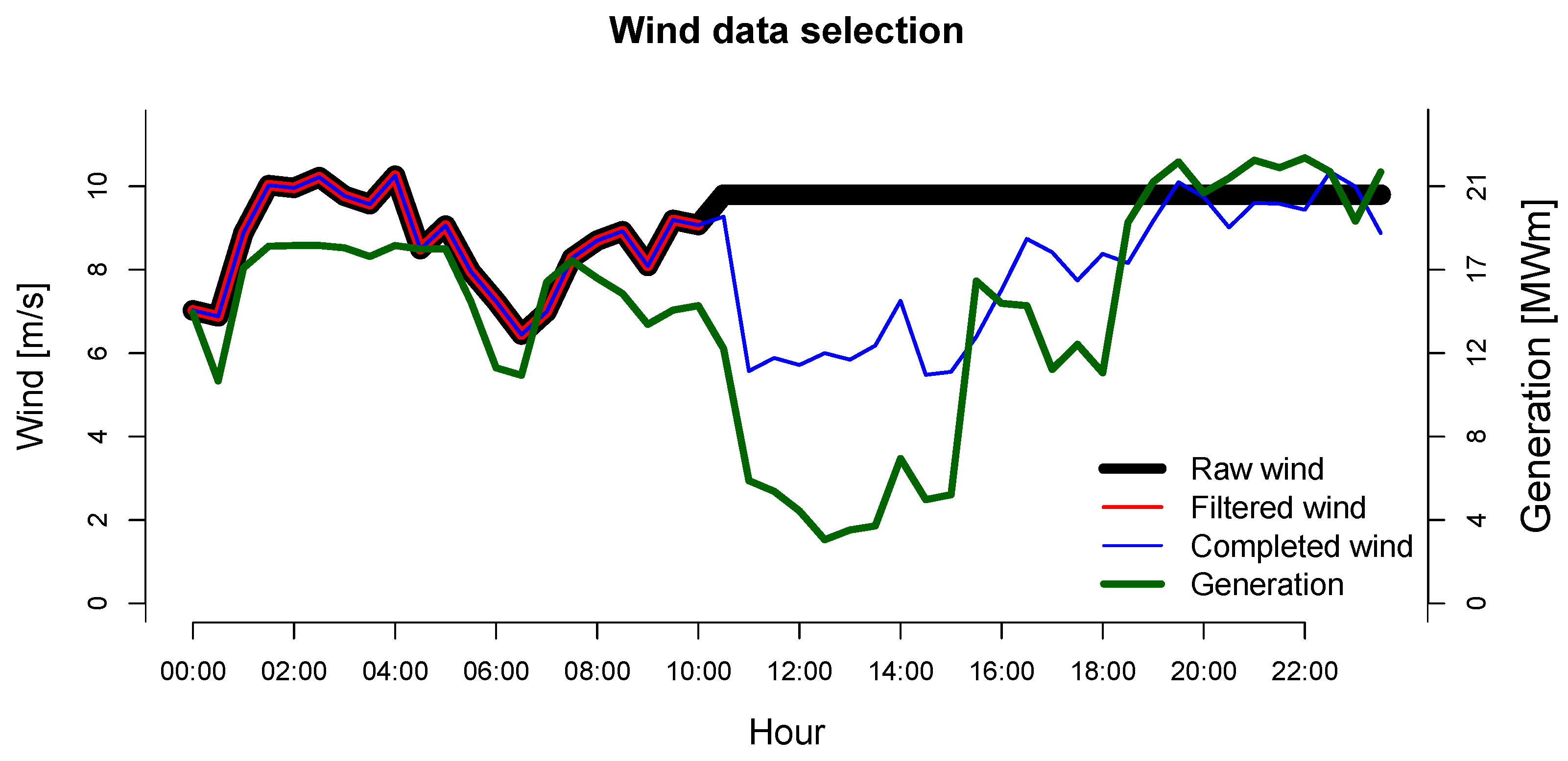
- Data input: raw hourly wind speed time series obtained from ONS and EPE databases, organized at daily resolution.
- (ii)
- Physical consistency filter: removal of measurements that are physically incompatible or that fall outside limits considered representative for the normal operation of wind farms.
- (iii)
- Low variability filter: identification and removal of nearly constant measurements over moving windows of 96 consecutive hours, aiming to detect sensors with insufficient temporal variation.
- (iv)
- Short-term frozen sensor detection: elimination of sequences of measurements with negligible variation over continuous periods of up to 3 h, characterizing temporary reading or data transmission failures.
- (v)
- Daily representativeness check: discarding days with an insufficient number of valid observations (fewer than five hourly measurements), ensuring a minimum level of statistical representativeness for the daily series.
3.2.2. Measurement Source Combination Model
- (i)
- Verification of valid data availability: assessment of the presence of clean and valid wind observations from the ONS and EPE databases over the period of interest. Not all wind farms have both sources available simultaneously.
- (ii)
- Linear regression model adjustment between sources: when both sources provide valid data, a linear model is fitted between the corresponding wind speed time series from ONS and EPE, with statistical consistency evaluated through the coefficient of determination ().
- (iii)
- Geometric consistency filter: application of an additional quality criterion based on the geometric distance of points to the fitted regression line, removing observations beyond a predefined distance threshold to eliminate inconsistent measurement pairs.
- (iv)
- Model performance test: validation of the linear adjustment based on a minimum statistical performance criterion, with the model considered eligible for supplementation only when exceeds the established threshold ().
- (v)
- Hierarchical data supplementation: when the model is validated, gaps in the ONS series are filled using estimates derived from the adjusted EPE series, fully preserving the originally observed values and replacing only the positions with missing data.
3.2.3. Spatially Correlated Data Gap-Filling Model
- (i)
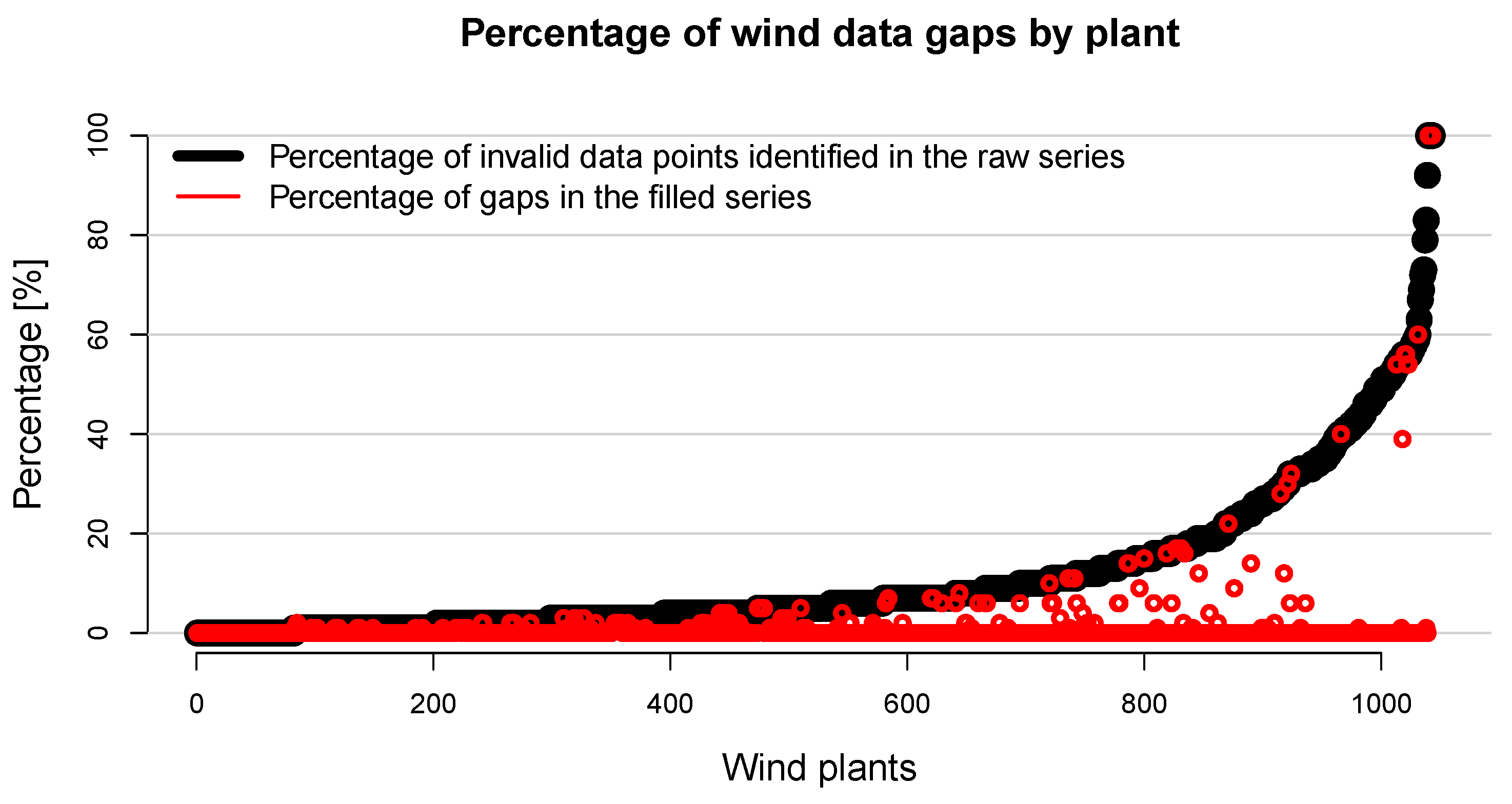
- Identification of neighboring wind farms: for each reference wind farm, geographically proximate wind farms within a maximum distance of 50 km are selected, ensuring spatial relevance.
- (ii)
- Linear adjustment of neighboring series: wind time series from each neighboring wind farm are individually adjusted to the reference wind farm series using linear regression models of the form , with coefficient estimation and statistical consistency evaluated through the coefficient of determination ().
- (iii)
- Ranking and selection wind farms: neighboring wind farms are ranked according to their values, and only those meeting a minimum statistical correlation criterion () are considered eligible for gap filling, ensuring that only representative series contribute to the data supplementation.
- (iv)
- Hierarchical gap filling: missing values in the reference wind farm series are filled hierarchically, prioritizing the most strongly correlated neighboring series, replacing only positions with missing data while fully preserving the originally observed values.
3.3. Wind-to-Power Model
3.3.1. Wind Speed–Power Scatter Filter
3.3.2. Dynamic Creation of Wind vs. Power Curves
3.4. Validation, Uncertainty, and Performance Criteria
4. Results
4.1. Results of Historical Data Preprocessing
4.2. Results of the Estimation Model Application
5. Discussion
5.1. Limitations of the Historical Data Preprocessing and Wind-to-Power Models
5.2. Assessment of the Results
5.3. Curtailment Dynamics in the Brazilian Power System
6. Conclusions
Author Contributions
Funding
Institutional Review Board Statement
Informed Consent Statement
Data Availability Statement
Acknowledgments
Conflicts of Interest
Abbreviations
| SIN | Brazilian Interconnected Power System |
| ONS | Brazilian National Electric System Operator |
| EPE | Brazilian Energy Research Office |
| ANEEL | Brazilian Electricity Regulatory Agency |
| VRE | Variable Renewable Energy |
| GAM | Generalized Additive Models |
| MARS | Multivariate Adaptive Regression Splines |
| SVR | Support Vector Regression |
| ME | Mean Error |
| MAE | Mean Absolute Error |
| RMSE | Root Mean Square Error |
| MAPE | Mean Absolute Percentage Error |
| Coefficient of Determination | |
| W–P | Wind vs. Power |
References
- IEA. World Energy Outlook 2024. International Energy Agency. 2024. Available online: https://iea.blob.core.windows.net/assets/140a0470-5b90-4922-a0e9-838b3ac6918c/WorldEnergyOutlook2024.pdf (accessed on 15 August 2025).
- REN21. Global Status Report Collection: Energy Supply. Renewables. 2024. Available online: https://www.ren21.net/ (accessed on 15 August 2025).
- EIA. Independent Statistics and Analysis. U.S. Energy Information Administration. 2024. Available online: https://www.eia.gov/ (accessed on 10 August 2025).
- IEA. Analysis and Forecast to 2030; International Energy Agency: Paris, France, 2024. Available online: https://iea.blob.core.windows.net/assets/493a4f1b-c0a8-4bfc-be7b-b9c0761a3e5e/Oil2024.pdf (accessed on 15 August 2025).
- IEA. Integrating Solar and Wind; International Energy Agency: Paris, France, 2024. Available online: https://iea.blob.core.windows.net/assets/4e495603-7d8b-4f8b-8b60-896a5936a31d/IntegratingSolarandWind.pdf (accessed on 15 August 2025).
- Yousuf, M.U.; Al-Bahadly, I.; Avci, E. Current perspective on the accuracy of deterministic wind speed and power forecasting. IEEE Access 2019, 7, 159547–159564. [Google Scholar] [CrossRef]
- GIZ. International Best Practices in Solar and Wind Power Forecasting. Deutsche Gesellschaft für Internationale Zusammenarbeit, Global Energy Transformation Programme Technical Brief. 2023. Available online: https://www.get-transform.eu/wp-content/uploads/2024/01/GET.transform-Brief_VRE-Forecasting-Solar-Wind.pdf (accessed on 15 August 2025).
- Electricity Authority Te Mana Hiko. Review of Forecasting Provisions for Intermittent Generators in the Spot Market. New Zealand. 2024. Available online: https://www.ea.govt.nz/documents/5244/Review_of_forecasting_provisions_for_intermittent_generators_in_the_spot_marke_se5mcdm.pdf (accessed on 15 August 2025).
- Yasuda, Y.; Bird, L.; Carlini, E.M.; Eriksen, P.B.; Estanqueiro, A.; Flynn, D.; Vrana, T.K. CE (curtailment–energy share) map: An objective and quantitative measure to evaluate wind and solar curtailment. Renew. Sustain. Energy Rev. 2022, 160, 112212. [Google Scholar] [CrossRef]
- Bird, L.; Lew, D.; Milligan, M.; Carlini, E.M.; Estanqueiro, A.; Flynn, D.; Miller, J. Wind and solar energy curtailment: A review of international experience. Renew. Sustain. Energy Rev. 2016, 65, 577–586. [Google Scholar] [CrossRef]
- Bird, L.; Cochran, J.; Wang, X. Wind and Solar Energy Curtailment: Experience and Practices in the United States. National Renewable Energy Laboratory. 2014. Available online: http://www.nrel.gov/docs/fy14osti/60983.pdf (accessed on 5 February 2026).
- Jacobsen, H.K.; Schröder, S.T. Curtailment of renewable generation: Economic optimality and incentives. Energy Policy 2012, 49, 663–675. [Google Scholar] [CrossRef]
- Joos, M.; Staffell, I. Short-term integration costs of variable renewable energy: Wind curtailment and balancing in Britain and Germany. Renew. Sustain. Energy Rev. 2018, 86, 45–65. [Google Scholar] [CrossRef]
- Kim, D.Y.; Kim, B.S. Exploring wind curtailment effects and economic implications in the growing variable renewable energy penetration. J. Renew. Sustain. Energy 2024, 16, 023310. [Google Scholar] [CrossRef]
- Moreno, B.O. Renewable compensation policies and conventional energy investment: A theoretical model. Heliyon 2024, 10, e33971. [Google Scholar] [CrossRef]
- Wen, Z.; Bai, Y.; Wang, Y. Research on Automatic Calculating Methods of Wind Curtailment Based on Measured Data. In Proceedings of the 11th Frontier Academic Forum of Electrical Engineering (FAFEE2024); Springer Nature: Singapore, 2024; pp. 107–115. [Google Scholar] [CrossRef]
- Simankov, V.; Buchatskiy, P.; Teploukhov, S.; Onishchenko, S.; Kazak, A.; Chetyrbok, P. Review of Estimating and Predicting Models of the Wind Energy Amount. Energies 2023, 16, 5926. [Google Scholar] [CrossRef]
- Ren, G.; Wan, J.; Liu, J.; Yu, D. Spatial and temporal correlation analysis of wind power between different provinces in China. Energy 2020, 191, 116514. [Google Scholar] [CrossRef]
- Li, H. Short-Term Wind Power Prediction via Spatial Temporal Analysis and Deep Residual Networks. Front. Energy Res. 2022, 10, 920407. [Google Scholar] [CrossRef]
- Widodo, D.A.; Iksan, N. Machine learning-driven wind energy mapping enhanced by natural neighbor interpolation. J. Energy Syst. 2024, 8, 193–206. [Google Scholar] [CrossRef]
- Zhao, W.; Zhong, Y.; Li, Q.; Li, M.; Liu, J.; Tang, L. Comparison and correction of IDW based wind speed interpolation methods in urbanized Shenzhen. Front. Earth Sci. 2022, 16, 798–808. [Google Scholar] [CrossRef]
- Cai, C.; Shi, Q.; Jin, Y.; Hua, M.; Tao, Y.; Hou, S. Offshore wind power forecasting with wind-regime clustering and multi-scale feature learning. Int. J. Electr. Power Energy Syst. 2026, 174, 111553. [Google Scholar] [CrossRef]
- Cellura, M.; Cirrincione, G.; Marvuglia, A.; Miraoui, A. Wind speed spatial estimation for energy planning in Sicily: A neural kriging application. Renew. Energy 2008, 33, 1251–1266. [Google Scholar] [CrossRef]
- Hanifi, S.; Liu, X.; Lin, Z.; Lotfian, S. A Critical Review of Wind Power Forecasting Methods—Past, Present and Future. Energies 2020, 13, 3764. [Google Scholar] [CrossRef]
- Sohoni, V.; Gupta, S.C.; Nema, R.K. A Critical Review on Wind Turbine Power Curve Modelling Techniques and Their Applications in Wind Based Energy Systems. J. Energy 2016, 2016, 8519785. [Google Scholar] [CrossRef]
- Mushtaq, K.; Zou, R.; Waris, A.; Yang, K.; Wang, J.; Iqbal, J.; Jameel, M. Multivariate wind power curve modeling using multivariate adaptive regression splines and regression trees. PLoS ONE 2023, 18, e0290316. [Google Scholar] [CrossRef] [PubMed]
- Liu, T.; Lv, K.; Chen, F.; Goh, H.H.; Kurniawan, T.A.; Hu, R.; Jiang, M.; Zhang, D. Wind power curve model combining smoothed spline with first-order moments and density-adjusted wind speed strategy. Energy 2024, 313, 133628. [Google Scholar] [CrossRef]
- Li, L.-L.; Zhao, X.; Tseng, M.-L.; Tan, R.R. Short-term wind power forecasting based on support vector machine with improved dragonfly algorithm. J. Clean. Prod. 2020, 242, 118447. [Google Scholar] [CrossRef]
- Singh, U.; Rizwan, M.; Alaraj, M.; Alsaidan, I. A Machine Learning-Based Gradient Boosting Regression Approach for Wind Power Production Forecasting: A Step towards Smart Grid Environments. Energies 2021, 14, 5196. [Google Scholar] [CrossRef]
- Zheng, H.; Wu, Y. A XGBoost Model with Weather Similarity Analysis and Feature Engineering for Short-Term Wind Power Forecasting. Appl. Sci. 2019, 9, 3019. [Google Scholar] [CrossRef]
- Siqueira, M.V.M.; Ferreira, V.H.; Colombini, A.C. Long term wind energy forecasting using machine learning techniques. Glob. Energy Interconnect. 2025, 8, 1030–1046. [Google Scholar] [CrossRef]
- Viner, B.; Noble, S.; Qian, J.-H.; Werth, D.; Gayes, P.; Pietrafesa, L.; Bao, S. Frequency and Characteristics of Inland Advecting Sea Breezes in the Southeast United States. Atmosphere 2021, 12, 950. [Google Scholar] [CrossRef]
- EPE. Sistema AMA—13 Anos de Acompanhamento de Medições Anemométricas: Aprendizados e Visão de Futuro. Brazilian Energy Research Office. 2025. Available online: https://www.epe.gov.br/sites-pt/publicacoes-dados-abertos/publicacoes/PublicacoesArquivos/publicacao-854/NT-EPE-DEE-SGR-030-2024-R1.pdf (accessed on 20 May 2025).
- ONS. NT 0097/2021—Modelo de Estimação das Curvas Vento X Potência para Estimação de Energia Frustrada. Brazilian National Electric System Operator. 2023. Available online: https://sintegre.ons.org.br/sites/8/103/105/paginas/servicos/produtos-pasta.aspx?RootFolder=/sites/8/103/105/Produtos/671/05-05-2022_112100 (accessed on 20 May 2025).
- Nascimento, P.S.C.; Mendes, E.L.; Marcato, A.L.M.; Araujo, L.F.; Khenayfis, L.S. Statistical model for treatment of missing and outliers in time series for wind power forecast. In Proceedings of the XIV Latin-American Congress on Electricity Generation and Transmission (CLAGTEE); Even3 Publicações: Rio de Janeiro, Brazil, 2022; number B-5.3-4; Available online: https://www.feg.unesp.br/Home/Eventos/clagtee/topic-5---energy-planning-and-management.zip (accessed on 20 May 2025).
- ONS. NT 0151-2018—Desenvolvimento Metodológico para Previsão de Geração de Fonte Eólica. Brazilian National Electric System Operator. 2018. Available online: https://sintegre.ons.org.br/sites/8/103/105/_layouts/15/WopiFrame.aspx?sourcedoc={27C54B62-AA88-4FB0-9D63-C393521D557A} (accessed on 20 May 2025).
- Ye, S.; He, Y.; Zhang, L. Review of short-term wind power forecasting models. Renew. Energy 2016, 87, 259–270. [Google Scholar]
- Zhao, X.; Wang, H.; Chen, M. Short-term wind power forecasting using machine learning methods: A review. Renew. Sustain. Energy Rev. 2018, 93, 419–430. [Google Scholar]
- Rolo, M.N.M. Previsão de Produção Eólica com Modelização de Incertezas. Ph.D. Thesis, Faculdade de Engenharia da Universidade do Porto, Porto, Portugal, 2014. Available online: https://repositorio-aberto.up.pt/bitstream/10216/75803/2/31592.pdf (accessed on 20 May 2025).
- Messner, J.W.; Pinson, P.; Browell, J.; Bjerregård, M.B.; Schicker, I. Evaluation of wind power forecasts: An up-to-date view. Wind Energy 2020, 23, 1461–1481. [Google Scholar] [CrossRef]
- Hyndman, R.J.; Koehler, A.B. Another look at measures of forecast accuracy. Int. J. Forecast. 2006, 22, 679–688. [Google Scholar] [CrossRef]
- González-Sopeña, J.M.; Pakrashi, V.; Ghosh, B. An overview of performance evaluation metrics for short-term statistical wind power forecasting. Renew. Sustain. Energy Rev. 2021, 138, 110515. [Google Scholar] [CrossRef]
- Nascimento, P.S.C.; Deotti, L.M.P.; Marcato, A.L.M.; Farias, W.C.M. Wind Power Forecasting for Independent System Operators: Modeling Approaches, Practical Applications, and Operational Challenges in the Brazilian Context. IEEE Access 2026, 14, 27895–27914. [Google Scholar] [CrossRef]
- Vieira, G.; Silva, W.; Salles, M.; Lourenço, L. Assessment of Constrained-Off in Renewable Energy Integration in Brazil. In Proceedings of the 2025 International Conference on Clean Electrical Power; IEEE: Villasimius, Italy, 2025; pp. 121–127. [Google Scholar] [CrossRef]
- Vieira, G.; Silva, W.; Lourenço, L.; Monaro, R. Characterizing wind and solar curtailment in Brazil: An evidence-based analysis of operational drivers. Electr. Power Syst. Res. 2026, 254, 109684. [Google Scholar] [CrossRef]
- Silva, W.; Vieira, G.; Simone, L.; Lourenço, L.; Salles, M. Data-Driven Analysis of Wind Curtailment Energy Imbalance and Distributed Generation in Brazil. In Proceedings of the 2025 International Conference on Clean Electrical Power; IEEE: Villasimius, Italy, 2025; pp. 728–734. [Google Scholar] [CrossRef]




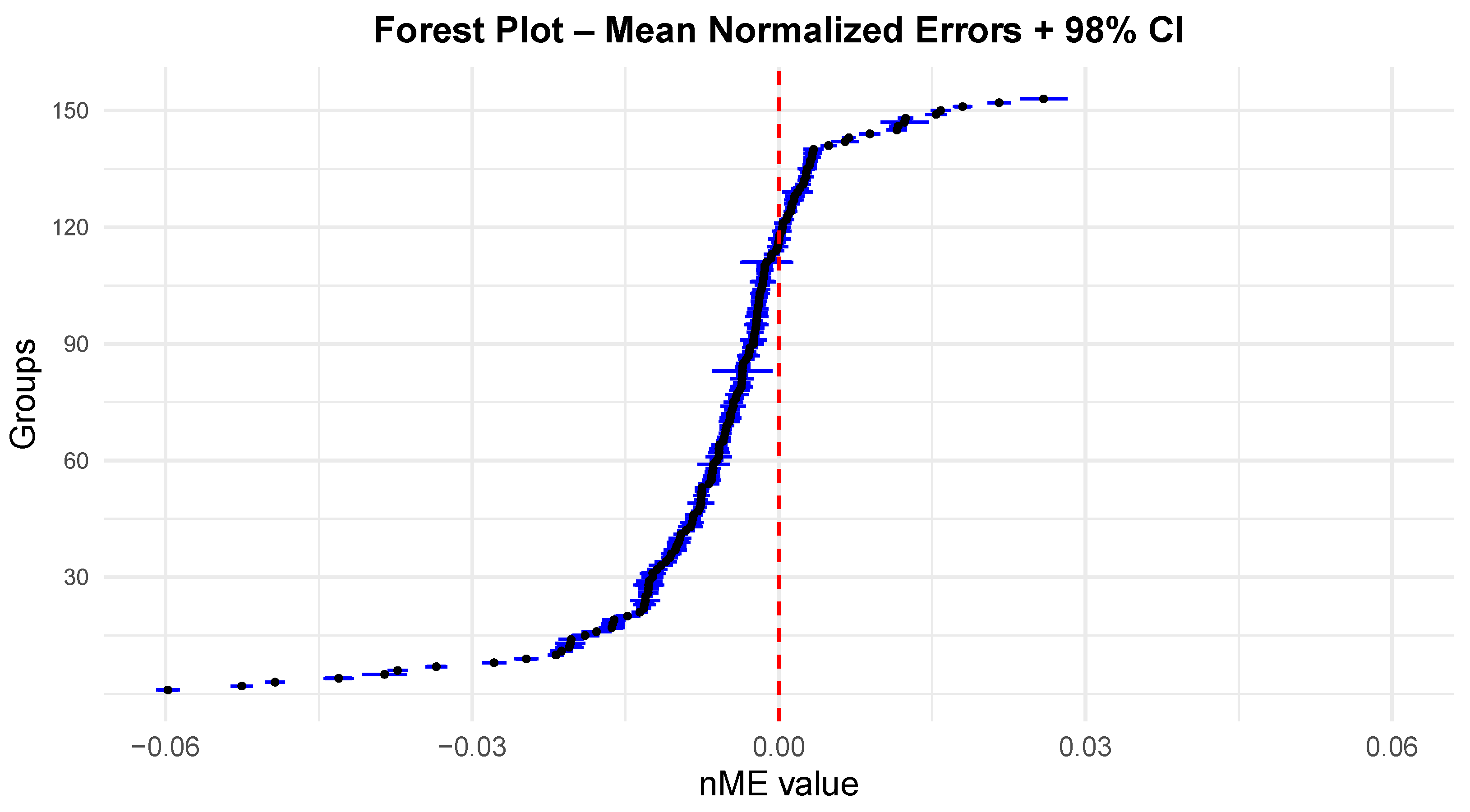
| nME | nMAE | nRMSE | nMAPE (%) | |
|---|---|---|---|---|
| Values | −0.0281 | 0.0401 | 0.0680 | 4.0121 |
Disclaimer/Publisher’s Note: The statements, opinions and data contained in all publications are solely those of the individual author(s) and contributor(s) and not of MDPI and/or the editor(s). MDPI and/or the editor(s) disclaim responsibility for any injury to people or property resulting from any ideas, methods, instructions or products referred to in the content. |
© 2026 by the authors. Licensee MDPI, Basel, Switzerland. This article is an open access article distributed under the terms and conditions of the Creative Commons Attribution (CC BY) license.
Share and Cite
Nascimento, P.; Cossich, W.; Araujo, L.; Santos, I.; Almeida, K.; Marcato, A. An Integrated Methodology for Assessing Wind Power Curtailment Using Anemometric Measurements and Operational Data in the Brazilian Context. Atmosphere 2026, 17, 333. https://doi.org/10.3390/atmos17040333
Nascimento P, Cossich W, Araujo L, Santos I, Almeida K, Marcato A. An Integrated Methodology for Assessing Wind Power Curtailment Using Anemometric Measurements and Operational Data in the Brazilian Context. Atmosphere. 2026; 17(4):333. https://doi.org/10.3390/atmos17040333
Chicago/Turabian StyleNascimento, Paulo, William Cossich, Lais Araujo, Isabela Santos, Kevin Almeida, and André Marcato. 2026. "An Integrated Methodology for Assessing Wind Power Curtailment Using Anemometric Measurements and Operational Data in the Brazilian Context" Atmosphere 17, no. 4: 333. https://doi.org/10.3390/atmos17040333
APA StyleNascimento, P., Cossich, W., Araujo, L., Santos, I., Almeida, K., & Marcato, A. (2026). An Integrated Methodology for Assessing Wind Power Curtailment Using Anemometric Measurements and Operational Data in the Brazilian Context. Atmosphere, 17(4), 333. https://doi.org/10.3390/atmos17040333