
Association of Cognition-Related Genetic Polymorphisms with Elite Athlete Status: A Meta-Analysis


Abstract
1. Introduction
2. Methods
2.1. Search Strategy
2.2. Inclusion and Exclusion Criteria
2.3. Data Extraction
2.4. Statistical Analysis Process
3. Results
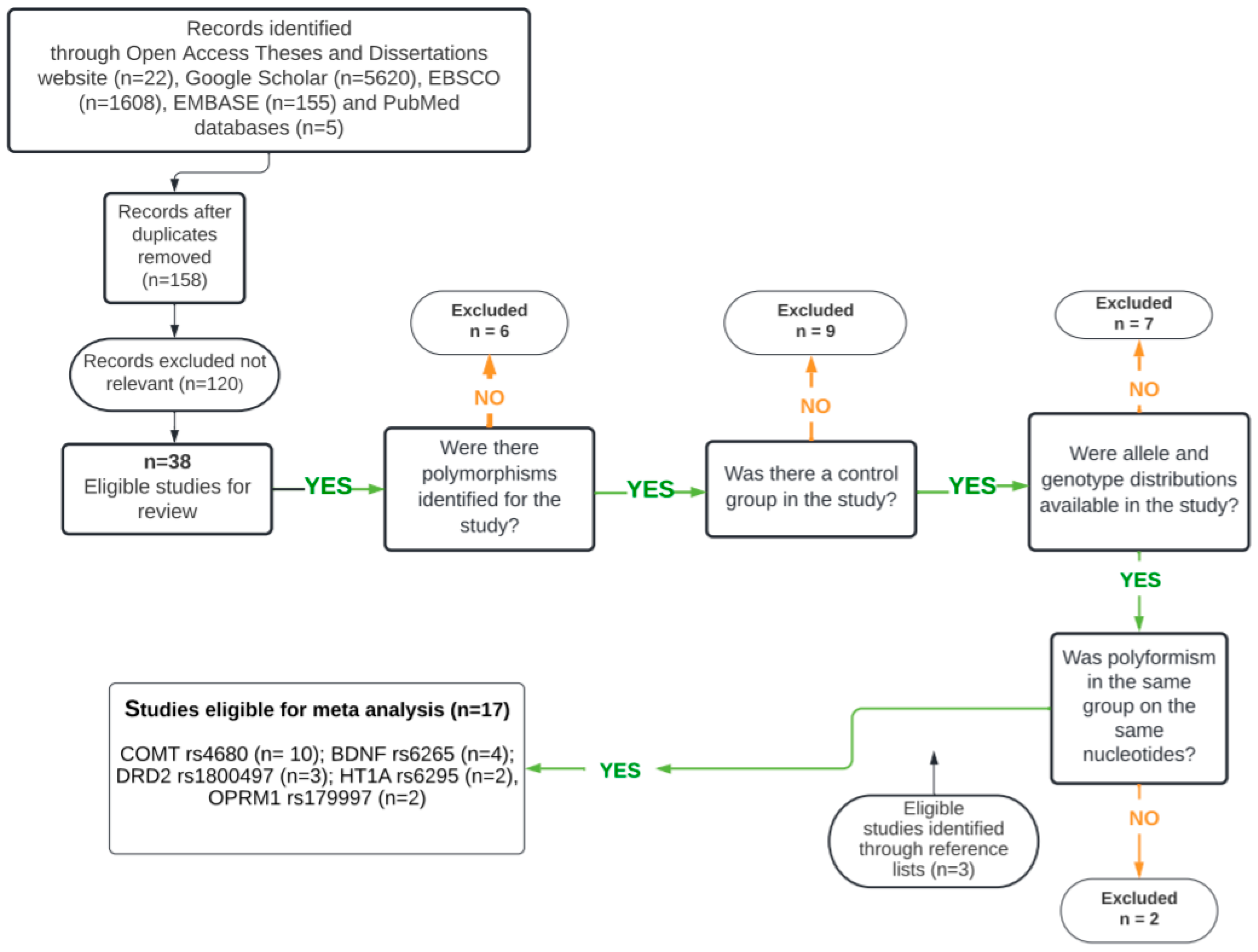
3.1. Characteristics of Included Studies
3.2. Meta-Analysis Results
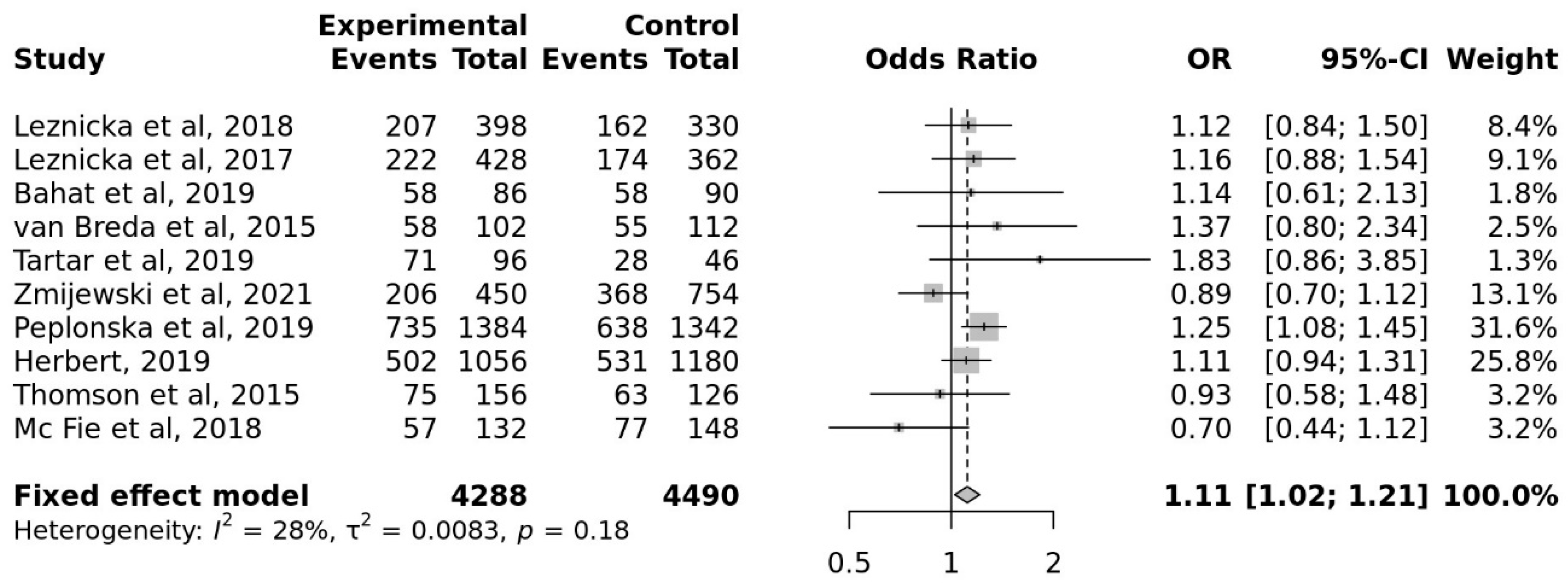
3.3. Cognition-Related Traits and the COMT Gene rs4680 Polymorphism
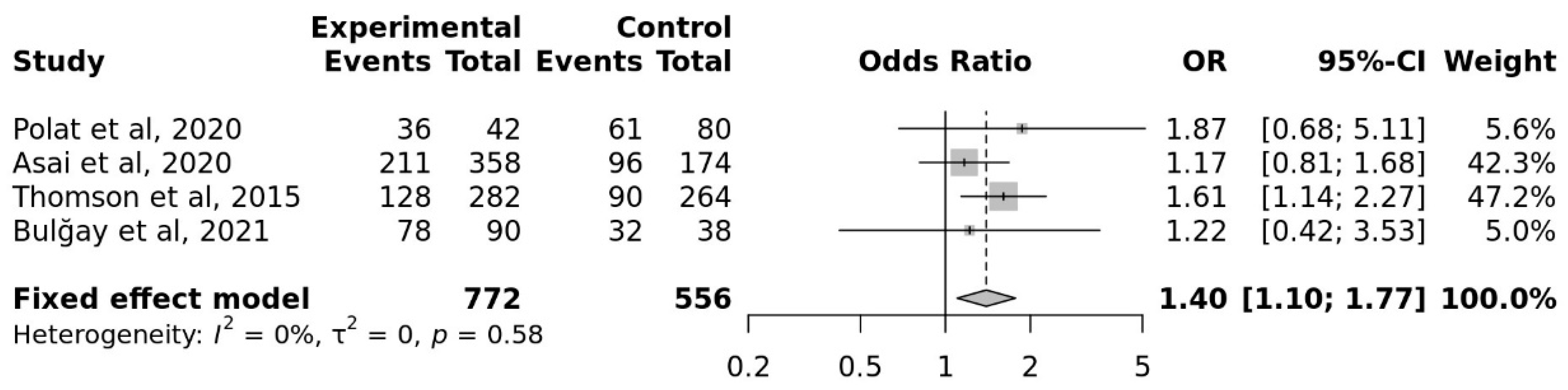
3.4. Cognition-Related Traits, and BDNF Gene rs6265 Polymorphism
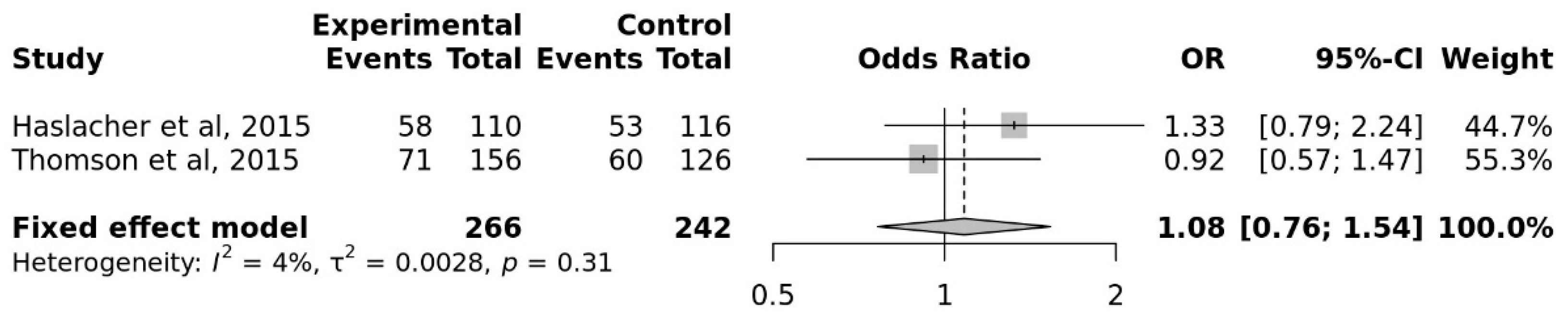
3.5. Cognition-Related Traits and HTR1A Gene rs6295 Polymorphism
3.6. Cognition-Related Traits and DRD2 rs1800497 and OPRM1 Gene rs179997 Polymorphisms
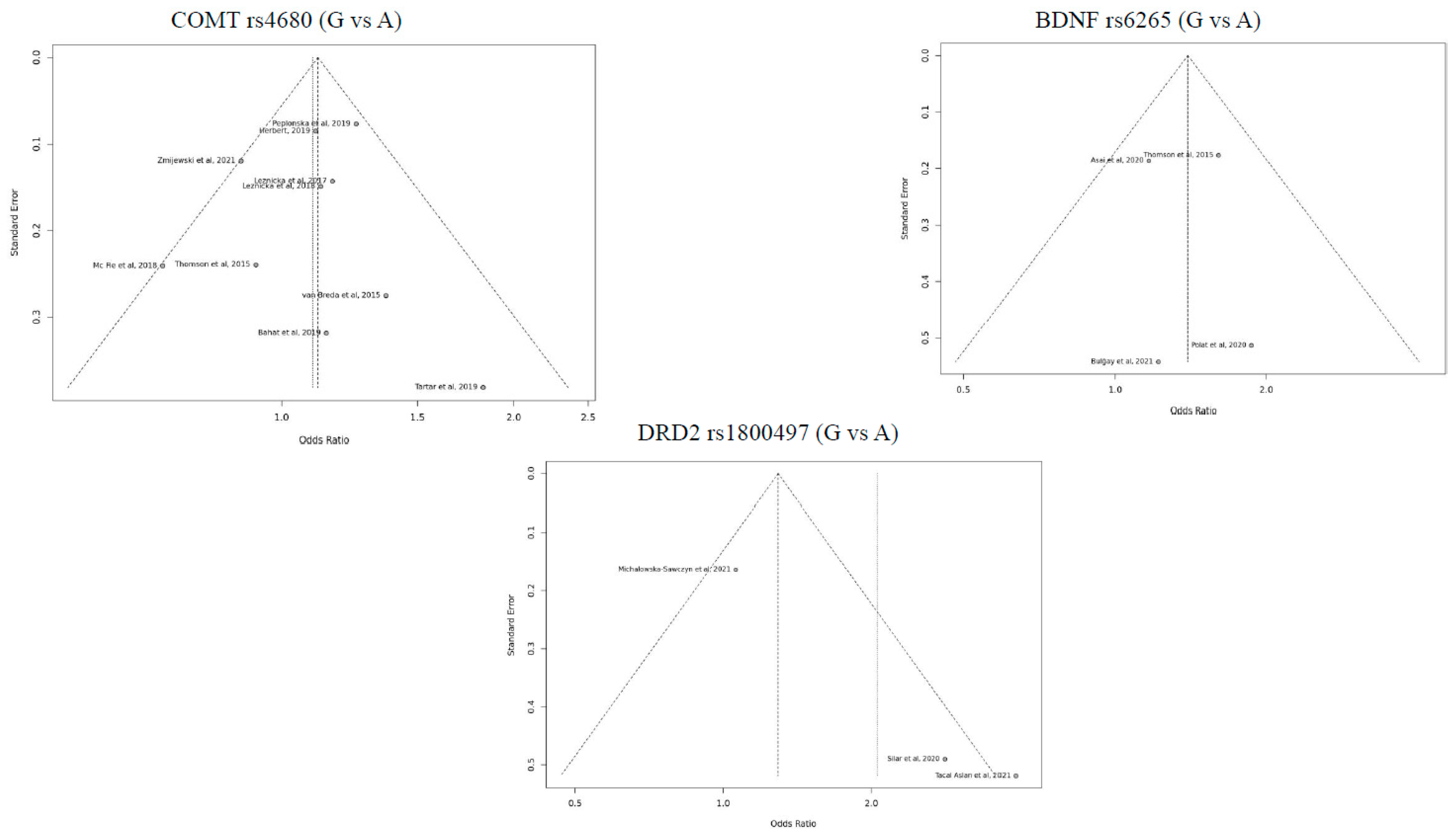
3.7. Publication Bias
4. Discussion
5. Conclusions
6. Limitations
- ➢
- In addition, although efforts were made to implement a comprehensive search strategy, certain limitations related to the literature search should be acknowledged. The applied time restriction (2014–2022) may have limited the inclusion of earlier relevant studies. Furthermore, although all potentially eligible studies were considered regardless of access status, some studies could not be included due to the inability to obtain full-text articles or sufficient data, despite attempts to access them through institutional resources or by contacting the corresponding authors.
- ➢
- The number of included studies was limited for certain polymorphisms, particularly HTR1A rs6295 and OPRM1 rs1799971. This restricted the statistical power of the analyses and limited the robustness of the pooled estimates. In addition, the small number of studies for these polymorphisms prevented a reliable assessment of publication bias and may have reduced the precision of the conclusions.
- ➢
- Heterogeneity across the included studies should be taken into account. The analyzed studies differed in terms of sport disciplines, population characteristics, ethnic backgrounds, and sample sizes. Such variability may have influenced the pooled results and complicated direct comparisons across studies.
- ➢
- Some included studies showed deviation from the Hardy–Weinberg equilibrium in control groups, which may reflect potential issues such as population stratification or genotyping errors. Although sensitivity analyses indicated that the overall findings were not substantially affected, this factor should still be considered when interpreting the results.
- ➢
- The present meta-analysis was based on genotype and allele frequency data rather than direct measurements of neurocognitive or behavioral outcomes. Therefore, the findings reflect associations at the genetic level and do not allow for direct inferences regarding cognition-related traits or athletic performance.
- ➢
- Although multiple statistical approaches, including random-effects models and sensitivity analyses, were applied to improve robustness, the overall conclusions remain dependent on the quality and availability of the included studies.
7. Protocol Registration
Author Contributions
Funding
Institutional Review Board Statement
Informed Consent Statement
Data Availability Statement
Acknowledgments
Conflicts of Interest
References
- Goldstein, D.B.; Cavalleri, G.L. Understanding human diversity. Nature 2005, 437, 1241–1242. [Google Scholar] [CrossRef]
- Shen, H.; Li, J.; Zhang, J.; Xu, C.; Jiang, Y.; Wu, Z.; Zhao, F.; Liao, L.; Chen, J.; Lin, Y.; et al. Comprehensive characterization of human genome variation by high coverage whole-genome sequencing of forty four caucasians. PLoS ONE 2013, 8, e59494. [Google Scholar] [CrossRef]
- Burgess, D.; Naughton, G.; Hopkins, W. Draft-camp predictors of subsequent career success in the Australian Football League. J. Sci. Med. Sport 2012, 15, 561–567. [Google Scholar] [CrossRef] [PubMed]
- Jacob, Y.; Spiteri, T.; Hart, N.H.; Anderton, R.S. The Potential Role of Genetic Markers in Talent Identification and Athlete Assessment in Elite Sport. Sports 2018, 6, 88. [Google Scholar] [CrossRef]
- Pion, J.A.; Fransen, J.; Deprez, D.N.; Segers, V.I.; Vaeyens, R.; Philippaerts, R.M.; Lenoir, M. Stature and jumping height are required in female volleyball, but motor coordination is a key factor for future elite success. J. Strength. Cond. Res. 2015, 29, 1480–1485. [Google Scholar] [CrossRef]
- Fritsch, B.; Reis, J.; Martinowich, K.; Schambra, H.M.; Ji, Y.; Cohen, L.G.; Lu, B. Direct current stimulation promotes BDNF-dependent synaptic plasticity: Potential implications for motor learning. Neuron 2010, 66, 198–204. [Google Scholar] [CrossRef] [PubMed]
- Huertas, E.; Bühler, K.; Echeverry-Alzate, V.; Giménez, T.; López-Moreno, J.A. C957T polymorphism of the dopamine D2 receptor gene is associated with motor learning and heart rate. Genes. Brain Behav. 2012, 11, 677–683. [Google Scholar] [CrossRef] [PubMed]
- Blasi, G.; Mattay, V.S.; Bertolino, A.; Elvevåg, B.; Callicott, J.H.; Das, S.; Kolachana, B.S.; Egan, M.F.; Goldberg, T.E.; Weinberger, D.R. Effect of catechol-O-methyltransferase val158met genotype on attentional control. J. Neurosci. 2005, 25, 5038–5045. [Google Scholar]
- Chen, J.; Lipska, B.K.; Halim, N.; Ma, Q.D.; Matsumoto, M.; Melhem, S.; Kolachana, B.S.; Hyde, T.M.; Herman, M.M.; Apud, J.; et al. Functional analysis of genetic variation in catechol-O-methyltransferase (COMT): Effects on mRNA, protein, and enzyme activity in postmortem human brain. Am. J. Hum. Genet. 2004, 75, 807–821. [Google Scholar] [CrossRef]
- Weinberger, D.R.; Egan, M.F.; Bertolino, A.; Callicott, J.H.; Mattay, V.S.; Lipska, B.K.; Berman, K.F.; Goldberg, T.E. Prefrontal neurons and the genetics of schizophrenia. Biol. Psychiatry 2001, 50, 825–844. [Google Scholar] [CrossRef]
- Witte, A.V.; Jansen, S.; Schirmacher, A.; Young, P.; Flöel, A. COMT Val158Met polymorphism modulates cognitive effects of dietary intervention. Front. Aging Neurosci. 2010, 2, 7257. [Google Scholar] [CrossRef]
- Goldberg, T.E.; Weinberger, D.R. Genes and the parsing of cognitive processes. Trends Cogn. Sci. 2004, 8, 325–335. [Google Scholar] [CrossRef]
- Baker-Herman, T.L.; Fuller, D.D.; Bavis, R.W.; Zabka, A.G.; Golder, F.J.; Doperalski, N.J.; A Johnson, R.; Watters, J.J.; Mitchell, G.S. BDNF is necessary and sufficient for spinal respiratory plasticity following intermittent hypoxia. Nat. Neurosci. 2004, 7, 48–55. [Google Scholar] [CrossRef] [PubMed]
- Clow, C.; Jasmin, B.J. Brain-derived neurotrophic factor regulates satellite cell differentiation and skeltal muscle regeneration. Mol. Biol. Cell 2010, 21, 2182–2190. [Google Scholar] [CrossRef]
- Zhang, X.; Poo, M. Localized synaptic potentiation by BDNF requires local protein synthesis in the developing axon. Neuron 2002, 36, 675–688. [Google Scholar] [CrossRef] [PubMed]
- Reichardt, L.F. Neurotrophin-regulated signalling pathways. Philos. Trans. R. Soc. B Biol. Sci. 2006, 361, 1545–1564. [Google Scholar] [CrossRef]
- Pringle, A.; Sundstrom, L.; Wilde, G.; Williams, L.; Lannotti, F. Brain-derived neurotrophic factor, but not neurotrophin-3, prevents ischaemia-induced neuronal cell death in organotypic rat hippocampal slice cultures. Neurosci. Lett. 1996, 211, 203–206. [Google Scholar] [CrossRef] [PubMed]
- Xie, S.; Yu, L.; Zhou, M.; Liu, L.; Lei, D.; Han, C. Association between BDNF rs6265 polymorphisms and postoperative cognitive dysfunction in Chinese Han Population. Brain Behav. 2020, 10, e01800. [Google Scholar] [CrossRef]
- Wildenberg, E.V.D.; Wiers, R.W.; Dessers, J.; Janssen, R.G.J.H.; Lambrichs, E.H.; Smeets, H.J.M.; Van Breukelen, G.J.P. A Functional polymorphism of the μ-opioid receptor gene (OPRM1) influences cue-induced craving for alcohol in male heavy drinkers. Alcohol. Clin. Exp. Res. 2007, 31, 1–10. [Google Scholar] [CrossRef]
- Leźnicka, K.; Niewczas, M.; Kurzawski, M.; Cięszczyk, P.; Safranow, K.; Ligocka, M.; Białecka, M. The association between COMT rs4680 and OPRM1 rs1799971 polymorphisms and temperamental traits in combat athletes. Pers. Individ. Differ. 2018, 124, 105–110. [Google Scholar] [CrossRef]
- Kavanagh, J.J.; McFarland, A.J.; Taylor, J.L. Enhanced availability of serotonin increases activation of unfatigued muscle but exacerbates central fatigue during prolonged sustained contractions. J. Physiol. 2019, 597, 319–332. [Google Scholar] [CrossRef] [PubMed]
- Okamoto, K.; Imbe, H.; Tashiro, A.; Kimura, A.; Donishi, T.; Tamai, Y.; Senba, E. The role of peripheral 5HT2A and 5HT1A receptors on the orofacial formalin test in rats with persistent temporomandibular joint inflammation. Neuroscience 2005, 130, 465–474. [Google Scholar] [CrossRef]
- Moher, D.; Liberati, A.; Tetzlaff, J.; Altman, D.G.; The PRISMA Group. Preferred reporting items for systematic reviews and meta-analyses: The PRISMA statement. Ann. Intern. Med. 2009, 151, 264–269. [Google Scholar] [CrossRef]
- Ginevičienė, V.; Utkus, A.; Pranckevičienė, E.; Semenova, E.A.; Hall, E.C.R.; Ahmetov, I.I. Perspectives in Sports Genomics. Biomedicines 2022, 10, 298. [Google Scholar] [CrossRef] [PubMed]
- Zmijewski, P.; Leońska-Duniec, A.; Stuła, A.; Sawczuk, M. Evaluation of the association of comt Rs4680 polymorphism with swimmers’ competitive performance. Genes 2021, 12, 1641. [Google Scholar] [CrossRef] [PubMed]
- Tartar, J.L.; Cabrera, D.; Knafo, S.; Thomas, J.D.; Antonio, J.; Peacock, C.A. The “Warrior” COMT Val/Met genotype occurs in greater frequencies in mixed martial arts fighters relative to controls. Sports Sci. Med. 2020, 19, 38–42. [Google Scholar]
- van Breda, K.; Collins, M.; Stein, D.J.; Rauch, L. The COMT val158met polymorphism in ultra-endurance athletes. Physiol. Behav. 2015, 151, 279–283. [Google Scholar] [CrossRef]
- Bahat, B.; Kapıcı, S.; Sercan, C.; Tuna, G.; Kaynar, Ö.; Bilici, F.; Ulucan, K. Investigation of catechol -O-methyl transferase (COMT) rs4680 polymorphism in swimmers and skiers. J. Neurobehav. Sci. 2019, 6, 125–128. [Google Scholar] [CrossRef]
- Mc Fie, S.; Abrahams, S.; Patricios, J.; Suter, J.; Posthumus, M.; September, A.V. The association between COMT rs4680 and 5-HTTLPR genotypes and concussion history in South African rugby union players. J. Sports Sci. 2018, 36, 920–933. [Google Scholar] [CrossRef]
- Leźnicka, K.; Kurzawski, M.; Cięszczyk, P.; Safranow, K.; Malinowski, D.; Brzeziańska-Lasota, E.; Zmijewski, P. Polymorphisms of catechol-O-methyltransferase (COMT rs4680:G>A) and μ-opioid receptor (OPRM1 rs1799971:A >G) in relation to pain perception in combat athletes. Biol. Sport 2017, 34, 295–301. [Google Scholar] [CrossRef]
- Peplonska, B.; Safranow, K.; Adamczyk, J.; Boguszewski, D.; Szymański, K.; Soltyszewski, I.; Barczak, A.; Siewierski, M.; Ploski, R.; Sozanski, H.; et al. Association of serotoninergic pathway gene variants with elite athletic status in the Polish population. J. Sports Sci. 2019, 37, 1655–1662. [Google Scholar] [CrossRef]
- Thomson, C.J.; Power, R.J.; Carlson, S.R.; Rupert, J.L.; Michel, G. A comparison of genetic variants between proficient low- and high-risk sport participants. J. Sports Sci. 2015, 33, 1861–1870. [Google Scholar] [CrossRef]
- Herbert, A.J. Genetics of Bone Mineral Density and the Associated Influence on Performance and Stress Fracture Incidence in High-Level Endurance Runners. Ph.D. Thesis, Manchester Metropolitan University, Manchester, UK, 2019. [Google Scholar]
- Haslacher, H.; Michlmayr, M.; Batmyagmar, D.; Perkmann, T.; Ponocny-Seliger, E.; Scheichenberger, V.; Scherzer, T.M.; Nistler, S.; Pilger, A.; Dal-Bianco, P.; et al. rs6295 [C]-allele protects against depressive mood in elderly endurance athletes. J. Sport Exerc. Psychol. 2015, 37, 637–645. [Google Scholar] [CrossRef]
- Ulucan, K.; Polat, T.; Dogan, C.S.; Eken, B.F.; Yilmaz, Ö.; Silar, Ç.; Karapinar, G.; Baltacıoğlu, B.; Ekmekçi, R. The Distribution of Brain-Derived Neurotrophic Factor rs6265 Polymorphism in Turkish Volleyball Players. J. Neurobehav. Sci. 2020, 7, 152. [Google Scholar] [CrossRef]
- Asai, T.; Abe, D.; Doi, H.; Tanaka, C.; Ohishi, K.; Maeda, H.; Wada, T.; Takahashi, Y.; Nakahata, Y.; Shinohara, K. Characteristics of the BDNF Val66Met polymorphism in competitive swimmers and judo athletes. Acta Med. Nagasaki. 2020, 64, 23–29. [Google Scholar]
- Bulgay, C.; Zorba, E.; Kazan, H.H.; Bayraktar, I.; Uca, M.; Ergün, M.A.; John, G.; Yusupov, R.A.; Sultanov, R.I.; Semenova, E.A.; et al. BDNF coexpresses with MTOR and is associated with muscle fiber size, lean mass and power-related traits. Eur. J. Appl. Physiol. 2025, 125, 2781–2792. [Google Scholar] [CrossRef] [PubMed]
- Michałowska-Sawczyn, M.; Chmielowiec, K.; Chmielowiec, J.; Trybek, G.; Masiak, J.; Niewczas, M.; Cieszczyk, P.; Bajorek, W.; Król, P.; Grzywacz, A. Analysis of Selected Variants of DRD2 and ANKK1 Genes in Combat Athletes. Genes 2021, 12, 1239. [Google Scholar] [CrossRef]
- Aslan, B.T.; Yılmaz, Ö.Ö.; Polat, T.; Şılar, Ç.; Eken, B.F.; Doğan, C.S.; Ulucan, K. Distribution of Dopamine Receptor 2 DRD2 rs1800497 Polymorphisms in Professional Football Players. Turkish J. Sport Exerc. 2021, 23, 185–189. [Google Scholar]
- Ulucan, K.; Silar, Ç.; Karagöz, E.; Polat, T.; Yilmaz, Ö.; Aslan, B.T.; Doğan, C.S.; Baltacioğlu, B.S.; Kaman, T. Distribution of Dopamine Receptor 2 (DRD2) rs1800497 Polymorphisms in Cyclist. J. Neurobehav. Sci. 2020, 7, 170. [Google Scholar] [CrossRef]
- Huedo-Medina, T.B.; Sánchez-Meca, J.; Marín-Martínez, F.; Botella, J. Assessing heterogeneity in meta-analysis: Q statistic or I2 index? Psychol. Methods 2006, 11, 193–206. [Google Scholar] [CrossRef]
- Martorell-Marugan, J.; Toro-Dominguez, D.; Alarcon-Riquelme, M.E.; Carmona-Saez, P. MetaGenyo: A web tool for meta-analysis of genetic association studies. BMC Bioinform. 2017, 18, 563. [Google Scholar] [CrossRef]
- Munafò, M.R.; Clark, T.G.; Moore, L.R.; Payne, E.; Walton, R.; Flint, J. Genetic polymorphisms and personality in healthy adults: A systematic review and meta-analysis. Mol. Psychiatry 2003, 8, 471–484. [Google Scholar] [CrossRef] [PubMed]
- Egger, M.; Smith, G.D.; Schneider, M.; Minder, C. Bias in meta-analysis detected by a simple, graphical test. BMJ 1997, 315, 629–634. [Google Scholar] [CrossRef] [PubMed]
- Akil, M.; Kolachana, B.S.; Rothmond, D.A.; Hyde, T.M.; Weinberger, D.R.; Kleinman, J.E. Catechol-O-methyltransferase genotype and dopamine regulation in the human brain. J. Neurosci. 2003, 23, 2008–2013. [Google Scholar] [CrossRef]
- de Frias, C.M.; Annerbrink, K.; Westberg, L.; Eriksson, E.; Adolfsson, R.; Nilsson, L.-G. Catechol O-methyltransferase Val158Met polymorphism is associated with cognitive performance in nondemented adults. J. Cogn. Neurosci. 2005, 17, 1018–1025. [Google Scholar] [CrossRef]
- Heinz, A.; Smolka, M.N. The Effects of Catechol O-methyltransferase genotype on brain activation elicited by affective stimuli and cognitive tasks. Prog. Neurobiol. 2006, 17, 359–368. [Google Scholar] [CrossRef]
- Enoch, M.; Waheed, J.F.; Harris, C.R.; Albaugh, B.; Goldman, D. COMT Val158Met and cognition: Main effects and interaction with educational attainment. Genes. Brain Behav. 2009, 8, 36–42. [Google Scholar] [CrossRef] [PubMed]
- Toh, Y.L.; Ng, T.; Tan, M.; Tan, A.; Chan, A. Impact of brain-derived neurotrophic factor genetic polymorphism on cognition: A systematic review. Brain Behav. 2018, 8, e01009. [Google Scholar] [CrossRef]
- Guo, J.-C.; Li, X.; Guo, M.; Gao, Y.-S.; Fu, L.-Q.; Jiang, X.-L.; Fu, L.M.; Huang, T. Association of BDNF gene polymorphism with endophenotypes in posttraumatic stress disorder. Rev. Assoc. Méd. Bras. 2020, 66, 615–622. [Google Scholar] [CrossRef]
- Hamilton, G.F.; Rhodes, J.S. Exercise Regulation of Cognitive Function and Neuroplasticity in the Healthy and Diseased Brain, 1st ed.; Elsevier Inc.: Amsterdam, The Netherlands, 2015. [Google Scholar]
- Mete, L. Depresyon ve Nöroplastisite. Klin. Psikofarmakol. Bul. 2007, 17, 100–111. [Google Scholar]
- Neeper, S.A.; Gómez-Pinilla, F.; Choi, J.; Cotman, C.W. Physical activity increases mRNA for brain-derived neurotrophic factor and nerve growth factor in rat brain. Brain Res. 1996, 726, 49–56. [Google Scholar] [CrossRef]
- Grandy, D.K.; Litt, M.; Allen, L.; Bunzow, J.R.; Marchionni, M.; Makam, H.; Reed, L.; Magenis, R.E.; Civelli, O. The human dopamine D2 receptor gene is located on chromosome 11 at q22-q23 and identifies a TaqI RFLP. Am. J. Hum. Genet. 1989, 45, 778. [Google Scholar]
- Roetker, N.S.; A Yonker, J.; Lee, C.; Chang, V.; Basson, J.J.; Roan, C.L.; Hauser, T.S.; Hauser, R.M.; Atwood, C.S. Multigene interactions and the prediction of depression in the Wisconsin Longitudinal Study. BMJ Open 2012, 2, e000944. [Google Scholar] [CrossRef]
- Lawford, B.R.; Young, R.; Noble, E.P.; Kann, B.; Ritchie, T. The D2 dopamine receptor (DRD2) gene is associated with co-morbid depression, anxiety and social dysfunction in untreated veterans with post-traumatic stress disorder: Supported by The Greenslopes Private Hospital Research Foundation, Australia, Queenslan. Eur. Psychiatry 2006, 21, 180–185. [Google Scholar] [CrossRef]
- Ndamanisha, J.C.; Guo, L. Nonenzymatic glucose detection at ordered mesoporous carbon modified electrode. Bioelectrochemistry 2009, 77, 60–63. [Google Scholar] [CrossRef]
- Noohi, F.; Boyden, N.B.; Kwak, Y.; Humfleet, J.; Burke, D.T.; Müller, M.L.T.M.; Bohnen, N.I.; Seidler, R.D. Association of COMT val158met and DRD2 G>T genetic polymorphisms with individual differences in motor learning and performance in female young adults. J. Neurophysiol. 2014, 111, 628–640. [Google Scholar] [CrossRef]
- Carver, C.S.; Johnson, S.L.; Kim, Y. Mu opioid receptor polymorphism, early social adversity, and social traits. Soc. Neurosci. 2016, 11, 515–524. [Google Scholar] [CrossRef] [PubMed]
- Tanwar, S.; Mattoo, B.; Kumar, U.; Dada, R.; Bhatia, R. Does human serotonin-1A receptor polymorphism (rs6295) code for pain and associated symptoms in fibromyalgia syndrome? Reumatismo 2021, 73, 24–31. [Google Scholar] [CrossRef] [PubMed]
- Huang, Y.-Y.; Battistuzzi, C.; Oquendo, M.A.; Harkavy-Friedman, J.; Greenhill, L.; Zalsman, G.; Brodsky, B.; Arango, V.; Brent, D.A.; Mann, J.J. Human 5-HT1A receptor C(−1019)G polymorphism and psychopathology. Int. J. Neuropsychopharmacol. 2004, 7, 441–451. [Google Scholar] [CrossRef] [PubMed]
- Lemonde, S.; Turecki, G.; Bakish, D.; Du, L.; Hrdina, P.D.; Bown, C.D.; Sequeira, A.; Kushwaha, N.; Morris, S.J.; Basak, A.; et al. Impaired repression at a 5-hydroxytryptamine 1A receptor gene polymorphism associated with major depression and suicide. J. Neurosci. 2003, 23, 8788–8799. [Google Scholar] [CrossRef]
- Lemonde, S.; Du, L.; Bakish, D.; Hrdina, P.; Albert, P.R. Association of the C(–1019)G 5-HT1A functional promoter polymorphism with antidepressant response. Int. J. Neuropsychopharmacol. 2004, 7, 501–506. [Google Scholar] [CrossRef] [PubMed]
- A Sanhueza, J.; Zambrano, T.; Bahamondes-Avila, C.; A Salazar, L. Association of Anxiety-Related Polymorphisms with Sports Performance in Chilean Long Distance Triathletes: A Pilot Study. J. Sports Sci. Med. 2016, 15, 554–561. [Google Scholar] [PubMed]




| Author, Year | Samples | n | Gene and Polymorphism | Genotypes | Genotypes | Genotypes | Allele | Allele | Hardy–Weinberg Value (p) |
|---|---|---|---|---|---|---|---|---|---|
| Zmijewski et al., 2021 [25] | Elite Swimmers Sedentary Controls | 225 377 | COMT rs4680 | AA A:71 C:106 | AG A:102 C:174 | GG A:52 C:97 | A A:244 C:386 | G A:206 C:368 | 0.138 |
| Tartar et al., 2020 [26] | Combat Athletes Athletes Non-Athlete Controls | 25 23 23 | COMT rs4680 | AA A:0 A2:0 C:0 | AG A:12 A2:13 C:18 | GG A:13 A2:10 C:5 | A A:12 A2:13 C:18 | G A:38 A2:33 C:28 | 0.002 |
| van Breda et al., 2015 [27] | Ironman Triathletes Active Controls | 51 56 | COMT rs4680 | AA A:14 C:20 | AG A:16 C:17 | GG A:21 C:19 | A A:44 C:57 | G A:58 C:55 | 0.0033 |
| Bahat et al., 2019 [28] | Ski Runners Swimmers Sedentary Controls | 19 24 45 | COMT rs4680 | AA A:0 A2:0 C:4 | AG A:15 A2:13 C:24 | GG A:4 A2:11 C:17 | A A:15 A2:13 C:32 | G A:23 A2:35 C:58 | 0.2719 |
| Mc Fie et al., 2018 [29] | Elite Rugby Athletes Controls | 66 74 | COMT rs4680 | AA A:26 C:22 | AG A:23 C:27 | GG A:17 C:25 | A A:75 C:71 | G A:57 C:77 | 0.206 |
| Leźnicka et al., 2018 [20] | Combat Athletes Healthy Men | 199 165 | COMT rs4680 OPRM1 rs1799971 | AA A:45 C:41 AA A:167 C:136 | AG A:101 C:86 AG A:30 C:29 | GG A:53 C:38 GG A:2 C:0 | A A:191 C:168 A A:364 C:301 | G A:207 C:162 G A:34 C:29 | 0.5827 0.2159 |
| Leźnicka et al., 2017 [30] | Combat Athletes Non-Athlete Controls | 214 181 | COMT rs4680 OPRM1 rs17999971 | AA A:50 C:47 AA A:178 C:149 | AG A:106 C:94 AG A:34 C:32 | GG A:58 C:40 GG A:2 C:0 | A A:206 C:188 A A:390 C:330 | G A:222 C:174 G A:38 C:32 | 0.5883 0.2159 |
| Peplonska et al., 2019 [31] | Elite Endurance Athletes Sedentary Controls | 621 671 | COMT rs4680 | AA A:172 C:187 | AG A:306 C:330 | GG A:143 C:154 | A A:650 C:704 | G A:660 C:638 | 0.7167 |
| Thomson et al., 2015 [32] | High-Risk Sportsmen Controls | 141 132 | COMT rs4680 BDNF rs6265 HTR1A rs6295 | AA A:22 C:18 AA A:2 C:3 CC A:17 C:24 | AG A:37 C:27 AG A:24 C:30 GC A:37 C:32 | GG A:19 C:18 GG A:52 C:30 GG A:24 C:17 | A A:81 C:63 A A:28 C:36 C A:71 C:80 | G A:75 C:63 G A:128 C:90 G A:85 C:66 | 0.2568 0.00 0.8853 |
| Herbert, 2019 [33] | Marathon Runners Non-Athlete Controls | 528 559 | COMT rs4680 | AA A:137 C:162 | AG A:280 C:263 | GG A:111 C:134 | A A:554 C:587 | G A:502 C:531 | 0.0157 |
| Haslacher et al., 2015 [34] | Endurance Athletes Controls | 55 58 | HTR1A rs6295 | CC A:15 C:10 | GC A:28 C:33 | GG A:12 C:15 | C A:58 C:53 | G A:52 C:83 | 0.5294 |
| Polat et al., 2020 [35] | Volleyball Players Controls | 21 40 | BDNF rs6265 | AA A:0 C:2 | AG A:6 C:15 | GG A:15 C:23 | A A:6 C:19 | G A:36 C:61 | 0.823 |
| Asai et al., 2020 [36] | Swimmers Judo Athletes Non-athlete Controls | 105 74 87 | BDNF rs6265 | AA A:18 A2:6 C:19 | AG A:65 A2:34 C:40 | GG A:22 A2:34 C:28 | A A:101 A2:46 C:78 | G A:109 A2:102 C:96 | 0.5107 |
| Bulğay, 2021 [37] | Jumping Athletes Middle Distance Athletes Long Distance Athletes Controls | 17 15 13 19 | BDNF rs6265 | AA A:0 A2:0 A3:0 C:0 | AG A:7 A2:2 A3:3 C:6 | GG A:10 A2:13 A3:10 C:13 | A A:7 A2:2 A3:3 C:6 | G A:24 A2:28 A3:23 C:32 | 0.4138 |
| Michałowska-Sawczyn et al., 2021 [38] | Combat Athletes Healthy Controls | 258 284 | DRD2 rs1800497 | AA A:4 C:7 | AG A:75 C:82 | GG A:179 C:195 | A A:83 C:96 | G A:433 C:472 | 0.6383 |
| Tacal Aslan et al., 2021 [39] | Football Players Controls | 21 52 | DRD2 rs1800497 | AA A:0 C:9 | AG A:5 C:18 | GG A:16 C:25 | A A:5 C:36 | G A:37 C:68 | 0.1346 |
| Silar et al., 2020 [40] | Cyclists Sedentary controls | 19 52 | DRD2 rs1800497 | AA A:0 C:9 | AG A:6 C:18 | GG A:13 C:25 | A A:6 C:36 | G A:32 C:68 | 0.1346 |
| Association Test | Models | Heterogeneity | Publication Bias | |||||
|---|---|---|---|---|---|---|---|---|
| Allelic Model | Number of Studies | OR | 95% CI | p-Value | I2 | p-Value | Egger’s Test p-Value | |
| COMT rs4680 (G vs. A) | 10 | 1.11 | [1.02–1.21] | 0.01 | Fixed | 0.28 | 0.18 | 0.72 |
| BDNF rs6265 (G vs. A) | 4 | 1.40 | [1.1–1.7] | 0.005 | Fixed | 0 | 0.58 | 0.87 |
| HTR1A rs6295 (C vs. G) | 2 | 1.08 | [0.7–1.5] | 0.65 | Fixed | 0.04 | 0.3 | NaN |
| DRD2 rs1800497 (G vs. A) | 3 | 2.05 | [0.83–5.07] | 0.11 | Fixed | 0.76 | 0.01 | 0.07 |
| OPRM1 rs179997 (A vs. G) | 2 | 1.01 | [0.7–1.4] | 0.94 | Fixed | 0 | 0.92 | NaN |
Disclaimer/Publisher’s Note: The statements, opinions and data contained in all publications are solely those of the individual author(s) and contributor(s) and not of MDPI and/or the editor(s). MDPI and/or the editor(s) disclaim responsibility for any injury to people or property resulting from any ideas, methods, instructions or products referred to in the content. |
© 2026 by the authors. Licensee MDPI, Basel, Switzerland. This article is an open access article distributed under the terms and conditions of the Creative Commons Attribution (CC BY) license.
Share and Cite
Akkuş, E.; Eyipınar, C.D.; Buzdagli, Y. Association of Cognition-Related Genetic Polymorphisms with Elite Athlete Status: A Meta-Analysis. Genes 2026, 17, 435. https://doi.org/10.3390/genes17040435
Akkuş E, Eyipınar CD, Buzdagli Y. Association of Cognition-Related Genetic Polymorphisms with Elite Athlete Status: A Meta-Analysis. Genes. 2026; 17(4):435. https://doi.org/10.3390/genes17040435
Chicago/Turabian StyleAkkuş, Elif, Cemre Didem Eyipınar, and Yusuf Buzdagli. 2026. "Association of Cognition-Related Genetic Polymorphisms with Elite Athlete Status: A Meta-Analysis" Genes 17, no. 4: 435. https://doi.org/10.3390/genes17040435
APA StyleAkkuş, E., Eyipınar, C. D., & Buzdagli, Y. (2026). Association of Cognition-Related Genetic Polymorphisms with Elite Athlete Status: A Meta-Analysis. Genes, 17(4), 435. https://doi.org/10.3390/genes17040435