Figure 1.
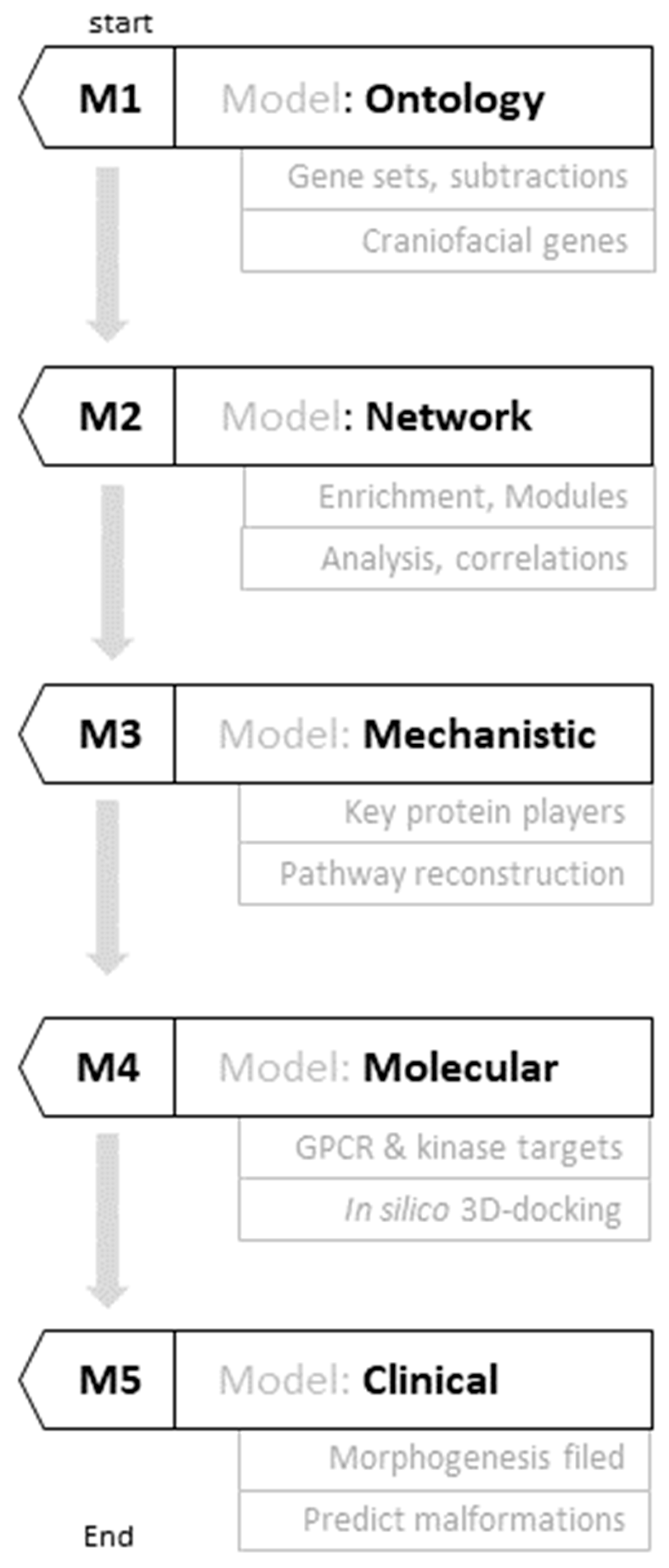
Five-tier computational workflow for predicting neural crest loss and craniofacial malformations through Sonic Hedgehog kinase module analysis. The workflow integrates five progressively refined modeling approaches: (M1) Ontology-based systematic curation of craniofacial development gene sets from UniProt and KEGG databases; (M2) Network enrichment analysis revealing convergent SHH and WNT signaling axes with GPCR and kinase hubs; (M3) Mechanistic pathway reconstruction mapping signal transduction cascades governing neural crest cell fate; (M4) Molecular characterization through in silico 3D docking of ligand–protein-binding affinities; and (M5) Clinical integration establishing computational biomarkers for craniofacial anomalies. This hierarchical framework enables systematic progression from genomic data through molecular mechanisms to phenotype prediction.
Figure 1.
Five-tier computational workflow for predicting neural crest loss and craniofacial malformations through Sonic Hedgehog kinase module analysis. The workflow integrates five progressively refined modeling approaches: (M1) Ontology-based systematic curation of craniofacial development gene sets from UniProt and KEGG databases; (M2) Network enrichment analysis revealing convergent SHH and WNT signaling axes with GPCR and kinase hubs; (M3) Mechanistic pathway reconstruction mapping signal transduction cascades governing neural crest cell fate; (M4) Molecular characterization through in silico 3D docking of ligand–protein-binding affinities; and (M5) Clinical integration establishing computational biomarkers for craniofacial anomalies. This hierarchical framework enables systematic progression from genomic data through molecular mechanisms to phenotype prediction.
Figure 2.
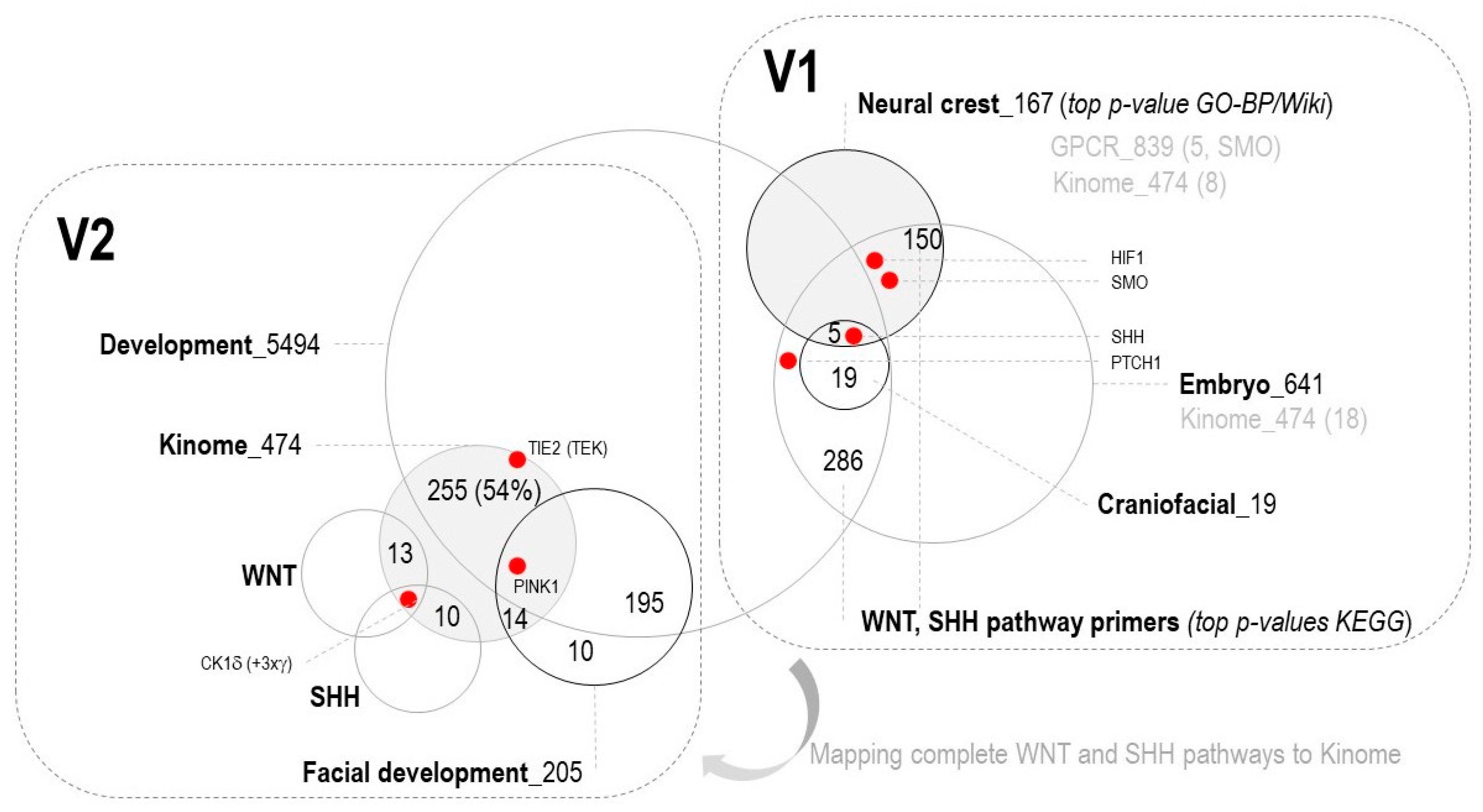
Two-step gene set integration strategy for identifying craniofacial development regulators. (V1) (Initial Pathway Primer Identification): Intersection analysis of neural crest genes (167 genes, GO-BP- and WikiPathways-validated), embryonic genes (641 genes), and craniofacial-specific genes (19 genes) identified HIF1A and SMO within the neural crest set and SHH within the craniofacial subset. KEGG functional enrichment established WNT and SHH pathways as critical primers. (V2) (Refined Kinome Integration): Integration of developmental genes (5494), facial development genes (205), and human kinome genes (474) with complete WNT/SHH pathway annotations revealed CK1δ (plus 3x CK1γ isoforms) at the intersection of developmental processes and kinase signaling. Analysis identified 255 genes (54% of kinome) shared between developmental and kinome datasets, with 14 genes overlapping WNT signaling and 10 genes overlapping SHH signaling, converging on 186 unique genes driving craniofacial phenotypes through integrated developmental and signaling mechanisms. Red dots indicate location of genes in the set.
Figure 2.
Two-step gene set integration strategy for identifying craniofacial development regulators. (V1) (Initial Pathway Primer Identification): Intersection analysis of neural crest genes (167 genes, GO-BP- and WikiPathways-validated), embryonic genes (641 genes), and craniofacial-specific genes (19 genes) identified HIF1A and SMO within the neural crest set and SHH within the craniofacial subset. KEGG functional enrichment established WNT and SHH pathways as critical primers. (V2) (Refined Kinome Integration): Integration of developmental genes (5494), facial development genes (205), and human kinome genes (474) with complete WNT/SHH pathway annotations revealed CK1δ (plus 3x CK1γ isoforms) at the intersection of developmental processes and kinase signaling. Analysis identified 255 genes (54% of kinome) shared between developmental and kinome datasets, with 14 genes overlapping WNT signaling and 10 genes overlapping SHH signaling, converging on 186 unique genes driving craniofacial phenotypes through integrated developmental and signaling mechanisms. Red dots indicate location of genes in the set.

Figure 3.
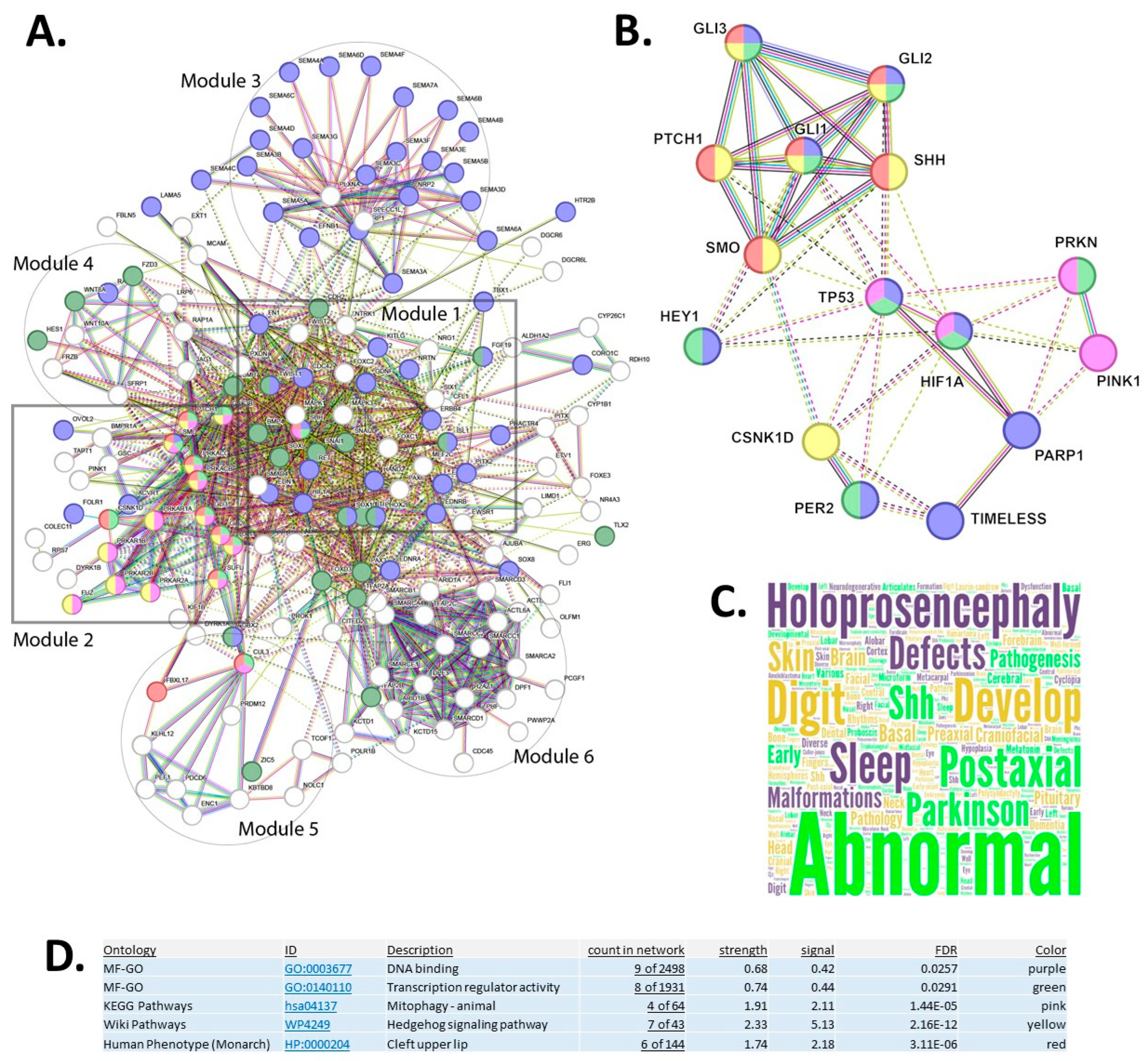
Protein–protein interaction network architecture reveals modular organization of craniofacial development genes and disease associations. (A) (Master Network): STRING database analysis of 186 candidate genes reveals six distinct functional modules. Module 1 is anchored by HIF1A and SHH (distinctive four-colored node), representing the core regulatory hub. Module 2 contains SHH pathway components including PTCH1/SMO (five-colored node) and GLI transcription factors. Critical kinases CK1δ (CSNK1D) and PINK1 are integrated within Module 2. Edge colors encode interaction evidence types (purple: experimental; green: co-expression; pink: functional associations). (B) (Hybrid Module): Extracted hybrid module combining Modules 1 and 2 demonstrates intricate connectivity between canonical SHH members and novel interactors including HEY1, TP53, HIF1A, PARP1, TIMELESS, PER2, and PRKN, revealing cross-talk between hedgehog signaling, hypoxia response, circadian regulation, and cellular stress pathways. CSNK1D occupies a central linking position. (C) (Disease Phenotype Cloud): OMIM term frequency analysis reveals holoprosencephaly as the predominant craniofacial abnormality (largest text), with recurring terms including Parkinson disease, digit abnormalities, skin defects, postaxial polydactyly, basal cell carcinoma, and various developmental malformations, reflecting network pleiotropy. (D) (Functional Enrichment): Four ontology databases reveal: MF-GO: DNA binding (9/2498 genes, FDR = 0.0257) and transcription regulator activity (8/1931 genes, FDR = 0.0291); KEGG: mitophagy-animal (4/64 genes, FDR = 1.44 × 10⁻⁵); WikiPathways: hedgehog signaling (7/43 genes, FDR = 2.16 × 10⁻¹²); and Human Phenotype Ontology: cleft upper lip (6/144 genes, FDR = 3.11 × 10⁻⁶). Multi-colored nodes indicate genes annotated across multiple categories.
Figure 3.
Protein–protein interaction network architecture reveals modular organization of craniofacial development genes and disease associations. (A) (Master Network): STRING database analysis of 186 candidate genes reveals six distinct functional modules. Module 1 is anchored by HIF1A and SHH (distinctive four-colored node), representing the core regulatory hub. Module 2 contains SHH pathway components including PTCH1/SMO (five-colored node) and GLI transcription factors. Critical kinases CK1δ (CSNK1D) and PINK1 are integrated within Module 2. Edge colors encode interaction evidence types (purple: experimental; green: co-expression; pink: functional associations). (B) (Hybrid Module): Extracted hybrid module combining Modules 1 and 2 demonstrates intricate connectivity between canonical SHH members and novel interactors including HEY1, TP53, HIF1A, PARP1, TIMELESS, PER2, and PRKN, revealing cross-talk between hedgehog signaling, hypoxia response, circadian regulation, and cellular stress pathways. CSNK1D occupies a central linking position. (C) (Disease Phenotype Cloud): OMIM term frequency analysis reveals holoprosencephaly as the predominant craniofacial abnormality (largest text), with recurring terms including Parkinson disease, digit abnormalities, skin defects, postaxial polydactyly, basal cell carcinoma, and various developmental malformations, reflecting network pleiotropy. (D) (Functional Enrichment): Four ontology databases reveal: MF-GO: DNA binding (9/2498 genes, FDR = 0.0257) and transcription regulator activity (8/1931 genes, FDR = 0.0291); KEGG: mitophagy-animal (4/64 genes, FDR = 1.44 × 10⁻⁵); WikiPathways: hedgehog signaling (7/43 genes, FDR = 2.16 × 10⁻¹²); and Human Phenotype Ontology: cleft upper lip (6/144 genes, FDR = 3.11 × 10⁻⁶). Multi-colored nodes indicate genes annotated across multiple categories.

Figure 4.
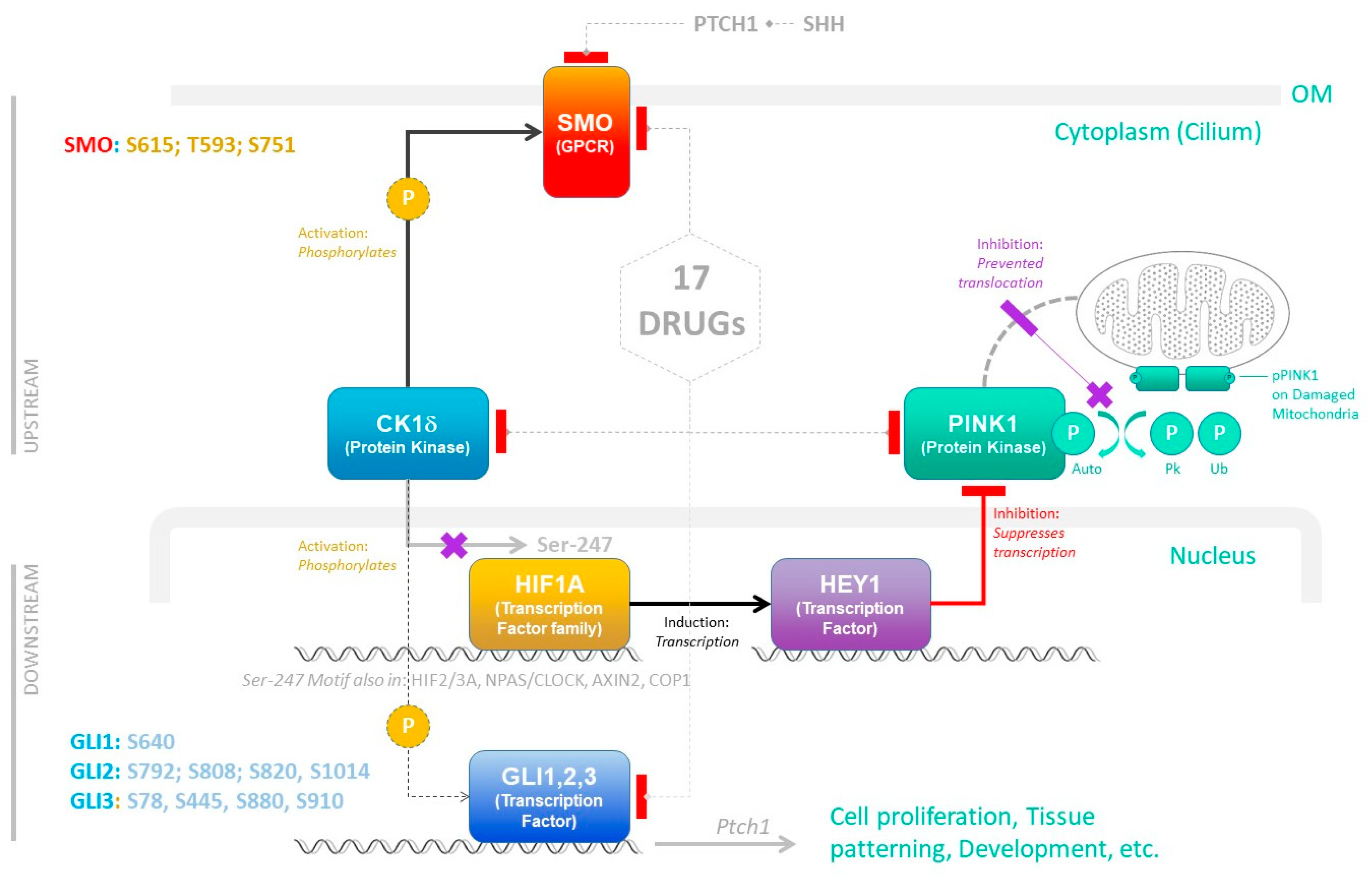
In-silico-predicted CK1δ phosphorylation targets within the Sonic Hedgehog–HIF1A–PINK1 signaling network and their mechanistic integration. The diagram maps the functional architecture of a multi-compartmental signaling module connecting upstream morphogen reception (SHH–PTCH1–SMO), cytoplasmic/ciliary kinase activity (CK1δ), nuclear transcriptional regulation (HIF1A–HEY1; GLI1/2/3), and mitochondrial quality control (PINK1-dependent mitophagy). Seventeen pharmacological compounds are indicated at key pathway nodes, reflecting the potential for multimodal cross-docking analysis and inference therapeutic intervention in developmental disorders including craniofacial malformations. Compartmental layers (outer membrane/cytoplasm–cilium; nucleus) are delineated by horizontal gray bars. Upstream signaling: outer membrane and cytoplasm/cilium. SMO (red-orange; GPCR) is activated upon SHH-mediated de-repression of PTCH1 (dashed inhibitory interaction, upper right). CK1δ (blue; protein kinase) is specifically localized to the primary cilium together with SMO—a spatial co-localization not shared by CK1α—making it the biologically relevant isoform for ciliary SMO phosphorylation in this model. In silico cross-tool consensus prediction (seven independent tools; see Materials and Methods) identified three candidate CK1δ phosphorylation sites on the intracellular tail of human SMO: S615, T593, and S751 (annotated in red, upper left). These sites are represented by a thick solid arrow from CK1δ to SMO, denoting direct, high-confidence prediction supported by the majority of tools queried with CK1δ as the target kinase. Nuclear transcriptional regulation: HIF1A axis. CK1δ phosphorylates HIF1A (yellow-orange; transcription factor family) at Ser247, a site reported and used for scanning of the human proteome identified by Prosite motif tool. This phosphorylation event—shown with a crossed arrow indicating it is blocked in the pathway state depicted—would otherwise stabilize HIF1A under normoxic conditions, creating a hypoxia-mimetic transcriptional state. Importantly, Prosite scanning of the human proteome revealed that the Ser247 sequence motif is not unique to HIF1A: identical or equivalent motifs are present in HIF2A, HIF3A, NPAS2/CLOCK, AXIN2, and COP1 (listed beneath the HIF1A box), indicating that CK1δ-mediated regulation through this motif may extend to multiple members of the HIF family and associated transcriptional regulators (suggesting a multi-level logic of morphogenesis). When HIF1A is not phosphorylated at Ser247 (as depicted), it induces transcription of HEY1 (purple; transcriptional repressor), which in turn directly suppresses PINK1 expression (red inhibitory arrow). Mitochondrial quality control—PINK1 axis. PINK1 (teal; protein kinase) is a master regulator of mitophagy. Under mitochondrial stress, PINK1 accumulates on the outer membrane of damaged mitochondria, undergoes auto-phosphorylation (Auto-P), and phosphorylates both Parkin (Pk) and ubiquitin (Ub), initiating selective mitophagic clearance (teal circular arrows, right panel). HEY1-mediated transcriptional repression of PINK1 additionally prevents its translocation to mitochondria (gray dashed arrow with purple cross), further impairing quality control during metabolically vulnerable developmental windows. GLI transcriptional outputs—downstream of SMO. Activated SMO promotes nuclear translocation and transcriptional activity of GLI1, GLI2, and GLI3 (blue boxes, lower panel). The same multi-tool in silico pipeline used for SMO was applied to all three GLI proteins; however, because the Kinexus PhosphoNET tool predicted phosphorylation at the identified residues specifically for CK1α but not CK1δ, while the remaining tools support CK1 family phosphorylation consistent with the shared pSer/pThr–X–X–Ser/Thr consensus motif, these predictions are depicted with a dashed arrow from CK1δ—indicating high mechanistic plausibility but lower isoform-level specificity relative to the SMO sites. Predicted candidate phosphorylation sites are: GLI1: S640; GLI2: S792, S808, S820, S1014; GLI3: S78, S445, S880, S910. GLI factors regulate the transcription of developmental target genes including Ptch1, controlling cell proliferation, tissue patterning, and organogenesis. Mechanistic interpretation. This integrated model illustrates how sustained or dysregulated CK1δ activity during critical developmental windows—as may occur under hypoxia, circadian disruption, or metabolic stress—can simultaneously perturb three interconnected axes: (i) hyperactivation of the SHH–SMO–GLI morphogen signaling cascade through direct SMO phosphorylation in the cilium; (ii) stabilization of HIF1A and downstream induction of the HEY1 transcriptional repressor via Ser247 phosphorylation; and (iii) HEY1-mediated suppression of PINK1, impairing mitochondrial quality control precisely when elevated morphogenetic activity and ROS production demand robust mitophagy. The breadth of the Ser247 motif across the HIF family and circadian regulators (NPAS2/CLOCK) further suggests that CK1δ dysregulation may coordinately disrupt oxygen-sensing and circadian transcriptional networks. The convergence of these three axes provides a mechanistic framework for understanding how embryonic perturbations in CK1δ activity—through genetic, pharmacological, or environmental insults—can precipitate craniofacial and other developmental malformations.
Figure 4.
In-silico-predicted CK1δ phosphorylation targets within the Sonic Hedgehog–HIF1A–PINK1 signaling network and their mechanistic integration. The diagram maps the functional architecture of a multi-compartmental signaling module connecting upstream morphogen reception (SHH–PTCH1–SMO), cytoplasmic/ciliary kinase activity (CK1δ), nuclear transcriptional regulation (HIF1A–HEY1; GLI1/2/3), and mitochondrial quality control (PINK1-dependent mitophagy). Seventeen pharmacological compounds are indicated at key pathway nodes, reflecting the potential for multimodal cross-docking analysis and inference therapeutic intervention in developmental disorders including craniofacial malformations. Compartmental layers (outer membrane/cytoplasm–cilium; nucleus) are delineated by horizontal gray bars. Upstream signaling: outer membrane and cytoplasm/cilium. SMO (red-orange; GPCR) is activated upon SHH-mediated de-repression of PTCH1 (dashed inhibitory interaction, upper right). CK1δ (blue; protein kinase) is specifically localized to the primary cilium together with SMO—a spatial co-localization not shared by CK1α—making it the biologically relevant isoform for ciliary SMO phosphorylation in this model. In silico cross-tool consensus prediction (seven independent tools; see Materials and Methods) identified three candidate CK1δ phosphorylation sites on the intracellular tail of human SMO: S615, T593, and S751 (annotated in red, upper left). These sites are represented by a thick solid arrow from CK1δ to SMO, denoting direct, high-confidence prediction supported by the majority of tools queried with CK1δ as the target kinase. Nuclear transcriptional regulation: HIF1A axis. CK1δ phosphorylates HIF1A (yellow-orange; transcription factor family) at Ser247, a site reported and used for scanning of the human proteome identified by Prosite motif tool. This phosphorylation event—shown with a crossed arrow indicating it is blocked in the pathway state depicted—would otherwise stabilize HIF1A under normoxic conditions, creating a hypoxia-mimetic transcriptional state. Importantly, Prosite scanning of the human proteome revealed that the Ser247 sequence motif is not unique to HIF1A: identical or equivalent motifs are present in HIF2A, HIF3A, NPAS2/CLOCK, AXIN2, and COP1 (listed beneath the HIF1A box), indicating that CK1δ-mediated regulation through this motif may extend to multiple members of the HIF family and associated transcriptional regulators (suggesting a multi-level logic of morphogenesis). When HIF1A is not phosphorylated at Ser247 (as depicted), it induces transcription of HEY1 (purple; transcriptional repressor), which in turn directly suppresses PINK1 expression (red inhibitory arrow). Mitochondrial quality control—PINK1 axis. PINK1 (teal; protein kinase) is a master regulator of mitophagy. Under mitochondrial stress, PINK1 accumulates on the outer membrane of damaged mitochondria, undergoes auto-phosphorylation (Auto-P), and phosphorylates both Parkin (Pk) and ubiquitin (Ub), initiating selective mitophagic clearance (teal circular arrows, right panel). HEY1-mediated transcriptional repression of PINK1 additionally prevents its translocation to mitochondria (gray dashed arrow with purple cross), further impairing quality control during metabolically vulnerable developmental windows. GLI transcriptional outputs—downstream of SMO. Activated SMO promotes nuclear translocation and transcriptional activity of GLI1, GLI2, and GLI3 (blue boxes, lower panel). The same multi-tool in silico pipeline used for SMO was applied to all three GLI proteins; however, because the Kinexus PhosphoNET tool predicted phosphorylation at the identified residues specifically for CK1α but not CK1δ, while the remaining tools support CK1 family phosphorylation consistent with the shared pSer/pThr–X–X–Ser/Thr consensus motif, these predictions are depicted with a dashed arrow from CK1δ—indicating high mechanistic plausibility but lower isoform-level specificity relative to the SMO sites. Predicted candidate phosphorylation sites are: GLI1: S640; GLI2: S792, S808, S820, S1014; GLI3: S78, S445, S880, S910. GLI factors regulate the transcription of developmental target genes including Ptch1, controlling cell proliferation, tissue patterning, and organogenesis. Mechanistic interpretation. This integrated model illustrates how sustained or dysregulated CK1δ activity during critical developmental windows—as may occur under hypoxia, circadian disruption, or metabolic stress—can simultaneously perturb three interconnected axes: (i) hyperactivation of the SHH–SMO–GLI morphogen signaling cascade through direct SMO phosphorylation in the cilium; (ii) stabilization of HIF1A and downstream induction of the HEY1 transcriptional repressor via Ser247 phosphorylation; and (iii) HEY1-mediated suppression of PINK1, impairing mitochondrial quality control precisely when elevated morphogenetic activity and ROS production demand robust mitophagy. The breadth of the Ser247 motif across the HIF family and circadian regulators (NPAS2/CLOCK) further suggests that CK1δ dysregulation may coordinately disrupt oxygen-sensing and circadian transcriptional networks. The convergence of these three axes provides a mechanistic framework for understanding how embryonic perturbations in CK1δ activity—through genetic, pharmacological, or environmental insults—can precipitate craniofacial and other developmental malformations.

Figure 5.
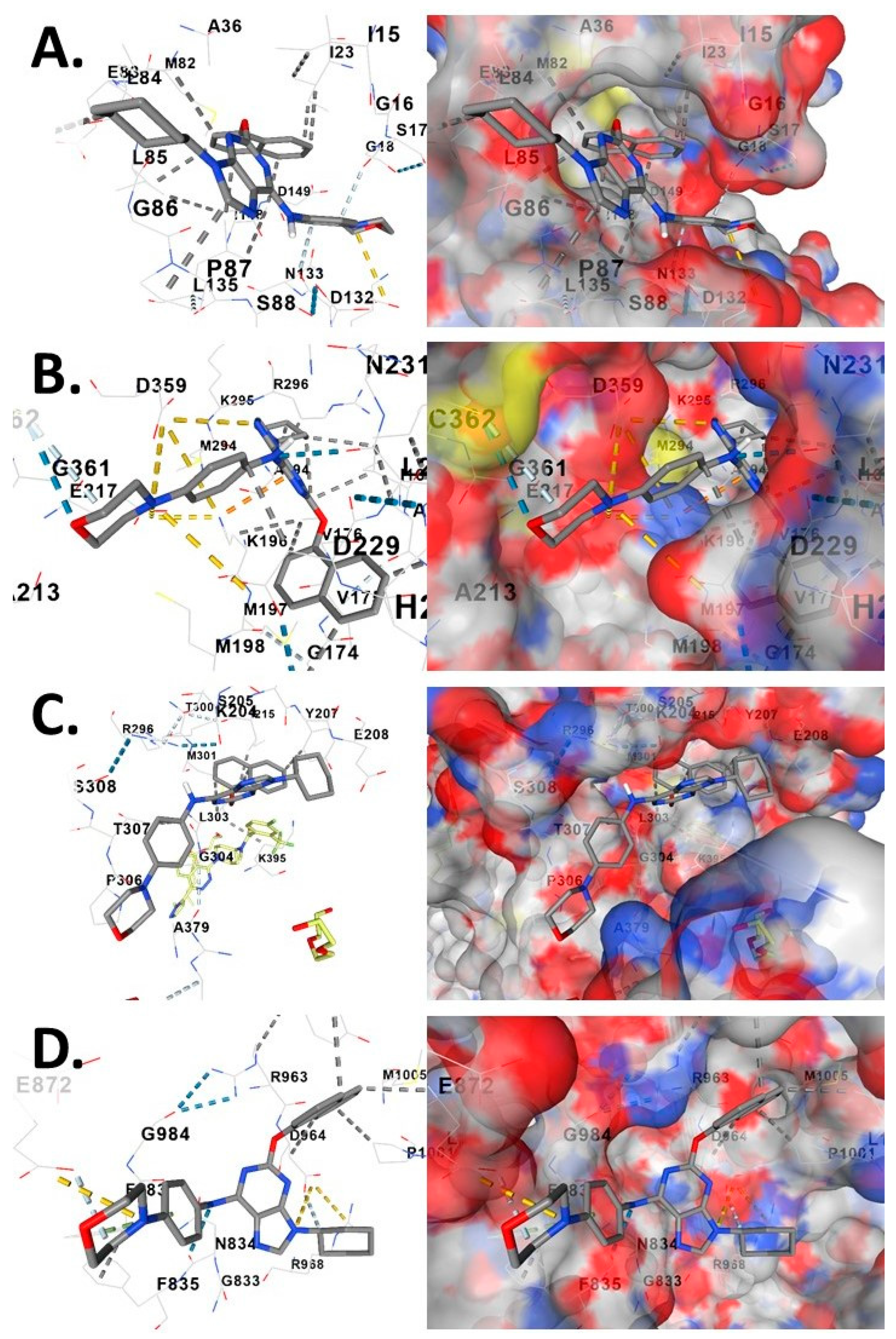
Molecular docking analysis of purmorphamine reveals distinct binding modes and target selectivity across pathway kinases and the SMO receptor. Computational docking of purmorphamine (PubChem CID: 5284329), an SHH pathway agonist, into CK1δ, PINK1, SMO, and control kinase TIE2/TEK reveals target-specific binding modes and differential pocket geometries. Each panel displays stick representation (left, atomic interactions) and electrostatic surface (right, colored by potential), providing structural rationale for purmorphamine’s polypharmacology. (A) (CK1δ, PDB: 3UYS): Purmorphamine adopts a compact conformation in the ATP-binding pocket, with morpholine ring oriented toward the hinge region (Gly86, Pro87, Ser88). Hydrogen bonds form with Gly86 backbone and Asp132 side chain. Hydrophobic contacts with Leu85, Met82, Ile23. The deep, compact cavity yields favorable predicted binding energy (low Vina score), suggesting competitive ATP-site inhibition of CK1δ-mediated phosphorylation of HIF1A and SMO. (B) (PINK1, PDB: 5OAT): Curved conformation maximizes contacts with the narrow active site. Multiple hydrogen bonds with hinge region (Gly174, Met197, Met198) and catalytic loop (Asp229, Asn231). Morpholine extends into hydrophobic subpocket (Met294, Lys295, Cys362). Tightly constricted geometry yields low Vina score (high-affinity), suggesting purmorphamine may modulate PINK1 activity, partially compensating for HEY1-mediated transcriptional repression. Residue numbering corresponds to Tribolium castaneum PINK1 (PDB 5OAT) and structurally equivalent human PINK1 residues: Gly174 (T. castaneum, red flour beetle, UniProt ID:D6WMX): This aligns with the first glycine in the GKG motif (glycine-rich loop) of the human sequence (UniProt ID:Q9BXM7). In the alignment, the beetle …GKPI AKGTNG aligns with human …GQSIG KGC…, placing beetle G174 opposite human G193; Met197 and Met198 (Beetle): These two consecutive methionines in beetle (MM) correspond to the two methionines in human (MM) at positions M216 and M217 within the conserved ALKMMWN motif; Asp229 and Asn231 (Beetle): These residues are located in the activation segment. Beetle YSNHDL aligns with human YAGEYG, placing beetle D229 opposite human D248 and beetle N231 opposite human N250; Met294 and Lys295 (Beetle): These are in the highly conserved HRDLK motif of the kinase domain. Beetle HRDLK aligns perfectly with human HRDLK, mapping beetle M294 and K295 to human M314 and K315; and Cys362 (Beetle): This residue is in the DFG motif region. Beetle DFGCCL aligns with human DFGCCL, mapping beetle C362 to human C387. (C) (SMO, PDB: 4JKV): Extended conformation in the transmembrane heptahelical bundle allows morpholine and aromatic rings to engage different subpockets. Hydrogen bonds with Tyr207, Glu208, Ser308. Hydrophobic contacts with Met301, Leu303, Pro306, Ala379. Larger, more open cavity yields higher Vina score (moderate affinity), consistent with purmorphamine’s SMO agonist role, stabilizing active receptor conformation. (D) (TIE2/TEK, PDB: 1FVR, Control): Partially extended conformation with hydrogen bonds to hinge region (Asp964, Gly984). Relatively open geometry yields higher Vina score (weaker affinity), suggesting reduced off-target kinase inhibition. TIE2 serves as non-embryonic control, demonstrating purmorphamine’s preferential binding to developmental kinases (CK1δ, PINK1) over non-developmental targets.
Figure 5.
Molecular docking analysis of purmorphamine reveals distinct binding modes and target selectivity across pathway kinases and the SMO receptor. Computational docking of purmorphamine (PubChem CID: 5284329), an SHH pathway agonist, into CK1δ, PINK1, SMO, and control kinase TIE2/TEK reveals target-specific binding modes and differential pocket geometries. Each panel displays stick representation (left, atomic interactions) and electrostatic surface (right, colored by potential), providing structural rationale for purmorphamine’s polypharmacology. (A) (CK1δ, PDB: 3UYS): Purmorphamine adopts a compact conformation in the ATP-binding pocket, with morpholine ring oriented toward the hinge region (Gly86, Pro87, Ser88). Hydrogen bonds form with Gly86 backbone and Asp132 side chain. Hydrophobic contacts with Leu85, Met82, Ile23. The deep, compact cavity yields favorable predicted binding energy (low Vina score), suggesting competitive ATP-site inhibition of CK1δ-mediated phosphorylation of HIF1A and SMO. (B) (PINK1, PDB: 5OAT): Curved conformation maximizes contacts with the narrow active site. Multiple hydrogen bonds with hinge region (Gly174, Met197, Met198) and catalytic loop (Asp229, Asn231). Morpholine extends into hydrophobic subpocket (Met294, Lys295, Cys362). Tightly constricted geometry yields low Vina score (high-affinity), suggesting purmorphamine may modulate PINK1 activity, partially compensating for HEY1-mediated transcriptional repression. Residue numbering corresponds to Tribolium castaneum PINK1 (PDB 5OAT) and structurally equivalent human PINK1 residues: Gly174 (T. castaneum, red flour beetle, UniProt ID:D6WMX): This aligns with the first glycine in the GKG motif (glycine-rich loop) of the human sequence (UniProt ID:Q9BXM7). In the alignment, the beetle …GKPI AKGTNG aligns with human …GQSIG KGC…, placing beetle G174 opposite human G193; Met197 and Met198 (Beetle): These two consecutive methionines in beetle (MM) correspond to the two methionines in human (MM) at positions M216 and M217 within the conserved ALKMMWN motif; Asp229 and Asn231 (Beetle): These residues are located in the activation segment. Beetle YSNHDL aligns with human YAGEYG, placing beetle D229 opposite human D248 and beetle N231 opposite human N250; Met294 and Lys295 (Beetle): These are in the highly conserved HRDLK motif of the kinase domain. Beetle HRDLK aligns perfectly with human HRDLK, mapping beetle M294 and K295 to human M314 and K315; and Cys362 (Beetle): This residue is in the DFG motif region. Beetle DFGCCL aligns with human DFGCCL, mapping beetle C362 to human C387. (C) (SMO, PDB: 4JKV): Extended conformation in the transmembrane heptahelical bundle allows morpholine and aromatic rings to engage different subpockets. Hydrogen bonds with Tyr207, Glu208, Ser308. Hydrophobic contacts with Met301, Leu303, Pro306, Ala379. Larger, more open cavity yields higher Vina score (moderate affinity), consistent with purmorphamine’s SMO agonist role, stabilizing active receptor conformation. (D) (TIE2/TEK, PDB: 1FVR, Control): Partially extended conformation with hydrogen bonds to hinge region (Asp964, Gly984). Relatively open geometry yields higher Vina score (weaker affinity), suggesting reduced off-target kinase inhibition. TIE2 serves as non-embryonic control, demonstrating purmorphamine’s preferential binding to developmental kinases (CK1δ, PINK1) over non-developmental targets.

Figure 6.
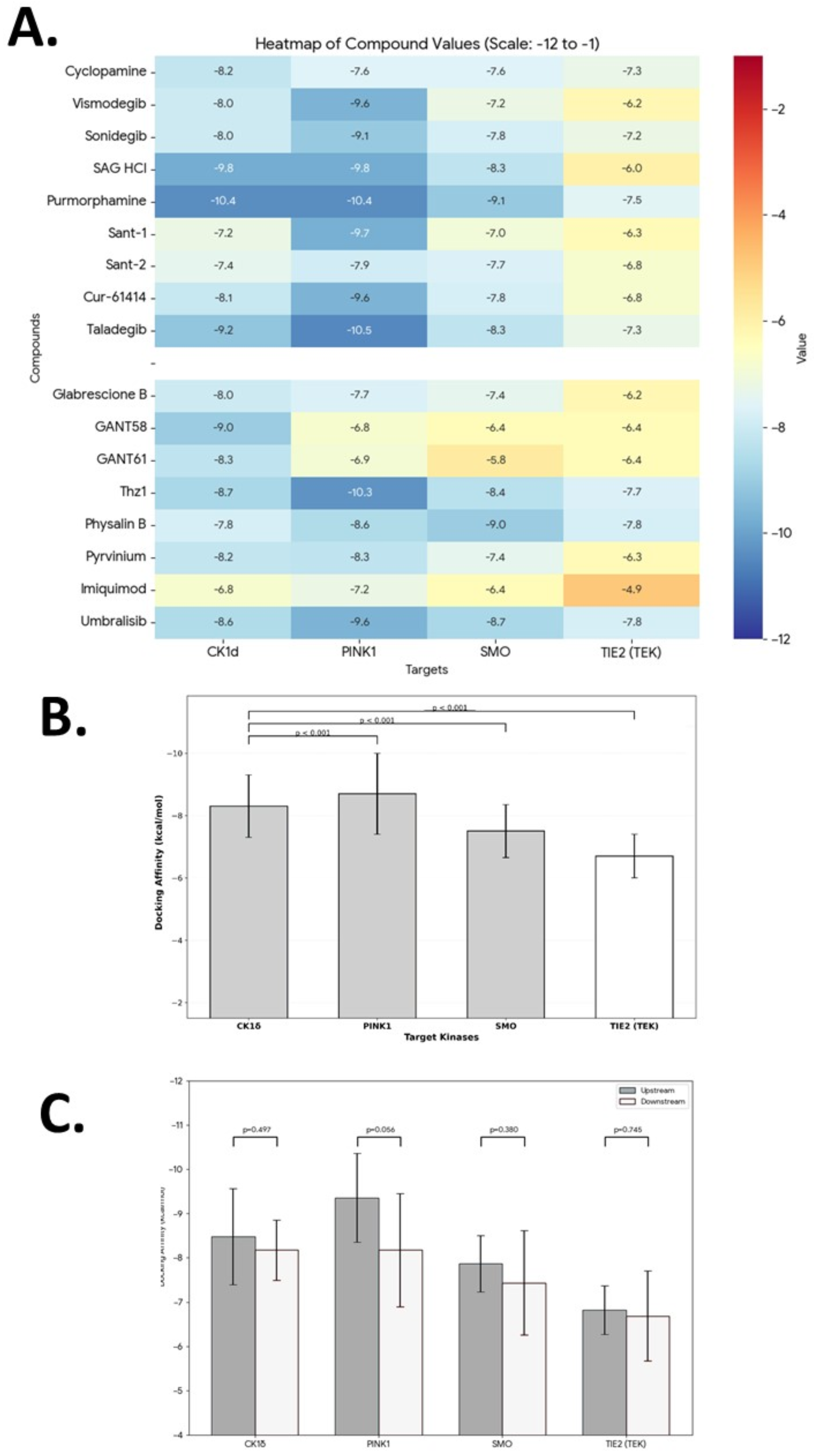
Systematic multi-target-binding affinity profiling reveals preferential engagement of developmental pathway kinases by SMO modulators and identifies embryonic-stage kinase selectivity patterns. Comprehensive molecular docking of 17 compounds against CK1δ, PINK1, SMO, and TIE2/TEK reveals systematic preferential binding to embryonic kinases over non-developmental control, supporting the integrated CK1δ-HIF1A-HEY1-PINK1 axis and rationalizing therapeutic dual kinase–GPCR modulation strategies. (A) (Heatmap): Color-coded binding affinity matrix (red = −1 kcal/mol weaker, blue = −12 kcal/mol stronger) for 17 compounds × 4 targets. Compounds organized into SMO-targeting (n = 9: cyclopamine, vismodegib, sonidegib, SAG HCl, purmorphamine, SANT-1, SANT-2, Cur-61414, taladegib) and downstream modulators (n = 8: glabrescione B, GANT58, GANT61, Thz1, physalin B, pyrvinium, imiquimod, umbralisib). Both classes show stronger binding to CK1δ (mean: −8.34 kcal/mol, range: −6.8 to −10.4) and PINK1 (mean: −8.80 kcal/mol, range: −6.8 to −10.5) versus TIE2 (mean: −6.76 kcal/mol, range: −4.3 to −7.8). Purmorphamine exhibits strongest CK1δ and PINK1 binding (−10.4 each), with moderately strong SMO binding (−9.1), positioning it as a lead polypharmacological scaffold. (B) (Mean Affinity Comparison): Target-centric analysis of all 17 compounds shows PINK1 exhibits the strongest mean affinity (−8.80 ± 1.15 kcal/mol), followed by CK1δ (−8.34 ± 0.86 kcal/mol), SMO (−7.50 ± 0.97 kcal/mol), and TIE2 (−6.76 ± 1.02 kcal/mol). All pairwise comparisons between developmental kinases and the TIE2 control reach statistical significance (p < 0.001, paired t-tests with Bonferroni correction), confirming the affinity ranking CK1δ ≈ PINK1 > SMO > TIE2 across the full compound panel. Even compounds designed to target SMO exhibit stronger mean affinity for the embryonic kinases than for their primary target, indicating that ATP-binding pockets of CK1δ and PINK1 present more thermodynamically favorable environments for these scaffolds than the SMO transmembrane cavity. (C) (Stratified Analysis): Both upstream SMO-targeting compounds (gray hatched bars; n = 9) and downstream non-SMO modulators (white bars; n = 8) maintain preferential binding to developmental kinases over the TIE2 control. Between-class comparisons (upstream vs. downstream) for each individual target are all non-significant (ns): CK1δ, p = 0.497; PINK1, p = 0.056; SMO, p = 0.380; TIE2, p = 0.748, indicating that the two compound classes do not differ significantly in their absolute affinity for any target. In contrast, within-class comparisons against TIE2 remain highly significant for both classes: for upstream SMO-targeting compounds, CK1δ vs. TIE2: −1.71 kcal/mol (p = 6.62 × 10⁻⁷) and PINK1 vs. TIE2: −2.55 kcal/mol (p = 3.05 × 10⁻⁸); for downstream modulators, CK1δ vs. TIE2: −1.43 kcal/mol (p = 3.62 × 10⁻⁶) and PINK1 vs. TIE2: −1.46 kcal/mol (p = 1.51 × 10⁻⁶). This pattern indicates that the selectivity for early-embryonic kinases over the non-developmental control is intrinsic to SHH pathway scaffolds as a class, rather than being specific to either upstream or downstream compound subgroups.
Figure 6.
Systematic multi-target-binding affinity profiling reveals preferential engagement of developmental pathway kinases by SMO modulators and identifies embryonic-stage kinase selectivity patterns. Comprehensive molecular docking of 17 compounds against CK1δ, PINK1, SMO, and TIE2/TEK reveals systematic preferential binding to embryonic kinases over non-developmental control, supporting the integrated CK1δ-HIF1A-HEY1-PINK1 axis and rationalizing therapeutic dual kinase–GPCR modulation strategies. (A) (Heatmap): Color-coded binding affinity matrix (red = −1 kcal/mol weaker, blue = −12 kcal/mol stronger) for 17 compounds × 4 targets. Compounds organized into SMO-targeting (n = 9: cyclopamine, vismodegib, sonidegib, SAG HCl, purmorphamine, SANT-1, SANT-2, Cur-61414, taladegib) and downstream modulators (n = 8: glabrescione B, GANT58, GANT61, Thz1, physalin B, pyrvinium, imiquimod, umbralisib). Both classes show stronger binding to CK1δ (mean: −8.34 kcal/mol, range: −6.8 to −10.4) and PINK1 (mean: −8.80 kcal/mol, range: −6.8 to −10.5) versus TIE2 (mean: −6.76 kcal/mol, range: −4.3 to −7.8). Purmorphamine exhibits strongest CK1δ and PINK1 binding (−10.4 each), with moderately strong SMO binding (−9.1), positioning it as a lead polypharmacological scaffold. (B) (Mean Affinity Comparison): Target-centric analysis of all 17 compounds shows PINK1 exhibits the strongest mean affinity (−8.80 ± 1.15 kcal/mol), followed by CK1δ (−8.34 ± 0.86 kcal/mol), SMO (−7.50 ± 0.97 kcal/mol), and TIE2 (−6.76 ± 1.02 kcal/mol). All pairwise comparisons between developmental kinases and the TIE2 control reach statistical significance (p < 0.001, paired t-tests with Bonferroni correction), confirming the affinity ranking CK1δ ≈ PINK1 > SMO > TIE2 across the full compound panel. Even compounds designed to target SMO exhibit stronger mean affinity for the embryonic kinases than for their primary target, indicating that ATP-binding pockets of CK1δ and PINK1 present more thermodynamically favorable environments for these scaffolds than the SMO transmembrane cavity. (C) (Stratified Analysis): Both upstream SMO-targeting compounds (gray hatched bars; n = 9) and downstream non-SMO modulators (white bars; n = 8) maintain preferential binding to developmental kinases over the TIE2 control. Between-class comparisons (upstream vs. downstream) for each individual target are all non-significant (ns): CK1δ, p = 0.497; PINK1, p = 0.056; SMO, p = 0.380; TIE2, p = 0.748, indicating that the two compound classes do not differ significantly in their absolute affinity for any target. In contrast, within-class comparisons against TIE2 remain highly significant for both classes: for upstream SMO-targeting compounds, CK1δ vs. TIE2: −1.71 kcal/mol (p = 6.62 × 10⁻⁷) and PINK1 vs. TIE2: −2.55 kcal/mol (p = 3.05 × 10⁻⁸); for downstream modulators, CK1δ vs. TIE2: −1.43 kcal/mol (p = 3.62 × 10⁻⁶) and PINK1 vs. TIE2: −1.46 kcal/mol (p = 1.51 × 10⁻⁶). This pattern indicates that the selectivity for early-embryonic kinases over the non-developmental control is intrinsic to SHH pathway scaffolds as a class, rather than being specific to either upstream or downstream compound subgroups.

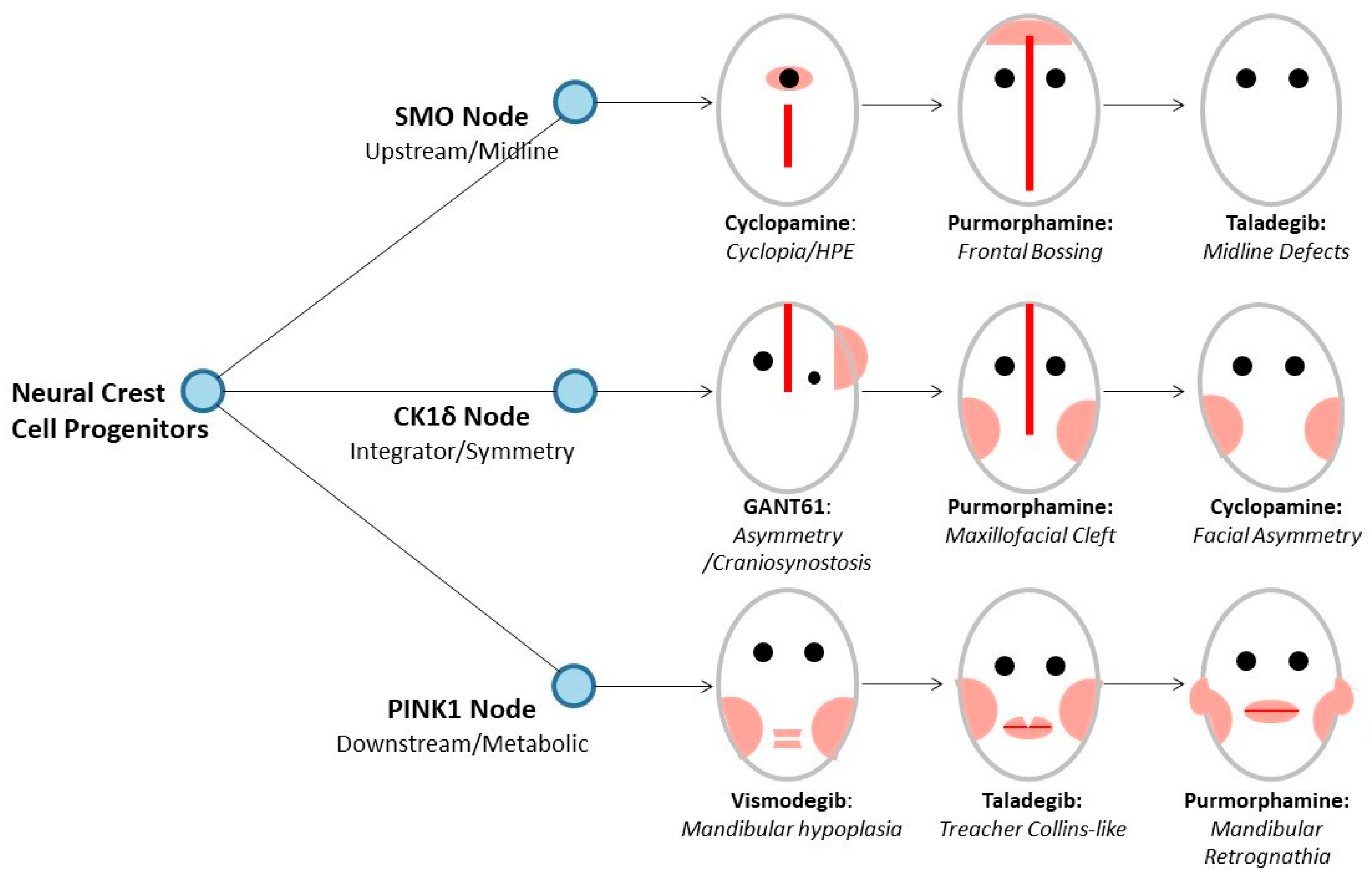
Figure 7.
Integrated developmental perturbation model: multi-node molecular targeting by pharmacological compounds and associated anatomically specific craniofacial malformation phenotypes. The figure presents a unified mechanism-based framework linking three critical signaling nodes, SMO (upstream morphogen transducer), CK1δ (symmetry integrator), and PINK1 (mitochondrial quality control regulator), to nine distinct craniofacial malformation phenotypes arising from perturbation of neural crest cell progenitor populations. Each schematic face depicts a stylized anterior view in which pink/red shading indicates anatomical regions that are hypoplastic, fused, asymmetrically underdeveloped, or structurally absent as a consequence of the indicated compound. Vertical red bars on the facial midline denote abnormal fusion or failure of midline separation. The developmental decision tree illustrates how the same compounds produce different phenotypes depending on the node they preferentially perturb and how multi-node compounds (purmorphamine, cyclopamine, taladegib) produce combinatorial phenotypes. Anatomical legend for red/pink shading regions: The pink shading in each facial schematic represents the following affected anatomical territories: the frontonasal region (forehead, glabella, nasal bridge) and periorbital region (orbital rims, upper and lower eyelid margins) when affected in midline or gain-of-function phenotypes; the malar/zygomatic region (cheekbones and zygomatic arches) and auricular region (external ear and periauricular soft tissue) when bilateral hypoplasia is shown; and the mandibular/lower facial region (mandibular body, ramus, condyle, and chin prominence) and maxillary region (upper jaw and palate) in lower-face phenotypes. The midline vertical red bar represents failed or abnormal separation of bilateral facial primordia. SMO Node (Upstream/Midline Patterning): (1) Cyclopamine (SMO antagonist): Cyclopia/Holoprosencephaly (HPE). The facial schematic depicts a single, centrally fused eye with a prominent vertical midline bar. The pink shading covers the entire nasal dorsum and midface, indicating complete absence of the nasal septum, piriform aperture, and interorbital septum. Anatomically, cyclopamine-induced HPE results from failure of the embryonic prosencephalon to divide into bilateral cerebral hemispheres, with corresponding failure of the single eye field to resolve into two separate orbital cavities. Affected regions include the ethmoid (absent crista galli and cribriform plate), the interorbital septum, and the premaxillary/vomeronasal complex; the nasal bones and the alae are absent or vestigial, replaced by a proboscis-like appendage above the single orbit. The midline facial skeleton is therefore completely absent, with absence of the philtrum, median lip, and premaxillary bones. (2) Purmorphamine (SMO agonist): Frontal Bossing/Hypertelorism. The facial schematic shows bilateral eyes with increased inter-orbital spacing and pink shading over the supraorbital ridges and forehead. Anatomically, SMO hyperactivation by purmorphamine drives excessive proliferation of frontonasal mesenchyme, causing overgrowth of the frontal bone (frontal bossing), widening of the interorbital distance (hypertelorism due to excessive expansion of the ethmoid and interorbital plate), and broadening of the nasal bridge. The coronal suture and metopic suture regions are affected by premature or disproportionate bone formation. The supraorbital rims, glabella, and frontal squama are the primary sites of osseous excess. (3) Taladegib (SMO antagonist): Midline Defects/Microform HPE. The facial schematic shows bilateral eyes without midline fusion but with a prominent vertical midline bar and pink shading limited to the nasal bridge and philtrum region, representing intermediate-severity midline disruption short of cyclopia. Anatomically, this corresponds to the HPE microform spectrum: median cleft lip, single central maxillary incisor, hypotelorism (reduced interorbital distance with narrowing of the ethmoid), midface hypoplasia of the premaxilla and vomer, and hypoplastic nasal bones with a flat or absent nasal bridge. The primary nasal septum and columella are underdeveloped; orbital hypotelorism reflects incomplete lateral displacement of the orbits from a persistent midline position. CK1δ Node (integrator/symmetry control): (1) GANT61 (GLI1/2 inhibitor): Asymmetry/Craniosynostosis. The facial schematic depicts asymmetric eye positions with pink unilateral shading over one cheek and parietal region and a vertical midline bar. Anatomically, CK1δ–GLI axis disruption impairs the bilateral symmetry program in neural crest cell populations, resulting in unilateral or asymmetric craniosynostosis—premature fusion of cranial sutures (most characteristically the coronal and lambdoid sutures on one side)—producing plagiocephaly with tilted skull base, asymmetric orbital positioning, and unilateral malar/zygomatic hypoplasia. The affected hemiface shows underdevelopment of the zygomatic body and arch, the lateral orbital wall (frontal process of the zygoma), and the maxillary tuberosity on the ipsilateral side, while the contralateral hemiface is relatively preserved. (2) Purmorphamine (SMO/CK1δ agonist): Maxillofacial Cleft. The facial schematic shows bilateral eye positions and prominent vertical midline bar with bilateral pink shading over both cheeks and jaw. Anatomically, bilateral maxillofacial clefting arises from failure of the maxillary and medial nasal prominences to merge correctly during primary palate formation (Carnegie stage 16–18), resulting in bilateral cleft lip extending through the primary palate (premaxillary segment), and potentially involving the secondary palate (hard palate posterior to the incisive foramen). The affected structures include the maxillary alveolar ridges bilaterally, the philtrum and columella, the nasal alae and nasal floor, and the palatine processes of the maxilla. The zygomatic buttresses and malar soft tissues are involved in the most severe cases. (3) Cyclopamine (SMO/CK1δ inhibitor): Facial Asymmetry. The facial schematic shows bilateral eyes but asymmetric pink shading predominantly over one side of the lower face (mandibular body and ramus), indicating unilateral mandibular and lower-facial underdevelopment. Anatomically, this reflects asymmetric collateral inhibition of CK1δ-dependent symmetry signaling in lower facial neural crest cells, producing hemifacial microsomia-like phenotype with unilateral hypoplasia of the mandibular body, ramus, condylar head, and coronoid process, along with ipsilateral underdevelopment of the masseter and pterygoid musculature and, in more severe cases, microtia (malformation of the external ear on the affected side) and flattening of the gonial angle. PINK1 Node (downstream/metabolic regulation): (1) Vismodegib (SMO antagonist): Mandibular Hypoplasia/Micrognathia. The facial schematic shows bilateral eyes and pink shading restricted to the lower face—mandibular body, chin, and lower lip region—with absent or flattened chin contour. Anatomically, Hedgehog pathway inhibition by vismodegib impairs Meckel’s cartilage chondrogenesis and mandibular mesenchymal proliferation, producing a symmetrical micrognathia in which both the mandibular body and the ramus are shortened; the condylar head is underdeveloped; the symphyseal region is hypoplastic. Histologically, this reflects reduced proliferation and increased apoptosis of mandibular prominence mesenchymal cells, with delayed condensation of Meckel’s cartilage by approximately one developmental day. The result is a small, recessed lower jaw without significant associated clefting or zygomatic involvement. (2) Taladegib (SMO/PINK1 inhibitor): Treacher Collins-like Syndrome. The facial schematic shows bilateral eyes with pink shading over the bilateral malar/zygomatic regions (cheekbones), lower orbital rims, and lower facial region (mandible and lower eyelid areas), reflecting the characteristic bilateral and symmetric distribution of this phenotype. Anatomically, this corresponds closely to the mandibulofacial dysostosis pattern of Treacher Collins syndrome: bilateral and symmetric hypoplasia of the zygomatic complex (body, arch, and frontal process of zygoma), malar eminences, mandibular condyle, ramus and body, and the lateral orbital wall; downward slanting of the palpebral fissures due to inferior displacement of the lateral canthus from zygomatic hypoplasia; lower eyelid coloboma region due to absent or deficient orbicularis oculi support; and microtia (malformed external ear). Unlike canonical TCS caused by TCOF1 mutation (ribosomal stress pathway), the mechanism here is PINK1-mediated mitochondrial dysfunction causing massive neural crest cell apoptosis during pharyngeal arch colonization—a functionally convergent but molecularly distinct pathway. (3) Purmorphamine (SMO/CK1δ/PINK1 agonist): Mandibular Retrognathia. The facial schematic shows bilateral eyes and pink shading over the lower jaw region and lateral chin areas, indicating posterior displacement and relative underdevelopment of the mandibular body with relatively preserved upper face. Anatomically, mandibular retrognathia (Class II skeletal profile) involves posterior positioning of the mandible relative to the maxilla, with underdevelopment of the mandibular body length and the gonial angle, while the ramus height may be relatively preserved. Affected structures include the mandibular symphysis and parasymphyseal region, the pogonion (chin prominence), and the preauricular soft tissues. Associated secondary palate clefting may occur due to posteriorly displaced tongue reducing palatal shelf elevation. This phenotype reflects multi-node perturbation encoded in purmorphamine’s polypharmacological binding profile. Model Synthesis. Compounds appearing across multiple branches (purmorphamine: all three nodes; cyclopamine, taladegib: two nodes each) produce anatomically combinatorial and more severe phenotypes, while node-selective compounds (GANT61: CK1δ only; vismodegib: PINK1 only) produce more anatomically restricted malformations. The vertical organization of the three rows encodes developmental timing: SMO governs the earliest midline patterning events (E8.5–E10), directing prosencephalic division and orbital separation; CK1δ governs intermediate symmetry establishment and prominence fusion (E9.5–E11), directing bilateral equivalence of the maxillary, mandibular, and frontonasal processes; PINK1 governs late mitochondrial quality control during rapid mesenchymal proliferation and differentiation (E10–E12), supporting survival and osteogenic specification of pharyngeal arch neural crest cells. Each row therefore maps to an anatomically distinct craniofacial territory: the midline neurocranium and primary palate (SMO row); the midface, palate, and sutures (CK1δ row); and the lower face, mandible, zygoma, and ear (PINK1 row).
Figure 7.
Integrated developmental perturbation model: multi-node molecular targeting by pharmacological compounds and associated anatomically specific craniofacial malformation phenotypes. The figure presents a unified mechanism-based framework linking three critical signaling nodes, SMO (upstream morphogen transducer), CK1δ (symmetry integrator), and PINK1 (mitochondrial quality control regulator), to nine distinct craniofacial malformation phenotypes arising from perturbation of neural crest cell progenitor populations. Each schematic face depicts a stylized anterior view in which pink/red shading indicates anatomical regions that are hypoplastic, fused, asymmetrically underdeveloped, or structurally absent as a consequence of the indicated compound. Vertical red bars on the facial midline denote abnormal fusion or failure of midline separation. The developmental decision tree illustrates how the same compounds produce different phenotypes depending on the node they preferentially perturb and how multi-node compounds (purmorphamine, cyclopamine, taladegib) produce combinatorial phenotypes. Anatomical legend for red/pink shading regions: The pink shading in each facial schematic represents the following affected anatomical territories: the frontonasal region (forehead, glabella, nasal bridge) and periorbital region (orbital rims, upper and lower eyelid margins) when affected in midline or gain-of-function phenotypes; the malar/zygomatic region (cheekbones and zygomatic arches) and auricular region (external ear and periauricular soft tissue) when bilateral hypoplasia is shown; and the mandibular/lower facial region (mandibular body, ramus, condyle, and chin prominence) and maxillary region (upper jaw and palate) in lower-face phenotypes. The midline vertical red bar represents failed or abnormal separation of bilateral facial primordia. SMO Node (Upstream/Midline Patterning): (1) Cyclopamine (SMO antagonist): Cyclopia/Holoprosencephaly (HPE). The facial schematic depicts a single, centrally fused eye with a prominent vertical midline bar. The pink shading covers the entire nasal dorsum and midface, indicating complete absence of the nasal septum, piriform aperture, and interorbital septum. Anatomically, cyclopamine-induced HPE results from failure of the embryonic prosencephalon to divide into bilateral cerebral hemispheres, with corresponding failure of the single eye field to resolve into two separate orbital cavities. Affected regions include the ethmoid (absent crista galli and cribriform plate), the interorbital septum, and the premaxillary/vomeronasal complex; the nasal bones and the alae are absent or vestigial, replaced by a proboscis-like appendage above the single orbit. The midline facial skeleton is therefore completely absent, with absence of the philtrum, median lip, and premaxillary bones. (2) Purmorphamine (SMO agonist): Frontal Bossing/Hypertelorism. The facial schematic shows bilateral eyes with increased inter-orbital spacing and pink shading over the supraorbital ridges and forehead. Anatomically, SMO hyperactivation by purmorphamine drives excessive proliferation of frontonasal mesenchyme, causing overgrowth of the frontal bone (frontal bossing), widening of the interorbital distance (hypertelorism due to excessive expansion of the ethmoid and interorbital plate), and broadening of the nasal bridge. The coronal suture and metopic suture regions are affected by premature or disproportionate bone formation. The supraorbital rims, glabella, and frontal squama are the primary sites of osseous excess. (3) Taladegib (SMO antagonist): Midline Defects/Microform HPE. The facial schematic shows bilateral eyes without midline fusion but with a prominent vertical midline bar and pink shading limited to the nasal bridge and philtrum region, representing intermediate-severity midline disruption short of cyclopia. Anatomically, this corresponds to the HPE microform spectrum: median cleft lip, single central maxillary incisor, hypotelorism (reduced interorbital distance with narrowing of the ethmoid), midface hypoplasia of the premaxilla and vomer, and hypoplastic nasal bones with a flat or absent nasal bridge. The primary nasal septum and columella are underdeveloped; orbital hypotelorism reflects incomplete lateral displacement of the orbits from a persistent midline position. CK1δ Node (integrator/symmetry control): (1) GANT61 (GLI1/2 inhibitor): Asymmetry/Craniosynostosis. The facial schematic depicts asymmetric eye positions with pink unilateral shading over one cheek and parietal region and a vertical midline bar. Anatomically, CK1δ–GLI axis disruption impairs the bilateral symmetry program in neural crest cell populations, resulting in unilateral or asymmetric craniosynostosis—premature fusion of cranial sutures (most characteristically the coronal and lambdoid sutures on one side)—producing plagiocephaly with tilted skull base, asymmetric orbital positioning, and unilateral malar/zygomatic hypoplasia. The affected hemiface shows underdevelopment of the zygomatic body and arch, the lateral orbital wall (frontal process of the zygoma), and the maxillary tuberosity on the ipsilateral side, while the contralateral hemiface is relatively preserved. (2) Purmorphamine (SMO/CK1δ agonist): Maxillofacial Cleft. The facial schematic shows bilateral eye positions and prominent vertical midline bar with bilateral pink shading over both cheeks and jaw. Anatomically, bilateral maxillofacial clefting arises from failure of the maxillary and medial nasal prominences to merge correctly during primary palate formation (Carnegie stage 16–18), resulting in bilateral cleft lip extending through the primary palate (premaxillary segment), and potentially involving the secondary palate (hard palate posterior to the incisive foramen). The affected structures include the maxillary alveolar ridges bilaterally, the philtrum and columella, the nasal alae and nasal floor, and the palatine processes of the maxilla. The zygomatic buttresses and malar soft tissues are involved in the most severe cases. (3) Cyclopamine (SMO/CK1δ inhibitor): Facial Asymmetry. The facial schematic shows bilateral eyes but asymmetric pink shading predominantly over one side of the lower face (mandibular body and ramus), indicating unilateral mandibular and lower-facial underdevelopment. Anatomically, this reflects asymmetric collateral inhibition of CK1δ-dependent symmetry signaling in lower facial neural crest cells, producing hemifacial microsomia-like phenotype with unilateral hypoplasia of the mandibular body, ramus, condylar head, and coronoid process, along with ipsilateral underdevelopment of the masseter and pterygoid musculature and, in more severe cases, microtia (malformation of the external ear on the affected side) and flattening of the gonial angle. PINK1 Node (downstream/metabolic regulation): (1) Vismodegib (SMO antagonist): Mandibular Hypoplasia/Micrognathia. The facial schematic shows bilateral eyes and pink shading restricted to the lower face—mandibular body, chin, and lower lip region—with absent or flattened chin contour. Anatomically, Hedgehog pathway inhibition by vismodegib impairs Meckel’s cartilage chondrogenesis and mandibular mesenchymal proliferation, producing a symmetrical micrognathia in which both the mandibular body and the ramus are shortened; the condylar head is underdeveloped; the symphyseal region is hypoplastic. Histologically, this reflects reduced proliferation and increased apoptosis of mandibular prominence mesenchymal cells, with delayed condensation of Meckel’s cartilage by approximately one developmental day. The result is a small, recessed lower jaw without significant associated clefting or zygomatic involvement. (2) Taladegib (SMO/PINK1 inhibitor): Treacher Collins-like Syndrome. The facial schematic shows bilateral eyes with pink shading over the bilateral malar/zygomatic regions (cheekbones), lower orbital rims, and lower facial region (mandible and lower eyelid areas), reflecting the characteristic bilateral and symmetric distribution of this phenotype. Anatomically, this corresponds closely to the mandibulofacial dysostosis pattern of Treacher Collins syndrome: bilateral and symmetric hypoplasia of the zygomatic complex (body, arch, and frontal process of zygoma), malar eminences, mandibular condyle, ramus and body, and the lateral orbital wall; downward slanting of the palpebral fissures due to inferior displacement of the lateral canthus from zygomatic hypoplasia; lower eyelid coloboma region due to absent or deficient orbicularis oculi support; and microtia (malformed external ear). Unlike canonical TCS caused by TCOF1 mutation (ribosomal stress pathway), the mechanism here is PINK1-mediated mitochondrial dysfunction causing massive neural crest cell apoptosis during pharyngeal arch colonization—a functionally convergent but molecularly distinct pathway. (3) Purmorphamine (SMO/CK1δ/PINK1 agonist): Mandibular Retrognathia. The facial schematic shows bilateral eyes and pink shading over the lower jaw region and lateral chin areas, indicating posterior displacement and relative underdevelopment of the mandibular body with relatively preserved upper face. Anatomically, mandibular retrognathia (Class II skeletal profile) involves posterior positioning of the mandible relative to the maxilla, with underdevelopment of the mandibular body length and the gonial angle, while the ramus height may be relatively preserved. Affected structures include the mandibular symphysis and parasymphyseal region, the pogonion (chin prominence), and the preauricular soft tissues. Associated secondary palate clefting may occur due to posteriorly displaced tongue reducing palatal shelf elevation. This phenotype reflects multi-node perturbation encoded in purmorphamine’s polypharmacological binding profile. Model Synthesis. Compounds appearing across multiple branches (purmorphamine: all three nodes; cyclopamine, taladegib: two nodes each) produce anatomically combinatorial and more severe phenotypes, while node-selective compounds (GANT61: CK1δ only; vismodegib: PINK1 only) produce more anatomically restricted malformations. The vertical organization of the three rows encodes developmental timing: SMO governs the earliest midline patterning events (E8.5–E10), directing prosencephalic division and orbital separation; CK1δ governs intermediate symmetry establishment and prominence fusion (E9.5–E11), directing bilateral equivalence of the maxillary, mandibular, and frontonasal processes; PINK1 governs late mitochondrial quality control during rapid mesenchymal proliferation and differentiation (E10–E12), supporting survival and osteogenic specification of pharyngeal arch neural crest cells. Each row therefore maps to an anatomically distinct craniofacial territory: the midline neurocranium and primary palate (SMO row); the midface, palate, and sutures (CK1δ row); and the lower face, mandible, zygoma, and ear (PINK1 row).

Table 1.
Phosphorylation prediction tools used in this study. All URLs are accessed on 5 April 2026.
Table 1.
Phosphorylation prediction tools used in this study. All URLs are accessed on 5 April 2026.
Table 2.
Cross-tool consensus matrix for predicted CK1δ phosphorylation sites in human SMO. (✓) predicted; (—) not predicted.
Table 2.
Cross-tool consensus matrix for predicted CK1δ phosphorylation sites in human SMO. (✓) predicted; (—) not predicted.
| Residue | KP | NP | PP | GP | PN | PS | UP |
|---|
| T593 | ✓ | ✓ | ✓ | ✓ | ✓ | ✓ | ✓ |
| S615 | ✓ | ✓ | — | ✓ | ✓ | ✓ | — |
| S751 | ✓ | ✓ | ✓ | — | — | — | — |
Table 3.
Candidate CK1 phosphorylation sites in human GLI1, GLI2, and GLI3 identified by cross-tool in silico analysis.
Table 3.
Candidate CK1 phosphorylation sites in human GLI1, GLI2, and GLI3 identified by cross-tool in silico analysis.
| Protein | Residue(s) | Supporting Tools/
Evidence | Kinase Assignment | Notes |
|---|
| GLI1 | S640 | Multi-tool consensus (KP, NP, PS, GP) | CK1α/CK1δ (predicted) | Canonical pS/pT–X–X–S/T motif confirmed by Prosite |
| GLI2 | S792 | NetPhos 3.1 top-score; multi-tool support | CK1α/CK1δ (predicted) | Highest-confidence GLI2 site by NetPhos score |
| GLI2 | (S808) | Secondary prediction; lower tool coverage | CK1α/CK1δ (predicted) | Parentheses indicate sub-threshold confidence |
| GLI2 | S820/S863 | Prosite motif match; Kinexus (KX) S820 | CK1α/CK1δ (predicted) | Prosite identifies identical sequence context at S820 and S863 |
| GLI2 | S1014 | CK1α consensus motif; multi-tool | CK1α/CK1δ (predicted) | Predicted to match CK1δ based on shared motif logic |
| GLI3 | S880/S910 | Prosite motif (SseaS pattern); multi-tool | CK1α/CK1δ (predicted) | Identical sequence context also in GLI2 and PER3 (known CK1δ substrate); ischemia-responsive |
| GLI3 | S78/S445 | CK2α motif; secondary CK1δ compatibility | CK2α primary; CK1δ possible | Non-canonical Prosite motif; ischemia-responsive; predicted CK1δ compatibility noted |