Article

Frequency and Hearing Loss Phenotypes of OPA1 Variants in a Cohort of 18,475 Patients with Hearing Impairment


1
Department of Otorhinolaryngology-Head and Neck Surgery, Shinshu University School of Medicine, Matsumoto 390-8621, Japan
2
Department of Hearing Implant Sciences, Shinshu University School of Medicine, Matsumoto 390-8621, Japan
3
Department of Otolaryngology, Aizawa Hospital, Matsumoto 390-8510, Japan
4
Department of Clinical Genetics, Iwate Medical University, Morioka 020-8505, Japan
5
Department of Otolaryngology-Head and Neck Surgery, Tohoku University Hospital, Sendai 980-8574, Japan
6
Department of Otolaryngology-Head and Neck Surgery, Fujita Health University, Toyoake 470-1192, Japan
7
Department of Otolaryngology-Head and Neck Surgery, Graduate School of Medicine, Kyoto University, Kyoto 606-8507, Japan
8
Department of Otorhinolaryngology-Head and Neck Surgery, Shiga University of Medical Science, Otsu 520-2192, Japan
9
Department of Otorhinolaryngology, Shonan Kamakura General Hospital, Kamakura 247-8533, Japan
10
Department of Otorhinolaryngology, Head and Neck Surgery, Graduate School of Biomedical and Health Sciences, Hiroshima University, Hiroshima 734-8553, Japan
*
Author to whom correspondence should be addressed.
Genes 2026, 17(3), 341; https://doi.org/10.3390/genes17030341
Submission received: 14 January 2026 / Revised: 24 February 2026 / Accepted: 25 February 2026 / Published: 19 March 2026
(This article belongs to the Section Human Genomics and Genetic Diseases)

Abstract

Background/Objectives: The OPA1 gene encodes a dynamin-related GTPase essential for mitochondrial fusion. Variants in OPA1 are a major cause of autosomal dominant optic atrophy (DOA). A subset of DOA patients exhibits hearing loss, often manifesting as auditory neuropathy spectrum disorder (ANSD). In this study, we aimed to describe the frequency of OPA1-related hearing loss in a large cohort of patients with hearing loss and to explore the genotype–phenotype correlations and appropriate interventions. Methods: A total of 18,475 Japanese patients with hearing loss were recruited. Targeted massively parallel sequencing of 158 deafness-related genes was performed, and individuals with OPA1 variants were identified. Clinical data, including age of onset, audiological findings, and systemic features, were retrospectively reviewed. Results: Ten individuals from eight independent families carrying OPA1 variants were identified. Three variants were classified as pathogenic or likely pathogenic, while five were variants of uncertain significance. Hearing loss was typically post-lingual in onset and progressive, with predominantly mild-to-moderate severity. Missense variants tended to be associated with DOA-plus phenotypes and ANSD. Five patients obtained only limited benefit from hearing aids, whereas one patient who received a cochlear implant achieved good speech perception. Conclusions: OPA1 is a rare causative gene for hearing loss and is frequently associated with the ANSD phenotype. Affected individuals exhibited phenotypic heterogeneity, which may reflect incomplete penetrance or the influence of mitochondrial DNA-related factors.

1. Introduction

Congenital sensorineural hearing loss (HL) is one of the most common sensory disorders, occurring in one in 700–1000 newborns, with about 60% of cases due to genetic causes [1]. A recent epidemiological survey in Japan involving 153,913 newborns revealed that 1.62 per 1000 newborns had HL [2]. Among the genetic causes of HL, ~80% are autosomal recessive (AR), and ~15% are autosomal dominant (AD). In addition, X-linked or mitochondrial inheritance is rare [3]. Interestingly, AR variants generally cause congenital, non-progressive HL, whereas AD variants typically lead to post-lingual onset and progressive HL [1].
The OPA1 gene, located on chromosome 3q28-29, encodes a dynamin-related mitochondrial inner membrane GTPase that plays an essential role in mitochondrial fusion, cristae integrity, and oxidative phosphorylation [4]. OPA1 has been identified as the causative gene for autosomal dominant optic atrophy (DOA), accounting for approximately 90% of DOA cases [5]. DOA is characterized by a slowly progressive bilateral visual loss occurring in childhood [6]. Beyond isolated optic atrophy (OA), increasing evidence indicates that pathogenic variants in OPA1 also contribute to HL. OPA1-related HL has been increasingly recognized as a component of DOA-plus syndromes, which encompass OA, sensorineural HL, myopathy, peripheral neuropathy, and other systemic manifestations [7,8,9]. Given the high metabolic demands of cochlear hair cells and spiral ganglion neurons, the mitochondrial dysfunction, oxidative stress, and impaired bioenergetics caused by OPA1 variants contribute to auditory dysfunction [10]. OPA1 variants also lead to an auditory neuropathy spectrum disorder (ANSD) phenotype characterized by abnormal auditory brainstem responses (ABR) and auditory steady-state responses (ASSR) with preserved distortion product otoacoustic emissions (DPOAEs) [11,12]. This pattern reflects preserved outer hair cell function with impaired auditory nerve conduction, suggesting a postsynaptic auditory deficit [13]. ANSD refers to a range of hearing impairments characterized by poor speech perception despite relatively preserved pure-tone thresholds [14]. Most previous reports have focused on the clinical phenotypes of OA, and the detailed characteristics of HL, such as HL type, severity, hearing deterioration rate, and outcomes of hearing aids (HAs) and cochlear implantation (CI), remain unclear.
In this study, we aimed to describe (1) the frequency, (2) the auditory phenotypes including ANSD, (3) the genotype–phenotype correlations, and (4) the interventions for HL associated with OPA1 variants in a large patient cohort.

2. Materials and Methods

2.1. Subjects

This study was conducted as a part of a large cohort study involving 18,475 samples from 130 collaborating institutions, obtained through social health insurance-based genetic testing for the diagnosis of HL patients. Thus, our cohort was mainly composed of affected individuals. The earlier phase results of this project for 10,047 HL patients analyzed using a 63-gene panel have been reported previously [15]. Since that report, the study has continued to expand in both the number of tested individuals and the number of target genes. In the present study, we analyzed 18,475 individuals with an updated 158-gene panel that includes the OPA1 gene to clarify the detailed characteristics of OPA1-related HL. Targeted resequencing analysis was performed using the Ion AmpliSeq platform (ThermoFisher Scientific, Waltham, MA, USA). For this study, we selected the patients carrying OPA1 candidate variants from this cohort. A retrospective chart review was conducted to obtain the clinical information of OPA1-related HL patients. Written informed consent was obtained from all 18,475 participants and from the next of kin, caretaker, or guardian when the participants were minors or children. The study protocol was approved by the Shinshu University Ethics Committee as well as the ethics committees of each participating institution.

2.2. Variant Analysis

Sequencing libraries were prepared using an Ion AmpliSeq Custom Panel (ThermoFisher Scientific, Waltham) for 158 causative genes associated with non-syndromic or syndromic HL with the Ion AmpliSeq Library Kit 2.0 (ThermoFisher Scientific), according to the manufacturer’s protocol [16]. After the amplicon libraries were prepared, sequencing was performed using the Ion S5 plus system with the Ion 540 Kit-Chef and Ion 540 Chip Kit (ThermoFisher Scientific), according to the manufacturer’s procedure. The Torrent Mapping Alignment Program ver. 5.16. was used to align the sequence data against the human genome sequence (build GRCh37/hg19). Following sequence mapping, the DNA variants were identified using the Torrent Variant Caller plug-in program ver. 5.16. After variant detection, their effects were assessed using the ANNOVAR software ver. 2020-06-08 [17]. The detected variants were filtered based on the following criteria: (1) protein-affecting variants (including the missense, nonsense, insertion/deletion, and splicing variants) and (2) a minor allele frequency of less than 1% in several control databases (including the 1000 Genome Database [18], The Genome Aggregation Database ver 4.1 [19], the human genetic variation database (dataset for 1208 Japanese exome variants) [20], the 59,940 Japanese genome variation database (ToMMo 60KJPN) [21], and the 333 in-house Japanese controls with normal hearing). Filtering was performed with the original database software described in our previous paper [22]. Sanger sequencing was used to validate the identified candidate variants and to conduct family segregation analysis where applicable. We also performed copy number analysis using the read depth data for all 158 genes obtained from the NGS analysis, according to the methods described in our previous paper [23]. For missense variants, functional in silico prediction software, including Sorting Intolerant From Tolerant (SIFT), Polymorphism Phenotyping v2 Human Variation (PP2 HVAR), MutationTaster, Combined Annotation Dependent Depletion (CADD), and Rare Exome Variant Ensemble Learner (REVEL) were used in the ANNOVAR software. For splice-site variants, SpliceAI ver 1.3 and dbscSNV (ADA) in the ANNOVAR software were employed to predict the potential impact on splicing. The pathogenicity of the identified variants was evaluated according to the American College of Medical Genetics (ACMG) criteria [24], with expert specification from the ClinGen HL Clinical Domain Working Group [25]. Candidate variants were selected among the identified variants based on the following criteria: (1) previously reported pathogenic or likely pathogenic variants with no conflicting evidence; (2) novel variants predicted to be pathogenic or likely pathogenic; and (3) variants of uncertain significance (VUS) that remained as the sole candidate after filtering, with no other candidate variants observed in the other 157 genes and without any conflicting evidence. In brief, we evaluated the remaining candidate variants after the filtering procedure. When no alternative genetic diagnosis that provided a better explanation than the OPA1 variant was identified, we employed the VUS as the candidate variant. For example, candidate variants were excluded when (1) only a heterozygous variant was detected in genes associated with autosomal recessive inheritance or (2) the variant had “benign” supporting evidence (e.g., the in silico prediction score supported a “benign” effect onto protein function or the minor allele frequency in the control database was over 0.0002 in autosomal dominant inheritance genes).

2.3. Clinical Evaluations

We retrospectively collected detailed clinical data including (1) the presence of OA, age at evaluation, age at onset of HL, and self-reported progressive worsening of hearing; (2) pure-tone audiometry; (3) DPOAEs; (4) ABR or ASSR; and (5) use of hearing devices and outcomes from medical charts. HL severity was evaluated based on pure-tone audiometry. Audiometric thresholds at four frequencies (0.5, 1, 2, and 4 kHz) were averaged to calculate the pure-tone average (PTA). PTA was categorized as mild (>25 dB and ≤40 dB HL), moderate (>40 dB and ≤70 dB HL), severe (>70 dB and ≤90 dB HL), or profound (>90 dB HL). The audiometric configurations were classified as flat, low-frequency HL, mid-frequency HL, and high-frequency HL as reported previously [26]. ANSD was defined as abnormal or absent ABR and/or severe-to-profound HL in ASSR, with preserved DPOAE responses in this study.
To assess the degree of hearing impairment, the better-ear PTA was employed. To assess the progression of HL, we analyzed the relationship between age and better-ear PTA across all available audiometric data points. A simple linear regression model was fitted with better-ear PTA as the dependent variable and age as the independent variable, using ordinary least squares. The regression equation, slope, intercept, and coefficient of determination (R2) were extracted from the fitted model, and a 90% confidence interval for the regression line was estimated. Visualization was performed using Python (version 3.10) with the matplotlib and statsmodels packages and included scatter plotting, the fitted regression line, and confidence interval shading.
The outcomes of interventions (HA or CI) were evaluated by chart review. Speech perception in the CI recipients was evaluated using the iPad-based Japanese speech perception test (iCI-2004) [27].

3. Results

3.1. Detected Variants

We identified eight OPA1 variants, including one pathogenic variant, two likely pathogenic variants, and five variants of uncertain significance (VUS) (Table 1). Four of the eight variants were novel, comprising one missense variant and three splice-site variants. The minor allele frequencies of all variants were below 0.0001% in the aforementioned databases. Three splice-site variants were predicted to result in a deterioration of splicing in both SpliceAI and dbscSNV software. According to ACMG guidelines, all novel variants were classified as VUS. Segregation analysis was available only for selected families, as DNA samples were not available from all relatives. In addition, we could not perform RNA-Seq or RT-PCR analysis for splice site variants because this study was conducted retrospectively.

3.2. Clinical Features of Patients with OPA1 Variants

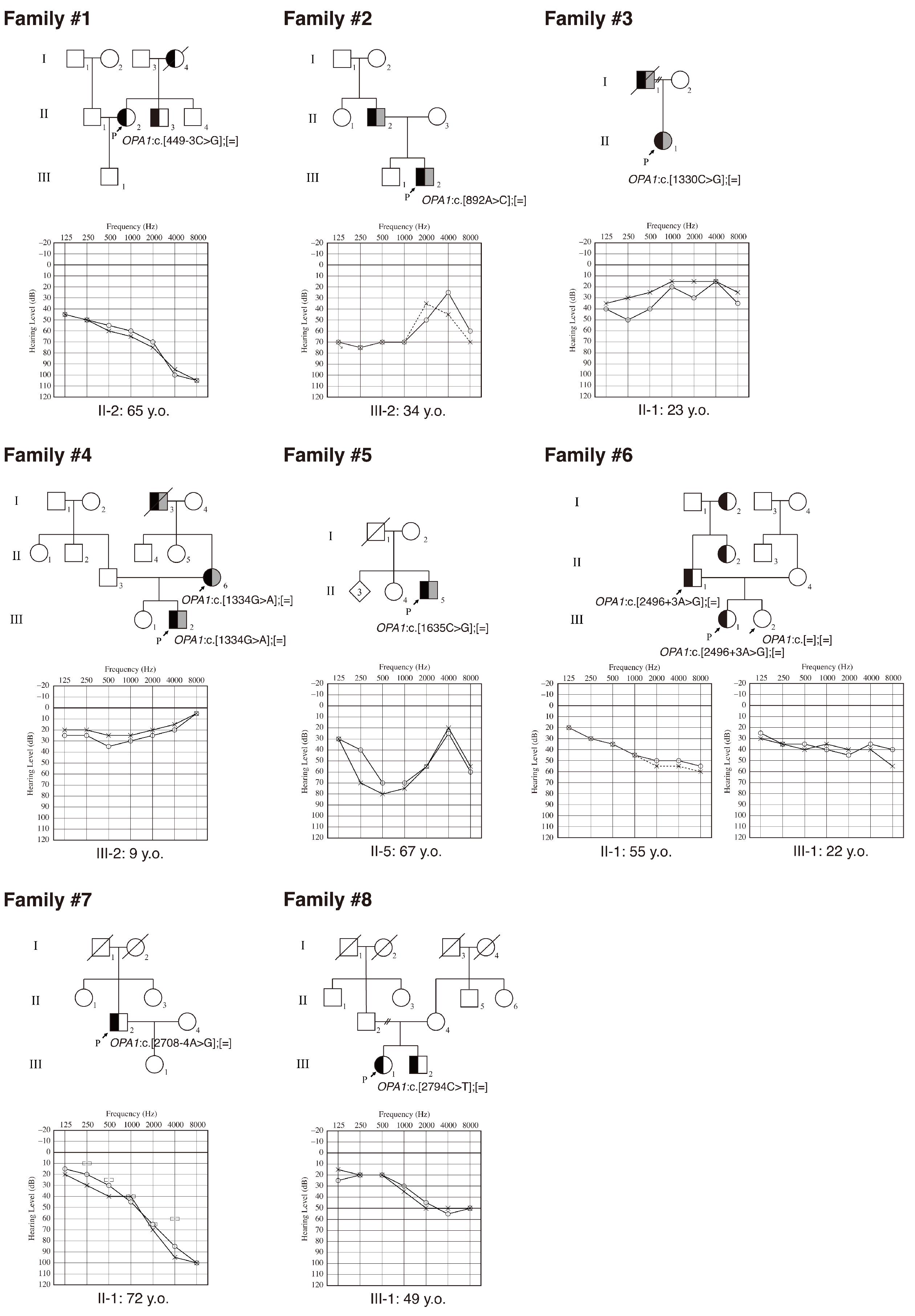
We identified ten affected individuals from eight independent families, each carrying a distinct OPA1 variant, including four previously reported variants (Figure 1, Table 2) [28,29,30,31]. Their clinical characteristics are summarized in Table 2. Four individuals carrying missense variants, JHLB-2582, JHLB-7354, the mother of JHLB-7354, and JHLB-11374, presented with OA. The age at onset of HL ranged from 6 to 60 years, and four individuals, including JHLB-1912, the father of JHLB-4064, JHLB-16179, and JHLB-16789, first noticed HL in adulthood. Six of the eight patients demonstrated progressive HL, and all exhibited bilateral HL. The audiometric configurations consisted of a flat pattern in two, a sloping high-frequency HL pattern in four, a low-frequency HL pattern in two, and a mid-frequency HL pattern in one. Most patients had mild-to-moderate HL: two had mild HL, four had moderate HL, one had severe HL, and two had normal better-hearing ear PTA.
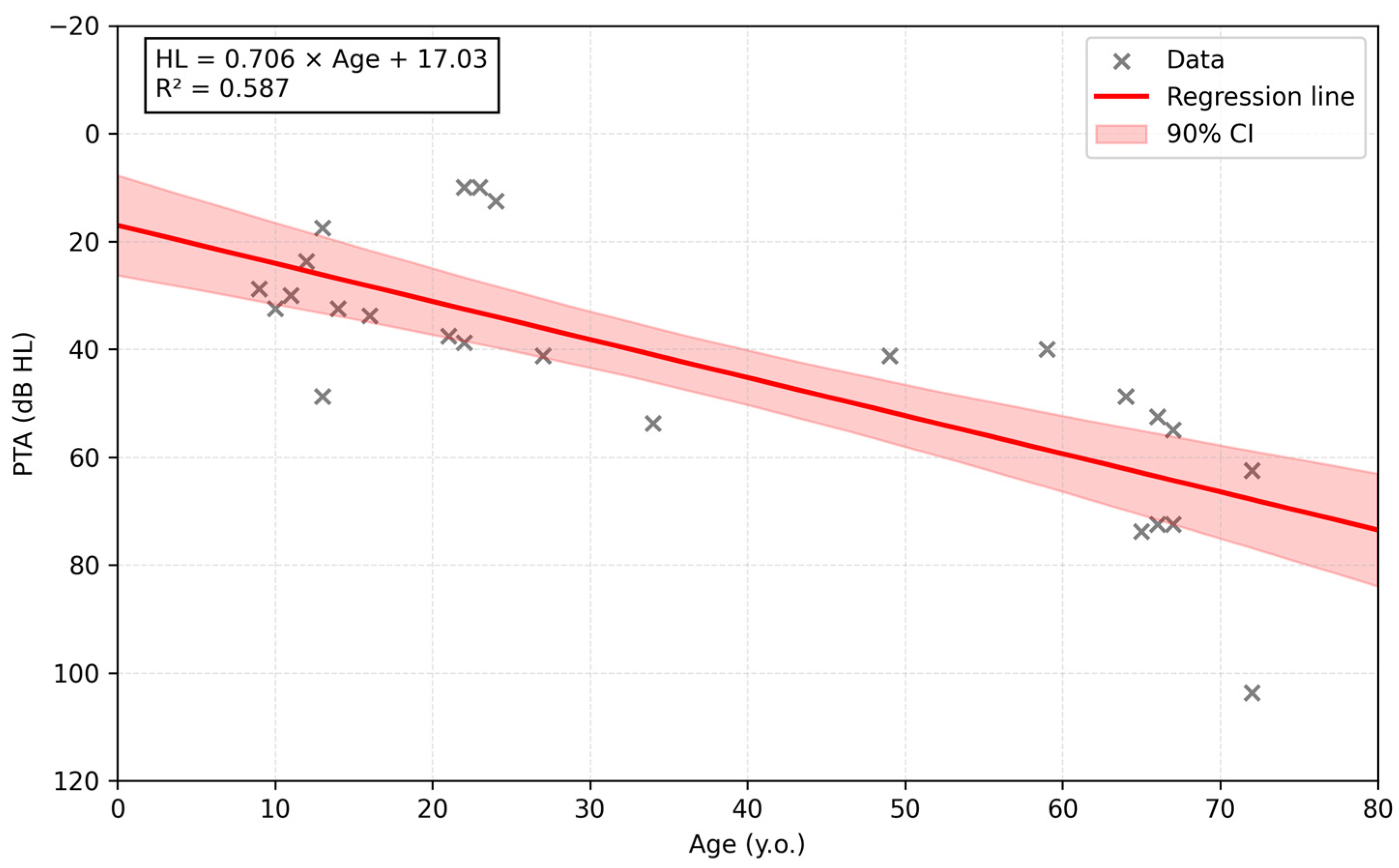
To assess overall auditory decline, all available audiometric data points for probands were aggregated and plotted using better-ear PTA values (Figure 2). Linear regression confirmed age-dependent deterioration in hearing, yielding the equation HL (dB) = 0.706 × Age + 17.03 (R2 = 0.587). The corresponding coefficient of determination was R2 = 0.587, indicating that approximately 60% of the variance in hearing thresholds was explained by age. The fitted regression curve and its 90% confidence interval (shaded in red) illustrate the expected range of hearing trajectories while reflecting variability in progression patterns.
Among the six patients carrying missense variants, four demonstrated characteristics consistent with ANSD. JHLB-7354 showed severe impairment on ASSR testing, whereas ABR responses were absent in JHLB-2582, JHLB-11374, and JHLB-13305. All four patients exhibited preserved DPOAE responses. The variant identified in JHLB-13305 is a novel OPA1 variant that is currently classified as a VUS. As additional symptoms, JHLB-11374 showed peripheral neuropathy, ataxia, and external ophthalmoplegia.

3.3. Intervention

Six of eight individuals had used HAs, and satisfaction data were available for five. Among these five cases, four were unable to continue using HAs due to discomfort during daily use and insufficient improvement in hearing and communication. One of these individuals, JHLB-1912, eventually underwent CI. This patient experienced rapid progression from moderate to profound HL in the left ear, followed by deterioration of the right ear to profound HL within three months. At the age of 72 years, the patient received left-sided CI. Speech perception testing using the Japanese monosyllable, word, and sentence perception tests (iCI-2004) was administered before and at six months after CI, demonstrating favorable outcomes, with over 90% correct in quiet conditions on the Japanese word perception test (Table 3). Given the favorable auditory performance and high satisfaction with the first implant, the patient underwent CI in the right ear nine months later. The second implant yielded a similarly favorable speech perception outcome (Table 3).
Better-ear PTA thresholds (defined as the lower of the right and left ear PTA values at 0.5, 1, 2, and 4 kHz) are plotted against age at testing. Gray crosses indicate individual audiometric evaluations. The red line represents the linear regression model (HL [dB HL] = 0.706 × Age [years] + 17.03), and the shaded area denotes the 90% confidence interval. The vertical axis is displayed in audiogram style, with better thresholds at the top (0 dB HL). This figure illustrates a general trend of progressive deterioration of hearing with age and marked inter-individual variability (R2 = 0.587).
Scores (% correct) on Japanese monosyllable, word, and sentence tests were obtained before and at six months after cochlear implantation. Scores before implantation were measured with hearing aids. The iCI2004, a Japanese cochlear implant speech test battery, was administered at a presentation level of 65 dB SPL. “Silent” indicates testing in quiet, and “SN+10” indicates testing at a signal-to-noise ratio of +10 dB.

4. Discussion

4.1. OPA1 Variant Spectrum in Hearing Loss

OPA1 is known to be a highly mutationally diverse gene. According to ClinVar (https://www.ncbi.nlm.nih.gov/clinvar/ accessed 18 November 2025), 415 unique OPA1 variants have been reported as likely pathogenic or pathogenic, including 116 frameshift variants, 67 missense variants, 72 nonsense variants, and 77 splice-site variants, among others [32]. As shown in Table 1, we identified a total of eight OPA1 variants. Among the five missense variants, one was pathogenic, two were likely pathogenic, and two were VUS. The remaining three variants were splice-site variants, all classified as VUS.
In a previous report, the DOA-plus phenotype is predominantly associated with missense variants in the GTPase domain of OPA1 [8]. These missense variants are thought to exert a dominant-negative effect due to an abnormal protein that interferes with normal mitochondrial function. Missense variants are also often associated with the ANSD phenotype, whereas truncating variants, including frameshift, nonsense and splice-site variant in the OPA1 that lead to haploinsufficiency, have not been associated with ANSD [13].

4.2. Clinical Findings

In this study, OA was observed in four of six patients, and all patients with pathogenic or likely pathogenic missense variants exhibited OA. OPA1-related disease may also manifest with isolated or predominantly auditory phenotypes, as previously reported by Milone et al. [33]. Previous studies have reported the penetrance of OA to be approximately 80–90%, while HL has been observed in 10–20% of affected individuals. Therefore, incomplete penetrance may have contributed to the absence of clinical manifestations in some carriers [34,35].
In our cohort, OA manifested in early childhood, whereas the age at onset of HL ranged widely from 6 to 60 years. In patients with pathogenic or likely pathogenic variants, HL onset was observed at 9 to 16 years of age. Yu-Wai-Man et al. reported that, in DOA-plus syndrome, vision loss usually begins in the first decade of life, whereas HL tends to manifest from late childhood to early adulthood. Therefore, OPA1-related HL is generally considered to have post-lingual onset [9]. However, the age at onset showed considerable variability in our cases, especially in patients carrying VUS variants. We also observed marked heterogeneity in the progression of HL. Six of the eight individuals showed progressive hearing deterioration, and one progressed rapidly to profound levels within a year. The patients with pathogenic or likely pathogenic variants showed progressive HL. This variability may be influenced by somatic mitochondrial DNA instability, as well as by the hypothesis proposed by Chao de la Barca et al. [36]. To evaluate the progression of HL, linear regression of hearing level in the better-ear against age was conducted (Figure 2). This analysis suggested a trend toward age-related hearing deterioration; however, given the small number of patients and heterogeneous longitudinal data, further investigation will be needed. This trend was also observed after excluding the audiometric data for one patient with rapid hearing deterioration.
Growing evidence indicates that some missense variants of OPA1 lead to ANSD rather than HL of cochlear origin [10,13]. In this study, four of six patients with missense variants showed preserved outer hair cell function in which DPOAE responses were preserved and ABRs absent, or severe HL in ASSR, which is a hallmark of ANSD [11,12].

4.3. Intervention

It has been reported that many individuals with ANSD show limited functional hearing and poor speech understanding despite the use of HAs [37]. Previous reports indicate that missense variants in OPA1 could present with an ANSD phenotype, whereas splice-site variants generally do not [13]. In our study, two of the three individuals with splice-site variants were unable to achieve adequate benefit from HAs. These findings suggest the potential for certain splice-site variants to be associated with cochlear–neural dysfunction resembling ANSD. In particular, individual JHLB-1912, who harbored a splice-site variant, showed poor word recognition using HAs, despite her pure-tone thresholds still being in the moderate range at that time. Although OPA1-related HL is often considered a form of ANSD, several reports have suggested that CI may be associated with favorable speech outcomes despite the neural origin of the deficit. In this study, the HL of individual JHLB-1912 progressed from moderate to profound. After receiving a CI, she demonstrated high word and sentence recognition scores (>90%) in quiet. Similar observations have been described by Santarelli et al. and Huang et al. In both reports, electrocochleography suggested dysfunction of distal auditory nerve dendrites, whereas electrical stimulation recruited preserved proximal axons and spiral ganglion cells, thereby re-establishing reliable neural transmission to the brain [7,13].
While HL has been reported in approximately 10–20% of individuals with OPA1-related OA in vision-centered cohorts, our results demonstrate that OPA1 variants account for only a very small fraction (8 of 18,475; 0.043%) of cases in a large HL cohort. This asymmetry underscores how disease prevalence estimates for OPA1 vary substantially depending on the clinical ascertainment strategy. Nonetheless, small sample size of OPA1-related HL patients, limited segregation data, and the predominance of VUS without functional analysis remain important limitations of this study. Larger, multicenter studies incorporating functional assays and refined genotype–phenotype correlations will be essential for clarifying pathogenicity, improving prognostic accuracy, and providing personalized management for OPA1-related HL.

5. Conclusions

This study aimed to clarify the prevalence and clinical characteristics of OPA1-related HL in a large HL cohort, demonstrating that OPA1-related HL is rare from an audiological perspective, accounting for eight probands of 18,475 (0.043%) cases. HL was typically post-lingual in onset and progressive, with predominantly mild-to-moderate severity. Affected individuals with VUS exhibited phenotypic heterogeneity, which may reflect the uncertain pathogenicity of these variants, incomplete penetrance, and the influence of mitochondrial component genes. Missense variants were frequently associated with the clinical features of OA and ANSD. In our study, a favorable CI outcome was observed in a patient with OPA1-related HL, supporting the results of previous reports. Our findings highlight the importance of genetic diagnosis and comprehensive management in individuals with OPA1 variants.

Author Contributions

Conceptualization, M.K., S.-y.N., H.M. and S.-i.U.; methodology, M.K., S.-y.N. and S.-i.U.; software, S.-y.N.; validation, M.K., H.M. and S.-y.N.; resources, Y.T., Y.K., M.A., T.O., H.Y., J.N., S.O. and T.I.; data curation, M.K. and S.-y.N.; writing—original draft preparation, M.K. and H.M.; writing—review and editing, M.K., S.-y.N., H.M. and S.-i.U.; visualization, M.K. and S.-y.N.; supervision, S.-i.U.; project administration, S.-i.U.; and funding acquisition, S.-i.U. All authors have read and agreed to the published version of the manuscript.

Funding

This study was funded by a Health and Labor Sciences Research Grant for Research on Rare and Intractable Diseases and Comprehensive Research on Disability Health and Welfare from the Ministry of Health, Labor and Welfare of Japan (S.U. H29-Nanchitou(Nan)-Ippan-031, 20FC10148, 23FC10149) as well as Grants-in-Aid from the Japan Agency for Medical Research and Development (AMED) (S.U. JP16kk0205010, JP18ek0109363, JP21ek0109542, and JP24ek0109741).

Institutional Review Board Statement

This study was conducted according to the guidelines of the Declaration of Helsinki and was approved by the Institutional Ethics Committee of Shinshu University School of Medicine (no. 387—4 September 2012, no. 576—2 May 2017, and no. 718—7 March 2022).

Informed Consent Statement

Written informed consent was obtained from all the patients (or from their next of kin, caretaker, or legal guardian in the case of minors or children).

Data Availability Statement

The datasets used during the current study are available from the corresponding author upon reasonable request.

Acknowledgments

We would like to express our gratitude to the probands and their family members who participated in this study. We also thank Sachiko Matsuda and Fumiko Tomioka for their technical assistance with this research.

Conflicts of Interest

The authors declare no conflicts of interest.

Abbreviations

The following abbreviations are used in this manuscript:
ABRAuditory brain stem response
ANSDAuditory neuropathy spectrum disorder
CICochlear implant
HLHearing loss
OAOptic atrophy
SNHLSensorineural hearing loss

References

  1. Morton, C.C.; Nance, W.E. Newborn hearing screening—A silent revolution. N. Engl. J. Med. 2006, 354, 2151–2164. [Google Scholar] [CrossRef] [PubMed]
  2. Yoshimura, H.; Okubo, T.; Shinagawa, J.; Nishio, S.Y.; Takumi, Y.; Usami, S.I. Epidemiology, aetiology and diagnosis of congenital hearing loss via hearing screening of 153,913 newborns. Int. J. Epidemiol. 2024, 53, dyae052. [Google Scholar] [CrossRef]
  3. Hildebrand, M.S.; Newton, S.S.; Gubbels, S.P.; Sheffield, A.M.; Kochhar, A.; de Silva, M.G.; Dahl, H.-H.M.; Rose, S.D.; Behlke, M.A.; Smith, R.J.H. Advances in molecular and cellular therapies for hearing loss. Mol. Ther. 2008, 16, 224–236. [Google Scholar] [CrossRef] [PubMed]
  4. Alexander, C.; Votruba, M.; Pesch, U.E.A.; Thiselton, D.L.; Mayer, S.; Moore, A.; Rodriguez, M.; Kellner, U.; Leo-Kottler, B.; Auburger, G.; et al. OPA1, encoding a dynamin-related GTPase, is mutated in autosomal dominant optic atrophy linked to chromosome 3q28. Nat. Genet. 2000, 26, 211–215. [Google Scholar] [CrossRef] [PubMed]
  5. Delettre, C.; Lenaers, G.; Griffoin, J.M.; Gigarel, N.; Lorenzo, C.; Belenguer, P.; Pelloquin, L.; Grosgeorge, J.; Turc-Carel, C.; Perret, E.; et al. Nuclear gene OPA1, encoding a mitochondrial dynamin-related protein, is mutated in dominant optic atrophy. Nat. Genet. 2000, 26, 207–210. [Google Scholar] [CrossRef]
  6. Lenaers, G.; Hamel, C.; Delettre, C.; Amati-Bonneau, P.; Procaccio, V.; Bonneau, D.; Reynier, P.; Milea, D. Dominant optic atrophy. Orphanet J. Rare Dis. 2012, 7, 46. [Google Scholar] [CrossRef]
  7. Huang, T.; Santarelli, R.; Starr, A. Mutation of OPA1 gene causes deafness by affecting function of auditory nerve terminals. Brain Res. 2009, 1300, 97–104. [Google Scholar] [CrossRef]
  8. Amati-Bonneau, P.; Valentino, M.L.; Reynier, P.; Gallardo, M.E.; Bornstein, B.; Boissière, A.; Campos, Y.; Rivera, H.; de la Aleja, J.G.; Carroccia, R.; et al. OPA1 mutations induce mitochondrial DNA instability and optic atrophy ‘plus’ phenotypes. Brain 2008, 131, 338–351. [Google Scholar] [CrossRef]
  9. Yu-Wai-Man, P.; Griffiths, P.G.; Gorman, G.S.; Lourenco, C.M.; Wright, A.F.; Auer-Grumbach, M.; Toscano, A.; Musumeci, O.; Valentino, M.L.; Caporali, L.; et al. Multi-system neurological disease is common in patients with OPA1 mutations. Brain 2010, 133, 771–786. [Google Scholar] [CrossRef]
  10. Affortit, C.; Coyat, C.; Saidia, A.R.; Ceccato, J.-C.; Charif, M.; Sarzi, E.; Flamant, F.; Guyot, R.; Cazevieille, C.; Puel, J.-L.; et al. The human OPA1 delTTAG mutation induces adult-onset and progressive auditory neuropathy in mice. Cell. Mol. Life Sci. 2024, 81, 80. [Google Scholar] [CrossRef]
  11. Starr, A.; Picton, T.W.; Sininger, Y.; Hood, L.J.; Berlin, C.I. Auditory neuropathy. Brain 1996, 119, 741–753. [Google Scholar] [CrossRef] [PubMed]
  12. Kaga, K.; Nakamura, M.; Shinogami, M.; Tsuzuku, T.; Yamada, K.; Shindo, M. Auditory nerve disease of both ears revealed by auditory brainstem responses, electrocochleography and otoacoustic emissions. Scand. Audiol. 1996, 25, 233–238. [Google Scholar] [CrossRef]
  13. Santarelli, R.; Rossi, R.; Scimemi, P.; Cama, E.; Valentino, M.L.; La Morgia, C.; Caporali, L.; Liguori, R.; Magnavita, V.; Monteleone, A.; et al. OPA1-related auditory neuropathy: Site of lesion and outcome of cochlear implantation. Brain 2015, 138, 563–576. [Google Scholar] [CrossRef]
  14. Siati, R.D.; Rosenzweig, F.; Gersdorff, G.; Gregoire, A.; Rombaux, P.; Deggouj, N. Auditory neuropathy spectrum disorders: From diagnosis to treatment. J. Clin. Med. 2020, 9, 1074. [Google Scholar] [CrossRef] [PubMed]
  15. Usami, S.I.; Nishio, S.Y. The genetic etiology of hearing loss in Japan revealed by the social health insurance-based genetic testing of 10K patients. Hum. Genet. 2022, 141, 665–681. [Google Scholar] [CrossRef]
  16. Nishio, S.Y.; Hayashi, Y.; Watanabe, M.; Usami, S.I. Clinical application of a custom AmpliSeq library and Ion Torrent PGM sequencing to comprehensive mutation screening for deafness genes. Genet. Test Mol. Biomark. 2015, 19, 209–217. [Google Scholar] [CrossRef]
  17. Wang, K.; Li, M.; Hakonarson, H. ANNOVAR: Functional annotation of genetic variants from high-throughput sequencing data. Nucleic Acids Res. 2010, 38, e164. [Google Scholar] [CrossRef]
  18. 1000 Genome Project. Available online: https://www.internationalgenome.org (accessed on 26 August 2015).
  19. Genome Aggregation Database. Available online: https://gnomad.broadinstitute.org (accessed on 11 November 2024).
  20. The Human Genetic Variation Database. Available online: https://www.hgvd.genome.med.kyoto-u.ac.jp (accessed on 15 November 2015).
  21. ToMMo 60KJPN-Integrative Japanese Genome Variation Database. Available online: https://jmorp.megabank.tohoku.ac.jp (accessed on 5 September 2024).
  22. Nishio, S.Y.; Usami, S.I. The clinical next-generation sequencing database: A tool for the unified management of clinical information and genetic variants to accelerate variant pathogenicity classification. Hum. Mutat. 2017, 38, 252–259. [Google Scholar] [CrossRef] [PubMed]
  23. Nishio, S.Y.; Moteki, H.; Usami, S.I. Simple and efficient germline copy number variant visualization method for the Ion AmpliSeq custom panel. Mol. Genet. Genom. Med. 2018, 6, 678–686. [Google Scholar] [CrossRef] [PubMed]
  24. Richards, S.; Aziz, N.; Bale, S.; Bick, D.; Das, S.; Gastier-Foster, J.; Grody, W.W.; Hegde, M.; Lyon, E.; Spector, E.; et al. Standards and guidelines for the interpretation of sequence variants. Genet. Med. 2015, 17, 405–424. [Google Scholar] [CrossRef]
  25. Oza, A.M.; DiStefano, M.T.; Hemphill, S.E.; Cushman, B.J.; Grant, A.R.; Siegert, R.K.; Shen, J.; Chapin, A.; Boczek, N.J.; Schimmenti, L.A.; et al. Expert specification of the ACMG/AMP variant interpretation guidelines for genetic hearing loss. Hum. Mutat. 2018, 39, 1593–1613. [Google Scholar] [CrossRef]
  26. Mazzoli, M.; Van Camp, G.; Newton, V.; Giarbini, N.; Declau, F.; Parving, A. Recommendations for the description of genetic and audiological data for families with nonsyndromic hereditary hearing impairment. Audiol. Med. 2003, 1, 148–150. [Google Scholar] [CrossRef]
  27. Nishio, S.Y.; Tono, T.; Iwaki, T.; Moteki, H.; Suzuki, K.; Tsushima, Y.; Kashio, A.; Akamatsu, Y.; Sato, H.; Yaegashi, K.; et al. Development and validation of an iPad-based Japanese language monosyllable speech perception test (iCI2004 monosyllable). Acta Otolaryngol. 2021, 141, 267–272. [Google Scholar] [CrossRef] [PubMed]
  28. Ideura, M.; Nishio, S.Y.; Moteki, H.; Takumi, Y.; Miyagawa, M.; Sato, T.; Kobayashi, Y.; Ohyama, K.; Oda, K.; Matsui, T.; et al. Comprehensive analysis of syndromic hearing loss patients in Japan. Sci. Rep. 2019, 9, 11976. [Google Scholar] [CrossRef]
  29. Shimizu, S.; Mori, N.; Kishi, M.; Sugata, H.; Tsuda, A.; Kubota, N. A novel mutation in the OPA1 gene in a Japanese patient with optic atrophy. Am. J. Ophthalmol. 2003, 135, 256–257. [Google Scholar] [CrossRef]
  30. Hudson, G.; Amati-Bonneau, P.; Blakely, E.L.; Stewart, J.D.; He, L.; Schaefer, A.M.; Griffiths, P.G.; Ahlqvist, K.; Suomalainen, A.; Reynier, P.; et al. Mutation of OPA1 causes dominant optic atrophy with external ophthalmoplegia, ataxia, deafness and multiple mitochondrial DNA deletions: A novel disorder of mtDNA maintenance. Brain 2008, 131, 329–337. [Google Scholar] [CrossRef]
  31. Nochez, Y.; Arsene, S.; Gueguen, N.; Chevrollier, A.; Ferré, M.; Guillet, V.; Desquiret, V.; Toutain, A.; Bonneau, D.; Procaccio, V.; et al. Acute and late-onset optic atrophy due to a novel OPA1 mutation leading to a mitochondrial coupling defect. Mol. Vis. 2009, 15, 598–608. [Google Scholar] [PubMed]
  32. National Center for Biotechnology Information (NCBI). ClinVar. Available online: https://www.ncbi.nlm.nih.gov/clinvar/ (accessed on 18 November 2025).
  33. Milone, M.; Younge, B.R.; Wang, J.; Zhang, S.; Wong, L.-J. Mitochondrial disorder with OPA1 mutation lacking optic atrophy. Mitochondrion 2009, 9, 279–281. [Google Scholar] [CrossRef] [PubMed]
  34. Cohn, A.; Toomes, C.; Potter, C.; Towns, K.; Hewitt, A.; Inglehearn, C.; Craig, J.; Mackey, D. Autosomal dominant optic atrophy: Penetrance and expressivity in patients with OPA1 mutations. Am. J. Ophthalmol. 2007, 143, 656–662. [Google Scholar] [CrossRef] [PubMed]
  35. Yu-Wai-Man, P.; Griffiths, P.G.; Burke, A.; Sellar, P.W.; Clarke, M.P.; Gnanaraj, L.; Ah-Kine, D.; Hudson, G.; Czermin, B.; Taylor, R.W.; et al. The prevalence and natural history of dominant optic atrophy due to OPA1 mutations. Ophthalmology 2010, 117, 1538–1546.e1. [Google Scholar] [CrossRef]
  36. Chao de la Barca, J.M.; Prunier-Mirebeau, D.; Amati-Bonneau, P.; Ferré, M.; Sarzi, E.; Bris, C.; Leruez, S.; Chevrollier, A.; Desquiret-Dumas, V.; Gueguen, N.; et al. OPA1-related disorders: Diversity of clinical expression, modes of inheritance and pathophysiology. Neurobiol. Dis. 2016, 90, 20–26. [Google Scholar] [CrossRef] [PubMed]
  37. Gökdoğan, Ç.; Altınyay, Ş.; Gündüz, B.; Kemaloğlu, Y.K.; Bayazıt, Y.; Uygur, K. Management of children with auditory neuropathy spectrum disorder (ANSD). Braz. J. Otorhinolaryngol. 2016, 82, 493–499. [Google Scholar] [CrossRef] [PubMed]
Figure 1. Pedigrees and audiograms of the eight families carrying OPA1 variants. In the pedigrees, the left half of each symbol shaded in black indicates hearing loss, and the right half shaded in gray indicates optic atrophy. Arrows with “P” indicate the proband. Genetic findings of tested individuals are shown in the pedigree. Age at the time of genetic and audiometric testing is provided beneath each audiogram.
Genes 17 00341 g001
Figure 2. Age-related progression of better-ear hearing levels in individuals with OPA1 variants.
Genes 17 00341 g002
Table 1. All possibly pathogenic OPA1 variants identified in this study (NM_015560).
Base ChangeAA ChangePathogenicityACMGToMMo 60K
JPN Database
gnomAD v4.1SIFTPP2 HVARMutTasterCADD PhredREVELSpliceAI
Δ Score
dbscSNV (ADA)Reference
c.449-3C>G-VUSPM2/PP3-------AL 0.841.0000This study
c.892A>Cp.Ser298ArgLPPM2/PM5_Strong/PP3--DDD27.00/965--Ideura et al., 2019 [28]
c.1330G>Cp.Glu444GlnVUSPM2/PM5/PP3--DDD28.40.859--This study
c.1334G>Ap.Arg445HisPPP1_Strong/PM2/PP3--DDA340.934--Shimizu et al., 2003 [29]
c.1635C>Gp.Ser545ArgLPPS1/PM2/PP1_Moderate/PP3--DDD29.10.843--Hudson et al., 2008 [30]
c.2496+3A>G-VUSPM2/PP3-------DL 0.60.9998This study
c.2708-4A>G-VUSPM2/PP3-7.72 × 10−7-----AG 0.810.9991This study
c.2794C>Tp.Arg932CysVUSPM2/PP3-1.11 × 10−5DDD340.855--Nochez et al., 2009 [31]
All variants are indicated according to NM_015560. AA, amino acid; P, pathogenic; LP, likely pathogenic; VUS, variant of uncertain significance; PP2, PolyPhen-2; SpliceAI Δ score shows the predicted splice site effect and maximum Δ score. AL, acceptor loss; DL, donor loss; AG, acceptor gain. dbscSNV (ADA) indicates the adaptive boosting scores. D (in SIFT), deleterious; D (in PP2), probably damaging; D (in MutTaster), disease causing; A, disease-causing automatic.
Table 2. Clinical characteristics of individuals with OPA1 variants identified in this study (NM_015560).
Family No.IDSexBase
Change
AA ChangeOAOther SymptomsAgeOnset of HLConfigurationSeverity
of HL
Progression
of HL
ABRASSRDPOAEsInterventionDiscontinued
HA Use
1JHLB-1912Fc.449-3C>G.N/ANothing6545HighSevereYN/AN/AAbsentCIY
2JHLB-2582Mc.892A>Cp.Ser298ArgYN/A3416LowModerateYNRN/APresentN/AN/A
3JHLB-13305Fc.1330G>Cp.Glu444GlnN/ANothing2318LowNormalYNRModeratePresentHearing aidY
4JHLB-7354Mc.1334G>Ap.Arg445HisYN/A99FlatNormalN/AN/ASeverePresentHearing aidY
MotherFc.1334G>Ap.Arg445HisYN/A42N/AN/AN/AN/AN/AN/AN/AN/AN/A
5JHLB-11374Mc.1635C>Gp.Ser545ArgYPeripheral neuropathy, Ataxia,
External ophthalmoplegia
6710MidModerateYNRN/APresentHearing aidN/A
6JHLB-4064Fc.2496+3A>G.NNothing226FlatMildNN/AN/AN/AHearing aidY
FatherMc.2496+3A>G.N/AN/A5530HighModerateYN/AN/AN/ANoneN/A
7JHLB-16789Mc.2708-4A>G.NNothing7260HighModerateNN/AN/AN/ANoneN/A
8JHLB-16179Fc.2794C>Tp.Arg932CysN/AN/A4930HighMildYN/AN/AAbsentHearing aidN
F, female; M, male; OA, optic atrophy; Age, age at the time of genetic testing; Y, yes; N, no; N/A, data not available; Flat, flat audiometric configuration; High, high-frequency hearing loss; Mid, mid-frequency hearing loss; Low, low-frequency hearing loss; ABR, auditory brainstem response; ASSR, auditory steady-state response; DPOAEs, distortion product otoacoustic emissions; NR, no response. “Progression of HL” indicates whether the patient was aware of progressive hearing deterioration. “Discontinued HA use” indicates that the patient discontinued hearing aid use because the benefit was insufficient.
Table 3. Results of speech perception testing before and after cochlear implantation for JHLB-1912.
Speech Perception TestsRight HALeft HARight CILeft CI
SilentMonosyllable006661
Word009296
Sentence0095100
S/N+10dBWordNANA7268
SentenceNANA8376
Disclaimer/Publisher’s Note: The statements, opinions and data contained in all publications are solely those of the individual author(s) and contributor(s) and not of MDPI and/or the editor(s). MDPI and/or the editor(s) disclaim responsibility for any injury to people or property resulting from any ideas, methods, instructions or products referred to in the content.