Driven by Dopamine: Genetic Insights into Motivation and Performance in Sports and Esports


Abstract
1. Introduction
2. Materials and Methods: Narrative Review Design
3. The Dopaminergic System and Its Biological Significance
4. Genes and Polymorphisms of the Dopaminergic System
5. Epigenetic Modulation of the Dopaminergic System in Athletes
6. Significance of Dopaminergic Gene Polymorphisms in the Context of Predisposition to Physical and Esports Activity
7. Conclusions and Further Research Direction
Author Contributions
Funding
Institutional Review Board Statement
Informed Consent Statement
Data Availability Statement
Conflicts of Interest
Abbreviations
| 10R | 10-repeat |
| 4R | 4-repeat |
| 7R | 7-repeat |
| 9R | 9-repeat |
| ADHD | Attention Deficit Hyperactivity Disorder |
| ANKK1 | Ankyrin repeat and kinase domain containing 1 |
| cAMP | Cyclic Adenosine Monophosphate |
| COMT | Catechol-O-methyltransferase |
| D1–D5 | Dopamine receptor type 1–5 |
| D2L | Long isoform of the dopamine D2 receptor |
| D2S | Short isoform of the dopamine D2 receptor |
| DAT1 | Dopamine transporter |
| DBH | Dopamine Beta-Hydroxylase |
| DRD1 | Dopamine D1 receptor gene |
| DRD2 | Dopamine D2 receptor gene |
| DRD3 | Dopamine D3 receptor gene |
| DRD4 | Dopamine D4 receptor gene |
| DRD5 | Dopamine D5 receptor gene |
| EEG | Electroencephalography |
| fMRI | Functional magnetic resonance imaging |
| L-DOPA | L-3,4-dihydroxyphenylalanine |
| NEO-FFI | NEO Five Factor Inventory |
| PET | Positron emission tomography |
| SLC6A3 | Solute Carrier Family 6 Member 3 |
| SN | Substantia Nigra |
| SNP | Single Nucleotide Polymorphism |
| TH | Tyrosine Hydroxylase |
| Val158Met | Valine-to-methionine substitution |
| VNTR | Variable Number Tandem Repeats |
| VTA | Ventral Tegmental Area |
References
- Sahu, M.; Prasuna, J. Twin Studies: A Unique Epidemiological Tool. Indian J. Community Med. 2016, 41, 177–182. [Google Scholar] [CrossRef]
- Choi, C.Q. How Epigenetics Affects Twins. Genome Biol. 2004, 5, spotlight-20050708-02. [Google Scholar] [CrossRef]
- Humińska-Lisowska, K. Dopamine in Sports: A Narrative Review on the Genetic and Epigenetic Factors Shaping Personality and Athletic Performance. Int. J. Mol. Sci. 2024, 25, 11602. [Google Scholar] [CrossRef] [PubMed]
- Bavelier, D.; Green, C.S.; Pouget, A.; Schrater, P. Brain Plasticity Through the Life Span: Learning to Learn and Action Video Games. Annu. Rev. Neurosci. 2012, 35, 391–416. [Google Scholar] [CrossRef]
- Granic, I.; Lobel, A.; Engels, R.C. The Benefits of Playing Video Games. Am. Psychol. 2014, 69, 66–78. [Google Scholar] [CrossRef] [PubMed]
- Feng, J.; Spence, I. Playing Action Video Games Boosts Visual Attention. In Video Game Influences on Aggression, Cognition, and Attention; Ferguson, C.J., Ed.; Springer International Publishing: Cham, Switzerland, 2018; pp. 93–104. [Google Scholar]
- Pallavicini, F.; Ferrari, A.; Mantovani, F. Video Games for Well-Being: A Systematic Review on the Application of Computer Games for Cognitive and Emotional Training in the Adult Population. Front. Psychol. 2018, 9, 2127. [Google Scholar] [CrossRef] [PubMed]
- Smith, E.T.; Basak, C. A Game-Factors Approach to Cognitive Benefits from Video-Game Training: A Meta-Analysis. PLoS ONE 2023, 18, e0285925. [Google Scholar] [CrossRef]
- Wang, P.; Liu, H.-H.; Zhu, X.-T.; Meng, T.; Li, H.-J.; Zuo, X.-N. Action Video Game Training for Healthy Adults: A Meta-Analytic Study. Front. Psychol. 2016, 7, 907. [Google Scholar] [CrossRef]
- Sukhera, J. Narrative Reviews: Flexible, Rigorous, and Practical. J. Grad. Med. Educ. 2022, 14, 414–417. [Google Scholar] [CrossRef]
- Bıçakçı, B.; Cięszczyk, P.; Humińska-Lisowska, K. Genetic Determinants of Endurance: A Narrative Review on Elite Athlete Status and Performance. Int. J. Mol. Sci. 2024, 25, 13041. [Google Scholar] [CrossRef]
- Schultz, W. Dopamine Reward Prediction-Error Signalling: A Two-Component Response. Nat. Rev. Neurosci. 2016, 17, 183–195. [Google Scholar] [CrossRef]
- Holroyd, C.B.; Nieuwenhuis, S.; Yeung, N.; Cohen, J.D. Errors in Reward Prediction Are Reflected in the Event-Related Brain Potential. NeuroReport 2003, 14, 2481–2484. [Google Scholar] [CrossRef]
- Matsumoto, M.; Hikosaka, O. Two Types of Dopamine Neuron Distinctly Convey Positive and Negative Motivational Signals. Nature 2009, 459, 837–841. [Google Scholar] [CrossRef]
- Molina-Luna, K.; Pekanovic, A.; Röhrich, S.; Hertler, B.; Schubring-Giese, M.; Rioult-Pedotti, M.-S.; Luft, A.R. Dopamine in Motor Cortex Is Necessary for Skill Learning and Synaptic Plasticity. PLoS ONE 2009, 4, e7082. [Google Scholar] [CrossRef]
- Brown, M.T.C.; Henny, P.; Bolam, J.P.; Magill, P.J. Activity of Neurochemically Heterogeneous Dopaminergic Neurons in the Substantia Nigra during Spontaneous and Driven Changes in Brain State. J. Neurosci. 2009, 29, 2915–2925. [Google Scholar] [CrossRef]
- Cousineau, J.; Plateau, V.; Baufreton, J.; Le Bon-Jégo, M. Dopaminergic Modulation of Primary Motor Cortex: From Cellular and Synaptic Mechanisms Underlying Motor Learning to Cognitive Symptoms in Parkinson’s Disease. Neurobiol. Dis. 2022, 167, 105674. [Google Scholar] [CrossRef] [PubMed]
- Cools, R.; D’Esposito, M. Inverted-U–Shaped Dopamine Actions on Human Working Memory and Cognitive Control. Biol. Psychiatry 2011, 69, e113–e125. [Google Scholar] [CrossRef] [PubMed]
- Muehlberg, C.; Goerg, S.; Rullmann, M.; Hesse, S.; Sabri, O.; Wawrzyniak, M.; Classen, J.; Fricke, C.; Rumpf, J.-J. Motor Learning Is Modulated by Dopamine Availability in the Sensorimotor Putamen. Brain Commun. 2024, 6, fcae409. [Google Scholar] [CrossRef] [PubMed]
- Arnsten, A.F.T.; Rubia, K. Neurobiological Circuits Regulating Attention, Cognitive Control, Motivation, and Emotion: Disruptions in Neurodevelopmental Psychiatric Disorders. J. Am. Acad. Child Adolesc. Psychiatry 2012, 51, 356–367. [Google Scholar] [CrossRef]
- Hornykiewicz, O. Chemical Neuroanatomy of the Basal Ganglia—Normal and in Parkinson’s Disease. J. Chem. Neuroanat. 2001, 22, 3–12. [Google Scholar] [CrossRef]
- Surmeier, D.J.; Obeso, J.A.; Halliday, G.M. Selective Neuronal Vulnerability in Parkinson Disease. Nat. Rev. Neurosci. 2017, 18, 101–113. [Google Scholar] [CrossRef]
- Volkow, N.D.; Morales, M. The Brain on Drugs: From Reward to Addiction. Cell 2015, 162, 712–725. [Google Scholar] [CrossRef]
- Salamone, J.D.; Yohn, S.E.; López-Cruz, L.; San Miguel, N.; Correa, M. Activational and Effort-Related Aspects of Motivation: Neural Mechanisms and Implications for Psychopathology. Brain 2016, 139, 1325–1347. [Google Scholar] [CrossRef] [PubMed]
- Treadway, M.T.; Zald, D.H. Reconsidering Anhedonia in Depression: Lessons from Translational Neuroscience. Neurosci. Biobehav. Rev. 2011, 35, 537–555. [Google Scholar] [CrossRef]
- Dang, L.C.; O’Neil, J.P.; Jagust, W.J. Genetic Effects on Behavior Are Mediated by Neurotransmitters and Large-Scale Neural Networks. NeuroImage 2013, 66, 203–214. [Google Scholar] [CrossRef] [PubMed]
- Peuskens, J.; Pani, L.; Detraux, J.; De Hert, M. The Effects of Novel and Newly Approved Antipsychotics on Serum Prolactin Levels: A Comprehensive Review. CNS Drugs 2014, 28, 421–453. [Google Scholar] [CrossRef]
- Beaulieu, J.-M.; Gainetdinov, R.R. The Physiology, Signaling, and Pharmacology of Dopamine Receptors. Pharmacol. Rev. 2011, 63, 182–217. [Google Scholar] [CrossRef] [PubMed]
- Rosen, Z.B.; Cheung, S.; Siegelbaum, S.A. Midbrain Dopamine Neurons Bidirectionally Regulate CA3-CA1 Synaptic Drive. Nat. Neurosci. 2015, 18, 1763–1771. [Google Scholar] [CrossRef]
- Missale, C.; Nash, S.R.; Robinson, S.W.; Jaber, M.; Caron, M.G. Dopamine Receptors: From Structure to Function. Physiol. Rev. 1998, 78, 189–225. [Google Scholar] [CrossRef]
- Lauretani, F.; Giallauria, F.; Testa, C.; Zinni, C.; Lorenzi, B.; Zucchini, I.; Salvi, M.; Napoli, R.; Maggio, M.G. Dopamine Pharmacodynamics: New Insights. Int. J. Mol. Sci. 2024, 25, 5293. [Google Scholar] [CrossRef]
- Nemoda, Z.; Szekely, A.; Sasvari-Szekely, M. Psychopathological Aspects of Dopaminergic Gene Polymorphisms in Adolescence and Young Adulthood. Neurosci. Biobehav. Rev. 2011, 35, 1665–1686. [Google Scholar] [CrossRef] [PubMed]
- Bertolino, A.; Taurisano, P.; Pisciotta, N.M.; Blasi, G.; Fazio, L.; Romano, R.; Gelao, B.; Bianco, L.L.; Lozupone, M.; Di Giorgio, A.; et al. Genetically Determined Measures of Striatal D2 Signaling Predict Prefrontal Activity during Working Memory Performance. PLoS ONE 2010, 5, e9348. [Google Scholar] [CrossRef]
- Gluskin, B.S.; Mickey, B.J. Genetic Variation and Dopamine D2 Receptor Availability: A Systematic Review and Meta-Analysis of Human in Vivo Molecular Imaging Studies. Transl. Psychiatry 2016, 6, e747. [Google Scholar] [CrossRef]
- Savitz, J.; Hodgkinson, C.A.; Martin-Soelch, C.; Shen, P.-H.; Szczepanik, J.; Nugent, A.C.; Herscovitch, P.; Grace, A.A.; Goldman, D.; Drevets, W.C. DRD2/ANKK1 Taq1A Polymorphism (Rs1800497) Has Opposing Effects on D2/3 Receptor Binding in Healthy Controls and Patients with Major Depressive Disorder. Int. J. Neuropsychopharmacol. 2013, 16, 2095–2101. [Google Scholar] [CrossRef] [PubMed]
- Spitta, G.; Fliedner, L.E.; Gleich, T.; Zindler, T.; Sebold, M.; Buchert, R.; Heinz, A.; Gallinat, J.; Friedel, E. Association between DRD2/ANKK1 TaqIA Allele Status and Striatal Dopamine D2/3 Receptor Availability in Alcohol Use Disorder. J. Integr. Neurosci. 2022, 21, 171. [Google Scholar] [CrossRef]
- Zhang, Y.; Bertolino, A.; Fazio, L.; Blasi, G.; Rampino, A.; Romano, R.; Lee, M.-L.T.; Xiao, T.; Papp, A.; Wang, D.; et al. Polymorphisms in Human Dopamine D2 Receptor Gene Affect Gene Expression, Splicing, and Neuronal Activity during Working Memory. Proc. Natl. Acad. Sci. USA 2007, 104, 20552–20557. [Google Scholar] [CrossRef]
- Colizzi, M.; Iyegbe, C.; Powell, J.; Ursini, G.; Porcelli, A.; Bonvino, A.; Taurisano, P.; Romano, R.; Masellis, R.; Blasi, G.; et al. Interaction Between Functional Genetic Variation of DRD2 and Cannabis Use on Risk of Psychosis. Schizophr. Bull. 2015, 41, 1171–1182. [Google Scholar] [CrossRef] [PubMed]
- Huminska-Lisowska, K.; Stronska-Pluta, A.; Suchanecka, A.; Massidda, M.; Trybek, G.; Calo, C.M.; Rzeszutko, A.; Reclaw, R.; Grzywacz, A. Association Study of the Taq1D Rs1800498 Polymorphism of the DRD2 Gene with Personality Traits in a Group of Athletes. Balt. J. Health Phys. Act. 2024, 16, Article9. [Google Scholar] [CrossRef]
- Sweitzer, M.M.; Halder, I.; Flory, J.D.; Craig, A.E.; Gianaros, P.J.; Ferrell, R.E.; Manuck, S.B. Polymorphic Variation in the Dopamine D4 Receptor Predicts Delay Discounting as a Function of Childhood Socioeconomic Status: Evidence for Differential Susceptibility. Soc. Cogn. Affect. Neurosci. 2013, 8, 499–508. [Google Scholar] [CrossRef]
- Dmitrieva, J.; Chen, C.; Greenberger, E.; Ogunseitan, O.; Ding, Y.-C. Gender-Specific Expression of the DRD4 Gene on Adolescent Delinquency, Anger and Thrill Seeking. Soc. Cogn. Affect. Neurosci. 2011, 6, 82–89. [Google Scholar] [CrossRef]
- Turic, D. DRD4 And DAT1 in ADHD: Functional Neurobiology to Pharmacogenetics. Pharmacogenom. Pers. Med. 2010, 3, 61–78. [Google Scholar] [CrossRef]
- Bakermans-Kranenburg, M.J.; Van IJzendoorn, M.H. Gene-Environment Interaction of the Dopamine D4 Receptor (DRD4) and Observed Maternal Insensitivity Predicting Externalizing Behavior in Preschoolers. Dev. Psychobiol. 2006, 48, 406–409. [Google Scholar] [CrossRef]
- Nobile, M.; Giorda, R.; Marino, C.; Carlet, O.; Pastore, V.; Vanzin, L.; Bellina, M.; Molteni, M.; Battaglia, M. Socioeconomic Status Mediates the Genetic Contribution of the Dopamine Receptor D4 and Serotonin Transporter Linked Promoter Region Repeat Polymorphisms to Externalization in Preadolescence. Dev. Psychopathol. 2007, 19, 1147–1160. [Google Scholar] [CrossRef] [PubMed]
- Tei, S.; Mitsuhashi, H.; Ishiura, S. Data Describing the Effect of DRD4 Promoter Polymorphisms on Promoter Activity. Data Brief 2016, 7, 1112–1117. [Google Scholar] [CrossRef] [PubMed]
- Eichhammer, P.; Sand, P.G.; Stoertebecker, P.; Langguth, B.; Zowe, M.; Hajak, G. Variation at the DRD4 Promoter Modulates Extraversion in Caucasians. Mol. Psychiatry 2005, 10, 520–522. [Google Scholar] [CrossRef] [PubMed]
- Michałowska-Sawczyn, M.; Niewczas, M.; Król, P.; Czarny, W.; Rzeszutko, A.; Chmielowiec, K.; Chmielowiec, J.; Grzywacz, A.; Humińska-Lisowska, K.; Lachowicz, M.; et al. Associations Between the Dopamine D4 Receptor Gene Polymorphisms and Personality Traits in Elite Athletes. Biol. Sport 2019, 36, 365–372. [Google Scholar] [CrossRef]
- Vereczkei, A.; Demetrovics, Z.; Szekely, A.; Sarkozy, P.; Antal, P.; Szilagyi, A.; Sasvari-Szekely, M.; Barta, C. Multivariate Analysis of Dopaminergic Gene Variants as Risk Factors of Heroin Dependence. PLoS ONE 2013, 8, e66592. [Google Scholar] [CrossRef]
- Pan, Y.; Wang, B.; Yao, J. Association of Dopamine D1 Receptor Gene Polymorphism with Schizophrenia: A Meta-Analysis. Neuropsychiatr. Dis. Treat. 2014, 10, 1133–1139. [Google Scholar] [CrossRef]
- Abi-Dargham, A.; Mawlawi, O.; Lombardo, I.; Gil, R.; Martinez, D.; Huang, Y.; Hwang, D.-R.; Keilp, J.; Kochan, L.; Van Heertum, R.; et al. Prefrontal Dopamine D1 Receptors and Working Memory in Schizophrenia. J. Neurosci. 2002, 22, 3708–3719. [Google Scholar] [CrossRef]
- Park, S.; Kwon, J.; Ahn, C.; Cho, H.-S.; Moon, H.Y.; Lee, C.G. The Role of Dopamine Receptor D2 in Bridging the Intention-Behavior Gap in Sport Participation. Int. J. Environ. Res. Public Health 2021, 18, 2379. [Google Scholar] [CrossRef]
- Zhang, K.; Wang, L.; Cao, C.; Li, G.; Fang, R.; Liu, P.; Luo, S.; Zhang, X.; Liberzon, I. A DRD2/ANNK1–COMT Interaction, Consisting of Functional Variants, Confers Risk of Post-Traumatic Stress Disorder in Traumatized Chinese. Front. Psychiatry 2018, 9, 170. [Google Scholar] [CrossRef]
- Jiang, Y.; Liu, B.; Wu, C.; Gao, X.; Lu, Y.; Lian, Y.; Liu, J. Dopamine Receptor D2 Gene (DRD2) Polymorphisms, Job Stress, and Their Interaction on Sleep Dysfunction. Int. J. Environ. Res. Public Health 2020, 17, 8174. [Google Scholar] [CrossRef] [PubMed]
- Deng, Y.; Huang, J.; Zhang, H.; Zhu, X.; Gong, Q. Association of Expression of DRD2 Rs1800497 Polymorphism with Migraine Risk in Han Chinese Individuals. J. Pain Res. 2018, 11, 763–769. [Google Scholar] [CrossRef] [PubMed]
- Zhang, C.; Zhang, J.; Fan, J.; Cheng, W.; Du, Y.; Yu, S.; Fang, Y. Identification of ANKK1 Rs1800497 Variant in Schizophrenia: New Data and Meta-analysis. Am. J. Med. Genet. B Neuropsychiatr. Genet. 2014, 165, 564–571. [Google Scholar] [CrossRef]
- Miura, I.; Zhang, J.-P.; Hagi, K.; Lencz, T.; Kane, J.M.; Yabe, H.; Malhotra, A.K.; Correll, C.U. Variants in the DRD2 Locus and Antipsychotic-Related Prolactin Levels: A Meta-Analysis. Psychoneuroendocrinology 2016, 72, 1–10. [Google Scholar] [CrossRef]
- Chiang, T.-I.; Lane, H.-Y.; Lin, C.-H. D2 Dopamine Receptor Gene (DRD2) Taq1A (Rs1800497) Affects Bone Density. Sci. Rep. 2020, 10, 13236. [Google Scholar] [CrossRef]
- Cohen, O.S.; Weickert, T.W.; Hess, J.L.; Paish, L.M.; McCoy, S.Y.; Rothmond, D.A.; Galletly, C.; Liu, D.; Weinberg, D.D.; Huang, X.-F.; et al. A Splicing-Regulatory Polymorphism in DRD2 Disrupts ZRANB2 Binding, Impairs Cognitive Functioning and Increases Risk for Schizophrenia in Six Han Chinese Samples. Mol. Psychiatry 2016, 21, 975–982. [Google Scholar] [CrossRef]
- Moyer, R.A.; Wang, D.; Papp, A.C.; Smith, R.M.; Duque, L.; Mash, D.C.; Sadee, W. Intronic Polymorphisms Affecting Alternative Splicing of Human Dopamine D2 Receptor Are Associated with Cocaine Abuse. Neuropsychopharmacology 2011, 36, 753–762. [Google Scholar] [CrossRef]
- Roussotte, F.F.; Jahanshad, N.; Hibar, D.P.; Thompson, P.M. Altered Regional Brain Volumes in Elderly Carriers of a Risk Variant for Drug Abuse in the Dopamine D2 Receptor Gene (DRD2). Brain Imaging Behav. 2015, 9, 213–222. [Google Scholar] [CrossRef]
- Smith, C.T.; Dang, L.C.; Buckholtz, J.W.; Tetreault, A.M.; Cowan, R.L.; Kessler, R.M.; Zald, D.H. The Impact of Common Dopamine D2 Receptor Gene Polymorphisms on D2/3 Receptor Availability: C957T as a Key Determinant in Putamen and Ventral Striatum. Transl. Psychiatry 2017, 7, e1091. [Google Scholar] [CrossRef] [PubMed]
- Ramsay, H.; Barnett, J.H.; Miettunen, J.; Mukkala, S.; Mäki, P.; Liuhanen, J.; Murray, G.K.; Jarvelin, M.-R.; Ollila, H.; Paunio, T.; et al. Association between Dopamine Receptor D2 (DRD2) Variations Rs6277 and Rs1800497 and Cognitive Performance According to Risk Type for Psychosis: A Nested Case Control Study in a Finnish Population Sample. PLoS ONE 2015, 10, e0127602. [Google Scholar] [CrossRef]
- He, H.; Wu, H.; Yang, L.; Gao, F.; Fan, Y.; Feng, J.; Ma, X.-C. Associations between Dopamine D2 Receptor Gene Polymorphisms and Schizophrenia Risk: A PRISMA Compliant Meta-Analysis. Neuropsychiatr. Dis. Treat. 2016, 12, 3129–3144. [Google Scholar] [CrossRef] [PubMed]
- Paderina, D.Z.; Boiko, A.S.; Pozhidaev, I.V.; Mednova, I.A.; Goncharova, A.A.; Bocharova, A.V.; Fedorenko, O.Y.; Kornetova, E.G.; Semke, A.V.; Bokhan, N.A.; et al. The Gender-Specific Association of DRD2 Polymorphism with Metabolic Syndrome in Patients with Schizophrenia. Genes 2022, 13, 1312. [Google Scholar] [CrossRef]
- Qi, X.; Xuan, J.; Xing, J.; Wang, B.; Yao, J. No Association between Dopamine D3 Receptor Gene Ser9Gly Polymorphism (Rs6280) and Risk of Schizophrenia: An Updated Meta-Analysis. Neuropsychiatr. Dis. Treat. 2017, 13, 2855–2865. [Google Scholar] [CrossRef]
- Tsai, H.; North, K.E.; West, S.L.; Poole, C. The DRD3 Rs6280 Polymorphism and Prevalence of Tardive Dyskinesia: A Meta-analysis. Am. J. Med. Genet. B Neuropsychiatr. Genet. 2010, 153B, 57–66. [Google Scholar] [CrossRef]
- Siokas, V.; Aloizou, A.-M.; Tsouris, Z.; Liampas, I.; Aslanidou, P.; Dastamani, M.; Brotis, A.G.; Bogdanos, D.P.; Hadjigeorgiou, G.M.; Dardiotis, E. Genetic Risk Factors for Essential Tremor: A Review. Tremor Other Hyperkinetic Mov. 2020, 10, 4. [Google Scholar] [CrossRef]
- Lowe, N.; Kirley, A.; Hawi, Z.; Sham, P.; Wickham, H.; Kratochvil, C.J.; Smith, S.D.; Lee, S.Y.; Levy, F.; Kent, L.; et al. Joint Analysis of the DRD5 Marker Concludes Association with Attention-Deficit/Hyperactivity Disorder Confined to the Predominantly Inattentive and Combined Subtypes. Am. J. Hum. Genet. 2004, 74, 348–356. [Google Scholar] [CrossRef]
- Lachman, H.M.; Papolos, D.F.; Saito, T.; Yu, Y.-M.; Szumlanski, C.L.; Weinshilboum, R.M. Human Catechol-O-Methyltransferase Pharmacogenetics: Description of a Functional Polymorphism and Its Potential Application to Neuropsychiatric Disorders. Pharmacogenetics 1996, 6, 243–250. [Google Scholar] [CrossRef] [PubMed]
- Reith, M.E.A.; Kortagere, S.; Wiers, C.E.; Sun, H.; Kurian, M.A.; Galli, A.; Volkow, N.D.; Lin, Z. The Dopamine Transporter Gene SLC6A3: Multidisease Risks. Mol. Psychiatry 2022, 27, 1031–1046. [Google Scholar] [CrossRef] [PubMed]
- Bademci, G.; Vance, J.M.; Wang, L. Tyrosine Hydroxylase Gene: Another Piece of the Genetic Puzzle of Parkinson’s Disease. CNS Neurol. Disord. Drug Targets 2012, 11, 469–481. [Google Scholar] [CrossRef]
- Tunbridge, E.M.; Harrison, P.J.; Weinberger, D.R. Catechol-o-Methyltransferase, Cognition, and Psychosis: Val158Met and Beyond. Biol. Psychiatry 2006, 60, 141–151. [Google Scholar] [CrossRef]
- Lotta, T.; Vidgren, J.; Tilgmann, C.; Ulmanen, I.; Melen, K.; Julkunen, I.; Taskinen, J. Kinetics of Human Soluble and Membrane-Bound Catechol O-Methyltransferase: A Revised Mechanism and Description of the Thermolabile Variant of the Enzyme. Biochemistry 1995, 34, 4202–4210. [Google Scholar] [CrossRef]
- Gibbs, A.; Bautista, C.; Mowlem, F.; Naudts, K.; Duka, D. Catechol-O-Methyltransferase Val158met Genotype Determines Effect of Reboxetine on Emotional Memory in Healthy Male Volunteers. J. Psychiatry Neurosci. 2014, 39, E24–E31. [Google Scholar] [CrossRef]
- Humińska-Lisowska, K.; Chmielowiec, K.; Chmielowiec, J.; Strońska-Pluta, A.; Bojarczuk, A.; Dzitkowska-Zabielska, M.; Łubkowska, B.; Spieszny, M.; Surała, O.; Grzywacz, A. Association Between the Rs4680 Polymorphism of the COMT Gene and Personality Traits among Combat Sports Athletes. J. Hum. Kinet. 2023, 89, 89–99. [Google Scholar] [CrossRef]
- Faraone, S.V.; Spencer, T.J.; Madras, B.K.; Zhang-James, Y.; Biederman, J. Functional Effects of Dopamine Transporter Gene Genotypes on in Vivo Dopamine Transporter Functioning: A Meta-Analysis. Mol. Psychiatry 2014, 19, 880–889. [Google Scholar] [CrossRef]
- Congdon, E.; Canli, T. A Neurogenetic Approach to Impulsivity. J. Pers. 2008, 76, 1447–1484. [Google Scholar] [CrossRef]
- Horiguchi, M.; Ohi, K.; Hashimoto, R.; Hao, Q.; Yasuda, Y.; Yamamori, H.; Fujimoto, M.; Umeda-Yano, S.; Takeda, M.; Ichinose, H. Functional Polymorphism (C-824T) of the Tyrosine Hydroxylase Gene Affects IQ in Schizophrenia. Psychiatry Clin. Neurosci. 2014, 68, 456–462. [Google Scholar] [CrossRef] [PubMed]
- Sadahiro, R.; Suzuki, A.; Shibuya, N.; Kamata, M.; Matsumoto, Y.; Goto, K.; Otani, K. Association Study between a Functional Polymorphism of Tyrosine Hydroxylase Gene Promoter and Personality Traits in Healthy Subjects. Behav. Brain Res. 2010, 208, 209–212. [Google Scholar] [CrossRef] [PubMed]
- Zhang, L.; Rao, F.; Wessel, J.; Kennedy, B.P.; Rana, B.K.; Taupenot, L.; Lillie, E.O.; Cockburn, M.; Schork, N.J.; Ziegler, M.G.; et al. Functional Allelic Heterogeneity and Pleiotropy of a Repeat Polymorphism in Tyrosine Hydroxylase: Prediction of Catecholamines and Response to Stress in Twins. Physiol. Genom. 2004, 19, 277–291. [Google Scholar] [CrossRef] [PubMed]
- Schlüter, C.; Arning, L.; Fraenz, C.; Friedrich, P.; Pinnow, M.; Güntürkün, O.; Beste, C.; Ocklenburg, S.; Genc, E. Genetic Variation in Dopamine Availability Modulates the Self-Reported Level of Action Control in a Sex-Dependent Manner. Soc. Cogn. Affect. Neurosci. 2019, 14, 759–768. [Google Scholar] [CrossRef]
- Zhang, K.; Zhang, L.; Rao, F.; Brar, B.; Rodriguez-Flores, J.L.; Taupenot, L.; O’Connor, D.T. Human Tyrosine Hydroxylase Natural Genetic Variation: Delineation of Functional Transcriptional Control Motifs Disrupted in the Proximal Promoter. Circ. Cardiovasc. Genet. 2010, 3, 187–198. [Google Scholar] [CrossRef]
- Wyner, N.; Barash, M.; McNevin, D. Forensic Autosomal Short Tandem Repeats and Their Potential Association with Phenotype. Front. Genet. 2020, 11, 884. [Google Scholar] [CrossRef] [PubMed]
- Hill, M.; Anney, R.J.L.; Gill, M.; Hawi, Z. Functional Analysis of Intron 8 and 3′ UTR Variable Number of Tandem Repeats of SLC6A3: Differential Activity of Intron 8 Variants. Pharmacogenom. J. 2010, 10, 442–447. [Google Scholar] [CrossRef]
- Pinsonneault, J.K.; Han, D.D.; Burdick, K.E.; Kataki, M.; Bertolino, A.; Malhotra, A.K.; Gu, H.H.; Sadee, W. Dopamine Transporter Gene Variant Affecting Expression in Human Brain Is Associated with Bipolar Disorder. Neuropsychopharmacology 2011, 36, 1644–1655. [Google Scholar] [CrossRef] [PubMed]
- Brookes, K.-J.; Mill, J.; Guindalini, C.; Curran, S.; Xu, X.; Knight, J.; Chen, C.-K.; Huang, Y.-S.; Sethna, V.; Taylor, E.; et al. A Common Haplotype of the Dopamine Transporter Gene Associated with Attention-Deficit/Hyperactivity Disorder and Interacting with Maternal Use of Alcohol During Pregnancy. Arch. Gen. Psychiatry 2006, 63, 74–81. [Google Scholar] [CrossRef]
- Mill, J.; Asherson, P.; Browes, C.; D’Souza, U.; Craig, I. Expression of the Dopamine Transporter Gene Is Regulated by the 3′ UTR VNTR: Evidence from Brain and Lymphocytes Using Quantitative RT-PCR. Am. J. Med. Genet. 2002, 114, 975–979. [Google Scholar] [CrossRef]
- Ishiguro, H.; Arinami, T. Systematic Search for Variations in the Tyrosine Hydroxylase Gene and Their Associations with Schizophrenia, Affective Disorders, and Alcoholism. Am. J. Med. Genet. (Neuropsychiatr. Genet.) 1998, 81, 388–396. [Google Scholar] [CrossRef]
- Say, Y.-H. The Association of Insertions/Deletions (INDELs) and Variable Number Tandem Repeats (VNTRs) with Obesity and Its Related Traits and Complications. J. Physiol. Anthropol. 2017, 36, 25. [Google Scholar] [CrossRef] [PubMed]
- Albanese, V. Quantitative Effects on Gene Silencing by Allelic Variation at a Tetranucleotide Microsatellite. Hum. Mol. Genet. 2001, 10, 1785–1792. [Google Scholar] [CrossRef]
- Doll, B.B.; Hutchison, K.E.; Frank, M.J. Dopaminergic Genes Predict Individual Differences in Susceptibility to Confirmation Bias. J. Neurosci. 2011, 31, 6188–6198. [Google Scholar] [CrossRef]
- Dimauro, I.; Paronetto, M.P.; Caporossi, D. Exercise, Redox Homeostasis and the Epigenetic Landscape. Redox Biol. 2020, 35, 101477. [Google Scholar] [CrossRef] [PubMed]
- Sellami, M.; Bragazzi, N.; Prince, M.S.; Denham, J.; Elrayess, M. Regular, Intense Exercise Training as a Healthy Aging Lifestyle Strategy: Preventing DNA Damage, Telomere Shortening and Adverse DNA Methylation Changes Over a Lifetime. Front. Genet. 2021, 12, 652497. [Google Scholar] [CrossRef]
- Bukowska-Damska, A.; Reszka, E.; Kaluzny, P.; Wieczorek, E.; Przybek, M.; Zienolddiny, S.; Peplonska, B. Sleep Quality and Methylation Status of Selected Tumor Suppressor Genes among Nurses and Midwives. Chronobiol. Int. 2018, 35, 122–131. [Google Scholar] [CrossRef]
- Etayo-Urtasun, P.; Sáez De Asteasu, M.L.; Izquierdo, M. Effects of Exercise on DNA Methylation: A Systematic Review of Randomized Controlled Trials. Sports Med. 2024, 54, 2059–2069. [Google Scholar] [CrossRef]
- Ursini, G.; Bollati, V.; Fazio, L.; Porcelli, A.; Iacovelli, L.; Catalani, A.; Sinibaldi, L.; Gelao, B.; Romano, R.; Rampino, A.; et al. Stress-Related Methylation of the Catechol-O-Methyltransferase Val158 Allele Predicts Human Prefrontal Cognition and Activity. J. Neurosci. 2011, 31, 6692–6698. [Google Scholar] [CrossRef]
- Humińska-Lisowska, K.; Chmielowiec, K.; Strońska-Pluta, A.; Chmielowiec, J.; Suchanecka, A.; Masiak, J.; Michałowska-Sawczyn, M.; Boroń, A.; Cięszczyk, P.; Grzywacz, A. Epigenetic Analysis of the Dopamine Transporter Gene DAT1 with a Focus on Personality Traits in Athletes. Int. J. Mol. Sci. 2023, 24, 8931. [Google Scholar] [CrossRef]
- Recław, R.; Chmielowiec, J.; Chmielowiec, K.; Larysz, D.; Pedrycz, A.; Grzywacz, A. Interaction Between the VNTR of the DAT1 Gene and DAT1 Methylation in Relation to Impulsivity in Combat Sports Athletes. Biomedicines 2025, 13, 2893. [Google Scholar] [CrossRef] [PubMed]
- Schmitz, J.; Kumsta, R.; Moser, D.; Güntürkün, O.; Ocklenburg, S. DNA Methylation of Dopamine-Related Gene Promoters Is Associated with Line Bisection Deviation in Healthy Adults. Sci. Rep. 2019, 9, 5902. [Google Scholar] [CrossRef] [PubMed]
- Pedraza-Ramirez, I.; Musculus, L.; Raab, M.; Laborde, S. Setting the Scientific Stage for Esports Psychology: A Systematic Review. Int. Rev. Sport Exerc. Psychol. 2020, 13, 319–352. [Google Scholar] [CrossRef]
- Ayranci, M.; Aydin, M.K. The Complex Interplay between Psychological Factors and Sports Performance: A Systematic Review and Meta-Analysis. PLoS ONE 2025, 20, e0330862. [Google Scholar] [CrossRef]
- Matuszewski, P.; Dobrowolski, P.; Zawadzki, B. The Association Between Personality Traits and eSports Performance. Front. Psychol. 2020, 11, 1490. [Google Scholar] [CrossRef] [PubMed]
- Behnke, M.; Stefanczyk, M.M.; Żurek, G.; Sorokowski, P. Esports Players Are Less Extroverted and Conscientious than Athletes. Cyberpsychology Behav. Soc. Netw. 2023, 26, 50–56. [Google Scholar] [CrossRef] [PubMed]
- Nieoullon, A.; Coquerel, A. Dopamine: A Key Regulator to Adapt Action, Emotion, Motivation and Cognition. Curr. Opin. Neurol. 2003, 16, S3–S9. [Google Scholar] [CrossRef]
- Enge, S.; Sach, M.; Reif, A.; Lesch, K.-P.; Miller, R.; Fleischhauer, M. Cumulative Dopamine Genetic Score Predicts Behavioral and Electrophysiological Correlates of Response Inhibition via Interactions with Task Demand. Cogn. Affect. Behav. Neurosci. 2020, 20, 59–75. [Google Scholar] [CrossRef]
- Chmielowiec, K.; Michałowska-Sawczyn, M.; Masiak, J.; Chmielowiec, J.; Trybek, G.; Niewczas, M.; Czarny, W.; Cieszczyk, P.; Massidda, M.; Proia, P.; et al. Analysis of DRD2 Gene Polymorphism in the Context of Personality Traits in a Group of Athletes. Genes 2021, 12, 1219. [Google Scholar] [CrossRef]
- Lachowicz, M.; Recław, R.; Chmielowiec, K.; Chmielowiec, J.; Łosińska, K.; Suchanecka, A.; Masiak, J.; Grzywacz, A. Dopaminergic Modulation of Conscientiousness: DRD2 Rs1799732 and Personality Traits in Elite Mixed Martial Arts Athletes. Genes 2025, 16, 720. [Google Scholar] [CrossRef]
- Kim, E.; Lee, D.; Do, K.; Kim, J. Interaction Effects of DRD2 Genetic Polymorphism and Interpersonal Stress on Problematic Gaming in College Students. Genes 2022, 13, 449. [Google Scholar] [CrossRef]
- Noble, E.P.; Jeor, S.T.S.; Ritchie, T.; Syndulko, K.; Jeor, S.C.S.; Fitch, R.J.; Brunner, R.L.; Sparkes, R.S. D2 Dopamine Receptor Gene and Cigarette Smoking: A Reward Gene? Med. Hypotheses 1994, 42, 257–260. [Google Scholar] [CrossRef] [PubMed]
- McAuley, A.B.T.; Hughes, D.C.; Tsaprouni, L.G.; Varley, I.; Suraci, B.; Baker, J.; Herbert, A.J.; Kelly, A.L. Genetic Associations with Personality and Mental Toughness Profiles of English Academy Football Players: An Exploratory Study. Psychol. Sport Exerc. 2022, 61, 102209. [Google Scholar] [CrossRef]
- Dohrn, I.-M.; Papenberg, G.; Winkler, E.; Welmer, A.-K. Impact of Dopamine-Related Genetic Variants on Physical Activity in Old Age—A Cohort Study. Int. J. Behav. Nutr. Phys. Act. 2020, 17, 68. [Google Scholar] [CrossRef]
- Gerra, M.C.; Dallabona, C.; Manfredini, M.; Giordano, R.; Capriotti, C.; González-Villar, A.; Triñanes, Y.; Arendt-Nielsen, L.; Carrillo-de-la-Peña, M.T. The Polymorphism Val158Met in the COMT Gene: Disrupted Dopamine System in Fibromyalgia Patients? Pain 2024, 165, e184–e189. [Google Scholar] [CrossRef]
- Valeeva, E.V.; Kashevarov, G.S.; Kasimova, R.R.; Ahmetov, I.I.; Kravtsova, O.A. Association of the Val158Met Polymorphism of the COMT Gene with Measures of Psychophysiological Status in Athletes. Neurosci. Behav. Physiol. 2020, 50, 485–492. [Google Scholar] [CrossRef]
- Huppertz, C.; Bartels, M.; Groen-Blokhuis, M.M.; Dolan, C.V.; De Moor, M.H.M.; Abdellaoui, A.; Van Beijsterveldt, C.E.M.; Ehli, E.A.; Hottenga, J.-J.; Willemsen, G.; et al. The Dopaminergic Reward System and Leisure Time Exercise Behavior: A Candidate Allele Study. BioMed Res. Int. 2014, 2014, 591717. [Google Scholar] [CrossRef]
- Benoit, J.J.; Roudaia, E.; Johnson, T.; Love, T.; Faubert, J. The Neuropsychological Profile of Professional Action Video Game Players. PeerJ 2020, 8, e10211. [Google Scholar] [CrossRef] [PubMed]
- Niewczas, M.; Grzywacz, A.; Leźnicka, K.; Chmielowiec, K.; Chmielowiec, J.; Maciejewska-Skrendo, A.; Ruzbarsky, P.; Masiak, J.; Czarny, W.; Cięszczyk, P. Association between Polymorphism Rs1799732 of DRD2 Dopamine Receptor Gene and Personality Traits among MMA Athletes. Genes 2021, 12, 1217. [Google Scholar] [CrossRef]
- Michałowska-Sawczyn, M.; Humińska-Lisowska, K.; Chmielowiec, K.; Chmielowiec, J.; Strońska-Pluta, A.; Suchanecka, A.; Zadroga, Ł.; Massidda, M.; Calò, C.M.; Recław, R.; et al. Association Analysis of the Dopaminergic Receptor 2 Gene Tag1Brs1079597 and Personality Traits among a Cohort of Professionalathletes. Biol. Sport 2025, 42, 35–43. [Google Scholar] [CrossRef]
- Thomson, C.J. The Genetics of Sports Behaviour: The Role of the DRD4 Gene in Sensation Seeking in Skiers. Ph.D. Thesis, University of British Columbia, Vancouver, BC, Canada, 2008. [Google Scholar] [CrossRef]
- Bayraktar, I.; Cepicka, L.; Barasinska, M.; Kazan, H.H.; Zorba, E.; Ergun, M.A.; Eken, Ö.; Ceylan, H.İ.; Bulgay, C.; Gabrys, T. Athletic Performance, Sports Experience, and Exercise Addiction: An Association Study on ANKK1 Gene Polymorphism Rs1800497. Front. Psychol. 2023, 14, 1182575. [Google Scholar] [CrossRef] [PubMed]
- Thomson, C.J.; Hanna, C.W.; Carlson, S.R.; Rupert, J.L. The −521 C/T Variant in the Dopamine-4-receptor Gene (DRD4) Is Associated with Skiing and Snowboarding Behavior. Scand. J. Med. Sci. Sports 2013, 23, e108–e113. [Google Scholar] [CrossRef]
- Abrahams, S.; McFie, S.; Lacerda, M.; Patricios, J.; Suter, J.; September, A.V.; Posthumus, M. Unravelling the Interaction between the DRD2 and DRD4 Genes, Personality Traits and Concussion Risk. BMJ Open Sport Exerc. Med. 2019, 5, e000465. [Google Scholar] [CrossRef]
- Van Der Mee, D.J.; Fedko, I.O.; Hottenga, J.-J.; Ehli, E.A.; Van Der Zee, M.D.; Ligthart, L.; Van Beijsterveldt, T.C.E.M.; Davies, G.E.; Bartels, M.; Landers, J.G.; et al. Dopaminergic Genetic Variants and Voluntary Externally Paced Exercise Behavior. Med. Sci. Sports Exerc. 2018, 50, 700–708. [Google Scholar] [CrossRef] [PubMed]
- Michałowska-Sawczyn, M.; Lachowicz, M.; Grzywacz, A.; Suchanecka, A.; Chmielowiec, J.; Chmielowiec, K.; Chycki, J.; Trybek, G.; Żmijewski, P.; Cięszczyk, P. Analysis of Polymorphic Variants of the Dopamine Transporter (DAT1) Gene Polymorphism and Personality Traits Among Athletes. J. Hum. Kinet. 2020, 72, 79–89. [Google Scholar] [CrossRef]
- London, E.D. Human Brain Imaging Links Dopaminergic Systems to Impulsivity. In Recent Advances in Research on Impulsivity and Impulsive Behaviors; De Wit, H., Jentsch, J.D., Eds.; Current Topics in Behavioral Neurosciences; Springer International Publishing: Cham, Switzerland, 2020; Volume 47, pp. 53–71. [Google Scholar]
- Trofimova, I.; Robbins, T.W.; Sulis, W.H.; Uher, J. Taxonomies of Psychological Individual Differences: Biological Perspectives on Millennia-Long Challenges. Philos. Trans. R. Soc. B Biol. Sci. 2018, 373, 20170152. [Google Scholar] [CrossRef]
- Kim, J.; Choe, Y.; Cumming, P.; Son, Y.; Kim, H.; Joo, Y.; Kim, J. Relationship of Self-transcendence Traits with in Vivo Dopamine D2/3 Receptor Availability and Functional Connectivity: An [18F]Fallypride PET and fMRI Study. Synapse 2019, 73, e22121. [Google Scholar] [CrossRef]
- Dahoun, T.; Pardiñas, A.F.; Veronese, M.; Bloomfield, M.A.P.; Jauhar, S.; Bonoldi, I.; Froudist-Walsh, S.; Nosarti, C.; Korth, C.; Hennah, W.; et al. The Effect of the DISC1 Ser704Cys Polymorphism on Striatal Dopamine Synthesis Capacity: An [18F]-DOPA PET Study. Hum. Mol. Genet. 2018, 27, 3498–3506. [Google Scholar] [CrossRef]
- Enge, S.; Fleischhauer, M.; Lesch, K.-P.; Strobel, A. On the Role of Serotonin and Effort in Voluntary Attention: Evidence of Genetic Variation in N1 Modulation. Behav. Brain Res. 2011, 216, 122–128. [Google Scholar] [CrossRef]
- Plaza-Diaz, J.; Izquierdo, D.; Torres-Martos, Á.; Baig, A.T.; Aguilera, C.M.; Ruiz-Ojeda, F.J. Impact of Physical Activity and Exercise on the Epigenome in Skeletal Muscle and Effects on Systemic Metabolism. Biomedicines 2022, 10, 126. [Google Scholar] [CrossRef] [PubMed]
- Geiger, C.; Needhamsen, M.; Emanuelsson, E.B.; Norrbom, J.; Steindorf, K.; Sundberg, C.J.; Reitzner, S.M.; Lindholm, M.E. DNA Methylation of Exercise-Responsive Genes Differs between Trained and Untrained Men. BMC Biol. 2024, 22, 147. [Google Scholar] [CrossRef] [PubMed]
- Cappelli, K.; Mecocci, S.; Porceddu, A.; Albertini, E.; Giontella, A.; Miglio, A.; Silvestrelli, M.; Verini Supplizi, A.; Marconi, G.; Capomaccio, S. Genome-Wide Epigenetic Modifications in Sports Horses during Training as an Adaptation Phenomenon. Sci. Rep. 2023, 13, 18786. [Google Scholar] [CrossRef] [PubMed]
- Brooke, R.T.; Kocher, T.; Zauner, R.; Gordevicius, J.; Milčiūtė, M.; Nowakowski, M.; Haser, C.; Blobel, T.; Sieland, J.; Langhoff, D.; et al. Epigenetic Age Monitoring in Professional Soccer Players for Tracking Recovery and the Effects of Strenuous Exercise. Aging Cell 2025, 24, e70182. [Google Scholar] [CrossRef]
- Yan, L.; Wei, J.; Yang, F.; Wang, M.; Wang, S.; Cheng, T.; Liu, X.; Jia, Y.; So, K.; Zhang, L. Physical Exercise Prevented Stress-Induced Anxiety via Improving Brain RNA Methylation. Adv. Sci. 2022, 9, 2105731. [Google Scholar] [CrossRef]
- Maier, T.; Alzahabi, R.; Sharpe, B.T.; Maier, H. The React–Predict–Manipulate Model: A Proposed Theoretical Hierarchy of Decision Making in Competitive Environments. J. Electron. Gaming Esports 2024, 2, jege.2024-0014. [Google Scholar] [CrossRef]
- Sharpe, B.T.; Birch, P.D.J. Psychology of Esports Special Issue: A Catalyst for Change. J. Electron. Gaming Esports 2024, 2, jege.2024-0058. [Google Scholar] [CrossRef]
- Miao, H.; He, H.; Hou, X.; Wang, J.; Chi, L. Cognitive Expertise in Esport Experts: A Three-Level Model Meta-Analysis. PeerJ 2024, 12, e17857. [Google Scholar] [CrossRef] [PubMed]
- Valls-Serrano, C.; De Francisco, C.; Caballero-López, E.; Caracuel, A. Cognitive Flexibility and Decision Making Predicts Expertise in the MOBA Esport, League of Legends. Sage Open 2022, 12, 21582440221142728. [Google Scholar] [CrossRef]
- Kou, Y.; Gui, X. Emotion Regulation in eSports Gaming: A Qualitative Study of League of Legends. Proc. ACM Hum. Comput. Interact. 2020, 4, 1–25. [Google Scholar] [CrossRef]
- Beres, N.A.; Klarkowski, M.; Mandryk, R.L. Playing with Emotions: A Systematic Review Examining Emotions and Emotion Regulation in Esports Performance. Proc. ACM Hum. Comput. Interact. 2023, 7, 558–587. [Google Scholar] [CrossRef]
- Matsui, T.; Takahashi, S.; Ochi, G.; Yoshitake, S.; Funabashi, D.; Matsuoka, H.; Kagesawa, J.; Dobashi, S.; Yoshimoto, H.; Sakairi, Y.; et al. Cognitive Decline with Pupil Constriction Independent of Subjective Fatigue during Prolonged Esports across Player Expertise Levels. Comput. Hum. Behav. 2024, 156, 108219. [Google Scholar] [CrossRef]
- Garrett, D.D.; Kloosterman, N.A.; Epp, S.; Chopurian, V.; Kosciessa, J.Q.; Waschke, L.; Skowron, A.; Shine, J.M.; Perry, A.; Salami, A.; et al. Dynamic Regulation of Neural Variability during Working Memory Reflects Dopamine, Functional Integration, and Decision-Making. BioRxiv 2022. [Google Scholar] [CrossRef]
- Westbrook, A.; Van Den Bosch, R.; Määttä, J.I.; Hofmans, L.; Papadopetraki, D.; Cools, R.; Frank, M.J. Dopamine Promotes Cognitive Effort by Biasing the Benefits versus Costs of Cognitive Work. Science 2020, 367, 1362–1366. [Google Scholar] [CrossRef]
- Gong, D.; He, H.; Ma, W.; Liu, D.; Huang, M.; Dong, L.; Gong, J.; Li, J.; Luo, C.; Yao, D. Functional Integration between Salience and Central Executive Networks: A Role for Action Video Game Experience. Neural Plast. 2016, 2016, 9803165. [Google Scholar] [CrossRef]
- Zmigrod, L.; Robbins, T.W. Dopamine, Cognitive Flexibility, and IQ: Epistatic Catechol-O-MethylTransferase:DRD2 Gene–Gene Interactions Modulate Mental Rigidity. J. Cogn. Neurosci. 2021, 34, 153–179. [Google Scholar] [CrossRef] [PubMed]



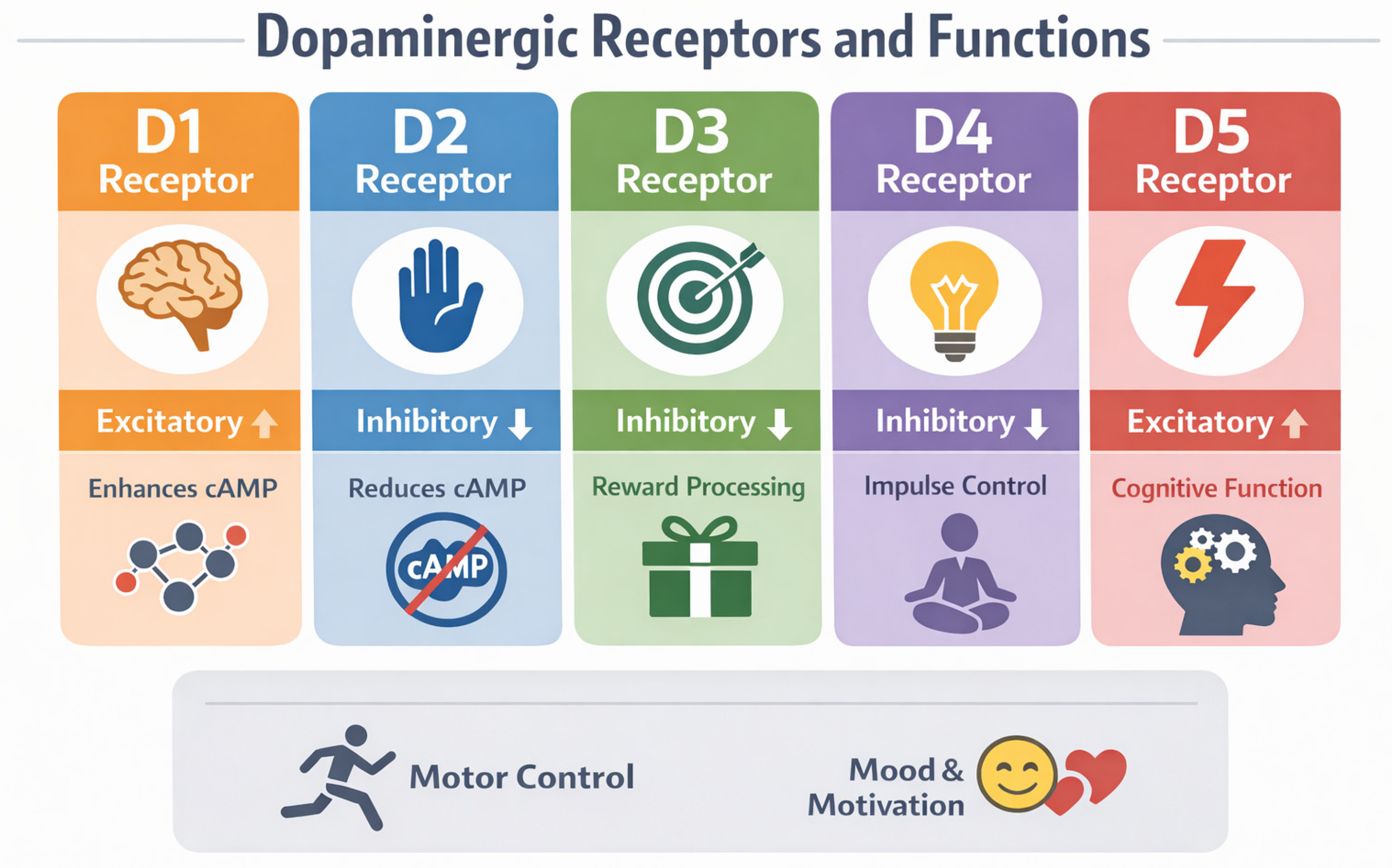
| Receptor | Receptor Group | Neuroanatomical Location of the Receptor | Biological Functions | Biological Effect | Mechanism of Action | Effect on Adenylate Cyclase |
|---|---|---|---|---|---|---|
| DRD1 (D1) | D1 (D1-like) | Cerebral cortex, striatum, hippocampus, olfactory bulb, limbic system | Learning, working memory, executive functions, motivation | Neuron excitation, increased activity | adenylyl cyclase → ↑ cAMP | ↑ cAMP (stimulation) |
| DRD2 (D2) | D2 (D2-like) | Striatum, substantia nigra, thalamus, hypothalamus, cortex | Motor coordination, motivation, sleep, hormonal regulation | Inhibition of neuronal activity, inhibitory effect | Inhibits adenylyl cyclase → ↓ cAMP | ↓ cAMP (inhibition or no effect) |
| DRD3 (D3) | D2 (D2-like) | Limbic system, nucleus accumbent, striatum, hippocampus | Regulation of reward-related behaviour and emotional responses | Inhibition of neuronal activity, inhibitory effect | Inhibits adenylyl cyclase | ↓ cAMP (inhibition or no effect) |
| DRD4 (D4) | D2 (D2-like) | Prefrontal cortex, amygdala, hippocampus, striatum | Attention, impulse control, exploratory behaviour | Inhibition of neuronal activity, inhibitory effect | Inhibits adenylyl cyclase | ↓ cAMP (inhibition or no effect) |
| DRD5 (D5) | D1 (D1-like) | Frontal cortex, hippocampus, and cingulate cortex | Cognitive functions similar to D1 | Neuron excitation, increased activity | Stimulates adenylyl cyclase → ↑ cAMP | ↑ cAMP (stimulation) |
| Gen | Polymorphism | Location (Genomic/ Structural) | Biological Functions | Biological Effect | Research |
|---|---|---|---|---|---|
| DRD1 | rs4532 (A > G) | 5′ UTR/promoter region | A nucleotide change may create short open reading frames that inhibit translation; potential impact on receptor expression. | It may modulate the effects of dopaminergic drugs and executive functions, but there is no clear clinical. evidence. | [49,50,51] |
| DRD2 | rs1800497 (Taq1A, C > T) | Intron of the ANKK1 gene adjacent to DRD2 | The T allele (A1) reduces the density of D2 receptors in the striatum; it affects dopaminergic transmission. | Linked to differences in motivation, impulses and addictions, effect dependent on environmental context. | [34,35,36,52,53,54,55,56,57] |
| DRD2 | rs1076560 (G > T) | Intron (affects splicing) | Allele T reduces the expression of the presynaptic short isoform of the dopamine D2 receptor (D2S), increasing the proportion of postsynaptic long isoform of the dopamine D2 receptor (D2L). | Associated with greater activity in the basal ganglia and prefrontal cortex during cognitive tasks, as well as with a higher risk of psychotic disorders. | [33,37,38,58,59,60] |
| DRD2 | rs6277 (C957T, C > T) | Exon 7 (Synonymous polymorphism) | The T allele reduces mRNA stability but increases the availability of D2/3 receptors in the striatum. | Reduces the risk of schizophrenia in the European population, may affect working memory and learning through reinforcement. | [61,62,63] |
| DRD2 | rs1799732 (-141C Ins/Del) | Promoter (Sp1 binding site) | The deletion reduces promoter activity in luciferase assays; it may alter receptor expression. | Variable effect on body weight and the action of neuroleptic drugs; stronger effect in women | [63,64] |
| DRD3 | rs6280 (Ser9Gly, A > G) | Exon 1 | The Gly allele increases the affinity of the D3 receptor for dopamine and enhances intracellular signalling. | May modulate response to reward and dopaminergic drugs, no clear effect on Schizophrenia. | [35,65,66,67] |
| DRD4 | VNTR 48 bp (2R/4R/7R) | Exon 3 (tandem repeats) | Allele 7R reduces adenylate cyclase inhibition and dopamine sensitivity. | Increased impulsivity, novelty seeking; the effect depends on the environment and upbringing. | [40,43,44] |
| DRD4 | rs1800955 (–521 C > T) | Promoter region (5′) | May affect promoter activity in neurons (no clear results) | Variability in personality traits (extroversion, impulsivity); effect dependent on gender and environment. | [45,46,48] |
| DRD5 | (CA) microsatellite (148 bp) | Approximately 18 kb above the gene | It does not encode a protein but may be coupled with another regulatory variant. | A slight increase in the risk of Attention Deficit Hyperactivity Disorder (ADHD) (OR ≈ 1.24)—mainly in the inattentive and combined subtypes. | [68] |
| Gen | Polymorphism | Location (Genomic/ Structural) | Biological Functions | Biological Effect | Research |
|---|---|---|---|---|---|
| COMT | rs4680 (Val158Met, G > A) | Exon 4; chromosome 22q11.21 | Substitution of valine for methionine (Val→Met) reduces COMT enzyme activity by approximately 35–40%, increasing. dopamine availability in the prefrontal cortex. | The Met allele is associated with better working memory and executive functions, but greater reactivity to stress and emotional disturbances. | [18,20,72,73,74,75,82,83] |
| COMT | rs4633 (C > T) | Exon 3; chromosome 22q11.21 | Synonymous polymorphism, does not change the amino acid, but affects mRNA stability and enzyme expression. | Usually coupled with rs4680; affects cognitive and emotional functions in a similar way to Val158Met. | [72] |
| SLC6A3 | rs28363170 (3′-UTR VNTR, 40 bp, 9R/10R) | Region 3′-UTR; chromosome 5p15.33 | The number of repeats modulates gene expression levels; the 9R allele is associated with lower expression and less DAT, while the 10R allele is associated with higher expression and more efficient dopamine uptake. | This variant is associated with differences in reward sensitivity, impulsivity, and activity of the basal ganglia and prefrontal cortex in motivational tasks; effects depend on population and environmental factors. | [70,76,77,84] |
| SLC6A3 | rs27072 (A > G) | Region 3′ UTR; chromosome 5p15.33 | The variant affects mRNA stability and dopamine transporter expression levels; it may be linked to the 3′-UTR VNTR (rs28363170). | Associated with differences in attention control and impulsivity; moderate effects, often modulated by environmental factors. | [85,86,87] |
| TH | rs10770141 (C > T) | Promoter; chromosome 11p15.5 | Allele T increases promoter activity and TH transcription, increasing dopamine synthesis. | May increase susceptibility to stress and the risk of depression or schizophrenia; effect dependent on environment. | [82,88] |
| TH | rs6356 C-824T | Promoter; chromosome 11p15.5 | The C > T change affects the binding of transcription factors and the mRNA level of the enzyme. | Combined with differences in temperament and cognitive functions in people with mental disorders. | [79,83,88,89,90] |
| Gen | Polymorphism (Variant) | Location | Functional Effect | Population and Research Results | Potential Impact on Characteristics in Esports |
|---|---|---|---|---|---|
| DRD2 | rs1799732 (–141C Ins/Del) | Promoter 5′ | The deletion reduces promoter activity and the number of D2 receptors. | Polish MMA fighters (n = 85) vs. controls (n = 284). The deletion was associated with lower reward dependence and less harm avoidance [106,116] | Lower reward dependence may promote independence and perseverance in stressful situations; the player may continue playing despite the lack of immediate rewards. |
| DRD2 | rs1800498 (Taq1D, C/T) | Intron 1 | It is believed that the T allele reduces the density of D2 receptors. | Polish athletes (n = 159) vs. control group (n = 232). Taq1D (C/T) was associated with higher conscientiousness in athletes [39] | May favour planning, discipline and strategic organization; beneficial for training and in-game strategy. |
| DRD2 | rs1079597 (Tag1B, G/A) | Intron 1 | Allele reduces receptor expression. | Professional athletes (n = 163) vs. controls (n = 232). G/G genotype and G allele were more frequent in athletes; athletes scored higher on extraversion and conscientiousness [117] | Variation may shape extraversion and conscientiousness, affecting social interaction, motivation, and discipline in esports. |
| DRD2 | rs6277 (C957T) | Exon 7 | The T allele reduces mRNA stability and D2 expression. | Skiers and snowboarders (M = 341, F = 258); Caucasian; C allele increases D2 expression while T allele decreases it [118] | Reduced receptor availability may affect reward processing and reaction speed; potential influence on focus and motivation, though unstudied in esports. |
| DRD2/ANKK1 | rs1800497 (Taq1A, A1/A2) | ANKK1 gene (close to DRD2) | Allele A1 reduces the availability of D2 receptors. | Elite athletes (n = 60) vs. (n = 20) control group. Studies indicate the A1 allele is linked to increased impulsivity and risk-taking [119] | May promote risk-taking and reward-seeking behaviours; could be advantageous in high-risk gaming strategies, but evidence in esports is lacking. |
| DRD3 | rs167771 (A/G) | Intron | The A/A genotype is associated with greater agreeableness; G reduces sensation seeking. | Football players carrying A/A genotype showed higher agreeableness compared with carriers of the G allele [110] | Enhanced agreeableness may support teamwork and communication; reduced sensation seeking could lower risk-taking, potentially leading to more conservative play. |
| DRD3 | rs6280 (Ser9Gly) | Exon 1 (amino acid change) | The Gly allele increases receptor affinity. | No direct sports studies; functional assays indicate a higher affinity for dopamine for the Gly variant [114] | Increased receptor sensitivity may heighten reward responsiveness and motivation; implications for gaming performance remain speculative. |
| DRD4 | VNTR (Number of repetitions) | Exon 3 | Long alleles (≥7 repeats) reduce receptor binding and lower cAMP. | Meta-analyses show carriers of the long allele score higher on novelty-seeking traits [47,120,121] | Higher novelty seeking may foster exploration and creative strategies, but could also lead to impulsive risk-taking in esports. |
| DRD5 | VNTR (130–166 bp) | Promoter | The 148 bp allele reduces D5 expression. | The 148 bp allele of the microsatellite near DRD5 has been associated with ADHD, but not directly with receptor levels. Association studies indicate the 148 bp allele is linked to ADHD and decreased attention, but there are no athlete-specific data [122] | Reduced receptor function may diminish dopaminergic signalling and attention; possible impact on focus and reward processing in esports, but the evidence is indirect. |
| COMT | rs4680 (Val158Met, G/A) | Exon 4 | The Met allele reduces COMT activity (↑dopamine) | Combat sports athletes (n = 258) vs. controls (n = 278). Athletes had different genotype frequencies and showed significant interactions between the COMT genotype and personality traits such as novelty seeking, self-management, and self-transcendence [75] | Lower COMT activity (Met allele) elevates dopamine, which may enhance cognitive control, stress resilience, and self-management-traits advantageous for sustained focus and emotion regulation in esports. |
| SLC6A3 (DAT1) | VNTR (9R/10R) | 3′UTR | The direction of the effect may depend on the study. | Polish male combat sports athletes (n = 200) Polish male controls (n = 102); 9/10 VNTR genotype associated with lower levels of anxiety in CS; 10/10 VNTR genotype associated with lower agreeability in CS [123] | 10R allele carriers may exhibit greater aggressiveness and excitability, possibly favouring assertive play; 9R allele carriers may be more sensitive to reward and punishment, influencing risk assessment and emotional responses in competitive gaming. |
Disclaimer/Publisher’s Note: The statements, opinions and data contained in all publications are solely those of the individual author(s) and contributor(s) and not of MDPI and/or the editor(s). MDPI and/or the editor(s) disclaim responsibility for any injury to people or property resulting from any ideas, methods, instructions or products referred to in the content. |
© 2026 by the authors. Licensee MDPI, Basel, Switzerland. This article is an open access article distributed under the terms and conditions of the Creative Commons Attribution (CC BY) license.
Share and Cite
Majchrzak, N.; Humińska-Lisowska, K.; Leońska-Duniec, A. Driven by Dopamine: Genetic Insights into Motivation and Performance in Sports and Esports. Genes 2026, 17, 144. https://doi.org/10.3390/genes17020144
Majchrzak N, Humińska-Lisowska K, Leońska-Duniec A. Driven by Dopamine: Genetic Insights into Motivation and Performance in Sports and Esports. Genes. 2026; 17(2):144. https://doi.org/10.3390/genes17020144
Chicago/Turabian StyleMajchrzak, Natalia, Kinga Humińska-Lisowska, and Agata Leońska-Duniec. 2026. "Driven by Dopamine: Genetic Insights into Motivation and Performance in Sports and Esports" Genes 17, no. 2: 144. https://doi.org/10.3390/genes17020144
APA StyleMajchrzak, N., Humińska-Lisowska, K., & Leońska-Duniec, A. (2026). Driven by Dopamine: Genetic Insights into Motivation and Performance in Sports and Esports. Genes, 17(2), 144. https://doi.org/10.3390/genes17020144