
Abstract
Nitrate () plays a pivotal role in stimulating lateral root (LR) formation and growth in plants. However, the role of in modulating rice LR formation and the signalling pathways involved in this process remain unclear. Phenotypic and genetic analyses of rice were used to explore the role of strigolactones (SLs) and auxin in -modulated LR formation in rice. Compared with ammonium (), stimulated LR initiation due to higher short-term root IAA levels. However, this stimulation vanished after 7 d, and the LR density was reduced, in parallel with the auxin levels. Application of the exogenous auxin α-naphthylacetic acid to -treated rice plants promoted LR initiation to levels similar to those under at 7 d; conversely, the application of the SL analogue GR24 to -treated rice inhibited LR initiation to levels similar to those under supply by reducing the root auxin levels at 10 d. D10 and D14 mutations caused loss of sensitivity of the LR formation response to . The application of and GR24 downregulated the transcription of PIN-FORMED 2 (PIN2), an auxin efflux carrier in roots. LR number and density in pin2 mutant lines were insensitive to treatment. These results indicate that LR formation by affecting the auxin response and transport in rice, with the involvement of SLs.
1. Introduction
Plants have various mechanisms to adapt to nutrient supply conditions, especially plastic root development [1,2,3,4,5,6,7]. Lateral roots (LRs) are generally more sensitive to nutrient conditions than that are primary/adventitious roots in plants [8,9]. The LRs develop from founder cells in the pericycle, the outermost layer of the vascular cylinder (stele) of the roots [10].
Nitrogen (N) is an essential macronutrient for plant growth and crop productivity. Changes in N supplied in the nutrient medium induce plasticity in LR initiation and elongation [5,11,12,13,14]. A striking example of plasticity in LR development is seen in the response of Arabidopsis to localised treatment via the stimulation of LR elongation. Studies of an Arabidopsis nitrate reductase double mutant suggested that the local stimulation of LR elongation is a consequence of the ion acting as a signal rather than a nutrient. Nitrate transporters, transcription factors, and micro-RNAs are involved in -modulated LR growth and development [14,15,16,17,18,19]. LR growth is regulated by both environmental conditions and intrinsic developmental regulators, such as plant hormones [20]. Auxin plays a dominant role in the specification of founder cells that give rise to LR initiation and the later stages of LR development and is involved in -modulated LR growth [10,13,14,20,21]. Localised supply does not stimulate LR elongation in axr4, an auxin-insensitive mutant, which suggests that regulates LR growth via auxin signalling pathways [21]. NRT1.1 is a key component of -sensing system that enables the plant to detect and exploit [22]. The and auxin signalling pathways are also linked by their effect on auxin transport via AtNRT1.1 (CHL1/NPF6.3) [23]. Local high levels of promoted Arabidopsis LR development as a result of auxin accumulation in the LR primordia and tip [24]. However, inconsistent results have been reported in maize [25], although localised -induced LR elongation has been observed, -fed compartments have lower auxin levels compared with -free compartments, and localised supply inhibits auxin transport from shoot to root. A positive effect of low on Arabidopsis LR formation required more auxin accumulation in LR primordia [20], consistent with the result in maize [26]; however, LR formation in rice was inhibited by low , which was closely linked to lower auxin contents. The role of auxin in -regulated LR growth remains unclear.
Strigolactones (SLs) are phytohormones involved in the growth and formation of LR in several plant species [27,28,29,30]. Compared with the wild-type (WT), Arabidopsis with mutations associated with SL synthesis and signalling had higher LR densities [27]. However, there was no difference in LR density between WT and d mutants in rice [30]. Application of GR24 decreased the LR density in both Arabidopsis and rice [27,30]. SLs are also involved in -regulated root elongation by modulating PIN1b gene expression [7]. Therefore, the mechanisms by which SLs regulate LR growth in response to supply are more complex and require further investigation.
Studies of LR growth in response to have focused on the upland model plant Arabidopsis, and research in other plants, especially crop plants, is needed. Rice (Oryza sativa L.) is a major staple food globally, and the main source of N for rice in paddy soil [31]. Interestingly, it has been predicted that 40% of the N acquired by rice roots is due to nitrification occurring at the root surface, even in flooded conditions [32,33]. Increasing numbers of Chinese farmers are practicing intermittent flooding during rice cultivation, which increases within the soil horizon. Although plays a pivotal role in regulating root architecture by stimulating the initiation and elongation of LRs, the role of in modulating LR growth in rice and the signalling pathways involved in this process remain unclear. Therefore, to evaluate the mechanisms of -modulated LR formation in rice, we compared the time course of LR formation, auxin content, and DR5::GUS activity of rice in response to and .
2. Results
2.1. Nitrate Regulated LR Formation in Rice
Compared with conditions, the number of LRs in the seminal root increased under treatment within 7 d (Figure 1A,B). However, the LR number was lower under than treatment after 10 d (Figure 1B). There was no difference in LR density between and conditions before 7 d. Surprisingly, LR density was lower under than treatment after 8 d (Figure 1C,D). These results suggest that supply stimulates LR formation for a short period (within 7 d), but this stimulatory effect disappears after 7 d.
Figure 1.
The lateral root (LR) density and LR number in wild-type (WT) plants. Seedlings were grown in a hydroponic media containing and for 14 d. (A) LR formation at 3rd and 4th d; (B) LR number over time; (C) The lateral root morphology in seminal root of the rice plants at 10 d; (D) LR density over time. Data are means ± SE, and bars with different letters indicate significant difference at p < 0.05 tested with ANOVA. d = days.
2.2. Auxin Is Involved in -Modulated LR Formation
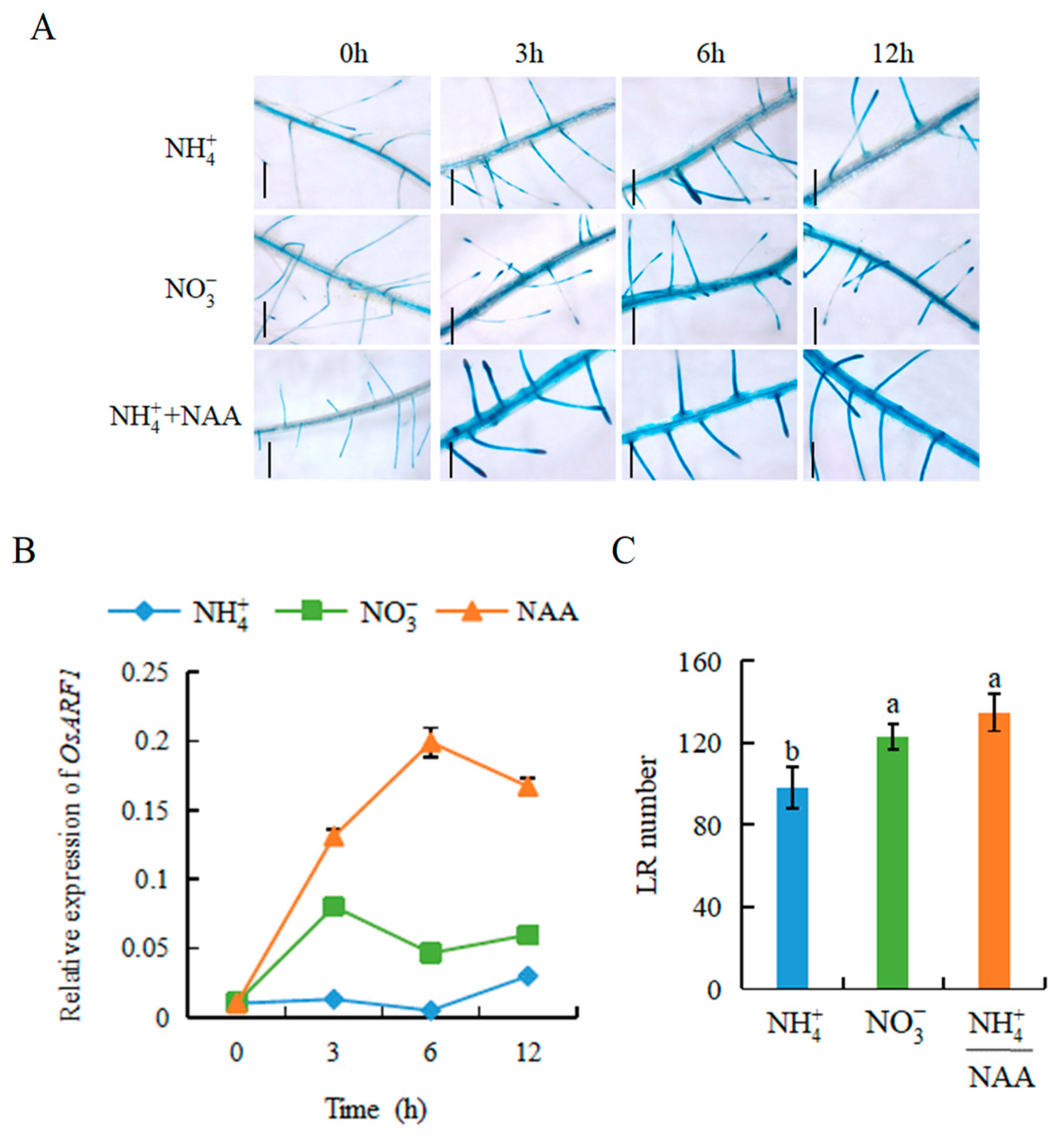
Abundant evidence suggests that auxin has a close relationship with LR development [3,10,13,21]. To understand temporal changes in auxin-responsive genes to , DR5::GUS and the expression of AUXIN RESPONSE FACTOR 1 (ARF1) in roots under , and plus α-naphthylacetic acid (NAA) treatments were analysed from 0 to 12 h (Figure 2). The expression of DR5::GUS in roots was induced by and plus NAA over the entire experiment compared with nutrition (Figure 2A). Compared with , the expression of OsARF1 was upregulated by both and plus NAA (Figure 2B).
Figure 2.
Histochemical localization of DR5::GUS and qRT-PCR analysis of ARF1 gene, lateral root (LR) number in rice plants. Rice seedlings were grown in hydroponic media containing , , and +NAA treatments. Bar = 1 mm. (A) DR5::GUS in LR region; (B) Relative expression of ARF1 over time; (C) LR number. Data are means ± SE, and bars with different letters indicate significant difference between treatments at p < 0.05. h = hours.
To assess the roles of auxin in -induced LR formation in rice, we examined the LR number in response to exogenous application of NAA under at 7 d. Application of plus NAA significantly increased the LR number at 7 d, to the same level as that under conditions (Figure 2C).
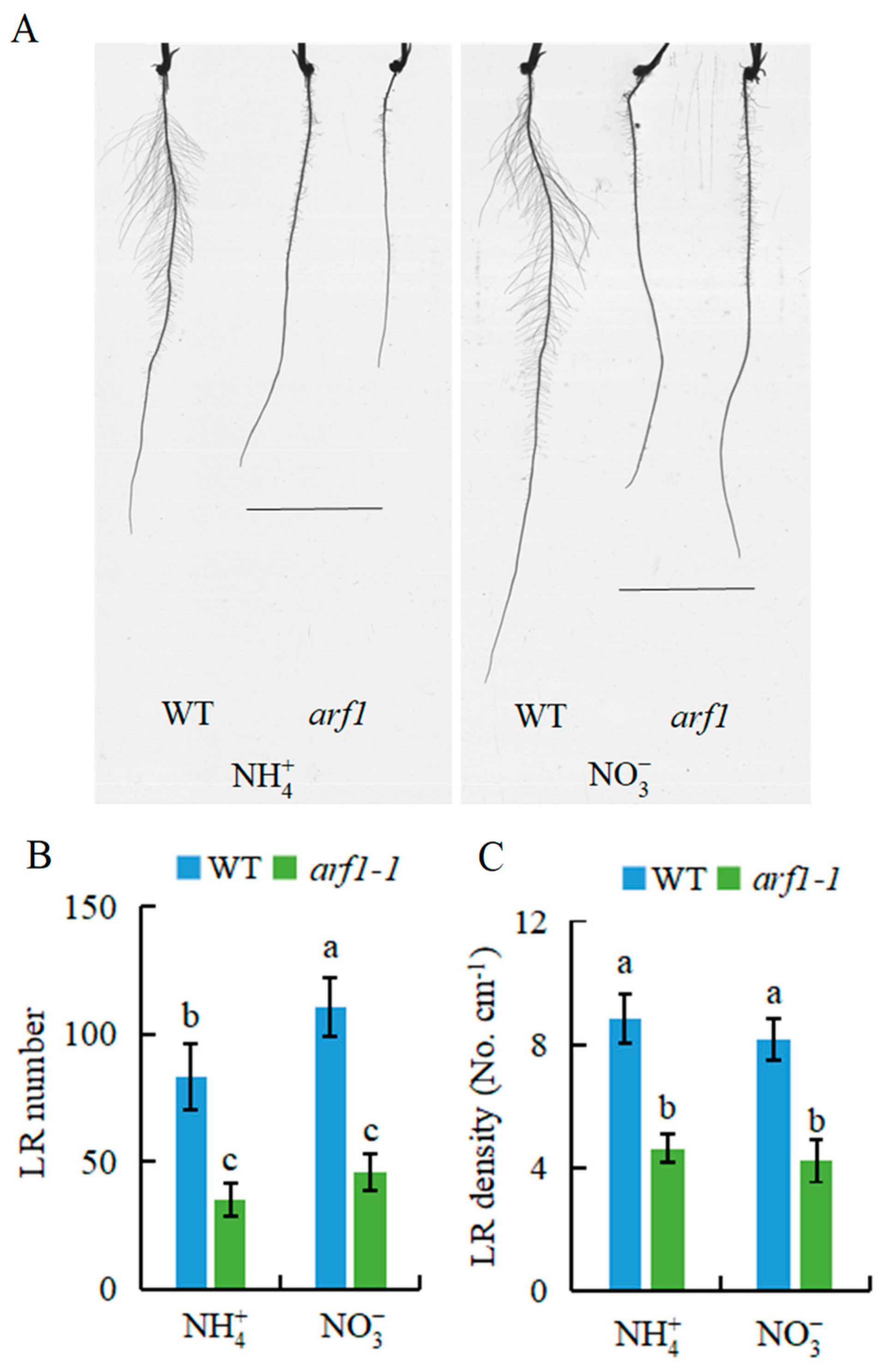
To determine whether ARF1 is involved in -promoted rice LR formation in the short term, we used arf1 mutant. The T-DNA insertion mutant of arf1 is shown in Supplementary Figure S1. Compared with WT plants (DJ), LR number and density were decreased in the arf1 mutant under both and conditions (Figure 3), indicating that ARF1 is involved in -induced LR formation in rice.
Figure 3.
The lateral root (LR) number and LR density in arf1 mutant plants. Seedlings were grown in a hydroponic media containing and conditions for 7 d. (A) The lateral root morphology in seminal root of the rice plants. (B) LR number; (C) LR density. Data are means ± SE, and bars with different letters indicate significant difference between treatments at p < 0.05. d = days.
2.3. SLs Are Also Involved in -Modulated LR Formation
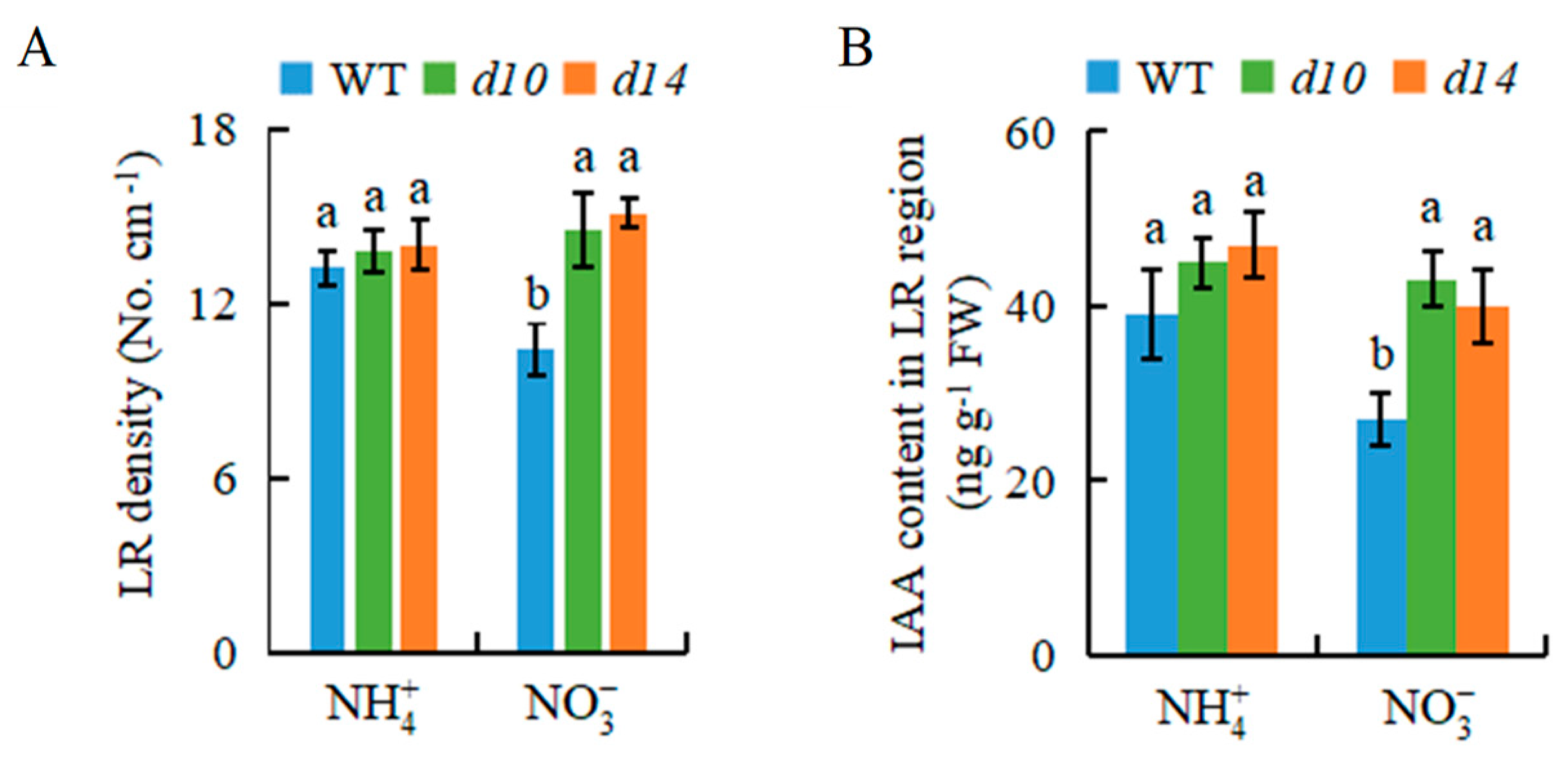
Compared with WT plants, the root morphology of d10 (SL biosynthesis mutant) and d14 (SL-responsive mutant) plants, including LR density, was less responsive to (Figure 4A,B). For example, the LR density under the two treatments was similar between d mutants and -treated WT plants at 10 d. Interestingly, the LR density of d mutants was less responsive to supply, ultimately resulting in a greater LR density, compared with WT plants regardless of the treatment at 10 d (Figure 4A). These results suggest that SLs are involved in -modulated LR formation in rice.
Figure 4.
IAA content and LR density in wild-type (WT), d10 (SL biosynthesis mutant), and d14 (SL-responsive mutant) plants. Rice seedlings were grown in hydroponic media containing and for 10 d. (A) LR density; (B) IAA content in LR region. Data are means ± SE, and bars with different letters indicate significant difference between treatments at p < 0.05. d = days.
Based on the LR density of d mutants in response to we speculated that the IAA content is higher in the roots of d mutants at 10 d (Figure 4B). Compared with , treatment reduced the IAA levels in the roots of WT plants. IAA levels were similar between WT and d mutants under conditions, but were higher in d mutants than WT plants under conditions (Figure 4B). We examined whether exogenous application of the SL analogue GR24 affects the IAA levels and LR formation (Figure 5). The application of GR24 in -treated rice reduced DR5::GUS expression and IAA levels in roots (Figure 5A,B), and inhibited LR formation to levels similar to those under at 10 d (Figure 5C). Conversely, treatment with NAA plus significantly increased the LR density to the same level as that under at 10 d (Figure 5D). These results indicate that inhibited LR formation, probably by decreasing auxin levels in roots in the long term, and SLs may be involved in this process.
Figure 5.
Histochemical localization of DR5::GUS, IAA content, and LR density in rice plants. Rice seedlings were grown in hydroponic media containing , , and +GR24 for 10 d. (A) DR5::GUS in LR region; (B) IAA content in LR region; (C,D) LR density. (A) Bar = 1 mm. Data are means ± SE, and bars with different letters indicate significant difference between treatments at p < 0.05. d = days.
2.4. OsPIN2 Is Involved in -Modulated Auxin Levels and LR Formation in Rice
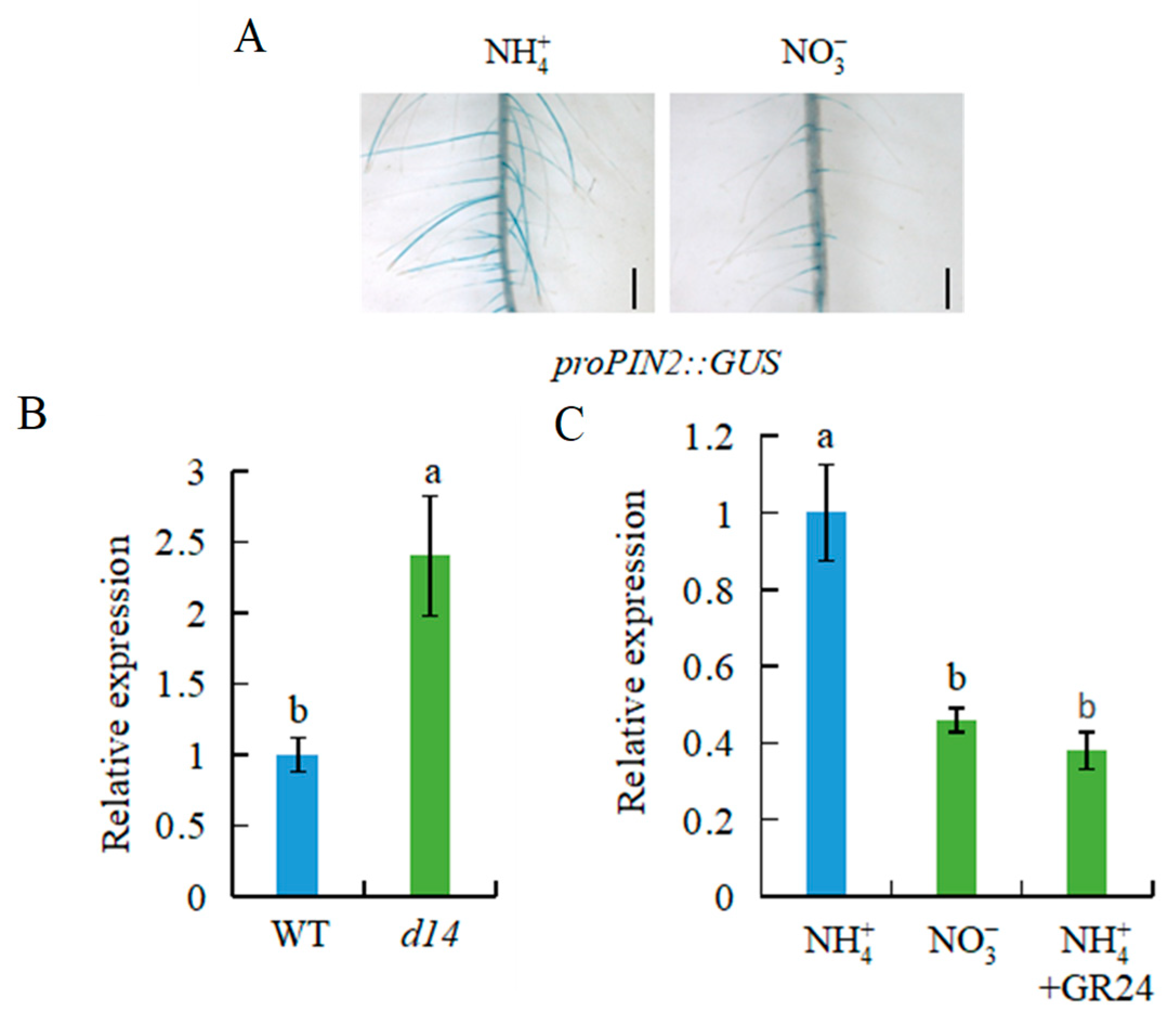
A previous study showed that SLs regulate LR formation by inhibiting auxin transport, with involvement of PIN proteins [30]. In this study, compared with , treatment downregulated the expression of PIN2 and proPIN2::GUS at 10 d (Figure 6A,C). PIN2 expression in roots was significantly higher in the d14 mutant than WT plants under both treatments (Figure 6B). PIN2 expression was downregulated by plus GR24 compared with treatment at 10 d (Figure 6C). These results suggest that SLs participate in the -induced inhibition of PIN2 transcription gene in rice.
Figure 6.
Histochemical localization of proPIN2::GUS and OsPIN2 expression in rice plants. Rice seedlings were grown in hydroponic media containing , , and + GR24 for 10 d. (A) Localization of proPIN2::GUS; Bar = 0.5 mm. (B) OsPIN2 expression in WT and d14 mutant under and ; (C) OsPIN2 expression in WT under , , and +GR24 conditions. Data are means ± SE, and bars with different letters indicate significant difference between treatments at p < 0.05.
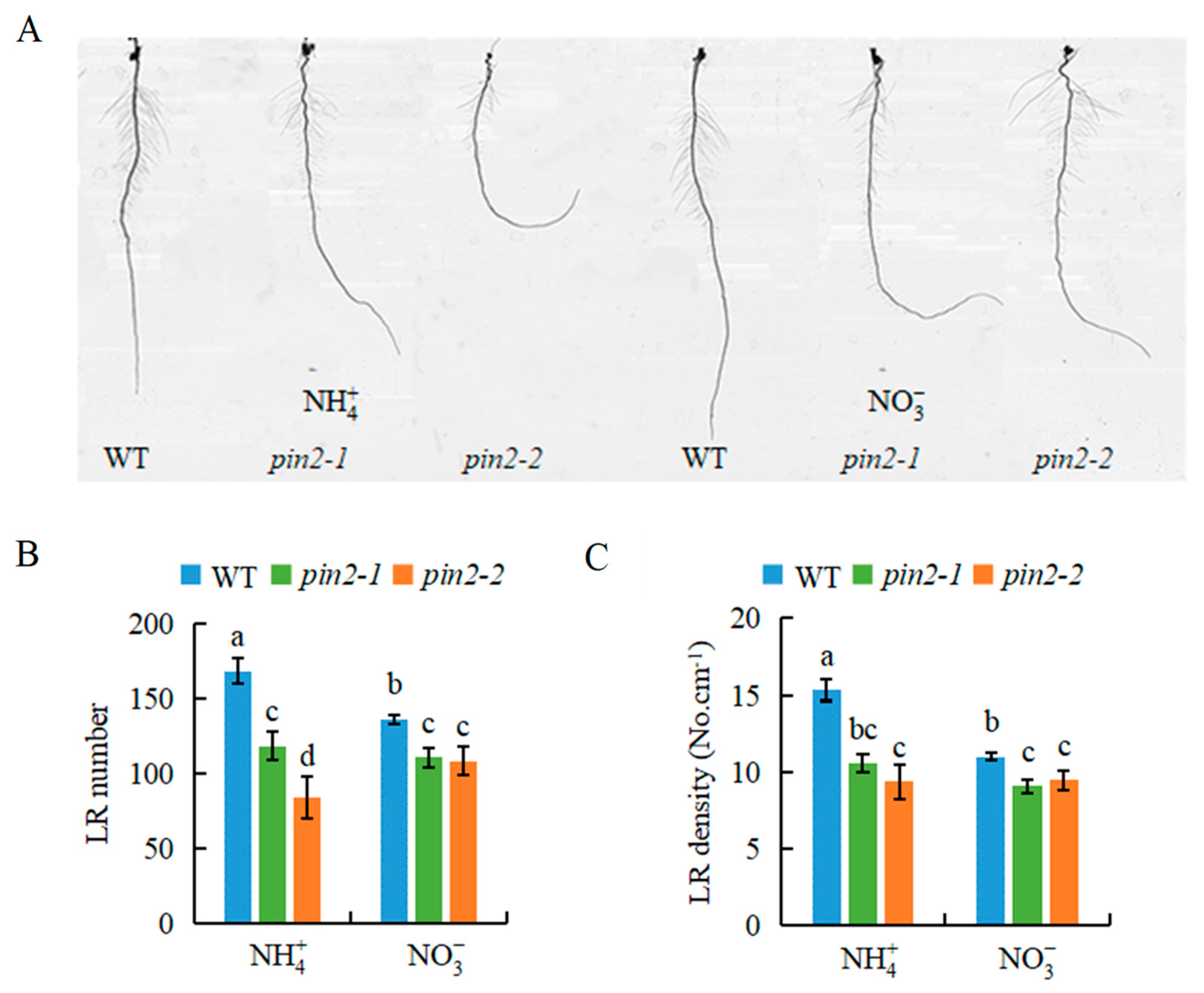
To determine the functions of PIN2 in -modulated LR formation, we assessed the LR number and density in pin2 mutants in response to at 10 d (Supplementary Figure S2; Figure 7). Compared with WT plants, the two pin2 mutant lines exhibited less responsiveness of the LR number and density to and fewer and less dense LRs under the two treatments at 10 d (Figure 7B,C). This implies that OsPIN2 is also involved in rice LR formation modulated by application long-term.
Figure 7.
The lateral root (LR) number and LR density in pin2 mutant plants. Seedlings were grown in a hydroponic media containing and for 10 d. (A) The lateral root morphology in seminal root of the rice plants. (B) LR number; (C) LR density. Data are means ± SE, and bars with different letters indicate significant difference between treatments at p < 0.05. d = days.
3. Discussion
Nitrogen is a major plant nutrient, and crops strongly depend on fertilization programs, affecting environmental quality. The identification of crop cultivars with more efficient nutrient acquisition continues to be a priority for plant scientists [34,35]. LRs are crucial for the detection and uptake of N in plants [24,36]. Nitrate triggers several molecular and physiological events, including LR growth, leading to the overall response of the plant to its availability [11,12,37]. Several molecular components of -regulated LR growth have been identified, mostly in the model plant Arabidopsis thaliana. However, the role of in modulating LR formation and growth in rice and the signalling pathways involved in this process remain unclear. In this study, we found that -induced LR growth depends on the auxin response and transport in roots, with the involvement of SLs.
Studies of an Arabidopsis nitrate reductase double mutant suggested that the local stimulation of LR elongation was a consequence of the ion acting as a signal, rather than a nutrient. The AtANR1 and AtNRT1.1 genes, which encode a transcription factor and a dual transporter, respectively, were proposed to consecutively regulate the stimulatory effect of on LR elongation [11,21,23]. In rice, LR formation was less sensitive to localised supply in osnar2.1 mutants than WT plants, suggesting that OsNAR2.1 is involved in a signalling pathway that modulates LR formation [15]. Here, we also found that induced LR formation, probably via its signalling pathway. As shown in Figure 1, may induce LR formation by triggering systemic signals that influence LR growth compared with .
Localised supply did not stimulate LR elongation in the auxin-insensitive mutant, which suggests that regulates LR growth via auxin signalling pathways [21]. To illustrate the mechanism of the nitrate-specific effects on rice LR formation within 7 d, the expression of ARF1 (auxin-responsive gene) and DR5::GUS was evaluated in response to two N forms (Figure 2). After 3 h of treatment, ARF1 expression in rice roots was higher under than under , which coincided with the higher DR5::GUS expression in the LR zone under treatment. enhanced ARF1 expression within hours, suggesting that auxin triggers a systemic signal to participate in -induced LR formation in rice. Exogenous application of NAA under supply restored the LR number to a level similar to that under supply within 7 d (Figure 2), and the LR number and density were lower in the arf1 mutant relative to WT plants at 7 d (Figure 3B,C), which further demonstrates that auxin participates in specific -induced LR formation.
SLs have been suggested to modulate auxin transport in the regulation of root growth [27,30]. In Arabidopsis, SLs modulated local auxin levels, and the net result of the SL action depended on the auxin status of the plant [27]. In rice, GR24 application markedly reduced auxin transport to levels equivalent to those under N-deficient conditions, which in turn reduced the LR density [30]. A previous study showed that application enhanced SL signalling from 7 d in rice [7]. The SL levels in root exudates are regulated by N stress [30]. In this study (Figure 5), application of GR24 to rice plants under treatment inhibited LR initiation to the same levels as those under treatment by reducing IAA levels in roots at 10 d. Conversely, compared with conditions, NAA treatment of -treated rice prevented the downtrend in LR initiation to the same levels as those in -treated rice plants at 10 d (Figure 5). This indicated that the supply increased SL production after 7 d and inhibited LR formation by decreasing auxin levels in the LR region, consistent with the previous report [7,30]. This suggests that SLs are involved in -inhibited LR formation by reducing auxin transport in roots in the long term.
The influence of SLs on auxin transport is mediated by PIN expression [3,7,27,30]. For example, SLs increased the rate of PIN1 removal from the plasma membrane and altered the polarization of PIN2 in the plasma membrane in Arabidopsis [38]. Similarly, relative PIN expression in rice roots was significantly decreased under LN conditions, after GR24 application [30]. SLs participated in -induced rice root elongation by modulating PIN1b transcription [7]. In this study, PIN2 expression was inhibited by treatment long-term (Figure 6A,C), suggesting that PIN2 is involved in -modulated auxin polar transport to play an important role in LR development. Compared with treatment, PIN2 expression was downregulated under or plus GR24 treatment at 10 d (Figure 6). Furthermore, the expression of PIN2 was significantly upregulated in the d14 mutant compared with the WT (Figure 6B). These results suggest that inhibits auxin transport by regulating PIN2 expression in roots, with the involvement of SLs. Compared with WT plants, mutations in D genes that eliminate the inhibition of SLs on auxin transport led to higher auxin levels in the LR region and no response of LR formation to relative to (Figure 4). The lower LR number and density were recorded in the pin2 mutants relative to WT plants under both and supplies (Figure 7). These results further demonstrate that the effect of LR formation regulated by depends on auxin response and transport in roots.
4. Materials and Methods
4.1. Plant Materials
The d10 (SL biosynthesis mutant) and d14 (SL-responsive mutant) were Shiokari ecotype [30], arf1 mutant was Dongjin (DJ) ecotype, and CRISPR-edited PIN2 knockout mutant lines (pin2) were Nipponbare ecotype. The arf1 was obtained from Kyung Hee University, Korea (Supplementary Figure S1).
4.2. Plant Growth
Plants were grown in a greenhouse under natural light at day/night temperatures of 30 °C/18 °C. Germinated seeds of uniform size were transplanted into holes in a PCR tube rack for 14 d. PCR tubes receiving nitrogen treatments were filled with 1.25 (NH4)2SO4 and/or Ca(NO3)2. Other chemical compositions of International Rice Research Institute (IRRI) nutrient solution were (mM): 1.25 (NH4)2SO4 and/or Ca(NO3)2, 0.3 KH2PO4, 0.35 K2SO4, 1.0 CaCl2, 1.0 MgSO4·7H2O, 0.5 Na2SiO3; and (µM) 9.0 MnCl2, 0.39 (NH4)6Mo7O24, 20.0 H3BO3, 0.77 ZnSO4, and 0.32 CuSO4 (pH 5.5) as previously described [30].
The treatments applied were as follows: 10 nM 1-naphthylacetic acid (NAA), 2.5 µM GR24 (an SL analogue) [30,39].
4.3. Root System Architecture
The fibrous root system of rice includes seminal root, adventitious roots, and lateral root (LR) grown from seminal and adventitious roots. The preliminary experiments suggested that the response of LRs on seminal root to two N forms was similar to that on adventitious roots. Therefore, the numbers of LRs on SRs were chosen to evaluate the effects of and on LR growth. LRs were enumerated visually. The LR density was calculated as LR number divided by the length of the SR.
4.4. Determination of IAA Content
The plant tissues were ground with quartz sand and butylated hydroxytoluene (BHT) in liquid N2 and lixiviated in 80% methanol (20 mL) for 12 h. The extracted fluid was collected and concentrated by a rotary evaporator to 10 mL at 40 mL, and then the concentrated fluid was extracted with petroleum ether of the same volume. Underlayer liquid was adjusted to pH 8.5 and added 0.2 g polyvinylpyrrolidone (PVP) then vibrated for 30 min, and then filtered through a 0.45 μm filter. The cartridge was initially washed with 0.1 M acetic acid, eluted with 4 mL of a mixture of 25% (v/v) methanol and 0.1 M acetic acid, and eventually with 70% (v/v) methanol only. After vacuum evaporation, the purified samples were metered volume to 1 mL with mobile phase and then loaded on a reverse-phase HPLC column. Standard auxin samples were from Sigma-Aldrich (St. Louis, MO, USA), and chromatographic conditions were described as: Waters 600–2487; Hibar column RT 250 mm × 4.6 mm; Purospher STAR RP-18 (5 μm); column temperature 45 °C; fluid phase: methanol: 1% acetic acid (v/v, 40/60), isocratic elution; fluid rate: 0.6 mL min−1; UV detector, l = 269 nm; injection volume 20 μL. A 0.22 μm filter was used for filtration of both the buffer and the samples before HPLC analysis as previously described [40].
To assess auxin distribution, rice plants were transformed with the pDR5::GUS constructs using Agrobacterium tumefaciens (strain EHA105). DR5::GUS, a specific reporter that contains seven repeats of a highly active synthetic auxin-response element and can reflect the in vivo auxin level [41]. The roots were subjected to GUS staining. Stained plant tissues were photographed using a stereomicroscope (Stemi 508; Zeiss, Gottingen, Germany) equipped with a colour CCD camera. All experiments included eight replicates.
4.5. qRT-PCR Analysis
Total RNA was isolated from the roots of rice plants under or supply. The RNA extraction, reverse transcription, and quantitative reverse transcription-polymerase chain reaction (qRT-PCR) methods were as previously described [42]. All experiments were with three replicates. The primer sets for ARF1 and PIN2 are listed in Supplemental Table S1.
4.6. Data Analysis
Data were pooled to calculate means and standard errors (SEs) and subjected to one-way analysis of variance (ANOVA), followed by a Ryan–Einot–Gabriel–Welch F-test at p < 0.05 to determine the statistical significance of differences between treatments. All statistical evaluations were conducted using SPSS (version 11.0) statistical software (SPSS Inc., Chicago, IL, USA). All experiments included three independent biological replicates.
5. Conclusions
stimulated LR formation within 7 d, but the stimulatory effect disappeared after 7 d, in parallel with the auxin response and transport in roots. ARF1 was involved in the short-term -induced LR formation. SL production was increased under treatment. The application of SLs and inhibited PIN2 transcription. PIN2 mutation inhibited the sensitivity of the response of LR formation to application. These results demonstrate that modulated LR formation by affecting the auxin response and transport in rice roots, with SL involvement in the long term.
Supplementary Materials
The following are available online at https://www.mdpi.com/article/10.3390/genes12060850/s1, Supplementary Table S1. The primers for qRT-PCR of ARF1 and PIN2 genes. Supplementary Figure S1. Identification of T-DNA insertion arf1 mutant. Supplementary Figure S2. Sequencing verification of CRISPR-edited PIN2 knockout mutants.
Author Contributions
B.W. and X.G. performed experiments; X.Z., X.Q., and F.F. assisted the experiment; Q.Z. and Y.Z. analysed data; D.H. and H.S. designed the experiment and wrote the paper. All authors have read and agreed to the published version of the manuscript.
Funding
This work was funded by the National Nature Science Foundation of China (Grant No. 31601821, 31972501, and 31971846), Modern Agricultural Industry Technology System Projects of Henan Province (S2012-04-G02), and Innovation Scientists and Technicians Troop Construction Projects of Henan Province (94200510003).
Institutional Review Board Statement
Not applicable.
Informed Consent Statement
Informed consent was obtained from all subjects involved in the study.
Data Availability Statement
Not applicable.
Conflicts of Interest
The authors declare no conflict of interest.
References
- Patterson, K.; Walters, L.A.; Cooper, A.M.; Olvera, J.G.; Rosas, M.A.; Rasmusson, A.G.; Escobar, M.A. Nitrate-regulated glutaredoxins control Arabidopsis primary root growth. Plant Physiol. 2016, 170, 989–999. [Google Scholar] [CrossRef]
- Shahzad, Z.; Amtmann, A. Food for thought: How nutrients regulate root system architecture. Curr. Opin. Plant Biol. 2017, 39, 80–87. [Google Scholar] [CrossRef]
- Sun, H.; Feng, F.; Liu, J.; Zhao, Q. Nitric oxide affect rice root growth by regulating auxin transport under nitrate supply. Front. Plant Sci. 2018, 9, 659. [Google Scholar] [CrossRef]
- Huang, S.; Liang, Z.; Chen, S.; Sun, H.; Fan, X.; Wang, C.; Xu, G.; Zhang, Y. A transcription factor, OsMADS57, regulates long-distance nitrate transport and root elongation. Plant Physiol. 2019, 180, 882–895. [Google Scholar] [CrossRef]
- Song, M.; Fan, X.; Chen, J.; Qu, H.; Luo, L.; Xu, G. OsNAR2.1 interaction with OsNIT1 and OsNIT2 functions in root-growth responses to nitrate and ammonium. Plant Physiol. 2020, 183, 289–303. [Google Scholar] [CrossRef]
- Jia, L.; Xie, Y.; Wang, Z.; Luo, L.; Zhang, C.; Pélissier, P.; Parizot, B.; Qi, W.; Zhang, J.; Hu, Z.; et al. Rice plants respond to ammonium-stress by adopting a helical root growth pattern. Plant J. 2020, 104, 1023–1037. [Google Scholar] [CrossRef] [PubMed]
- Sun, H.; Guo, X.; Qi, X.; Feng, F.; Xie, X.; Zhang, Y.; Zhao, Q. SPL14/17 act downstream of strigolactone signalling to modulate root elongation in response to nitrate supply in rice. Plant J. 2021. [Google Scholar] [CrossRef] [PubMed]
- Gruber, B.D.; Giehl, R.F.H.; Friedel, S.; Von Wirén, N. Plasticity of the Arabidopsis root system under nutrient deficiencies. Plant Physiol. 2013, 163, 161–179. [Google Scholar] [CrossRef] [PubMed]
- Tian, H.; De Smet, I.; Ding, Z. Shaping a root system: Regulating lateral versus primary root growth. Trends Plant Sci. 2014, 19, 426–431. [Google Scholar] [CrossRef] [PubMed]
- De Smet, I.; Vanneste, S.; Inzé, D.; Beeckman, T. Lateral root initiation or the birth of a new meristem. Plant Mol. Biol. 2006, 60, 871–887. [Google Scholar] [CrossRef]
- Zhang, H.; Forde, B. An Arabidopsis MADS box gene that controls nutrient-induced changes in root architecture. Science 1998, 279, 407–409. [Google Scholar] [CrossRef]
- Guo, F.; Crawford, N. Arabidopsis nitric oxide synthase1 is targeted to mitochondria and protects against oxidative damage and dark-induced senescence. Plant Cell 2005, 17, 3436–3450. [Google Scholar] [CrossRef]
- Song, W.; Sun, H.; Li, J.; Gong, X.; Huang, S.; Zhu, X.; Zhang, Y.; Xu, G. Auxin distribution is differentially affected by nitrate in roots of two rice cultivars differing in responsiveness to nitrogen. Ann. Bot. 2013, 112, 1383–1393. [Google Scholar] [CrossRef]
- Huang, S.; Chen, S.; Liang, Z.; Zhang, C.; Yan, M.; Chen, J.; Xu, G.; Fan, X.; Zhang, Y. Knockdown of the partner protein OsNAR2.1 for high-affinity nitrate transport represses lateral root formation in a nitrate-dependent manner. Sci. Rep. 2015, 5, 18192. [Google Scholar] [CrossRef]
- Zhao, Y.; Xu, Z.; Mo, Q.; Zou, C.; Li, W.; Xu, Y.; Xie, C. Combined small RNA and degradome sequencing reveals novel miRNAs and their targets in response to low nitrate availability in maize. Ann. Bot. 2013, 112, 633–642. [Google Scholar] [CrossRef]
- Alvarez, J.; Riveras, E.; Vidal, E.; Gras, D.; Contreras-López, O.; Tamayo, K.; Aceituno, F.; Gómez, I.; Ruffel, S.; Lejay, L.; et al. Systems approach identifies TGA1 and TGA4 transcription factors as important regulatory components of the nitrate response of Arabidopsis thaliana roots. Plant J. 2014, 80, 1–13. [Google Scholar] [CrossRef] [PubMed]
- Yan, Y.; Wang, H.; Hamera, S.; Chen, X.; Fang, R. miR444a has multiple functions in rice nitrate-signaling pathway. Plant J. 2014, 78, 44–55. [Google Scholar] [CrossRef]
- Yu, C.; Su, S.; Xu, Y.; Zhao, Y.; Yan, A.; Huang, L.; Ali, I.; Gan, Y. The effects of fluctuations in the nutrient supply on the expression of five members of the AGL17 clade of MADS-box genes in rice. PLoS ONE 2014, 9, e105597. [Google Scholar] [CrossRef] [PubMed]
- Wei, J.; Zheng, Y.; Feng, H.; Qu, H.; Fan, X.; Yamaji, N.; Ma, J.F.; Xu, G. OsNRT2.4 encodes a dual-affinity nitrate transporter and functions in nitrate-regulated root growth and nitrate distribution in rice. J. Exp. Bot. 2018, 69, 1095–1107. [Google Scholar] [CrossRef]
- Ma, W.; Li, J.; Qu, B.; He, X.; Zhao, X.; Li, B.; Fu, X.; Tong, Y. Auxin biosynthetic gene TAR2 is involved in low nitrogen-mediated reprogramming of root architecture in Arabidopsis. Plant J. 2014, 78, 70–79. [Google Scholar] [CrossRef] [PubMed]
- Zhang, H.; Jennings, A.; Barlow, P.W.; Forde, B.G. Dual pathways for regulation of root branching by nitrate. Proc. Natl. Acad. Sci. USA 1999, 96, 6529–6534. [Google Scholar] [CrossRef]
- Krouk, G.; Lacombe, B.; Bielach, A.; Perrine-Walker, F.; Malinska, K.; Mounier, E.; Hoyerova, K.; Tillard, P.; Leon, S.; Ljung, K.; et al. Nitrate-regulated auxin transport by NRT1.1 defines a mechanism for nutrient sensing in plants. Dev. Cell. 2010, 18, 927–937. [Google Scholar] [CrossRef]
- Remans, T.; Nacry, P.; Pervent, M.; Filleur, S.; Diatloff, E.; Mounier, E.; Tillard, P.; Forde, B.G.; Gojon, A. The Arabidopsis NRT1.1 transporter participates in the signaling pathway triggering root colonization of nitrate-rich patches. Proc. Natl. Acad. Sci. USA 2006, 103, 19206–19211. [Google Scholar] [CrossRef]
- Mounier, E.; Pervent, M.; Ljung, K.; Gojon, A.; Nacry, P. Auxin-mediated nitrate signalling by NRT1.1 participates in the adaptive response of Arabidopsis root architecture to the spatial heterogeneity of nitrate availability. Plant Cell Environ. 2014, 37, 162–174. [Google Scholar] [CrossRef] [PubMed]
- Liu, J.; An, X.; Cheng, L.; Chen, F.; Bao, J.; Yuan, L.; Zhang, F.; Mi, G. Auxin transport in maize roots in response to localized nitrate supply. Ann. Bot. 2010, 106, 1019–1026. [Google Scholar] [CrossRef] [PubMed]
- Tian, Q.; Chen, F.; Liu, J.; Zhang, F.; Mi, G. Inhibition of maize root growth by high nitrate supply is correlated with reduced IAA levels in roots. J. Plant Physiol. 2008, 165, 942–951. [Google Scholar] [CrossRef]
- Ruyter-Spira, C.; Kohlen, W.; Charnikhova, T.; van Zeijl, A.; van Bezouwen, L.; de Ruijter, N.; Cardoso, C.; Lopez-Raez, J.A.; Matusova, R.; Bours, R.; et al. Physiological effects of the synthetic strigolactone analog GR24 on root system architecture in Arabidopsis: Another belowground role for strigolactones? Plant Physiol. 2011, 155, 721–734. [Google Scholar] [CrossRef] [PubMed]
- Kapulnik, Y.; Delaux, P.-M.; Resnick, N.; Mayzlish-Gati, E.; Wininger, S.; Bhattacharya, C.; Séjalon-Delmas, N.; Combier, J.-P.; Bécard, G.; Belausov, E.; et al. Strigolactones affect lateral root formation and root-hair elongation in Arabidopsis. Planta 2011, 233, 209–216. [Google Scholar] [CrossRef] [PubMed]
- Mayzlish-Gati, E.; De-Cuyper, C.; Goormachtig, S.; Beeckman, T.; Vuylsteke, M.; Brewer, P.B.; Beveridge, C.A.; Yermiyahu, U.; Kaplan, Y.; Enzer, Y.; et al. Strigolactones are involved in root response to low phosphate conditions in Arabidopsis. Plant Physiol. 2012, 160, 1329–1341. [Google Scholar] [CrossRef] [PubMed]
- Sun, H.; Tao, J.; Liu, S.; Huang, S.; Chen, S.; Xie, X.; Yoneyama, K.; Zhang, Y.; Xu, G. Strigolactones are involved in phosphate and nitrate deficiency-induced root development and auxin transport in rice. J. Exp. Bot. 2014, 65, 6735–6746. [Google Scholar] [CrossRef] [PubMed]
- Wang, M.; Siddeqi, M.; Ruth, T.; Glass, A. Ammonium uptake by rice roots. I. Kinetics of 13NH4+ influx across the plasmalemma. Plant Physiol. 1993, 103, 1259–1267. [Google Scholar] [CrossRef] [PubMed]
- Kronzucker, H.J.; Glass, A.D.M.; Siddiqi, M.Y.; Kirk, G.J.D. Comparative kinetic analysis of ammonium and nitrate acquisition by tropical lowland rice: Implications for rice cultivation and yield potential. New Phytol. 2000, 145, 471–476. [Google Scholar] [CrossRef] [PubMed]
- Kirk, G.J.; Kronzucker, H.J. The potential for nitrification and nitrate uptake in the rhizosphere of wetland plants: A modelling study. Ann. Bot. 2005, 96, 639–646. [Google Scholar] [CrossRef]
- Robertson, G.P.; Vitousek, P.M. Nitrogen in agriculture: Balancing the cost of an essential resource. Ann. Rev. Environ. Resour. 2009, 34, 97–125. [Google Scholar] [CrossRef]
- Xu, G.; Fan, X.; Miller, A.J. Plant nitrogen assimilation and use efficiency. Ann. Rev. Plant Biol. 2012, 63, 153–182. [Google Scholar] [CrossRef]
- Xuan, W.; Beeckman, T.; Xu, G. Plant nitrogen nutrition: Sensing and signaling. Curr. Opin. Plant Biol. 2017, 39, 57–65. [Google Scholar] [CrossRef]
- Gojon, A.; Krouk, G.; Perrine-Walker, F.; Laugier, E. Nitrate transceptor(s) in plants. J. Exp. Bot. 2011, 62, 2299–2308. [Google Scholar] [CrossRef] [PubMed]
- Kumar, M.; Pandya-Kumar, N.; Dam, A.; Haor, H.; Mayzlish-Gati, E.; Belausov, E.; Wininger, S.; Abu-Abied, M.; McErlean, C.S.P.; Bromhead, L.J.; et al. Arabidopsis response to low-phosphate conditions includes active changes in actin filaments and PIN2 polarization and is dependent on strigolactones signaling. J. Exp. Bot. 2015, 66, 1499–1510. [Google Scholar] [CrossRef] [PubMed]
- Sun, H.; Bi, Y.; Tao, J.; Huang, S.; Hou, M.; Xue, R.; Liang, Z.; Gu, P.; Yoneyama, K.; Xie, X.; et al. Strigolactones are required for nitric oxide to induce root elongation in response to nitrogen and phosphate deficiencies in rice. Plant Cell Environ. 2016, 39, 1473–1484. [Google Scholar] [CrossRef] [PubMed]
- Lu, Y.; Xu, Y.; Shen, Q.; Dong, C. Effects of different nitrogen forms on the growth and cytokinin content in xylem sap of tomato (Lycopersicon esculentum Mill.) seedlings. Plant Soil 2009, 315, 67–77. [Google Scholar] [CrossRef]
- Ulmasov, T.; Murfett, J.; Hagen, G.; Guilfoyle, T.J. Aux/IAA proteins repress expression of reporter genes containing natural and highly active synthetic auxin response elements. Plant Cell 1997, 9, 1963–1971. [Google Scholar] [PubMed]
- Jia, H.; Ren, H.; Gu, M.; Zhao, J.; Sun, S.; Zhang, X.; Chen, J.; Wu, P.; Xu, G. The phosphate transporter gene OsPht1;8 is involved in phosphate homeostasis in rice. Plant Physiol. 2011, 156, 1164–1175. [Google Scholar] [CrossRef] [PubMed]
Publisher’s Note: MDPI stays neutral with regard to jurisdictional claims in published maps and institutional affiliations. |
© 2021 by the authors. Licensee MDPI, Basel, Switzerland. This article is an open access article distributed under the terms and conditions of the Creative Commons Attribution (CC BY) license (https://creativecommons.org/licenses/by/4.0/).