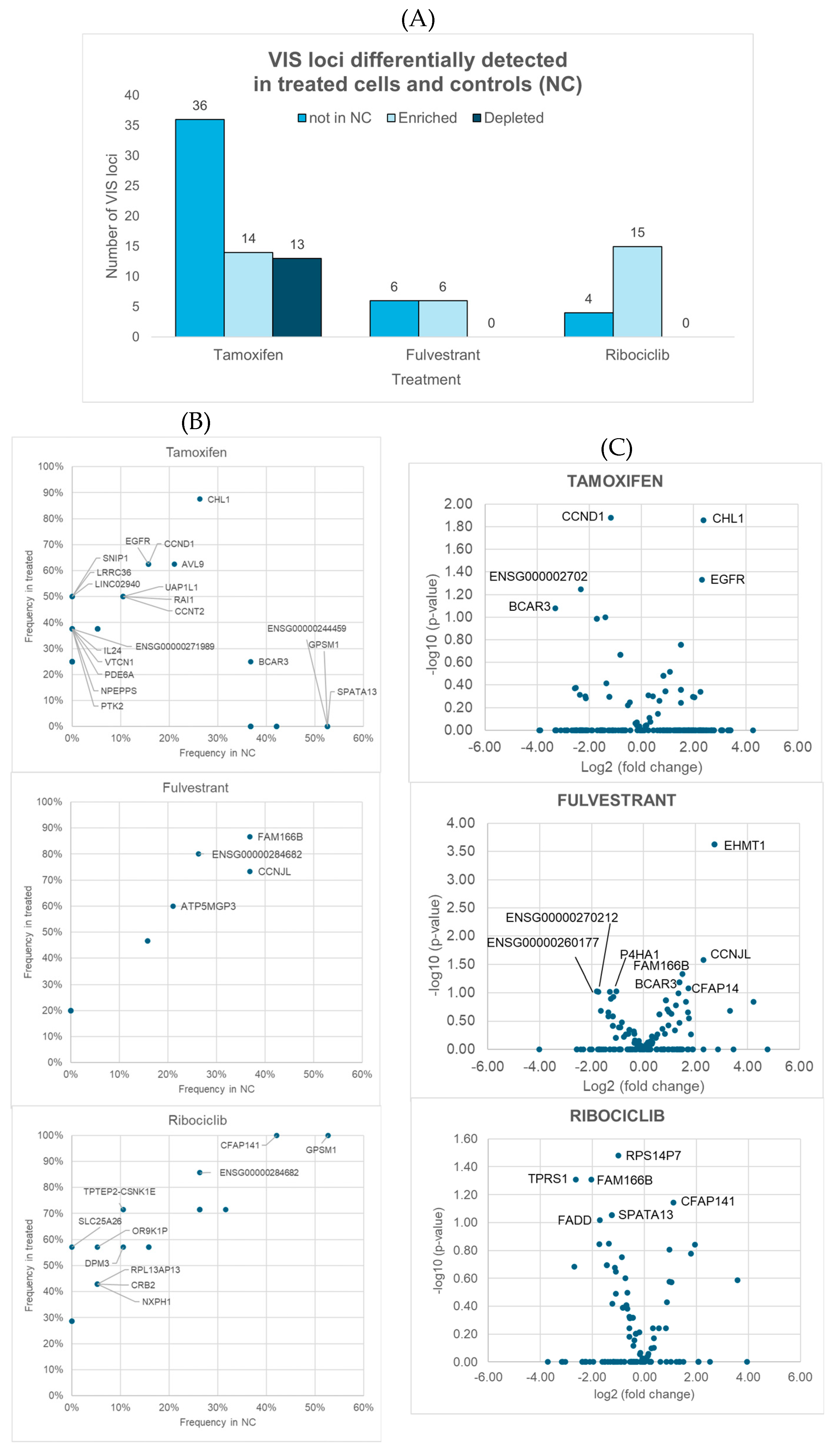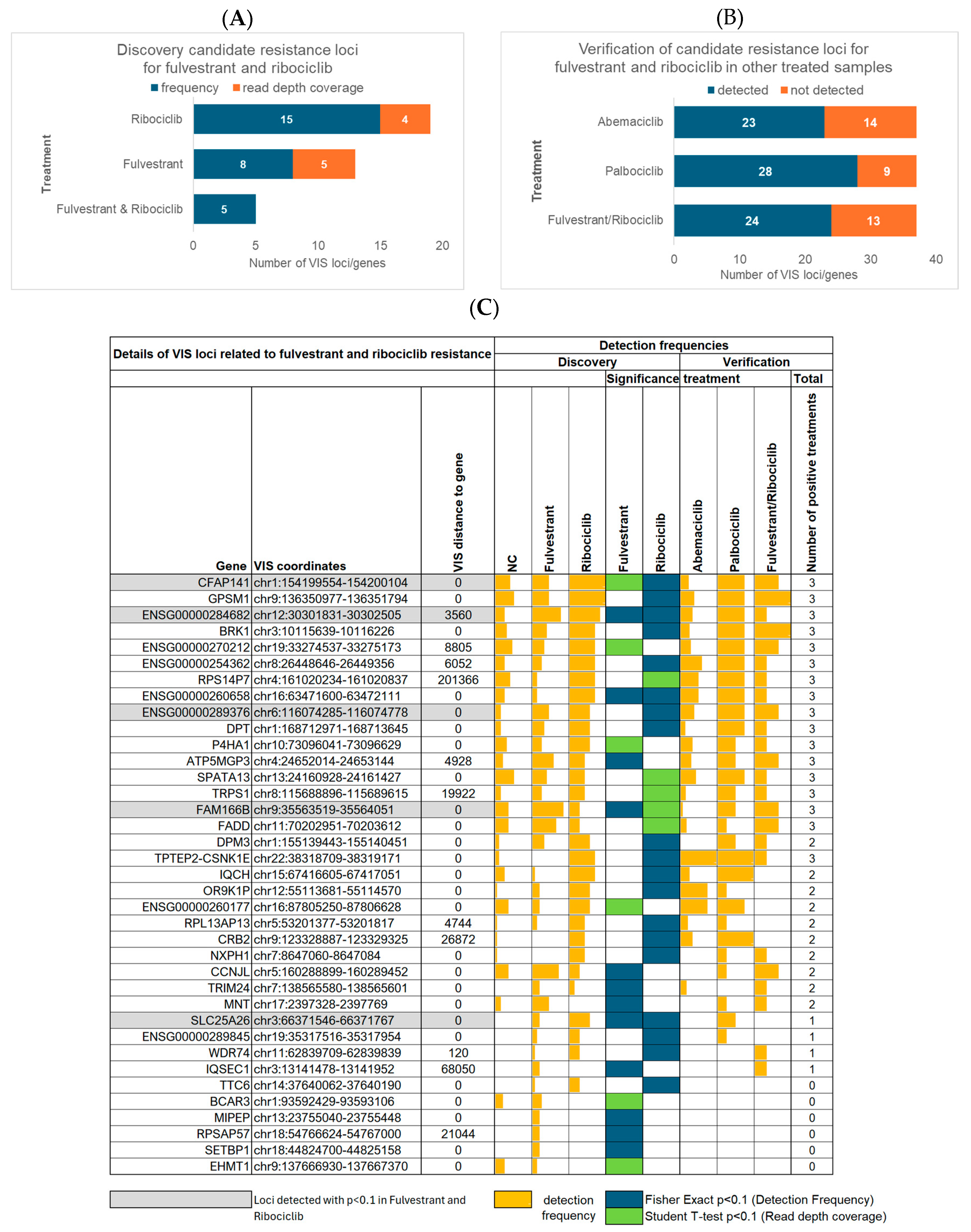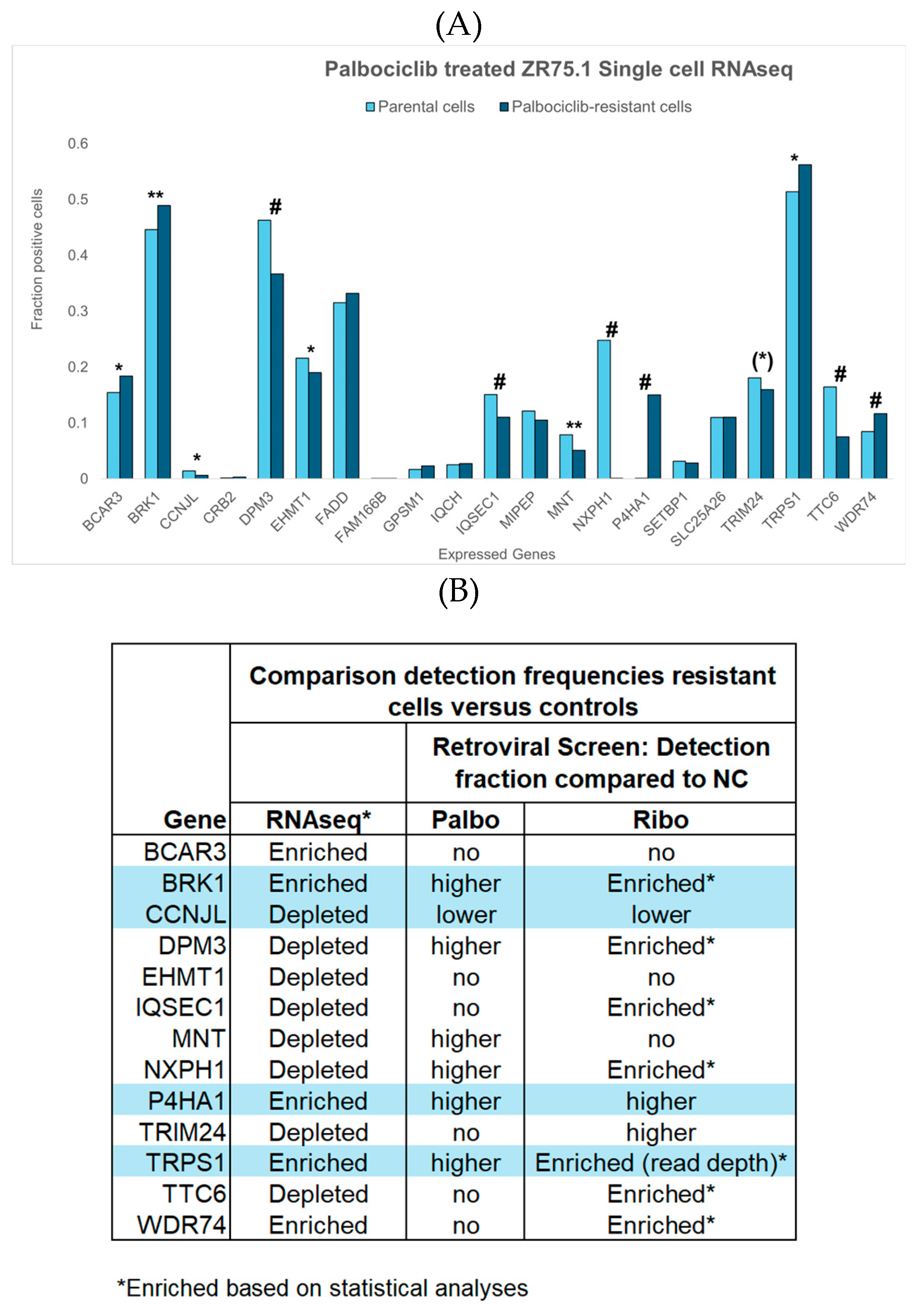


Identification of Resistance Genes in Breast Cancer Cells Treated with Fulvestrant and Ribociclib via Retroviral Screening and Integration Site Sequencing
 , , , and
Abstract
1. Introduction
2. Materials and Methods
2.1. Retroviral Cell Clones and Culture
2.2. Compounds and Retroviral Screen Design
2.3. DNA Isolation and Quantification
2.4. VIS-NGS Protocol
2.5. Explorative Partial Support Using Single-Cell Transcriptomics
2.6. Statistics
3. Results
3.1. Retroviral Screen and Selection of VIS Loci
3.2. Detection of Known 4-OH-Tamoxifen Resistance Genes
3.3. Identification of VIS Loci Enriched or Depleted in Therapy-Resistant Cells
3.4. Verification of Candidate Resistance Genes
3.5. Single-Cell Transcriptomics of Candidate Resistance Genes for Preliminary Validation
4. Discussion
Supplementary Materials
Author Contributions
Funding
Data Availability Statement
Acknowledgments
Conflicts of Interest
References
- Siegel, R.L.; Kratzer, T.B.; Giaquinto, A.N.; Sung, H.; Jemal, A. Cancer statistics, 2025. CA Cancer J. Clin. 2025, 75, 10–45. [Google Scholar] [CrossRef] [PubMed]
- Li, T.; Zhang, H.; Lian, M.; He, Q.; Lv, M.; Zhai, L.; Zhou, J.; Wu, K.; Yi, M. Global status and attributable risk factors of breast, cervical, ovarian, and uterine cancers from 1990 to 2021. J. Hematol. Oncol. 2025, 18, 5. [Google Scholar] [CrossRef] [PubMed]
- Carvalho, E.; Canberk, S.; Schmitt, F.; Vale, N. Molecular Subtypes and Mechanisms of Breast Cancer: Precision Medicine Approaches for Targeted Therapies. Cancers 2025, 17, 1102. [Google Scholar] [CrossRef] [PubMed]
- Lee, J.S.; Hackbart, H.; Cui, X.; Yuan, Y. CDK4/6 Inhibitor Resistance in Hormone Receptor-Positive Metastatic Breast Cancer: Translational Research, Clinical Trials, and Future Directions. Int. J. Mol. Sci. 2023, 24, 11791. [Google Scholar] [CrossRef]
- Zhou, F.H.; Downton, T.; Freelander, A.; Hurwitz, J.; Caldon, C.E.; Lim, E. CDK4/6 inhibitor resistance in estrogen receptor positive breast cancer, a 2023 perspective. Front. Cell Dev. Biol. 2023, 11, 1148792. [Google Scholar] [CrossRef]
- Karihtala, P. How to choose optimal adjuvant therapies for high-risk hormone receptor-positive, HER2-negative breast cancer after chemotherapy? Acta Oncol. 2025, 64, 815–829. [Google Scholar] [CrossRef]
- McKeage, K.; Curran, M.P.; Plosker, G.L. Fulvestrant: A review of its use in hormone receptor-positive metastatic breast cancer in postmenopausal women with disease progression following antiestrogen therapy. Drugs 2004, 64, 633–648. [Google Scholar] [CrossRef]
- Andrahennadi, S.; Sami, A.; Haider, K.; Chalchal, H.I.; Le, D.; Ahmed, O.; Manna, M.; El-Gayed, A.; Wright, P.; Ahmed, S. Efficacy of Fulvestrant in Women with Hormone-Resistant Metastatic Breast Cancer (mBC): A Canadian Province Experience. Cancers 2021, 13, 4163. [Google Scholar] [CrossRef]
- Slamon, D.J.; Neven, P.; Chia, S.; Fasching, P.A.; De Laurentiis, M.; Im, S.A.; Petrakova, K.; Bianchi, G.V.; Esteva, F.J.; Martín, M.; et al. Phase III Randomized Study of Ribociclib and Fulvestrant in Hormone Receptor-Positive, Human Epidermal Growth Factor Receptor 2-Negative Advanced Breast Cancer: MONALEESA-3. J. Clin. Oncol. 2018, 36, 2465–2472. [Google Scholar] [CrossRef]
- Cristofanilli, M.; Turner, N.C.; Bondarenko, I.; Ro, J.; Im, S.A.; Masuda, N.; Colleoni, M.; DeMichele, A.; Loi, S.; Verma, S.; et al. Fulvestrant plus palbociclib versus fulvestrant plus placebo for treatment of hormone-receptor-positive, HER2-negative metastatic breast cancer that progressed on previous endocrine therapy (PALOMA-3): Final analysis of the multicentre, double-blind, phase 3 randomised controlled trial. Lancet Oncol. 2016, 17, 425–439. [Google Scholar]
- Sledge, G.W., Jr.; Toi, M.; Neven, P.; Sohn, J.; Inoue, K.; Pivot, X.; Burdaeva, O.; Okera, M.; Masuda, N.; Kaufman, P.A.; et al. MONARCH 2: Abemaciclib in Combination with Fulvestrant in Women with HR+/HER2-Advanced Breast Cancer Who Had Progressed While Receiving Endocrine Therapy. J. Clin. Oncol. 2017, 35, 2875–2884. [Google Scholar] [CrossRef] [PubMed]
- Marcuello, C.; Lim, K.; Nisini, G.; Pokrovsky, V.S.; Conde, J.; Ruggeri, F.S. Nanoscale Analysis beyond Imaging by Atomic Force Microscopy: Molecular Perspectives on Oncology and Neurodegeneration. Small Sci. 2025, 5, 2500351. [Google Scholar] [CrossRef] [PubMed]
- Ezenwafor, T.; Anye, V.; Madukwe, J.; Amin, S.; Obayemi, J.; Odusanya, O.; Soboyejo, W. Nanoindentation study of the viscoelastic properties of human triple negative breast cancer tissues: Implications for mechanical biomarkers. Acta Biomater. 2023, 158, 374–392. [Google Scholar] [CrossRef] [PubMed]
- Dorssers, L.C.; van Agthoven, T.; Dekker, A.; van Agthoven, T.L.; Kok, E.M. Induction of antiestrogen resistance in human breast cancer cells by random insertional mutagenesis using defective retroviruses: Identification of bcar-1, a common integration site. Mol. Endocrinol. 1993, 7, 870–878. [Google Scholar]
- Meijer, D.; van Agthoven, T.; Bosma, P.T.; Nooter, K.; Dorssers, L.C. Functional screen for genes responsible for tamoxifen resistance in human breast cancer cells. Mol. Cancer Res. 2006, 4, 379–386. [Google Scholar] [CrossRef]
- Zhang, Y.; Wester, L.; He, J.; Geiger, T.; Moerkens, M.; Siddappa, R.; Helmijr, J.A.; Timmermans, M.M.; Look, M.P.; van Deurzen, C.H.; et al. IGF1R signaling drives antiestrogen resistance through PAK2/PIX activation in luminal breast cancer. Oncogene 2018, 37, 1869–1884. [Google Scholar] [CrossRef]
- Wester, L.; Venneker, S.; Hazenoot, M.; Pont, C.; Koedoot, E.; Timmermans, A.M.; Martens, J.W.M.; Jansen, M.P.H.M.; Kockx, C.E.M.; van IJcken, W.F.J.; et al. A kinase inhibitor screen reveals MEK1/2 as a novel therapeutic target to antagonize IGF1R-mediated antiestrogen resistance in ERalpha-positive luminal breast cancer. Biochem. Pharmacol. 2022, 204, 115233. [Google Scholar] [CrossRef]
- van der Noord, V.E.; van der Stel, W.; Louwerens, G.; Verhoeven, D.; Kuiken, H.J.; Lieftink, C.; Grandits, M.; Ecker, G.F.; Beijersbergen, R.L.; Bouwman, P.; et al. Systematic screening identifies ABCG2 as critical factor underlying synergy of kinase inhibitors with transcriptional CDK inhibitors. Breast Cancer Res. 2023, 25, 51. [Google Scholar] [CrossRef]
- Nagarajan, S.; Rao, S.V.; Sutton, J.; Cheeseman, D.; Dunn, S.; Papachristou, E.K.; Prada, J.-E.G.; Couturier, D.-L.; Kumar, S.; Kishore, K.; et al. ARID1A influences HDAC1/BRD4 activity, intrinsic proliferative capacity and breast cancer treatment response. Nat. Genet. 2020, 52, 187–197. [Google Scholar] [CrossRef]
- Mayayo-Peralta, I.; Faggion, B.; Hoekman, L.; Morris, B.; Lieftink, C.; Goldsbrough, I.; Buluwela, L.; Siefert, J.C.; Post, H.; Altelaar, M.; et al. Ribociclib Induces Broad Chemotherapy Resistance and EGFR Dependency in ESR1 Wildtype and Mutant Breast Cancer. Cancers 2021, 13, 6314. [Google Scholar] [CrossRef]
- Massimino, M.; Huang, Z.; Helmijr, J.; Muritti, C.; Uijtdewillegen, A.; Vigneri, P.; Martens, J.W.M.; Jansen, M.P.H.M. Novel protocol for mapping virus integration sites in genes involved in therapy resistance. Sci. Rep. 2025, 15, 21841. [Google Scholar] [CrossRef]
- Migliaccio, I.; Bonechi, M.; Romagnoli, D.; Boccalini, G.; Galardi, F.; Guarducci, C.; Nardone, A.; Schiff, R.; Biganzoli, L.; Malorni, L.; et al. Single-cell transcriptomics reveals biomarker heterogeneity linked to CDK4/6 Inhibitor resistance in breast cancer cell lines. NPJ Breast Cancer 2025, 11, 82. [Google Scholar] [CrossRef] [PubMed]
- Dorssers, L.C.; van Agthoven, T.; Brinkman, A.; Veldscholte, J.; Smid, M.; Dechering, K.J. Breast cancer oestrogen independence mediated by BCAR1 or BCAR3 genes is transmitted through mechanisms distinct from the oestrogen receptor signalling pathway or the epidermal growth factor receptor signalling pathway. Breast Cancer Res. 2005, 7, R82–R92. [Google Scholar] [CrossRef] [PubMed]
- Godinho, M.; Meijer, D.; Setyono-Han, B.; Dorssers, L.C.; van Agthoven, T. Characterization of BCAR4, a novel oncogene causing endocrine resistance in human breast cancer cells. J. Cell. Physiol. 2011, 226, 1741–1749. [Google Scholar] [CrossRef] [PubMed]
- van Agthoven, T.; Veldscholte, J.; Smid, M.; van Agthoven, T.L.; Vreede, L.; Broertjes, M.; de Vries, I.; de Jong, D.; Sarwari, R.; Dorssers, L.C.J. Functional identification of genes causing estrogen independence of human breast cancer cells. Breast Cancer Res. Treat. 2009, 114, 23–30. [Google Scholar] [CrossRef]
- Padrão, N.; Gregoricchio, S.; Eickhoff, N.; Dong, J.; Luzietti, L.; Bossi, D.; Severson, T.M.; Siefert, J.; Calcinotto, A.; Buluwela, L.; et al. TRIM24 as a therapeutic target in endocrine treatment-resistant breast cancer. Proc. Natl. Acad. Sci. USA 2025, 122, e2507571122. [Google Scholar] [CrossRef]
- Ghosh, A.; Chaubal, R.; Das, C.; Parab, P.; Das, S.; Maitra, A.; Majumder, P.P.; Gupta, S.; Biswas, N.K. Genomic hallmarks of endocrine therapy resistance in ER/PR+HER2- breast tumours. Commun. Biol. 2025, 8, 207. [Google Scholar] [CrossRef]
- Beecher, K.; Kulasegaran, T.; Lakhani, S.R.; McCart Reed, A.E. Genomic Predictive Biomarkers in Breast Cancer: The Haves and Have Nots. Int. J. Mol. Sci. 2025, 26, 7300. [Google Scholar] [CrossRef]
- Saatci, O.; Huynh-Dam, K.T.; Sahin, O. Endocrine resistance in breast cancer: From molecular mechanisms to therapeutic strategies. J. Mol. Med. 2021, 99, 1691–1710. [Google Scholar] [CrossRef]
- Mosele, F.; Stefanovska, B.; Lusque, A.; Dien, A.T.; Garberis, I.; Droin, N.; Le Tourneau, C.; Sablin, M.-P.; Lacroix, L.; Enrico, D.; et al. Outcome and molecular landscape of patients with PIK3CA-mutated metastatic breast cancer. Ann. Oncol. 2020, 31, 377–386. [Google Scholar] [CrossRef]
- Keegan, N.M.; Gleeson, J.P.; Hennessy, B.T.; Morris, P.G. PI3K inhibition to overcome endocrine resistance in breast cancer. Expert Opin. Investig. Drugs 2018, 27, 1–15. [Google Scholar] [CrossRef] [PubMed]
- van Agthoven, T.; Sieuwerts, A.M.; Meijer-van Gelder, M.E.; Look, M.P.; Smid, M.; Veldscholte, J.; Sleijfer, S.; Foekens, J.A.; Dorssers, L.C. Relevance of breast cancer antiestrogen resistance genes in human breast cancer progression and tamoxifen resistance. J. Clin. Oncol. 2009, 27, 542–549. [Google Scholar] [CrossRef] [PubMed]
- Jeong, Y.; Bae, S.Y.; You, D.; Jung, S.P.; Choi, H.J.; Kim, I.; Lee, S.K.; Yu, J.; Kim, S.W.; Lee, J.E.; et al. EGFR is a Therapeutic Target in Hormone Receptor-Positive Breast Cancer. Cell. Physiol. Biochem. 2019, 53, 805–819. [Google Scholar] [CrossRef] [PubMed]
- Hanf, D.; Fasching, P.; Gass, P.; Beckmann, M.W.; Hack, C.C.; Heindl, F.; Häberle, L.; John, N.; Erber, R.; Press, M.F.; et al. Impact of CCND1 amplification on the prognosis of hormone receptor-positive, HER2-negative breast cancer patients-correlation of clinical and pathological markers. Breast Cancer Res. Treat. 2025, 210, 125–134. [Google Scholar] [CrossRef]
- Scott, T.G.; Sathyan, K.M.; Gioeli, D.; Guertin, M.J. TRPS1 modulates chromatin accessibility to regulate estrogen receptor alpha (ER) binding and ER target gene expression in luminal breast cancer cells. PLoS Genet. 2024, 20, e1011159. [Google Scholar] [CrossRef]
- Yang, L.; Fan, Q.; Wang, J.; Yang, X.; Yuan, J.; Li, Y.; Sun, X.; Wang, Y. TRPS1 regulates the opposite effect of progesterone via RANKL in endometrial carcinoma and breast carcinoma. Cell Death Discov. 2023, 9, 185. [Google Scholar] [CrossRef]
- Elster, D.; Tollot, M.; Schlegelmilch, K.; Ori, A.; Rosenwald, A.; Sahai, E.; von Eyss, B. TRPS1 shapes YAP/TEAD-dependent transcription in breast cancer cells. Nat. Commun. 2018, 9, 3115. [Google Scholar] [CrossRef]
- Tollot-Wegner, M.; Jessen, M.; Kim, K.; Sanz-Moreno, A.; Spielmann, N.; Gailus-Durner, V.; Fuchs, H.; de Angelis, M.H.; von Eyss, B. TRPS1 maintains luminal progenitors in the mammary gland by repressing SRF/MRTF activity. Breast Cancer Res. 2024, 26, 74. [Google Scholar] [CrossRef]


Disclaimer/Publisher’s Note: The statements, opinions and data contained in all publications are solely those of the individual author(s) and contributor(s) and not of MDPI and/or the editor(s). MDPI and/or the editor(s) disclaim responsibility for any injury to people or property resulting from any ideas, methods, instructions or products referred to in the content. |
© 2026 by the authors. Licensee MDPI, Basel, Switzerland. This article is an open access article distributed under the terms and conditions of the Creative Commons Attribution (CC BY) license.
Share and Cite
Huang, Z.; Beaufort, C.; Helmijr, J.; Zantboer, B.; Rozema, G.; Muritti, C.; Whien, J.J.; Uijterwegen, A.; Massimino, M.; Martens, J.W.M.; et al. Identification of Resistance Genes in Breast Cancer Cells Treated with Fulvestrant and Ribociclib via Retroviral Screening and Integration Site Sequencing. Cells 2026, 15, 260. https://doi.org/10.3390/cells15030260
Huang Z, Beaufort C, Helmijr J, Zantboer B, Rozema G, Muritti C, Whien JJ, Uijterwegen A, Massimino M, Martens JWM, et al. Identification of Resistance Genes in Breast Cancer Cells Treated with Fulvestrant and Ribociclib via Retroviral Screening and Integration Site Sequencing. Cells. 2026; 15(3):260. https://doi.org/10.3390/cells15030260
Chicago/Turabian StyleHuang, Zhangzan, Corine Beaufort, Jean Helmijr, Brian Zantboer, Giada Rozema, Camilla Muritti, Julia J. Whien, Anna Uijterwegen, Michele Massimino, John W. M. Martens, and et al. 2026. "Identification of Resistance Genes in Breast Cancer Cells Treated with Fulvestrant and Ribociclib via Retroviral Screening and Integration Site Sequencing" Cells 15, no. 3: 260. https://doi.org/10.3390/cells15030260
APA StyleHuang, Z., Beaufort, C., Helmijr, J., Zantboer, B., Rozema, G., Muritti, C., Whien, J. J., Uijterwegen, A., Massimino, M., Martens, J. W. M., & Jansen, M. P. H. M. (2026). Identification of Resistance Genes in Breast Cancer Cells Treated with Fulvestrant and Ribociclib via Retroviral Screening and Integration Site Sequencing. Cells, 15(3), 260. https://doi.org/10.3390/cells15030260