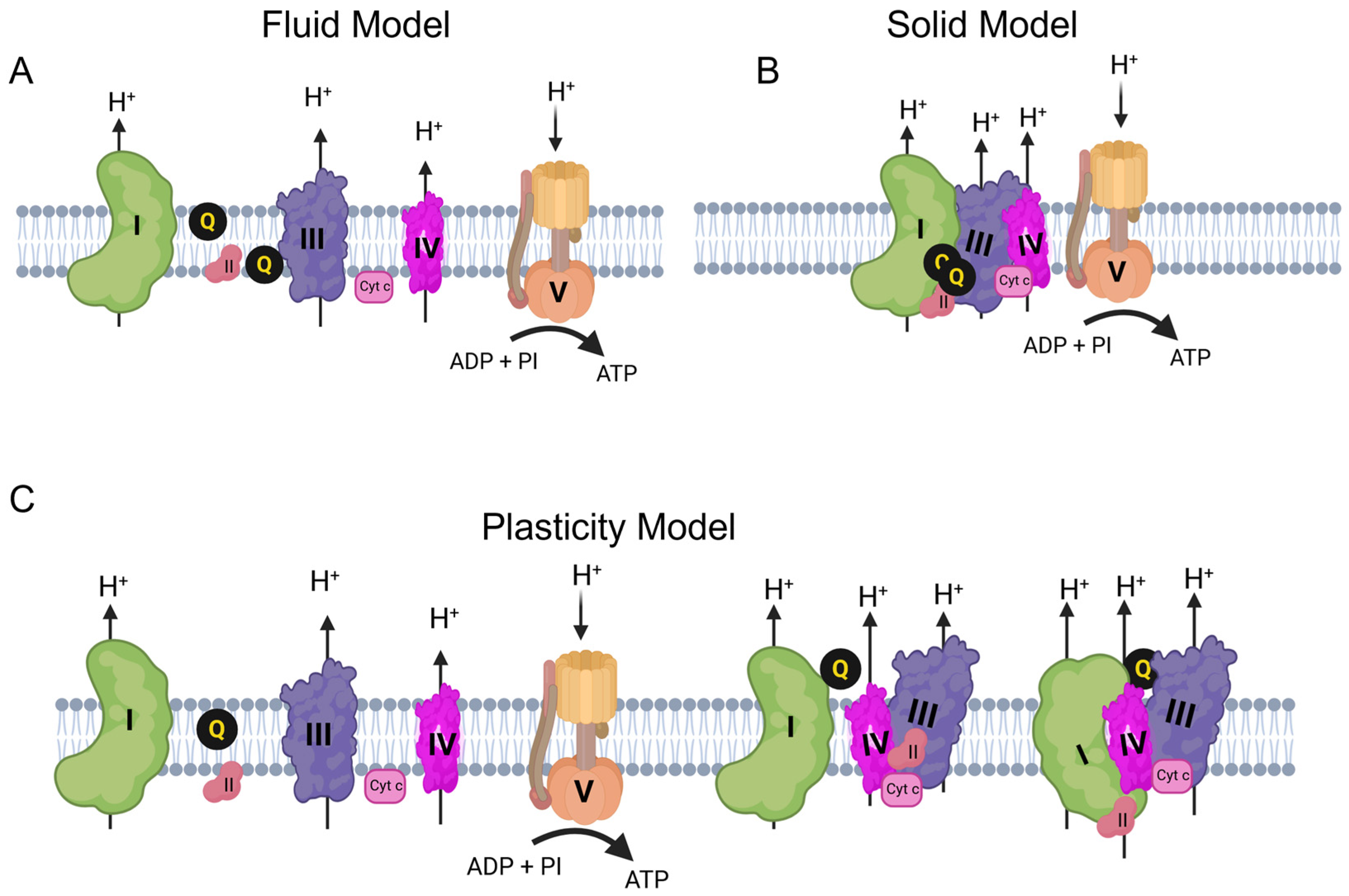

From Structure to Vulnerability: Mitochondrial Supercomplexes in Cancer Cells


Highlights
- Mitochondrial respiratory supercomplexes (SCs) are dynamically organized assemblies regulated by membrane lipid composition and specific protein factors.
- SCs formation optimizes electron transfer efficiency and modulates mitochondrial reactive oxygen species production.
- Dynamic SCs remodeling contributes to mitochondrial adaptation under metabolic and environmental stress.
- In cancer, SCs dynamics support metabolic flexibility and redox homeostasis and may present therapeutic opportunities.
Abstract
1. Introduction
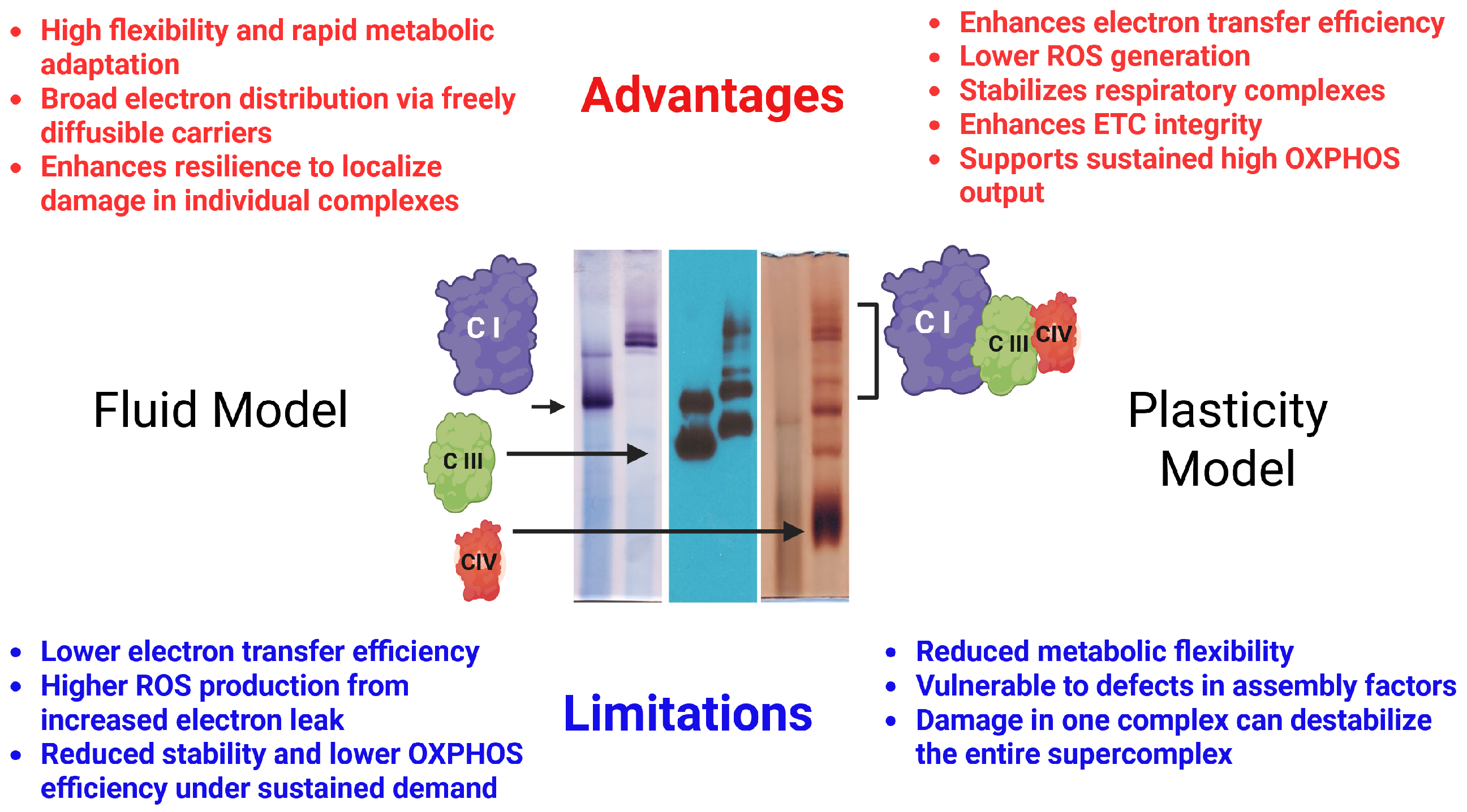
2. From Fluid to Plasticity: Evolving Models of Respiratory Chain Organization in Mammalian Mitochondria
3. Structural Organization and Functional Significance of Supercomplexes
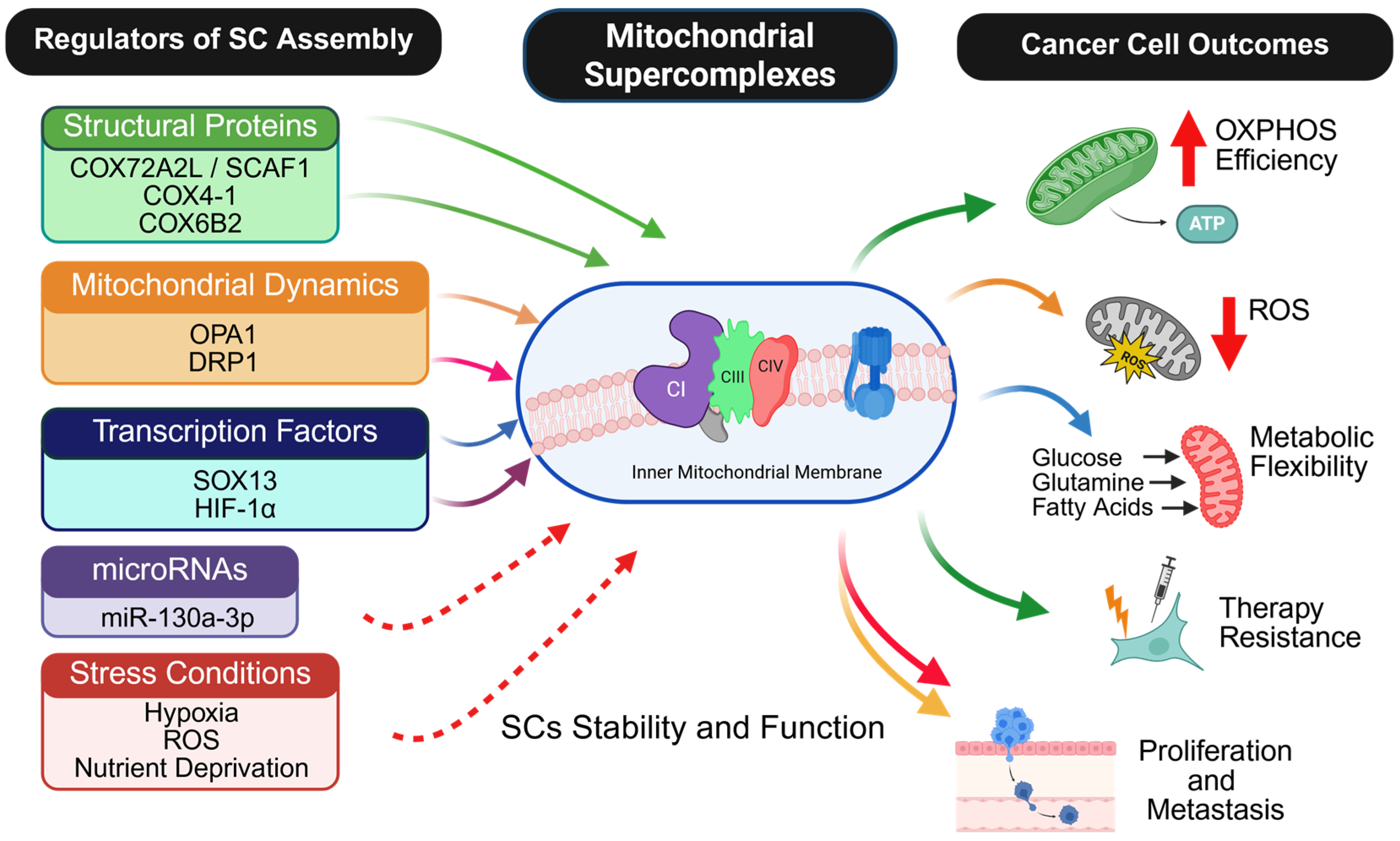
4. Regulation of Mitochondrial Respiratory Supercomplex Assembly and Stability
5. Mitochondrial SCs Stabilization as a Convergent Mechanism of Tumor Progression and Therapy Resistance in Cancer
6. Metabolic Effects of SCs-Regulating Factors in Cancer
7. Regulation of SC Organization in Cancer
7.1. Pancreatic Ductal Adenocarcinoma
7.2. Breast Cancer
7.3. Hepatocellular Carcinoma
7.4. Endometrial Cancer
7.5. Lung Cancer
7.6. Glioblastoma
7.7. Gastric Cancer
7.8. Ovarian Cancer
7.9. Leukemia
8. Mitochondrial SCs as a Unifying Metabolic Framework and Therapeutic Leverage Point in Cancer
9. Conclusions
Author Contributions
Funding
Institutional Review Board Statement
Informed Consent Statement
Data Availability Statement
Acknowledgments
Conflicts of Interest
References
- Guo, R.; Gu, J.; Wu, M.; Yang, M. Amazing structure of respirasome: Unveiling the secrets of cell respiration. Protein Cell 2016, 7, 854–865. [Google Scholar] [CrossRef] [PubMed]
- Sousa, J.S.; D’Imprima, E.; Vonck, J. Mitochondrial Respiratory Chain Complexes. In Membrane Protein Complexes: Structure and Function; Springer: Singapore, 2018; Volume 87, pp. 167–227. [Google Scholar] [CrossRef]
- Zhao, R.-Z.; Jiang, S.; Zhang, L.; Yu, Z.-B. Mitochondrial electron transport chain, ROS generation and uncoupling (Review). Int. J. Mol. Med. 2019, 44, 3–15. [Google Scholar] [CrossRef]
- Hensley, C.T.; Wasti, A.T.; DeBerardinis, R.J. Glutamine and cancer: Cell biology, physiology, and clinical opportunities. J. Clin. Investig. 2013, 123, 3678–3684. [Google Scholar] [CrossRef]
- Locasale, J.W. New concepts in feedback regulation of glucose metabolism. Curr. Opin. Syst. Biol. 2018, 8, 32–38. [Google Scholar] [CrossRef]
- Martínez-Reyes, I.; Chandel, N.S. Mitochondrial TCA cycle metabolites control physiology and disease. Nat. Commun. 2020, 11, 102. [Google Scholar] [CrossRef] [PubMed]
- Panov, A.V.; Mayorov, V.I.; Dikalov, S.I. Role of Fatty Acids β-Oxidation in the Metabolic Interactions Between Organs. Int. J. Mol. Sci. 2024, 25, 12740. [Google Scholar] [CrossRef]
- Brand, M.D. The sites and topology of mitochondrial superoxide production. Exp. Gerontol. 2010, 45, 466–472. [Google Scholar] [CrossRef]
- Murphy, M.P. How mitochondria produce reactive oxygen species. Biochem. J. 2009, 417, 1–13. [Google Scholar] [CrossRef]
- Papa, S.; Martino, P.L.; Capitanio, G.; Gaballo, A.; De Rasmo, D.; Signorile, A.; Petruzzella, V. The oxidative phosphorylation system in mammalian mitochondria. Adv. Exp. Med. Biol. 2012, 942, 3–37. [Google Scholar] [CrossRef] [PubMed]
- Quinlan, C.L.; Perevoshchikova, I.V.; Hey-Mogensen, M.; Orr, A.L.; Brand, M.D. Sites of reactive oxygen species generation by mitochondria oxidizing different substrates. Redox Biol. 2013, 1, 304–312. [Google Scholar] [CrossRef]
- Alva, R.; Wiebe, J.E.; Stuart, J.A. Revisiting reactive oxygen species production in hypoxia. Pflüg. Arch. Eur. J. Physiol. 2024, 476, 1423–1444. [Google Scholar] [CrossRef]
- Hackenbrock, C.R.; Chazotte, B.; Gupte, S.S. The random collision model and a critical assessment of diffusion and collision in mitochondrial electron transport. J. Bioenerg. Biomembr. 1986, 18, 331–368. [Google Scholar] [CrossRef]
- Cruciat, C.-M.; Brunner, S.; Baumann, F.; Neupert, W.; Stuart, R.A. The Cytochrome bc 1 and Cytochromec Oxidase Complexes Associate to Form a Single Supracomplex in Yeast Mitochondria. J. Biol. Chem. 2000, 275, 18093–18098. [Google Scholar] [CrossRef]
- Schägger, H.; Pfeiffer, K. Supercomplexes in the respiratory chains of yeast and mammalian mitochondria. EMBO J. 2000, 19, 1777–1783. [Google Scholar] [CrossRef]
- Acin-Perez, R.; Enriquez, J.A. The function of the respiratory supercomplexes: The plasticity model. Biochim. Biophys. Acta (BBA)-Bioenerg. 2014, 1837, 444–450. [Google Scholar] [CrossRef]
- Genova, M.L.; Lenaz, G. Functional role of mitochondrial respiratory supercomplexes. Biochim. Biophys. Acta (BBA)-Bioenerg. 2014, 1837, 427–443. [Google Scholar] [CrossRef]
- Lapuente-Brun, E.; Moreno-Loshuertos, R.; Acín-Pérez, R.; Latorre-Pellicer, A.; Colás, C.; Balsa, E.; Perales-Clemente, E.; Quirós, P.M.; Calvo, E.; Rodríguez-Hernández, M.A.; et al. Supercomplex Assembly Determines Electron Flux in the Mitochondrial Electron Transport Chain. Science 2013, 340, 1567–1570. [Google Scholar] [CrossRef]
- Buck, K.J.; Walter, N.A.R.; Denmark, D.L. Genetic variability of respiratory complex abundance, organization and activity in mouse brain. Genes Brain Behav. 2013, 13, 135–143. [Google Scholar] [CrossRef]
- Guan, S.; Zhao, L.; Peng, R. Mitochondrial Respiratory Chain Supercomplexes: From Structure to Function. Int. J. Mol. Sci. 2022, 23, 13880. [Google Scholar] [CrossRef]
- Lobo-Jarne, T.; Ugalde, C. Respiratory chain supercomplexes: Structures, function and biogenesis. Semin. Cell Dev. Biol. 2018, 76, 179–190. [Google Scholar] [CrossRef]
- Kohler, A.; Barrientos, A.; Fontanesi, F.; Ott, M. The functional significance of mitochondrial respiratory chain supercomplexes. EMBO Rep. 2023, 24, e57092. [Google Scholar] [CrossRef] [PubMed]
- Lobo-Jarne, T.; Pérez-Pérez, R.; Fontanesi, F.; Timón-Gómez, A.; Wittig, I.; Peñas, A.; Serrano-Lorenzo, P.; García-Consuegra, I.; Arenas, J.; Martín, M.A.; et al. Multiple pathways coordinate assembly of human mitochondrial complex IV and stabilization of respiratory supercomplexes. EMBO J. 2020, 39, e103912. [Google Scholar] [CrossRef] [PubMed]
- Zheng, W.; Chai, P.; Zhu, J.; Zhang, K. High-resolution in situ structures of mammalian respiratory supercomplexes. Nature 2024, 631, 232–239. [Google Scholar] [CrossRef] [PubMed]
- Brzezinski, P.; Moe, A.; Ädelroth, P. Structure and Mechanism of Respiratory III–IV Supercomplexes in Bioenergetic Membranes. Chem. Rev. 2021, 121, 9644–9673. [Google Scholar] [CrossRef]
- Brave, F.D.; Becker, T. Supercomplex formation boosts respiration. EMBO Rep. 2020, 21, e51830. [Google Scholar] [CrossRef]
- Vercellino, I.; Sazanov, L.A. Structure and assembly of the mammalian mitochondrial supercomplex CIII2CIV. Nature 2021, 598, 364–367. [Google Scholar] [CrossRef] [PubMed]
- Letts, J.A.; Fiedorczuk, K.; Sazanov, L.A. The architecture of respiratory supercomplexes. Nature 2016, 537, 644–648. [Google Scholar] [CrossRef]
- Wu, M.; Gu, J.; Guo, R.; Huang, Y.; Yang, M. Structure of Mammalian Respiratory Supercomplex I 1 III 2 IV 1. Cell 2016, 167, 1598–1609.e10. [Google Scholar] [CrossRef]
- Guo, R.; Zong, S.; Wu, M.; Gu, J.; Yang, M. Architecture of Human Mitochondrial Respiratory Megacomplex I2III2IV2. Cell 2017, 170, 1247–1257.e12. [Google Scholar] [CrossRef]
- Davies, K.M.; Blum, T.B.; Kühlbrandt, W. Conserved in situ arrangement of complex I and III 2 in mitochondrial respiratory chain supercomplexes of mammals, yeast, and plants. Proc. Natl. Acad. Sci. USA 2018, 115, 3024–3029. [Google Scholar] [CrossRef]
- Jang, S.; Javadov, S. Elucidating the contribution of ETC complexes I and II to the respirasome formation in cardiac mitochondria. Sci. Rep. 2018, 8, 17732. [Google Scholar] [CrossRef]
- Mühleip, A.; Flygaard, R.K.; Baradaran, R.; Haapanen, O.; Gruhl, T.; Tobiasson, V.; Maréchal, A.; Sharma, V.; Amunts, A. Structural basis of mitochondrial membrane bending by the I–II–III2–IV2 supercomplex. Nature 2023, 615, 934–938. [Google Scholar] [CrossRef] [PubMed]
- Lobo-Jarne, T.; Nývltová, E.; Pérez-Pérez, R.; Timón-Gómez, A.; Molinié, T.; Choi, A.; Mourier, A.; Fontanesi, F.; Ugalde, C.; Barrientos, A. Human COX7A2L Regulates Complex III Biogenesis and Promotes Supercomplex Organization Remodeling without Affecting Mitochondrial Bioenergetics. Cell Rep. 2018, 25, 1786–1799.e4. [Google Scholar] [CrossRef] [PubMed]
- Calvaruso, M.A.; Willems, P.; Brand, M.v.D.; Valsecchi, F.; Kruse, S.; Palmiter, R.; Smeitink, J.; Nijtmans, L. Mitochondrial complex III stabilizes complex I in the absence of NDUFS4 to provide partial activity. Hum. Mol. Genet. 2011, 21, 115–120. [Google Scholar] [CrossRef] [PubMed]
- Mirali, S.; Botham, A.; Voisin, V.; Xu, C.; St-Germain, J.; Sharon, D.; Hoff, F.W.; Qiu, Y.; Hurren, R.; Gronda, M.; et al. The mitochondrial peptidase, neurolysin, regulates respiratory chain supercomplex formation and is necessary for AML viability. Sci. Transl. Med. 2020, 12, eaaz8264. [Google Scholar] [CrossRef]
- Rugolo, M.; Zanna, C.; Ghelli, A.M. Organization of the Respiratory Supercomplexes in Cells with Defective Complex III: Structural Features and Metabolic Consequences. Life 2021, 11, 351. [Google Scholar] [CrossRef]
- Diaz, F.; Garcia, S.; Padgett, K.R.; Moraes, C.T. A defect in the mitochondrial complex III, but not complex IV, triggers early ROS-dependent damage in defined brain regions. Hum. Mol. Genet. 2012, 21, 5066–5077. [Google Scholar] [CrossRef]
- Guerrero-Castillo, S.; Baertling, F.; Kownatzki, D.; Wessels, H.J.; Arnold, S.; Brandt, U.; Nijtmans, L. The Assembly Pathway of Mitochondrial Respiratory Chain Complex I. Cell Metab. 2017, 25, 128–139. [Google Scholar] [CrossRef]
- Lopez-Fabuel, I.; Le Douce, J.; Logan, A.; James, A.M.; Bonvento, G.; Murphy, M.P.; Almeida, A.; Bolaños, J.P. Complex I assembly into supercomplexes determines differential mitochondrial ROS production in neurons and astrocytes. Proc. Natl. Acad. Sci. USA 2016, 113, 13063–13068. [Google Scholar] [CrossRef]
- Maranzana, E.; Barbero, G.; Falasca, A.I.; Lenaz, G.; Genova, M.L. Mitochondrial Respiratory Supercomplex Association Limits Production of Reactive Oxygen Species from Complex I. Antioxid. Redox Signal. 2013, 19, 1469–1480. [Google Scholar] [CrossRef]
- Porras, C.; Porras, C.A.; Bai, Y. Respiratory supercomplexes plasticity and implications. Front. Biosci. 2015, 20, 621–634. [Google Scholar] [CrossRef]
- Berndtsson, J.; Aufschnaiter, A.; Rathore, S.; Marin-Buera, L.; Dawitz, H.; Diessl, J.; Kohler, V.; Barrientos, A.; Büttner, S.; Fontanesi, F.; et al. Respiratory supercomplexes enhance electron transport by decreasing cytochrome c diffusion distance. EMBO Rep. 2020, 21, e51015. [Google Scholar] [CrossRef]
- Blaza, J.N.; Serreli, R.; Jones, A.J.Y.; Mohammed, K.; Hirst, J. Kinetic evidence against partitioning of the ubiquinone pool and the catalytic relevance of respiratory-chain supercomplexes. Proc. Natl. Acad. Sci. USA 2014, 111, 15735–15740. [Google Scholar] [CrossRef]
- Fedor, J.G.; Hirst, J. Mitochondrial Supercomplexes Do Not Enhance Catalysis by Quinone Channeling. Cell Metab. 2018, 28, 525–531.e4. [Google Scholar] [CrossRef]
- Grant, J.; Saldanha, J.W.; Gould, A.P. A Drosophila model for primary coenzyme Q deficiency and dietary rescue in the developing nervous system. Dis. Model. Mech. 2010, 3, 799–806. [Google Scholar] [CrossRef]
- Letts, J.A.; Fiedorczuk, K.; Degliesposti, G.; Skehel, M.; Sazanov, L.A. Structures of Respiratory Supercomplex I+III2 Reveal Functional and Conformational Crosstalk. Mol. Cell 2019, 75, 1131–1146.e6. [Google Scholar] [CrossRef]
- Wang, Y.; Oxer, D.; Hekimi, S. Mitochondrial function and lifespan of mice with controlled ubiquinone biosynthesis. Nat. Commun. 2015, 6, 6393. [Google Scholar] [CrossRef]
- Zhang, K.; Chen, L.; Wang, B.; Chen, D.; Ye, X.; Han, X.; Fang, Q.; Yu, C.; Wu, J.; Guo, S.; et al. Mitochondrial supercomplex assembly regulates metabolic features and glutamine dependency in mammalian cells. Theranostics 2023, 13, 3165–3187. [Google Scholar] [CrossRef] [PubMed]
- Shimada, S.; Oosaki, M.; Takahashi, R.; Uene, S.; Yanagisawa, S.; Tsukihara, T.; Shinzawa-Itoh, K. A unique respiratory adaptation in Drosophila independent of supercomplex formation. Biochim. Biophys. Acta (BBA)-Bioenerg. 2018, 1859, 154–163. [Google Scholar] [CrossRef] [PubMed]
- Moreno-Lastres, D.; Fontanesi, F.; García-Consuegra, I.; Martín, M.A.; Arenas, J.; Barrientos, A.; Ugalde, C. Mitochondrial Complex I Plays an Essential Role in Human Respirasome Assembly. Cell Metab. 2012, 15, 324–335. [Google Scholar] [CrossRef] [PubMed]
- Signes, A.; Fernandez-Vizarra, E. Assembly of mammalian oxidative phosphorylation complexes I–V and supercomplexes. Essays Biochem. 2018, 62, 255–270. [Google Scholar] [CrossRef]
- Timón-Gómez, A.; Garlich, J.; Stuart, R.A.; Ugalde, C.; Barrientos, A. Distinct Roles of Mitochondrial HIGD1A and HIGD2A in Respiratory Complex and Supercomplex Biogenesis. Cell Rep. 2020, 31, 107607. [Google Scholar] [CrossRef]
- Goetzman, E.S.; Prochownik, E.V. The Role for Myc in Coordinating Glycolysis, Oxidative Phosphorylation, Glutaminolysis, and Fatty Acid Metabolism in Normal and Neoplastic Tissues. Front. Endocrinol. 2018, 9, 129. [Google Scholar] [CrossRef]
- Melber, A.; Winge, D.R. Inner Secrets of the Respirasome. Cell 2016, 167, 1450–1452. [Google Scholar] [CrossRef]
- Rutter, J.; Winge, D.R.; Schiffman, J.D. Succinate dehydrogenase—Assembly, regulation and role in human disease. Mitochondrion 2010, 10, 393–401. [Google Scholar] [CrossRef]
- Calvo, E.; Cogliati, S.; Hernansanz-Agustín, P.; Loureiro-López, M.; Guarás, A.; Casuso, R.A.; García-Marqués, F.; Acín-Pérez, R.; Martí-Mateos, Y.; Silla-Castro, J.; et al. Functional role of respiratory supercomplexes in mice: SCAF1 relevance and segmentation of the Qpool. Sci. Adv. 2020, 6, eaba7509. [Google Scholar] [CrossRef] [PubMed]
- Garcia-Poyatos, C.; Cogliati, S.; Calvo, E.; Hernansanz-Agustín, P.; Lagarrigue, S.; Magni, R.; Botos, M.; Langa, X.; Amati, F.; Vázquez, J.; et al. Scaf1 promotes respiratory supercomplexes and metabolic efficiency in zebrafish. EMBO Rep. 2020, 21, e50287. [Google Scholar] [CrossRef]
- Cogliati, S.; Herranz, F.; Ruiz-Cabello, J.; Enríquez, J.A. Digitonin concentration is determinant for mitochondrial supercomplexes analysis by BlueNative page. Biochim. Biophys. Acta (BBA)-Bioenerg. 2021, 1862, 148332. [Google Scholar] [CrossRef] [PubMed]
- Fernández-Vizarra, E.; López-Calcerrada, S.; Formosa, L.E.; Pérez-Pérez, R.; Ding, S.; Fearnley, I.M.; Arenas, J.; Martín, M.A.; Zeviani, M.; Ryan, M.T.; et al. SILAC-based complexome profiling dissects the structural organization of the human respiratory supercomplexes in SCAFIKO cells. Biochim. Biophys. Acta (BBA)-Bioenerg. 2021, 1862, 148414. [Google Scholar] [CrossRef] [PubMed]
- Fernández-Vizarra, E.; López-Calcerrada, S.; Sierra-Magro, A.; Pérez-Pérez, R.; Formosa, L.E.; Hock, D.H.; Illescas, M.; Peñas, A.; Brischigliaro, M.; Ding, S.; et al. Two independent respiratory chains adapt OXPHOS performance to glycolytic switch. Cell Metab. 2022, 34, 1792–1808.e6. [Google Scholar] [CrossRef]
- Ikeda, K.; Shiba, S.; Horie-Inoue, K.; Shimokata, K.; Inoue, S. A stabilizing factor for mitochondrial respiratory supercomplex assembly regulates energy metabolism in muscle. Nat. Commun. 2013, 4, 2147. [Google Scholar] [CrossRef]
- Pérez-Pérez, R.; Lobo-Jarne, T.; Milenkovic, D.; Mourier, A.; Bratic, A.; García-Bartolomé, A.; Fernández-Vizarra, E.; Cadenas, S.; Delmiro, A.; García-Consuegra, I.; et al. COX7A2L Is a Mitochondrial Complex III Binding Protein that Stabilizes the III2+IV Supercomplex without Affecting Respirasome Formation. Cell Rep. 2016, 16, 2387–2398. [Google Scholar] [CrossRef]
- Ramírez-Aguilar, S.J.; Keuthe, M.; Rocha, M.; Fedyaev, V.V.; Kramp, K.; Gupta, K.J.; Rasmusson, A.G.; Schulze, W.X.; van Dongen, J.T. The Composition of Plant Mitochondrial Supercomplexes Changes with Oxygen Availability. J. Biol. Chem. 2011, 286, 43045–43053. [Google Scholar] [CrossRef]
- Shiba, S.; Ikeda, K.; Horie-Inoue, K.; Nakayama, A.; Tanaka, T.; Inoue, S. Deficiency of COX7RP, a mitochondrial supercomplex assembly promoting factor, lowers blood glucose level in mice. Sci. Rep. 2017, 7, 7606. [Google Scholar] [CrossRef]
- Triolo, M.; Baker, N.; Agarwal, S.; Larionov, N.; Podinić, T.; Khacho, M. Optic atrophy 1 mediates muscle differentiation by promoting a metabolic switch via the supercomplex assembly factor SCAF1. iScience 2024, 27, 109164. [Google Scholar] [CrossRef]
- Williams, E.G.; Wu, Y.; Jha, P.; Dubuis, S.; Blattmann, P.; Argmann, C.A.; Houten, S.M.; Amariuta, T.; Wolski, W.; Zamboni, N.; et al. Systems proteomics of liver mitochondria function. Science 2016, 352, aad0189. [Google Scholar] [CrossRef] [PubMed]
- Balsa, E.; Soustek, M.S.; Thomas, A.; Cogliati, S.; García-Poyatos, C.; Martín-García, E.; Jedrychowski, M.; Gygi, S.P.; Enriquez, J.A.; Puigserver, P. ER and Nutrient Stress Promote Assembly of Respiratory Chain Supercomplexes through the PERK-eIF2α Axis. Mol. Cell 2019, 74, 877–890.e6. [Google Scholar] [CrossRef] [PubMed]
- Dawitz, H.; Schäfer, J.; Schaart, J.M.; Magits, W.; Brzezinski, P.; Ott, M. Rcf1 Modulates Cytochrome c Oxidase Activity Especially Under Energy-Demanding Conditions. Front. Physiol. 2020, 10, 1555. [Google Scholar] [CrossRef] [PubMed]
- Hollinshead, K.E.; Parker, S.J.; Eapen, V.V.; Encarnacion-Rosado, J.; Sohn, A.; Oncu, T.; Cammer, M.; Mancias, J.D.; Kimmelman, A.C. Respiratory Supercomplexes Promote Mitochondrial Efficiency and Growth in Severely Hypoxic Pancreatic Cancer. Cell Rep. 2020, 33, 108231. [Google Scholar] [CrossRef]
- Römpler, K.; Müller, T.; Juris, L.; Wissel, M.; Vukotic, M.; Hofmann, K.; Deckers, M. Overlapping Role of Respiratory Supercomplex Factor Rcf2 and Its N-terminal Homolog Rcf3 in Saccharomyces cerevisiae. J. Biol. Chem. 2016, 291, 23769–23778. [Google Scholar] [CrossRef]
- Salazar, C.; Yañez, O.; Elorza, A.A.; Cortes, N.; García-Beltrán, O.; Tiznado, W.; Ruiz, L.M. Biosystem Analysis of the Hypoxia Inducible Domain Family Member 2A: Implications in Cancer Biology. Genes 2020, 11, 206. [Google Scholar] [CrossRef]
- Vukotic, M.; Oeljeklaus, S.; Wiese, S.; Vögtle, F.N.; Meisinger, C.; Meyer, H.E.; Zieseniss, A.; Katschinski, D.M.; Jans, D.C.; Jakobs, S.; et al. Rcf1 Mediates Cytochrome Oxidase Assembly and Respirasome Formation, Revealing Heterogeneity of the Enzyme Complex. Cell Metab. 2012, 15, 336–347. [Google Scholar] [CrossRef]
- Zhu, J.-Y.; Chen, M.; Mu, W.-J.; Luo, H.-Y.; Guo, L. The functional role of Higd1a in mitochondrial homeostasis and in multiple disease processes. Genes Dis. 2023, 10, 1833–1845. [Google Scholar] [CrossRef]
- Homberg, B.; Römpler, K.; Wissel, M.; Callegari, S.; Deckers, M. Rcf proteins and their differential specificity for respiratory chain complexes: A unique role for Rcf2 on oxygen sensitive supercomplexes? Biochim. Biophys. Acta (BBA)-Mol. Cell Res. 2021, 1868, 119133. [Google Scholar] [CrossRef]
- Schmidt, T.R.; Goodman, M.; Grossman, L.I. Molecular evolution of the COX7A gene family in primates. Mol. Biol. Evol. 1999, 16, 619–626. [Google Scholar] [CrossRef] [PubMed]
- Seelan, R.S.; Grossman, L.I. Structural organization and evolution of the liver isoform gene for bovine cytochrome c oxidase subunit VIIa. Genomics 1993, 18, 527–536. [Google Scholar] [CrossRef]
- Yu, M.; Jaradat, S.A.; Grossman, L.I. Genomic organization and promoter regulation of human cytochrome c oxidase subunit VII heart/muscle isoform (COX7AH). Biochim. Biophys. Acta (BBA)-Gene Struct. Expr. 2002, 1574, 345–353. [Google Scholar] [CrossRef]
- Benegiamo, G.; Sleiman, M.B.; Wohlwend, M.; Rodríguez-López, S.; Goeminne, L.J.E.; Laurila, P.-P.; Klevjer, M.; Salonen, M.K.; Lahti, J.; Jha, P.; et al. COX7A2L genetic variants determine cardiorespiratory fitness in mice and human. Nat. Metab. 2022, 4, 1336–1351. [Google Scholar] [CrossRef] [PubMed]
- Ameri, K.; Jahangiri, A.; Rajah, A.M.; Tormos, K.V.; Nagarajan, R.; Pekmezci, M.; Nguyen, V.; Wheeler, M.L.; Murphy, M.P.; Sanders, T.A.; et al. HIGD1A Regulates Oxygen Consumption, ROS Production, and AMPK Activity during Glucose Deprivation to Modulate Cell Survival and Tumor Growth. Cell Rep. 2015, 10, 891–899. [Google Scholar] [CrossRef]
- An, H.-J.; Shin, H.; Jo, S.-G.; Kim, Y.J.; Lee, J.-O.; Paik, S.-G.; Lee, H. The survival effect of mitochondrial Higd-1a is associated with suppression of cytochrome C release and prevention of caspase activation. Biochim. Biophys. Acta (BBA)-Mol. Cell Res. 2011, 1813, 2088–2098. [Google Scholar] [CrossRef]
- Hock, D.H.; Reljic, B.; Ang, C.-S.; Muellner-Wong, L.; Mountford, H.S.; Compton, A.G.; Ryan, M.T.; Thorburn, D.R.; Stroud, D.A. HIGD2A is Required for Assembly of the COX3 Module of Human Mitochondrial Complex IV. Mol. Cell. Proteom. 2020, 19, 1145–1160. [Google Scholar] [CrossRef]
- Jia, Y.-Z.; Liu, J.; Wang, G.-Q.; Pan, H.; Huang, T.-Z.; Liu, R.; Zhang, Y. HIG1 domain family member 1A is a crucial regulator of disorders associated with hypoxia. Mitochondrion 2023, 69, 171–182. [Google Scholar] [CrossRef]
- Lin, H.; Kuo, Y.; Weng, Y.; Lai, I.; Huang, T.H.; Lin, S.; Niu, D.; Chen, C. Activation of silenced tumor suppressor genes in prostate cancer cells by a novel energy restriction-mimetic agent. Prostate 2012, 72, 1767–1778. [Google Scholar] [CrossRef]
- Xiang, F.; Peng, L.; Yin, Z.; Jia, R.; Hu, Z.; Li, Z.; Ni, X.; Liang, X.; Li, L.; He, C.; et al. Acute and subchronic toxicity as well as evaluation of safety pharmacology of Galla chinensis solution. J. Ethnopharmacol. 2015, 162, 181–190. [Google Scholar] [CrossRef] [PubMed]
- Hatle, K.M.; Gummadidala, P.; Navasa, N.; Bernardo, E.; Dodge, J.; Silverstrim, B.; Fortner, K.; Burg, E.; Suratt, B.T.; Hammer, J.; et al. MCJ/DnaJC15, an Endogenous Mitochondrial Repressor of the Respiratory Chain That Controls Metabolic Alterations. Mol. Cell. Biol. 2013, 33, 2302–2314. [Google Scholar] [CrossRef]
- Signorile, A.; Pacelli, C.; Palese, L.L.; Santeramo, A.; Roca, E.; Cocco, T.; De Rasmo, D. cAMP/PKA Signaling Modulates Mitochondrial Supercomplex Organization. Int. J. Mol. Sci. 2022, 23, 9655. [Google Scholar] [CrossRef]
- Jang, S.; Javadov, S. OPA1 regulates respiratory supercomplexes assembly: The role of mitochondrial swelling. Mitochondrion 2020, 51, 30–39. [Google Scholar] [CrossRef]
- Pérez-Mejías, G.; Guerra-Castellano, A.; Díaz-Quintana, A.; De la Rosa, M.A.; Díaz-Moreno, I. Cytochrome c: Surfing Off of the Mitochondrial Membrane on the Tops of Complexes III and IV. Comput. Struct. Biotechnol. J. 2019, 17, 654–660. [Google Scholar] [CrossRef]
- Ren, C.; Xi, L.; Li, H.; Pan, Z.; Li, Y.; Wang, G.; Dai, J.; He, D.; Fan, S.; Wang, Q. Inhibition of the FOXO1–ROCK1 axis mitigates cardiomyocyte injury under chronic hypoxia in Tetralogy of Fallot by maintaining mitochondrial quality control. Life Sci. 2024, 357, 123084. [Google Scholar] [CrossRef] [PubMed]
- Sandoval-Acuña, C.; Torrealba, N.; Tomkova, V.; Jadhav, S.B.; Blazkova, K.; Merta, L.; Lettlova, S.; Adamcová, M.K.; Rosel, D.; Brábek, J.; et al. Targeting Mitochondrial Iron Metabolism Suppresses Tumor Growth and Metastasis by Inducing Mitochondrial Dysfunction and Mitophagy. Cancer Res. 2021, 81, 2289–2303. [Google Scholar] [CrossRef] [PubMed]
- Shinde, A.; Jung, H.; Lee, H.; Singh, K.; Roy, M.; Gohel, D.; Kim, H.B.; Mane, M.; Vasiyani, H.; Currim, F.; et al. TNF-α differentially modulates subunit levels of respiratory electron transport complexes of ER/PR +ve/−ve breast cancer cells to regulate mitochondrial complex activity and tumorigenic potential. Cancer Metab. 2021, 9, 19. [Google Scholar] [CrossRef]
- McKeown, S.R. Defining normoxia, physoxia and hypoxia in tumours—Implications for treatment response. Br. J. Radiol. 2014, 87, 20130676. [Google Scholar] [CrossRef] [PubMed]
- Li, B.; Huang, P.; Qiu, J.; Liao, Y.; Hong, J.; Yuan, Y. MicroRNA-130a is down-regulated in hepatocellular carcinoma and associates with poor prognosis. Med Oncol. 2014, 31, 230. [Google Scholar] [CrossRef]
- Shi, K.-Q.; Lin, Z.; Chen, X.-J.; Song, M.; Wang, Y.-Q.; Cai, Y.-J.; Yang, N.-B.; Zheng, M.-H.; Dong, J.-Z.; Zhang, L.; et al. Hepatocellular carcinoma associated microRNA expression signature: Integrated bioinformatics analysis, experimental validation and clinical significance. Oncotarget 2015, 6, 25093–25108. [Google Scholar] [CrossRef]
- Wang, G.; Popovic, B.; Ta, J.; Jiang, A. Overexpression of COX7RP promotes tumor growth and metastasis by inducing ROS production in hepatocellular carcinoma cells. Am. J. Cancer Res. 2020, 10, 1366–1383. [Google Scholar] [PubMed]
- Huang, J.; Zhao, M.; Hu, H.; Wang, J.; Ang, L.; Zheng, L. MicroRNA-130a reduces drug resistance in breast cancer. Int. J. Clin. Exp. Pathol. 2019, 12, 2699–2705. [Google Scholar] [PubMed]
- Eichelmann, A.K.; Matuszcak, C.; Lindner, K.; Haier, J.; Hussey, D.J.; Hummel, R. Complex role of miR-130a-3p and miR-148a-3p balance on drug resistance and tumor biology in esophageal squamous cell carcinoma. Sci. Rep. 2018, 8, 17553. [Google Scholar] [CrossRef]
- Xu, N.; Shen, C.; Luo, Y.; Xia, L.; Xue, F.; Xia, Q.; Zhang, J. Upregulated miR-130a increases drug resistance by regulating RUNX3 and Wnt signaling in cisplatin-treated HCC cell. Biochem. Biophys. Res. Commun. 2012, 425, 468–472. [Google Scholar] [CrossRef]
- Han, H.; Li, Y.; Lin, Z.; Ma, X.; Huang, W.; Lu, C.; Ma, R.; Han, R. Exosomal miR-130a-3p confers cisplatin resistance in esophageal cancer by regulating ferroptosis via the suppression of METTL14-mediated m6A RNA methylation of FSP1. Int. Immunopharmacol. 2024, 146, 113804. [Google Scholar] [CrossRef]
- Tepe, N.B.; Bozgeyik, E.; Bozdag, Z.; Balat, O.; Ozcan, H.C.; Ugur, M.G. Identification of autophagy-associated miRNA signature for the cervical squamous cell cancer and high-grade cervical intraepithelial lesions. Reprod. Biol. 2021, 21, 100536. [Google Scholar] [CrossRef]
- Causin, R.L.; Lengert, A.V.H.; Gomes, I.N.F.; De Freitas, A.J.A.; Rosa, M.N.; Dos Reis, R.; Reis, R.M.; Marques, M.M.C. MicroRNA-130a-3p inhibition suppresses cervical cancer cell progression. Oncol. Rep. 2023, 49, 109. [Google Scholar] [CrossRef]
- Fan, Q.; Huang, T.; Sun, X.; Yang, X.; Wang, J.; Liu, Y.; Ni, T.; Gu, S.; Li, Y.; Wang, Y. miR-130a-3p promotes cell proliferation and invasion by targeting estrogen receptor α and androgen receptor in cervical cancer. Exp. Ther. Med. 2021, 21, 414. [Google Scholar] [CrossRef]
- Chen, R.; Dakhili, S.A.T.; Gerulskis, R.; Zhao, Y.-Y.; Lockhart, S.; Tonoyan, L.; Siraki, A.G.; Huang, G.; Kinnaird, A.; Freed, D.H.; et al. Cysteine oxidation of a redox hub within complex I can facilitate electron transport chain supercomplex formation. J. Biol. Chem. 2025, 301, 110555. [Google Scholar] [CrossRef]
- Chen, Z.; Ho, I.-L.; Soeung, M.; Yen, E.-Y.; Liu, J.; Yan, L.; Rose, J.L.; Srinivasan, S.; Jiang, S.; Chang, Q.E.; et al. Ether phospholipids are required for mitochondrial reactive oxygen species homeostasis. Nat. Commun. 2023, 14, 2194. [Google Scholar] [CrossRef]
- Cheng, C.-C.; Wooten, J.; Gibbs, Z.A.; McGlynn, K.; Mishra, P.; Whitehurst, A.W. Sperm-specific COX6B2 enhances oxidative phosphorylation, proliferation, and survival in human lung adenocarcinoma. eLife 2020, 9, e58108. [Google Scholar] [CrossRef] [PubMed]
- Masoud, R.; Reyes-Castellanos, G.; Lac, S.; Garcia, J.; Dou, S.; Shintu, L.; Hadi, N.A.; Gicquel, T.; El Kaoutari, A.; Diémé, B.; et al. Targeting Mitochondrial Complex I Overcomes Chemoresistance in High OXPHOS Pancreatic Cancer. Cell Rep. Med. 2020, 1, 100143. [Google Scholar] [CrossRef]
- Lee, K.-M.; Giltnane, J.M.; Balko, J.M.; Schwarz, L.J.; Guerrero-Zotano, A.L.; Hutchinson, K.E.; Nixon, M.J.; Estrada, M.V.; Sánchez, V.; Sanders, M.E.; et al. MYC and MCL1 Cooperatively Promote Chemotherapy-Resistant Breast Cancer Stem Cells via Regulation of Mitochondrial Oxidative Phosphorylation. Cell Metab. 2017, 26, 633–647.e7. [Google Scholar] [CrossRef]
- Tapia, I.J.; Perico, D.; Wolos, V.J.; Villaverde, M.S.; Abrigo, M.; Di Silvestre, D.; Mauri, P.; De Palma, A.; Fiszman, G.L. Proteomic Characterization of a 3D HER2+ Breast Cancer Model Reveals the Role of Mitochondrial Complex I in Acquired Resistance to Trastuzumab. Int. J. Mol. Sci. 2024, 25, 7397. [Google Scholar] [CrossRef] [PubMed]
- Ikeda, K.; Horie-Inoue, K.; Suzuki, T.; Hobo, R.; Nakasato, N.; Takeda, S.; Inoue, S. Mitochondrial supercomplex assembly promotes breast and endometrial tumorigenesis by metabolic alterations and enhanced hypoxia tolerance. Nat. Commun. 2019, 10, 4108. [Google Scholar] [CrossRef]
- Kamada, S.; Takeiwa, T.; Ikeda, K.; Horie, K.; Inoue, S. Emerging Roles of COX7RP and Mitochondrial Oxidative Phosphorylation in Breast Cancer. Front. Cell Dev. Biol. 2022, 10, 717881. [Google Scholar] [CrossRef] [PubMed]
- Rohlenova, K.; Sachaphibulkij, K.; Stursa, J.; Bezawork-Geleta, A.; Blecha, J.; Endaya, B.; Werner, L.; Cerny, J.; Zobalova, R.; Goodwin, J.; et al. Selective Disruption of Respiratory Supercomplexes as a New Strategy to Suppress Her2high Breast Cancer. Antioxid. Redox Signal. 2017, 26, 84–103. [Google Scholar] [CrossRef]
- Baek, M.L.; Lee, J.; Pendleton, K.E.; Berner, M.J.; Goff, E.B.; Tan, L.; Martinez, S.A.; Mahmud, I.; Wang, T.; Meyer, M.D.; et al. Mitochondrial structure and function adaptation in residual triple negative breast cancer cells surviving chemotherapy treatment. Oncogene 2023, 42, 1117–1131. [Google Scholar] [CrossRef] [PubMed]
- Cogliati, S.; Frezza, C.; Soriano, M.E.; Varanita, T.; Quintana-Cabrera, R.; Corrado, M.; Cipolat, S.; Costa, V.; Casarin, A.; Gomes, L.C.; et al. Mitochondrial Cristae Shape Determines Respiratory Chain Supercomplexes Assembly and Respiratory Efficiency. Cell 2013, 155, 160–171. [Google Scholar] [CrossRef] [PubMed]
- Zamberlan, M.; Boeckx, A.; Muller, F.; Vinelli, F.; Ek, O.; Vianello, C.; Coart, E.; Shibata, K.; Christian, A.; Grespi, F.; et al. Inhibition of the mitochondrial protein Opa1 curtails breast cancer growth. J. Exp. Clin. Cancer Res. 2022, 41, 95. [Google Scholar] [CrossRef]
- Diokmetzidou, A.; Maracani, A.; Pellattiero, A.; Cardenas-Rodriguez, M.; Rivière, E.A.; Scorrano, L. Metastatic breast cancer cells are selectively dependent on the mitochondrial cristae-shaping protein OPA1. Cell Death Dis. 2025, 16, 539. [Google Scholar] [CrossRef]
- Huang, K.; Liu, Z.; Xie, Z.; Li, X.; Zhang, H.; Chen, Y.; Wang, Y.; Lin, Z.; Li, C.; Liu, H.; et al. HIGD2A silencing impairs hepatocellular carcinoma growth via inhibiting mitochondrial function and the MAPK/ERK pathway. J. Transl. Med. 2023, 21, 253. [Google Scholar] [CrossRef] [PubMed]
- Zhang, H.; Li, X.; Liu, Z.; Lin, Z.; Huang, K.; Wang, Y.; Chen, Y.; Liao, L.; Wu, L.; Xie, Z.; et al. Elevated expression of HIGD1A drives hepatocellular carcinoma progression by regulating polyamine metabolism through c-Myc–ODC1 nexus. Cancer Metab. 2024, 12, 7. [Google Scholar] [CrossRef]
- Sharanek, A.; Burban, A.; Laaper, M.; Heckel, E.; Joyal, J.-S.; Soleimani, V.D.; Jahani-Asl, A. OSMR controls glioma stem cell respiration and confers resistance of glioblastoma to ionizing radiation. Nat. Commun. 2020, 11, 4116. [Google Scholar] [CrossRef]
- Baccelli, I.; Gareau, Y.; Lehnertz, B.; Gingras, S.; Spinella, J.-F.; Corneau, S.; Mayotte, N.; Girard, S.; Frechette, M.; Blouin-Chagnon, V.; et al. Mubritinib Targets the Electron Transport Chain Complex I and Reveals the Landscape of OXPHOS Dependency in Acute Myeloid Leukemia. Cancer Cell 2019, 36, 84–99.e8. [Google Scholar] [CrossRef]
- Burban, A.; Tessier, C.; Larroquette, M.; Guyon, J.; Lubiato, C.; Pinglaut, M.; Toujas, M.; Galvis, J.; Dartigues, B.; Georget, E.; et al. Exploiting metabolic vulnerability in glioblastoma using a brain-penetrant drug with a safe profile. EMBO Mol. Med. 2025, 17, 469–503. [Google Scholar] [CrossRef]
- Oliva, C.R.; Ali, Y.; Flor, S.; Griguer, C.E. COX4-1 promotes mitochondrial supercomplex assembly and limits reactive oxide species production in radioresistant GBM. Cell Stress 2022, 6, 45–60. [Google Scholar] [CrossRef]
- Oliva1, C.R.; Flor1, S.; Ali2, Y.; Griguer1, C.E. The Nuclear-Encoded Cytochrome c Oxidase Subunit COX4-1 Enhances Hypoxia Tolerance in Glioblastoma Cells. J. Oncol. Res. Ther. 2025, 10, 10299. [Google Scholar] [CrossRef]
- Oliva, C.R.; Markert, T.; Gillespie, G.Y.; Griguer, C.E. Nuclear-encoded cytochrome c oxidase subunit 4 regulates BMI1 expression and determines proliferative capacity of high-grade gliomas. Oncotarget 2015, 6, 4330–4344. [Google Scholar] [CrossRef]
- Yang, H.; Li, Q.; Chen, X.; Weng, M.; Huang, Y.; Chen, Q.; Liu, X.; Huang, H.; Feng, Y.; Zhou, H.; et al. Targeting SOX13 inhibits assembly of respiratory chain supercomplexes to overcome ferroptosis resistance in gastric cancer. Nat. Commun. 2024, 15, 4296. [Google Scholar] [CrossRef]
- Miglietta, S.; Sollazzo, M.; Gherardi, I.; Milioni, S.; Cavina, B.; Marchio, L.; De Luise, M.; Coada, C.A.; Fiorillo, M.; Perrone, A.M.; et al. Mitochondrial chaperonin DNAJC15 promotes vulnerability to ferroptosis of chemoresistant ovarian cancer cells. Open Biol. 2025, 15, 240151. [Google Scholar] [CrossRef]
- Shridhar, V.; Bible, K.C.; Staub, J.; Avula, R.; Lee, Y.K.; Kalli, K.; Huang, H.; Hartmann, L.C.; Kaufmann, S.H.; Smith, D.I. Loss of expression of a new member of the DNAJ protein family confers resistance to chemotherapeutic agents used in the treatment of ovarian cancer. Cancer Res. 2001, 61, 4258–4265. [Google Scholar]
- Stemberkova-Hubackova, S.; Zobalova, R.; Dubisova, M.; Smigova, J.; Dvorakova, S.; Korinkova, K.; Ezrova, Z.; Endaya, B.; Blazkova, K.; Vlcak, E.; et al. Simultaneous targeting of mitochondrial metabolism and immune checkpoints as a new strategy for renal cancer therapy. Clin. Transl. Med. 2022, 12, e645. [Google Scholar] [CrossRef] [PubMed]
- Witham, J.; Vidot, S.; Agarwal, R.; Kaye, S.B.; Richardson, A. Transient ectopic expression as a method to detect genes conferring drug resistance. Int. J. Cancer 2008, 122, 2641–2645. [Google Scholar] [CrossRef] [PubMed]
- Strathdee, G.; Vass, J.K.; Oien, K.A.; Siddiqui, N.; Curto-Garcia, J.; Brown, R. Demethylation of the MCJ gene in stage III/IV epithelial ovarian cancer and response to chemotherapy. Gynecol. Oncol. 2005, 97, 898–903. [Google Scholar] [CrossRef]
- Alistar, A.; Morris, B.B.; Desnoyer, R.; Klepin, H.D.; Hosseinzadeh, K.; Clark, C.; Cameron, A.; Leyendecker, J.; D’Agostino, R.; Topaloglu, U.; et al. Safety and tolerability of the first-in-class agent CPI-613 in combination with modified FOLFIRINOX in patients with metastatic pancreatic cancer: A single-centre, open-label, dose-escalation, phase 1 trial. Lancet Oncol. 2017, 18, 770–778. [Google Scholar] [CrossRef] [PubMed]
- Ghiglione, N.; Abbo, D.; Bushunova, A.; Costamagna, A.; Porporato, P.E.; Martini, M. Metabolic plasticity in pancreatic cancer: The mitochondrial connection. Mol. Metab. 2024, 92, 102089. [Google Scholar] [CrossRef]
- Neuzil, J.; Rohlena, J.; Werner, L.; Bielcikova, Z. MitoTam-01 Trial: Mitochondrial Targeting as Plausible Approach to Cancer Therapy. Comment on Yap et al. Complex I Inhibitor of Oxidative Phosphorylation in Advanced Solid Tumors and Acute Myeloid Leukemia: Phase I Trials. Nat. Med. 2023, 29, 115–126. Cancers 2023, 15, 4476. [Google Scholar] [CrossRef]
- Yap, T.A.; Daver, N.; Mahendra, M.; Zhang, J.; Kamiya-Matsuoka, C.; Meric-Bernstam, F.; Kantarjian, H.M.; Ravandi, F.; Collins, M.E.; Di Francesco, M.E.; et al. Complex I inhibitor of oxidative phosphorylation in advanced solid tumors and acute myeloid leukemia: Phase I trials. Nat. Med. 2023, 29, 115–126. [Google Scholar] [CrossRef] [PubMed]
- Reinema, F.; Hudson, N.; Adema, G.; Peeters, W.; Neuzil, J.; Stursa, J.; Werner, L.; Sweep, F.; Bussink, J.; Span, P. MitoTam induces ferroptosis and increases radiosensitivity in head and neck cancer cells. Radiother. Oncol. 2024, 200, 110503. [Google Scholar] [CrossRef] [PubMed]
- Bielcikova, Z.; Stursa, J.; Krizova, L.; Dong, L.; Spacek, J.; Hlousek, S.; Vocka, M.; Rohlenova, K.; Bartosova, O.; Cerny, V.; et al. Mitochondrially targeted tamoxifen in patients with metastatic solid tumours: An open-label, phase I/Ib single-centre trial. eClinicalMedicine 2023, 57, 101873. [Google Scholar] [CrossRef] [PubMed]



| Study | Model | Tissue- Cell Type | Effect on SCs | Effect on Mitochondrial Bioenergetics and Phenotype | Genetic Background |
|---|---|---|---|---|---|
| Perez-Perez et al. [63] | SCAF1 KD | 143B cells | Loss of CII2+CIV SCs | No change in OCR | |
| Lobo-Jarne et al. [34] | COX7A2L-KO | HEK293T and U87MG cells | Loss of CII2+CIV SCs and some large SCs (CI+CIII2+CIV2-4). WT SC phenotype restored by ectopic expression of long but not short COX7A2L | No change in bioenergetics under physiologic conditions or in nutritional stress (galactose) or with heat shock or oxidative stress | |
| Balsa et al. [68] | COX7A2L-KO | U2OS cells | Decrease in abundance of CI+CIII2+CIVn respirasomes vs. WT cells | No change in OCR in cells cultured in glucose. Decrease in bioenergetics in cells cultured in galactose | |
| Zhang et al. [49] | COX7A2L-KO | HEK293T, C2C12 and 3T3-L1 cells | Loss of CIII2+CIV SCs and large SCs (CI+CIII2+CIV2-4) | Did not affect ATP production or glucose metabolism. Enhanced CII-mediated respiration | |
| Fernandez-Vizarra [61] | COX7A2L-KO | HEK293T cells | 30–40% decrease in respirasomes CI+CIII2+CIV. Loss of CIII2+CIV SCs | ||
| COX7A2-KO | HEK293T | Presence of CI+CIII2+CIV respirasome bound only to SCAF1. Increased abundance of CIII2+CIV SCs | |||
| WT | HEK293T | 60–70% of CI+CIII2+CIV respirasomes contain COX7A2, 30–40% contain SCAF1 | |||
| HEK293T | Loss of CIII2+CIV SCs. No change in the abundance of CI+CIII2+CIV respirasomes containing COX7A2 | No change in mitochondrial bioenergetics, even when cultured with galactose instead of glucose | |||
| Lapuente et al. 2013 [18] | SCAF1 short and SCAF1 long | Fibroblasts | SCAF1 short: No CIV-containing SCs SCAF1 long: CIV-containing SCs | SCAF1 short: C57BL/6J and BALB/c mice SCAF1 long: 129sv mice | |
| Benegiamo 2022 [79] | Cox7a2l DD allele | Skeletal muscle and Liver | Increase in CIII2+CIV SCs with exercise in muscle. No change with exercise in liver | Muscle: Increased mitochondrial bioenergetics and increased lean mass Animals had lower body weight and higher food intake. Liver: Not reported | C57BL/6J |
| COX7A2L variant with 10-bp insertion | Myotubes | Increased stability of COX7A2L mRNA; increased SCAF1 expression. Increased abundance of SCs under galactose. | Enhanced bioenergetics under galactose. Subjects had lower body fat and improved cardiorespiratory fitness | ||
| Williams et al. 2016 [67] | B6 allele | Heart | Absence of III2+IV1, I+III2+IV2, and I+III2+IV3 SCs | B6 background vs. D2 background | |
| Liver | Reduced abundance of III2+IV1, I+III2+IV2, and I+III2+IV3 SCs | ||||
| Ikeda et al. 2013 [62] | Cox7rpKO mice vs. WT | Fibroblasts | Decreased bioenergetics | C57Bl/6 | |
| Muscle | Decreased SC formation | Decreased muscle strength and heat production | |||
| COX7RP-TG mice vs. WT | Muscle | Increased SC formation | Increased muscle strength and heat production | ||
| Shiba et al. 2017 [65] | Cox7rpKO mice | Liver | Increased SC formation | Increased ATP production | |
| Garcia-Poyatos 2020 [58] | scaf1-/- zebrafish | Loss of CIII2+CIV SCs | Decreased bioenergetic efficiency. Small size, abnormal fat distribution, and female infertility | ||
| Benegiamo et al. 2022 [79] | COX7A2L variant with 10-bp insertion | Myotubes | Increased stability of COX7A2L mRNA; increased SCAF1 expression and abundance of SCs | Enhanced bioenergetics. Lower body fat and improved cardiorespiratory fitness | Human |
| Cox7a2l DD allele | Muscle | Increased abundance of SCs in skeletal muscle after 5 weeks of exercise training | Increased max O2 consumption, muscle mass, and increased energy expenditure during activity | C57BL/6 | |
| Ren et al. 2024 [90] | COX7A2L-KD | H9C2 cells | Increased hypoxia-induced mitochondrial ROS production |
Disclaimer/Publisher’s Note: The statements, opinions and data contained in all publications are solely those of the individual author(s) and contributor(s) and not of MDPI and/or the editor(s). MDPI and/or the editor(s) disclaim responsibility for any injury to people or property resulting from any ideas, methods, instructions or products referred to in the content. |
© 2026 by the authors. Licensee MDPI, Basel, Switzerland. This article is an open access article distributed under the terms and conditions of the Creative Commons Attribution (CC BY) license.
Share and Cite
Griguer, C.E.; Flor, S.; Oliva, C.R. From Structure to Vulnerability: Mitochondrial Supercomplexes in Cancer Cells. Cells 2026, 15, 258. https://doi.org/10.3390/cells15030258
Griguer CE, Flor S, Oliva CR. From Structure to Vulnerability: Mitochondrial Supercomplexes in Cancer Cells. Cells. 2026; 15(3):258. https://doi.org/10.3390/cells15030258
Chicago/Turabian StyleGriguer, Corinne E., Susanne Flor, and Claudia R. Oliva. 2026. "From Structure to Vulnerability: Mitochondrial Supercomplexes in Cancer Cells" Cells 15, no. 3: 258. https://doi.org/10.3390/cells15030258
APA StyleGriguer, C. E., Flor, S., & Oliva, C. R. (2026). From Structure to Vulnerability: Mitochondrial Supercomplexes in Cancer Cells. Cells, 15(3), 258. https://doi.org/10.3390/cells15030258