


Abstract
Iron oxides are crucial for the long-term storage of soil organic carbon (SOC) in paddy soils, making them a key factor in global carbon cycles and important for strategies aimed at combating climate change. This review examines the role of iron oxides in paddy soils, particularly their interaction with SOC, which helps stabilize carbon and contributes to mitigating climate change. These processes of iron oxide phase transformations, wet–dry cycles, and microbial activity help trap carbon in the soil, supporting climate change mitigation efforts. Wet–dry cycles promote mineral dissolution and re-precipitation, forming new reactive surfaces and OC-Fe complexes. Future research should adopt a multi-scale approach to better connect molecular mechanisms with ecosystem-level carbon processes. A deeper understanding of iron oxide behavior in paddy soils will support the development of sustainable soil management practices and improve models for predicting soil carbon sequestration under climate change.
1. Introduction
Paddy soils, a significant type of anthropogenic wetland ecosystem, are crucial for global food security, providing sustenance for more than half of the world’s population. Despite occupying a relatively small area, paddy soils play a critical role in the global carbon cycle, especially in the long-term sequestration of organic carbon [1]. Globally, rice cultivation covers approximately 160 million hectares, accounting for about 11–12% of total cropland area [2]. Continuous anthropogenic management through periodic flooding, ploughing, and drainage profoundly influences pedogenic processes, promoting the distinctive features of these soils, including pronounced iron and manganese mobilization, gleization, and the formation of characteristic plough-pan horizons [3].
Paddy soils, though occupying a small area, are highly effective in storing SOC, which plays a vital role in reducing greenhouse gases and combating climate change. This carbon storage capability makes paddy soils essential for mitigating climate change [4]. The ability of paddy soils to store carbon is largely due to the stabilization of organic carbon through interactions with soil minerals, especially iron oxides [5,6]. Iron-bound organic carbon (OC-Fe) makes up about 21–30% of the total organic carbon in paddy soils, which is much higher than in non-flooded soils [7]. OC-Fe refers to organic carbon associated with iron oxides and hydroxides via adsorption, complexation or co-precipitation; the resulting OC-Fe complexes are regarded as a key fraction of mineral-associated organic carbon (MAOC) that plays a disproportionate role in the long-term stabilization of SOC in flooded paddy soil systems. These iron oxides, often referred to as the “rust carbon pool” by forming strong physicochemical bonds with organic molecules, thereby reducing their bioavailability and enhancing their long-term persistence [8,9].
The mechanisms governing the quantity and persistence of SOC are critical to global climate regulation, nutrient cycling, and soil moisture retention [10,11,12]. Within this broader context, the significant SOC sequestration potential exhibited by paddy soils underlines their global environmental importance and the necessity to understand the mineralogical and biogeochemical factors driving carbon stabilization [13]. Early foundational reviews, such as Kögel-Knabner et al., (2010) provided comprehensive descriptions of the biogeochemical and physicochemical characteristics of paddy soils, with particular emphasis on redox-induced transformations [3]. Although the role of iron in the carbon cycle is well-established, research on how iron oxide transformations affect the long-term stability of SOC in paddy soils is still limited [3]. Given that iron oxides continuously transition between poorly crystalline and highly crystalline states under fluctuating redox conditions (e.g., variations in temperature, inundation frequency, pH, and redox potential(Eh)) [5,14,15,16], these minerals uniquely govern electron transfer between Fe2+ and Fe3+, fundamentally regulating SOC stabilization pathways [6,9].
This review explicitly bridges this knowledge gap by integrating recent mechanistic insights into iron oxide dissolution-reprecipitation, solid-state conversions, and their intricate coupling with organo-iron complex formation under variable redox conditions. We also examine how these coupled mineral–organic interactions influence aggregate protection, microbial redox reactions, and ultimately SOC stabilization in paddy soils. By synthesizing these interconnected processes, we provide an integrated framework that extends existing understanding and offers targeted strategies for enhancing SOC persistence in flooded agricultural ecosystems.
2. Method
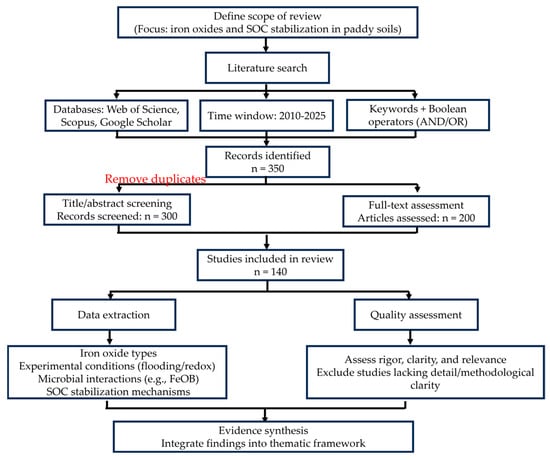
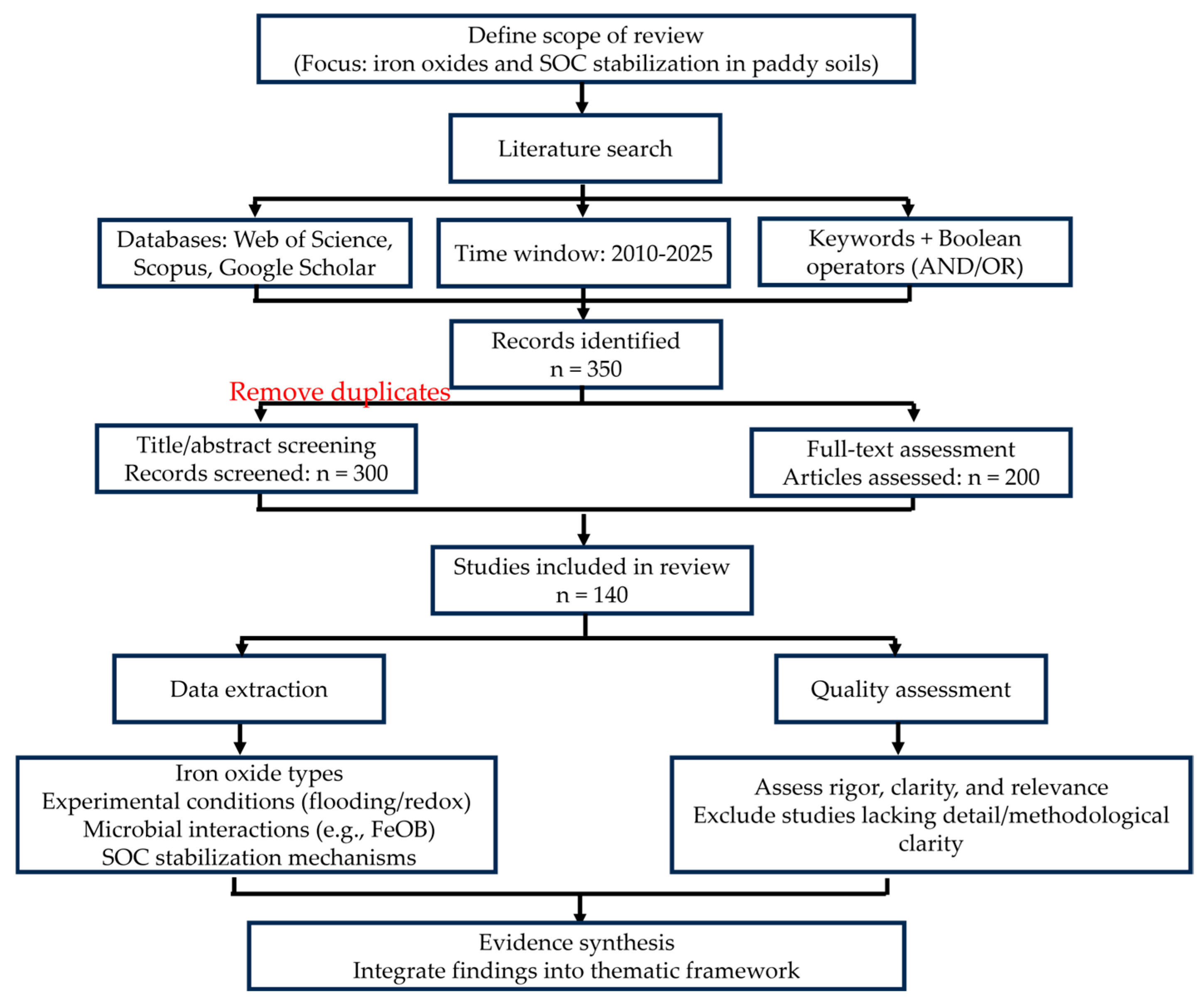
This review synthesizes current knowledge on the role of iron oxide transformations in SOC stabilization in paddy soils. The literature included in this review was selected based on a systematic search and screening process (Figure 1), which is outlined below.
Figure 1.
Flowchart of references screening method.
- Literature Search Strategy
A comprehensive literature search was conducted using the following databases: Web of Science, Scopus, and Google Scholar. The search was limited to studies published between 2010 and 2025 to ensure the inclusion of the most recent research. Keywords used in the search included “iron oxides,” “iron oxide transformations,” “paddy soils,” “soil organic carbon stabilization,” and related terms. Boolean operators (AND/OR) were used to combine the keywords effectively.
- Inclusion and Exclusion Criteria
Inclusion Criteria: Studies were included if they focused on the role of iron oxides in SOC stabilization within paddy soils, provided experimental or field-based data, or discussed the mechanisms of iron cycling (oxidation/reduction processes).
Exclusion Criteria: Studies were excluded if they focused on non-paddy soil ecosystems, did not address iron oxide interactions with SOC, or lacked sufficient experimental detail or data on iron species involved in the SOC stabilization processes.
- Screening Process
The initial search yielded 350 articles. After removing duplicates, 300 articles were screened based on titles and abstracts. Following the abstract screening, 200 articles were selected for full-text evaluation. After thorough review, 140 studies met the inclusion criteria and were retained for this review.
- Data Extraction
Relevant data were extracted from the selected studies, focusing on the types of iron oxides studied, experimental conditions (e.g., flooding, redox conditions), the role of microbial interactions (e.g., iron-oxidizing bacteria (FeOB)), and the findings related to SOC stabilization mechanisms.
- Quality Assessment
Studies were evaluated based on their experimental rigor, the clarity of their findings, and their relevance to the topic. Studies lacking sufficient detail or methodological clarity were excluded from the final analysis.
3. Sources, Sink Functions and Stabilization Mechanisms of SOC in Paddy Soils
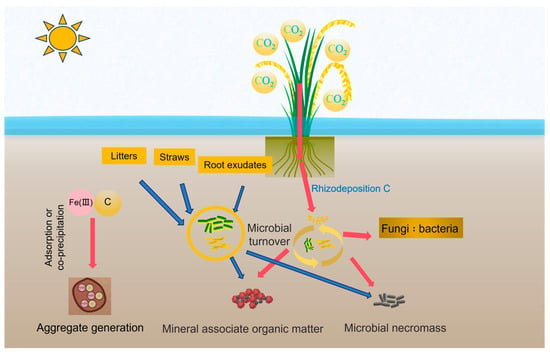
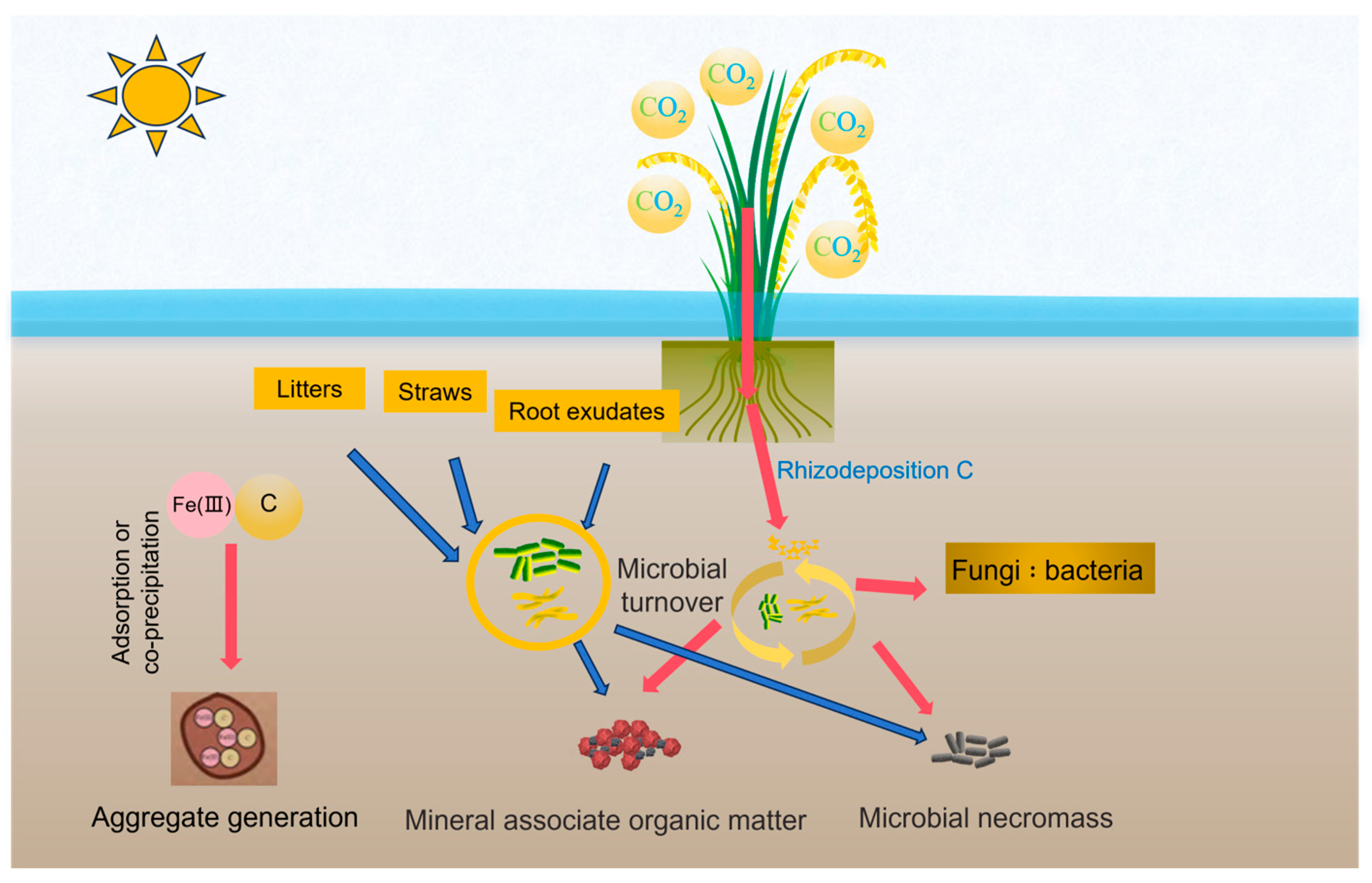
Paddy ecosystems simultaneously function as both carbon sources and sinks [3,17]. labile organic carbon (LOC) contribute to rapid turnover and short-term nutrient cycling, while resistant organic carbon (ROC) play a key role in maintaining soil structure and fertility over longer timescales, ensuring sustainable agricultural productivity [12]. In flooded paddy soils, the main sources of SOC are plant residues and microbial biomass, both of which contribute significantly to the long-term carbon storage potential of these soils [3]. Agronomic practices, especially the application of organic manures, further promote SOC accumulation by increasing external carbon inputs and stimulating microbial activity [9,18]. Once incorporated into the soil, carbon is retained in various forms, including plant residues, microbial necromass, aromatic structures, and humic macromolecules. Long-term preservation of SOC relies on a synergistic interplay of aggregate occlusion, mineral complexation, and microbial transformation (Figure 2) [19,20]. At the same time, these mechanisms maintain the carbon reservoir in paddy ecosystems.
Figure 2.
Conceptual model of carbon inputs and Fe–OM–microbe interactions in flooded paddy soils. Plant litter, straw, and root exudates provide organic substrates for microbial growth and rhizodeposition carbon in the rhizosphere. Microbial turnover produces mineral-associated organic matter and microbial necromass (black rod), part of which is stabilized through Fe(III)-C adsorption or co-precipitation and aggregate formation. Blue arrows indicate carbon input fluxes, whereas red arrows represent microbial transformation and stabilization pathways. The Fe(III)-C symbol denotes Fe-bound organic carbon. The red amorphous particles represent minerals, while the small black amorphous particles represent carbon bound to minerals [3,17].
3.1. Carbon Sources and Sink Functions in Paddy Soils
The SOC can be categorized into two main pools: labile organic carbon (LOC), which decomposes rapidly, and resistant organic carbon (ROC), which is more stable and plays a key role in maintaining long-term soil health [20]. LOC consists of dissolved organic carbon (DOC), microbial biomass carbon (MBC), and particulate organic carbon (POC), all of which are highly sensitive to environmental fluctuations and are decomposed at a faster rate [21,22]. In contrast, the relatively stable ROC is primarily composed of MAOC and highly condensed aromatic structures. These compounds are chemically stabilized via inner-sphere complexation or surface adsorption onto clay minerals and Fe/Al oxides, rendering them recalcitrant and pivotal to long-term soil structure and fertility [19,23,24,25]. Due to its slow turnover, MAOC represents a disproportionately effective leverage point for long-term carbon sequestration and climate change mitigation [26].
Pronounced vertical stratification characterizes SOC fractions within paddy profiles. In a subtropical paddy soil, MAOC represented up to 90% of total SOC at 50–70 cm depth, whereas the relative abundance of LOC fractions fell sharply with depth [27]. Conversely, Jiang et al. (2023) documented a decline in MAOC from 49.5% in the surface horizon to 33.0% at 80–100 cm, accompanied by an increase in POC from 50.6% to 67.0% [28]. Such contrasting depth trends underscore the co-control exerted by mineralogy, physical stratification, regional climate, cultivation history and water-management regime on the architecture and persistence of carbon stocks in paddy soils [4,17,27].
3.2. Mineralization of SOC in Paddy Soils
The mineralization of organic carbon in paddy soils is a key process in the soil carbon output, where organic carbon compounds in the soil are converted into inorganic carbon compounds [29]. This process plays an extremely important role in the carbon cycle of paddy soil ecosystems. During the planting process of rice from the heading stage to the ripening stage, shallow, wet, and intermittent dry irrigation techniques are used to maintain the rice’s high assimilation capacity and vigorous root system. As a result, paddy soils undergo alternating dry and wet conditions followed by continuous flooding.
Long-term flooding may create more stringent anaerobic conditions in the paddy soils. Studies have found that the turnover rate of organic carbon in paddy soils under flooding conditions is higher than under aerobic conditions [30]. Additionally, research has shown that when dry land is converted to flooding management within a certain moisture range, the soil moisture content is positively correlated with organic carbon mineralization rates [31]. The type of organic carbon utilized by microorganisms also differs under varying moisture conditions. A study by Li et al. (2021) indicated that under flooding conditions, soil microorganisms primarily use amino acid-based carbon sources during the early stages of flooding, while in the later stages, they mainly use phenolic acids and amino acid-based carbon sources [32]. Under oxygen-rich conditions, microorganisms predominantly utilize polymeric carbon source [32]. When paddy soils remain flooded for extended periods, the oxygen concentration in the soil decreases, CO2 concentration increases, soil Eh decreases, and ammonia nitrogen accumulates. This is accompanied by the reduction of NO3−, SO42−, Fe3+, and Mn4+, which affects the solubility of iron, manganese, and phosphate in paddy fields and alters soil pH [33]. Under long-term flooding, when paddy soils are in an anaerobic state, the Eh decreases, and anaerobic microorganisms dominate the soil, slowing down organic matter decomposition. When the oxygen content in the soil further decreases and reaches strict anaerobic conditions, soil reduction increases. At lower soil Eh, organic matter decomposition becomes incomplete, producing methane and large amounts of harmful intermediate products (such as organic acids, hydrogen sulfide, lactic acid, formic acid, acetic acid, and propionic acid) that are detrimental to crops [34].
3.3. Long-Term Stabilization of SOC in Paddy Systems
The persistence of SOC in flooded soils depends on three interrelated processes. Physical occlusion within aggregates restricts contact between fresh carbon inputs, decomposers, and the atmosphere, slowing the decomposition of SOC [35,36,37]. Chemical bonding, mediated by ligand exchange, sorption, and co-precipitation, forms organo-mineral complexes that further slow decomposition [38,39,40]. Additionally, changes in microbial community structure and function regulate substrate turnover, while the gradual accumulation of microbial necromass supplies a durable carbon sink [41,42,43]. Together, these physical, chemical, and biological processes drive SOC accumulation, contributing to the long-term sustainability of paddy soils and supporting essential ecosystem services such as soil fertility and carbon sequestration [4].
3.3.1. Aggregate-Mediated Protection
Soil aggregates, formed through the binding of mineral particles by organic matter, are fundamental structural units that regulate key ecosystem functions [20,44]. These include the long-term stabilization of SOC and the retention of essential nutrients. Based on size, soil aggregates are commonly classified into macroaggregates (>250 µm), microaggregates (53–250 µm), and the silt and clay fraction (<53 µm) [23,45]. This physical hierarchy parallels the partitioning of SOC pools into coarse particulate organic carbon (cPOC, >250 µm), fine particulate organic carbon (fPOC, 53–250 µm), and MAOC (<53 µm) [46,47].
In paddy soils, prolonged flooding stabilizes the aggregate framework. Physical occlusion limits microbial attack and atmospheric exchange, markedly lowering SOC mineralization rates [23]. Enhanced aggregation also improves water retention and aeration, reinforcing structural integrity and further protecting SOC [48]. Micropores within aggregates restrict microbial access, reducing the likelihood of carbon decomposition [49]. During growth, rice roots both promote aggregate formation and drive cycles of fragmentation and reassembly, sustaining a dynamic yet steady turnover of organic carbon [20,23]. Encapsulation of SOC is most evident in the cPOC and fPOC fractions [20,24]. Whereas macroaggregates dominate SOC storage in upland soils, paddy soils are typically richer in microaggregates and silt-plus-clay particles [50]. This finer soil matrix accumulates greater amounts of photosynthetically fixed carbon and offers extensive specific surface area that promotes adsorption and long-term SOC stabilization [51].
3.3.2. Organic Matter Mineral Complexation as a Chemical Protection Pathway
Within aggregates, reactive mineral surfaces promote the accumulation of organic carbon through chemical adsorption and complexation [46,52]. Chemical protection is expressed primarily in the MAOC fraction. Within individual aggregates, reactive mineral surfaces adsorb SOC and promote the formation of organic matter mineral complexes that are largely inaccessible to microbial enzymes [53]. This mechanism effectively prolongs the residence time of SOC. In paddy soils, the abundant iron oxides catalyze oxidative and covalent polymerization of low molecular weight organic molecules into larger macromolecules [54,55]. Under reducing conditions, these polymers tend to coagulate or adsorb onto clay particles, processes that collectively enhance SOC stabilization [56]. Recurrent shifts between oxic and anoxic conditions dissolve existing iron oxides and promote their re-precipitation [57]. This cyclical process disrupts and reconstructs soil aggregates, exposes fresh reactive surfaces, and increases the contact between iron oxides and organic substrates [58,59].
Adsorption and co-precipitation with DOC produce OC-Fe complexes that further stabilize carbon [5,52]. These chemical bonds form within aggregates, causing the resulting OC-Fe and other organic matter mineral complexes to become physically integrated into the aggregate structure. Physical occlusion provides an additional barrier to microbial decomposition, further reinforcing the long-term stability of SOC [60].
3.3.3. Microbial Necromass Pathway for SOC Stabilization
Carbon within microbial residues is generally considered the most persistent fraction of SOC, often showing greater stability than plant-derived carbon. Such persistence is largely attributed to the close association of microbial residues with soil minerals within aggregates, physical protection afforded by organo-mineral complexes, and the gradual accumulation of residues through continuous microbial turnover [61,62,63,64]. Pulse-labelling with 13C-labelled CO2 illustrates this contribution. After 110 days of continuous labelling, illuminated paddy soils stored 105.0 to 133.8 mg kg−1 of 13C-SOC, exceeding the storage measured in upland soils. These results indicate a stronger microbial capacity for SOC fixation under flooded conditions [18].
Microbial activity is heavily influenced by soil redox conditions and plays a crucial role in SOC stability. In flooded, anoxic paddy soils, plant residues decompose slowly, which helps retain plant-derived carbon [6,15,65]. In flooded, anoxic paddy soils, plant residues decompose slowly, promoting the retention of plant-derived carbon [4,7]. When soils are drained and oxygen becomes available, microbial activity increases, decomposition accelerates, and a greater proportion of SOC is transformed into microbial residues [66].
Flooded paddy soils also develop distinctive aggregation and organo-mineral interactions [44,57]. Repeated redox fluctuations fragment large aggregates, highlighting the importance of microaggregate formation and strong mineral–organic associations, especially with iron oxides, in safeguarding carbon [58,67]. At the same time, microbial transformation of plant detritus and biomass into persistent humic substances makes a substantial contribution to SOC stability [63]. The precise pathways and relative importance of these mechanisms remain incompletely understood. For example, it is still unclear how microbially derived humic substances bind to iron minerals, or under what conditions physical occlusion offers more protection than chemical adsorption. Resolving these uncertainties will require integrated approaches that couple detailed molecular characterization of SOM with targeted experiments capable of isolating specific stabilization pathways under field-relevant conditions.
4. Mineralogical Characteristics and Dynamics of Iron Oxides in Paddy Soils
4.1. Redox Dynamics Influence on Iron Cycling in Paddy Soils
Iron in paddy soils is primarily found in two forms: Fe2+ and Fe3+. These forms are influenced by environmental factors such as soil pH, oxygen levels, and Eh, which govern iron’s role in soil processes [37]. In soils with little oxygen (anaerobic conditions), Fe2+ remains stable [37]. In oxygen-rich environments (aerobic conditions), Fe2+ reacts with oxygen and changes into Fe3+, which is less soluble and tends to form insoluble iron oxides and hydroxides with different chemical properties, such as a higher capacity to adsorb organic carbon [5]. The oxidation rate of Fe2+ is influenced by factors such as temperature, pH, dissolved oxygen, and the concentration of Fe2+ [68]. At pH values below 4, the oxidation rate of Fe2+ is slow, even in the presence of oxygen [5,69]. And this rate increases significantly under alkaline conditions. In anaerobic, neutral conditions, microbial activity primarily drives Fe2+ oxidation, often coupled with electron acceptors such as NO3−, ClO3−, and ClO4−. These microorganisms are capable of oxidizing not only dissolved Fe2+ but also ferrous iron in solid and mineral forms, such as FeCO3 [69]. In illuminated environments, photoautotrophic ferrous oxidizing bacteria can also oxidize Fe2+ while using CO2 as a carbon source [70]. Under microaerophilic, neutral conditions, microaerophilic Fe2+-oxidizing bacteria compete with non-biological oxidation of O2 and Fe2+, thereby mediating ferrous oxidation, which is crucial for iron cycling in aerobic environments [71]. In flooded soils, with an Eh of around 120 mV, Fe3+ is reduced to Fe2+ [14].
4.2. Chemical Extraction Procedures for Iron Oxide Fractional in Paddy Soils
In paddy soils, iron appears in several forms: as free iron oxides (Fed), as amorphous (poorly crystallized) iron oxides (Feo), and as iron bound to organic molecules or minerals (Fep) [5]. Fed is commonly extracted using the dithionite-citrate-bicarbonate (DCB) method, which targets the reducible pool of “free” iron oxides, including highly reactive colloidal amorphous phases and crystalline minerals such as goethite and hematite [72,73]. This method also serves as an integrative indicator of the total abundance of iron oxides and their eluviation-illuviation dynamics [74]. Feo refers to the fraction extracted by acid ammonium oxalate, representing poorly crystalline or amorphous iron oxides that lack distinct XRD diffraction peaks [75]. This pool broadly reflects re-precipitated and newly formed iron minerals, together with part of the short-range ordered phases that readily undergo dissolution and reconfiguration in response to pH-Eh fluctuations [76,77]. Fep refers to the fraction of organically complexed or coated iron extracted by sodium pyrophosphate [78]. While not fully soluble in oxalate, it plays a key role in iron translocation, colloidal transport, and the formation of organo-mineral complexes [78,79].
Within this framework, the difference between Fed and Feo is often approximated as crystalline iron (Fec), providing an operational index of more crystalline iron oxide forms that is conceptually linked to the sequential extraction scheme of Poulton and Canfield and widely applied in contemporary geochemical modelling [80]. Spectroscopic analyses indicate that pyrophosphate may lead to the excessive extraction of humus-bound Fe and Al [81]. However, sequential extraction and isotopic evidence suggest that the mobile organic matter iron complexes identified in the Fep fraction contribute significantly to organic matter mineral associations and play a key role in long term carbon sequestration [82]. Taken together, the Fed-Feo-Fep (and derived Fec) indices constitute a complementary suite of metrics constraining the balance between crystalline and amorphous phases, the degree of organic complexation, and gradients in Fe reactivity, thereby providing a foundational framework for elucidating iron cycling in paddy soils [83,84].
4.3. Iron Oxides Commonly Found in Paddy Soils
At the mineralogical scale, the dominant iron oxide phases in paddy soils comprise ferrihydrite (Fe5HO8·4H2O), lepidocrocite (γ-FeOOH), goethite (α-FeOOH), hematite (α-Fe2O3), and magnetite (Fe3O4) with their composition and spatial distribution highly sensitive to redox conditions [85,86]. Their crystal structures and principal physicochemical properties are summarized in Figure 3 and Table 1.
Table 1.
Naturally occurring iron oxides [85,86,87,88,89,90].
Figure 3.
Schematic diagram of the crystal structures of common iron oxides in soils, including ferrihydrite, goethite, hematite, lepidocrocite, and magnetite [14,85,86,88,89]. a, b, c are the coordinate axes of the unit cell spatial coordinate system representing the crystal structure.
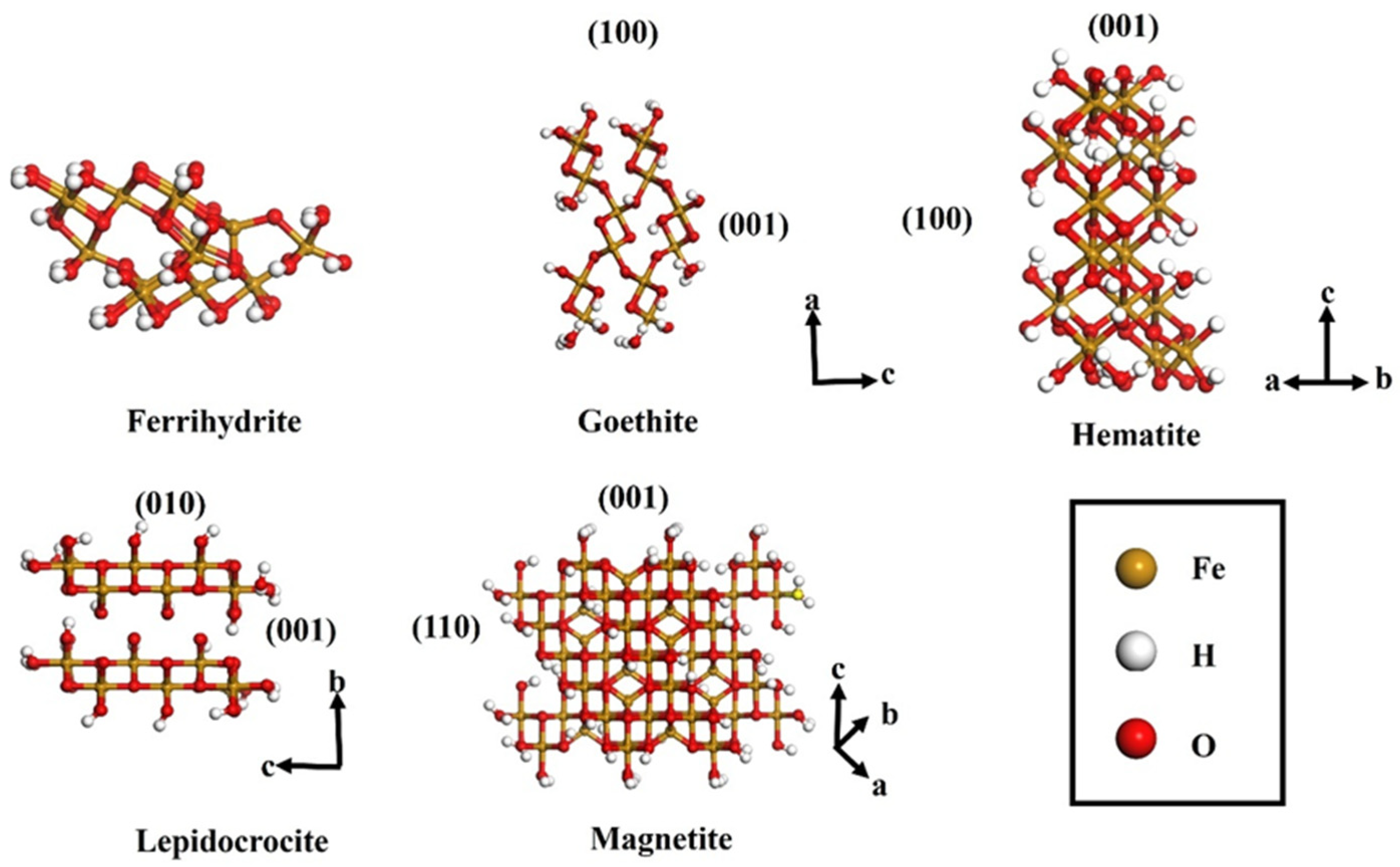
Ferrihydrite, characterized by its high specific surface area and poor crystallinity, commonly acts as a transient precursor to more stable crystalline phases and is repeatedly generated and transformed under periodic flooding [89]. Under drained or oxic conditions, ferrihydrite and dissolved Fe2+ rapidly transform to goethite and lepidocrocite; among these, goethite is thermodynamically more stable and thus tends to dominate in long-term paddy cultivation systems [90], whereas lepidocrocite is preferentially enriched in microenvironments such as the rhizosphere and structural surfaces where redox conditions oscillate intensely [91]. Hematite formation generally requires stronger and more persistent oxidizing conditions, resulting in limited abundance in continuously flooded or poorly drained paddies but a more frequent occurrence under upland-rice rotations or well-drained regimes [86]. Magnetite and maghemite typically occur in trace amounts and are often linked to specific parent materials, localized intense reduction, or microbially mediated transformations [85]. Collectively, the rates and pathways of interconversion among these phases exert first order control on the reactivity of the iron oxide pool and its capacity to stabilize associated organic carbon.
5. Impact of Iron Oxide Structural Transformations on Persistent SOC Stabilization in Paddy Soils
The following subsections synthesize how iron oxide phase and structural transformations contribute to long-term SOC stabilization through three interlinked pathways: (i) aggregate-scale physical protection mediated by iron oxides [92,93]; (ii) chemical stabilization via the formation, restructuring and persistence of OC-Fe associations [52,94]; and (iii) feedbacks between iron redox cycling, microbial metabolism and SOC turnover [93,95].
5.1. Aggregate-Scale Influence of Iron Oxides on SOC Stabilization
Iron oxides act as binding agents or form organo-mineral complexes, promoting aggregate formation and restricting microbial and enzymatic access to SOC, thereby favoring long-term carbon storage [44]. Their large specific surface area (SSA), abundant surface hydroxyl groups, and high sorption capacity enable iron oxides to readily interact with SOC through mechanisms such as adsorption and co-precipitation [52]. These processes promote the formation of OC-Fe complexes.
5.1.1. Physical Pathway: Promotion of Aggregate Formation
Alternating wetting and drying cycles drive iron redox transformations and the repeated formation and breakdown of soil aggregates. These processes play a central role in regulating SOC sequestration within aggregate interiors. During flooding, declining oxygen creates reducing conditions that promote the reduction of Fe3+ oxides to soluble Fe2+. The resulting Fe2+ readily interacts with SOC in the pore water, facilitating its adsorption and potential stabilization [96]. After drainage, oxygen re-enters the soil, oxidizing Fe2+ to Fe3+ oxides and generating amorphous or organic complexed forms [57,97]. When aggregates disintegrate, fresh mineral surfaces are exposed, promoting the binding of aromatic carbon to iron minerals. These newly formed complexes are subsequently embedded and protected during soil re-aggregation [57]. The structure of iron oxides produced during redox oscillations directly influences soil aggregation [98,99].
5.1.2. Chemical Pathway: Formation of OC-Fe Complexes
Globally, OC-Fe complexes account for roughly one quarter of total SOC, equivalent to about 58.7 Pg [8]. The high abundance of iron oxides in paddy soils plays a crucial role in carbon retention [55]. Iron oxides react with DOC through adsorption or co-precipitation to form OC-Fe complexes that stabilize SOC [5,52]. Adsorption of organic matter onto iron oxides is predominantly mediated by inner-sphere ligand exchange, whereby deprotonated carboxylate and phenolic hydroxyl groups replace surface hydroxyls (≡Fe-OH) to form strong Fe-O-C bonds, while additional outer-sphere electrostatic interactions, hydrogen bonding and cation bridging also contribute to weaker associations [52]. Owing to the saturation of available sorption sites, the maximum amount of OC that iron oxides can retain is constrained, with a molar C/Fe ratio typically approaching 1 [100,101]. Co-precipitation arises from changes in pH or Eh, leading to the formation of insoluble Fe3+-organic complexes. In flooded paddy soils, intensive Fe redox cycling promotes the co-precipitation of Fe2+/Fe3+ with DOM, where organic ligands modulate Fe polyhedral linkage, generate defective or short-range ordered structures (e.g., ferrihydrite-like phases), and partially inhibit the transformation to more crystalline goethite or hematite [102]. During subsequent oxidation-reduction cycles, these OC-laden precursors may recrystallize into finely grained, strain-rich iron oxides or composite phases, in which OC is intercalated, occluded within nanopores, or trapped along crystal boundaries, thereby reorganizing the internal structure and crystallographic domains of iron oxides and enhancing the persistence of OC-Fe in paddy soils [103]. In this case, OC is not only adsorbed onto the mineral surface but may also be incorporated into the mineral matrix or occlude reactive sites, thereby altering the internal structure and crystallographic properties of the iron oxides [94,104,105]. Successive cycles of iron reduction, secondary mineral formation and periodic carbon diffusion create onion-like layers in which the C/Fe ratio can reach 6 to 10 [106,107,108].
5.2. Structural and Morphological Evolution of Iron Oxides and Its Influence on SOC Stabilization
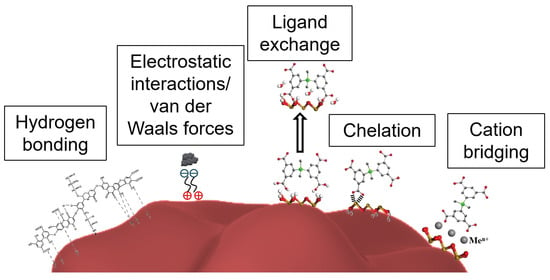
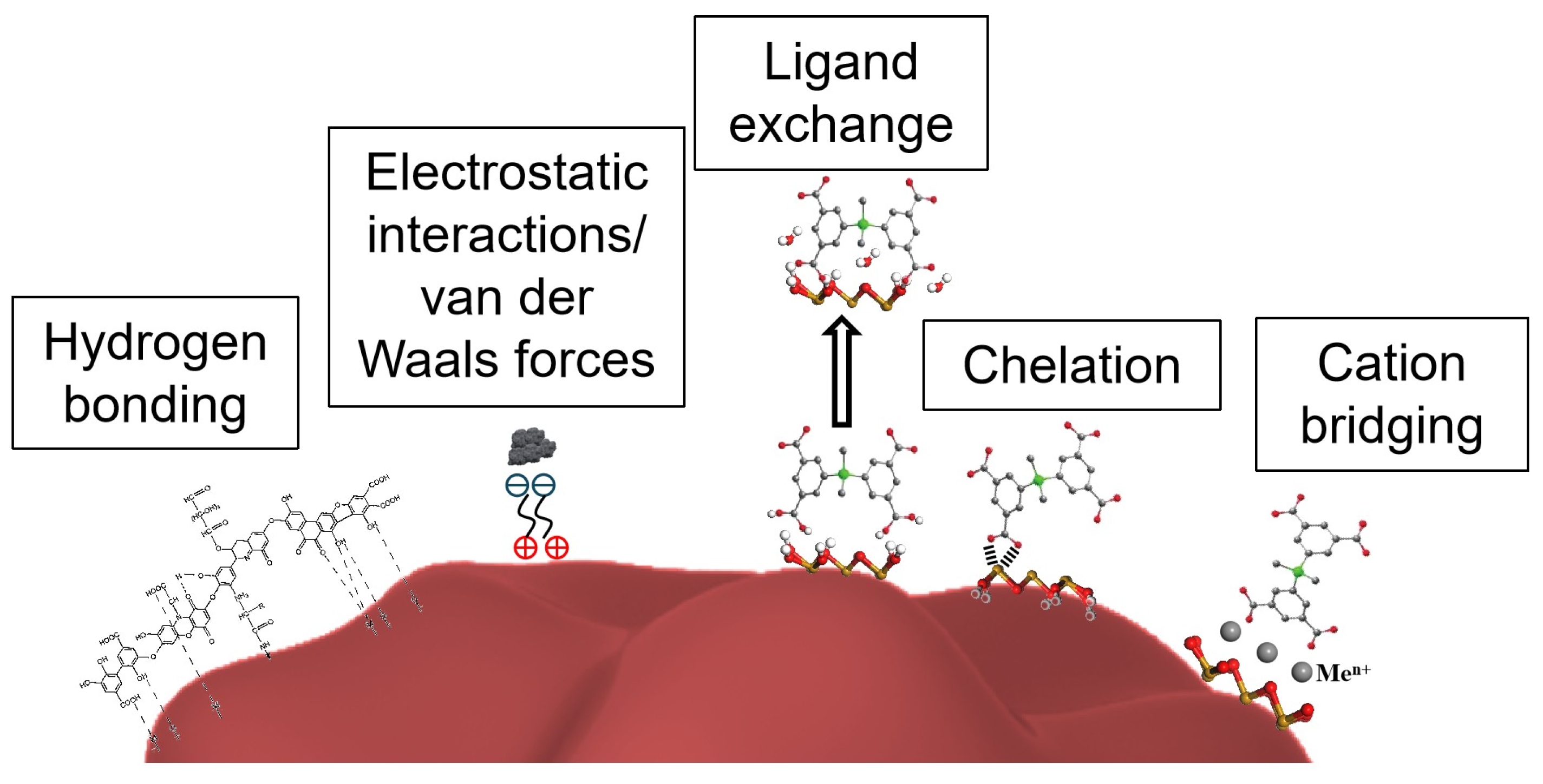
The formation pathways of OC-Fe complexes are largely governed by the surface chemistry of specific iron oxide minerals (Figure 4). In ferrihydrite, DOC sorption generally increases with temperature due to enhanced diffusion and reaction rates [109]. Goethite and hematite preferentially bind aromatic and carboxyl rich organic compounds via inner-sphere complexation, while lepidocrocite and magnetite interactions are strongly influenced by carboxyl group density, molecular conformation and pH [110]. Overall, short-range ordered iron oxides exhibit higher sorption capacities and greater sensitivity to redox- and pH-driven transformation, whereas well-crystallized phases such as hematite display more stable sorption behavior across moderate environmental fluctuations [111].
Figure 4.
Conceptual mechanisms of organic matter association with ferrihydrite surfaces. The red amorphous surface represents reactive ferrihydrite surfaces. Stick models illustrate representative organic ligands. The main interaction mechanisms include hydrogen bonding, electrostatic interactions/van der Waals forces, ligand exchange, chelation, and cation bridging. Grey spheres (Men+) denote polyvalent metal cations that act as bridges between negatively charged functional groups on minerals and organic matter [14].
Mineral phase transformation inherently entails coupled changes in both crystal structure and particle morphology. During Fe2+-induced transformation of ferrihydrite, only minor carbon loss is observed. However, the increase in H2PO4-extractable organic carbon suggests a decline in MAOC stability [106]. Ageing of ferrihydrite–humic acid co-precipitates result in a modest yet continuous release of carbon into solution under both oxic and anoxic conditions [112,113]. Comparable carbon loss is observed when ferrihydrite transforms into goethite or hematite [113]. Along the transformation pathway from ferrihydrite to lepidocrocite, SOC forms inner-sphere complexes where carboxyl and related functional groups coordinate with surface Fe3+. This strengthens the mineral–organic bond and reduces the likelihood of desorption or degradation [114]. The formation of magnetite usually produces aggregated particles that trap fulvic acids within surface pores and lattice defects, thereby enhancing their retention [114]. These studies demonstrate that crystal structure transitions and morphological changes jointly regulate SOC stability.
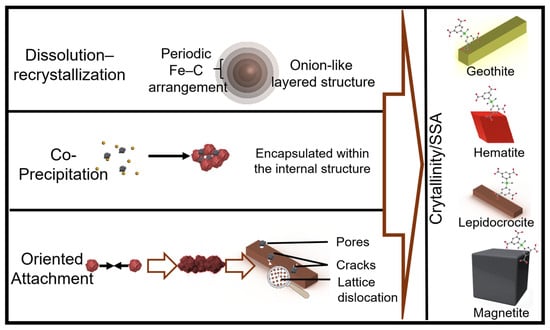
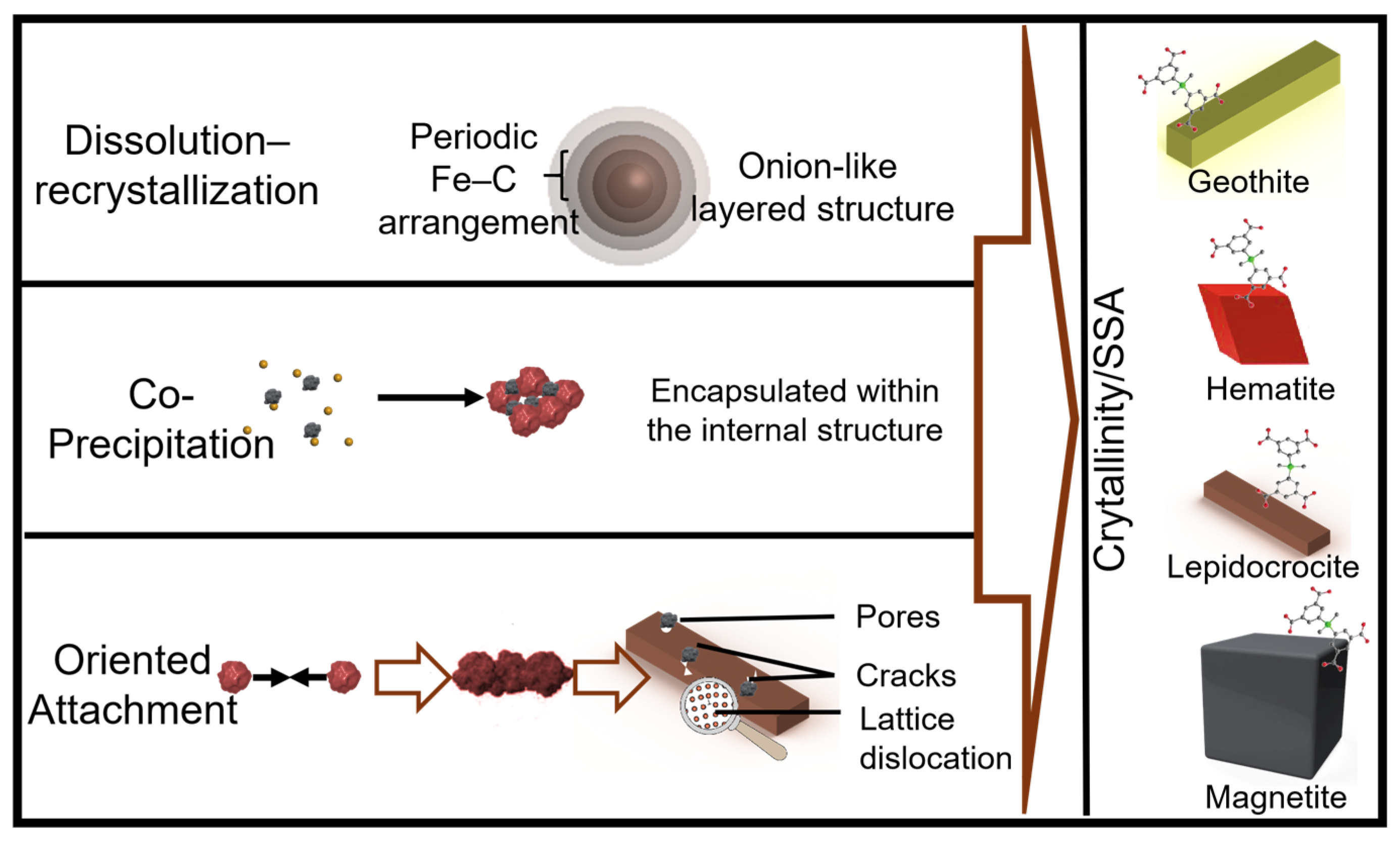
Morphological evolution influences SOC not only by altering SSA but also through the underlying crystal growth mechanism. Classical dissolve-reprecipitate pathways erode mineral surfaces and release bound carbon [115]. Fluctuating hydrological regimes impose alternating redox conditions that drive repeated cycles of dissolution, organic matter adsorption and surface recrystallisation [67]. These processes generate an onion-like architecture that promotes carbon preservation (Figure 5) [30]. Non-classical routes such as particle to particle oriented attachment also occur. Which pathway dominates depends on factors such as temperature, Fe2+ concentration and the presence of organic ligands. These routes yield products rich in lattice defects, pores and fractures [116,117,118], features that enhance the adsorptive and co-precipitative capacity of iron oxides for SOC [114]. Dynamic coupling between crystal growth and structural transformation therefore exerts a primary control on the long-term stabilization of organic carbon in paddy soils.
Figure 5.
Schematic representation of Fe oxide formation and OC-Fe oxide associations. Primary Fe(III) polymers aggregate into short-range-ordered Fe oxides, which progressively transform into more crystalline phases during pedogenesis. The panels on the right show representative organic ligands bound to different Fe oxides, including goethite, hematite, lepidocrocite, and magnetite. The brown bracket qualitatively indicates the trend of increasing crystallinity and decreasing SSA along this transformation sequence [114,118,119].
5.3. Influence of the Iron Redox Cycle on SOC Stabilization
Iron oxides immobilize organic carbon by fostering aggregate formation and generating OC-Fe complexes, both of which restrict microbial access to SOC [44,120]. In flooded paddy soils, however, the bulk soil is anoxic. Rice roots adapt to submergence by transporting stored O2 through aerenchyma to the rhizosphere, where the gas oxidizes Fe2+ to Fe3+. The precipitated Fe3+ accumulates on root surfaces as an “iron plaque”, which provides a continuous supply of electron acceptors for microbial Fe3+ reduction [121]. This root-driven Fe2+-Fe3+ cycle links microbial energy generation to SOC turnover [121]. Microorganisms harvest energy from electron transfer that accompanies the Fe2+-Fe3+ redox couple, and they use soil organic carbon as an additional substrate to fuel their metabolism; together, these processes indirectly shape the stability of SOC [122,123,124,125].
5.3.1. Fe2+ Oxidation and Its Influence on SOC Stabilization
Microorganisms form the core biological engine of iron redox cycling in paddy soils and exert decisive control over the stabilization or mineralization of SOC. Among them, iron-oxidizing bacteria (FeOB) (Table 2) and iron-reducing bacteria (FeRB) constitute two functional guilds with contrasting metabolisms that directly shape Fe–C coupling under fluctuating redox regimes [6,15].
Table 2.
Metabolic traits of Fe2+-oxidizing microorganisms [6,126,127,128,129,130].
FeOB-including microaerophilic Gallionellaceae, Acidithiobacillus ferrooxidans, Pseudomonas spp., and photoferrotrophs-use Fe2+ as an electron donor and precipitate highly reactive Fe3+ oxides that strongly associate with organic matter via inner-sphere complexation, co-precipitation, and aggregation [52,131,132,133]. In the rhizosphere, oxygen leakage further stimulates FeOB activity and promotes the formation of Fe plaques that serve as persistent reservoirs of sorptive Fe(III) phases.
FeOB-mediated Fe2+ oxidation also produces reactive oxygen species (ROS), creating strong selective pressure on microbial communities. Most FeRB (e.g., Geobacter, Shewanella) are obligate anaerobes with low oxidative-stress tolerance, whereas many FeOB thrive under microaerophilic or oxic conditions [134]. Thus, redox oscillations impose a “biological filter” that shifts the balance between FeOB and FeRB, determining whether the Fe cycle favors SOC stabilization through Fe(III) regeneration or SOC mineralization through Fe(III) reduction [56,124,125].
In addition to their direct redox metabolism, iron-cycling microorganisms influence SOC turnover by regulating extracellular enzyme systems. Under aerated conditions, phenol oxidase uses O2 as a terminal electron acceptor, decomposing phenolic inhibitors and enhancing hydrolase activity—an “enzyme-latch” effect that accelerates SOC decomposition [127,128]. In contrast, during re-oxygenation after anoxic periods, rapid Fe2+ oxidation reduces Fe2+ availability and suppresses phenol oxidase activity, leading to the accumulation of aromatic compounds that inhibit hydrolases. This “iron-gate” mechanism slows SOC breakdown and demonstrates how FeOB modulate both mineralogical and biochemical pathways of SOC stabilization [99,129].
Collectively, the interactions among FeOB, FeRB, extracellular enzymes, ROS dynamics, and mineral transformations form an integrated microbial–mineral feedback system that regulates SOC persistence in paddy soils. Future work combining metagenomics, isotopic tracing, and synchrotron spectroscopy is needed to resolve the co-evolving microbial and mineral processes that underpin long-term SOC stabilization.
5.3.2. Fe3+ Reduction and Its Influence on SOC Stabilization
In anoxic environments, coupled abiotic and biotic reduction of structural Fe3+ in minerals provides an important route for SOC oxidation [119,135,136]. Laboratory studies typically use iron hydroxides as electron acceptors with organic matter and sometimes H2 as electron donors [6]. Both respiratory and fermentative microbes catalyse Fe3+ reduction, though respiration provides the majority of cellular energy (Table 3) [101]. Fermenters transfer fewer reducing equivalents; Fe3+ reduction in these organisms helps dispose of excess electrons and buffers pH [137,138,139]. Field observations confirm that Fe3+ reduction can drive SOC turnover, for example, through the dissolution of iron minerals in peat soils (Table 3) [119]. However, quantitative data on the extent of SOC oxidation remain limited. In coastal wetlands with hydrological regimes similar to those of paddy soils, the contribution of dissimilatory Fe3+ reduction to anaerobic SOC oxidation correlates with the abundance of iron hydroxides, suggesting that frequent redox cycling and mineral regeneration play an important role in carbon respiration [13,140].
Table 3.
Overview of recent studies on iron oxide transformations and SOC stabilization in paddy soils and related redox-dynamic environments, including research gaps and future directions [6,13,15,30,37,44,46,52,56,58,73,77,82,92,93,94,103,104,106,111,115,119,121].
6. Conclusions
Paddy soils are dynamic redox systems in which iron oxides act as active regulators, influenced by management practices such as alternating flooding and drainage, fertilization, and organic inputs. These processes lead to continuous restructuring of iron oxide phases, governing the availability of reactive surfaces for organic carbon stabilization. Within this framework, paddy soils can accumulate substantial OC-Fe, but this capacity is intrinsically sensitive to imposed hydrological and nutrient regimes. Recent studies suggest that moderate, recurrent redox oscillations promote the renewal of short-range ordered OC-Fe complexes and enhance MAOC formation by facilitating aggregation and occlusion of organic matter and microbial residues. Excessive reduction or shifts toward more crystalline iron oxides weaken organo-mineral associations, increasing SOC vulnerability to microbial and oxidative loss. Balanced mineral fertilizers and organic inputs stabilize reactive OC-Fe complexes, while unbalanced or low-input regimes reduce sorption site diversity and erode the protective matrix. Therefore, SOC sequestration in paddy soils should be seen as the result of management-driven iron oxide phase transformations, rather than simply a function of bulk carbon inputs.
Future research should focus on: resolving the dynamics of OC-Fe interactions using advanced techniques, incorporating OC-Fe interactions into soil carbon models as management-sensitive pools, and translating these findings into climate-smart paddy management strategies to optimize MAOC retention and improve agricultural sustainability. Recognizing and deliberately harnessing iron oxide transformations in flooded paddy systems offers a concrete pathway to align agricultural production with long-term carbon sustainability.
Author Contributions
Conceptualization, X.L. and S.H.; methodology, X.G. and F.Z.; software, L.W.; investigation, Z.L. (Zhuoyi Li); writing—original draft preparation, X.G.; writing—review and editing, Y.H. and Y.L.; supervision, Y.L. and F.Z.; project administration, B.L. and Z.L. (Zuran Li); funding acquisition, S.H. All authors have read and agreed to the published version of the manuscript.
Funding
This research was funded by the National Natural Science Foundation of China, grant number 42507406 & 42367005, the Youth Project of Yunnan Provincial Basic Research Program grant number No. 202401AU070080 and Expert Workstation Project of Yunnan Province grant number 202305AF150042.
Data Availability Statement
No new data were created or analyzed in this study.
Conflicts of Interest
The authors declare no conflicts of interest.
References
- Zhang, G.; Gong, T. Pedogenic evolution of paddy soils in different soil landscapes. Geoderma 2003, 115, 15–19. [Google Scholar] [CrossRef] [Scilit]
- FAO. World Food and Agriculture—Statistical Yearbook 2023; FAO: Rome, Italy, 2023. [Google Scholar] [CrossRef] [Scilit]
- Kögel-Knabner, I.; Amelung, W.; Cao, Z.; Fiedler, S.; Frenzel, P.; Jahn, R.; Kalbitz, K.; Köbl, A.; Schloter, M. Biogeochemistry of paddy soils. Geoderma 2010, 157, 1–14. [Google Scholar] [CrossRef] [Scilit]
- Chen, X.; Hu, Y.; Xia, Y.; Zheng, Z.; Ma, C.; Rui, Y.; He, H.; Huang, D.; Zhang, Z.; Ge, T.; et al. Contrasting pathways of carbon sequestration in paddy and upland soils. Glob. Change Biol. 2021, 27, 2478–2490. [Google Scholar] [CrossRef] [Scilit]
- Jia, N.; Li, L.; Guo, H.; Xie, M. Important role of Fe oxides in global soil carbon stabilization and stocks. Nat. Commun. 2024, 15, 10318. [Google Scholar] [CrossRef] [Scilit]
- Dong, L.; Zeng, Q.; Sheng, Y.; Chen, C.; Yu, G.; Kappler, A. Coupled iron cycling and organic matter transformation across redox interfaces. Nat. Rev. Earth Environ. 2023, 4, 659–673. [Google Scholar] [CrossRef] [Scilit]
- Wei, L.; Ge, T.; Zhu, Z.; Luo, Y.; Yang, Y.; Xiao, M.; Yan, Z.; Li, Y.; Wu, J.; Kuzyakov, Y.L. Comparing carbon and nitrogen stocks in paddy and upland soils: Accumulation, stabilization mechanisms, and environmental drivers. Geoderma 2021, 398, 115121. [Google Scholar] [CrossRef] [Scilit]
- Zhang, Z.; Gao, H.; Gao, X.; Huang, S.; Niu, S.; Lugato, E.; Xia, X. Short-term warming supports mineral-associated carbon accrual in abandoned croplands. Nat. Commun. 2025, 16, 344. [Google Scholar] [CrossRef] [Scilit]
- Zhao, Y.; Liu, C.; Li, X.; Ma, L.; Zhai, G.; Feng, X. Sphagnum increases soil’s sequestration capacity of mineral-associated organic carbon via activating metal oxide. Nat. Commun. 2023, 14, 5052. [Google Scholar] [CrossRef] [Scilit]
- Wang, M.; Zhang, S.; Guo, X.; Xiao, L.; Yang, Y.; Luo, Y.; Mishra, U.; Luo, Z. Responses of soil organic carbon to climate extremes under warming across global biomes. Nat. Clim. Change 2024, 14, 98–105. [Google Scholar] [CrossRef] [Scilit]
- Lugato, E. Soil organic carbon losses exacerbated by climate extremes. Nat. Clim. Change 2024, 14, 17–18. [Google Scholar] [CrossRef] [Scilit]
- Wiesmeier, M.; Urbanski, L.; Hobley, E.; Lang, B.; von Lützow, M.; Marin-Spiotta, E.; Van Wesemael, B.; Rabot, E.; Liess, M.; Garcia-Franco, N.; et al. Soil organic carbon storage as a key function of soils—A review of drivers and indicators at various scales. Geoderma 2019, 333, 149–162. [Google Scholar] [CrossRef] [Scilit]
- Yu, C.; Xie, S.; Song, Z.; Xia, S.; Åström, M.E. Biogeochemical cycling of iron (hydr-)oxides and its impact on organic carbon turnover in coastal wetlands: A global synthesis and perspective. Earth-Sci. Rev. 2021, 218, 103658. [Google Scholar] [CrossRef] [Scilit]
- Carstens, J.F.; Bachmann, J.; Guggenberger, G. Aggregation and transport behavior of goethite colloids as affected by dissolved organic matter and pH: Electrostatic vs. hydrophilic interactions. Colloids Surf. A Physicochem. Eng. Asp. 2021, 609, 125647. [Google Scholar] [CrossRef] [Scilit]
- Kappler, A.; Bryce, C.; Mansor, M.; Lüder, U.; Byrne, J.M.; Swanner, E.D. An evolving view on biogeochemical cycling of iron. Nat. Rev. Microbiol. 2021, 19, 360–374. [Google Scholar] [CrossRef] [Scilit]
- Yang, S.; Ge, X.; Li, Y.; Ding, H.; Li, Y.; Wang, C.; Lu, A. Light-induced coupling process of Fe redox cycling and natural dissolved organic matters oxidative decomposition at goethite surface: Key role of reactive oxidative species. Chem. Geol. 2022, 603, 120928. [Google Scholar] [CrossRef] [Scilit]
- Liu, Y.; Ge, T.; van Groenigen, K.J.; Yang, Y.; Wang, P.; Cheng, K.; Zhu, Z.; Wang, J.; Li, Y.; Guggenberger, G.; et al. Rice paddy soils are a quantitatively important carbon store according to a global synthesis. Commun. Earth Environ. 2021, 2, 172. [Google Scholar] [CrossRef] [Scilit]
- Ge, T.; Wu, X.; Chen, X.; Yuan, H.; Zou, Z.; Li, B.; Zhou, P.; Liu, S.; Tong, C.; Brookes, P.C.; et al. Microbial phototrophic fixation of atmospheric CO2 in China subtropical upland and paddy soils. Geochim. Cosmochim. Acta 2013, 113, 70–78. [Google Scholar] [CrossRef] [Scilit]
- Schmidt, M.W.I.; Torn, M.S.; Abiven, S.; Dittmar, T.; Guggenberger, G.; Janssens, I.A.; Kleber, M.; Kögel-Knabner, I.; Lehmann, J.; Manning, D.A.C.; et al. Persistence of soil organic matter as an ecosystem property. Nature 2011, 478, 49–56. [Google Scholar] [CrossRef] [Scilit]
- Lehmann, J.; Hansel, C.M.; Kaiser, C.; Kleber, M.; Maher, K.; Manzoni, S.; Nunan, N.; Reichstein, M.; Schimel, J.P.; Torn, M.S.; et al. Persistence of soil organic carbon caused by functional complexity. Nat. Geosci. 2020, 13, 529–534. [Google Scholar] [CrossRef] [Scilit]
- Huang, R.; Lan, T.; Song, X.; Li, J.; Ling, J.; Deng, O.; Wang, C.; Gao, X.; Li, Q.; Tang, X.; et al. Soil labile organic carbon impacts C:N:P stoichiometry in urban park green spaces depending on vegetation types and time after planting. Appl. Soil Ecol. 2021, 163, 103926. [Google Scholar] [CrossRef] [Scilit]
- von Lützow, M.; Kögel-Knabner, I.; Ekschmitt, K.; Flessa, H.; Guggenberger, G.; Matzner, E.; Marschner, B. SOM fractionation methods: Relevance to functional pools and to stabilization mechanisms. Soil Biol. Biochem. 2007, 39, 2183–2207. [Google Scholar] [CrossRef] [Scilit]
- Six, J.; Bossuyt, H.; Degryze, S.; Denef, K. A history of research on the link between (micro)aggregates, soil biota, and soil organic matter dynamics. Soil Tillage Res. 2004, 79, 7–31. [Google Scholar] [CrossRef] [Scilit]
- Cotrufo, M.F.; Soong, J.L.; Horton, A.J.; Campbell, E.E.; Haddix, M.L.; Wall, D.H.; Parton, A.J. Formation of soil organic matter via biochemical and physical pathways of litter mass loss. Nat. Geosci. 2015, 8, 776–779. [Google Scholar] [CrossRef] [Scilit]
- Woolf, D.; Lehmann, J. Microbial models with minimal mineral protection can explain long-term soil organic carbon persistence. Sci. Rep. 2019, 9, 6522. [Google Scholar] [CrossRef] [Scilit]
- Tang, L.; Zhang, W.; Hu, P.; Ye, Y.; Xiao, J.; Zhao, J.; Chen, H.; Wang, K. Temperature effects on soil mineral-protected organic carbon are regulated by lithology in humid subtropical forests. Catena 2025, 250, 107810. [Google Scholar] [CrossRef] [Scilit]
- Schwarz, E.; Johansson, A.; Lerda, C.; Livsey, J.; Scaini, A.; Said-Pullicino, D.; Manzoni, S. Organic carbon stabilization in temperate paddy fields and adjacent semi-natural forests along a soil age gradient. Geoderma 2024, 443, 116825. [Google Scholar] [CrossRef] [Scilit]
- Jiang, S.; Liu, X.; Lu, Y.; Wu, J.; Zhang, L.; Wang, J.; Wu, W. Profile and nano-scale distribution of soil organic carbon for upland and paddy soils from an alluvial plain in South China. Chem. Geol. 2023, 640, 121740. [Google Scholar] [CrossRef] [Scilit]
- Borken, W.; Matzner, E. Reappraisal of drying and wetting effects on C and N mineralization and fluxes in soils. Glob. Change Biol. 2009, 15, 808–824. [Google Scholar] [CrossRef] [Scilit]
- Bi, Y.; Li, T.; Zhao, W.; Xue, L.; Lei, Y.; Zhang, Q.; Gao, X.; Li, X.; Yan, Z. Variations in Iron-bound carbon in Scirpus mariqueter rhizosphere and bulk soils across different salinities and tidal elevations. Plant Soil. 2024, 508, 99–115. [Google Scholar] [CrossRef] [Scilit]
- Yin, S.; Bai, J.; Wang, W.; Zhang, G.; Jia, J.; Cui, B.; Liu, X. Effects of soil moisture on carbon mineralization in floodplain wetlands with different flooding frequencies. J. Hydrol. 2019, 574, 1074–1084. [Google Scholar] [CrossRef] [Scilit]
- Li, C.; Liu, X.; Meng, M.; Zhai, L.; Zhang, B.; Jia, Z.; Gu, Z.; Liu, Q.; Zhang, Y.; Zhang, J. The use of Biolog Eco microplates to compare the effects of sulfuric and nitric acid rain on the metabolic functions of soil microbial communities in a subtropical plantation within the Yangtze River Delta region. Catena 2021, 198, 105039. [Google Scholar] [CrossRef] [Scilit]
- Tan, X.; Shao, D.; Liu, H.; Yang, F.; Xiao, C.; Yang, H. Effects of alternate wetting and drying irrigation on percolation and nitrogen leaching in paddy fields. Paddy Water Environ. 2013, 11, 381–395. [Google Scholar] [CrossRef] [Scilit]
- Beschkov, V.N.; Angelov, I.K. Volatile fatty acid production vs. methane and hydrogen in anaerobic digestion. Fermentation 2025, 11, 172. [Google Scholar] [CrossRef] [Scilit]
- Six, J.; Conant, R.T.; Paul, E.A.; Paustian, K. Stabilization mechanisms of soil organic matter: Implications for C-saturation of soils. Plant Soil. 2002, 241, 155–176. [Google Scholar] [CrossRef] [Scilit]
- Wagai, R.; Mayer, L.M.; Kitayama, K. Nature of the “occluded” low-density fraction in soil organic matter studies: A critical review. Soil Sci. Plant Nutr. 2009, 55, 13–25. [Google Scholar] [CrossRef] [Scilit]
- Xue, B.; Huang, L.; Huang, Y.; Zhou, F.; Li, F.; Kubar, K.A.; Li, X.; Lu, J.; Zhu, J. Roles of soil organic carbon and iron oxides on aggregate formation and stability in two paddy soils, Research. Soil Tillage Res. 2019, 187, 161–171. [Google Scholar] [CrossRef] [Scilit]
- Baldock, J.A.; Skjemstad, J.O. Role of the soil matrix and minerals in protecting natural organic materials against biological attack. Org. Geochem. 2000, 31, 697–710. [Google Scholar] [CrossRef] [Scilit]
- Lehmann, J.; Kleber, M. The contentious nature of soil organic matter. Nature 2015, 528, 60–68. [Google Scholar] [CrossRef] [Scilit]
- Kan, Z.R.; Liu, W.; Liu, W.; Lal, R.; Dang, Y.; Zhao, X.; Zhang, H. Mechanisms of soil organic carbon stability and its response to no-till: A global synthesis and perspective. Glob. Change Biol. 2022, 28, 693–710. [Google Scholar] [CrossRef] [Scilit]
- Cotrufo, M.F.; Wallenstein, M.D.; Boot, C.M.; Denef, K.; Paul, E. The Microbial Efficiency-Matrix Stabilization (MEMS) framework integrates plant litter decomposition with soil organic matter stabilization: Do labile plant inputs form stable soil organic matter? Glob. Change Biol. 2013, 19, 988–995. [Google Scholar] [CrossRef] [Scilit]
- Li, Z.; Duan, X.; Guo, X.; Gao, W.; Li, Y.; Zhou, P.; Zhu, Q.; O’Donnell, A.G.; Dai, K.; Wu, J.; et al. Microbial metabolic capacity regulates the accrual of mineral-associated organic carbon in subtropical paddy soils. Soil Biol. Biochem. 2024, 195, 109457. [Google Scholar] [CrossRef] [Scilit]
- Li, Z.; Wei, X.; Zhu, Z.; Fang, Y.; Yuan, H.; Li, Y.; Zhu, Q.; Guo, X.; Wu, J.; Kuzyakov, Y. Organic fertilizers incorporation increased microbial necromass accumulation more than mineral fertilization in paddy soil via altering microbial traits. Appl. Soil Ecol. 2024, 193, 105137. [Google Scholar] [CrossRef] [Scilit]
- Gu, W.; Wang, Y.; Sun, Y.; Liu, Z.; Wang, W.; Wu, D.; Zhang, Y.; Sun, W.; Wang, X.; Feng, Z.; et al. Assessing the formation and stability of paddy soil aggregate driven by organic carbon and Fe/Al oxides in rice straw cyclic utilization strategies: Insight from a six-year field trial. Sci. Total Environ. 2024, 951, 175607. [Google Scholar] [CrossRef] [Scilit]
- Tisdall, J.M.; Oades, J.M. Organic matter and water-stable aggregates in soils. J. Soil Sci. 1982, 33, 141–163. [Google Scholar] [CrossRef] [Scilit]
- Cotrufo, M.F.; Ranalli, M.G.; Haddix, M.L.; Six, J.; Lugato, E. Soil carbon storage informed by particulate and mineral-associated organic matter. Nat. Geosci. 2019, 12, 989–994. [Google Scholar] [CrossRef] [Scilit]
- Lavallee, J.M.; Soong, J.L.; Cotrufo, M.F. Conceptualizing soil organic matter into particulate and mineral-associated forms to address global change in the 21st century. Glob. Change Biol. 2020, 26, 261–273. [Google Scholar] [CrossRef] [Scilit]
- Jiang, X.; Wright, A.L.; Wang, X.; Liang, F. Tillage-induced changes in fungal and bacterial biomass associated with soil aggregates: A long-term field study in a subtropical rice soil in China. Appl. Soil Ecol. 2011, 48, 168–173. [Google Scholar] [CrossRef] [Scilit]
- Creamer, C.A.; Filley, T.R.; Boutton, T.W.; Oleynik, S.V.; Kantola, I.S. Controls on soil carbon accumulation during woody plant encroachment: Evidence from physical fractionation, soil respiration, and δ13C of respired CO2. Soil Biol. Biochem. 2011, 43, 1678–1687. [Google Scholar] [CrossRef] [Scilit]
- Six, J.; Elliott, E.; Paustian, K. Aggregate and Soil Organic Matter Dynamics under Conventional and No-Tillage Systems. Soil Sci. Soc. Am. J. 1999, 63, 1350–1358. [Google Scholar] [CrossRef] [Scilit]
- Atere, C.T.; Ge, T.; Zhu, Z.; Tong, C.; Jones, D.L.; Shibistova, O.; Guggenberger, G.; Wu, J. Rice rhizodeposition and carbon stabilisation in paddy soil are regulated via drying-rewetting cycles and nitrogen fertilisation. Biol. Fertil. Soils. 2017, 53, 407–417. [Google Scholar] [CrossRef] [Scilit]
- Kleber, M.; Bourg, I.C.; Coward, E.K.; Hansel, C.M.; Myneni, S.C.B.; Nunan, N. Dynamic interactions at the mineral–organic matter interface. Nat. Rev. Earth Environ. 2021, 2, 402–421. [Google Scholar] [CrossRef] [Scilit]
- Olk, D.; Cassman, K.G.; Schmidt-Rohr, K.; Anders, M.; Mao, J.D.; Deenik, J. Chemical stabilization of soil organic nitrogen by phenolic lignin residues in anaerobic agroecosystems. Soil Biol. Biochem. 2006, 38, 3303–3312. [Google Scholar] [CrossRef] [Scilit]
- Huang, X.; Kang, W.; Wang, L.; Yu, G.; Ran, W.; Hong, J.; Shen, Q. Vermiremediation of organically contaminated soils: Concepts, current status, and future perspectives. Appl. Soil Ecol. 2020, 147, 103377. [Google Scholar] [CrossRef] [Scilit]
- Niu, C.; Weng, L.; Lian, W.; Zhang, R.; Ma, J.; Chen, Y. Carbon sequestration in paddy soils: Contribution and mechanisms of mineral-associated SOC formation. Chemosphere 2023, 333, 138927. [Google Scholar] [CrossRef] [Scilit]
- Deng, L.; Peng, C.; Kim, D.G.; Li, J.; Liu, Y.; Hai, X.; Liu, Q.; Huang, C.; Shangguan, Z.; Kuzyakov, Y. Drought effects on soil carbon and nitrogen dynamics in global natural ecosystems. Earth-Sci. Rev. 2021, 214, 103501. [Google Scholar] [CrossRef] [Scilit]
- Huang, X.; Tang, H.; Kang, W.; Yu, G.; Ran, W.; Hong, J.; Shen, Q. Redox interface-associated organo-mineral interactions: A mechanism for C sequestration under a rice-wheat cropping system. Soil Biol. Biochem. 2018, 120, 12–23. [Google Scholar] [CrossRef] [Scilit]
- Possinger, A.R.; Bailey, S.W.; Inagaki, T.M.; Kögel-Knabner, I.; Dynes, J.J.; Arthur, Z.A.; Lehmann, J. Organo-mineral interactions and soil carbon mineralizability with variable saturation cycle frequency. Geoderma 2020, 375, 114483. [Google Scholar] [CrossRef] [Scilit]
- Cui, J.; Li, Z.; Liu, Z.; Ge, B.B.; Fang, C.; Zhou, C.; Tang, B. Physical and chemical stabilization of soil organic carbon along a 500-year cultived soil chronosequence originating from estuarine wetlands: Temporal patterns and land use effects. Agric. Ecosyst. Environ. 2014, 196, 10–20. [Google Scholar] [CrossRef] [Scilit]
- Six, J.; Schultz, P.A.; Jastrow, J.D.; Merckx, R. Recycling of sodium polytungstate used in soil organic matter studies. Soil Biol. Biochem. 1999, 31, 1193–1196. [Google Scholar] [CrossRef] [Scilit]
- Lundberg, P.; Ekblad, A.; Nilsson, M. 13C NMR spectroscopy studies of forest soil microbial activity: Glucose uptake and fatty acid biosynthesis. Soil Biol. Biochem. 2001, 33, 621–632. [Google Scholar] [CrossRef] [Scilit]
- Grandy, A.S.; Neff, J.C. Molecular C dynamics downstream: The biochemical decomposition sequence and its impact on soil organic matter structure and function. Sci. Total Environ. 2008, 404, 297–307. [Google Scholar] [CrossRef] [Scilit]
- Xu, Y.; Seshadri, B.; Sarkar, B.; Rumpel, C.; Sparks, D.; Bolan, N. Microbial control of soil carbon turnover. In The Future of Soil Carbon: Its Conservation and Formation; Bolan, N., Sarkar, B., Wang, Y., Eds.; Academic Press: London, UK, 2018; pp. 165–194. [Google Scholar] [CrossRef] [Scilit]
- Bian, Q.; Zhao, L.; Cheng, K.; Jiang, Y.; Li, D.; Xie, Z.; Sun, B.; Wang, X. Divergent accumulation of microbe- and plant-derived carbon in different soil organic matter fractions in paddy soils under long-term organic amendments. Agric. Ecosyst. Environ. 2024, 366, 108934. [Google Scholar] [CrossRef] [Scilit]
- Keiluweit, M.; Wanzek, T.; Kleber, M.; Nico, P.; Fendorf, S. Anaerobic microsites have an unaccounted role in soil carbon stabilization. Nat. Commun. 2017, 8, 1771. [Google Scholar] [CrossRef] [Scilit]
- Duan, X.; Rui, Y.; Xia, Y.; Hu, Y.; Ma, C.; Qiao, H.; Zeng, G.; Su, Y.; Wu, J.; Chen, X. Higher microbial C use efficiency in paddy than in adjacent upland soils: Evidence from continental scale. Soil Tillage Res. 2024, 235, 105932. [Google Scholar] [CrossRef] [Scilit]
- Patzner, M.S.; Kainz, N.; Lundin, E.; Barczok, M.; Smith, C.; Herndon, E.; Kinsman-Costello, L.; Fischer, S.; Straub, D.; Kleindienst, S.; et al. Seasonal Fluctuations in Iron Cycling in Thawing Permafrost Peatlands. Environ. Sci. Technol. 2022, 56, 4620–4631. [Google Scholar] [CrossRef] [Scilit]
- Davison, W.; Seed, G. The kinetics of the oxidation of ferrous iron in synthetic and natural waters. Geochim. Cosmochim. Acta 1983, 47, 67–79. [Google Scholar] [CrossRef] [Scilit]
- Bryce, C.; Blackwell, N.; Schmidt, C.; Otte, J.; Huang, Y.; Kleindienst, S.; Tomaszewski, E.; Schad, M.; Warter, V.; Peng, C.; et al. Microbial anaerobic Fe(II) oxidation—Ecology, mechanisms and environmental implications. Environ. Microbiol. 2018, 20, 462–3483. [Google Scholar] [CrossRef] [Scilit]
- Haas, N.W.; Jain, A.; Hying, Z.; Arif, S.J.; Niehaus, T.D.; Gralnick, J.A.; Fixen, K.R. PioABC-Dependent Fe(II) Oxidation during Photoheterotrophic Growth on an Oxidized Carbon Substrate Increases Growth Yield. Appl. Environ. Microbiol. 2022, 88, e00974-22. [Google Scholar] [CrossRef] [Scilit]
- Vogelsang, V.; Fiedler, S.; Jahn, R.; Kaiser, K. In-situ transformation of iron-bearing minerals in marshland-derived paddy subsoil. Eur. J. Soil Sci. 2016, 2, 5502–5515. [Google Scholar] [CrossRef] [Scilit]
- Aburtim, F.A.; Siythard, R.J. Thermal Analysis Mineral Quantification and Applications as a Relative Dating Tool in Moraine Chronosequences. Soil Sci. Soc. Am. J. 2016, 80, 502–515. [Google Scholar] [CrossRef] [Scilit]
- Yang, Q.; Li, X.; Han, Z.; Wang, X.; Zhao, W.; Yi, S.; Lu, H. DCB dissolution of iron oxides in aeolian dust deposits controlled by particle size rather than mineral species. Sci. Rep. 2022, 12, 2786. [Google Scholar] [CrossRef] [Scilit]
- Hao, Q.; Guo, Z. Quantitative measurements on the paleo-weathering intensity of the loess-soil sequences and implication on paleomonsoon. Sci. China Ser. D Earth Sci. 2001, 44, 566–576. [Google Scholar] [CrossRef] [Scilit]
- McKeague, J.A.; Day, J.H. Dithionite- and oxalate-extractable fe and al as aids in differentiating various classes of soils. Can. J. Soil Sci. 1966, 46, 13–22. [Google Scholar] [CrossRef] [Scilit]
- Bazilevskaya, E.; Archibald, D.D.; Martínez, C.E. Rate constants and mechanisms for the crystallization of Al nano-goethite under environmentally relevant conditions. Geochim. Cosmochim. Acta 2012, 88, 167–182. [Google Scholar] [CrossRef] [Scilit]
- Bhattacharyya, A.; Campbell, A.N.; Tfaily, M.M.; Lin, Y.; Kukkadapu, R.K.; Silver, W.L.; Nico, P.S.; Pett-Ridge, J. Redox Fluctuations Control the Coupled Cycling of Iron and Carbon in Tropical Forest Soils. Environ. Sci. Technol. 2018, 52, 14129–14139. [Google Scholar] [CrossRef] [Scilit]
- McKeague, J.A. An evaluation of 0.1 m pyrophosphate and pyrophosphate-dithionite in comparison with oxalate as extractants of the accumulation products in podzols and some other soils. Can. J. Soil Sci. 1967, 47, 95–99. [Google Scholar] [CrossRef] [Scilit]
- Bascomb, C.L. Distribution of pyrophosphate-extractable iron and organic carbon in soils of various groups. J. Soil Sci. 1968, 19, 251–268. [Google Scholar] [CrossRef] [Scilit]
- Poulton, S.W.; Canfield, D.E. Development of a sequential extraction procedure for iron: Implications for iron partitioning in continentally derived particulates. Chem. Geol. 2005, 214, 209–221. [Google Scholar] [CrossRef] [Scilit]
- Kaiser, K.; Zech, W. Defects in estimation of aluminum in humus complexes of podzolic soils by pyrophosphate extraction. Soil Sci. 1996, 161, 452–458. [Google Scholar] [CrossRef] [Scilit]
- Heckman, K.; Lawrence, C.R.; Harden, J.W. A sequential selective dissolution method to quantify storage and stability of organic carbon associated with Al and Fe hydroxide phases. Geoderma 2018, 312, 24–35. [Google Scholar] [CrossRef] [Scilit]
- Hall, S.J.; Thompson, A. What do relationships between extractable metals and soil organic carbon concentrations mean? Soil Sci. Soc. Am. J. 2022, 86, 195–208. [Google Scholar] [CrossRef] [Scilit]
- Tao, Z.; Zhou, Q.; Zheng, T.; Mo, F.; Ouyang, S. Iron oxide nanoparticles in the soil environment: Adsorption, transformation, and environmental risk. J. Hazard. Mater. 2023, 459, 132036. [Google Scholar] [CrossRef] [Scilit]
- Lu, S.; Zhu, L.; Yu, J. Mineral magnetic properties of Chinese paddy soils and its pedogenic implications. Catena 2012, 93, 9–17. [Google Scholar] [CrossRef] [Scilit]
- Huang, L.; Jia, X.; Shao, M.; Chen, L.; Han, G.; Zhang, G. Phases and rates of iron and magnetism changes during paddy soil development on calcareous marine sediment and acid Quaternary red-clay. Sci. Rep. 2018, 8, 444. [Google Scholar] [CrossRef] [Scilit]
- Cornell, R.M.; Schwertmann, U. The Iron Oxides: Structure, Properties, Reactions, Occurrences and Uses, 2nd ed.; Wiley-VCH: Weinheim, Germany, 2003; 664p. [Google Scholar] [CrossRef] [Scilit]
- Guo, H.; Barnard, A.S. Naturally occurring iron oxide nanoparticles: Morphology, surface chemistry and environmental stability. J. Mater. Chem. A 2013, 1, 27–42. [Google Scholar] [CrossRef] [Scilit]
- Dixon, J.B.; Weed, S.B. Minerals in Soil Environments, 2nd ed.; Soil Science Society of America Inc.: Madison, WI, USA, 1989. [Google Scholar]
- Schulz, K.; Notini, L.; Grigg, A.R.C.; Kubeneck, L.J.; Wisawapipat, W.; ThomasArrigo, L.K.; Kretzschmar, R. Contact with soil impacts ferrihydrite and lepidocrocite transformations during redox cycling in a paddy soil. Environ. Sci. Process. Impacts 2023, 25, 1945–1961. [Google Scholar] [CrossRef] [Scilit]
- Sun, L.; Liu, Q.; Xue, Y.; Xu, C.; Peng, C.; Yuan, X.; Shi, J.J. Dynamic influence of S fertilizer on Cu bioavailability in rice (Oryza sativa L.) rhizosphere soil during the whole life cycle of rice plants. J. Soils Sediments 2019, 19, 198–210. [Google Scholar] [CrossRef] [Scilit]
- Wagai, R.; Mayer, L.M. Sorptive stabilization of organic matter in soils by hydrous iron oxides. Geochim. Cosmochim. Acta 2007, 71, 25–35. [Google Scholar] [CrossRef] [Scilit]
- Xue, B.; Huang, L.; Huang, Y.; Yin, Z.; Li, X.; Lu, J. Effects of organic carbon and iron oxides on soil aggregate stability under different tillage systems in a rice–rape cropping system. Catena 2019, 177, 1–12. [Google Scholar] [CrossRef] [Scilit]
- Lalonde, K.; Mucci, A.; Ouellet, A.; Gélinas, Y. Preservation of organic matter in sediments promoted by iron. Nature 2012, 483, 198–200. [Google Scholar] [CrossRef] [Scilit]
- Duan, X.; Li, Z.; Li, Y.; Yuan, H.; Gao, W.; Chen, X.; Ge, T.; Wu, J.; Zhu, Z. Iron–organic carbon associations stimulate carbon accumulation in paddy soils by decreasing soil organic carbon priming. Soil Biol. Biochem. 2023, 179, 108972. [Google Scholar] [CrossRef] [Scilit]
- De-Campos, A.B.; Huang, C.; Johnston, C.T. Biogeochemistry of terrestrial soils as influenced by short-term flooding. Biogeochemistry 2012, 111, 239–252. [Google Scholar] [CrossRef] [Scilit]
- LaCroix, R.E.; Tfaily, M.M.; McCreight, M.; Jones, M.E.; Spokas, L.; Keiluweit, M. Shifting mineral and redox controls on carbon cycling in seasonally flooded mineral soils. Biogeosciences 2019, 16, 2573–2589. [Google Scholar] [CrossRef] [Scilit]
- Hou, T.; Xu, R.; Zhao, A. Interaction between electric double layers of kaolinite and Fe/Al oxides in suspensions. Colloids Surf. A 2007, 297, 91–94. [Google Scholar] [CrossRef] [Scilit]
- Wang, Y.; Wang, H.; He, J.; Feng, X. Iron-mediated soil carbon response to water-table decline in an alpine wetland. Nat. Commun. 2017, 8, 15972. [Google Scholar] [CrossRef] [Scilit]
- Mikutta, R.; Kleber, M.; Torn, M.S.; Jahn, R. Stabilization of Soil Organic Matter: Association with Minerals or Chemical Recalcitrance? Biogeochemistry 2006, 77, 25–56. [Google Scholar] [CrossRef] [Scilit]
- Weber, K.A.; Achenbach, L.A.; Coates, J.D. Microorganisms pumping iron: Anaerobic microbial iron oxidation and reduction. Nat. Rev. Microbiol. 2006, 4, 752–764. [Google Scholar] [CrossRef] [Scilit]
- Schulz, K.; Wisawapipat, W.; Barmettler, K.; Grigg, A.R.C.; Kubeneck, L.J.; ThomasArrigo, L.K.; Kretzschmar, R. Iron Oxyhydroxide Transformation in a Flooded Rice Paddy Field and the Effect of Adsorbed Phosphate. Environ. Sci. Technol. 2024, 58, 10601–10610. [Google Scholar] [CrossRef] [Scilit] [PubMed]
- Grigg, A.R.C.; ThomasArrigo, L.K.; Schulz, K.; Rothwell, K.A.; Kaegi, R.; Kretzschmar, R. Ferrihydrite transformations in flooded paddy soils: Rates, pathways, and product spatial distributions. Environ. Sci. Process. Impacts 2022, 24, 1867–1882. [Google Scholar] [CrossRef] [Scilit] [PubMed]
- Chen, C.; Dynes, J.J.; Wang, J.; Sparks, D.L. Properties of Fe-Organic Matter Associations via Coprecipitation versus Adsorption. Environ. Sci. Technol. 2014, 48, 13751–13759. [Google Scholar] [CrossRef] [Scilit] [PubMed]
- Barber, A.; Brandes, J.A.; Leri, A.; Lalonde, K.; Balind, K.; Wirick, S.; Wang, J.; Gélinas, Y. Preservation of organic matter in marine sediments by inner-sphere interactions with reactive iron. Sci. Rep. 2017, 7, 366. [Google Scholar] [CrossRef] [Scilit]
- Chen, C.; Kukkadapu, R.K.; Sparks, D.L. Influence of Coprecipitated Organic Matter on Fe2+(aq)-Catalyzed Transformation of Ferrihydrite: Implications for Carbon Dynamics. Environ. Sci. Technol. 2015, 49, 10927–10936. [Google Scholar] [CrossRef] [Scilit]
- Rasmussen, C.; Heckman, K.; Wieder, W.R.; Keiluweit, M.; Lawrence, C.R.; Berhe, A.A.; Blankinship, J.C.; Crow, S.E.; Druhan, J.L.; Pries, C.E.H.; et al. Beyond clay: Towards an improved set of variables for predicting soil organic matter content. Biogeochemistry 2018, 137, 297–306. [Google Scholar] [CrossRef] [Scilit]
- Qafoku, O.; Kovarik, L.; Bowden, M.E.; Nakouzi, E.; Sheng, A.; Liu, J.; Pearce, C.I.; Rosso, K.M. Nanoscale observations of Fe(ii)-induced ferrihydrite transformation. Environ. Sci. Nano 2020, 7, 2953–2967. [Google Scholar] [CrossRef] [Scilit]
- Daugherty, E.E.; Lobo, G.P.; Young, R.B.; Pallud, C.; Borch, T. Temperature effects on sorption of dissolved organic matter on ferrihydrite under dynamic flow and batch conditions. Soil Sci. Soc. Am. J. 2022, 86, 224–237. [Google Scholar] [CrossRef] [Scilit]
- Liu, J.; Louie, S.M.; Zhao, J.; Gao, X.; Hu, Y. Aggregation of varied organic coated magnetite nanoparticles: Adsorbed mass and thickness of coatings and interactions with natural organic matter. Sci. Total Environ. 2022, 831, 154976. [Google Scholar] [CrossRef] [Scilit] [PubMed]
- Nguyen, M.L.; Goldfarb, J.L.; Plante, A.F.; Lau, B.L.T.; Hockaday, W.C. Sorption temperature and the stability of iron-bound soil organic matter. Geoderma 2019, 341, 93–99. [Google Scholar] [CrossRef] [Scilit]
- Hu, S.; Liang, Y.; Liu, T.; Li, F.; Lu, Y.; Shi, Z. Kinetics of As(V) and carbon sequestration during Fe(II)-induced transformation of ferrihydrite-As(V)-fulvic acid coprecipitates. Geochim. Cosmochim. Acta 2020, 272, 160–176. [Google Scholar] [CrossRef] [Scilit]
- Hu, S.; Lu, Y.; Peng, L.; Wang, P.; Zhu, M.; Dohnalkova, A.C.; Chen, H.; Lin, Z.; Dang, Z.; Shi, Z. Coupled Kinetics of Ferrihydrite Transformation and As(V) Sequestration under the Effect of Humic Acids: A Mechanistic and Quantitative Study. Environ. Sci. Technol. 2018, 52, 11632–11641. [Google Scholar] [CrossRef] [Scilit]
- Liu, F.; Lu, Y.; Shi, Z. Nanoscale mechanisms of carboxyl carbon preservation during Fe(II)-induced ferrihydrite transformation. Geochim. Cosmochim. Acta 2024, 373, 1–16. [Google Scholar] [CrossRef] [Scilit]
- Krause, L.; Klumpp, E.; Nofz, I.; Missong, A.; Amelung, W.; Siebers, N. Colloidal iron and organic carbon control soil aggregate formation and stability in arable Luvisols. Geoderma 2020, 374, 114421. [Google Scholar] [CrossRef] [Scilit]
- Banfield, J.F.; Welch, S.A.; Zhang, H.; Ebert, T.T.; Penn, R.L. Aggregation-Based Crystal Growth and Microstructure Development in Natural Iron Oxyhydroxide Biomineralization Products. Science 2000, 289, 751–754. [Google Scholar] [CrossRef] [Scilit] [PubMed]
- De Yoreo, J.J.; Gilbert, P.U.P.A.; Sommerdijk, N.A.J.M.; Penn, R.L.; Whitelam, S.; Joester, D.; Zhang, H.; Rimer, J.D.; Navrotsky, A.; Banfield, J.F.; et al. Crystallization by particle attachment in synthetic, biogenic, and geologic environments. Science 2015, 349, aaa6760. [Google Scholar] [CrossRef] [Scilit]
- Zhu, G.; Legg, B.A.; Sassi, M.; Liang, X.; Zong, M.; Rosso, K.M.; De Yoreo, J.J. Crystal dissolution by particle detachment. Nat. Commun. 2023, 14, 2712. [Google Scholar] [CrossRef] [Scilit]
- Patzner, M.S.; Mueller, C.W.; Malusova, M.; Baur, M.; Nikeleit, V.; Scholten, T.; Hoeschen, C.; Byrne, J.M.; Borch, T.; Kappler, A.; et al. Iron mineral dissolution releases iron and associated organic carbon during permafrost thaw. Nat. Commun. 2020, 11, 5008. [Google Scholar] [CrossRef] [Scilit]
- Wang, S.; Gao, W.; Ma, Z.; Zhu, Z.; Luo, Y.; Wei, L.; Yuan, H.; Chen, S.; Ying, C.; Mason-Jones, K.; et al. Iron mineral type controls organic matter stability and priming in paddy soil under anaerobic conditions. Soil Biol. Biochem. 2024, 197, 109518. [Google Scholar] [CrossRef] [Scilit]
- Duan, X.; Yu, X.; Li, Z.; Wang, Q.; Liu, Z.; Zou, Y. Iron-bound organic carbon is conserved in the rhizosphere soil of freshwater wetlands. Soil Biol. Biochem. 2020, 149, 107949. [Google Scholar] [CrossRef] [Scilit]
- Rasouly, A.; Nudler, E. Reactive oxygen species as the long arm of bactericidal antibiotics. Proc. Natl. Acad. Sci. USA 2019, 116, 9696–9698. [Google Scholar] [CrossRef] [Scilit] [PubMed]
- van Erk, M.R.; Bourceau, O.M.; Moncada, C.; Basu, S.; Hansel, C.M.; de Beer, D. Reactive oxygen species affect the potential for mineralization processes in permeable intertidal flats. Nat. Commun. 2023, 14, 4878. [Google Scholar] [CrossRef] [Scilit]
- Chen, R.; Liu, H.; Zhang, P.; Ma, J.; Jin, M. Co-response of Fe-reducing/oxidizing bacteria and Fe species to the dynamic redox cycles of natural sediment. Sci. Total Environ. 2022, 815, 152953. [Google Scholar] [CrossRef] [Scilit] [PubMed]
- Sekar, R.; DiChristina, T.J. Microbially Driven Fenton Reaction for Degradation of the Widespread Environmental Contaminant 1,4-Dioxane. Environ. Sci. Technol. 2014, 48, 12858–12867. [Google Scholar] [CrossRef] [Scilit]
- Burns, R.G.; DeForest, J.L.; Marxsen, J.; Sinsabaugh, R.L.; Stromberger, M.E.; Wallenstein, M.D.; Weintraub, M.N.; Zoppini, A. Soil enzymes in a changing environment: Current knowledge and future directions. Soil Biol. Biochem. 2013, 58, 216–234. [Google Scholar] [CrossRef] [Scilit]
- Sinsabaugh, R.L. Phenol oxidase, peroxidase and organic matter dynamics of soil. Soil Biol. Biochem. 2010, 42, 391–404. [Google Scholar] [CrossRef] [Scilit]
- Freeman, C.; Ostle, N.; Kang, H. An enzymic ‘latch’ on a global carbon store. Nature 2001, 409, 149. [Google Scholar] [CrossRef] [Scilit] [PubMed]
- Jiang, Z.; Liu, Y.; Lin, J.; Mo, C.; Yang, J.; Gunina, A. Conversion from double-rice to maize-rice increases iron-bound organic carbon by “iron gate” and “enzyme latch” mechanisms. Soil Tillage Res. 2021, 211, 105014. [Google Scholar] [CrossRef] [Scilit]
- Ilbert, M.; Bonnefoy, V. Insight into the evolution of the iron oxidation pathways. Biochim. Biophys. Acta Bioenerg. 2013, 1827, 161–175. [Google Scholar] [CrossRef] [Scilit]
- Emerson, D.; Fleming, E.J.; McBeth, J.M. Iron-oxidizing bacteria: An environmental and genomic perspective. Annu. Rev. Microbiol. 2010, 64, 561–583. [Google Scholar] [CrossRef] [Scilit] [PubMed]
- Kappler, A.; Newman, D.K. Formation of Fe(III) minerals by Fe(II)-oxidizing photoautotrophic bacteria. Geochim. Cosmochim. Acta 2004, 68, 1217–1226. [Google Scholar] [CrossRef] [Scilit]
- Hedrich, S.; Schlömann, M.; Johnson, D.B. The iron-oxidizing proteobacteria. Microbiology 2011, 157, 1551–1564. [Google Scholar] [CrossRef] [Scilit]
- Imlay, J.A. Cellular defenses against superoxide and hydrogen peroxide. Annu. Rev. Biochem. 2008, 77, 755–776. [Google Scholar] [CrossRef] [Scilit]
- Huang, W.; Hall, S.J. Elevated moisture stimulates carbon loss from mineral soils by releasing protected organic matter. Nat. Commun. 2017, 8, 1774. [Google Scholar] [CrossRef] [Scilit]
- Chen, C.; Hall, S.J.; Coward, E.; Thompson, A. Iron-mediated organic matter decomposition in humid soils can counteract protection. Nat. Commun. 2020, 11, 2255. [Google Scholar] [CrossRef] [Scilit] [PubMed]
- Dalla Vecchia, E.; Suvorova, E.I.; Maillard, J.; Bernier-Latmani, R. Fe(III) reduction during pyruvate fermentation by Desulfotomaculum reducens strain MI-1. Geobiology 2014, 12, 48–61. [Google Scholar] [CrossRef] [Scilit] [PubMed]
- Dong, Y.; Sanford, R.A.; Chang, Y.; McInerney, M.J.; Fouke, B.W. Hematite Reduction Buffers Acid Generation and Enhances Nutrient Uptake by a Fermentative Iron Reducing Bacterium. Orenia metallireducens Strain Z6. Environ. Sci. Technol. 2017, 51, 232–242. [Google Scholar] [CrossRef] [Scilit] [PubMed]
- List, C.; Hosseini, Z.; Meibom, K.L.; Hatzimanikatis, V.; Bernier-Latmani, R. Impact of iron reduction on the metabolism of Clostridium acetobutylicum. Environ. Microbiol. 2019, 21, 3548–3563. [Google Scholar] [CrossRef] [Scilit]
- Peiffer, S.; Kappler, A.; Haderlein, S.B.; Schmidt, C.; Byrne, J.M.; Kleindienst, S.; Vogt, C.; Richnow, H.H.; Obst, M.; Angenent, L.T.; et al. A biogeochemical–hydrological framework for the role of redox-active compounds in aquatic systems. Nat. Geosci. 2021, 14, 264–272. [Google Scholar] [CrossRef] [Scilit]
Disclaimer/Publisher’s Note: The statements, opinions and data contained in all publications are solely those of the individual author(s) and contributor(s) and not of MDPI and/or the editor(s). MDPI and/or the editor(s) disclaim responsibility for any injury to people or property resulting from any ideas, methods, instructions or products referred to in the content. |
© 2025 by the authors. Licensee MDPI, Basel, Switzerland. This article is an open access article distributed under the terms and conditions of the Creative Commons Attribution (CC BY) license.