Article

Cultivation Management Reshapes Soil Profile Configuration and Organic Carbon Sequestration: Evidence from a 45-Year Field Study
1
College of Land and Environment, Shenyang Agricultural University, Shenyang 110866, China
2
New Zealand Institute for Bioeconomy Science Limited, Private Bag 3230, Hamilton 3240, New Zealand
3
College of Life Engineering, Shenyang Institute of Technology, Shenyang 113122, China
*
Author to whom correspondence should be addressed.
Agronomy 2026, 16(1), 110; https://doi.org/10.3390/agronomy16010110 (registering DOI)
Submission received: 10 December 2025 / Revised: 27 December 2025 / Accepted: 29 December 2025 / Published: 1 January 2026
(This article belongs to the Special Issue Soil Evolution, Management, and Sustainable Utilization)

Abstract

Long-term human cultivation activities are the key factors of the vertical distribution and storage dynamics of soil organic carbon (SOC) in cropland. Based on a 45-year long-term field experiment, this study systematically compared SOC dynamics and carbon storage characteristics in soil profiles (0–200 cm) between cultivated land and adjacent natural forest. The findings reveal the hierarchical regulatory effects of tillage management on the soil carbon pool. The results show that: (1) Under both land use types, SOC content decreased exponentially with depth, but values in cultivated soils were 0.35–1.54% lower than in forest soils at each layer. SOC content in surface soil (0–78 cm) was significantly higher than in the subsoil (78–158 cm) and substratum layers (158–200 cm) (p < 0.01). At equivalent depths, SOC in cultivated land was significantly lower than in forest land (p < 0.01). Over 45 years, the SOC accumulation rate in the surface soil of cropland (0.07 g·kg−1·yr−1) was only half that of forest land (0.14 g·kg−1·yr−1). (2) The controls of soil physicochemical properties on SOC differed with land use: in forest soils, SOC correlated positively with clay content (r = 0.63, p < 0.01), whereas in cultivated soils, SOC was primarily regulated by total nitrogen (r = 0.94, p < 0.01) and sand content (r = 0.60, p < 0.01) and negatively correlated with bulk density (r = −0.55, p < 0.01) and pH value (r = −0.45, p < 0.05). (3) Long-term tillage significantly reshaped soil profile structure, thickening the plough layer from 20 cm to 78 cm. Surface carbon storage reached 20.76 t·ha−2, an increase of 11.13 t·ha−2 compared with forest soil (p < 0.01). However, storage decreased by 4.99 t·ha−2 and 7.60 t·ha−2 in the subsoil and substratum layers, respectively (p < 0.01). The SOC storage increment rate was 50.95 t·ha−2·yr−1 higher than that of forest soil in the surface layer but 46.81 t·ha−2·yr−1 and 11.12 t·ha−2·yr−1 lower in deeper layers. These results confirm that cultivation alters soil structure and material cycling, enhancing carbon enrichment in surface soils while accelerating depletion of deeper carbon pools. This provides new insights into the vertical differentiation mechanisms of SOC under long-term agricultural management.

1. Introduction

SOC is of great significance in maintaining soil fertility, supporting plant growth, ensuring ecosystem stability, and mitigating climate change [1,2]. As a major reservoir of soil nutrients, SOC influences the soil’s physical, chemical, and biological properties, and is an essential component of the global carbon cycle. Its reserves and dynamics are vital for reducing greenhouse gas emissions and stabilizing the climate [3].
There are significant differences in the cycling rate and decomposability of SOC across soil depths. Compared with surface soils, deep SOC decomposes more slowly, has a longer residence time, and is therefore more stable in nature [4]. These depth-dependent differences are closely related to the overall stability of SOC pools. Although surface soils typically receive greater organic inputs, deep soils can store substantially larger amounts of organic carbon due to their greater volume of soil. In regions with relatively shallow soil profiles, where the distance from the soil surface to the underlying bedrock is limited [5], organic carbon stock is generally higher in surface soils than in deep soils. However, in regions characterized by thicker soil profiles, such as the Kanto Plain [6], organic carbon stock in deep soils far exceeds that in surface soils. Niu et al. found that in some regions, deep SOC accounts for more than 50% of the total stock. These findings indicate that when the depth is sufficiently large, deep soils may represent a dominant reservoir of organic carbon, surpassing surface soils in their contribution to long-term carbon storage [7].
Research on SOC stocks, both domestically and internationally, has largely been limited to surface soils, with relatively little attention given to deep SOC stocks below one meter. Different soil parent materials, such as brown soil and red soil, contain varying components of organic carbon, which in turn affect SOC stability [8,9]. Soil parent materials regulate the mineral composition, pH, and soil structure, thereby influencing the stability of deep SOC and its interactions with minerals [10].
Land use change strongly affects SOC dynamics. When natural ecosystems are converted to croplands, SOC typically declines due to reduced organic matter inputs and intensified cultivation, which accelerates SOC mineralization and decomposition [11]. Long-term cultivation is therefore a key factor shaping SOC dynamics in agricultural soils. By altering soil structure, affecting microbial activity, and regulating carbon inputs and outputs, cultivation significantly impacts the soil carbon pool. For example, conventional ploughing disrupts soil aggregates, enhancing organic matter decomposition and reducing SOC in the 0–20 cm layer by 15–25% within 20 years in intensively farmed Chinese black soils [1,12]. In a 5-year trial in the North China Plain, SOC storage in the top 30 cm ranged between 30.59 and 32.76 Mg·km−2, with reduced tillage and no-tillage increasing annual SOC storage by 434.00 kg·km−2·yr−1 and 204.00 kg·km−2·yr−1, respectively, compared with conventional ploughing [13]. Most previous studies have focused on SOC dynamics across different land uses, but relatively few have systematically examined how long-term cultivation affects carbon pools across soil horizons, particularly the relationship between tillage-induced disturbance of soil depth configuration and SOC loss.
The black soil region of Northeast China has been managed under decentralized land use systems since the mid to late 1980s. In agricultural production, practices such as ridge sowing following stubble removal, ridging with small four-wheel tractors, and flat sowing after shallow rotary tillage using low-power machinery have been widely adopted. However, long-term reliance on small-scale machinery has resulted in pronounced soil degradation, including a shallower tillage layer, thickening of the plow pan, deterioration of soil structure, declines in soil organic matter quantity and quality, and intensified soil erosion [14]. Deep tillage practices, such as subsoiling and deep plowing, can break the plow pan, deepen the tillage layer, reduce soil bulk density, promote crop root penetration and the utilization of water and nutrients in deep soil, thereby increasing crop yields [15]. However, some studies have found that deep plowing can bring nutrient-poor subsoil to the surface, accelerate the mineralization of SOC, exacerbate nutrient depletion in the cultivated layer, and ultimately reduce soil water-holding capacity and crop productivity [16]. Huang et al. [17] conducted a comparative analysis of forest and farmland ecosystems and found that, over a 20-year period of vegetation restoration on cultivated land, increases in deep SOC storage were significantly greater in forest ecosystems than in agricultural systems. Moreover, SOC accumulation under natural restoration was higher than that under artificial restoration. Similarly, under the arid and cold ecological conditions of irrigated desert soil area in the Hexi Corridor, a 41-year long-term positioning experiment (1982–2022) examining dynamics of SOC within the 0–200 cm soil profile revealed significant differences among fertilization regimes in their capacity to enhance SOC content [18].
In this study, we compared long-term cultivated soils with nearby undisturbed forest soils, analyzing SOC content, storage, and their relationships with soil physicochemical properties. We also evaluated how long-term tillage reshapes soil carbon pools across horizons. The aim was to provide a new perspective on the impacts of cultivation on SOC distribution and storage, and to contribute to scientific guidance for soil carbon management and sustainable agricultural development.

2. Materials and Methods

2.1. Study Area

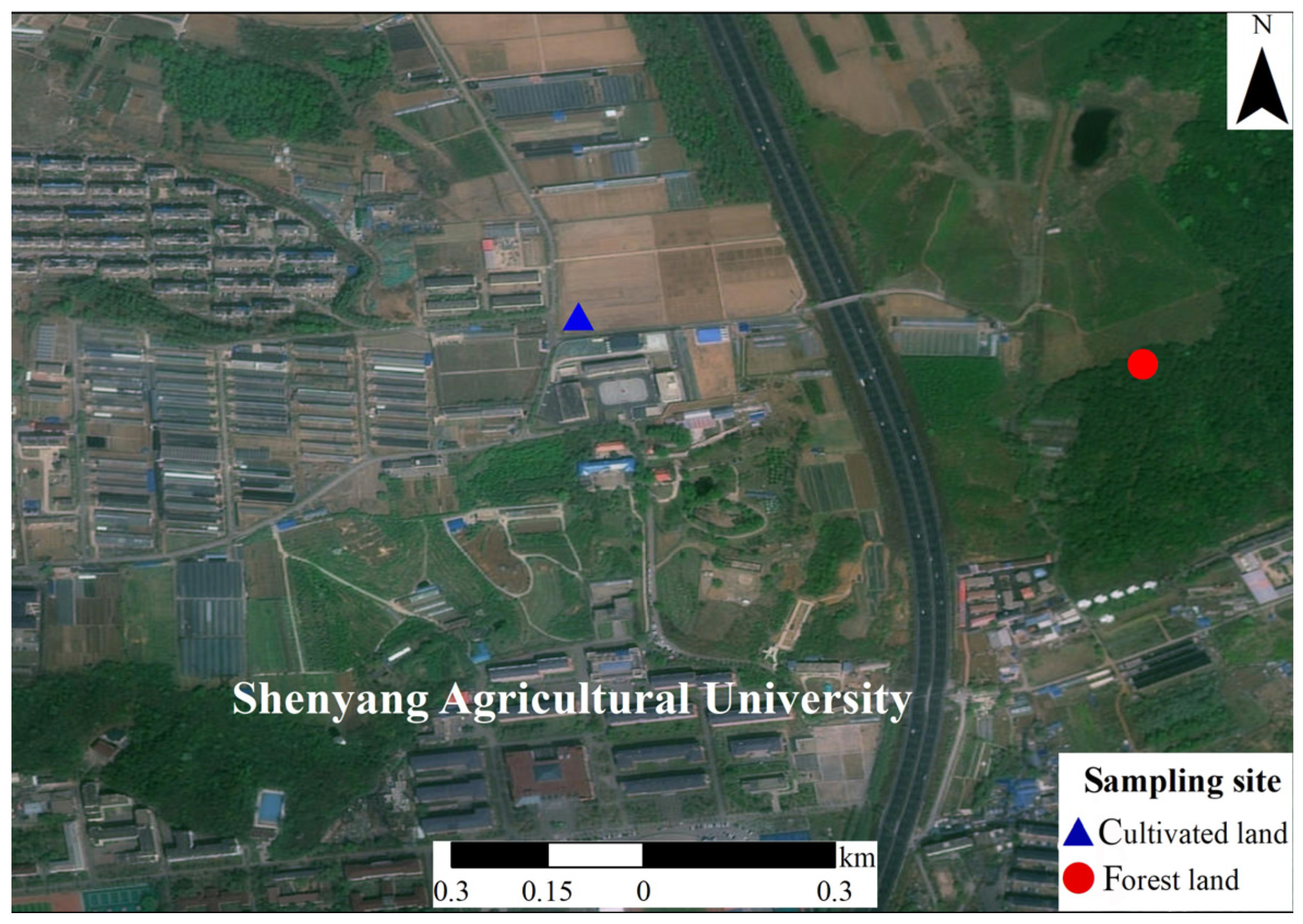
The study area located in the long-term experimental field of Shenyang Agricultural University, Shenyang City, Liaoning Province (41°50′2″ N, 123°34′00″ E), at an altitude of 72 m. This site lies in the core area of the southern Songliao Plain (Figure 1) and has a temperate, humid to semi-humid monsoon climate. The average annual precipitation ranges from 574 to 684 mm, the mean annual temperature is 7.0–8.1 °C, and the average annual sunshine duration is about 2373 h.
The predominant soil type is typical brown soil (moist leached soil), with loess or loess-like materials as its parent substrate. A long-term brown soil fertilization experiment has been conducted at this site since 1979, spanning 45 years. The cropping system is a corn-corn-soybean rotation. Each year, urea (46% N), superphosphate (12% P2O5), and potassium sulfate (50% K2O) are applied at sowing, together with fully decomposed pig manure containing, on average, 119.6 g kg−1 organic matter, 5.6 g kg−1 N, 8.3 g kg−1 P2O5, and 10.9 g kg−1 K2O. All fertilizers are broadcast as basal applications and incorporated into the soil to a depth of 20 cm using a rotary tiller. Sowing is carried out from April to May, and harvest occurs between September and October. After each harvest, crop residues are removed. As a control, a typical forest site was selected near the experimental plots (Figure 1). This forest lies on flat, stable terrain at the same slope position as the cropland and shares identical soil-forming factors except for land use. The vegetation is dominated by perennial oak trees, with a forest age of approximately 40 to 50 years.

2.2. Profile Description and Soil Sample Collection

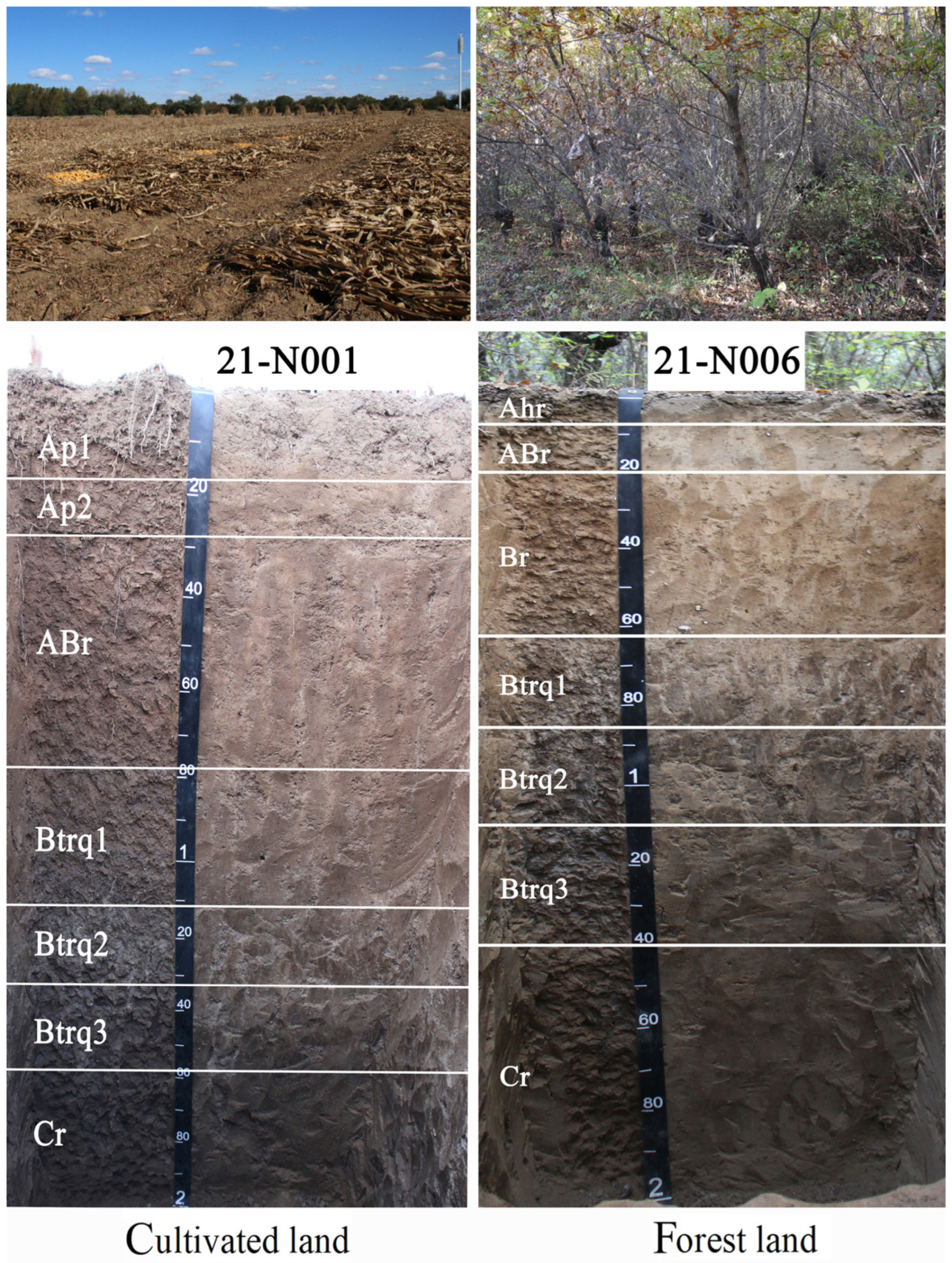
According to the Manual of Field Soil Description and Sampling [19], the morphological characteristics of the profiles were carefully observed and described (Table 1). Prior to sampling, approximately 5 cm of topsoil was removed with a rust-free steel shovel. Soil samples were then collected sequentially from the bottom to the top of each occurrence horizon across 28 profiles. For forest soil profiles, the surface litter layer of dead branches and fallen leaves was first cleared away (Figure 2).

2.3. Data Processing and Analysis

Soil bulk density was determined using the ring knife method [20,21]. Soil pH was determined using potentiometry [22]. Organic carbon and total nitrogen were analyzed using a TOC elemental analyzer [23]. Particle size distribution was measured with a laser particle size analyzer [24,25]. Experimental data were processed in Excel 2021, figures were plotted using Origin 2024, and Pearson correlation analyses were conducted in SPSS 27.0.
Soil organic carbon (SOC) storage was calculated by the stratification method [26], using the following equation:
SO C s = i = 1 n C i ρ i T i ( 1 θ i ) × 1 0 1
In the formula, SOCs represents the organic carbon storage (t·ha−2) at the specified soil depth, Ci denotes the organic carbon content (g·kg−1) of the i-th layer of soil, ρi stands for the bulk density of the i-th layer of soil (g·cm−3), Ti represents the thickness of the i-th layer of soil (cm), θi refers to gravel content (>2 mm) of the i-th soil layer (% by volume), and n signifies total number of soil layers included in the calculation. As the proportion of gravel (>2 mm) in the study soils was extremely low, this term was disregarded in the calculations.
A soil reconstruction model [27] was used to quantitatively estimate the gains or losses of selected components within 100 cm3 of weathered soil during soil formation. The general expression is:
UVF   =   B D w × C iw B D pm × C ipm
D jw = B D w × C jw UVF × ( B D pm × C jpm )
In the formula, BDw and BDpm represent the bulk density of the weathered layer and substratum, respectively; Ciw and Cipm represent the concentration of an immobile reference component i in the weathered layer and substratum, respectively; Cjw and Cjpm represent the concentration of component j in the weathered layer and substratum, respectively; and Djw represents gain or loss of component j in the weathered layer during soil formation. The rate of change in SOC content and SOC storage was expressed as the net gain or loss over the 45-year experimental period, normalized by time.

3. Results

3.1. Distribution of Soil Organic Carbon Content Under Different Land Use Patterns

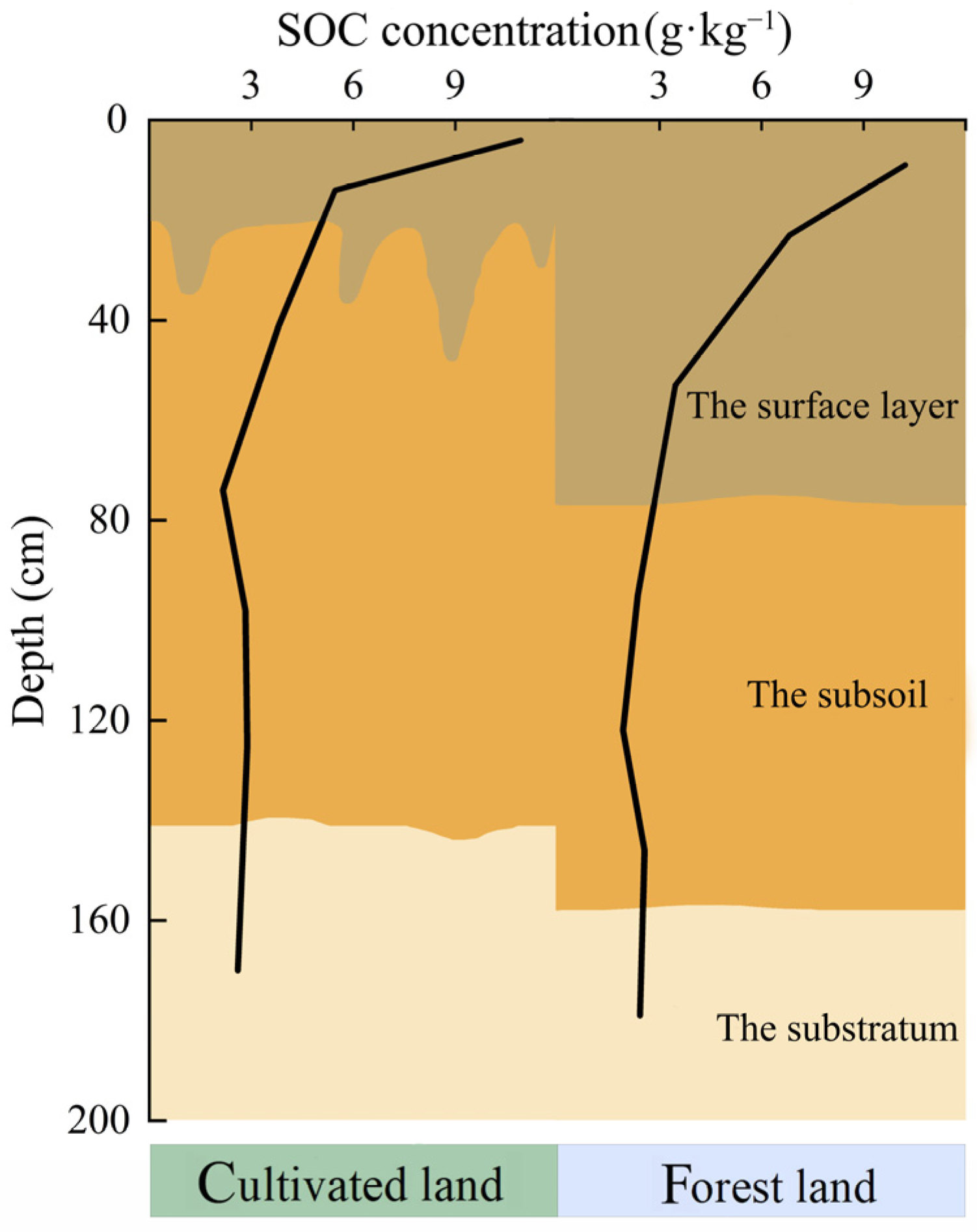
Under different land use patterns in the study area, SOC content gradually decreased with increasing profile depth. At all depths, SOC content in cultivated land was consistently lower than in forest land (Figure 3). The mean SOC content in cultivated land was 3.54 g·kg−1 (CV = 83.43%), while that in forest land was 3.35 g·kg−1 (CV = 87.33%). The slightly higher variation in forest land indicates greater fluctuation in SOC content, but both land use types exhibited high-intensity spatial variation.
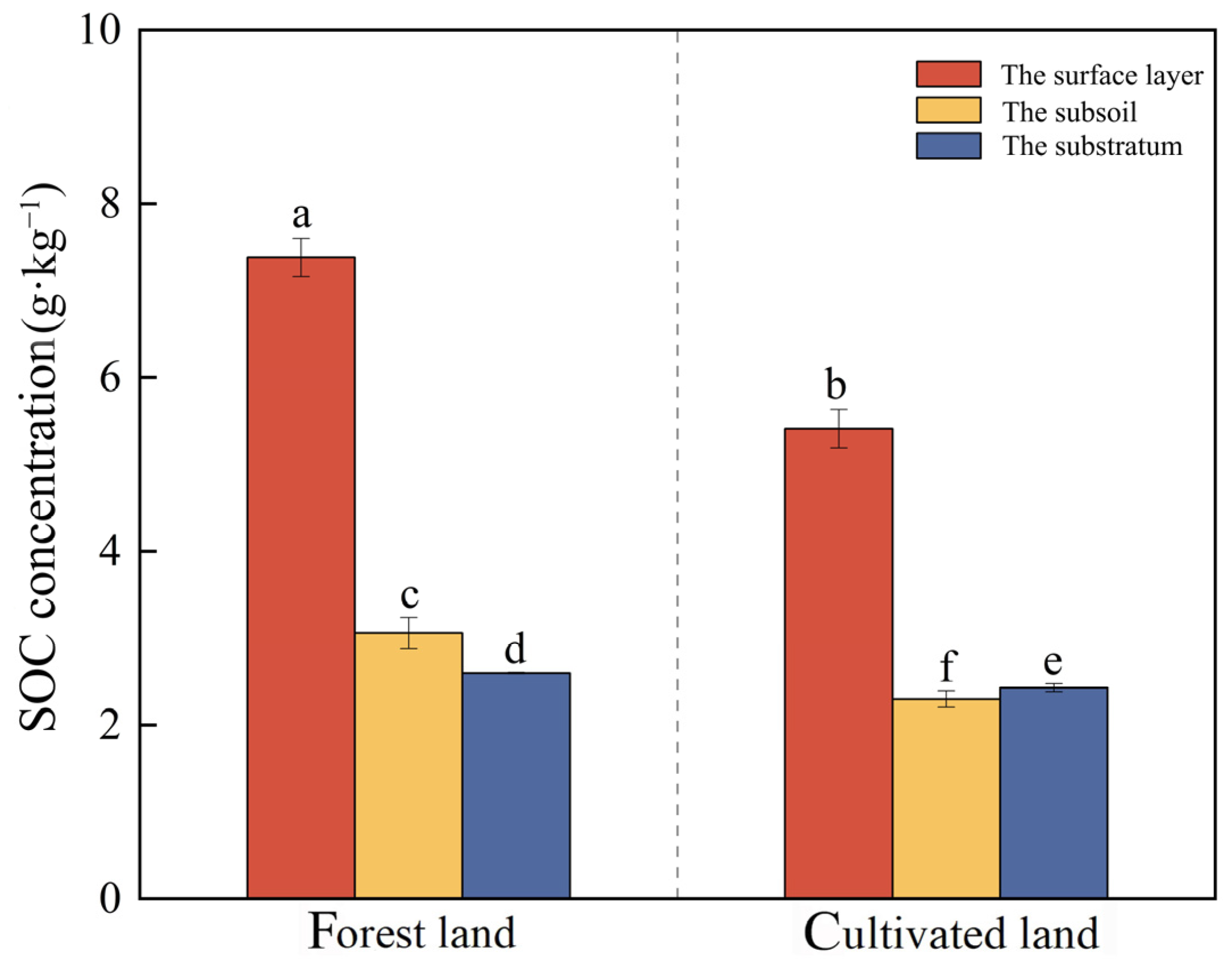
Analysis of variance indicated that SOC content in the surface soil layer of both land use types was significantly higher than that in the subsoil and substratum layers (p < 0.01). Furthermore, SOC content across all layers of forest land was significantly higher than that of cultivated land. Specifically, the average SOC contents in the surface, subsoil, and substratum layers of forest land were 7.38 g·kg−1, 3.06 g·kg−1, and 2.61 g·kg−1, respectively. In contrast, the corresponding values for cultivated land were 5.41 g·kg−1, 2.30 g·kg−1 and 2.43 g·kg−1, respectively.
Thus, cultivated land contained 1.97 g·kg−1, 0.76 g·kg−1 and 0.18 g·kg−1 less SOC than forest land in the surface, subsoil, and substratum layers, respectively. The difference between land use types was smallest in the substratum layer, compared with the larger differences observed in the surface layer and the subsoil (Figure 4). Over the 45-year period, SOC content in the surface soil layer of forest land increased at a rate of 0.14 g·kg−1·yr−1, nearly twice that of cultivated land (0.07 g·kg−1·yr−1). In the subsoil, forest land showed a slight increase (0.01 g·kg−1·yr−1), whereas cultivated land exhibited a slight decline (−0.01 g·kg−1·yr−1). SOC content in the substratum layer of both land use types remained relatively stable.

3.2. Relationship Between Soil Organic Carbon Content and Physicochemical Properties

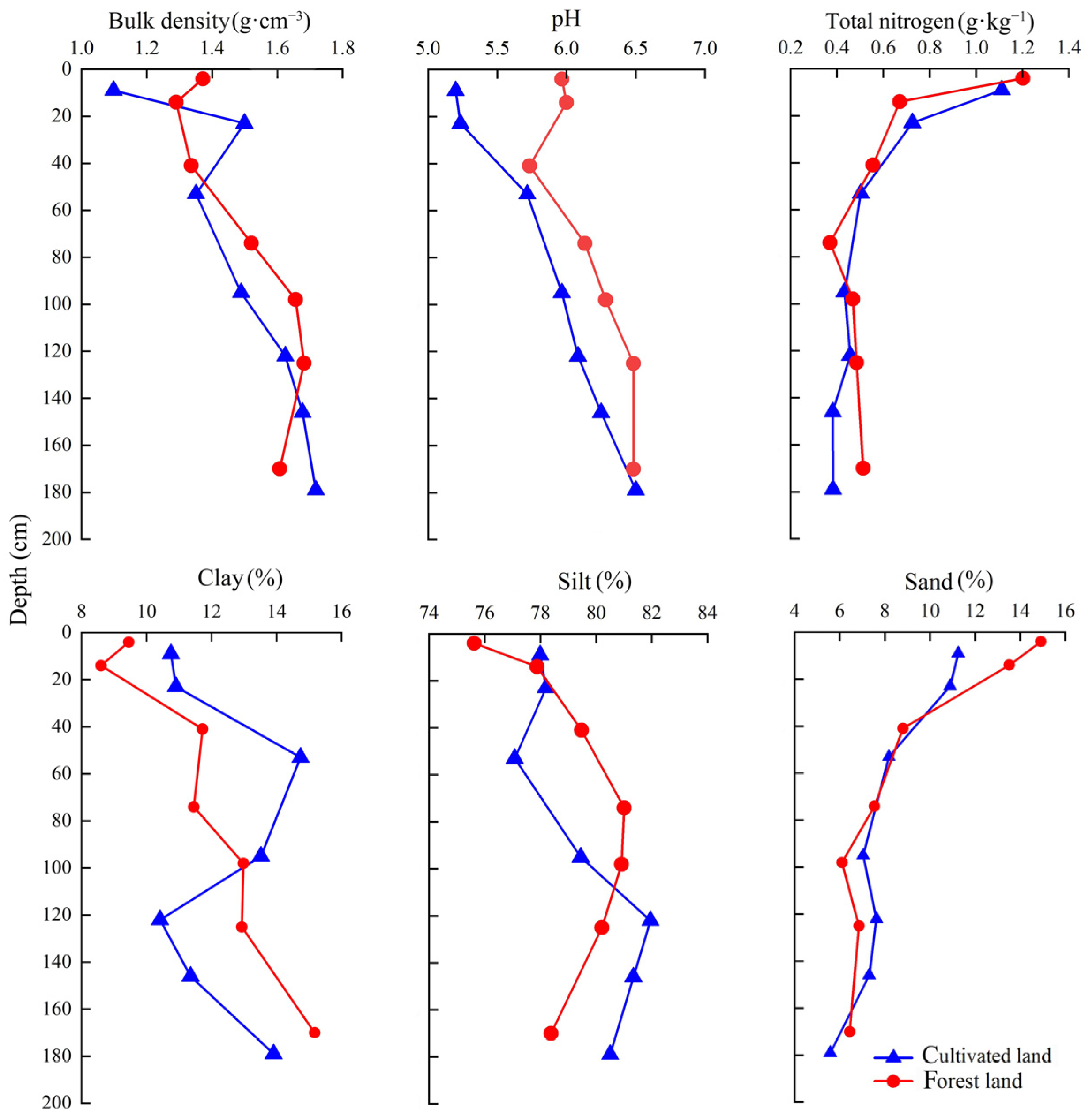
The results (Table 2) show that SOC content in forest land was extremely significantly and positively correlated with total nitrogen, clay content and sand content (p < 0.01), while it was significantly and negatively correlated with bulk density, pH, and silt content. In cultivated land, SOC content was extremely significantly correlated with all physicochemical indicators except clay content (p < 0.01).
With increasing soil depth, bulk density (1.09–1.71 g·cm−3) generally showed a fluctuating upward trend. The bulk density of the 17–28 cm layer in cultivated land was significantly higher than in forest land (Figure 5), reflecting soil compaction and the influence of long-term ploughing. Soil pH values in both land uses were weakly acidic (5.2–6.5) and increased with depth, with mean values of 6.15 in forest land and 5.85 in cultivated land. The distribution pattern of total nitrogen followed the same trend as SOC, decreasing markedly with depth. Average values were higher in forest land (0.60 g·kg−1) than in cultivated land (0.57 g·kg−1). Clay content in both land uses increased from 0 to 100 cm, decreased slightly below 100 cm, and then increased again. Silt content first increased and then decreased with depth, while sand content declined significantly with increasing depth (Figure 5).

3.3. Distribution of Soil Organic Carbon Storage Under Different Land Use Patterns

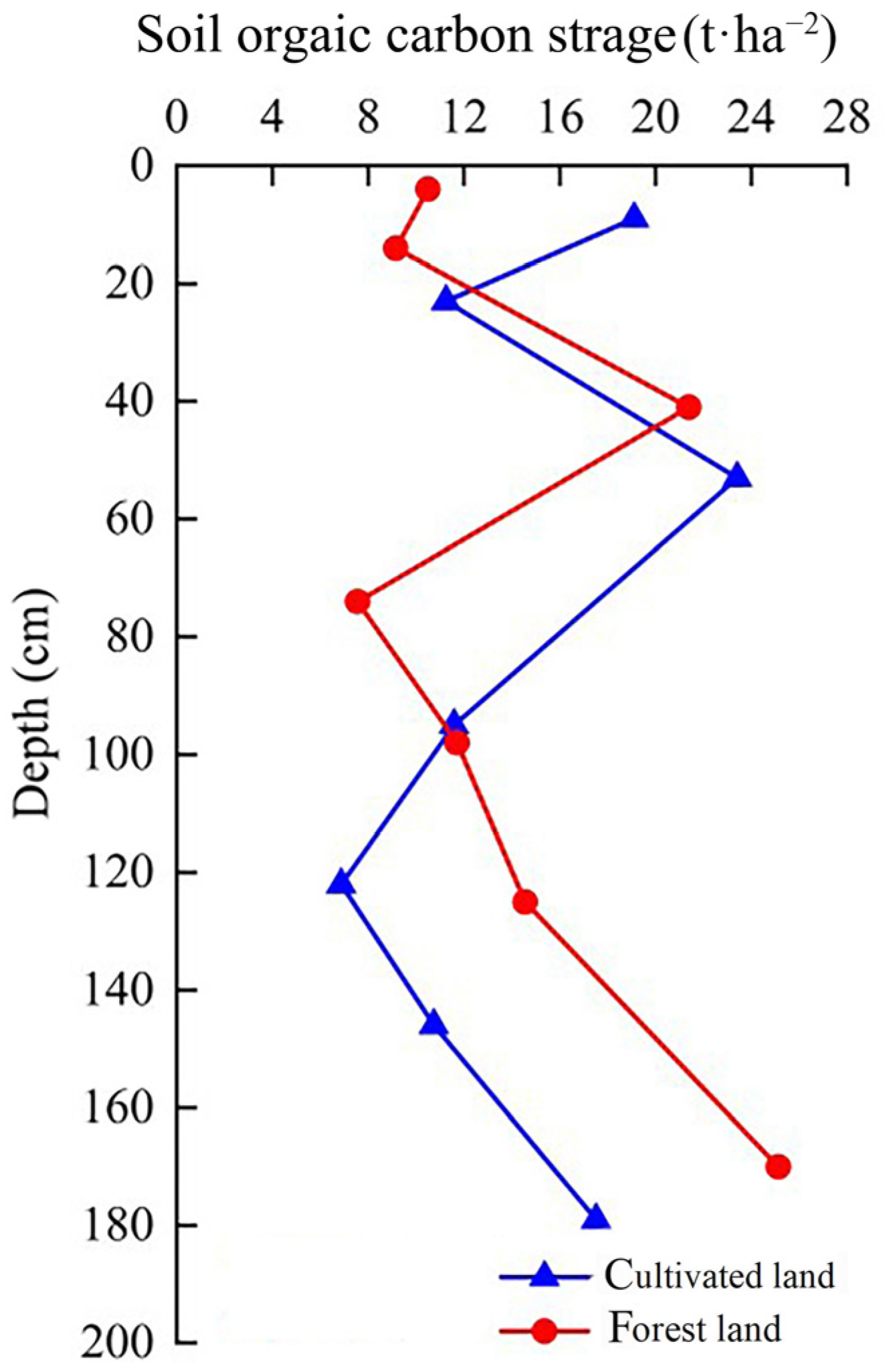
The average SOC storage in cultivated land was 15.70 t·ha−2 (CV = 35.16%), while that of forest land was 17.51 t·ha−2 (CV = 35.73%). SOC storage in forest land fluctuated more strongly with depth compared to cultivated land. SOC storage increased with depth in forest land soils at 85–200 cm and in cultivated land soils at 133–200 cm (Figure 6).
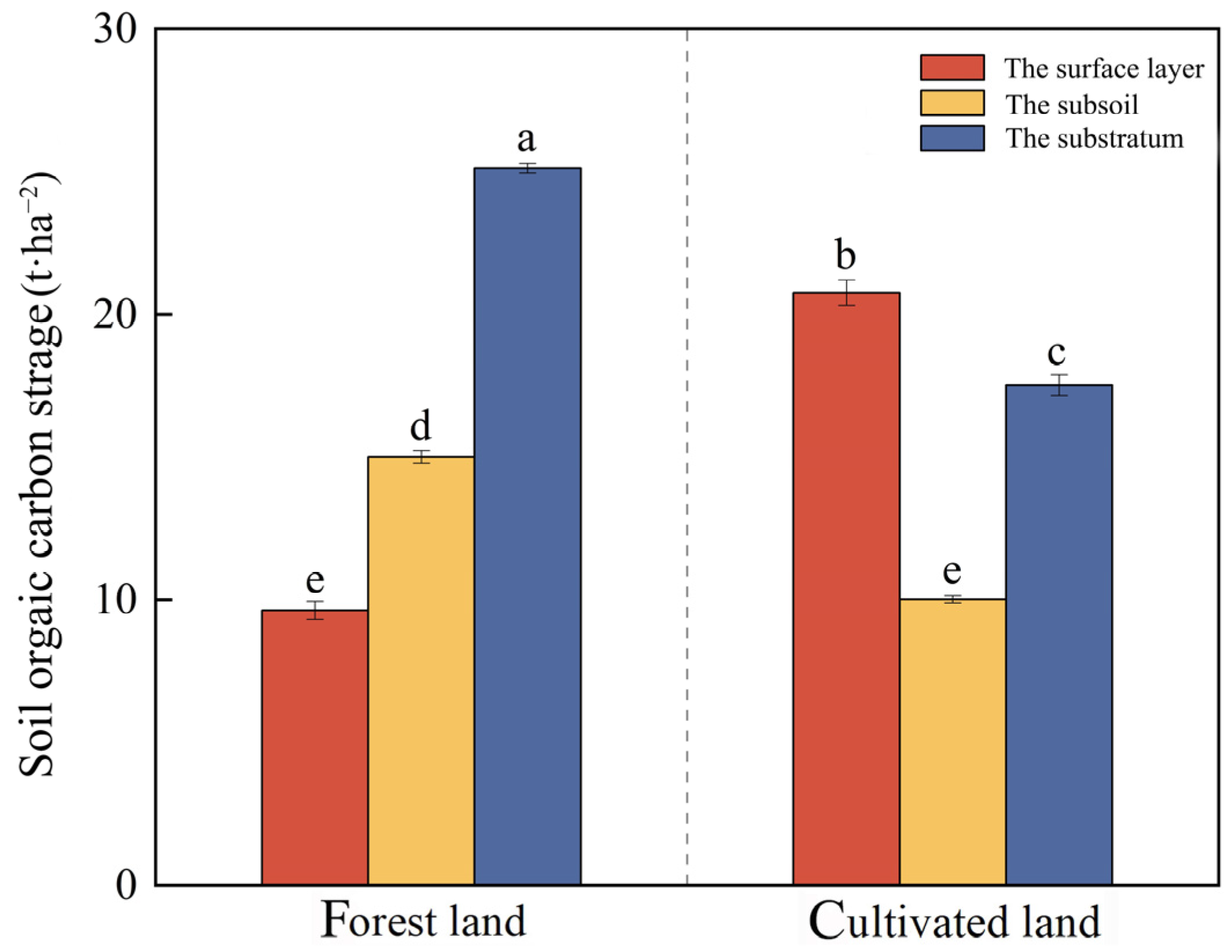
Analysis of variance showed that in forest land, SOC storage in the substratum layer was significantly higher than in the topsoil and subsoil layers. In cultivated land, SOC storage in both the topsoil and substratum layers was significantly higher than in the subsoil layer. Across all soil layers, SOC storage differed extremely significantly between cultivated and forest land (Figure 7). Specifically, the average SOC storage in the topsoil was 9.63 t·ha−2 in forest land and 20.76 t·ha−2 in cultivated land, 11.13 t·ha−2 higher in cultivated land. In the subsoil layer, SOC storage was 15.01 t·ha−2 in forest land versus 10.02 t·ha−2 in cultivated land, 4.99 t·ha−2 lower in the latter. In the substratum layer, forest land storage (25.12 t·ha−2) exceeded that of cultivated land (17.52 t·ha−2) by 7.60 t·ha−2. Over 45 years, SOC storage in forest land increased at rates of 30.26, 110.74, and 56.99 t·ha−2·yr−1 in the surface, subsoil, and substratum layers, respectively. In cultivated land, the corresponding rates were 80.11 t·ha−2·yr−1, 64.95 t·ha−2·yr−1 and 45.87 t·ha−2·yr−1, respectively.

4. Discussion

4.1. Variation in Soil Organic Carbon Content Under Different Land Use Patterns

SOC dynamics are mainly influenced by multiple factors, including climate, vegetation, soil physicochemical properties, and agricultural management. Among these, land use is a primary driver of SOC variation [28,29,30]. Differences in land use affect the vertical migration of SOC from surface to deeper layers, thereby altering its overall profile distribution [31]. In this study, SOC content under all land use patterns decreased progressively with depth.
Across all profile layers, SOC content in cultivated land was consistently lower than in forest land. This difference can be attributed largely to human disturbance [32]. Harvesting crops removes much of the above-ground biomass, reducing organic matter inputs and limiting SOC accumulation [33]. By contrast, forest ecosystems provide substantial organic matter inputs through litterfall, root turnover, and deadwood, all of which enhance SOC content. Deep-rooted trees also transport organic matter into subsoil horizons. Frequent tillage in cultivated soils further disrupts soil structure, increases aeration, and accelerates organic matter mineralization [34]. These processes, combined with shifts in microbial community composition, reduce SOC storage. Long-term monitoring over 45 years showed that SOC accumulation rates in forest land were significantly higher than in cultivated land, especially in the surface layer. SOC in the topsoil of forest land increased at 0.14 g·kg−1·yr−1—double the rate observed in cultivated land (0.07 g·kg−1·yr−1). Forest soils are less disturbed by human activities, maintaining a stable structure, rich microbial communities, and plant-microbe interactions that enhance carbon sequestration. In deeper layers, SOC in forest soils is further stabilized. On the one hand, vertical translocation delivers organic inputs downward; on the other hand, SOC decomposition is slower in subsoils [35]. These processes collectively explain why forest soils maintain higher SOC content than in cultivated land.

4.2. Influence of Soil Physical and Chemical Properties on Soil Organic Carbon

Because climate, topography, and substratum were similar across the study sites, differences in SOC were primarily driven by vegetation type, soil physicochemical properties, and land management. SOC content showed an extremely significant positive correlation with total nitrogen in both land uses (r = 0.96 for cultivated land; r = 0.94 for forest land). This indicates that higher SOC is consistently associated with higher nitrogen availability. SOC was negatively correlated with bulk density (r = −0.78 and −0.55 for cultivated and forest land, respectively), suggesting that higher SOC is associated with looser, less compact soils. This aligns with findings by Wu et al. [36], reinforcing the close linkage between SOC, nitrogen cycling, and soil structure. SOC was also significantly negatively correlated with pH (r = −0.86 and −0.45). Both forest and cultivated soils were weakly acidic (pH 5.2–6.5), conditions favorable for microbial activity, which enhances litter decomposition and SOC accumulation [37]. With respect to particle size, SOC in forest land was positively correlated with clay content (r = 0.63), consistent with previous studies [38]. However, no significant relationship was observed in cultivated soils. This may be due to long-term tillage, which alters soil structure and reduces organic inputs, thereby limiting the capacity of clay to adsorb and stabilize SOC [39,40].
Interestingly, unlike earlier reports showing positive relationships between SOC and silt, and negative relationships with sand [41,42], this study found extremely significant negative correlations between SOC and both silt and clay (r = −0.62 and −0.75), and positive correlations with sand (r = 0.81 and 0.60). These patterns may reflect long-term leaching and sediment redistribution, which altered particle-size composition within profiles. Strong leaching in surface layers reduces sand content, while deeper layers stabilize in texture. At the same time, organic matter inputs decline with depth, reducing SOC concentrations. This highlights that the influence of soil texture on SOC can vary significantly between regions, and its mechanisms require further investigation.

4.3. Changes in Soil Organic Carbon Storage Under Different Land Use Patterns

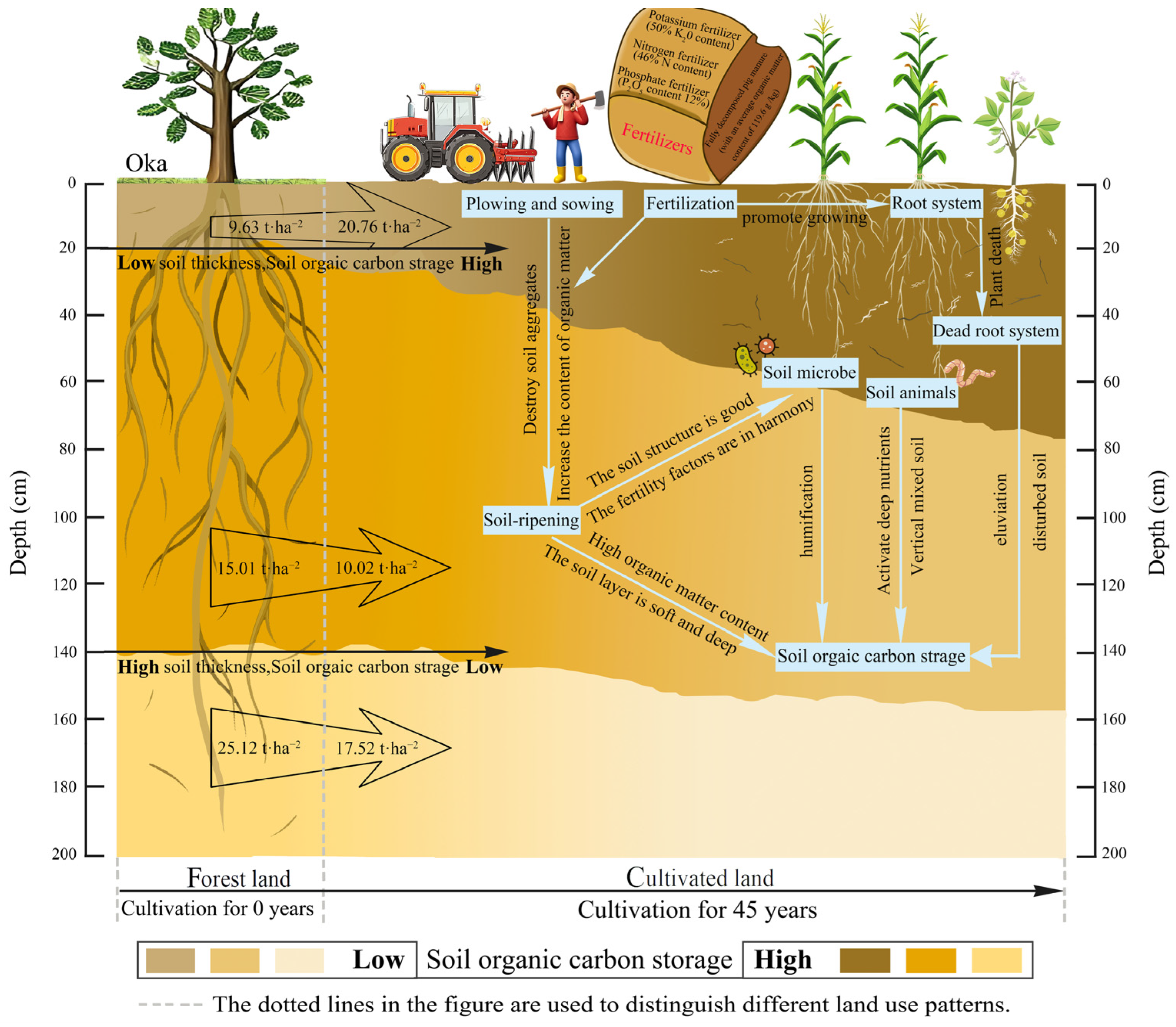
SOC storage is of critical significance in maintaining soil fertility, regulating carbon cycling, and mitigating climate change [43,44]. Different land use patterns significantly affect the vertical distribution and variability of SOC storage by altering vegetation residue inputs, management practices, and soil environmental conditions. In this study, SOC storage in forest soils at 85–200 cm and in cultivated soils at 133–200 cm increased with depth. This trend occurs because deeper soil layers experience less disturbance from human activities, organic matter decomposes more slowly, and root exudates and litter residues migrate downward through leaching, leading to a relatively stable carbon storage. In forest land, the substratum layer has the highest SOC storage, followed by the subsoil layer and topsoil layer. This reflects continuous carbon transport to deep soil via root secretions and decomposition of microbial and animal residues [45,46,47]. The substratum layer, being less disturbed, allows organic matter to decompose slowly and accumulate over time. In cultivated land, however, the topsoil layer stored the most SOC, followed by the substratum and subsoil layers. This pattern is largely due to the continuous application of organic fertilizers, which enhances organic matter input and SOC accumulation in surface layers. SOC storage is determined by SOC concentration, bulk density, and soil thickness [48]. In this study, soil thickness was a key factor influencing SOC variation. Long-term cultivation modified soil configuration, thickening the topsoil and creating marked differences in SOC distribution. As a result, cultivated soils showed carbon enrichment in the topsoil—where SOC storage was much higher than in forest soils—but carbon depletion in the subsoil and substratum layers, where SOC storage was lower than in forest soils. These findings clearly demonstrate the role of human cultivation in reshaping the vertical migration and redistribution of the soil carbon pool (Figure 8).
In the first year of reclamation, the topsoil thickness of cultivated land was similar to that of the forest land (about 20 cm). After 45 years of farming, the long-term application of tillage practices—such as ploughing, deep loosening, and fertilization—had two main effects: it enhanced the accumulation of surface organic matter, and it disrupted soil aggregates, leading to particle rearrangement and increased porosity. As a result, the cultivated topsoil expanded vertically, reaching 78 cm in thickness (Figure 8). The progressive thickening of the soil layer provided greater storage capacity for root growth and retention of dead roots, increased the activity and spatial extent of soil microorganisms, and created favorable conditions for SOC input, transformation, and storage. Over the 45-year period, SOC storage in both forest and cultivated soils increased across all layers, but at markedly different rates. Results showed that SOC storage in the topsoil of cultivated land was 11.13 t·ha−2 higher than in forest land, with an accumulation rate 50.95 t·ha−2·yr−1 greater. This difference can be attributed to the continuous addition of organic fertilizers in cultivated soils, which directly enhanced organic matter inputs, while the thickened topsoil provided greater capacity to retain and stabilize carbon. In addition, ploughing improved gas exchange between soil and atmosphere, stimulating microbial decomposition of organic matter and humus formation, further enhancing SOC accumulation in the cultivated topsoil. Although litter inputs occur in forest land, the topsoil is relatively compact, with low porosity. As a result, the decomposition of dead branches and fallen leaves is slow, and the thin soil layer has limited capacity to retain SOC. In addition, part of the organic matter is lost through surface runoff, while the SOC released by decomposition is prone to mineralization, ultimately constraining SOC accumulation in the forest topsoil. The subsoil layer extended from 20 to 140 cm in forest land, but from 78 to 158 cm in cultivated land. Continuous thickening of the cultivated topsoil pushed the initial boundary of the subsoil layer downward and reduced its thickness. This occurs because farming practices primarily affect the surface, leaving deeper layers less disturbed. As the topsoil expands, the upper boundary of the subsoil layer is forced deeper. Consequently, SOC storage in the cultivated subsoil layer was 4.99 t·ha−2 lower than in forest land, and the accumulation rate was 46.81 t·ha−2·yr−1 lower. This highlights the contrasting impacts of land use on the deep soil carbon pool. From a soil carbon cycle perspective, forest ecosystems maintain a continuous vertical migration of SOC via root secretions and persistent vegetation cover. Carbon gradually accumulates in deeper layers through root turnover and the long-term activity of microorganisms. In contrast, crop roots in cultivated soils are largely confined to the topsoil, resulting in limited carbon input to deeper horizons. The substratum layer occurred at 140–200 cm in forest land and 158–200 cm in cultivated land. Long-term cultivation altered the structure of the topsoil and subsoil layers, pushing the starting depth of the substratum layer downward, though its thickness remained largely unchanged. SOC storage in the cultivated substratum layer was 7.60 t·ha−2 lower than in forest land, and its accumulation rate was 11.12 t·ha−2·yr−1 lower. In forests, root systems continuously transport carbon into the substratum layer, whereas in cultivated soils, root-derived carbon inputs are concentrated in the plough layer. Moreover, mechanical tillage and compaction create a plough pan that restricts the downward movement of organic matter from fertilizers, further limiting SOC sequestration in deeper layers.
By optimizing tillage practices and implementing measures such as moderate deep loosening and reducing the frequency of soil plowing, it is possible to effectively maintain and enhance the carbon sequestration capacity of topsoil in agricultural fields while minimizing disturbance and damage to deeper soil carbon pools caused by anthropogenic tillage. Future research should focus on precisely quantifying the efficiency of soil organic carbon sequestration under different agricultural management practices, such as no-tillage and crop rotation. By integrating the historical context and long-term evolution of land use in the study area, it is essential to identify strategies that enhance soil carbon stocks while balancing soil ecological protection with the practical needs of agricultural production. Such efforts will provide actionable scientific guidance for the sustainable utilization and informed management of farmland soils in China’s black soil regions and other comparable brown soil areas nationwide.

5. Conclusions

(1) SOC content decreased with soil depth under both land uses, with lower levels in cultivated land compared to forest land. In all cases, topsoil contained significantly more SOC than the subsoil and parent layers. Over 45 years since land conversion, SOC in forest topsoil increased at twice the rate of cultivated land, while the forest subsoil layer showed a slight gain and cultivated land a slight loss. Substratum SOC remained stable.
(2) SOC was strongly and positively correlated with total nitrogen and negatively with bulk density and pH, in both land uses. Forest SOC also showed a strong positive correlation with clay, unlike cultivated soils. The relationships between SOC and silt or sand content differed from earlier studies, likely reflecting long-term leaching, sediment redistribution, and regional differences in soil formation and land management.
(3) Long-term tillage thickened the cultivated topsoil, leading to greater surface SOC storage (surface carbon enrichment) but reduced SOC storage in deeper layers (deep carbon loss). This shows that cultivation reshapes soil profile configuration, enhancing surface carbon but weakening deep carbon sequestration. In contrast, forest soils maintained a more balanced vertical distribution, with the substratum layer benefiting from sustained root-derived inputs.

Author Contributions

Conceptualization, Z.-X.S. and W.-W.Q.; methodology, S.-Y.C., Z.-X.S., S.-Y.D. and Y.-Y.J.; software, S.-Y.C. and S.-Y.D.; validation, Z.-X.S., S.-Y.D. and W.-W.Q.; formal analysis, S.-Y.C. and Y.-Y.J.; investigation, S.-Y.C., Z.-X.S. and Y.-Y.J.; resources, Z.-X.S.; data curation, S.-Y.C., Z.-X.S., W.-W.Q. and Y.-Y.J.; writing—original draft preparation, S.-Y.C. and Z.-X.S.; writing—review and editing, Z.-X.S., S.-Y.D. and W.-W.Q.; visualization, Z.-X.S. and W.-W.Q.; supervision, Z.-X.S. and S.-Y.D.; project administration, Z.-X.S. and S.-Y.D.; funding acquisition, Z.-X.S. All authors have read and agreed to the published version of the manuscript.

Funding

The authors sincerely thank the Scientific Research Fund of Liaoning Provincial Education Department (JYTYB2024007) for funding this project/research.

Data Availability Statement

The raw data supporting the conclusions of this article will be made available by the authors on request.

Acknowledgments

The authors’ thanks go to all the students and staff who provided input into this study. Our acknowledgements also extend to the anonymous reviewers for their constructive reviews of the manuscript.

Conflicts of Interest

Author Wei-Wen Qiu was employed by the company New Zealand Institute for Bioeconomy Science Limited. The remaining authors declare that the research was conducted in the absence of any commercial or financial relationships that could be construed as a potential conflict of interest.

References

  1. Pan, G. China’s Soil Organic Carbon Pool and Its Evolution and Response to Climate Change. Adv. Clim. Change Res. 2008, 4, 282–289. [Google Scholar]
  2. Li, Q.L.; Yan, X.; Wu, X.Z.; Wang, B.; Liu, R.T.; An, H. The influence of desert steppe desertification on soil inorganic carbon and organic carbon. J. Soil Water Conserv. 2019, 33, 98–110. [Google Scholar]
  3. Banger, K.; Toor, G.S.; Biswas, A.; Sidhu, S.S.; Sudhir, K. Soil organic carbon fractions after 16-years of applications of fertilizers and organic manure in a Typic Rhodalfs in semi-arid tropics. Nutr. Cycl. Agroecosyst. 2010, 86, 391–399. [Google Scholar] [CrossRef]
  4. Zhou, Y.X.; Lyu, M.K.; Xie, J.S.; Yang, Z.J.; Jiang, J.; Yang, Y.S. Sources, characteristics and stability of organic carbon in deep soil. J. Subtrop. Resour. Environ. 2013, 8, 48–55. [Google Scholar]
  5. Kuriakose, S.L.; Devkota, S.; Rossiter, D.G.; Jetten, V.G. Prediction of soil depth using environmental variables in an anthropogenic landscape, a case study in the Western Ghats of Kerala, India. Catena 2009, 79, 27–38. [Google Scholar] [CrossRef]
  6. Gentile, R.M.; Malepfane, N.M.; van den Dijssel, C.; Arnold, N.; Liu, J.; Müller, K. Comparing deep soil organic carbon stocks under kiwifruit and pasture land uses in New Zealand. Agric. Ecosyst. Environ. 2021, 306, 107190. [Google Scholar] [CrossRef]
  7. Niu, X.; Liu, C.; Jia, X.; Zhu, J. Changing soil organic carbon with land use and management practices in a thousand-year cultivation region. Agric. Ecosyst. Environ. 2021, 322, 107639. [Google Scholar] [CrossRef]
  8. Zhang, M.K.; Wu, M.J. Genetic characteristics and classification of soils developed from parent materials of red bed in the subtropical region: Take Zhejiang Province as an example. J. Zhejiang Univ. 2022, 48, 182–190. [Google Scholar]
  9. Mahmoodi, M.; Khormali, F.; Amini, A.; Ayoubi, S. Weathering and soils formation on different parent materials in Golestan Province, Northern Iran. J. Mt. Sci. 2016, 13, 870–881. [Google Scholar] [CrossRef]
  10. Mao, X.L. Accumulation Characteristics and Stabilization Mechanisms of Organic Carbon in Soils Developed from Different Parent Materials in Subtropical Regions; Zhejiang University: Hangzhou, China, 2020. [Google Scholar]
  11. Wang, Y.H.; Xuan, Q.X.; Wang, L.L.; Yang, D.L.; Zhao, J.N.; Li, G.; Xiu, W.M.; Hong, Y. Study on the Effects of Different Tillage Methods on Soil Organic Carbon Mineralization and Enzyme Activity. Chin. J. Soil Sci. 2020, 51, 876–884. [Google Scholar]
  12. Duan, S.Y.; Sun, Z.X.; Liu, H.B.; Qian, F.K.; Wang, Q.B.; Jiang, Y.Y.; Song, X.D. Human activities drive accelerated soil aggregation in Quaternary red soil. Catena 2025, 258, 109232. [Google Scholar] [CrossRef]
  13. Wu, F.L.; Li, L.; Zhang, H.L.; Chen, F. The impact of conservation tillage on net carbon release from farmland ecosystems. Chin. J. Ecol. 2007, 12, 2035–2039. [Google Scholar]
  14. Schmidt, M.W.I.; Torn, M.S.; Abiven, S.; Dittmar, T.; Guggenberger, G.; Janssens, I.A.; Kleber, M.; Kögel-Knabner, I.; Lehmann, J.; Manning, D.A.C.; et al. Persistence of soil organic matter as an ecosystem property. Nature 2011, 478, 49–56. [Google Scholar] [CrossRef]
  15. Fontaine, S.; Barot, S.; Barré, P.; Bdioui, N.; Mary, B.; Rumpel, C. Stability of organic carbon in deep soil layers controlled by fresh carbon supply. Nature 2007, 450, 277–280. [Google Scholar] [CrossRef]
  16. Kunlanit, B.; Butnan, S.; Vityakon, P. Land–use changes influencing C sequestration and quality in topsoil and subsoil. Agronomy 2019, 9, 520. [Google Scholar] [CrossRef]
  17. Huang, Y.Z.; Xin, Z.B. Effects of different ecological restoration patterns on soil organic carbon in gullies of Loess Plateau. Acta Ecol. Sin. 2020, 40, 778–788. [Google Scholar] [CrossRef]
  18. Zhang, J.W.; Du, J.; Sun, J.H.; Wu, H.Y.; Sun, N.K.; Suo, D.R.; Zhao, X.N.; Xu, Y.; Xia, L.L.; Ma, Y.Q.; et al. Long-term fertilization effects on organic carbon content and carbon storage in irrigated desert soil. Soils 2025, 57, 1004–1012. [Google Scholar]
  19. Zhang, G.L.; Li, D.C. Field Soil Description and Sampling Manual; Science Press: Beijing, China, 2016. [Google Scholar]
  20. Grossman, R.B.; Reinsch, T.G. Bulk density and linear extensibility. In Methods of Soil Analysis: Part 4 Physical Methods; SSSA: Madison, WI, USA, 2002; pp. 201–228. [Google Scholar]
  21. Jiang, Y.Y.; Sun, Z.X.; Wang, Q.B.; Sun, Z.G.; Jiang, Z.D.; Gu, H.Y.; Libohova, Z.; Owens, P.R. Characteristics of the typical loess profile with a macroscopic tephra layer in the northeast China and the paleoclimatic significance. Catena 2021, 198, 105043. [Google Scholar] [CrossRef]
  22. Thomas, G.W. Soil pH and soil acidity. In Methods of Soil Analysis: Part 3 Chemical Methods; SSSA: Madison, WI, USA, 1996; pp. 475–490. [Google Scholar]
  23. Yu, T.R.; Wang, Z.Q. Soil Analytical Chemistry; Science Press: Beijing, China, 1985; pp. 21–29. [Google Scholar]
  24. Institute of Soil Science, Chinese Academy of Sciences. Soil Physical and Chemical Analysis; Shanghai Science and Technology Press: Shanghai, China, 1978; pp. 1–6. [Google Scholar]
  25. Sun, Z.X.; Zhang, N.W.; Jiang, Y.Y.; Wang, Q.B.; Zhang, G.L. The Long-Term Deep Loessal Sediments of Northeast China: Loess or Loessal Paleosols? Quaternary 2023, 6, 53. [Google Scholar] [CrossRef]
  26. Hao, X.X.; Han, X.Z.; Li, L.J.; Zou, W.X.; Lu, X.C.; Qiao, Y.F. The influence of land use patterns on the distribution and carbon storage of organic matter in the black soil profile. Chin. J. Appl. Ecol. 2015, 26, 965. [Google Scholar]
  27. Stolt, M.H.; Baker, J.C. Quantitative comparison of soil and saprolite genesis: Examples from the Virginia Blue Ridge and Piedmont. Southeast. Geol. 2000, 39, 129–150. [Google Scholar]
  28. Yu, X.; Zhou, W.J.; Cheng, P. Soil organic carbon fractions and 14C ages through 70 years of cropland cultivation. Soil Tillage Res. 2019, 195, 104415. [Google Scholar] [CrossRef]
  29. Xu, J.H.; Sun, Y.; Gao, L.; Cui, X.Y. Research Progress on Influencing Factors of Soil Organic Carbon Stability. Chin. J. Ecol. Cloth. Ind. 2018, 26, 222–230. [Google Scholar]
  30. Jiang, Y.Y.; Sun, Z.X.; Zheng, Y.B.; Wang, H.L.; Wang, J.Q. Establishing a soil health assessment system for quaternary red soils (Luvisols) under different land use patterns. Agronomy 2023, 13, 2026. [Google Scholar] [CrossRef]
  31. Huang, B.; Wang, Q.Q.; Li, D.Q.; Xiao, H.B.; Nie, X.D.; Yuan, Z.J.; Zheng, M.G.; Liao, Y.S.; Liang, C. Characteristics of altitude gradient changes of soil organic carbon and components in the Nanling Mountains. Chin. Soil Sci. Bull. 2022, 53, 374–383. [Google Scholar]
  32. Wang, Y.; Zhao, P.X. The Influence of Land Use Types in North China on Soil Respiration, Organic Carbon components and water-stable aggregates. Res. Soil Water Conserv. 2020, 27, 59–65. [Google Scholar]
  33. Wiesmeier, M.; Hübner, R.; Barthold, F.; Spörlein, P.; Geuß, U.; Hangen, E.; Reischl, A.; Schilling, B.; Lützow, M.V.; Kögel-Knabner, I. Amount, distribution and driving factors of soil organic carbon and nitrogen in cropland and grassland soils of southeast Germany (Bavaria). Agric. Ecosyst. Environ. 2013, 176, 39–52. [Google Scholar] [CrossRef]
  34. Yuan, H.; Li, H.; Zhang, L.; Duan, L.X.; Huang, Y.X.; Wang, H. Characteristics of organic carbon and its components in major agricultural soils in the mid-subtropical region. J. Integr. Agric. 2021, 11, 17–26. [Google Scholar]
  35. Chang, R.Y.; Fu, B.J.; Liu, G.H.; Wang, S.; Yang, X.L. The effects of afforestation on soil organic and inorganic carbon: A case study of the Loess Plateau of China. Catena 2012, 95, 145–152. [Google Scholar] [CrossRef]
  36. Wu, X.G.; Guo, J.P.; Yang, X.Y.; Tian, X.P. Distribution characteristics and carbon storage of soil organic carbon profile in typical vegetation of Luya Mountain. Acta Ecol. Sin. 2011, 31, 3009–3019. [Google Scholar]
  37. Zhang, P.; Zhang, T.; Chen, N.L. Distribution characteristics and influencing factors of soil carbon and nitrogen in the vertical zone of the northern foot of the Qilian Mountains. Chin. J. Appl. Ecol. 2009, 20, 518–524. [Google Scholar]
  38. Priess, J.A.; Koning, G.H.J.; Veldkamp, A. Assessment of interactions between land use change and carbon and nutrient fluxes in Ecuador. Agric. Ecosyst. Environ. 2001, 85, 269–279. [Google Scholar] [CrossRef]
  39. Sollins, P.; Swanston, C.; Kramer, M. Stabilization and destabilization of soil organic matter—A new focus. Biogeochemistry 2007, 85, 1–7. [Google Scholar] [CrossRef]
  40. Zhu, J.; Sun, Z.X. Estimation of cation exchange capacity for low-activity clay soil fractions using experimental data from south China. Agronomy 2024, 14, 2671. [Google Scholar] [CrossRef]
  41. Ma, Y.X.; Li, X.S.; Li, D.C.; Han, Z.Y.; Zhang, G.L.; Li, X.S.; Yang, P.; He, X.W.; Zhao, Y.Z.; Li, R.Q.; et al. Spatial Variation of Surface Soil Organic Carbon in Farmland in the Mountainous Area of Southern Anhui Province and Its Influencing Factors: A Case Study of Xuancheng District. Chin. J. Soil Sci. 2014, 45, 1424–1429. [Google Scholar]
  42. Konen, M.E.; Burras, C.L.; Sandor, J.A. Organic carbon, texture, and quantitative color measurement relationships for cultivated soils in north central Iowa. Soil Sci. Soc. Am. J. 2003, 67, 1823–1830. [Google Scholar] [CrossRef]
  43. Nottingham, A.T.; Meir, P.; Velasquez, E.; Turner, B.L. Soil carbon loss by experimental warming in a tropical forest. Nature 2020, 584, 234–237. [Google Scholar] [CrossRef]
  44. Jiang, Y.Y.; Sun, Z.X.; Liu, S.; Wang, J.Q. Construction and application of the Phaeozem health evaluation system in Liaoning Province, China. Agronomy 2024, 14, 1754. [Google Scholar] [CrossRef]
  45. Yang, Y.; Wang, B.R.; Dou, Y.X.; Xue, Z.J.; Sun, H.; Wang, Y.Q.; Liang, C.; An, S.S. Research progress on the transformation and stability of Soil Organic Carbon from Plant and Microbial sources. Chin. J. Appl. Ecol. 2024, 35, 111–123. [Google Scholar]
  46. Hicks, L.C.; Meir, P.; Nottingham, A.T.; Reay, D.S.; Stott, A.W.; Salinas, N.; Whitaker, J. Carbon and nitrogen inputs differentially affect priming of soil organic matter in tropical lowland and montane soils. Soil Biol. Biochem. 2019, 129, 212–222. [Google Scholar] [CrossRef]
  47. Sun, Z.X.; Wang, S.N.; Jiang, Y.Y.; Wang, Q.B.; Zhang, G.L. Iron pools of the typical loess--paleosol sequence and their environmental significance in northeastern China. Earth Surf. Process. Landf. 2024, 49, 511–524. [Google Scholar] [CrossRef]
  48. Cotching, W.E. Carbon stocks in Tasmanian soils. Soil Res. 2012, 50, 83–90. [Google Scholar] [CrossRef]
Figure 1. Schematic diagram of the location of the study area.
Agronomy 16 00110 g001
Figure 2. Landscape and profile photographs of the study site.
Agronomy 16 00110 g002
Figure 3. Distribution of soil organic carbon content with depth under different land use patterns.
Agronomy 16 00110 g003
Figure 4. Distribution of organic carbon content across soil profile layers under different land use patterns. Different lowercase letters indicate significant differences among different land use patterns of the same soil layer (p < 0.01). Vertical bars represent standard errors (n =3).
Agronomy 16 00110 g004
Figure 5. Distribution of soil physical and chemical properties under different land use patterns.
Agronomy 16 00110 g005
Figure 6. Distribution of soil organic carbon storage with depth under different land use patterns.
Agronomy 16 00110 g006
Figure 7. Distribution of organic carbon storage across soil profile layers under different land use patterns. Different lowercase letters indicate significant differences among different land use patterns of the same soil layer (p < 0.01). Vertical bars represent standard errors (n =3).
Agronomy 16 00110 g007
Figure 8. Conceptual model of the profile-configuration-driven mechanism of soil organic carbon sequestration under tillage management.
Agronomy 16 00110 g008
Table 1. Morphological characteristics of the investigated soil profiles.
ProfileOccurrence LayerDepth
(cm)
Color (Dry State)Structure and Its Degree of DevelopmentSoil TextureFixation (Dry)Other Characteristics
Cultivated land
21-N001
Ap10–1710YR 4/3Moderately developed mesenchymalSilty loamSoftA very small amount of iron-manganese nodules
Ap217–2810YR 4/4Moderately developed thin sheetSilty loamSlightly hardA very small amount of iron-manganese nodules
ABr28–7810YR 5/4Moderately developing massSilty loamSlightly hardA small amount of iron-manganese nodules
Btrq178–11110YR 5/4Moderately developed middle ridge blockSilty loamHardA small amount of clay film, iron-manganese nodules and silica neoformation powder
Btrq2111–13310YR 4/4Moderately developed middle ridge blockSilty loamHardA moderate amount of clay film, a small amount of iron and manganese nodules and a large amount of silica neoformation powder
Btrq3133–15810YR 4/3Moderately developed middle ridge blockSilty loamVery hardA moderate amount of clay film, a small amount of iron and manganese nodules and a large amount of silica neoformation powder
Cr158–20010YR 5/4Moderately developed middle ridge blockSilty loamVery hardA small amount of iron-manganese nodules
Forest land 21-N006Ahr0–77.5YR 6/4Moderately developing massSilty loamsoftA small amount of iron-manganese nodules
ABr7–207.5YR 4/4Moderately developing massSilty loamsoftA small amount of iron-manganese nodules
Br20–6210YR 4/3Moderately developing massSilty loamSlightly hardA small amount of iron-manganese nodules
Btrq162–8510YR 5/4Moderately developed small ridgesSilty loamHardA small amount of iron-manganese nodules and a moderate amount of silica neoformation powder
Btrq285–11010YR 4/3Moderately developed small massesSilty loamHardA small amount of iron and manganese nodules and a large amount of silica neoformation powder
Btrq3110–14010YR 5/3Moderately developed middle ridge blockSilty loamVery hardA small amount of iron and manganese nodules and a large amount of silica neoformation powder
Cr140–20010YR 5/6Moderately developed middle ridge blockSilty loamVery hardModerate iron-manganese nodules
Table 2. Correlation coefficients between soil organic carbon content and soil physical and chemical properties.
Land Utilization TypeBulk DensitypHTotal NitrogenClaySiltSand
Forest land−0.55 **−0.45 *0.94 **0.63 **−0.75 **0.60 **
Cultivated land−0.78 **−0.86 **0.96 **−0.42−0.62 **0.81 **
Note: ** p < 0.01 (extremely significant); * p < 0.05 (significant).
Disclaimer/Publisher’s Note: The statements, opinions and data contained in all publications are solely those of the individual author(s) and contributor(s) and not of MDPI and/or the editor(s). MDPI and/or the editor(s) disclaim responsibility for any injury to people or property resulting from any ideas, methods, instructions or products referred to in the content.