4.1. Definition of Evaluation Indicators
Table 13 provides the definition of
,
and
for the evaluation system. In the evaluation system,
is treated as a negative indicator because increased conductive yarn consumption leads to higher material cost, whereas lower yarn usage is more favorable from the perspective of economic efficiency and resource utilization.
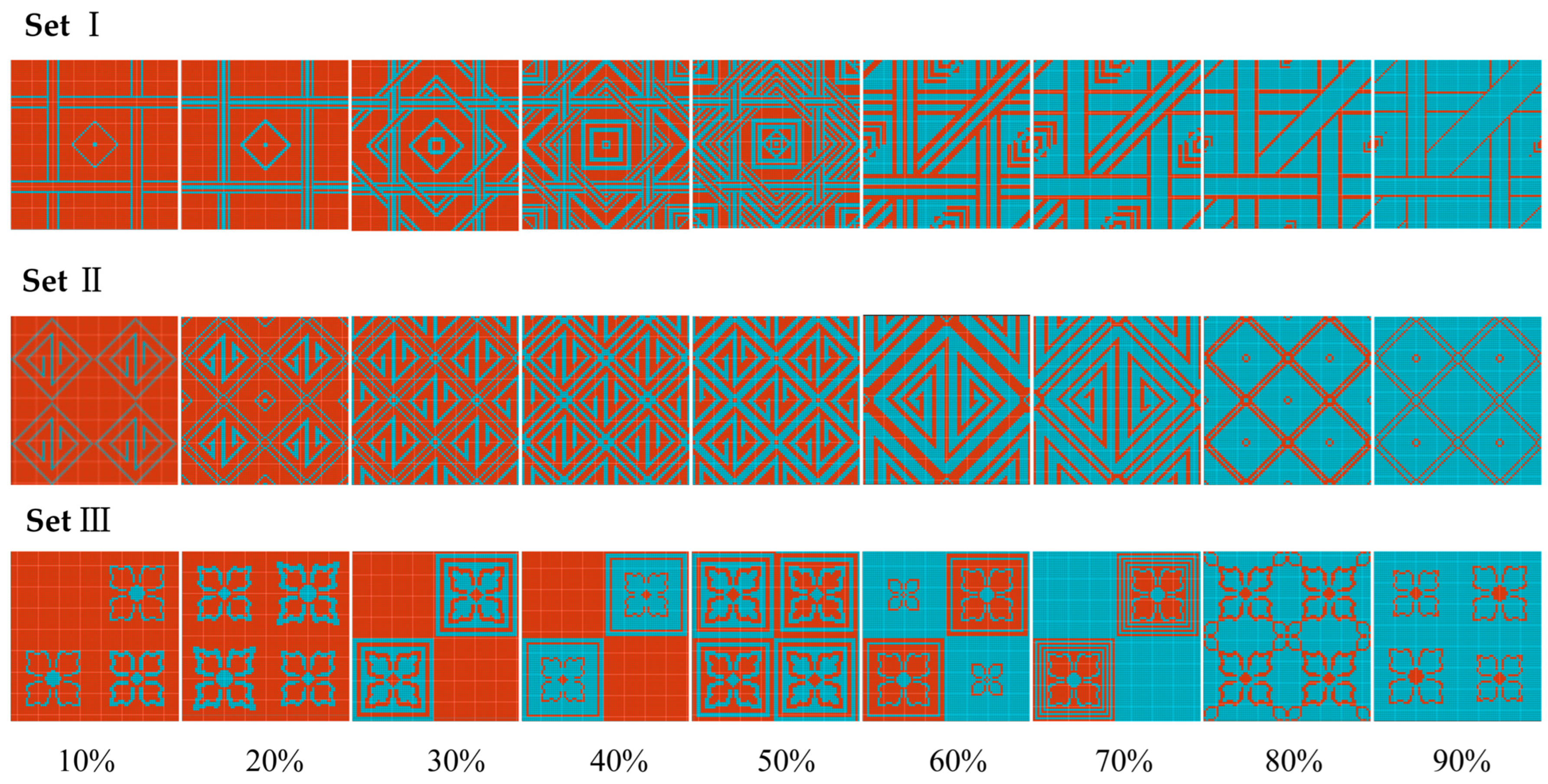
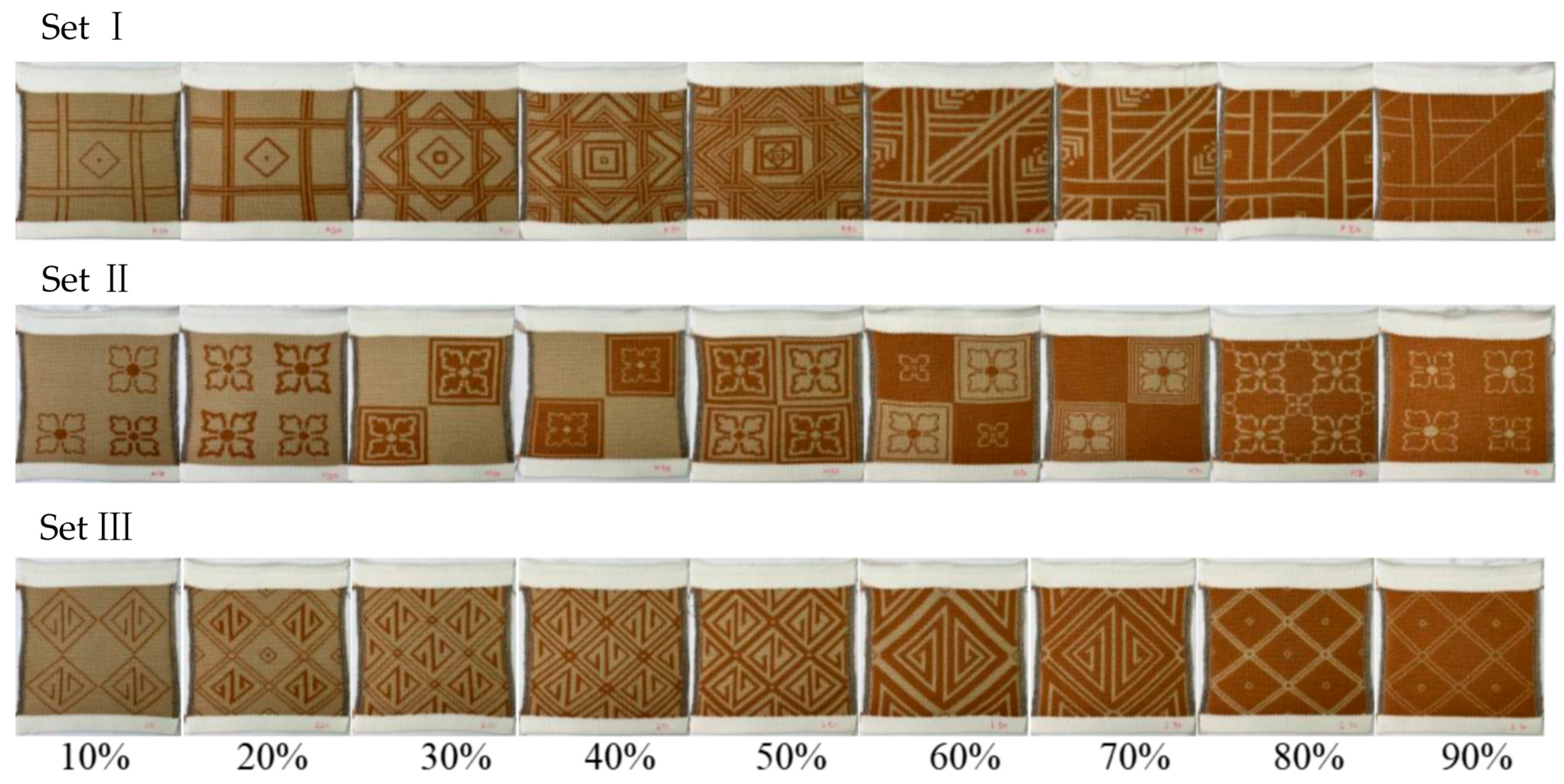
The indicators , and are physically related to the structural design of the Jacquard pattern, particularly the proportion of conductive yarn used in the fabric. Indicator represents the consumption of conductive yarn, which is directly associated with the color proportion in the Jacquard pattern; a larger pattern proportion corresponds to a higher amount of conductive yarn used in the fabric. Indicator represents the electrical resistance of the conductive fabric. As the proportion of conductive yarn in the pattern increases, the conductive pathway within the fabric becomes longer, leading to an increase in electrical resistance. Indicator represents the steady-state temperature of the fabric during the heating process, which reflects the overall thermal performance of the conductive knitted structure.
Although these indicators are structurally related through the Jacquard pattern design, they characterize different aspects of the conductive textile system, namely material consumption, electrical performance, and thermal response. Therefore, they provide complementary information for the fuzzy comprehensive evaluation.
4.4. Determination of Final Evaluation Grade
According to the maximum membership principle, the evaluation grade that corresponds to the largest value in the comprehensive membership vector is taken as the final grade of the sample. The sum of the elements in equals 1, reflecting the normalized membership distribution.
If two grades have equal membership values, the final decision is made by considering indicator weight and actual performance, with priority given to the grade associated with the indicator of a higher weight. For example, if (
), the sample is classified as “Excellent”. When the membership values of two grades are equal (e.g.,
), the following decision rule is applied: first, identify which indicator contributes the most to the calculation of each of the two grades; then compare the weights of these indicators. The grade corresponding to the indicator with the larger weight is taken as the final evaluation result [
39].
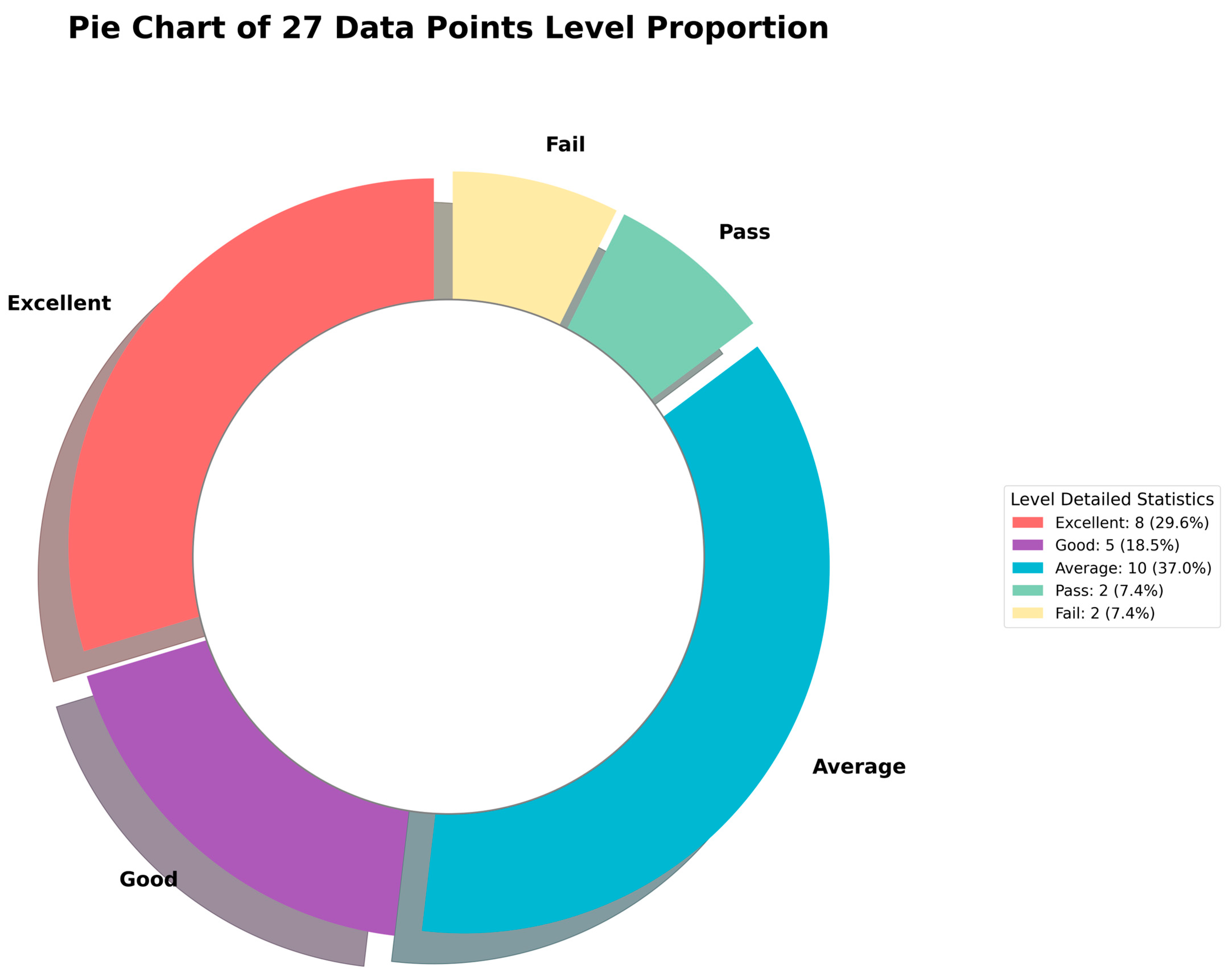
The distribution of the 27 samples, as illustrated by the pie chart in
Figure 7, indicates that approximately 30% of the samples have an excellent performance, characterized by a high conductive yarn content, stable electrical resistance, and a favorable temperature response. Samples classified as having good performance slightly outnumber those with excellent performance, and together, they account for 48.1% of the total samples. While a lower content of conductive yarn is indeed associated with lower costs, a slightly higher content was found to provide the best overall performance, including better electrical resistance stability and a higher temperature rise. The results indicate that a substantial proportion of the samples demonstrated good or excellent performance, while most samples still met the basic functional requirements.
Most of the samples have a average performance, thus indicating that they meet the basic functional requirements but have not yet reached the optimized state. The proportion of samples with a passing performance is comparable to that of the samples with an excellent performance, thus implying that only a subset of the samples meets the minimum performance criteria and so there is still considerable potential for further improvement. Samples that have a failing performance constitute a relatively small percentage (7.4%), and typically associated with an extremely low conductive yarn consumption ratio () and/or excessively high rates of change in resistance (), which result in abnormal temperature increase or electrical failure.
Overall, the samples with an excellent performance characterize a bit more conductive yarn, show little variation in resistance, and have a stable temperature, so that these constitute as the elements for optimizing the production process.
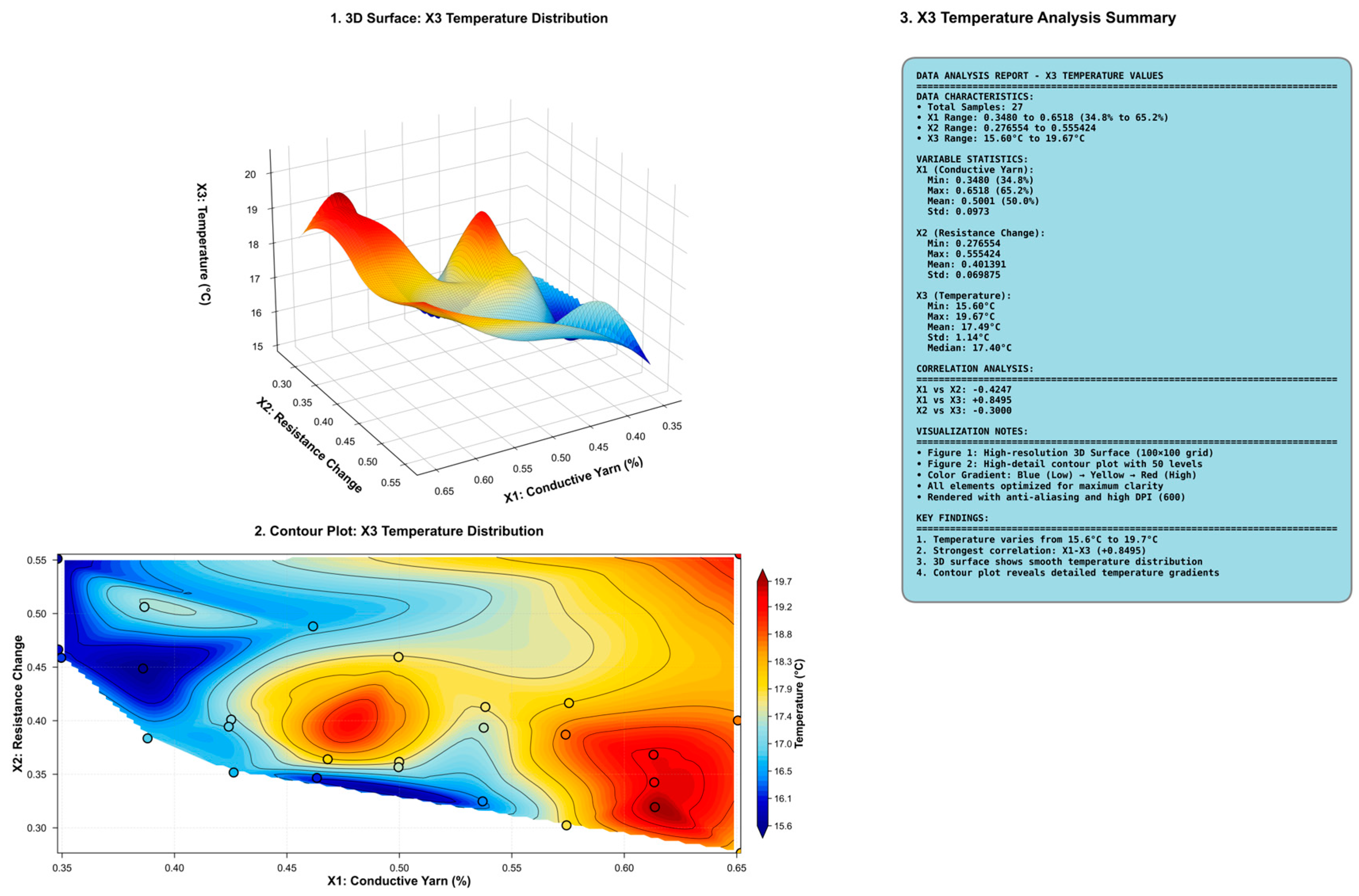
Figure 8 shows the 3D surface and contour maps that show the temperature distribution. The figure illustrates the combined effects of conductive yarn consumption ratio (
) and rate of change in resistance (
) on the temperature (
). The contour plot of the temperature distribution on the
–
plane shows a trend of temperature increase with higher
values, with the contour lines extending approximately in a diagonal direction. That is, there is a pronounced upward trend along the
axis, which indicates that the temperature show an increasing trend with increasing conductive yarn content, which confirms a positive relationship between
and
. In contrast, variations along the
direction are relatively moderate, thus suggesting that the influence of the rate of change in resistance on temperature is comparatively weaker. That is, the relatively sparse contour spacing along the
axis indicates that temperature is less sensitive to variations in the rate of change in resistance, thus further corroborating an important role of amount of conductive yarn in determining the thermal behavior of conductive knitted fabrics.
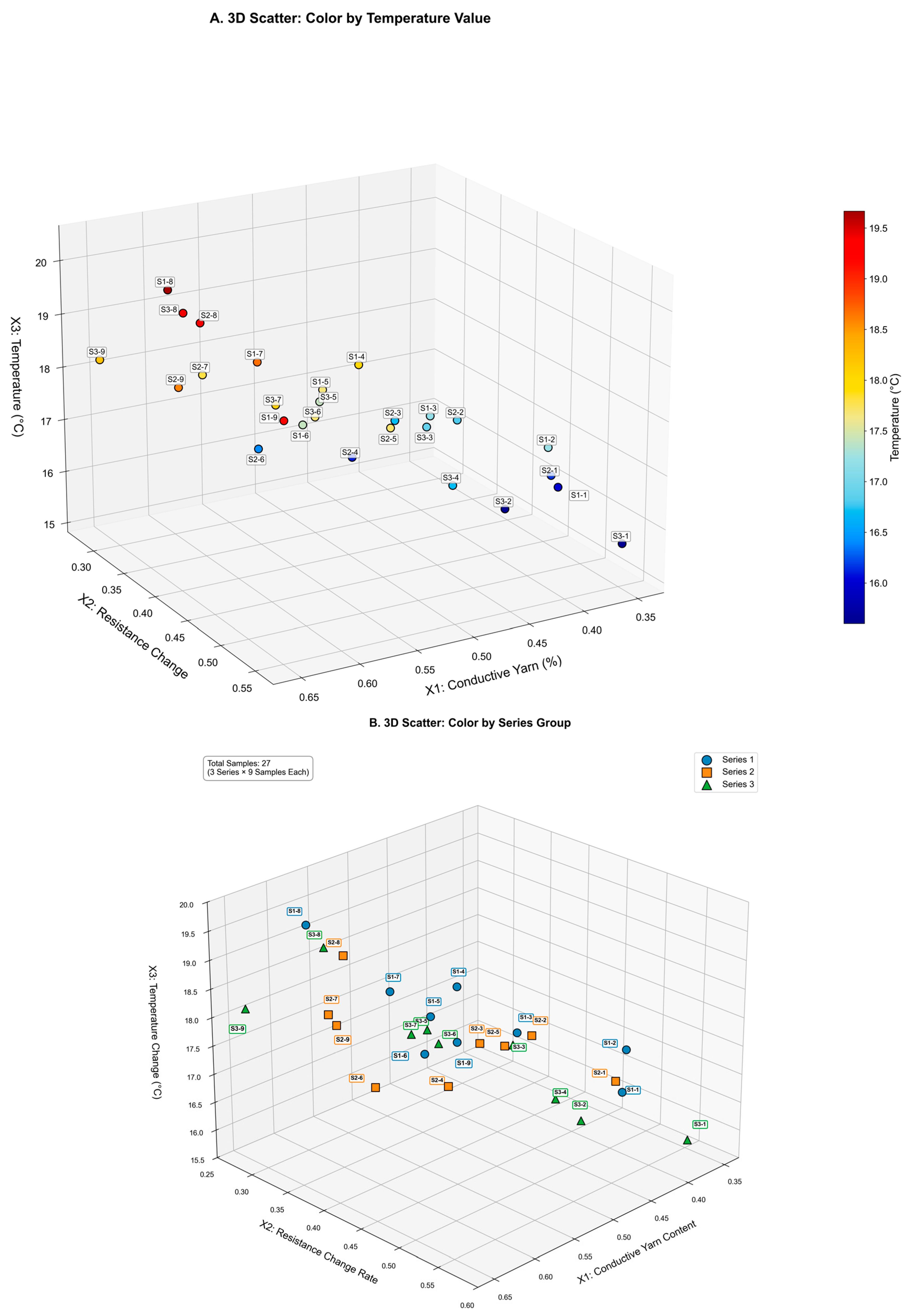
The 3D scatter plot further presents the actual distribution of the 27 samples in the
–
–
space (
Figure 9). High-temperature samples are mainly found in regions with high
and low
, which is consistent with the pattern of the surface map. This observation further confirms that
is the dominant factor that governs temperature response, whereas
is secondary.
Among the three sets of samples, Set I exhibits the best overall performance, with the highest proportion of samples that have excellent and good performances (66.7%: 6 out of 9 samples), with a relatively high percentage of excellent-grade samples. The sample distribution across the performance levels is well balanced, with all grades represented, thus indicating good process robustness and stability.
Set II shows a stable and well-controlled performance, with all samples meeting the qualification criteria and no unqualified samples observed, thus suggesting the most stringent process control among the three sets of samples. However, the percentage of samples with excellent–good performance (33.3%: 3 out of 9 samples) is lower than that of Set I, thus indicating that while this process readily meets baseline requirements, achieving an exceptional performance remains challenging.
In contrast, Set III is at a medium level. The percentage of samples with excellent–good performance is 44.4% (4 out of 9 samples). Although this proportion was higher than that of the second group, it was still lower than that of the top-performing first group. Moreover, there were some samples that were classified as unqualified, indicating that there is still room for improvement in the stability of the process parameter control, and performance fluctuations are prone to occur.
The experimental results indicate that samples with slightly higher conductive yarn content exhibit more stable electrical resistance and a higher temperature rise. Based on the distribution characteristics of the evaluated samples, it is recommended that be controlled within the range of 38–54%, where there are the most samples and process stability is maximized, thus providing a favorable balance between performance reliability and manufacturing robustness. It represents a balanced range that ensures relatively low cost while achieving stable electrical and thermal performance.
4.5. Discussion and Limitation
To further evaluate whether significant differences exist among the three sample sets, a Kruskal–Wallis non-parametric test was conducted. This statistical method is suitable for comparing multiple independent groups when the sample size is relatively small or when the assumption of normal distribution may not be satisfied. The results show that the differences among the three groups are not statistically significant (H = 0.814, p = 0.666 > 0.05). Although the descriptive statistics suggest that Set I exhibits slightly higher performance levels than Set II and III, the statistical analysis indicates that these variations do not reach statistical significance. Therefore, the observed differences among the three groups may be attributed to random variation rather than inherent group effects.
Nevertheless, the experimental results still reveal certain trends in the electrothermal performance of the jacquard conductive knitted fabrics. In particular, the washing durability and heating performance appear to be closely related to the proportion of conductive yarn in the fabric structure. Fabrics with an appropriate conductive yarn content generally exhibit more stable electrical resistance after washing and a more pronounced temperature rise during heating tests. This indicates that conductive yarn content plays a crucial role in determining both the electrical conductivity and the stability of the heating response during repeated use. The fuzzy comprehensive evaluation integrates multiple indicators, including the conductive yarn usage ratio, resistance variation after washing, and temperature variation, providing a systematic assessment of the overall performance. The results demonstrate that samples with a moderate conductive yarn content tend to achieve better overall performance, indicating that balancing material composition and heating properties is essential for the design of practical conductive knitted heating textiles.
Despite the promising results obtained in this study, several limitations should be acknowledged. First, the number of samples investigated was relatively limited, which may restrict the statistical representativeness of the results. Second, the washing and heating performance evaluation was mainly based on resistance variation after washing and temperature rise under controlled laboratory conditions, while long-term durability and real wearing conditions were not investigated. In addition, the fuzzy comprehensive evaluation method relies on the selection of evaluation indicators and their corresponding weights, which may introduce a certain degree of subjectivity. Future studies could expand the sample size, incorporate additional performance indicators such as comfort and mechanical durability, and conduct long-term wear tests to further validate the applicability of the proposed conductive knitted fabrics.