1. Introduction
The sandwich structures integrated with both generalized reinforcing and weakening phases have found widespread applications in aerospace, automotive, marine, and other related engineering fields owing to their excellent performance characteristics, including their remarkable strength-to-weight characteristics, excellent anti-corrosion performance, and acoustic function design flexibility [
1,
2]. The reinforcing phases include metal particles and glass/carbon fiber-enhanced lattice columns, trusses, and honeycomb partitions [
3,
4,
5]. The weakened phases generally contain porous sound-absorbing or sound-insulating foam, a soft vibration damping layer, an acoustic functional cavity, and so on [
6,
7]. In marine engineering, the rib-stiffened PVC foam sandwich structures with reinforcing and weakening phases could be applied on superstructures, such as the sail and rudder plate of an underwater vehicle. With an appropriate acoustic function design, the sandwich structure could gain excellent performances of vibration attenuation and noise isolation or absorption [
8,
9], as well as its lightweight and high rigidity characteristics. Once excited by the external load in the underwater environment, it is imperative to investigate the acoustic vibration characteristics of the rib-stiffened sandwich in acoustic-structural coupling analysis.
The research on composite structures has a long history, among which the most representative theories are the CLT (classical lamination theory) and FSDT (first-order shear deformation theory) [
10]. The CLT assumes that plane sections remain plane and normal to the mid-surface after deformation, which is well-suited for thin composite plates where shear deformation effects are negligible [
11,
12,
13]. The FSDT, by contrast, incorporates the role of rotary inertia and shear deformation, rendering it more appropriate for moderately thick composite plates [
14,
15,
16]. These classical theories have not only elucidated fundamental mechanical responses of composite plates but have also been widely adopted as essential tools in the preliminary design and performance analysis of composite plate structures across various engineering domains. Based on the CLT and the FSDT, scholars have developed and derived various higher-order shear deformation theories (HSDTs). Tu et al. [
17] adopted the third-order shear deformation theory (TSDT) as the theoretical basis and derived the calculation formula for the driving force of macroscopic fiber composite materials. To conduct static mechanical analysis of functionally graded saturated porous plates resting on the Paschen–Narkovsky elastic foundation, Tru et al. [
18] proposed a novel quasi-3D-HSDT and employed it for the analysis. Lakhemissi et al. [
19] used the integral-type-HSDT, in consideration of the transverse shear effect, to investigate the mechanical behavior of bidirectional functionally graded materials plates under elastic bending conditions. As an expansion of the CLT and the FSDT, HSDTs are widely applied in the field of composite laminated plate design. Compared with traditional theories, it could make more accurate predictions of structural stress and deformation.
Over the past few decades, researchers have conducted extensive research on the mechanical and acoustic properties of rib-stiffened homogeneous plates. Hou et al. [
20] conducted experiments and numerical methods to study the low-speed impact (LVI) and post-impact compression (CAI) behaviors of rib-strengthened CFRP panels. In the stability analysis of U-shaped rib-stiffened plates, Wang et al. [
21] explored how aspect ratios affect stability performance via tests and numerical simulations, and put forward reasonable width-to-height ratio recommendations for engineering practice. Yekta et al. [
22] derived an analytical method by solving the generalized Bragg wave incidence, which was used to consider the acoustic properties of multiple rib-stiffened plates connected in series. Chen et al. [
23] investigated the influence of varying welding energy inputs on the vibro-acoustic characteristics of stiffened plate structures, performing a series of experiments on the vibration modes, underwater vibration responses, and acoustic radiation behaviors of such structures under different welding energy input conditions. In conclusion, the current extensive research on rib-stiffened plates mainly focuses on homogeneous structures. By combining experimental methods, numerical simulations, and analytical methods, the influences of the structural parameters, loading conditions, and processing techniques on the mechanical properties and acoustic characteristics of the structure have been systematically investigated, providing data and theoretical support for the design optimization of the base reinforcement plate structure.
To meet the comprehensive requirements of underwater equipment, such as lightweighting, high strength, shock absorption, and pressure resistance, researchers have gradually broken through the limitations of homogeneous structures and achieved improvements in structural performance by introducing reinforcing phases in the core. Roun et al. [
24] proposed a new type of nanocomposite material, which was used to integrate GPLs into the plate structure of a traditional functional graded matrix, and the performance of such plates was evaluated through free vibration and buckling analyses. Wang et al. [
25] combined topological optimization to design three bimodal lattice/CFRP sandwich structures. Through testing the bending behavior and damage process, they revealed the complex failure modes and energy absorption enhancement mechanisms of this type of structure. Leveraging the interfacial stress transfer mechanism between the fiber-reinforced composite layer, damping layer, and reinforcing ribs, Wang et al. [
26] proposed an innovative dynamic analytical model to investigate the dynamic performance of rib-reinforced composite damping plates integrated with randomly aligned carbon nanotubes. Madenci et al. [
27,
28] investigated the bending behavior of FG-CNTRC sandwich beams with a pultruded GFRP core, revealing the influence of the pultruded composite core on the bending mechanical response of the sandwich beam; meanwhile, systematic experimental and analytical studies on the buckling performance of FG-CNTRC sandwich beams have also been carried out, and the critical buckling load and failure mode of such structures have been clarified with a verifiable analytical prediction model. Most of the current research on enhanced phase-related studies focus on the modification of a single reinforcing phase and mostly target the optimization of the mechanical properties of the structures in an air environment. The research on the acoustic vibration coupling characteristics of rib-stiffened composite structures containing reinforcing phases in underwater environments is relatively insufficient, and there is even less involvement in the coordinated regulation with other functional phases.
Unlike the reinforcing phases, which aim to improve the structural mechanical load-bearing capacity and vibration resistance stiffness as its main goal, the introduction of the functional weakening phases are guided by the core objective of actively dissipating vibration energy and optimizing the acoustic radiation characteristics [
29]. Kong et al. [
30] investigated a butterfly-like double-layer Helmholtz resonator structure lined with porous materials. By virtue of a distinctive resonant mechanism, this structure enabled efficient acoustic wave absorption at specific frequencies, thus achieving effective ambient noise attenuation. Wang et al. [
31] designed a sound-absorbing periodically arrayed structure (SPAS) by leveraging the synergistic effects of cavity resonance and impedance transition. This structure exhibited a sound absorption coefficient of 0.9 within the frequency range of 2400–10,000 Hz at a water pressure of 1.5 MPa, and further realized broadband sound absorption at a water depth of 300 m. Liu et al. [
32] proposed a new type of Helmholtz resonant metamaterial composed of perforated rigid panels and perforated porous materials. This structure dissipated acoustic energy via the porous material lining the back cavity, enabling nearly perfect sound absorption across a broad range of neck diameters. In the field of bio-inspired sandwich structures, Song et al. [
33,
34] studied the acoustic properties of honeycomb sandwich panels filled with paper fibers/cement panels, and conducted an in-depth analysis of the effects of the filling material, panel configuration, and core material type on the FHW sound insulation performance. In addition, the vibration characteristics of the foam-filled Beetle elytron plate (BEP) were also investigated by changing the structural parameters.
Most current studies have mainly focused on rib-stiffened homogeneous plates and sandwich plates that contain only a single reinforcing phase or a single weakening phase; however, there is still a lack of research on the underwater acoustic vibration response characteristics of composite plates that have both rib stiffeners and simultaneously contain reinforcing and weakening phases. Such composite plates have broad application potential in the field of ship engineering. However, due to their complex form and the diverse components of the core layer materials, vibration analyses of these composite plates is difficult to conduct, except in cumbersome specific structural refinement modeling based on numerical simulations.
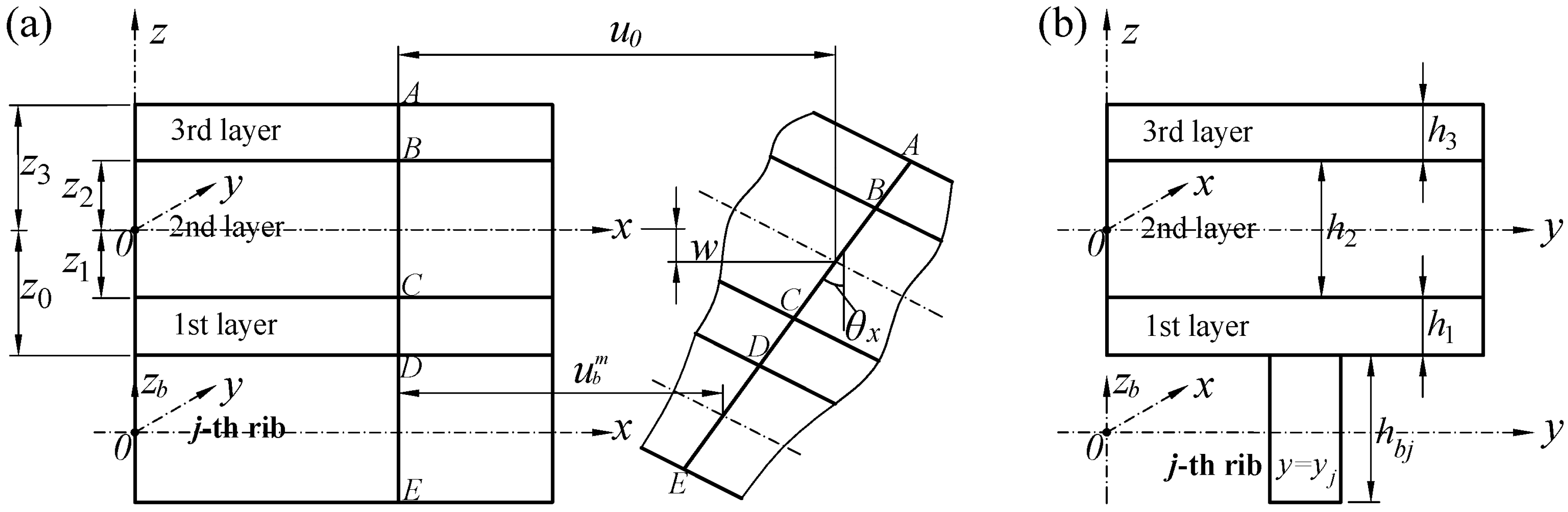
To deal with the problem, this paper has constructed a theoretical method applicable to analyzing the acoustic vibration characteristics of rib-stiffened PVC foam sandwich structures with reinforcing and weakening phases in underwater environments. The composite core containing reinforcing and weakening phases is equivalently represented as a single orthotropic layer to simplify characterization. For the rib-stiffened sandwich under simply supported boundary constraints, the motion equations are derived by considering the coupling effect between the ribs and the sandwich plates. Regarding the coupling relationship between the underwater environment and the structure, the distribution of sound pressure fields is described by the Helmholtz equation, while the continuity condition on the fluid–solid interaction interface is controlled by the Euler equation. The control equations are solved using the Navier method to obtain the natural frequencies and acoustic vibration response. Parametric studies are further conducted to explore the influence of the parameters of the rib and core layers on the underwater acoustic vibration characteristics.
The main innovations of this paper are reflected in the following three aspects. First, by focusing on rib-stiffened PVC foam sandwich structures with both reinforcing and weakening phases, a novel theoretical method has been established to realize the rapid and accurate calculation of acoustic vibration response. Unlike the existing analytical methods, the proposed method achieves a balance between calculation efficiency and precision, effectively filling the gap in efficient analytical methods for such complex sandwich structures with dual-phase core defects. Furthermore, the proposed equivalent single-layer theoretical method possesses excellent universality. It can be flexibly extended to the acoustic vibration analysis of other composite structures with complex core layers, providing a unified theoretical framework for similar complex structure analyses. Finally, this paper conducts systematic variable analyses of material and geometric parameters for the rib-stiffened PVC foam sandwich structures with reinforcing and weakening phases. This not only reveals the intrinsic influence laws of key parameters on the acoustic vibration characteristics of such structures but also provides targeted theoretical references and reliable data support for future related studies and engineering design optimization, which has important engineering application value.
3. Validation of Method Effectiveness
Free and forced vibration investigations of the orthogonal rib-stiffened PVC foam sandwich structures with reinforcing and weakening phases in vacuum and water are conducted in this section, where the acoustic velocity and mass density of water are and .
3.1. Simulation Verification Description
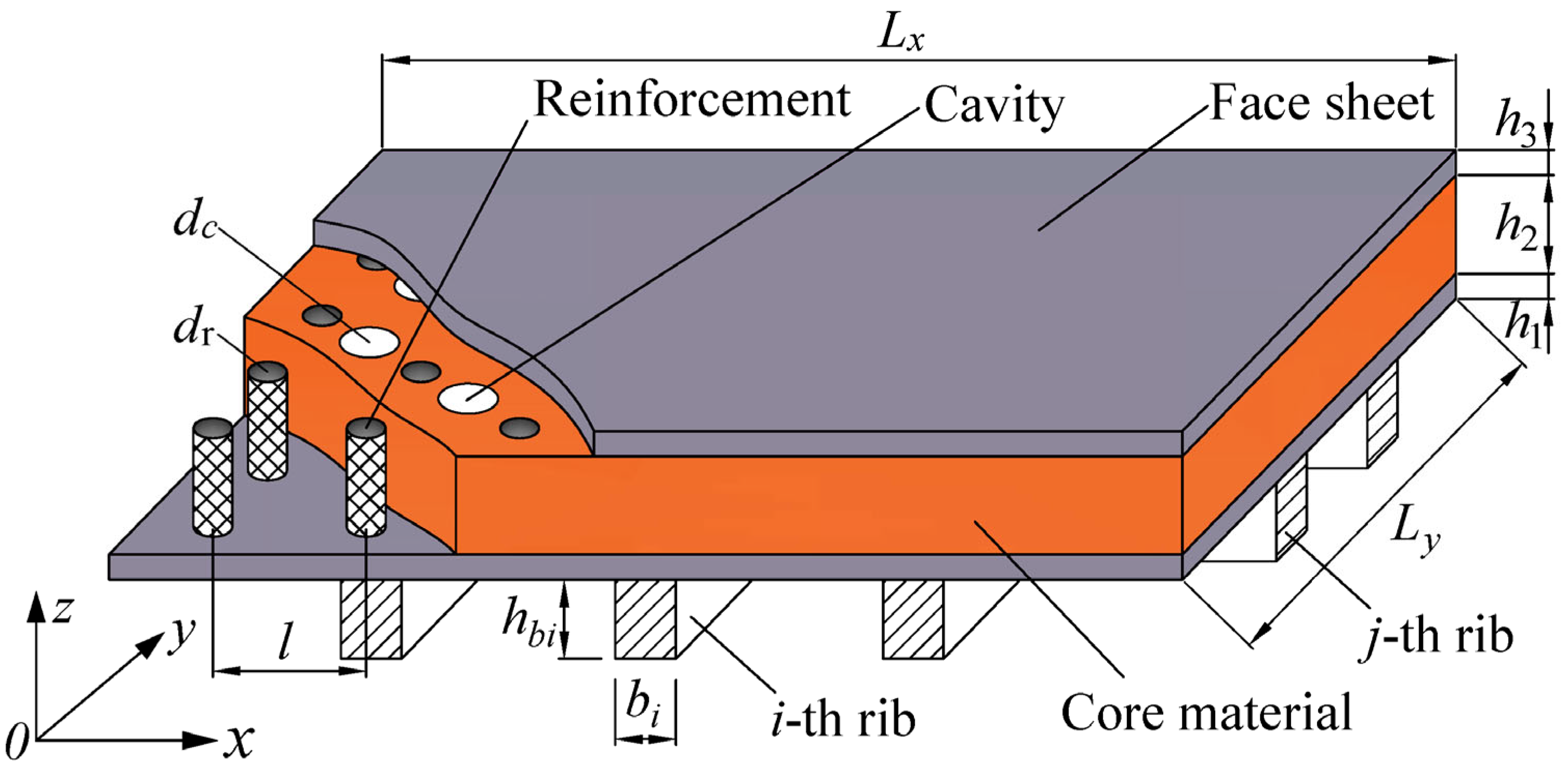
The orthogonal rib-stiffened PVC foam sandwich structures with reinforcing and weakening phases are further considered. For the geometric parameters of the structure, the plate length and width are specified as and . The thicknesses of the lower face sheet, core layer, and upper face sheet are defined as , , and . Additionally, the spacing between the adjacent reinforcements, the reinforcement diameter, and the cavity diameter are given as , , and . The height and width of the rectangular rib is 0.03 m and 0.01 m. The face sheets comprise glass fiber-reinforced plastics (GFRP), with its Young’s modulus as E11 = E22 = 23.5 GPa and E33 = 4.5 GPa; shear modulus as G12 = G13 = G23 = 3.23 GPa; a Poisson’s ratio of ; and a mass density of 1800 kg/m3. The rib stiffeners comprise polyurethane (PU), with the Young’s modulus as Eb = 14 GPa; a Poisson’s ratio of ; and a mass density of 760 kg/m3. The core material is PVC-H320, with its Young’s modulus as Ecm = 0.45 GPa; a Poisson’s ratio of ; and a mass density of 320 kg/m3. The reinforcement has the Young’s modulus as Ere = 55 GPa; a Poisson’s ratio of ; and mass density of 1300 kg/m3. The weak modulus of the cavity is assumed as . The theoretically predicted vibration results under vacuum and when submerged in water are validated by comparisons with the numerical simulation outcomes, including FE analyses conducted in ANSYS 16.0 and coupled FE/BE analyses performed in Virtual.Lab 13.3. Three cases of orthogonal ribs are taken into account as: (1) n1 = 1 and n2 = 2 (y1 = 0.45 m, x1 = 0.42 m, x2 = 0.84 m); (2) n1 = 2 and n2 = 2 (y1 = 0.30 m, y2 = 0.60 m, x1 = 0.42 m, x2 = 0.84 m); and (3) n1 = 2 and n2 = 3 (y1 = 0.30 m, y2 = 0.60 m, x1 = 0.30 m, x2 = 0.63 m, x3 = 0.96 m).
To demonstrate the numerical analysis procedure, a rib-stiffened sandwich structure with
n1 = 2 and
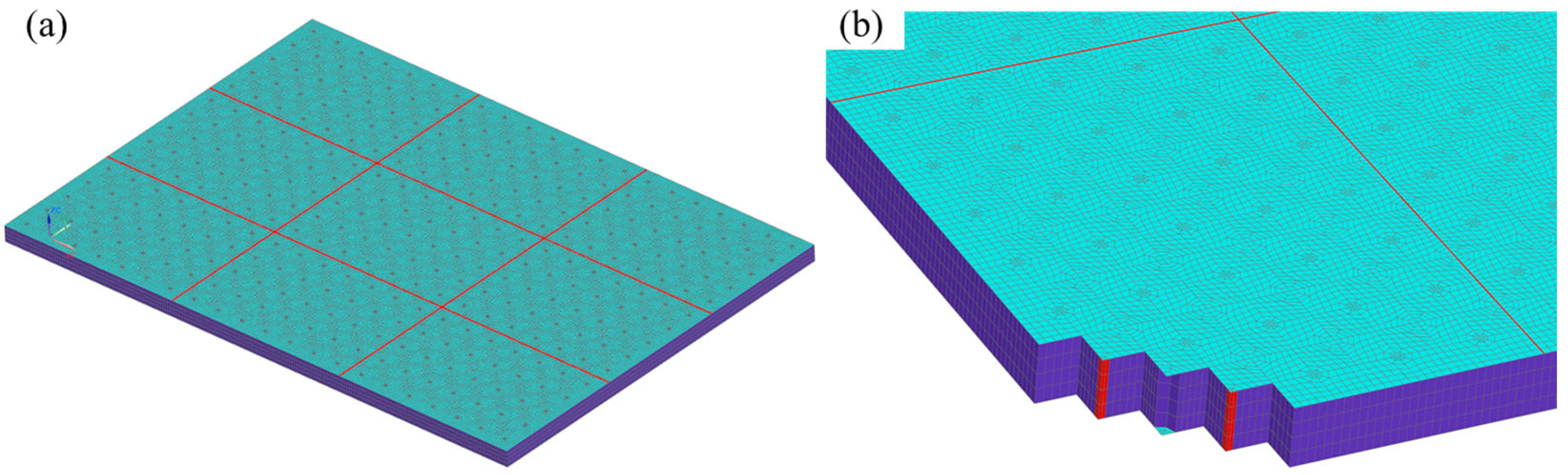
n2 = 2 is selected as a case study, and its FE implementation in ANSYS is detailed as follows: a convergent FE model is established through iterative mesh refinement, consisting of 238,152 elements with a minimum mesh size of 2.5 mm (as illustrated in
Figure 3), where the face sheets, core layer (including both the core material and internal reinforcements), and ribs are assigned SHELL181, SOLID185 and BEAM188 elements respectively, and the rib-stiffened structure is subjected to simply supported boundary conditions.
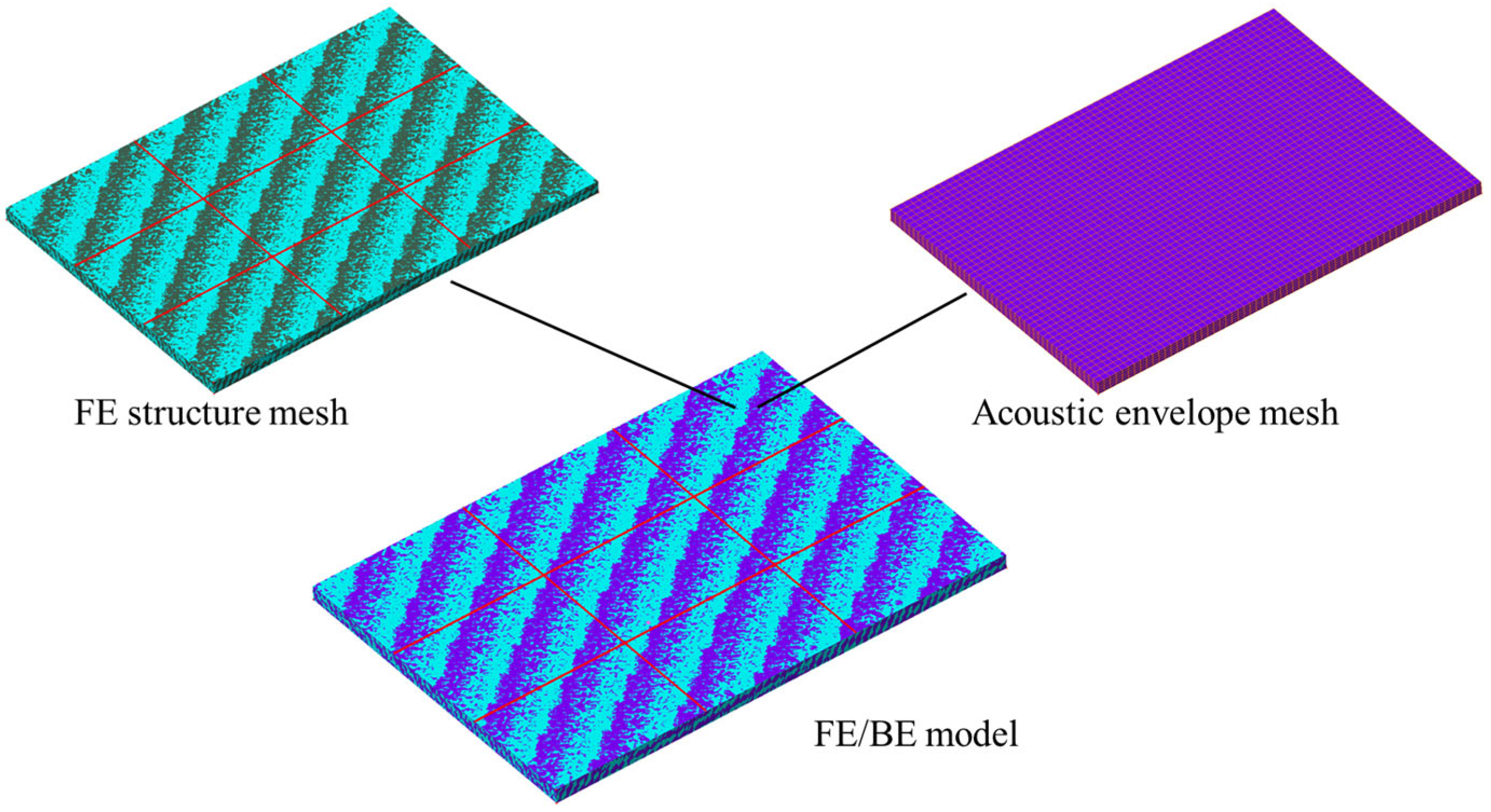
FE analyses are first performed to investigate the free vibration of the rib-stiffened sandwich structure in a vacuum environment. Using the obtained dry-mode vibration characteristics, coupled FE/BE analyses are subsequently carried out in Virtual.Lab to predict the vibration response of the structure submerged in water. To establish the acoustic coupling, the structural FE mesh is enclosed within an acoustic envelope mesh, and the FE/BE model is constructed via mesh mapping, as depicted in
Figure 4. This acoustic envelope mesh comprises 7420 shell elements and is validated to ensure the convergence of FE/BE analyses, with the direct BE method adopted for acoustic field calculations.
3.2. Convergence Verification
Before performing the simulation calculation and after the two steps of the Mori–Tanaka homogenization method, the equivalent elastic constants for each stage are shown in the following
Table 1.
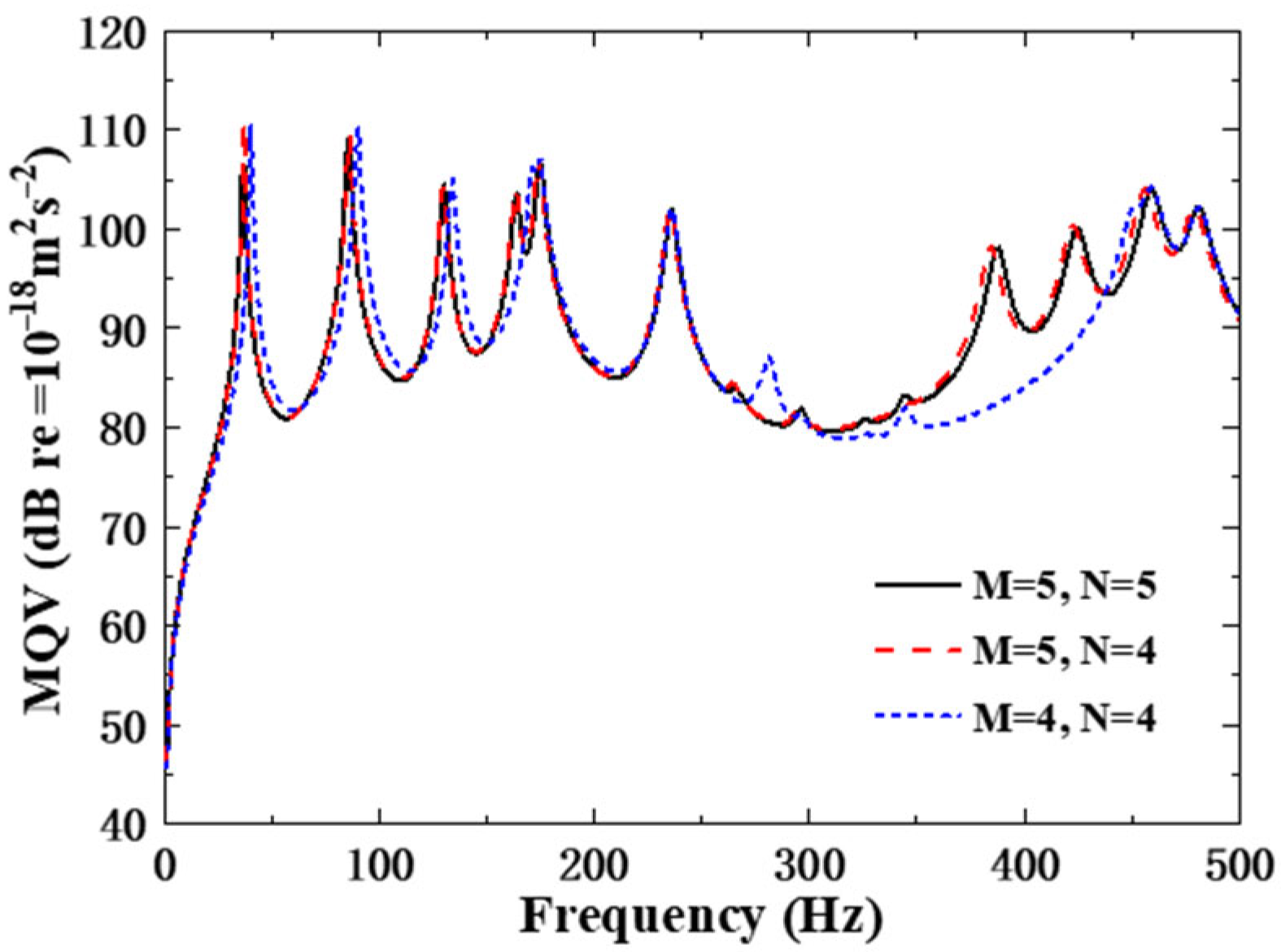
In order to analyze the relationship between the truncation orders (M, N) and the natural frequencies, convergence analysis was performed by gradually increasing the values of M and N. The calculation results show that the natural frequency gradually converges with the increase in truncation orders, and when M and N reach a certain threshold, the natural frequency value tends to be stable and no longer changes significantly, as clearly demonstrated by the convergence curves in the
Figure 5.
On this basis, the natural frequencies of the underwater (
m,
n) modes of the composite structure are listed in the following
Table 2 (
m = 1, 2, 3, 4, 5, 6, and
n = 1, 2, 3, 4, 5), which complements the graphical results and provides specific data supporting the convergence analysis. From the table, it can be seen that the natural frequencies of modes (6,
n) and (
m, 5) are both greater than 500 Hz, which is consistent with the high-frequency distribution law reflected in the
Figure 5. Therefore, by choosing M = 5 and N = 4 as the truncation values, we can ensure that all the modes that contribute to the response within the analysis frequency range are included without wasting computing resources due to the inclusion of too many non-essential higher-order modes—this is the optimal choice that balances accuracy and efficiency.
To ensure the reliability of the numerical results and to eliminate the influence of mesh discretization error, a mesh convergence study was performed in ANSYS. As shown in
Table 3, two finite element mesh schemes were established: an original mesh with 238,152 elements and a refined mesh with 365,640 elements. The results showed that the relative differences in the natural frequencies of all considered modes between the refined and original meshes were less than 0.6%. This level of discrepancy satisfied the accuracy requirements for both engineering and academic analyses, confirming that the original mesh scheme has achieved mesh convergence and is sufficiently refined to yield reliable results for the subsequent vibro-acoustic response investigations.
In addition, the influence of acoustic grid density on the calculation results was verified, and the calculation results of each mode under the two grid schemes (7420 and 11,280) were compared, as shown in
Table 4. The results show that under the calculated modes, the calculation differences in the two grids are all less than 0.5%, which proves that when the number of acoustic grids reaches 7420, the numerical solution is close to the grid-independent solution. Further increasing the grid density has a limited effect on improving the accuracy; therefore, in this study, 7420 is selected as the benchmark density for the acoustic grid, which can ensure calculation accuracy and improve calculation efficiency.
3.3. Validity for Free Vibration
Table 5 displays the comparison of achieved analytical and numerical natural frequencies, both in vacuum and in water. The first five modes of presented sandwich structures with three cases of orthogonal ribs are listed, and the errors of the analytical results are calculated. It can be seen that there is good consistency between the first five analytical and numerical natural frequencies, while all the errors were no more than 3.87%. Hence, the correctness of the proposed analytical method is confirmed for the free vibration analysis of the rib-stiffened sandwich structure. In addition, when the number of ribs increases and the cases of ribs tend to be concentrated, all of the first five natural frequencies show rising trends, except for the mode (1, 2) of rib case (
n1 = 2,
n2 = 2) and the mode (3, 1) of rib case (
n1 = 2,
n2 = 3)—in general, the ribs enhance the global bending stiffness of whole sandwich structure.
Under the three different rib arrangement conditions, the natural frequencies in the water environment are significantly lower than those in the vacuum environment. The frequency ratio is greater than 2.9 in all cases. This clearly indicates that the additional mass effect of the water significantly reduces the natural frequencies of the structure. At the same time, the frequency ratio decreases as the modal order increases; for example, in the (n1 = 1, n2 = 2) condition, from the mode (1, 1) of 4.25 to the mode (2, 2) of 2.99, it shows that the influence of the additional mass on higher-order modes is relatively small. Moreover, the influence of different rib arrangements on the frequency ratio is small, indicating that the additional mass effect is mainly dominated by the coupling effect between the fluid and the structure, rather than the stiffness change in the ribs themselves.
3.4. Validity for Forced Vibration
Calculating the underwater forced vibration response of orthogonal rib-stiffened PVC foam sandwich structures with reinforcing and weakening phases based on the second reinforcement rib case (
n1 = 2,
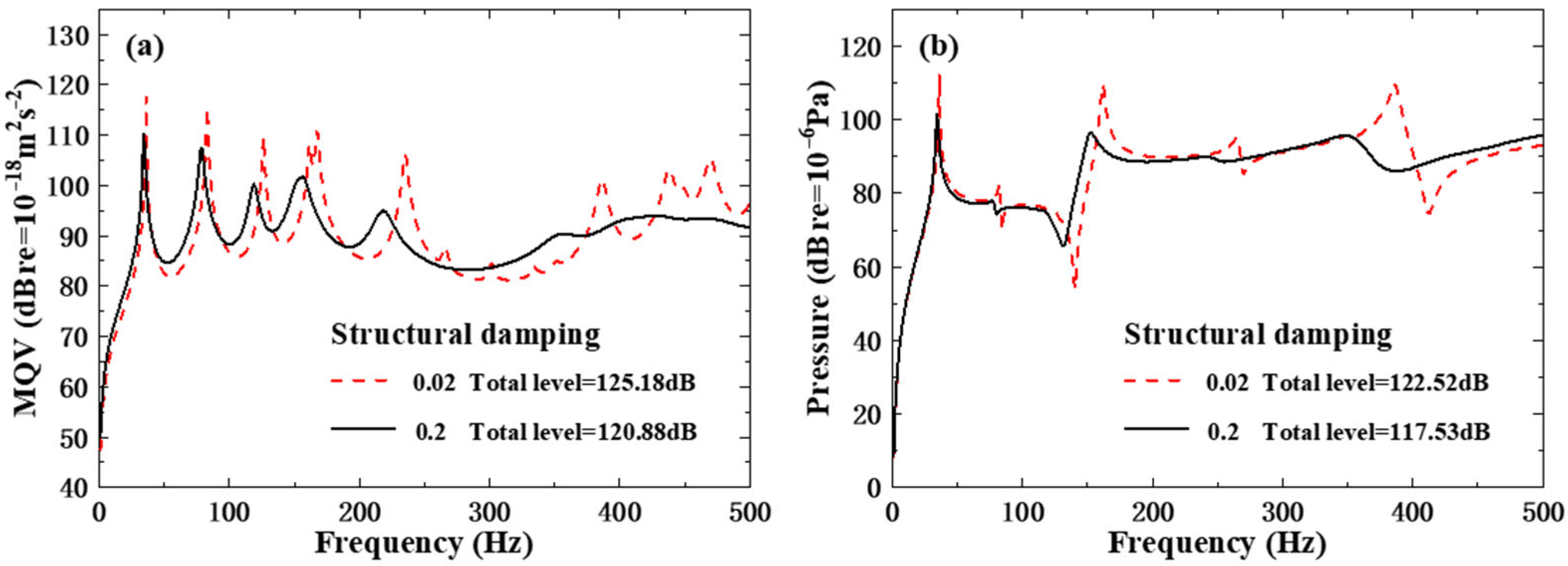
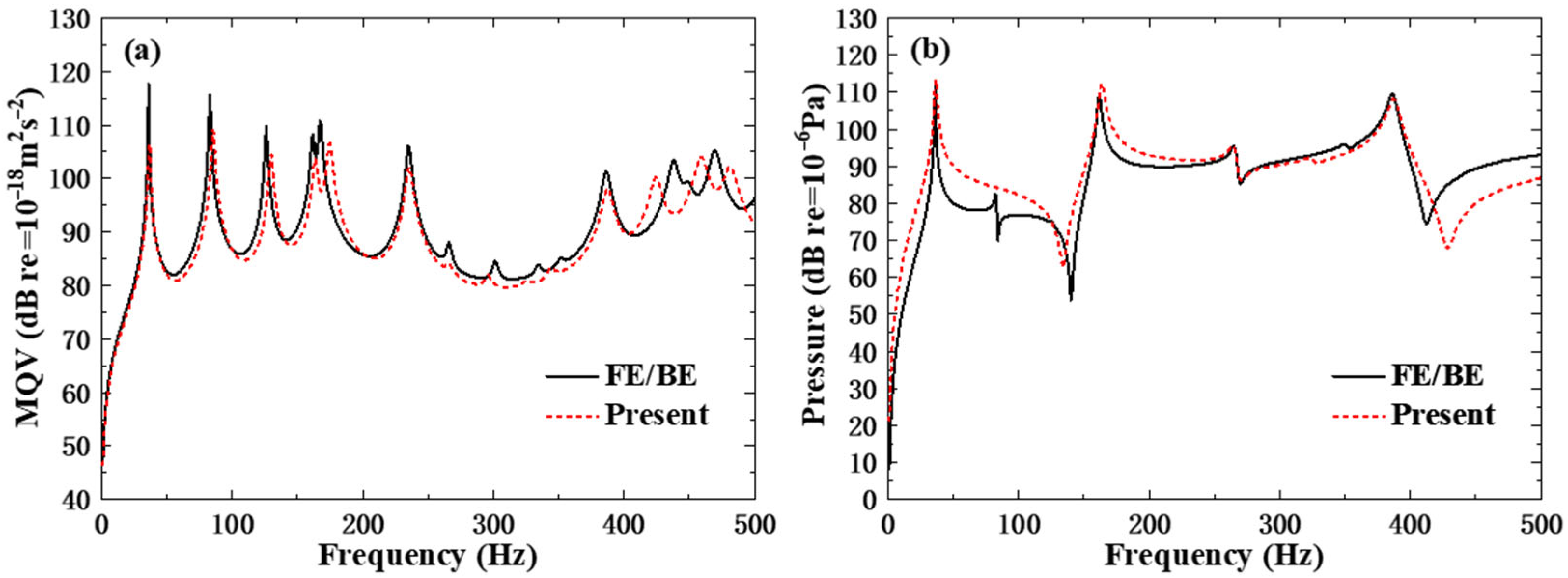
n2 = 2). A concentrated force in the z-direction is applied to the surface of the reinforced plate. The point of application of the excitation force is at (0.3, 0.3, 0), and the magnitude of the force is 1 N. The frequency range of the analysis is 1–500 Hz, with a step size of 1 Hz. In the underwater acoustic analysis, the fluid domain is assumed to be infinite, homogeneous, compressible, inviscid, and quiescent water, which satisfies the Helmholtz equation in the frequency domain. For the sound pressure evaluation, the coordinate of the field point in the sound pressure is (0.63, 0.45, 5), which is located in the far field to characterize the underwater acoustic radiation characteristics of the structure. The results of the ESL theoretical modeling approach based on core equivalent homogenization are compared with the results of the FE/BE numerical simulation approach, as shown in
Figure 6. As can be seen, the analytical solution of the ESL theoretical modeling approach agrees well with the numerical solution. In the region of low frequencies, the MQV curves essentially overlap, but the peaks of the curves are shifted in the region of high frequencies. For the field point sound pressure, there are good agreements between the present analytical results and the ones from FE/BE simulation. Thus, the present FSDT-based analytical approach has good accuracy for the underwater acoustic vibration research of rib-stiffened PVC foam sandwich structures with reinforcing and weakening phases.
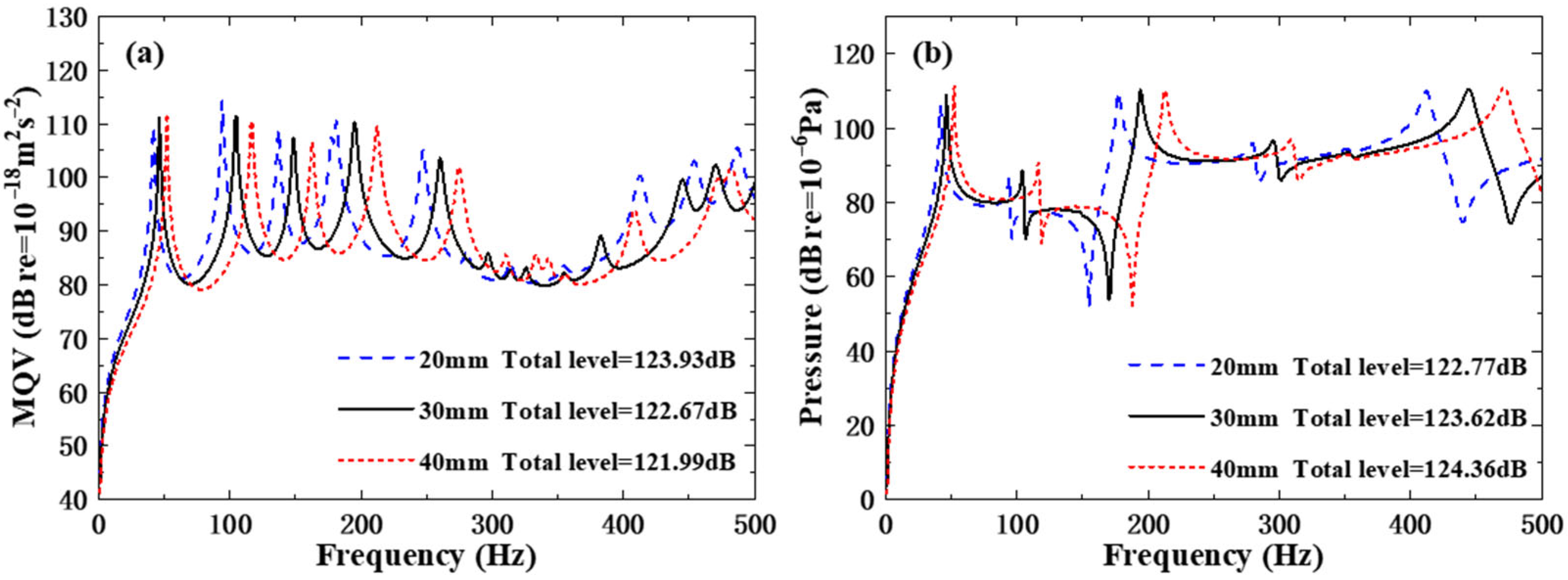
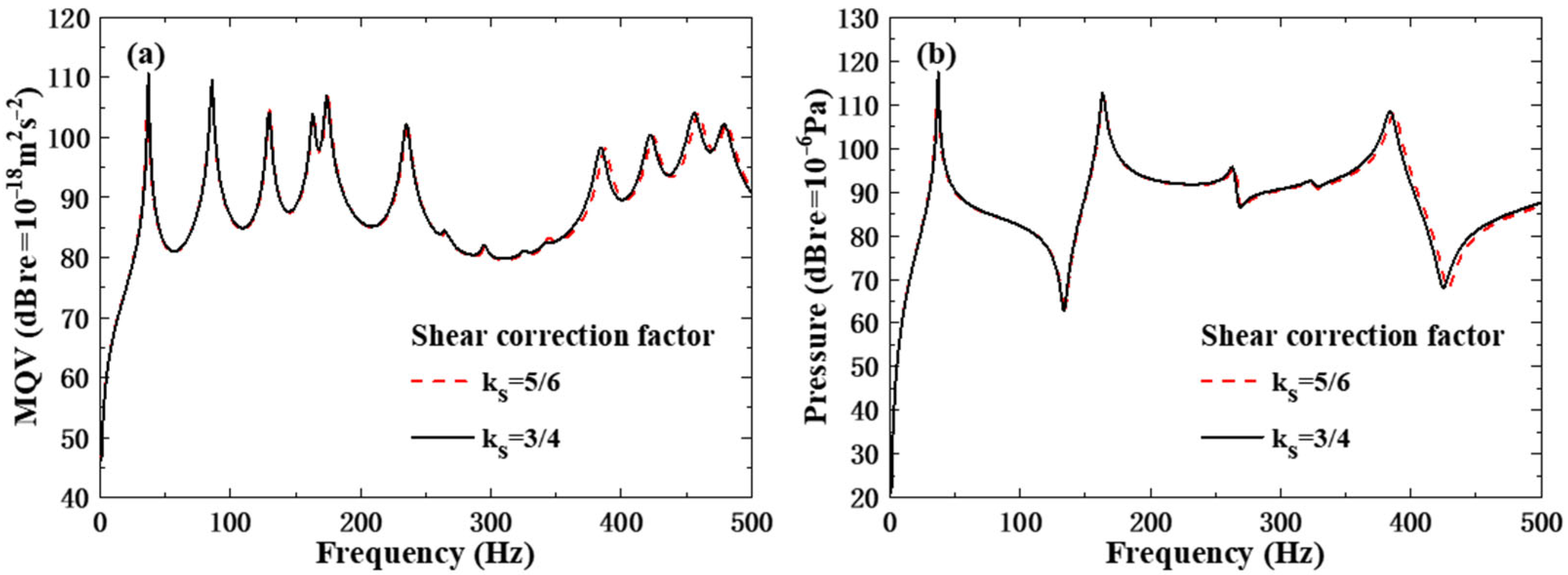
Figure 7 compares the influence of different shear correction factors on the calculated vibro-acoustic results. Parametric studies confirm that the shear correction factor (
) exhibits a frequency-dependent impact on vibro-acoustic responses. At low frequencies, the influence of
on both the MQV and field point sound pressure is negligible with the curves for different values nearly coinciding. Nevertheless, in the high-frequency domain (>200 Hz), a larger
value significantly amplifies the vibration response, inducing distinct deviations in the radiated sound pressure. These results emphasize that while the low-frequency analysis can tolerate a certain flexibility in selecting α, a rational and physically justified choice of
is critical for high-frequency simulations to guarantee reliable predictions of structural vibration and noise.