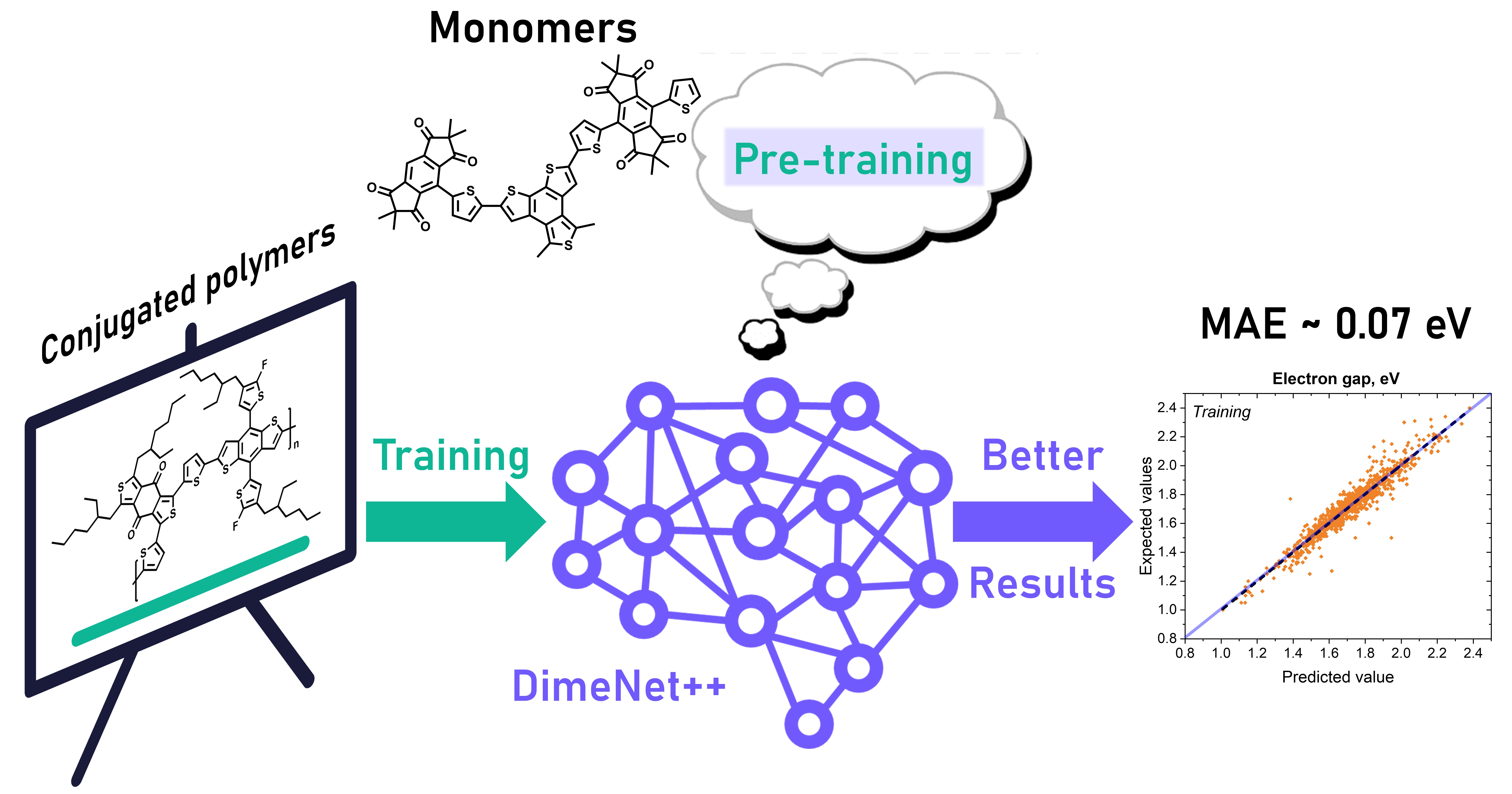
Fine-Tuning Directional Message Passing Neural Networks: Predicting Properties of Conjugated Organic Polymers with High Accuracy


Abstract
1. Introduction
2. Materials and Methods
2.1. Dataset Preparation
2.2. GNN Methods
3. Results
4. Discussion
5. Conclusions
Supplementary Materials
Author Contributions
Funding
Institutional Review Board Statement
Data Availability Statement
Conflicts of Interest
Abbreviations
| ML | Machine Learning |
| GNN | Graph Neural Network |
| DMPNN | Direct Message Passing Neural Network |
| DFT | Density Functional Theory |
| TD-DFT | Time-Dependent Density Functional Theory |
| HOMO | Highest Occupied Molecular Orbital |
| LUMO | Lowest Occupied Molecular Orbital |
| MAE | Mean Absolute Error |
| UMAP | Uniform Manifold Approximation and Projection |
References
- Mdluli, S.B.; Ramoroka, M.E.; Yussuf, S.T.; Modibane, K.D.; John-Denk, V.S.; Iwuoha, E.I. π-Conjugated Polymers and Their Application in Organic and Hybrid Organic-Silicon Solar Cells. Polymers 2022, 14, 716. [Google Scholar] [CrossRef] [PubMed]
- Facchetti, A. π-Conjugated Polymers for Organic Electronics and Photovoltaic Cell Applications. Chem. Mater. 2011, 23, 733–758. [Google Scholar] [CrossRef]
- Shen, Z.; Lu, G.; Tang, X.; Zhang, Y.; Li, S.; Wang, J.; Yu, J.; Gao, F.; Bu, L.; Chen, X.; et al. Intrinsic light reflection of conjugated films towards high-performance organic solar cells. Nat. Commun. 2025, 17, 655. [Google Scholar] [CrossRef] [PubMed]
- Yang, J.; Zhao, Z.; Wang, S.; Guo, Y.; Liu, Y. Insight into High-Performance Conjugated Polymers for Organic Field-Effect Transistors. Chem 2018, 4, 2748–2785. [Google Scholar] [CrossRef]
- Chen, Z.; Ding, X.; Wang, J.; Guo, X.; Shao, S.; Feng, K. π-Conjugated Polymers for High-Performance Organic Electrochemical Transistors: Molecular Design Strategies, Applications and Perspectives. Angew. Chem. Int. Ed. 2025, 64, e202423013. [Google Scholar] [CrossRef]
- Ding, L.; Yu, Z.-D.; Wang, X.-Y.; Yao, Z.-F.; Lu, Y.; Yang, C.-Y.; Wang, J.-Y.; Pei, J. Polymer Semiconductors: Synthesis, Processing, and Applications. Chem. Rev. 2023, 123, 7421–7497. [Google Scholar] [CrossRef]
- Jadoun, S.; Riaz, U. Conjugated Polymer Light-Emitting Diodes. In Polymers for Light-Emitting Devices and Displays; John Wiley & Sons, Inc.: Hoboken, NJ, USA, 2020; pp. 77–98. [Google Scholar]
- Naveen, M.H.; Gurudatt, N.G.; Shim, Y.-B. Applications of conducting polymer composites to electrochemical sensors: A review. Appl. Mater. Today 2017, 9, 419–433. [Google Scholar] [CrossRef]
- Ye, Q.; Fan, S.; Lao, J.; Xu, J.; Liu, X.; Wu, P. Research Advances in Conjugated Polymer-Based Optical Sensor Arrays for Early Diagnosis of Clinical Diseases. Polymers 2026, 18, 310. [Google Scholar] [CrossRef]
- Stewart, K.; Limbu, S.; Nightingale, J.; Pagano, K.; Park, B.; Hong, S.; Lee, K.; Kwon, S.; Kim, J.-S. Molecular understanding of a π-conjugated polymer/solid-state ionic liquid complex as a highly sensitive and selective gas sensor. J. Mater. Chem. C 2020, 8, 15268–15276. [Google Scholar] [CrossRef]
- Zhao, Y.; Wu, M.; Chen, H.; Zhu, J.; Liu, J.; Ye, Z.; Zhang, Y.; Zhang, H.; Ma, Y.; Li, C.; et al. Balance cathode-active and anode-active groups in one conjugated polymer towards high-performance all-organic lithium-ion batteries. Nano Energy 2021, 86, 106055. [Google Scholar] [CrossRef]
- Genene, Z.; Xia, Z.; Yang, G.; Mammo, W.; Wang, E. Recent Advances in the Synthesis of Conjugated Polymers for Supercapacitors. Adv. Mater. Technol. 2024, 9, 2300167. [Google Scholar] [CrossRef]
- Siwach, P.; Gaba, L.; Dahiya, S.; Punia, R.; Maan, A.S.; Singh, K.; Ohlan, A. Recent progress in conjugated polymers composites with metal-organic frameworks as electrode materials for supercapacitors. Appl. Surf. Sci. Adv. 2024, 19, 100555. [Google Scholar] [CrossRef]
- Arı, H.; Büyükmumcu, Z. Comparison of DFT functionals for prediction of band gap of conjugated polymers and effect of HF exchange term percentage and basis set on the performance. Comput. Mater. Sci. 2017, 138, 70–76. [Google Scholar] [CrossRef]
- Dorlus, T.A.; Roy, J.K.; Leszczynski, J. Designing Thiadiazoloquinoxaline-Based Conjugated Polymers for Efficient Organic Photovoltaics: A DFT/TDDFT Study. Molecules 2024, 29, 1580. [Google Scholar] [CrossRef]
- Sun, H.; Autschbach, J. Electronic Energy Gaps for π-Conjugated Oligomers and Polymers Calculated with Density Functional Theory. J. Chem. Theory Comput. 2014, 10, 1035–1047. [Google Scholar] [CrossRef]
- Di Sabatino, S.; Loos, P.-F.; Romaniello, P. Scrutinizing GW-Based Methods Using the Hubbard Dimer. Front. Chem. 2021, 9, 751054. [Google Scholar] [CrossRef]
- Ferretti, A.; Mallia, G.; Martin-Samos, L.; Bussi, G.; Ruini, A.; Montanari, B.; Harrison, N.M. Ab initio complex band structure of conjugated polymers: Effects of hydrid density functional theory and schemes. Phys. Rev. B 2012, 85, 235105. [Google Scholar] [CrossRef]
- Nagasawa, S.; Al-Naamani, E.; Saeki, A. Computer-Aided Screening of Conjugated Polymers for Organic Solar Cell: Classification by Random Forest. J. Phys. Chem. Lett. 2018, 9, 2639–2646. [Google Scholar] [CrossRef]
- Hasan, M.M.; Tarkhaneh, O.; Bungay, S.D.; Poirier, R.A.; Islam, S.M. Predicting HOMO–LUMO Gaps Using Hartree–Fock Calculated Data and Machine Learning Models. J. Chem. Inf. Model. 2025, 65, 9497–9515. [Google Scholar] [CrossRef]
- Mazouin, B.; Schöpfer, A.A.; von Lilienfeld, O.A. Selected machine learning of HOMO–LUMO gaps with improved data-efficiency. Mater. Adv. 2022, 3, 8306–8316. [Google Scholar] [CrossRef]
- Gaul, C.; Cuesta-Lopez, S. Machine Learning for Orbital Energies of Organic Molecules Upwards of 100 Atoms. Phys. Status Solidi B 2024, 261, 2200553. [Google Scholar] [CrossRef]
- Nguyen, T.H.; Nguyen, L.H.; Truong, T.N. Application of Machine Learning in Developing Quantitative Structure–Property Relationship for Electronic Properties of Polyaromatic Compounds. ACS Omega 2022, 7, 22879–22888. [Google Scholar] [CrossRef] [PubMed]
- Zheng, F.; Zhu, Z.; Lu, J.; Yan, Y.; Jiang, H.; Sun, Q. Predicting the HOMO-LUMO gap of benzenoid polycyclic hydrocarbons via interpretable machine learning. Chem. Phys. Lett. 2023, 814, 140358. [Google Scholar] [CrossRef]
- Kyhoiesh, H.A.K.; Salem, K.H.; Elnaggar, A.Y.; Al-Kubaisi, A.A.; El Azab, I.H.; Mahmoud, M.H.H.; Hamoodah, Z.J.; Nief, A.H. An explainable machine learning data mining to generate new organic donors of organic dyes with lowest possible HOMO-LUMO gaps. Chem. Phys. Lett. 2025, 877, 142291. [Google Scholar] [CrossRef]
- Mamede, R.; Pereira, F.; Aires-de-Sousa, J. Machine learning prediction of UV–Vis spectra features of organic compounds related to photoreactive potential. Sci. Rep. 2021, 11, 23720. [Google Scholar] [CrossRef]
- Althagafi, T.M.; Tahir, M.H.; Naeem, S.; Alzahrani, F.M.A.; Al-Buriahi, M.S. Prediction of UV/visible absorption maxima of organic compounds in dichloromethane and database generation of organic compounds with red-shifted absorption maxima. Org. Electron. 2025, 145, 107304. [Google Scholar] [CrossRef]
- McNaughton, A.D.; Joshi, R.P.; Knutson, C.R.; Fnu, A.; Luebke, K.J.; Malerich, J.P.; Madrid, P.B.; Kumar, N. Machine Learning Models for Predicting Molecular UV–Vis Spectra with Quantum Mechanical Properties. J. Chem. Inf. Model. 2023, 63, 1462–1471. [Google Scholar] [CrossRef]
- Bi, H.; Jiang, J.; Chen, J.; Kuang, X.; Zhang, J. Machine Learning Prediction of Quantum Yields and Wavelengths of Aggregation-Induced Emission Molecules. Materials 2024, 17, 1664. [Google Scholar] [CrossRef]
- Kumar, J.N.; Li, Q.; Jun, Y. Challenges and opportunities of polymer design with machine learning and high throughput experimentation. MRS Commun. 2019, 9, 537–544. [Google Scholar] [CrossRef]
- Chebotaev, P.P.; Buglak, A.A. Predicting the quantum yield of 1O2 generation for pteridines and fluoroquinolones using machine learning. Phys. Chem. Chem. Phys. 2025, 27, 23722–23740. [Google Scholar] [CrossRef]
- Zhong, J.; Zhu, W.; Shen, S.; Zhou, N.; Xi, M.; Du, K.; Wang, D.; Tang, B.Z. Machine Learning for Organic Fluorescent Materials. Aggregate 2025, 6, e70089. [Google Scholar] [CrossRef]
- Armeli, G.; Peters, J.-H.; Koop, T. Machine-Learning-Based Prediction of the Glass Transition Temperature of Organic Compounds Using Experimental Data. ACS Omega 2023, 8, 12298–12309. [Google Scholar] [CrossRef]
- Galeazzo, T.; Shiraiwa, M. Predicting glass transition temperature and melting point of organic compounds via machine learning and molecular embeddings. Environ. Sci. Atmos. 2022, 2, 362–374. [Google Scholar] [CrossRef]
- Taniguchi, T. Exploration of elastic moduli of molecular crystals via database screening by pretrained neural network potential. CrystEngComm 2024, 26, 631–638. [Google Scholar] [CrossRef]
- Khakurel, H.; Taufique, M.F.N.; Roy, A.; Balasubramanian, G.; Ouyang, G.; Cui, J.; Johnson, D.D.; Devanathan, R. Machine learning assisted prediction of the Young’s modulus of compositionally complex alloys. Sci. Rep. 2021, 11, 17149. [Google Scholar] [CrossRef]
- Coley, C.W.; Barzilay, R.; Jaakkola, T.S.; Green, W.H.; Jensen, K.F. Prediction of Organic Reaction Outcomes Using Machine Learning. ACS Cent. Sci. 2017, 3, 434–443. [Google Scholar] [CrossRef] [PubMed]
- Gao, H.; Struble, T.J.; Coley, C.W.; Wang, Y.; Green, W.H.; Jensen, K.F. Using Machine Learning to Predict Suitable Conditions for Organic Reactions. ACS Cent. Sci. 2018, 4, 1465–1476. [Google Scholar] [CrossRef] [PubMed]
- Ida, T.; Kojima, H.; Hori, Y. Predicting and analyzing organic reaction pathways by combining machine learning and reaction network approaches. Chem. Commun. 2023, 59, 12439–12442. [Google Scholar] [CrossRef]
- Vera de la Garza, C.G.; Fomine, S. Machine-learning-accelerated band gap prediction from chemical composition with near-experimental accuracy. Next Mater. 2026, 11, 101728. [Google Scholar] [CrossRef]
- Xu, P.; Lu, T.; Ju, L.; Tian, L.; Li, M.; Lu, W. Machine Learning Aided Design of Polymer with Targeted Band Gap Based on DFT Computation. J. Phys. Chem. B 2021, 125, 601–611. [Google Scholar] [CrossRef]
- Katzberger, P.; Riniker, S. A general graph neural network based implicit solvation model for organic molecules in water. Chem. Sci. 2024, 15, 10794–10802. [Google Scholar] [CrossRef] [PubMed]
- Ebrahimi, S.; Criqui, L.; Soldera, A.; Guéguen, C. Supervised Machine Learning and Graph Neural Networks to Predict Collision Cross-Section Values of Aquatic Dissolved Organic Compounds. J. Am. Soc. Mass Spectrom. 2026, 37, 581–589. [Google Scholar] [CrossRef] [PubMed]
- Adams, C.; Horton, J.T.; Wang, L.; Boothroyd, S.; Mobley, D.L.; Wright, D.W.; Cole, D.J. A Graph Neural Network Charge Model Targeting Accurate Electrostatic Properties of Organic Molecules. J. Chem. Theory Comput. 2025, 21, 12133–12148. [Google Scholar] [CrossRef] [PubMed]
- Chang, J.; Zhu, S. MGNN: Moment Graph Neural Network for Universal Molecular Potentials. NPJ Comput. Mater. 2025, 11, 55. [Google Scholar] [CrossRef]
- Weal, G.R.; Nurhuda, M.; Hodgkiss, J.M.; Hume, P.A.; Packwood, D.M. Graph neural networks to predict atomic transition charges and exciton couplings in organic semiconductors. J. Chem. Phys. 2025, 163, 024125. [Google Scholar] [CrossRef]
- Pablo-García, S.; Morandi, S.; Vargas-Hernández, R.A.; Jorner, K.; Ivković, Ž.; López, N.; Aspuru-Guzik, A. Fast evaluation of the adsorption energy of organic molecules on metals via graph neural networks. Nat. Comput. Sci. 2023, 3, 433–442. [Google Scholar] [CrossRef]
- Choudhary, K.; DeCost, B. Atomistic Line Graph Neural Network for improved materials property predictions. npj Comput. Mater. 2021, 7, 185. [Google Scholar] [CrossRef]
- Schütt, K.T.; Hessmann, S.S.P.; Gebauer, N.W.A.; Lederer, J.; Gastegger, M. SchNetPack 2.0: A neural network toolbox for atomistic machine learning. J. Chem. Phys. 2023, 158, 144801. [Google Scholar] [CrossRef]
- Espinosa, R.; Ponce, H.; Ortiz-Medina, J. A 3D orthogonal vision-based band-gap prediction using deep learning: A proof of concept. Comput. Mater. Sci. 2022, 202, 110967. [Google Scholar] [CrossRef]
- Friedman, H.C.; Cosco, E.D.; Atallah, T.L.; Jia, S.; Sletten, E.M.; Caram, J.R. Establishing design principles for emissive organic SWIR chromophores from energy gap laws. Chem 2021, 7, 3359–3376. [Google Scholar] [CrossRef]
- Suruga, S.; Mikie, T.; Sato, Y.; Kohzuki, K.; Jeon, J.; Kim, H.D.; Inamoto, S.; Ishii, H.; Nakano, K.; Tajima, K.; et al. Backbone rigidity promoting hole delocalization and enabling efficient charge generation with minimal voltage loss in nonfullerene organic photovoltaics. Commun. Mater. 2026, 7, 79. [Google Scholar] [CrossRef]
- Organic Photovoltaic (OPV) Database. Available online: https://data.nlr.gov/submissions/236 (accessed on 30 March 2026).
- Liu, B.; Yan, Y.; Liu, M. Harnessing DFT and machine learning for accurate optical gap prediction in conjugated polymers. Nanoscale 2025, 17, 7865–7876. [Google Scholar] [CrossRef]


Disclaimer/Publisher’s Note: The statements, opinions and data contained in all publications are solely those of the individual author(s) and contributor(s) and not of MDPI and/or the editor(s). MDPI and/or the editor(s) disclaim responsibility for any injury to people or property resulting from any ideas, methods, instructions or products referred to in the content. |
© 2026 by the authors. Licensee MDPI, Basel, Switzerland. This article is an open access article distributed under the terms and conditions of the Creative Commons Attribution (CC BY) license.
Share and Cite
Koskin, I.P.; Petrosyan, L.S.; Kazantsev, M.S. Fine-Tuning Directional Message Passing Neural Networks: Predicting Properties of Conjugated Organic Polymers with High Accuracy. Polymers 2026, 18, 879. https://doi.org/10.3390/polym18070879
Koskin IP, Petrosyan LS, Kazantsev MS. Fine-Tuning Directional Message Passing Neural Networks: Predicting Properties of Conjugated Organic Polymers with High Accuracy. Polymers. 2026; 18(7):879. https://doi.org/10.3390/polym18070879
Chicago/Turabian StyleKoskin, Igor P., Lev S. Petrosyan, and Maxim S. Kazantsev. 2026. "Fine-Tuning Directional Message Passing Neural Networks: Predicting Properties of Conjugated Organic Polymers with High Accuracy" Polymers 18, no. 7: 879. https://doi.org/10.3390/polym18070879
APA StyleKoskin, I. P., Petrosyan, L. S., & Kazantsev, M. S. (2026). Fine-Tuning Directional Message Passing Neural Networks: Predicting Properties of Conjugated Organic Polymers with High Accuracy. Polymers, 18(7), 879. https://doi.org/10.3390/polym18070879