Manufacturing-Induced Defect Taxonomy and Visual Detection in UD Tapes with Carbon and Glass Fiber Reinforcements

Abstract
1. Introduction
2. Materials and Methods
2.1. Materials
2.2. UD Tape Production Process
2.3. Defect Formation Due to Production
2.4. Creation of Defect Taxonomy and Classification of Visual Characteristics
2.5. Relative Detectableness and Classification Rationale
2.6. Vision-Based Defect Detection Methodology and Experimental Setup
2.6.1. Image and Video Data Acquisition
2.6.2. Manufacturing-Aware Data Preparation and UD Tape-Specific Augmentation Strategy
2.6.3. Rationale for Object Detection Instead of Segmentation
2.6.4. Object Detection Architecture and Training Procedure
2.7. Evaluation Metrics and Confidence Threshold Determination
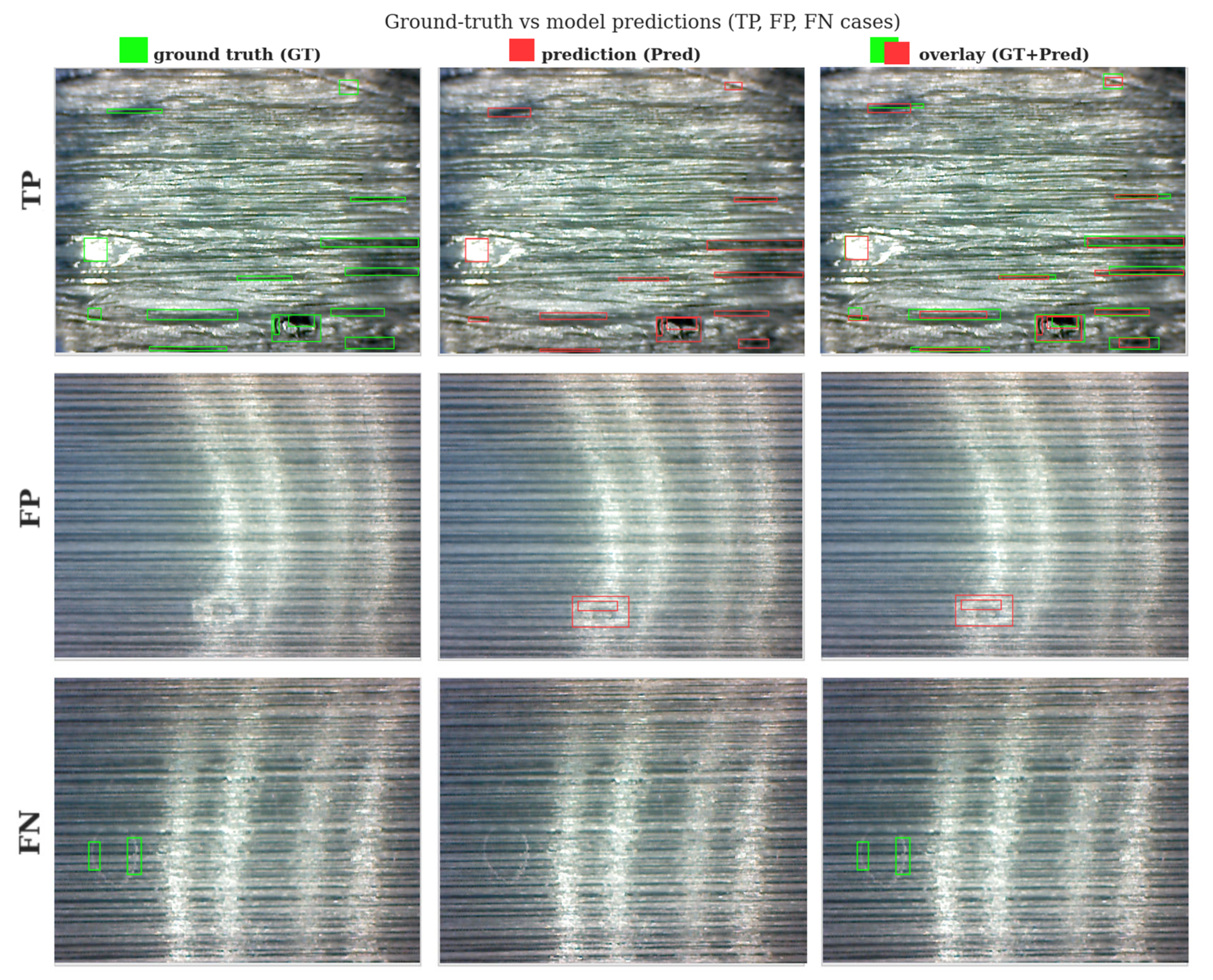
- TP (True Positive): A region that truly contains a defect and is correctly detected as defective by the model.
- TN (True Negative): A region that does not contain a defect and is correctly classified as defect-free by the model.
- FP (False Positive): A region that does not contain a defect but is incorrectly detected as defective by the model.
- FN (False Negative): A region that truly contains a defect but is missed by the model and incorrectly classified as defect-free.
- Objectness loss: Determines whether the predicted bounding box actually contains an object (defect) and enables the model to learn the distinction between foreground and background.
- Localization loss (box regression loss): Measures the geometric error between the predicted bounding box and the ground truth, and is applied only when an object is detected.
3. Results and Discussion
3.1. Defect Detection Performance Across Defect Classes
3.2. Practical Implications for Manufacturing Inspection
3.3. Limitations and Future Research Directions
4. Conclusions
Funding
Institutional Review Board Statement
Data Availability Statement
Acknowledgments
Conflicts of Interest
References
- Nakada, M.; Miyano, Y.; Morisawa, Y.; Isaki, T.; Hirano, T.; Uzawa, K. Statistical life prediction of UD CF/PP tape under creep. J. Reinforc. Plast. Compos. 2020, 39, 278–284. [Google Scholar] [CrossRef]
- Grätzl, T.; Hille, M.; Schramm, N.; Kroll, L. Modelling the deformation of continuous fibre-reinforced thermoplastics subjected to hygrothermal loading. J. Reinforc. Plast. Compos. 2018, 37, 1227–1245. [Google Scholar] [CrossRef]
- Özkaymak, M.; Öz, Y.; Evis, Z. Review, manufacturing, and tooling processes for continuous reinforced thermoplastics. J. Reinforc. Plast. Compos. 2025. [Google Scholar] [CrossRef]
- Barile, M.; Lecce, L.; Iannone, M.; Pappadà, S.; Roberti, P. Thermoplastic composites for aerospace applications. In Revolutionizing Aircraft Materials and Processes; Pantelakis, S., Tserpes, K., Eds.; Springer: Cham, Switzerland, 2020; pp. 87–114. [Google Scholar] [CrossRef]
- Daghigh, V.; Nikbakht, M.; Daghigh, H. Review of machine learning applications for defect detection in composite materials. Mach. Learn. Appl. 2024, 18, 100600. [Google Scholar] [CrossRef]
- Zhao, Z.; Cheng, Y. NDT defect detection in composites based on deep learning. Appl. Sci. 2024, 14, 4161. [Google Scholar] [CrossRef]
- Tai, J.L.; Sultan, M.T.H.; Łukaszewicz, A.; Józwik, J.; Oksiuta, Z.; Shahar, F.S. Recent trends in NDT approaches for composites. Materials 2025, 18, 3146. [Google Scholar] [CrossRef]
- Tyagi, S.; Singh, P.; Ahmad Khan, K.L. A comprehensive analysis of ML techniques in advancing composites. In Proceedings of the IC3 2025 Conference, Mathura, India, 13–14 February 2025; pp. 512–517. [Google Scholar] [CrossRef]
- Hu, Y.; Yan, H.; Wang, P.; Liu, Z. A study on the application of machine vision technology in defect detection of CFRP composites. J. Reinforc. Plast. Compos. 2025. [Google Scholar] [CrossRef]
- Arrabiyeh, P.A.; Bobe, M.; Duhovic, M.; Eckrich, M.; Dlugaj, A.M.; May, D. Implementing low budget machine vision to improve fiber alignment in wet fiber placement. J. Reinforc. Plast. Compos. 2024, 45, 442–452. [Google Scholar] [CrossRef]
- Shah, C.; Zupan, J.; Krizman, A. Taxonomy of damage patterns in composite materials. Materials 2022, 15, 4645. [Google Scholar] [CrossRef]
- Zhang, J.; Zhao, B.; Zhang, L.; Ye, N. Online defect detection based on 2.5D images. Acta Mater. Compos. Sin. 2025, 42, 4112–4128. [Google Scholar] [CrossRef]
- Yadav, N.; Schledjewski, R. Review of in-process defect monitoring for ATL. Compos. Part A 2023, 172, 107654. [Google Scholar] [CrossRef]
- Meister, S.; Möller, N.; Stüve, J.; Groves, R.M. Synthetic image data augmentation for fibre layup inspection processes. J. Intell. Manuf. 2021, 32, 1767–1789. [Google Scholar] [CrossRef]
- Meister, S.; Wermes, M.A.; Stüve, J.; Groves, R.M. Review of image segmentation techniques for layup defect detection in AFP. J. Intell. Manuf. 2021, 32, 2099–2119. [Google Scholar] [CrossRef]
- Tucci, F.; Rubino, F.; Carlone, P. Thermoplastic pultrusion of PP/GF tapes. Polymers 2023, 15, 2374. [Google Scholar] [CrossRef]
- Mao, M.; Hong, M. YOLO object detection for real-time fabric defect inspection. Sensors 2025, 25, 2270. [Google Scholar] [CrossRef]
- Li, L.; Yao, S.; Xiao, S.; Wang, Z. Machine vision framework for real-time surface yarn alignment defect detection in CFRP preforms. J. Compos. Sci. 2025, 9, 295. [Google Scholar] [CrossRef]
- Li, Z.; Yan, Y.; Wang, X.; Ge, Y.; Meng, L. A survey of deep learning for industrial visual anomaly detection. Artif. Intell. Rev. 2025, 58, 279. [Google Scholar] [CrossRef]
- Long, K.; Mei, B.; Fu, Y.; Zhu, W. AFP-Net: A single-stage approach for defect detection in automated fiber placement of carbon fiber reinforced polymers for aircraft manufacturing. Aerosp. Sci. Technol. 2026, 171, 111638. [Google Scholar] [CrossRef]
- Zhao, B.; Zhang, L.; Zhang, J.; Ye, N. Online detection and visualization of surface defects for AFP. Compos. Commun. 2025, 58, 102539. [Google Scholar] [CrossRef]
- Fu, Y.; Yao, X. A review on manufacturing defects and their detection of fiber-reinforced resin matrix composites. Compos. Part C 2022, 8, 100276. [Google Scholar] [CrossRef]
- Maes, V.K.; Potter, K.; Kratz, J. Features and defects characterisation for virtual verification and certification of composites. Compos. Part B 2022, 246, 110282. [Google Scholar] [CrossRef]
- Mujtaba, A.; Islam, F.; Kaeding, P.; Lindemann, T.; Prusty, B.G. Machine-learning based process monitoring for automated composites manufacturing. J. Intell. Manuf. 2025, 36, 1095–1110. [Google Scholar] [CrossRef]
- Fereidouni, M.; Van Hoa, S. In-situ consolidation of thermoplastic composites by automated fiber placement: Characterization of defects. J. Thermoplast. Compos. Mater. 2025, 38, 471–511. [Google Scholar] [CrossRef] [PubMed]
- Böckl, B. Effects of defects in automated fiber placement laminates and its correlation to mechanical performance. J. Reinforc. Plast. Compos. 2023, 42, 3–16. [Google Scholar] [CrossRef]
- Zenker, T.; Bruckner, F.; Drechsler, K. Effects of defects on laminate quality in thermoplastic AFP. Adv. Manuf. Polym. Compos. Sci. 2019, 5, 184–205. [Google Scholar] [CrossRef]
- Oromiehie, E.; Prusty, B.G.; Compston, P.; Rajan, G. AFP-based composite structures: Review on defects, impacts and inspection techniques. Compos. Struct. 2019, 230, 111987. [Google Scholar] [CrossRef]
- Wen, L.; Li, S.; Dong, Z.; Shen, H.; Xu, E. AFP surface defect detection based on improved YOLOv7. Appl. Sci. 2024, 14, 5657. [Google Scholar] [CrossRef]
- Brysch, M.; Bahar, M.; Hohensee, H.C.; Sinapius, M. Single system for online monitoring and inspection of automated fiber placement with object segmentation by artificial neural networks. J. Intell. Manuf. 2022, 33, 2013–2025. [Google Scholar] [CrossRef]
- Wen, L.; Li, S.; Ren, J. Surface defect detection for ATL and winding based on YOLOv5. Materials 2023, 16, 5291. [Google Scholar] [CrossRef]
- Lu, L.; Hou, J.; Yuan, S.; Yao, X.; Li, Y.; Zhu, J. Deep learning-assisted real-time defect detection and closed-loop adjustment for additive manufacturing. Robot. Comput.-Integr. Manuf. 2023, 79, 102431. [Google Scholar] [CrossRef]
- Merola, S.; Guida, M.; Marulo, F. Deep learning approach for damage detection on composite structures. J. Mater. Eng. Perform. 2025, 34, 30566–30573. [Google Scholar] [CrossRef]
- Ye, Y.; Zhang, T.; Liu, X.; Wang, X.; Su, Z.; Ding, L.; Zhang, D. Recognition of small defects in shearography via improved YOLO. Opt. Laser Technol. 2025, 184, 112524. [Google Scholar] [CrossRef]
- Kloiber, K.; Voltz, M.; Marschik, C.; Wenninger, M.; Kohl, S.; Hochleitner, G. Automated quality assessment of UD tapes. AIP Conf. Proc. 2024, 3158, 060005. [Google Scholar] [CrossRef]
- Ferguson, O.V.; Rifai, J.; Wisnom, M.R.; Jørgensen, J.B.; Mikkelsen, L.P. Compressive behaviour of uni-directional carbon fibre-reinforced pultruded profiles with manufacturing-induced fuzz ball defects. Compos. Part A 2025, 198, 109059. [Google Scholar] [CrossRef]
- Wenninger, M.; Marschik, C.; Felbermayer, K.; Heise, B.; Kranzl, T.; Steinbichler, G. OCT-based inline quality assessment of UD tapes. J. Thermoplast. Compos. Mater. 2022, 36, 3943–3965. [Google Scholar] [CrossRef]
- Wenninger, M.; Marschik, C.; Felbermayer, K.; Heise, B.; Berger-Weber, G.R.; Steinbichler, G. OCT for evaluating UD tape quality. AIP Conf. Proc. 2023, 2884, 050008. [Google Scholar] [CrossRef]
- Wenninger, M.; Kloiber, K.; Marschik, C.; Hochleitner, G.; Berger-Weber, G.; Steinbichler, G. Applying OCT to inline monitoring of UD tapes. J. Thermoplast. Compos. Mater. 2025, 38, 3051–3076. [Google Scholar] [CrossRef]
- Hopmann, C.; Beste, C.; Hildebrandt, M.; Boettcher, A.; Fischer, K. Quality controlled UD tape production for the individualised production of load optimised thermoplastic composite parts. Key Eng. Mater. 2017, 742, 90–95. [Google Scholar] [CrossRef]
- Su, W.; Sang, M.; Liu, Y.; Wang, X. Defect detection of carbon fiber UD prepreg based on enhanced YOLOv8s. Sensors 2025, 25, 2665. [Google Scholar] [CrossRef]
- Szarski, M.; Chauhan, S. An unsupervised defect detection model for a dry carbon fibre textile. J. Intell. Manuf. 2022, 33, 2075–2092. [Google Scholar] [CrossRef]
- Kim, T.Y.; Yoon, S.; Yeun, C.Y.; Cantwell, W.J.; Cho, C.S. Site-specific defect detection in composite using deep learning. In Proceedings of the European Workshop on Structural Health Monitoring, Palermo, Italy, 4–7 July 2023; Springer: Cham, Switzerland, 2023; pp. 442–451. [Google Scholar] [CrossRef]
- Ultralytics. Ultralytics YOLO; Ultralytics: New York, NY, USA, 2024; Available online: https://github.com/ultralytics/ultralytics (accessed on 14 February 2026).
- Heinecke, F.; Willberg, C. Manufacturing-induced imperfections in composite parts manufactured via automated fiber placement. J. Compos. Sci. 2019, 3, 56. [Google Scholar] [CrossRef]
- Skalski, P. Makesense.ai—A Free Web-Based Image Annotation Tool. Available online: https://www.makesense.ai/ (accessed on 14 February 2026).
- Kulkarni, A.; Chong, D.; Batarseh, F.A. Foundations of data imbalance and solutions for a data democracy. In Data Democracy; Academic Press: London, UK, 2020; pp. 83–106. [Google Scholar] [CrossRef]
- Duran, G.; Koçak, F.; Yazıcı, M. Composite materials damage assessment with the YOLO algorithms. In Proceedings of the 11th International Automotive Technologies Congress, Bursa, Türkiye, 9–10 September 2024; pp. 725–740. [Google Scholar]
- Park, I.; Kim, S. Performance indicator survey for object detection. In Proceedings of the ICCAS 2020 Conference, Busan, Republic of Korea, 13–16 October 2020; pp. 284–288. [Google Scholar] [CrossRef]
- Lowe, D.G. Object recognition from local scale-invariant features. In Proceedings of the IEEE International Conference on Computer Vision (ICCV), Kerkyra, Greece, 20–27 September 1999; Volume 2, pp. 1150–1157. [Google Scholar] [CrossRef]
- Felzenszwalb, P.F.; Girshick, R.B.; McAllester, D.; Ramanan, D. Object detection with discriminatively trained part-based models. IEEE Trans. Pattern Anal. Mach. Intell. 2010, 32, 1627–1645. [Google Scholar] [CrossRef]
- Zhu, L.; Xie, Z.; Liu, L.; Tao, B.; Tao, W. IoU-uniform R-CNN. Pattern Recognit. 2021, 112, 107816. [Google Scholar] [CrossRef]
- Everingham, M.; Van Gool, L.; Williams, C.K.; Winn, J.; Zisserman, A. The PASCAL visual object classes (VOC) challenge. Int. J. Comput. Vis. 2010, 88, 303–338. [Google Scholar] [CrossRef]
- Krizhevsky, A.; Sutskever, I.; Hinton, G.E. ImageNet classification with deep convolutional neural networks. In Proceedings of the Advances in Neural Information Processing Systems 25, Lake Tahoe, NV, USA, 3–6 December 2012; Curran Associates Inc.: Red Hook, NY, USA, 2012; Volume 25, pp. 1097–1105. [Google Scholar]
- Simonyan, K.; Zisserman, A. Very deep convolutional networks for large-scale image recognition. arXiv 2014, arXiv:1409.1556. [Google Scholar] [CrossRef]
- Yang, Y.; Lai, Y.; Zhao, S.; Chen, H.; Li, R.; Wang, Y. Optically transparent and high-strength glass-fabric composites. Compos. Sci. Technol. 2024, 245, 110338. [Google Scholar] [CrossRef]




| Augmentation Parameters | Value | Description |
|---|---|---|
| Mosaic | 0.0 | Off. (It creates spurious defect neighborhoods that do not exist in actual production. It disrupts tape continuity and is physically meaningless for UD tape.) |
| Scale | 0.1 | Limited scaling to simulate minor camera distance variations. |
| Flip Left-Right | 0.15 | Rotates the image (Off in Albumentation). Simulates lateral orientation variation across tape width. |
| Translate | 0.02 | Shifts the image horizontally/vertically by ±2%. |
| HSV-Hue | 0.0 | Off. (It artificially distorts PP-CF/PP-GF contrast.) |
| HSV-Saturation | 0.1 | Mild lighting-induced saturation variation. |
| HSV-Value | 0.15 | Controlled brightness variation to emulate illumination changes. |
| Mixup | 0.0 | Off. (It artificially alters the real tape texture.) |
| Flip Up-Down | 0.0 | Off. (In UD conveyor belts, the production direction is unidirectional. This distorts the actual production conditions.) |
| Perspective | 0.0 | Off. Affine distortions. |
| Hyperparameter | Value (This Study) | Practical Interpretation in Manufacturing |
|---|---|---|
| Model architecture | Ultralytics YOLOv8, v11 and new YOLO26 (variants: s, n) | Lightweight structure suitable for real-time or near real-time inspection |
| Input image size | 640p | Preserves surface texture while maintaining computational efficiency |
| Batch size | 16 (depending on GPU/CPU memory) | Balance between convergence stability and hardware limits |
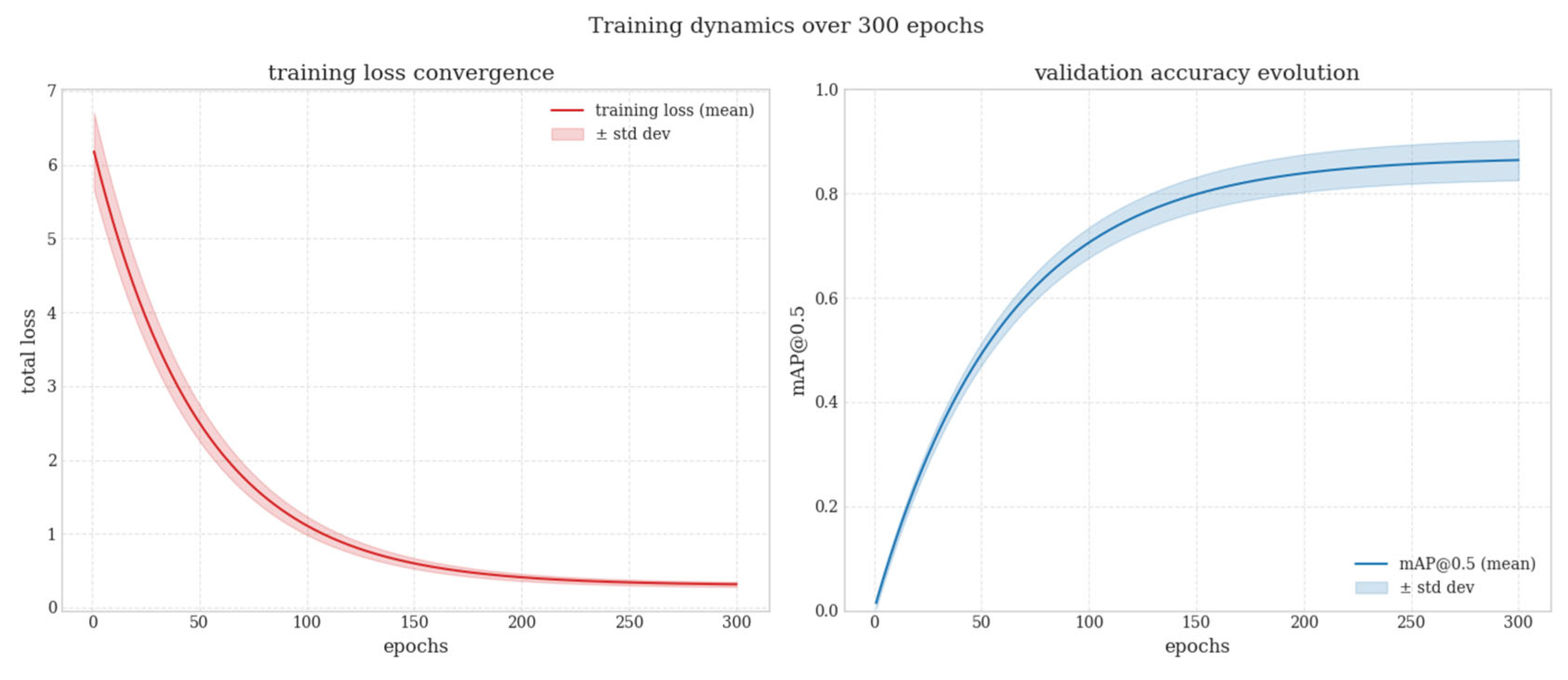
| Epochs | 300 | Ensures sufficient convergence for limited experimental datasets. |
| Learning rate | 0.01/0.001 (default scheduler) & (with warm-up + cosine scheduler strategy) | Stable optimization without overfitting risk. This provides stable convergence, especially for limited datasets. |
| Optimizer | AdamW/SGD (default YOLO) (Momentum: 0.9, Weight Decay: 0.0005) | SGD enables stable and reliable learning of rare defects without being affected by noise, by reducing overfitting in small datasets. |
| IoU threshold | 0.5 | Standard value for bounding box correctness in object detection |
| Confidence threshold (lab) | 0.5–0.6 | Filters weak detections; suitable for controlled experimental evaluation |
| Confidence threshold (production) | 0.20–0.30 (with operator supervision) | Lower threshold to minimize false negatives; early-warning philosophy |
| Non-maximum suppression (NMS) | Enabled (default YOLO) | Prevents multiple overlapping detections for the same defect |
| Transfer learning | Pretrained COCO weights | Strongly recommended and practically mandatory for small experimental datasets; ensures faster convergence and more robust training behavior. |
| Data augmentation | Scale, Flip, Brightness, Contrast, Noise | Applied to increase dataset variability and prevent overfitting. Improves robustness to lighting and surface texture variations |
| Training data type | Real experimental images only | No synthetic or simulated data used; full manufacturing realism |
| Inference mode | Object detection | (not segmentation) Faster annotation, robust for diffuse defect boundaries |
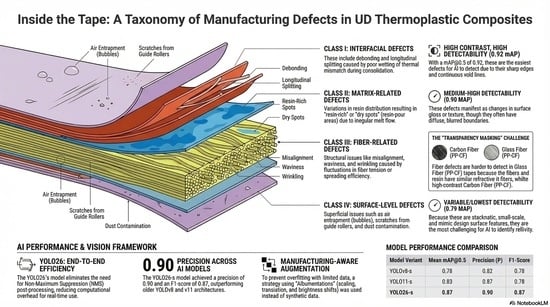
| Defect Class | Subtypes | Physical Formation Mechanism | Production Process | Visual Characteristics | Relative Detectability |
|---|---|---|---|---|---|
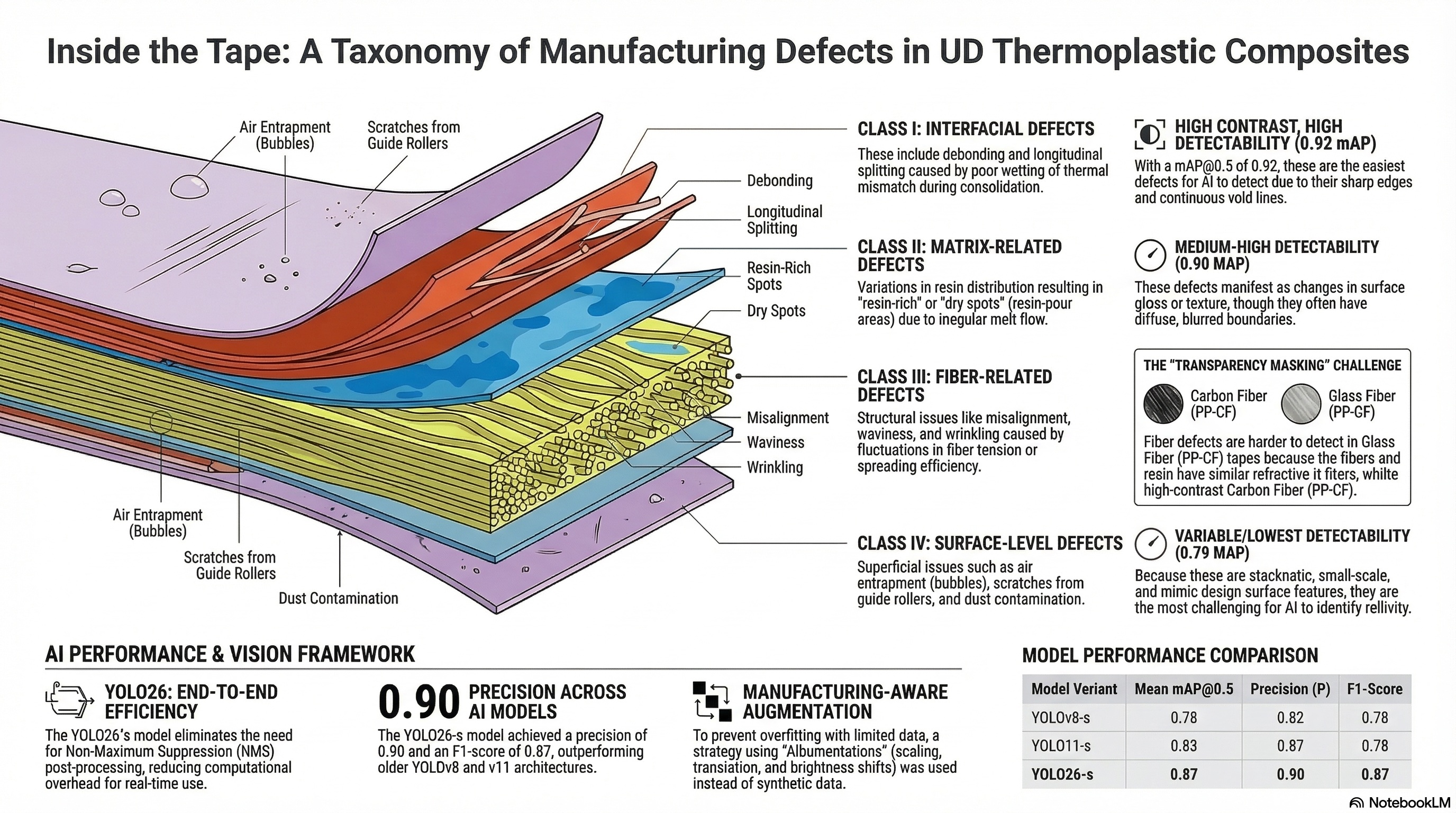
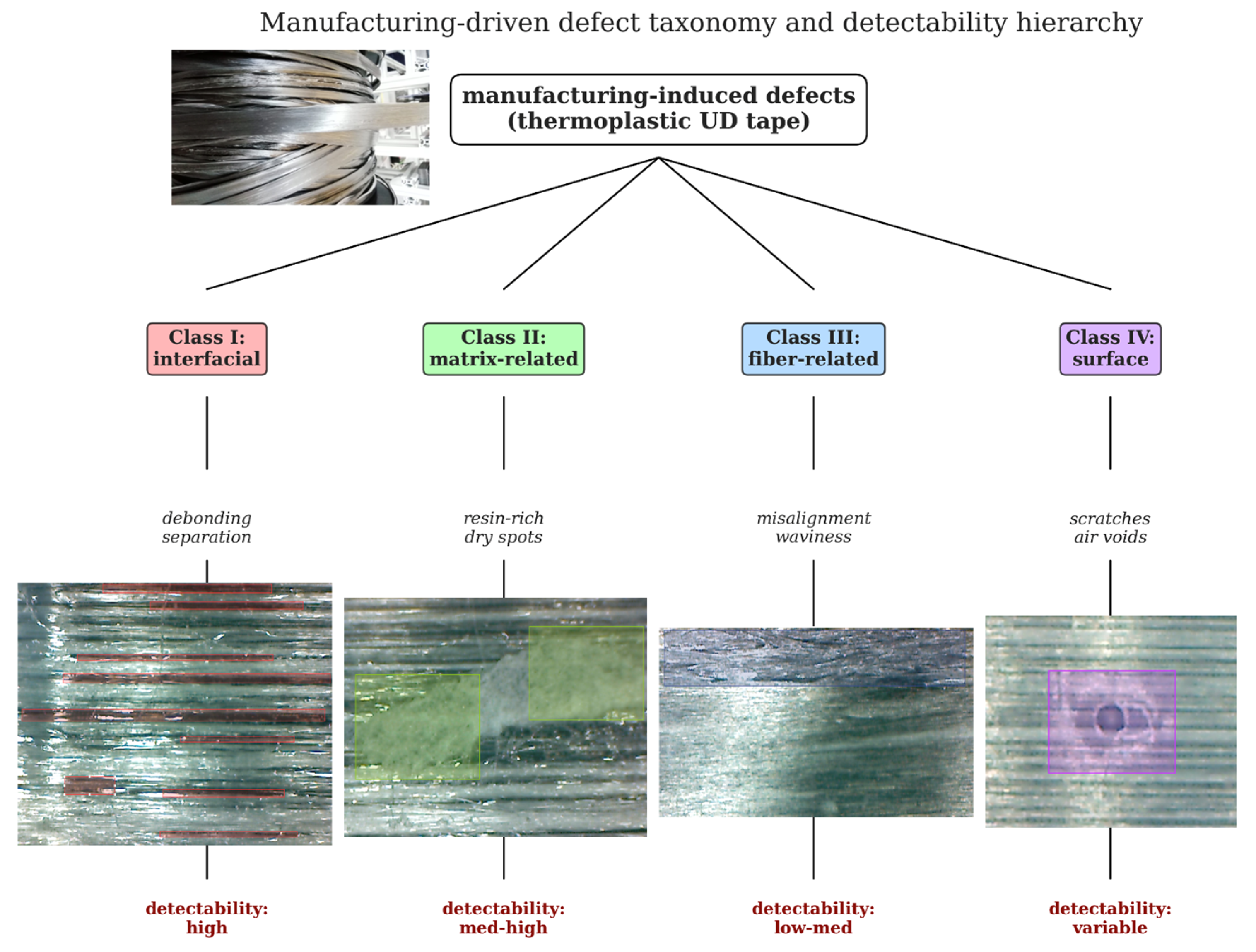
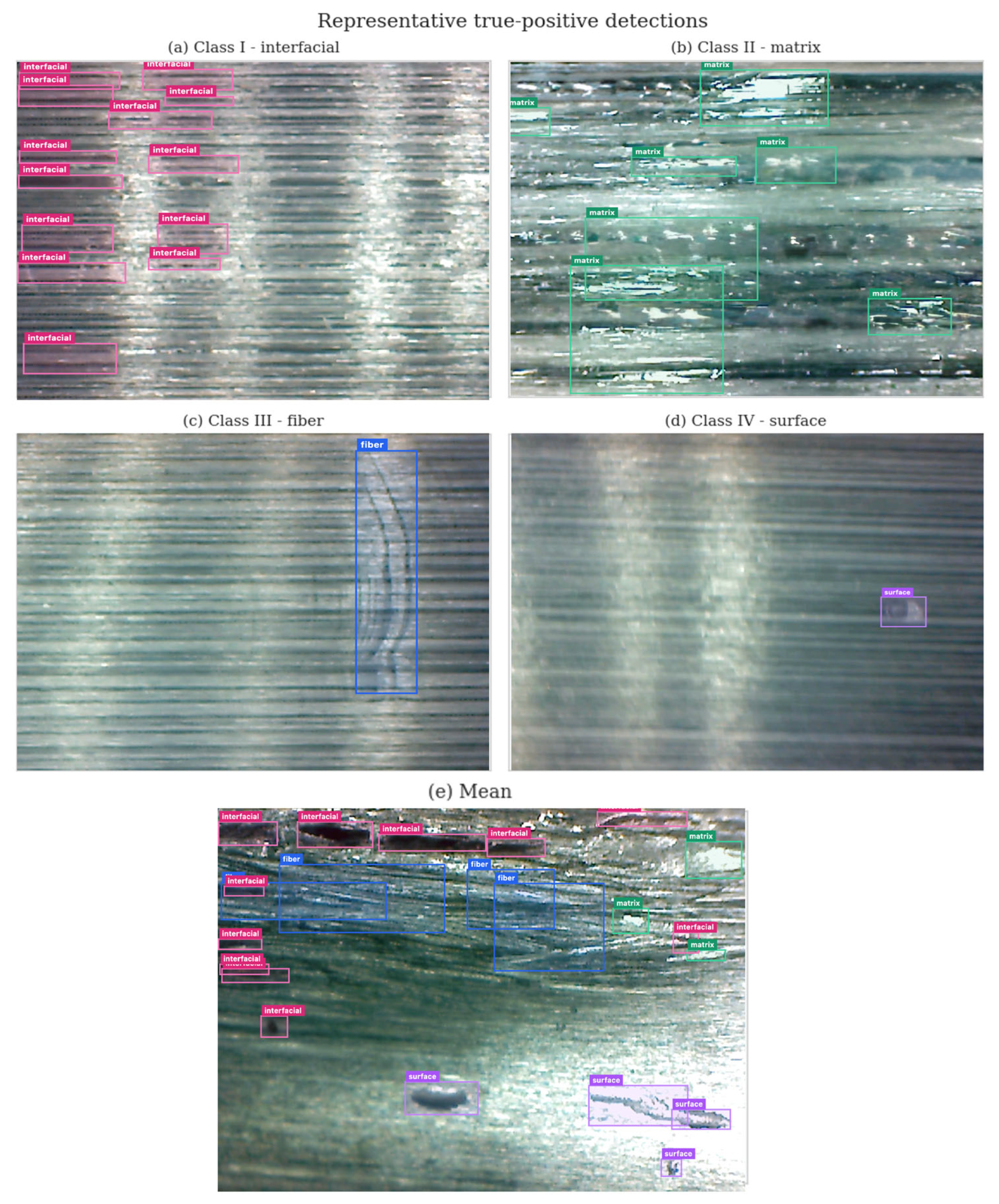
| Class I: interfacial | Debonding, Longitudinal splitting, Gap | Poor wetting, thermal mismatch, insufficient consolidation pressure, impregnation defects, and localized cooling. | High temperature (T) ↑, low impregnation pressure, increased processing speed. ↑ | High contrast, sharp edges, and continuous void lines along the fiber direction. | High |
| Class II: matrix | Resin-rich areas, Dry spots | Irregular melt flow, permeability variations, viscosity fluctuations, and fiber opening. | T incorrect, speed ↑ | Variations in surface gloss (specular reflection), texture changes, diffuse boundaries, surface texture differences, and blurred edges. | Medium–High |
| Class III: fiber | Misalignment, Waviness, Blurring | Tension fluctuations, mechanical jamming, and fiber spreading defects. | Tension variation, spreading error. | Low contrast, subtle geometric deviations, fine texture variations without sharp intensity transitions, waviness along the fiber direction, and line distortion. | Medium |
| Class IV: surface | Scratches, Air pockets, Surface marks, Foreign objects | Handling, cooling, contact with rollers, entrapped air, and surface contamination. | Guiding and contact conditions, process control, working environmental conditions, ventilation. | Stochastic, geometric irregularities that are generally small-scale and distinct from the fiber texture; point-like spots, fine scratches, and random distribution. | Variable |
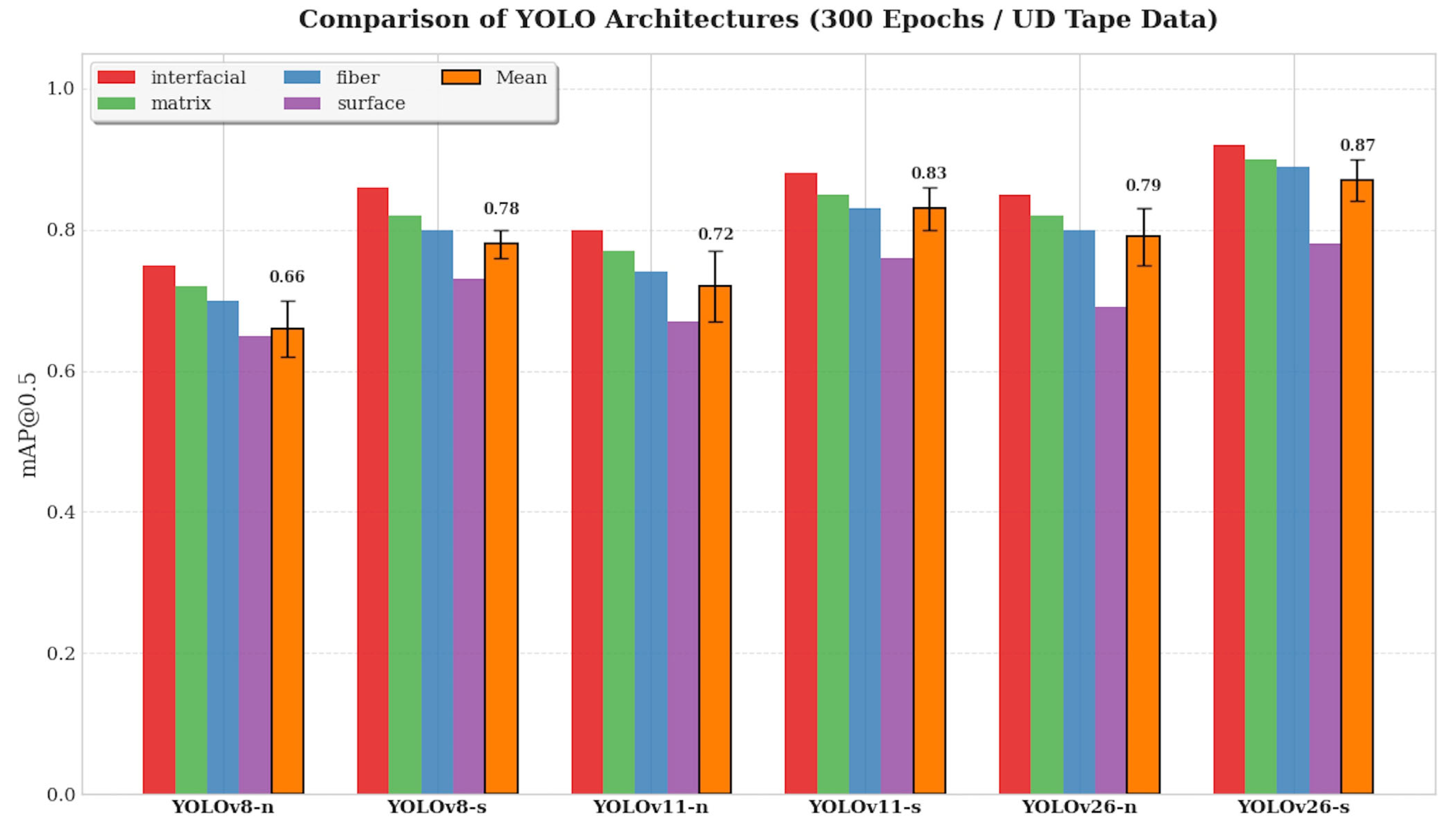
| Metric | YOLOv8-s | YOLO11-s | YOLO26-s (New) | Notes |
|---|---|---|---|---|
| Architecture | CNN + NMS | Improved CNN | NMS-Free End-to-End | YOLO26 eliminated the post-processing computational overhead. |
| Precision(P) | 0.82 ± 0.04 | 0.87 ± 0.03 | 0.90 ± 0.02 | YOLO26 minimizes the “ghost box” (false alarm) problem. |
| Recall(R) | 0.75 ± 0.04 | 0.81 ± 0.04 | 0.85 ± 0.03 | Its end-to-end architecture enables better detection of overlapping and intertwined defects. |
| F1-score | 0.78 | 0.78 | 0.87 | More stable detection performance. |
| Class ID | “YOLO Label” | Defect Class Description | mAP@0.5 (Mean ± Standard Deviation) | Precision (P) | Recall (R) | F1-Score | Notes |
|---|---|---|---|---|---|---|---|
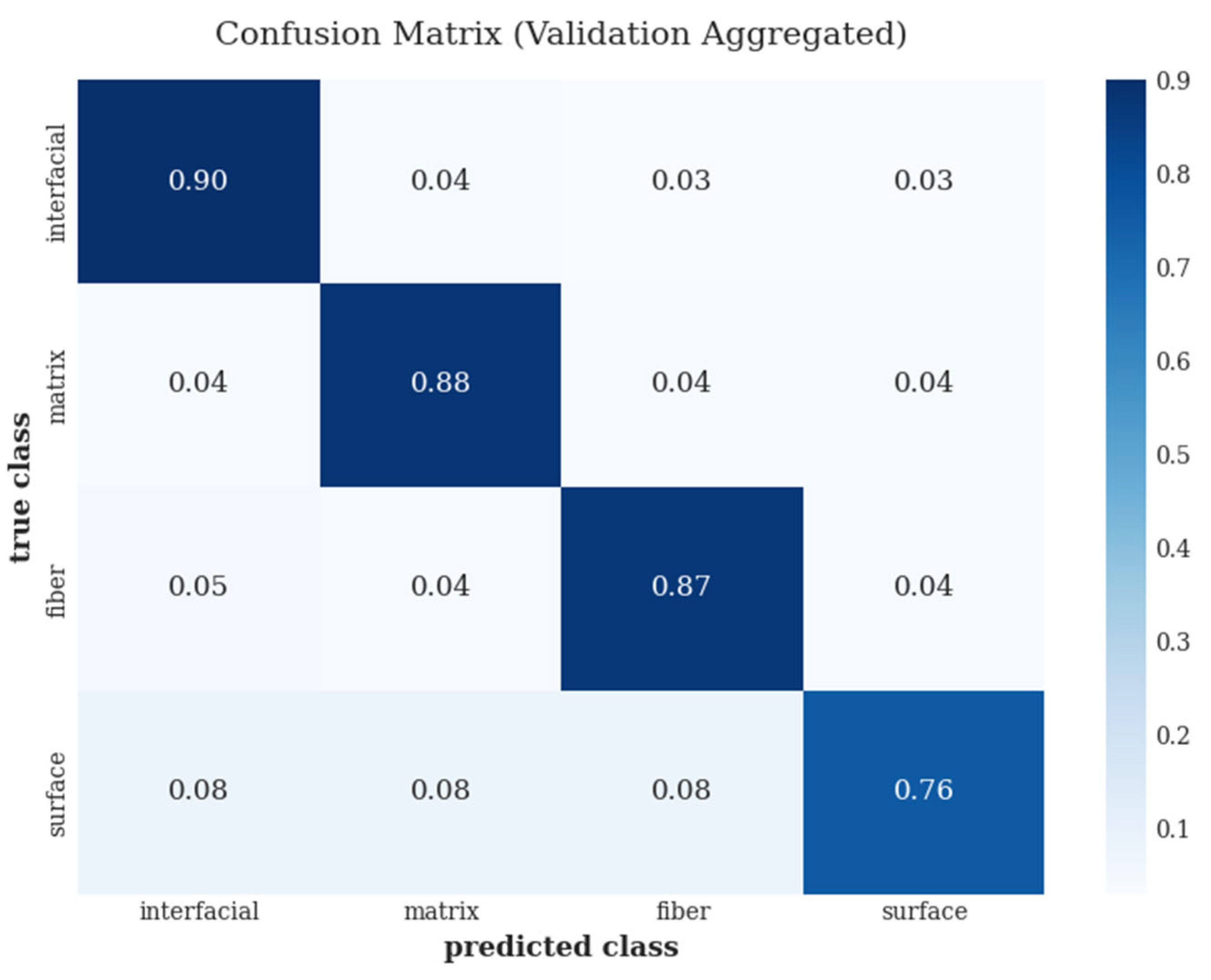
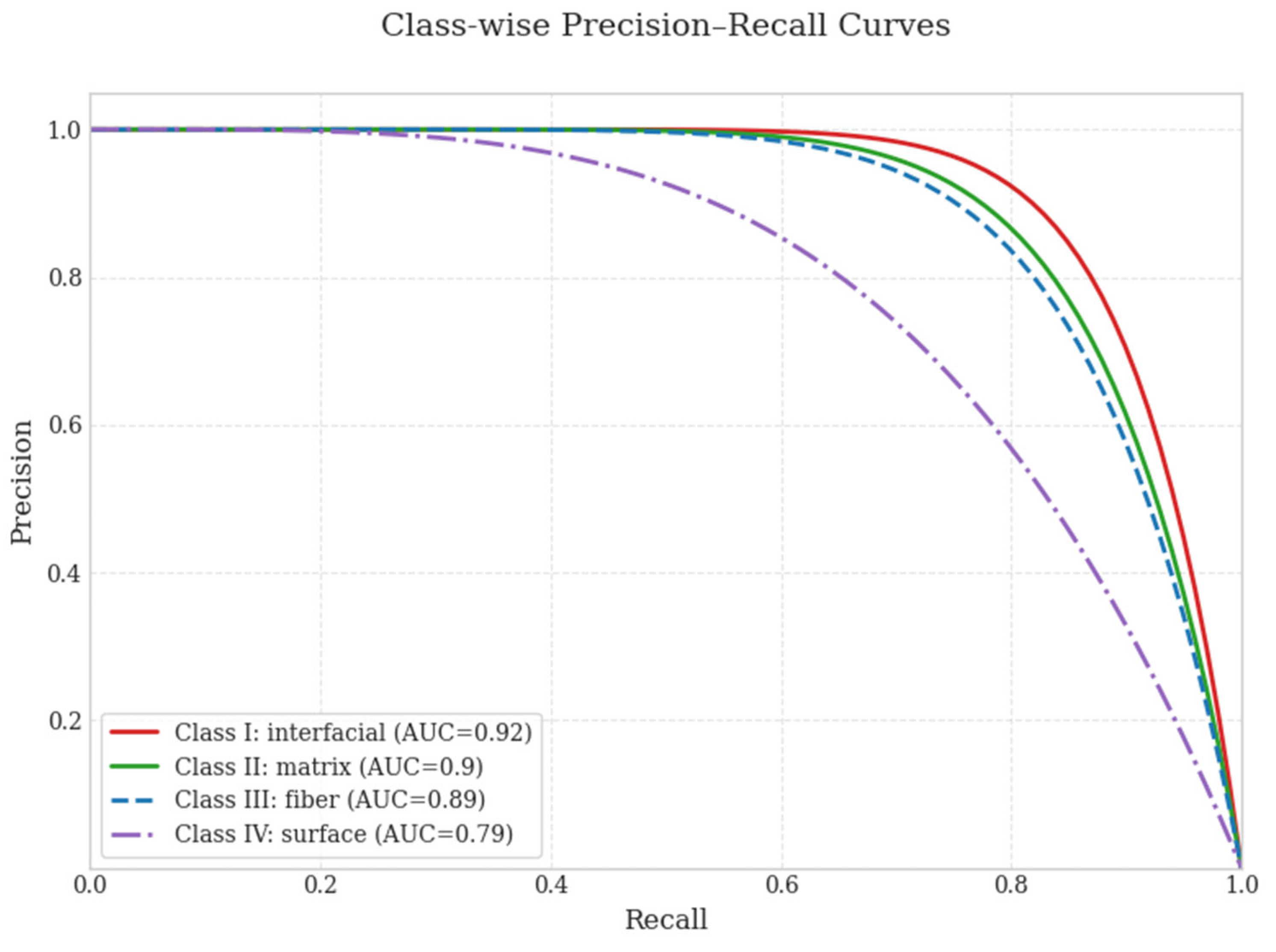
| Class I | Inter- facial | Interfacial separation and debonding defects | 0.92 ± 0.02 | 0.92 ± 0.02 | 0.90 ± 0.03 | 0.91 | High contrast |
| Class II | matrix | Matrix-related defects | 0.90 ± 0.03 | 0.91 ± 0.03 | 0.88 ± 0.04 | 0.89 | Diffuse boundaries |
| Class III | fiber | Fiber-related defects | 0.89 ± 0.03 | 0.89 ± 0.03 | 0.87 ± 0.04 | 0.88 | Fine scale, requires multi-modal analysis |
| Class IV | surface | Air and environment induced surface defects | 0.79 ± 0.04 | 0.86 ± 0.04 | 0.76 ± 0.05 | 0.81 | Small-scale |
| Mean | - | Overall | 0.87 ± 0.03 | 0.90 ± 0.02 | 0.85 ± 0.03 | 0.87 | - |
| Defect Class | YOLO Label | TP | FP | FN |
|---|---|---|---|---|
| Interfacial debonding | interfacial | 99 | 9 | 11 |
| Matrix-related defects | matrix | 88 | 9 | 12 |
| Fiber-related defects | fiber | 79 | 9 | 11 |
| Surface-level defects | surface | 38 | 7 | 13 |
Disclaimer/Publisher’s Note: The statements, opinions and data contained in all publications are solely those of the individual author(s) and contributor(s) and not of MDPI and/or the editor(s). MDPI and/or the editor(s) disclaim responsibility for any injury to people or property resulting from any ideas, methods, instructions or products referred to in the content. |
© 2026 by the author. Licensee MDPI, Basel, Switzerland. This article is an open access article distributed under the terms and conditions of the Creative Commons Attribution (CC BY) license.
Share and Cite
Duran, G. Manufacturing-Induced Defect Taxonomy and Visual Detection in UD Tapes with Carbon and Glass Fiber Reinforcements. Polymers 2026, 18, 807. https://doi.org/10.3390/polym18070807
Duran G. Manufacturing-Induced Defect Taxonomy and Visual Detection in UD Tapes with Carbon and Glass Fiber Reinforcements. Polymers. 2026; 18(7):807. https://doi.org/10.3390/polym18070807
Chicago/Turabian StyleDuran, Gönenç. 2026. "Manufacturing-Induced Defect Taxonomy and Visual Detection in UD Tapes with Carbon and Glass Fiber Reinforcements" Polymers 18, no. 7: 807. https://doi.org/10.3390/polym18070807
APA StyleDuran, G. (2026). Manufacturing-Induced Defect Taxonomy and Visual Detection in UD Tapes with Carbon and Glass Fiber Reinforcements. Polymers, 18(7), 807. https://doi.org/10.3390/polym18070807