3.2. COF Examinations
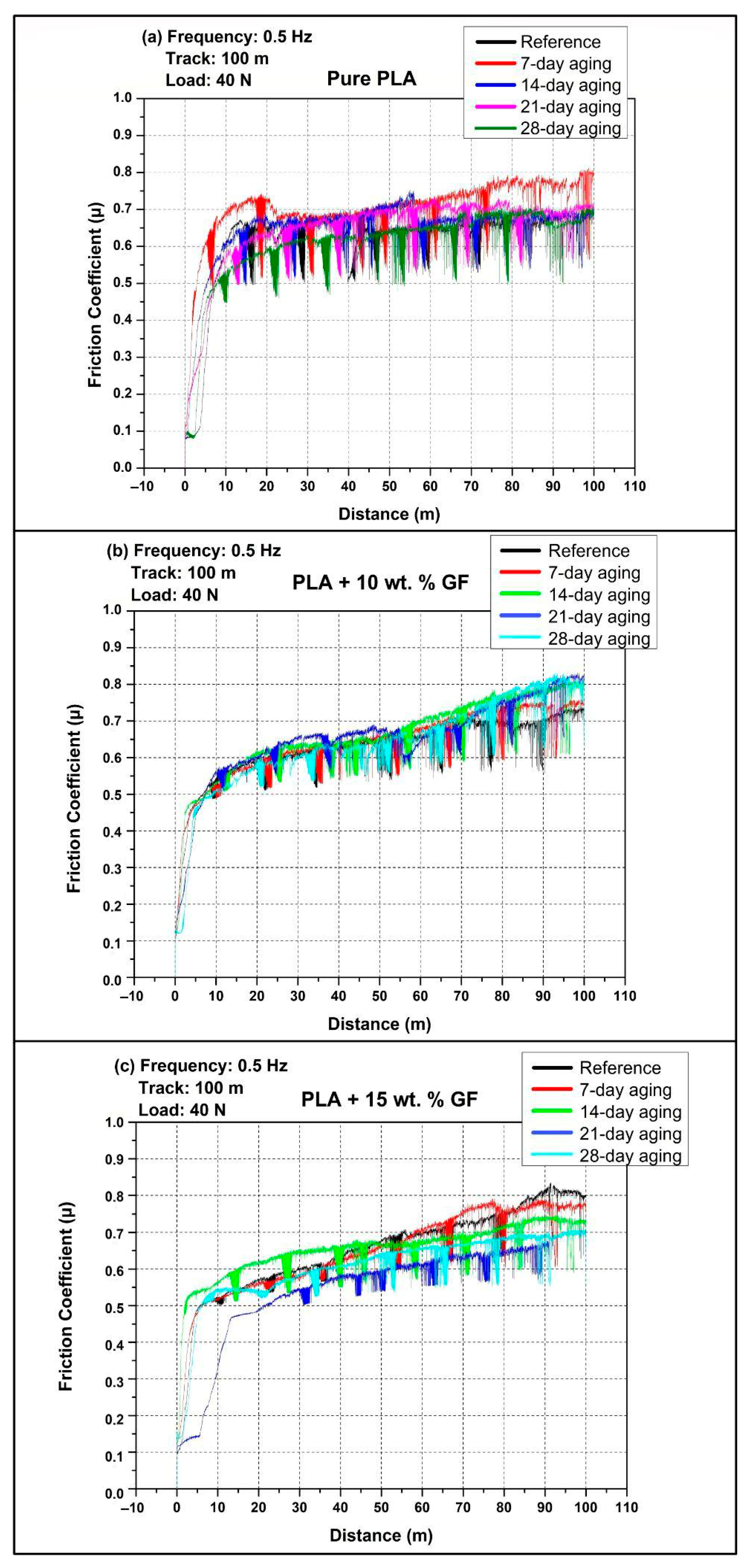
Figure 4 shows the friction coefficient (COF) stages during reciprocating wear at 40 N, 0.5 Hz, and a total track length of 100 m for three 3D-printed PLA-based systems. In line with the experimental plan shown in
Table 2, the tribological response of the PLA-based systems was evaluated in both the as-processed (non-aged) state and following water immersion periods of 7, 14, 21, and 28 days. For all material configurations, the friction curves display an initial brief running-in phase, which is subsequently followed by a more extended steady-state regime where COF fluctuates around a characteristic level, with intermittent sharp drops that indicate transient instabilities of the contact, such as momentary loss and reformation of the transfer layer or stick slip events.
For
Figure 4a (pure PLA), the reference specimen rapidly increases from a low initial COF to a quasi-steady level around 0.65 to 0.70 within the first roughly 10 to 20 m, then remains broadly stable with moderate fluctuations up to 100 m. The 7-day-aged PLA shows the highest friction response among the aging conditions, with an early overshoot to roughly 0.70 to 0.73 and a progressive increase after about 60 m, reaching about 0.75 to 0.80 toward the end of the track. The 14-day- and 21-day-aged curves largely overlap the reference in the mid distance range, typically stabilizing around 0.66 to 0.70, with the 14-day condition showing a local rise near the mid-track where COF momentarily approaches the low 0.70 s. The value of the 28-day-aged PLA is seen to be marginally lower than that of other ages for most of the period, ranging roughly between 0.63 and 0.68, which reflects a relatively lower level of friction. This is in spite of the fact that their initial variations are similar.
For
Figure 4b (PLA + 10 wt.% GF), the initial running is again rapid, but the subsequent behavior is characterized by a more gradual, distance-dependent increase in COF. In the first 10 to 20 m, COF typically rises to about 0.50 to 0.60, then continues increasing slowly through the mid-track. Beyond about 60 m, the curves diverge more clearly with aging time. The reference condition remains the lowest overall, ending at about 0.70 to 0.73 at 100 m. Water-aged specimens generally show elevated late-stage COF, with the 7-day condition ending around the mid-0.70 s, while the 14-day and 28-day conditions reach the highest terminal values, approaching about 0.80 to 0.82. The 21-day curve is typically intermediate, rising above the reference after mid-track and finishing around the high 0.70 s. Across all aging states, frequent short downward excursions are visible, but the dominant trend for this composite is that longer immersion tends to amplify the late track friction increase.
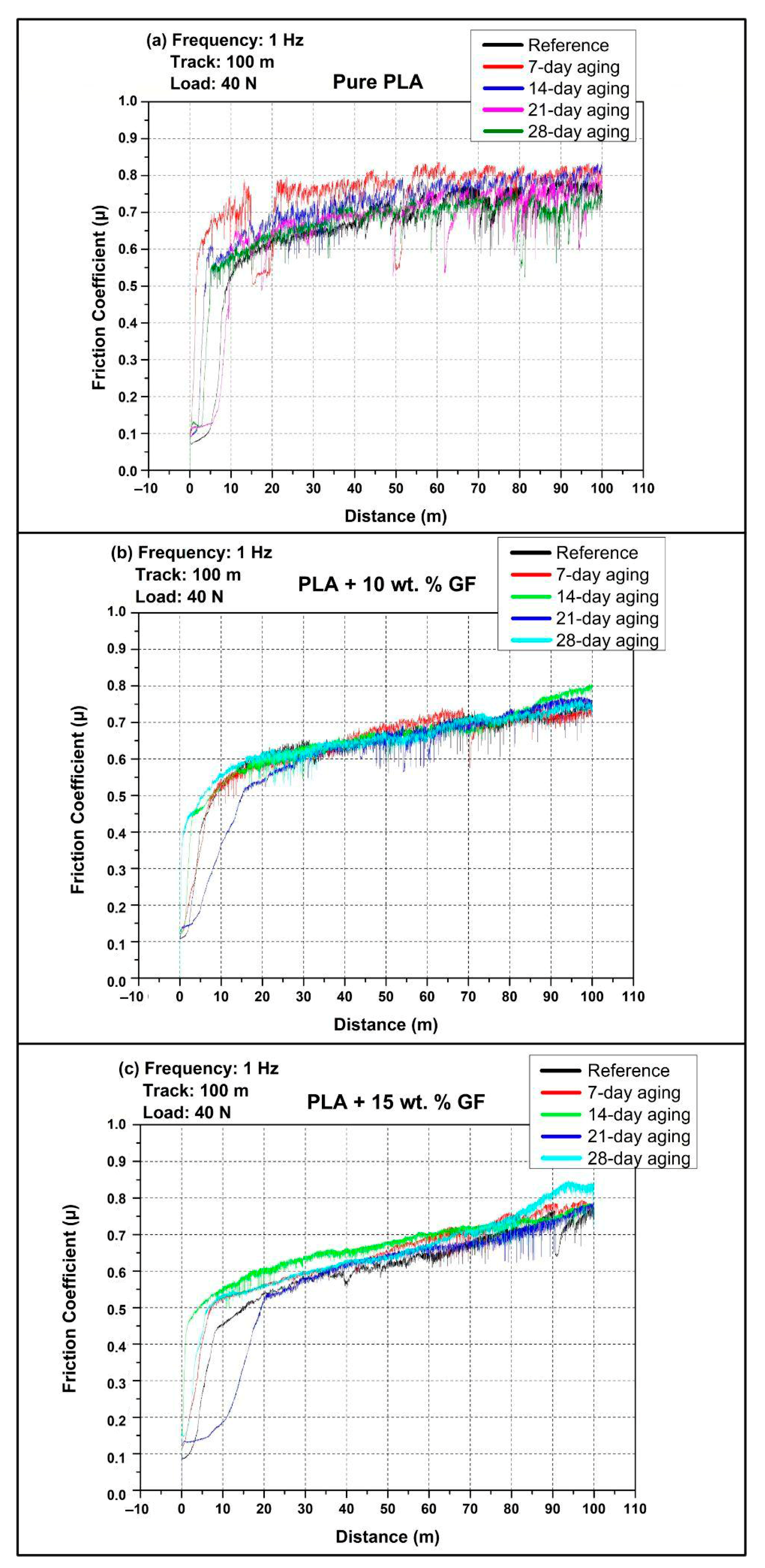
Considering the composite type effect across
Figure 4, the friction response transitions from a comparatively flat, plateau-like behavior in pure PLA to a more distance-dependent increase when glass fiber is introduced. Pure PLA mostly clusters around 0.65 to 0.70 after running in, except for the 7-day-aged condition that rises to about 0.75 to 0.80 late in the test. The 10 wt.% GF composite shows the most consistent late-stage COF escalation with aging, reaching the highest end of track values overall, up to about 0.80 to 0.82 for longer immersion. The 15 wt.% GF composites can either match the high friction levels of the 10 wt.% GF system in the reference and 7-day states or deliver a lower sustained COF under specific aging conditions, most clearly at 21-day where it becomes the lowest friction case among the reinforced materials. Overall, adding GF increases the sensitivity of COF to water aging and sliding distance, while increasing GF content from 10 wt.% to 15 wt.% does not uniformly increase COF, instead yielding aging-dependent shifts in both the running in behavior and the steady friction level.
Figure 5 shows the friction coefficient (COF) stages with sliding distance during 1 Hz reciprocating wear under 40 N over a 100 m track, comparing the reference condition (no aging) with 7-day, 14-day, 21-day, and 28-day water immersion, in accordance with the aging matrix in
Table 2. Across all three panels, the COF curves exhibit a short running in period in the first few meters, followed by a longer regime where friction gradually increases with distance and is interrupted by occasional sharp drops, which are indicative of transient contact instabilities such as local disruption and re-establishment of the polymer transfer layer, intermittent debris entrainment, or short stick slip events.
In
Figure 5a (pure PLA), all conditions rapidly transition from an initially low COF to a higher steady sliding regime within the first roughly 5 to 15 m. After running in, the reference specimen typically stabilizes around approximately 0.62 to 0.70 in the early to mid-track and then shows a gradual increase, reaching about 0.78 to 0.82 toward 100 m. Water aging generally shifts the pure PLA curves upward and amplifies fluctuations. The 7-day-aged specimen shows the most pronounced early COF rise, rapidly reaching roughly 0.70 to 0.75 and maintaining the highest friction band over much of the test, often around approximately 0.75 to 0.82. The 14-day and 28-day curves largely overlap the reference during the mid-track but remain slightly higher at long distances, typically ending close to about 0.80. The 21-day-aged curve tends to remain comparatively lower than the other aged conditions for most of the track, usually clustering around approximately 0.65 to 0.75 and ending below the highest curve group, although still showing an overall distance driven increase.
In
Figure 5b (PLA + 10 wt.% GF), the COF responses are more tightly clustered than pure PLA, indicating that the addition of glass fiber reduces the sensitivity of friction to aging time under 1 Hz, at least within the scatter of the signals. After the initial running in, all conditions converge to a similar friction level in the range of about 0.55 to 0.62 by roughly 10 to 20 m, followed by a nearly monotonic, slow increase with distance. The reference condition generally occupies the lower envelope through the later stages, ending around approximately 0.72 to 0.75 at 100 m. The 7-day- and 14-day-aged conditions are typically slightly higher than the reference across the mid-to-late track, often ending around 0.74 to 0.77. The 21-day- and 28-day-aged specimens show the highest terminal COF values within this composite family, approaching approximately 0.77 to 0.79 near the end of the track. Overall, the dominant feature is the gradual distance-dependent increase rather than strong separation by immersion duration.
In
Figure 5c (PLA + 15 wt.% GF), the curves show clearer differentiation with aging time, particularly in the late track. Following running in, friction values generally lie around approximately 0.50 to 0.60 in the early to mid-distances and then increase progressively. The reference condition remains comparatively lower over much of the track and typically finishes around approximately 0.75 to 0.78, with intermittent sharp drops near the end suggesting occasional loss of stable sliding. The 7-day-aged condition trends higher than the reference during the second half of the test and reaches about 0.78 to 0.80 at 100 m. The 14-day- and 21-day-aged curves are usually intermediate, tracking close to each other for most of the distance and ending around approximately 0.76 to 0.79. The 28-day-aged specimen exhibits the most prominent late-stage change, with an evident turnaround after a distance of 80–90 m, and a maximum terminal value of the COF of around 0.82–0.85. This implies that the immersion for a longer period of time has the most significant friction-escalating effect in a scenario of increased GF concentration, namely 15 wt.%, and at a high frequency of sliding.
Comparing composite types at 1 Hz, pure PLA generally exhibits the highest and most fluctuating friction response, with steady sliding typically evolving into a high COF band near approximately 0.78 to 0.82 by the end of the track, and with water aging, especially 7-day, further promoting higher friction throughout much of the test. Introducing GF produces more clustered and smoother COF trajectories and shifts the behavior toward a gradual, distance-dependent increase. The PLA + 10 wt.% GF system shows the smallest separation among aging durations and maintains terminal COF values mostly below pure PLA, typically around approximately 0.72 to 0.79. Increasing reinforcement to 15 wt.% GF strengthens the effect of long immersion time, with 28-day aging producing the highest end of track COF (about 0.82 to 0.85) among the reinforced composites, while shorter aging durations remain closer to the reference. Overall, at 1 Hz the influence of water aging on friction becomes more pronounced at higher GF content, primarily through elevated late-stage COF rather than major changes in the initial running in level.
As illustrated in
Figure 3 and
Figure 4, the observed coefficient of friction (COF) is consistent with the characteristic reciprocating wear behavior reported for polylactic acid (PLA) and PLA-based composite systems. The findings presented in this study are consistent with previously published research on the tribological behavior of PLA-based materials produced using FDM. Earlier studies have reported that modifications such as additive incorporation, filler reinforcement, or structural tailoring affect the friction coefficient and wear mechanisms of PLA composites under sliding conditions. The general trends observed in the present work—particularly the influence of reinforcement content on frictional response, wear development, and material–counterface interaction—are in agreement with these studies, confirming that the tribological behavior identified here aligns with the established literature [
40,
41,
42,
43]. This phenomenon explains the COF behavior in reinforced PLA, in which high levels of COF result because of fluctuations in COF as influenced by third-body wear, transfer film degradation, and surface damage.
3.3. Wear Damage Evaluation
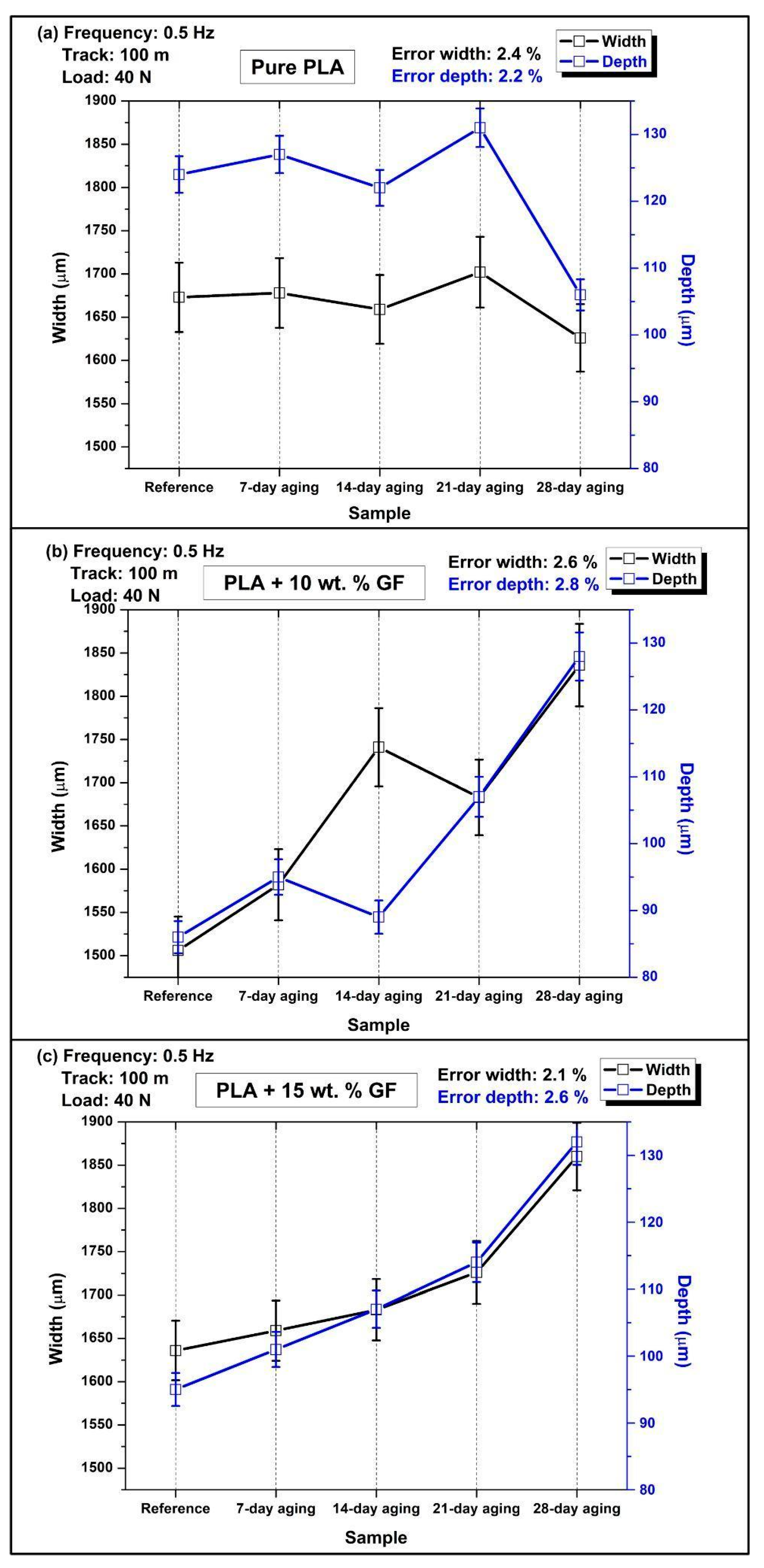
Figure 6 compares the wear scar width (left axis, black markers) and the maximum wear scar depth (right axis, blue markers) measured after reciprocating sliding at 40 N, 0.5 Hz, and of 100 m distance for pure PLA and glass-fiber-reinforced PLA (10 wt.% and 15 wt.% GF). As shown in the water immersion matrix in
Table 2, the baseline (no aging) is contrasted with samples aged in water for 7-day, 14-day, 21-day, and 28-day. These points show the mean level for each condition with error bars showing the repeatability of the measurement. The reported measurement uncertainty is low for all cases, with error widths of 2.4% to 2.6% and error depths of 2.2% to 2.8%, indicating that the observed differences among aging durations are systematic rather than within experimental scatter.
In the case of
Figure 6a, which corresponds to pure PLA, the width of the wear scar remains within a short range for different aging periods ranging from around 1625 µm to 1700 µm. The width of about 1670 µm and the corresponding depth of about 125 µm are seen in the reference sample. After 7 days of water aging, the dimensions remain almost the same (width of about 1675 µm) with a slight increase in the depth (around 127 µm), signifying slightly increased wear. The dimensions are slightly smaller in the 14-day-aged sample (width of about 1660 µm and depth of about 123 µm), possibly signifying the stabilization process of the contact area with a short-term changeover in the transfer film or maybe also associated with surface restructuring. The maximum dimensions (both width and depth) are measured in the 21-day water-aged sample with corresponding dimensions of about 1700 µm and 131 µm. These show increased wear. It can be noted that the dimensions for the 28-day water-aged pure PLA are smaller with a width of about 1625 µm and a significantly smaller depth of roughly 107 µm.
In
Figure 6b, for PLA with 10 wt.% glass fibers (PLA + 10 wt.% GF), the effect of water aging shows an ostensibly higher degree of dispersion in wear parameters than in pure PLA, especially at longer immersion periods. In the unaged configuration, the combined material shows the lowest dimensions in the wear tracks, with a width of about 1510 µm and a depth of approximately 85 µm, which reflects the efficacy of reinforcement in hindering penetration and minimizing material loss at 0.5 Hz. At 7-day, the width and depth increase to about 1585 µm and 95 µm, respectively, as expected for the initial stages of moisture-driven degradation of the polymer properties and fiber/matrix interfaces. At 14-day, the width of the wear tracks markedly increases to about 1740 µm, with a corresponding decrease in the depth to approximately 88 µm, which indicates relative material loss that is largely lateral and confined to widening the track rather than substantial gouging, possibly related to microcracking, fiber exposure, and gentle plowing actions in this stage. At 21-day, the depth shows a substantial increase to about 108 µm, with a corresponding slight reduction in width to about 1685 µm, which indicates a transition to a more penetrative form of material loss. The most degraded stages are at 28-day, with both width and depth reaching their highest levels at approximately 1830 µm and 129 µm, respectively, which recalls the cumulative effects of moisture-driven interfacial unbonding, possibly accelerating fiber pull-out or debonding with enhanced third-body abrasion action to widen the tracks and increase their depth.
For
Figure 6c (PLA + 15 wt.% GF), both wear scar width and depth increase almost monotonically with water aging time, showing the strongest time dependence among the three material systems. The reference specimen starts with a width of approximately 1635 µm and a depth near 96 µm, already deeper than the 10 wt.% GF references but still lower than the pure PLA reference depth. After 7-day, width and depth rise slightly to about 1660 µm and 101 µm, then continue increasing at 14-day (about 1685 µm width, 108 µm depth) and 21-day (about 1725 µm width, 115 µm depth). The condition of the 28-day-aged sample shows a pronounced increase, reaching around 1860 µm in width and 132 µm in depth. The monotonically increasing curve suggests that higher amounts of fibers could increase the susceptibility to the effects of longer immersion times, primarily due to the additional interfaces and the possibility of capillary paths which could facilitate faster invasion of water, thus leading to more pronounced removal of materials.
Across composite types, the reference condition indicates that GF reinforcement can reduce wear depth substantially relative to pure PLA, decreasing from approximately 125 µm in pure PLA to about 85 µm for 10 wt.% GF and about 96 µm for 15 wt.% GF, while also reducing or maintaining comparable track widths depending on GF content. However, under prolonged water aging the ranking reverses. At 28-day, pure PLA shows the smallest depth, approximately 107 µm, and the smallest width, about 1625 µm, whereas both GF-reinforced systems exhibit considerably larger scars. The 10 wt.% GF and 15 wt.% GF specimens reach widths of approximately 1830 µm and 1860 µm, with depths of about 129 µm and 132 µm, respectively. Therefore, at 0.5 Hz and 40 N, GF additions are beneficial in the unaged state but lead to greater wear sensitivity after extended immersion, with the 15 wt.% GF composites showing the most pronounced time-driven escalation in both widening and penetration.
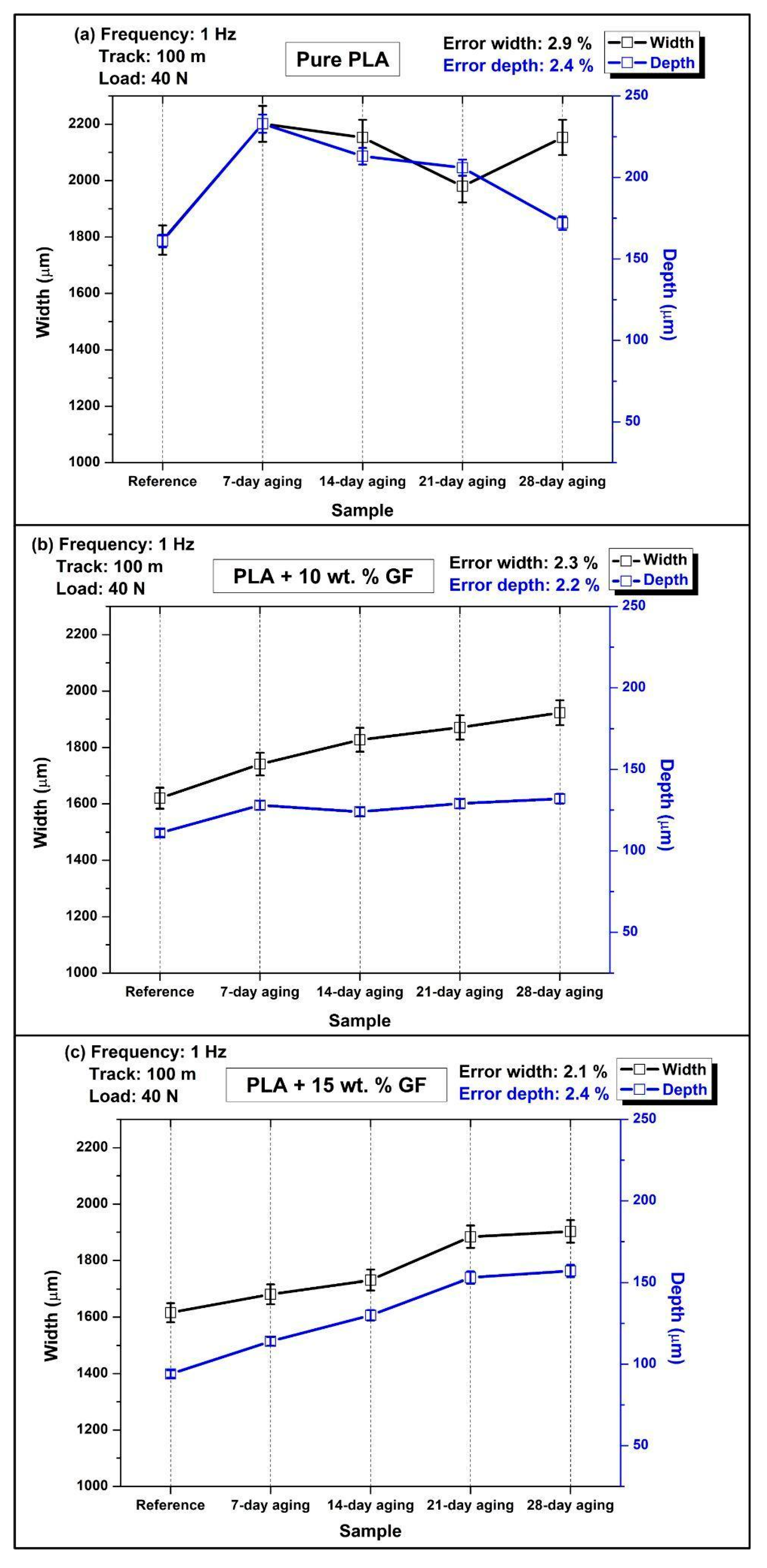
Figure 7 shows the variation in wear scar width (left
y-axis) and maximum wear scar depth (right
y-axis) for neat PLA and glass-fiber-reinforced PLA composites containing 10 wt.% and 15 wt.% GF, determined from reciprocating wear tests performed under a normal load of 40 N at 1 Hz with a total sliding distance of 100 m. The results are presented as a function of water immersion duration (unaged, 7, 14, 21, and 28 days), in accordance with the aging scheme outlined in
Table 2. The comparatively low measurement uncertainties reported on each panel, error width 2.1% to 2.9% and error depth 2.2% to 2.4%, indicate that the observed aging-driven shifts in wear metrics are meaningful and not dominated by experimental scatter.
In
Figure 7a (pure PLA), water aging strongly increases the penetration component of wear, particularly at short to intermediate immersion times. The reference depth is approximately 165 µm, whereas the 7-day-aged condition reaches the maximum depth, approximately 235 µm to 240 µm, indicating a pronounced loss of near-surface load bearing capacity after early water exposure. On further immersion, the depth keeps reducing, and at 14-day, the depth is about 210–215 µm, at 21 days about 205–210 µm, and at 28-day the depth is approximately 175 µm, which shows the partial recovery of the resistance to deep grooving. The width values among the aged pure PLA conditions remain high overall, peaking at about 2200 µm at 7-day, decreasing to about 2140 µm at 14-day, reaching the minimum around 1980 µm at 21-day, and increasing again to about 2140 µm at 28-day. This combination, very high depth at 7-day with simultaneously large width, is consistent with severe adhesive plus abrasive damage when the matrix is most susceptible to moisture-induced softening or hydrolytic weakening, while the reduced depth at 28-day together with re expanded width implies a shift toward more laterally distributed material removal and/or a more stable but broader tribo-layer response rather than purely penetrative plowing.
As shown in
Figure 7b for the PLA composite containing 10 wt.% glass fibers, a progressive increase in wear scar width is observed with increasing water-aging duration. The average width rises from approximately 1620 µm in the unaged condition to nearly 1740 µm after 7 days of immersion, followed by further increases to about 1825 µm at 14 days, 1870 µm at 21 days, and reaching roughly 1920 µm after 28 days. The depth changes are comparatively modest relative to pure PLA, rising from about 115 µm (reference) to about 130 µm (7-day), dipping slightly to about 125 µm to 126 µm (14-day), then increasing again to about 130 µm (21-day) and about 133 µm (28-day). The data indicate that water aging in the 10 wt.% GF composite primarily promotes track broadening, while the depth remains constrained within a narrow band, which is consistent with reinforcement limiting penetration even as matrix softening and progressive interface deterioration facilitate wider damage and debris-assisted lateral abrasion.
For the PLA composite reinforced with 15 wt.% glass fiber (
Figure 7c), both the wear scar width and maximum depth increase systematically with prolonged water immersion, with the depth evolution being more pronounced than that observed for the 10 wt.% GF formulation. The wear scar width expands from roughly 1610 µm in the unaged condition to around 1690 µm after 7 days, followed by values of approximately 1730–1740 µm at 14 days, and then shows a marked rise to nearly 1890 µm and 1910 µm after 21 and 28 days of aging, respectively. In parallel, the maximum wear depth increases from about 95 µm in the reference state to approximately 115 µm (7 days) and 130 µm (14 days), before rising more rapidly to around 155 µm at 21 days and reaching nearly 160 µm after 28 days. The step-like increase after 14 days suggests that prolonged immersion increasingly compromises the integrity of the fiber–matrix interphase and promotes more penetrative damage modes, such as fiber debonding, pull-out, and third-body abrasion, which can raise both penetration depth and track widening during reciprocating sliding.
Across composite types, the reference condition confirms the beneficial role of GF addition in reducing penetration, pure PLA shows the highest depth at about 165 µm, PLA + 10 wt.% GF decreases to about 115 µm, and PLA + 15 wt.% GF decreases further to about 95 µm, while the reference widths for both reinforced systems remain around 1610 µm to 1620 µm. Under water aging, pure PLA exhibits the most severe depth excursion at short aging, reaching about 235 µm to 240 µm at 7-day, whereas the reinforced systems remain far lower at the same immersion time, about 130 µm for 10 wt.% GF and about 115 µm for 15 wt.% GF. At prolonged aging, the reinforced systems show continued widening, and the 15 wt.% GF composite in particular shows a strong depth increase up to about 160 µm at 28-day, narrowing the performance gap relative to pure PLA at long immersion. Overall, GF reinforcement improves wear resistance in the unaged state and limits early depth escalation, but extended water exposure progressively increases wear scar width in both composites and promotes deeper penetration at higher fiber content, indicating that moisture sensitivity of the interfacial network becomes a dominant factor at longer aging durations under 1 Hz loading conditions.
The increases in wear scar width and depth observed in
Figure 6 and
Figure 7 are consistent with previously reported findings on aged fiber-reinforced composite systems. Earlier studies have shown that moisture exposure and hydrothermal aging generally promote matrix softening, interface degradation, and fiber–matrix debonding, all of which contribute to widened and deepened wear tracks under sliding conditions [
24,
44,
45]. The trends identified in the present work—particularly the progressive deterioration of interfacial integrity and the associated changes in wear morphology—are therefore in agreement with the established literature on the tribological behavior of water-aged, fiber-reinforced composites.
3.4. Profilometric Analysis of Wear Track Damage
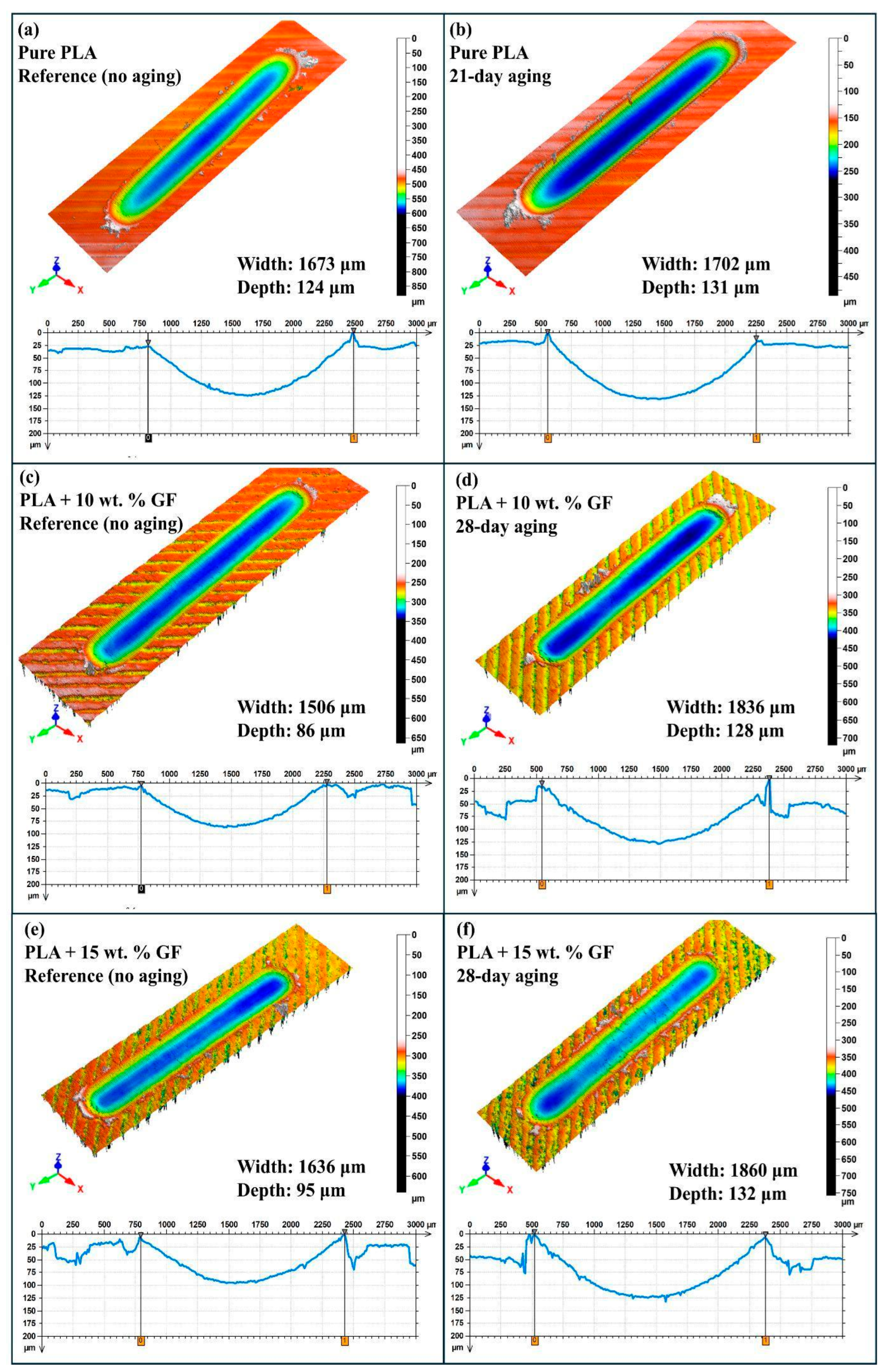
Figure 8 is intended to provide a within-group comparison between the reference condition and the specimen that exhibited the maximum wear scar depth among the tested aging durations for that same material system. Accordingly, the figure does not represent a full chronological sequence for every aging interval. Instead, it highlights the worst-case depth response relative to the corresponding unaged baseline, enabling a direct assessment of the most detrimental aging condition for each formulation under 40 N, 0.5 Hz and 100 m reciprocating sliding.
For pure PLA, the reference specimen in
Figure 8a is compared with the aged condition in
Figure 8b, which shows the maximum depth within the pure PLA set. The unaged PLA exhibits a wear scar width of 1673 µm and a minimum depth of 124 µm, with a smooth valley profile and moderate pile up at the track edges. Under the aging condition selected as the maximum depth case, the wear scar depth increases to 131 µm and the width to 1702 µm, corresponding to an increase of approximately 5.6 percent in depth and approximately 1.7 percent in width relative to the reference. The deeper penetration and slightly enlarged track indicate that the most severe aging state for neat PLA within the tested window promotes higher subsurface compliance and facilitates greater counterface indentation during reciprocating motion.
For PLA + 10 wt.% GF,
Figure 8c presents the reference surface, while
Figure 8d corresponds to the aging duration at which the maximum depth was recorded within this composite group. In the unaged condition, the composite shows a reduced wear scar depth of 86 µm and a width of 1506 µm, confirming the beneficial role of glass fiber reinforcement on load support and penetration resistance at the initial state. In the maximum depth aging condition, the depth rises to 128 µm and the width increases to 1836 µm, which corresponds to approximately 49 percent higher depth and approximately 22 percent higher width compared with the reference. The transition from a shallow groove to a markedly deeper valley in the worst-case aged specimen is consistent with aging-induced deterioration of the fiber matrix interface, which weakens the reinforcement efficiency and allows the contact to penetrate more aggressively.
For PLA + 15 wt.% GF,
Figure 8e shows the reference condition and
Figure 8f shows the aging duration that produced the maximum depth within this group. The unaged 15 wt.% GF composite exhibits a wear scar depth of 95 µm and a width of 1636 µm, which is deeper and wider than the 10 wt.% GF reference, indicating that the higher fiber loading does not further decrease wear penetration in the baseline state, likely due to increased heterogeneity and local stress concentrations. Under the maximum depth aging condition, the depth increases to 132 µm and the width to 1860 µm, corresponding to approximately 38.9 percent higher depth and approximately 13.7 percent higher width relative to the unaged reference. The deeper and broader groove morphology in the worst-case aged specimen supports the interpretation that, within the tested aging window, the most critical degradation state in the 15 wt.% GF composite substantially accelerates penetration and track expansion.
Overall, the within-group comparisons in
Figure 8 demonstrate that the aging duration associated with the maximum wear scar depth differs by material system, and the magnitude of the degradation is strongly formulation dependent. Neat PLA shows a relatively modest depth increase at its maximum depth aging condition, whereas both GF-reinforced composites exhibit pronounced increases in depth at their respective maximum depth aging durations, indicating that aging-driven interfacial weakening dominates the wear penetration response once fibers are introduced.
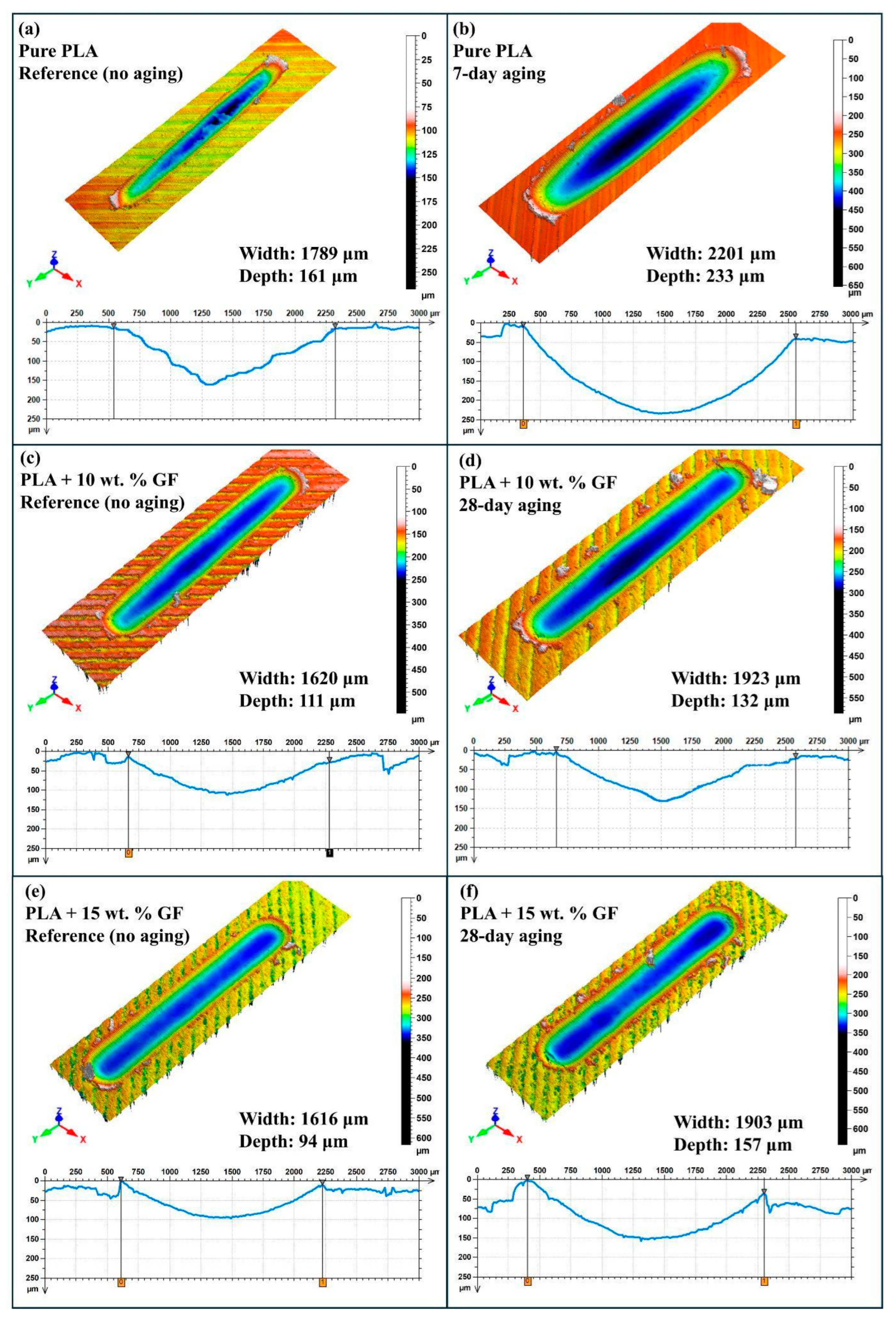
Figure 9 compares the post-test three-dimensional wear scar morphologies and the corresponding transverse profiles for pure PLA and PLA reinforced with 10 wt.% and 15 wt.% glass fibers under reciprocating sliding at 40 N, 1 Hz and a 100 m track length. For each material system, the unaged reference specimen is paired with the aged condition that produced the maximum wear scar depth within that same group. This selection strategy highlights the worst-case penetration behavior driven by water aging, while keeping the baseline unchanged, so that the relative susceptibility of each formulation to aging-induced wear damage can be evaluated directly.
From
Figure 9a–f it was demonstrated that, under 40 N, 1 Hz, and 100 m sliding, GF reinforcement reduces the baseline wear severity by decreasing the unaged wear depth from approximately 161 µm (neat PLA) to approximately 111 µm (10 wt.% GF) and approximately 94 µm (15 wt.% GF), while also reducing the wear track width from approximately 1789 µm to approximately 1620–1616 µm. Water aging increases wear damage in all systems; however, the aging duration associated with the maximum wear depth is formulation dependent. Neat PLA reaches its worst-case condition at 7 days, where the wear track expands to approximately 2201 µm in width and approximately 233 µm in depth, consistent with rapid matrix plasticization and enhanced deformation-driven penetration. In contrast, both GF-reinforced systems reach their maximum depths at 28 days, indicating a delayed but interface-controlled degradation response. The 10 wt.% GF composite increases to approximately 1923 µm in width and approximately 132 µm in depth, whereas the 15 wt.% GF composite exhibits the strongest deterioration in depth, increasing to approximately 157 µm despite a comparable width increase to approximately 1903 µm, which is consistent with progressive fiber–matrix debonding, microcracking, and debris-assisted three-body abrasion that promotes deeper penetration at higher fiber content.
The three-dimensional profilometric observations shown in
Figure 8 and
Figure 9 indicate that pressurized water aging leads to notable geometric changes in the wear tracks of both neat PLA and GF/PLA composites. The observed trends of increased depth and width of wear scar formation with increased durations of aging can be explained in light of existing knowledge on the degradation of such materials, where exposure to moisture results in a softened matrix with reduced load-carrying capability, thus facilitating wear scar formation of increased depth and width. Furthermore, the trends of wear scar formation in the GF/PLA composite materials, such as increased width of wear scar, asymmetrical wear scar profiles, and irregular wear scar formation, can be explained in light of existing knowledge on the degradation of such materials, where exposure to moisture results in weakening of the interfacial regions, exposure of fibers, and three-body abrasion caused by debris [
46,
47]. The trends of wear scar formation observed in this study can be said to align with the existing body of knowledge on the wear behavior of hydrothermally aged composite materials.
3.5. Microstructural Examination of Wear Damages
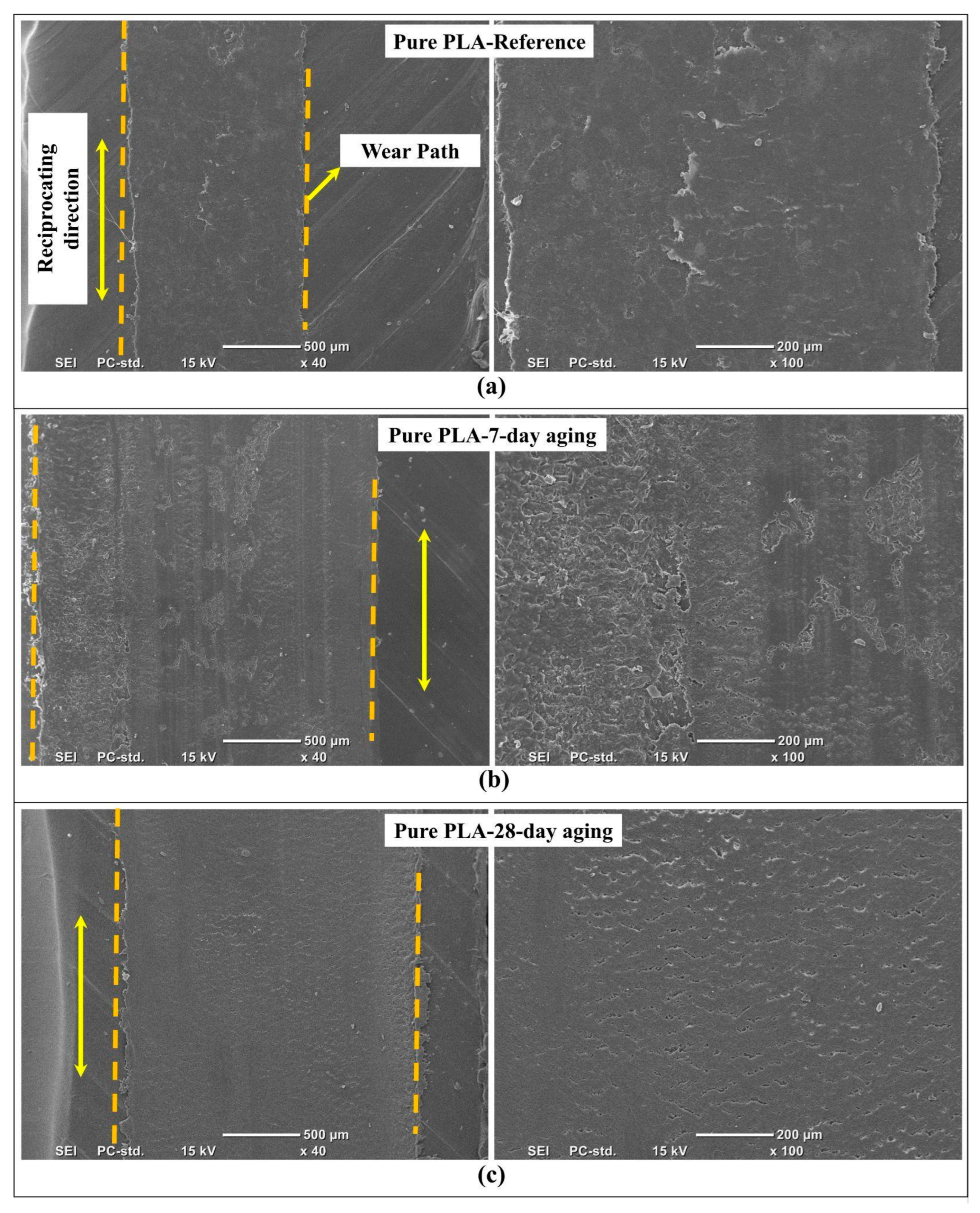
Figure 10 provides representative SEM observations of the reciprocating wear tracks produced on pure PLA in the reference (no aging) state and after water aging for 7-day and 28-day. The low magnification views delineate the overall wear path and its lateral boundaries, while the higher magnification images resolve the dominant local damage modes inside the track, enabling a mechanism-level comparison of how water exposure modifies near-surface deformation, debris evolution, and tribo-layer stability during sliding.
In
Figure 10a, the absence of aging in pure PLA shown in
Figure 10a has a relatively even wear rate with less discontinuity over a wide wear track. The main wear appearance is of smearing and shallow micro-plowing scratches that are in line with the rubbing direction. This indicates that wear occurs in a manner that involves visco-plastic flow of the material. At a higher magnification, the wear track is relatively dense, but there are patches of film and microcrack details that are not so prominent. All these indicate that polymer flow due to visco-plastic material is involved in increased rubbing that may have led to a stable interface.
From
Figure 10b, it is clear that the wear track with seven-day aging exhibits a significantly greater degree of surface damage than the reference sample. The low-magnification micrograph discloses an increased degree of irregularity within the wear track, as well as increased signs of surface disruption associated with debris, suggesting an increased ease of removal and dispersal of the broken-off polymer pieces during bidirectional rubbing. The high-magnification micrograph discloses extensive surface roughening, pronounced microcracking, as well as significant delamination at various locations, indicating an increased level of adhesive wear superimposed upon abrasion. This wear feature correlates with modifications to the near-surface mechanics induced by absorbed moisture, leading to decreased strength and increased compliance with attendant removal by subsequent rubbing-induced tearing, unstable third-body films, and third-body abrasion by debris pieces. Carrasco et al. [
48] reported that hydrolytic aging of PLA predominantly affects the polymer chains located in the amorphous domains, resulting with a pronounced decrease in molecular weight and a consequent increase in matrix brittleness. This degradation creates a network of subsurface microcracks that, under the cyclic shear stress of reciprocating sliding, coalesce into the large-scale delamination observed.
The 28-day-aged pure PLA shown in the images of
Figure 10c has a wear track that seems to be more uniform compared to the situation in the 7-day-aged PLA, despite the obvious signs of ongoing sliding-induced changes. Indeed, the appearance of the wear track under low magnification appears to be less dominated by delamination and to have a more homogeneous core, which may reflect the ongoing reduction in the wear process contributions from the large patch pull-off mechanisms that dominated the initial aging stage. Under higher magnification, the observed fine and directionally aligned groove structure and relatively compacted texture may also reflect the typical characteristics of an abrasion-controlled regime, which, under the action of micro-plowing and the relatively stabilized debris-compacted layer, seems to contrast the more homogeneous and microcrack-assisted spallation-dominated situation of the 7-day-aged material, where the dominant morphological changes seem to favor the transition to a more stationary sliding regime where the damage contribution to the wear process seems to be relatively more uniformly distributed along the contact patch. This observation is consistent with the results reported by Afrose et al. [
49], who showed that extended exposure to water promotes the development of a weak and eroded surface layer on PLA. During sliding, this degraded layer is gradually eliminated through micro-plowing mechanisms, giving rise to the oriented groove patterns observed on wear tracks after long-term aging.
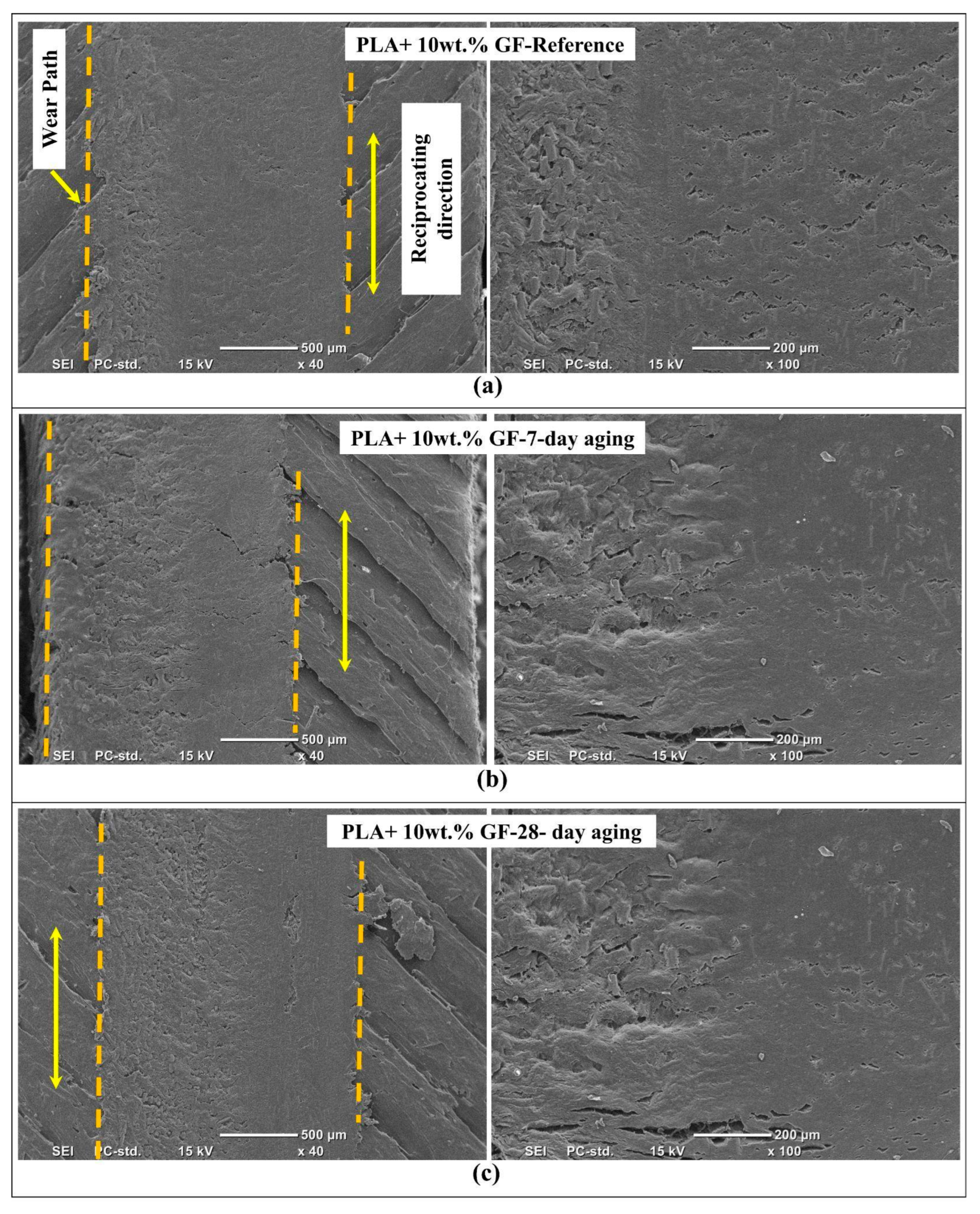
Figure 11 compares the SEM morphologies of wear tracks formed on PLA reinforced with 10 wt.% glass fiber in the reference state and after water aging for 7-day and 28-day. The low magnification images define the wear path boundaries and the directionality of sliding, while the higher magnification views resolve the local damage mechanisms within the track, particularly matrix smearing, interfacial debonding, fiber exposure, and debris-driven abrasion. This figure therefore clarifies how introducing GF changes the dominant wear mode from purely matrix-controlled plastic flow toward a coupled matrix, fiber and interface response, and how water aging progressively alters that balance.
As can be seen from
Figure 11a, the reference sample of PLA containing 10wt.% glass fiber (GF) has a wear track that is comparatively well-defined, reflecting a compact region in the wear track. The low magnification view also reveals that there is a wear track that is a continuous band and does not exhibit significant edge spallation. At higher magnification, the worn surface is characterized by smeared polymer patches and shallow grooves aligned with the reciprocating direction, together with discrete regions where short fiber ends or fiber imprints are visible. The presence of these imprints and limited pull-out cavities indicates that, in the unaged condition, the fiber–matrix interface largely remains intact, so fibers act primarily as barriers that resist penetration and stabilize the tribo-layer, rather than being released as abrasive third-body fragments.
Figure 11b shows that 7-day aging introduces a clear increase in surface disruption within the wear track. The low magnification image indicates a rougher track interior and more pronounced longitudinal shear bands, implying that the near-surface matrix becomes more compliant and prone to shear localization after water exposure. The higher magnification view reveals more frequent microcracks, torn polymer ligaments and small void like features associated with partial interfacial debonding or early-stage fiber pull-out. Compared with the reference, the worn surface appears less uniformly smeared and more fragmented, which suggests a transition from a predominantly adhesive smearing regime toward a mixed mechanism where locally detached polymer and partially loosened fibers promote intermittent third-body abrasion and micro cutting along the sliding direction.
In
Figure 11c, it is observed that the PLA sample aged for 28 days with 10 wt. % glass fiber (GF) has been affected to the highest extent. This is consistent with it having recorded the highest value on depth response. In the low magnification image, it is observed that there is higher heterogeneity on the track, which is characterized by pronounced shearing or removal, and there is less clarity on boundaries. At higher magnification, the surface contains more extensive delamination patches, larger cavities consistent with fiber pull-out, and a higher density of grooves and scratches aligned with the reciprocating direction. These features indicate that long-term water aging substantially degrades the fiber–matrix interface, allowing fibers to debonding and fragment, and the released glass particles then act as hard third-body abrasives that intensify micro-plowing and deepen the wear track. Overall,
Figure 10 demonstrates that glass fiber reinforcement improves the integrity of the unaged wear surface, but the tribological advantage progressively diminishes with aging as interfacial weakening activates debonding, pull-out, and abrasion-dominated wear.
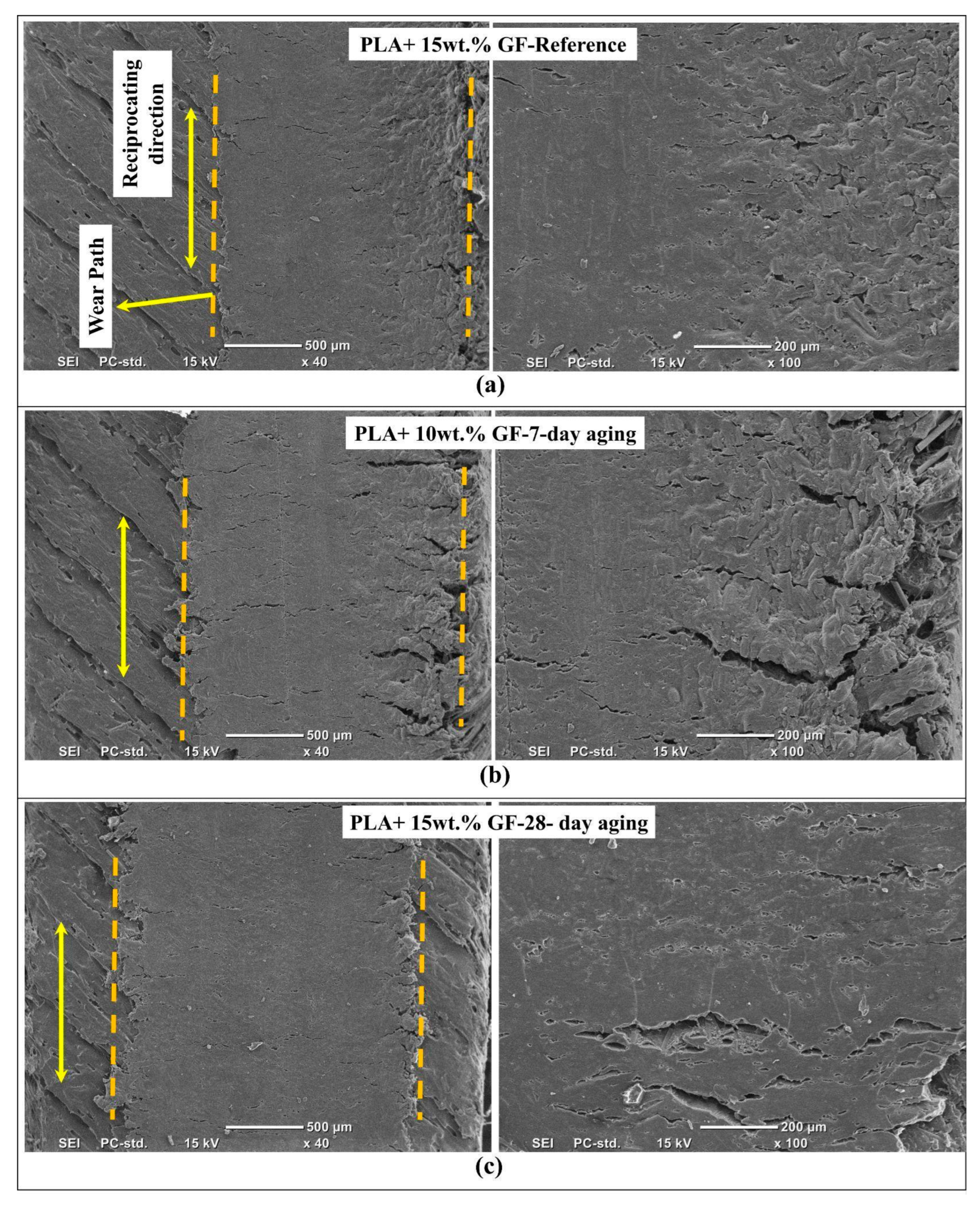
Figure 12 presents SEM micrographs of reciprocating wear tracks formed on PLA reinforced with 15 wt.% glass fibers in the reference condition and after water aging for 7-day and 28-day. The low magnification images delineate the wear path boundaries and reveal the macroscopic continuity of the track, whereas the higher magnification views resolve the local micro mechanisms governing damage development, including matrix smearing, microcracking, interfacial debonding, and fiber-related damage features. Because the fiber fraction is higher than in the 10 wt.% system, the wear response is more strongly controlled by fiber crowding effects and localized stress concentrations at the fiber–matrix interface, thereby rendering the aging-related degradation of interfacial integrity particularly evident in the resulting wear track morphology.
Starting with
Figure 12a, the reference PLA with 15 wt.% GF specimen displays a relatively compact wear track with a relatively homogeneous interior at a lower magnification. The wear track retains distinguishable boundaries without signs of large-scale spalling along these boundaries, which indicates a capacity of the modified surface to withstand the load without major displacement of materials. Higher magnification of the wear track reveals a surface with shallowed grooves oriented in the direction of motion as well as a smeared polymer with microcracks. These features confirm a mixed wear mechanism in which the visco-plastic deformation of the softened polymer is restricted by the high fraction of fibers, thus favoring microcracking within regions of high stochastic stress. The paucity of signs of large pull-out voids in the virgin structure indicates a strong enough bond between the interfacial zones to resist large-scale de or rebonding of the fibers within the wear track.
Figure 12b corresponds to the 7-day-aged condition of the PLA + 15 wt.% GF composite. Compared with the reference, the low magnification image shows a more disrupted track edge region and a more heterogeneous interior, indicating that aging accelerates damage localization and promotes intermittent material removal. The higher magnification view reveals a clear increase in microcrack density and crack opening, together with torn polymer ligaments and zones where the surface appears fractured and fragmented rather than smoothly smeared. This morphology is consistent with moisture-induced weakening of the matrix and, critically, partial loss of interfacial cohesion, which facilitates debonding at the fiber–matrix boundary and promotes crack propagation along interface-rich regions. The result is a more brittle, crack-assisted wear process in which local delamination events and debris generation become more frequent, increasing the likelihood of third-body abrasion during reciprocating sliding. The panel header in the image appears to contain a typographical inconsistency, and it should be aligned with the caption to indicate the PLA + 15 wt.% GF, 7-day aging condition.
In
Figure 12c, the 28-day-aged PLA + 15 wt.% GF depicts an ongoing process in the wear mechanism. By observing the low-magnification view, there is an onset of a more uniformly sheared path for the wear process in contrast to the 7-day-aged image. At higher magnification, the surface shows extended, directionally aligned grooves and elongated cavities or gaps that are consistent with advanced interfacial debonding and partial fiber pull-out or fiber imprinting. The presence of these elongated defects, together with the less continuous smeared film compared with the reference, indicates that long-term aging promotes progressive interface deterioration, enabling fibers to loosen and act as hard asperities or debris sources. Under reciprocating motion, such released or partially exposed fibers can intensify micro-plowing and micro cutting, thereby deepening the wear track and increasing surface roughness inside the path. Overall,
Figure 12 confirms that while 15 wt.% GF reinforcements can stabilize the unaged wear track, water aging shifts the dominant damage mode toward interface-controlled cracking and debonding, and this shift becomes increasingly pronounced as the exposure duration increases. In the hydrothermal aging of glass fiber/epoxy composites conducted by Yao et al. [
50], one can observe a clear similarity to the problem being discussed. The scanning electron microscopy results showed the same debonding along the interfacial boundaries between the fibers and matrices, which the authors believed to be due to the hydrolysis of the silane coupling agent and the infiltration of water molecules, reducing the strength of the adhesion. Once debonded, these glass fibers and fragments become potent third-body abrasives. The severe plowing and deep, sharp grooves in the aged composites are hallmarks of this mechanism.
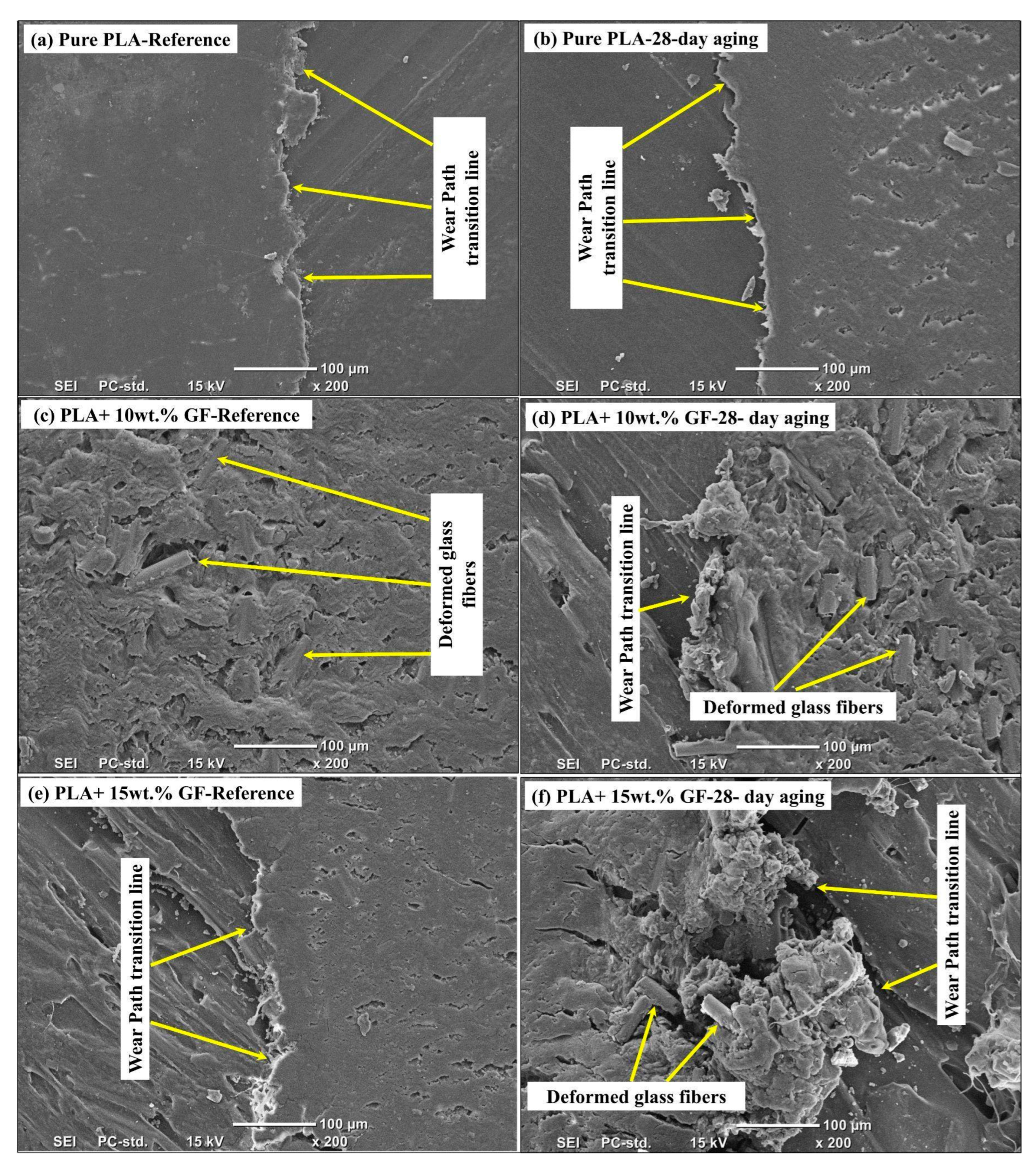
Figure 13 illustrates the wear track transition zone that has been defined as the boundary of the worn region and the less affected area that surrounds it. This interface is mechanistically important because it concentrates shear stresses, governs the stability of the tribo-layer, and is often the initiation site for edge delamination, crack growth, and debris release. The SEM micrographs therefore complement the width and depth data by revealing how aging and glass fiber addition change the local failure mode at the track margin, shifting the balance between ductile smearing, interfacial separation, and abrasion by third-body particles.
In
Figure 13a, the reference pure PLA shows a relatively well-defined wear path transition line with limited edge fragmentation. The boundary is shown to be in the form of a ridge that delineates a smooth worn zone from the surrounding material and suggests that mainly matrix shearing is occurring. In
Figure 13b, after 28-day aging, the same transition line becomes more irregular and locally undercut, with a rougher adjacent surface populated by small cavities and torn features. This change indicates that long-term water exposure reduces the cohesive integrity of the near-surface PLA, promoting localized edge chipping and discontinuous delamination at the boundary, which would facilitate intermittent debris generation and a less stable tribo-layer compared with the reference condition.
Figure 13c shows the transition region for the unaged PLA + 10 wt.% GF composite. The boundary is less purely ridge-like than in pure PLA and is accompanied by distinct deformed glass-fiber-related features within and near the transition zone. The local texture is more heterogeneous, consistent with load sharing between matrix and fibers and with shear localization around fiber-rich regions. In
Figure 13d, the 28-day-aged PLA + 10 wt.% GF specimen exhibits a markedly more disrupted transition line, together with more prominent clusters of deformed, partially exposed, or displaced glass fibers. The morphology suggests that aging weakens the fiber matrix interface, enabling fibers to debonding and protrude into the contact, while simultaneously producing hard fragments that intensify micro-plowing at the wear track edge. As a result, the transition zone evolves from a relatively coherent boundary in the reference state into a mechanically rough interface dominated by mixed adhesive and abrasive mechanisms.
In
Figure 13e, there is an observable transition line in the unaged PLA reinforced by 15wt.% GF, and there is also increased edge cracking and discontinuity compared to the reference sample of 10wt.% GF. This is consistent with higher fiber crowding and increased stress concentrations at the boundary, where matrix ligaments between adjacent fibers are thinner and more prone to crack-assisted separation under cyclic shear. In
Figure 13f, after 28-day aging, the transition zone becomes the most severely disrupted among the six panels. Large agglomerated debris masses and strongly deformed glass fiber bundles are visible adjacent to the boundary, indicating extensive interfacial debonding, fiber pull-out or fracture, and compaction of mixed polymer fiber debris into a mechanically active third-body layer. This morphology implies that the contact in the aged 15 wt.% GF composite is strongly influenced by abrasive action of glass-rich debris and by repeated edge delamination events, which are expected to accelerate track deepening and destabilize friction compared with both the unaged 15 wt.% GF specimen and the aged 10 wt.% GF composite. Across all materials, two consistent trends emerge from
Figure 13. First, water aging transforms the wear track boundary from a relatively continuous transition line into a more irregular, locally delaminated interface, indicating reduced near-surface cohesion and less stable tribo-layer formation. Second, introducing glass fibers moves the controlling mechanism at the transition zone from matrix-dominated smearing toward interface-controlled damage. The effect becomes stronger at 15 wt.% GF, where fiber crowding and aging-induced interfacial weakening promote severe debris accumulation and fiber-dominated third-body abrasion at the boundary. Sapuan et al. [
51], in the analysis of composite failures, highlighted that moisture absorption reduces the matrix’s fracture toughness and promotes crack initiation at stress concentrators (such as fiber ends or voids).
3.6. DSC Analyses
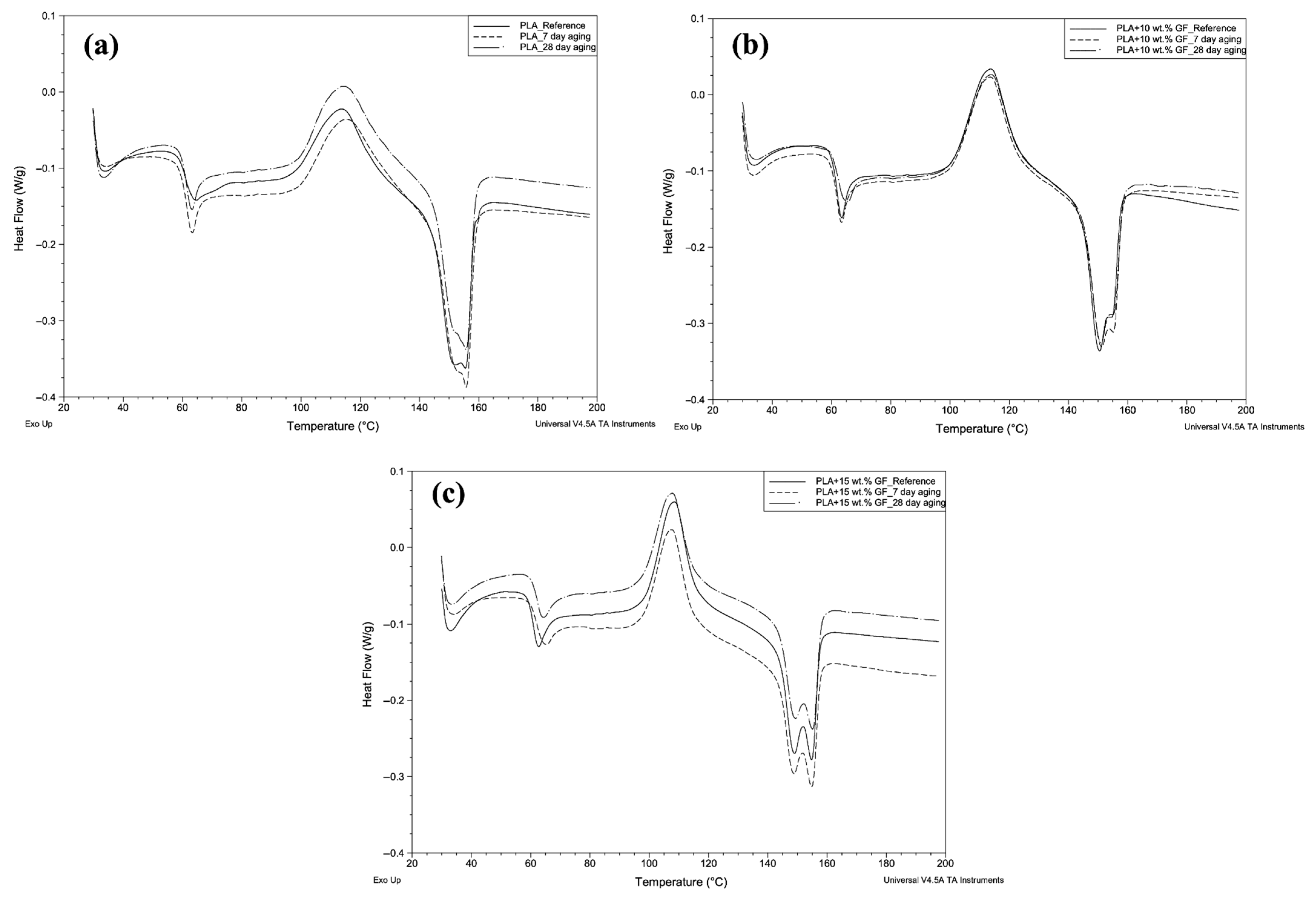
The variations in the thermal properties of 3D-printed samples produced by 3D printing using three different filament types due to water aging for varying periods of time were investigated by DSC analysis. Although the water aging process was applied for 0 (reference), 7-day, 14-day and 28-day, DSC analyses were only applied to samples aged for 0, 7-day and 28-day. The methodology was designed to elucidate the progressive impact of water aging on the thermal response of the material, capturing changes occurring at the early, intermediate, and advanced stages of exposure. In this context, DSC thermograms showing the result of three different water aging processes applied to the pure PLA sample are presented comparatively in
Figure 14a–c and
Table 3.
It is seen that in
Figure 14a, all DSC curves of pure PLA, T
g, T
cc and T
m peaks, which are considered to be characteristic for PLA, can be clearly observed. However, the DSC curves given in
Figure 14a and
Table 3 also show that some changes have occurred in the thermal behavior of water-aged pure PLA samples. While no important change is seen in Tg depending on the water aging time, it is observed that T
cc values increase slightly with aging. This increase can be explained by the shortening of PLA chains as a result of hydrolytic degradation and thus the increase in the number of chain ends. It can be said that the shortened PLA chains need more free volume and energy to be able to cold crystallize, that is, to start to become more regular, and therefore the T
cc value shifts to higher temperatures. At the same time, the increase observed in ΔH
cc value at 28 days of water aging can be interpreted as the water aging process applied for a relatively longer period of time facilitating the cold crystallization of the polymer chains by regularizing them, i.e., increasing their crystallization tendency. In addition to all these results, it can be concluded from
Figure 14 that Tm was observed at similar values in all three samples, and small changes occurred in ΔH
m values due to water aging, but these changes were not at a level that would significantly affect the crystal structure [
52,
53,
54]. In general, T
g and T
m of PLA did not change under water aging conditions, but water aging has the potential to cause structural changes that may increase the crystallization tendency. The thermal transition behaviors of PLA composites containing 10 wt.% GF at 0-day, 7-day and 28-day water aging conditions are given in
Figure 14b and
Table 3.
When
Figure 14b and
Table 3 are analyzed, it is seen that the T
g value does not change in all three sample types. This can be interpreted as GF addition to pure PLA does not have a significant effect on the chain mobility of PLA. The result that no change was observed in the chain mobility of PLA despite the addition of 10 wt.% GF suggests that the added glass fibers are micron-scale particles with a diameter in the range of 10–13 μm and particle size in the range of 50–200 μm, and due to their relatively low size, they do not form a strong interaction at this rate and size to restrict PLA chain mobility [
55]. However, as can be seen from
Figure 14b and
Table 3, T
cc values do not show a significant change depending on the water aging time. When this result is compared with the results of pure PLA given in
Figure 14a, it can be interpreted that the cold crystallization behavior of PLA chains becomes more stable with the addition of GF, which is not affected by water aging. Although small changes were observed in ΔH
cc and ΔH
m values depending on the water aging time, these changes cannot be said to be significant changes in the general structure of the crystal phase. In fact, Tm also exhibited very close values in all sample types, which once again showed that water aging had no significant effect on the crystal structure. In conclusion, it has been observed that adding 10 wt.% GF was not found to induce a change in the thermal properties of PLA matrix composites; however, it limits the change in thermal properties by water aging to a certain extent. The thermal transition behaviors of PLA composites containing 15 wt.% GF at 0-day, 7-day and 28-day water aging conditions are given in
Figure 14c and
Table 3.
From the analysis of
Figure 14c and
Table 3, it can be observed that the Tg values are generally constant during different aging durations. However, a slight increase in Tg (1.5 °C) is observed for the PLA composite containing 15 wt.% GF after water aging. Although the increased fiber content may slightly restrict the segmental mobility of the PLA chains, this phenomenon did not fully explain the observed change, as no such increase was observed before aging. Therefore, it is possible that the water aging process promotes interfacial interactions between the PLA matrix and glass fibers, such as the formation of hydrogen bonds, which may further limit chain mobility and contribute to the increase in T
g. Moreover, as evident from
Figure 14c and
Table 3, the cold crystallization temperature (T
cc) remains largely unchanged despite increasing water aging duration; the values of ΔH
cc decrease significantly with the increase in water aging time. Nevertheless, this decrease in values of ΔH
cc does not show a rise with increasing aging time. It can be assumed that this decrease in values of ΔH
cc could be attributed to a diminished capacity of the PLA chains caused by hydrolytic degradation because of aging. The effect of 15 wt.% GFs might be related to restricting the crystallization of PLA chains due to regularizing [
56].
3.7. Factorial Analysis
The factorial analysis can be defined as a statistical approach that helps to test more than one factor for its effect on a variable by considering all levels of variables. This approach to data collection is more effective compared to the traditional one-factor-at-a-time approach to data collection in experimental studies. This is because it saves experimental costs and time by considering all levels of variables. This approach is more effective due to its capacity to increase statistical credibility of experimental findings by providing knowledge on complex interdependencies between different variables using a unified approach. This paper uses factorial analysis to determine the effects of several critical parameters such as glass fiber weight ratio (0%, 10%, and 15%), test frequency (0.5 Hz and 1 Hz), and aging duration with pressurized water (0 to 28-day) on wear track properties, as well as coefficient of friction (COF), by considering their contribution effects.
As per the result obtained from the General Factorial Regression test, it can be interpreted that the overall fit of the model is good, as it has a high value of explanation with an R-squared of 97.43% and an adjusted R-squared of 96.34%. This means that more than 97% of the total variability of the coefficient of friction (COF) is explained by the variables of interest, which are factors of sample type, aging time, and test frequency. As can be seen in
Table 4, the main contributing factors to the COF values are outlined alongside their contribution percentages. The variance analysis has revealed the parameter that has the highest contribution to the COF values. This is the immersion time in water. This can be justified by the hydrolytic degradation process as outlined in this paper. Immersion in pressurized water will result in plasticization of the material through water uptake. sample type (PLA vs. GF-PLA) is the second most significant variable in the model. The statistical results confirm that glass fiber addition increases wear resistance and reduces friction variability compared to PLA. However, the interaction of GF-PLA on the degradation of the interface in the water aging test increases the importance of the relationship between sample type (PLA vs. GF-PLA) and “Water Aging Time”. Wear test frequency (Hz) is an important factor in COF, but its contribution ratio is smaller than other two major variables, which shows that the properties of the material (aging and reinforcement ratio) have more importance than other factors related to conducting the test (speed or frequency). Interaction: The sample × water immersion duration interaction is very interesting.
The high significance and contribution rate of three-way interactions in the analysis results prove that the effects of the controlled parameters on the friction coefficient are not independent of each other, but rather that the variables act with a collective synergy. High interaction is that the hydrolytic degradation caused by pressurized water triggers both the plasticization of the polymer matrix and the weakening of the glass fiber–matrix interface, thus altering the wear resistance of the material through a complex and variable mechanism depending on the sample type and test frequency. The high value of the three-way interaction in the analysis results proves that the combined effect of sample type, aging time, and test frequency on the friction coefficient exhibits a much more complex and interdependent characteristic than the individual contributions of these factors. The main reason for this is that the microstructural degradations caused by water in the polymer matrix and fiber interface, combined with dynamic loading under different test frequencies, trigger a unique and nonlinear wear mechanism for each material group.
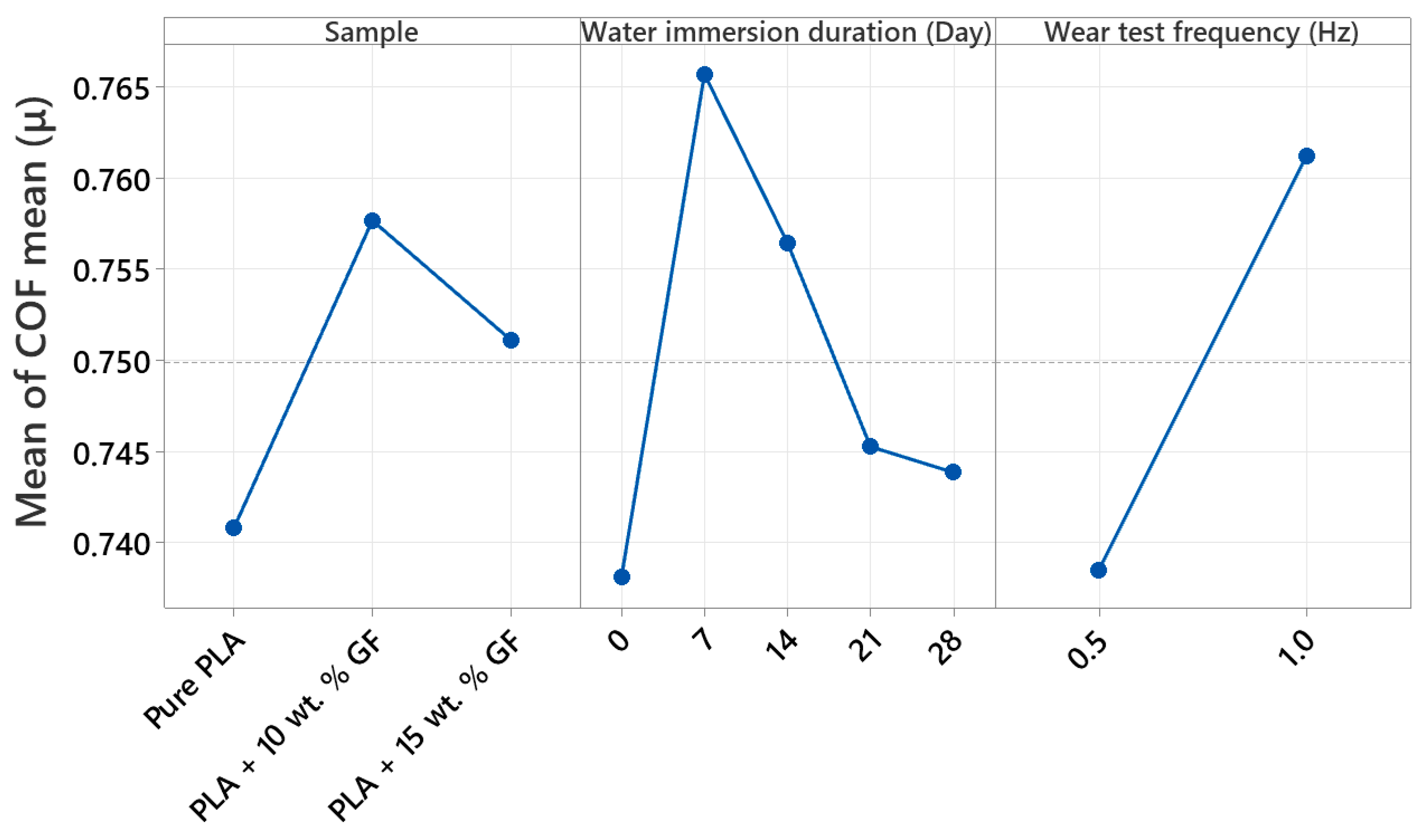
Figure 15 illustrates the individual effects of control parameters (sample type, water aging time, and test frequency) on the mean coefficient of friction (COF) through a “Main Effects Plot”. The steepness of the slope between the data points in the graph directly represents the intensity of the effect of the respective parameter on COF. Analysis reveals that water aging time has the steepest slope on the graph and leads to the most significant change in COF values. This confirms that plasticization and micro-scale structural distortions caused by pressurized water in the PLA matrix dominate the tribological response. The significance of a sample-type analysis lies in its ability to articulate well the difference in friction force due to reinforcement by glass fibers compared to PLA alone, wherein the reinforcement components act as load carriers on the wear surface. By doing this, it changes or affects the mechanism of friction force. Secondly, the variable of test frequency has less significance as a main factor in influencing the coefficient of friction (COF), and it plays a supplementary role in the interaction processes explained in the preceding section.
Figure 15 above is crucial in showing what factor takes priority in regulating the coefficient of friction.
From
Table 5, it can be seen that the major source of variation in the width of the wear track was the immersion time in water, accounting for 76.02% of the variation. This value underlines the high vulnerability of the material’s tribological properties in terms of environmental conditions, particularly pressurized water and immersion time. For both PLA and GF-PLA samples, the main mechanism in defining the width of wear was identified as being due to chemical dissolution/matrix softening due to water. The contribution of the sample type (sample) and the test frequency (Hz) was 5.76% and 4.14%, respectively. These small percentages imply that the material properties in terms of microstructure, affected by water immersion, and testing speed have negligible effects on the width of the wear tracks. Beyond the individual parameters, the sample × water immersion duration interaction has a contribution share of 5.09%. This percentage shows that the response of the sample type (pure or reinforced) to water differs; this numerically confirms that the water-based wear track widening effect progresses with different intensities (synergistic effect) on GF-PLA and pure PLA. The triple interaction (sample × water × frequency) being 1.40% and the model error margin being only 2.57% demonstrates that the experimental design is extremely precise and that the obtained width data are not coincidental but a direct result of the complex interaction of these three parameters.
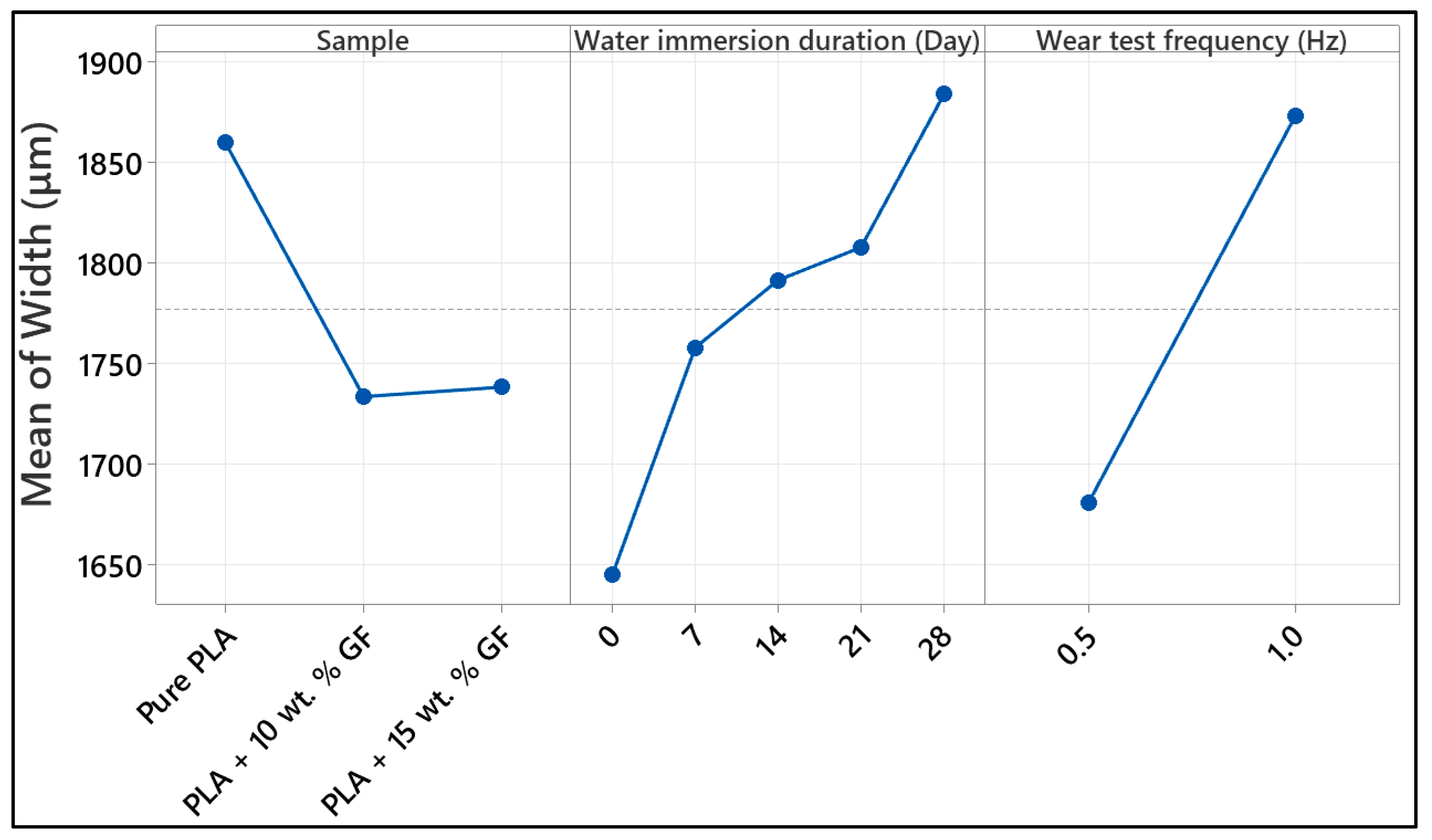
The main effects graph presented in
Figure 16 clearly shows that the most dramatic change in wear track width occurs with “Water Immersion Duration”. The steep slope of the aging time curve shown in the graph above supports the high contribution rate of 76.02% shown in
Table 5. The linear increase in the width of the wear track from 0 to 28-day can be attributed solely to the softening effects of the pressurized water on the polylactic acid (PLA) matrix. In determining the differences in variation based on the type of samples used, it can be seen that the glass fiber (GF) additives resist the width of the wear track, but this tends to weaken with time when exposed to water. In the case of the test frequency (Hz) factor, the slope follows a more horizontal course, proving that the frequency variation does not play as dominant a role in wear track width as the microstructural state (aging level) of the material. In summary, this graph scientifically demonstrates that wear track width is extremely sensitive to material intrinsic strength loss (hydrolytic degradation), but less affected by the mechanical speed of the test.
It is seen in
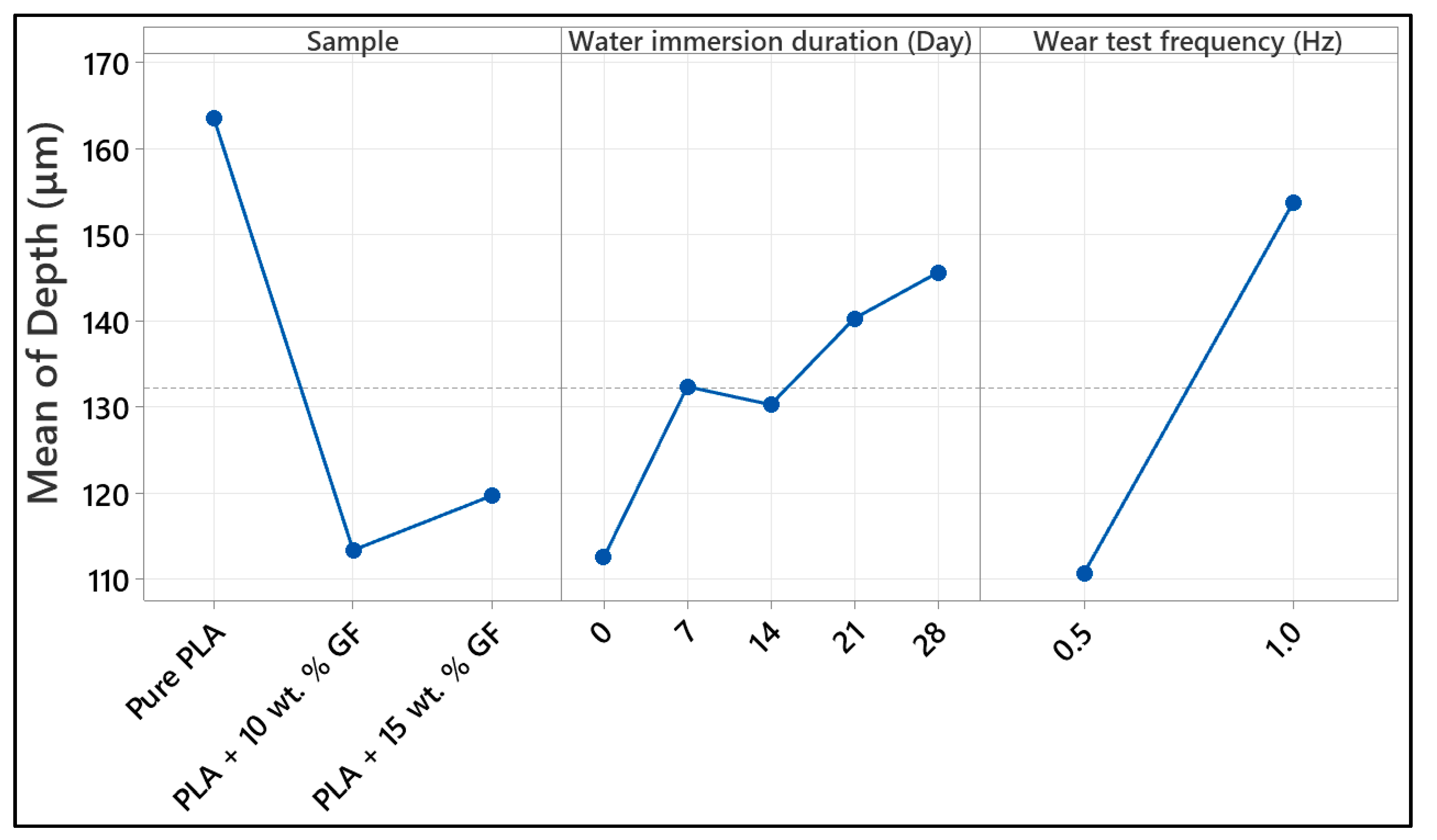
Table 6 that the most dominant factor on wear depth is “Water Immersion Duration”. The contribution rate of this parameter is the highest, similar to (and generally higher than) the width data in
Table 5. This demonstrates that the hydrolytic degradation caused by pressurized water not only creates a surface effect but also causes deep softening (plasticization) of the polymeric structure, leading to easier penetration of the abrasive tip into the material. The high contribution rate of water immersion duration shows that the structural integrity of the material weakens in direct proportion to the time spent underwater. In pure PLA and GF-PLA samples, micro-voids and bond breaks resulting from the diffusion of water within the matrix are the primary cause of the increase in wear depth. The fact that the sample type’s contribution ratio remains secondary to the aging time, while limiting the vertical wear depth of the glass fiber reinforcement to some extent, indicates that the softening of the matrix with water dominates this protective effect. Similarly, the low contribution of frequency (Hz) documents that the vertical material loss (depth) is related to the material’s current hardness/softness state rather than the test speed.
The main effects graph presented in
Figure 17 visually demonstrates that sample type and test frequency (Hz) are the most decisive factors influencing wear depth. According to the variance analysis results in
Table 6, sample type is the primary parameter dominating vertical wear with a contribution rate of 34.45% and test frequency with 31.98%. Examining the sample type curve in the graph, it is seen that glass fiber reinforcement (GF) significantly limits the wear depth compared to pure PLA; however, this resistance performance changes over time due to the effect of water aging. The steep slope created by the increase in test frequency on the wear depth shows that the dynamic loading rate directly affects the vertical penetration resistance of the material. Although the direct (linear) effect of water aging on depth has a lower percentage compared to the width data, the softening of the material due to hydrolytic degradation contributes to the deepening of the wear profile.




 ,
,