Phosphazene-Based Porous Polymer as Electrode Material for Electrochemical Applications

 , , and
Abstract
1. Introduction
2. Materials and Methods
2.1. Materials
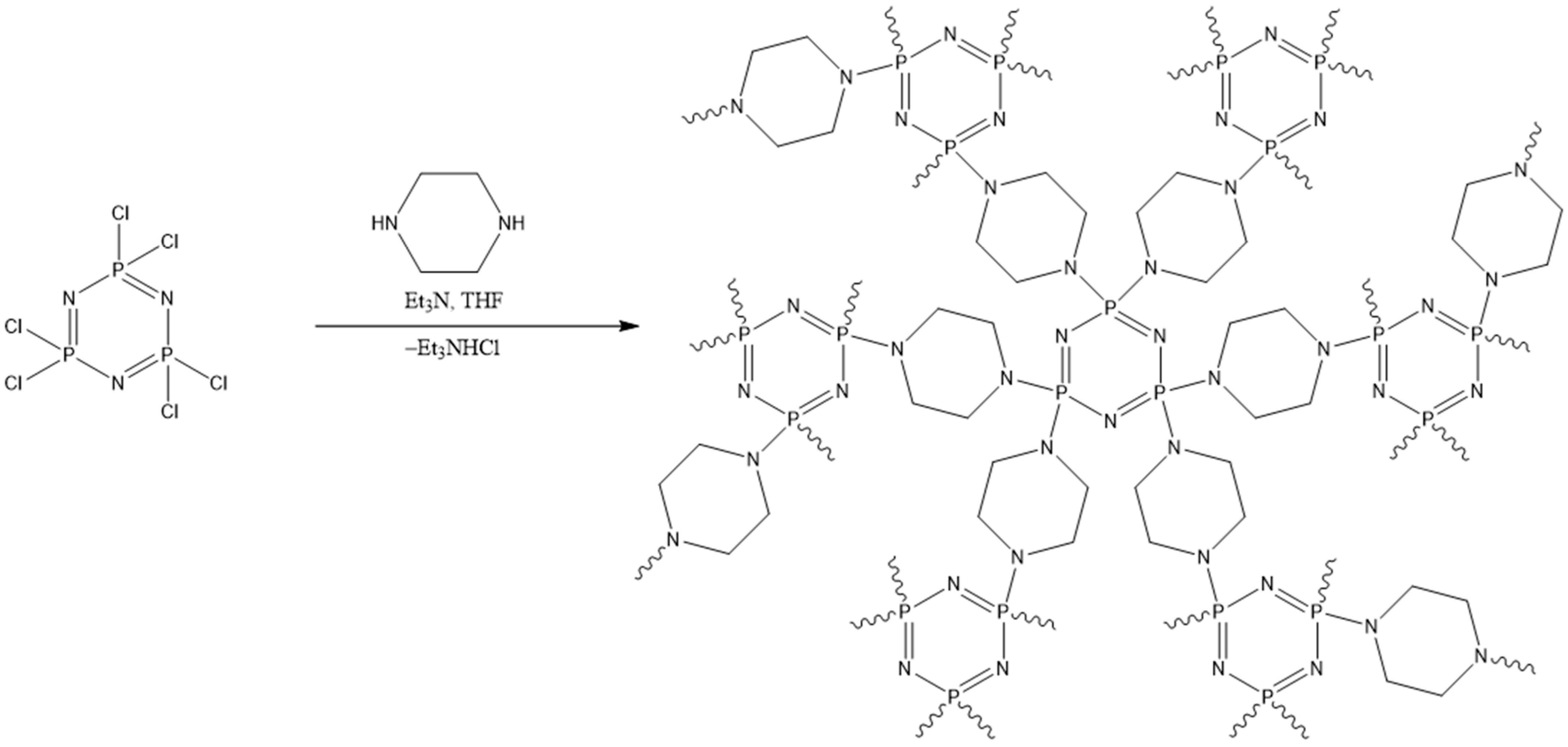
2.2. Synthesis of PIP
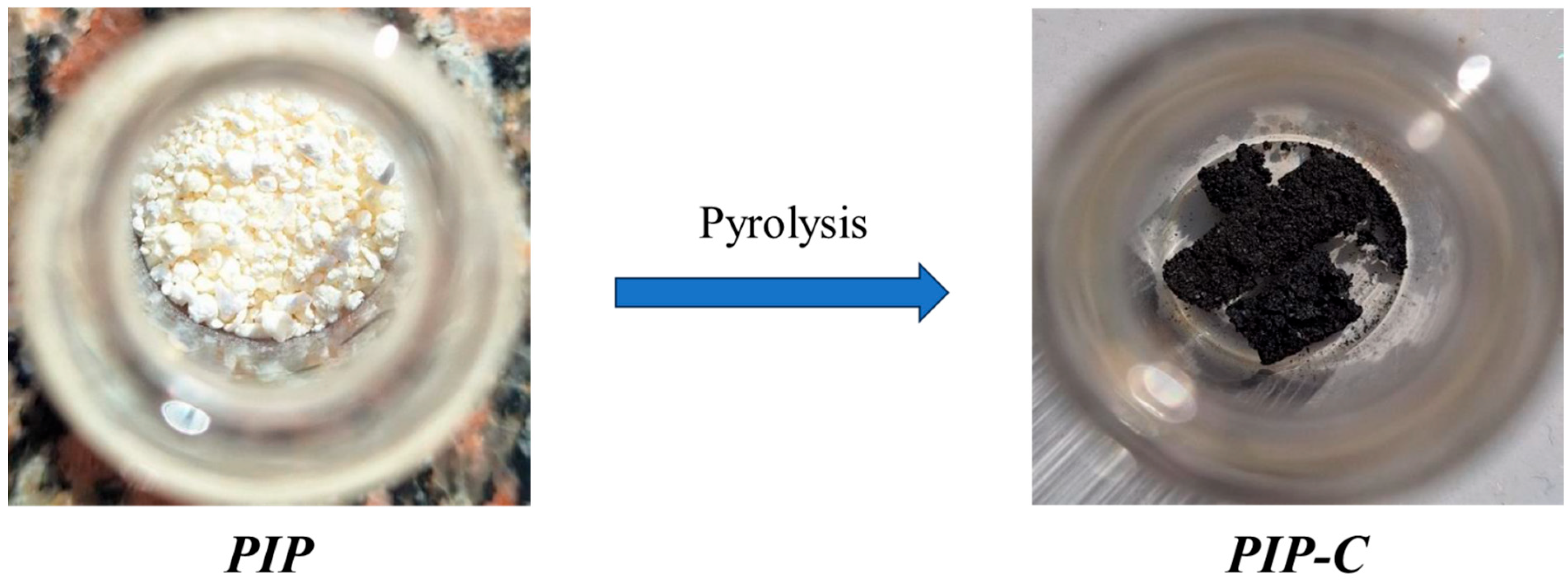
2.3. Preparation of Carbonization Product PIP-C
2.4. Electrode Preparation
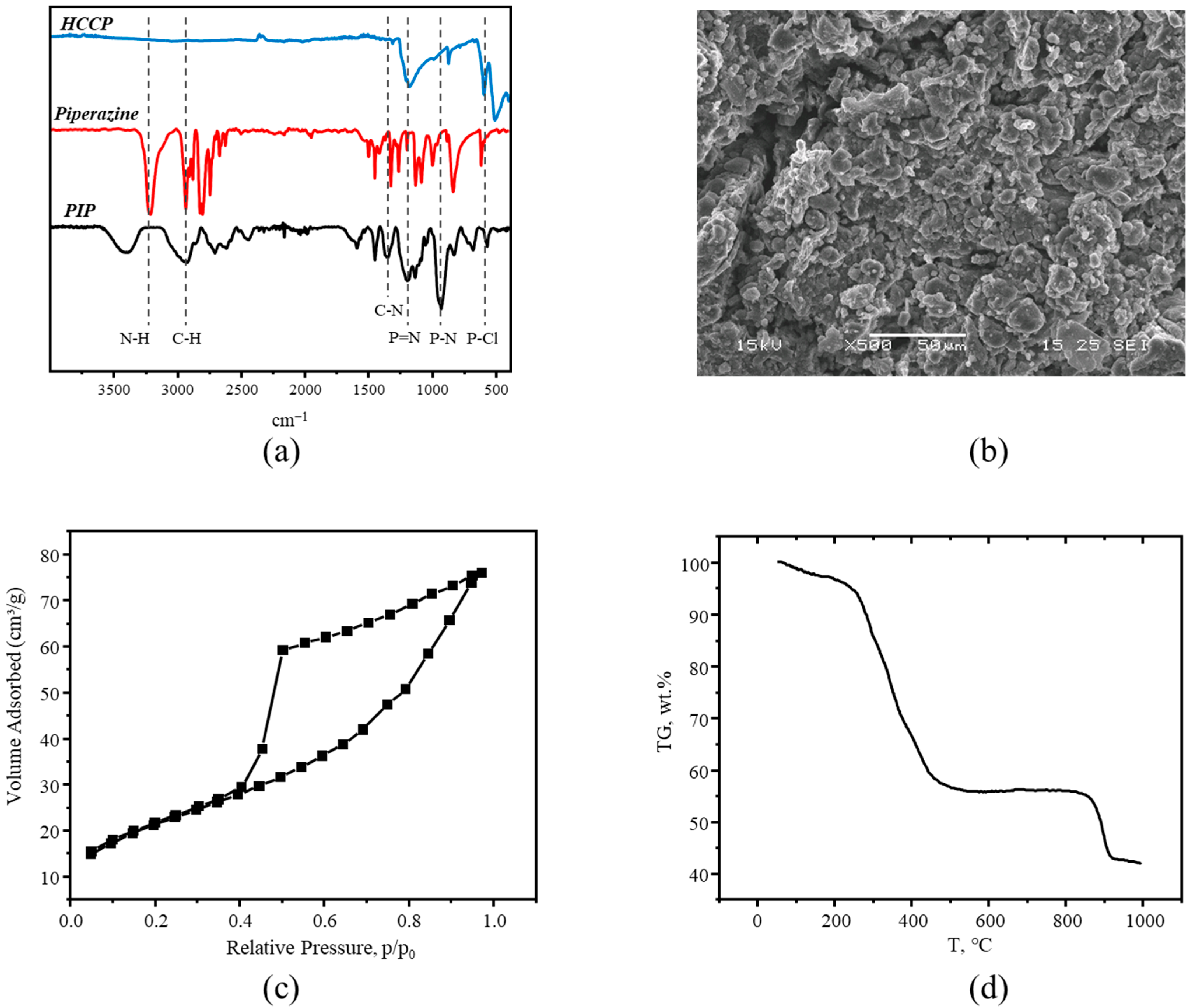
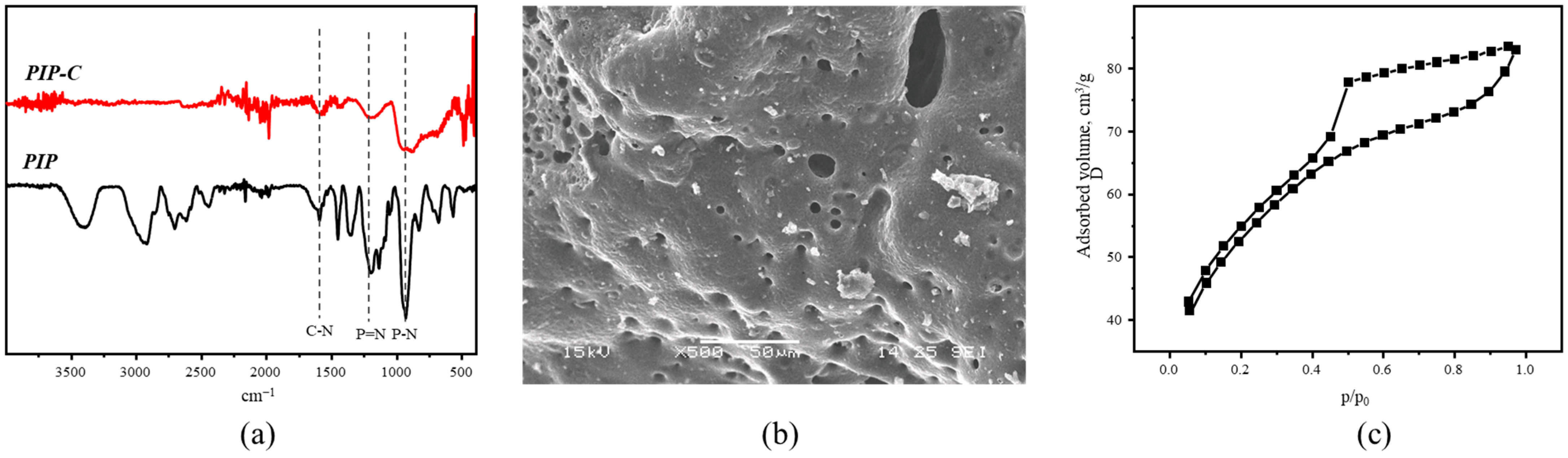
3. Results and Discussion
4. Conclusions
Supplementary Materials
Author Contributions
Funding
Institutional Review Board Statement
Data Availability Statement
Conflicts of Interest
References
- Yang, F.; Zhang, S.; Yang, Y.; Liu, W.; Qiu, M.; Abbas, Y.; Wu, Z.; Wu, D. Heteroatoms Doped Carbons Derived from Crosslinked Polyphosphazenes for Supercapacitor Electrodes. Electrochim. Acta 2019, 328, 135064. [Google Scholar] [CrossRef]
- Song, P.; Shen, X.; He, X.; Feng, K.; Kong, L.; Ji, Z.; Zhai, L.; Zhu, G.; Zhang, D. Cellulose-Derived Nitrogen-Doped Hierarchically Porous Carbon for High-Performance Supercapacitors. Cellulose 2019, 26, 1195–1208. [Google Scholar] [CrossRef]
- Rawal, S.; Kumar, Y.; Mandal, U.K.; Kumar, A.; Tanwar, R.; Joshi, B. Synthesis and Electrochemical Study of Phosphorus-Doped Porous Carbon for Supercapacitor Applications. SN Appl. Sci. 2021, 3, 141. [Google Scholar] [CrossRef]
- Sing, K.S.W. Reporting Physisorption Data for Gas/Solid Systems with Special Reference to the Determination of Surface Area and Porosity (Provisional). Pure Appl. Chem. 1982, 54, 2201–2218. [Google Scholar] [CrossRef]
- Je, S.H.; Kim, H.J.; Kim, J.; Choi, J.W.; Coskun, A. Perfluoroaryl-Elemental Sulfur SNAr Chemistry in Covalent Triazine Frameworks with High Sulfur Contents for Lithium–Sulfur Batteries. Adv. Funct. Mater. 2017, 27, 1703947. [Google Scholar] [CrossRef]
- Ghazi, Z.A.; Zhu, L.; Wang, H.; Naeem, A.; Khattak, A.M.; Liang, B.; Khan, N.A.; Wei, Z.; Li, L.; Tang, Z. Efficient Polysulfide Chemisorption in Covalent Organic Frameworks for High-Performance Lithium-Sulfur Batteries. Adv. Energy Mater. 2016, 6, 1601250. [Google Scholar] [CrossRef]
- Song, Z.; Liang, Y.; Fan, M.; Zhou, F.; Liu, W. Lithium-Based Ionic Liquids Functionalized by Sym-Triazine and Cyclotriphosphazene as High Temperature Lubricants. Tribol. Int. 2014, 70, 136–141. [Google Scholar] [CrossRef]
- Xue, R.; Zheng, Y.-P.; Qian, D.-Q.; Xu, D.-Y.; Liu, Y.-S.; Huang, S.-L.; Yang, G.-Y. A 2-D Microporous Covalent Organic Framework for High-Performance Supercapacitor Electrode. Mater. Lett. 2022, 308, 131229. [Google Scholar] [CrossRef]
- Allcock, H.R.; Kwon, S. An Ionically Crosslinkable Polyphosphazene: Poly[Bis(Carboxylatophenoxy)Phosphazene] and Its Hydrogels and Membranes. Macromolecules 1989, 22, 75–79. [Google Scholar] [CrossRef]
- Fei, S.-T.; Allcock, H.R. Recent Progress with Ethyleneoxy Phosphazenes as Lithium Battery Electrolytes. MRS Online Proc. Libr. 2009, 1127, 105. [Google Scholar] [CrossRef]
- Li, Y.; Chen, J.; Cai, P.; Wen, Z. An Electrochemically Neutralized Energy-Assisted Low-Cost Acid-Alkaline Electrolyzer for Energy-Saving Electrolysis Hydrogen Generation. J. Mater. Chem. A 2018, 6, 4948–4954. [Google Scholar] [CrossRef]
- Allen, C.W. The Use of Phosphazenes as Fire Resistant Materials. J. Fire Sci. 1993, 11, 320–328. [Google Scholar] [CrossRef]
- Dutkiewicz, M.; Przybylak, M.; Januszewski, R.; Maciejewski, H. Synthesis and Flame Retardant Efficacy of Hexakis(3-(Triethoxysilyl)Propyloxy)Cyclotriphosphazene/Silica Coatings for Cotton Fabrics. Polym. Degrad. Stab. 2018, 148, 10–18. [Google Scholar] [CrossRef]
- Chandrasekhar, V.; Thilagar, P.; Murugesa Pandian, B. Cyclophosphazene-Based Multi-Site Coordination Ligands. Coord. Chem. Rev. 2007, 251, 1045–1074. [Google Scholar] [CrossRef]
- Allcock, H.R.; McIntosh, M.B.; Klingenberg, E.H.; Napierala, M.E. Functionalized Polyphosphazenes: Polymers with Pendent Tertiary Trialkylamino Groups. Macromolecules 1998, 31, 5255–5263. [Google Scholar] [CrossRef]
- ALOthman, Z.A. A Review: Fundamental Aspects of Silicate Mesoporous Materials. Materials 2012, 5, 2874–2902. [Google Scholar] [CrossRef]
- Krogman, N.R.; Hindenlang, M.D.; Nair, L.S.; Laurencin, C.T.; Allcock, H.R. Synthesis of Purine- and Pyrimidine-Containing Polyphosphazenes: Physical Properties and Hydrolytic Behavior. Macromolecules 2008, 41, 8467–8472. [Google Scholar] [CrossRef]
- Wu, Z.; Li, L.; Yan, J.; Zhang, X. Materials Design and System Construction for Conventional and New-Concept Supercapacitors. Adv. Sci. 2017, 4, 1600382. [Google Scholar] [CrossRef]
- Zhu, H.; Yin, J.; Wang, X.; Wang, H.; Yang, X. Microorganism-Derived Heteroatom-Doped Carbon Materials for Oxygen Reduction and Supercapacitors. Adv. Funct. Mater. 2013, 23, 1305–1312. [Google Scholar] [CrossRef]
- Hu, L.; Hou, J.; Ma, Y.; Li, H.; Zhai, T. Multi-Heteroatom Self-Doped Porous Carbon Derived from Swim Bladders for Large Capacitance Supercapacitors. J. Mater. Chem. A 2016, 4, 15006–15014. [Google Scholar] [CrossRef]
- He, Y.; Han, X.; Du, Y.; Song, B.; Xu, P.; Zhang, B. Bifunctional Nitrogen-Doped Microporous Carbon Microspheres Derived from Poly(o-Methylaniline) for Oxygen Reduction and Supercapacitors. ACS Appl. Mater. Interfaces 2016, 8, 3601–3608. [Google Scholar] [CrossRef]
- Zhou, M.; Pu, F.; Wang, Z.; Guan, S. Nitrogen-Doped Porous Carbons through KOH Activation with Superior Performance in Supercapacitors. Carbon 2014, 68, 185–194. [Google Scholar] [CrossRef]
- Liu, Z.-W.; Peng, F.; Wang, H.-J.; Yu, H.; Zheng, W.-X.; Yang, J. Phosphorus-Doped Graphite Layers with High Electrocatalytic Activity for the O2 Reduction in an Alkaline Medium. Angew. Chem. Int. Ed. 2011, 50, 3257–3261. [Google Scholar] [CrossRef]
- Wu, J.; Yang, Z.; Li, X.; Sun, Q.; Jin, C.; Strasser, P.; Yang, R. Phosphorus-Doped Porous Carbons as Efficient Electrocatalysts for Oxygen Reduction. J. Mater. Chem. A 2013, 1, 9889–9896. [Google Scholar] [CrossRef]
- Ali, Z.; Khan, A.M.; Mushtaq, M.A.; Wei, L.; Yu, W.W.; Wu, Z. Polyphosphazene Frameworks for Sustainable Applications in Adsorption, Flame Retardancy and Electrochemistry. Nano-Struct. Nano-Objects 2025, 43, 101518. [Google Scholar] [CrossRef]
- Yuan, D.; Zhou, T.; Zhou, S.; Zou, W.; Mo, S.; Xia, N. Nitrogen-Enriched Carbon Nanowires from the Direct Carbonization of Polyaniline Nanowires and Its Electrochemical Properties. Electrochem. Commun. 2011, 13, 242–246. [Google Scholar] [CrossRef]
- Su, F.; Poh, C.K.; Chen, J.S.; Xu, G.; Wang, D.; Li, Q.; Lin, J.; Lou, X.W. Nitrogen-Containing Microporous Carbon Nanospheres with Improved Capacitive Properties. Energy Environ. Sci. 2011, 4, 717–724. [Google Scholar] [CrossRef]
- Zhao, L.; Fan, L.-Z.; Zhou, M.-Q.; Guan, H.; Qiao, S.; Antonietti, M.; Titirici, M.-M. Nitrogen-Containing Hydrothermal Carbons with Superior Performance in Supercapacitors. Adv. Mater. 2010, 22, 5202–5206. [Google Scholar] [CrossRef]
- Qu, K.; Zheng, Y.; Jiao, Y.; Zhang, X.; Dai, S.; Qiao, S.-Z. Polydopamine-Inspired, Dual Heteroatom-Doped Carbon Nanotubes for Highly Efficient Overall Water Splitting. Adv. Energy Mater. 2017, 7, 1602068. [Google Scholar] [CrossRef]
- Li, L.; Yang, Z.; Gao, H.; Zhang, H.; Ren, J.; Sun, X.; Chen, T.; Kia, H.G.; Peng, H. Vertically Aligned and Penetrated Carbon Nanotube/Polymer Composite Film and Promising Electronic Applications. Adv. Mater. 2011, 23, 3730–3735. [Google Scholar] [CrossRef]
- Mastragostino, M.; Arbizzani, C.; Meneghello, L.; Paraventi, R. Electronically Conducting Polymers and Activated Carbon: Electrode Materials in Supercapacitor Technology. Adv. Mater. 1996, 8, 331–334. [Google Scholar] [CrossRef]
- Allcock, H.R. Recent Developments in Polyphosphazene Materials Science. Curr. Opin. Solid State Mater. Sci. 2006, 10, 231–240. [Google Scholar] [CrossRef]
- Li, X.; Lv, Z.; Wu, M.; Li, X.; Li, Z. N, P Co-Doped Porous Carbon from Cross-Linking Cyclophosphazene for High-Performance Supercapacitors. J. Electroanal. Chem. 2021, 881, 114952. [Google Scholar] [CrossRef]
- Liu, W.; Zhang, S.; Dar, S.U.; Zhao, Y.; Akram, R.; Zhang, X.; Jin, S.; Wu, Z.; Wu, D. Polyphosphazene-Derived Heteroatoms-Doped Carbon Materials for Supercapacitor Electrodes. Carbon 2018, 129, 420–427. [Google Scholar] [CrossRef]
- Bagotsky, V.S.; Skundin, A.M.; Volfkovich, Y.M. Electrochemical Power Sources: Batteries, Fuel Cells, and Supercapacitors; The Electrochemical Society Series; Wiley: Hoboken, NJ, USA, 2015. [Google Scholar]
- Karpova, E.A.; Sysoev, A.A.; Rozhkov, I.M.; Soldatov, M.A. Preparation of Three-Dimensional Porous Amino-Substituted Cyclophosphazenes. INEOS OPEN 2025, 8, 164–165. [Google Scholar] [CrossRef]
- Hakimi, M.; Rezaei, H.; Moeini, K.; Mardani, Z.; Carpenter-Warren, C. Solvent Free Synthesis of Three Cyclotriphosphazene Derivatives Containing Piperazine Substituents Using Microwave Irradiation. Spectral, Theoretical, Solution and Docking Studies. Phosphorus Sulfur Silicon Relat. Elem. 2020, 195, 13–21. [Google Scholar] [CrossRef]
- Mehmood, S.; Wang, L.; Yu, H.; Haq, F.; Amin, B.; Uddin, M.A.; Fahad, S.; Haroon, M.; Shen, D.; Ni, Z. Preparation of Poly(Cyclotriphosphazene-Co-Piperazine) Nanospheres and Their Drug Release Behavior. Int. J. Polym. Mater. Polym. Biomater. 2022, 71, 139–147. [Google Scholar] [CrossRef]
- Yang, R.; Ma, B.; Zhang, X.; Li, J. Fire Retardance and Smoke Suppression of Polypropylene with a Macromolecular Intumescent Flame Retardant Containing Caged Bicyclic Phosphate and Piperazine. J. Appl. Polym. Sci. 2019, 136, 47593. [Google Scholar] [CrossRef]
- Wu, F.; Zhao, Y.; Hou, Z.; Jiang, M.; He, W.; Su, D.; Wang, M.; Wang, J.-G. Lignocellulosic Oxidation Bridging to Modulate Pseudographitic Domain of Hard Carbon toward Boosted Sodium Storage. J. Energy Storage 2025, 130, 117496. [Google Scholar] [CrossRef]
- Barsukov, I.V.; Johnson, C.S.; Doninger, J.E.; Barsukov, V.Z. New Carbon Based Materials for Electrochemical Energy Storage Systems: Batteries, Supercapacitors and Fuel Cells; Barsukov, I.V., Johnson, C.S., Doninger, J.E., Barsukov, V.Z., Eds.; NATO Science Series II: Mathematics, Physics and Chemistry; Springer: Dordrecht, The Netherlands, 2006; Volume 229. [Google Scholar]
- Hussain, C.M.; Ahamed, M.B. Functionalized Nanomaterials Based Supercapacitor: Design, Performance and Industrial Applications; Hussain, C.M., Ahamed, M.B., Eds.; Materials Horizons: From Nature to Nanomaterials; Springer Nature: Singapore, 2024. [Google Scholar]
- Shirley, D.A. High-resolution X-ray photoemission spectrum of the valence bands of gold. Phys. Rev. B 1972, 5, 4709–4713. [Google Scholar] [CrossRef]
- Scotfield, H. Hartree-Slater subshell photoionization cross-sections at 1254 and 1487 eV. J. Electr. Spectr. Relat. Phenom. 1976, 8, 129–137. [Google Scholar] [CrossRef]



| Temperature Interval, °C | Heating Rate, °C/min |
|---|---|
| from RT to 140 | rapid heating |
| from 140 to 520 | 1.0 |
| from 520 to 800 | 2.5 |
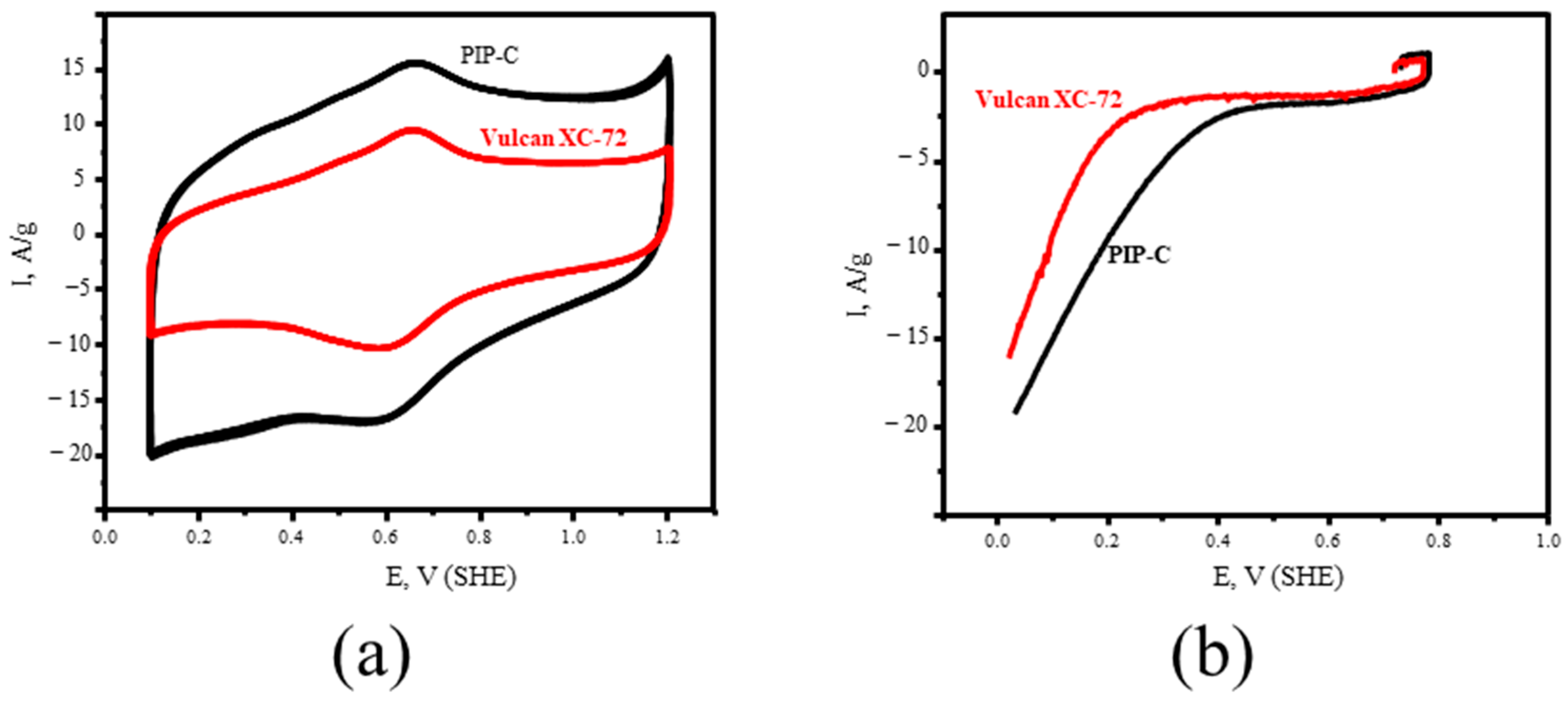
| Carbon Material | SBET, m2/g | Specific Capacitance, F/g | Catalytical Activity, A/g |
|---|---|---|---|
| PIP-C | 177 | 155.6 | 15.9 |
| Vulcan VX-72 | 230 * | 58.7 | 12.7 |
Disclaimer/Publisher’s Note: The statements, opinions and data contained in all publications are solely those of the individual author(s) and contributor(s) and not of MDPI and/or the editor(s). MDPI and/or the editor(s) disclaim responsibility for any injury to people or property resulting from any ideas, methods, instructions or products referred to in the content. |
© 2026 by the authors. Licensee MDPI, Basel, Switzerland. This article is an open access article distributed under the terms and conditions of the Creative Commons Attribution (CC BY) license.
Share and Cite
Karpova, E.A.; Sysoev, A.A.; Tsvetkov, I.D.; Klyuev, A.L.; Raitman, O.A.; Soldatov, M.A. Phosphazene-Based Porous Polymer as Electrode Material for Electrochemical Applications. Polymers 2026, 18, 366. https://doi.org/10.3390/polym18030366
Karpova EA, Sysoev AA, Tsvetkov ID, Klyuev AL, Raitman OA, Soldatov MA. Phosphazene-Based Porous Polymer as Electrode Material for Electrochemical Applications. Polymers. 2026; 18(3):366. https://doi.org/10.3390/polym18030366
Chicago/Turabian StyleKarpova, Ekaterina A., Alexander A. Sysoev, Ilya D. Tsvetkov, Alexey L. Klyuev, Oleg A. Raitman, and Mikhail A. Soldatov. 2026. "Phosphazene-Based Porous Polymer as Electrode Material for Electrochemical Applications" Polymers 18, no. 3: 366. https://doi.org/10.3390/polym18030366
APA StyleKarpova, E. A., Sysoev, A. A., Tsvetkov, I. D., Klyuev, A. L., Raitman, O. A., & Soldatov, M. A. (2026). Phosphazene-Based Porous Polymer as Electrode Material for Electrochemical Applications. Polymers, 18(3), 366. https://doi.org/10.3390/polym18030366