
This is an early access version, the complete PDF, HTML, and XML versions will be available soon.
Article

Effect of Silica- and Cellulose-Based Nanofillers in Poly(butylene succinate-co-butylene adipate)-Based Composites

by
Camilla Ferretti
1,
Miriam Cappello
1,
Patrizia Cinelli
1,*,
Damiano Rossi
1,
Nicolas Sbirrazzuoli
2,
Giovanna Molinari
3,
Maria Cristina Righetti
3 and
Maurizia Seggiani
1
1
Department of Civil and Industrial Engineering, University of Pisa, Largo Lazzarino 1, 56122 Pisa, Italy
2
Institute of Chemistry of Nice, UMR CNRS 7272, University Côte d’Azur, 06100 Nice, France
3
Institute for Chemical and Physical Processes (IPCF), National Research Council (CNR), Via Moruzzi 1, 56124 Pisa, Italy
*
Author to whom correspondence should be addressed.
Polymers 2026, 18(2), 189; https://doi.org/10.3390/polym18020189
Submission received: 30 November 2025 / Revised: 28 December 2025 / Accepted: 2 January 2026 / Published: 9 January 2026

Abstract

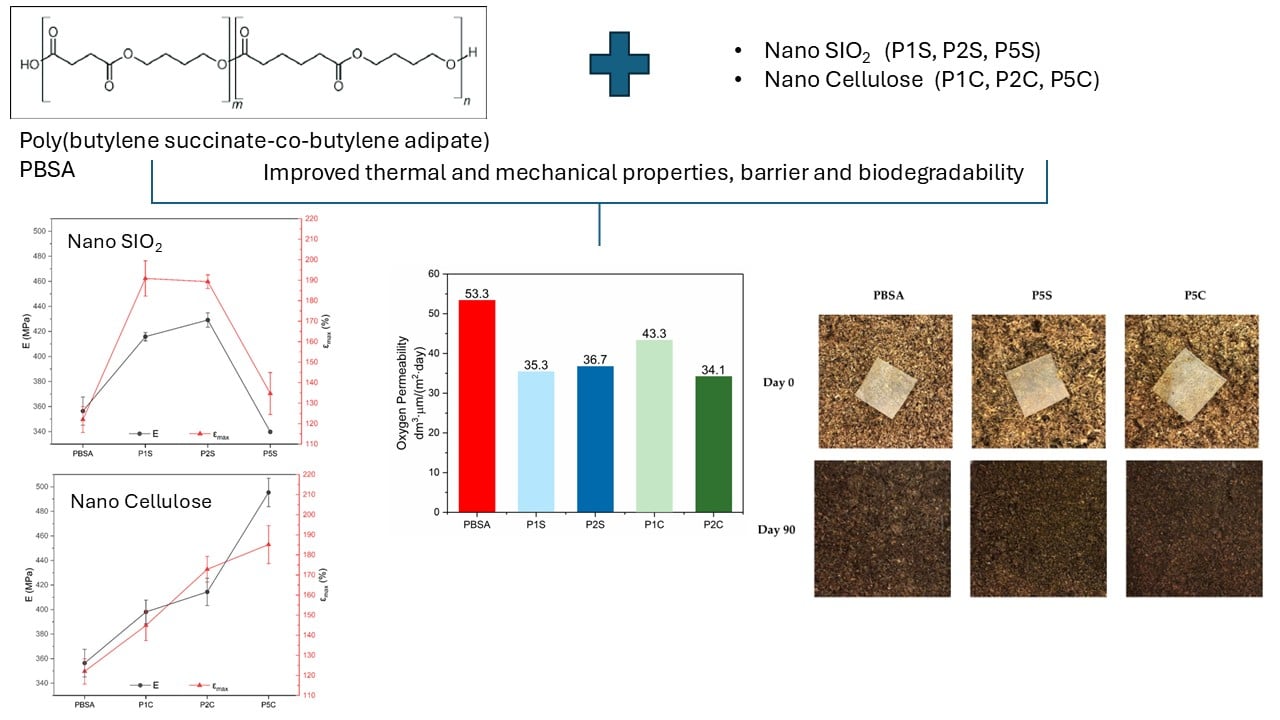
In an effort to reduce global dependence on fossil-based polymers and advance toward a more sustainable materials industry, research over recent decades has increasingly focused on the development of bio-based polymers and broadening their potential applications. Within this context, the present study investigates nanocomposites based on poly(butylene succinate-co-butylene adipate) (PBSA), reinforced with two types of nanofillers: silicon dioxide nanoparticles (SiO2 NPs) and cellulose nanofibrils (CNFs). The main objective of this work is to examine how the morphology, geometry, and chemical nature of the nanofillers influence the thermal, mechanical, and barrier properties of PBSA, as well as its biodegradability. For each nanofiller, three formulations were prepared, containing 1, 2, and 5 wt% of filler, respectively. Scanning electron microscopy (SEM) analysis confirmed good dispersion and minimal aggregation in the SiO2-based systems, whereas marked aggregation was observed in the CNF-based samples. Thermal analysis indicated that the intrinsic thermal properties of neat PBSA were largely preserved. Mechanical testing revealed improvements in both the elastic modulus and elongation at break for most nanocomposite samples. In particular, CNFs provided the most consistent reinforcing effect, with enhancements of approximately 40% in the elastic modulus (495.4 vs. 356.4 GPa in neat PBSA) and 52% in elongation at the break (185.1 vs. 122.0% in neat PBSA) with 5 wt% loading. Additionally, the incorporation of nanofillers did not alter the surface hydrophilicity, but it did improve the oxygen barrier performance and enhanced disintegration under composting conditions. Overall, these findings demonstrate the promising potential of PBSA-based nanocomposites for sustainable rigid packaging applications.
Keywords: poly(butylene succinate-co-butylene adipate); cellulose; silica; nanocomposites; thermal; mechanical; barrier properties poly(butylene succinate-co-butylene adipate); cellulose; silica; nanocomposites; thermal; mechanical; barrier properties
Graphical Abstract