Mild Two-Step Thermochemical Recovery of Clean Glass Fibers from Wind-Blade GFRP


Abstract
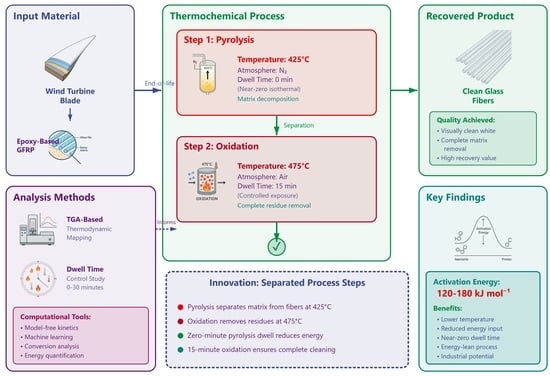
1. Introduction
- Thermal and mechanical stresses damage fibers. As a result, without exact control of variables including temperature limits, oxygen exposure, and residence times, post-processing treatment of the recycled glass fibers (rGFs), in addition to their length and the extent of surface irregularities, can reduce the original properties of the fibers. Additionally, deterioration of any original sized coatings applied to the glass fibers can negatively affect bonding between the recycled fibers and other components in the new composite material. Therefore, it is important to develop sizing techniques that are specific to the rGF surface [3].
- The core of the blade laminate includes foam, wood, and other adhesives/minerals, such as calcium carbonate (CaCO3). Additionally, the presence of various volatiles during processing creates additional difficulties in managing the removal of these volatiles and inorganic fouling of the blades. It also creates additional complexity in recovering oil and gas, as well as maintaining the quality of the glass fibers, thus making process control and residue management even more complicated. Traditional fixed-bed studies have been successful in developing process conditions that do not decompose fillers; however, today’s multiple-component blade laminates require that this selectivity be extended to the entire laminated assembly [1].
- Pyrolysis oil is a potential fuel source; however, the greater value in the chemical stream (e.g., styrene streams, aromatic building blocks) will increase the overall economic viability through additional process steps (upgrading, separation, and speciation). A gas-based energy recovery system should be included to reduce utility requirements. Examples of utilizing resin-derived streams in an open loop (e.g., superplasticizer production from an epoxy degradative solution) demonstrate how new value chains can be developed on a larger scale [1,6].
- The reviews of individual blades are based on the fact that the grade of fibers after recycling determines their suitability for secondary uses. It is necessary to develop standards for grading and fractioning recycled glass fibers (rGFs), establish standardized re-sizing processes, and create rules that relate the properties of rGFs to specific product types (e.g., reinforcing concrete, thermoplastics compounding) to facilitate continued market expansion.
2. Materials and Methods
2.1. Sample Collection
2.2. Thermodynamic Analysis
2.3. Experimental Setup
2.4. Kinetic Analysis
2.4.1. Model-Free Kinetic Analysis
2.4.2. Model-Fitting Kinetic Analysis
2.5. Machine Learning
3. Results
3.1. TGA
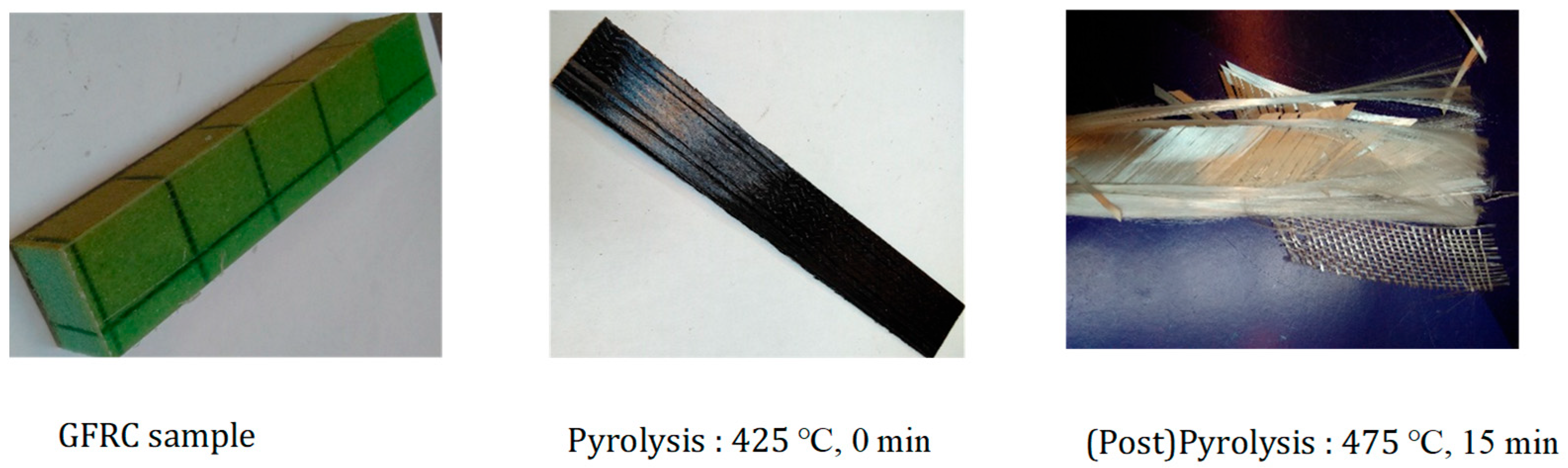
3.2. Pyrolysis and Post-Pyrolysis
3.3. Mechanical Characteristics of Recovered Glass Fibers
3.4. Thermokinetics
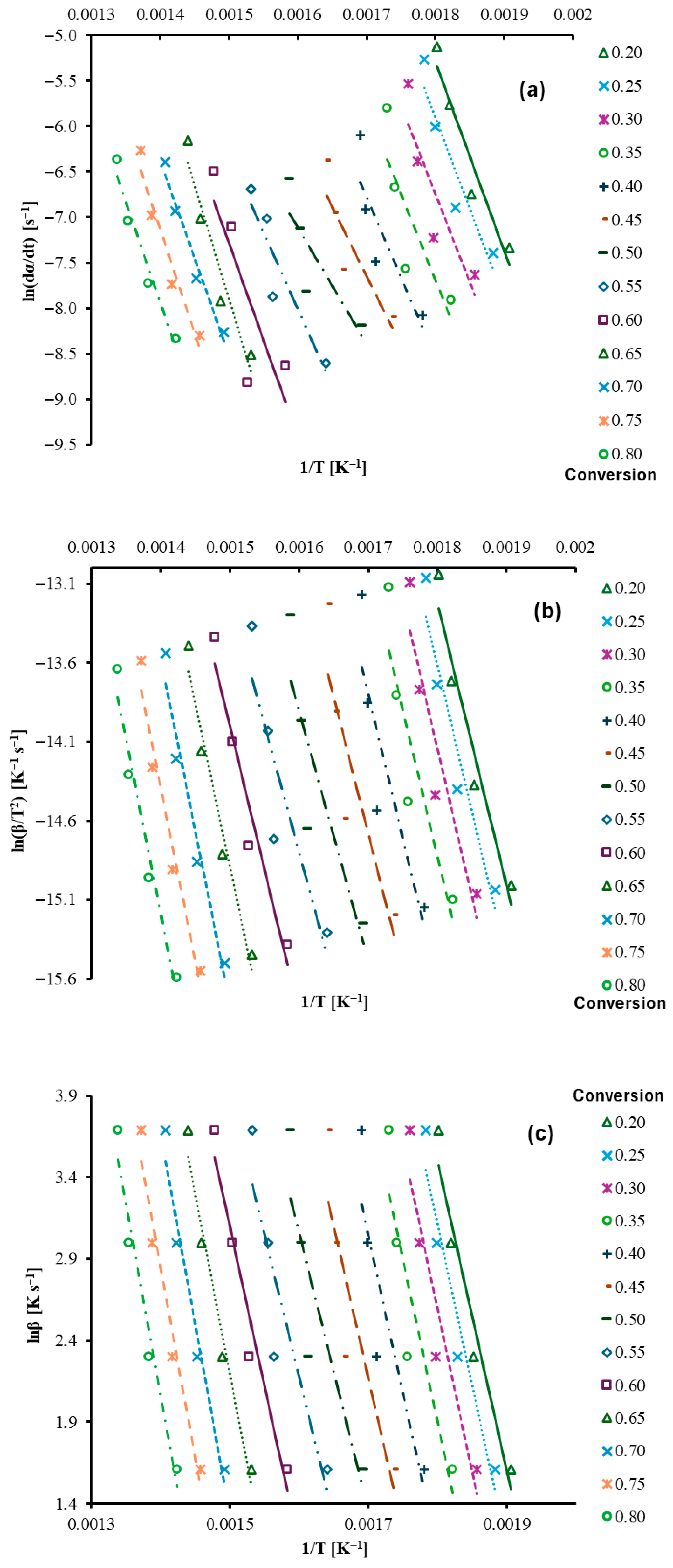
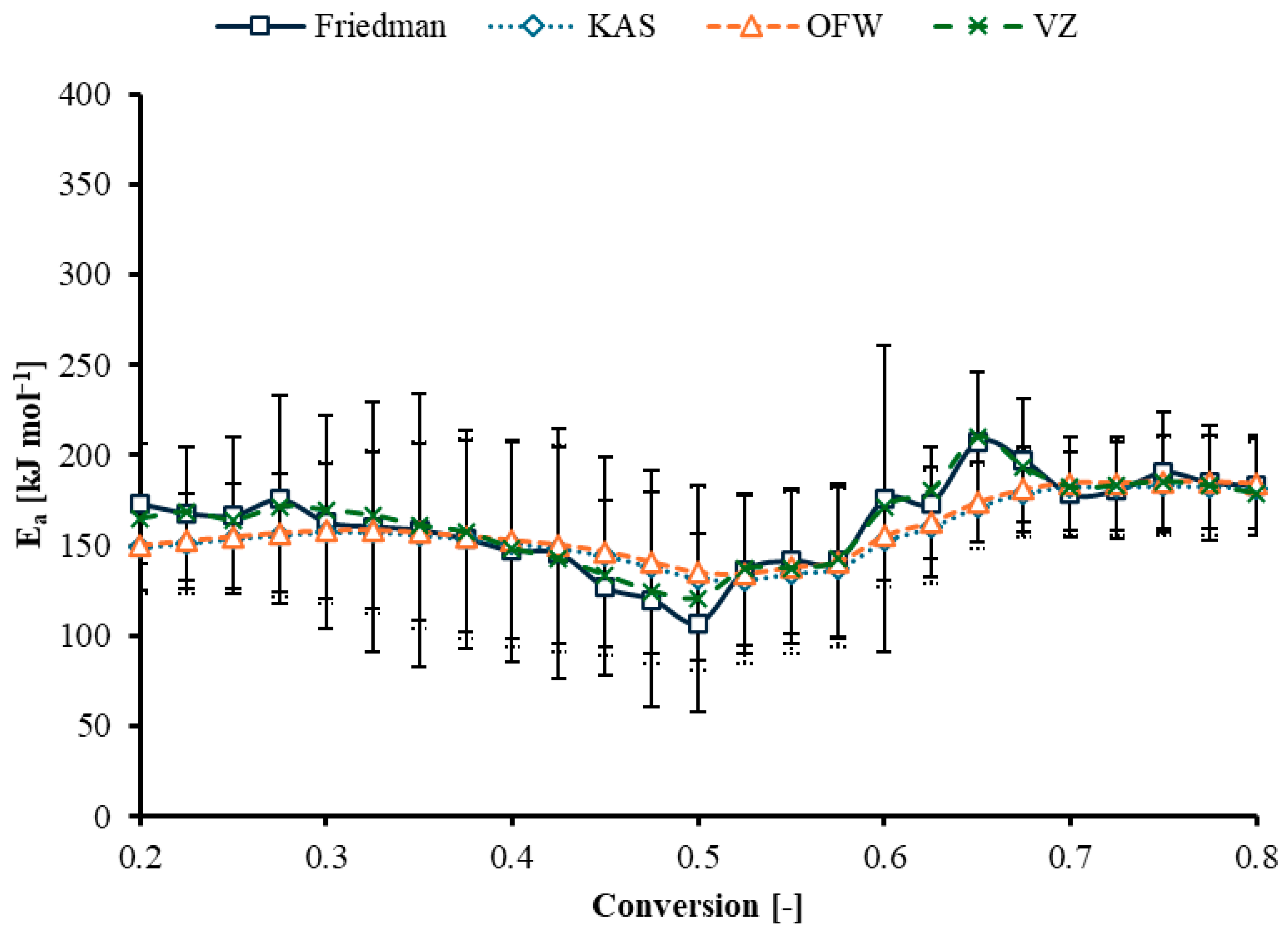
3.4.1. Model-Free Kinetics
3.4.2. Combined Kinetics
3.5. Machine Learning Prediction
4. Conclusions
Author Contributions
Funding
Data Availability Statement
Acknowledgments
Conflicts of Interest
References
- De, B.; Bera, M.; Bhattacharjee, D.; Ray, B.C.; Mukherjee, S. A comprehensive review on fiber-reinforced polymer composites: Raw materials to applications, recycling, and waste management. Prog. Mater. Sci. 2024, 146, 101326. [Google Scholar] [CrossRef] [Scilit]
- Xu, M.-X.; Ji, H.-W.; Wu, Y.-C.; Meng, X.-X.; Di, J.-Y.; Yang, J.; Lu, Q. Recovering glass fibers from waste wind turbine blades: Recycling methods, fiber properties, and potential utilization. Renew. Sustain. Energy Rev. 2024, 202, 114690. [Google Scholar] [CrossRef] [Scilit]
- Naqvi, S.R.; Prabhakara, H.M.; Bramer, E.A.; Dierkes, W.; Akkerman, R.; Brem, G. A critical review on recycling of end-of-life carbon fibre/glass fibre reinforced composites waste using pyrolysis towards a circular economy. Resour. Conserv. Recycl. 2018, 136, 118–129. [Google Scholar] [CrossRef] [Scilit]
- Cunliffe, A.M.; Williams, P.T. Characterisation of products from the recycling of glass fibre reinforced polyester waste by pyrolysis. Fuel 2003, 82, 2223–2230. [Google Scholar] [CrossRef] [Scilit]
- Tao, R.; Wu, Y.; Geng, J.; Zhan, Y.; Zhao, L.; Li, B.; Yuan, H.; Gu, J.; Chen, Y. Thermochemical recycling of waste glass fiber-reinforced polymers: Experiments and quantum chemical calculations. J. Anal. Appl. Pyrolysis 2025, 192, 107277. [Google Scholar] [CrossRef] [Scilit]
- Zhao, J.; Liu, P.; Yue, J.; Huan, H.; Bi, G.; Zhang, L. Recycling glass fibers from thermoset epoxy composites via in-situ oxonium-type polyionic liquid formation and superplasticizer synthesis. Compos. Part B 2023, 254, 110435. [Google Scholar] [CrossRef] [Scilit]
- Yousef, S.; Eimontas, J.; Striūgas, N.; Praspaliauskas, M.; Abdelnaby, M.A. Pyrolysis kinetic behaviour of glass fibre-reinforced epoxy resin composites using linear and nonlinear isoconversional methods. Polymers 2021, 13, 1543. [Google Scholar] [CrossRef] [Scilit]
- Serras-Malillos, A.; Perez-Martinez, B.B.; Lopez-Urionabarrenechea, A.; Acha, E.; Caballero, B.M. Integral recycling of polyester based end-of-life fibre reinforced plastic waste towards syngas generation. Sustain. Mater. Technol. 2023, 38, e00773. [Google Scholar] [CrossRef] [Scilit]
- Rafay, A.; Irfan, M.; Naqvi, S.R.; Umer, M.A.; Rehman, M.A.; Saleem, M.; Butt, M.S.; Khan, A.U. Recovery and restoration of glass fibers from end-of-life composite waste through pyrolysis and partial oxidation processes combined with hot alkaline surface treatments. Polym. Compos. 2024, 45, 16616–16629. [Google Scholar] [CrossRef] [Scilit]
- Caballero, B.M.; Lopez-Urionabarrenechea, A.; Gonzalez-Arcos, J.P.; Perez-Martinez, B.B.; Acha, E.; Iturrondobeitia, M.; Ibarretxe, J.; Esnaola, A.; Baskaran, M. Recycling Fiber-Reinforced Polyamide Waste from the Automotive Industry: Life Cycle Assessment (LCA) of an Advanced Pyrolysis Process to Reclaim Glass Fibers and Valuable Chemicals. Materials 2025, 18, 1594. [Google Scholar] [CrossRef] [Scilit]
- Karuppannan Gopalraj, S.; Kärki, T. A review on the recycling of waste carbon fibre/glass fibre-reinforced composites: Fibre recovery, properties and life-cycle analysis. SN Appl. Sci. 2020, 2, 433. [Google Scholar] [CrossRef] [Scilit]
- Miyazawa, M.; Wajima, T. Recycling of waste glass fiber-reinforced plastics using pyrolysis with KOH. J. Phys. Conf. Ser. 2021, 1777, 012018. [Google Scholar] [CrossRef] [Scilit]
- Yousef, S.; Kiminaitė, I.; Eimontas, J.; Striūgas, N.; Abdelnaby, M.A. Recovery of phenol and acetic acid from glass fibre reinforced thermoplastic resin using catalytic pyrolysis process on ZSM-5 zeolite catalyst and its kinetic behaviour. Thermochim. Acta 2022, 715, 179293. [Google Scholar] [CrossRef] [Scilit]
- Takaaki, W.; Miyagawa, M. Recycling of Waste Glass Fiber Reinforced Plastics (GFRP) via Pyrolysis with Sodium Hydroxide using Microwave Heating. Key Eng. Mater. 2022, 920, 68–73. [Google Scholar] [CrossRef] [Scilit]
- Naqvi, S.R.; Ali, I.; Farooq, W. Recovery of Glass Fibers from End-of-Life Wind Turbine Fiber Composite Wastes Through Pyrolysis Process. In Proceedings of the 9th Jordan International Chemical Engineering Conference (JICHEC9), Amman, Jordan, 12–14 October 2021. [Google Scholar]
- Khan, A.; Saeed, S.; Pervaiz, E.; Khoja, A.H.; Naqvi, S.R.; Saeed, S.; Ali, I. Comprehensive investigation of almond shells pyrolysis using advance predictive models. Renew. Energy 2024, 227, 120568. [Google Scholar] [CrossRef] [Scilit]
- Ali, I.; Naqvi, S.R.; Bahadar, A. Kinetic analysis of Botryococcus braunii pyrolysis using model-free and model fitting methods. Fuel 2018, 214, 369–380. [Google Scholar] [CrossRef] [Scilit]
- Naqvi, S.R.; Taqvi, S.A.A.; Khoja, A.H.; Ali, I.; Mehran, M.T.; Farooq, W.; Tippayawong, N.; Juchelková, D.; Atabani, A.E. Valorization of wet oily petrochemical sludge via slow pyrolysis: Thermo-kinetics assessment and artificial neural network modeling. Front. Energy Res. 2022, 9, 782139. [Google Scholar] [CrossRef] [Scilit]
- Yousef, S.; Eimontas, J.; Striūgas, N.; Subadra, S.P.; Abdelnaby, M.A. Thermal degradation and pyrolysis kinetic behaviour of glass fibre-reinforced thermoplastic resin by TG-FTIR, Py-GC/MS, linear and nonlinear isoconversional models. J. Mater. Res. Technol. 2021, 15, 5360–5374. [Google Scholar] [CrossRef] [Scilit]
- Qiao, Y.; Das, O.; Zhao, S.N.; Sun, T.S.; Xu, Q.; Jiang, L. Pyrolysis kinetic study and reaction mechanism of epoxy glass fiber reinforced plastic by thermogravimetric analyzer (Tg) and tg–ftir (fourier-transform infrared) techniques. Polymers 2020, 12, 2739. [Google Scholar] [CrossRef] [Scilit]
- Yousef, S.; Eimontas, J.; Striūgas, N.; Abdelnaby, M.A. Recovery of styrene from waste wind turbine blades (fiberglass/polyester resin composites) using pyrolysis treatment and its kinetic behavior. J. Therm. Anal. Calorim. 2024, 149, 521–538. [Google Scholar] [CrossRef] [Scilit]
- Zhang, B.; Zhang, S.; Yang, Z.; Liu, W.; Wu, B.; Huang, M.; Liu, B. Pyrolysis process and products characteristics of glass fiber reinforced epoxy resin from waste wind turbine blades. Compos. Part B Eng. 2024, 287, 111803. [Google Scholar] [CrossRef] [Scilit]
- ASTM C1557–20; Standard Test Method for Tensile Strength and Young’s Modulus of Fibers. ASTM international: West Conshohocken, PA, USA, 2020.
- Giorgini, L.; Leonardi, C.; Mazzocchetti, L.; Zattini, G.; Cavazzoni, M.; Montanari, I.; Tosi, C.; Benelli, T. Pyrolysis of Fiberglass/Polyester Composites: Recovery and Characterization of Obtained Products. FME Trans. 2016, 44, 405–414. [Google Scholar] [CrossRef] [Scilit]
- Onwudili, J.A.; Miskolczi, N.; Nagy, T.; Lipóczi, G. Recovery of glass fibre and carbon fibres from reinforced thermosets by batch pyrolysis and investigation of fibre re-using as reinforcement in LDPE matrix. Compos. Part B Eng. 2016, 91, 154–161. [Google Scholar] [CrossRef] [Scilit]
- Ge, L.; Yang, Q.; Feng, H.; Li, X.; Zhang, W.; Liu, Y.; Liu, H.; Wang, Y.; Xu, C. Analysis of the pyrolysis processes, kinetics and products of end-of-life wind turbine blade base component blends (epoxy resin/glass fiber and thermoplastic polyurethane/carbon fiber). Sustain. Energy Technol. Assess. 2025, 83, 104619. [Google Scholar] [CrossRef] [Scilit]
- Wu, Y.; Ge, Z.; Huang, C.; Zha, Z.; Zeng, M.; Ma, Y.; Sun, L.; Hou, Z.; Chu, S.; Zhang, H. In-situ pyrolysis kinetic analysis and fixed-bed pyrolysis behavior of ex-service wind turbine blades. Waste Manag. 2023, 168, 54–62. [Google Scholar] [CrossRef] [Scilit]
- Shahroodi, Z.; Tayebi, A.; Far, A.M.; Zidar, D.; Straka, K.; Arbeiter, F.; Krempl, N.; Holzer, C. Data-Driven Prediction of Mechanical Properties in Recycled Fibre-Reinforced Polymer Composites: Integrating Machine Learning with Material–Processing Feature Importance Analysis. J. Mater. Res. Technol. 2026, 41, 687–698. [Google Scholar] [CrossRef] [Scilit]
- Chen, S.; Liu, J.; Lin, Z.; Lin, S.; Li, L.; Chen, Y.; Evrendilek, F.; Li, W.; Huang, W.; Yang, C.; et al. Atmosphere-dependent pyrolytic transformability of glass fiber/epoxy resin composites in waste wind turbine blades. Chem. Eng. J. 2025, 505, 159675. [Google Scholar] [CrossRef] [Scilit]




| Study (Year) | Feedstock/Context | Pyrolysis Process and Conditions | Key Findings | Challenges |
|---|---|---|---|---|
| Naqvi et al. (2018) [3] | CFRC/GFRC from automotive, wind, aerospace | Two-step pyrolysis, 300–700 °C, lab scale | Moderate energy use (30 MJ/kg), viable for fiber and fuel recovery, promising for the circular economy | Optimization and commercialization challenges, fiber quality, and energy use |
| Caballero et al. (2025) [10] | Glass fiber-reinforced polyamide (auto waste) | Two-step: 500 °C pyrolysis + 900 °C thermal cracking | Improved gas quality, reduced global warming impact, better LCA than conventional pyrolysis | Pre-existing fiber damage limits quality |
| Karuppannan Gopalraj & Kärki (2020) [11] | General review (CF/GF composites) | Mechanical, thermal (pyrolysis/fluidized-bed), chemical | Pyrolysis preserves fiber better than combustion, up to 20% fiber reuse | Environmental/ economic trade-offs, fiber property loss |
| Yousef et al. (2021) [7] | GFRC panels (epoxy) | TG-FTIR, 256–500 °C | Three-stage decomposition, major volatiles: phenol, benzene; activation energy 165–193 kJ/mol | Mechanical pre-treatment affects kinetics |
| Miyazawa & Wajima (2021) [12] | Waste GFRP | Pyrolysis with KOH, inert atmosphere | Promotes gasification, converts glass fiber to soluble silicate | High temp/cost, residue handling |
| Yousef et al. (2022) [13] | GFRP + nanofillers | Catalytic pyrolysis (ZSM-5), 5–30 °C/min | Lower activation energy, higher volatile yield | Filler effects, catalyst cost |
| Takaaki & Miyagawa (2022) [14] | Waste GFRP | Pyrolysis with NaOH, microwave heating | 75% energy reduction vs. conventional, efficient silica extraction | Microwave scale-up, residue handling |
| Serras-Malillos et al. (2023) [8] | EoL GF polyester | 900 °C, two-stage | Maximized syngas, minimized hazardous liquids | High temp, process scale |
| Rafay et al. (2024) [9] | EoL GFRP panels | Pyrolysis + partial oxidation + hot alkaline etching | 200% fiber strength increase vs. pyrolysis alone | Process complexity, short etching cycles |
| Platin | Post-Pyrolysis (Air) | ||
|---|---|---|---|
| Temperature (°C) | Time (min) | Temperature (°C) | Time (min) |
| Effect of temperature on pyrolysis | |||
| 350 | 30 | - | - |
| 400 | 30 | - | - |
| 425 | 30 | - | - |
| 450 | 30 | - | - |
| Effect of residence time on pyrolysis | |||
| 425 | 0 | - | - |
| 425 | 15 | - | - |
| 425 | 30 | - | - |
| Effect of temperature on post-pyrolysis | |||
| 425 | 30 | 400 | 30 |
| 425 | 30 | 450 | 30 |
| 425 | 30 | 475 | 30 |
| 425 | 30 | 500 | 30 |
| Effect of residence time on post-pyrolysis | |||
| 425 | 0 | 475 | 0 |
| 425 | 0 | 475 | 15 |
| 425 | 0 | 475 | 30 |
| Reference | Reactor Type | Tensile Strength (GPa) | Young’s Modulus (GPa) |
|---|---|---|---|
| Giorgini, Leonardi et al. (2016) [24] | Fixed-bed reactor (pyrolysis) | 1.02 (−50%) | 53 (−25%) |
| Onwudili, Miskolczi et al. (2016) [25] | Steel semi-batch reactor (pyrolysis) | 1.10 (−45%) | 60 (−15%) |
| This study | Batch-type pyrolyzer (two-step mild thermochemical) | 1.52 (−24%) | 62 (−12%) |
| Model | AME | MSE | RMSE | R2 | Valid N |
|---|---|---|---|---|---|
| ANN | 5.647 | 49.780 | 7.055 | 0.903 | 363 |
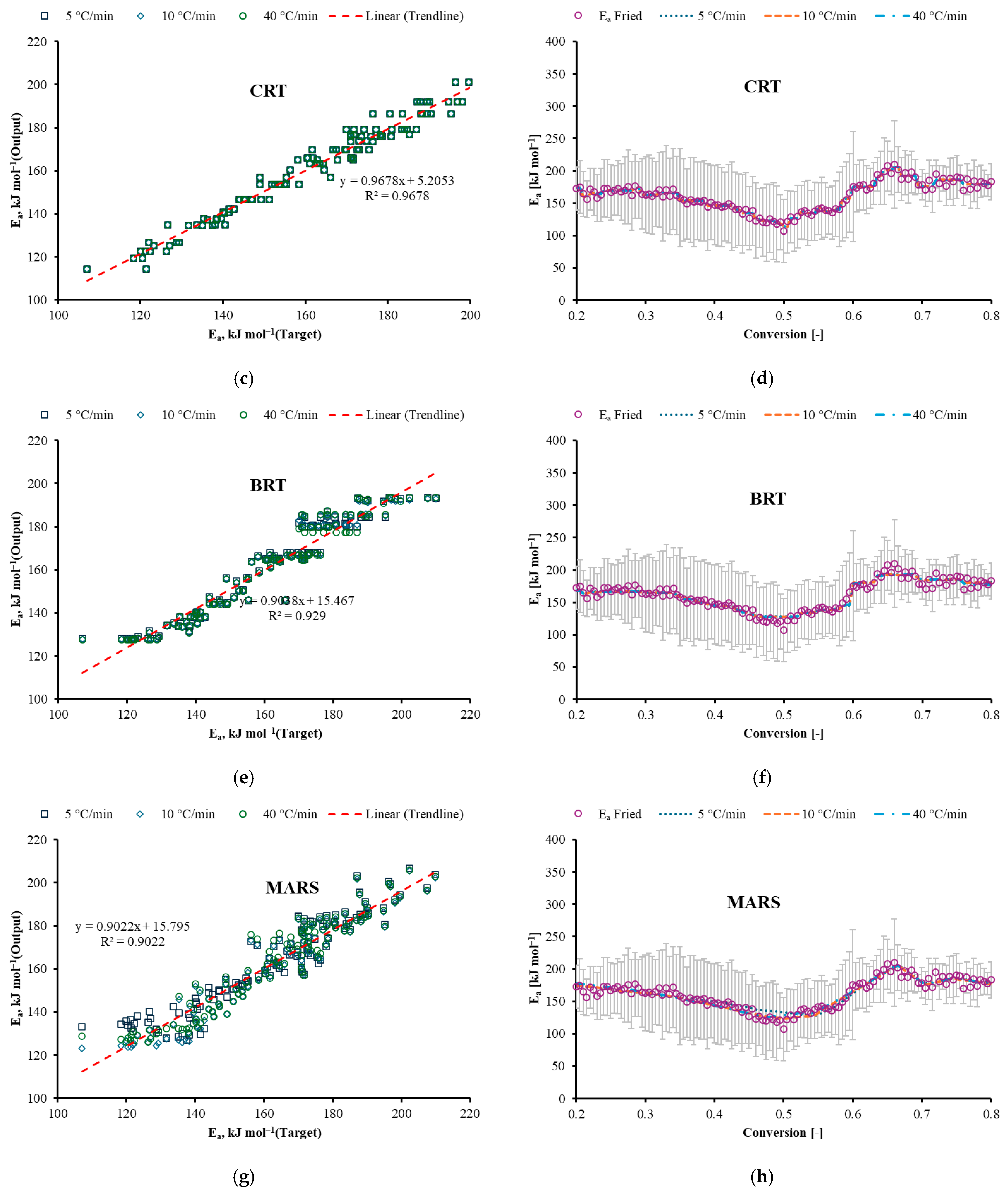
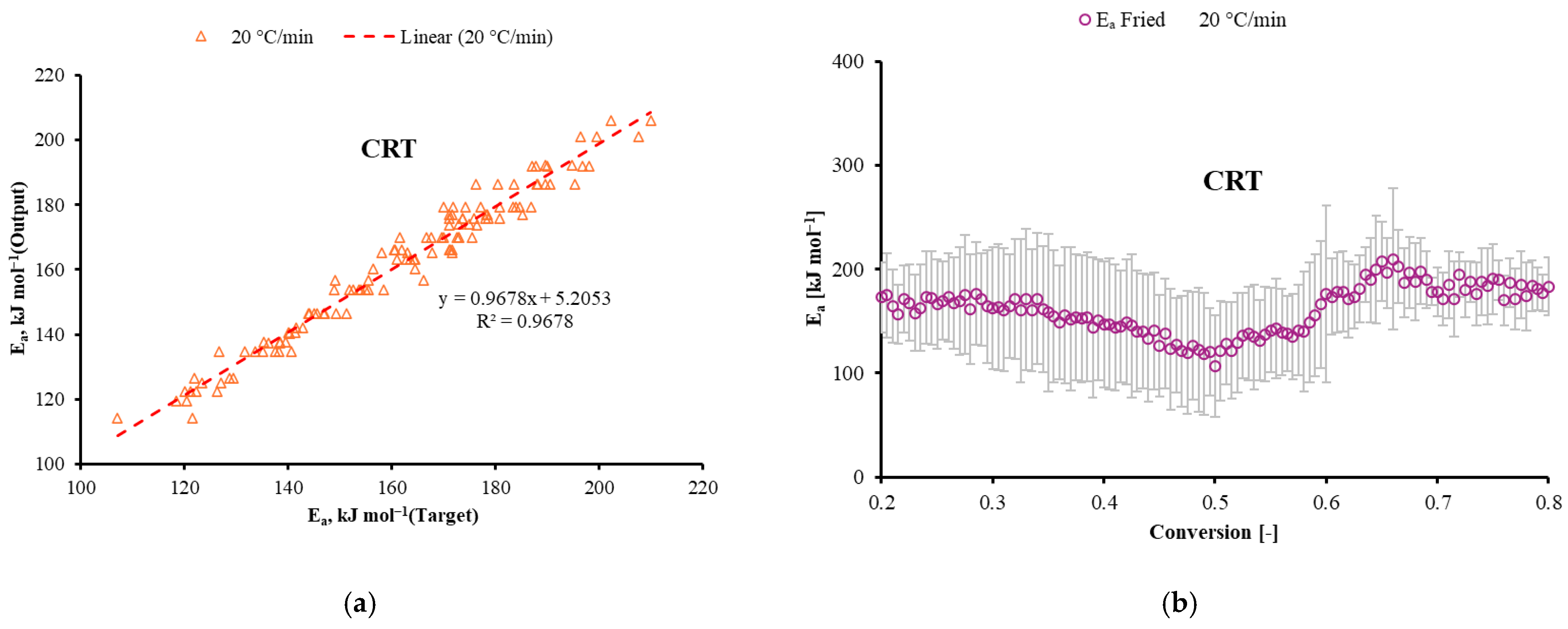
| CRT | 3.267 | 16.588 | 4.073 | 0.968 | 363 |
| BRT | 4.662 | 36.870 | 6.072 | 0.928 | 363 |
| MARS | 5.679 | 50.336 | 7.095 | 0.902 | 363 |
Disclaimer/Publisher’s Note: The statements, opinions and data contained in all publications are solely those of the individual author(s) and contributor(s) and not of MDPI and/or the editor(s). MDPI and/or the editor(s) disclaim responsibility for any injury to people or property resulting from any ideas, methods, instructions or products referred to in the content. |
© 2025 by the authors. Licensee MDPI, Basel, Switzerland. This article is an open access article distributed under the terms and conditions of the Creative Commons Attribution (CC BY) license (https://creativecommons.org/licenses/by/4.0/).
Share and Cite
AlGhamdi, A.; Ali, I.; Naqvi, S.R. Mild Two-Step Thermochemical Recovery of Clean Glass Fibers from Wind-Blade GFRP. Polymers 2025, 17, 3344. https://doi.org/10.3390/polym17243344
AlGhamdi A, Ali I, Naqvi SR. Mild Two-Step Thermochemical Recovery of Clean Glass Fibers from Wind-Blade GFRP. Polymers. 2025; 17(24):3344. https://doi.org/10.3390/polym17243344
Chicago/Turabian StyleAlGhamdi, AbdulAziz, Imtiaz Ali, and Salman Raza Naqvi. 2025. "Mild Two-Step Thermochemical Recovery of Clean Glass Fibers from Wind-Blade GFRP" Polymers 17, no. 24: 3344. https://doi.org/10.3390/polym17243344
APA StyleAlGhamdi, A., Ali, I., & Naqvi, S. R. (2025). Mild Two-Step Thermochemical Recovery of Clean Glass Fibers from Wind-Blade GFRP. Polymers, 17(24), 3344. https://doi.org/10.3390/polym17243344