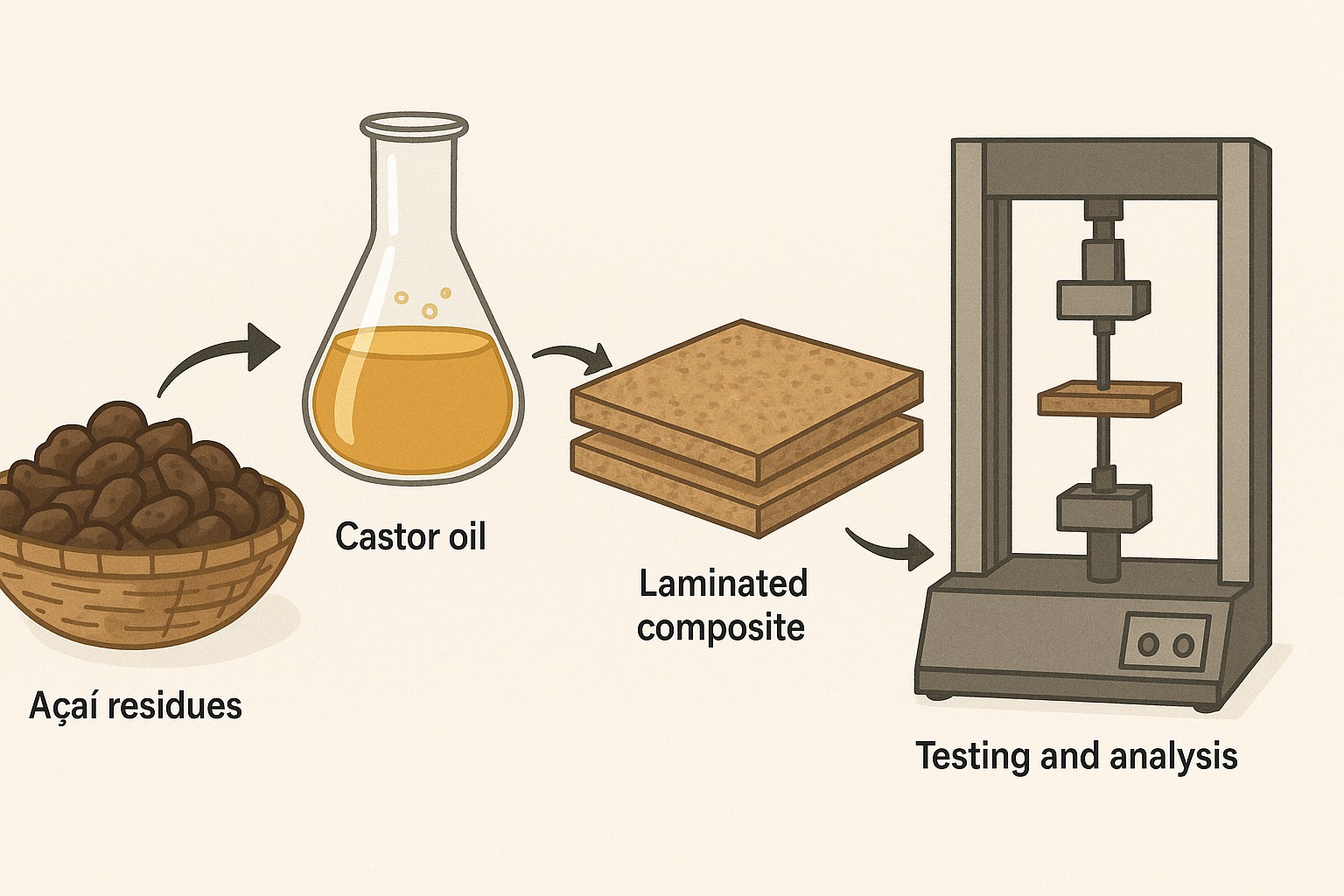
Development and Characterization of Laminated Composites from Açaí Residues and Castor Oil-Based Polyurethane Matrix

 ,
,  , ,
, ,  and
and
Abstract
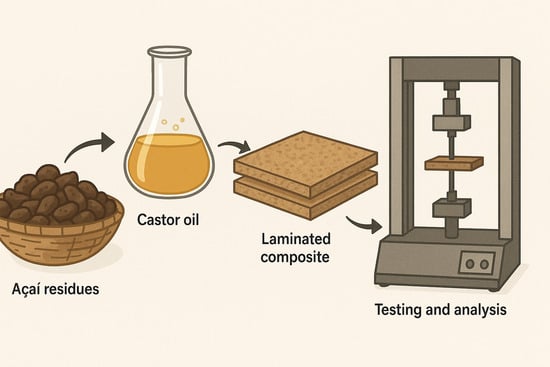
1. Introduction
2. Materials and Methods
2.1. Materials
2.2. Methods
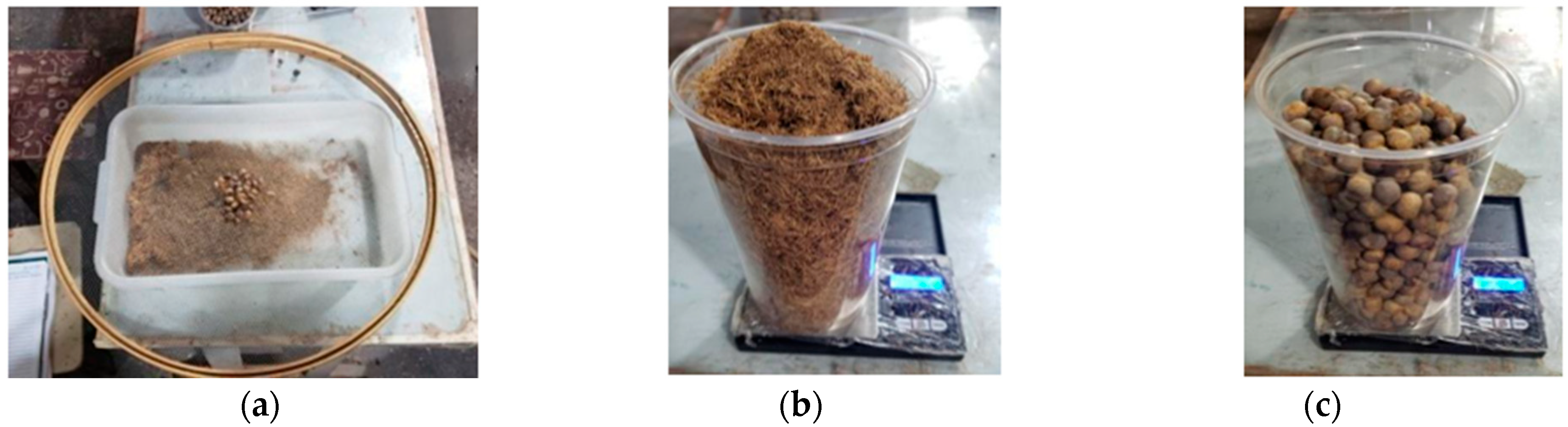
2.2.1. Collection and Drying of Açaí Seeds
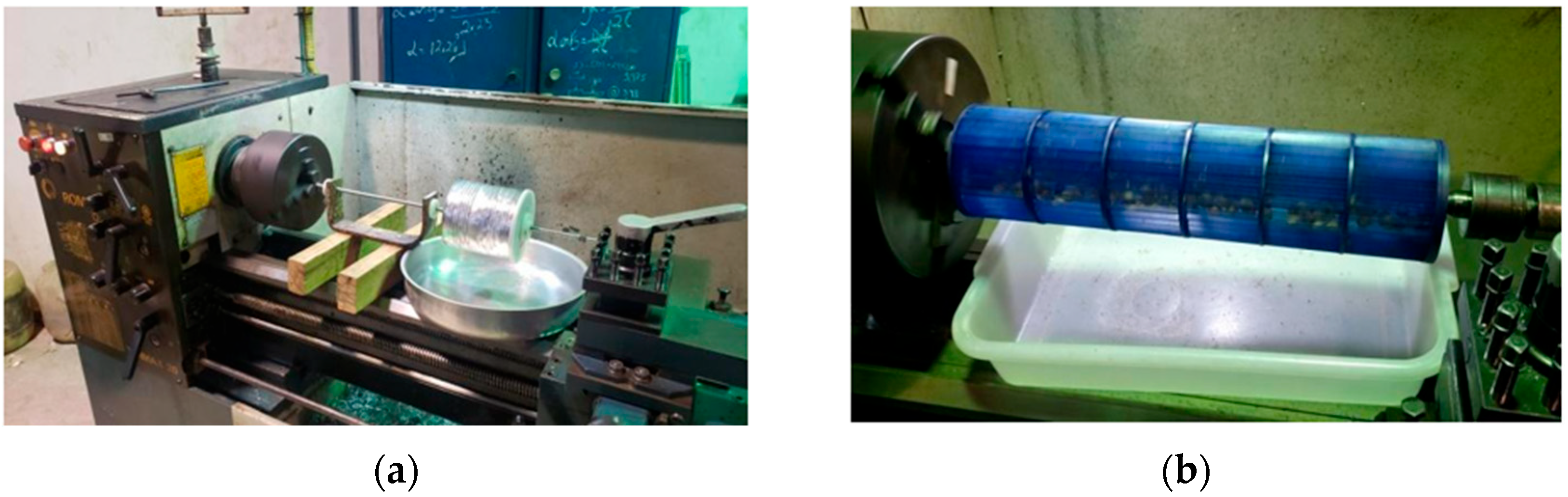
2.2.2. Fiber Extraction
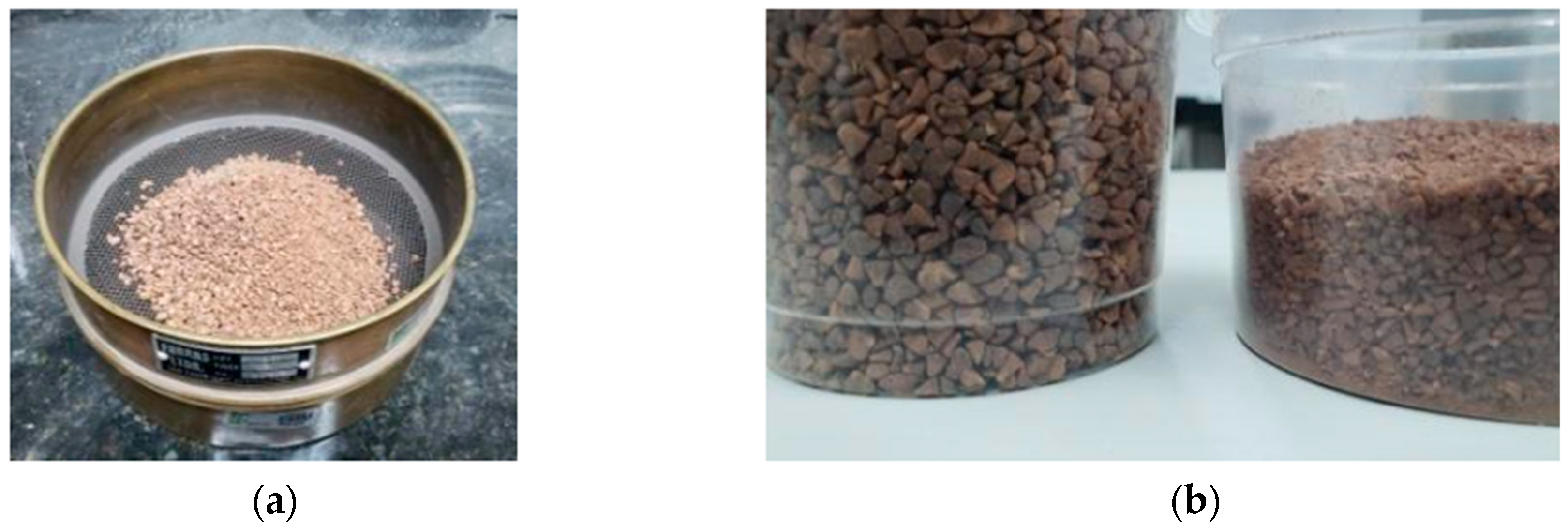
2.2.3. Seed Grinding
2.2.4. Characterization of Fibers and Seeds
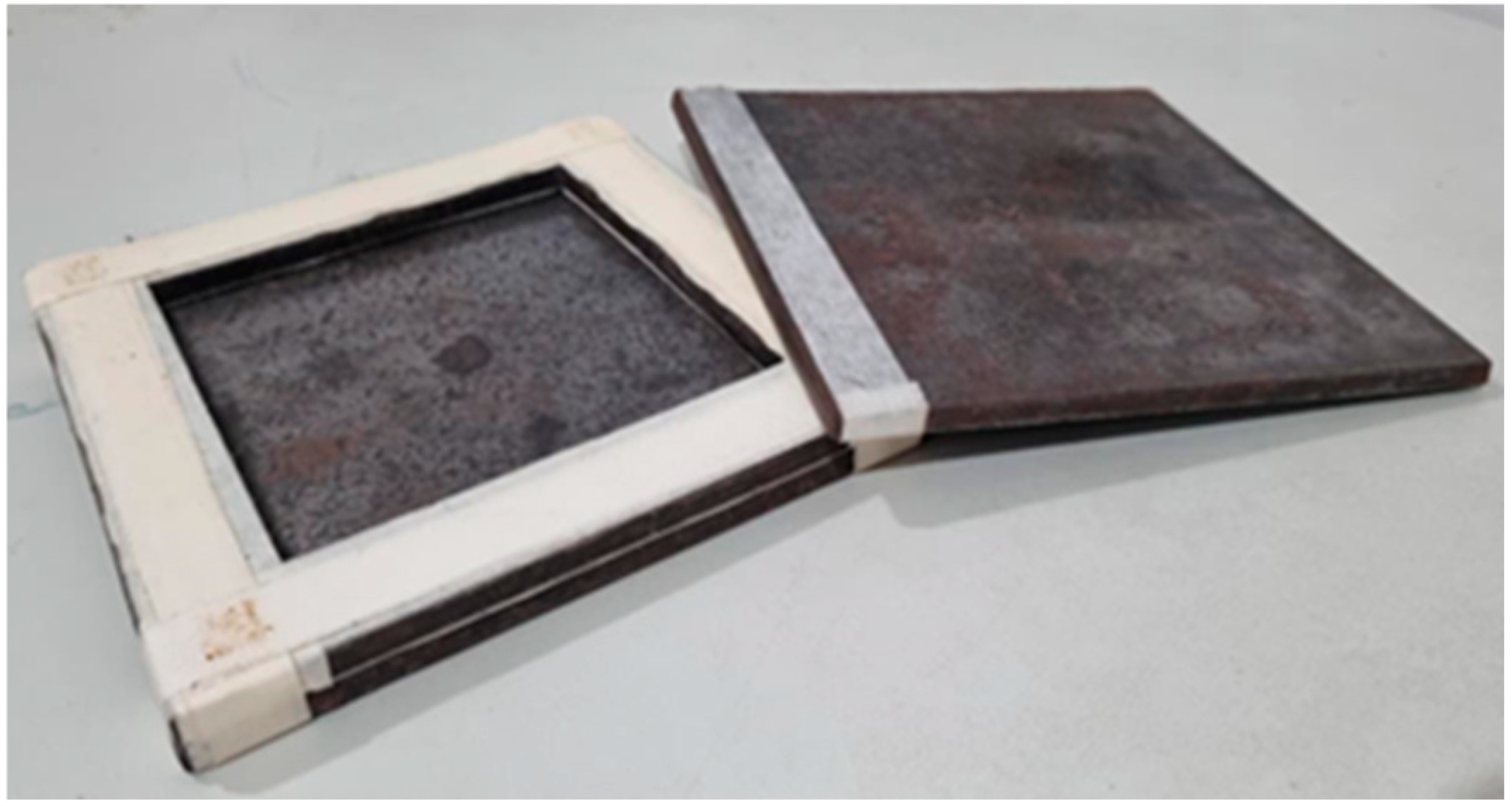
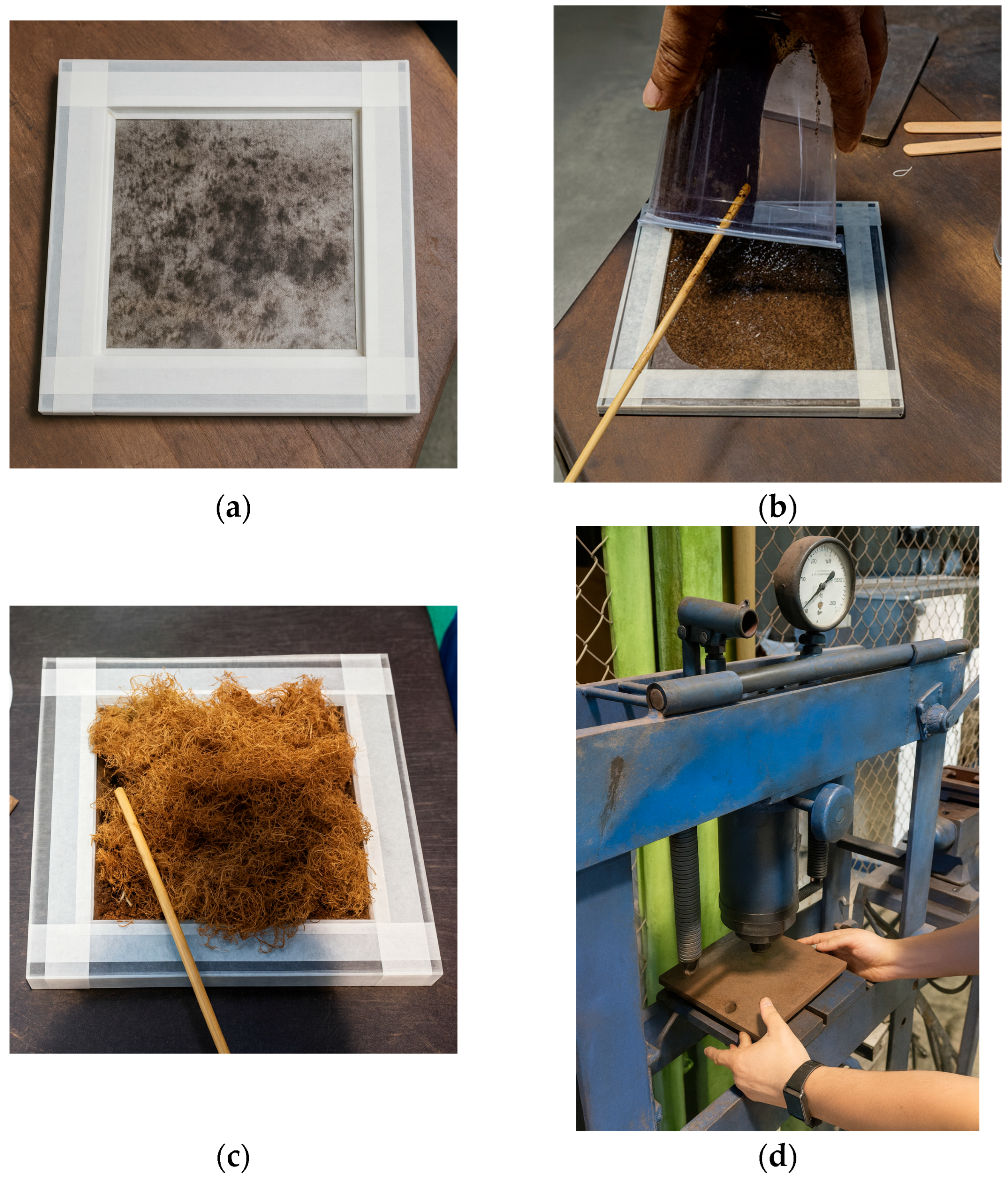
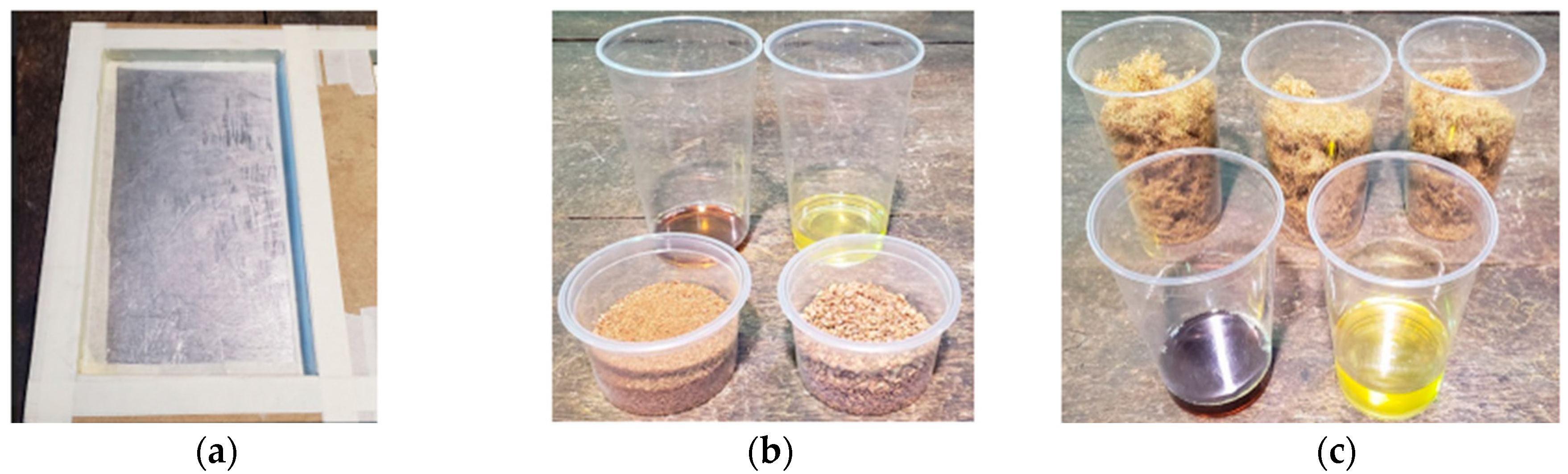
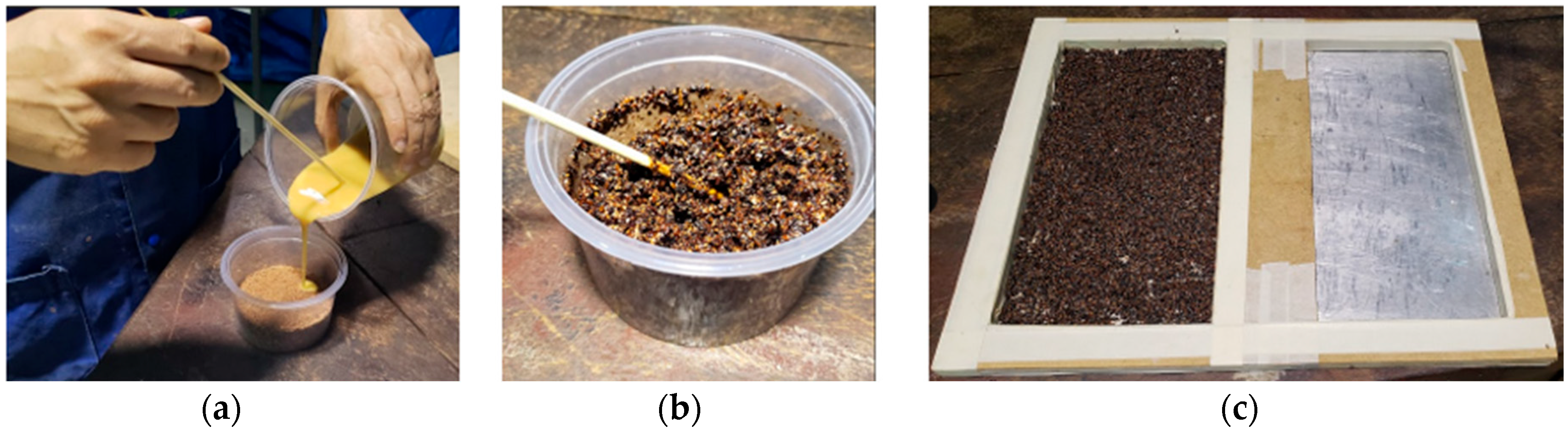
2.2.5. Manufacturing of Laminated Composite Panels
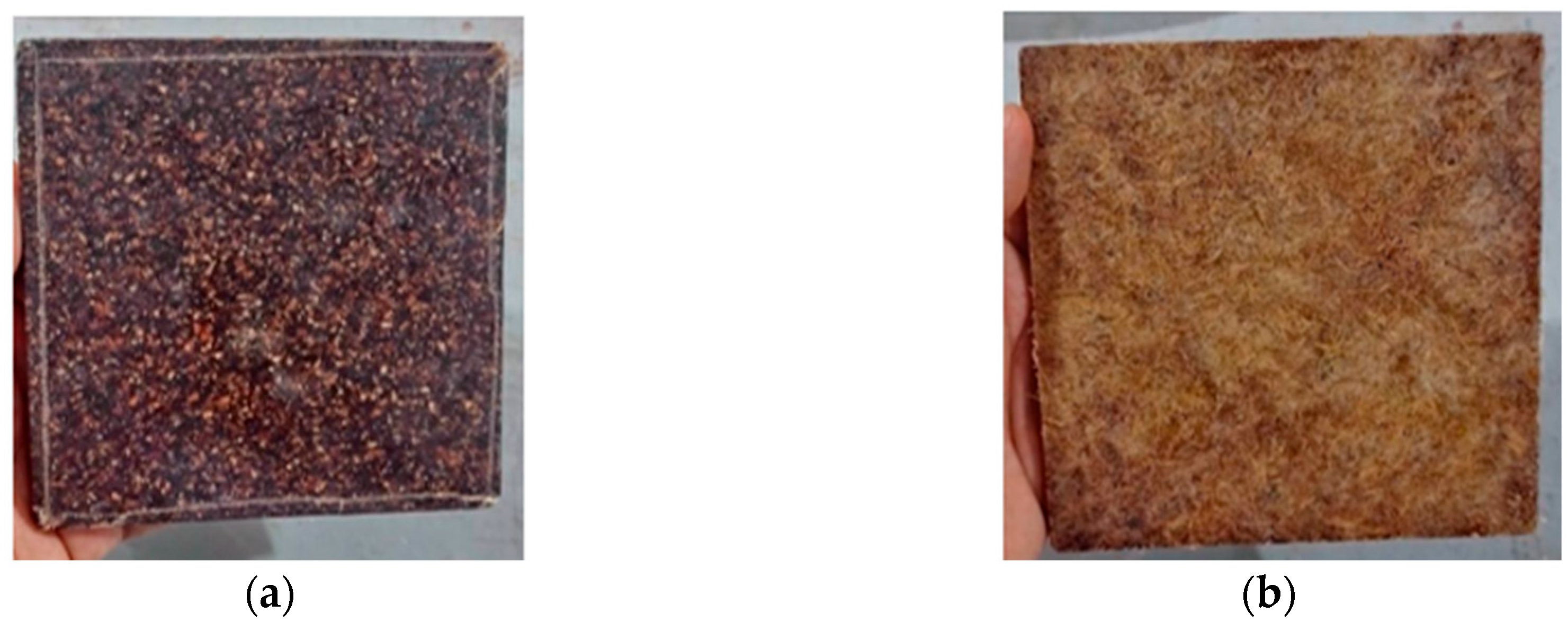
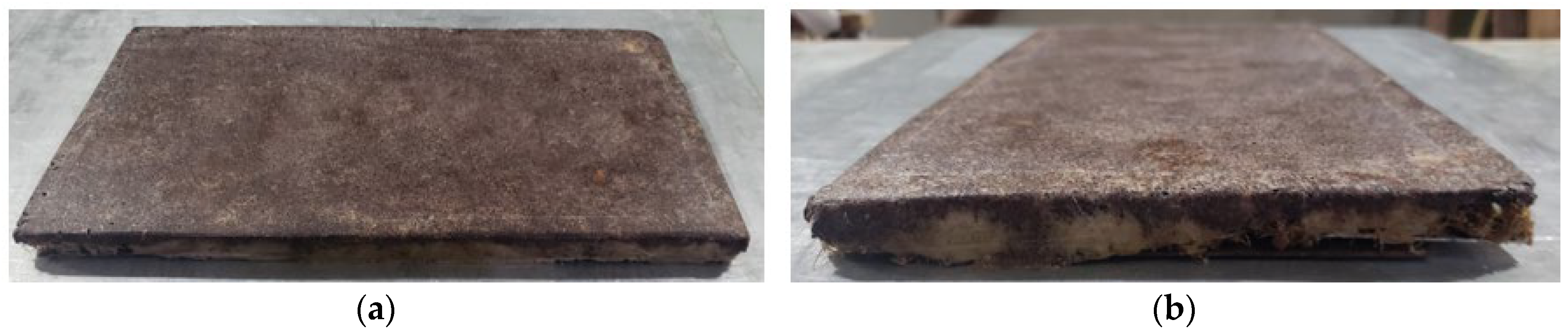
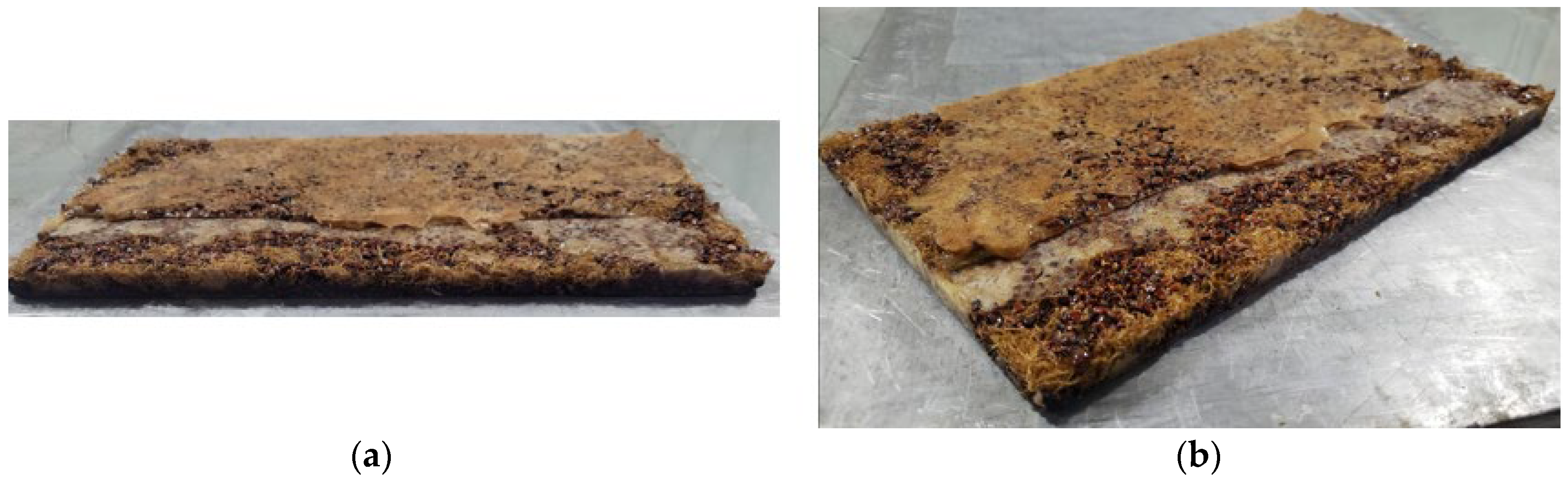
Test Panel 1 (PT1)
Test Panel 2 (PT2)
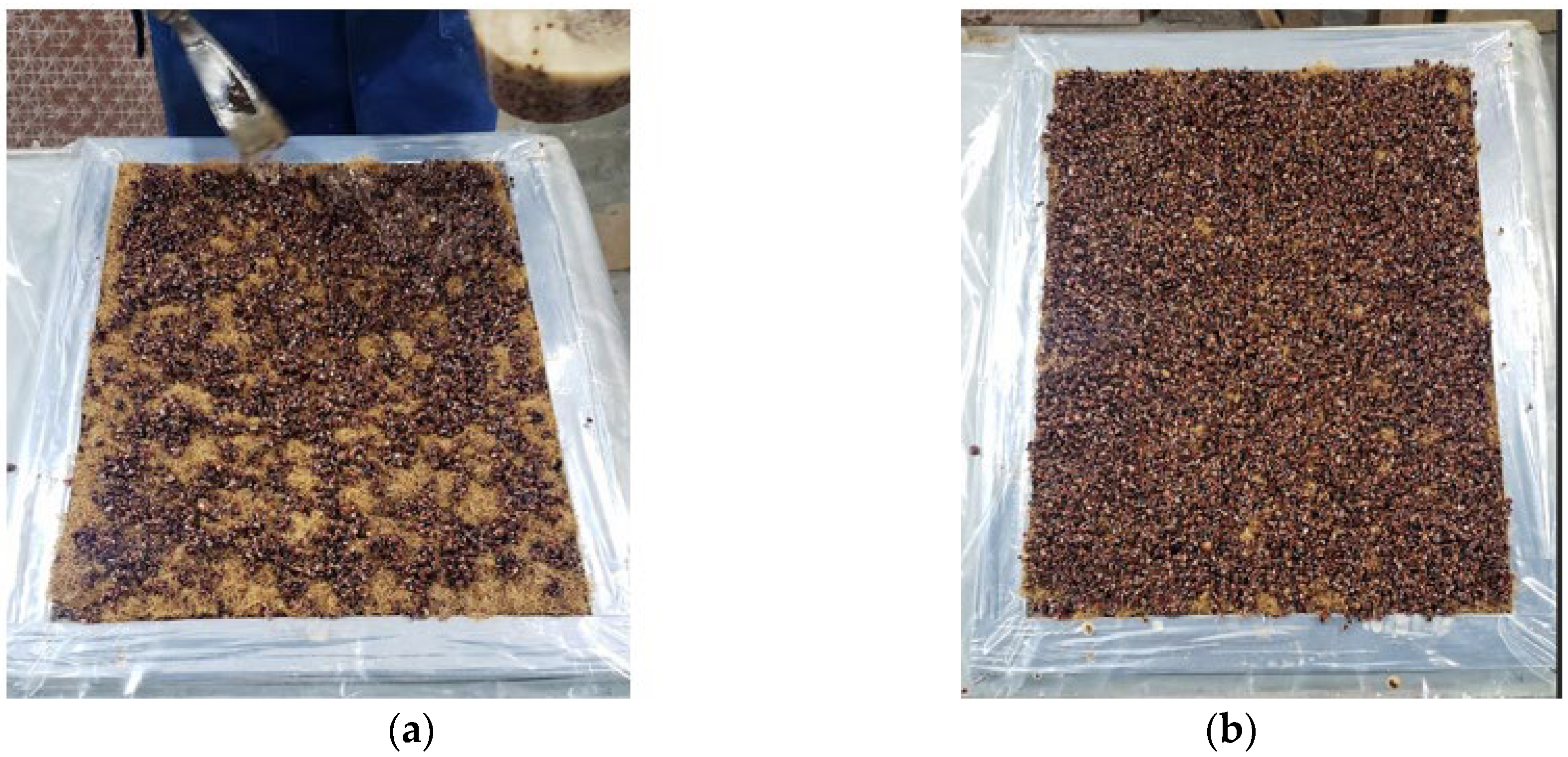
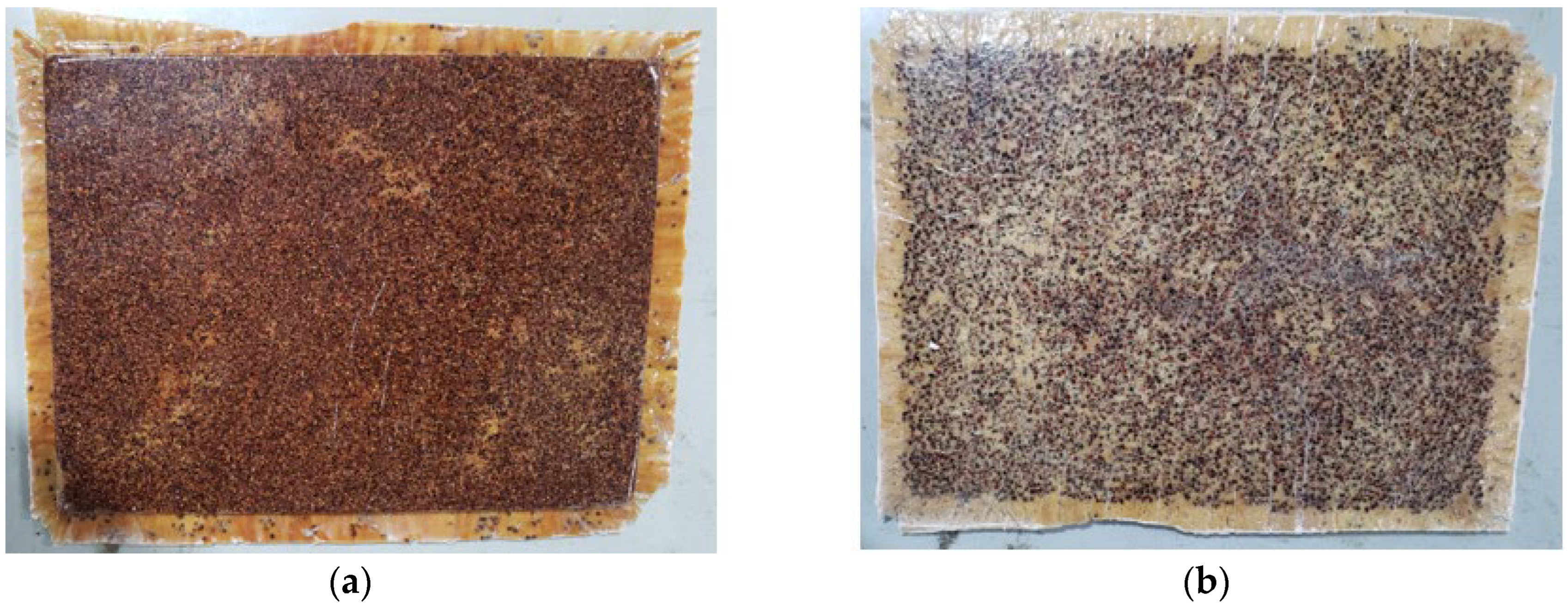
Final Panels (PD1 and PD2)
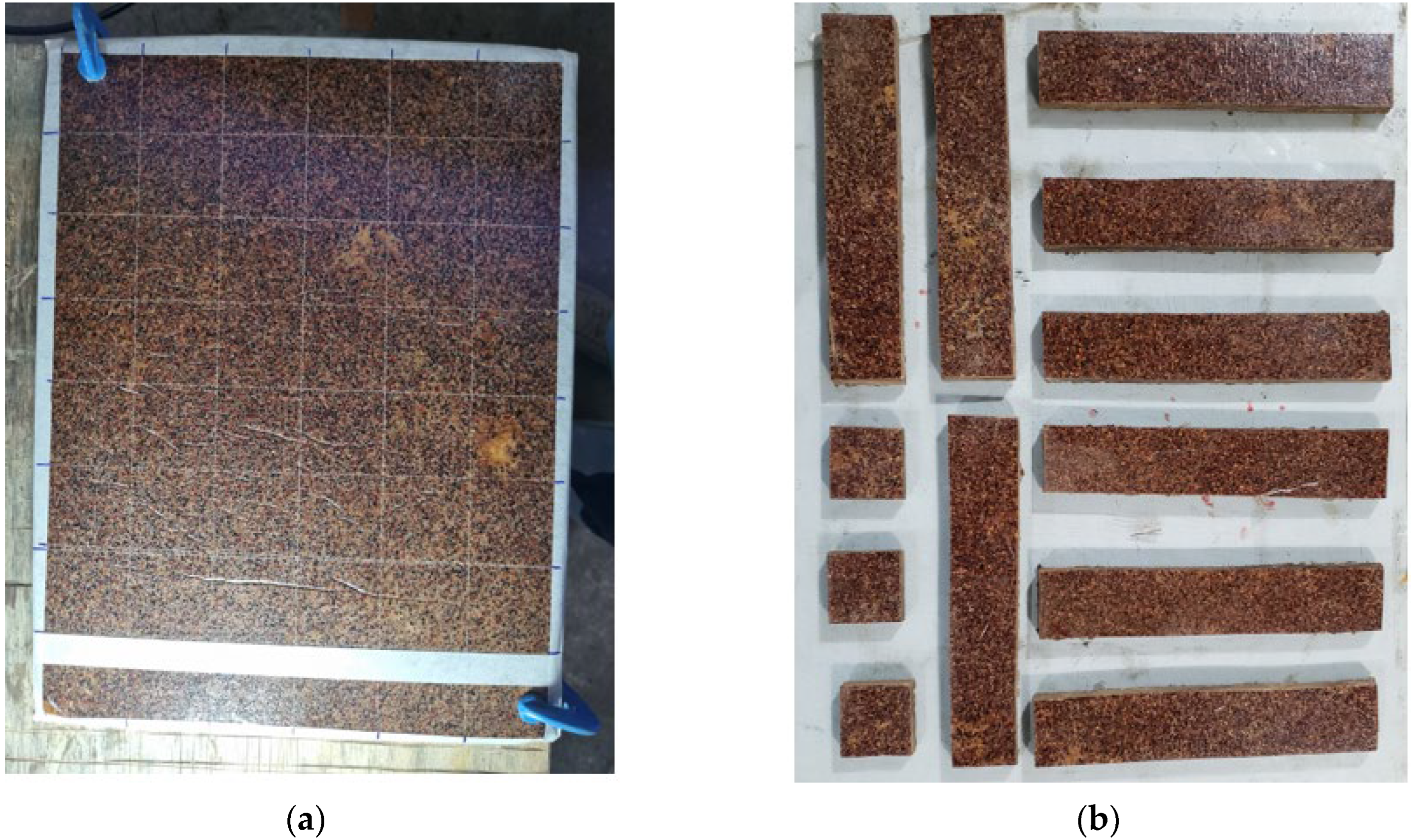
2.2.6. Specimen Fabrication and Characterization
Moisture Content Determination
Density Determination
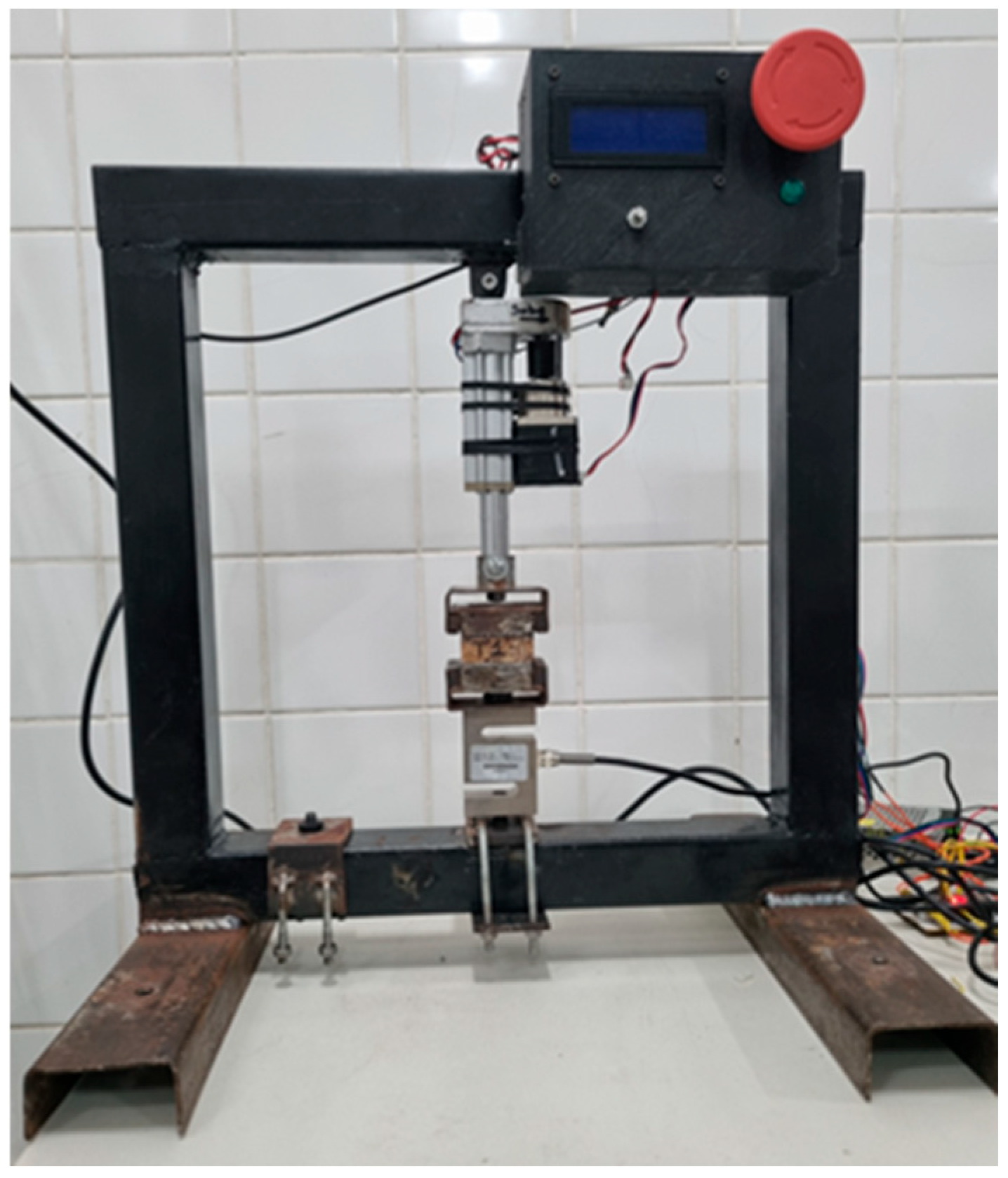
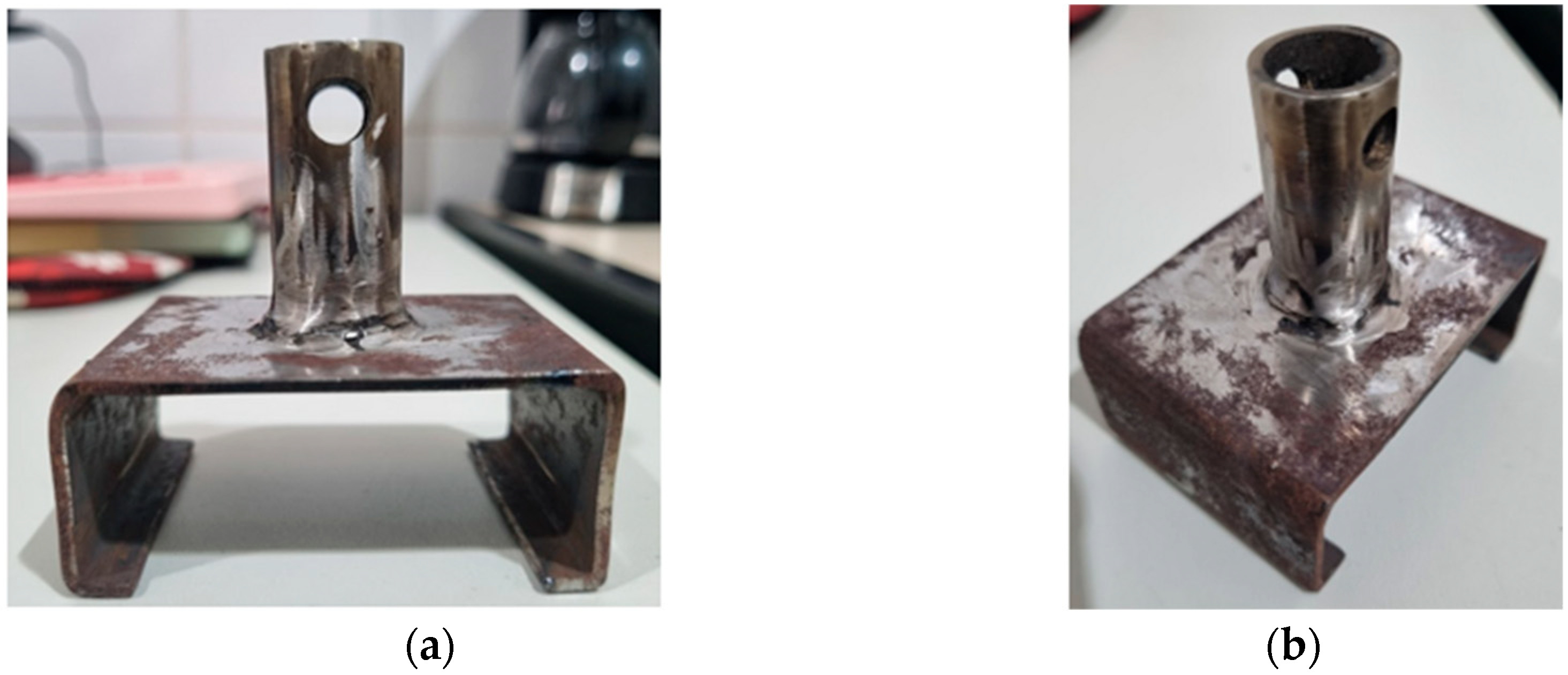
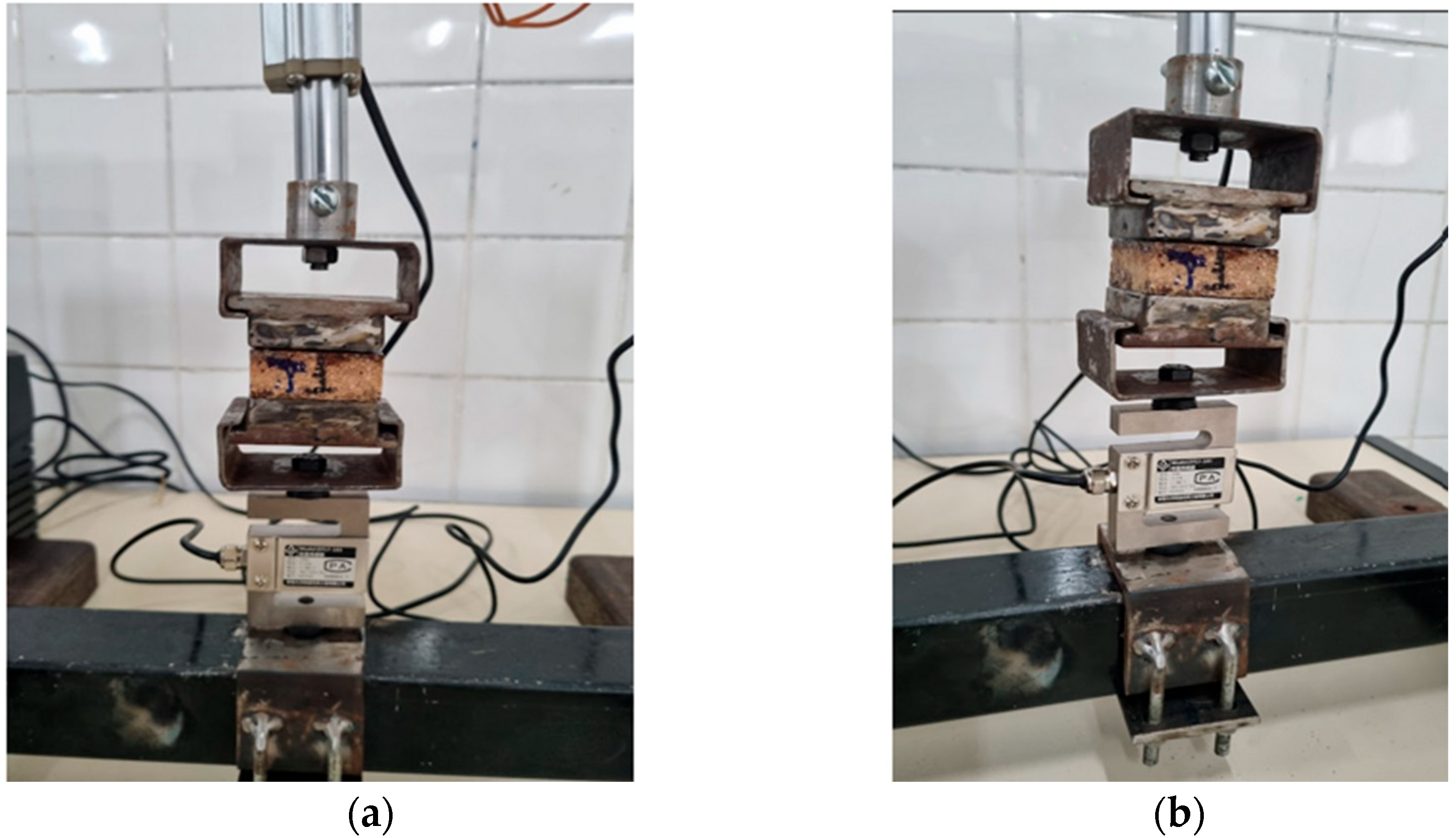
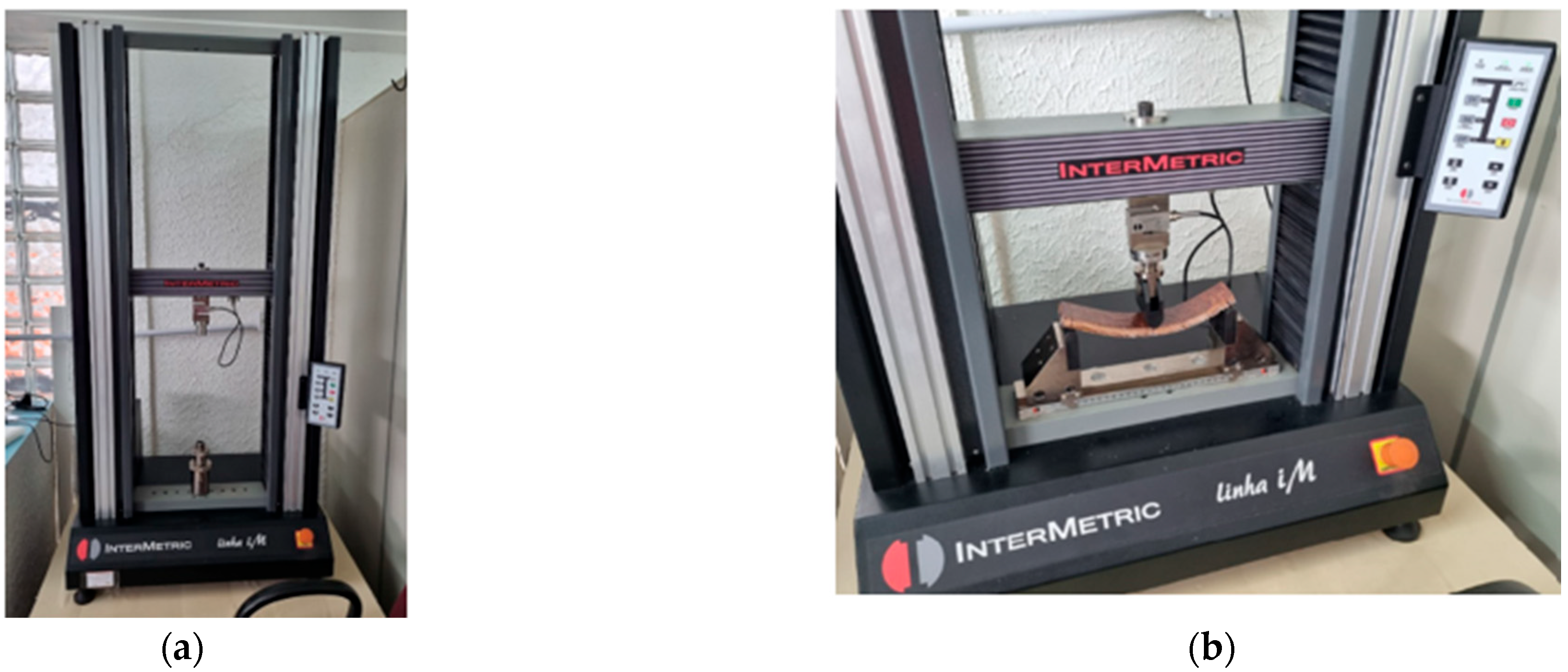
Perpendicular Tensile Strength Determination
Static Bending Strength and Modulus of Elasticity Determination
Thickness Swelling Determination After 24 h
3. Results and Discussion
3.1. Characterization of Açaí Fibers and Seeds
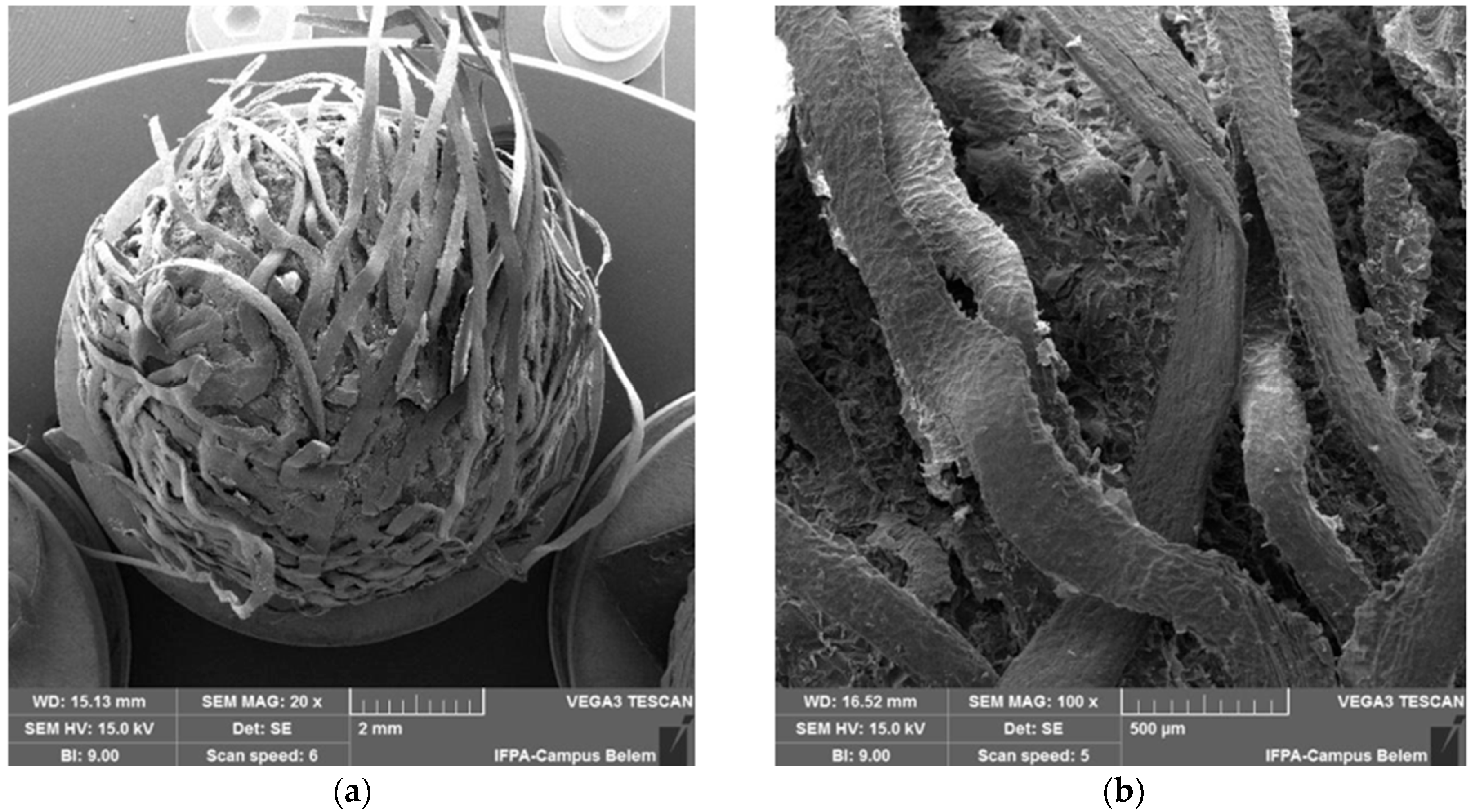
3.1.1. Morphology
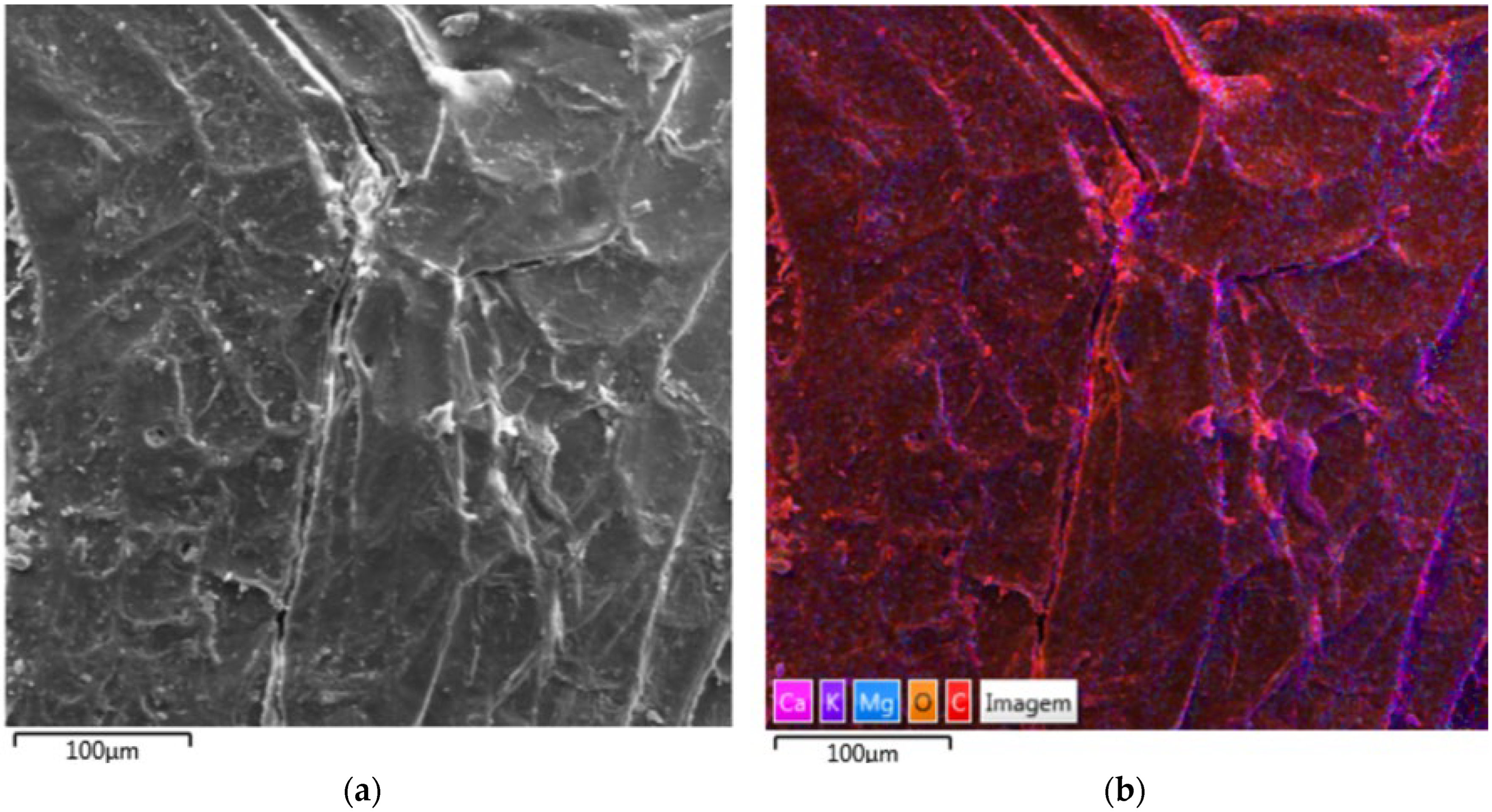
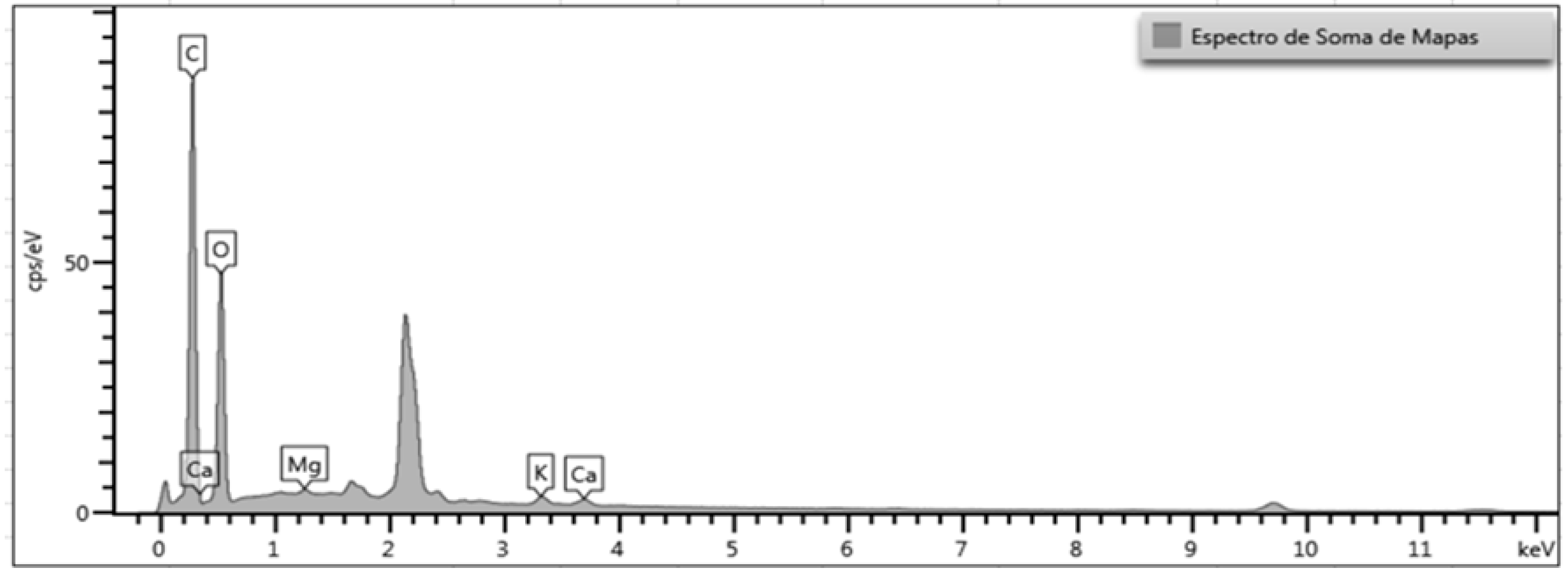
3.1.2. Chemical Composition
3.2. Characterization of Composites
3.2.1. Moisture Content
3.2.2. Tolerance in Relation to Average Densit
3.2.3. Perpendicular Tensile Strength
3.2.4. Static Flexural Strength and Modulus of Elasticity
3.2.5. Swelling for 24 h
3.2.6. Comparison of Results with the Literature
4. Conclusions
- Efficient processing and panel formation
- The manual lamination and cold-pressing route proved suitable for consolidating panels with good macroscopic integrity, proper curing of the polyurethane matrix, and adequate bonding between fibers, particles, and resin.
- Excellent hygroscopic and dimensional stability
- The panels exhibited a low average moisture content (6.2%) and reduced 24 h swelling (2.76%), both well within the requirements of ABNT NBR 14810-2:2018.
- These results confirm the effectiveness of castor oil polyurethane as a moisture barrier matrix and its strong interfacial compatibility with açaí residues.
- Good internal cohesion
- The perpendicular tensile strength (0.49 N/mm2) exceeded the minimum specification of the standard, indicating satisfactory internal bonding and proper impregnation of the lignocellulosic reinforcement.
- Flexural performance remains the main limitation
- The flexural strength (2.4 N/mm2) and elastic modulus (1323 N/mm2) did not meet the values required for type P2 panels.
- These limitations are primarily attributed to the particulate nature of the reinforcement, local density heterogeneity, and resin-migration effects typical of manual lamination.
- Application potential
- Despite the flexural limitations, the composite demonstrates suitable performance for indoor, low-load, non-structural applications, such as wall panels, decorative elements, lightweight partitions, and furniture components.
- Environmental and technological relevance
- The study reinforces the potential of açaí residues as a high-value raw material, supporting circular bioeconomy strategies in the Amazon region and encouraging future development of upgraded or hybrid panel structures.
Author Contributions
Funding
Data Availability Statement
Acknowledgments
Conflicts of Interest
References
- Bhaskaran, S.K.; Boga, K.; Arukula, R.; Gaddam, S.K. Natural Fibre Reinforced Vegetable-Oil-Based Polyurethane Composites: A Review. J. Polym. Res. 2023, 30, 325. [Google Scholar] [CrossRef]
- Rayung, M.; Abd Ghani, N.; Hasanudin, N. A Review on Vegetable Oil-Based Non-Isocyanate Polyurethane: Towards a Greener and Sustainable Production Route. RSC Adv. 2024, 14, 9273–9299. [Google Scholar] [CrossRef]
- Jayalath, P.; Ananthakrishnan, K.; Jeong, S.; Shibu, R.P.; Zhang, M.; Kumar, D.; Yoo, C.G.; Shamshina, J.L.; Therasme, O. Bio-Based Polyurethane Materials: Technical, Environmental, and Economic Insights. Processes 2025, 13, 1591. [Google Scholar] [CrossRef]
- Rabelo Aparício, R.; Machado dos Santos, G.; Siqueira Magalhães Rebelo, V.; Giacon, V.M.; da Silva, C.G. Performance of Castor Oil Polyurethane Resin in Composite with the Piassava Fibers Residue from the Amazon. Sci. Rep. 2024, 14, 6679. [Google Scholar] [CrossRef]
- de Melo Barbosa, A.; Machado dos Santos, G.; Medeiros de Melo, G.M.; Litaiff, H.A.; Martorano, L.G.; Giacon, V.M. Evaluation of the Use of Açaí Seed Residue as Reinforcement in Polymeric Composite. Polym. Polym. Compos. 2022, 30, 096739112211083. [Google Scholar] [CrossRef]
- Leite-Barbosa, O.; Pinto, C.C.d.O.; Leite-da-Silva, J.M.; de Aguiar, E.M.M.M.; Veiga-Junior, V.F. Polymer Composites Reinforced with Residues from Amazonian Agro-Extractivism and Timber Industries: A Sustainable Approach to Enhancing Material Properties and Promoting Bioeconomy. Polymers 2024, 16, 3282. [Google Scholar] [CrossRef] [PubMed]
- Dhakal, H.N.; Khan, S.H.; Alnaser, I.A.; Karim, M.R.; Saifullah, A.; Zhang, Z. Potential of Date Palm Fibers (DPFs) as a Sustainable Reinforcement for Bio-Composites and Its Property Enhancement for Key Applications: A Review. Macromol. Mater. Eng. 2024, 309, 2400081. [Google Scholar] [CrossRef]
- Leite-Barbosa, O.; da Silva, M.S.; da Silva Santos, D.C.; Fernandes Braga, F.C.; de Oliveira, M.F.L.; de Oliveira, M.G.; Monteiro, S.N.; Veiga-Junior, V.F. PBAT Biocomposites Reinforced with Açaí Seed Residues: Exploring Sustainable Material Development. J. Mater. Res. Technol. 2025, 37, 524–536. [Google Scholar] [CrossRef]
- Santos, N.S.; Silva, M.R.; Alves, J.L. Reinforcement of a Biopolymer Matrix by Lignocellulosic Agro-Waste. Procedia Eng. 2017, 200, 422–427. [Google Scholar] [CrossRef]
- Elfaleh, I.; Abbassi, F.; Habibi, M.; Ahmad, F.; Guedri, M.; Nasri, M.; Garnier, C. A Comprehensive Review of Natural Fibers and Their Composites: An Eco-Friendly Alternative to Conventional Materials. Results Eng. 2023, 19, 101271. [Google Scholar] [CrossRef]
- Ortega, F.; Versino, F.; López, O.V.; García, M.A. Biobased Composites from Agro-Industrial Wastes and By-Products. Emergent Mater. 2022, 5, 873–921. [Google Scholar] [CrossRef]
- Khalid, M.Y.; Al Rashid, A.; Arif, Z.U.; Ahmed, W.; Arshad, H.; Zaidi, A.A. Natural Fiber Reinforced Composites: Sustainable Materials for Emerging Applications. Results Eng. 2021, 11, 100263. [Google Scholar] [CrossRef]
- Rocha, J.H.A.; de Siqueira, A.A.; de Oliveira, M.A.B.; Castro, L.d.S.; Caldas, L.R.; Monteiro, N.B.R.; Toledo Filho, R.D. Circular Bioeconomy in the Amazon Rainforest: Evaluation of Açaí Seed Ash as a Regional Solution for Partial Cement Replacement. Sustainability 2022, 14, 14436. [Google Scholar] [CrossRef]
- Leszczyńska, M.; Malewska, E.; Ryszkowska, J.; Kurańska, M.; Gloc, M.; Leszczyński, M.K.; Prociak, A. Vegetable Fillers and Rapeseed Oil-Based Polyol as Natural Raw Materials for the Production of Rigid Polyurethane Foams. Materials 2021, 14, 1772. [Google Scholar] [CrossRef] [PubMed]
- Mo, Y.; Huang, X.; Hu, C. Recent Advances in the Preparation and Application of Bio-Based Polyurethanes. Polymers 2024, 16, 2155. [Google Scholar] [CrossRef] [PubMed]
- Seibel, R.K.; Zimmer, A.; Fiorio, R. Development and Characterization of Novel Castor Oil-Based Polyurethane Composites Containing Wood Sawdust and Rubber Tire Powder. Polym. Polym. Compos. 2020, 29, 876–887. [Google Scholar] [CrossRef]
- Jamshaid, H.; Mishra, R.K.; Chandan, V.; Nazari, S.; Shoaib, M.; Bizet, L.; Ivanova, T.A.; Muller, M.; Valasek, P. Mechanical and Thermo-Mechanical Performance of Natural Fiber-Based Single-Ply and 2-Ply Woven Prepregs. Polymers 2023, 15, 994. [Google Scholar] [CrossRef] [PubMed]
- Shelly, D.; Singhal, V.; Jaidka, S.; Banea, M.D.; Lee, S.-Y.; Park, S.-J. Mechanical Performance of Bio-Based Fiber Reinforced Polymer Composites: A Review. Polym. Compos. 2025, 46 (Suppl. S3), S9–S43. [Google Scholar] [CrossRef]
- McKay, I.; Vargas, J.; Yang, L.; Felfel, R.M. A Review of Natural Fibres and Biopolymer Composites: Progress, Limitations, and Enhancement Strategies. Materials 2024, 17, 4878. [Google Scholar] [CrossRef] [PubMed]
- Negreiros, W.J.A.G.; Rodrigues, J.d.S.; Ribeiro, M.M.; Silva, D.S.; Junio, R.F.P.; Monteiro, S.N.; Corrêa, A.d.C. Potential Use of Castor Oil-Based Polyurethane Matrix Composite with Miriti Fiber Filling as Thermal Insulation Applied to Metal Tiles. Polymers 2025, 17, 892. [Google Scholar] [CrossRef]
- Balla, E.; Bikiaris, D.N.; Pardalis, N.; Bikiaris, N.D. Toward Sustainable Polyurethane Alternatives: A Review of the Synthesis, Applications, and Lifecycle of Non-Isocyanate Polyurethanes (NIPUs). Polymers 2025, 17, 1364. [Google Scholar] [CrossRef]
- Kaikade, D.S.; Sabnis, A.S. Polyurethane Foams from Vegetable Oil-Based Polyols: A Review. Polym. Bull. 2023, 80, 2239–2261. [Google Scholar] [CrossRef]
- Yao, L.; Baharum, A.; Yu, L.J.; Yan, Z.; Badri, K.H. A Vegetable-Oil-Based Polyurethane Coating for Controlled Nutrient Release: A Review. Coatings 2025, 15, 665. [Google Scholar] [CrossRef]
- Silva, R.; Barros-Timmons, A.; Quinteiro, P. Life Cycle Assessment of Fossil- and Bio-Based Polyurethane Foams: A Review. J. Clean. Prod. 2023, 430, 139697. [Google Scholar] [CrossRef]
- Teixeira, T.A.; Mendes, F.B. Valorization of Açaí Waste from Processing Agro-Industry: A Review. Res. Soc. Dev. 2023, 12, e126121143799. [Google Scholar] [CrossRef]
- Hairon Azhar, N.N.; Ang, D.T.-C.; Abdullah, R.; Harikrishna, J.A.; Cheng, A. Bio-Based Materials Riding the Wave of Sustainability: Common Misconceptions, Opportunities, Challenges and the Way Forward. Sustainability 2022, 14, 5032. [Google Scholar] [CrossRef]
- NBR 14810-2:2018; Painéis de Partículas de Média Densidade—Parte 2: Requisitos e Métodos de Ensaio. Associação Brasileira de Normas Técnicas (ABNT): Rio de Janeiro, Brazil, 2018.
- Quirino, M.G. Estudo de Matriz Polimérica Produzida com Resina Natural e Fibra da Semente de açaí (Euterpe Precatória). Master’s Thesis, Universidade Federal do Amazonas, Manaus, Brazil, 2010. Available online: https://tede.ufam.edu.br/handle/tede/3472 (accessed on 18 June 2025).
- Mesquita, A.L. Estudos de Processos de Extração e Caracterização de Fibras do Fruto do açaí (Euterpe oleracea Mart.) da Amazônia para Produção de Ecopainel de Partículas Homogêneas de Média Densidade. Ph.D. Thesis, Universidade Federal do Pará (UFPA), Belém, Brazil, 2013. [Google Scholar]
- Silva, A.M.V.d. Avaliação do Comportamento Térmico de Compósitos Poliméricos Produzidos com Resíduos de açaí em Edificações na Amazônia. Master’s Thesis, Universidade Federal do Amazonas, Manaus, Brazil, 2019. Available online: https://tede.ufam.edu.br/handle/tede/7215 (accessed on 18 October 2025).
- Cavalcanti, B.P.B.; Souza, G.L.; Benevides Júnior, A.Y.; Ruschival, C.B.; Quirino, M.G.; Castro, D.F. O uso do Caroço do açaí como Reforço para a Modelagem de Material Compósito de Matriz de Poliuretano Vegetal. Mix Sustentável 2021, 7, 19–28. [Google Scholar] [CrossRef]
- Barbosa, A.M. Compósitos Poliméricos com Resíduos de Açaí para Mitigação de Efeitos Térmicos como Estratégia Eco-Alternativa em Habitações na Amazônia. Master’s Thesis, Universidade Federal do Amazonas, Manaus, Brazil, 2016. Available online: https://tede.ufam.edu.br/handle/tede/5494 (accessed on 20 October 2025).
- Mesquita, A.L.; Barrero, N.G.; Fiorelli, J.; Christoforo, A.L.; De Faria, L.J.G.; Lahr, F.A.R. Eco-particleboard manufactured from chemically treated fibrous vascular tissue of acai (Euterpe oleracea Mart.) fruit: A new alternative for the particleboard industry with its potential application in civil construction and furniture. Ind. Crops Prod. 2018, 112, 644–651. [Google Scholar] [CrossRef]



| Sample | Identification | Grams |
|---|---|---|
| 01 | Powder (not used) | 583.05 |
| 02 | Granulometry passing through the metal sieve | 606.94 |
| 03 | Granulometry retained in the metal sieve | 1816.06 |
| Total | 848.01 |
| Reference [27]: | |||||
| Non-structural panels for internal use in dry conditions (Type P2)—Requirements for mechanical properties and swelling. NOMINAL THICKNESS > 13 to 20 mm | |||||
| Criteria: | |||||
| 5% to 13% | |||||
| Characteristics of the test specimens: | |||||
| Description | Quantity | Dimensions | Thickness | ||
| Test specimens | 10 | 50 mm × 50 mm | 15 mm | ||
| Individual and average moisture content results: | |||||
| Test Specimen | WU—Wet Mass (g) | DM—Dry Mass (g) | Moisture (%) | ||
| 01 | 16.8378 | 15.907 | 5.851511913 | ||
| 02 | 22.7503 | 21.4163 | 6.228900417 | ||
| 03 | 17.4239 | 16.5414 | 5.335098601 | ||
| 04 | 17.7138 | 16.2537 | 8.983185367 | ||
| 05 | 20.0845 | 18.9853 | 5.78974259 | ||
| 06 | 24.7481 | 23.1783 | 6.772714133 | ||
| 07 | 23.2427 | 21.7229 | 6.99630344 | ||
| 08 | 14.8427 | 14.143 | 4.947323764 | ||
| 09 | 19.4798 | 18.3734 | 6.021748833 | ||
| 10 | 19.1174 | 18.1452 | 5.357890792 | ||
| Average | 6.23 | ||||
| Standard Deviation | 1.16 | ||||
| Final Result (Mean ± SD) | 6.23 ± 1.16% | ||||
| Reference [27]: | ||||
| Non-structural panels for internal use in dry conditions (Type P2)—Requirements for mechanical properties and swelling. NOMINAL THICKNESS > 13 to 20 mm | ||||
| Criteria: | ||||
| ±7% | ||||
| Characteristics of the test specimens: | ||||
| Description | Quantity | Dimensions | Thickness | |
| Test specimens | 10 | 50 mm × 50 mm | 15 mm | |
| Individual Results: Test Specimen Volume: | ||||
| Test Specimen | Dimension b1 (mm) | Dimension b2 (mm) | Thickness e (mm) | Volume V (mm3) |
| 01 | 45.6333 | 44.4333 | 14.9 | 30.211.81 |
| 02 | 47.6333 | 47.9 | 14 | 31.942.89 |
| 03 | 45.7666 | 46.0333 | 16 | 33.708.60 |
| 04 | 42.6 | 47.6666 | 16.6 | 33.707.91 |
| 05 | 46.4333 | 46.4333 | 17 | 36.652.87 |
| 06 | 48.2666 | 48.3333 | 13.5 | 31.493.93 |
| 07 | 47.8333 | 47.5666 | 12.7 | 28.895.90 |
| 08 | 46.3333 | 42.3 | 15.8 | 30.966.40 |
| 09 | 47.2 | 46.0333 | 15.8 | 34.329.79 |
| 10 | 46.6333 | 46.4666 | 16.8 | 36.403.77 |
| Individual density results and variation: | ||||
| Test Specimen | Mass M (g) | Volume V (mm3) | Density (kg/m3) | Density percentage variation D (%) |
| 01 | 15.907 | 30.211.81 | 526.5160 | −7.073644127 |
| 02 | 21.4163 | 31.942.89 | 670.4559 | 18.33073484 |
| 03 | 16.5414 | 33.708.60 | 490.7175 | −13.39183028 |
| 04 | 16.2537 | 33.707.91 | 482.1924 | −14.89644227 |
| 05 | 16.2537 | 33.707.91 | 482.1924 | −8.580933602 |
| 06 | 18.9853 | 36.652.87 | 517.9758 | 29.89187767 |
| 07 | 23.1783 | 31.493.93 | 735.9608 | 32.68107071 |
| 08 | 21.7229 | 28.895.90 | 751.7642 | −19.39199126 |
| 09 | 14.143 | 30.966.40 | 456.7209 | −5.540493136 |
| 10 | 18.3734 | 34.329.79 | 535.2027 | −12.02834318 |
| Average Density | 566.59 | |||
| Standard Deviation | 32.50 | |||
| Final Result (Mean ± SD) | 566.59 ± 32.50 kg/m3 | |||
| Maximum Density Variation Module | 33% | |||
| Reference [27]: | ||||
| Non-structural panels for internal use in dry conditions (Type P2)—Requirements for mechanical properties and swelling. NOMINAL THICKNESS > 13 to 20 mm | ||||
| Criteria: | ||||
| 0.35 N/mm2 (minimum) | ||||
| Characteristics of the test specimens: | ||||
| Description | Quantity | Dimensions | Thickness | |
| Test specimens | 09 | 50 mm × 50 mm | 15 mm | |
| Individual results: Area of the Test Specimen: | ||||
| Test Specimen | Dimension b1 (mm) | Dimension b2 (mm) | Thickness e (mm) | Area S (mm2) |
| 01 | 49.5 | 48.8 | 19.1 | 2415.60 |
| 02 | 50 | 49.3 | 19.5 | 2465.00 |
| 03 | 46.9 | 47.4 | 18 | 2223.06 |
| 04 | 47.4 | 46.7 | 17.5 | 2213.58 |
| 05 | 48.3 | 47.4 | 18.8 | 2289.42 |
| 06 | 48.7 | 47.2 | 19.6 | 2298.64 |
| 07 | 47.1 | 47.6 | 17.5 | 2241.96 |
| 08 | 46.8 | 48.4 | 20.4 | 2265.12 |
| 09 | 47.8 | 46.6 | 19.2 | 2227.48 |
| 10 | - | - | - | - |
| Individual results: Perpendicular tensile strength (PT): | ||||
| Test Specimen | Rupture load P (N) | Area S (mm2) | Perpendicular tensile strength PT (N/mm2) | |
| 01 | 1370 | 2415.60 | 0.5671 | |
| 02 | 789.55 | 2465.00 | 0.3203 | |
| 03 | 1282 | 2223.06 | 0.5767 | |
| 04 | 1248.7 | 2213.58 | 0.5641 | |
| 05 | 1330 | 2289.42 | 0.5809 | |
| 06 | 817.95 | 2298.64 | 0.3558 | |
| 07 | 1132.9 | 2241.96 | 0.5053 | |
| 08 | 554.53 | 2265.12 | 0.2448 | |
| 09 | 1531 | 2227.48 | 0.6873 | |
| 10 | - | - | - | |
| Average Strength | 0.49 | |||
| Standard Deviation | 0.15 | |||
| Final Result (Mean ± SD) | 0.49 ± 0.15 N/mm2 | |||
| Reference [27]: | |||||||||||||
| Non-structural panels for internal use in dry conditions (Type P2)—Requirements for mechanical properties and swelling. NOMINAL THICKNESS > 13 to 20 mm | |||||||||||||
| Criteria: | |||||||||||||
| MOR = 11 N/mm2 (minimum)/MOE = 1600 N/mm2 (minimum) | |||||||||||||
| Characteristics of the test specimens: | |||||||||||||
| Description | Quantity | Dimensions | Thickness | ||||||||||
| Test specimens | 10 | 50 mm × 220 mm | 15 mm | ||||||||||
| Static bending strength—MOR | |||||||||||||
| Test Specimen | Rupture load P (N) | Distance between supports D (mm) | Width (mm) | Thickness (mm) | MOR (N/mm2) | ||||||||
| 01 | 65.079 | 220 | 46.1 | 15.3 | 1.990082239 | ||||||||
| 02 | 74.271 | 220 | 47 | 14.8 | 2.380739746 | ||||||||
| 03 | 106.86 | 220 | 47.6 | 15.3 | 3.164749175 | ||||||||
| 04 | 47.865 | 220 | 47.4 | 15.4 | 1.405116132 | ||||||||
| 05 | 36.276 | 220 | 48.7 | 14.3 | 1.202077026 | ||||||||
| 06 | 77.411 | 220 | 47.6 | 15 | 2.385212885 | ||||||||
| 07 | 101.76 | 220 | 45.2 | 14.4 | 3.582841691 | ||||||||
| 08 | 77.796 | 220 | 44 | 15.3 | 2.492502884 | ||||||||
| 09 | 107.86 | 220 | 47 | 14.7 | 3.504627209 | ||||||||
| 10 | 164.73 | 220 | 43.8 | 21 | 2.814322989 | ||||||||
| Average Strength (MOR) | 2.49 | ||||||||||||
| Standard Deviation (MOR) | 0.81 | ||||||||||||
| Final Result (Mean ± SD) | 2.49 ± 0.81 N/mm2 | ||||||||||||
| Modulus of elasticity—MOE | |||||||||||||
| Test Specimen | Deflection d (mm) | Distance between supports D (mm) | Limit load P1 (N) | Width B (mm) | Thickness E (mm) | MOE (N/mm2) | |||||||
| 01 | 3.8065 | 220 | 29.021 | 46.1 | 15.3 | 122.9191002 | |||||||
| 02 | 3.3641 | 220 | 23.178 | 47 | 14.8 | 120.3738382 | |||||||
| 03 | 6.4747 | 220 | 51.493 | 47.6 | 15.3 | 124.1810564 | |||||||
| 04 | 3 | 220 | 20.815 | 47.4 | 15.4 | 106.6897525 | |||||||
| 05 | 4.8848 | 220 | 24.443 | 48.7 | 14.3 | 93.53597947 | |||||||
| 06 | 5.0968 | 220 | 46.258 | 47.6 | 15 | 150.3891764 | |||||||
| 07 | 5.5115 | 220 | 43.722 | 45.2 | 14.4 | 156.4632504 | |||||||
| 08 | 5.6221 | 220 | 34.864 | 44 | 15.3 | 104.7513742 | |||||||
| 09 | 3.2995 | 220 | 34.724 | 47 | 14.7 | 187.6462129 | |||||||
| 10 | 3.5645 | 220 | 65.059 | 43.8 | 21 | 119.7801413 | |||||||
| Average (MOE) | 128.67 | ||||||||||||
| Standard Deviation (MOE) | 28.31 | ||||||||||||
| Final Result (Mean ± SD) | 128.67 ± 28.31 N/mm2 | ||||||||||||
| Reference [27]: | |||||
| Non-structural panels for internal use in dry conditions (Type P2)—Requirements for mechanical properties and swelling. NOMINAL THICKNESS > 13 to 20 mm | |||||
| Criteria: | |||||
| 22% (maximum) | |||||
| Characteristics of the test specimens: | |||||
| Description | Quantity | Dimensions | Thickness | ||
| Test Specimen | 10 | 50 mm × 50 mm | 15 mm | ||
| Individual and average swelling results: | |||||
| Test Specimen | Thickness E1 (mm) | Thickness E0 (mm) | Swelling (%) | ||
| 01 | 15.27 | 14.9 | 2.48 | ||
| 02 | 14.22 | 14 | 1.57 | ||
| 03 | 16.45 | 16 | 2.81 | ||
| 04 | 16.95 | 16.6 | 2.11 | ||
| 05 | 17.4 | 17 | 2.35 | ||
| 06 | 14.1 | 13.5 | 4.44 | ||
| 07 | 13.75 | 12.7 | 8.27 | ||
| 08 | 15.67 | 15.5 | 1.10 | ||
| 09 | 15.77 | 15.5 | 1.74 | ||
| 10 | 16.92 | 16.8 | 0.71 | ||
| Average | 2.76 | ||||
| Standard Deviation | 2.19 | ||||
| Final Result (Mean ± SD) | 2.76 ± 2.19% | ||||
| Property | Result Obtained (Present Work) | Reference Value/Requirements | Comparison with Literature | Compliance |
|---|---|---|---|---|
| Moisture content (%) | 6.23 | 5–13 | [28]: 10.5 [29]: 7.5; [30]: 6.9–8.6 | Positive |
| Average density (kg/m3) | 566.59 | 604.5–695.5 | [28]: 720 [29]: 713–745 [31]: 1000 | Negative |
| Perpendicular tensile strength (N/mm2) | 0.49 | ≥0.35 | [28]: 0.60; [29]: to 0.75; [32]: 0.55; [30]: 0.56 | Positive |
| Static bending strength (MOR) (N/mm2) | 2.4 | ≥11 | [28]: 15.23; [29]: 17; [33]: 17; [30]: 3.94 | Negative |
| Modulus of elasticity (MOE) (N/mm2) | 130 | ≥1600 | [28]: 997.4; [29]: 1130; [33]: 1080; [30]: 486.78 | Negative |
| 24 h swelling (%) | 2.76 | ≤22 | [28]: 3.76; [33]: 24; [30]: 11.11 | Positive |
Disclaimer/Publisher’s Note: The statements, opinions and data contained in all publications are solely those of the individual author(s) and contributor(s) and not of MDPI and/or the editor(s). MDPI and/or the editor(s) disclaim responsibility for any injury to people or property resulting from any ideas, methods, instructions or products referred to in the content. |
© 2025 by the authors. Licensee MDPI, Basel, Switzerland. This article is an open access article distributed under the terms and conditions of the Creative Commons Attribution (CC BY) license (https://creativecommons.org/licenses/by/4.0/).
Share and Cite
Gaby Filho, J.B.; Ribeiro, M.M.; Silva, D.S.; Junio, R.F.P.; Araújo, J.d.R.M.; Ramos, R.P.B.; Monteiro, S.N.; Rodrigues, J.d.S. Development and Characterization of Laminated Composites from Açaí Residues and Castor Oil-Based Polyurethane Matrix. Polymers 2025, 17, 3219. https://doi.org/10.3390/polym17233219
Gaby Filho JB, Ribeiro MM, Silva DS, Junio RFP, Araújo JdRM, Ramos RPB, Monteiro SN, Rodrigues JdS. Development and Characterization of Laminated Composites from Açaí Residues and Castor Oil-Based Polyurethane Matrix. Polymers. 2025; 17(23):3219. https://doi.org/10.3390/polym17233219
Chicago/Turabian StyleGaby Filho, Jorge Bastos, Maurício Maia Ribeiro, Douglas Santos Silva, Raí Felipe Pereira Junio, José de Ribamar Mouta Araújo, Roberto Paulo Barbosa Ramos, Sergio Neves Monteiro, and Jean da Silva Rodrigues. 2025. "Development and Characterization of Laminated Composites from Açaí Residues and Castor Oil-Based Polyurethane Matrix" Polymers 17, no. 23: 3219. https://doi.org/10.3390/polym17233219
APA StyleGaby Filho, J. B., Ribeiro, M. M., Silva, D. S., Junio, R. F. P., Araújo, J. d. R. M., Ramos, R. P. B., Monteiro, S. N., & Rodrigues, J. d. S. (2025). Development and Characterization of Laminated Composites from Açaí Residues and Castor Oil-Based Polyurethane Matrix. Polymers, 17(23), 3219. https://doi.org/10.3390/polym17233219