Tensile Strength Analysis of Thin-Walled Polymer Glass Fiber Reinforced Samples Manufactured by 3D Printing Technology



Abstract
1. Introduction
2. Materials and Methods
2.1. Method
2.2. Materials
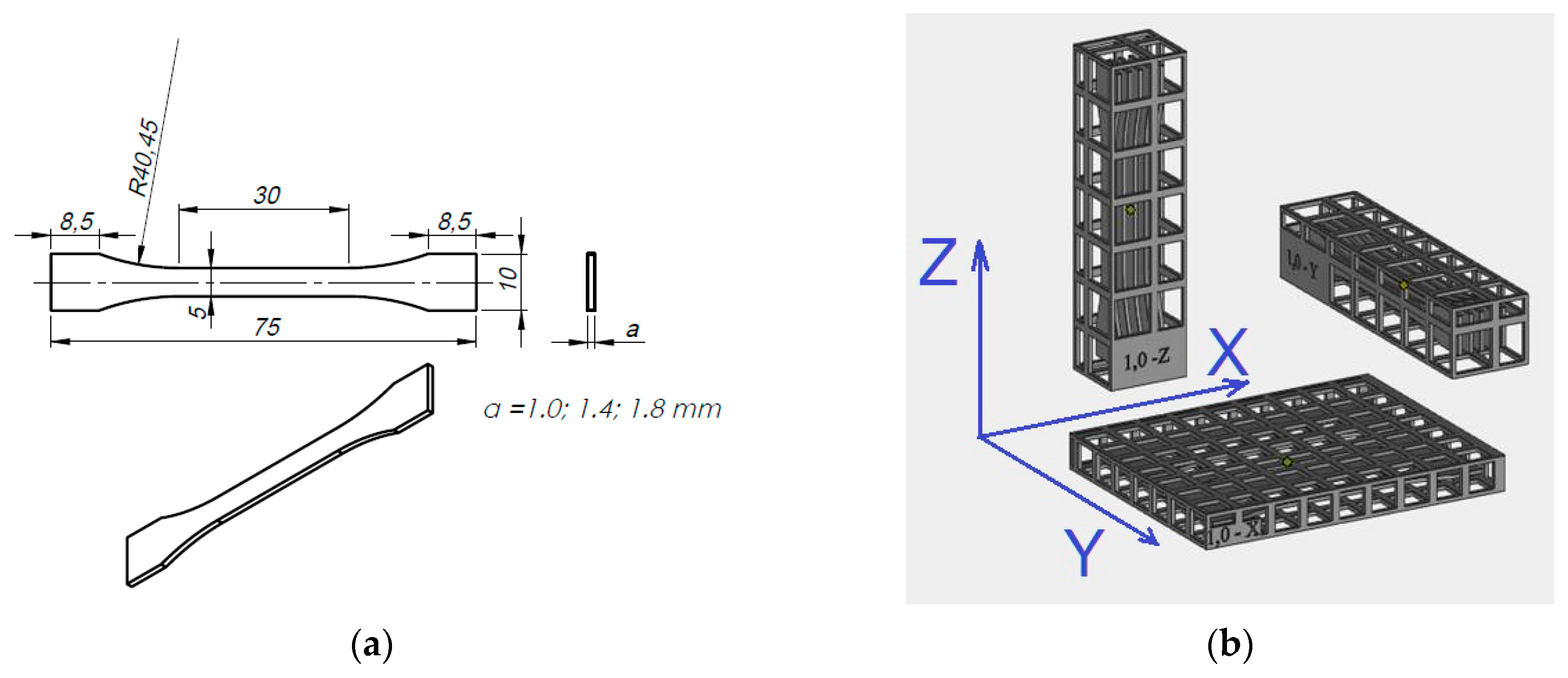
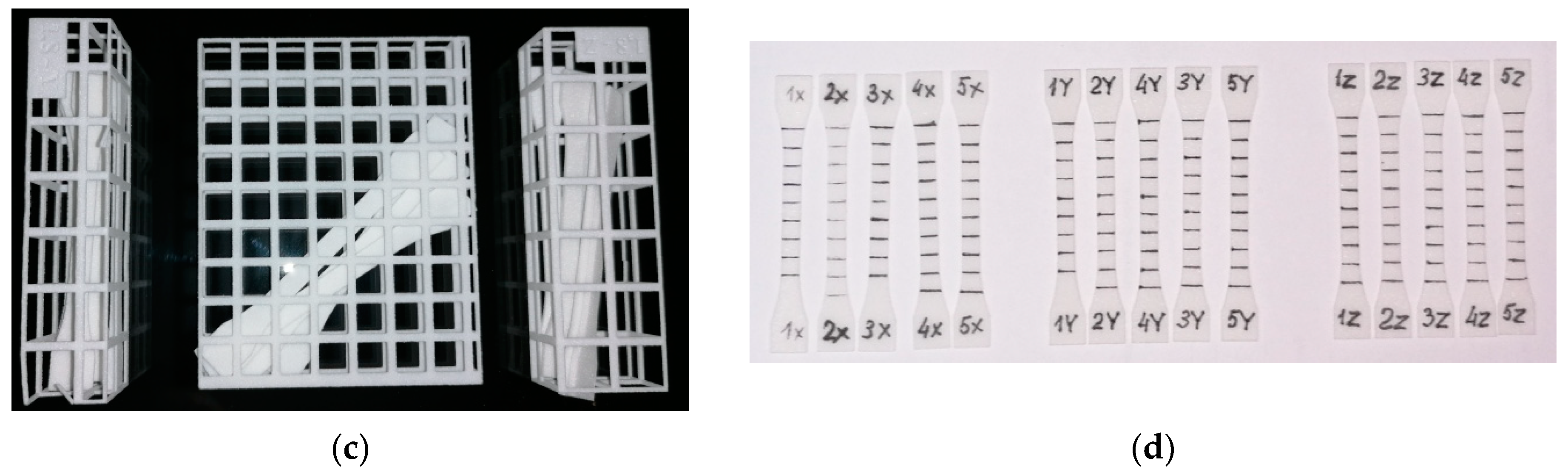
2.3. Preparation of SLS Samples
2.4. Tensile Test
- E—is the tensile modulus of elasticity, in MPa;
- —is the stress, in MPa, measured at the value of the relative elongation ;
- —is the stress, in MPa, measured at the value of the relative elongation .
3. Results
4. Discussion
- –
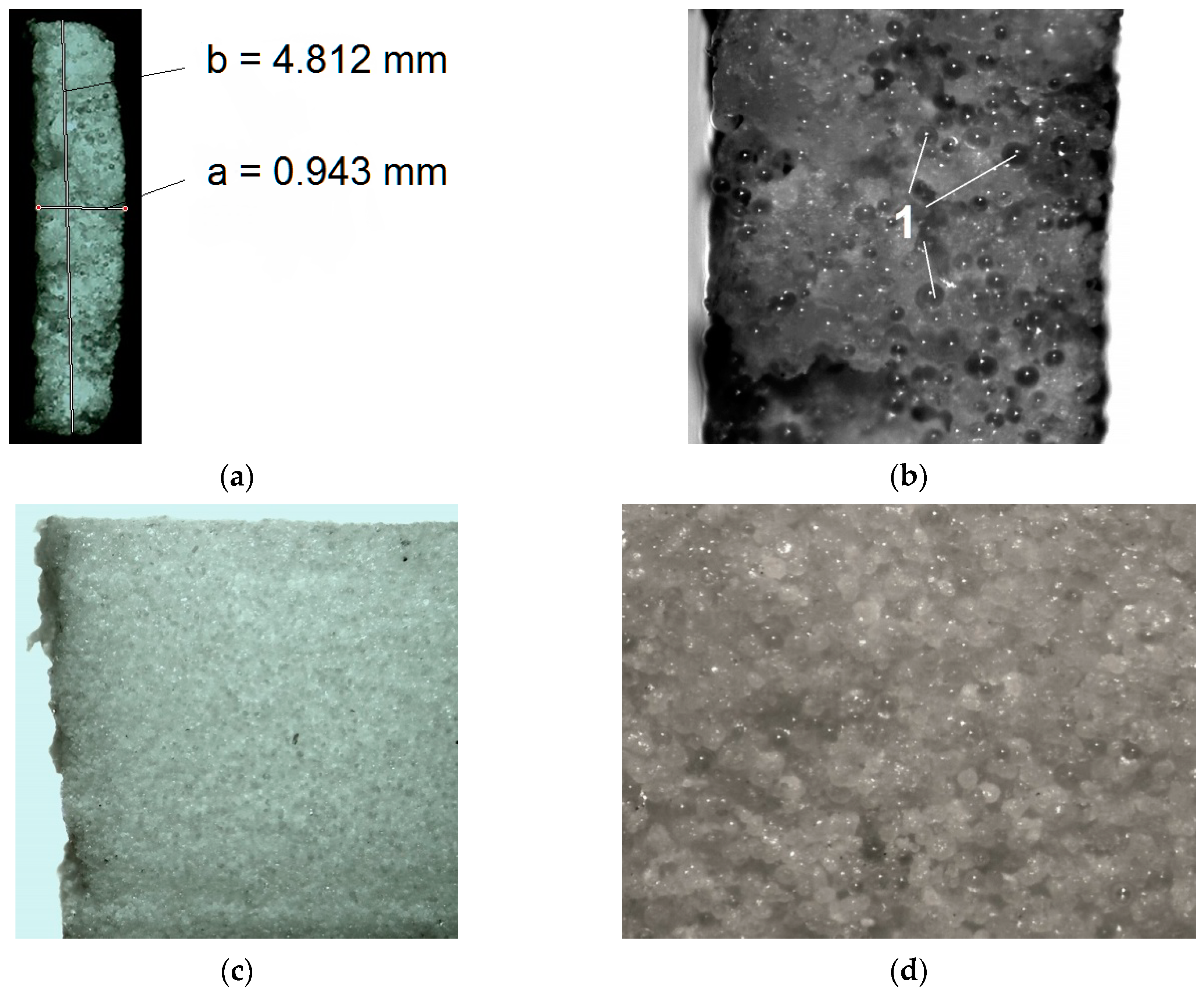
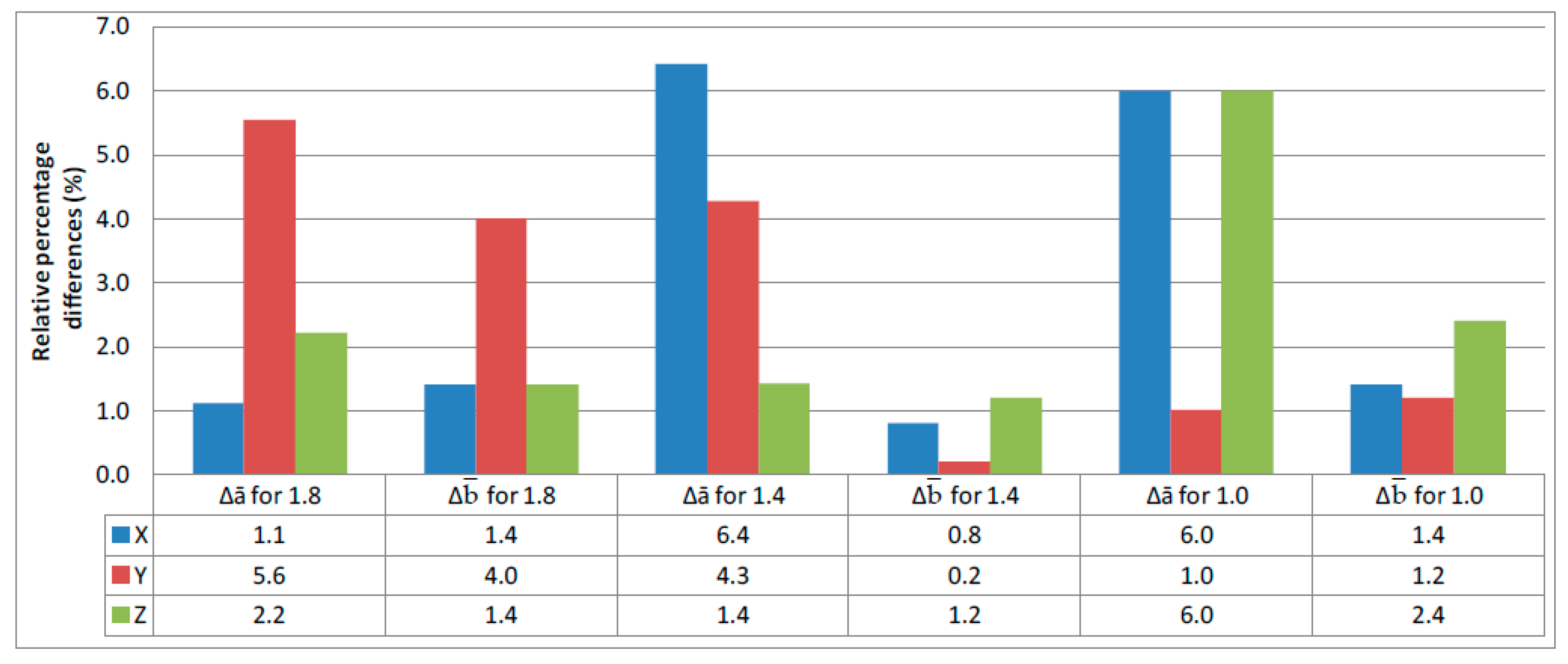
- Differences between the nominal (designed) dimensions of thin samples and the actual dimensions obtained by 3D printing (see Table 2), taking into account the orientation on the work platform;
- –
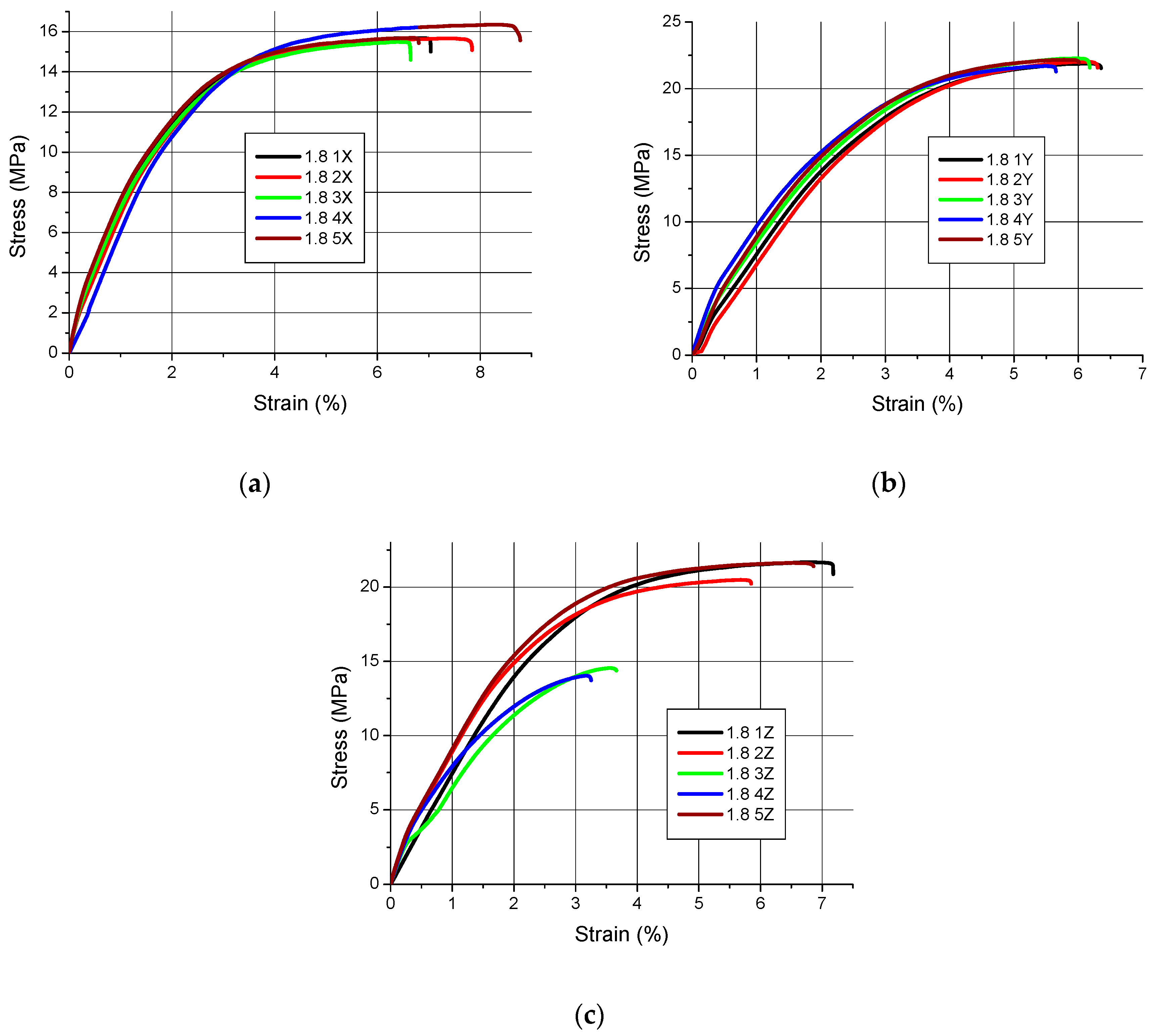
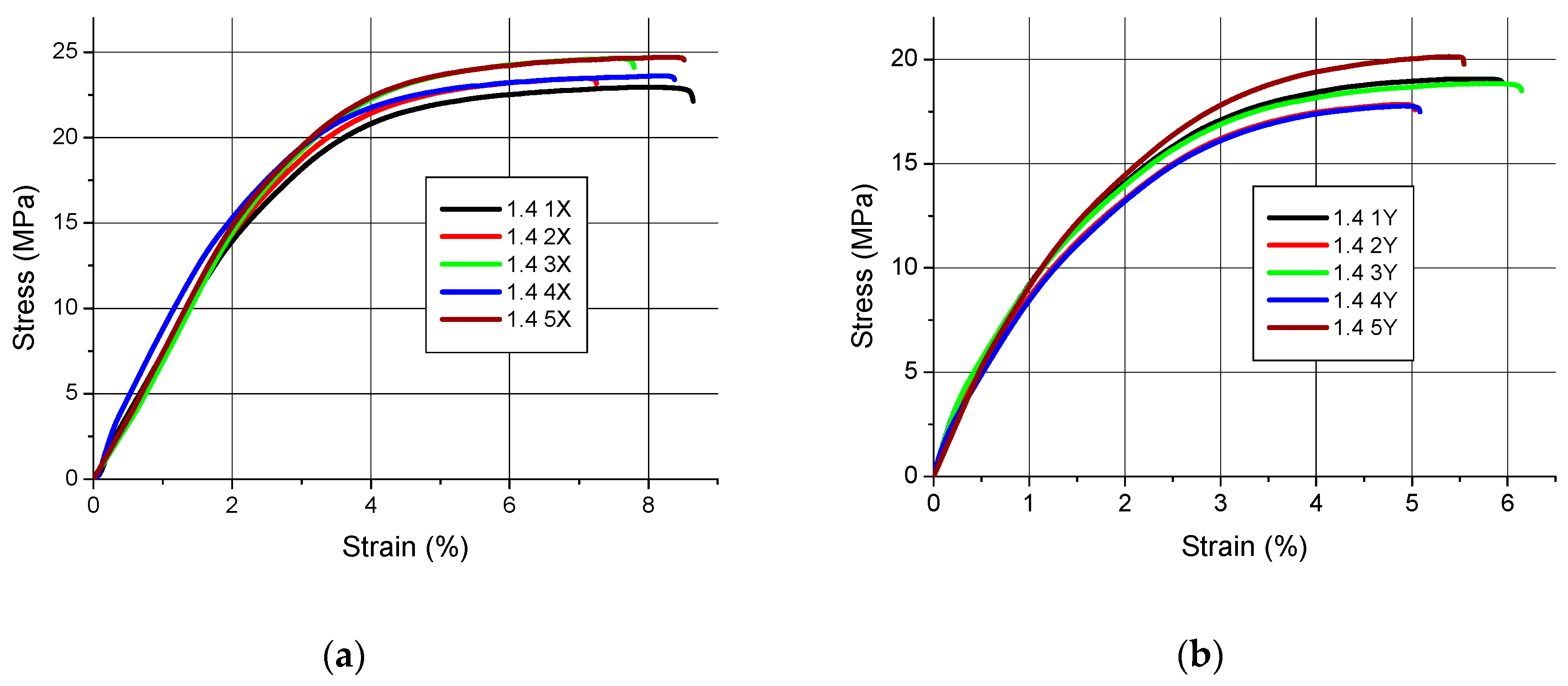
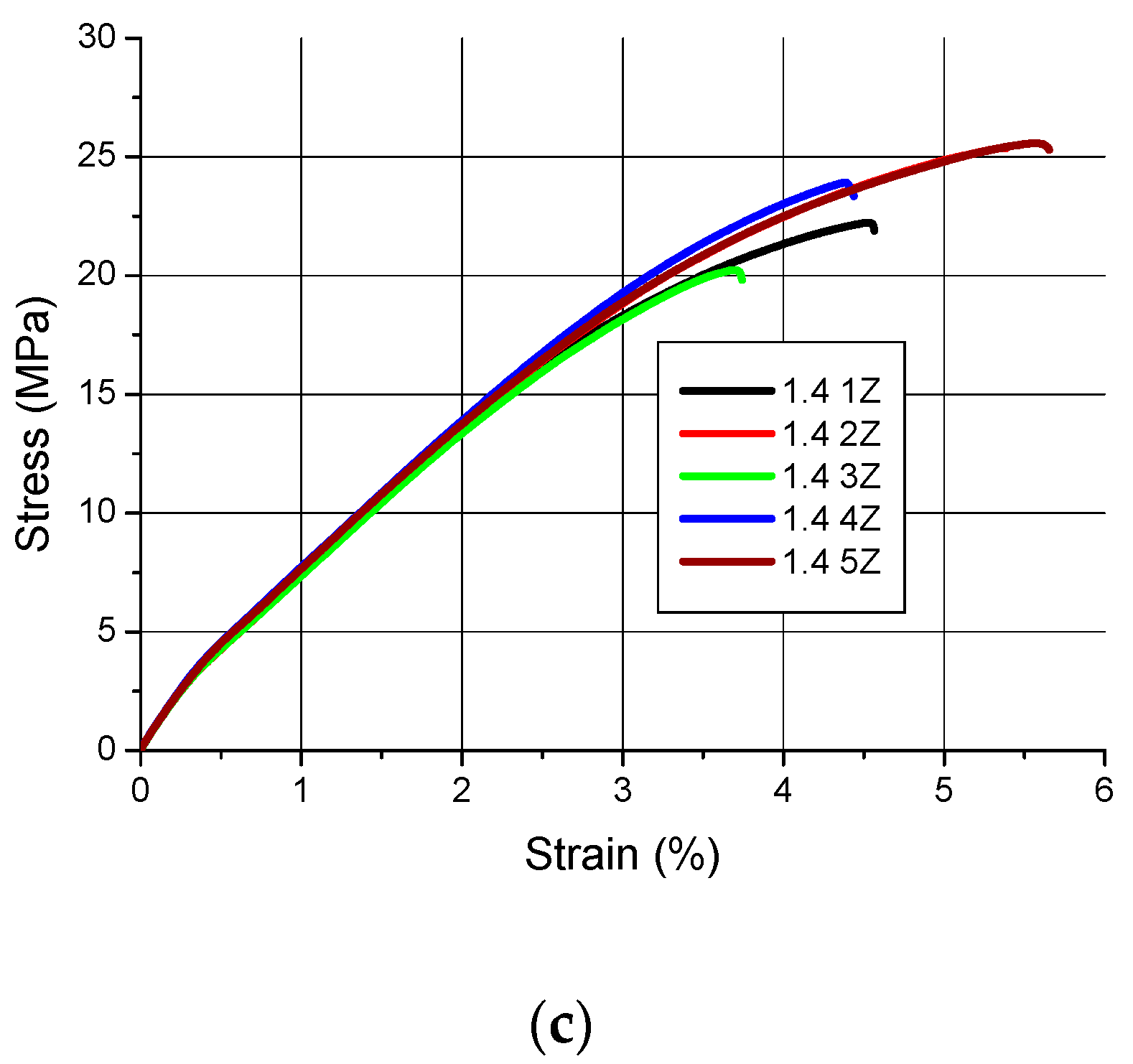
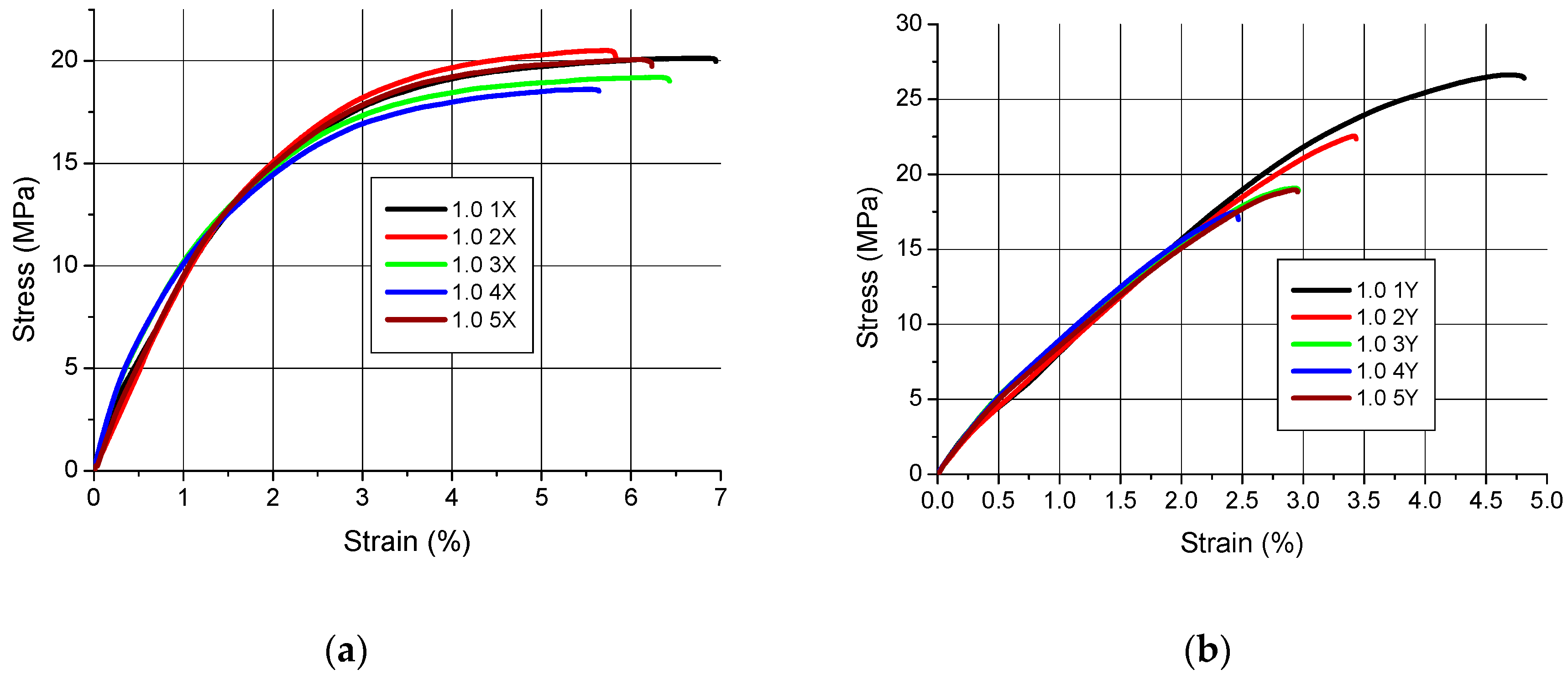
- Impact of the orientation of elements on the working platform on the strength Rm and the maximum percentage strain ɛm (Table 3).
5. Conclusions
Author Contributions
Funding
Conflicts of Interest
References
- Gibson, I.; Shi, D. Material properties and fabrication parameters in selective laser sintering process. Rapid Prototyp. J. 1997, 3, 129–136. [Google Scholar] [CrossRef]
- Feygin, M.; Shkolnik, A.; Diamond, M.N.; Dvorskiy, E. Laminated Object Manufacturing System. U.S. Patent 5,730,817A, 22 April 1996. [Google Scholar]
- Hull, C. Apparatus for Production of Three-Dimensional OBJECTS by stereolithography. U.S. Patent 4,575,330A, 11 March 1986. [Google Scholar]
- Crump, S. Apparatus and Method for Creating Three-Dimensional Objects. U.S. Patent 5,121,329A, 30 October 1989. [Google Scholar]
- Sachs, E.M.; Haggerty, J.S.; Cima, M.J.; Williams, P.A. Three-Dimensional Printing Techniques. U.S. Patent 5,204,055A, 20 April 1993. [Google Scholar]
- Deckard, C.R.; Beaman, J.J.; Darrah, J.F. Method for Selective Laser Sintering with Layerwise Cross-Scanning. U.S. Patent 5,155,324A, 17 October 1986. [Google Scholar]
- Pan, R.; Yang, L.; Zheng, L.; Hao, L.; Li, Y. Microscopic morphology, thermodynamic and mechanical properties of thermoplastic polyurethane fabricated by selective laser sintering. Mater. Res. Express 2020, 7, 55301. [Google Scholar] [CrossRef]
- Adamczak, S.; Zmarzły, P.; Kozior, T.; Gogolewski, D. Assessment of roundness and waviness deviations of elements produced by selective laser sintering. Eng. Mech. 2017, 2017, 70–73. [Google Scholar]
- Wang, Y.; Xu, Z.; Wu, D.; Bai, J. Current Status and Prospects of Polymer Powder 3D Printing Technologies. Materials 2020, 13, 2406. [Google Scholar] [CrossRef]
- Leuders, S.; Thöne, M.; Riemer, A.; Niendorf, T.; Tröster, T.; Richard, H.A.; Maier, H.J. On the mechanical behaviour of titanium alloy TiAl6V4 manufactured by selective laser melting: Fatigue resistance and crack growth performance. Int. J. Fatigue 2013, 48, 300–307. [Google Scholar] [CrossRef]
- Xiong, W.; Hao, L.; Li, Y.; Tang, D.; Cui, Q.; Feng, Z.; Yan, C. Effect of selective laser melting parameters on morphology, microstructure, densification and mechanical properties of supersaturated silver alloy. Mater. Des. 2019, 170. [Google Scholar] [CrossRef]
- Shishkovsky, I.; Yadroitsev, I.; Bertrand, P.; Smurov, I. Alumina–zirconium ceramics synthesis by selective laser sintering/melting. Appl. Surf. Sci. 2007, 254, 966–970. [Google Scholar] [CrossRef]
- Song, S.; Gao, Z.; Lu, B.; Bao, C.; Zheng, B.; Wang, L. Performance optimization of complicated structural SiC/Si composite ceramics prepared by selective laser sintering. Ceram. Int. 2020, 46, 568–575. [Google Scholar] [CrossRef]
- Hon, K.K.B.; Gill, T.J. Selective Laser Sintering of SiC/Polyamide Composites. CIRP Ann. 2003, 52, 173–176. [Google Scholar] [CrossRef]
- Bochnia, J.; Blasiak, S. Anisotrophy of mechanical properties of a material which is shaped incrementally using polyjet technology. Eng. Mech. 2016, 22, 70–77. [Google Scholar]
- Pilipović, A.; Valentan, B.; Brajlih, T.; Haramina, T.; Balić, J.; Kodvanj, J.; Sercer, M.; Drstvenśek, I. Influence of laser sintering parameters on mechanical properties of polymer products. In Proceedings of the 3rd International Conference on Additive Technologies, Nova Gorica, Slovenia, 22–24 September 2010; DAAAM International Vienna: Vienna, Austria, 2010. [Google Scholar]
- Wang, X.; Jiang, M.; Zhou, Z.; Gou, J.; Hui, D. 3D printing of polymer matrix composites: A review and prospective. Compos. Part B Eng. 2017, 110, 442–458. [Google Scholar] [CrossRef]
- Ligon, S.C.; Liska, R.; Stampfl, J.; Gurr, M.; Mülhaupt, R. Polymers for 3D Printing and Customized Additive Manufacturing. Chem. Rev. 2017, 117, 10212–10290. [Google Scholar] [CrossRef] [PubMed]
- Campbell, I.; Bourell, D.; Gibson, I. Additive manufacturing: Rapid prototyping comes of age. Rapid Prototyp. J. 2012, 18, 255–258. [Google Scholar] [CrossRef]
- Guo, N.; Leu, M.C. Additive manufacturing: Technology, applications and research needs. Front. Mech. Eng. 2013, 8, 215–243. [Google Scholar] [CrossRef]
- Javaid, M.; Haleem, A. Additive manufacturing applications in medical cases: A literature based review. Alex. J. Med. 2018, 54, 411–422. [Google Scholar] [CrossRef]
- Dikova, T.; Vasilev, T.; Dzhendov, D.; Ivanova, E. Investigation the fitting accuracy of cast and slm co-cr dental bridges using cad software. J. IMAB 2017, 23, 1688–1696. [Google Scholar] [CrossRef]
- Kozior, T.; Trabelsi, M.; Mamun, A.; Sabantina, L.; Ehrmann, A. Stabilization of Electrospun Nanofiber Mats Used for Filters by 3D Printing. Polymers 2019, 11, 1618. [Google Scholar] [CrossRef]
- Kozior, T.; Mamun, A.; Trabelsi, M.; Wortmann, M.; Lilia, S.; Ehrmann, A. Electrospinning on 3D Printed Polymers for Mechanically Stabilized Filter Composites. Polymers 2019, 11, 2034. [Google Scholar] [CrossRef]
- Kozior, T.; Mamun, A.; Trabelsi, M.; Sabantina, L.; Ehrmann, A. Quality of the Surface Texture and Mechanical Properties of FDM Printed Samples after Thermal and Chemical Treatment. J. Mech. Eng. 2020, 66, 105–113. [Google Scholar] [CrossRef]
- Dhakshyani, R.; Nukman, Y.; Osman Noor Azuan, A. FDM models and FEA in dysplastic hip. Rapid Prototyp. J. 2012, 18, 215–221. [Google Scholar] [CrossRef]
- Blachowicz, T.; Ehrmann, A. 3D Printed MEMS Technology-Recent Developments and Applications. Micromachines 2020, 11, 434. [Google Scholar] [CrossRef] [PubMed]
- Bochnia, J.; Blasiak, S. Stress Relaxation and Creep of a Polymer-Aluminum Composite Produced through Selective Laser Sintering. Polymers 2020, 12, 830. [Google Scholar] [CrossRef] [PubMed]
- Coniglio, N.; Sivarupan, T.; El Mansori, M. Investigation of process parameter effect on anisotropic properties of 3D printed sand molds. Int. J. Adv. Manuf. Technol. 2018, 94, 2175–2185. [Google Scholar] [CrossRef]
- Kozior, T.; Blachowicz, T.; Ehrmann, A. Adhesion of three-dimensional printing on textile fabrics: Inspiration from and for other research areas. J. Eng. Fibers Fabr. 2020, 15. [Google Scholar] [CrossRef]
- Grothe, T.; Brockhagen, B.; Storck, J.L. Three-dimensional printing resin on different textile substrates using stereolithography: A proof of concept. J. Eng. Fibers Fabr. 2020. [Google Scholar] [CrossRef]
- Petzold, S.; Klett, J.; Schauer, A.; Osswald, T.A. Surface roughness of polyamide 12 parts manufactured using selective laser sintering. Polym. Test. 2019, 80. [Google Scholar] [CrossRef]
- Kozior, T. The Influence of Selected Selective Laser Sintering Technology Process Parameters on Stress Relaxation, Mass of Models, and Their Surface Texture Quality. 3D Print. Addit. Manuf. 2020, 7, 126–138. [Google Scholar] [CrossRef]
- Kozior, T. Rheological Properties of Polyamide PA 2200 in SLS Technology. The. Vjesn. 2020, 27, 1092–1100. [Google Scholar] [CrossRef]
- Kozior, T.; Bochnia, J. The Influence of Printing Orientation on Surface Texture Parameters in Powder Bed Fusion Technology with 316L Steel. Micromachines 2020, 11, 639. [Google Scholar] [CrossRef]
- Kozior, T.; Bochnia, J.; Zmarzły, P.; Gogolewski, D.; Mathia, T.G. Waviness of Freeform Surface Characterizations from Austenitic Stainless Steel (316L) Manufactured by 3D Printing-Selective Laser Melting (SLM) Technology. Materials 2020, 13, 4372. [Google Scholar] [CrossRef]
- Melenka, G.W.; Cheung, B.K.O.; Schofield, J.S.; Dawson, M.R.; Carey, J.P. Evaluation and prediction of the tensile properties of continuous fiber-reinforced 3D printed structures. Compos. Struct. 2016, 153, 866–875. [Google Scholar] [CrossRef]
- Chung, H.; Das, S. Processing and properties of glass bead particulate-filled functionally graded Nylon-11 composites produced by selective laser sintering. Mater. Sci. Eng. A 2006, 437, 226–234. [Google Scholar] [CrossRef]
- Dizon, J.R.C.; Espera, A.H.; Chen, Q.; Advincula, R.C. Mechanical characterization of 3D-printed polymers. Addit. Manuf. 2018, 20, 44–67. [Google Scholar] [CrossRef]
- Schneider, J.; Kumar, S. Multiscale characterization and constitutive parameters identification of polyamide (PA12) processed via selective laser sintering. Polym. Test. 2020, 86. [Google Scholar] [CrossRef]
- Zmarzły, P.; Gogolewski, D.; Kozior, T. Design guidelines for plastic casting using 3D printing. J. Eng. Fibers Fabr. 2020, 15. [Google Scholar] [CrossRef]
- Zmarzły, P.; Kozior, T.; Gogolewski, D. Dimensional and Shape Accuracy of Foundry Patterns Fabricated Through Photo-Curing. Teh. Vjesn. 2019, 26, 1576–1584. [Google Scholar] [CrossRef]
- Formiga P100. User Manual EOS; Formiga P100: Munich, Germany, 2008. [Google Scholar]
- Bochnia, J. Selected Physical Properties of Materials Obtained with Additive Technologies; Kielce University of Technology: Kielce, Poland, 2018. (In Polish) [Google Scholar]
- Geng, L.C.; Ruan, X.L.; Wu, W.W.; Xia, R.; Fang, D.N. Mechanical Properties of Selective Laser Sintering (SLS) Additive Manufactured Chiral Auxetic Cylindrical Stent. Exp. Mech. 2019, 59, 913–925. [Google Scholar] [CrossRef]
- Laureto, J.J.; Pearce, J.M. Anisotropic mechanical property variance between ASTM D638-14 type i and type iv fused filament fabricated specimens. Polym. Test. 2018, 68, 294–301. [Google Scholar] [CrossRef]



| Mechanical Properties | Value | Unit | Test Standard |
|---|---|---|---|
| Tensile Modulus | 3200 | MPa | ISO 527 |
| Tensile Strength | 51 | MPa | ISO 527 |
| Strain at break | 9 | % | ISO 527 |
| Charpy impact strength (+23 °C) | 35 | kJ/m2 | ISO 179/1eU |
| Charpy notched impact strength (+23 °C) | 5.4 | kJ/m2 | ISO 179/1eA |
| Flexural modulus (23 °C) | 2900 | MPa | ISO 178 |
| Flexural Strength | 73 | MPa | ISO 178 |
| Izod notched impact strength (+23 °C) | 4.2 | kJ/m2 | ISO 180/1A |
| Izod impact strength (+23 °C) | 21 | kJ/m2 | ISO 180/1U |
| Shore D hardness | 80 | - | ISO 7619-1 |
| Ball indentation hardness | 98 | MPa | ISO 2039-1 |
| Designation of the Samples | (mm) | (mm) | Designation of the Samples | (mm) | (mm) | Designation of the Samples | (mm) | (mm) |
|---|---|---|---|---|---|---|---|---|
| 1.8 1X | 1.83 | 4.94 | 1.4 1X | 1.31 | 4.96 | 1.0 1X | 1.05 | 4.93 |
| 1.8 2X | 1.82 | 4.93 | 1.4 2X | 1.31 | 4.97 | 1.0 2X | 1.06 | 4.92 |
| 1.8 3X | 1.82 | 4.93 | 1.4 3X | 1.31 | 4.95 | 1.0 3X | 1.07 | 4.93 |
| 1.8 4X | 1.82 | 4.93 | 1.4 4X | 1.31 | 4.95 | 1.0 4X | 1.06 | 4.93 |
| 1.8 5X | 1.82 | 4.93 | 1.4 5X | 1.31 | 4.95 | 1.0 5X | 1.06 | 4.94 |
| 1.82 | 4.93 | 1.31 | 4.96 | 1.06 | 4.93 | |||
| SD | 0.0045 | 0.0045 | SD | 0 | 0.0089 | SD | 0.0071 | 0.0071 |
| 1.4 1Y | 1.67 | 4.8 | 1.4 1Y | 1.35 | 4.99 | 1.0 1Y | 0.99 | 4.93 |
| 1.4 2Y | 1.71 | 4.8 | 1.4 2Y | 1.34 | 5 | 1.0 2Y | 1 | 4.95 |
| 1.4 3Y | 1.73 | 4.79 | 1.4 3Y | 1.34 | 4.99 | 1.0 3Y | 0.98 | 4.92 |
| 1.4 4Y | 1.72 | 4.8 | 1.4 4Y | 1.32 | 4.97 | 1.0 4Y | 0.98 | 4.95 |
| 1.4 5Y | 1.69 | 4.8 | 1.4 5Y | 1.34 | 4.98 | 1.0 5Y | 0.98 | 4.93 |
| 1.70 | 4.80 | 1.34 | 4.99 | 0.99 | 4.94 | |||
| SD | 0.0241 | 0.0045 | SD | 0.011 | 0.0114 | SD | 0.0089 | 0.0134 |
| 1 1Z | 1.77 | 4.98 | 1.4 1Z | 1.36 | 4.93 | 1.0 1Z | 0.95 | 4.86 |
| 1 2Z | 1.79 | 4.95 | 1.4 2Z | 1.39 | 4.95 | 1.0 2Z | 0.95 | 4.88 |
| 1 3Z | 1.75 | 4.87 | 1.4 3Z | 1.38 | 4.94 | 1.0 3Z | 0.94 | 4.89 |
| 1 4Z | 1.74 | 4.89 | 1.4 4Z | 1.37 | 4.94 | 1.0 4Z | 0.93 | 4.89 |
| 1 5Z | 1.75 | 4.95 | 1.4 5Z | 1.40 | 4.95 | 1.0 5Z | 0.95 | 4.88 |
| 1.76 | 4.93 | 1.38 | 4.94 | 0.94 | 4.88 | |||
| SD | 0.02 | 0.0460 | SD | 0.0158 | 0.0084 | SD | 0.01 | 0.0123 |
| Designation of the Samples | Rm (MPa) | ɛm (%) | Designation of the Samples | Rm (MPa) | ɛm (%) | Designation of the Samples | Rm (MPa) | ɛm (%) |
|---|---|---|---|---|---|---|---|---|
| 1.8 1X | 15.69 | 6.8 | 1.4 1X | 22.96 | 8.6 | 1.0 1X | 20.14 | 6.9 |
| 1.8 2X | 15.67 | 8.8 | 1.4 2X | 23.48 | 7.2 | 1.0 2X | 20.51 | 5.8 |
| 1.8 3X | 15.49 | 6.6 | 1.4 3X | 24.65 | 7.8 | 1.0 3X | 19.19 | 6.4 |
| 1.8 4X | 16.35 | 7.8 | 1.4 4X | 23.62 | 8.4 | 1.0 4X | 18.61 | 5.6 |
| 1.8 5X | 15.70 | 7.0 | 1.4 5X | 24.71 | 8.5 | 1.0 5X | 20.06 | 6.2 |
| 15.78 | 7.4 | 23.88 | 8.1 | 19.7 | 6.2 | |||
| SD | 0.33 | 0.91 | SD | 1.53 | 1.2 | SD | 1.56 | 1.0 |
| 1.8 1Y | 21.89 | 6.0 | 1.4 1Y | 19.07 | 5.9 | 1.0 1Y | 26.62 | 4.8 |
| 1.8 2Y | 22.02 | 5.7 | 1.4 2Y | 17.85 | 5.0 | 1.0 2Y | 22.55 | 3.4 |
| 1.8 3Y | 22.27 | 6.2 | 1.4 3Y | 18.86 | 6.1 | 1.0 3Y | 19.08 | 3.0 |
| 1.8 4Y | 21.70 | 6.3 | 1.4 4Y | 17.77 | 5.1 | 1.0 4Y | 17.46 | 2.5 |
| 1.8 5Y | 22.17 | 6.4 | 1.4 5Y | 20.14 | 5.5 | 1.0 5Y | 18.95 | 3.0 |
| 22.01 | 6.1 | 18.74 | 5.5 | 20.93 | 3.3 | |||
| SD | 0.45 | 0.56 | SD | 1.95 | 0.96 | SD | 7.37 | 1.75 |
| 1.8 1Z | 21.67 | 7.2 | 1.4 1Z | 22.23 | 4.6 | 1.0 1Z | 17.28 | 4.6 |
| 1.8 2Z | 20.49 | 5.8 | 1.4 2Z | 25.38 | 5.4 | 1.0 2Z | 18.12 | 6.6 |
| 1.8 3Z | 14.54 * | 3.7 * | 1.4 3Z | 20.23 | 3.7 | 1.0 3Z | 16.87 | 6.1 |
| 1.8 4Z | 14.03 * | 3.3 * | 1.4 4Z | 23.91 | 4.4 | 1.0 4Z | 14.05 * | 5.0 * |
| 1.8 5Z | 21.63 | 6.9 | 1.4 5Z | 25.58 | 5.7 | 1.0 5Z | 17.88 | 6.6 |
| 21.26 | 6.6 | 23.47 | 4.8 | 17.54 | 6.0 | |||
| SD | 0.95 | 1.04 | SD | 4.51 | 0.36 | SD | 1.71 | 2.4 |
| Designation of the Samples | E (MPa) | Designation of the Samples | E (MPa) | Designation of the Samples | E (MPa) |
|---|---|---|---|---|---|
| 1.8 1X | 1071 | 1.4 1X | 895 | 1.0 1X | 1272 |
| 1.8 2X | 845 | 1.4 2X | 677 | 1.0 2X | 960 |
| 1.8 3X | 968 | 1.4 3X | 641 | 1.0 3X | 1476 |
| 1.8 4X | 528 * | 1.4 4X | 1193 | 1.0 4X | 1481 |
| 1.8 5X | 1070 | 1.4 5X | 912 | 1.0 5X | 1221 |
| 988 | 864 | 1282 | |||
| SD | 107 | SD | 221 | SD | 214 |
| 1.8 1Y | 1027 | 1.4 1Y | 1304 | 1.0 1Y | 1082 |
| 1.8 2Y | 529 * | 1.4 2Y | 1230 | 1.0 2Y | 977 |
| 1.8 3Y | 1126 | 1.4 3Y | 1318 | 1.0 3Y | 1102 |
| 1.8 4Y | 1390 | 1.4 4Y | 1059 | 1.0 4Y | 1071 |
| 1.8 5Y | 1133 | 1.4 5Y | 1049 | 1.0 5Y | 1067 |
| 1169 | 1192 | 1059 | |||
| SD | 155 | SD | 130 | SD | 48 |
| 1.8 1Z | 759 * | 1.4 1Z | 973 | 1.0 1Z | 1530 |
| 1.8 2Z | 1274 | 1.4 2Z | 950 | 1.0 2Z | 1365 |
| 1.8 3Z | 1003 | 1.4 3Z | 946 | 1.0 3Z | 1485 |
| 1.8 4Z | 1139 | 1.4 4Z | 996 | 1.0 4Z | 1274 |
| 1.8 5Z | 1249 | 1.4 5Z | 971 | 1.0 5Z | 1403 |
| 1166 | 967 | 1411 | |||
| SD | 123 | SD | 20 | SD | 100 |
Publisher’s Note: MDPI stays neutral with regard to jurisdictional claims in published maps and institutional affiliations. |
© 2020 by the authors. Licensee MDPI, Basel, Switzerland. This article is an open access article distributed under the terms and conditions of the Creative Commons Attribution (CC BY) license (http://creativecommons.org/licenses/by/4.0/).
Share and Cite
Bochnia, J.; Blasiak, M.; Kozior, T. Tensile Strength Analysis of Thin-Walled Polymer Glass Fiber Reinforced Samples Manufactured by 3D Printing Technology. Polymers 2020, 12, 2783. https://doi.org/10.3390/polym12122783
Bochnia J, Blasiak M, Kozior T. Tensile Strength Analysis of Thin-Walled Polymer Glass Fiber Reinforced Samples Manufactured by 3D Printing Technology. Polymers. 2020; 12(12):2783. https://doi.org/10.3390/polym12122783
Chicago/Turabian StyleBochnia, Jerzy, Malgorzata Blasiak, and Tomasz Kozior. 2020. "Tensile Strength Analysis of Thin-Walled Polymer Glass Fiber Reinforced Samples Manufactured by 3D Printing Technology" Polymers 12, no. 12: 2783. https://doi.org/10.3390/polym12122783
APA StyleBochnia, J., Blasiak, M., & Kozior, T. (2020). Tensile Strength Analysis of Thin-Walled Polymer Glass Fiber Reinforced Samples Manufactured by 3D Printing Technology. Polymers, 12(12), 2783. https://doi.org/10.3390/polym12122783