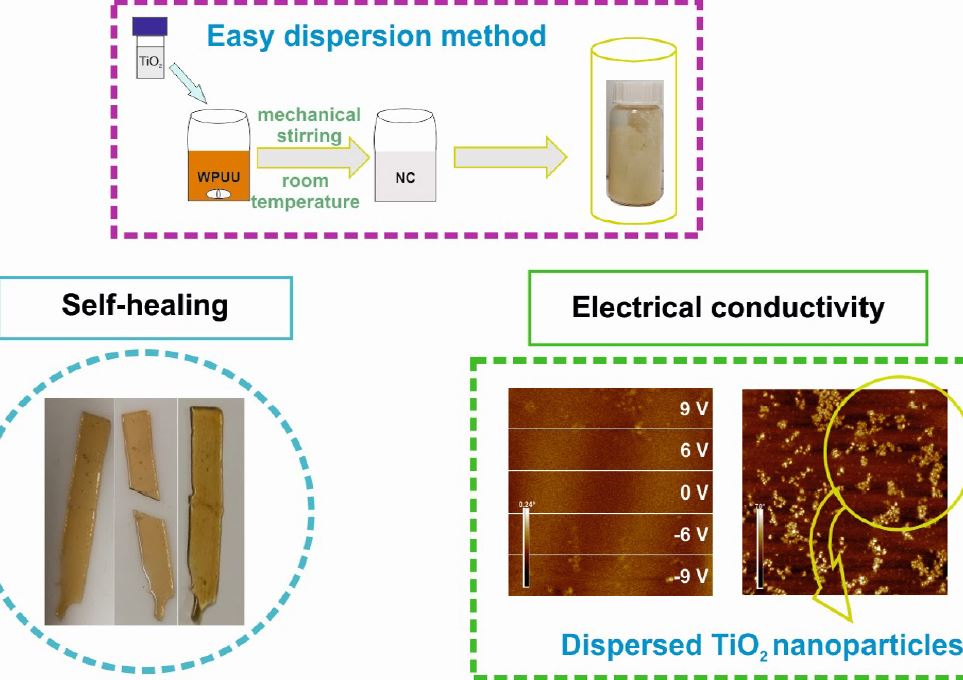
Improvement of Mechanical Properties and Self-Healing Efficiency by Ex-Situ Incorporation of TiO2 Nanoparticles to a Waterborne Poly(Urethane-Urea)




Abstract
1. Introduction
2. Experimental Methods
2.1. Materials
2.2. Synthesis of the Waterborne Poly(Urethane-Urea)
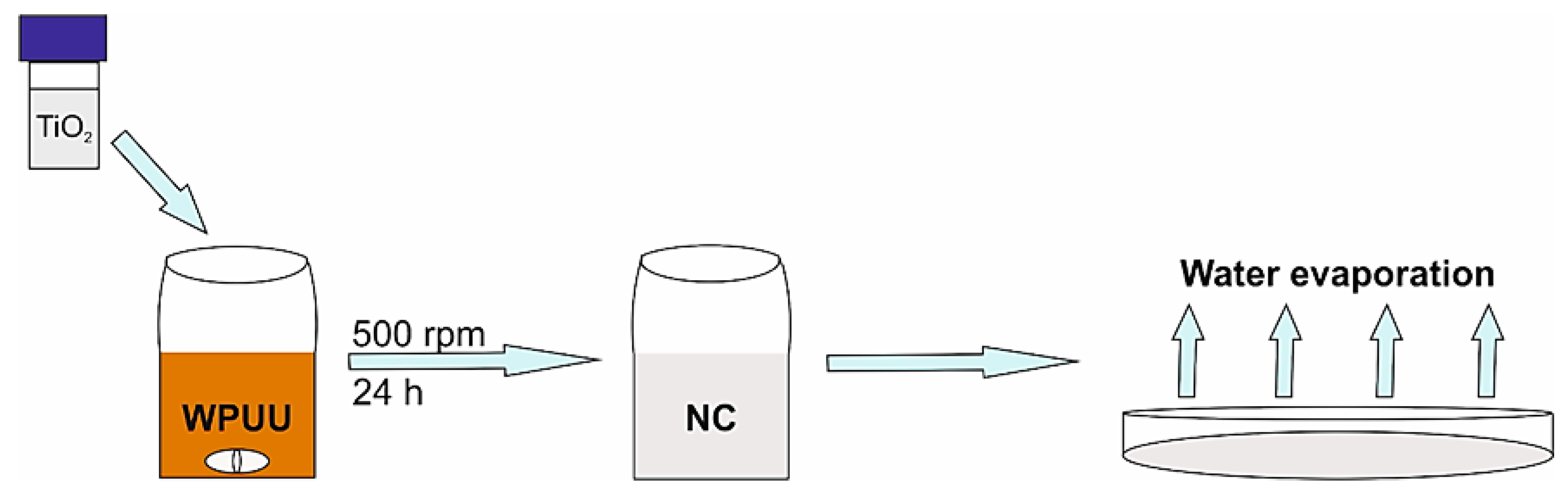
2.3. Preparation of Nanocomposites Films
2.4. Characterization Techniques
2.4.1. Solid Content
2.4.2. Fourier Transform Infrared Spectroscopy
2.4.3. Differential Scanning Calorimetry
2.4.4. Thermogravimetric Analysis
2.4.5. Atomic Force Microscopy
2.4.6. Optical Microscopy
2.4.7. Mechanical Testing/Self-Healing Ability
2.4.8. Contact Angle/Self-Healing
2.4.9. Electrostatic Force Microscopy
3. Results and Discussion
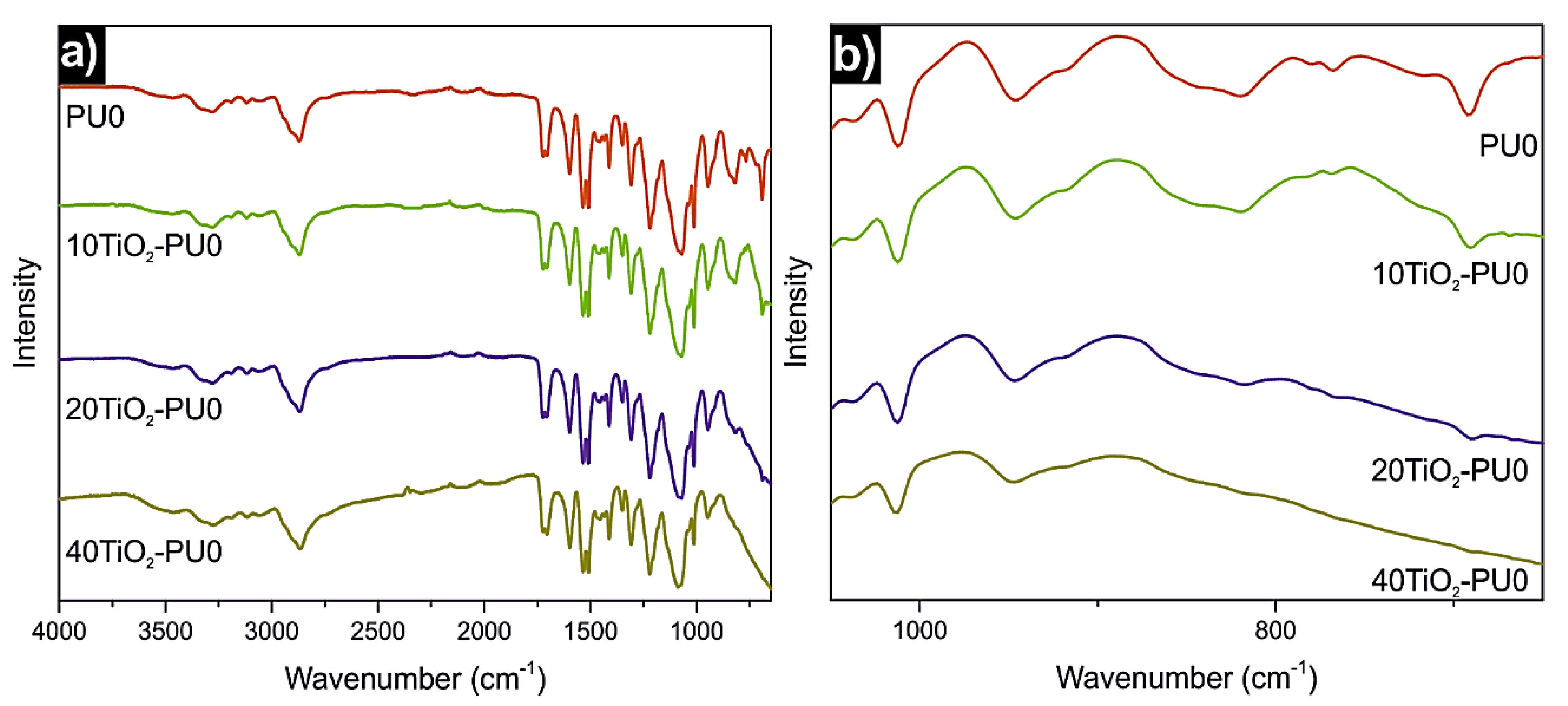
3.1. FTIR Spectra
3.2. Thermal Characterization and Stability
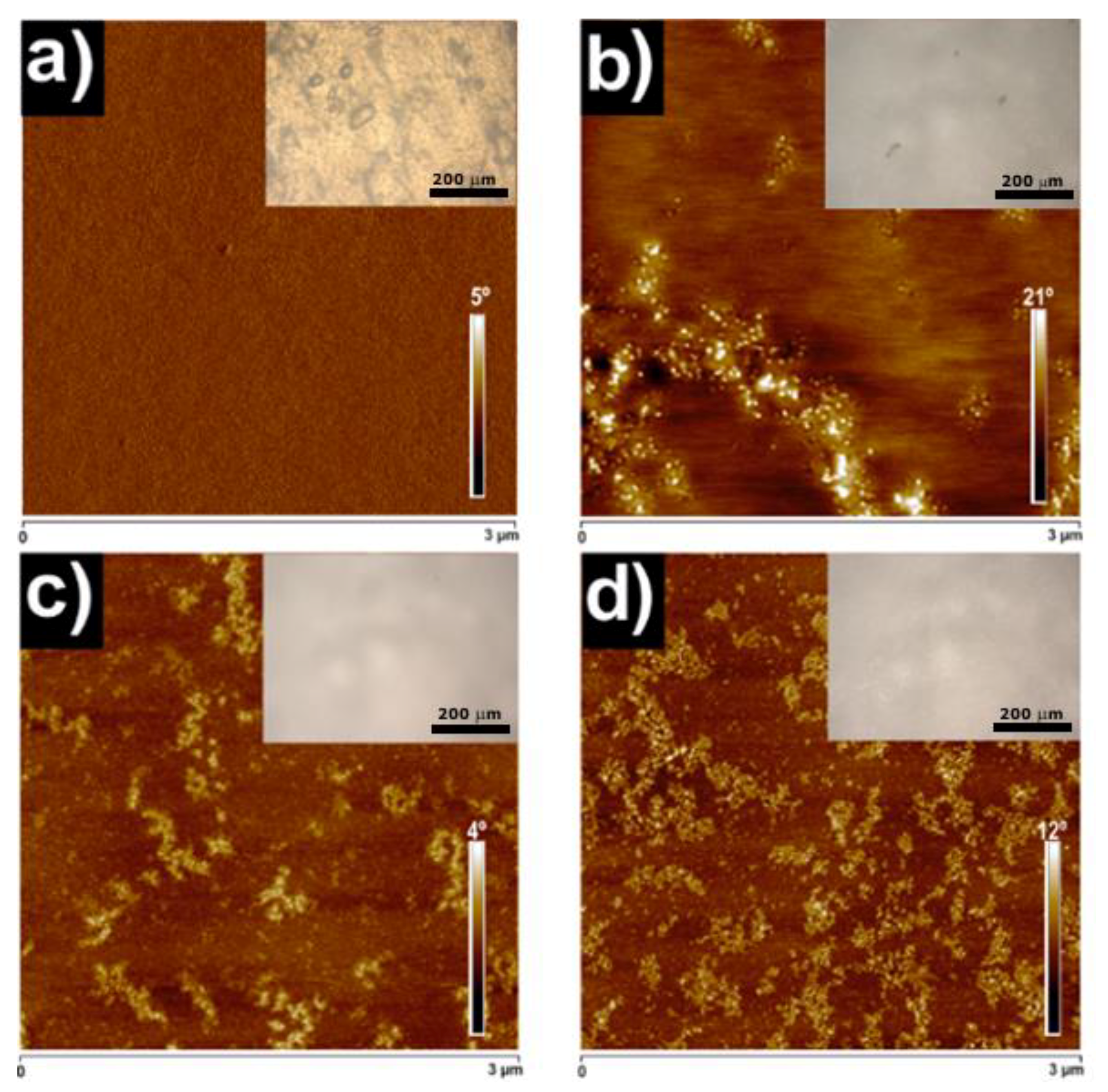
3.3. Morphology
3.4. Mechanical Properties
3.5. Self-Healing
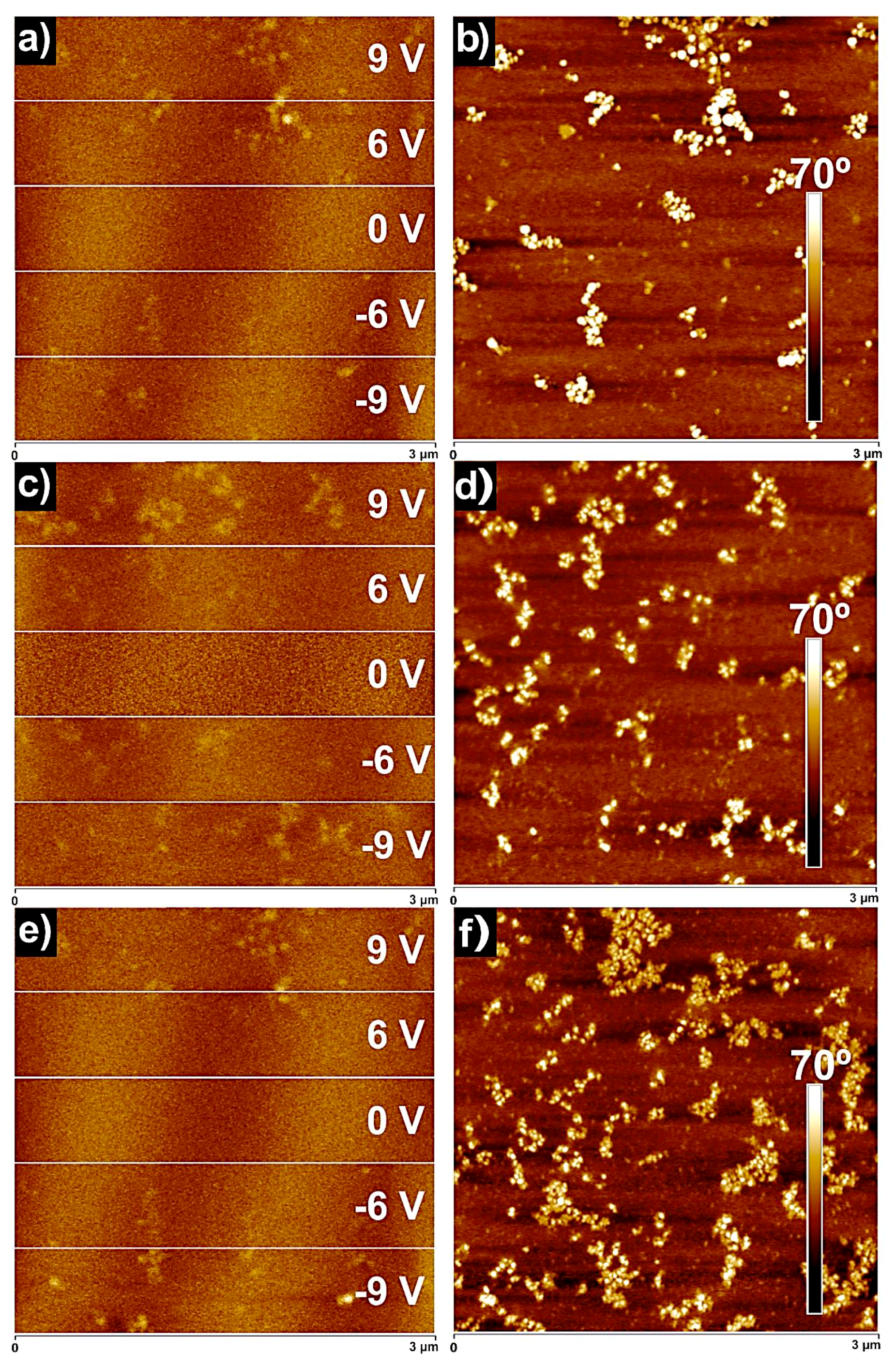
3.6. Electrostatic Force Microscopy
4. Conclusions
Supplementary Materials
Author Contributions
Funding
Acknowledgments
Conflicts of Interest
References
- Huang, F.; Zheng, W.; Tahmasbi Rad, A.; Nieh, M.P.; Cornelius, C.J. SiO2-TiO2-PBC nanocomposite film morphology, solvent swelling, estimated χ parameter, and liquid transport. Polymer 2017, 123, 247–257. [Google Scholar] [CrossRef]
- Zhao, L.; Yu, J. Controlled synthesis of highly dispersed TiO2 nanoparticles using SBA-15 as hard template. J. Colloid Interface Sci. 2006, 304, 84–91. [Google Scholar] [CrossRef] [PubMed]
- Gutierrez, J.; Tercjak, A.; Mondragon, I. Conductive behavior of high TiO2 nanoparticle content of inorganic/organic nanostructured composites. J. Am. Chem. Soc. 2010, 132, 873–878. [Google Scholar] [CrossRef] [PubMed]
- Zhai, L.; Wang, Y.; Peng, F.; Xiong, Z.; Liu, R.; Yuan, J.; Lan, Y. Synthesis of TiO2-SiO2/waterborne polyurethane hybrid with amino-siloxane terminated via a sol-gel process. Mater. Lett. 2012, 89, 81–85. [Google Scholar] [CrossRef]
- Ma, X.Y.; Zhang, W.D. Effects of flower-like ZnO nanowhiskers on the mechanical, thermal and antibacterial properties of waterborne polyurethane. Polym. Degrad. Stab. 2009, 94, 1103–1109. [Google Scholar] [CrossRef]
- Zhong, Z.; Luo, S.; Yang, K.; Wu, X.; Ren, T. High-performance anionic waterborne polyurethane/Ag nanocomposites with excellent antibacterial property via in situ synthesis of Ag nanoparticles. RSC Adv. 2017, 7, 42296–42304. [Google Scholar] [CrossRef]
- Yang, C.H.; Liu, F.J.; Liu, Y.P.; Liao, W.T. Hybrids of colloidal silica and waterborne polyurethane. J. Colloid Interface Sci. 2006, 302, 123–132. [Google Scholar] [CrossRef]
- Behniafar, H.; Alimohammadi, M.; Malekshahinezhad, K. Transparent and flexible films of new segmented polyurethane nanocomposites incorporated by NH2-functionalized TiO2 nanoparticles. Prog. Org. Coat. 2015, 88, 150–154. [Google Scholar] [CrossRef]
- Li, K.; Peng, J.; Zhang, M.; Heng, J.; Li, D.; Mu, C. Comparative study of the effects of anatase and rutile titanium dioxide nanoparticles on the structure and properties of waterborne polyurethane. Colloids Surfaces A Physicochem. Eng. Asp. 2015, 470, 92–99. [Google Scholar] [CrossRef]
- Han, J.G.; Xiang, Y.Q.; Zhu, Y. New Antibacterial composites: Waterborne polyurethane/gold nanocomposites synthesized via self-emulsifying method. J. Inorg. Organomet. Polym. Mater. 2014, 24, 283–290. [Google Scholar] [CrossRef]
- Lin, S.C.; Ma, C.C.M.; Hsiao, S.T.; Wang, Y.S.; Yang, C.Y.; Liao, W.H.; Li, S.M.; Wang, J.A.; Cheng, T.Y.; Lin, C.W.; et al. Electromagnetic interference shielding performance of waterborne polyurethane composites filled with silver nanoparticles deposited on functionalized graphene. Appl. Surf. Sci. 2016, 385, 436–444. [Google Scholar] [CrossRef]
- Song, W.; Wang, B.; Fan, L.; Ge, F.; Wang, C. Graphene oxide/waterborne polyurethane composites for fine pattern fabrication and ultrastrong ultraviolet protection cotton fabric via screen printing. Appl. Surf. Sci. 2019, 463, 403–411. [Google Scholar] [CrossRef]
- Cakić, S.M.; Ristić, I.S.; Cincović, M.M.; Stojiljković, D.T.; Budinski-Simendić, J.K. Preparation and characterization of waterborne polyurethane/silica hybrid dispersions from castor oil polyols obtained by glycolysis poly (ethylene terephthalate) waste. Int. J. Adhes. Adhes. 2016, 70, 329–341. [Google Scholar] [CrossRef]
- Hendessi, S.; Sevinis, E.B.; Unal, S.; Cebeci, F.C.; Menceloglu, Y.Z.; Unal, H. Antibacterial sustained-release coatings from halloysite nanotubes/waterborne polyurethanes. Prog. Org. Coat. 2016, 101, 253–261. [Google Scholar] [CrossRef]
- Gao, X.; Zhu, Y.; Zhou, S.; Gao, W.; Wang, Z.; Zhou, B. Preparation and characterization of well-dispersed waterborne polyurethane/CaCO3 nanocomposites. Colloids Surfaces A Physicochem. Eng. Asp. 2011, 377, 312–317. [Google Scholar] [CrossRef]
- Zhang, S.; Li, Y.; Peng, L.; Li, Q.; Chen, S.; Hou, K. Synthesis and characterization of novel waterborne polyurethane nanocomposites with magnetic and electrical properties. Compos. Part A 2013, 55, 94–101. [Google Scholar] [CrossRef]
- Charpentier, P.A.; Burgess, K.; Wang, L.; Chowdhury, R.R.; Lotus, A.F.; Moula, G. Nano-TiO2/polyurethane composites for antibacterial and self-cleaning coatings. Nanotechnology 2012, 23, 425606/1–425606/9. [Google Scholar] [CrossRef]
- Yaghoubi, H.; Dayerizadeh, A.; Han, S.; Mulaj, M.; Gao, W.; Li, X.; Muschol, M.; Ma, S.; Takshi, A. The effect of surfactant-free TiO2 surface hydroxyl groups on physicochemical, optical and self-cleaning properties of developed coatings on polycarbonate. J. Phys. D Appl. Phys. 2013, 46, 505316/1–505316/10. [Google Scholar] [CrossRef]
- Chen, X.D.; Wang, Z.; Liao, Z.F.; Mai, Y.L.; Zhang, M.Q. Roles of anatase and rutile TiO2 nanoparticles in photooxidation of polyurethane. Polym. Test. 2007, 26, 202–208. [Google Scholar] [CrossRef]
- Abdal-hay, A.; Mousa, H.M.; Khan, A.; Vanegas, P.; Lim, J.H. TiO2 nanorods coated onto nylon 6 nanofibers using hydrothermal treatment with improved mechanical properties. Colloids Surfaces A Physicochem. Eng. Asp. 2014, 457, 275–281. [Google Scholar] [CrossRef]
- Fujishima, A.; Honda, K. Electrochemical photolysis of water at a semiconductor electrode. Nature 1972, 238, 37–38. [Google Scholar] [CrossRef]
- Wan, T.; Chen, D. Synthesis and properties of self-healing waterborne polyurethanes containing disulfide bonds in the main chain. J. Mater. Sci. 2017, 52, 197–207. [Google Scholar] [CrossRef]
- Bekas, D.G.; Tsirka, K.; Baltzis, D.; Paipetis, A.S. Self-healing materials: A review of advances in materials, evaluation, characterization and monitoring techniques. Compos. Part B 2016, 87, 92–119. [Google Scholar] [CrossRef]
- Garcia, S.J. Effect of polymer architecture on the intrinsic self-healing character of polymers. Eur. Polym. J. 2014, 53, 118–125. [Google Scholar] [CrossRef]
- Yuan, C.; Rong, M.Z.; Zhang, M.Q. Self-healing polyurethane elastomer with thermally reversible alkoxyamines as crosslinkages. Polymer 2014, 55, 1782–1791. [Google Scholar] [CrossRef]
- Xiao, Y.; Huang, H.; Peng, X. Synthesis of self-healing waterborne polyurethanes containing sulphonate groups. RSC Adv. 2017, 7, 20093–20100. [Google Scholar] [CrossRef]
- Gao, L.; He, J.; Hu, J.; Wang, C. Photoresponsive self-healing polymer composite with photoabsorbing hybrid microcapsules. ACS Appl. Mater. Interfaces 2015, 7, 25546–25552. [Google Scholar] [CrossRef]
- Zhang, X.; Tang, Z.; Tian, D.; Liu, K.; Wu, W. A self-healing flexible transparent conductor made of copper nanowires and polyurethane. Mater. Res. Bull. 2017, 90, 175–181. [Google Scholar] [CrossRef]
- Kim, Y.J.; Huh, P.H.; Kim, B.K. Synthesis of self-healing polyurethane urea-based supramolecular materials. J. Polym. Sci. Part B Polym. Phys. 2015, 53, 468–474. [Google Scholar] [CrossRef]
- Feula, A.; Pethybridge, A.; Giannakopoulos, I.; Tang, X.; Chippindale, A.; Siviour, C.R.; Buckley, C.P.; Hamley, I.W.; Hayes, W. A thermoreversible supramolecular polyurethane with excellent healing ability at 45 °C. Macromolecules 2015, 48, 6132–6141. [Google Scholar] [CrossRef]
- Jud, K.; Kausch, H.H.; Polytechnique, E. Load Transfer through chain molecules after interpenetration at interfaces. Polym. Bull. 1979, 1, 697–707. [Google Scholar] [CrossRef]
- Wool, R.P.; O’Connor, K.M. A theory of crack healing in polymers. J. Appl. Phys. 1981, 52, 5953–5963. [Google Scholar] [CrossRef]
- Kim, J.T.; Kim, B.K.; Kim, E.Y.; Kwon, S.H.; Jeong, H.M. Synthesis and properties of near IR induced self-healable polyurethane/graphene nanocomposites. Eur. Polym. J. 2013, 49, 3889–3896. [Google Scholar] [CrossRef]
- Yamaguchi, M.; Ono, S.; Terano, M. Self-repairing property of polymer network with dangling chains. Mater. Lett. 2007, 61, 1396–1399. [Google Scholar] [CrossRef]
- Grzelak, A.W.; Boinard, P.; Liggat, J.J. The influence of diol chain extender on morphology and properties of thermally-triggered UV-stable self-healing polyurethane coatings. Prog. Org. Coat. 2018, 122, 1–9. [Google Scholar] [CrossRef]
- Díez-García, I.; Santamaría-Echart, A.; Eceiza, A.; Tercjak, A. Synthesis and characterization of environmentally-friendly waterborne poly (urethane-urea) s. Eur. Polym. J. 2018, 99, 240–249. [Google Scholar] [CrossRef]
- Tang, H.; Xu, H. Process for Synthesizing 2,4-Diamino Benzene Sulfonic Acid and Its Salt. Patent WO 2,008,011,830, 31 January 2008. [Google Scholar]
- Schrader, M.E. Young-Dupre revisted. Langmuir 1995, 11, 3585–3589. [Google Scholar] [CrossRef]
- Zhang, S.; Ren, Z.; He, S.; Zhu, Y.; Zhu, C. FTIR spectroscopic characterization of polyurethane-urea model hard segments (PUUMHS) based on three diamine chain extenders. Spectrochim. Acta-Part A 2007, 66, 188–193. [Google Scholar] [CrossRef]
- Schrijnemakers, K.; Impens, N.R.E.N.; Vansant, E.F. Deposition of a titania coating on silica by means of the chemical surface coating. Langmuir 1999, 15, 5807–5813. [Google Scholar] [CrossRef]
- Zhang, M.; Chen, T.; Wang, Y. Insights into TiO2 polymorphs: Highly selective synthesis, phase transition, and their polymorph-dependent properties. RSC Adv. 2017, 7, 52755–52761. [Google Scholar] [CrossRef]
- Zheng, J.; Ozisik, R.; Siegel, R.W. Disruption of self-assembly and altered mechanical behavior in polyurethane/zinc oxide nanocomposites. Polymer 2005, 46, 10873–10882. [Google Scholar] [CrossRef]
- Mahfuz, H.; Rangari, V.K.; Islam, M.S.; Jeelani, S. Fabrication, synthesis and mechanical characterization of nanoparticles infused polyurethane foams. Compos. Part A 2004, 35, 453–460. [Google Scholar] [CrossRef]
- Díez-García, I.; Santamaria-Echart, A.; Eceiza, A.; Tercjak, A. Triblock copolymers containing hydrophilic PEO blocks as effective polyols for organic solvent-free waterborne poly (urethane-urea) s. React. Funct. Polym. 2018, 131, 1–11. [Google Scholar] [CrossRef]
- Ramar, A.; Saraswathi, R.; Rajkumar, M.; Chen, S.M. Influence of poly (n-vinylcarbazole) as a photoanode component in enhancing the performance of a dye-sensitized solar cell. J. Phys. Chem. C 2015, 119, 23830–23838. [Google Scholar] [CrossRef]
- Cano, L.; Evelyn, A.; Mauro, D.; Striccoli, M.; Curri, M.L.; Tercjak, A. Optical and conductive properties of as-synthesized organic-capped TiO2 nanorods highly dispersible in polystyrene-block-poly (methyl methacrylate) diblock copolymer. ACS Appl. Mater. Interfaces 2014, 6, 11805–11814. [Google Scholar] [CrossRef]
- Mattia, J.; Painter, P. A comparison of hydrogen bonding and order in a polyurethane and poly(urethane-urea) and their blends with poly (ethylene glycol). Macromolecules 2007, 40, 1546–1554. [Google Scholar] [CrossRef]
- Król, P.; Król, B. Surface free energy of polyurethane coatings with improved hydrophobicity. Colloid Polym. Sci. 2012, 290, 879–893. [Google Scholar] [CrossRef]
- Yu, X.; Yang, P.; Zhang, Z.; Wang, L.; Liu, Y.; Wang, Y. Self-healing polyurethane nanocomposite films with recoverable surface hydrophobicity. J. Appl. Polym. Sci. 2018, 135, 46421/1–46421/10. [Google Scholar] [CrossRef]
- Enke, M.; Döhler, D.; Bode, S.; Binder, W.H.; Hager, M.D.; Schubert, U.S. Intrinsic self-healing polymers based on supramolecular interactions: State of the art and future directions. In Self-Healing Materials; Hager, M.D., van der Zwaag, S., Schubert, U.S., Eds.; Springer: Cham, Switzerland, 2016; Volume 273, pp. 59–112. [Google Scholar] [CrossRef]
- Nyffenegger, R.M.; Penner, R.M.; Schierle, R. Electrostatic force microscopy of silver nanocrystals with nanometer-scale resolution. Appl. Phys. Lett. 1997, 71, 1878–1880. [Google Scholar] [CrossRef]
- Tercjak, A.; Gutierrez, J.; Mondragon, G.; Mondragon, I. Cellulose nanocrystals and Au nanoparticles well-dispersed in a poly (styrene-b-ethylene oxide) block copolymer matrix. J. Phys. Chem. C 2011, 115, 22180–22185. [Google Scholar] [CrossRef]
- Tercjak, A.; Garcia, I.; Mondragon, I. Liquid crystal alignment in electro-responsive nanostructured thermosetting materials based on block copolymer dispersed liquid crystal. Nanotechnology 2008, 19, 275701. [Google Scholar] [CrossRef]




| Sample | Mw a (g mol−1) | PDI a | Solid content (%) |
|---|---|---|---|
| PU0 | 31,750 | 1.89 | 24.1 ± 0.6 |
| Sample | E (MPa) | σmax (MPa) | σb (MPa) | εb (%) |
|---|---|---|---|---|
| PU0 | 6.2 ± 1.7 | 1.5 ± 0.2 | 0.7 ± 0.1 | 490 ± 90 |
| 10TiO2-PU0 | 12.6 ± 2.2 | 1.6 ± 0.3 | 1.0 ± 0.2 | 289 ± 20 |
| 20TiO2-PU0 | 25.0 ± 10.4 | 2.2 ± 0.3 | 1.3 ± 0.3 | 298 ± 50 |
| 40TiO2-PU0 | 41.9 ± 9.1 | 2.6 ± 0.4 | 2.0 ± 0.6 | 201 ± 73 |
| Sample | Original (°) | First Healing (°) | Second Healing (°) | Third Healing (°) |
|---|---|---|---|---|
| PU0 | 62.4 ± 6.9 | 61.2 ± 8.3 | 53.7 ± 2.5 | 57.1 ± 9.5 |
| 10TiO2-PU0 | 65.6 ± 9.0 | 50.1 ± 5.5 | 54.9 ± 3.5 | 56.6 ± 4.9 |
| 20TiO2-PU0 | 65.7 ± 6.6 | 57.6 ± 2.9 | 57.7 ± 2.3 | 59.4 ± 2.9 |
© 2019 by the authors. Licensee MDPI, Basel, Switzerland. This article is an open access article distributed under the terms and conditions of the Creative Commons Attribution (CC BY) license (http://creativecommons.org/licenses/by/4.0/).
Share and Cite
Díez-García, I.; Eceiza, A.; Tercjak, A. Improvement of Mechanical Properties and Self-Healing Efficiency by Ex-Situ Incorporation of TiO2 Nanoparticles to a Waterborne Poly(Urethane-Urea). Polymers 2019, 11, 1209. https://doi.org/10.3390/polym11071209
Díez-García I, Eceiza A, Tercjak A. Improvement of Mechanical Properties and Self-Healing Efficiency by Ex-Situ Incorporation of TiO2 Nanoparticles to a Waterborne Poly(Urethane-Urea). Polymers. 2019; 11(7):1209. https://doi.org/10.3390/polym11071209
Chicago/Turabian StyleDíez-García, Iñigo, Arantxa Eceiza, and Agnieszka Tercjak. 2019. "Improvement of Mechanical Properties and Self-Healing Efficiency by Ex-Situ Incorporation of TiO2 Nanoparticles to a Waterborne Poly(Urethane-Urea)" Polymers 11, no. 7: 1209. https://doi.org/10.3390/polym11071209
APA StyleDíez-García, I., Eceiza, A., & Tercjak, A. (2019). Improvement of Mechanical Properties and Self-Healing Efficiency by Ex-Situ Incorporation of TiO2 Nanoparticles to a Waterborne Poly(Urethane-Urea). Polymers, 11(7), 1209. https://doi.org/10.3390/polym11071209