
Next Article in Journal
Cyanide-Free Gold Electroplating with 2-Hydroxyphosphonoacetic Acid (HPAA) as Complexing Agent: Experimental Investigation and Theoretical Simulation
Previous Article in Journal
The Crystal Structure of the GG-Rich DNA Quadruplex Sequence GGGGTTTTGGGG in Presence of Zn2+ and K+ Ions
Previous Article in Special Issue
Synthesis and Structures of Ru(II)-p-Cymene Sandwich Complexes with Electron-Withdrawing Cyclopentadienyl Ligands
 
 
Due to scheduled maintenance work on our servers, there may be short service disruptions on this website between 11:00 and 12:00 CEST on March 28th.
Article

Diradical Silver Derivative of Nitronyl Nitroxide: Synthesis, Structure, and Conformation-Dependent Magnetic Properties

by
Igor A. Zayakin
1,
Dmitry E. Gorbunov
2,
Pavel G. Shangin
1,
Mikhail A. Syroeshkin
1,
Pavel V. Dorovatovskii
3,
Alexander A. Korlyukov
4,
Roman A. Novikov
1,
Debin Xia
5,
Nina P. Gritsan
2,* and
Evgeny V. Tretyakov
1,*
1
N. D. Zelinsky Institute of Organic Chemistry, Russian Academy of Sciences, Leninsky Ave. 47, 119991 Moscow, Russia
2
V. V. Voevodsky Institute of Chemical Kinetics and Combustion, Siberian Branch of Russian Academy of Sciences, Institutskaya St. 3, 630090 Novosibirsk, Russia
3
NRC Kurchatov Institute, 123182 Moscow, Russia
4
A. N. Nesmeyanov Institute of Organoelement Compounds, Vavilova St. 28, 119991 Moscow, Russia
5
State Key Laboratory of Space Power-Sources, School of Chemistry and Chemical Engineering, Harbin Institute of Technology, Harbin 150001, China
*
Authors to whom correspondence should be addressed.
Crystals 2026, 16(4), 224; https://doi.org/10.3390/cryst16040224
Submission received: 15 February 2026 / Revised: 12 March 2026 / Accepted: 25 March 2026 / Published: 27 March 2026

Abstract

Nitronyl nitroxides (NNs) are widely employed in chemistry, physics, and materials science due to their inherently high stability and magnetic properties. However, the synthesis of C(2)-organoelement derivatives remains a challenging task. This paper reports on the efficient synthesis and characterization of an unusual organosilver complex consisting of the [Ag–(IPr)2]+ cation and the [Ag–(NN)2] anion. The salt [Ag–(IPr)2][Ag–(NN)2] was prepared in high yields (88–96%) by two synthetic routes: by reacting the carbene ligand precursor IPr·HCl with Ag2O and nitronyl nitroxide NN–H, or by addition of NN–H/tBuONa to a THF solution of IPrAgCl (generated in situ from IPr·HCl and Ag2O) under microwave irradiation. Electrochemical analysis of [Ag–(IPr)2][Ag–(NN)2] revealed a reversible one-electron oxidation peak at E1/2 = −0.258 V and an irreversible reduction peak at Ep = −2.169 V, which is likely related to the electrochemical transformation of the nitronyl nitroxide moieties. Crystallization from an acetone/benzene solution yielded crystals of [Ag–(IPr)2][Ag–(NN)2]·2H2O solvate, in which the diradical anion [Ag–(NN)2] is bound to two water molecules by hydrogen bonds. These hydrogen bonds stabilize a planar conformation of the [Ag–(NN)2] anion, in which both NN fragments lie in the same plane and, according to DFT calculations, are linked by fairly strong antiferromagnetic interaction. DFT calculations also predict the dissociation of the complex with water in toluene solution and a conformational change leading to the appearance of about 90° between NN fragments and a significant decrease in exchange interaction.

1. Introduction

The design and synthesis of organometallic compounds occupy a central position in modern chemistry [1,2]. Particularly noteworthy are representatives of this class with open-shell electronic configurations, which exhibit multispin functionality [3,4]. These paramagnetic organometallic compounds hold significant value for both fundamental and applied research due to their unique combination of redox and magnetic properties [5,6,7,8,9]. A specific group among these organometallic paramagnets comprises nitronyl nitroxide organometallic derivatives M–NN, where NN denotes the deprotonated 4,4,5,5-tetramethyl-4,5-dihydro-1H-imidazole 3-oxide 1-oxyl [10,11,12]. The advantages of these metalloid radicals (M–NN) stem from their high stability in contrast to the radical anion NN, which is why M–NN are actively studied in various fields of science. Among M–NN compounds, derivatives of Group 11 metals are particularly prevalent. Organogold compounds, in particular, attract considerable interest not only for their distinctive structural and electronic properties, but also for their utility in constructing organic open-shell systems via Pd-catalyzed cross-coupling reactions [13,14,15,16,17]. This synthetic approach has proven pivotal in the preparation of strongly exchange-coupled di-, tri-, and even unprecedented tetra-radicals [18,19,20,21].
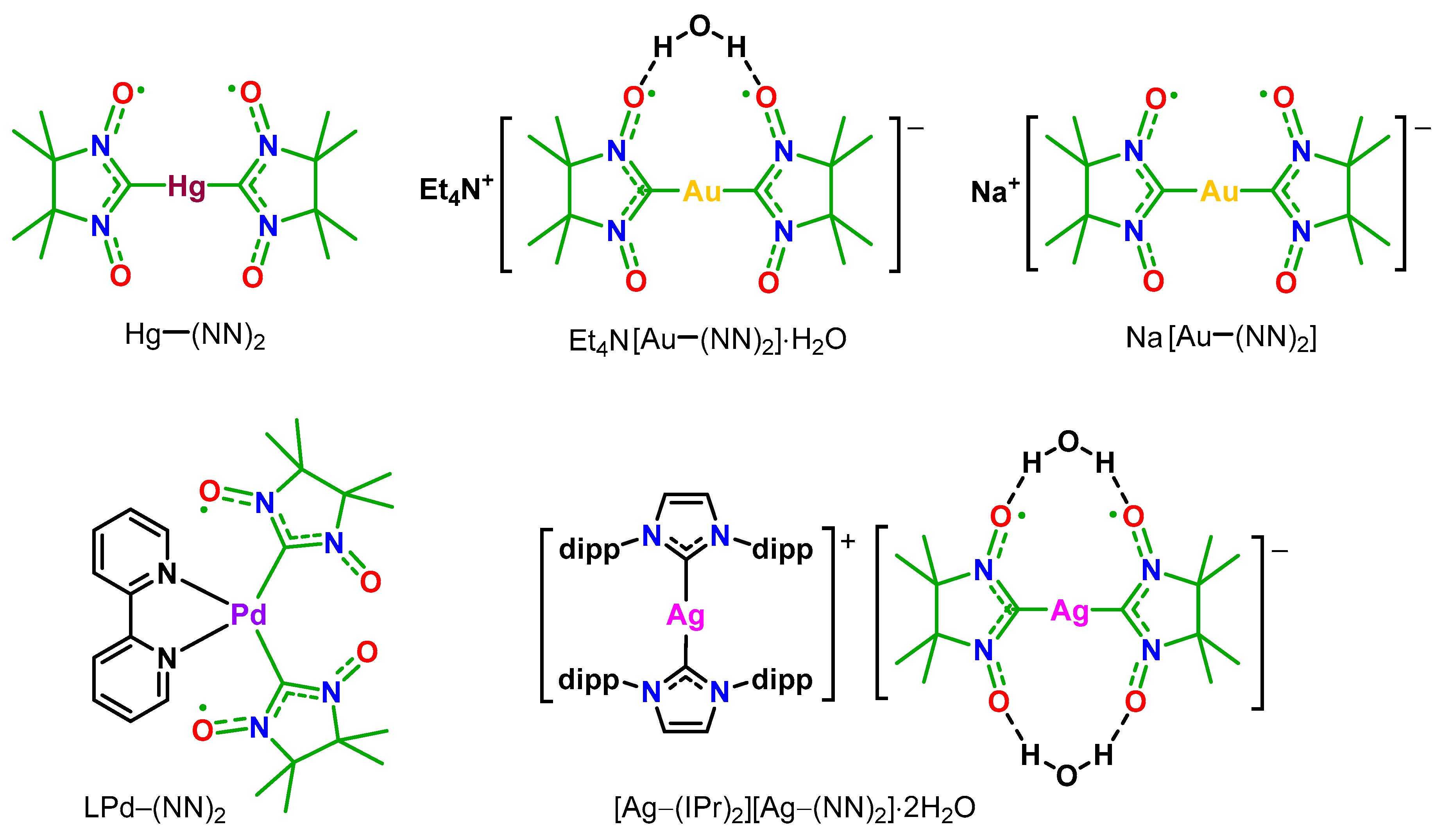
In contrast to M–NN, their analogs M–(NN)2, featuring two metalated NN moieties, are relatively rare. The first example of a compound featuring two nitronyl nitroxide moieties bound to a metal center was the organomercury complex Hg–(NN)2. Reported by Ullman in 1972 [22], its solid-state dimeric structure was only determined in 2003 (Figure 1) [23]. This diradical demonstrated stability under ambient conditions and displayed the characteristics of a weakly exchange-coupled paramagnetic unit. Later, Okada and co-workers reported several related compounds: the nitronyl nitroxide palladium derivative LPd–(NN)2, organogold derivatives Na[Au–(NN)2] and Et4N[Au–(NN)2]·H2O. These compounds are stable, can be isolated in crystalline form, and have been fully characterized (Figure 1) [24,25]. Notably, the sodium salt Na[Au–(NN)2], when reacted with Gd(NO3)3·6H2O in EtOH, forms an architecture containing 13 unpaired electrons, exhibiting ferromagnetic interactions between the organic and metal components.
In this work, we describe the synthesis of the unusual salt [Ag–(IPr)2][Ag–(NN)2] and the structure of its water solvate, [Ag–(IPr)2][Ag–(NN)2]·2H2O. In the solid state, the [Ag–(NN)2] anion adopts a coplanar structure that is stabilized by hydrogen bonding with water molecules (Figure 1). We employed quantum-chemical calculations to investigate the conformational behavior of the diradical anion [Ag–(NN)2] in solution and its intriguing magnetic properties, which arise from the structural flexibility of this anion.

2. Materials and Methods

2.1. General Procedures

4,4,5,5-Tetramethyl-4,5-dihydro-1H-imidazole 3-oxide 1-oxyl (NN–H) was synthesized according to a previously reported procedure [26]. All other organic reagents were purchased from commercial suppliers (Sigma-Aldrich, Darmstadt, Germany; TCI Chemicals, Chennai, India) and were used as received. Solvents were of reagent quality and used without additional purification. The reactions were monitored by thin-layer chromatography on silica gel 60 F254 aluminum sheets from Merck (Darmstadt, Germany). The yields are given for pure substances obtained after recrystallization. Melting points were measured by means of the Stuart melting point apparatus SMP 30 (Cole-Parmer Ltd., Staffordshire, UK).
1H NMR and 109Ag spectra were recorded with Bruker Avance III 400 WB (400 MHz) spectrometer (Bruker Corporation, Billerica, MA, USA), using deuterated solvents to provide a deuterium “lock” signal for field stabilization; chemical shifts (δ) are reported in ppm, calibrated against the residual proton signal of the solvent. Fourier transform infrared (FT-IR) spectra were registered using a Bruker ALPHA spectrometer. Mass spectra (electrospray ionization; ESI) were acquired on Bruker microTOF II spectrometer at a capillary potential of 4500 V, with direct (syringe) injection of each sample as a solution in methylene chloride (3 μL/min).
Thermogravimetric analysis (TGA), differential thermal analysis (DTA), and differential scanning calorimetry (DSC) measurements were performed on a NETZSCH STA 409 instrument (NETZSCH-Gerätebau GmbH, Selb, Germany) at a heating rate of 5 °C/min in an argon atmosphere.
ESR measurements were conducted on a Jeol JES-FA200 X-band (JEOL Ltd., Tokyo, Japan) spectrometer using a Jeol X-Band Microwave Unit at 290 K in dilute (down to approximately 10−5 M) toluene solutions degassed by argon bubbling. The spectra were recorded during one slow (~1 h) scan with a modulation of 0.2 mT at 100 kHz and a power of 4 mW. Isotropic g-factor values were measured experimentally using MgO doped with Mn(II) ions as a standard placed in the resonator simultaneously with the test solution. The spectra were simulated using the EasySpin toolbox for Matlab (R2025a (25.1)) [27].

2.2. N,N′-Bis(2,6-diisopropylphenyl)-1,4-diazabutadiene (1s)

A 3.68 g measure of 40% glyoxal water solution (2.9 mL, 28.2 mmol, 1.0 eq) was mixed with EtOH (10 mL), the mixture obtained was added dropwise to solution of 2,6-diisopropylaniline (90%, technical grade) (10.0 g, 10.6 mL, 56.5 mmol, 2.0 eq) and AcOH (0.5 mL) in EtOH (10 mL) at 50 °C. After stirring for 2 h at 50 °C, the reaction mixture was cooled down to room temperature followed by solidification. The yellow product 1s was filtered off, washed with cold (−20 °C) EtOH until the washing liquids were pale yellow, and dried under reduced pressure. Yield 7.365 g (70%). Diazabutadiene 1s was employed in the next step without further purification.

2.3. 1,3-Bis(2,6-diisopropylphenyl)imidazolium Chloride (IPr·HCl)

Paraformaldehyde (0.250 g, 8.3 mmol, 1.04 eq) was added to a solution of diazabutadiene 1s (3.0 g, 8.0 mmol, 1.0 eq) in EtOAc (40 mL) at 70 °C. After 15 min, a solution of TMSCl (0.900 g, 1.0 mL, 8.3 mmol, 1.04 eq) in EtOAc (10 mL) was added dropwise under vigorous stirring. The reaction mixture was heated for 2 h at 70 °C and then cooled down to 5 °C. White microcrystalline product IPr·HCl was filtered off, washed with EtOAc and diethyl ether, and dried under reduced pressure. Yield 3.100 g (91%).

2.4. Synthesis of [Ag–(IPr)2][Ag–(NN)2]. Method 1

Stage 1. IPr·HCl (0.500 g, 1.18 mmol, 1.0 eq), Ag2O (0.177 g, 0.76 mmol, 0.65 eq), and 2 mL of reagent-grade THF were placed in a 10 mL microwave vial equipped with a magnetic stir bar. The vial was capped and irradiated for 30 min at 110 °C (with monitoring by an IR sensor). After cooling down to room temperature, the mixture was filtered and washed with CH2Cl2. The filtrate was evaporated under reduced pressure, and the residue was triturated with a minimal amount of CH2Cl2 followed by the addition of hexane. The precipitated product was filtered and dried under vacuum. The yield was 0.467 g (75%) of white powder. The spectral characteristics of IPrAgCl were identical to those published previously [28]. 1H NMR (400 MHz, CD2Cl2, ppm): 7.58 (t, J = 7.8 Hz, 2H), 7.39 (d, J = 7.8 Hz, 4H), 7.31 (d, JH-Ag = 1.9 Hz, 2H), 2.59 (hept, J = 6.9 Hz, 2H), 1.31 (d, J = 6.9 Hz, 6H), 1.27 (d, J = 6.9 Hz, 6H). 109Ag NMR (400 MHz, CD2Cl2, ppm): 580.1.
Stage 2. IPrAgCl (0.340 g, 0.64 mmol, 1.0 eq) and NN–H (0.100 g, 0.64 mmol, 1.0 eq) were dissolved in CH2Cl2 (5 mL), followed by the addition of tBuONa (0.092 g, 0.96 mmol, 1.5 eq). The initial red magenta color of the reaction mixture instantly turned purple. After stirring for 20 min, the solvent was distilled off under reduced pressure until dry. Then, CH2Cl2 was added to the residue, the mixture was filtered, 10 mL of n-heptane was added to the filtrate, and CH2Cl2 was slowly evaporated under reduced pressure until the product started to crystallize. Filtration and washing with hexane gave [Ag–(IPr)2][Ag–(NN)2] as a purple powder. The yield was 0.401 g (96%), m.p. 135–137 °C.

2.5. Synthesis of [Ag–(IPr)2][Ag–(NN)2]. Method 2

IPr·HCl (0.300 g, 0.71 mmol, 1.0 eq), Ag2O (0.165 g, 0.71 mmol, 1.0 eq), and 2 mL of reagent-grade THF were placed in a 10 mL microwave vial equipped with a magnetic stir bar. The vial was capped and irradiated for 30 min at 110 °C (with monitoring by an IR sensor). After cooling down to room temperature, NN–H (0.110 g, 0.71 mmol, 1.0 eq) was added to the reaction mixture followed by the addition of tBuONa (0.100 g, 1.05 mmol, 1.5 eq). After stirring for 20 min, the solvent was distilled off under reduced pressure until dry. Then, CH2Cl2 was added to the residue, the mixture was filtered, 10 mL of n-heptane was added to the filtrate, and CH2Cl2 was slowly evaporated under reduced pressure until the product started to crystallize. Filtration and washing with hexane gave [Ag–(IPr)2][Ag–(NN)2] as a purple powder. Yield 0.404 g (88%). The spectroscopic data were identical to those obtained in method 1.
1H NMR (400 MHz, CD2Cl2, ppm) ([Ag–(IPr)2]+): 7.52 (t, J = 7.5 Hz, 4H), 7.19 (d, J = 7.5 Hz, 8H), 7.07 (br s, 4H), 2.30 (m, 4H), 1.10 (d, J = 6.4 Hz, 12H), 0.84 (d, J = 6.6 Hz, 12H). 109Ag NMR (400 MHz, CD2Cl2, ppm): 569.7 ([Ag–(IPr)2]+). ESR (toluene, 293 K): g = 2.0079, aN(2 14N, I = 1) = 0.790 mT, aAg (107Ag, I = 1/2, natural abundance 51.8%) = 0.253 mT, aAg (109Ag, I = 1/2, natural abundance 48.2%) = 0.250 mT. ATR FTIR: 3103, 3068, 2962, 2927, 2869, 1594, 1459, 1410, 1385, 1364, 1324, 1300, 1205, 1136, 806, 759. HRMS, positive ion mode (m/z): calcd for C54H72AgN4+ [Ag–(IPr)2]+: 883.4802. Found: 883.4804. Anal. Calcd for C68H96Ag2N8O4: C, 62.57; H, 7.41; N 8.58. Found: C, 62.19; H, 7.69; N, 8.47.
Dissolution of the compound [Ag–(IPr)2][Ag–(NN)2] in a mixture of acetone with benzene and subsequent crystallization in an open flask at 6.5 °C led to the formation of crystals of [Ag–(IPr)2][Ag–(NN)2]·2H2O. The 1H and 109Ag NMR spectra of this water solvate are identical to those of the compound [Ag–(IPr)2][Ag–(NN)2]. FTIR (KBr, cm−1): 3142, 3101, 3068, 2963, 2929, 2869, 1628, 1595, 1553, 1465, 1326, 1303, 1208, 806, 760. ATR FTIR: 3469, 3416, 3141, 3076, 2961, 2927, 2869, 1669, 1636, 1592, 1556, 1459, 1407, 1384, 1365, 1328, 1300, 1205, 1137, 806, 758. HRMS, positive ion mode (m/z): calcd for C54H72AgN4+ [Ag–(IPr)2]+: 883.4802. Found: 883.4804. Anal. Calcd for C68H100Ag2N8O6: C, 60.89; H, 7.51; N 8.35. Found: C, 60.51; H, 7.72; N, 8.27.

2.6. X-Ray Crystallographic Data and Refinement Details

The single crystal X-ray data for complex [Ag–(IPr)2][Ag–(NN)2]·2H2O were collected using synchrotron radiation on the “Belok-XSA” beamline [29,30] at the Kurchatov Synchrotron Radiation Source (National Research Center “Kurchatov Institute”, Moscow, Russia) in ϕ-scan mode using the SX165 CCD detector (Rayonix, Evanston, IL, USA) at 100 K in each experiment (λ = 0.7527(2) Å). The raw data for complex [Ag–(IPr)2][Ag–(NN)2]·2H2O were indexed, integrated, and scaled with the XDS data reduction program [31]. The crystal structure for complex [Ag–(IPr)2][Ag–(NN)2]·2H2O was solved by direct methods, and refined by the full-matrix least-squares on F2 (ref. [32]) using OLEX2 structural data visualization and analysis program suite [33]. Non-hydrogen atoms were refined with anisotropic thermal parameters. The positions of H(C) atoms were calculated, and those of H(N) and H(O) atoms were taken from Fourier maps. All H atoms were refined in a riding model with Uiso(H) = 1.5Ueq(Xi) for water molecules and methyl groups, and 1.2Ueq(Xi) for other atoms.
CCDC 2527922 (accessed on 10 March 2026) contains the supplementary crystallographic data for complex [Ag–(IPr)2][Ag–(NN)2]·2H2O (T = 100 K). These data can be obtained free of charge via www.ccdc.cam.ac.uk/structures (accessed on 10 March 2026), by e-mailing data_request@ccdc.cam.ac.uk, or by contacting the Cambridge Crystallographic Data Centre, 12 Union Road, Cambridge, CB2 1EZ, UK; fax: +44-1223-336033.
Crystallographic data for [Ag–(IPr)2][Ag–(NN)2]·2H2O: Moiety formula C54H72AgN4+, C14H24AgN4O4, 2H2O, Sum formula C68H100Ag2N8O6, M = 1341.30, T = 100 K, monoclinic space group C2/c, a = 26.912(5), b = 10.680(2), c = 24.554(5) Å, β = 109.31(3)°, V = 6661(3) Å3; Z = 4, dcalc = 1.338 g·cm−3, µ (synchrotron, 0.75270 Å) = 0.74 mm−1, θ range 1.7–24.9°, Ihkl collected/unique 20570/8660, Rint = 0.123, 4427 reflections with I > 2σ(I), 400 refined parameters, GooF = 1.05, R1 = 0.091, wR2 = 0.221.

2.7. Computational Details

Geometry optimization of the [Ag–(NN)2] triplet diradical and its complex with water was performed at the dispersion-corrected B97-D3 level [34,35] with the ma-def2-TZVPP basis set [36,37] with ECP for Ag [38]. The dispersion-corrected calculations were based on the Becke–Johnson damping function [39]. Optimizations were carried out taking into account toluene as a solvent using the CPCM model [40]. The ORCA 6.0.1 software package [41] was used for all calculations in this work.
For the [Ag–(NN)2] triplet diradical with optimized geometry, natural bond orbital (NBO) analysis [42] was performed using the NBO7 software [43], as well as the results of all-electron DFT calculations using the scalar relativistic Douglas–Kroll–Hess (DKH2) Hamiltonian [44], the PBE0-D3 functional [45,46], and the ma-DKH-def2-TZVPP basis set for C, N and O atoms implemented in the ORCA 6.0.1 and SARS-DKH-TZVPP for Ag [47]. In the NBO procedure, [NN–Ag–NN] diradical was divided into three moieties: Ag+ ion with the d10 valence shell and two NN anions as ligands. The strongly interacting NBOs were visualized in Chemcraf [48]. Orbital contributions to the Ag–C bond energies were calculated using the second-order perturbation theory.
The g-factor and HFC constants with N and Ag nuclei were also calculated at the all-electron DFT level using the TPSSh functional and basis set described above. The spin–orbit coupling (SOC) was taken into account using the spin–orbit mean-field (SOMF) approximation [49]. Parameter J of the exchange interaction ( H ^ =   2 J S ^ 1 S ^ 2 ) between radical moieties of [Ag–(NN)2] diradical was calculated by the spin-unrestricted broken-symmetry approach [50] at the DKH2-UB3LYP level with the same relativistic basis set as above using the Yamaguchi formula [51].

3. Results and Discussion

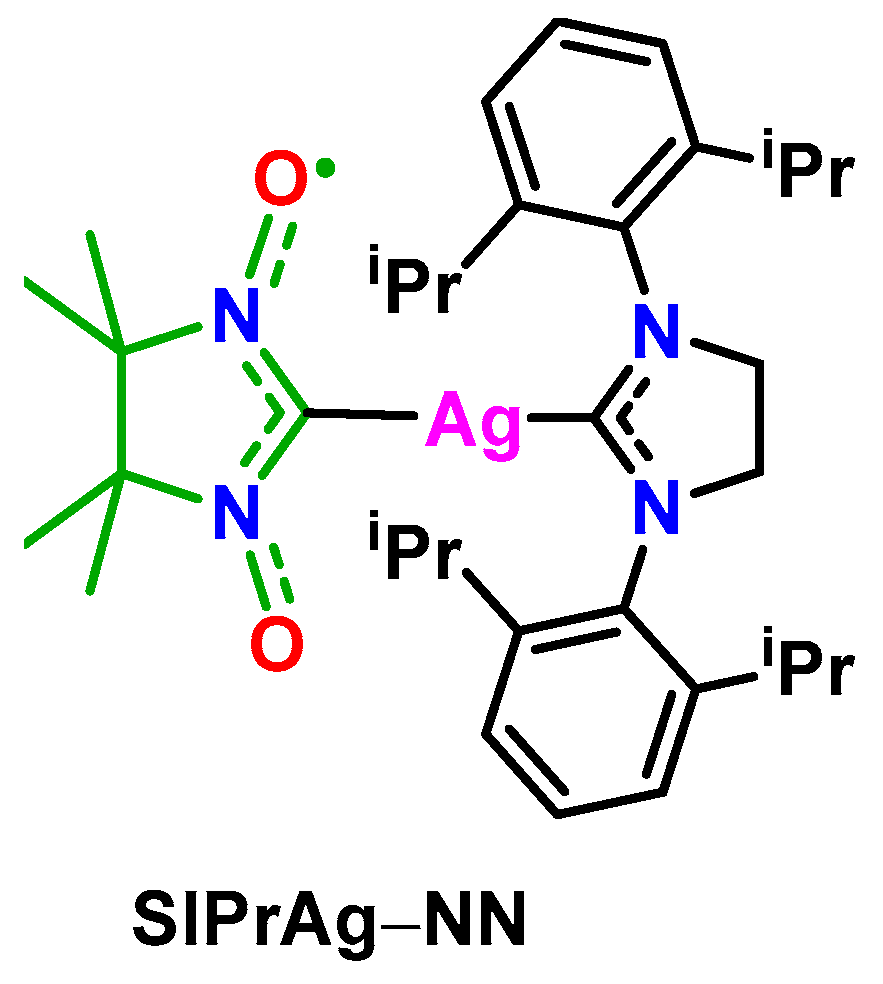
In 2014, Okada and co-workers reported the ability of the organogold derivative Ph3PAu–NN to undergo palladium-catalyzed cross-coupling with aryl and hetaryl iodides to afford the corresponding substituted nitronyl nitroxides [13]. Following this pioneering work, we explored new M–NN reagents and catalytic systems with improved properties for cross-coupling reactions. In particular, we focused on M–NN reagents featuring N-heterocyclic carbene ligands, as they typically display enhanced activity and stability compared to analogous systems with classical organophosphine ligands [52,53,54,55]. For example, we recently prepared the first organosilver compound, SIPrAg–NN (Figure 2), which incorporates both a nitronyl nitroxide ligand and a sterically bulky N-heterocyclic carbene [56]. This compound exhibits stability and reactivity comparable to organogold analogs, making it a valuable reagent for synthesizing functionally substituted nitronyl nitroxides.
In an effort to obtain carbene complexes that are structurally similar to SIPrAg–NN, we attempted to synthesize a derivative containing the IPr carbene ligand. Unlike SIPr, the IPr moiety possesses a double bond in its five-membered ring. Surprisingly, the reaction yielded an unexpected self-assembled product: the salt [Ag–(IPr)2][Ag–(NN)2]. In this novel compound, the anion is an organometallic silver species [Ag–(NN)2] with two deprotonated nitronyl nitroxide moieties, while the cation is a silver–carbene complex [Ag–(IPr)2]+, coordinated by two IPr ligands. Below, we provide a detailed description of this unexpected result.

3.1. Synthesis

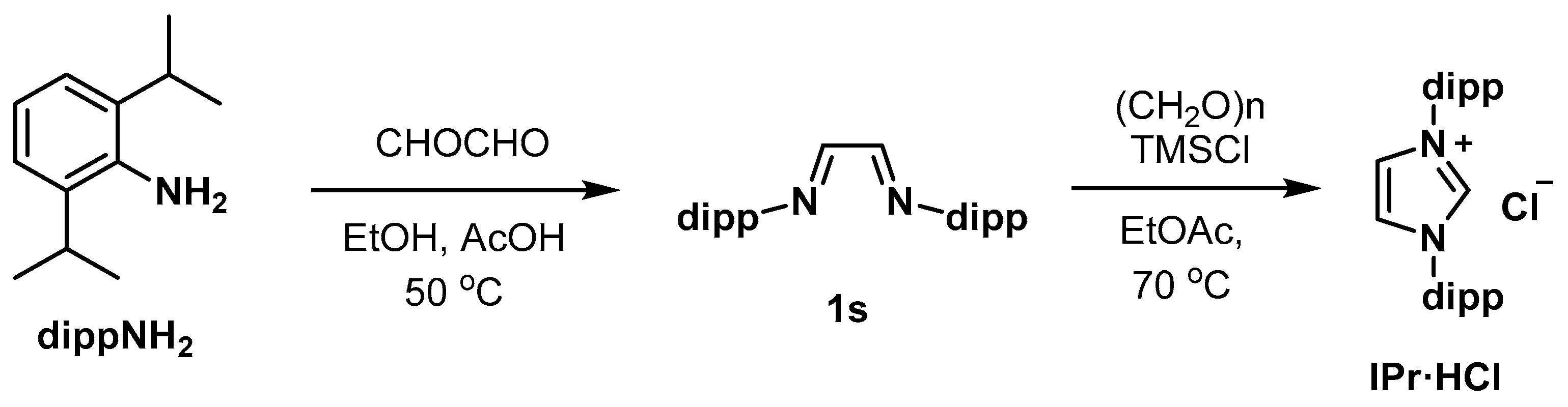
The key precursor, 1,3-bis(2,6-diisopropylphenyl)imidazolium chloride (IPr·HCl), was prepared in two steps (Scheme 1). Reaction of 2,6-disubstituted aniline (dippNH2) with glyoxal in the presence of acetic acid (AcOH) afforded the Schiff base 1s. Treatment of 1s with paraformaldehyde in the presence of trimethylsilyl chloride (TMSCl) gave the target IPr·HCl.
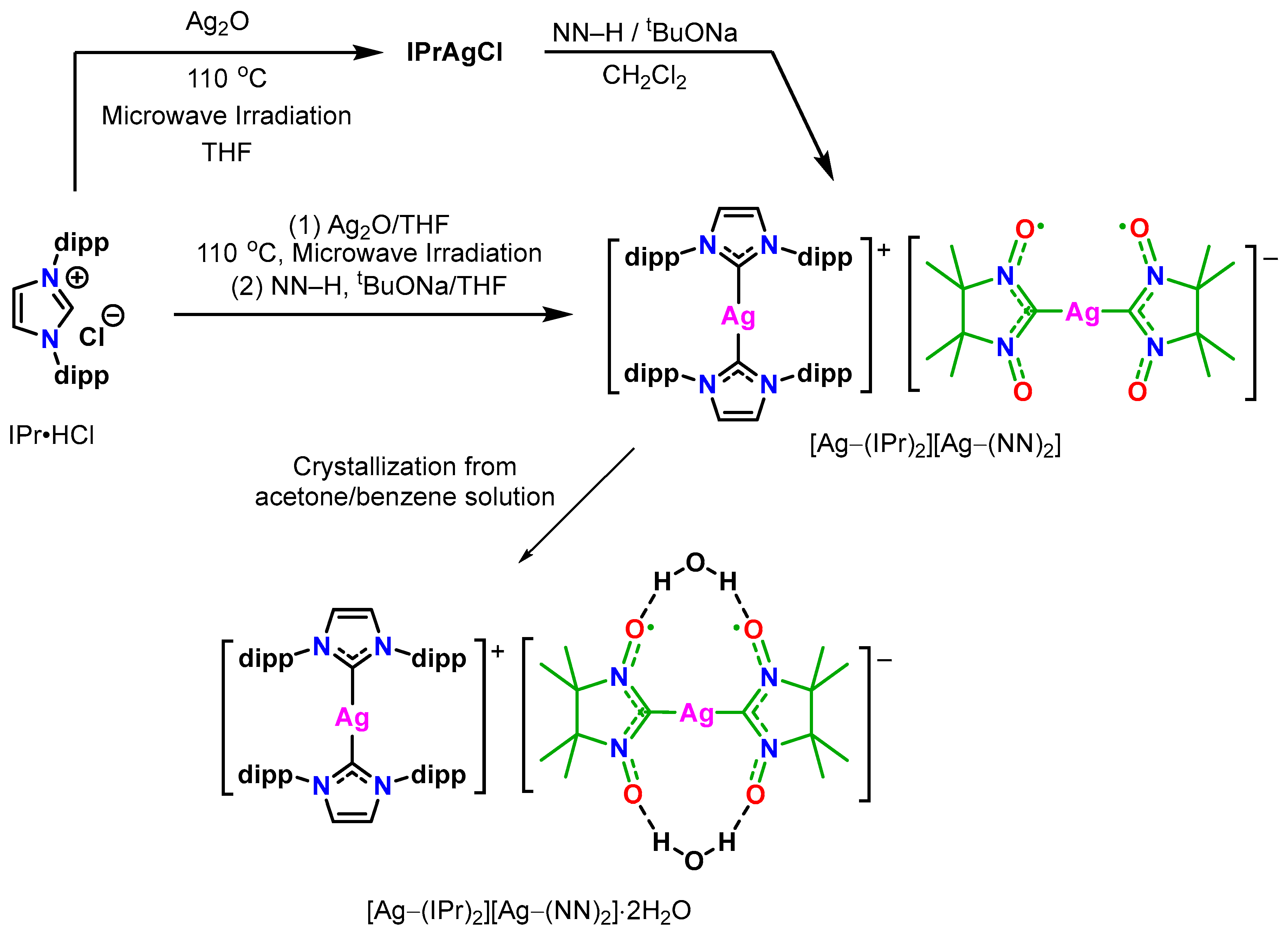
The reaction of the carbene ligand precursor IPr·HCl with Ag2O and the nitronyl nitroxide NN–H was conducted similarly to the previously reported procedure for SIPr·HCl [56]. Specifically, NN–H/tert-BuONa was added to a tetrahydrofuran (THF) solution of IPrAgCl, which was generated in situ from IPr·HCl and Ag2O under microwave irradiation. Surprisingly, this reaction did not yield the expected IPrAg–NN but instead afforded the salt [Ag–(IPr)2][Ag–(NN)2], isolated in 88% yield after crystallization from a dichloromethane/benzene solution (Scheme 2). Furthermore, the complex [Ag–(IPr)2][Ag–(NN)2] was also synthesized in 96% yield by treating a solution of IPrAgCl and NN–H dichloromethane with 1.5 equivalents of tert-BuONa. The resulting complex [Ag–(IPr)2][Ag–(NN)2] was isolated as purple crystals (Figure S1) and exhibited high stability both in the solid state and in solution. Recrystallization of [Ag–(IPr)2][Ag–(NN)2] from an acetone/benzene solution at 6.5 °C yielded solvate crystals of the composition [Ag–(IPr)2][Ag–(NN)2]·2H2O.
Comprehensive characterization of the silver derivatives [Ag–(IPr)2][Ag–(NN)2] and [Ag–(IPr)2][Ag–(NN)2]·2H2O was performed both in the solid state and in solution using multiple analytical techniques: elemental analysis, 109Ag and 1H-109Ag HMBC NMR spectroscopy, IR, and ESR spectroscopy, high-resolution mass spectrometry (HRMS), cyclic voltammetry (CV), and X-ray diffractometry. Furthermore, the structure and magnetic properties of [Ag–(IPr)2][Ag–(NN)2] and [Ag–(IPr)2][Ag–(NN)2]·2H2O were analyzed using density functional theory (DFT) calculations.

3.2. Solid Phases of [Ag–(IPr)2][Ag–(NN)2] and [Ag–(IPr)2][Ag–(NN)2]·2H2O

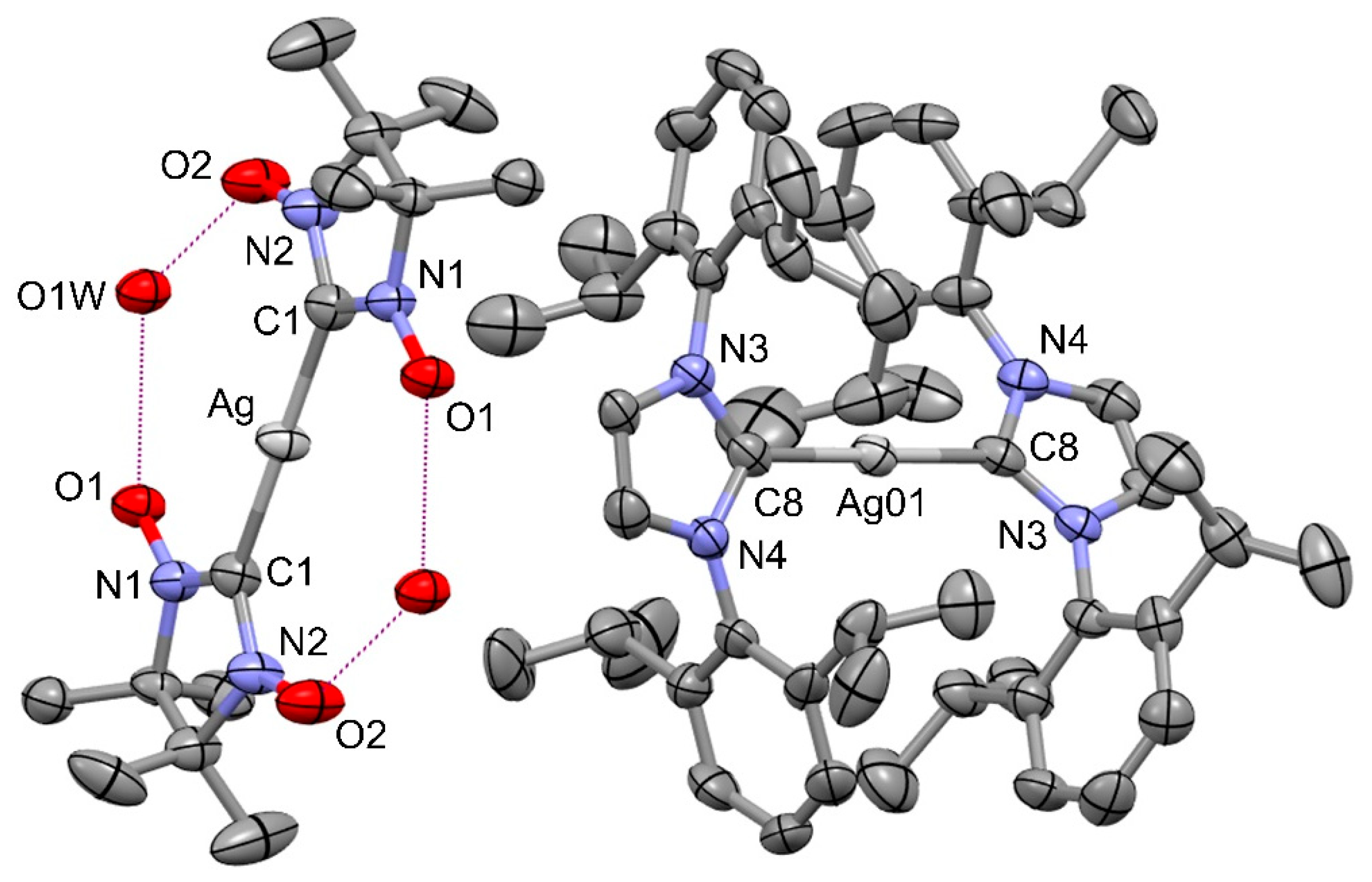
An attempt to crystallize the reaction product from a mixture of methylene chloride and n-heptane resulted in finely crystalline aggregates of the complex [Ag–(IPr)2][Ag–(NN)2] (Figure S1). A suitable crystal for single-crystal X-ray diffraction analysis could not be found. The powder XRD pattern of [Ag–(IPr)2][Ag–(NN)2] sample is shown in Figure S8. Slow evaporation of the reaction product solution in acetone/benzene at 6.5 °C yielded solvate crystals of the composition [Ag–(IPr)2][Ag–(NN)2]·2H2O, suitable for X-ray diffraction (XRD) analysis. XRD analysis revealed that the organosilver compound crystallizes in the monoclinic crystal system (space group C2/c). The crystal structure comprises a diamagnetic silver cation, [Ag–(IPr)2]+, in which the silver center is coordinated by two IPr ligands and a paramagnetic diradical anion, [Ag–(NN)2], consisting of an Ag+ ion bound to two nitronyl nitroxide radical anions (Figure 3). For comparison, Figure S8 shows the X-ray powder diffraction pattern of [Ag–(IPr)2][Ag–(NN)2]·2H2O calculated from single crystal data.
Table 1 summarizes the selected structural parameters of [Ag–(IPr)2][Ag–(NN)2]·2H2O. Full crystallographic data are provided in Table S1 (see Supporting Information (SI)). In the paramagnetic [Ag–(NN)2] ion, the O(1)–N(1) and O(2)–N(2) bond lengths are equal within the standard deviation, as are the C(1)–N(1) and C(1)–N(2) bond lengths. The Ag–C(1) bond length is 2.084(8) Å, and the C(1)–Ag–C(1) angle is 180.0°. In the [Ag–(NN)2] anion, two nitronyl nitroxide moieties are coplanar. This coplanar conformation is most likely stabilized by hydrogen bonds between the oxygen atoms of the nitroxide groups and the hydrogen atoms of two water molecules (Figure 3). The lengths of these bonds (O(1)⋯H [2.038 Å] and O(2)⋯H [1.992 Å]) are significantly shorter than the sum of van der Waals radii for O and H (2.72 Å), which confirms the presence of strong hydrogen bonds [57].
The geometric parameters of the paramagnetic anion [Ag–(NN)2] closely resemble those in the previously reported compound SIPrAg–NN (Table 1). Notable differences emerge when comparing the two salts [Ag–(IPr)2][Ag–(NN)2]·2H2O with Et4N[Au–(NN)2]·2H2O. In the latter salt, water molecules play a dual role in hydrogen bonding: water molecules of the first type form H-bonds directly with nitroxide O atoms. Water molecules of the second type bridge paramagnetic anions, forming H-bonds with both the O atoms of nitroxide and the O atoms of the water molecules of the first type [25]. This asymmetric network of hydrogen-bonding causes a slight bending of the [Au–(NN)2] anion: the C1–Au–C1 angle is equal to 178°, and the dihedral angle between the planes of nitronyl nitroxide moieties is 28°. A similar distortion is observed in the sodium salt Na[Au–(NN)2], where sodium ions are electrostatically bound to two nitroxide oxygen atoms.
The FTIR and ATR-FTIR spectra of the water solvate [Ag–(IPr)2][Ag–(NN)2]·2H2O are characterized by intense broad absorption bands in the 3200–3500 cm−1 region (stretching vibrations) and bands near 1650 cm−1 (deformation vibrations). These absorption bands are absent in the spectrum of [Ag–(IPr)2][Ag–(NN)2] (see Supplementary Materials).
Thermal Analysis (TGA/DTA/DSC) of [Ag–(IPr)2][Ag–(NN)2] and [Ag–(IPr)2][Ag–(NN)2]·2H2O revealed characteristic differences. Although the mass loss of [Ag–(IPr)2][Ag–(NN)2]·2H2O due to water loss is small (2.7%), the DTA and DSC curves nevertheless exhibit features in the 70–80 °C temperature range that are absent in the analogous curves of the anhydrous compound [Ag–(IPr)2][Ag–(NN)2] (SI).
Thus, the characterization of solid phases [Ag–(IPr)2][Ag–(NN)2] and [Ag–(IPr)2][Ag–(NN)2]·2H2O revealed characteristic differences and confirmed the presence of the solvate water in the latter sample. Interestingly, solutions of these compounds exhibit identical properties; no differences were detected between them, as discussed below.

3.3. Prtoperties of [Ag–(IPr)2][Ag–(NN)2] and [Ag–(IPr)2][Ag–(NN)2]·2H2O in Solutions

Since all further measurements were done in solution, we modeled the structure of the [Ag–(NN)2] diradical in toluene using DFT calculations. At first, we calculated the parameter of the exchange interaction for the XRD geometry (SI, Figure S11a), which was found to be about −20 cm−1 at the BS-UB3LYP level. Thus, the ground state of the diradical complex is a singlet state with low singlet-triplet splitting, and we evaluated the thermodynamics of complex formation between the triplet [Ag–(NN)2] diradical and water molecules in toluene. It was found that both steps—the addition of the first and second molecules—are endothermic with ΔG1 = 1.0 and ΔG2 = 0.9 kcal/mol (standard state, 1 M solution). Estimates show that even in a water-saturated toluene (0.033% H2O) solution, the concentrations of both types of complexes are negligible.
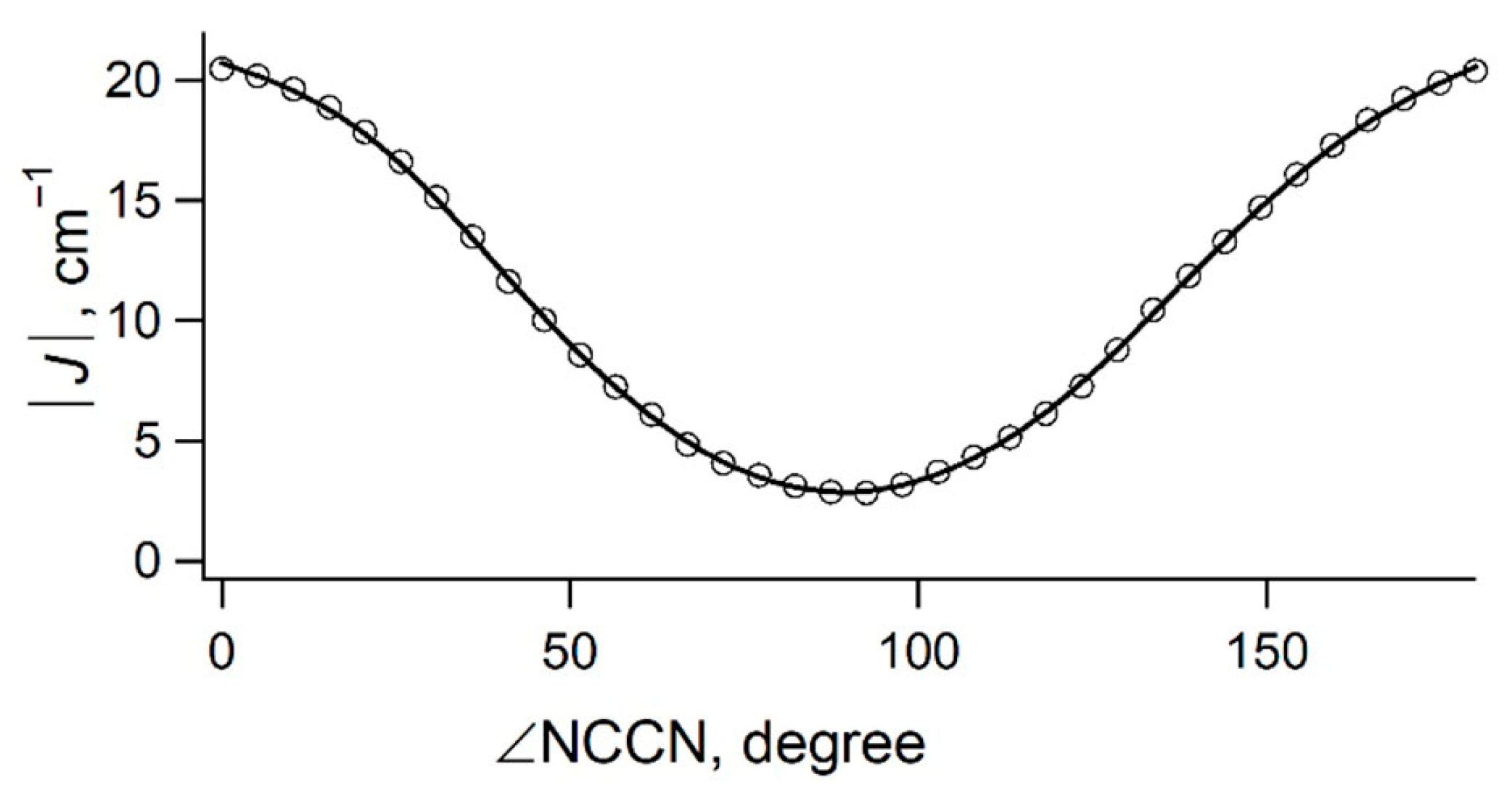
In contrast to the complexes with one and two water molecules having the coplanar arrangement of the NN fragments, the [Ag–(NN)2] diradical is characterized by an almost perpendicular arrangement of NN fragments (Figures S11d and S12a, SI). Moreover, the exchange interaction parameter decreases during the transition from the coplanar geometry of the diradical (transition state) to the energy minimum by more than an order of magnitude (Figure 4; see for details SI, Section S5).
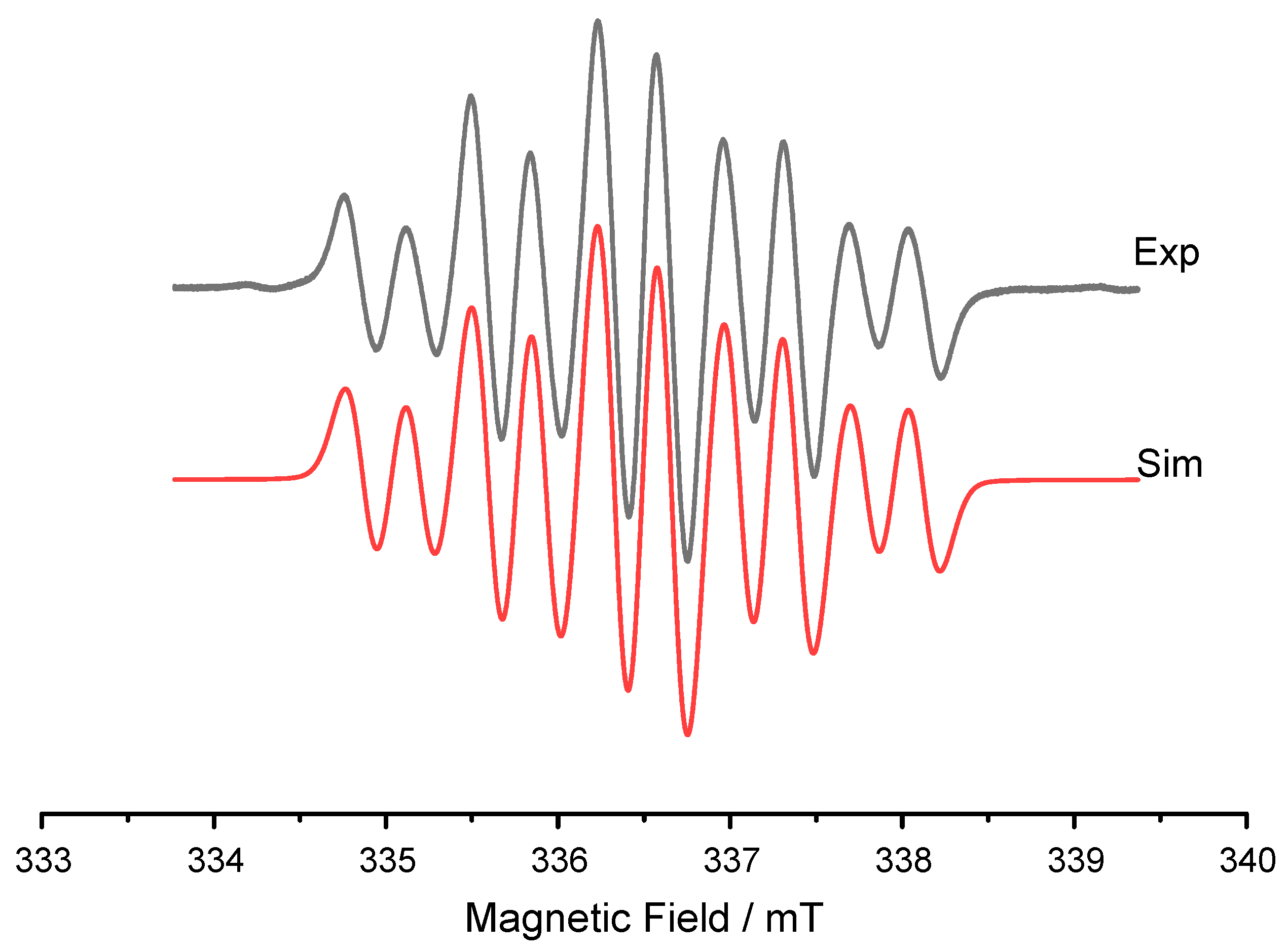
Water loss by [Ag–(IPr)2][Ag–(NN)2]·2H2O molecules in a toluene solution, as predicted by quantum chemical calculations, is followed by the transition of the [Ag–(NN)2] anion to a more favorable conformation with a 90° rotation of the plane of the nitronyl nitroxide moiety. This process was confirmed by EPR spectroscopy data. The ESR spectra of [Ag–(IPr)2][Ag–(NN)2] and [Ag–(IPr)2][Ag–(NN)2]·2H2O, recorded at room temperature in a thoroughly deoxygenated toluene solution at a concentration of approximately ~10−4 M, were identical (Figure 5). The ESR signal has a complicated shape with 10 clearly defined lines. Although the paramagnetic anion contains five magnetically active nuclei (one silver and four nitrogen atoms), hyperfine coupling (HFC) is observed only with the silver center and two nitrogen nuclei. This means that exchange interaction between the two paramagnetic nitronyl nitroxide fragments is very weak, despite their coordination with the same silver cation. Our quantum chemical calculations (see above) are consistent with this conclusion and explain the weak exchange interaction by the nearly perpendicular arrangement of the NN fragments (SI, Section S5.3).
The obtained EPR spectrum of [Ag–(IPr)2][Ag–(NN)2] was successfully simulated as a superposition of two isotopomeric signals (107Ag–NN and 109Ag–NN) with the following parameters: |aN| = 0.730 mT for two equivalent 14N nuclei (I = 1), |aAg| = 0.313 mT for 107Ag nuclei (I = 1/2, natural abundance 51.8%) and |aAg| = 0.360 mT for 109Ag nuclei (I = 1/2, natural abundance = 48.2%), giso = 2.0079. The all-electron DFT calculations of the spin Hamiltonian parameters predict the values a(107Ag) = −0.705 mT, a(109Ag) = −0.810 mT, and aN = 0.559 ÷ 0.566 mT, giso = 2.0070, which are in reasonable agreement with experiment, although the calculated values of aN are a little lower and |aAg| are higher than the experimental values.
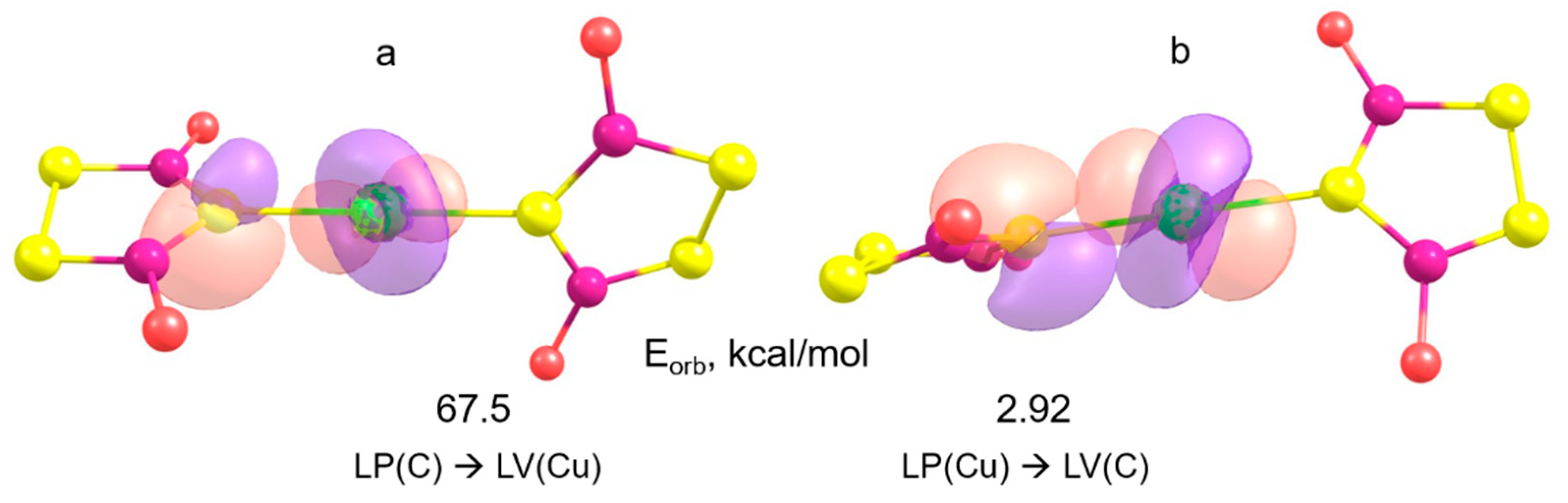
Modeling of the EPR spectrum gives a fairly high HFC constant with the Ag nucleus. To understand the electronic structure of the [Ag–(NN)2] complex, in particular the origin of the HFC constant with Ag nuclei, an analysis of Ag–CNN coordination bonds was performed using NBO and NEDA methods. NBO analysis shows that the orbital contribution (Eorb) to the energy of the Ag–CNN coordination bonds is large (158 kcal/mol per bond), resulting in significant electron transfer from the NN radical anions to the Ag(I) cation, mainly to its 5s-AO (Figure 6a), while the contribution of back donation (Figure 6b) is small. According to the Mulliken protocol, 0.09e is transferred from each NN fragment to Ag+ (qnat(Ag) = 0.82). It should be noted that the contributions of α- and β-electrons to Eorb are slightly different, which also results in the non-zero spin population of Ag+ (0.009 is the spin population of 5s-AO and a total of −0.004 of the five 4d-AOs).
According to the natural energy decomposition analysis (NEDA), the energy of the Ag–CNN coordination bond was estimated at 125 kcal/mol with a charge transfer contribution −ECT = 96.5 kcal/mol. The latter term is similar in nature to the orbital stabilization energy (−Eorb = 158 kcal/mol), which is overestimated due to its perturbative origin and neglecting the destabilizing interaction of the two forming Ag–CNN bonds. Nevertheless, the NBO analysis is very useful as it allows us to understand the details, e.g., to trace the background of HFC with Ag+.
The redox properties of the open-shell system [Ag–(IPr)2][Ag–(NN)2] were investigated using cyclic voltammetry (CV) with a three-electrode setup. The ferrocenium/ferrocene (Fc+/Fc) couple served as the internal reference. Figure 7 displays the cyclic voltammogram of the synthesized compound over the accessible potential range in acetonitrile solvent. The organosilver derivative exhibits a reversible one-electron oxidation peak at E1/2 = −0.258 V, assigned to the nitronyl nitroxide moiety (Figure 8). No additional oxidation processes occur up to the solvent oxidation limit. In the cathodic region, an irreversible reduction peak appears at Ep = −2.169 V, likely associated with the nitronyl nitroxide moieties; this process remains irreversible at a potential sweep rate up to 1 V/s. At more negative potentials, at approximately −2.400 V, a reduction peak corresponding to the Ag+/Ag couple is observed. The strongly non-diffusive shape of the Ag+/Ag reduction wave indicates the formation of a silver layer on the electrode surface, manifesting as a dendritic film. During reverse scanning, this silver film is reoxidized at −0.230 V, producing a distorted peak that overlaps with the oxidation process of the nitronyl nitroxide.

4. Conclusions

In summary, we have successfully synthesized and characterized a novel nitronyl nitroxide organosilver derivative. Single-crystal X-ray diffraction analysis reveals its unique salt-like structure [Ag–(IPr)2][Ag–(NN)2], consisting of a diamagnetic silver cation coordinated with two IPr ligands [Ag–(IPr)2]+ and a paramagnetic diradical anion [Ag–(NN)2]. The salt was prepared in high yield (88–96%) by two synthetic routes: the reaction of the carbene ligand precursor IPr·HCl with Ag2O and nitronyl nitroxide NN–H or by the addition of NN–H/tBuONa to an IPrAgCl solution in THF under microwave irradiation. Electrochemical analysis of [Ag–(IPr)2][Ag–(NN)2] revealed a reversible one-electron oxidation peak at E1/2 = −0.258 V and an irreversible reduction peak at Ep = −2.169 V, the latter likely explained by the electrochemical conversion of the nitronyl nitroxide moieties. Crystallization from an acetone/benzene solution yielded solvate crystals [Ag–(IPr)2][Ag–(NN)2]·2H2O, in which diradical anions [Ag–(NN)2] are bound to two water molecules via hydrogen bonds. Water binding stabilizes the planar conformation of the [Ag–(NN)2] anion, in which both nitronyl nitroxide moieties lie in the same plane, and the exchange interaction between them is predicted to be moderate. DFT modeling further demonstrated that removal of water molecules in solution is thermodynamically favorable and causes a conformational change in which the nitronyl nitroxide moieties rotate relative to each other by approximately 90° with a significant weakening of the exchange interaction between them. Our laboratory is currently conducting research aimed at using the obtained diradical anion as a ligand for paramagnetic metal coordination compounds, the results of which will be presented in due course.

Supplementary Materials

The following supporting information can be downloaded at: https://www.mdpi.com/article/10.3390/cryst16040224/s1, Figure S1: Optical microscope images of thin crystals of the organic silver derivative [Ag–(IPr)2][Ag–(NN)2]; Figure S2. Optical microscope images of crystals of [Ag–(IPr)2][Ag–(NN)2]·2H2O (the crystals were grown from a mixture of acetone and benzene); Figure S3: 109Ag and 1H-109Ag HMBC NMR spectra of IPrAgCl; Figure S4: 109Ag and 1H-109Ag HMBC NMR spectra of [Ag–(IPr)2][Ag–(NN)2]·2H2O; Figure S5: FTIR spectrum of [Ag–(IPr)2][Ag–(NN)2]·2H2O recorded in KBr pellet; Figure S6a,b: Attenuated total reflection FTIR spectra of [Ag–(IPr)2][Ag–(NN)2] and [Ag–(IPr)2][Ag–(NN)2]·2H2O; Figure S7a,b: ESI-HRMS spectra of [Ag–(IPr)2][Ag–(NN)2] and [Ag–(IPr)2][Ag–(NN)2]·2H2O; Table S1: Selected geometric parameters of [Ag–(IPr)2][Ag–(NN)2]·2H2O; Figure S8: X-ray powder diffraction pattern of the [Ag–(IPr)2][Ag–(NN)2] sample; Figure S9: TGA-DTA and DSC curves of the [Ag–(IPr)2][Ag–(NN)2] sample; Figure S10: TGA-DTA and DSC curves of the [Ag–(IPr)2][Ag–(NN)2]·2H2O sample; Figure S11: Experimental X-ray structure of the diradical complex with two water molecules (a), its structure optimized at the B97-D3/ma-def2-TZVPP level in toluene; Figure S12: (a) The energy scan performed at the UB97-D3/def2-TZVPP level by varying the dihedral angle with optimization of all other coordinates for the rotation of one NN fragment around Ag–C bond for the [Ag–(NN)2] diradical in the triplet state. (b) Absolute values of the parameter J of the exchange interaction between NN fragments calculated at the BS-UB3LYP/def2-TZVP level for diradical geometries varying along the right-hand side of the scan curve. References [58,59,60,61,62,63,64] are included in the Supplementary Materials section.

Author Contributions

Conceptualization, E.V.T.; methodology, M.A.S., D.X. and P.V.D.; validation, N.P.G., M.A.S. and E.V.T.; formal analysis, N.P.G., M.A.S., D.X. and E.V.T.; investigation, I.A.Z., D.E.G., P.G.S., P.V.D., R.A.N. and A.A.K.; writing—original draft preparation, E.V.T. and N.P.G.; writing—review and editing, E.V.T.; supervision, N.P.G. and E.V.T.; project administration, E.V.T. All authors have read and agreed to the published version of the manuscript.

Funding

This research was funded by the Russian Science Foundation (project No. 25-73-20009) and the Russian Science Foundation (project No. 22-13-00077-P) in the quantum chemical calculations.

Data Availability Statement

The data that support the findings of this study are available upon reasonable request from the authors.

Acknowledgments

X-ray diffraction studies for complex Ag–NN2 performed using the unique scientific facility Kurchatov synchrotron radiation source “KISI-Kurchatov” of the National Research Center “Kurchatov Institute”. N.P.G. and D.E.G. acknowledge the Supercomputer Center of Novosibirsk State University for the computational resources. A.A. Korlyukov is grateful to the Ministry of Science and Higher Education of the Russian Federation (Contract No. 075-03-2026-024) for financial support of X-ray diffraction studies using the equipment of the Center for Collective Use of INEOS RAS. We thank Petr Prikhodchenko for the DTA, TGA, and DSC Analysis.

Conflicts of Interest

The authors declare no conflicts of interest.

References

  1. Verma, D.K.; Aslam, J. (Eds.) Organometallic Compounds: Synthesis, Reactions, and Applications; Wiley-VCH GmbH: Weinheim, Germany, 2023. [Google Scholar] [CrossRef]
  2. Parkin, G.; Meyer, K.; O’hare, D. (Eds.) Comprehensive Organometallic Chemistry IV; Elsevier Ltd.: Amsterdam, The Netherlands, 2022. [Google Scholar]
  3. Leznoff, D.B.; Hayes, C.E.; Mund, G. Paramagnetic Organometallic Complexes. In Encyclopedia of Inorganic and Bioinorganic Chemistry; Scott, R.A., Ed.; John Wiley & Sons, Ltd.: Hoboken, NJ, USA, 2012. [Google Scholar] [CrossRef]
  4. Kegl, T.; Fortman, G.C.; Temprad, M.; Hoff, C.D. Organometallic radicals: Thermodynamics, kinetics, and reaction mechanisms. In Physical Inorganic Chemistry: Reactions, Processes, and Applications; Bakac, A., Ed.; John Wiley & Sons: New York, NY, USA, 2010; p. 429. [Google Scholar]
  5. Abe, M. Diradicals. Chem. Rev. 2013, 113, 7011–7088. [Google Scholar] [CrossRef] [PubMed]
  6. Thorarinsdottir, A.E.; Harris, T.D. Metal–Organic Framework Magnets. Chem. Rev. 2020, 120, 8716–8789. [Google Scholar] [CrossRef] [PubMed]
  7. Masuda, Y.; Kuratsu, M.; Suzuki, S.; Kozaki, M.; Shiomi, D.; Sato, K.; Takui, T.; Hosokoshi, Y.; Lan, X.-Z.; Miyazaki, Y.; et al. A New Ferrimagnet Based on a Radical-Substituted Radical Cation Salt. J. Am. Chem. Soc. 2009, 131, 4670–4673. [Google Scholar] [CrossRef] [PubMed]
  8. Nagata, A.; Hiraoka, S.; Suzuki, S.; Kozaki, M.; Shiomi, D.; Sato, K.; Takui, T.; Tanaka, R.; Okada, K. Redox-Induced Modulation of Exchange Interaction in a High-Spin Ground-State Diradical/Triradical System. Chem. Eur. J. 2020, 26, 3166–3172. [Google Scholar] [CrossRef]
  9. Coronado, E. Molecular Magnetism: From Chemical Design to Spin Control in Molecules, Materials and Devices. Nat. Rev. Mater. 2019, 5, 87–104. [Google Scholar] [CrossRef]
  10. Suzuki, S.; Wada, T.; Tanimoto, R.; Kozaki, M.; Shiomi, D.; Sugisaki, K.; Sato, K.; Takui, T.; Miyake, Y.; Hosokoshi, Y.; et al. Cyclic Triradicals Composed of Iminonitroxide–Gold(I) with Intramolecular Ferromagnetic Interactions. Angew. Chem. Int. Ed. 2016, 55, 10791–10794. [Google Scholar] [CrossRef]
  11. Suzuki, S.; Nakamura, F.; Naota, T. A Direct Synthetic Method for (Nitronyl Nitroxide)-Substituted π-Electronic Compounds via a Palladium-Catalyzed Cross-Coupling Reaction with a Zinc Complex. Mater. Chem. Front. 2018, 2, 591–596. [Google Scholar] [CrossRef]
  12. Shu, C.; Yang, Z.; Rajca, A. From Stable Radicals to Thermally Robust High-Spin Diradicals and Triradicals. Chem. Rev. 2023, 123, 11954–12003. [Google Scholar] [CrossRef]
  13. Tanimoto, R.; Suzuki, S.; Kozaki, M.; Okada, K. Nitronyl Nitroxide as a Coupling Partner: Pd-Mediated Cross-Coupling of (Nitronyl Nitroxide-2-Ido)(Triphenylphosphine)Gold(I) with Aryl Halides. Chem. Lett. 2014, 43, 678–680. [Google Scholar] [CrossRef]
  14. Yamada, K.; Zhang, X.; Tanimoto, R.; Suzuki, S.; Kozaki, M.; Tanaka, R.; Okada, K. Radical Metalloids with N-Heterocyclic Carbene and Phenanthroline Ligands: Synthesis, Properties, and Cross-Coupling Reaction of [(Nitronyl Nitroxide)-2-Ido]Metal Complexes with Aryl Halides. Bull. Chem. Soc. Jpn. 2018, 91, 1150–1157. [Google Scholar] [CrossRef]
  15. Kira, S.; Miyamae, T.; Yoshida, K.; Kanzaki, Y.; Sugisaki, K.; Shiomi, D.; Sato, K.; Takui, T.; Suzuki, S.; Kozaki, M.; et al. Aurophilic Interactions in Multi-Radical Species: Electronic-Spin and Redox Properties of Bis- and Tris-[(Nitronyl Nitroxide)-Gold(I)] Complexes with Phosphine-Ligand Scaffolds. Chem. Eur. J. 2021, 27, 11450–11457. [Google Scholar] [CrossRef]
  16. Zayakin, I.; Romanenko, G.; Bagryanskaya, I.; Ugrak, B.; Fedin, M.; Tretyakov, E. Catalytic System for Cross-Coupling of Heteroaryl Iodides with a Nitronyl Nitroxide Gold Derivative at Room Temperature. Molecules 2023, 28, 7661. [Google Scholar] [CrossRef]
  17. Zayakin, I.A.; Zimina, A.M.; Tretyakov, E.V. Cross-Coupling Reactions of Organometallic Derivatives of Nitronyl Nitroxides with Aryl Halides Catalyzed by Palladium Complexes (A Review). Russ. J. Org. Chem. 2025, 61, 1011–1033. [Google Scholar] [CrossRef]
  18. Tretyakov, E.V.; Zhivetyeva, S.I.; Petunin, P.V.; Gorbunov, D.E.; Gritsan, N.P.; Bagryanskaya, I.Y.; Bogomyakov, A.S.; Postnikov, P.S.; Kazantsev, M.S.; Trusova, M.E.; et al. Ferromagnetically Coupled S=1 Chains in Crystals of Verdazyl-Nitronyl Nitroxide Diradicals. Angew. Chem. Int. Ed. 2020, 59, 20704–20710. [Google Scholar] [CrossRef]
  19. Shu, C.; Pink, M.; Junghoefer, T.; Nadler, E.; Rajca, S.; Casu, M.B.; Rajca, A. Synthesis and Thin Films of Thermally Robust Quartet (S = 3/2) Ground State Triradical. J. Am. Chem. Soc. 2021, 143, 5508–5518. [Google Scholar] [CrossRef] [PubMed]
  20. Zayakin, I.A.; Petunin, P.V.; Postnikov, P.S.; Dmitriev, A.A.; Gritsan, N.P.; Dorovatovskii, P.; Korlyukov, A.; Fedin, M.V.; Bogomyakov, A.S.; Akyeva, A.Y.; et al. Toward New Horizons in Verdazyl-Nitroxide High-Spin Systems: Thermally Robust Tetraradical with Quintet Ground State. J. Am. Chem. Soc. 2024, 146, 13666–13675. [Google Scholar] [CrossRef] [PubMed]
  21. Wang, D.; Shi, C.; Baumgarten, M.; Wang, W.; Liu, J. Nonalternating π-System Mediated Spin Coupling in Azulene Nitronyl Nitroxide Diradicals. J. Org. Chem. 2024, 89, 12277–12285. [Google Scholar] [CrossRef] [PubMed]
  22. Leute Richard, K.; Ullman Edwin, F. 4,5-Dihydroimidazoline-3-oxide-1-oxyl. U.S. Patent 3697535-A, 10 October 1972. Available online: https://pubchem.ncbi.nlm.nih.gov/patent/US-3697535-A (accessed on 15 February 2026).
  23. Fokin, S.V.; Romanenko, G.V.; Baumgarten, M.; Ovcharenko, V.I. Crystal Structure of Cu(Hfac)2 Complexes with Organomercury Binitroxide. J. Struct. Chem. 2003, 44, 864–869. [Google Scholar] [CrossRef]
  24. Suzuki, S.; Yokoi, H.; Kozaki, M.; Kanzaki, Y.; Shiomi, D.; Sato, K.; Takui, T.; Okada, K. Synthesis and Properties of a Bis[(nitronyl nitroxide)-2-ide radical anion]–Palladium Complex. Eur. J. Inorg. Chem. 2014, 2014, 4740–4744. [Google Scholar] [CrossRef]
  25. Tanimoto, R.; Wada, T.; Okada, K.; Shiomi, D.; Sato, K.; Takui, T.; Suzuki, S.; Naota, T.; Kozaki, M. A Molecule Having 13 Unpaired Electrons: Magnetic Property of a Gadolinium(III) Complex Coordinated with Six Nitronyl Nitroxide Radicals. Inorg. Chem. 2022, 61, 3018–3023. [Google Scholar] [CrossRef]
  26. Tretyakov, E.V.; Utepova, I.A.; Varaksin, M.V.; Tolstikov, S.E.; Romanenko, G.V.; Bogomyakov, A.S.; Stass, D.V.; Ovcharenko, V.I.; Chupakhin, O.N. New Approach to Synthesis of Nitronyl and Imino Nitroxides Based on SNH Methodology. Arkivoc 2011, 2011, 76–98. [Google Scholar] [CrossRef]
  27. Stoll, S.; Schweiger, A. EasySpin, a Comprehensive Software Package for Spectral Simulation and Analysis in EPR. J. Magn. Reson. 2006, 178, 42–55. [Google Scholar] [CrossRef] [PubMed]
  28. Landers, B.; Navarro, O. Microwave-Assisted Synthesis of (N-Heterocyclic Carbene)MCl Complexes of Group 11 Metals. Eur. J. Inorg. Chem. 2012, 2012, 2980–2982. [Google Scholar] [CrossRef]
  29. Lazarenko, V.; Dorovatovskii, P.; Zubavichus, Y.; Burlov, A.; Koshchienko, Y.; Vlasenko, V.; Khrustalev, V. High-Throughput Small-Molecule Crystallography at the ‘Belok’ Beamline of the Kurchatov Synchrotron Radiation Source: Transition Metal Complexes with Azomethine Ligands as a Case Study. Crystals 2017, 7, 325. [Google Scholar] [CrossRef]
  30. Svetogorov, R.D.; Dorovatovskii, P.V.; Lazarenko, V.A. Belok/XSA Diffraction Beamline for Studying Crystalline Samples at Kurchatov Synchrotron Radiation Source. Cryst. Res. Technol. 2020, 55, 1900184. [Google Scholar] [CrossRef]
  31. Kabsch, W.  XDS. Acta Crystallogr. D Biol. Crystallogr. 2010, 66, 125–132. [Google Scholar] [CrossRef]
  32. Sheldrick, G.M. SHELXT—Integrated Space-Group and Crystal-Structure Determination. Acta Crystallogr. A Found. Adv. 2015, 71, 3–8. [Google Scholar] [CrossRef]
  33. Dolomanov, O.V.; Bourhis, L.J.; Gildea, R.J.; Howard, J.A.K.; Puschmann, H. OLEX2: A Complete Structure Solution, Refinement and Analysis Program. J. Appl. Crystallogr. 2009, 42, 339–341. [Google Scholar] [CrossRef]
  34. Grimme, S. Semiempirical GGA-type Density Functional Constructed with a Long-range Dispersion Correction. J. Comput. Chem. 2006, 27, 1787–1799. [Google Scholar] [CrossRef]
  35. Grimme, S.; Antony, J.; Ehrlich, S.; Krieg, H. A Consistent and Accurate Ab Initio Parametrization of Density Functional Dispersion Correction (DFT-D) for the 94 Elements H-Pu. J. Chem. Phys. 2010, 132, 154104. [Google Scholar] [CrossRef]
  36. Weigend, F.; Ahlrichs, R. Balanced Basis Sets of Split Valence, Triple Zeta Valence and Quadruple Zeta Valence Quality for H to Rn: Design and Assessment of Accuracy. Phys. Chem. Chem. Phys. 2005, 7, 3297. [Google Scholar] [CrossRef] [PubMed]
  37. Zheng, J.; Xu, X.; Truhlar, D.G. Minimally Augmented Karlsruhe Basis Sets. Theor. Chem. Acc. 2011, 128, 295–305. [Google Scholar] [CrossRef]
  38. Andrae, D.; Häußermann, U.; Dolg, M.; Stoll, H.; Preuß, H. Energy-Adjustedab Initio Pseudopotentials for the Second and Third Row Transition Elements. Theor. Chim. Acta 1990, 77, 123–141. [Google Scholar] [CrossRef]
  39. Grimme, S.; Ehrlich, S.; Goerigk, L. Effect of the Damping Function in Dispersion Corrected Density Functional Theory. J. Comput. Chem. 2011, 32, 1456–1465. [Google Scholar] [CrossRef]
  40. Barone, V.; Cossi, M. Quantum Calculation of Molecular Energies and Energy Gradients in Solution by a Conductor Solvent Model. J. Phys. Chem. A 1998, 102, 1995–2001. [Google Scholar] [CrossRef]
  41. Neese, F. Software Update: The ORCA Program System—Version 6.0. WIREs Comput. Mol. Sci. 2025, 15, e70019. [Google Scholar] [CrossRef]
  42. Weinhold, F. Valency and Bonding: A Natural Bond Orbital Donor-Acceptor Perspective; Cambridge University Press: Cambridge, UK, 2005. [Google Scholar]
  43. Glendening, E.D.; Landis, C.R.; Weinhold, F. NBO 7.0: New Vistas in Localized and Delocalized Chemical Bonding Theory. J. Comput. Chem. 2019, 40, 2234–2241. [Google Scholar] [CrossRef]
  44. Hess, B.A. Relativistic Electronic-Structure Calculations Employing a Two-Component No-Pair Formalism with External-Field Projection Operators. Phys. Rev. A 1986, 33, 3742–3748. [Google Scholar] [CrossRef]
  45. Perdew, J.P.; Ernzerhof, M.; Burke, K. Rationale for Mixing Exact Exchange with Density Functional Approximations. J. Chem. Phys. 1996, 105, 9982–9985. [Google Scholar] [CrossRef]
  46. Adamo, C.; Barone, V. Toward Reliable Density Functional Methods without Adjustable Parameters: The PBE0 Model. J. Chem. Phys. 1999, 110, 6158–6170. [Google Scholar] [CrossRef]
  47. Rolfes, J.D.; Neese, F.; Pantazis, D.A. ALL-ELECTRON Scalar Relativistic Basis Sets for the Elements Rb–Xe. J. Comput. Chem. 2020, 41, 1842–1849. [Google Scholar] [CrossRef]
  48. Andrienko, G.A. Chemcraft—Graphical Software for Visualization of Quantum Chemistry Computations. Available online: https://www.chemcraftprog.com (accessed on 10 March 2026).
  49. Heß, B.A.; Marian, C.M.; Wahlgren, U.; Gropen, O. A Mean-Field Spin-Orbit Method Applicable to Correlated Wavefunctions. Chem. Phys. Lett. 1996, 251, 365–371. [Google Scholar] [CrossRef]
  50. Nagao, H.; Nishino, M.; Shigeta, Y.; Soda, T.; Kitagawa, Y.; Onishi, T.; Yoshioka, Y.; Yamaguchi, K. Theoretical Studies on Effective Spin Interactions, Spin Alignments and Macroscopic Spin Tunneling in Polynuclear Manganese and Related Complexes and Their Mesoscopic Clusters. Coord. Chem. Rev. 2000, 198, 265–295. [Google Scholar] [CrossRef]
  51. Soda, T.; Kitagawa, Y.; Onishi, T.; Takano, Y.; Shigeta, Y.; Nagao, H.; Yoshioka, Y.; Yamaguchi, K. Ab Initio Computations of Effective Exchange Integrals for H–H, H–He–H and Mn2O2 Complex: Comparison of Broken-Symmetry Approaches. Chem. Phys. Lett. 2000, 319, 223–230. [Google Scholar] [CrossRef]
  52. Jahnke, M.C.; Hahn, F.E. Chemistry of N-heterocyclic carbene ligands. Top. Organomet. Chem. 2010, 30, 95–129. [Google Scholar] [CrossRef]
  53. Nolan, S.P. (Ed.) N-Heterocyclic Carbenes; Wiley-VCH: Weinheim, Germany, 2014. [Google Scholar]
  54. Peris, E. Smart N-heterocyclic carbene ligands in catalysis. Chem. Rev. 2018, 118, 9988–10031. [Google Scholar] [CrossRef]
  55. Kantchev, A.B.; O’Brien, C.J.; Organ, M.G. Pd-N-heterocyclic carbene (NHC) catalysts for cross-coupling reactions. Aldrichchim. Acta 2006, 39, 97–111. [Google Scholar] [CrossRef]
  56. Zayakin, I.A.; Romanenko, G.V.; Korlyukov, A.A.; Tretyakov, E.V. Silver Instead of Gold in Nitronyl Nitroxide Chemistry. Organometallics 2025, 44, 892–898. [Google Scholar] [CrossRef]
  57. Bondi, A. Van Der Waals Volumes and Radii. J. Phys. Chem. 1964, 68, 441–451. [Google Scholar] [CrossRef]
  58. Glendening, E.D. Natural Energy Decomposition Analysis: Extension to Density Functional Methods and Analysis of Cooperative Effects in Water Clusters. J. Phys. Chem. A 2005, 109, 11936–11940. [Google Scholar] [CrossRef]
  59. Frisch, M.J.; Trucks, G.W.; Schlegel, H.B.; Scuseria, G.E.; Robb, M.A.; Cheeseman, J.R.; Scalmani, G.; Barone, V.; Mennucci, B.; Petersson, G.A.; et al. Gaussian 09. Revision C.01; Gaussian, Inc.: Wallingford, CT, USA, 2009. [Google Scholar]
  60. Tao, J.; Perdew, J.P.; Staroverov, V.N.; Scuseria, G.E. Climbing the Density Functional Ladder: Nonempirical Meta–Generalized Gradient Approximation Designed for Molecules and Solids. Phys. Rev. Lett. 2003, 91, 146401. [Google Scholar] [CrossRef]
  61. Becke, A.D. Density-Functional Thermochemistry. III. The Role of Exact Exchange. J. Chem. Phys. 1993, 98, 5648–5652. [Google Scholar] [CrossRef]
  62. Lee, C.; Yang, W.; Parr, R.G. Development of the Colle-Salvetti Correlation-Energy Formula into a Functional of the Electron Density. Phys. Rev. B 1988, 37, 785–789. [Google Scholar] [CrossRef]
  63. Windom, Z.W.; Perera, A.; Bartlett, R.J. Benchmarking Isotropic Hyperfine Coupling Constants Using (QTP) DFT Functionals and Coupled Cluster Theory. J. Chem. Phys. 2022, 156, 094107. [Google Scholar] [CrossRef]
  64. Haase, P.A.B.; Repisky, M.; Komorovsky, S.; Bendix, J.; Sauer, S.P.A. Relativistic DFT Calculations of Hyperfine Coupling Constants in 5d Hexafluorido Complexes: [ReF6]2− and [IrF6]2−. Chem.—Eur. J. 2018, 24, 5124–5133. [Google Scholar] [CrossRef]
Figure 1. Organometallic derivatives of type M–(NN)2 (M = Pd, Hg, Au, and Ag; NN is deprotonated 4,4,5,5-tetramethyl-4,5-dihydro-1H-imidazole 3-oxide 1-oxyl).
Crystals 16 00224 g001
Figure 2. Structure of the organosilver compound SIPrAg–NN.
Crystals 16 00224 g002
Scheme 1. Synthesis of 1,3-bis(2,6-diisopropylphenyl)imidazolium chloride (IPr·HCl).
Crystals 16 00224 sch001
Scheme 2. Synthesis of nitronyl nitroxide silver derivative [Ag–(IPr)2][Ag–(NN)2] and [Ag–(IPr)2][Ag–(NN)2]·2H2O.
Crystals 16 00224 sch002
Figure 3. ORTEP view of [Ag–(IPr)2][Ag–(NN)2]·2H2O at the 50% probability level (hydrogen atoms are omitted for clarity).
Crystals 16 00224 g003
Figure 4. Absolute values of the parameter J of the exchange interaction between NN fragments calculated at the BS-UB3LYP/def2-TZVP level (open circles) for diradical geometries varying along the right-hand side of the scan curve (solid line added for convenience).
Crystals 16 00224 g004
Figure 5. Experimental (black) and simulated (red) X-band CW ESR spectra of [Ag–(IPr)2][Ag–(NN)2] measured in ~10−4 M deoxygenated toluene solution at room temperature (best-fit parameters are provided in the text).
Crystals 16 00224 g005
Figure 6. Pairs of strongly interacting α-type NBOs (isosurface at 0.03 au), namely, Lewis donor NBOs: lone pair (LP) of the C atom (a) and 4d valence orbital of Ag+ (b); non-Lewis acceptor NBOs: (5s(90%) + d(10%)) orbital of Ag (a) and p-type orbital on C atom (b), as well as the energies of their interactions calculated using second order perturbation theory.
Crystals 16 00224 g006
Figure 7. Cyclic voltammograms of [Ag–(IPr)2][Ag–(NN)2] (1 × 10⁻³ M) at scan rate 0.1 V/s registered in 0.1 M nBu4NBF4/MeCN vs. Fc+/Fc (the colored curves denote the oxidation (red) and reduction (blue) processes).
Crystals 16 00224 g007
Figure 8. Cyclic voltammograms of one-electron oxidation curve of [Ag–(IPr)2][Ag–(NN)2] (1 × 10⁻³ M) at different potential sweep rates registered in 0.1 M nBu4NBF4/MeCN vs. Fc+/Fc.
Crystals 16 00224 g008
Table 1. Selected Geometric Parameters (Å, °) of [Ag–(IPr)2][Ag–(NN)2]·2H2O and Similar Nitronyl Nitroxide Derivatives of Group 11 Metals for Comparison.
CompoundM–C(1)C(1)–N(1),
C(1)–N(2)
N(1)–O(1),
N(2)–O(2)
Ag–CHet∠C(1)–M–C(1)∠{NN/NN} a
[Ag–(IPr)2][Ag–(NN)2]·2H2O2.084(8)1.333(9),
1.364(10)
1.289(8),
1.292(8)
2.095(8)180.00
SIPrAg–NN b2.064(3)1.332(3),
1.332(3)
1.287(3),
1.287(3)
2.083(3)180.0
(for C(NN)–Ag–C(SIPr))
Et4N[Au–(NN)2]·2H2O c,d2.016(4),
2.020(4)
1.338(5),
1.347(5),
1.352(5),
1.338(5)
1.290(5),
1.292(5),
1.297(5),
1.301(5)
177.7(2)−28
Na[Au–(NN)2] c2.011(2),
2.014(2),
2.016(2)
1.330(3)–1.347(3),
1.349(3)–1.367(3)
1.282(3)–1.290(2),
1.291(3)–1.301(3),
1.321(3)
172.2(1)22,
−6
a The dihedral angles between the planes of the nitronyl nitroxide moieties in the [M–(NN)2] anions. b For further details, see Ref. [56]. c For additional information, see Ref. [25]. d Hydrogen bonding is observed between the oxygen atoms of the [Au–(NN)2] anions and the hydrogen atoms of water molecules H2O(5): O(1)⋯H (2.101 Å) and O(3)⋯H (2.144 Å). Additional H2O(6) water molecules participate in the formation of intermolecular hydrogen bonds. These water molecules bridge the H2O(5) water molecules and the nitroxide oxygen atoms, thereby contributing to the extended hydrogen-bonding network.
Disclaimer/Publisher’s Note: The statements, opinions and data contained in all publications are solely those of the individual author(s) and contributor(s) and not of MDPI and/or the editor(s). MDPI and/or the editor(s) disclaim responsibility for any injury to people or property resulting from any ideas, methods, instructions or products referred to in the content.