
Article

Positional Methyl Effects in Benzo[e][1,2,4]triazines—Synthesis and Crystal Structure Analysis of 5-Methyl-3-phenylbenzo[e][1,2,4]triazine and Its Precursor, N′-(3-Methyl-2-nitrophenyl)benzohydrazide


Department of Natural Sciences, University of Michigan-Dearborn, Dearborn, MI 48128, USA
*
Author to whom correspondence should be addressed.
Crystals 2026, 16(3), 206; https://doi.org/10.3390/cryst16030206
Submission received: 6 March 2026 / Revised: 13 March 2026 / Accepted: 16 March 2026 / Published: 18 March 2026
(This article belongs to the Section Organic Crystalline Materials)

Abstract

We report the synthesis, spectroscopic characterization, and single-crystal X-ray structures of 5-methyl-3-phenylbenzo[e][1,2,4]triazine (I) and its precursor N′-(3-methyl-2-nitrophenyl)benzohydrazide (IV). Compound IV was obtained by nucleophilic aromatic substitution of 1-fluoro-3-methyl-2-nitrobenzene with benzohydrazide and was converted to I through a reductive cyclodehydration/oxidative aromatization sequence. The present study provides a concise route to the 5-methyl regioisomer together with full structural characterization and examines how methyl substitution at the 5-position influences molecular geometry and crystal packing relative to the previously reported 6- and 8-methyl analogs. X-ray analysis shows that IV adopts a conjugated hydrazide framework with a twisted N–N linkage and an out-of-plane nitro group. In the crystal, it forms one-dimensional N–H⋯O hydrogen-bonded chains further assembled by weaker intermolecular contacts. By contrast, I displays an essentially planar benzo[e][1,2,4]triazine core with an almost coplanar phenyl substituent and packs into slipped π-stacked columns reinforced by secondary C–H⋯N contacts. Comparison with the previously reported methyl regioisomers shows that relocation of the methyl group to the 5-position has little effect on the intrinsic molecular geometry of the benzo[e][1,2,4]triazine scaffold, while subtly modulating the stacking arrangement and secondary packing interactions in the solid state. These results further define the role of methyl-substituent position in shaping the supramolecular organization of 3-phenylbenzo[e][1,2,4]triazines.

1. Introduction

Benzo[e][1,2,4]triazines (Btz, Figure 1) are a distinct subclass of 1,2,4-triazines [1,2,3] that have attracted increasing attention in recent decades due to their biological, electronic, photonic, and energetic properties, leading to applications in pharmacology and materials science [4,5,6,7,8]. Substitution at the C3 position has a pronounced effect on biological activity. For example, 3-amino derivatives have been reported to exhibit antimalarial [9] and antitumor activity [10,11], whereas 3-phenyl substitution has been associated with antiviral activity [12].
Benzo[e][1,2,4]triazines bearing aromatic heterocyclic substituents at C6 have been reported as PAD enzyme inhibitors [13], while C6-methyl derivatives have shown promise for the treatment or amelioration of cancer [14]. In parallel, benzo[e][1,2,4]triazines have been used as key components in light-emitting materials [15,16] and as precursors to Blatter radicals [17], which are of interest for applications in molecular magnetism and spintronics [17,18,19,20,21,22,23,24,25]. Recent reviews have summarized the synthesis, reactivity, medicinal relevance, and broader chemistry of 1,2,4-triazines and benzotriazines, including benzo[e][1,2,4]triazine derivatives and their benzo-fused analogs [26,27,28].
The main compound examined in this study, 5-methyl-3-phenylbenzo[e][1,2,4]triazine (I, Figure 1), has shown promise for enhancing the performance of electroluminescent devices [29]. More broadly, benzo[e][1,2,4]triazines fused with heteroaromatic moieties have been reported as electron-acceptor units for n-type semiconductors [30,31]. Despite this wide range of applications, there are comparatively few systematic studies that correlate substituent effects with their electronic structure, molecular geometry, and solid-state organization [32,33,34,35,36,37,38]. In nitrogen-rich heteroaromatic systems, electronic communication between the aromatic framework and the ring nitrogens can strongly influence π-delocalization and, in radical derivatives, spin delocalization. In the solid state, these compounds commonly adopt supramolecular arrangements dominated by π–π stacking between heteroaromatic cores, underscoring the importance of packing on their functional properties. Accordingly, the benzo[e][1,2,4]triazine scaffold provides a useful platform for probing structure–property relationships through systematic functionalization of the aromatic rings.
Reported crystal structures of 6-methyl- and 8-methyl-3-phenylbenzo[e][1,2,4]triazines (IIIII, Figure 1) show similar one-dimensional π-stacked columns, with parallel π–π interactions that are offset both longitudinally and laterally [37,38]. Additional short contacts, including weak hydrogen-bond-type interactions, further rigidify the solid-state assemblies. Because relocating the methyl substituent from C6 to C8 has little effect on the overall supramolecular arrangement, we sought to examine the related 5-methyl derivative, in which the substituent lies in closer proximity to the π surfaces involved in stacking and could therefore exert a stronger influence on packing.
Herein, we report the synthesis and single-crystal X-ray structures of 5-methyl-3-phenylbenzo[e][1,2,4]triazine (I) and its precursor N′-(3-methyl-2-nitrophenyl)benzohydrazide (IV). Although 5-methyl-3-phenylbenzo[e][1,2,4]triazine (I) has been previously reported [29], the purpose of the present work is to establish a concise preparative route to this regioisomer, provide full spectroscopic and crystallographic characterization, and evaluate how methyl substitution at the 5-position influences molecular geometry and solid-state organization relative to the previously characterized 6- and 8-methyl analogs [38]. For clarity, two numbering schemes are used in this work. IUPAC ring-atom numbering (Figure 1) is used to denote substituent positions in the benzo[e][1,2,4]triazine framework, whereas crystallographic atom numbering is used in the discussion of molecular geometry, crystal packing, and intermolecular interactions.

2. Materials and Methods

All reagents, chemicals, and solvents were sourced from Sigma-Aldrich (St. Louis, MO, USA) and used directly without any further purification. NMR spectra for both 1H and 13C were recorded on a Bruker Avance 400 MHz spectrometer (Bruker BioSpin GmbH, Rheinstetten, Germany). Residual solvent signals were used as internal references, and all chemical shifts are expressed in parts per million (ppm). High-resolution mass spectrometry (HRMS) and associated fragmentation data were collected using a Waters Xevo G2–XS QTof mass spectrometer (Waters Corporation, Wilmslow, Cheshire, United Kingdom) operating in positive electrospray ionization (ESI+) mode. The measurements were performed by direct flow injection at a flow rate of 0.2 mL/min, using a 95:5 (v/v) methanol–water solvent system as the mobile phase. Single-crystal X-ray diffraction data were obtained using a Rigaku MicroMax-007HF diffractometer (Rigaku Corporation, Tokyo, Japan). Melting points were determined with a Mel-Temp (Stanford Research Systems (SRS), Sunnyvale, CA, USA) melting point apparatus.

2.1. Synthesis of N′-(3-Methyl-2-nitrophenyl)benzhydrazide (IV)

A solution of 1-fluoro-3-methyl-2-nitrobenzene (2.33 g, 15.0 mmol) and benzohydrazide (2.11 g, 15.5 mmol) in dry DMSO (3 mL) was stirred at 80 °C for 2 days under anhydrous conditions. After cooling, ethyl acetate (100 mL) followed by H2O (150 mL) were added to the reaction mixture and the organic layer was separated. The aqueous layer was extracted twice with small portions of ethyl acetate. The combined organic layers were dried (Mg2SO4), the solvent was evaporated, and the solid residue was crystallized (DCM/Cyclohexane), giving 1.08 g (26% yield) of the hydrazide as yellow crystals: mp = 144.9–147.8 °C; 1H NMR (CDCl3, 400 MHz) δ 9.03 (1H, s), 8.06 (1H, s), 8.01 (1H, s), 7.89 (2H, d, J = 7.4 Hz), 7.61 (1H, m), 7.52 (2H, m), 7.32 (1H, d, J = 6.9 Hz), 7.10 (1H, d, J = 8.6 Hz), 2.33 (3H, s); 13C NMR (CDCl3, 400 MHz) d 167, 143, 137, 133, 132, 129, 127, 126, 115, 114, 20; HRMS (ES+) m/z: [M+H]+ calcd for C14H14N3O3: 272.1035, found 272.1039; EI-MS (70eV): m/z = 105, 77 (100%).

2.2. Synthesis of 5-Methyl-3-phenylbenzo[e][1,2,4]triazine (I)

N’-(3-methyl-2-nitrophenyl)benzhydrazide (1.08 g, 4.0 mmol) was dissolved in glacial acetic acid (42 mL), Sn powder (2.0 g, 16.9 mmol) was added, and the solution was stirred vigorously at room temperature for 1 hr. The reaction was then heated at 120 °C for 20 min. Upon cooling, methylene chloride (150 mL) followed by H2O (200 mL) were added, and the resulting biphasic mixture was passed through a layer of Celite. The organic layer was separated and the aqueous layer was extracted with methylene chloride. The combined organic extracts were washed with sat. NaHCO3 and dried (Mg2SO4). The solvent was removed, the solid residue was dissolved in a MeOH/CH2Cl2 mixture (1:1, 84 mL), and solid NaIO4 (1.28 g, 6.0 mmol) was added. The mixture was stirred until the initial dihydro derivative was no longer observed by TLC (30 min). Inorganic salts were filtered, solvents were evaporated, and the resulting yellow solid residue was passed through a short SiO2 column (AcOEt/hexane, 1:5) giving 0.13 g (14.8% yield) of 5-methyl-3-phenylbenzo[e][1,2,4]triazine as a yellow solid. Subsequent sublimation (120 °C) gave 14.1 mg (1.6% yield) of pure product: mp: 139.2–141.3 °C; 1H NMR (CDCl3, 400 MHz) d 8.77 (dd, 2H, J = 7.6, 2.2 Hz), 8.43 (d, 1H, J = 8.6 Hz), 7.88 (1H, s), 7.69–7.67 (m, 1H), 7.64–7.59 (m, 3H), 2.68 (s, 3H); 13C NMR (CDCl3, 400 MHz) d 160, 147, 145, 141, 136, 133, 131, 130, 129, 128, 127, 22; HRMS (ES+) m/z: [M+H]+ calcd for C14H12N3: 222.1031, found 222.1023; EI-MS (70 eV): m/z = 222, 192, 179, 165 (100%), 152, 104, 89, 77.

2.3. Crystal Structure Determination

Unit cell parameters were refined using CrysAlis PRO version 1.171.43.130a [39]. Indexing and image collection were performed based on strategy calculations from DTREK 9.9.9.4 W9RSSI [40]. Absorption correction was carried out using spherical harmonics via the SCALE3 ABSPACK algorithm from CrysAlis PRO. The structure was solved with the ShelXT 2018/2 [41] solution program using dual methods and Olex2 1.5-alpha [42] as the graphical interface. Final structure refinement was achieved using full matrix least-squares minimization within SHELXL 2019/3 [43]. All non-hydrogen atoms were refined anisotropically, while hydrogen atoms were positioned geometrically and refined under the riding model.
CCDC 2533925 and 2533926 contain the Supplementary Crystallographic Data for N′-(3-methyl-2-nitrophenyl)benzhydrazide (IV) and 5-methyl-3-phenylbenzo[e][1,2,4]triazine (I), respectively. The data can be obtained free of charge via http://www.ccdc.cam.ac.uk/structures (accessed on 1 March 2026) (or from the CCDC, 12 Union Road, Cambridge CB2 1EZ, UK; Fax: +44 1223 336033; E-mail: deposit@ccdc.cam.ac.uk).

3. Results and Discussion

The synthesis of 5-methyl-3-phenylbenzo[e][1,2,4]triazine (I) was accomplished in two steps from commercially available 1-fluoro-3-methyl-2-nitrobenzene (Scheme 1). In the first step, the corresponding N′-(3-methyl-2-nitrophenyl)benzohydrazide (IV) was obtained via a nucleophilic aromatic substitution of the activated aryl fluoride by benzohydrazide in dry DMSO under anhydrous conditions at 80 °C (2 days), followed by standard aqueous workup and recrystallization to afford IV as yellow crystals. This hydrazide formation is consistent with our prior protocols for preparing N′-(2-nitrophenyl)benzohydrazides from fluoro-nitroarenes and benzohydrazide under similar conditions [34].
In the second step, hydrazide IV was converted to benzotriazine I using a one-pot reductive cyclodehydration/oxidative aromatization sequence that parallels our reported route to the 6- and 8-methyl-3-phenylbenzo[e][1,2,4]triazines [35]. Treatment of IV with tin in glacial acetic acid at room temperature followed by brief heating promotes reduction in the nitro group and intramolecular ring closure to a dihydrobenzotriazine intermediate, which was observed by TLC. Subsequent oxidation with NaIO4 in a MeOH/CH2Cl2 mixture afforded the fully aromatized benzo[e][1,2,4]triazine I. The overall synthetic route provides direct access to I from readily available starting materials and matches the general strategy previously used for closely related methyl regioisomers in this series [35].
Crystal Data for C14H13N3O3 (CCDC 2533925): Mr = 271.27, monoclinic, P21/c (No. 14), a = 17.1527(4) Å, b = 4.96670(10) Å, c = 16.4805(4) Å, β = 116.330(3)°, α = γ = 90°, V = 1258.35(6) Å3, T = 100.00(10) K, Z = 4, Z′ = 1, μ(Cu Ka) = 0.858, 10,970 reflections measured, 2559 unique (Rint = 0.0155) which were used in all calculations. The final wR2 was 0.0849 (all data) and R1 was 0.0311 (I ≥ 2σ(I)).
Crystal Data for C14H11N3 (CCDC 2533926): Mr = 221.26, orthorhombic, P212121 (No. 19), a = 4.6031(2) Å, b = 14.1189(7) Å, c = 16.8936(7) Å, α = β = γ = 90°, V = 1097.93(9) Å3, T = 100.01(10) K, Z = 4, Z′ = 1, μ(Cu Kα) = 0.650, 8338 reflections measured, 2195 unique (Rint = 0.0505) which were used in all calculations. The final wR2 was 0.1758 (all data) and R1 was 0.0647 (I ≥ 2σ(I)).

3.1. Geometry Characteristics of the Molecular Structure

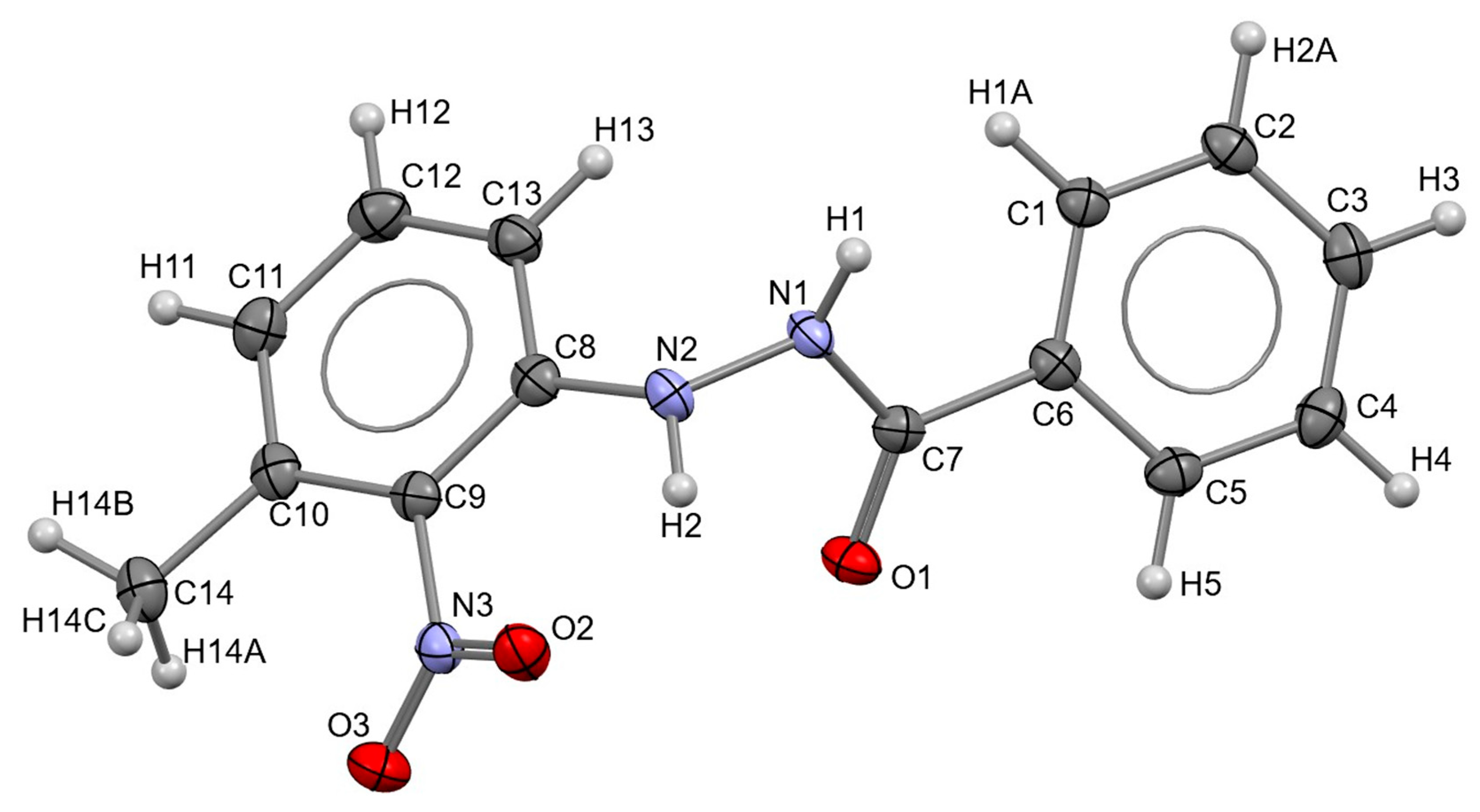
Compound IV crystallizes in the monoclinic space group P21/c with one molecule in the asymmetric unit (Figure 2). The hydrazide fragment adopts the expected amide-like geometry, with a short carbonyl distance (d(O1–C7) = 1.2315(13) Å) and a shortened C(O)–N bond (d(C7–N1) = 1.3561(14) Å), consistent with significant conjugation across the O=C–N linkage. This is closely aligned with our previously reported N′-(2-nitrophenyl)benzohydrazides, where planarity at the acyl nitrogen was taken as evidence of N–C(O) delocalization [37]. The local geometry around N1 in IV indicates a near-trigonal arrangement evident by the angles at N1 (116(1)°, 122(1)°, 118.03(9)°; Σangles ≈ 356.03°) and a small out-of-plane displacement of 0.147 Å from the N2-C7-H1 plane.
In contrast, the terminal nitrogen N2 is noticeably pyramidalized (0.276 Å from the C8-H2-N1 plane), and the hydrazide bond is strongly twisted (∡(C7–N1–N2–C8) = −86.74(12)°). Together with the relatively long N2–C8 bond (1.3910(14) Å), these features indicate that conjugation is localized primarily on the amide side (O=C–N1) rather than extended through N2 into the nitroaryl ring. This structural feature is qualitatively closer to that observed for N′-(4-methyl-2-nitrophenyl)benzohydrazide (V) [37], and contrasts with N′-(2-nitro-(4-trifluoromethyl)phenyl)benzohydrazide (VI) [37], in which planarization at N′ and an unusually short C8–N2 distance are consistent with greater π-delocalization along the N′–aryl bond into the nitro-substituted ring, leading to an almost parallel arrangement of the two aromatic rings [44,45,46,47,48,49,50,51,52,53,54,55,56,57]. Notably, the pyramidalization at N2 in IV (0.276 Å) is smaller than in the methyl analog V (0.326 Å), indicating a modest increase in delocalization while still well short of full planarity.
Two additional intramolecular distortions are evident and consistent with the steric congestion created by adjacent methyl and nitro substituents on the same aromatic ring. First, the nitro group is rotated out of the aromatic plane (∡(O2–N3–C9–C8) = 29.80(14)°), most plausibly due to steric congestion with the adjacent methyl substituent, which offsets the electronic tendency toward coplanarity and π-conjugation. Second, the amide carbonyl is also twisted relative to the benzoyl ring (∡(C5–C6–C7–O1) = −25.69(15)°), indicating that conjugation on the benzoyl side is likewise moderated by torsional distortion arising from steric and/or packing effects.
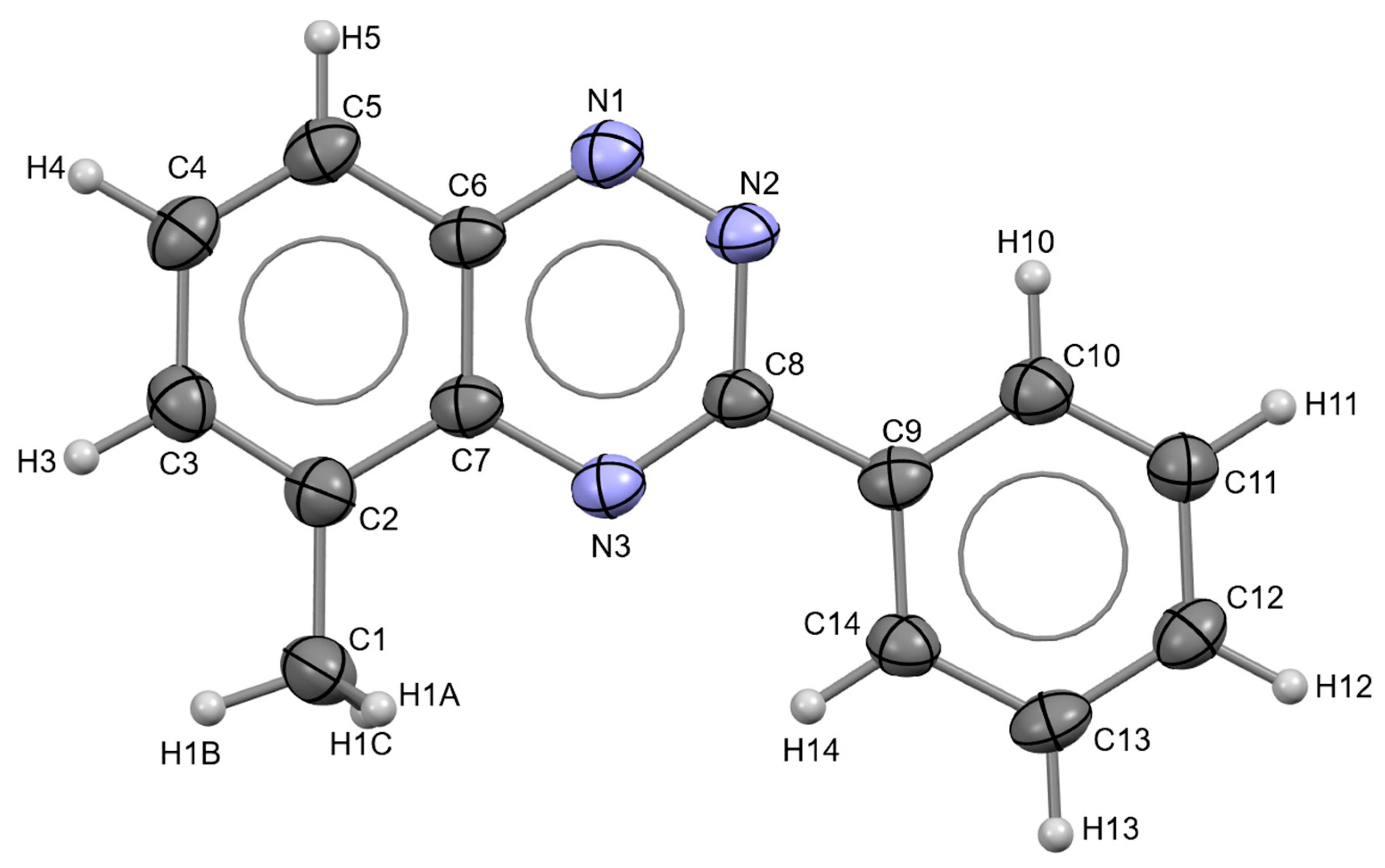
Compound I crystallizes in the orthorhombic space group P212121 with one molecule in the asymmetric unit (Figure 3). Although I is an achiral molecule, crystallization in the Sohncke space group P212121 is not unusual. In this case, the refined Flack parameter should be interpreted with caution because the structure contains only weak anomalous scatterers and the benzo[e][1,2,4]triazine framework is essentially planar. The angle between the benzo-fused ring plane (C2–C7) and the amidrazonyl moiety (N1–N2–C8–N3) is only 1.74°. Bond lengths and angles within the N-rich core are consistent with aromatic delocalization, with d(N1–N2) = 1.312(4) Å, d(N3–C8) = 1.311(4) Å, and C–N distances clustered around 1.36 Å (d(N1–C6) = 1.363(4) Å; d(N3–C7) = 1.364(4) Å). These values are consistent with those reported for the 6-methyl and 8-methyl-benzo[e][1,2,4]triazines (II and III) analogs [38], where triazine-ring distances (1.311–1.374 Å) were interpreted as intermediate between single and double bonds owing to π-conjugation.
A noticeable conformational feature in benzotriazine I is the orientation of the pendant 3-phenyl ring. In I, the phenyl ring is essentially coplanar with the benzotriazine π-surface (∡(N3–C8–C9–C14) = −2.5(5)°), indicating an extended conjugated system across the C8–C9 bond. This degree of coplanarity is comparable to, and in fact greater than, that reported for the 6- and 8-methyl regioisomers (II and III), where the dihedral angle between the benzotriazine core and the pendant phenyl ring is 9.68(4)° for the 6-methyl- benzo[e][1,2,4]triazine (II) and 4.37(5)° for the 8-methyl-benzo[e][1,2,4]triazine (III) [38]. Thus, in the 5-methyl regioisomer I, the methyl substituent does not induce steric twisting of the aryl substituent. Rather, the molecular conformation is governed primarily by the inherent planarity and π-delocalization of the benzo[e][1,2,4]triazine framework.

3.2. Supramolecular Arrangement

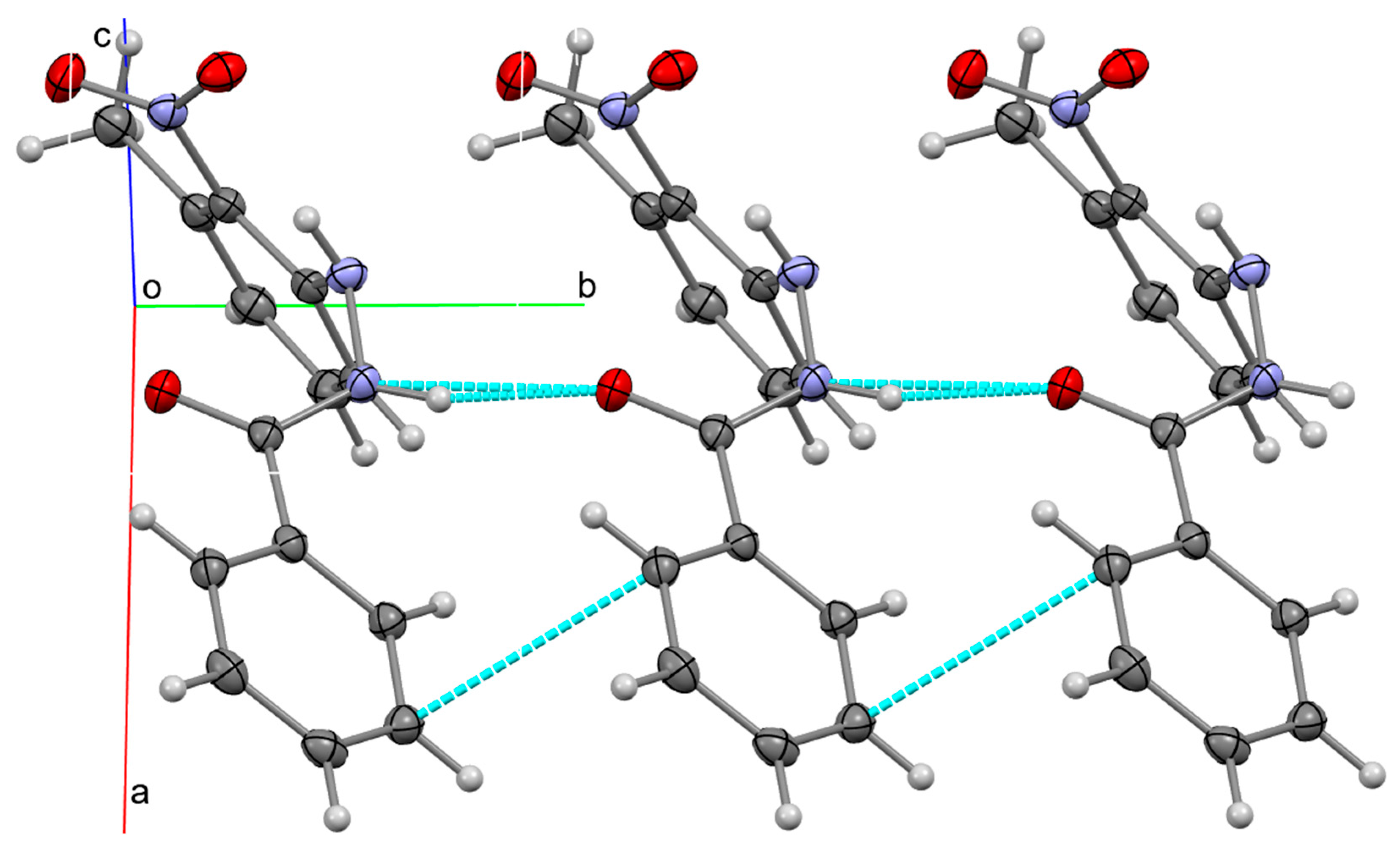
Crystal packing in IV is compact, with intermolecular contacts extending in all three crystallographic directions. Because hydrogen atoms were treated using a conventional IAM/riding model, X–H distances and H-involving short contacts should be regarded as standard crystallographic descriptors and interpreted with appropriate caution. The most prominent directional interaction occurs along the b axis (Figure 4), where neighboring molecules are linked into a one-dimensional chain (1D) through an N1–H1⋯O1 hydrogen bond (d(H1⋯O1) = 1.97(1) Å, ∡(N–H⋯O) = 165(1)°, d(N1⋯O1) = 2.843(1) Å), as shown in Figure 4. Within the same chain, close aromatic contacts are also present (d(C2⋯C5) = 3.387(2) Å), consistent with efficient packing of the phenyl fragments.
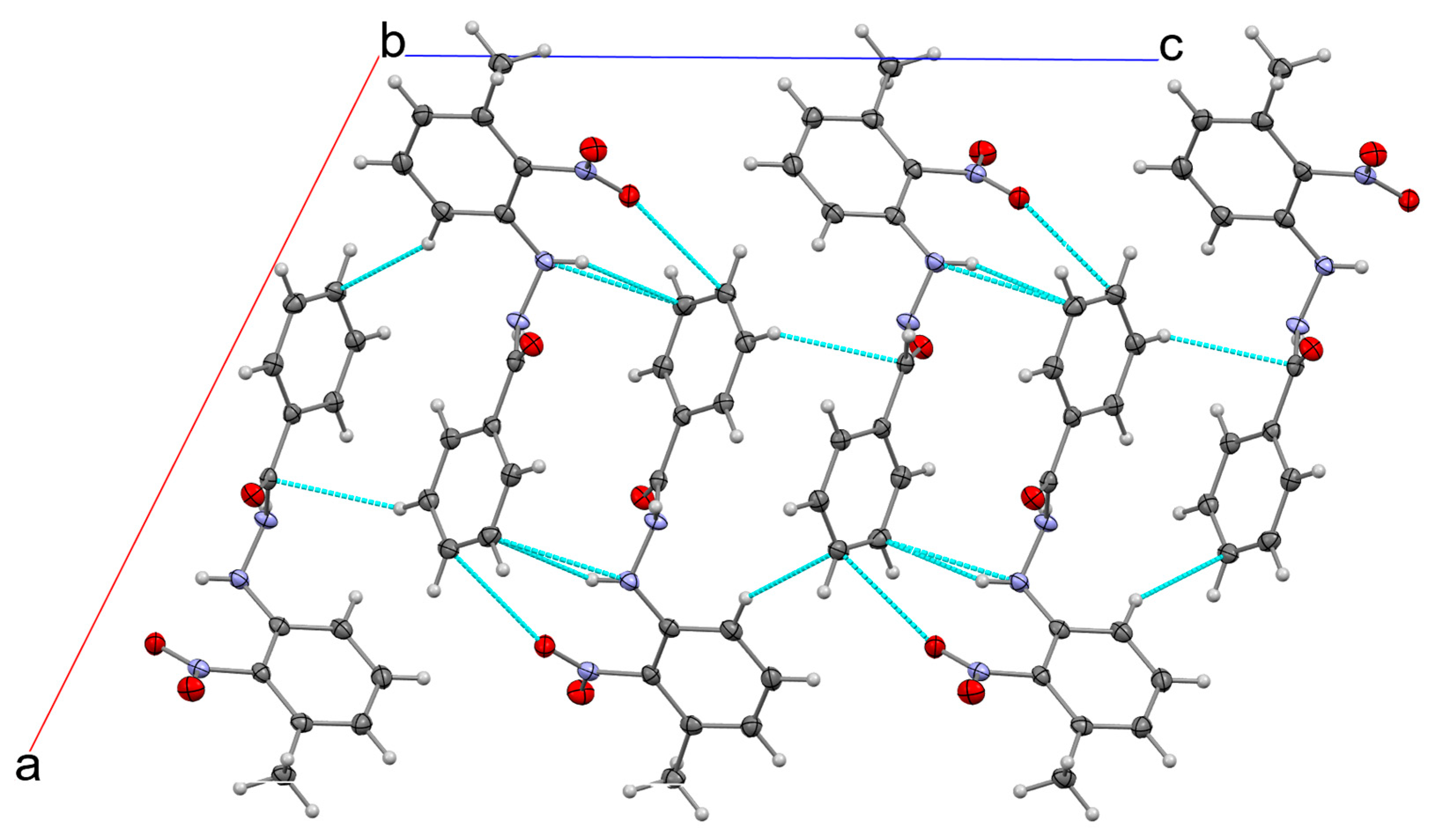
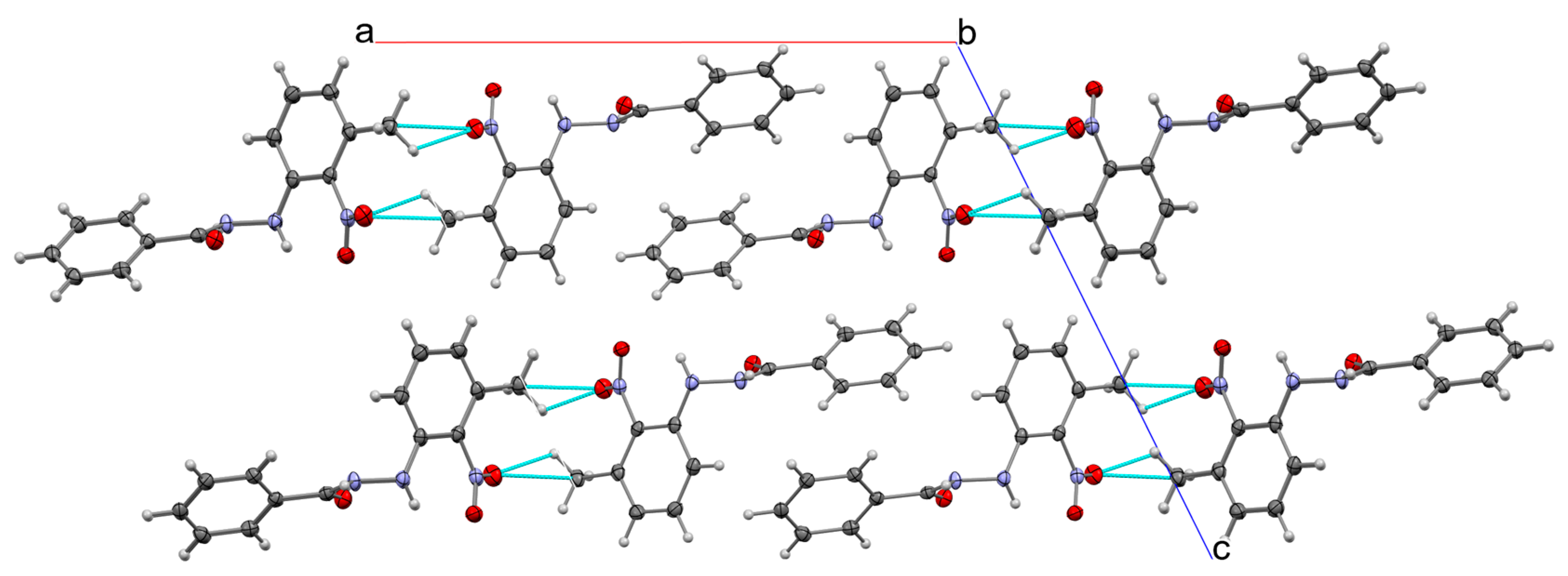
Additional organization is evident along the c axis, where molecules adopt an antiparallel arrangement to form a ribbon motif (Figure 5). The ribbon is supported primarily by short contacts that are best described as proximity interactions between aromatic fragments (for example, d(H13⋯C3) = 2.821 Å and d(H2A⋯C7) = 2.855 Å), together with an O3⋯C3 contact of 3.154(1) Å. A weak hydrogen-bond-like contact involving the terminal hydrazide N–H is also present (N2–H2⋯C4, d(H2⋯C4) = 2.72(2) Å, ∡(N2–H2⋯C4) = 119(1)°, d(N2⋯C4) = 3.232(1) Å). Along the a axis, the structure again adopts an antiparallel ribbon arrangement (Figure 6), which includes a weak C–H⋯O contact (d(H14C⋯O3) = 2.6477 Å, ∡(C14C–H14C⋯O3) = 114.18°, d(C14C⋯O3) = 3.178(2) Å).
Overall, the packing motif of IV differs from that reported for N′-(4-methyl-2-nitrophenyl)benzohydrazide (V) and N′-(2-nitro-(4-trifluoromethyl)phenyl)benzohydrazide (VI) [37], where π–π stacking between aromatic rings drives the formation of centrosymmetric one-dimensional columns of dimers, reinforced by symmetric N–H⋯O hydrogen bonds. In benzohydrazide IV, the dominant motif is instead a hydrogen-bonded chain along b with additional ribbon-like antiparallel organization along a and c, stabilized by a network of weaker proximity contacts. The distinct packing motif observed for IV is consistent with the more torsionally flexible hydrazide geometry observed for IV, including a twisted nitro group and non-coplanarity of the carbonyl with the benzoyl ring, which can disfavor the highly regular π-stacked dimer columns seen in the previously reported benzohydrazides [34].
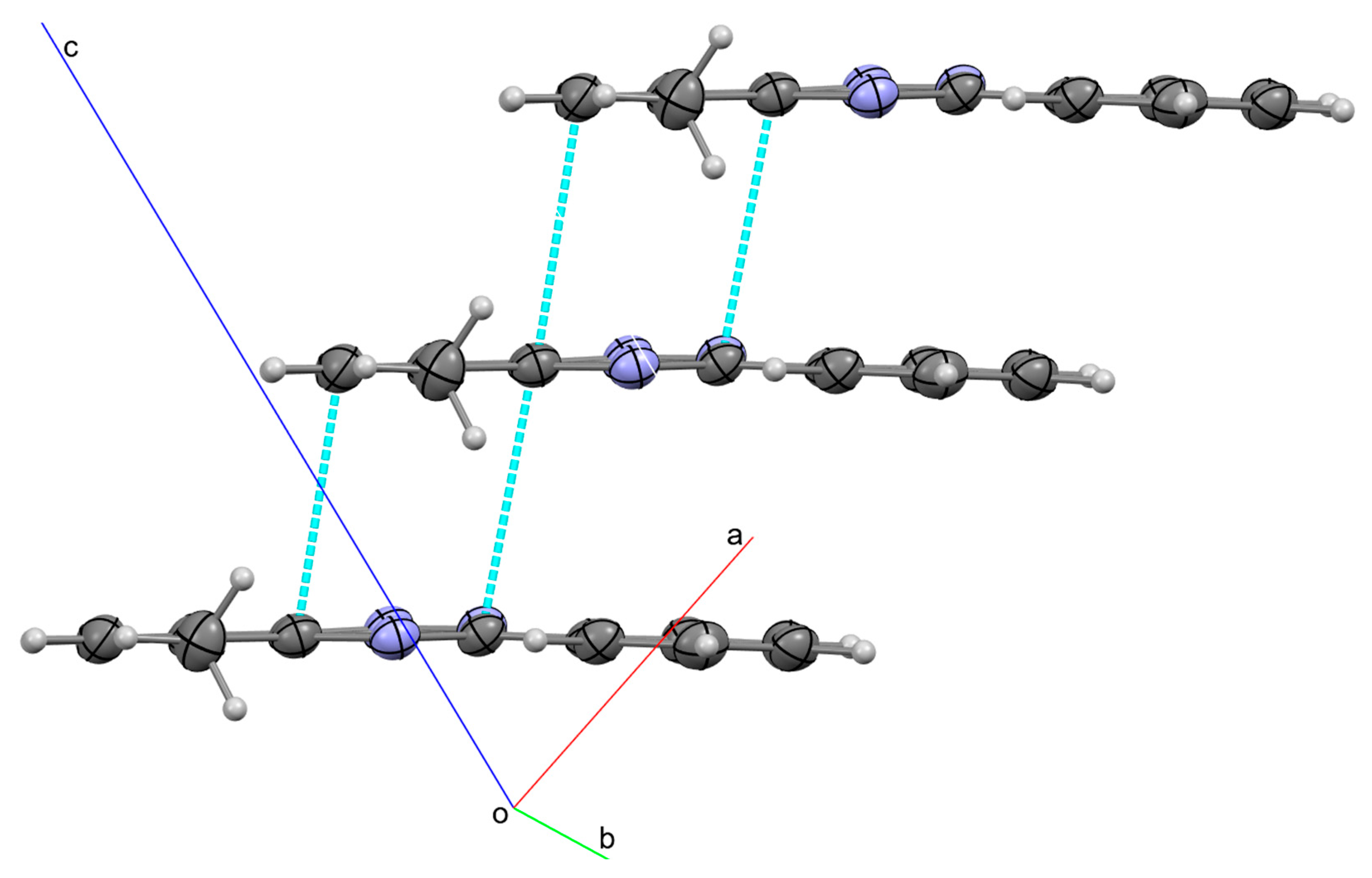
Crystal packing in I is likewise dense, with extensive intermolecular contacts across all axes. The dominant supramolecular feature is a one-dimensional (1D) column of slipped π-stacked benzotriazines running along the a axis (Figure 7). The interplanar spacing between benzotriazine cores is regular at 3.299 Å (defined using the ten atoms of the benzotriazine core), with longitudinal and latitudinal slippage angles of 41.98° and 20.36°, respectively. Within this stack, short intrachain C⋯C contacts are consistent with significant aromatic overlap (d(C6⋯C8) = 3.394(5) Å and d(C4⋯C7) = 3.339(5) Å).
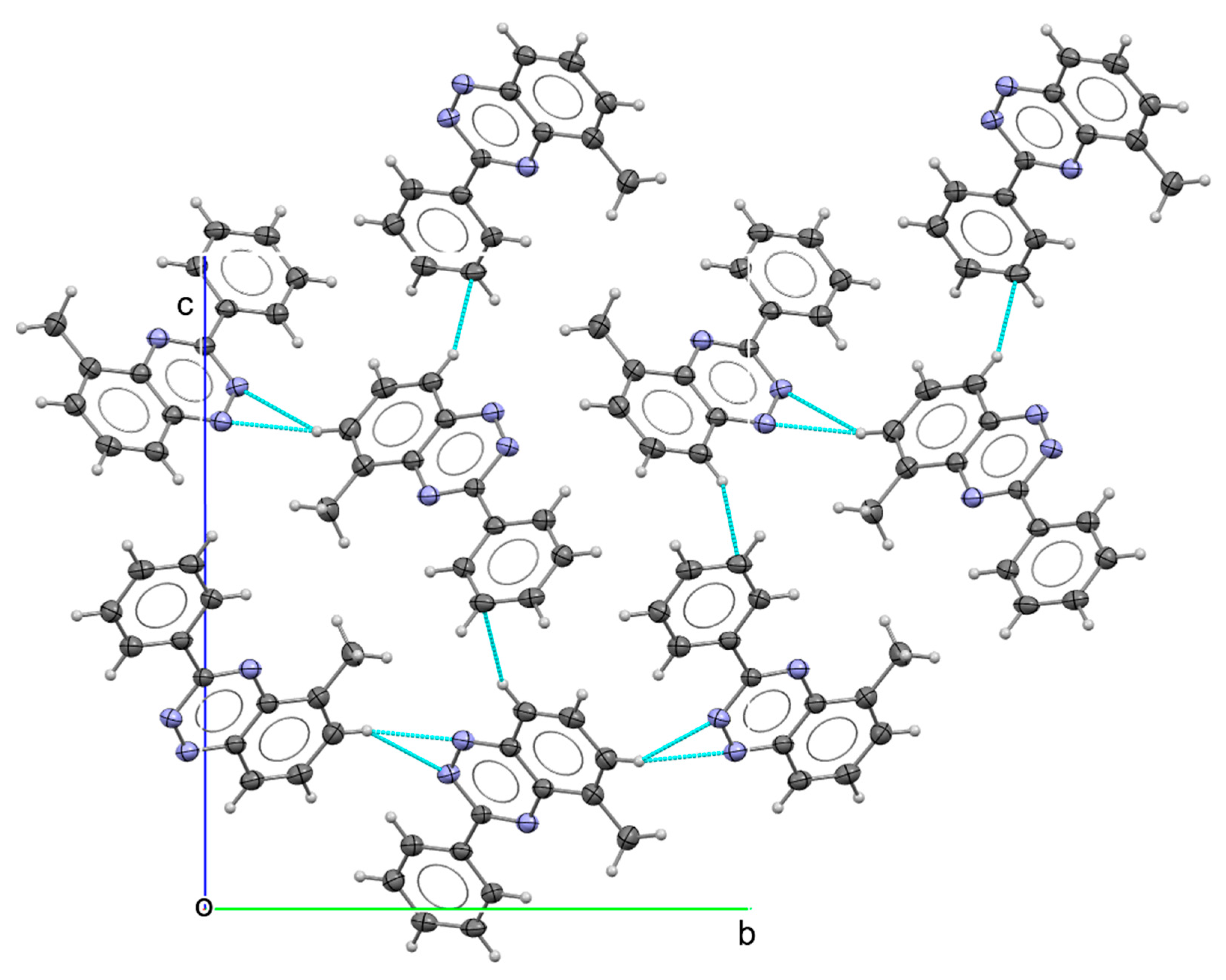
Packing connectivity beyond the a axis column is evident in the bc plane (Figure 8). The structure can be viewed as chains running along b, with adjacent chains arranged antiparallel along c to maintain a tight packing and to position methyl groups in regions that reduce steric congestion between neighboring benzotriazines. Interchain association is supported by weak C–H⋯N contacts, including a bifurcated interaction from C3–H3 to N1 and N2 (d(H3⋯N1) = 2.504 Å, ∡(C13–H3⋯N1) = 157.9°, d(C3⋯N1) = 3.402(4) Å; d(H3⋯N2) = 2.622 Å, ∡(C3–H3⋯N2) = 150.6°, d(C3⋯N2) = 3.480(4) Å). Additional short contacts such as d(C13⋯H5) = 2.803 Å also contribute to close packing between neighboring fused aromatic fragments.
To place I in the broader structural context of 3-phenylbenzo[e][1,2,4]triazines, it is useful to compare it with the previously reported 6-methyl and 8-methyl regioisomers II and III [38] as well as the parent [34] and dimethyl-substituted analogs [58]. Across this family, the benzo[e][1,2,4]triazine core remains essentially planar and the key N–N and C–N bond distances remain within the narrow range expected for a delocalized heteroaromatic system. Likewise, the 3-phenyl substituent remains only slightly twisted from the fused azaaromatic core. In the 6-methyl II and 8-methyl isomers III, the corresponding dihedral angles are 9.68(4) and 4.37(5)°, respectively, while in I the phenyl ring is nearly coplanar with the benzo[e][1,2,4]triazine π-surface. The dominant supramolecular motif across the series is π–π stacking, although the detailed stacking registry differs. The 6-methyl isomer II forms alternating dimers with interplanar separations of 3.257 and 3.304 Å, the 8-methyl isomer III forms regular translational stacks with a 3.366 Å spacing, and the parent 3-phenylbenzo[e][1,2,4]triazine [34] also adopts π-stacked columns, whereas the 5,7-dimethyl derivative shows a more dimeric stacking mode [58]. Taken together, these comparisons indicate that methyl substitution has only a minor effect on the intrinsic molecular geometry of the benzo[e][1,2,4]triazine core, but measurably influences the stacking registry and secondary intermolecular contacts in the crystal.

4. Conclusions

In summary, compound IV forms a robust one-dimensional hydrogen-bonded chain through N1–H1⋯O1 interactions, with the three-dimensional packing further stabilized by ribbon-like motifs supported by weaker C–H⋯O and C–H⋯C contacts. In contrast to the previously reported benzohydrazides, IV does not assemble into highly regular π-stacked dimer columns, a difference that is consistent with its more torsionally flexible hydrazide conformation, including nitro-group twisting and non-coplanarity of the carbonyl group with the benzoyl ring. Compound I displays an essentially planar benzo[e][1,2,4]triazine framework with an almost coplanar pendant phenyl ring, maintaining an extended conjugated system comparable to the 6- and 8-methyl analogs. Its supramolecular organization is dominated by slipped π-stacked columns of benzotriazines, reinforced by secondary C–H⋯N contacts, and the interplanar separation within the stack is slightly shorter than that reported for the corresponding methyl regioisomers, indicating efficient aromatic overlap in the solid state.
Within our broader effort to examine how methyl-substituent position affects the molecular and supramolecular behavior of benzo[e][1,2,4]triazines, the present study demonstrates that relocation of the methyl group to the 5-position in regioisomer I preserves the essential planarity of the benzo[e][1,2,4]triazine framework while subtly influencing the crystal packing arrangement. Comparison with the previously reported 6-methyl and 8-methyl regioisomers (II and III) shows that the overall preference for π–π-stacked columnar organization is maintained across the series, whereas the detailed intermolecular contacts, molecular offsets, and steric accommodation within the lattice vary with substituent position. Collectively, these findings reinforce the importance of methyl-group migration as a means of modulating supramolecular architecture in substituted benzo[e][1,2,4]triazines.

Supplementary Materials

The following supporting information can be downloaded at https://www.mdpi.com/article/10.3390/cryst16030206/s1. Figure S1. 1H NMR spectrum of N′-(3-methyl-2-nitrophenyl)benzhydrazide (IV); Figure S2. 13C NMR spectrum of N′-(3-methyl-2-nitrophenyl)benzhydrazide (IV); Figure S3. 1H NMR spectrum of 5-methyl-3-phenylbenzo[e][1,2,4]triazine (I); Figure S4. 13C NMR spectrum of 5-methyl-3-phenylbenzo[e][1,2,4]triazine (I); Figure S5. HRMS and pattern fragmentation of N′-(3-methyl-2-nitrophenyl)benzhydrazide (IV); Figure S6. HRMS and pattern fragmentation of 5-methyl-3-phenylbenzo[e][1,2,4]triazine (I); Crystal Data of N′-(3-methyl-2-nitrophenyl)benzhydrazide (IV); Crystal Data of 5-methyl-3-phenylbenzo[e][1,2,4]triazine (I).

Author Contributions

Conceptualization, C.P.C.; methodology, C.P.C.; software, C.P.C. and S.M.; formal analysis, C.P.C. and S.M.; investigation, J.-S.Y. and H.D.; writing—original draft preparation, C.P.C. and S.M.; writing—review and editing, C.P.C. and S.M.; supervision, C.P.C. and S.M.; project administration, C.P.C.; funding acquisition, C.P.C. All authors have read and agreed to the published version of the manuscript.

Funding

Funding for this research was provided by: Department of Energy, Office of Science, Basic Energy Sciences through Funding for Accelerated, Inclusive Research (FAIR), USA (grant No. DE-SC0025694) and NSF S-STEM Award Number 2130058, “Retaining Students in STEM on a Commuter Campus with Efficient High-Impact Practices,” 2021–2027.

Data Availability Statement

The original contributions presented in this study are included in the article/Supplementary Materials. Further inquiries can be directed to the corresponding author.

Acknowledgments

We acknowledge the use of the X-Ray facility at University of Michigan, Department of Chemistry. We thank Fengrui Qu for assistance with single-crystal data collection and analysis. The authors used AI solely to assist with language editing, including grammar, syntax, and phrasing, during manuscript revision. All scientific interpretation, analysis, and conclusions were developed and verified by the authors.

Conflicts of Interest

The authors declare no conflicts of interest. The funders had no role in the design of the study; in the collection, analyses, or interpretation of data; in the writing of the manuscript; or in the decision to publish the results.

References

  1. Kumar, R.; Kumar, N.; Roy, R.K.; Singh, A. Triazines—A comprehensive review of their synthesis and diverse biological importance. Curr. Med. Drug Res. 2017, 1, 173. [Google Scholar] [CrossRef]
  2. Siegl, S.J.; Dzijak, R.; Vázquez, A.; Pohl, R.; Vrabel, M. The discovery of pyridinium 1,2,4-triazines with enhanced performance in bioconjugation reactions. Chem. Sci. 2017, 8, 3593–3598. [Google Scholar] [CrossRef]
  3. Shivakumar, K.I.; Pociecha, D.; Szczytko, J.; Kapuściński, S.; Monobe, H.; Kaszyński, P. Photoconductive bent-core liquid crystalline radicals with a paramagnetic polar switchable phase. J. Mater. Chem. C 2020, 8, 1083–1088. [Google Scholar] [CrossRef]
  4. Fuchs, T.; Chowdhury, G.; Barnes, C.L.; Gates, K.S. 3-Amino-1,2,4-benzotriazine 4-oxide: Characterization of a new metabolite arising from bioreductive processing of the antitumor agent 3-amino-1,2,4-benzotriazine 1,4-dioxide (tirapazamine). J. Org. Chem. 2001, 66, 107–114. [Google Scholar] [CrossRef] [PubMed]
  5. Rogers, F.J.M.; Norcott, P.L.; Coote, M.L. Recent advances in the chemistry of benzo[e][1,2,4]triazinyl radicals. Org. Biomol. Chem. 2020, 18, 8255–8277. [Google Scholar] [CrossRef] [PubMed]
  6. Palanki, M.S.S.; Cao, J.-G.; Chow, C.P.; Dneprovskaia, E.; Mak, C.C.; McPherson, A.; Pathak, V.P.; Renick, J.; Soll, R.; Zeng, R.-Q.; et al. Development of novel benzotriazines for drug discovery. Expert Opin. Drug Discov. 2009, 4, 33–49. [Google Scholar] [CrossRef]
  7. Hay, M.P.; Hicks, K.O.; Pruijn, F.B.; Pchalek, K.; Siim, B.G.; Wilson, W.R.; Denny, W.A. Pharmacokinetic/pharmacodynamic model-guided identification of hypoxia-selective 1,2,4-benzotriazine 1,4-dioxides with antitumor activity: The role of extravascular transport. J. Med. Chem. 2007, 50, 6392–6404. [Google Scholar] [CrossRef]
  8. Hay, M.P.; Denny, W.A. New and versatile syntheses of 3-alkyl and 3-aryl-1,2,4-benzotriazine 1,4-dioxides: Preparation of bioreductive cytotoxins SR4895 and SR4941. Tetrahedron Lett. 2002, 43, 9569–9571. [Google Scholar] [CrossRef]
  9. Wolf, F.J.; Pfister, K., 3rd; Wilson, R.M., Jr.; Robinson, C. Benzotriazines. I. A new series of compounds having antimalarial activity. J. Am. Chem. Soc. 1954, 76, 3551–3553. [Google Scholar] [CrossRef]
  10. Noronha, G.; Barrett, K.; Cao, J.; Dneprovskaia, E.; Fine, R.W.; Lohse, D.; Mak, C.C.; McPherson, A.; Palanki, M.S.S.; Pathak, V.P.; et al. Discovery and preliminary structure–activity relationship studies of novel benzotriazine-based compounds as Src inhibitors. Bioorganic Med. Chem. Lett. 2006, 16, 5546–5550. [Google Scholar] [CrossRef]
  11. Noronha, G.; Barrett, K.; Boccia, A.; Brodhag, T.; Cao, J.; Chow, H.; Hanna, E.; Hood, J.D.; Hu, S.; Kang, X.; et al. Discovery of [7-(2,6-dichlorophenyl)-5-methylbenzo[1,2,4]triazin-3-yl]-[4-(2-pyrrolidin-1-ylethoxy)phenyl]amine, a potent, orally active Src inhibitor with anti-tumor activity in preclinical assays. Bioorganic Med. Chem. Lett. 2007, 17, 602–608. [Google Scholar] [CrossRef]
  12. Kotovskaya, S.K.; Zhumabaeva, G.N.; Perova, N.M.; Baskakova, Z.M.; Charushin, V.N.; Chupakhin, O.N.; Belanov, E.F.; Bormotov, N.L.; Blakhnin, S.M.; Serova, O.A. Synthesis and antiviral activity of fluorinated 3-phenyl-1,2,4-benzotriazines. Pharm. Chem. J. 2007, 41, 62–68. [Google Scholar] [CrossRef]
  13. Srivastava, A.S.; Cherney, R.J.; Ngu, K. Indole and Azaindole Inhibitors of PAD Enzymes. WO2020033520, 13 February 2020. [Google Scholar]
  14. Flückiger-Mangual, S.; Gruber, D.; Folmer, R.; Hekking, K.F.W.; Veerman, J.J.N.; Eerland, M.; Fabritius, C.-H. Heterocyclic Derivatives, Pharmaceutical Compositions and Their Use in the Treatment or Amelioration of Cancer. U.S. Patent 20230064948, 2 March 2023. [Google Scholar]
  15. Kristukat, C.; Lang, E. Organic Light-Emitting Component, and Use of a Copper Complex in a Charge Transport Layer. WO2012079956, 21 June 2012. [Google Scholar]
  16. Yokoyama, M.; Hagiya, K.; Adachi, C.; Toyama, T. Compound Having a π-Electron Conjugated Unit and a Carbazole Group. WO2019087936, 9 May 2019. [Google Scholar]
  17. Constantinides, C.P.; Koutentis, P.A. Stable N- and N/S-rich heterocyclic radicals: Synthesis and applications. Adv. Heterocycl. Chem. 2016, 119, 173–207. [Google Scholar]
  18. Constantinides, C.P.; Zissimou, G.A.; Berezin, A.A.; Ioannou, T.A.; Manoli, M.; Tsokkou, D.; Theodorou, E.; Hayes, S.C.; Koutentis, P.A. Tetraphenylhexaazaanthracenes: 16π weakly antiaromatic species with singlet ground states. Org. Lett. 2015, 17, 4026–4029. [Google Scholar] [CrossRef]
  19. Nicolaides, C.; Bazzi, F.; Vouros, E.; Flesariu, D.F.; Chrysochos, N.; Koutentis, P.A.; Constantinides, C.P.; Trypiniotis, T. Metal-free organic radical spin source. Nano Lett. 2023, 23, 4579–4586. [Google Scholar] [CrossRef] [PubMed]
  20. Perras, F.A.; Flesariu, D.F.; Southern, S.A.; Nicolaides, C.; Bazak, J.D.; Washton, N.M.; Trypiniotis, T.; Constantinides, C.P.; Koutentis, P.A. Methyl-driven Overhauser dynamic nuclear polarization. J. Phys. Chem. Lett. 2022, 13, 4000–4006. [Google Scholar] [CrossRef] [PubMed]
  21. Constantinides, C.P.; Carter, E.; Eisler, D.; Beldjoudi, Y.; Murphy, D.M.; Rawson, J.M. Effects of halo substitution on 2′-chloro-5′-halo-phenyl-1,2,3,5-dithiadiazolyl radicals: A crystallographic, magnetic and EPR case study. Cryst. Growth Des. 2017, 17, 3017–3029. [Google Scholar] [CrossRef]
  22. Constantinides, C.P.; Eisler, D.J.; Alberola, A.; Carter, E.; Murphy, D.M.; Rawson, J.M. Weakening of the π*–π* dimerisation in 1,2,3,5-dithiadiazolyl radicals: Structural, EPR, magnetic and computational studies of dichlorophenyl dithiadiazolyls, Cl2C6H3CNSSN. CrystEngComm 2014, 16, 7298–7312. [Google Scholar] [CrossRef]
  23. Constantinides, C.P.; Berezin, A.A.; Zissimou, G.A.; Manoli, M.; Leitus, G.M.; Koutentis, P.A. The suppression of columnar π-stacking in 3-adamantyl-1-phenyl-1,4-dihydrobenzo[e][1,2,4]triazin-4-yl. Molecules 2016, 21, 636. [Google Scholar] [CrossRef]
  24. Berezin, A.A.; Zissimou, G.; Constantinides, C.P.; Beldjoudi, Y.; Rawson, J.M.; Koutentis, P.A. Route to benzo- and pyrido-fused 1,2,4-triazinyl radicals via N′-(het)aryl-N′-[2-nitro(het)aryl]hydrazides. J. Org. Chem. 2014, 79, 314–327. [Google Scholar] [CrossRef]
  25. Constantinides, C.P.; Lawson, D.B.; Zissimou, G.A.; Berezin, A.A.; Mailman, A.; Manoli, M.; Kourtellaris, A.; Leitus, G.M.; Clérac, R.; Tuononen, H.M.; et al. Polymorphism in a π-stacked Blatter radical: Structures and magnetic properties of 3-phenyl-1-(pyrid-2-yl)-1,4-dihydrobenzo[e][1,2,4]triazine-4-yl. CrystEngComm 2020, 22, 5453–5463. [Google Scholar] [CrossRef]
  26. Ivanov, S.M. 1,2,4-Triazines and Their Benzo Derivatives. In Comprehensive Heterocyclic Chemistry IV; Black, D.S., Cossy, J., Stevens, C.V., Eds.; Elsevier: Oxford, UK, 2022; pp. 29–180. [Google Scholar]
  27. Mohammadi Ziarani, G.; Mostofi, M.; Gholamzadeh, P.; Mohammadi-Khanaposhtani, M.; Yavari, H. The synthesis of 1,2,4-benzotriazines. ARKIVOC 2019, 2019, 41–105. [Google Scholar] [CrossRef]
  28. Obijalska, E.; Kowalski, M.K. Recent progress in the synthesis of 1,2,4-benzotriazines (microreview). Chem. Heterocycl. Compd. 2017, 53, 846–848. [Google Scholar] [CrossRef]
  29. Dyatkin, A.B.; Boudreault, P.-L.T.; Ji, Z.; Luo, S.-M.; Tsai, J.-Y. Organic Electroluminescent Materials and Devices. U.S. Patent 20190248818, 15 August 2019. [Google Scholar]
  30. Branowska, D.; Olender, E.; Wysocki, W.; Karczmarzyk, Z.; Bancerz, I.; Ledwoń, P.; Łapkowski, M.; Mirosław, B.; Urbańczyk-Lipkowska, S.; Kalicki, P.B. Synthesis and electrochemical characterization of oligothiophenes with 1,2,4-triazine and 5,5′-bi-1,2,4-triazine as strong electron acceptor units. Electrochim. Acta 2016, 214, 19–30. [Google Scholar] [CrossRef]
  31. Maggiore, A.; Tan, X.; Brosseau, A.; Danos, A.; Miomandre, F.; Monkman, A.P.; Audebert, P.; Clavier, G. Novel D-A chromophores with condensed 1,2,4-triazine system simultaneously display thermally activated delayed fluorescence and crystallization-induced phosphorescence. Phys. Chem. Chem. Phys. 2022, 24, 17770–17781. [Google Scholar] [CrossRef] [PubMed]
  32. Cerri, R.; Boido, A.; Sparatore, F. Oxidation and acid-catalyzed cyclization of aldehyde 2-aminophenylhydrazones. Alternative syntheses for 1,2,4-benzotriazines and benzimidazoles. J. Heterocycl. Chem. 1979, 16, 1005–1008. [Google Scholar] [CrossRef]
  33. Khodja, M.; Moulay, S.; Boutoumi, H.; Wilde, H. Two-step syntheses of 3-methyl and 3-phenyl-1,2,4-benzotriazines. Heteroat. Chem. 2006, 17, 166–172. [Google Scholar] [CrossRef]
  34. Bodzioch, A.; Pomikło, D.; Celeda, M.; Pietrzak, A.; Kaszyński, P. 3-Substituted benzo[e][1,2,4]triazines: Synthesis and electronic effects of the C(3) substituent. J. Org. Chem. 2019, 84, 6377–6394. [Google Scholar] [CrossRef]
  35. Pomikło, D.; Bodzioch, A.; Kaszyński, P. 3-Substituted Blatter radicals: Cyclization of N-arylguanidines and N-arylamidines to benzo[e][1,2,4]triazines and PhLi addition. J. Org. Chem. 2023, 88, 2999–3011. [Google Scholar] [CrossRef]
  36. Teymouri, M.; Pietrzak, A.; Bartos, P. (Hetero)arene ring-fused [1,2,4]triazines. Molbank 2024, 2024, M1824. [Google Scholar] [CrossRef]
  37. Constantinides, C.P.; Raza, S.; Bazzi, F.; Sharara, N.; Marincean, S. Comparative analysis of the substituent effects on the supramolecular structure of N′-(4-methyl-2-nitrophenyl)benzohydrazide and N′-(2-nitro-(4-trifluoromethyl)phenyl)benzohydrazide. Crystals 2025, 15, 732. [Google Scholar] [CrossRef]
  38. Constantinides, C.P.; Raza, S.; Bazzi, F.; Sharara, N.; Marincean, S. Synthesis and crystal structures of 6- and 8-methyl-3-phenylbenzo[e][1,2,4]triazines. Acta Crystallogr. Sect. E Crystallogr. Commun. 2025, 81, 699–705. [Google Scholar] [CrossRef] [PubMed]
  39. CrysAlisPro Software System, version 1.171.43.130a; Rigaku Oxford Diffraction: Yarnton, UK, 2024.
  40. Pflugrath, J.W. The finer things in X-ray diffraction data collection. Acta Crystallogr. Sect. D 1999, 55, 1718–1725. [Google Scholar] [CrossRef] [PubMed]
  41. Sheldrick, G.M. SHELXT—Integrated space-group and crystal-structure determination. Acta Crystallogr. Sect. A 2015, 71, 3–8. [Google Scholar] [CrossRef]
  42. Dolomanov, O.V.; Bourhis, L.J.; Gildea, R.J.; Howard, J.A.K.; Puschmann, H. OLEX2: A complete structure solution, refinement and analysis program. J. Appl. Crystallogr. 2009, 42, 339–341. [Google Scholar] [CrossRef]
  43. Sheldrick, G.M. Crystal structure refinement with SHELXL. Acta Crystallogr. Sect. C 2015, 71, 3–8. [Google Scholar] [CrossRef]
  44. Seth, N.; Brown, S.N. CCDC 1863863, Cambridge Crystallographic Data Centre, Access Structures. Available online: http://www.ccdc.cam.ac.uk/structures (accessed on 1 March 2026).
  45. Kesternich, V.; Gahona, P.; Perez-Fehrmann, M.; Brito, I.; Lopez-Rodriguez, M. 2-Amino-N′-phenylbenzohydrazide. Acta Crystallogr. Sect. E 2012, 68, o1847. [Google Scholar] [CrossRef]
  46. Wardell, J.L.; Low, J.N.; Glidewell, C. N-(4-Nitrobenzoyl)-N′-phenylhydrazine: A three-dimensional hydrogen-bonded framework. Acta Crystallogr. Sect. C 2007, 63, o334. [Google Scholar] [CrossRef]
  47. Wardell, S.M.S.V.; de Souza, M.V.N.; Wardell, J.L.; Low, J.N.; Glidewell, C. N-(3,5-Dinitrobenzoyl)-N′-phenylhydrazine: Sheets built from N—H⋯O and C—H⋯O hydrogen bonds. Acta Crystallogr. Sect. E 2006, 62, o2589. [Google Scholar] [CrossRef]
  48. Saeed, A.; Arshad, I.; Flörke, U. N′-(2,4-Dinitrophenyl)benzohydrazide. Acta Crystallogr. Sect. E 2012, 68, o2418. [Google Scholar] [CrossRef]
  49. Nowick, J.S.; Pairish, M.; Lee, I.Q.; Holmes, D.L.; Ziller, J.W. An Extended β-Strand Mimic for a Larger Artificial β-Sheet. J. Am. Chem. Soc. 1997, 119, 5413–5424. [Google Scholar] [CrossRef]
  50. Saeed, A.; Arshad, I.; Flörke, U. Synthesis, crystal structure, and DFT study of N′-(2,4-dinitrophenyl)-2-fluorobenzohydrazide. J. Chem. 2013, 2013, 648121. [Google Scholar] [CrossRef]
  51. Ding, Y.; Zhang, L.; Yang, S.; Li, Z.; Wang, P.-Y. Synthesis, antimicrobial activity, and molecular docking of benzoic hydrazide or amide derivatives containing a 1,2,3-triazole group as potential SDH inhibitors. Chin. J. Chem. 2021, 39, 1319–1330. [Google Scholar] [CrossRef]
  52. Cortés, E.; Abonía, R.; Cobo, J.; Glidewell, C. Four related esters: Two 4-(aroylhydrazinyl)-3-nitrobenzoates and two 3-aryl-1,2,4-benzotriazine-6-carboxylates. Acta Crystallogr. Sect. C 2013, 69, 754–760. [Google Scholar] [CrossRef]
  53. Guru, M.M.; Punniyamurthy, T. Copper(II)-catalyzed aerobic oxidative synthesis of substituted 1,2,3- and 1,2,4-triazoles from bisarylhydrazones via C–H functionalization/C–C/N–N/C–N bond formation. J. Org. Chem. 2012, 77, 5063–5073. [Google Scholar] [CrossRef] [PubMed]
  54. Shuler, W.G.; Smith, E.A.; Hess, S.M.; McFadden, T.M.C.; Metz, C.R.; VanDerVeer, D.G.; Pennington, W.T.; Mabe, P.J.; Knick, S.L.; Beam, C.F. Preparation and X-ray crystal structure of 3-(4-(dimethylamino)phenyl)-2-(phenylamino)isoquinolin-1(2H)-one, 3-(4-methoxyphenyl)-2-(phenylamino)isoquinolin-1(2H)-one, and 2-methyl-N′-(4-methylbenzoyl)-N′-phenylbenzohydrazide from polylithiated 2-methylbenzoic acid phenylhydrazide and methyl 4-dimethylaminobenzoate, methyl 4-methoxybenzoate, or methyl 4-methylbenzoate. J. Chem. Crystallogr. 2012, 42, 952–959. [Google Scholar]
  55. Jha, A.K.; Kumari, R.; Easwar, S. A hydrazine insertion route to N′-alkyl benzohydrazides by an unexpected carbon–carbon bond cleavage. Org. Lett. 2019, 21, 8191–8195. [Google Scholar] [CrossRef]
  56. Ke, C.; Cao, Q.; Luo, Y.; Liu, X.; Feng, X. Catalytic asymmetric amination of azlactones with azobenzenes. Chem. Commun. 2022, 58, 5881–5884. [Google Scholar] [CrossRef]
  57. Zheng, L.; Zhuo, X.; Wang, Y.; Zou, X.; Zhong, Y.; Guo, W. Photocatalytic cross-dehydrogenative coupling reaction toward the synthesis of N,N-disubstituted hydrazides and their bromides. Org. Chem. Front. 2022, 9, 3012–3021. [Google Scholar] [CrossRef]
  58. Nicoló, F.; Panzalorto, M.; Scopelliti, R.; Grassi, G.; Risitano, F. 5,7-Dimethyl-3-phenyl-1,2,4-benzotriazine. Acta Crystallogr. Sect. C 1998, 54, 405–407. [Google Scholar] [CrossRef]
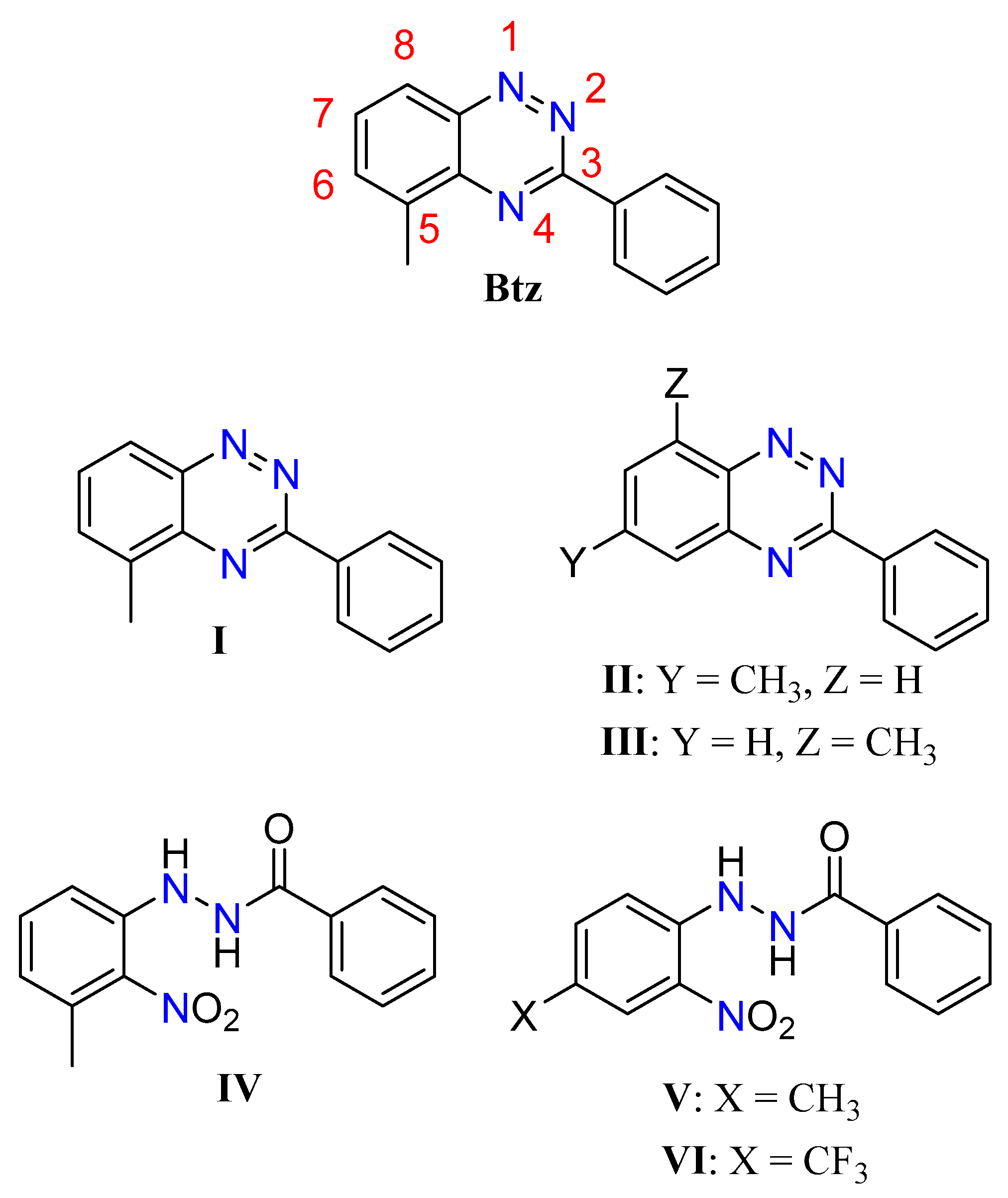
Figure 1. Molecular structures of (i) the parent benzo[e][1,2,4]triazine (Btz), with nomenclature ring-atom numbering in red; (ii) methyl-substituted benzo[e][1,2,4]triazines IIII; and (iii) methyl- and trifluoromethyl-substituted N′-phenylbenzohydrazides IVVI.
Crystals 16 00206 g001
Scheme 1. Synthesis of 5-methyl-3-phenylbenzo[e][1,2,4]triazine (I) via hydrazide formation, reductive cyclodehydration, and oxidative aromatization.
Crystals 16 00206 sch001
Figure 2. Molecular structure of N′-(3-methyl-2-nitrophenyl)benzhydrazide (IV) (ORTEP, 50% probability ellipsoids) with atom labeling.
Crystals 16 00206 g002
Figure 3. Molecular structure of 5-methyl-3-phenylbenzo[e][1,2,4]triazine (I) (ORTEP, 50% probability ellipsoids) with atom labeling.
Crystals 16 00206 g003
Figure 4. Packing along the b axis showing the N1–H1⋯O1 hydrogen-bonded chain and the closest aromatic contacts.
Crystals 16 00206 g004
Figure 5. Packing along the c axis showing the antiparallel ribbon arrangement and the key short contacts.
Crystals 16 00206 g005
Figure 6. Packing along the a axis highlighting the weak C–H⋯O contact.
Crystals 16 00206 g006
Figure 7. Packing along the a axis showing the slipped π-stacked column and the closest intrastack contacts.
Crystals 16 00206 g007
Figure 8. Packing in the bc plane showing interchain contacts, including the bifurcated C–H⋯N interactions.
Crystals 16 00206 g008
Disclaimer/Publisher’s Note: The statements, opinions and data contained in all publications are solely those of the individual author(s) and contributor(s) and not of MDPI and/or the editor(s). MDPI and/or the editor(s) disclaim responsibility for any injury to people or property resulting from any ideas, methods, instructions or products referred to in the content.