Article

Pb-Apatite Framework as a Generator of Novel Flat-Band CuO-Based Physics

1
Department of Physics, University of Colorado Boulder, Boulder, CO 80309, USA
2
Center for Experiments in Quantum Materials, University of Colorado Boulder, Boulder, CO 80309, USA
3
National Laboratory of the Rockies, Golden, CO 80401, USA
4
Theory and Simulation of Condensed Matter, King’s College London, The Strand, London WC2R 2LS, UK
*
Author to whom correspondence should be addressed.
Current address: Solaris National Synchrotron Radiation Centre, Jagiellonian University, Czerwone Maki 98, 30-392 Kraków, Poland.
Crystals 2026, 16(1), 74; https://doi.org/10.3390/cryst16010074 (registering DOI)
Submission received: 16 December 2025 / Revised: 14 January 2026 / Accepted: 17 January 2026 / Published: 22 January 2026
(This article belongs to the Section Inorganic Crystalline Materials)

Abstract

Based upon density functional theory (DFT) calculations, we present the basic electronic structure of CuPb9(PO4)6O (Cu-doped lead apatite, aka LK-99), in two scenarios: (1) where the structure is constrained to the P3 symmetry and (2) where no symmetry is imposed. At the DFT level, the former is predicted to be metallic while the latter is found to be a charge-transfer insulator. In both cases the filling of these states is nominally d 9 , consistent with the standard Cu2+ valence state, and Cu with a local magnetic moment of order 0.7 μB. In the metallic case we find these states to be unusually flat (∼0.2 eV dispersion), giving a very high density of electronic states (DOS) at the Fermi level that we argue can be a host for novel electronic physics. The flatness of the bands is the likely origin of symmetry-lowering gapping possibilities that would remove the spectral weight from E F . Motivated by some initial experimental observations of metallic or semiconducting behavior, we propose that disorder (likely structural) is responsible for closing the gap. Here, we consider a variety of possibilities that could possibly close the charge-transfer gap but limit consideration to kinds of disorder that preserve electron count. Of the possible kinds we considered (spin disorder, O populating vacancy sites, and Cu on less energetically favorable Pb sites), the local Cu moment, and consequently the charge-transfer gap, remains robust. We conclude that disorder responsible for metallic behavior entails some kind of doping where the electron count changes. Further, we claim that the emergence of the flat bands should be due to weak wave function overlap between the orbitals on Cu and O sites, owing to the directional character of the constituent orbitals. Therefore, finding an appropriate host structure for minimizing hybridization between Cu and O while allowing them to still weakly interact should be a promising route for generating flat bands at E F which can lead to interesting electronic phenomena, regardless of whether LK-99 is a superconductor.

1. Introduction

A Cu-doped lead apatite with chemical formula CuxPb10−x(PO4)6O ( 0.9   <   x   <   1.1 ) named “LK-99” spiked particular attention [1,2,3,4,5,6,7,8] after initial reports [9,10] claiming it is the world’s first ambient pressure room-temperature superconductor. In particular, many signatures of superconductivity were found to exist up to 400 K (127 °C), including diamagnetic responses and strong reductions in electrical resistance. While the validity of the claims of superconductivity was not confirmed [8,11,12,13], here we show that the electronic structure of this class of compounds is very interesting in its own right and has many features expected to be supportive of superconductivity at high temperatures. In particular, we show that, within DFT, the process of doping Cu atoms on the particular Pb(4f) site described in Refs. [9,10] generates either a metal, when the system is constrained to keep P3 symmetry as reported, or an insulator when the system is allowed to fully relax. The orbital character of states around the Fermi level E F also depends on whether relaxation is constrained or not, as we explain below. In either case, two bands near E F appear, consisting predominately of Cu d and O p character, and have an especially small bandwidth of order 0.2 eV. In the symmetry-constrained case, the three states coalesce and the system is metallic in DFT and DFT+U (U = 5 eV), while in the fully relaxed case, a state of Cu d with | m |   =   1 in one spin channel splits off and becomes unoccupied. Thus, Cu becomes d 9 and the system becomes insulating. We believe that metallic behavior observed in experiments [14] likely originates from disorder. In both cases the local Cu moment is ∼0.7 μ B .
Experience with many other electronic compounds with flat electronic bands right at the Fermi level immediately signals the possibility of exotic properties as such states tend to be extremely “active”. That is, the high density of electronic states at E F that comes with these flat bands tends to lead to electronic instabilities of various kinds, including charge density waves and/or superconductivity. Also helpful for generating exotic properties are systems with small spin magnetic moments as these usually bring strong quantum fluctuations of the spins. A good example is the Cu-O-based “cuprate” high-temperature superconductors [15] with spin 1/2 moments on the Cu sites or, more specifically, partially delocalized across Cu-O clusters [16]. We find that the present system also should contain spin 1/2 moments associated with Cu, consistent with the d 9 (Cu2+) valence state that our calculations show. Indeed, this system has many similarities with traditional cuprate superconductors, as we explain below. We will argue that these flat Cu-O-derived bands do not occur by accident in CuxPb10−x(PO4)6O ( 0.9   <   x   <   1.1 ) but rather should be due to minimal direct coupling between the Cu 3d and O 2p wave functions. (Already in the parent compound, the band dispersion of the O-derived valence band maximum itself has narrow dispersion.) This reduced coupling gives a reduced E vs. k band dispersion (flat bands) and an associated high electronic density of states. We find a portion of these flat bands/high density of states live right at E F so they should become strongly electronically “active”—which could potentially result in unconventional superconductivity through one of many possible channels, as will be discussed later. We argue the ultra-flat Cu-O bands at E F can be crucial for high-temperature superconductivity. The concepts outlined here can be used as guidance for finding other possible hosts besides Pb apatite that generate electronically active flat bands at E F . Figure 1 shows a schematic of how to obtain ultra-flat bands, as illustrated for Cu (red)- and O (blue)-hybridized wave functions. Panel (a1) is illustrative of “native” Cu-O bonds, where the wave function overlap is large. In this case (as occurs in the cuprates), Cu and O form strong covalent bonds, which gives rise to a significant dispersive bandwidth w 0 (a2). (Panel b1) The Cu and O atoms only weakly hybridize when Cu is placed in the Pb-apatite framework giving a small bandwidth from these states. Note that the phosphate (PO4 unit) indeed forms strong covalent bonds, but these bonding states reside far from the Fermi level.
In a metal with very flat bands at E F , the system would typically like to find some way to lower the symmetry and open gaps (panel c). The flatter the bands get, the greater the driving force to form a gap. There are many possibilities, including structural relaxation, that break the P3 symmetry, as we describe below. Indeed, higher-level calculations based on many-body perturbation theory shows that a gap slightly in excess of 3 eV is already present even within P3 symmetry [17]. However, small amounts of random disorder, for example, from incommensurate doping levels ( x     1 ), can protect the flat bands from such gapping effects, keeping them available to support superconductivity. It is possible that this system, owing to its weak hybridization, may be more sensitive to disorder than established superconductors. At the same time, superconductivity may be robust against this disorder, as Anderson showed in the context of s-wave superconductivity [18]. These ingredients are different from those proposed in Refs. [9,10] for the superconductivity. They argue that the relevant states for the superconductivity are 6 s 1 states from the six-fold degenerate Pb atoms (which we refer to as Pb(6h) following the Wyckoff notation for the original Pb-apatite crystal structure) with these states affected by the compressive strain of the inserted Cu atoms, leading to an insulator-to-metal transition and setting the stage for superconductivity. Our electronic structure calculations show negligible amounts of Pb 6s spectral weight near the Fermi level in the symmetry-constrained case (some Pb 6s does appear in the fully relaxed case). DFT calculations show contributions originate mostly from the Cu 3d and O 2p orbitals. An approximately similar conclusion is drawn from a high-fidelity description of the band structure [17]: the valence band consists mostly of O 2p character and the conduction band of Cu 3d character. Therefore, to the extent there is superconductivity in this system, it should be from the Cu and O states near E F , rather than by the size effect from substituting Cu for Pb.
Following this introduction, we present the details of our electronic structure calculations, beginning with the structures that these calculations are based upon.

2. Materials and Methods

We investigated an electronic structure of pure and Cu-doped lead apatite using density functional theory. Calculations were carried out using generalized gradient approximation (GGA) [19], GGA+U [20], with U (Cu-d) = 5 eV, and the strongly constrained and appropriately normed (SCAN) meta-GGA [21] with the projector-augmented wave approach (PAW) implemented in the VASP code [22]. Only collinear magnetic structures were considered and the spin–orbit coupling (SOC) was not included in the calculations. This is because we expect that SOC effects are strong only for unoccupied manifold of Pb states well above E F . Structural optimization was performed in two possible ways, with P3 symmetry imposed (default ISYM = 1) and without symmetry constraints (ISYM = 0), and the respective electronic structure was calculated for both cases. Plane wave cut-off energy was set to 360 eV and 2 × 2 × 4 k-mesh was utilized.

3. Results

3.1. Crystal and Electronic Structure of the Parent Compound Pb10(PO4)6O

The “parent” compound is Pb apatite Pb10(PO4)6O. This compound had been previously synthesized in single crystalline form 20 years ago, with detailed structural characterizations from X-ray diffraction measurements performed on these crystals [23], including a CIF structure file that is available in the ICSD database. This structure belongs to the P63/m hexagonal symmetry class (number 176) and consists of four Pb(4f) and six Pb(6h) sites, six PO4 tetrahedra each containing one O(1), two O(2), and one O(3) site, as well as four O(4) sites that are each 1/4 occupied. (Often Pb(6h) and Pb(4f) are denoted as Pb(1) and Pb(2), but the literature is not consistent.) We also note that the 1/4 occupation of the four O(4) sites implies that the experimental characterization describes only the average crystal structure, which does not capture the differences in the local geometries between occupied and unoccupied O(4) sites. To deal with the 1/4 occupation in our electronic structure calculations, we made the approximation that one of the four O(4) sites within the 41-atom primitive cell, hosting one formula unit (fu), should be occupied while the other three are not. This choice lifts the symmetry-equivalence of the O(4) sites and creates a long-range ordered structure with P3 (#143) space group symmetry. This structure is an imperfect but useful model to study Cu substitution in Pb10(PO4)6O, as it is small enough to allow for enumeration of all atomic configurations resulting from atomic site substitutions.
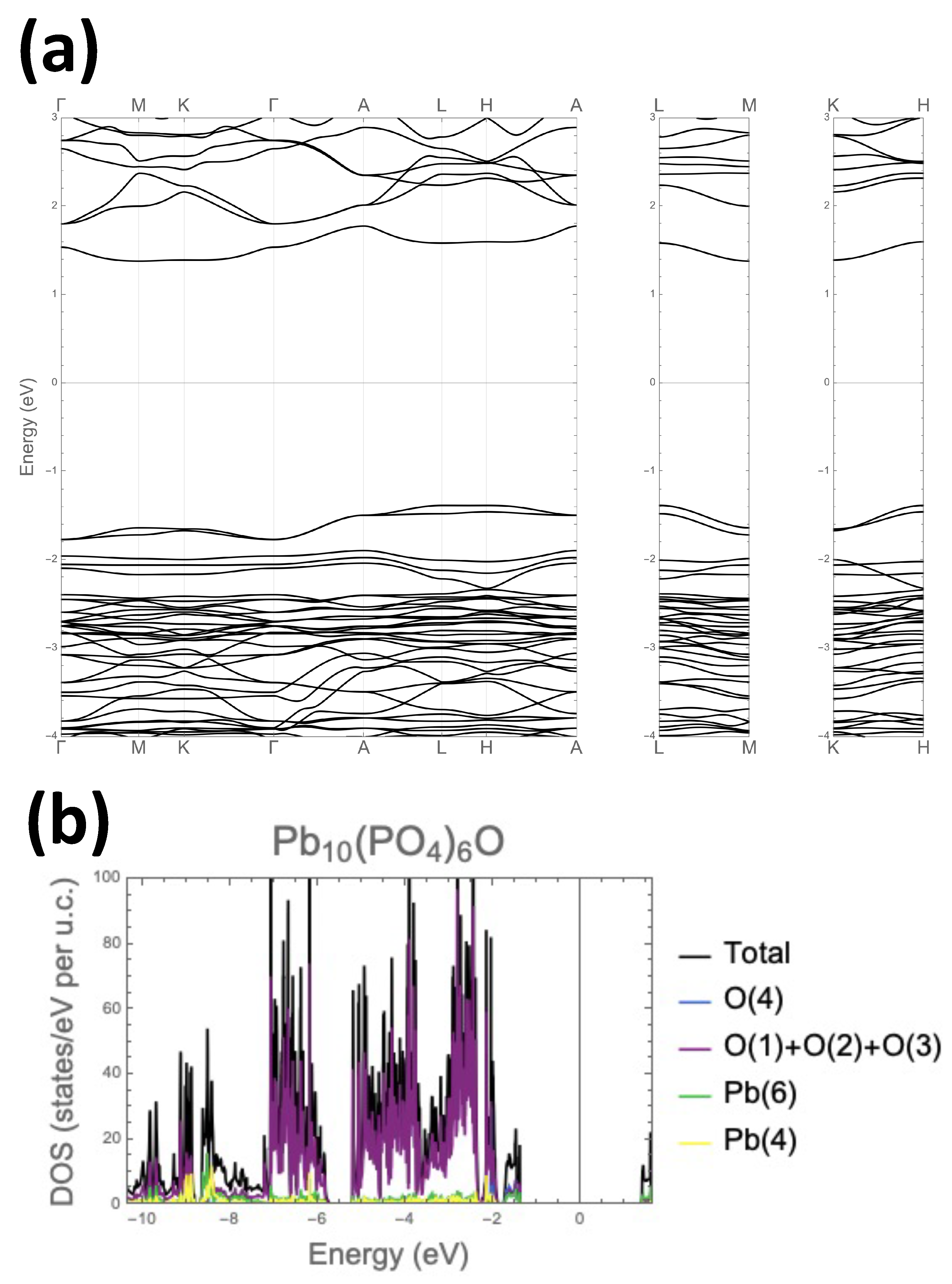
We calculated the band structure of this compound (see Figure 2) using the PBE functional and performed a structural relaxation with the P3 symmetry constrained. We selected one particular position (from four available), consistently with the 4f-1 configuration, which is described later in the text. Panel (a) shows the band dispersion along high-symmetry directions in the first Brillouin zone. The indirect energy gap is visible between the top of the valence band at the L point and the minimum of the conduction band at the M point, with a bandgap of 2.765 eV. Calculated partial densities of states allow us to assign main atomic contributions to bands at the edges of the bandgap, with the upper edge of the valence band states composed principally of states related to Pb(6h) atoms and oxygen from PO4 tetrahedra, i.e., O(1), O(2), and O(3) together. The distribution of contributions to the DOS at the bottom of the conduction band is more uniform: the dominant contribution comes from the lone oxygen O(4), which is enclosed in Pb(6h) chains. Pb(6h) atoms and the rest of the oxygen contribute almost the same number of states as O(4) in this energy region. Overall, the DOS between −8 and −2 eV is dominated by oxygen contribution. Pb(4) is visible as a spike at −2.16 eV which coincides with some flat bands in this region (see panel (b)) and this contribution gets more important between −10 and −8 eV.

3.2. Crystal Structure of CuPb9(PO4)6O

We note from the outset that the physical structure of CuPb9(PO4)6O (or the LK-99 materials) has not yet been fully determined. As an alloy system, this material is inherently atomically disordered, and to make the most accurate electronic structure calculations, one needs to determine realistic representative atomic structure models. The present work takes only the first step in this direction, but the variety of atomic and electronic configurations considered here allows us to draw first conclusions about CuPb9(PO4)6O with confidence.
In addition to the 41-atom primitive cell, we also consider a limited number of plausible atomic configurations in supercells containing 82 atoms ( 1 × 1 × 2 cell) and 328 atoms ( 2 × 2 × 2 cell). Crucially, these cells allow us to study the magnetic interactions between Cu2+ ions and to determine the impact of the simplest kinds of disorder on the opening of an energy gap. Fully accounting for atomic and magnetic disorder in an explicit atomistic model (as opposed to an average structure as observed in diffraction experiments) would require configuration sampling in large supercells. Monte-Carlo (MC) simulations of disorder have long been the domain of model Hamiltonian approaches like cluster expansion [24,25], especially for combined sampling of atomic and magnetic configurations [26,27], but DFT-based first-principles MC simulation are becoming increasingly feasible and effective [28,29]. Until representative atomic structure models are obtained from such sampling studies, we believe that the present results can help give a first-order understanding of the novel electronic states that should exist in this compound.
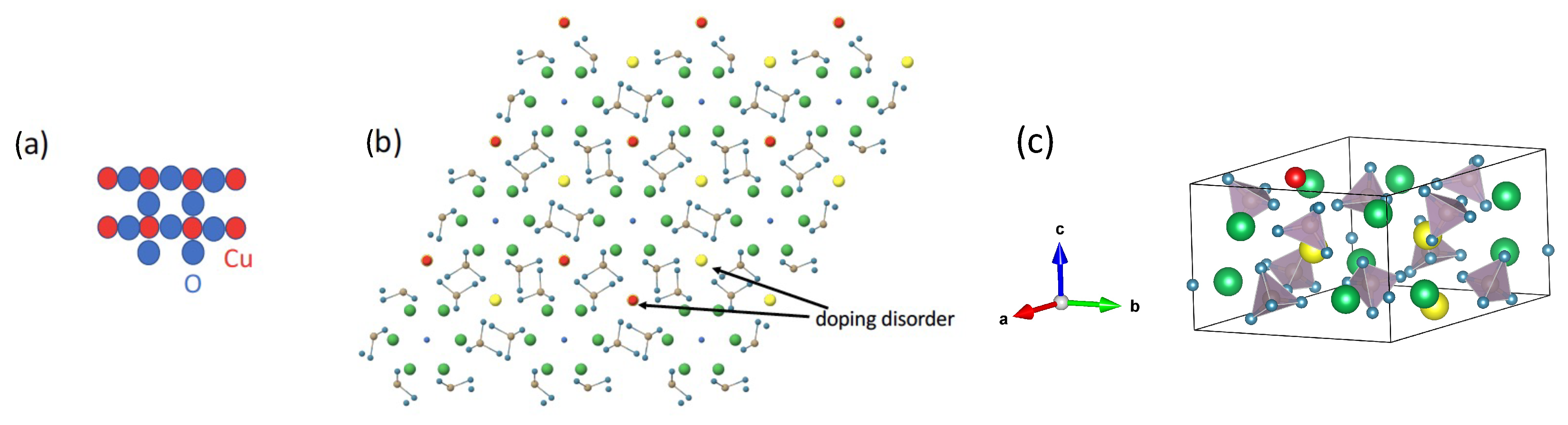
We need to note that full ionic relaxation will further reduce the symmetry introducing a weak distortion, with a resulting triclinic (space group P1) crystal structure. However, the deviation from the hexagonal unit cell is quite small (the angles between lattice vectors are α = 89.0003 ° ,   β = 89.7000 ° ,   γ = 121.3085 ° ), and the main structural features are preserved (Figure 3c).
References [9,10] indicate the composition of the putative superconductor as CuxPb10−x(PO4)6O with ( 0.9   <   x   <   1.1 ) so we choose x = 1 , i.e., CuPb9(PO4)6O, which is commensurate with the 41-atom cell. Reference [10] states that the Cu replaces one of the four original Pb(4f) atoms, which here we confirm through total energy calculations (see below). The Cu-substituted structure is illustrated in Figure 3b, which shows a top view projection of CuPb9(PO4)6O focusing on the Cu sites (red) which are substituted on 1/4 (∼1/2 in this view) of the four-fold Pb(4f) sites (yellow), the blue O(4) atoms, and the six-fold Pb(6h) (green). The PO4 tetrahedra are indicated by lines connecting P and O atoms. These structures form strong two-center bonds as noted above and are electronically inactive at the Fermi level. Also shown at the bottom right is one example of doping disorder, where the Cu goes into the alternative (“wrong”) Pb(4f) position. Figure 3c shows a three-dimensional view of the CuPb9(PO4)6O structure.
Reference [10] also indicates that compared to the parent compound, the in-plane lattice constant a shrinks from 9.865 Å to 9.843 Å while the out-of-plane lattice constant c shrinks from 7.431 Å to 7.428 Å, i.e., an overall volume shrinkage of 0.48 percent. We determined the lattice vectors by minimizing the total energy using different functionals and obtained good agreement with the experimental lattice constants (see below).

3.3. Total Energy Calculations

Total energy and atomic relaxations were calculated within density functional theory (DFT) at the levels of the generalized gradient approximation (GGA) [19], GGA+U [20], with U (Cu-d) = 5 eV, and the strongly constrained and appropriately normed (SCAN) meta-GGA [21] using the projector-augmented wave approach (PAW) implemented in the VASP code [22]. The present results were obtained from collinear spin-polarized calculations including relaxation of atomic forces and cell volume and shape with a stopping criterion of 0.03 eV/Å. For the 41-atom cell, we use a 2 × 2 × 4 k-mesh for Brillouin sampling. All three functionals yield broadly similar results.
Within the 41-atom unit cell, Cu substitution on the original Pb(4f) site leads to four different configurations, whereas there are two non-equivalent substitutions on Pb(6h). Notably, the 4f substitutions preserve the P3 symmetry of the 41-atom Pb10(PO4)6O cell, but the 6h substitutions result in a structure without remaining symmetries. However, even when the initial atomic structure preserves some symmetries, open-shell systems tend to break these symmetries to open an energy gap between occupied and unoccupied spin and crystal-field orbitals, thereby lowering the total energy. This phenomenon can be described as a cooperative Jahn–Teller effect, where the electronic symmetry breaking coincides with or arises from symmetry breaking in the atomic structure [30]. Such symmetry breaking is often suppressed in DFT calculations when the charge density is symmetrized to reduce the computational effort [31,32]. In order to account for a possible cooperative Jahn–Teller effect, we also perform calculations without the symmetry constraint. To lift the initial degeneracies, we apply stochastic perturbations in the initial atomic and/or electronic structures. Specifically, we add random atomic displacements up to 0.03 Å or preserve a degree of randomness in the initial wave function before starting the self-consistency cycle. Either approach, or a combination of both, is suitable to find symmetry-broken low-energy solutions.
Table 1 summarizes the relative energy differences between the different configurations for Cu substitution in the 41-atom unit cell, as well as energy gains resulting from the symmetry breaking. In all cases, including the symmetry-constrained ones, the self-consistency cycle converges to a total magnetic moment of 1 μ B /Cu. The four 4f site substitutions result in two pairs with almost identical total energies within each pair. Therefore, only two energies are given for the 4f sites in Table 1. One 4f pair results in the lowest overall energies in the GGA+U and SCAN functionals. Since SCAN likely provides the most accurate total energies, we use this configuration, labeled 4f-1, as the reference energy in Table 1. The energies obtained with symmetry-constrained calculations are higher by Δ E 0.4 eV/fu indicating a very substantial energy gain resulting from the Jahn–Teller distortion.
In the GGA calculation for the 6h-2 substitution, we observe an interesting effect in that the atomic relaxation, starting from the GGA+U relaxed structure, approaches a local minimum but then picks up larger forces again and settles in a new local minimum. Feeding this structure (labeled 6h-2’ in Table 1) back into a GGA+U relaxation leads to a lower energy than the original 6h-2. Even though this minimum remains above the energy of 4f-1 in GGA+U and SCAN, this observation is significant as it indicates that Cu substitution in Pb10(PO4)O6 could result in numerous local minima with different types and degrees of local distortions. Such complex energy landscapes could result in strong electron–phonon coupling effects with potentially important implications for superconductivity.

3.4. Electronic Structure Properties

Without Cu substitution, Pb10(PO4)6O is an insulator with a gap of several electron volts (see Figure 2). Determining the precise magnitude of the gap does not lie within the scope of the present work, as it requires beyond-DFT methods and consideration of spin–orbit coupling within the unoccupied Pb-6p manifold. Upon Cu substitution on the Pb(4f) sites with the constraint of preserving the initial symmetry in the charge density, the system becomes a half-metal (the band structure features will be discussed in more detail below). However, allowing for a breaking of the P3 symmetry causes an energy gap to open, consistent with Cu2+ in a d 9 configuration. A gap also opens in case of the Pb(6h) substitution, where the symmetry is already broken in the initial atomic structure. Notably, numerous preprints reported half-metallic band structures on the basis of DFT calculations and failed to observe the opening of a gap [1,2,6,7,33,34,35], presumably due to the above described symmetry constraint. The gapless band structure was also used for construction of tight-binding-type models for this material [36,37].
Table 2 gives the (generalized) Kohn–Sham energy gaps for the different functionals and atomic configurations described above. While the gaps of the symmetry-constrained calculations (not shown in Table 2) are zero for the DFT functionals considered here, we note that even with the P3 symmetry constraint, a gap opens up at a higher level of theory, the quasiparticle self-consistent GW (QSGW) approximation as previously noted [17]. Here, all configurations without explicit symmetrization show sizable bandgaps of comparable magnitudes, with the GGA+U and SCAN functionals giving larger gaps than GGA. It is remarkable that even standard DFT at the GGA level predicts a gap opening (Table 2), despite the well-known failure to predict any gaps at all in many Mott insulators, e.g., in CuO [38], while many-body perturbation theory provides a good description [39].
The gap opening requires the formation of a local magnetic moment at the Cu site. All gapped solutions have indeed a strong local moment, about 0.7 μ B in GGA+U and SCAN, and slightly smaller at about 0.6 μ B in GGA (magnitude determined from PAW projection). It is similar to but slightly smaller than the value 0.81 μ B reported in Ref. [17]. The local moment in the half-metallic symmetry-constrained cases is slightly smaller but still comparable, e.g., 0.70 vs. 0.72 μ B for 4f-1 in SCAN. The reason for the metallicity is that the symmetry constraint enforces the degeneracy of the two highest crystal-field orbitals in the local Cu minority spin channel, whereas the symmetry breaking lifts the orbital degeneracy. Thus, the present results are consistent with a Cu2+ d 9 configuration. Such a configuration is typically unstable against on-site electronic correlations that can also contribute to gapping, i.e., we can also consider these to be in the Mott family (or more precisely the charge-transfer insulator family, following the classification of Zaanen, Sawatzky, and Allen [40]). In the present case (as in most), both the structural (Jahn–Teller like) and correlation (Mott like) seem to be active. In order to test whether the atomic and electronic (spin and orbital) ordering, as implied by the periodic boundary conditions of the small 41-atom cell, affects the magnitude of the local moment and the energy gap, we performed supercell calculations. First, constructing a 1 × 1 × 2 supercell of Pb10(PO4)6O with 82 atoms, we relaxed all seven non-equivalent configurations with two out of the eight O(4) sites occupied. Using the lowest energy structure, we then generated six random Cu pair configurations on the original Pb(4f) sites and calculated for each the ferromagnetic (FM) and anti-ferromagnetic (AF) Cu spin configurations in GGA+U. Taking, again, the lowest energy configuration, we also calculated the respective SCAN energies. Here, the overall energy lies 0.27 eV/fu below that of 4f-1 in the 41-atom cell, indicating that the small cell models discussed above do not provide the absolute global energy minimum, although probably a reasonable approximation thereof. The AF configuration has a slightly lower energy than FM with E A F F M = 1.7 meV/Cu. The small energy difference indicates that the system is likely paramagnetic (spin-disordered) down to low (cryogenic) temperatures. The Cu local spin moments are virtually unchanged (0.72 μ B ) in both AF and FM and the bandgaps increase slightly (by 0.2 eV), when compared to the 4f-1 configuration of the 41-atom cell (cf. Table 2).
As an additional check, a quasirandom spin configuration of the 41-atom 4f-1 configuration was calculated in the 328-atom supercell, and the lattice was allowed to relax. As in the 82-atom AF case, the local Cu moment and the bandgap were nearly constant, and lattice relaxation had only a minor effect. To test disorder effects in the large 328-atom supercell, we calculated a configuration with one Cu atom at an alternative Pb(4f) site, giving similar results. Significant relaxation of the structure was needed, mostly visible in modification of the distance of Cu and Pb defect atoms. However, we invariably find that AF configurations maintain with local magnetic moments of similar magnitude at all Cu atoms, with a non-degenerate d 9 orbital configuration. In this respect, LK-99 is similar to NiO as well as the parent cuprate superconductor compounds such as La2CuO4, where spin disorder has only a minor effect on the gap. Even in the absence of more systematic configuration sampling, these supercell results strongly indicate that the local Cu moments and the gap opening are robust against atomic disorder (Cu distribution on Pb sublattice and O distribution on fractionally occupied O(4) sites) and against Cu spin fluctuations.
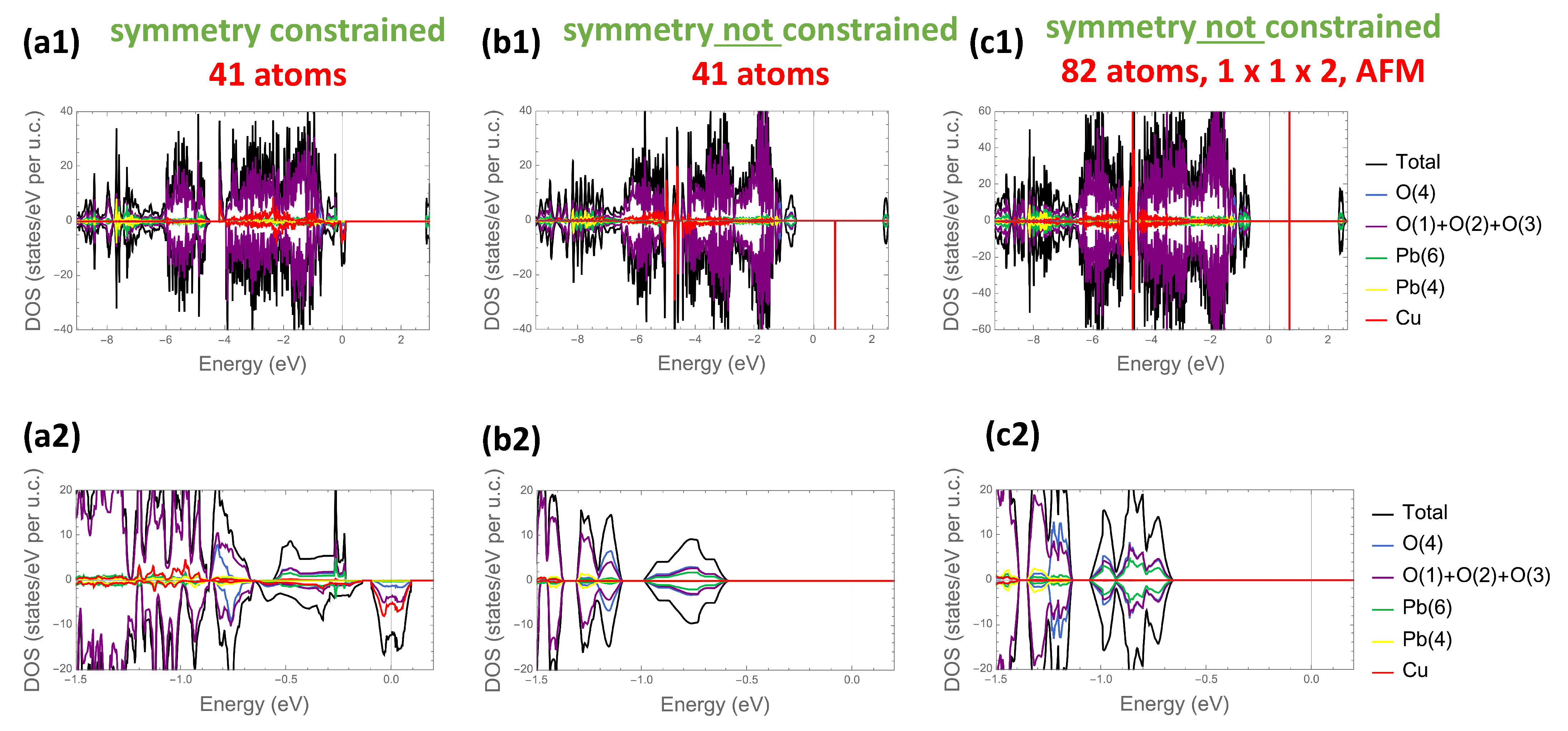
We have calculated the density of states (DOS) of CuPb9(PO4)6O for each supercell size discussed above using the GGA PBE+U functional with U = 5 eV on a Cu d shell. In Figure 4 we show only results for selected 41-atom and 82-atom cells as the other ones are expected to be qualitatively similar. We compare results of two different calculations. Firstly, we imposed P3 symmetry for both, crystal structure and electronic degrees of freedom (panels (a1) and (a2)). The other calculations were performed without symmetry restrictions for the 41-atom unit cell (panel (b1) for a wide energy range and panel (b2) for a narrow range around E F ) and for the 82-atom unit cell (panel (c1) for a wide energy range and panel (c2) for a narrow range around E F ). In both cases, we considered only collinear magnetism with an initial magnetic moment ∼1 μ B entirely on the Cu. The symmetry-restricted case is consistent with a metallic state with a large and spin-polarized DOS at E F coming mostly from Cu dopant, with significant admixture from oxygen from PO4 tetrahedra, denoted here as O(1)+O(2)+O(3).
A different situation is observed for the symmetry-unrestricted calculations (panels (b1) and (b2)). The energy gap opens around E F for the symmetry-relaxed cases, and in this case, the top of the valence band can be decomposed in comparable contributions of O(4) and O(1)+O(2)+O(3). The next leading contribution comes from Pb(6) sites. Cu states are now visible as a sharp peak in DOS at ∼1.2 eV above the top valence band. Interestingly, this behavior is preserved for a 1 × 1 × 2 supercell with AFM spin arrangement (panels (c1) and (c2)), showing that the Cu moment is a function only of its local environment. It is noteworthy that the relaxation of the symmetry constraint changes the character of the states around the Fermi level. Whereas in the symmetry-constrained case, E F intersects the metallic bands with predominant Cu characters (see Figure 5a), in the symmetry-broken case, E F lies between the empty Cu band and the occupied “valence band” states, which have Pb(6h) and oxygen character from all O sites, including O(4). In all considered cases we get filling of Cu d states equal to 9, similarly to the parent compounds of traditional cuprate superconductors.
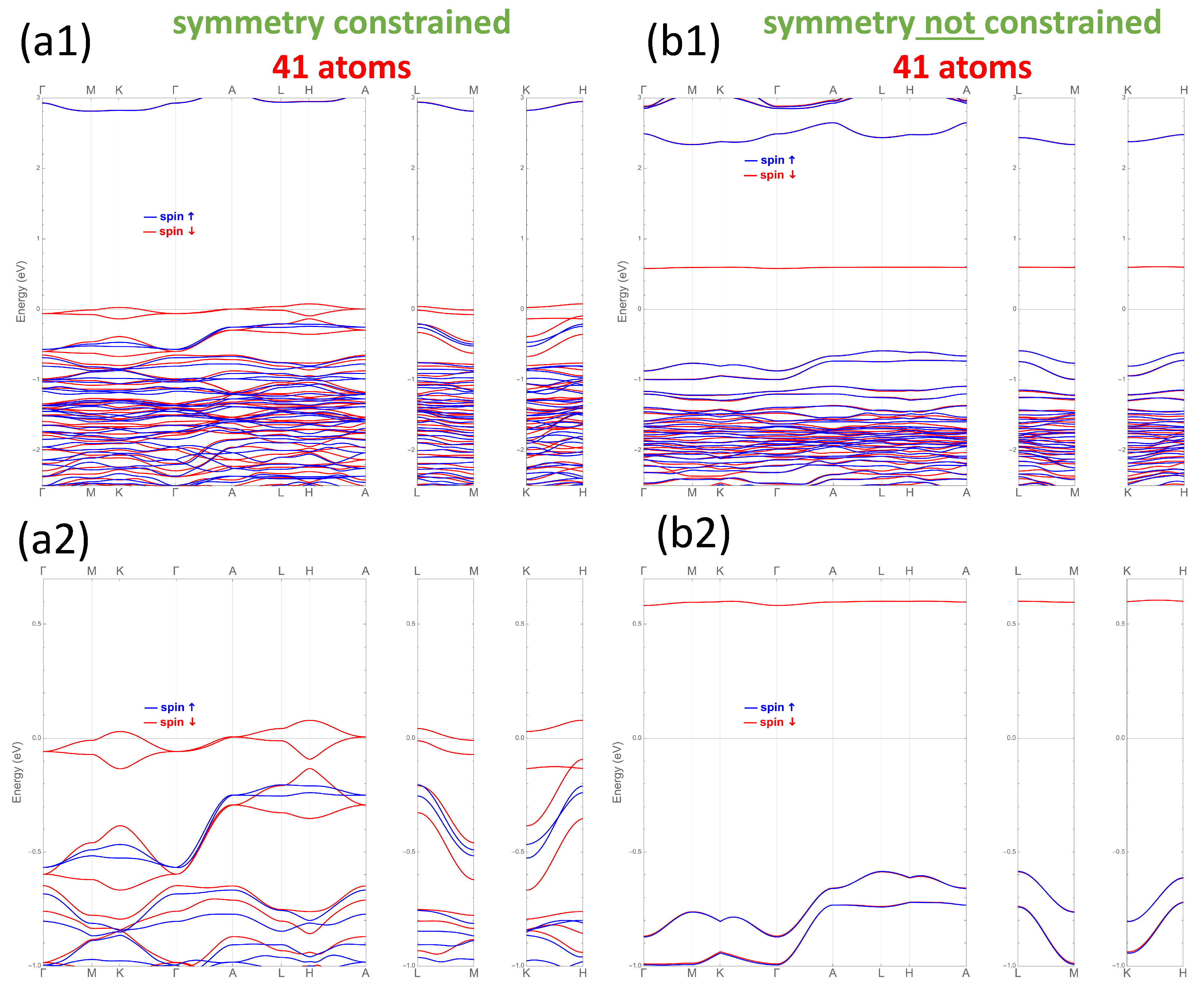
Figure 5 shows E vs. k dispersion relations for the different calculations. Panels (a1) and (a2) correspond to the P3 symmetry-preserving calculation, while panels (b1) and (b2) correspond to the symmetry-unconstrained case. We do not present bands for any other unit cell size than 41 atoms, because it would need band unfolding. In the case of P3-preserving calculations, one can see a set of narrow (<0.2 eV) bands of dominant Cu-O origin at E F , with no gap, indicative of a metallic state. The system is half-metallic and has a net magnetic moment of 1 μ B with 0.7 of it localized on the Cu site in DFT. In the simplest 41-atom cell, the Cu are ferromagnetically aligned and the two spin channels are different, giving rise to a half-metal. The conduction band is found only in the minority channel with a single, weakly dispersive (≈0.2 eV bandwidth) state mostly of Cu character forming the conduction band and the valence band consisting of mostly O- and Pb-derived states. We noticed that the flattest dispersion close to E F is found around the L point, in the AL direction. The small electron pocket with k F = 0.22 1/Å and the bottom at ε = 9.9 meV is characterized by effective mass m = 18   m e . The same effective mass can be found on the Γ plane; however, the flattest part of the band is well below the Fermi level (∼60 meV).
The band structure is changed significantly when symmetry constraints are not imposed (panels (b1) and (b2)) This is despite the fact that a triclinic distortion of the unit cell is relatively small, so the deviation from the hexagonal Brillouin zone can be basically ignored. The flat Cu band got pushed well above the Fermi level (∼1.2 eV). The width of this band is less than 24 meV. This band belongs to the “spin-down” manifold. Its spin polarization is in contrast with occupied bands which have their opposite spin counterparts extended roughly over the same binding energy range.
It is noteworthy that the unconstrained band structure in Figure 5b1 bears a strong resemblance to the many-body result obtained from QSGW theory, Figure 2d in Ref. [17]. In both cases the conduction band minimum consists of a nearly dispersionless minority Cu 3d state; only the gap is larger in the many-body case. Gap formation is a consequence of the general tendency in flat-band systems to open a gap, as noted in the introduction. In the DFT case, this is realized by structural symmetry breaking; in the many-body case, it is realized strictly through the electronic structure, through an orbital dependent potential.
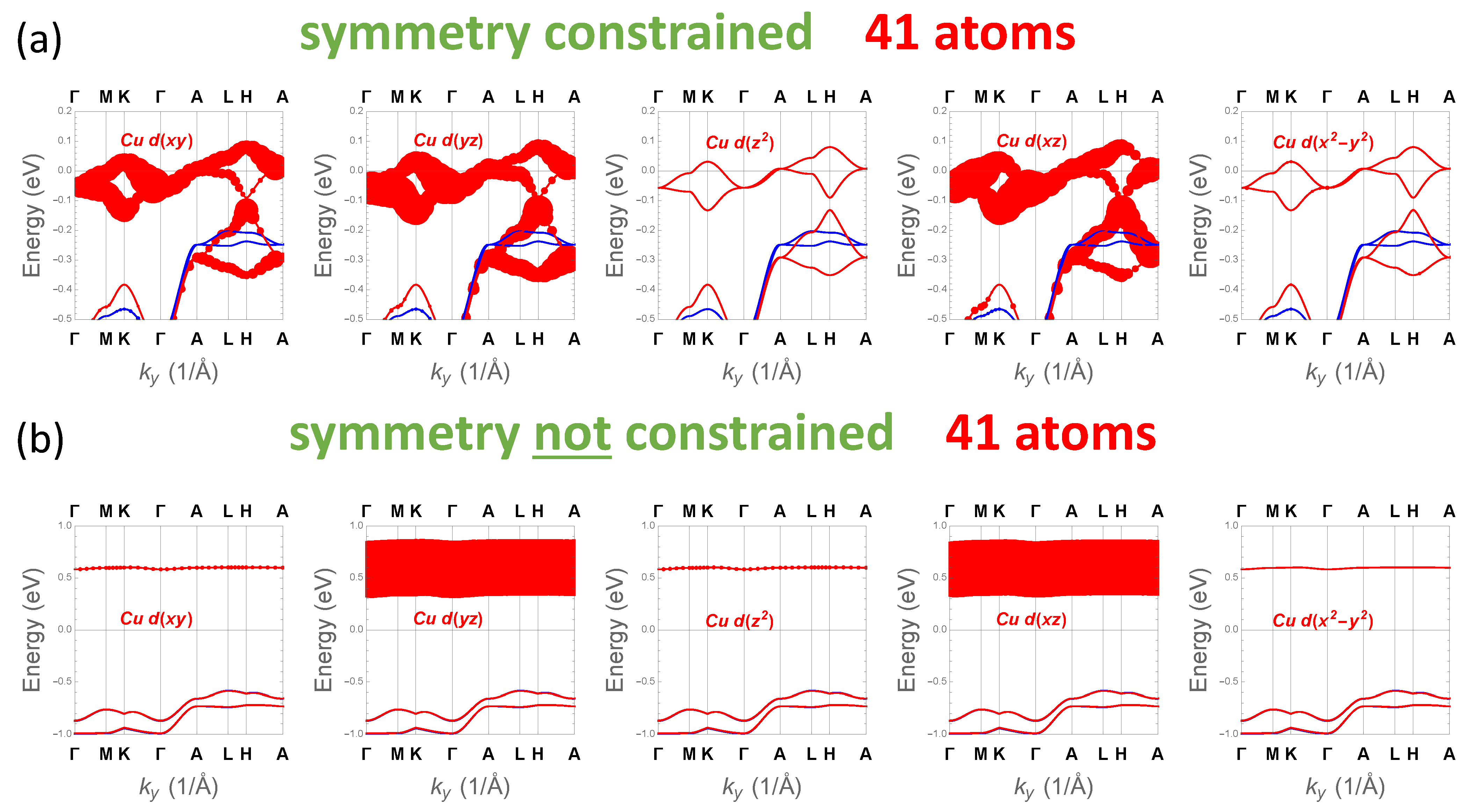
Figure 6 shows projections of the calculated bands onto the various Cu d-orbital symmetries, again for two different types of calculations: preserving P3 symmetry (panel a) and with no symmetry constraints (panel b). In the first case, we find the d ( x y ) , d ( x z ) , and d ( y z ) states all have significant spectral weight at E F , in strong contrast to conventional cuprate superconductors where the bands at E F are d ( x 2 y 2 ) -derived. This difference has to do with the local bonding directionality between the Cu and O atoms, though it is not clear yet what impact, if any, this might have on superconductivity. The orbital polarization is even stronger in the second case (no symmetry constraints). The contribution of d ( x y ) is strongly suppressed in the first conduction band (∼0.5 eV above the nominal E F , which is put in the middle of the gap). This implies even stronger directional hybridization effects.
There are strong similarities with undoped conventional cuprates: the closest Cu-O bond is similar, and states near the Fermi level are predominately of Cu and O character. Moreover, the system is AF in the ground state with significant local Cu moments, contributing to the gap opening. Unlike the cuprates, the valence band in the relaxed structure consists of a pair of mostly O-derived bands with little Cu character. Also, the O-derived valence bands and the Cu-derived conduction band are very flat. The Cu bands are essentially dispersionless, but also O-derived valence bands in the Brillouin zone in the plane normal to k z are very flat along in-plane directions. That implies a very large part of the Brillouin zone at E F has extremely flat bands.

4. Discussion and Implications

Our findings, through calculation, of flat Cu-O bands at E F in Cu-doped Pb apatite show that this kind of system can be a promising framework for superconductivity, though a critical aspect is whether or not the system will remain metallic, which is of course a requirement for supporting superconductivity. A departure from the “pure” stoichiometry considered here would be necessary, similar to doping of the cuprate superconductors, for example, by varying the concentration of O(4) atoms away from unity. Since the O(4) atoms are nominally 2-valence, a surplus of such O(4) atoms would act as a hole dopant or a deficit acting as an electron dopant. This could either lead to new impurity-like states within the bandgap or could shift the Fermi energy into the Cu-derived conduction band (electron-doped) or the Pb-O-derived valence band (hole-doping). Such a scenario could potentially lead to a metallic flat-band state with interesting properties that should be explored by future experimental and theoretical studies.
Flat bands yield strong correlations and such bands could be strongly favorable for superconductivity. Superconductivity mediated by spin fluctuations is also greatly enhanced by the flatness of the band; see, for example, Ref. [41]. Extremely flat states at the Fermi energy can also significantly enhance the electron–phonon coupling matrix elements, particularly in light of the multiplicity of lattice instabilities noted here. This boson could act cooperatively with spin fluctuations to support higher superconducting transition temperatures. In contrast with the hydride superconductors, the phonon modes are less violent for oxygen and copper and may not need high pressures to prevent the system from falling apart. The presence of disorder and flat electronic states together suggest the material may choose an s-wave superconducting phase. Most importantly, the Cooper pairing in that case will probably be better described by a strong coupling picture akin to the BEC limit where T c / T F > 1 / 10 .
However, superconductivity is only one of many possible instabilities. It must compete with, e.g., magnetically ordered phases. An excellent illustration of this is CaFe2As2: which instability is dominant depends on the details of the lattice structure [42]. Similarly, charge density waves can compete with the electron–phonon interaction or possibly enhance it. It requires a more careful analysis of all possible competing instability channels to explore what the material chooses as its ordered ground state. To summarize, we turn to Figure 1. We have established that the weak hybridization and flat bands can lead to instabilities of different kinds. The pristine compound is a charge-transfer insulator and appears to be robust against the disorder we have considered here. How a metallic phase forms from the near- E F states needs to be resolved by a combination of theory and experiments. The question of which boson predominates for correlated phenomena, including superconductivity, may well depend on the character of the metallic state.

Author Contributions

Conceptualization, M.v.S. and D.S.D.; Methodology, D.P., S.A. and M.v.S.; Validation, S.L. and D.S.D.; Formal analysis, S.A., D.P. and M.v.S.; Investigation, R.K., D.P., S.A., S.L. and D.S.D. All authors have read and agreed to the published version of the manuscript.

Funding

Funding was provided by the Basic Energy Sciences, Division of Materials within the Office of Basic Energy Sciences, U.S. Department of Energy. DD was supported by the U.S. Department of Energy, Office of Science, Office of Basic Energy Sciences, under Grant No. DE-FG02-03ER46066, and the Gordon and Betty Moore Foundation’s EPiQS Initiative through Grant No. GBMF9458; by the National Energy Research Scientific Computing Center; and by the Frontier machine at the Oak Ridge Leadership Computing facility. This work was authored in part by the National Laboratory of the Rockies, operated by Alliance for Sustainable Energy, LLC, for the U.S. Department of Energy (DOE) under Contract No. DE-AC36-08GO28308. DP, SL, SA, and MvS were supported by the Office of Science, Basic Energy Sciences, Division of Materials. Calculations were performed using computational resources sponsored by the Department of Energy: the Kestrel facility at NREL, sponsored by the Office of Energy Efficiency. We also made use of the National Energy Research Scientific Computing Center, under NERSC award BES-ERCAP0021783. The views expressed in the article do not necessarily represent the views of the DOE or the U.S. Government. The United States Government retains and the publisher, by accepting the article for publication, acknowledges that the United States Government retains a non-exclusive, paid-up, irrevocable, worldwide license to publish or reproduce the published form of this manuscript, or allows others to do so, for United States Government purposes.

Data Availability Statement

Raw data generated during this research are available publicly in the Zenodo repository under a link: https://doi.org/10.5281/zenodo.17725431, accessed on 13 January 2026.

Acknowledgments

We thank Dushyant Narayan for help in setting up some of the calculations.

Conflicts of Interest

The authors declare no conflicts of interest. The funders had no role in the design of the study; in the collection, analyses, or interpretation of data; in the writing of the manuscript; or in the decision to publish the results.

Abbreviations

The following abbreviations are used in this manuscript:
LK-99CuPb9(PO4)6O, Cu-doped lead apatite
DOSDensity of states
DFTDensity functional theory
MCMonte-Carlo
GGAGeneralized gradient approximation
SCANStrongly constrained and appropriately normed
AFAnti-ferromagnetic
FMFerromagnetic
PAWProjector-augmented wave
PBEPerdew–Burke–Ernzerhof
fuFormula unit
sbSymmetry-broken
scSymmetry-constrained

References

  1. Griffin, S.M. Origin of correlated isolated flat bands in copper-substituted lead phosphate apatite. arXiv 2023, arXiv:2307.16892. [Google Scholar] [PubMed]
  2. Lai, J.; Li, J.; Liu, P.; Sun, Y.; Chen, X.Q. First-principles study on the electronic structure of Pb10−xCux(PO4)6O (x = 0, 1). J. Mater. Sci. Technol. 2023, 171, 66–70. [Google Scholar] [CrossRef]
  3. Korotin, D.M.; Novoselov, D.Y.; Shorikov, A.O.; Anisimov, V.I.; Oganov, A.R. Electronic correlations in the ultranarrow energy band compound Pb9Cu(PO4)6O: A DFT+DMFT study. Phys. Rev. B 2023, 108, L241111. [Google Scholar] [CrossRef]
  4. Si, L.; Wallerberger, M.; Smolyanyuk, A.; di Cataldo, S.; Tomczak, J.M.; Held, K. Pb10−xCux(PO4)6O: A Mott or charge transfer insulator in need of further doping for (super)conductivity. J. Phys.-Condens. Matter 2024, 36, 065601. [Google Scholar] [CrossRef]
  5. Yue, C.; Christiansson, V.; Werner, P. Correlated electronic structure of Pb10−xCux(PO 4)6O. Phys. Rev. B 2023, 108, L201122. [Google Scholar] [CrossRef]
  6. Hao, L.; Fu, E. First-principles calculation on the electronic structures, phonon dynamics, and electrical conductivities of Pb10(PO4)6O and Pb9Cu(PO4)6O compounds. J. Mater. Sci. Technol. 2024, 173, 218–224. [Google Scholar] [CrossRef]
  7. Si, L.; Held, K. Electronic structure of the putative room-temperature superconductor Pb9Cu(PO4)6O. Phys. Rev. B 2023, 108, L121110. [Google Scholar] [CrossRef]
  8. Puphal, P.; Akbar, M.Y.P.; Hepting, M.; Goering, E.; Isobe, M.; Nugroho, A.A.; Keimer, B. Single crystal synthesis, structure, and magnetism of Pb10−xCux(PO4)6O. APL Mater. 2023, 11, 101128. [Google Scholar] [CrossRef]
  9. Lee, S.; Kim, J.H.; Kwon, Y.W. The First Room-Temperature Ambient-Pressure Superconductor. arXiv 2023, arXiv:2307.12008. [Google Scholar]
  10. Lee, S.; Kim, J.; Kim, H.T.; Im, S.; An, S.; Auh, K.H. Superconductor Pb10−xCux(PO4)6O showing levitation at room temperature and atmospheric pressure and mechanism. arXiv 2023, arXiv:2307.12037. [Google Scholar]
  11. Kumar, K.; KARN, N.K.; Awana, V.S. Synthesis of possible room temperature superconductor LK-99: Pb9Cu(PO4)6O. Supercond. Sci. Technol. 2023, 36, 10LT02. [Google Scholar] [CrossRef]
  12. Zhu, S.; Wu, W.; Li, Z.; Luo, J. First-order transition in LK-99 containing Cu2S. Matter 2023, 6, 4401–4407. [Google Scholar] [CrossRef]
  13. Georgescu, A.B. Why Charge Added Using Transition Metals to Some Insulators, Including LK-99, Localizes and Does Not Yield a Metal. Chem. Mater. 2025, 37, 1847–1853. [Google Scholar] [CrossRef]
  14. Wu, H.; Yang, L.; Yu, J.; Zhang, G.; Xiao, B.; Chang, H. Observation of abnormal resistance-temperature behavior along with diamagnetic transition in Pb10−xCux(PO4)6O-based composite. arXiv 2023, arXiv:2308.05001. [Google Scholar]
  15. Bednorz, J.; Muller, K. Possible high-Tc Superconductivity in the Ba-La-Cu-O system. Z. Phys. B-Condens. Matter 1986, 64, 189–193. [Google Scholar] [CrossRef]
  16. Zhang, F.C.; Rice, T.M. Effective Hamiltonian for the superconducting Cu oxides. Phys. Rev. B 1988, 37, 3759–3761. [Google Scholar] [CrossRef]
  17. Pashov, D.; Acharya, S.; Lany, S.; Dessau, D.S.; van Schilfgaarde, M. Multiple Slater determinants and strong spin-fluctuations as key ingredients of the electronic structure of electron- and hole-doped Pb10−xCux(PO4)6O. Crystals 2025, 15, 621. [Google Scholar] [CrossRef]
  18. Anderson, P. Theory of dirty superconductors. J. Phys. Chem. Solids 1959, 11, 26–30. [Google Scholar] [CrossRef]
  19. Perdew, J.P.; Burke, K.; Ernzerhof, M. Generalized Gradient Approximation Made Simple. Phys. Rev. Lett. 1996, 77, 3865–3868. [Google Scholar] [CrossRef]
  20. Dudarev, S.L.; Botton, G.A.; Savrasov, S.Y.; Humphreys, C.J.; Sutton, A.P. Electron-energy-loss spectra and the structural stability of nickel oxide: An LSDA+U study. Phys. Rev. B 1998, 57, 1505–1509. [Google Scholar] [CrossRef]
  21. Sun, J.; Ruzsinszky, A.; Perdew, J.P. Strongly Constrained and Appropriately Normed Semilocal Density Functional. Phys. Rev. Lett. 2015, 115, 036402. [Google Scholar] [CrossRef] [PubMed]
  22. Kresse, G.; Joubert, D. From ultrasoft pseudopotentials to the projector augmented-wave method. Phys. Rev. B 1999, 59, 1758–1775. [Google Scholar] [CrossRef]
  23. Krivovichev, S.V.; Burns, P.C. Crystal chemistry of lead oxide phosphates: Crystal structures of Pb4O(PO4)2, Pb8O5(PO4)2 and Pb10(PO4)6O. Z. Krist. Cryst. Mater. 2003, 218, 357–365. [Google Scholar] [CrossRef]
  24. Ravi, C.; Panigrahi, B.K.; Valsakumar, M.C.; van de Walle, A. First-principles calculation of phase equilibrium of V-Nb, V-Ta, and Nb-Ta alloys. Phys. Rev. B 2012, 85, 054202. [Google Scholar] [CrossRef]
  25. Cordell, J.J.; Pan, J.; Tamboli, A.C.; Tucker, G.J.; Lany, S. Probing configurational disorder in ZnGeN2 using cluster-based Monte Carlo. Phys. Rev. Mater. 2021, 5, 024604. [Google Scholar] [CrossRef]
  26. Lavrentiev, M.Y.; Nguyen-Manh, D.; Dudarev, S.L. Magnetic cluster expansion model for bcc-fcc transitions in Fe and Fe-Cr alloys. Phys. Rev. B 2010, 81, 184202. [Google Scholar] [CrossRef]
  27. Decolvenaere, E.; Levin, E.; Seshadri, R.; Van der Ven, A. Modeling magnetic evolution and exchange hardening in disordered magnets: The example of Mn1−xFexRu2Sn Heusler alloys. Phys. Rev. Mater. 2019, 3, 104411. [Google Scholar] [CrossRef]
  28. Gray, M.B.; Majher, J.D.; Holzapfel, N.P.; Woodward, P.M. Exploring the Stability of Mixed-Halide Vacancy-Ordered Quadruple Perovskites. Chem. Mater. 2021, 33, 2165–2172. [Google Scholar] [CrossRef]
  29. Rom, C.L.; Smaha, R.W.; Melamed, C.L.; Schnepf, R.R..; Heinselman, K.N.; Mangum, J.S.; Lee, S.J.; Lany, S.; Schelhas, L.T.; Greenaway, A.L.; et al. Combinatorial Synthesis of Cation-Disordered Manganese Tin Nitride MnSnN2 Thin Films with Magnetic and Semiconducting Properties. Chem. Mater. 2023, 35, 2936–2946. [Google Scholar] [CrossRef]
  30. Gehring, G.A.; Gehring, K.A. Co-operative Jahn-Teller effects. Rep. Prog. Phys. 1975, 38, 1. [Google Scholar] [CrossRef]
  31. Lany, S.; Zunger, A. Polaronic hole localization and multiple hole binding of acceptors in oxide wide-gap semiconductors. Phys. Rev. B 2009, 80, 085202. [Google Scholar] [CrossRef]
  32. Pashov, D.; Larsen, R.E.; Watson, M.D.; Acharya, S.; van Schilfgaarde, M. TiSe2 is a band insulator created by lattice fluctuations, not an excitonic insulator. npj Comput. Mater. 2025, 11, 152. [Google Scholar] [CrossRef]
  33. Cabezas-Escares, J.; Barrera, N.F.; Lavroff, R.H.; Alexandrova, A.N.; Cardenas, C.; Munoz, F. Electronic structure and vibrational stability of copper-substituted lead apatite LK-99. Phys. Rev. B 2024, 109, 144515. [Google Scholar] [CrossRef]
  34. Tao, K.; Chen, R.; Yang, L.; Gao, J.; Xue, D.; Jia, C. The 1/4 occupied O atoms induced ultra-flatband and the one-dimensional channels in the Pb10−xCux(PO4)6O4 (x = 0, 0.5) crystal. APL Mater. 2024, 12, 021120. [Google Scholar] [CrossRef]
  35. Jiang, Y.; Lee, S.B.; Herzog-Arbeitman, J.; Yu, J.; Feng, X.; Hu, H.; Călugăru, D.; Brodale, P.S.; Gormley, E.L.; Vergniory, M.G.; et al. Pb9Cu(PO 4)6(OH)2: Phonon bands, localized flat-band magnetism, models, and chemical analysis. Phys. Rev. B 2023, 108, 235127. [Google Scholar] [CrossRef]
  36. Tavakol, O.; Scaffidi, T. Minimal model for the flat bands in copper-substituted lead phosphate apatite: Strong diamagnetism from multiorbital physics. Phys. Rev. B 2024, 109, L100504. [Google Scholar] [CrossRef]
  37. Oh, H.; Zhang, Y.H. S-wave pairing in a two-orbital t-J model on triangular lattice: Possible application to Pb10−xCux(PO4)6O. arXiv 2023, arXiv:2308.02469. [Google Scholar]
  38. Wu, D.; Zhang, Q.; Tao, M. LSDA+U study of cupric oxide: Electronic structure and native point defects. Phys. Rev. B 2006, 73, 235206. [Google Scholar] [CrossRef]
  39. Cunningham, B.; Grüning, M.; Pashov, D.; van Schilfgaarde, M. QSG W ^ : Quasiparticle Self Consistent GW with Ladder Diagrams in W. Phys. Rev. B 2023, 108, 165104. [Google Scholar] [CrossRef]
  40. Zaanen, J.; Sawatzky, G.A.; Allen, J.W. Band gaps and electronic structure of transition-metal compounds. Phys. Rev. Lett. 1985, 55, 418–421. [Google Scholar] [CrossRef]
  41. Acharya, S.; Katsnelson, M.I.I.; van Schilfgaarde, M. Vertex dominated superconductivity in intercalated FeSe. npj Quantum Mater. 2023, 8, 24. [Google Scholar] [CrossRef]
  42. Acharya, S.; Pashov, D.; Jamet, F.; van Schilfgaarde, M. Controlling Tc through Band Structure and Correlation Engineering in Collapsed and Uncollapsed Phases of Iron Arsenides. Phys. Rev. Lett. 2020, 124, 237001. [Google Scholar] [CrossRef] [PubMed]
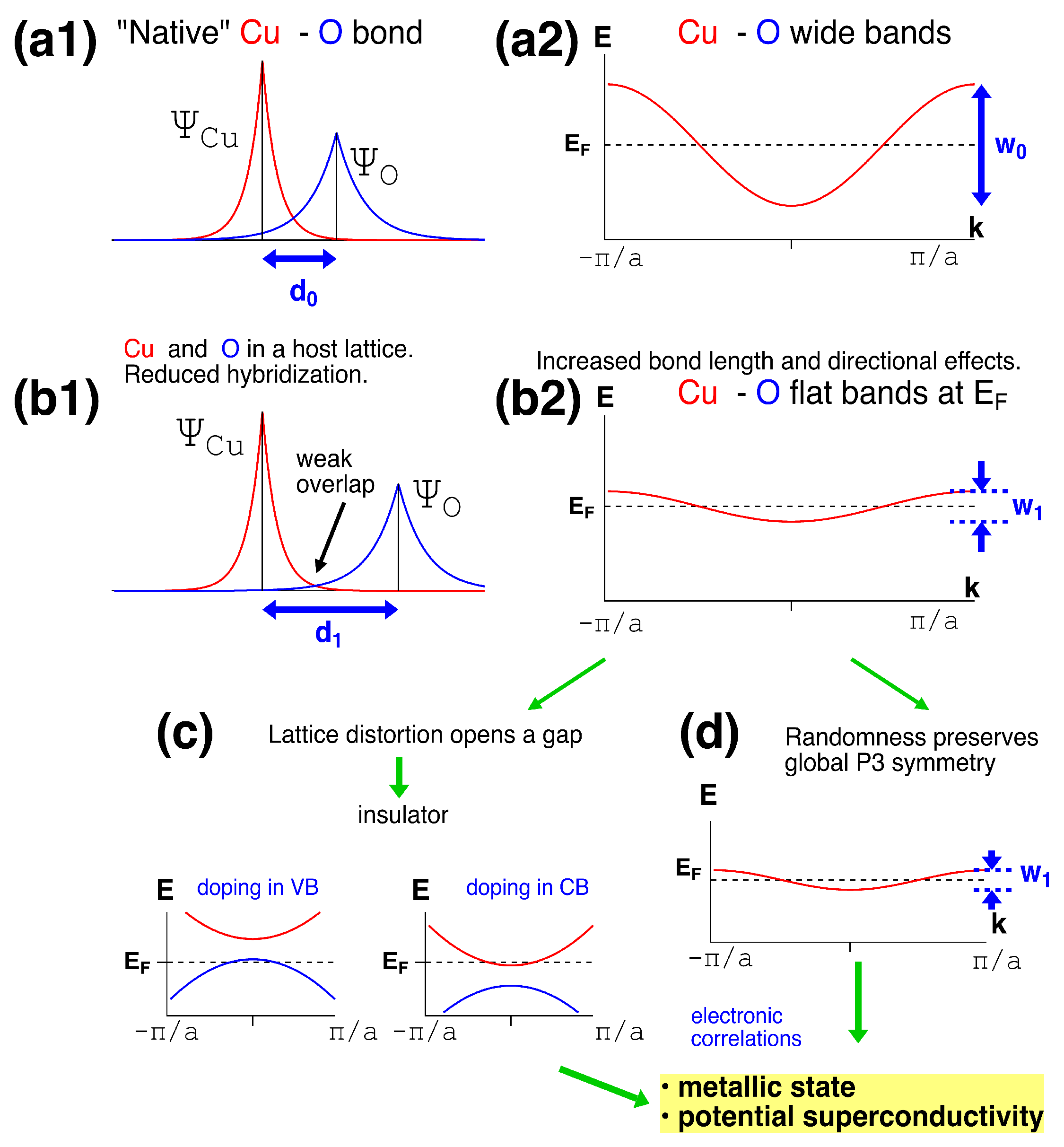
Figure 1. Roadmap for obtaining strongly renormalized ultra-flat Cu-O bands in a host lattice, potentially leading to high-temperature superconductivity. (a1) Situation for a “native” Cu-O bond, i.e., when the overlap of the Cu and O wave functions is large and leads to wide band behavior, as illustrated in a panel (a2). (b1) A properly designed host material allows for weak overlap between Cu and O orbitals leading to narrow band behavior, as shown in panel (b2). (c) Lattice distortions lower the system symmetry, which can drive the system to the insulating state, and in turn requires doping to restore the metallic state again. (d) Static disorder preserving P3 symmetry could be an alternative keeping the metallic state intact. Our calculations show that we are in between the steps of panels (b1,b2,c).
Crystals 16 00074 g001
Figure 2. Electronic structure of parent compound Pb10(PO4)6O. (a) Band dispersion calculated along high-symmetry paths. (b) Density of states projected onto different atomic sites. We refer the energies to the Fermi level (consistently within the entire manuscript), which is placed in the middle of the gap. The gap width is equal to 2.765 eV.
Crystals 16 00074 g002
Figure 3. (a) Natural bond distances between Cu and O in a Cu-O sublattice, give a large bandwidth w 0 . (b) Top view projection of CuPb9(PO4)6O focusing on the Cu sites (red) which are substituted on 1/4 ( 1/2 in this view) of the four-fold Pb(4f) sites (yellow), the blue O(4) atoms that will hybridize with the red coppers, and the six-fold Pb(6h) (green). Also shown at the bottom right is one example of doping disorder, where the Cu goes into the “wrong” Pb(4f) site. (c) shows a 41-atom unit cell in 3D with Cu at a selected Pb(4f) position after structural relaxation with no symmetry constraints. PO4 tetrahedra are shaded gray.
Crystals 16 00074 g003
Figure 4. Density of states of CuPb9(PO4)6O calculated with the GGA PBE functional and U = 5 eV at the Cu site calculated for different unit cell sizes and using different symmetry options. Negative and positive values denote opposite spin directions. (a1,a2) Calculations with the original P3 symmetry constrained. A narrow set of bands of dominant Cu-O origin appears at E F , with no gap indicative of a metallic state. The electron count is near d 9 , similar to the cuprate superconductors. (b1,b2) Results of calculations preformed without symmetry restrictions. Total energy is lowered and a gap will open at the Fermi level, producing an insulator (see Table 1). (c1,c2) Calculations with unrestricted symmetry but in a 1 × 1 × 2 supercell allowing for AFM configuration for out-of-plane spins. Despite the different magnetic order, the DOS close to E F is qualitatively similar to the ones presented in panels (b1,b2).
Crystals 16 00074 g004
Figure 5. The band structure of CuPb9(PO4)6O associated with the DOS of Figure 4. Red and blue lines indicate “spin-down” and “spin-up” bands, respectively. (a1,a2) show the band structure obtained from P3 symmetry-constrained calculations. (b1,b2) show the band structure obtained from calculations without symmetry constraints imposed. Only results for 41-atom unit cells are presented. In the case of results presented in panels (b1,b2), we use the same path as for (a1,a2), ignoring the effects of the weak triclinic distortion.
Crystals 16 00074 g005
Figure 6. Orbital projections of the flat bands at E F in CuPb9(PO4)6O, with spectral weight indicated by the size of the circles. Red and blue lines indicate “spin-down” and “spin-up” bands, respectively. In contrast to standard cuprate superconductors which have the near E F weight from d ( x 2 y 2 ) orbitals, the dominant weight in the wave function comes here from the d ( x y ) , d ( x z ) , and d ( y z ) orbitals in the symmetry-constrained case (a). An increase in directionality is visible in the case of calculations without symmetry restrictions (b). For the symmetry-unconstrained case, the contribution is almost fully from d ( x z ) and d ( y z ) states.
Crystals 16 00074 g006
Table 1. Relative energy differences (eV/fu) between different Cu configurations in the 41-atom unit cell of CuPb9(PO4)6O, calculated in the GGA+U, GGA, and SCAN functionals. Given are the energies for the symmetry-broken (sb) gapped state, and for the half-metallic symmetry-constrained (sc) calculation in case of the 4f site substitutions. Generally, the sb state with Cu on the 4f-1 site is the most favored.
GGA+U GGA SCAN
Cu Site sb sc sb sc sb sc
4f-100.8300.4100.46
4f-20.081.230.080.650.271.04
6h-10.13 0.04 0.24
6h-20.11 0.50
6h-2’0.04 −0.03 0.44
Table 2. Energy gaps (eV) of the different Cu configurations in the 41-atom unit cell of CuPb9(PO4)6O, as obtained from the (generalized) Kohn–Sham energies for the different considered functionals, all calculated for the symmetry-broken case.
Cu SiteGGA+UGGASCAN
4f-11.220.561.31
4f-21.120.461.20
6h-11.420.751.46
6h-21.17 1.25
6h-2’1.190.641.29
Disclaimer/Publisher’s Note: The statements, opinions and data contained in all publications are solely those of the individual author(s) and contributor(s) and not of MDPI and/or the editor(s). MDPI and/or the editor(s) disclaim responsibility for any injury to people or property resulting from any ideas, methods, instructions or products referred to in the content.