
Article

Sustainable Routes to a Soluble Anthelmintic Thiabendazole Organic Salt

by
Ilenia D’Abbrunzo
1,
Elisa Zampieri
1,
Maja Bjelošević Žiberna
2,
Serena Bertoni
3,
Cécile Häberli
4,5,
Jennifer Keiser
4,5 and
Beatrice Perissutti
1,*
1
Department of Chemical and Pharmaceutical Sciences, University of Trieste, P.le Europa 1, 34127 Trieste, Italy
2
Faculty of Pharmacy, University of Ljubljana, Aškerčeva Cesta 7, 1000 Ljubljana, Slovenia
3
Department of Pharmacy and Biotechnology, University of Bologna, V. S. Donato 19/2, 40127 Bologna, Italy
4
Department of Medical Parasitology, Swiss Tropical and Public Health Institute, 4123 Allschwil, Switzerland
5
University of Basel, 4000 Basel, Switzerland
*
Author to whom correspondence should be addressed.
Crystals 2026, 16(1), 63; https://doi.org/10.3390/cryst16010063
Submission received: 19 December 2025 / Revised: 7 January 2026 / Accepted: 13 January 2026 / Published: 16 January 2026
(This article belongs to the Section Crystal Engineering)

Abstract

A new organic salt of thiabendazole with p-toluenesulfonic acid was successfully synthesized by mechanochemistry. Notably, the same crystalline form and morphology were obtained both through neat grinding and liquid-assisted grinding using 4-methyltetrahydropyran, a sustainable solvent not yet commonly employed in mechanochemical processes. The resulting salt crystallizes as a hydrate with impressive physical stability for up to 18 months under four storage conditions, including 40 °C. Comprehensive solid-state characterization (PXRD, DSC, TGA, HSM, SEM) confirmed the phase identity, purity, and thermal behavior of the material, while FTIR spectroscopy provided insight into the intermolecular interactions driving salt formation and stabilizing the crystalline water. In comparison to pure thiabendazole, the hydrate salt exhibited a remarkable ~70-fold increase in solubility and significantly improved intrinsic dissolution rate over the entire study period. Importantly, the in vivo evaluation in the Heligmosomoides polygyrus mouse model of the salt and the pure drug revealed similar moderate reductions in worm burden, indicating that salt formation does not compromise anthelmintic efficacy.

1. Introduction

In recent years, the concept of sustainability has become a central focus across diverse sectors, encompassing economic, social, and environmental dimensions. Defined as the ability to be maintained at a certain rate or level, sustainability is most often associated with the responsible preservation and management of natural resources. In response to increasing global awareness of environmental challenges, the pharmaceutical field has begun to integrate sustainable practices through zero-waste strategies and circular economy paradigms [1]. These frameworks not only emphasize waste and resource reduction but also foster interdisciplinary collaboration, promoting innovations toward environmentally sensible pharmaceutical processes [2,3].
Most newly developed active pharmaceutical ingredients (APIs) are poorly water-soluble, posing significant challenges for formulation and bioavailability. Among various strategies to address this limitation, the mechanochemical approach has shown particularly promising potential. The fundamental concept of mechanochemistry is based on the understanding that interactions between solid substances need not be initiated via solution synthesis but can instead be induced through the application of mechanical energy, typically within a milling jar. This greener alternative involves the technological process of milling, particularly ball milling, which offers advantages such as a high efficiency, economic feasibility, and operational simplicity, as reported in several studies [4,5,6,7,8]. When milling is employed for the preparation of multicomponent systems (e.g., cocrystals, salts, coamorphous) that directly influence the biopharmaceutical properties of the API, little to no solvent is required. This further contributes to the advancement of sustainability and the promotion of a healthier ecosystem [9].
In this experimental study, we apply the green principles of mechanochemistry to a scarcely explored API—thiabendazole—investigating its conversion into a multicomponent form via sustainable milling techniques.
Thiabendazole (hereinafter referred to as TBZ) is a benzimidazole with antifungal and antiparasitic activities, proved effective in the treatment of strongyloidiasis, cutaneous larva migrans, visceral larva migrans, and other helminthic infections, commonly administered via oral or topical routes [10]. Its anthelmintic properties were first demonstrated in 1961 by Merck researchers [11]. However, the development of TBZ-based dosage forms remains challenging, primarily due to its limited water solubility (~28 mg/L), which restricts bioavailability and complicates formulation [12,13].
Beyond its pharmaceutical relevance, TBZ is widely employed in the food industry as a fungicidal and preservative agent for fruits and vegetables. Despite its relatively low toxicity, TBZ residues can bioaccumulate, potentially contributing to health risks over prolonged exposure. Its high thermal stability prevents degradation under conventional food-processing conditions [14,15]. One limiting aspect is also the development of suitable analytical methods for TBZ detection in food, compounded by its poor solubility. Accordingly, the food industry seeks approaches to improve TBZ physicochemical properties and to develop simple, rapid, and sensitive assays for residue detection, while pursuing sustainable solutions [16,17,18,19].
Considering these challenges, enhancing TBZ solubility via multicomponent systems not only improves pharmaceutical performance (e.g., bioavailability, therapeutic efficacy) but may also facilitate more effective and sustainable applications in food processing, where increased solubility allows easier removal of residues through washing. This dual-use concept highlights the potential for interdisciplinary innovation bridging pharmaceutical and food sciences.
Several studies have attempted to improve TBZ solubility. For example, Aeindartehran and co-workers used liquid-assisted grinding with various solvents (water, ethanol, methanol, dimethyl carbonate, acetonitrile, and ethyl acetate) to reformulate TBZ with four different hydrogen donors: saccharin, fumaric acid, maleic acid, and oxalic acid. This approach led to 4-, 21-, 23-, and 60-fold increases in solubility for TBZ-fumaric acid, TBZ-oxalic acid, TBZ-saccharin, and TBZ-maleic acid, respectively [20]. Gao et al. reported that water solubility and fungicidal activity of TBZ were significantly enhanced through complexation with hydroxypropyl-β-cyclodextrin, achieved via manual grinding and incorporation into nanofibers [21].
Considering the foregoing, the present study is based on the hypothesis that TBZ, when incorporated into a multicomponent system via mechanochemical techniques, could achieve enhanced solubility while adhering to sustainable principles. Such an approach not only has clear pharmaceutical relevance but may also extend its applicability to food-related contexts, providing a dual-use strategy and laying the foundation for future interdisciplinary innovations.
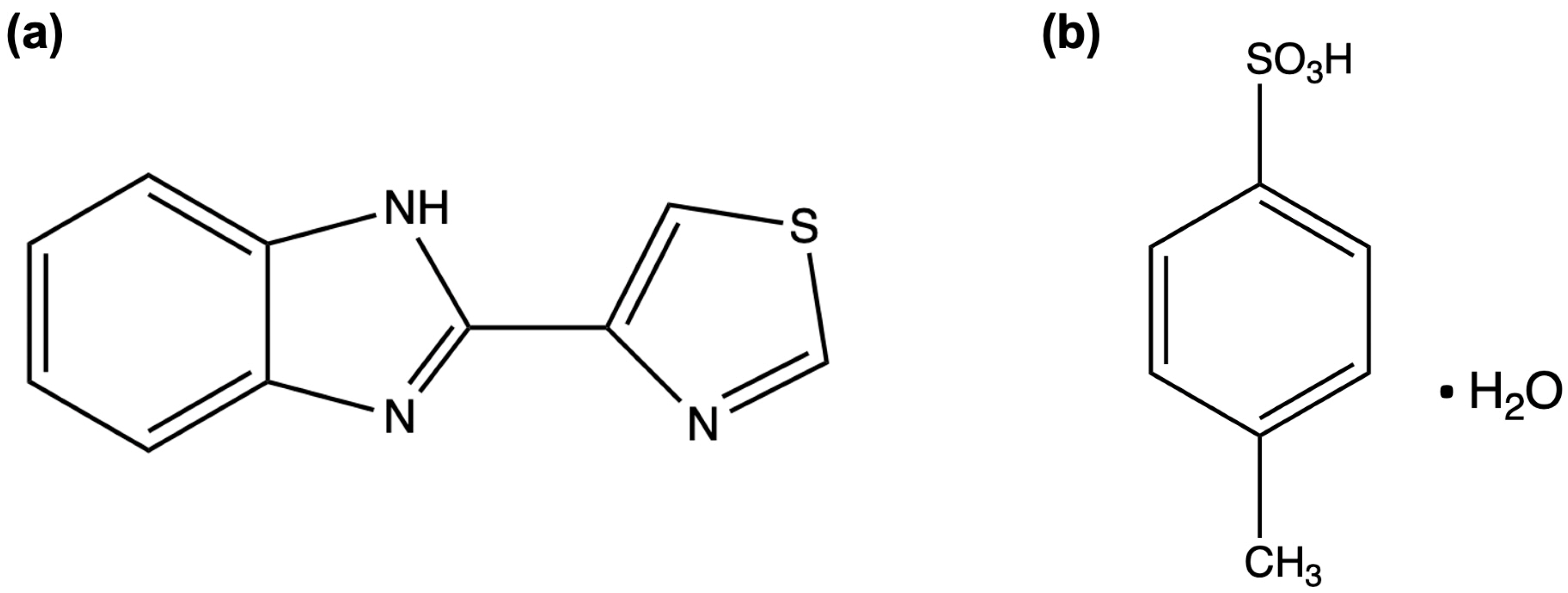
Therefore, based on the theoretical rule for successful salt formation—typically requiring a pKa difference of around 3–4 units between the protonated base and the acid [22,23,24,25,26]—we combined via mechanochemistry TBZ (pKa ≈ 4.64) [19,27] and p-toluenesulfonic acid monohydrate (hereinafter referred to as PTOS·MH) (Figure 1), a strong organic acid with a pKa of −2.8 in water [28]. The tosylate, along with other counterions derived from organic sulfonic acids, belongs to the counterions approved for pharmaceutical use, specifically to Class II according to Gaisford [29], which includes non-natural counterions commonly used and well tolerated over time. PTOS·MH has previously been shown to be suitable for mechanochemical processes and to improve solubility in related systems [30].
Using both neat grinding (NG) and liquid-assisted grinding (LAG) with 4-methyltetrahydropyran (4-MeTHP)—a greener solvent with low toxicity and favorable environmental profile [31,32]—we successfully obtained a multicomponent crystalline form of TBZ.

2. Materials and Methods

2.1. Materials

Thiabendazole (TBZ, Sigma-Aldrich Ltd., St Louis, MO, USA) and p-toluenesulfonic acid monohydrate (PTOS·MH, Sigma-Aldrich Ltd., St Louis, MO, USA) were used without further purification. 4-methyltetrahydropyran (4-MeTHP) was kindly donated by Carlo Erba (CARLO ERBA Reagents srl, Milan, Italy). Hexane, methanol (MeOH), NaCl, KCl, Na2PO4·7H2O and KH2PO4 of analytical grade were purchased by Sigma-Aldrich Ltd., while water (H2O) was freshly distilled.

2.2. Methods

2.2.1. Mechanochemical Routes for Preparing TBZ Multicomponent Crystal

Mechanochemical reactions were carried out using a Retsch MM400 mill (Retsch, Haan, Germany) equipped with two stainless steel jars (25 mL internal volume) and screw-cap closure. Each jar contained one stainless-steel ball (Ø 10 mm) as the grinding medium. For each experiment, the total mass of the equimolar TBZ-PTOS mixture was fixed at 400 mg.
The multicomponent crystal of TBZ was obtained via both NG and LAG, the latter using 80 µL of 4-MeTHP. Milling frequency and time were maintained in both cases at 25 Hz and 2 h, respectively. To ensure reproducibility, all experiments were performed at least in duplicate.
After the LAG procedure, all products were left to evaporate under a fume hood and subsequently stored in a vacuum desiccator.
The resulting mechanochemical products were characterized after standing overnight using powder X-ray diffraction (PXRD) and differential scanning calorimetry (DSC), while the additional characterizations were carried out in the following days.

2.2.2. Characterization

Powder X-Ray Diffraction (PXRD)
For PXRD measurements, a Bruker D2 Phaser diffractometer (Bruker, Manheim, Germany) with Cu-Kα source (λ = 1.54 Å) was used. The system works with a 300 W low power X-ray generator (30 kV at 10 mA). The steel sample holder used has a capacity of 300 µL, while cylindrical gearboxes in polyvinylidene fluoride (PVDF) were used for reducing the capacity to about 100 µL of solid. The conditions used for the measurement were as follows: 2θ angles from 3° to 40°, 0.02° 2θ increment, time step 0.6 s.
Differential Scanning Calorimetry (DSC) Analysis
For DSC analysis, each sample weighing 2–4 mg was introduced into an aluminum sealed and pierced 40 μL crucible and analyzed by a DSC 3 Star System Mettler Toledo (Mettler Toledo, Milan, Italy) with a heating program of 30–310 °C (10 °C/min) under a nitrogen (N2) atmosphere (50 mL/min flow rate).
Thermogravimetric Analysis (TGA)
TGA analysis of the new multicomponent system was performed using a TGA 2 Mettler Toledo (Mettler Toledo, Milan, Italy). Briefly, 5–10 mg of the powdered sample were inserted into Alumina 100 μL crucibles and analyzed with a heating program of 30–310 °C (10 °C/min) under a nitrogen (N2) atmosphere (50 mL/min flow rate).
Hot-Stage Microscopy (HSM)
A thin layer of each sample was placed on a glass microscope slide and heated from 25 to 210 °C at a controlled heating rate of 10 °C min−1 using a Mettler FP52 hot stage (Mettler, Zurich, Switzerland, CH). The samples were continuously observed under a Leica optical microscope equipped with an Olympus EP50 digital camera (Olympus, Segrate, Italy), allowing real-time monitoring and recording of morphological changes occurring during heating.
Fourier-Transform Infrared Spectroscopy (FT-IR)-Attenuated Total Reflectance (ATR) Analysis
Powdered samples (pure TBZ and PTOS·MH, and TBZ-PTOS crystals) were analyzed with a Shimadzu IRAffinity-1S FT-IR instrument (Shimadzu, Kyoto, Japan) using the attenuated total reflectance technique, in a range of 400–4000 cm−1 with a resolution of 4 cm−1 and 20 scans.
Scanning Electron Microscopy (SEM) Analysis
Images of TBZ multicomponent crystals and pure raw components were collected through scanning electron microscopy (SEM). The powdered sample was placed on an aluminum stub covered with a carbon double-sided tape and sputter-coated with gold using a Sputter Coater K550X (Emitech, Quorum Technologies Ltd., Lewes, UK), before being analyzed by a scanning electron microscope (Fei Quanta 250 SEM, Hillsboro, OR, USA) with the secondary electron detector. The working distance was set at 10 mm to obtain the appropriate magnifications, and the acceleration voltage was set at 5 kV.
Physical Stability Tests Under Various Temperature Conditions
The TBZ multicomponent crystal was stored in sealed glass vials at four different temperatures (−30 °C, 5 °C, 25 °C, and 40 °C) and monitored over a period of 18 months. Samples were collected weekly during the first month and biweekly thereafter, with each sample analyzed by PXRD, as described in Section Powder X-Ray Diffraction (PXRD).
Solubility Studies
To evaluate the solubility of the newly prepared TBZ–PTOS salts in comparison with pure TBZ, solubility tests were conducted in screw-capped 20 mL glass vials by adding an excess of powder to 10 mL of phosphate buffer (pH 7.4). Each experiment was performed at 37 ± 0.5 °C using a thermostatic water bath. After 24 and 48 h, samples were collected and filtered through a 0.45 μm cellulose acetate syringe membrane filter (Millex™-GP, Merck KGaA, Darmstadt, Germany). The concentration of dissolved TBZ was determined spectrophotometrically (Biochrom Libra S12, Cambridge, UK) at 298 nm. PTOS·MH maximum UV absorption occurs at a lower wavelength not interfering with TBZ quantification. All measurements were carried out in triplicate for each sample and time point.
Intrinsic Dissolution Rate (IDR) Tests
The IDR of commercial TBZ and the TBZ–PTOS crystal was determined using 300 mg powder tablets prepared with a hydraulic press (PerkinElmer, Norwalk, CT, USA) at 4.5 tons for 120 s in a stainless-steel cylinder serving as the sample holder. The resulting tablets had a diameter of 1 cm and a flat surface area of 0.785 cm2. Sample holders were immersed in 500 mL of phosphate buffer (pH 7.4) at 37 °C and stirred at 200 rpm. Filtered samples (to exclude undissolved particles) through full flow filters (Agilent, Santa Clara, CA, USA) were automatically collected every 10 min using a peristaltic pump, and UV absorption at 298 nm was measured. All experiments were performed in triplicate and mean and standard deviations (%) were calculated. Slopes of the intrinsic dissolution curves (amount dissolved per unit area over time) were determined by linear regression, and dissolution behavior was compared using a t-test with p value < 0.05 considered statistically significant.
In Vivo Activity
In vivo studies were conducted in accordance with the local cantonal veterinary guidelines, license number 545. Female NMRI mice (3 weeks old) were obtained from Charles River and kept in individually ventilated cages with free access to food and water. The animals were allowed a one-week acclimation period before infection. Immunosuppression was achieved by adding dexamethasone (0.25 mg/L) to the drinking water, beginning two days after arrival and continuing until two days prior to treatment. Mice were orally infected with 100 infective third-stage larvae (L3) of Heligmosomoides polygyrus (H. polygyrus). The life cycle of H. polygyrus is maintained at Swiss TPH. Fourteen days after infection, test compounds were administered orally at doses of 100 or 200 mg/kg (n = 4 mice per group). Four additional mice remained untreated as controls. Six to seven days after treatment, mice were euthanized by CO2 asphyxiation. The entire gastrointestinal tract, including the stomach and small intestine, was collected and dissected to recover adult worms. Worm counts were performed for both treated and control groups, and worm burden reduction (WBR%) was calculated as the percentage decrease in mean worm counts in treated groups relative to controls.

3. Results and Discussion

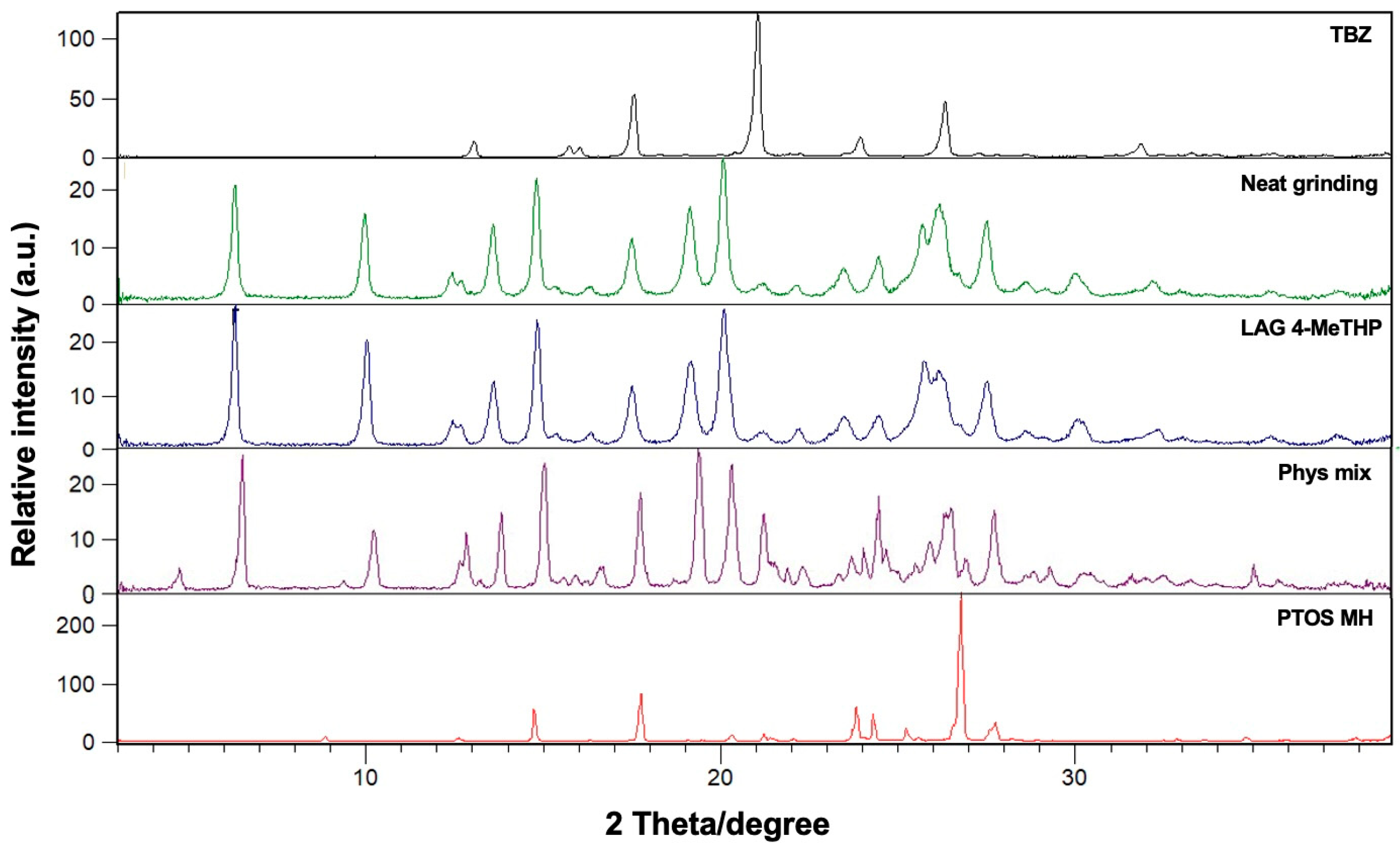
In this work, our aim was to obtain a new salt form of TBZ; therefore, the selection of the coformer was based on its biological safety and the ΔpKa rule. The new salt was prepared mechanochemically by milling TBZ with PTOS·MH in equimolar amounts under ambient conditions. Since the crystallization of this salt into single crystals proved difficult and considering that solution-based synthesis generally requires large amounts of solvent and longer processing times, mechanochemistry was employed as a reliable and powerful approach for the preparation of the pharmaceutical salt, affording high purity and yield. The synthesis of the TBZ salt was successfully achieved by two different methods. In both cases, the reactions were completed, as no trace of starting materials was detected in the final products (Figure 2). On one hand, the salt could be obtained by adding 80 μL of liquid to 400 mg of powder, followed by milling for 2 h at 25 Hz. These operational conditions (milling time and frequency) had previously been successfully applied in the synthesis of a molecular cocrystal [33] and a salt containing the same coformer [30]. Among the tested liquids (hexane, methanol, and the more sustainable option 4-MeTHP), the most effective proved to be 4-MeTHP, which demonstrated high efficiency even in small amounts (only 80 μL, compared with the 160 μL used in the cited works [30,33]).
The salt prepared using hexane exhibited poor physical properties due to extreme electrostatic behavior, whereas methanol did not provide the same process yield, and the resulting solid still contained residual crystalline phases (see the PXRD pattern in Figure S1 in the Supporting Information (SI) File). Therefore, 4-MeTHP was ultimately selected as the grinding liquid, in the amount of 80 μL.
4-MeTHP, derived from renewable sources, is an aprotic solvent, immiscible with water, and particularly suited for reactions carried out in biphasic environments (such as nucleophilic substitution reactions, but also LAG processes). A relatively high boiling point of 4-MeTHP allows for operation at temperatures above ambient conditions (after 2 h of LAG at 25 Hz, a temperature of approximately 40–45 °C is reached [34]), while its low viscosity favors molecular diffusion during milling. However, it has not yet been employed in mechanochemical synthesis [31,32].
A particularly interesting and distinctive feature of this salt is that even neat grinding (NG), assisted solely by mechanical energy (2 h at 25 Hz), afforded the same salt. Notably, the simple physical mixture (see Figure 2) does not induce any reaction between TBZ and PTOS, highlighting that mechanical energy under appropriate operational conditions is essential. This outcome is especially remarkable given that NG typically leads to amorphous phases [35], also in case of salts [30,36] or, in some cases, polymorphic forms [34,37], whereas the addition of a liquid usually guides the system toward crystalline phases. This observation highlights the role of liquid-assisted grinding (LAG) in steering crystallization [38]. Yet it must be emphasized that PTOS is originally a monohydrate and therefore intrinsically contains a fraction of water that can act as a grinding liquid. This dual functionality underscores the strategic choice of PTOS·MH in the formation of the TBZ organic salt. Indeed, PTOS·MH simultaneously acts as the counterion and provides, through its intrinsic hydration, the necessary liquid medium for mechanochemical grinding. Such a property not only facilitates salt formation under NG conditions but also highlights the broader potential of hydrated coformers in pharmaceutical mechanochemistry.
Finally, the two coformers already interact in the simple physical mixture, as shown in Figure 2, confirming the appropriate selection of the coformers. However, salt formation occurs exclusively through mechanochemical activation as a result of the applied mechanical energy. Thermal effects alone can be ruled out, since no salt formation is observed in the PXRD pattern of the equimolar physical mixture after thermal treatment at 40 °C for 2 h (see Supporting Information, Figure S2).
Given that the salt exists in a hydrated form, as will be explained in greater detail later, the choice of liquid becomes particularly relevant to preserving its structural integrity. The use of 4-MeTHP as grinding liquid is particularly appropriate, since its immiscibility with water prevents dehydration. In contrast, methanol (MeOH), being fully miscible with water, dehydrates PTOS·MH and thereby hinders crystallization. In other words, methanol can promote water removal by dissolving it and facilitating its displacement throughout the grinding process, thus preventing the crystallization of the hydrate. Consistently, water-immiscible hexane also afforded the hydrated salt, albeit in lower yield, further confirming the critical role of solvent miscibility in preserving hydration and enabling salt formation.
The salt obtained through both LAG and NG appears crystalline in the PXRD analysis, displaying diffraction peaks clearly distinguishable from those of the starting materials as well as from the simple physical mixture. The crystallinity of NG sample is only slightly lower than that of the LAG-derived sample. In neither case residual signals of the starting components are observed (Figure 2). As anticipated, the solid obtained in the presence of MeOH differs from all the others, exhibiting a predominant phase that is distinct and most likely corresponds to a polymorphic form of the tosylate salt, along with minor residual amounts of unreacted TBZ (Figure S1 in the SI file).
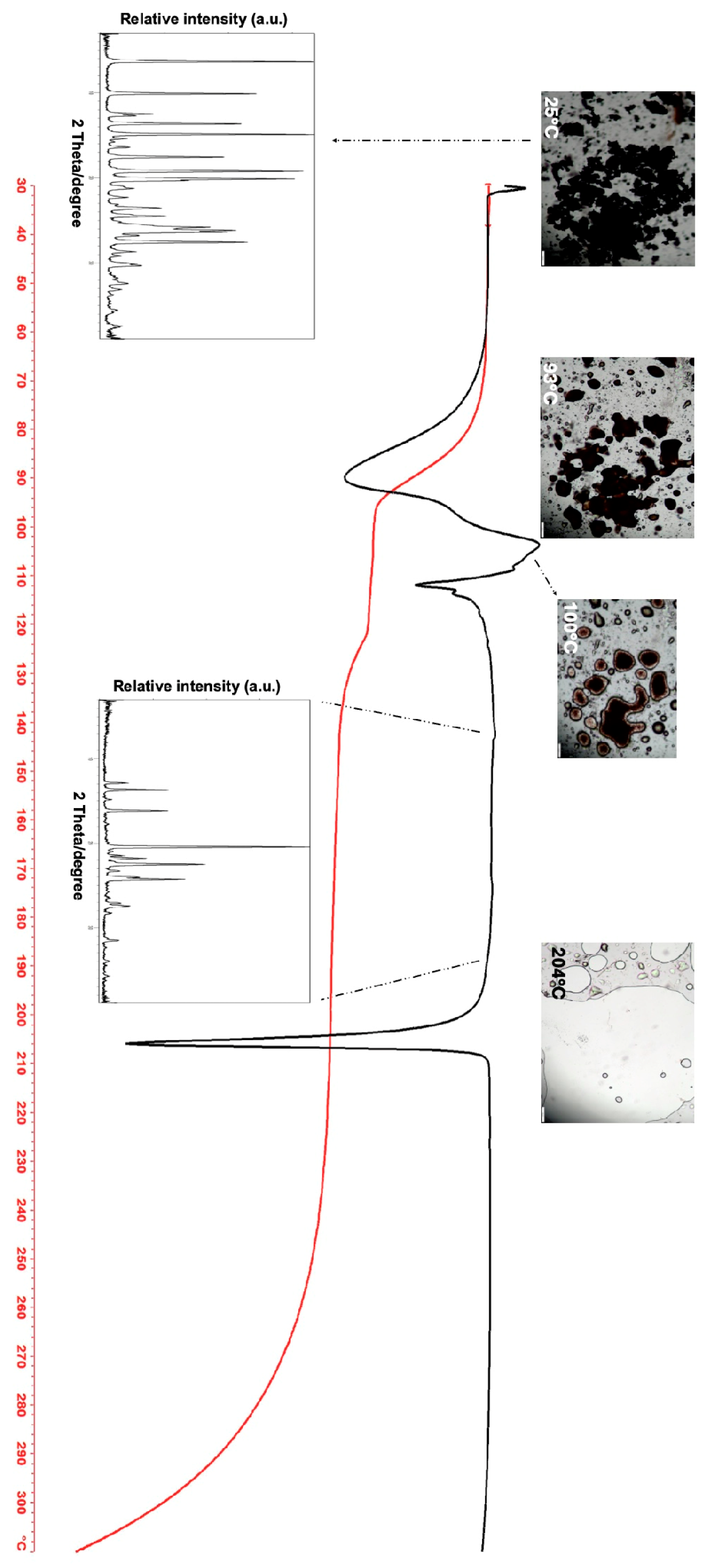
Thermal analyses provided further insight into the crystalline salt phase. DSC, TGA, and HSM were performed on the sample and compared with the pure coformers. The thermogram of the salt in DSC appears complex and is characterized by several thermal events. For clarity, Figure 3 reports the results of four different analyses, allowing for a more comprehensive interpretation, while in Figure S2 in the SI all HSM images are reported.
The first event in DSC (black curve) is a rather broad endotherm between approximately 74.89 and 95.67 °C, attributable to sample dehydration, which corresponds to a 3.4% mass loss in the TGA trace (red curve). During this event, the solid collapses (as observed by HSM) and subsequently recrystallizes, giving rise to an exothermic event between 95 and 105 °C, leading to a new solid form that is also hydrated. A second dehydration step is observed in the DSC as a sharp, bifurcated endotherm with two peaks at 110–112 °C, corresponding in the TGA to a modest mass loss of 0.88%. Due to its low magnitude, this dehydration is hardly visible in HSM analysis. Overall, the total amount of water present in the crystalline lattice of the salt corresponds to an equimolar salt-water ratio.
Finally, the solid melts with an extremely sharp and narrow endotherm, with an onset at 204.70 °C (ΔH = 76.74 J/g). Notably, the TGA also shows that the salt remains thermally stable for an additional ~20 °C beyond its melting event, as no significant mass loss occurs until temperatures exceed 230 °C. Combined DSC-PXRD experiments (i.e., sample heated through DSC at 10 °C/min up to 130 °C) corroborate this result, revealing a new diffraction pattern of a highly crystalline solid, clearly distinct from the initial salt pattern. The latter phase is also formed from a phase originally different prepared by using MeOH as grinding liquid (Figure S3).
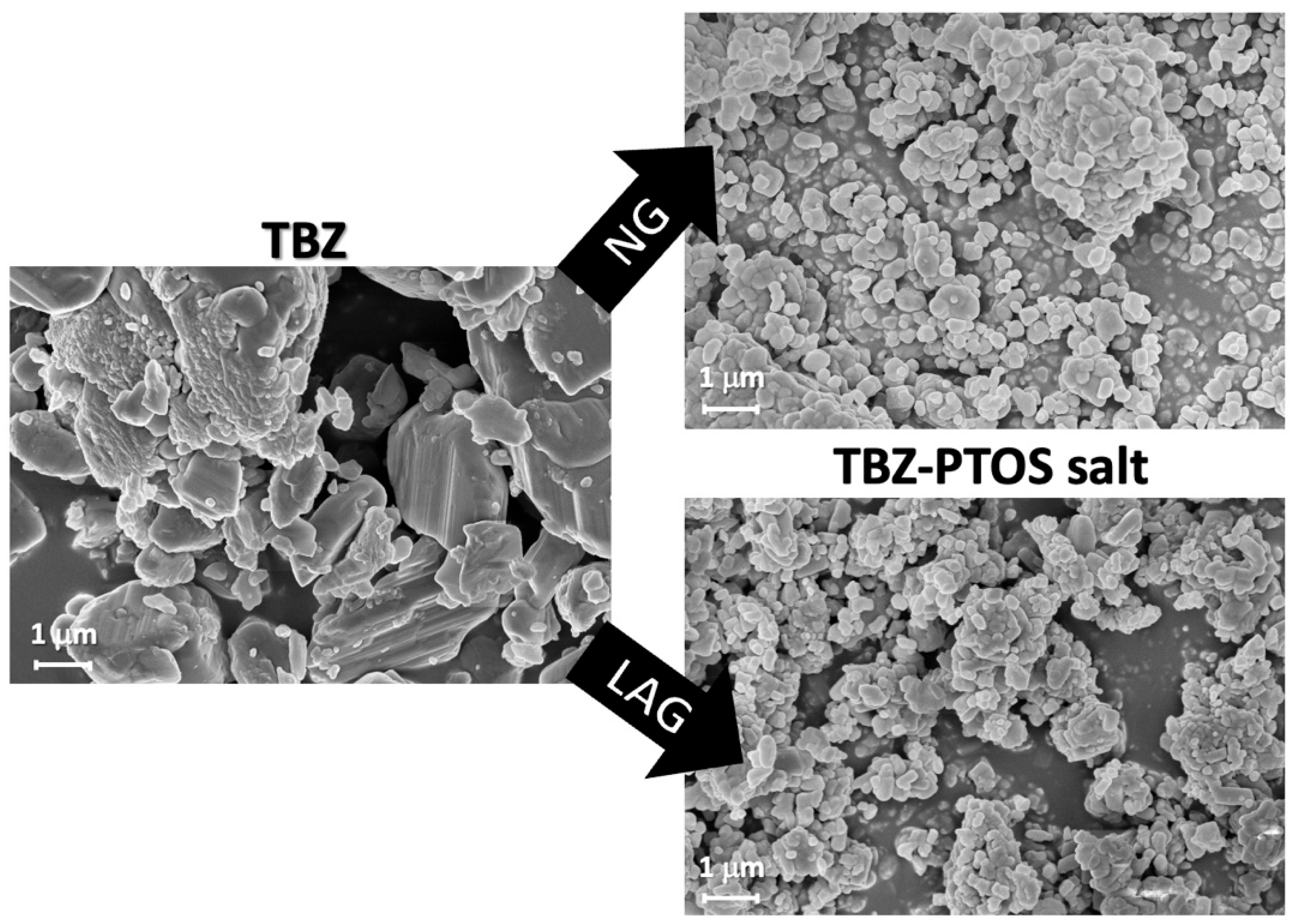
SEM images in Figure 4 reveal that the morphology of the samples obtained through NG or LAG with 4-MeTHP is essentially identical. The particles show a pronounced size reduction, all measuring below 1 μm, and display the characteristic rounded-edge morphology typical of mechanochemically produced solids [33,39]. In contrast, TBZ shows a plate-like habit with an average diameter of approximately 3 μm.
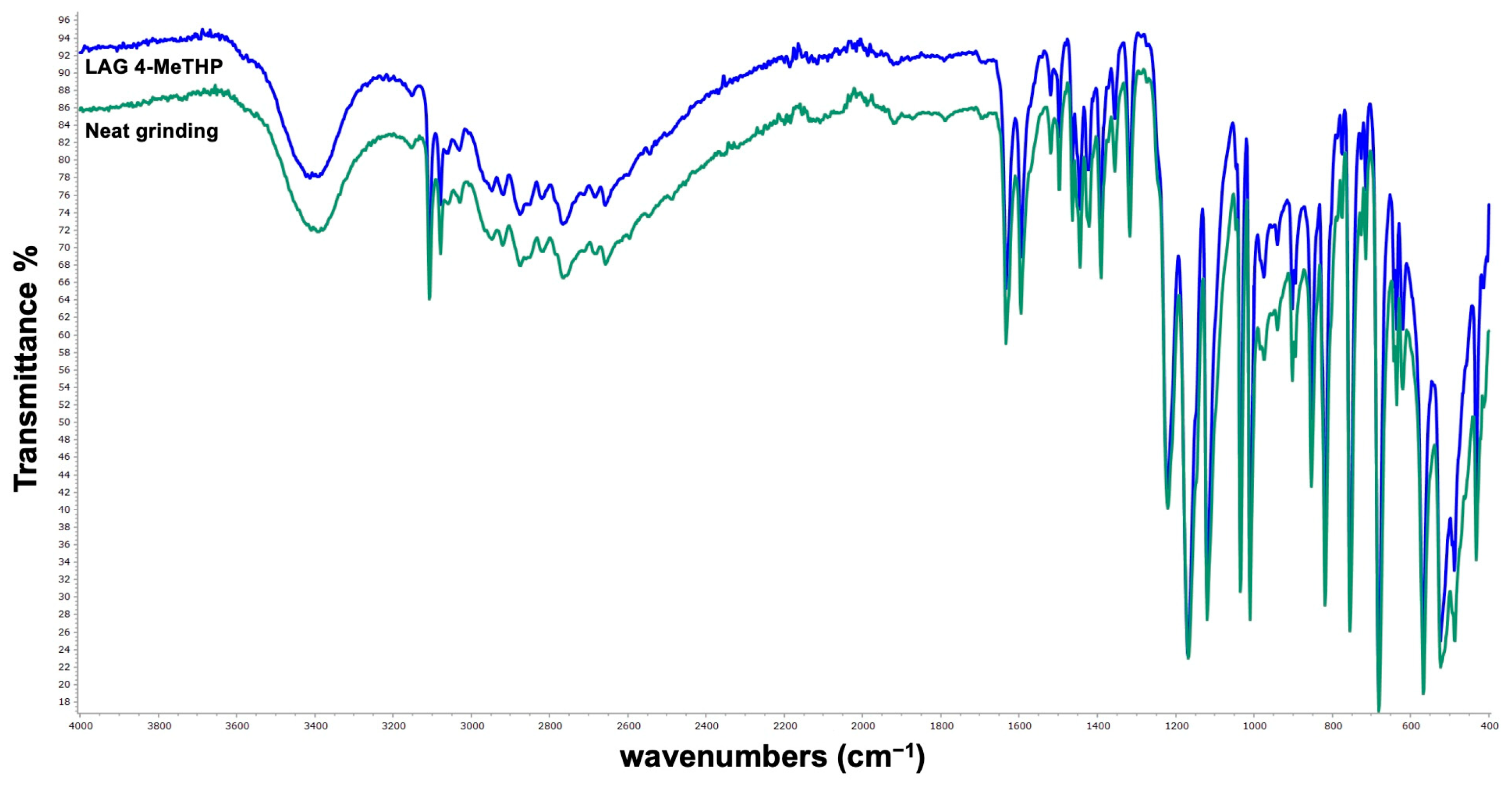
Considering the FTIR analyses of the two NG and LAG salts, it is noteworthy that both the spectra are essentially identical (Figure 5), suggesting that both samples share essentially the same type of intermolecular interactions between the two coformers, further confirming the interchangeability of the two mechanochemical processes for producing the salt.
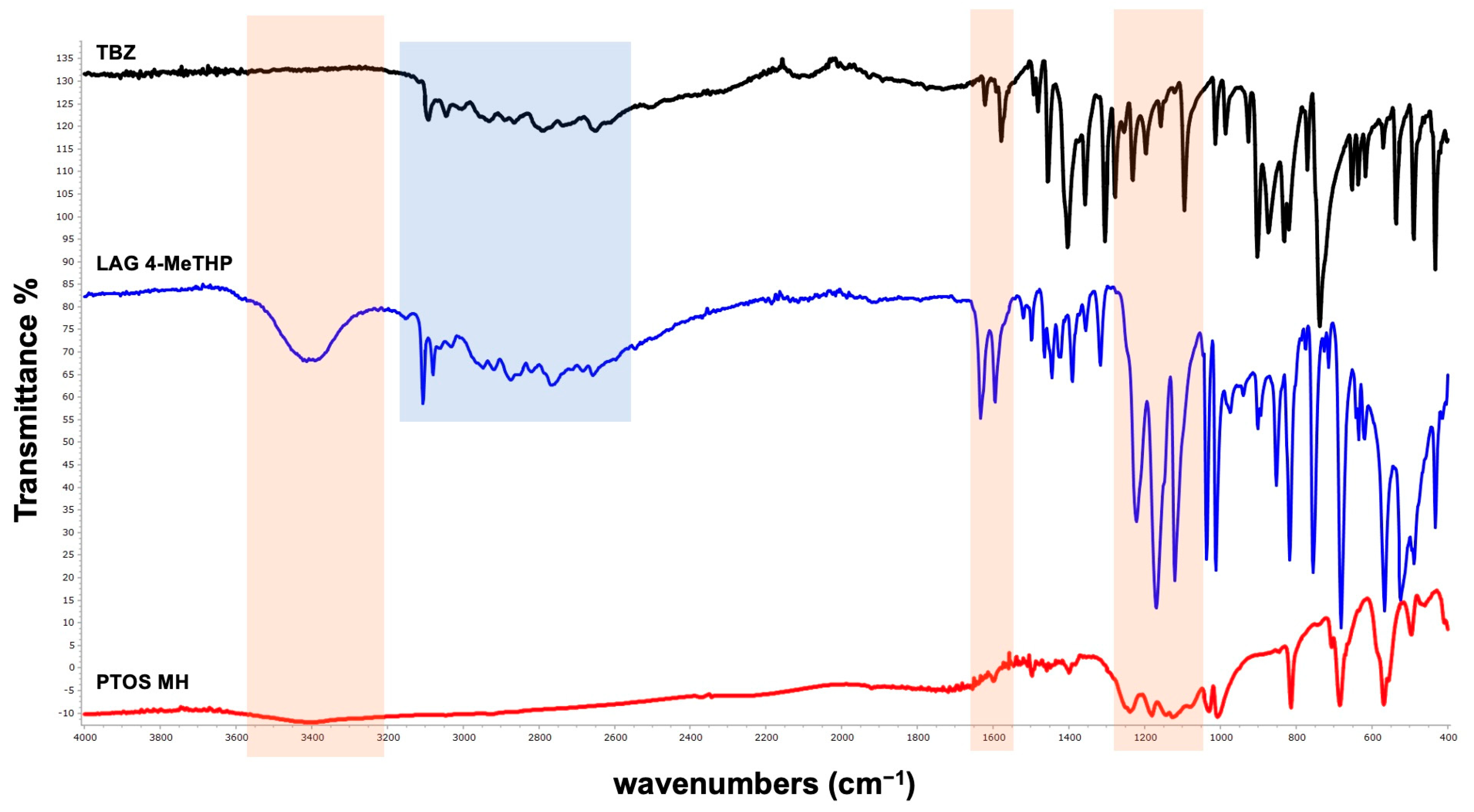
Both the NG and LAG salt samples exhibit distinctive spectral signature, clearly distinguishable from those of the starting materials (color-highlighted regions in Figure 6), which is a typical confirmation of the formation of a new solid phase and can serve for identification purposes. The most evident differences between the spectra of the salt and TBZ are observed in the high-frequency region. The spectrum of the hydrated salt exhibits a broad band between 3200–3600 cm−1, with a maximum around 3400 cm−1, which cannot be unambiguously assigned. This region may include contributions from O–H stretching vibrations of hydrated water as well as N–H stretching modes associated with protonated nitrogen species. Also, a complex broad profile extending from 2250 to 3300 cm−1 is observed (blue block in Figure 6). This feature is typical of crystalline TBZ and reflects the prominent role of intermolecular hydrogen bonding and anharmonic couplings involving higher-energy vibrations and lattice modes [40], as it is absent in the spectrum of pure TBZ [41]. These features are present with higher intensity and exhibit a blue shift in the salt spectrum. Furthermore, protonation alters the electronic distribution and modifies the C=N resonance. This is evident from the upward shift of the C=C and C=N vibrations (phenyl + imidazole), originally observed at 1622, 1592 and 1579 cm−1, to ~1633 and 1595 cm−1, respectively. In addition, confirmation of TBZ protonation is provided by the disappearance/shift of NH bending modes: the NH bending vibrations at 1403, 1254, and 901 cm−1 (scissoring, wagging, and rocking, respectively) undergo changes, with the band at 901 cm−1 remaining unchanged, the band at 1403 cm−1 shifting upward to ~1423 cm−1, and the band at 1254 cm−1 disappearing.
While FTIR and long-term PXRD stability data (discussed below) indicate that water is an integral component of the hydrogen bond network, definitive assignment of its structural role would require crystallographic analysis.
As mentioned previously, the primary objective of the present study was to enhance the solubility of TBZ, a drug with inherently low water solubility, through a mechanochemical approach. To elucidate this, the solubility (Cs) of TBZ and TBZ-PTOS salt were determined and compared. Since the salts obtained by NG and LAG were identical, only the latter was subjected to solubility and intrinsic dissolution rate (IDR) tests.
It was determined that pure TBZ at 37 °C in pH 7.4 phosphate buffer reached equilibrium after 48 h, with calculated Cs of 27.65 ± 3.79 mg L−1 after 24 h and 34.65 ± 1.17 mg L−1 (mean ± s.d., n = 3) after 48 h, which is comparable to data from the literature [12,13]. Under the same tested conditions, the newly prepared multicomponent TBZ–PTOS system reached equilibrium within 24 h, maintaining the supersaturation over the entire period. Specifically, the achieved Cs was 2542.51 ± 448.36 mg L−1 and 2485.06 ± 340.23 mg L−1 after 24 and 48 h, respectively. It is evident that combining TBZ with PTOS, assisted by 4-MeTHP, led to ~70-fold increase in solubility of the tested drug. According to the European Pharmacopoeia [42], the solubility of pure TBZ can be classified as practically insoluble (more than 10,000 mL of solvent per gram of solute), whereas with the formation of a multicomponent system a slightly soluble (~100–1000 mL of solvent per gram of solute) behavior of TBZ was achieved.
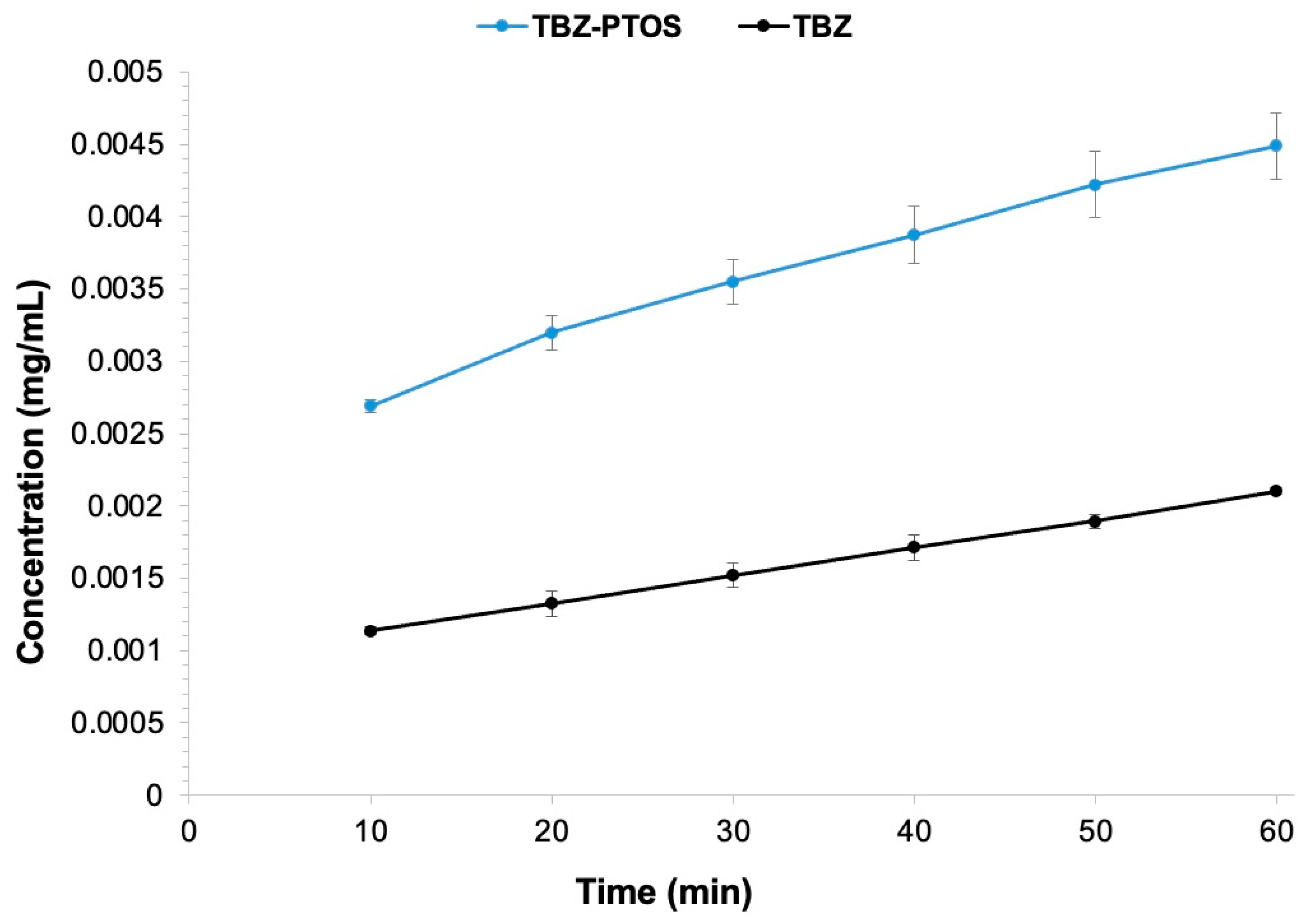
IDR is an important factor closely linked to the onset and persistence of API therapeutic effect [43]. The IDRs of commercial TBZ and TBZ multicomponent solid were monitored for comparative assessment to elucidate the hypothesized differences in dissolution behavior. The calculated values reveal significant differences in the dissolution rates, specifically, the IDR for TBZ was 0.013 ± 0.001 mg cm−2min−1, whereas the multicomponent system dissolved almost 2-fold faster with IDR of 0.025 ± 0.003 mg cm−2min−1. The trend is evident also from Figure 7, with statistically significant differences between the slopes of the TBZ and TBZ-PTOS dissolution profiles (p = 0.015) as well as between values of the individual sampling points (p < 0.001).
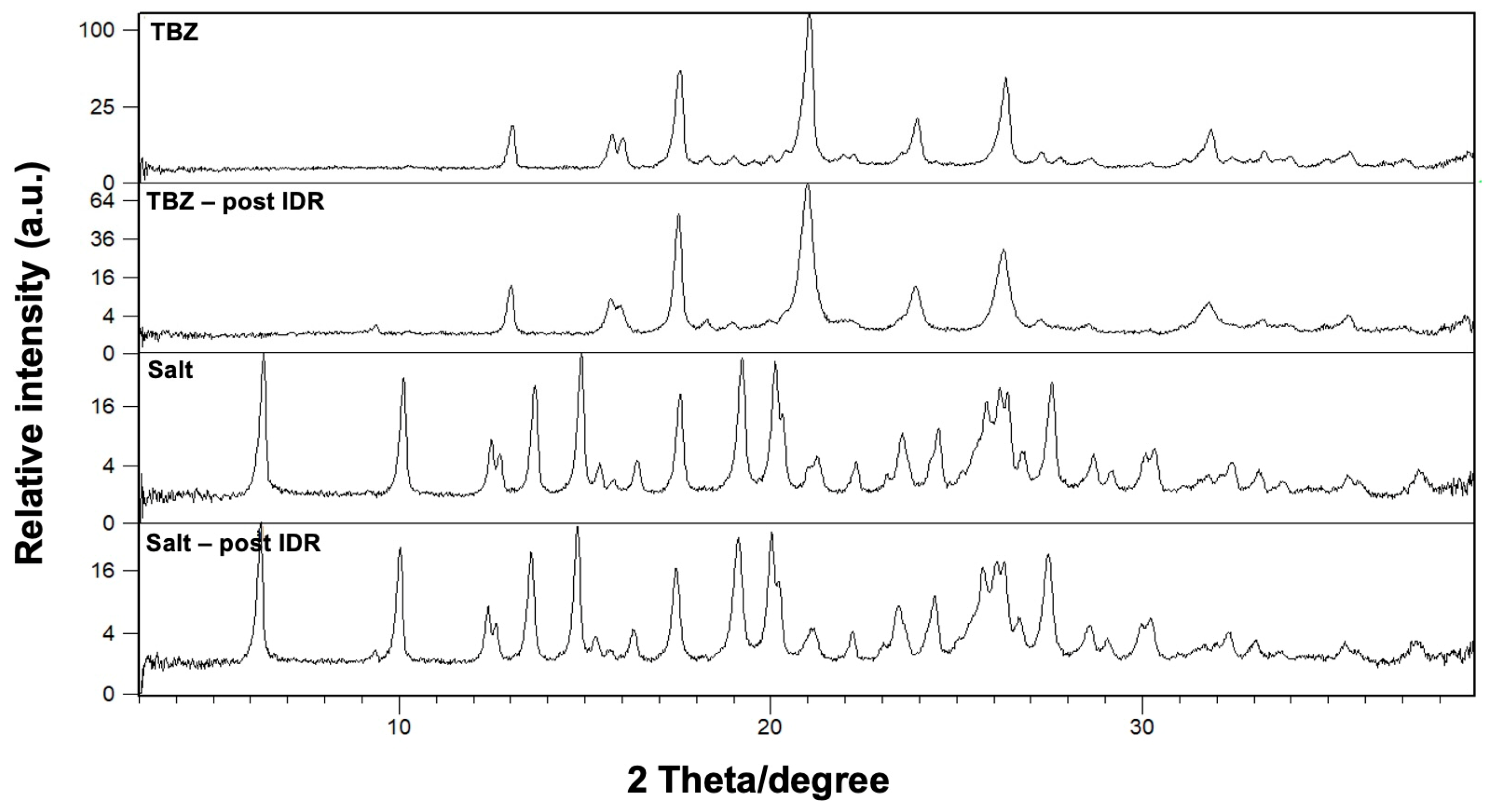
Although the enhancement in IDR is less pronounced than the increase in equilibrium solubility, this behavior is not associated with surface disproportionation or solution-mediated phase transformation. The salt enhances dissolution, and the non-converging straight lines indicate solid-state stability during dissolution, which is further confirmed by PXRD analysis of the tablet surface after the IDR experiment, showing preservation of the TBZ–PTOS crystal structure with no evidence of free TBZ formation (Figure 8).
According to the Noyes–Whitney equation, an increase in solubility is usually associated with an increase in IDR; however, since IDR is a function of several parameters, solubility data are insufficient to predict the extent of the IDR enhancement. Solubility is a thermodynamic parameter that defines the maximum concentration attainable in solution under saturation conditions. It is strongly influenced by the chemical nature of the salt, the strength of ionic interactions, and the ability of the solvent to stabilize the dissolved species. In contrast, the IDR is a kinetic parameter, which is additionally governed by the crystal lattice energy and by diffusion processes occurring within the boundary layer at the solid–liquid interface. Dissolution of the compounds with high melting temperature (>200 °C) is typically hindered by their slow dissociation from crystal lattice [44].
According to our results, it is plausible that a tosylate salt exhibits slower diffusion compared to the free base, thereby compensating—at least during the initial stages of dissolution (1 h of IDR)—for the substantial difference in solubility. In this context the IDR is governed (differently from the Cs) by the diffusion coefficient (D) and the thickness of the diffusion layer (h). Consequently, the increase in Cs does not translate linearly into an enhancement of IDR. During the first hour of dissolution, the D/h term may become the limiting factor. If the salt displays slower diffusion, the pronounced increase in Cs does not immediately result in a proportional acceleration of the dissolution rate. As a result, the IDR of the salt may be only two to three times higher, as in our case, rather than one hundred times, since the kinetics are counterbalanced by the reduced D. Classical dissolution tests performed on pure TBZ and on the salt, in powder form and in the same dissolution medium (results reported in Figure S4 in the SI File), show that although the dissolution of the salt is markedly superior in terms of rate and amount dissolved, it does not exhibit the typical behavior of a supersaturated system, which is characterized by an initial overshoot—i.e., a rapid increase in dissolved concentration beyond the equilibrium solubility. Specifically, the amount of dissolved pure TBZ was below 4% after 1 h and reached 9% after 5 h of testing, whereas TBZ in salt form showed approximately 40% dissolved after 1 h, reaching 69% only after 5 h. This behavior indicates that the improved dissolution performance of the salt is attributable to its intrinsic solid-state features rather than to transient supersaturation phenomena.
It should be also stated that after IDR tests, the pH of the medium remained at the initial value (7.4).
TBZ-PTOS salt obtained by LAG and pure TBZ were tested at doses of 100 and 200 mg/kg, respectively in the H. polygyrus mouse model. As can be seen from the Table 1, similar moderate worm burden reductions of 62 and 64.5% were observed, indicating that conversion of TBZ into a new multicomponent salt form (TBZ-PTOS) had no negative impact on API anthelmintic activity. The latter offers valuable insight related to in vivo activity of TBZ. Nevertheless, further confirmation with a larger sample size is required to enable more generalizable conclusions.
Furthermore, the comparable worm burden reduction observed for TBZ and TBZ–PTOS suggests that the therapeutic effect of TBZ may not be solubility-limited under the tested dosing conditions. Importantly, conversion of TBZ into the tosylate salt does not impair its anthelmintic efficacy, confirming that the mechanochemical formulation preserves biological activity while offering substantial advantages in terms of physicochemical properties and sustainability.
The physical stability of the salt hydrate, as evidenced by the previously discussed solid-state characterizations, is strongly governed by the presence of crystalline water. Maintaining this hydration state is essential for storage, handling, and practical use, as the integrity of the hydrate directly influences its performance and shelf-life. For this reason, we evaluated the stability of the hydrated salt under four different temperature conditions—freezer, refrigerator, room temperature, and 40 °C—over an extended period of 18 months, monitoring its solid-state form through PXRD. The results (Figure S5 in the SI File) are highly encouraging, namely no changes in the crystalline phase were observed throughout the entire study, fully consistent with the thermal stability previously indicated by TGA.

4. Conclusions

The guiding principle of this study was to develop a greener and more efficient multicomponent TBZ system. In detail, by utilizing mechanochemical energy, new hydrate crystal form of TBZ was prepared. The latter exhibited a remarkable ~70-fold increase in solubility compared to pure TBZ and retained its solid-state form for up to 18 months, thus considered physically stable. As demonstrated by PXRD analysis, no trace of starting materials was detected in the systems regardless of whether NG or LAG was applied. The grinding process yielded rounded-edge particles with reduced size seen from SEM micrographs, while TGA reveals thermal stability of new TBZ salt form up to 230 °C. Our sustainable approach has clear pharmaceutical relevance and provides meaningful potential in the food-related contexts, such the anthelmintic efficacy of TBZ salt form is retained.

Supplementary Materials

The following supporting information can be downloaded at: https://www.mdpi.com/article/10.3390/cryst16010063/s1, Figure S1. PXRD pattern comparison of TBZ and PTOS·MH coground in equimolar ratio for 2 h at 25 Hz in the presence of different grinding liquids and processed by NG. Figure S2. PXRD patterns of TBZ-PTOS·MH co-ground for 2 h at 25 Hz using LAG with 80 μL 4-MeTHP (blue), compared with the physical mixture (purple) and the physical mixture treated for 2 h at 40 °C (teal green). Figure S3. HSM images (mag 10×) of TBZ-PTOS salt from 25 °C to 205 °C. Figure S4. PXRD pattern comparison of the salt (prepared by LAG with 4-MeTHP) at room temperature and the new solid phase formed after heating at 10 °C/min from 30 °C to 160 °C. Please note that the same phase is also formed from a phase originally different as it was prepared by using MeOH as grinding liquid. Figure S5. Mean dissolution profiles (n = 3) of 3 mg of pure TBZ (black) and an equivalent TBZ amount from the salt (blue) in 150 mL of phosphate buffer pH 7.4 at 37 °C. Please note that standard deviations are smaller than 0.005 and are not visible at the scale of the plot. Figure S6. PXRD results of salt physical stability at different storage temperatures over the period of 18 months.

Author Contributions

I.D.: Writing—original draft, Investigation, Conceptualization. E.Z.: Investigation, Writing—original draft. M.B.Ž.: Writing—original draft, Investigation, Conceptualization. S.B.: Writing—original draft, Investigation. C.H.: Investigation. J.K.: Writing—review & editing, Resources, Methodology. B.P.: Writing—review & editing, Supervision, Resources, Project administration, Conceptualization. All authors have read and agreed to the published version of the manuscript.

Funding

The authors gratefully acknowledge the Erasmus+ Programme for Higher Education Mobility for supporting Maja Bjelošević Žiberna mobility that contributed to this work.

Data Availability Statement

The raw data supporting this article will be made available by the authors upon request.

Conflicts of Interest

The authors declare no conflicts of interest.

Abbreviations

APIs, active pharmaceutical ingredients; TBZ, thiabendazole; PTOS·MH, p-toluenesulfonic acid monohydrate; PTOS, p-toluenesulfonic acid; NG, neat grinding; LAG, liquid-assisted grinding; PXRD, powder X-Ray diffraction; PVDF, polyvinylidene fluoride; DSC, differential scanning calorimetry; TGA, thermogravimetric analysis; FT-IR ATR, Fourier-transform infrared spectroscopy attenuated total reflectance; SEM, scanning electron microscopy; HSM, hot-stage microscopy; H2O, water; 4-MeTHP, 4-methyltetrahydropyran; MeOH, methanol; IDR, intrinsic dissolution rate; Phys mix, physical mixture.

References

  1. Transforming Our World: The 2030 Agenda for Sustainable Development. Department of Economic and Social Affairs. Available online: https://sdgs.un.org/2030agenda (accessed on 22 November 2025).
  2. Muthoni, L.K. Sustainable Practices in Pharmaceutical Manufacturing. NewPort Int. J. Pub Health Pharm. 2025, 6, 42–49. [Google Scholar] [CrossRef]
  3. Dunn, P.J.; Wells, A.S.; Williams, M.T. (Eds.) Green Chemistry in the Pharmaceutical Industry; Wiley: Hoboken, NJ, USA, 2010; ISBN 9783527324187. [Google Scholar]
  4. Ferreira da Silva, J.L.; Minas da Piedade, M.F.; André, V.; Domingos, S.; Martins, I.C.B.; Duarte, M.T. The Lisbon Supramolecular Green Story: Mechanochemistry towards New Forms of Pharmaceuticals. Molecules 2020, 25, 2705. [Google Scholar] [CrossRef]
  5. Martínez, L.M.; Cruz-Angeles, J.; Vázquez-Dávila, M.; Martínez, E.; Cabada, P.; Navarrete-Bernal, C.; Cortez, F. Mechanical Activation by Ball Milling as a Strategy to Prepare Highly Soluble Pharmaceutical Formulations in the Form of Co-Amorphous, Co-Crystals, or Polymorphs. Pharmaceutics 2022, 14, 2003. [Google Scholar] [CrossRef]
  6. Ying, P.; Yu, J.; Su, W. Liquid-Assisted Grinding Mechanochemistry in the Synthesis of Pharmaceuticals. Adv. Synth. Catal. 2021, 363, 1246–1271. [Google Scholar] [CrossRef]
  7. Speight, I.R.; Ardila-Fierro, K.J.; Hernández, J.G.; Emmerling, F.; Michalchuk, A.A.L.; García, F.; Colacino, E.; Mack, J. Ball Milling for Mechanochemical Reactions. Nat. Rev. Met. Prim. 2025, 5, 29. [Google Scholar] [CrossRef]
  8. Arfelis, S.; Martín-Perales, A.I.; Nguyen, R.; Pérez, A.; Cherubin, I.; Len, C.; Malpartida, I.; Bala, A.; Fullana-i-Palmer, P. Linking Mechanochemistry with the Green Chemistry Principles: Review Article. Heliyon 2024, 10, e34655. [Google Scholar] [CrossRef]
  9. Fantozzi, N.; Volle, J.-N.; Porcheddu, A.; Virieux, D.; García, F.; Colacino, E. Green Metrics in Mechanochemistry. Chem. Soc. Rev. 2023, 52, 6680–6714. [Google Scholar] [CrossRef]
  10. Montgomery, M.D. Thiabendazole. In xPharm: The Comprehensive Pharmacology Reference; Elsevier: Amsterdam, The Netherlands, 2009; pp. 1–5. [Google Scholar]
  11. History-Merck.Com. Available online: https://www.merck.com/company-overview/history (accessed on 22 November 2025).
  12. Lombardi, B. Optimization of Parameters and Adsorption Mechanism of Thiabendazole Fungicide by a Montmorillonite of North Patagonia, Argentina. Appl. Clay Sci. 2003, 24, 43–50. [Google Scholar] [CrossRef]
  13. Cavalcanti, G.R.S.; Fonseca, M.G.; da Silva Filho, E.C.; Jaber, M. Thiabendazole/Bentonites Hybrids as Controlled Release Systems. Colloids Surf. B Biointerfaces 2019, 176, 249–255. [Google Scholar] [CrossRef]
  14. Motwadie, M.E.; Hashem, M.M.; Abo-EL-Sooud, K.; Abd-Elhakim, Y.M.; El-Metwally, A.E.; Ali, H.A. Modulation of Immune Functions, Inflammatory Response, and Cytokine Production Following Long-Term Oral Exposure to Three Food Additives; Thiabendazole, Monosodium Glutamate, and Brilliant Blue in Rats. Int. Immunopharmacol. 2021, 98, 107902. [Google Scholar] [CrossRef]
  15. Li, H.; Luo, X.; Haruna, S.A.; Zhou, W.; Chen, Q. Rapid Detection of Thiabendazole in Food Using SERS Coupled with Flower-like AgNPs and PSL-Based Variable Selection Algorithms. J. Food Compos. Anal. 2023, 115, 105016. [Google Scholar] [CrossRef]
  16. Estevez, M.-C.; Belenguer, J.; Gomez-Montes, S.; Miralles, J.; Escuela, A.M.; Montoya, A.; Lechuga, L.M. Indirect Competitive Immunoassay for the Detection of Fungicide Thiabendazole in Whole Orange Samples by Surface Plasmon Resonance. Analyst 2012, 137, 5659. [Google Scholar] [CrossRef]
  17. Arenas, R.V.; Rahman, H.; Johnson, N.A. Determination of Thiabendazole Residues in Whole Citrus Fruits by Liquid Chromatography with Fluorescence Detection. J. AOAC Int. 1996, 79, 579–582. [Google Scholar] [CrossRef]
  18. Müller, C.; David, L.; Chiş, V.; Pînzaru, S.C. Detection of Thiabendazole Applied on Citrus Fruits and Bananas Using Surface Enhanced Raman Scattering. Food Chem. 2014, 145, 814–820. [Google Scholar] [CrossRef]
  19. Budetić, M.; Kopf, D.; Dandić, A.; Samardžić, M. Review of Characteristics and Analytical Methods for Determination of Thiabendazole. Molecules 2023, 28, 3926. [Google Scholar] [CrossRef]
  20. Aeindartehran, L.; Lefton, J.B.; Burleson, J.; Unruh, D.K.; Runčevski, T. Soluble Thiabendazolium Salts with Anthelminthic Properties. Int. J. Pharm. 2023, 647, 123516. [Google Scholar] [CrossRef]
  21. Gao, S.; Liu, Y.; Jiang, J.; Li, X.; Zhao, L.; Fu, Y.; Ye, F. Encapsulation of Thiabendazole in Hydroxypropyl-β-cyclodextrin Nanofibers via Polymer-free Electrospinning and Its Characterization. Pest Manag. Sci. 2020, 76, 3264–3272. [Google Scholar] [CrossRef]
  22. Cruz-Cabeza, A.J. Acid–Base Crystalline Complexes and the PKa Rule. CrystEngComm 2012, 14, 6362. [Google Scholar] [CrossRef]
  23. Cruz-Cabeza, A.J.; Lusi, M.; Wheatcroft, H.P.; Bond, A.D. The Role of Solvation in Proton Transfer Reactions: Implications for Predicting Salt/Co-Crystal Formation Using the ΔpKa Rule. Faraday Discuss. 2022, 235, 446–466. [Google Scholar] [CrossRef]
  24. Quintano, M.; Moura, R.T.; Kraka, E. The PKa Rule in Light of Local Mode Force Constants. Chem. Phys. Lett. 2023, 826, 140654. [Google Scholar] [CrossRef]
  25. Childs, S.L.; Stahly, G.P.; Park, A. The Salt−Cocrystal Continuum: The Influence of Crystal Structure on Ionization State. Mol. Pharm. 2007, 4, 323–338. [Google Scholar] [CrossRef]
  26. Peluzo, B.M.T.C.; Bodo, F.; Aeindartehran, L.; Runčevski, T.; Kraka, E. Thiabendazole: Fumaric acid as a case study on the salt cocrystal continuum: A local vibrational mode perspective. Chem. Phys. Lett. 2025, 860, 141772. [Google Scholar] [CrossRef]
  27. Konce, İ.; Akkoc, S.; Üstun, Z.; Demilaray, E.Ç. Liquid Chromatographic Determination of PKa Value of 1-(2-Methylbenzonitrile)-3-Benzylbenzimidazolium Bromide as a Drug Candidate in Acetonitrile-Water Binary Mixtures. J. Res. Pharm. 2022, 26, 655–662. [Google Scholar] [CrossRef]
  28. Guthrie, J.P. Hydrolysis of Esters of Oxy Acids: PKa Values for Strong Acids; Brønsted Relationship for Attack of Water at Methyl; Free Energies of Hydrolysis of Esters of Oxy Acids; and a Linear Relationship between Free Energy of Hydrolysis and PKa Holding over a Range of 20  PK Units. Can. J. Chem. 1978, 56, 2342–2354. [Google Scholar] [CrossRef]
  29. Gaisford, S. Salt Selection. In Remington; Elsevier: Amsterdam, The Netherlands, 2021; pp. 307–314. [Google Scholar]
  30. D’Abbrunzo, I.; Beltrame, F.; Gigli, L.; Demitri, N.; Cepek, C.; Bassato, F.; Procida, G.; Voinovich, D.; Perissutti, B. The Ideal Duo for Salt Formation: Vinpocetine and Tosylic Acid. RSC Pharm 2026. [Google Scholar] [CrossRef]
  31. Kobayashi, S.; Tamura, T.; Yoshimoto, S.; Kawakami, T.; Masuyama, A. 4-Methyltetrahydropyran (4-MeTHP): Application as an Organic Reaction Solvent. Chem. Asian J. 2019, 14, 3921–3937. [Google Scholar] [CrossRef]
  32. Nienałtowski, T.; Krzesiński, P.; Baumert, M.E.; Skoczeń, A.; Suska-Kauf, E.; Pawłowska, J.; Kajetanowicz, A.; Grela, K. 4-Methyltetrahydropyran as a Convenient Alternative Solvent for Olefin Metathesis Reaction: Model Studies and Medicinal Chemistry Applications. ACS Sustain. Chem. Eng. 2020, 8, 18215–18223. [Google Scholar] [CrossRef]
  33. D’Abbrunzo, I.; Bianco, E.; Gigli, L.; Demitri, N.; Birolo, R.; Chierotti, M.R.; Škoríc, I.; Keiser, J.; Häberli, C.; Voinovich, D.; et al. Praziquantel Meets Niclosamide: A Dual-Drug Antiparasitic Cocrystal. Int. J. Pharm. 2023, 644, 123315. [Google Scholar] [CrossRef]
  34. Zanolla, D.; Perissutti, B.; Vioglio, P.C.; Chierotti, M.R.; Gigli, L.; Demitri, N.; Passerini, N.; Albertini, B.; Franceschinis, E.; Keiser, J.; et al. Exploring Mechanochemical Parameters Using a DoE Approach: Crystal Structure Solution from Synchrotron XRPD and Characterization of a New Praziquantel Polymorph. Eur. J. Pharm. Sci. 2019, 140, 105084. [Google Scholar] [CrossRef]
  35. D’Abbrunzo, I.; Venier, E.; Selmin, F.; Škorić, I.; Bernardo, E.; Procida, G.; Perissutti, B. Stability of Ternary Drug–Drug–Drug Coamorphous Systems Obtained Through Mechanochemistry. Pharmaceutics 2025, 17, 92. [Google Scholar] [CrossRef]
  36. D’Abbrunzo, I.; Birolo, R.; Chierotti, M.R.; Bučar, D.-K.; Voinovich, D.; Perissutti, B.; Hasa, D. Enantiospecific Crystallisation Behaviour of Malic Acid in Mechanochemical Reactions with Vinpocetine. Eur. J. Pharm. Biopharm. 2024, 201, 114344. [Google Scholar] [CrossRef]
  37. Zanolla, D.; Perissutti, B.; Passerini, N.; Chierotti, M.R.; Hasa, D.; Voinovich, D.; Gigli, L.; Demitri, N.; Geremia, S.; Keiser, J.; et al. A New Soluble and Bioactive Polymorph of Praziquantel. Eur. J. Pharm. Biopharm. 2018, 127, 19–28. [Google Scholar] [CrossRef] [PubMed]
  38. D’Abbrunzo, I.; Hasa, D. More than “Just a Drop”: The Enigmatic Role of Liquid Additives in Mechanochemistry. CrystEngComm 2026. [Google Scholar] [CrossRef]
  39. Germann, L.S.; Katsenis, A.D.; Huskić, I.; Julien, P.A.; Uzarevic, K.; Etter, M.; Farha, O.K.; Friscic, T.; Dinnebier, R.E. Real-Time in Situ Monitoring of Particle and Structure Evolution in Mechanochemical Synthesis of UiO-66 Metal-Organic Framework. Cryst. Growth Des. 2020, 20, 49–54. [Google Scholar] [CrossRef]
  40. Tabanez, A.M.; Nogueira, B.A.; Milani, A.; Eusébio, M.E.S.; Paixão, J.A.; Nur Kabuk, H.; Jajuga, M.; Ildiz, G.O.; Fausto, R. Thiabendazole and Thiabendazole-Formic Acid Solvate: A Computational, Crystallographic, Spectroscopic and Thermal Study. Molecules 2020, 25, 3083. [Google Scholar] [CrossRef] [PubMed]
  41. Thiabendazole. Available online: https://webbook.nist.gov/cgi/cbook.cgi?ID=C148798&Mask=80#IR-Spec (accessed on 17 December 2025).
  42. European Pharmacopoeia 11.0. Available online: https://pheur.edqm.eu/subhome/11-8 (accessed on 22 November 2025).
  43. Žegarac, M.; Lekšić, E.; Šket, P.; Plavec, J.; Devčić Bogdanović, M.; Bučar, D.-K.; Dumić, M.; Meštrović, E. A Sildenafil Cocrystal Based on Acetylsalicylic Acid Exhibits an Enhanced Intrinsic Dissolution Rate. CrystEngComm 2014, 16, 32–35. [Google Scholar] [CrossRef]
  44. Teleki, A.; Nylander, O.; Bergström, C.A.S. Intrinsic Dissolution Rate Profiling of Poorly Water-Soluble Compounds in Biorelevant Dissolution Media. Pharmaceutics 2020, 12, 493. [Google Scholar] [CrossRef]
Figure 1. (a) Thiabendazole and (b) p-toluenesulfonic acid monohydrate molecular structures.
Crystals 16 00063 g001
Figure 2. PXRD patterns of TBZ-PTOS·MH co-ground for 2 h at 25 Hz using neat grinding (green) and LAG with 80 μL 4-MeTHP (blue), compared with the physical mixture (purple) and the raw materials: TBZ (black) and PTOS·MH (red).
Crystals 16 00063 g002
Figure 3. Cartoon representing TBZ-PTOS salt characterization: DSC (black curve), TGA (red curve), PXRD (bottom) and HSM (top).
Crystals 16 00063 g003
Figure 4. SEM micrograph (mag 20,000×) of pure TBZ and of salt samples obtained by NG and LAG in the presence of 4-MeTHP. Scale bar: 1 μm.
Crystals 16 00063 g004
Figure 5. Comparison of spectra for TBZ-PTOS salt obtained by neat grinding (NG, green) and by liquid-assisted grinding (LAG) with 4-MeTHP (blue).
Crystals 16 00063 g005
Figure 6. FTIR spectra of TBZ-PTOS salt obtained by LAG (blue), compared with pure TBZ (black) and PTOS·MH (red). Color-highlighted regions correspond to most diagnostic spectral signatures. The spectrum of the NG salt is omitted for clarity, as it is superimposable with the LAG spectrum (see Figure 5).
Crystals 16 00063 g006
Figure 7. Intrinsic dissolution rates of TBZ and TBZ-PTOS salt in phosphate buffer (pH 7.4).
Crystals 16 00063 g007
Figure 8. PXRD patterns of solid samples collected after 1 h of IDR analysis at 37 °C in pH 7.4, compared with the starting solids.
Crystals 16 00063 g008
Table 1. Average worm number and percentage reduction in worm burden following administration of TBZ-PTOS salt and TBZ.
DrugDose (mg/kg)No. of Mice Cured/StudiedAverage Worm Number (SD)Worm Burden Reduction (%)
TBZ-PTOS salt *2000/421.0 (3.0)64.5
TBZ **1000/426.3 (2.2)62.0
Control 1-0/458.8 (6.7)-
Control 2-0/469.3 (3.7)-
* calculated versus control 1. ** calculated versus control 2.
Disclaimer/Publisher’s Note: The statements, opinions and data contained in all publications are solely those of the individual author(s) and contributor(s) and not of MDPI and/or the editor(s). MDPI and/or the editor(s) disclaim responsibility for any injury to people or property resulting from any ideas, methods, instructions or products referred to in the content.