Article

Impact of High Fe Doping on Structure, Optical, and Magnetic Properties of Zinc Oxide Nanostructures Synthesized by Hydrothermal Route


by
Essam M. Abdel-Fattah
* and
Salman M. Alshehri
Department of Physics, College of Science and Humanities, Prince Sattam Bin Abdulaziz University, P.O. Box 173, Al-Kharj 11942, Saudi Arabia
*
Author to whom correspondence should be addressed.
Crystals 2026, 16(1), 55; https://doi.org/10.3390/cryst16010055
Submission received: 25 November 2025 / Revised: 8 January 2026 / Accepted: 9 January 2026 / Published: 13 January 2026
(This article belongs to the Section Inorganic Crystalline Materials)

Abstract

Zn1−xFexO nanocomposites (NCs) with varying Fe concentrations (x = 0, 0.1, 0.2, 0.3, and 0.4) were effectively prepared using the hydrothermal approach, and their morphology, structural, optical, and magnetic properties were systematically analyzed. XRD analysis confirmed Fe doping reduced crystallinity and crystallite size. TEM images of Zn1−xFexO NCs exhibited smaller and more agglomerated nanostructures compared to the pure ZnO NPs. Raman and XPS analyses indicated increased lattice disorder, oxygen vacancies, and the coexistence of Fe2+/Fe3+ species. UV–Vis spectra showed enhanced visible light absorption and a tunable band gap, while PL results reflected defect-induced emission shifts and quenching, associated with zinc vacancies, interstitials, and oxygen-related defects. Magnetic measurements revealed a transition from diamagnetism to ferromagnetic-like behavior at room temperature for Fe content x ≥ 0.2, with magnetization strongly dependent on doping level. These results highlight Zn1−xFexO for advanced optoelectronic and spintronic applications.

1. Introduction

Diluted magnetic semiconductors (DMSs) represent a category of nanomagnetic materials where a limited portion of the host cations is substituted by magnetic ions, potentially inducing room-temperature ferromagnetism (RTFM) [1]. In recent years, DMSs have attracted wide interest owing to their promise in spintronic and multifunctional electronic applications, including quantum computers and non-volatile memory [2], ultraviolet detectors [3], optoelectronic devices [4], spin-based field-effect transistors [5], and photocatalytic and gas-sensing applications [6,7]. Transition metal (TM)-doped ZnO is a promising DMS, due to its wide band gap (3.37 eV), notable piezoelectric effect, and thermal and chemical stability [8]. The incorporation of TM into ZnO lattice led to changes in their electronic structure as well as their optical and magnetic characteristics [4,9].
Iron-incorporated zinc oxide (Zn1−xFexO) has been extensively investigated using a wide range of synthesis approaches, including green, chemical, and physical methods [10,11,12,13,14]. The reported effect of Fe doping on the optical, electronic, and magnetic properties of ZnO remains highly controversial, with inconsistent trends observed in photoluminescence (PL) behavior [15,16,17], optical band gap evolution [17,18,19,20,21,22,23], and magnetic response [20,24,25,26]. For example, Rosowska et al. [15] observed quenching of near-band-edge (NBE) emission and red-shifted deep level PL bands in ZnO doped with 0–10% Fe synthesized via a microwave-assisted hydrothermal method, whereas Maibam et al. [16] observed simultaneous suppression of NBE and green PL emissions accompanied by a blue shift in the UV absorption edge at very low Fe content. Other studies reported redshifted [18,19,20,21], blueshifted [22], or nearly unchanged bandgap energies [23], reflecting the lack of consensus on Fe-induced electronic structure modification in ZnO. Similar discrepancies are evident in magnetic studies, where ferromagnetism has been attributed to intrinsic exchange interactions [20], defect-mediated mechanisms and crystallite size effects [24], Fe-content-dependent magnetic phase transitions [25], or synthesis-condition-sensitive factors such as pH [26].
These discrepancies mainly originate from variations in synthesis routes, growth conditions, dopant incorporation pathways, and the physical form of ZnFeO, particularly when comparing thin films with nanoparticles. Thin films are often influenced by substrate-induced strain, growth kinetics, and interface effects, whereas nanoparticles are dominated by surface states, size-dependent phenomena, and defect-related processes. Recent studies [27,28] have clearly demonstrated that the synthesis method itself plays a decisive role in governing dopant distribution, Fe2+/Fe3+ ratio, defect density, and magnetic exchange interactions, even at comparable Fe concentrations. As a consequence, direct comparison between ZnFeO nanocomposites prepared by different synthesis routes or between thin-film and powder-based ZnFeO materials are inherently misleading and have contributed significantly to the contradictory trends reported in photoluminescence behavior, optical band-gap evolution, and magnetic response.
Among the available synthesis techniques, the hydrothermal approach offers distinct advantages, including precise control over particle size, morphology, crystallinity, and optical properties through careful tuning of reaction parameters such as temperatures, time, and precursor chemistry [29]. This method provides a well-defined and reproducible platform for investigating intrinsic dopant–defect interactions in ZnO nanostructures while minimizing extrinsic artifacts associated with high-temperature processing or substrate effects. However, despite these advantages, and to the best of the authors’ knowledge, hydrothermal synthesis of Fe-doped ZnO remains relatively underexplored. Existing studies are typically restricted to narrow Fe concentration ranges [16,30] or limited characterization techniques [31], or application-specific investigations such as gas sensing or photocatalysis [32,33]. Consequently, a systematic understanding of how Fe incorporation drives defect evolution and, in turn, governs the coupled optical and magnetic behavior of Zn1−xFexO nanostructures across a wide doping range is still lacking.
In this context, the present work addresses these limitations by providing a systematic and comprehensive investigation of Zn1−xFexO nanostructures synthesized via the hydrothermal route over a broad Fe concentration range (x = 0, 0.1, 0.2, 0.3, and 0.4). A comprehensive suite of characterization techniques, including transmission electron microscopy (TEM), X-ray diffraction (XRD), Raman spectroscopy, X-ray photoelectron spectroscopy (XPS), UV–Vis spectroscopy, photoluminescence (PL), and vibrating sample magnetometry (VSM), are employed to establish direct correlations between Fe incorporation, structural evolution, defect chemistry, optical response, and magnetic behavior in hydrothermally synthesized ZnFeO nanoparticles. Through this integrated approach, the present work provides a clear correlation between Fe incorporation, structural evolution, defect chemistry, optical response, and magnetic behavior in hydrothermally synthesized ZnFeO nanoparticles.

2. Materials and Methods

2.1. Synthesis of ZnO and ZnO-Fe Nanostructures

All reagents used in this study were of analytical grade and used without additional purification. To synthesize pure ZnO nanoparticles (NPs), a 0.1 M solution of zinc acetate [Zn(CH3COO)2] was dissolved in 100 mL of deionized water (DI) under continuous stirring. The pH of the solution was then adjusted to ~11 by adding sodium hydroxide (NaOH). Subsequently, 0.0028 M cetyltrimethylammonium bromide (CTAB) was added as a surfactant and capping agent, and the mixture was stirred thoroughly. The resulting solution was transferred into a hydrothermal reactor (KEJIA FURNACE, Zheng Zhou Shi, He Nan Sheng, China) and heated at 120 °C for 4 h. For the synthesis of Fe-doped ZnO nanostructures (Zn1−xFexO), 0.1 M zinc acetate and 0.5 M iron chloride (FeCl2) solutions were prepared in 100 mL of DI. These solutions were mixed in appropriate ratios according to the desired Fe doping content and stirred at ambient temperature for 2 h. The mixed solution was then placed in hydrothermal reactor and heated at 120 °C for 4 h. Later, the reactor left to cool to ambient temperature. The resulting precipitate was collected, thoroughly rinsed with DI water to ensure removal of residual ions, and dried at 60 °C for 24 h. The powders were stored for subsequent characterization. The chemical pathways leading to the formation of the ZnO and Fe-doped ZnO nanostructures are outlined as follows.
Z n C H 3 C O 2 2 + 2 H 2 O Z n O H 2 + 2 C H 3 C O O H
F e C l 2 + 2 N a O H F e ( O H ) 2 + 2 N a C l
Z n ( O H ) 2 Z n O + H 2 O
F e O H 2 F e O ( F e 2 + ) + H 2 O
Otherwise, during hydrothermal reaction the Fe(OH)2 possibly partially oxidized.
4 F e ( O H ) 2 + O 2 + 2 H 2 O 4 F e ( O H ) 3 ( F e 2 + F e 3 + )

2.2. Characterizations

The ZnO and Fe-doped ZnO nanostructures were comprehensively characterized using multiple techniques. The morphology of the samples was examined with a Transmission electron microscope (JEOL Ltd., Tokyo, Japan). Structural analysis was performed using an X-ray diffractometer XRD (Rigaku International Corp., Tokyo, Japan) with Cu Ka radiation of λ = 1.543 Å and Micro Raman (SENTERRA II, Brucker, Carteret, NJ, USA) spectrometer at λ = 532 nm. Surface chemical composition analysis was performed through X-Ray photoelectron spectroscopy XPS (Thermo Scientific, Waltham, MA, USA) using Thermo K alpha X-rays (1486.6 eV). Optical properties were analyzed with a UV-5200 spectrophotometer (Shanghai Xiwen Biotech, Shanghai, China), while photoluminescent (PL) spectra were recorded using a Cary Eclipse Fluorescence Spectrometer (Agilent, Santa Clara, CA 95051, USA) at excitation λ = 350 nm. The magnetic properties were assessed using MicroSense Vibrating Sample Magnetometers (EZ VSMs) Quantum Design, Taipei, Taiwan.

3. Results

3.1. Morphology of ZnO and ZnO-Fe Nanocomposite

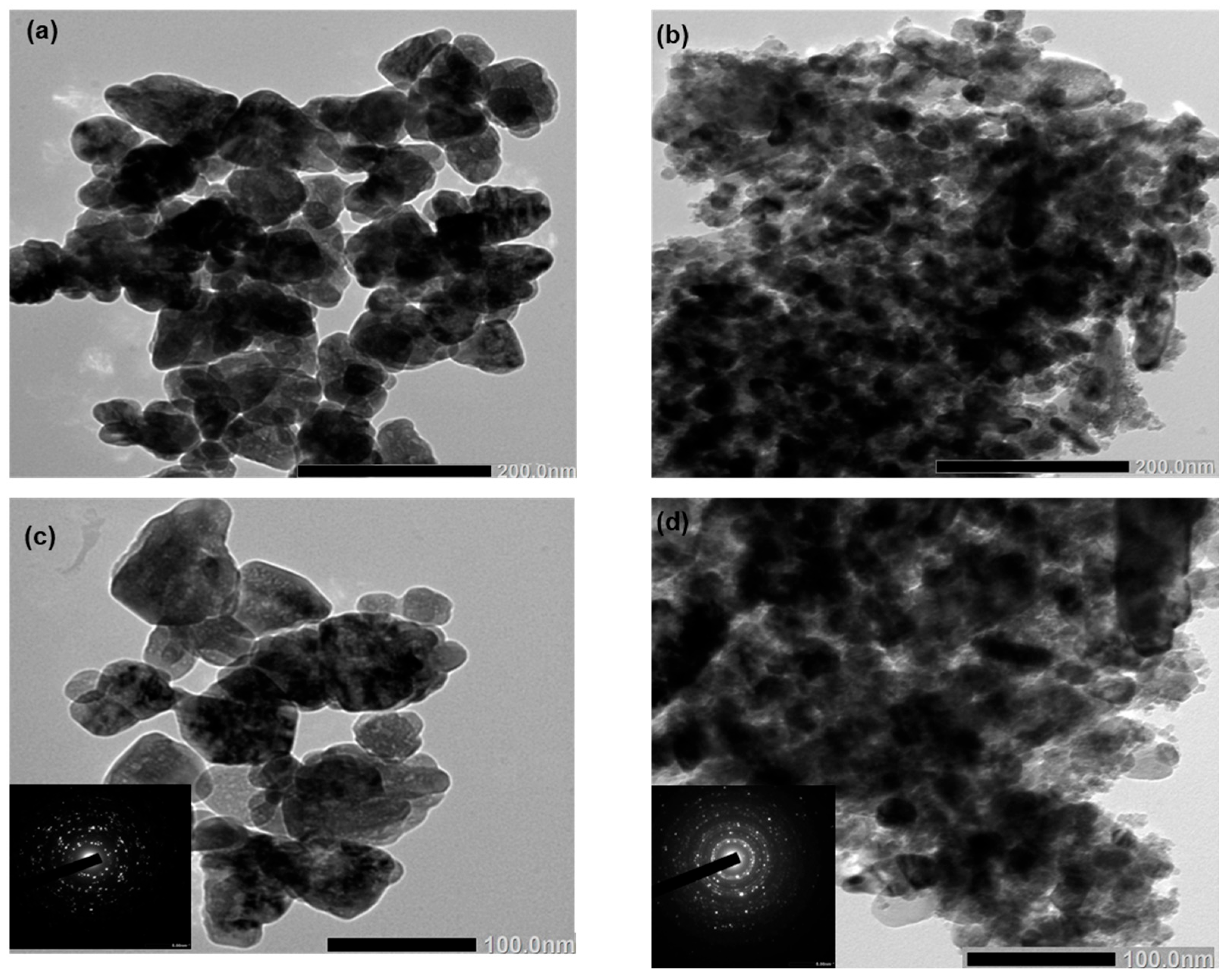
Figure 1 shows the TEM images of the NPs (a,c) correspond to pure ZnO, while (b,d) depict Fe-doped ZnO (Zn0.6Fe0.4O) at different magnifications, along with their corresponding SAED patterns in insets of Figure 1c,d. The pure ZnO NPs display a relatively uniform morphology consisting of well-faceted, polyhedral grains with particle sizes of ~80–120 nm, and a mean size of approximately 105 ± 10 nm. The particles are densely packed, with clear, sharp boundaries indicating high crystallinity. The SAED pattern (inset of Figure 1c) exhibits well-defined, sharp concentric rings, confirming the polycrystalline nature and the characteristic wurtzite ZnO hexagonal phase. By contrast, the Zn0.6Fe0.4O nanostructures (Figure 1b,d) show a substantial change in morphology. The particles are more spherical, smaller, and more agglomerated, with a broader size distribution and less pronounced faceting. The average particle size is significantly reduced to approximately 30–60 nm, with an average size of ~42 ± 8 nm. This refinement in grain size suggests that Fe doping inhibits crystal growth and promotes defect formation during synthesis. The SAED pattern of Zn0.6Fe0.4O (inset of Figure 1d) displays broadened, less intense rings compared to the pure ZnO, indicating reduced crystallinity and increased lattice disorder. A similar observation was reported in ref. [34].

3.2. Structure and Vibrational Analysis

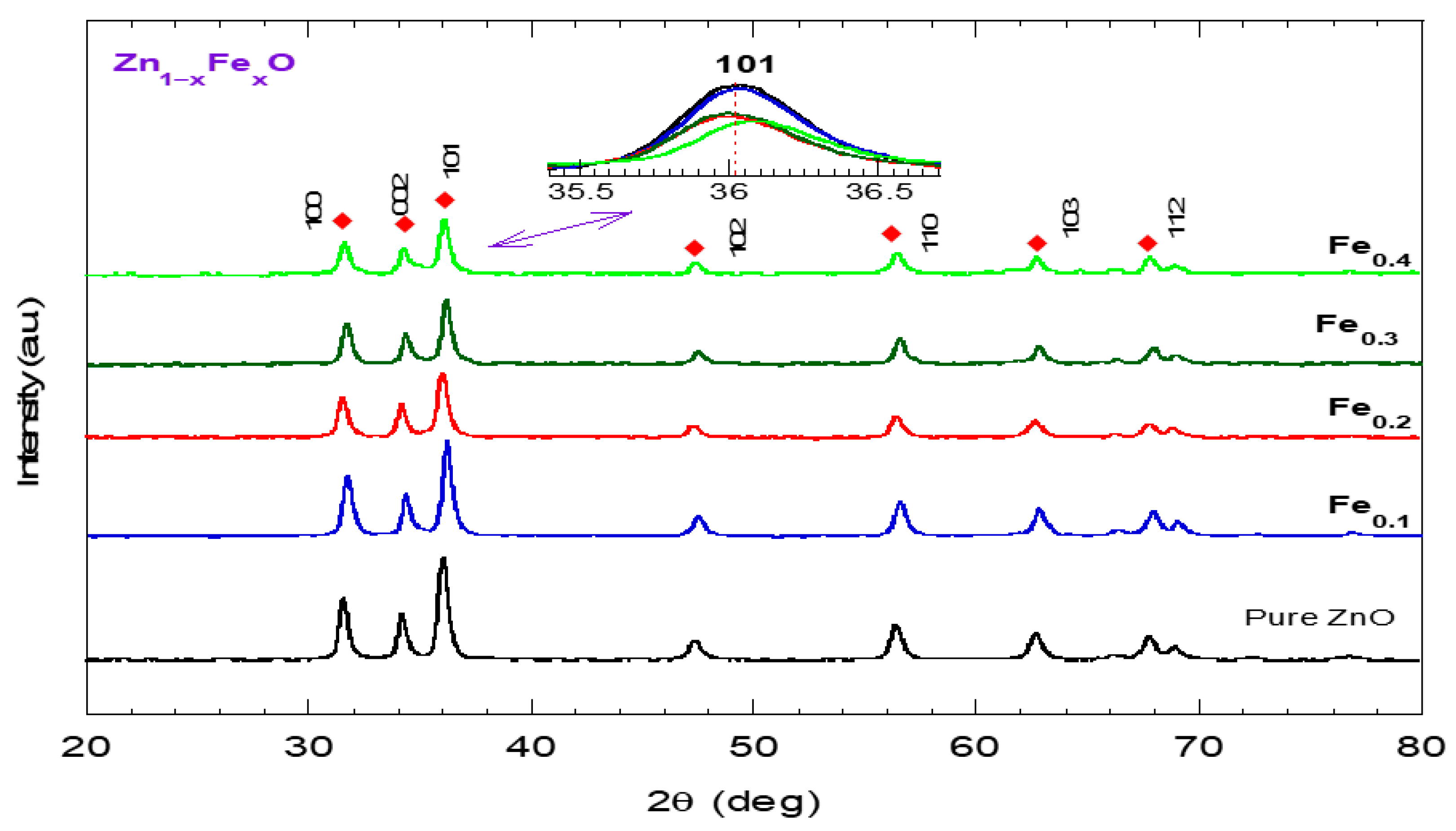
The XRD patterns of Zn1−xFexO NPs are presented in Figure 2. For pure ZnO NPs, x = 0, one can observe sharp peaks positioned at 2θ ~31.6°, 34.3°, 36.1°, 46.8°, 56.0°, 62.5°, and 67.4° corresponded to the hexagonal wurtzite ZnO structure, associated with P63mc (card number 96-900-8878) [35]. The observed peaks are then indexed to the (100), (002), (101), (102), (110), (103), and (112) planes, respectively. The sharpness of the XRD peaks indicates a well-defined crystalline structure, while the absence of unknown peaks confirms the purity of the synthesized ZnO NPs. The XRD pattern of Zn1−xFexO (with x ≥ 0.1) nanocomposites displays similar sharp diffracted peaks; however, their sharpness decreases as x increases, implying a decrease in crystallinity. Further, (101) peak position and broadening are slightly altered as the Fe content increases, suggesting the doping of Fe ions in the ZnO structure probably induces changes in the crystal size as well as the lattice spacing. It should be noted that the spinel phase ZnFe2O4 has characteristic peaks at 2θ ~35.23°, 56.60°, and 62.14° assigned to 311, 333, and 440 planes [28], which might be a reason for the observed slight peak shifting and broadening.

Williamson–Hall Plot

The Williamson–Hall (W–H) method was employed to evaluate the average crystallite size (G) and microstrain (ε) of the examined samples. This analysis allows the separation of peak broadening effects related to finite crystallite size and those arising from lattice strain, since their dependence on the diffraction angle (θ) differs. The contribution of crystallite size to peak broadening can be calculated using the Debye–Scherrer relation as follows: G = 0.9 · λ β · cos θ , where λ = 1.54 Å and β denote the full width at half-maximum (FWHM). Meanwhile, the broadening due to strain generated by lattice imperfections is given as β s = C ε tan θ [36]. Thus, the total broadening (βhkl) is expressed as
β h k l cos θ = 0.9 λ G + 4 ε   sin θ
Assuming isotropic behavior of the crystallites, β h k l cos θ was obtained for all peaks and plotted against 4 ε   sin θ , as illustrated in Figure S1. From the linear W–H fit, the intercept reflects the crystallite size, whereas the slope represents the microstrain. The observed positive slope indicates the presence of tensile strain in the prepared samples. The computed values of G and ε are reported in Table 1.
As evident from Table 1, at lower Fe doping levels (x ≈ 0.1), the crystallite size increases to 43.2 nm. However, with a further increase in Fe concentration, the crystallite size decreases, reaching 37.4 nm at x ≈ 0.4. Concurrently, Fe doping reduces the microstrain in the ZnO lattice from 2.18 × 10⁻³ to 1.43 × 10⁻³. These structural changes indicate the partial substitution of Zn2+ ions (ionic radius = 0.60 Å) by Fe ions with different valence states and ionic radii. At lower doping levels, the substitution of larger Fe2+ ions (0.64 Å) may dominate, leading to lattice expansion. Conversely, at elevated doping concentrations, the substitution of smaller Fe3+ ions (0.49 Å) introduces compressive strain. The difference in ionic radii between the Fe dopants and the host Zn2+ ions disrupts the lattice symmetry, induces strain, and inhibits crystallite growth, resulting in a reduction in crystallite size. Similar trends have been reported in previous studies [21].
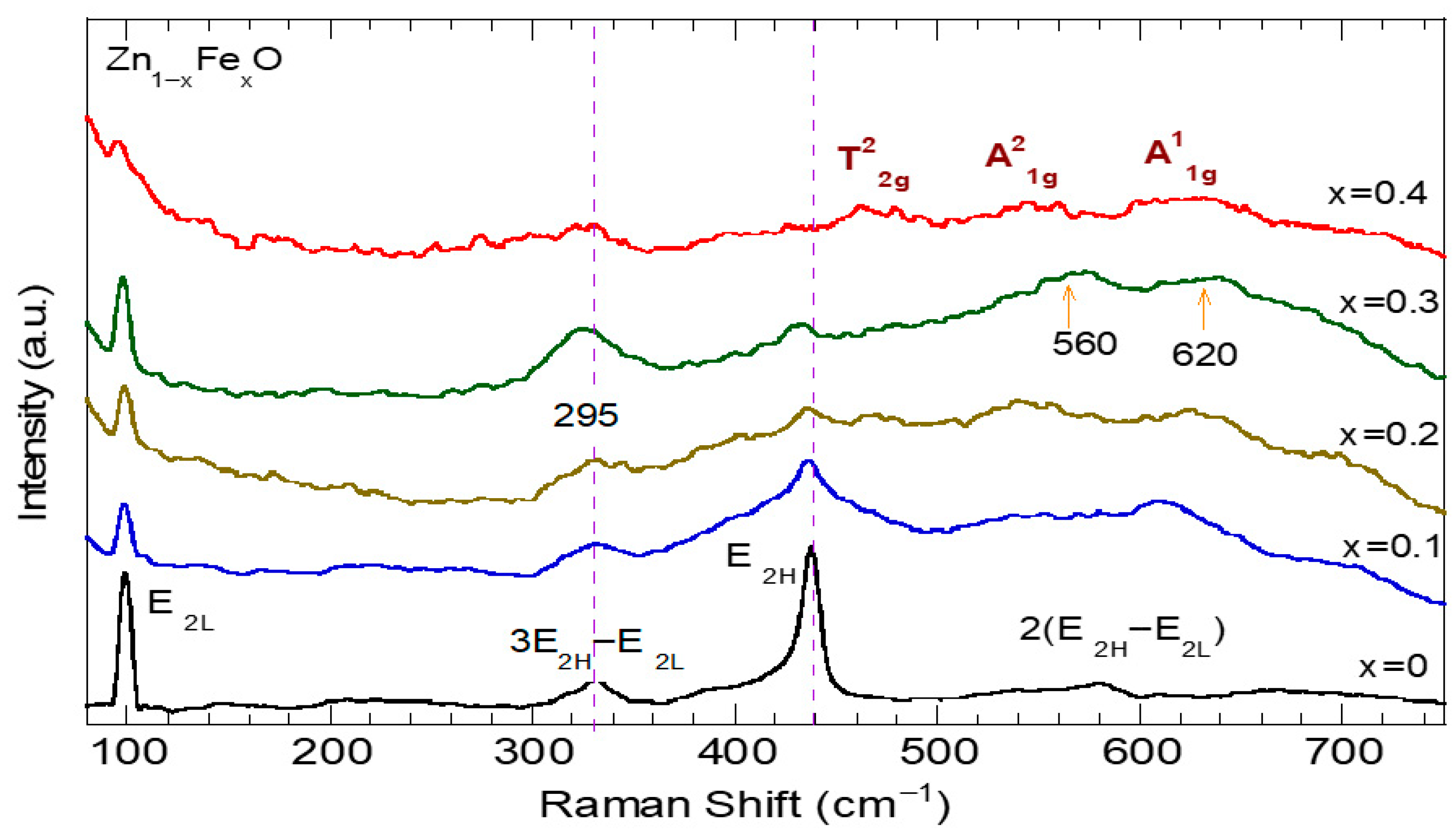
We further investigated the vibrational structure of Zn1−xFexO nanocomposites using Raman spectroscopy, with the results depicted in Figure 3. The Raman spectrum of pristine ZnO NPs (x = 0) revealed a prominent peak at 438 cm−1 corresponding to E2H mode, and other low-intensity peaks at 98, 333, and 578 cm−1 assigned to E2L, E2H-E2L, and 2(E2H-E2L). These modes are characteristic Raman modes of ZnO hexagonal wurtzite [8]. The E2H mode is an indicator of the crystallinity level in wurtzite-structured ZnO nanomaterials [37]. The broadening and shifts in asymmetric E2H mode for x > 0.1 imply a decrease in the crystallinity which aligns well with the XRD results in Figure 2. The E2H mode broadening is likely due to the simultaneous vibrations of multiple cations (Fe2+, Fe3+, and Zn2+) at their respective characteristic frequencies [38]. Meanwhile, similar shifts in the E2H peak have also been observed in other transition metal-doped ZnO materials and are typically linked to oxygen displacement [39,40]. This frequency shift suggests that Fe doping into ZnO enhances lattice distortion, which, in turn, softens the E2H phonon mode by reducing the atomic vibration force constant [22]. Moreover, Raman spectra of Zn1−xFexO samples with (x ≥ 0.1) exhibit A1g mode (680–760 cm−1), which is characteristic of spinel ferrites, arising from the combined Fe–O and Zn–O vibrations [32]. This A1g mode also exhibits a shoulder (A21g), which can be attributed to lattice defects [41]. The Eg mode at 325 cm−1 corresponds to the symmetric bending of oxygen atoms in Fe(Zn)–O bonds located at octahedral sites [38].

3.3. XPS Analysis

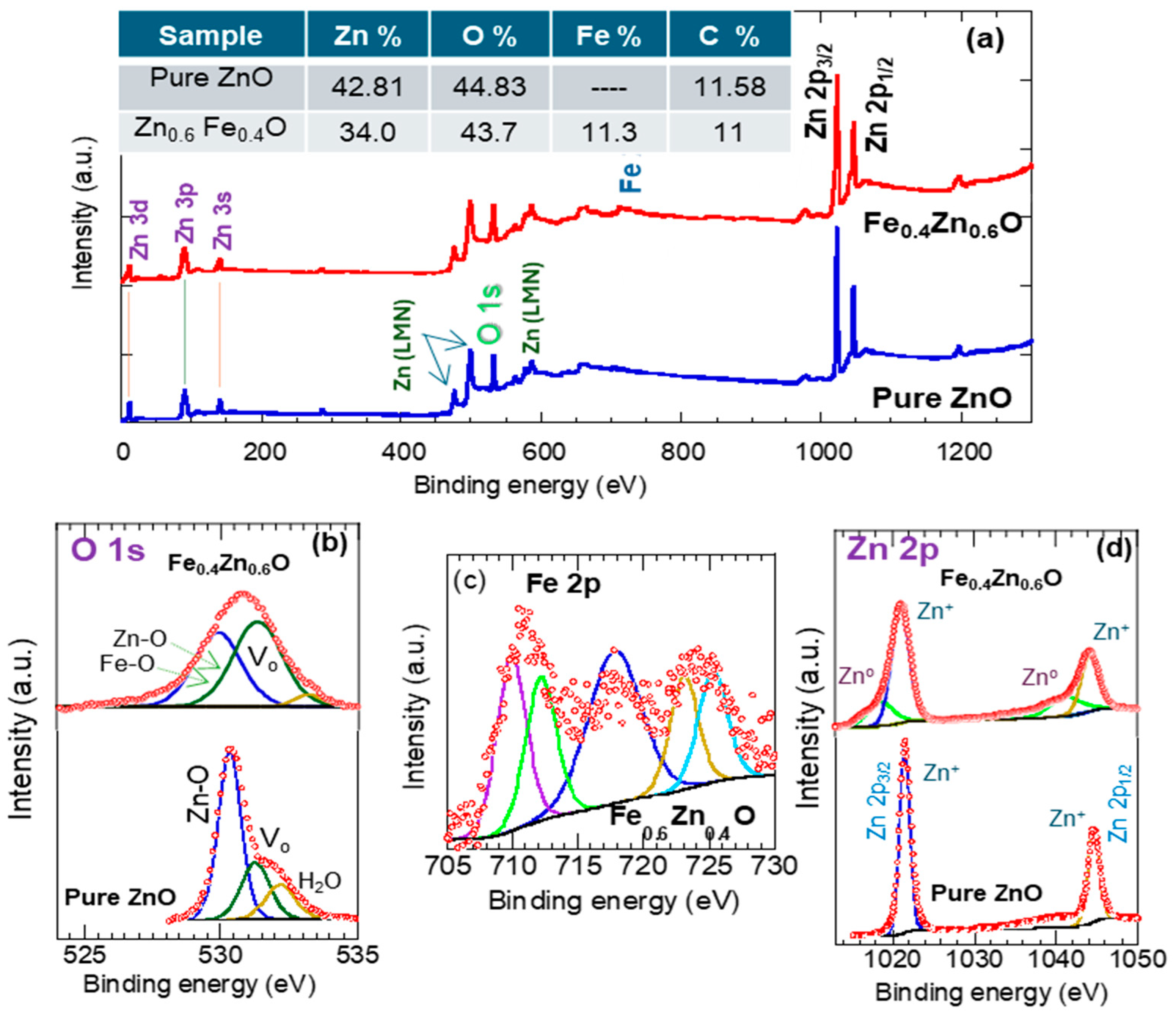
The chemical composition at the surface of both pristine ZnO and Fe-doped ZnO (Zn0.6Fe0.4O) was analyzed by XPS and is shown in Figure 4. The XP survey spectrum of pristine ZnO exhibits the following characteristic peaks of zinc: Zn 3d, Zn 2p, Zn 3s, Zn (LMN), Zn 2p3/2, and Zn 2p1/2, as well as Oxygen O 1s, as depicted in Figure 4a. Incorporation of Fe into the ZnO matrix (Zn0.6Fe0.4O) exhibited a relative reduction in the main Zn peak intensities; however, an additional tiny peak can be observed at 710 eV that is assigned to iron Fe 2p, as observed in Figure 4a. The inset of Figure 4a shows the elemental compositions estimated from the XPS survey spectra. The reported compositions % should be taken with caution as XPS is a surface-sensitive technique.
Figure 4b depicts the O 1s spectra of pristine ZnO and Zn0.6Fe0.4O samples. The O 1s spectrum of pristine ZnO is asymmetric with a shoulder at higher binding energies and can be deconvoluted into the following three distinct components: a peak at 530.2 eV assigned Zn–O bond; a peak at 531.3 eV corresponding to oxygen vacancies and/or Zn–OH; and a peak at 532.4 eV associated with adsorbed water (H2O) [8]. In contrast, the O 1s spectrum of Zn0.6Fe0.4O exhibits significant broadening, indicative of multiple chemical environments. This broadening mainly arises from the simultaneous presence of Zn–O and Fe–O bonds, along with the coexistence of multiple oxidation states of iron (Fe2+/Fe3+) and enhanced structural disorder. These factors collectively contribute to an increased concentration of oxygen vacancies and defect states. Deconvolution of the Zn0.6Fe0.4O spectrum reveals three components similar to those observed in pure ZnO; however, the fitted peak positions are slightly shifted toward lower binding energies. The peak at 530.2 eV now represents contributions from lattice oxygen in both Zn–O and Fe–O bonds. The peak at 531.3 eV, indicative of oxygen-deficient sites, is more intense in the Zn0.6Fe0.4O sample, indicating a higher defect density resulting from Fe incorporation. A similar trend has been reported previously [42].
Fe 2p XPS spectrum of the Zn0.6Fe0.4O composition, displayed in Figure 4c, shows two main peaks assigned to Fe 2p3/2 and Fe 2p1/2, along with a characteristic satellite peak at 718.8 eV [38,41]. Peak deconvolution indicates that Fe exists in a mixture of Fe3+ and Fe2+ oxidation states, suggesting that Fe3+ and Fe2+ ions substitute Zn2+ within the Zn0.6Fe0.4O lattice.
XPS analysis of the Zn 2p region of ZnO NPs shows a distinct doublet at 1021.5 eV (Zn 2p3/2) and 1044.6 eV (Zn 2p1/2) (Figure 4d), giving a spin–orbit splitting of 23.1 eV in accordance with earlier studies [19]. Furthermore, the spectrum confirms that Zn exists in the +2 oxidation state and is tetrahedrally coordinated with O2− ions in the wurtzite ZnO crystal structure [11]. Upon Fe doping to form the Zn0.6Fe0.4O sample, notable changes are observed in the Zn 2p spectral profile. The Zn 2p doublet becomes broader accompanied by distinct shoulders at lower binding energies, suggesting alterations in the local chemical environment. The Zn 2p3/2 spectrum of the Fe-doped ZnO sample (Zn0.6Fe0.4O) is deconvolved, as shown in Figure 5d. The peaks at 1021.1 eV and 1044.3 eV are attributed to Zn2+ species in the ZnO wurtzite structure, whereas the lower binding energy peaks at 1018.7 eV and 1041.4 eV are tentatively attributed to Zn0 (metallic zinc) [43]. This observation suggests a partial reduction in Zn2+ (from ZnO) to Zn0, potentially accompanied by the oxidation of Fe2+ to Fe3+, according to the following redox process: 2Fe2+ + Zn2+ → 2Fe3+ + Zn0. The presence of Zn0 implies the formation of oxygen defects, known to influence the magnetic and optical responses of Fe-doped ZnO nanocomposites.

3.4. Optical Properties

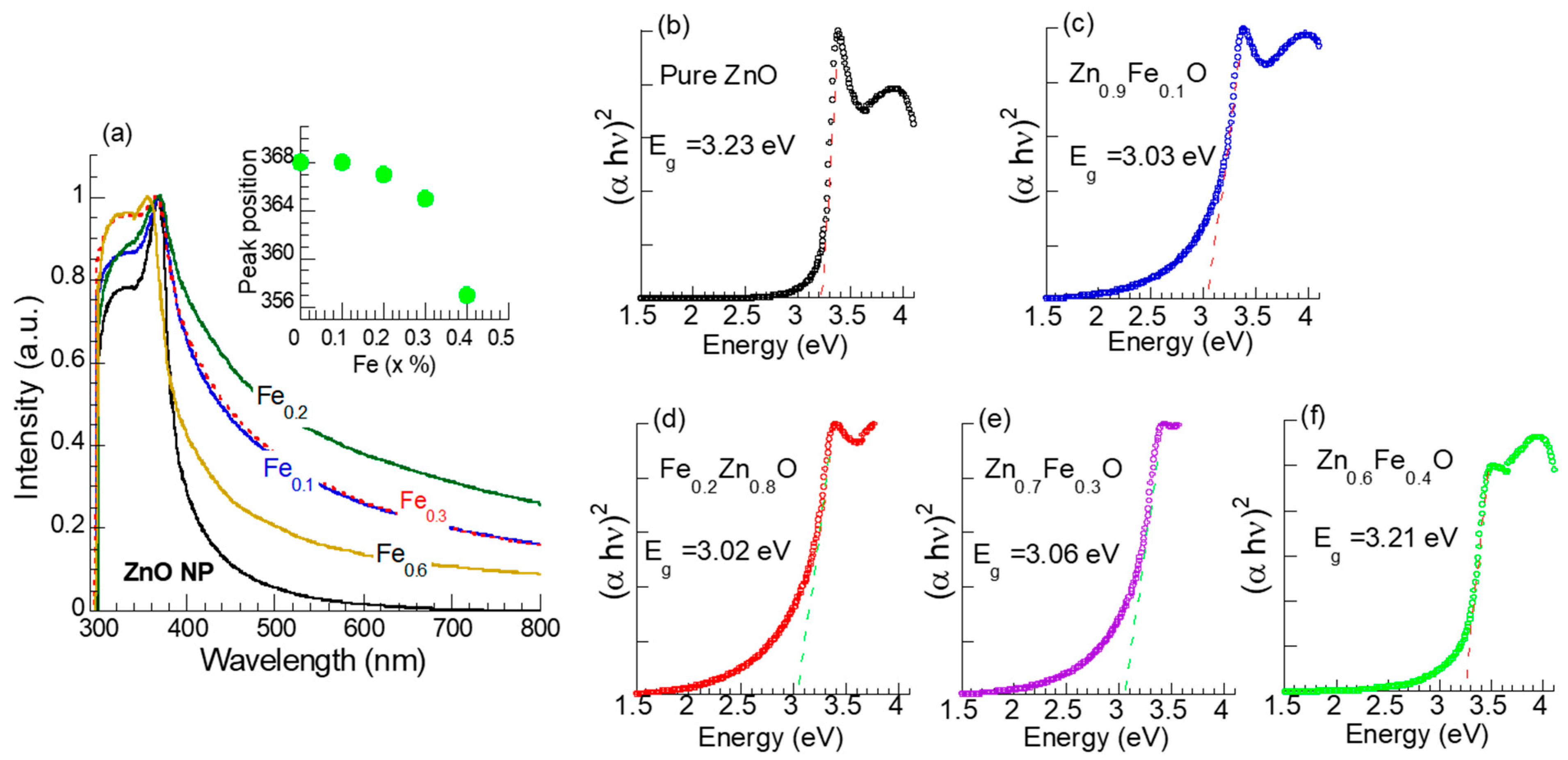
UV–Vis absorption spectroscopy was employed to examine the optical characteristics of both pristine and Fe-doped ZnO nanostructures. As shown in Figure 5a, the absorption spectra of the synthesized ZnO-based nanostructures exhibit pronounced absorption in the ultraviolet region (below 400 nm), which can be attributed to the intrinsic bandgap absorption of ZnO [8,29]. The UV absorption peak shifted from 3.67 to 3.56 nm (or 3.67 eV to 3.56 eV) as Fe content increased up to x = 0.4 (inset of Figure 5a), potentially due to a Moss–Burstein-type shift in the absorption edge [44,45]. Fe-doped ZnO (Zn1−xFexO) samples with x ≥ 0.1 also showed stronger absorption in the visible spectrum (λ > 400 nm) relative to the undoped ZnO, with the absorption increasing in the order Fe0.2 > Fe0.3 > Fe0.1 > Fe0.4, highlighting the critical role of Fe content in modulating the optical response of Zn1−xFexO nanostructures.
Using the Tauc method [8], the optical band gap Eg of the Zn1−xFexO nanostructures was estimated
h ν · α = A · h ν E g n
where A is constant, α is the absorption coefficient, and n = 2 for direct band-gap semiconductor. Eg was determined by extrapolating the linear portion of the (hν.α)2 versus hν plot to the energy axis (i.e., hν = 0). As illustrated in Figure 5b–e, introducing Fe into ZnO alters the band gap in a manner that depends on Fe content. The Eg decreases from 3.14 eV in pure ZnO to 3.02 eV for Zn0.8Fe0.2O. However, as x increases beyond 0.3, the band gap rises again to 3.21 eV. The observed band gap narrowing for x ≤ 0.3 is due to the substitution of Zn2+ ions with Fe2+ ions leading to structural defects such as Fe3+ and oxygen vacancies, as supported by XPS and Raman analyses. This effect is consistent with the mechanism described by Bylsma et al. [46], where sp–d interactions between band-edge electrons and dopant d electrons further reduce Eg, making Zn1−xFexO (x ≤ 0.3) a promising visible-light photocatalyst for dye degradation.
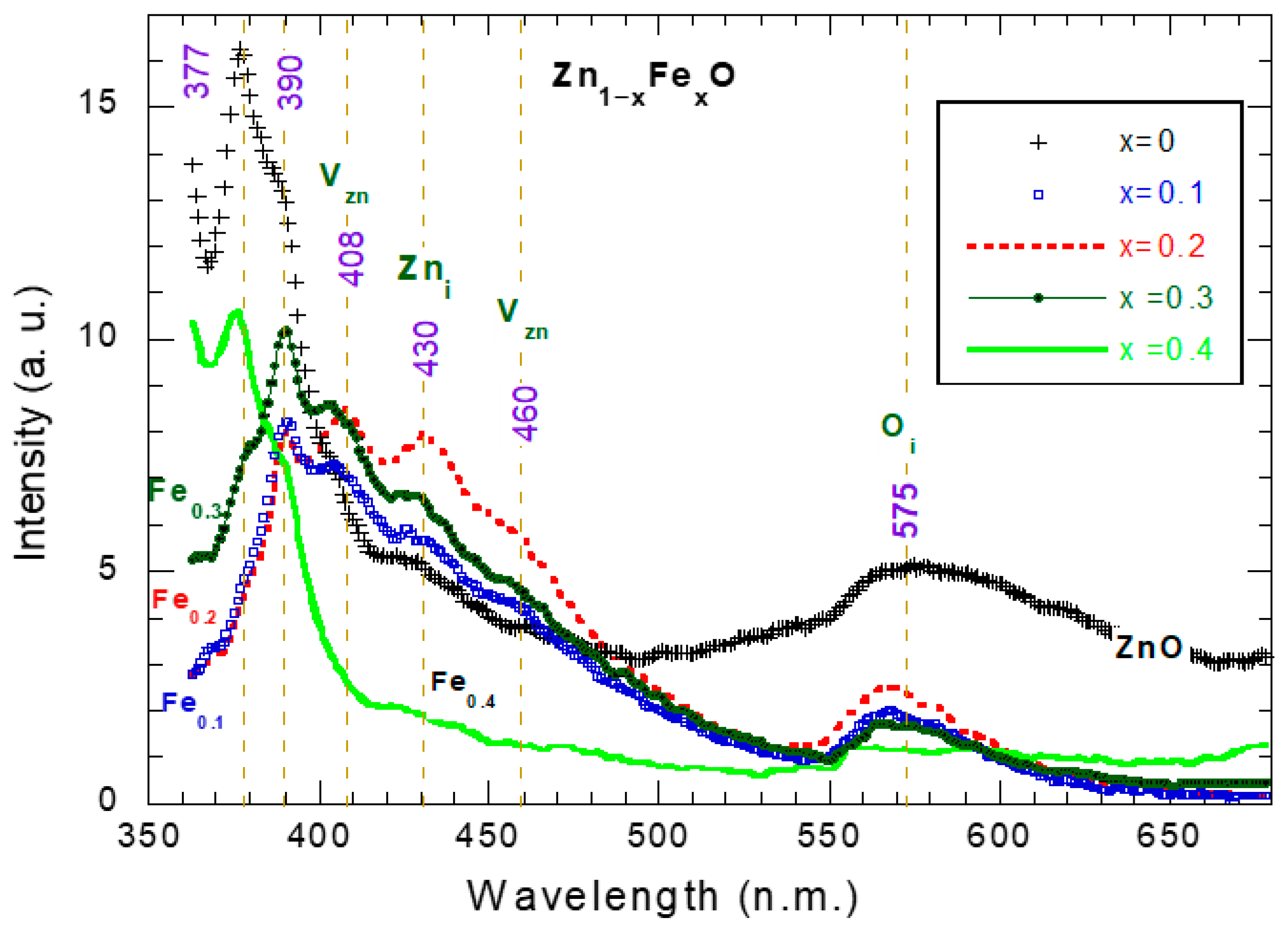
Room-temperature photoluminescence (PL) spectra of Zn1−xFexO samples were obtained using a 350 nm excitation laser, as shown in Figure 6. The spectrum of pristine ZnO NPs reveals a pronounced ultraviolet (UV) emission peak at 377 nm, a minor shoulder at 390 nm, and a broad, weak emission centered around 575 nm. The UV peak at 377 nm is due to near-band-edge (NBE) excitonic recombination in ZnO [47], whereas the yellow emission at ~575 nm is associated with interstitial oxygen ions (Oi2−) [48]. With increasing Fe content (x ≥ 0.1), the NBE emission decreases in intensity and exhibits a red shift up to x ≤ 0.3, beyond which blue shift is observed at x = 0.4, suggesting a change in the dominate recombination pathways. Concurrently, the 575 nm peak shifts to shorter wavelengths and decreases in intensity, indicating changes in defect-related states. The substitution of Fe3+ for Zn2+ introduces a charge imbalance that may be compensated by reducing negatively charged defects such as interstitial oxygen (Oi2−), leading to the observed decline in the 575 nm PL emission.
The PL spectra of Zn1−xFexO (x ≤ 0.1–0.3) exhibit emission humps at 408, 430, and 460 nm in the violet-blue region, which are commonly assigned in the literature to zinc vacancies (VZn), oxygen vacancies, and interstitial zinc (Zni) [49]. Although the exact origin of visible luminescence in ZnO remains a subject of ongoing debate [50], in this context, the observed violet-blue emissions may be tentatively associated with shallow defect introduced by Fe2+/Fe3+ substituting at Zn2+ lattice sites, which can induce local lattice distortion and alter the defect landscape of the ZnO host. At a higher Fe content (x = 0.4), both the UV and visible emissions reduced, likely due to the formation of Fe–Fe clusters that suppress radiative transitions [51]. These variations indicate modifications in the band structure and defect states of Zn1−xFexO due to Fe incorporation, which is consistent with the band gap changes (Figure 5b–f).

3.5. Magnetic Analysis

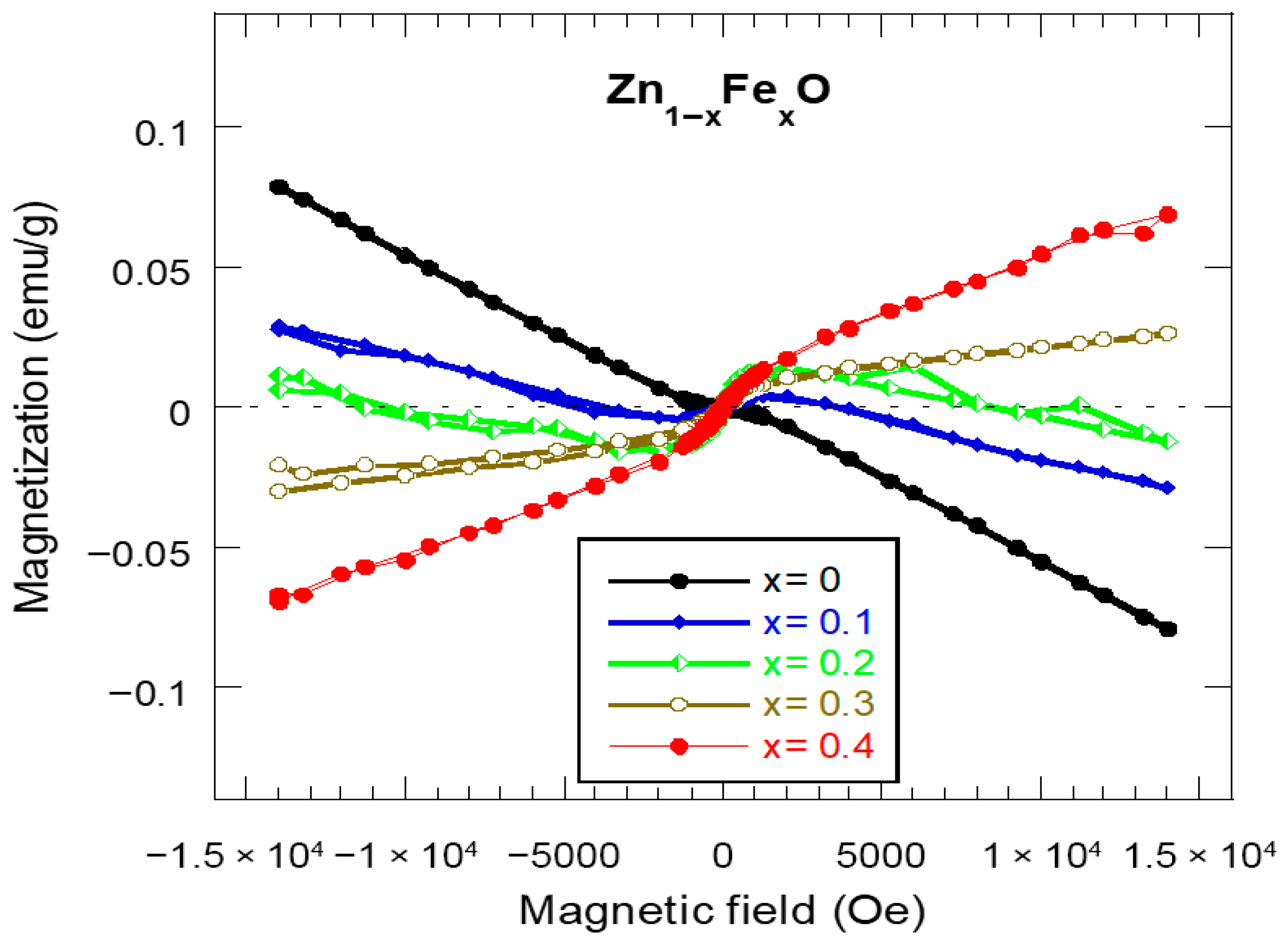
The magnetic properties of Zn1−xFexO nanostructures (x = 0.0, 0.1, 0.2, 0.3, and 0.4) were examined at room temperature using a vibrating sample magnetometer (VSM) under an applied magnetic field of ±15 kOe. After subtracting the diamagnetic contribution of the sample holder, the resulting magnetization (M–H) curves are presented in Figure 7. Pristine ZnO NPs exhibit a diamagnetic response similar to bulk ZnO. Upon Fe incorporation, the Zn0.9Fe0.1O sample displays a combination of diamagnetic behavior at high fields and weak ferromagnetic features in the low-field regime. With further increase in Fe content (x ≥ 0.2), the M–H curves show enhanced magnetic response across the entire field range, indicating the emergence of room-temperature ferromagnetic-like behavior that strengthens with increasing Fe concentration. Notably, although small but finite coercivity and remanent magnetization values are observed for samples with x ≥ 0.1, the corresponding M–H curves remain narrow and unsaturated, indicating the absence of a well-defined ferromagnetic hysteresis loop and suggesting superparamagnetic-like response, which is commonly reported for Fe-doped ZnO and nanostructured spinel ferrites. The slight loop opening observed for the Zn0.8Fe0.2O sample is attributed to uncompensated surface spins, arising from finite-size effects and defect-induced magnetic moments.
XRD analysis (Figure 2) reveals the absence of secondary iron-containing phases, indicating that the observed ferromagnetic-like behavior at room temperature is intrinsic rather than arising from metallic Fe clusters. This conclusion is further supported by XPS and Raman analyses, which confirm the incorporation of Fe3+ and Fe2+ ions at Zn2+ lattice sites. The observed magnetic behavior is therefore attributed to a defect-mediated ferromagnetic exchange mechanism, in which intrinsic point defects Zni and VZn facilitate indirect exchange interactions between localized Fe spins and neighboring oxygen ions [18,19,20,21].
Raman and photoluminescence (PL) analyses reveal that these defect species increase with Fe doping (especially at x ≈ 0.1–0.3), while oxygen interstitials (Oi) decrease. The spatial coexistence of Fe dopants with these defect states enhances carrier-mediated and defect-assisted exchange pathways, therefore enabling long-range ferromagnetic order. At higher Fe content (x = 0.4), the increased density of Fe ions and reduced ion spacing strengthen the magnetic exchange interactions, resulting in enhanced magnetization [52]. However, this behavior is accompanied by increased defect disorder and Fe–Fe interactions, which reduce magnetic remanence and promote superparamagnetic relaxation. This behavior is consistent with the strong quenching of PL emission observed at the same composition, indicating that excessive defect accumulation suppresses both radiative recombination and stable magnetic ordering.
Table 2 summarizes the magnetic parameters, namely coercive field (Hc), remanent magnetization (Mr), high-field magnetization (MHF, measured at 15 kOe), and the remanence ratio (Mr/MHF). It is evident that none of the samples reach complete magnetic saturation within the applied field range (±15 kOe), indicating the coexistence of paramagnetic contributions alongside weak ferromagnetic ordering. With increasing Fe content, MHF increases markedly, while Hc decreases systematically. The highest Mr/MHF ratio at x = 0.1 reflects relatively stronger ferromagnetic ordering at low Fe concentrations. In contrast, at higher Fe content (x = 0.4), despite the largest MHF, the significantly reduced Mr/MHF ratio indicates increased spin disorder and the dominance of superparamagnetic-like relaxation effects.
Overall, although finite coercivity and remanence values are observed for all doped Zn1−xFexO samples, the narrow and unsaturated loops indicate weak ferromagnetism rather than a well-developed ferromagnetic hysteresis. These magnetic trends closely correlate with the defect evolution revealed by PL and Raman analyses, demonstrating that Fe-induced defect states play a decisive role in governing magnetic interactions in Zn1−xFexO nanostructures. This defect-mediated magnetism provides a consistent explanation for the coupled optical and magnetic behavior, highlighting the potential of these nanostructures for dilute magnetic semiconductors and spintronic applications.

4. Conclusions

Zn1−xFexO nanocomposites with x = 0–0.4 were synthesized using hydrothermal route. Doping ZnO with Fe changes its morphology to be more spherical, smaller, and more agglomerated, along with a reduction in the crystallite size and microstrain in the ZnO lattice. Further, Fe incorporation disrupts the ZnO lattice by introducing structural defects and cation disorder, leading to Raman phonon mode softening, and the emergence of Raman spinel ferrite features at higher Fe content. XPS results reveal that Fe is found mostly in mixed Fe2+ and Fe3+ oxidation states, while Zn is in the Zn2+ oxidation state. The oxygen vacancies Vo increase with Fe doping. The optical band gap of Zn1−xFexO nanocomposites initially decreases from 3.14 to 3.02 eV at x = 0.2, beyond which it increases to 3.21 eV for Fe content of x = 0.4. The PL results confirm that Fe incorporation modifies the optical properties of Zn1−xFexO possibly by introducing defect-related shallow levels and reducing radiative recombination at higher doping levels through the formation of non-radiative centers. Fe doping in ZnO nanostructures induces ferromagnetic-like behavior at room temperature, with optimal magnetic ordering observed at x = 0.2. The enhancement in magnetization and defect-mediated exchange interactions highlights the potential of Zn1−xFexO for spintronic and soft magnetic applications.

Supplementary Materials

The following supporting information can be downloaded at https://www.mdpi.com/article/10.3390/cryst16010055/s1. Figure S1. Williamson–Hall (W–H) plots for synthesized Zn1-xFexO samples.

Author Contributions

E.M.A.-F.; conceptualization, formal analysis, investigation, funding acquisition, supervision, writing—original draft preparation, and writing—review and editing. S.M.A.; methodology, formal analysis, investigation, and validation. All authors have read and agreed to the published version of the manuscript.

Funding

This research was funded by the deanship of scientific research at Prince Sattam bin Abdulaziz University, grant number (PSAU/2025/01/33049).

Data Availability Statement

The authors confirm that the data supporting the findings of this study are available within the article.

Acknowledgments

The authors extend their appreciation to Prince Sattam bin Abdulaziz University for funding this research work through the project number (PSAU2025/01/33049).

Conflicts of Interest

The authors declare no conflicts of interest.

References

  1. Singh, S.; Kumar, V.; Tyagi, S.; Saxena, N.; Khan, Z.H.; Kumar, P. Room temperature ferromagnetism in metal oxides for spintronics: A comprehensive review. Opt. Quantum Electron. 2023, 55, 123. [Google Scholar]
  2. Chen, B.; Zeng, M.; Khoo, K.H.; Das, D.; Fong, X.; Fukami, S.; Li, S.; Zhao, W.; Parkin, S.; Piramanayagam, S.N.; et al. Spintronic devices for high-density memory and neuromorphic computing—A review. Mater. Today 2023, 70, 193–217. [Google Scholar]
  3. Salman, K.M.; Zikriya, M.; Renuka, C.G. Impact of modified spin coating variations on electrical resistivity and UV detector responsivity in Mg-doped ZnO thin films. Opt. Mater. 2025, 158, 116460. [Google Scholar] [CrossRef]
  4. Badawi, A.; Althobaiti, M.G.; Ali, E.E.; Alharthi, S.S.; Alharbi, A.N. A comparative study of the structural and optical properties of transition metals (M = Fe, Co, Mn, Ni) doped ZnO films deposited by spray-pyrolysis technique for optoelectronic applications. Opt. Mater. 2022, 124, 112055. [Google Scholar]
  5. Ciorga, M. Perspective on the spin field-effect transistor. J. Phys. D Appl. Phys. 2024, 58, 012001. [Google Scholar]
  6. Sundaram, G.A.; Muniyandi, G.r.; Ethiraj, J.; Parimelazhagan, V.; Kumar, A.S.K. Introduction and Advancements in Room-Temperature Ferromagnetic Metal Oxide Semiconductors for Enhanced Photocatalytic Performance. ChemEngineering 2024, 8, 36. [Google Scholar] [CrossRef]
  7. Panžić, I.; Bafti, A.; Radovanović-Perić, F.; Gašparić, D.; Shi, Z.; Borenstein, A.; Mandić, V. Advancements in Nanostructured Functional Constituent Materials for Gas Sensing Applications: A Comprehensive Review. Appl. Sci. 2025, 15, 2522. [Google Scholar] [CrossRef]
  8. Abdel-Fattah, E.; Elsayed, I.A.; Fahmy, T. Substrate temperature and laser fluence effects on properties of ZnO thin films deposited by pulsed laser deposition. J. Mater. Sci. Mater. Electron. 2018, 29, 19942. [Google Scholar] [CrossRef]
  9. Zhao, G.; Gu, G.; Yang, S.; Peng, Y.; Li, X.; Kojima, K.M.; Lin, C.; Wang, X.; Ziman, T.; Uemura, Y.J.; et al. Doping Effects on Magnetic and Electronic Transport Properties in BaZn2As2. Crystals 2025, 15, 582. [Google Scholar] [CrossRef]
  10. Habib, A.K.M.; Rifat, K.M.R.; Kabir, M.E.; Noor Khan, J.; Nasim Rokon, S.M.; Rabbi, M.A. Improved photocatalytic activity of (Ni, Mn) co-doped ZnO nanoparticles prepared via green synthesis route using orange peel extract. Results Mater. 2024, 22, 100581. [Google Scholar]
  11. Luo, Z.; Rong, P.; Yang, Z.; Zhang, J.; Zou, X.; Yu, Q. Preparation and Application of Co-Doped Zinc Oxide: A Review. Molecules 2024, 29, 3373. [Google Scholar] [CrossRef] [PubMed]
  12. Srinivasa Subbarao, P.; Aparna, Y.; Ramanaiah, M. Ni Doped ZnO Nanostructures: Synthesis, Characterization and It’s Sensing Behavior at Lower Concentration and High Temperature. ECS J. Solid State Sci. Technol. 2025, 14, 107001. [Google Scholar]
  13. Mahoura, L.N.; Choudharya, H.K.; Kumara, R.; Anupamab, A.V.; Sahooa, B. Structural, optical and Mössbauer spectroscopic investigations on the environment of Fe in Fe-doped ZnO (Zn1-xFexO) ceramics synthesized by solution combustion method. Ceram. Int. 2019, 45, 24625–24634. [Google Scholar]
  14. Gartner, M.; Chelu, M.; Szekeres, A.; Petrik, P. Towards Advanced Materials: Functional Perspectives of Co-Doped ZnO Thin Films. Micromachines 2025, 16, 1179. [Google Scholar] [CrossRef]
  15. Rosowska, J.; Kaszewski, J.; Witkowski, B.; Wachnicki, Ł.; Kuryliszyn-Kudelska, I.; Godlewski, M. The effect of iron content on properties of ZnO nanoparticles prepared by microwave hydrothermal method. Opt. Mater. 2020, 109, 110089. [Google Scholar] [CrossRef]
  16. Maibam, B.; Baruah, S.; Kumar, S. Photoluminescence and intrinsic ferromagnetism of Fe doped zinc oxide. SN Appl. Sci. 2020, 2, 1712. [Google Scholar] [CrossRef]
  17. Jenish, S.L.; Valanarasu, S.; Prakash, B.; Veerathangam, K.; Vinoth, S.; Al-Enizi, A.M.; Ubaidullah, M.; Reddy, V.R.M.; Karim, A. Improved optical and electrical properties of Fe doped ZnO nanostructures facilely deposited by low-cost SILAR method for photosensor applications. Surf. Interfaces 2022, 31, 102071. [Google Scholar] [CrossRef]
  18. Hiremath, M.V.; Momin, N.; Kangralkar, M.V.; Manjanna, J.; Hegde, B.G.; Byalollikar, D.G. Synthesis and characterization of Fe-doped ZnO films for enhanced NO2 gas-sensing applications. J. Korean Phys. Soc. 2024, 85, 772–782. [Google Scholar]
  19. Srinivasulu, T.; Saritha, K.; Reddy, K.T. Synthesis and characterization of Fe-doped ZnO thin films deposited by chemical spray pyrolysis. Mod. Electron. Mater. 2017, 3, 76–85. [Google Scholar]
  20. Roy, S.; Ghosh, M.P.; Mukherjee, S. Introducing magnetic properties in Fe-doped ZnO nanoparticles. Appl. Phys. A 2021, 127, 451. [Google Scholar] [CrossRef]
  21. Fabbiyola, S.; John Kennedy, L.; Ratnaji, T.; Vijaya, J.; Aruldoss, U.; Bououdina, M. Effect of Fe-doping on the structural, optical and magnetic properties of ZnO nanostructures synthesized by co-precipitation method. Ceram. Int. 2016, 42, 1588–1596. [Google Scholar] [CrossRef]
  22. Musharaf, M.; Karamat, S.; Hassan, M.U.; Khalique, U.; Oral, A.; Behjat, A.B.; Akram, R.; Almohaimeed, Z. Solubility Enhancement of Fe in ZnO Nanoparticles Prepared by Co-Precipitation Method. J. Supercond. Nov. Magn. 2021, 34, 2633–2642. [Google Scholar] [CrossRef]
  23. Han, C.; Duan, L.; Zhao, X.; Hu, Z.; Niu, Y.; Geng, W. Effect of Fe doping on structural and optical properties of ZnO films and nanorods. J. Alloys Compd. 2019, 770, 854–863. [Google Scholar] [CrossRef]
  24. Saleh, R.; Prakoso, S.P.; Fishli, A. The influence of Fe doping on the structural, magnetic and optical properties of nanocrystalline ZnO particles. J. Magn. Magn Mater. 2012, 324, 665–670. [Google Scholar] [CrossRef]
  25. Goktas, A.; Mutlu, I.H.; Yamada, Y. Influence of Fe-doping on the structural, optical, and magnetic properties of ZnO thin films prepared by sol–gel method. Superlattices Microstruct. 2013, 57, 139–149. [Google Scholar] [CrossRef]
  26. Beltr’an, J.J.; Barreroa, C.A.; Punnoose, A. Understanding the role of iron in the magnetism of Fe doped ZnO nanoparticles. Phys. Chem. Chem. Phys. 2015, 17, 15284. [Google Scholar] [CrossRef]
  27. Hossain, M.S.; Hoque, S.M.; Liba, S.I.; Choudhury, S. Effect of synthesis methods and a comparative study of structural and magnetic properties of zinc ferrite. AIP Adv. 2017, 7, 105321. [Google Scholar] [CrossRef]
  28. Hejazi, A.S.; Al-Hunaiti, A.H.; Bsoul, I.; Mohaidat, Q.; Mahmood, S.H. Optimizing the synthesis of ZnFe2O4 through chemical and physical methods: Effects of the synthesis route on the phase purity, inversion, and magnetic properties of spinel zinc ferrite. Phys. Scr. 2024, 99, 065029. [Google Scholar] [CrossRef]
  29. Abdel-Fattah, E.M.; Alshehri, S.M.; Alotibi, S.; Alyami, M.; Abdelhameed, D. Hydrothermal Synthesis of ZnO Nanoflowers: Exploring the Relationship between Morphology, Defects, and Photocatalytic Activity. Crystals 2024, 14, 892. [Google Scholar] [CrossRef]
  30. Wu, X.; Wei, Z.; Zhang, L.; Wang, X.; Yang, H.; Jiang, J. Optical and Magnetic Properties of Fe Doped ZnO Nanoparticles Obtained by Hydrothermal Synthesis. J. Nanomater. 2014, 2014, 792102. [Google Scholar] [CrossRef]
  31. Qiaoping, L.; Xin, L.; Yanning, Y.; Fuchun, Z.; Qi, Z. Hydrothermal synthesis and optical properties of Fe doped ZnO nanorods. Ferroelectrics 2020, 564, 59–69. [Google Scholar] [CrossRef]
  32. Bai, S.; Guo, T.; Zhao, Y.; Sun, J.; Li, D.; Chen, A.; Liu, C.C. Sensing performance and mechanism of Fe-doped ZnO micro flowers. Sens. Actuators B Chem. 2014, 195, 657–666. [Google Scholar] [CrossRef]
  33. Chey, C.O.; Masood, A.; Riazanova, A.; Liu, X.; Rao, K.V.; Nur, O.; Willander, M. Synthesis of Fe-Doped ZnO Nanorods by Rapid Mixing Hydrothermal Method and Its Application for High Performance UV Photodetector. J. Nanomater. 2014, 2014, 222. [Google Scholar] [CrossRef]
  34. John, R.A.B.; Kumar, A.R.; Shruthi, J.; Reddy, M.V.R. FexZn1−xO as room temperature dual sensor for formaldehyde and ammonia gas detection. Inorg. Chem. Commun. 2022, 141, 109506. [Google Scholar] [CrossRef]
  35. Imboon, T.; Sugio, K.; Khumphon, J.; Sridawong, L.; Gowri, V.M.; Yamada, K.; Shima, M.; Thongmee, S. Synergistic Effects of Fe-Doped ZnO and Graphene Oxide for Enhanced Photocatalytic Performance and Tunable Magnetic Properties. ACS Omega 2025, 10, 34571−34587. [Google Scholar] [CrossRef]
  36. Abdel-Fattah, E.M.; Azab, A.A. Plasmonic Rutile TiO2/Ag Nanocomposites Tailored via Nonthermal-Plasma-Assisted Synthesis: Enhanced Spectroscopic and Optical Properties with Tuned Electrical Behavior. J. Compos. Sci. 2025, 9, 156. [Google Scholar] [CrossRef]
  37. Abdel-Fattah, E. Plasmonic ZnO-Au Nanocomposites: A Synergistic Approach to Enhanced Photocatalytic Activity through Nonthermal Plasma-Assisted Synthesis. Crystals 2024, 14, 890. [Google Scholar]
  38. Alharthi, A.I.; Abdel-Fattah, E.; Hargreaves, J.S.J.; Alotaibi, M.A.; Ud Din, I.; Al-Shalwi, M.N. Influence of Zn and Ni dopants on the physicochemical and activity patterns of CoFe2O4 derived catalysts for hydrogen production by catalytic cracking of methane. J. Alloys Compd. 2023, 938, 168437. [Google Scholar] [CrossRef]
  39. Gao, Q.Q.; Yu, Q.X.; Chen, B.; Zhu, H. Influence of thermal treatment on tuning the ferromagnetism in Mn-doped ZnO film. J. Alloys Compd. 2014, 590, 446–452. [Google Scholar]
  40. Fischer, D.; Bloos, D.; Krajewska, A.; McNally, G.M.; Zagorac, D.; Schön, J.C. Raman Characterization of Dioxygen Species as Defects in Single-Crystal ZnO Including Their Pressure Dependence. Crystals 2025, 15, 574. [Google Scholar]
  41. Abdel Fattah, E.; Alotaibi, M.A.; Alharthi, A.I. Thermo-catalytic methane decomposition over unsupported Fe–Al and Co–Al catalysts for hydrogen and carbon nanostructures production. Int. J. Hydrogen Energy 2024, 64, 685–694. [Google Scholar] [CrossRef]
  42. Rajić, V.; Simatović, I.S.; Veselinović, L.; Čavor, J.B.; Novaković, M.; Popović, M.; Škapin, S.D.; Mojović, M.; Stojadinović, S.; Rac, V.; et al. Bifunctional catalytic activity of Zn1−xFexO toward the OER/ORR: Seeking an optimal stoichiometry. Phys. Chem. Chem. Phys. 2020, 22, 22078–22095. [Google Scholar] [CrossRef] [PubMed]
  43. Yao, R.; Xia, Y.; Yang, L.; Xiang, J.; Zhao, Q.; Guo, S. Noble Metal Functionalized Metal Oxide Semiconductors for Enhanced Gas Sensing. Molecules 2025, 30, 4683. [Google Scholar] [CrossRef]
  44. Xu, L.; Li, X.J. Influence of Fe-doping on the structural and optical properties of ZnO thin films prepared by sol–gel method. Cryst. Growth 2010, 312, 851. [Google Scholar] [CrossRef]
  45. Inamdar, D.Y.; Pathak, A.K.; Dubenko, I.; Ali, N.; Mahamuni, S. Room Temperature Ferromagnetism and Photoluminescence of Fe Doped ZnO Nanocrystals. J. Phys. Chem. C 2011, 115, 23671–23676. [Google Scholar] [CrossRef]
  46. Bylsma, R.B.; Becker, W.M.; Kossut, J.; Debska, U.; Yoder-Short, D. Dependence of energy gap on x and T in Zn1-xMnxSe: The role of exchange interaction. Phys. Rev. B 1986, 33, 8207. [Google Scholar] [CrossRef]
  47. Liao, Y.-T.; Li, C.-H.; Chen, J.-H.; Wei, W.L.; Liu, S.Y.; Liu, H.-L.; Lin, B.-H.; Chern, M.-Y.; Lo, F.-Y. Visible light photoresistance and response time of samarium doped zinc oxide thin films grown by pulsed laser deposition. Opt. Mater. 2025, 167, 117307. [Google Scholar] [CrossRef]
  48. Vanheusden, K.; Seager, C.H.; Warren, W.L.; Tallant, D.R.; Voigt, J.A. Green photoluminescence efficiency and free-carrier density in ZnO phosphor powders prepared by spray pyrolysis. Appl. Phys. Lett. 1996, 68, 403. [Google Scholar] [CrossRef]
  49. Kumar, S.; Asokan, K.; Singh, R.K.; Chatterjee, S.; Kanjilal, D.; Ghosh, A.K. Structural and optical properties of ZnO and ZnO:Fe nanoparticles under dense electronic excitations. J. Appl. Phys. 2013, 114, 164321. [Google Scholar] [CrossRef]
  50. Galdámez-Martinez, A.; Santana, G.; Güell, F.; Martínez-Alanis, P.R.; Dutt, A. Photoluminescence of ZnO Nanowires: A Review. Nanomaterials 2020, 10, 857. [Google Scholar] [CrossRef]
  51. Chen, A.J.; Wu, X.M.; Sha, Z.D.; Zhuge, L.J.; Meng, Y.D. Structure and photoluminescence properties of Fe-doped ZnO thin films. J. Phys. D Appl. Phys. 2006, 39, 4762–4765. [Google Scholar] [CrossRef]
  52. Coey, J.M.D.; Venkatesan, M.; Fitzgerald, C.B. Donor impurity band exchange in dilute ferromagnetic oxides. Nat. Mater. 2005, 4, 173–179. [Google Scholar] [CrossRef] [PubMed]
Figure 1. TEM images of nanostructure: (a,c) pristine ZnO and (b,d) Fe-doped ZnO (Zn0.6Fe0.4O).
Crystals 16 00055 g001
Figure 2. X-ray diffraction pattern of the Zn1−xFexO nanocomposite.
Crystals 16 00055 g002
Figure 3. Raman spectra of Zn1−xFexO nanocomposite at various Fe content.
Crystals 16 00055 g003
Figure 4. (a) Survey XPS spectra of pristine and Fe-doped ZnO (Zn0.6Fe0.4O), accompanied by high-resolution spectra of (b) O 1s, (c) Fe 2p, and (d) Zn 2p regions.
Crystals 16 00055 g004
Figure 5. (a) UV–Visible absorption spectra and (bf) direct optical band gaps of Zn1−xFexO nanocomposite at various x contents.
Crystals 16 00055 g005
Figure 6. Photoluminescent spectra of Zn1−xFexO NCs at various x concentrations.
Crystals 16 00055 g006
Figure 7. Room-temperature magnetization (M–H) curves for Zn1-xFexO nanocomposites at varying Fe concentrations.
Crystals 16 00055 g007
Table 1. XRD pattern analysis of Zn1−xFexO nanocomposites.
SampleCrystal Size G (nm)Strain ε (10−3)
Pure ZnO41.12.18
Zn0.9 Fe0.1O43.21.59
Zn0.8 Fe0.2O40.31.69
Zn0.7 Fe0.3O39.11.52
Zn0.6 Fe0.4O37.41.43
Table 2. Magnetic parameters for the Zn1−xFexO nanostructures.
SampleHc (Oe)Mr (emu/g)MHF (emu/g)Mr/MHF
Pure ZnO---------------
Zn0.9 Fe0.1O1651.1 × 10−30.05 × 10−20.45
Zn0.8 Fe0.2O1000.8 × 10−31.4 × 10−20.06
Zn0.7 Fe0.3O710.6 × 10−32.0 × 10−20.03
Zn0.6 Fe0.4O480.65 × 10−36.0 × 10−20.01
Disclaimer/Publisher’s Note: The statements, opinions and data contained in all publications are solely those of the individual author(s) and contributor(s) and not of MDPI and/or the editor(s). MDPI and/or the editor(s) disclaim responsibility for any injury to people or property resulting from any ideas, methods, instructions or products referred to in the content.