Article

Gemological, Mineralogical and Spectral Characteristics of Forsterite from Pitawak Mine, Sar-e-Sang, Badakhshan, Afghanistan


1
School of Geosciences, Yunnan University, Kunming 650500, China
2
Key Laboratory of Critical Minerals Metallogeny, School of Earth Sciences, Yunnan University, Kunming 650500, China
3
Faculty of Land Resources Engineering, Kunming University of Science and Technology, Kunming 650093, China
4
Yunnan Institute of Geological Sciences, Kunming 650000, China
5
State Key Laboratory of Geological Processes and Mineral Resources, China University of Geosciences, Wuhan 430074, China
6
Faculty of Gemmology and Materials, Hebei GEO University, Shijiazhuang 050031, China
7
Gemstone Testing Center, Hebei GEO University, Shijiazhuang 050031, China
8
Qingdao Institute of Measurement Technology, Qingdao 266071, China
9
Analytic & Testing Research Center of Yunnan, Kunming 650093, China
10
Research Center for Analysis and Measurement, Kunming University of Science and Technology, Kunming 650093, China
11
Hayat Fine Minerals, Asif Gems Center, Shah Qabool Street, Namak Mandi, Peshawar 25000, Pakistan
12
Yunnan Provincial Key Laboratory of Geotechnical Engineering and Geological Hazards, Kunming 650051, China
13
Kunming Prospecting Design Institute of China Nonferrous Metals Industry Co., Ltd., Kunming 650051, China
*
Authors to whom correspondence should be addressed.
Crystals 2026, 16(1), 48; https://doi.org/10.3390/cryst16010048 (registering DOI)
Submission received: 8 December 2025 / Revised: 5 January 2026 / Accepted: 7 January 2026 / Published: 11 January 2026
(This article belongs to the Section Mineralogical Crystallography and Biomineralization)

Abstract

The Sar-e-Sang lapis lazuli deposit has a mining history exceeding 5000 years, producing the world’s finest lapis lazuli. Recently, gem-quality forsterite has been discovered in the marble containing spinel, dolomite, and phlogopite at the periphery of the lapis lazuli ore body at the Pitawak mine, located east of the Sar-e-Sang deposit. The mineral assemblage indicates that the protolith of this marble is dolomite with aluminous and siliceous components. These forsterite crystals occur as colorless, transparent anhedral grains, exhibiting distinct red fluorescence under 365 nm ultraviolet light. To investigate the gemological and spectroscopic characteristics of the Pitawak mine forsterite, this study conducted and analyzed data from basic gemological analysis, electron probe microanalysis (EPMA), Laser ablation inductively coupled plasma mass spectrometry (LA-ICP-MS), ultraviolet–visible absorption spectroscopy (UV-VIS), Fourier-transform infrared spectroscopy (FTIR), laser Raman spectroscopy (RAMAN), and photoluminescence spectroscopy (PL) on four forsterite samples from the Pitawak mine. The analysis results reveal that the samples indicate a composition close to ideal forsterite with a crystal chemical formula of (Mg2.00Fe0.02)Σ2.02Si0.99O4. The trace elements present include Fe, Mn, Ca, and minor amounts of Cr and Ni. The UV-VIS spectroscopy results show that the samples possess high transmittance across the visible light range with very weak absorption bands, contributing to the colorless and transparent appearance of Pitawak mine forsterite. This phenomenon is attributed to the extremely low content of chromophoric elements, which have a negligible effect on the forsterite’s color. PL spectroscopy indicates that the red fluorescence of the samples is caused by an emission peak near 642 nm. This emission peak arises from the spin-forbidden 4T16A1 transition of Mn2+ ions situated in octahedral sites within the forsterite structure.

1. Introduction

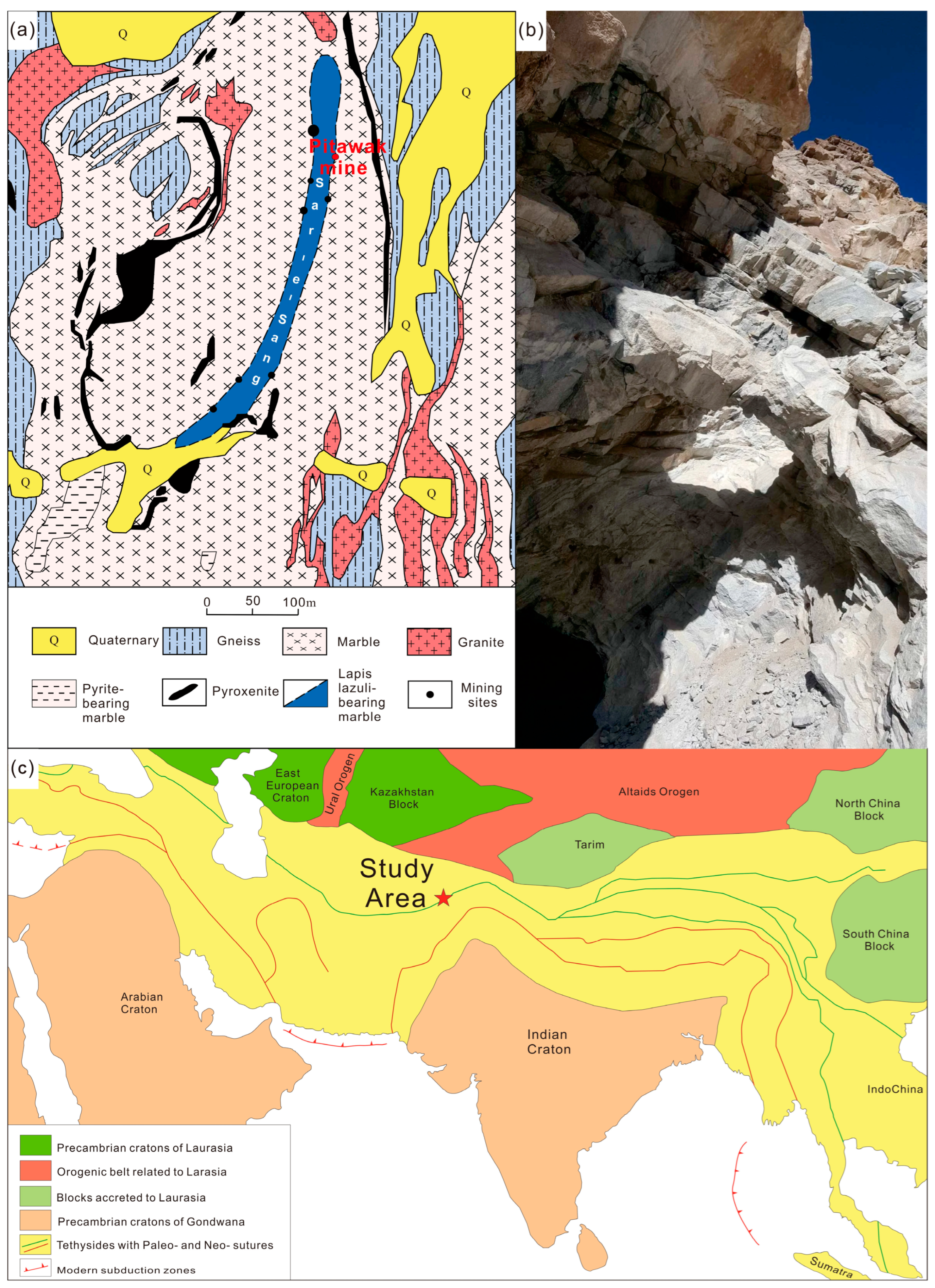
Sar-e-Sang is an important lapis lazuli deposit in Afghanistan, producing the world’s top-grade lapis lazuli. Sar-e-Sang (سر سنگ) means “on stone” in the Dari language. The Sar-e-Sang deposit is located in the Kuran wa Munjan District, southern part of Badakhshan Province in northwestern Afghanistan (Figure 1a). This deposit contains more than ten mines, producing dozens of gemstones including lapis lazuli, afghanite, sodalite (variety hackmanite), and spinel [1,2,3,4,5,6,7,8,9,10,11]. Sar-e-Sang exposes sedimentary rocks (mudstone, limestone, and evaporite) formed from the Neo-archean to Siderian system and Paleoproterozoic, as well as gabbro intruded during this period (2400–2700 Ma) [9,10]. The rocks formed during this period are called the Sakhi Series in Afghanistan [9,12]. They have undergone multiple stages of metamorphism, the carbonate rocks that are known as Sakhi marble [9,10,13] (Figure 1b). Previous studies have summarized the metamorphic history of this area in four stages: the first stage is a high-temperature and high-pressure granulite to eclogite event, and the second stage is an amphibolite facies event [13]. There are few studies on these two stages and the timing of these two events [13]. The third stage is the granite intrusion event that occurred during the Indochina Period [13]. These granites intruded into the northwestern and southeastern parts of Sar-e-Sang, with an age of approximately 200 Ma [13]. This stage is crucial for the formation of various gemstones in Sar-e-Sang and represents the main mineralization period of the Sar-e-Sang deposit. The Indosinian magmatic intrusion brought ore-forming materials for gemstone formation, provided part of the ore-forming fluids, and supplied the heat source to drive the movement of ore-forming fluids [9,10,13]. The fourth stage occurred during the Himalayan period, resulting in the superimposed transformation of the Sar-e-Sang deposit [13] (Figure 1c).
The Pitawak mine is located on the eastern side of the entire Sar-e-Sang deposit and on the northern bank of the Sar-e-Sang river. Petawi or Pitawak (پیتوک) refers to the sun’s light directly shining on the mountain in the Dari language. Some previous studies referred to this area as Pitwak. This time, we confirmed the correct name of the mine with local people, who believed that Pitawak should be used as its exact name. Pitawak mine mainly produces lapis lazuli [2]. The lapis lazuli is mainly hosted in the marble of the Sakhi Series, occurring in the forms of lumps, bands, and lenses (Figure 1b).
In this study, gem-quality forsterite was discovered in the marble at the periphery of the lapis lazuli ore body in Pitawak mine. The mineral assemblage of the forsterite-bearing marble is dolomite, forsterite, spinel, and phlogopite.
The forsterite is colorless and transparent, with irregular shapes, and the grain size is usually 5–25 mm.
In this study, we obtained characteristics such as specific gravity, hardness, refractive index, and fluorescence of the samples through basic gemological analysis; used electron probe microanalysis (EPMA) to gather the data of major element chemical composition of the samples and carried out end-member calculation; used laser ablation inductively coupled plasma mass spectrometry (LA-ICP-MS) to obtain the trace element content characteristics of the samples; used ultraviolet-visible absorption spectroscopy (UV-VIS), Fourier-transform infrared spectroscopy (FTIR), and laser Raman spectroscopy (Raman) to study the spectral characteristics of the samples and the correlation between the spectral characteristics and composition of the samples; and used photoluminescence spectroscopy (PL) to characterize the fluorescence properties of the samples and analyze the correlation between the fluorescence effect and composition of the samples.

2. Materials and Methods

2.1. Sample Materials

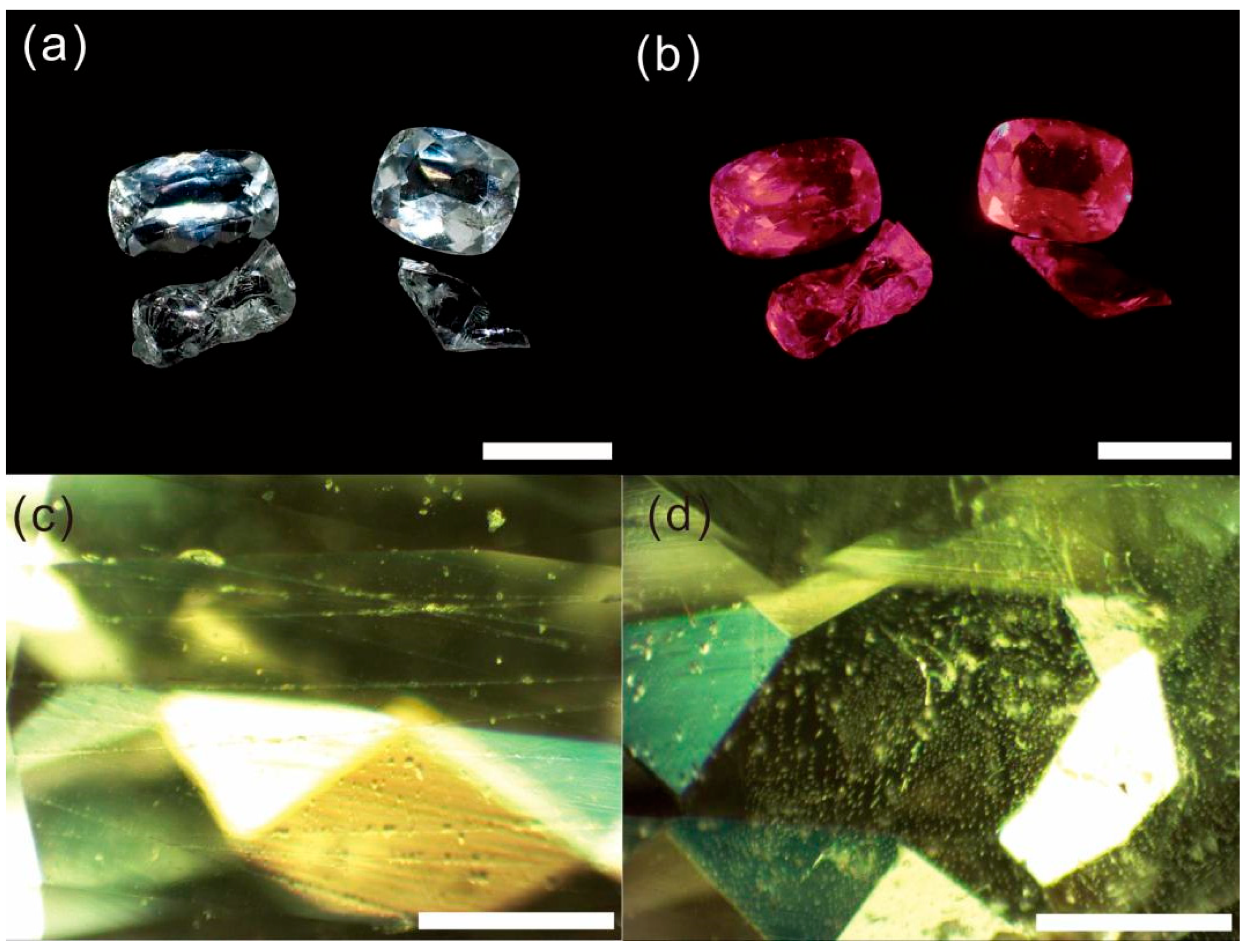
Four forsterite crystals were collected by Mr. Abdul Basit Hayat for this study. The samples are anhedral granular colorless transparent crystals, and no significant inclusions are observed with the naked eye. Among them, the two smaller-grained specimens Fo-b1 and Fo-b2 were used to make electron probe targets for EPMA and LA-ICP-MS analysis. The other larger-grained samples Fo-b3 and Fo-b4 were cut into faceted gemstones (Figure 2a).

2.2. Methods

2.2.1. Basic Gemological Analysis

Basic gemological analysis was conducted at the Research Center for Analysis and Measurement, Kunming University of Science and Technology. Refractivity analysis was conducted using the GI-RZ6 Gemstone Refractometer (BGI, Nanjing, China) with the spot measurement method. Specific gravity was determined by hydrostatic weighing, using the FA2004 electronic precision balance (Tianjin Qingda, Tianjin, China) as the measuring instrument.

2.2.2. Electron Probe Microanalysis (EPMA)

Mineral compositions were established with a JEOL JXA-8230 Electron Probe Microanalyser (JEOL, Tokyo, Japan) equipped with five wavelength-dispersive spectrometers (WDS) at the Laboratory of Microscopy and Microanalysis, Createch Testing Tianjin Technology Co., Ltd., Tianjin, China. The samples were firstly coated with a thin conductive carbon film prior to analysis. The precautions suggested by reference [14] were used to minimize the difference of carbon film thickness between samples and obtain a ca. 20 nm approximately uniform coating. Details of EPMA methods are described in reference [15]. Operating conditions for quantitative WDS analyses involved an accelerating voltage of 15 kV, a beam current of 20 nA, and a 10 µm spot size. Data were corrected online using a ZAF (atomic number, absorption, fluorescence) correction procedure. The peak counting time was 10 s for Ca, K, Na, Mg, Si, Al, Ni, Fe, Mn, and Cr. The background counting time was 1/2 of the peak counting time on the high- and low-energy background positions. The following standards were used: Diopside (Ca), Microcline (K), Jadeite (Na), Olivine (Si, Mg), Pyrope (Al), Nickel (Ni), Hematite (Fe), and Rhodonite (Mn).

2.2.3. Laser Ablation Inductively Coupled Plasma Mass Spectrometry (LA-ICP-MS)

In situ trace element analysis of silicate rock was performed in Createch Testing (Tianjin, China) Technology Co., Ltd. using Analytikjena PlasmaQuant MS Elite ICP-MS (Analytikjena, Jena, Germany) and its matching RESOlution SE 193 nm excimer laser denudation system (Applied Spectra, Sacramento, CA, USA). The laser bombardment was performed with a beam diameter of 40 μm, a frequency of 5 Hz, and an energy density of about 5.5 J/cm2. The carrier gas was high-purity helium. Before analysis, the NIST 610 was used to debug the instrument to optimal condition. LA-ICP-MS laser sampling was carried out in a single point. In the analysis process, the laser beam was blocked for blank background acquisition for 15 s, and then the sample was continuously denudated for 45 s. After the denudation stopped, the sample was purged for 25 s to clean the injection system, and the single-point analysis time was 85 s. A group of NIST 610, NIST 612, MASS-1, MASS-3, BHVO-2G, BCR-2G, and BIR-1G standards were inserted every 10 denudation points, and the element content was quantitatively calculated with Si as the internal standard [16,17]. Off-line processing of analytical data (including sample and blank signal selection, instrument sensitivity drift correction, and element content calculation) was performed using ICPMSData Cal (v.12.2) software.

2.2.4. Ultraviolet–Visible Absorption Spectroscopy (UV-VIS)

Ultraviolet–visible absorption spectroscopy (UV-VIS) was performed at the Research Center for Analysis and Measurement, Kunming University of Science and Technology. The ultraviolet–visible spectrum analysis was carried out using the Skyray UV100 spectrophotometer (Skyray Instrument, Kunshan, China). All samples had polished planes. The data collecting range was 200–1000 nm, the integration time was 100 ms, and the smoothing width was 5. The absorbance method was adopted for analysis, and the average number of scans was 40 times. The temperature was 20 °C.

2.2.5. Fourier-Transform Infrared Spectroscopy (FTIR)

Fourier-transform infrared spectroscopy (FTIR) was conducted at the Research Center for Analysis and Measurement, Kunming University of Science and Technology, using a Thermo NICOLET Is50 spectrometer (ThermoFisher, Waltham, MA, USA) equipped with a Pike UpIR diffuse reflectance accessory. The number of scans was 8, the resolution was 4 cm−1, the gain was 2, the moving mirror speed was 0.4747, and the aperture was 80. The collection range of diffuse reflection was 400–1300 cm−1, and the temperature was 20 °C. The analyses were carried out at the Kunming University of Science and Technology, Analysis and Testing Research Center.

2.2.6. Laser Raman Spectroscopy (RAMAN)

Laser Raman spectroscopy was performed at the Research Center for Analysis and Measurement, Kunming University of Science and Technology, using a LabRAM HR Evolution Raman spectrometer (HORIBA, Paris, France). The spectra covered the Raman shift range of 100–1600 cm−1. The analysis conditions were as follows: a laser wavelength of 532 nm and a 50 μm slit, an output power of 12.5 mW, a resolution of 1 cm−1, five accumulations, and an acquisition time of one minute; the temperature was 20 °C.

2.2.7. Photoluminescence Spectroscopy (PL)

Photoluminescence spectroscopy was performed using a Horiba LabRam HREvolution confocal Raman spectrometer (HORIBA, Paris, France) with a 532 nm excitation wavelength, 10 s acquisition time, one accumulation, 1800 grooves per millimeter grating, 1% laser power attenuation, and a detection range of 535–1000 nm; the temperature was 20 °C. PL spectroscopy was conducted at the Jewelry Testing Center of Hebei GEO University.

3. Results

3.1. Basic Gemology Characteristics

In basic gemology testing, we conducted analyses of refractive index, specific gravity, fluorescence reaction, and Mohs hardness on forsterite samples Fo-b3 and Fo-b4. The refractive index analysis was completed using the spot measurement method.
The specific gravity was measured using the hydrostatic method. Fluorescence reaction analysis was conducted using a long-wave (365 nm) ultraviolet light. Mohs hardness analysis used the ZJ-209 Mohs hardness pens (ZJIA, Shenzhen, China). The results are shown in Table 1.
The analysis results show that the refractive index of Pitawak forsterite samples is 1.631 with 0.35 birefringence, which is consistent with the refractive index characteristics of forsterite from other localities. The specific gravity is 3.28, which is essentially consistent with the specific gravity of the most ideal forsterite. The Mohs hardness of the samples was 7.5, which is the same as that of forsterite from other areas.
Fluorescence reaction analysis was completed using a Convoy S2 (UV365 nm) ultraviolet lamp (Convoy, Hongkong). Under long-wave (365 nm) ultraviolet light, the samples had strong red fluorescence (Figure 2b). We speculate that this fluorescence feature of the samples is related to Mn or Fe. Therefore, in the following text, we will conduct a detailed study on the composition of the samples and their photoluminescence spectrum.

3.2. Microscopic Characteristics

Microscopic observation and photomicrography were conducted at the Analysis and Testing Center of Kunming University of Science and Technology. A Jiangnan Yongxin NGI6 gemological microscope (JNOEC, Nanjing, China) was used to examine the faceted samples Fo-b3 and Fo-b4 (Figure 2c,d).
Microscopic observation reveals that the sample’s clarity is generally quite good, with extremely fine filamentous gas–liquid inclusions, negative crystal inclusions, and directionally distributed raindrop-like gas–liquid inclusions visible. However, lily-pad inclusions typically found in olivine of mantle origin are absent [13]. This suggests that the genesis of forsterite from Pitawak differs from that of olivine commonly formed in the mantle.

4. Compositional Characteristics

4.1. Electron Probe Microanalysis (EPMA)

The two forsterite samples Fo-b1 and Fo-b2 were placed on the electron probe target sprayed with a conductive carbon film. After observation, the samples were relatively homogeneous with no visible zoning structure or significant inclusions.
To avoid the residual polishing powder affecting the analysis results, the most homogeneous parts of the two samples without polishing powder contamination were selected for electron probe wavelength dispersive spectroscopy analysis to obtain the major element contents of the two samples (expressed as mass percentages of oxides). Three points were measured for each sample, and the analysis points of Fo-b1 and Fo-b2 are denoted as Fo1-1, Fo1-2, Fo1-3 and Fo2-1, Fo2-2, Fo2-3, respectively. The analysis results are shown in Table 2.
To obtain the crystal chemical formula of Pitawak mine forsterite samples, we collated the data in Table 2 and performed calculations using the charge balance method based on four oxygen atoms [18]. The ion counts for each point of the samples and the average ion counts of the two samples were obtained, and the calculation results are presented in Table 3. Based on the average ion counts of the two samples, the crystal chemical formula of Pitawak mine forsterite was calculated as: (Mg2.00Fe0.02)Σ2.02Si0.99O4. The sample is located at the forsterite end-member, and Fe exists in the form of Fe2+.

4.2. Laser Ablation Inductively Coupled Plasma Mass Spectrometry (LA-ICP-MS) Analysis Results

To enable internal standardization using EPMA data, LA-ICP-MS analysis was performed at the same locations as the EPMA points (results in Table 4). The sample shows low levels of chromophoric elements (Fe, Ni, and Mn), explaining its lack of color. Although Fe and Mn are present at levels that could, in principle, act as activators for the observed red fluorescence (unlike trace Cr), their specific roles require verification through photoluminescence spectroscopy.

5. Spectral Characteristics

5.1. FTIR Spectroscopy Analysis

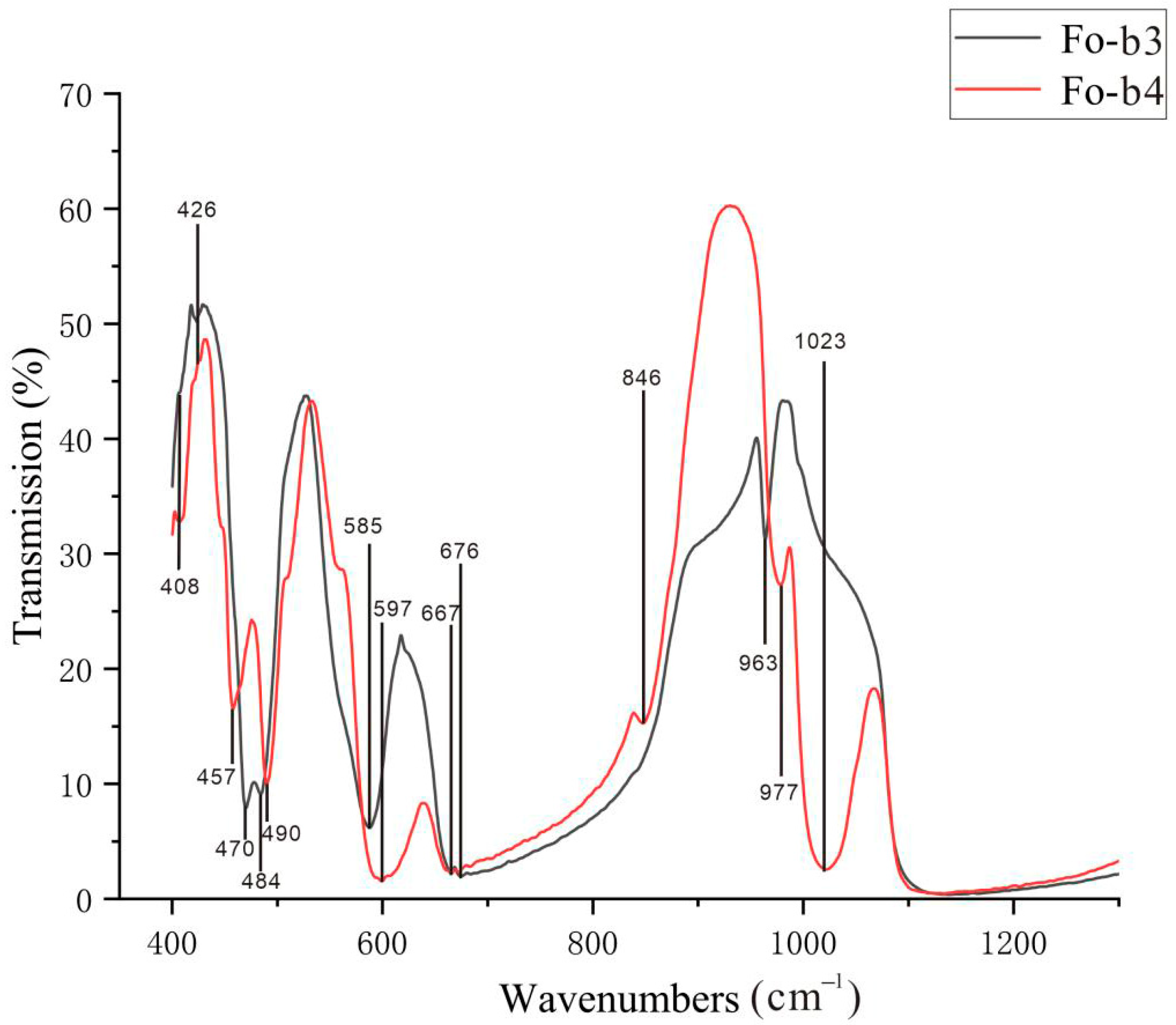
Forsterite, a nesosilicate, is based on isolated [SiO4]4− tetrahedra. Its structure can be described as a distorted hexagonal close-packing of O2− ions, with Si4+ ions occupying tetrahedral voids and various divalent cations (predominantly Mg2+ and Fe2+, along with minor Mn2+, Ni2+, Co2+, and Ca2+) occupying octahedral voids [19], connecting the silicate tetrahedrons. Its standard infrared absorption peaks mainly appear in the range of 400–1100 cm−1 [20,21]. In this analysis, eight infrared absorption peaks were found for sample Fo-b1, which are 1023 cm−1, 963 cm−1, 676 cm−1, 667 cm−1, 585 cm−1, 484 cm−1, 470 cm−1, 426 cm−1, and 408 cm−1; ten infrared absorption peaks were found for sample Fo-b2, which are 1023 cm−1, 977 cm−1, 846 cm−1, 676 cm−1, 667 cm−1, 597 cm−1, 490 cm−1, 457 cm−1, 426 cm−1, and 408 cm−1 (Figure 3). Among them, the absorption peaks near 1023 cm−1, 977 cm−1, 963 cm−1, and 846 cm−1 are attributed to the v1 symmetric stretching vibration of Si-O-Si. The absorption peaks at 676 cm−1, 667 cm−1, 597 cm−1, 585 cm−1, 490 cm−1, and 484 cm−1 are attributed to the v2 bending vibration of Si-O [22]. The absorption peaks at 470 cm−1, 457 cm−1, 426 cm−1, and 408 cm−1 are attributed to the peaks formed by the coupling of lattice vibration and internal vibration [20,22,23,24,25], so these peaks are difficult to be assigned one by one. The reason for the differences in the positions and numbers of absorption peaks between the two samples is that the analysis positions are located at different crystal orientations of olivine. Since the original samples are anhedral crystals, it is more difficult to determine the crystal orientation of the faceted forsterite samples after cutting, resulting in certain differences in the infrared absorption spectra of the two samples.

5.2. UV-Vis Absorption Spectroscopy Analysis

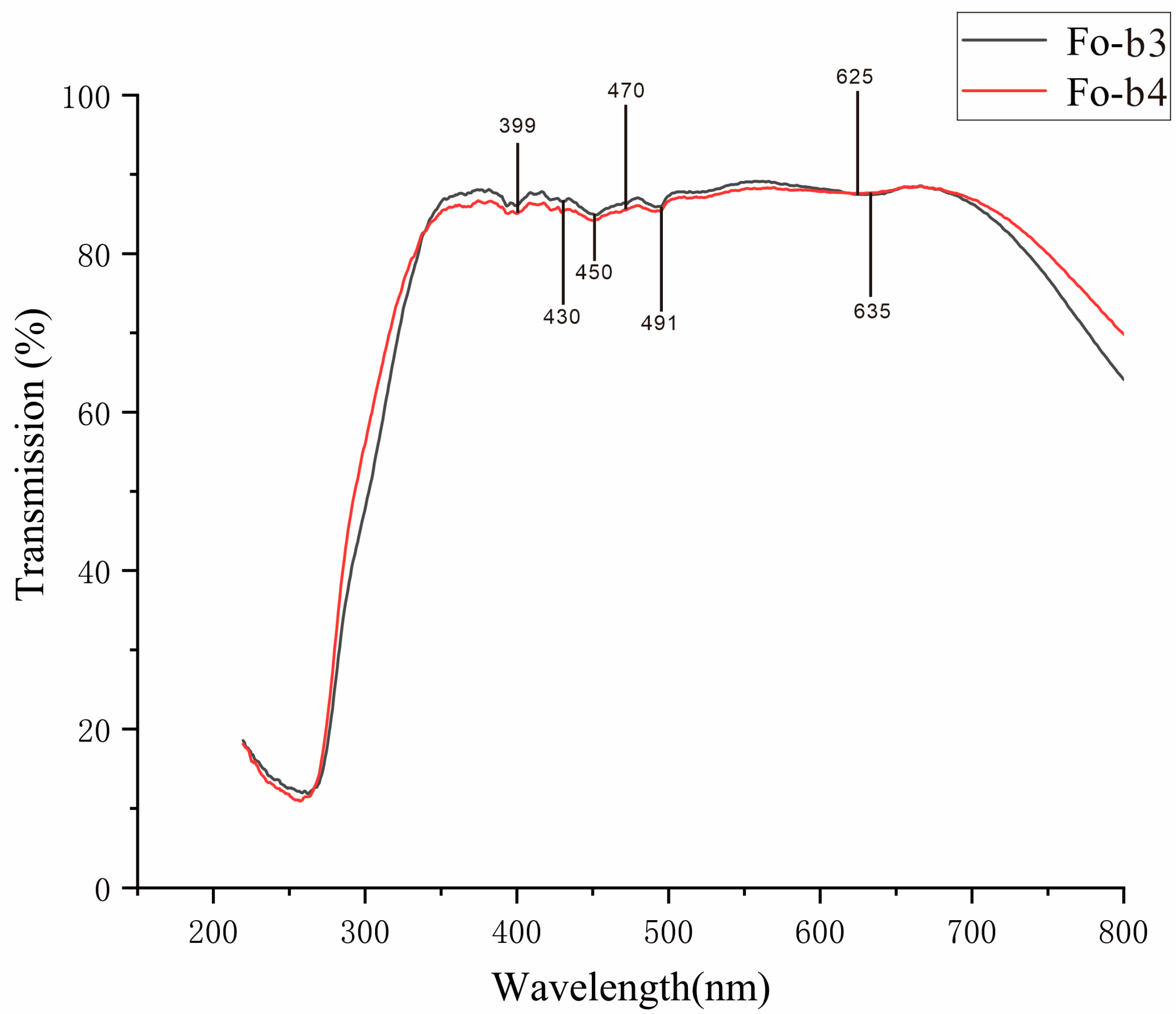
The UV-VIS results show that forsterite samples Fo-b3 and Fo-b4 have relatively consistent absorption characteristics. The samples have high transmittance in the visible light band and weak absorption peaks, so they appear colorless and transparent to the naked eye.
There are seven absorption peaks in this UV-VIS spectrum, which are 399 nm, 430 nm, 450 nm, 470 nm, 491 nm, 625 nm, and 635 nm (Figure 4). Among them, the absorption intensities of 625 nm and 635 nm are similar and weak, forming a relatively wide absorption centered at 630 nm.
According to previous studies, the peak at 399 nm is attributed to Fe3+ occupying octahedral sites, corresponding to electronic transitions between the 6A1g4Eg(4D) energy levels [25,26]. For the peak at 430 nm, since the octahedral crystal field of Mg2+ sites is slightly distorted, degeneration of the 4E(4G) and 4A1(4G) levels is released [26]. The peak at 450 nm is attributed to Fe3+ occupying octahedral sites, corresponding to electronic transitions between the 6A14A1 + 4E(4D) energy levels [26,27]. The peaks at 470 nm and 635 nm are attributed to Fe2+ occupying octahedral sites, corresponding to electronic transitions between the 5T2g3T1g energy levels. The peak at 491 nm is attributed to Fe2+ occupying octahedral sites, corresponding to electronic transitions between the 5T2g3T2g energy levels [25,26,27,28]. The peak at 625 nm is attributed to Mn2+ occupying octahedral sites, corresponding to electronic transitions between the 6A14A24T1(G) energy levels [26,29,30].

5.3. Raman Spectroscopy Analysis

In previous studies, olivine had 36 Raman-active modes: 11A1g + 11B1g + 7B2g + 7B3g. The Raman shifts of olivine can reflect the Si-O bond vibrations in the silicate tetrahedra of olivine and involve the octahedrally coordinated cation vibrations.
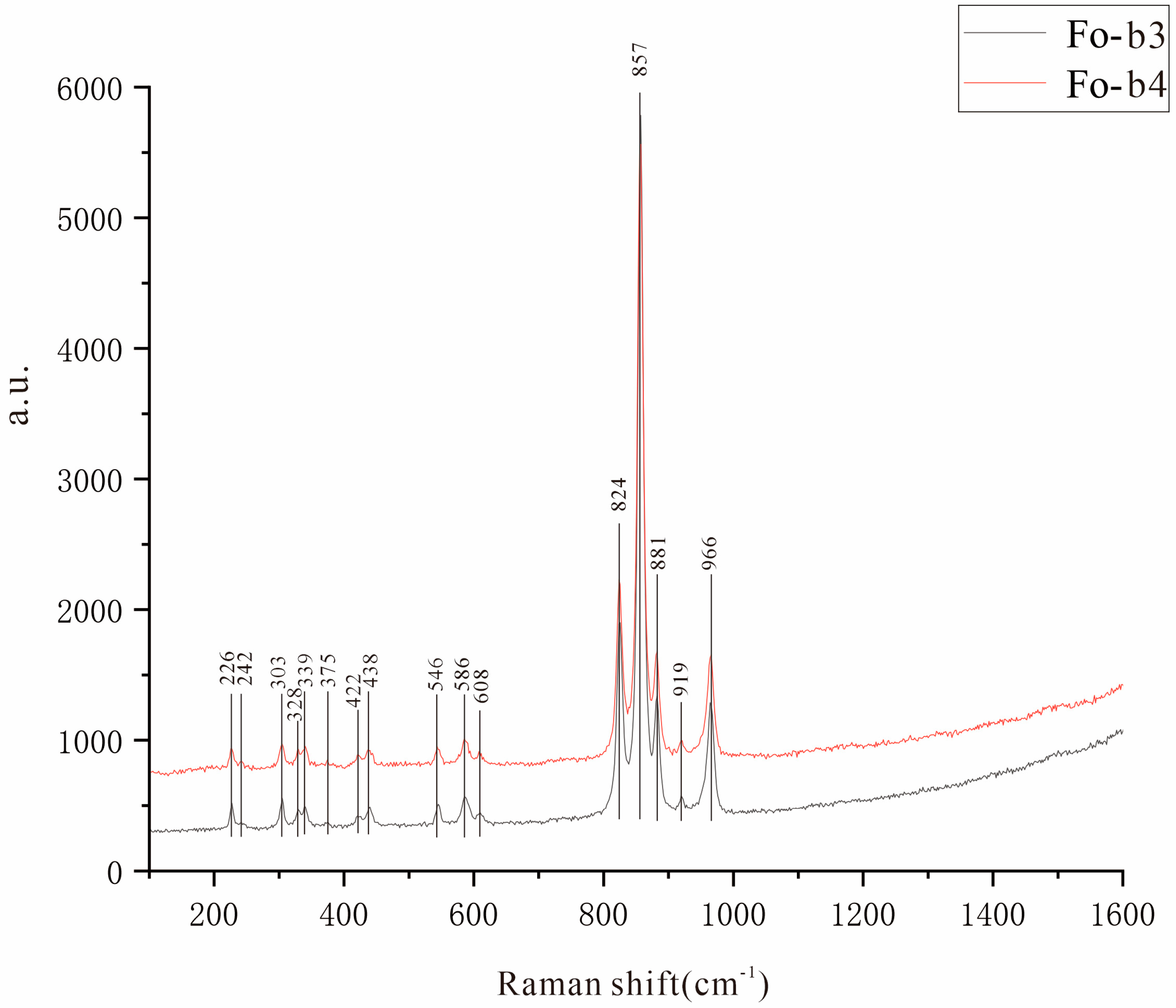
The Raman spectra of the analyzed samples Fo-b3 and Fo-b4 show extremely high consistency, and 13 Raman-active modes were measured for both samples (Figure 5), which are 966 cm−1, 919 cm−1, 881 cm−1, 857 cm−1, 824 cm−1, 608 cm−1, 586 cm−1, 546 cm−1, 438 cm−1, 422 cm−1, 375 cm−1, 339 cm−1, 328 cm−1, 303 cm−1, 242 cm−1, and 226 cm−1. Among them, the Raman-active modes at 966 cm−1, 919 cm−1, and 881 cm−1 are caused by the v3 antisymmetric stretching vibration of Si-O [30]; those at 857 cm−1 and 824 cm−1 are caused by the v1 symmetric stretching vibration and v3 antisymmetric stretching vibration of Si-O [31,32,33]; the Raman activities at 608 cm−1, 586 cm−1, and 546 cm−1 are attributed to the v4 antisymmetric bending vibration of Si-O [30,31,32]; the Raman-active modes at 438 cm−1 and 422 cm−1 are attributed to the v2 symmetric bending vibration of Si-O [32,33]; the Raman activities at 375 cm−1 and 339 cm−1 are generated by the cation translation vibration at the M2 sites; the Raman activities at 328 cm−1, 304 cm−1, 242 cm−1, and 226 cm−1 are attributed to the [SiO4]4− rotation vibration [31].

5.4. Photoluminescence Spectroscopy Analysis

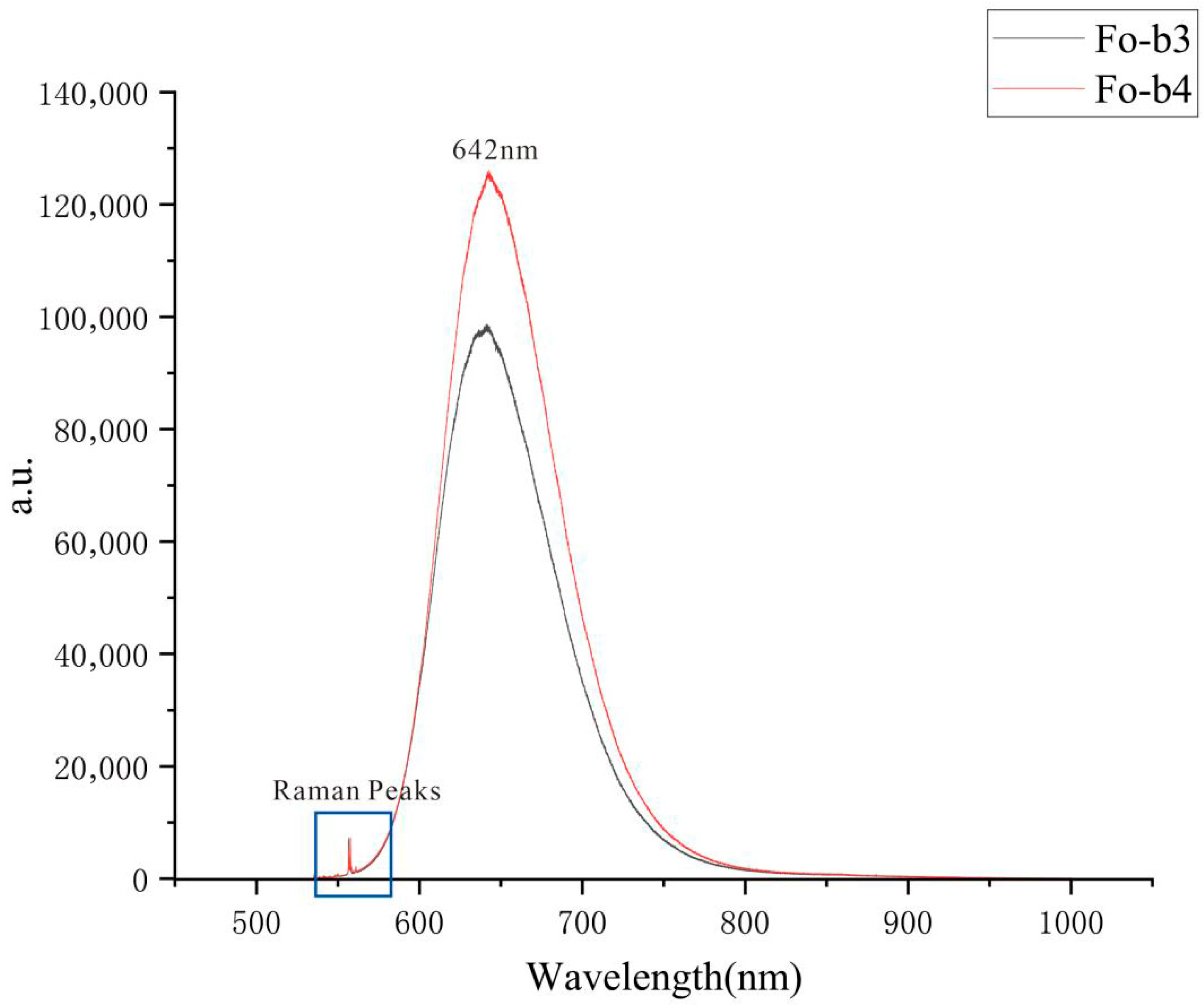
The sample exhibits intense red fluorescence under a 365 nm ultraviolet lamp. To analyze the cause of the sample’s fluorescence, we conducted PL spectroscopy analysis, and the analysis results are shown in Figure 6. We can observe multiple relatively sharp peaks near 558 nm. These peaks’ positions were converted to wavenumbers, and by subtracting the wavenumber of the laser source, the results are 919 cm−1, 881 cm−1, 857 cm−1, and 824 cm−1, respectively. Therefore, the peaks near 558 nm are not luminescence peaks but rather the Raman activity of the sample.
The peak centered around 642 nm in the sample is a typical luminescence peak. Combining the analysis results of EPMA and LA-ICP-MS, we found that the sample contains a trace amount of Mn ions. Moreover, according to previous studies, the luminescence peak of Mn2+-bearing forsterite is relatively broad and located around 580–680 nm [34]. Clearly, the luminescence peak of the sample conforms to this characteristic.
Therefore, we consider that the red fluorescence of the sample is caused by Mn2+, and its photoluminescence phenomenon originates from the spin-forbidden transition of 4T16A1 that occurs when Mn2+ is at the octahedral site [34,35,36,37]. The photon energy released in this process is approximately 2.0–2.2 eV, which exactly falls within the wavelength range from orange-red to red [34,36,37].

6. Discussion

  • According to the research by Weeks et al. (1974), olivine-group minerals may exhibit red fluorescence where they contain Fe3+ or Mn2+ at octahedral sites [37]. Since Fe in the sample exists as Fe2+ in octahedral sites, and based on previous studies, the emission peak caused by Fe3+ in olivine is around 716 nm [36,37], Fe in the sample does not contribute to the red fluorescence. Instead, as analyzed in Section 5.4, the red fluorescence of the sample is caused by Mn2+.
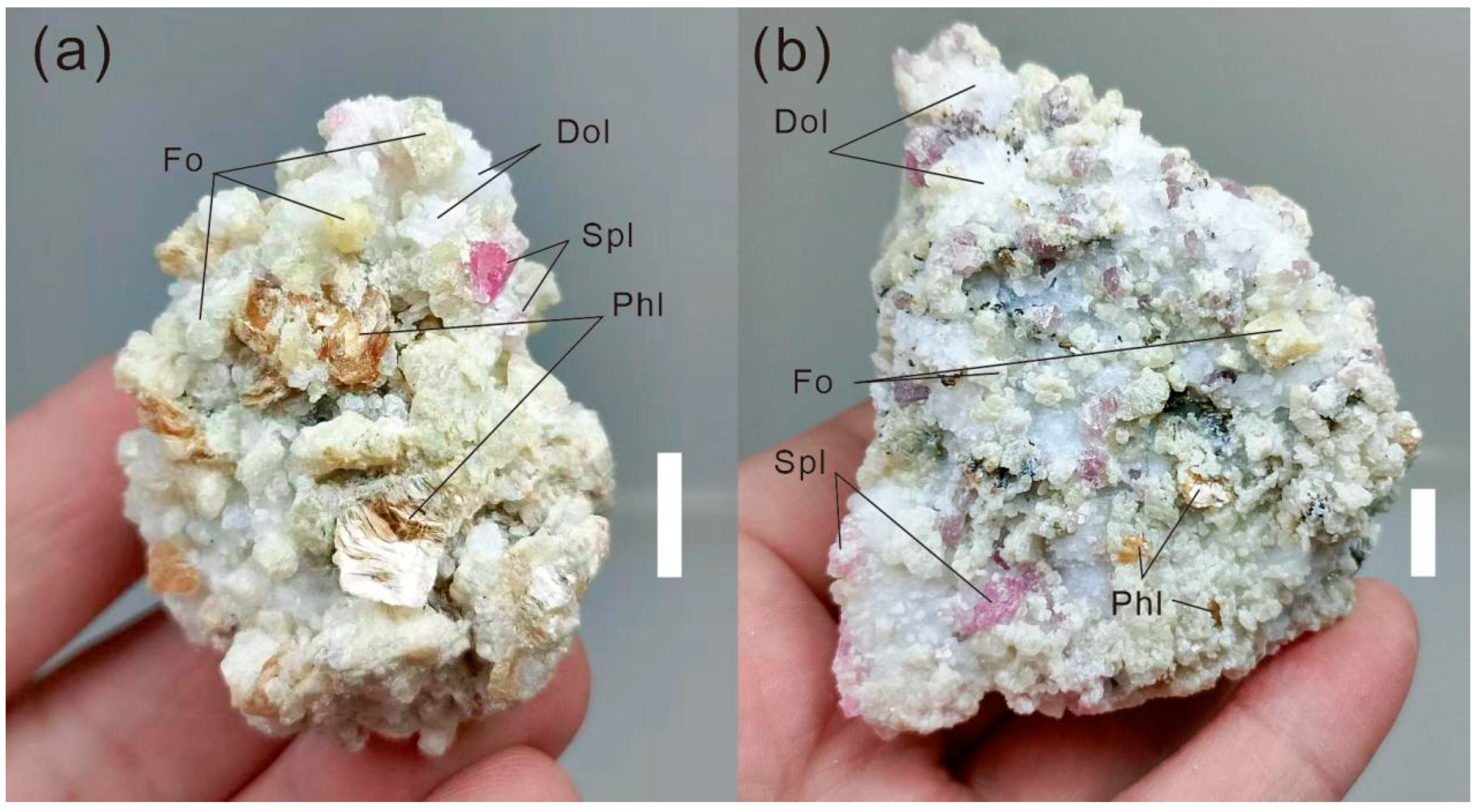
  • Metamorphic forsterite can well reflect its formation environment, and the mineral paragenetic association and relationships of forsterite can effectively constrain information such as protolith composition, temperature conditions, and metamorphic fluid composition. The mineral assemblage of the forsterite-bearing marble discovered at Pitawak mine is dolomite, forsterite, spinel, and phlogopite (Figure 7). Based on previous studies, it is known that forsterite is typically formed by the reaction of dolomite and siliceous components at high temperatures. This reaction occurs in a continental deep subduction environment similar to the study area at 610 °C to 660 °C and a pressure of 2.5–3.5 GPa [38], with a metamorphic fluid that is water-poor (under water-rich conditions, hydrous minerals such as tremolite and talc would tend to form). Therefore, this indicates that the protolith is a Si-rich dolomite [38,39,40]. Spinel is also a mineral that forms under conditions of relatively high temperature, certain pressure, and water-poor conditions, requiring extremely low SiO2 activity. The stability field of spinel does not coexist with quartz; only when the system is extremely Si-poor and Al- and Mg-rich will spinel form, instead of forming silicate minerals such as feldspar or mica. In addition, the formation of spinel requires an abundant source of Al2O3. Therefore, the protolith from which both forsterite and spinel can crystallize must be a “Mg- and Al-rich siliceous dolomite”. This composition is not common in ordinary pure carbonate rocks and usually implies that the protolith contains argillaceous interlayers or argillaceous admixtures, weathering products of igneous rocks (such as basalt), and minerals related to specific evaporite sequences, which is consistent with the conditions of Pitawak mine [12,38,39,40,41].
Based on the above information, we obtain the following conclusions:
(1) The protolith of the forsterite- and spinel-bearing marble in Pitawak mine is a Mg-rich dolomite containing siliceous and aluminous components.
(2) In the geological setting of Pitawak mine [12], the formation temperature and pressure conditions of forsterite may be close to those mentioned in reference [38].
(3) Dolomite is formed by the metamorphism of the original sedimentary rock and may have undergone multiple recrystallizations during multi-stage metamorphism [12]; during the forsterite formation stage, the conditions were medium–high temperature, high pressure, water-poor, and CO2-rich [41,42,43]; during the spinel formation stage, the conditions were medium–high temperature, high pressure, water-poor, and extremely low SiO2 activity [42,43].

7. Conclusions

1. The crystal chemical formula of forsterite samples from the Pitawak mine is (Mg2.00Fe0.02)Σ2.02Si0.99O4, indicating a composition close to ideal forsterite. The trace elements include Fe, Ca, Mn, Na, K, and minor amounts of Cr and Ni.
2. UV-VIS spectroscopy measurements show that the samples have high transmittance and weak absorption peaks across the visible range, which is consistent with their colorless and transparent appearance.
3. Photoluminescence (PL) analysis indicates that the red fluorescence of the samples is caused by an emission peak around 642 nm. This emission peak arises from the spin-forbidden 4T16A1 transition in Mn2+ within the octahedral crystal field.
4. The mineral assemblage of forsterite-bearing marble from the Pitawak mine shows that forsterite formed under conditions of high temperature, high pressure, and low water content, with the protolith being “Mg- and Al-rich siliceous dolomite”.

Author Contributions

Conceptualization, L.-R.-X.C.; methodology, L.-R.-X.C., D.Z., H.-T.S., Y.-G.L., Z.Q., H.-N.Y., Y.-K.H., R.-H.Z., Q.-Y.S. and X.-Q.Y.; investigation, H.-T.S. and A.B.H.; formal analysis, L.-R.-X.C., H.-T.S., Y.-G.L. and X.-Q.Y.; writing—original draft preparation, L.-R.-X.C. and D.Z.; writing—review and editing, L.-R.-X.C., D.Z., H.-T.S. and S.-T.Z.; visualization, L.-R.-X.C., X.-Q.Y., H.-N.Y., Y.-K.H., R.-H.Z., Q.-Y.S. and A.B.H.; supervision, S.-T.Z.; project administration, S.-T.Z.; funding acquisition, S.-T.Z.; resource, H.-T.S., Y.-G.L., Z.Q. and A.B.H.; software, H.-T.S. All authors have read and agreed to the published version of the manuscript.

Funding

This research was supported by the National Natural Science Foundation of China (grant No. 42320104005) and the New Round of Mineral Exploration Operation of Yunnan (grant No. Y202407).

Data Availability Statement

The original contributions presented in this study are included in the article. Further inquiries can be directed to the corresponding authors.

Acknowledgments

Figure 1b was taken by Raymond Wu. We have obtained permission from the photographer to use this photo in this article. We would like to express our gratitude to Raymond Wu.

Conflicts of Interest

The author Qiu-Yun Song was employed by the company Kunming Prospecting Design Institute of China Nonferrous Metals Industry Co., Ltd. The author Abul Basit Hayat was employed by Asif Gems Center. The remaining authors declare that the research was conducted in the absence of any commercial or financial relationships that could be construed as a potential conflict of interest.

References

  1. Blaise, J.; Cesbron, F. Données minéralogiques et pétrographiques sur le gisement de lapis lazuli de Sar-e-Sang, Hindou-Kouch, Afghanistan. Bull. Minéralogie 1966, 89, 333–343. [Google Scholar]
  2. Woodside, R.M.; Moore Thomas, P. Famous mineral localities: The Sar-e-Sang lapis mines, Kuran Wa Munjan district, Badakhshan Province, Afghanistan. Mineral. Rec. 2014, 45, 280–336. [Google Scholar]
  3. Pei, D.; Hui, L.; Hong, M.; Yang, Z.; Na, T. New Found Mineral Compositions of Lapis lazuli. China Gems Jades 2024, 8–15. [Google Scholar] [CrossRef]
  4. Cairncross, B. The Where of Mineral Names: Afghanite, Sar-e-Sang, Koksha Valley, Kuran wa Munjan District, Badakhshan, Afghanistan. Rocks Miner. 2021, 96, 568–571. [Google Scholar] [CrossRef]
  5. Orris, G.J.; Bliss, J.D. Mine and Mineral Occurrences of Afghanistan; Open-File Report 2002-110; U.S. Geological Survey: Reston, VA, USA, 2002. [CrossRef]
  6. Bariand, P.; Cesbron, F.; Giraud, R. Une nouvelle espèce minérale: L’afghanite de Sar-e-Sang, Badakhshan, Afghanistan. Comparaison avec les minéraux du groupe de la cancrinite. Bull. Société Fr. Minéralogie Cristallogr. 1968, 91, 34–42. [Google Scholar] [CrossRef]
  7. Maiorov, A.N.; Suderkin, A.I.; Krepoy, M.E. Report by the Survey and Prospecting Team on the Results Obtained in 1963–1964 at the Lapis Lazuli Occurrences of Afghanistan; Kabul Records Office of the Department of Geology and Mines (DGMS): Kabul, Afghanistan, 1965.
  8. Guastoni, A.; Demartin, F. Hervorragender Neufund: Tiefblaue-Afghanit-Kristalle von Sar-e-Sang, Badakhshan, Afghanistan. Lapis 2002, 27, 22–23. [Google Scholar]
  9. Poccoвский, Л.П.; Jun, C. Gem deposits in Afghanistan. Earth Environ. 1981, 01, 10–16. [Google Scholar]
  10. Wang, L.X.; Zhang, X.J. The main gemstone mines in Afghanistan. Xinjiang Geol. 2009, 27, 176–179. [Google Scholar]
  11. Lu, W.; Cao, J.; Zhang, L.; Zhang, Q.; He, S. Gemmological and Spectral Characteristic of Afghanite. J. Gems Gemmol. 2018, 20, 39–43. [Google Scholar] [CrossRef]
  12. Faryad, S.W.; Collett, S.; Petterson, M.; Sergeev, S.A. Magmatism and metamorphism linked to the accretion of continental blocks south of the Hindu Kush, Afghanistan. Lithos 2013, 175–176, 302–314. [Google Scholar] [CrossRef]
  13. Jan, M.Q.; Khan, M.A. Petrology of gem peridot from Sapat maficultramafic complex, Kohistan, NW Himalaya. Geol. Bull. Peshawar 1996, 29, 17–26. [Google Scholar]
  14. Zhang, R.X.; Yang, S.Y. A mathematical model for determining carbon coating thickness and its application in electron probe microanalysis. Microsc. Microanal. 2016, 22, 1374–1380. [Google Scholar] [CrossRef]
  15. Yang, S.Y.; Jiang, S.Y.; Mao, Q.; Chen, Z.Y.; Rao, C.; Li, X.L.; Li, W.C.; Yang, W.Q.; He, P.L.; Li, X. Electron probe microanalysis in geosciences: Analytical procedures and recent advances. At. Spectrosc. 2022, 43, 186–200. [Google Scholar] [CrossRef]
  16. Pearce, N.J.G.; Perkins, W.T.; Westgate, J.A.; Gorton, M.P.; Jackson, S.E.; Neal, C.R.; Chenery, S.P. A Compilation of new and published major and trace element data for NIST SRM 610 and NIST SRM 612 glass reference materials. Geostand. Newsl. 1997, 21, 115–144. [Google Scholar] [CrossRef]
  17. Liu, Y.; Hu, Z.; Gao, S.; Detlef, G.; Xu, J.; Gao, G.; Chen, H. In-situ Analysis of Major and Trace Elements of Anhydrous Minerals by LA-ICP-MS without Applying an Internal Standard. Chem. Geol. 2008, 257, 34–43. [Google Scholar] [CrossRef]
  18. Droop, G.T.R. A general equation for estimating Fe3+ concentrations in ferromagnesian silicates and oxides from microprobe analyses, using stoichiometric criteria. Mineral. Mag. 1987, 51, 431–435. [Google Scholar] [CrossRef]
  19. Zhang, L.; Smyth, J.R. Crystal chemistry of metal element substitution in olivine and its high-pressure polymorphs: Implications for the upper-mantle and the mantle transition zone. Earth-Sci. Rev. 2022, 232, 104127. [Google Scholar] [CrossRef]
  20. Burns, R.G. Crystal field spectra and evidence of cation ordering in olivine minerals. Am. Mineral. 1970, 55, 1608–1632. [Google Scholar]
  21. Burns, R.G.; Huggins, F.E.; Abu-Eid, R.M. Polarized absorption spectra of single crystals of lunar pyroxenes and olivines. Moon 1972, 4, 93–102. [Google Scholar] [CrossRef]
  22. Burns, R.G.; Huggins, F.E. Cation determinative curves for Mg-Fe-Mn olivines from vibrational spectra. Am. Mineral. 1972, 57, 962–985. [Google Scholar] [CrossRef]
  23. Wen, L. Mineral Infrared Spectroscopy; Chongqing University Press: Chongqing, China, 1989. [Google Scholar]
  24. Farmer, V.C. The Infrared Spectra of Minerals; Mineralogical Society: London, UK, 1974; pp. 331–358. [Google Scholar]
  25. Zhang, Z.; Ye, M.; Shen, A.H. Characterisation of Peridot from China’s Jilin Province and from North Korea. J. Gemmol. 2019, 36, 436–446. [Google Scholar] [CrossRef]
  26. Rossman, G.R.; Shannon, R.D.; Waring, R.K. Origin of the yellow colour of complex nickel oxides. J. Solid State Chem. 1981, 39, 277–287. [Google Scholar] [CrossRef]
  27. Tang, J.; Guo, Y.; Lai, X.; Liu, Y.; Wu, Q. Study on the correlation between Fe2+ and peridot’s yellow green color and quality evaluation of color based on CIE1976 L*a*b* uniform color space. In Proceedings of the 5th International Conference on Environment, Materials, Chemistry and Power Electronics, Zhengzhou, China, 11–12 April 2016; pp. 599–604. [Google Scholar] [CrossRef]
  28. Tang, W.; Guo, Y.; Ma, L. Influence of Fe2+ on the color appearance of yellow-green peridot. Key Eng. Mater. 2012, 492, 370–373. [Google Scholar] [CrossRef]
  29. Stockton, C.M.; Manson, D.V. Peridot from Tanzania. Gems Gemol. 1983, 19, 103–107. [Google Scholar] [CrossRef]
  30. Loeffler, B.M.; Burns, R.G. Shedding Light on the Color of Gems and Minerals: The selectrveabsorption of light according to wavelength—The result of various electronic processes whose energies correspond to certain wavelengths of visible light—Gives minerals their distirctive hues. Am. Sci. 1976, 64, 636–647. [Google Scholar]
  31. Chopelas, A. Single crystal Raman spectra of forsterite, fayalite, and monticellite. Am. Mineral. 1991, 76, 1101–1109. [Google Scholar]
  32. Foster, N.F.; Wozniakiewicz, P.J.; Price, M.C.; Kearsley, A.T.; Burchell, M.J. Identification by Raman spectroscopy of Mg–Fe content of olivine samples after impact at 6 km s−1 onto aluminium foil and aerogel: In the laboratory and in Wild-2 cometary samples. Geochim. Cosmochim. Acta 2013, 121, 1–14. [Google Scholar] [CrossRef]
  33. Kuebler, K.E.; Jolliff, B.L.; Wang, A.; Haskin, L.A. Extracting olivine (Fo–Fa) compositions from Raman spectral peak positions. Geochim. Cosmochim. Acta 2006, 70, 6201–6222. [Google Scholar] [CrossRef]
  34. Green, G.R.; Walker, G. Luminescence excitation spectra of Mn2+ in synthetic forsterite. Phys. Chem. Miner. 1985, 12, 271–278. [Google Scholar] [CrossRef]
  35. Lin, L.; Min, Y.; Chaoshu, S.; Weiping, Z.; Baogui, Y. Synthesis and Luminescence Properties of Red Phosphors: Mn2+ Doped MgSiO3 and Mg2SiO4 Prepared by Sol-Gel Method. J. Rare Earths 2006, 24, 104–107. [Google Scholar] [CrossRef]
  36. Rager, H. Electric field gradients and asymmetry parameters of Fe3+, Mn2+, Cr3+, and Mg2+ in Mg2SiO4. J. Mol. Struct. 1980, 58, 215–220. [Google Scholar] [CrossRef]
  37. Weeks, R.A.; Pigg, J.C.; Finch, C.B. Charge-transfer spectra of Fe3+ and Mn2+ in synthetic forsterite(Mg2SiO4). Am. Mineral. 1974, 59, 1259–1266. [Google Scholar]
  38. Liang, X.; Qiao, L. Characteristics of Humite Group Minerals Formed in Metasomatic Experimentation and Physico-chemical Conditions for Their Formation. Acta Petrol. Mineral. 1990, 9, 340–350. [Google Scholar]
  39. Kato, T.; Enami, M.; Zhai, M. Ultra-high-pressure (UHP) marble and eclogite in the Su-Lu UHP terrane, eastern China. J. Metamorph. Geol. 2004, 15, 169–182. [Google Scholar] [CrossRef]
  40. Guo, S.; Chu, X.; Hermann, J.; Chen, Y.; Li, Q.; Wu, F.; Liu, C.; Sein, K. Multiple episodes of fluid infiltration along a single metasomatic channel in metacarbonates and implications for CO2 release in orogenic belts. J. Geophys. Res. Solid Earth 2021, 126, e2020JB020988. [Google Scholar] [CrossRef]
  41. Zhu, Y.; Xu, X.; Chen, B.; Xue, Y. Dolomite marble and garnet amphibolite in the ophiolitic mélange in western Junggar: Relics of the Early Paleozoic oceanic crust and its deep subduction. Acta Petrol. Sin. 2008, 24, 2767–2777. Available online: https://www.sciengine.com/doi/10.0000/0cab172a23974745bb3359aa0717b58b (accessed on 10 November 2025).
  42. Biino, G.G.; Compagnoni, R. Very-high pressure metamorphism of the Brossasco coronite metagranite, southern Dora Maira Massif, Western Alps. Schweiz. Mineral. Und Petrogr. Mitteilungen 1992, 72, 347–363. [Google Scholar]
  43. Becker, H.; Altherr, R. Evidence from ultra-high pressure marbles for recycling of sediments into the mantle. Nature 1992, 358, 745–748. [Google Scholar] [CrossRef]
Figure 1. (a): Geological map of Sar-e-Sang. (b): Photo of Pitawak mine. Note: (a) is modified from reference [10]. (c): Tectonic setting map of the study area.
Crystals 16 00048 g001
Figure 2. Forsterite samples from the Pitawak mine. (a): Under ordinary light source. (b): Fluorescence of samples under 365 nm ultraviolet light. (c): Inclusions in Fo-b3. (d): Inclusions in Fo-b4. Bar in (a,b) = 1 cm. Bar in (c,d) = 1 mm.
Crystals 16 00048 g002
Figure 3. FTIR spectra of forsterite from Pitawak mine.
Crystals 16 00048 g003
Figure 4. UV-VIS spectra of forsterite from Pitawak mine.
Crystals 16 00048 g004
Figure 5. Raman spectra of forsterite from Pitawak mine.
Crystals 16 00048 g005
Figure 6. PL spectrum of forsterite from Pitawak mine.
Crystals 16 00048 g006
Figure 7. (a): Marble from Pitawak mine. (b): Typical Marble sample of the Pitawak mine Abbreviations: Fo, forsterite; Dol, dolomite; Spl, spinel; Phl, phlogopite.
Crystals 16 00048 g007
Table 1. Basic gemology analysis results of samples.
SampleRefractive IndexBirefringenceSpecific GravityMohs HardnessFluorescence
Fo-b31.6310.353.287.5red
Fo-b41.6310.353.287.5red
Table 2. EPMA analytical result of forsterite from Pitawak mine (Wt/%).
No.CaOMgOSiO2NiOFeOMnOTotal
Fo1-10.0256.6141.54 0.020.830.0599.06
Fo1-20.0156.7642.05Bdl0.830.0399.69
Fo1-30.0257.1642.620.010.790.01100.60
Fo2-10.0256.9141.760.030.750.0399.49
Fo2-20.0157.1942.23Bdl0.790.03100.25
Fo2-30.0257.0341.97Bdl0.760.0399.82
Fo1avg0.0256.8442.070.010.820.0399.78
Fo2avg0.0257.0541.990.010.770.0399.85
Note: avg means average irons of sample. Abbreviations: Bdl, below detection limit.
Table 3. Chemical formula of forsterite from Pitawak mine (calculated on the basis of 4 O2−).
No.CaMgSiNiFeMn
Fo1-10.00052.00640.98760.00030.01650.0011
Fo1-20.00031.99740.9926Bdl0.01640.0006
Fo1-30.00051.99150.99620.00020.01530.0001
Fo2-10.00042.00750.98810.00050.01480.0006
Fo2-20.00022.00140.9912Bdl0.01550.0005
Fo2-30.00062.00470.9896Bdl0.01500.0005
Fo-b1avg0.00041.99840.99220.00020.01610.0006
Fo-b2avg0.00042.00450.98960.00020.01510.0005
Note: avg means average irons of sample. Abbreviation: Bdl, below detection limit.
Table 4. LA-ICP-MS results of forsterite from Pitawak mine (Wt10−6).
No.LiBCaCrMnFeNi
FO2-19.96138.175.941.85413.985642.433.30
FO2-29.40138.83Bdl0.43419.375720.733.12
FO2-310.41144.0561.54Bdl426.475772.422.20
FO1-110.43139.75342.581.56433.326189.574.25
FO1-29.96142.358.23Bdl430.846291.373.83
FO1-310.27141.2538.290.42421.486194.154.60
Abbreviation: Bdl, below detection limit.
Disclaimer/Publisher’s Note: The statements, opinions and data contained in all publications are solely those of the individual author(s) and contributor(s) and not of MDPI and/or the editor(s). MDPI and/or the editor(s) disclaim responsibility for any injury to people or property resulting from any ideas, methods, instructions or products referred to in the content.