Article

Lanthanide-Induced Local Structural and Optical Modulation in Low-Temperature Ag2Se

by
Sathish Panneer Selvam
1,* and
Sungbo Cho
1,2,3,*
1
Department of Electronic Engineering, Gachon University, Seongnam-si 13120, Republic of Korea
2
Department of Semiconductor Engineering, Gachon University, Seongnam-si 13120, Republic of Korea
3
Gachon Advanced Institute for Health Science & Technology, Gachon University, Incheon 21999, Republic of Korea
*
Authors to whom correspondence should be addressed.
Crystals 2026, 16(1), 4; https://doi.org/10.3390/cryst16010004
Submission received: 9 December 2025 / Revised: 18 December 2025 / Accepted: 19 December 2025 / Published: 22 December 2025
(This article belongs to the Special Issue Properties and Synthesis of Luminescent Materials)

Abstract

Low-temperature Ag2Se is a narrow-band semiconductor, with its transport and optical properties significantly influenced by the local coordination environment. This study investigates the effects of La and Gd incorporation using DFT+U calculations and Ag-K edge EXAFS analysis. Analysis of electron localization function (ELF) and charge density differences reveals increased electron localization at dopant sites. Additionally, k3χ(k) and wavelet transforms demonstrate that the first M-Se shell shifts from approximately 1.346 Å in Ag-Se to around 1.386 Å and 1.291 Å for La-Se and Gd-Se, respectively (phase-uncorrected), thereby confirming dopant-specific lattice distortions while maintaining the orthorhombic framework. The observed changes are associated with an increase in dielectric strength, with ε2 increasing from approximately 30–40 in pristine Ag2Se to around 50–60 for La and 70–80 for Gd at low photon energies, alongside enhanced absorption nearing 1.32–1.34 × 105 cm−1. The characteristic plasmon resonance in the range of 15–20 eV is maintained. Rare-earth substitution effectively adjusts local bonding and low-energy optical response in Ag2Se, with Gd demonstrating the most significant impact among the examined dopants.

1. Introduction

Silver selenide (Ag2Se) is a narrow bandgap semiconductor characterized by elevated carrier mobility, reduced lattice thermal conductivity, and mechanical flexibility in its low-temperature orthorhombic phase [1]. These characteristics have rendered Ag2Se one of the most promising contenders for near-room-temperature thermoelectric devices and flexible power producers, encompassing thin film and nanowire-based architectures for wearable electronics. Recent advancements in film growth and processing including Te substitution at Se sites, orientation engineering, and microstructure control have elevated Ag2Se power factors and figures of merit to near or beyond unity at approximately room temperature, while preserving exceptional flexibility. Simultaneously, extensive patterned and entirely inkjet-printed Ag2Se films have shown that superior performance may be integrated with scalable, low-temperature manufacturing processes. In addition to thermoelectrics, Ag2Se nanostructures have garnered interest as fundamental components for optoelectronic and infrared systems. Colloidal Ag2Se nanocrystals and mesoporous assemblies offer variable electronic structures in terms of size and shape, together with significant infrared absorption, facilitating advancements in detectors and emitters for the near and mid-infrared spectrum [2,3,4]. Single crystalline β Ag2Se nanowires have been recognized as topological insulators exhibiting anisotropic Dirac surface states, underscoring the complex electronic properties that can emerge from minor alterations in structure and composition [5]. These investigations together demonstrate that precise manipulation of composition, crystallographic orientation, interfaces, and defect chemistry is essential for optimizing both transport and optical properties in Ag2Se-based materials [6].
To date, the majority of compositional tuning of Ag2Se has been on the substitution of chalcogens or coinage metals (such as Te, Cu, or In) and the creation of nanocomposites or heterostructures [7]. These tactics primarily regulate carrier concentration, grain orientation, and phonon scattering, demonstrating efficacy in enhancing thermoelectric performance. Nonetheless, the effects of rare-earth integration into low temperature Ag2Se remain largely unexamined, despite the unique way trivalent rare-earth ions can alter both local structure and electronic states. Ions like La3+ and Gd3+ possess comparatively high ionic radii and localized 4f electrons [8,9]. When they replace Ag or occupy interstitial sites, they can modify the local bonding environment, initiate charge compensation mechanisms, and transform the defect landscape. To clarify the incorporation mechanism, La3+ and Gd3+ dopants are introduced onto Ag lattice sites. Because they carry a higher charge than Ag+, their incorporation requires charge compensation through the formation of Ag vacancies. The defect chemistry can be expressed as: La(source)→La..Ag + V’Ag; Gd(source)→Gd..Ag + V’Ag; where La..Ag and Gd..Ag represents trivalent ions occupying Ag sites with an effective +2 charge, and V’Ag is the compensating Ag vacancy [10]. This is anticipated to alter band edges, adjust carrier concentration, and influence carrier mobility, providing a possible means to partially decouple parameters that are typically tightly linked in Ag2Se and analogous silver chalcogenides.
Rare-earth ions can introduce distinct electronic levels via their 4f shells. The interplay of these localized 4f states, the adjacent crystal field, and the Ag2Se host bands can lead to novel optical transitions (including f–d or intra 4f transitions), as well as dopant-induced defect and tail states within the bandgap [11,12]. Consequently, La and Gd doping may alter the absorption edge, reform sub-gap absorption, and enhance the infrared response, especially in the near and mid-infrared areas pertinent to photodetectors and emitters. In this work La and Gd are not chosen as arbitrary model dopants, but as experimentally realistic aliovalent cations for Ag2Se. First, β Ag2Se has emerged as a leading near room temperature thermoelectric for flexible and wearable devices, and its performance is already being optimized via controlled cation/anion substitution and defect engineering (e.g., Te on Se and In on Ag sites) using scalable thin film and nanowire routes, demonstrating that the Ag-Se framework tolerates substantial heterovalent doping without structural degradation. At the same time, there is a broad and rapidly growing body of work showing that trivalent rare-earth ions can be incorporated into a wide range of inorganic lattices and nanostructures, where they substitute on cation sites, are charge compensated by cation vacancies, and provide powerful levers over carrier density as well as optical and magnetic functionality [1]. Given that Ag2Se nanocrystals and mesostructures are already routinely synthesized by colloidal and solution methods [13], and that aliovalent substitution on the Ag sublattice has been experimentally realized in thin films and flexible devices [14], it is reasonable to expect that La3+ and Gd3+ can be introduced on Ag sites in Ag2Se under similar processing conditions, with charge compensation via Ag vacancies [15]. Our calculations are therefore not limited to an idealized model system but are intended to provide concrete guidance for rare-earth doping experiments in Ag2Se, linking specific La/Gd defect complexes to tunable electronic structure and transport parameters that are directly relevant for future flexible thermoelectric and multifunctional optoelectronic devices.
To the best of our knowledge, there are currently no experimental reports on substitutional La- or Gd-doped low temperature Ag2Se. However, Ag2Se nanocrystals have already been magnetically functionalized (e.g., with Mn) to yield ultrasmall Ag2Se@Mn quantum dots that combine near-infrared fluorescence with magnetic resonance contrast for in vivo multimodal tracking, demonstrating that the Ag2Se lattice and surface chemistry are compatible with the integration of paramagnetic species without quenching its NIR optical response [16]. In parallel, studies on rare-earth-doped inorganic nanomaterials have established that aliovalent rare-earth element substitution is a powerful route to simultaneously tailor optical, magnetic, and electrical properties by controlled defect and band-structure engineering [13]. Motivated by these experimental capabilities and design principles, our work explores, at the atomistic level, whether trivalent La and Gd could act as realistic aliovalent dopants in Ag2Se to enable coupled tuning of its transport and magnetic/optical response, thereby providing guidance for future synthesis efforts.
A comprehensive understanding of the accommodation of La and Gd atoms within the Ag2Se lattice is essential for the systematic use of these phenomena. Extended X-ray absorption fine structure (EXAFS) spectroscopy is a potent, element-specific approach for this application. EXAFS can elucidate the immediate coordination environment surrounding both host and dopant atoms, yielding insights into bond lengths, coordination numbers, and local disorder that are frequently unattainable through conventional diffraction, particularly at low dopant concentrations or amid nanoscale inhomogeneities [17,18]. Integrating EXAFS with electrical transport measurements enables a direct correlation between minor structural distortions such as alterations in Ag–Se bond lengths, rare-earth coordination geometry, and local strain and fluctuations in carrier concentration, mobility, and effective mass. Correlating structural and transport data with optical absorption and photoluminescence spectra allows for the observation of how dopant-induced defect states, band tailing, and rare-earth-related transitions alter the bandgap, sub-gap features, and infrared optical response that influence device performance [19,20].
This study comprehensively examines La and Gd-doped low-temperature Ag2Se to enhance and precisely modulate its electrical and optical characteristics via rare-earth doping. We integrate crystallographic characterization, EXAFS spectroscopy, and electrical transport measurements to ascertain how the insertion of La and Gd alters the local coordination environment and defect structure, and how these modifications influence macroscopic electronic behavior. Complementary optical measurements are employed to observe alterations in the bandgap, subgap absorption, and infrared transitions. Through the integration of these findings, we delineate direct structure–property correlations for rare-earth-doped Ag2Se and offer directives for utilizing dopants and defects to manipulate the low-temperature orthorhombic phase for sophisticated electrical and optoelectronic applications.

2. Computational Details

Calculations using density functional theory (DFT) were performed with the CASTEP module. The electronic exchange and correlation interactions were addressed through the generalized gradient approximation (GGA), specifically utilizing the Perdew–Burke–Ernzerhof (PBE) functional [21]. Ultrasoft pseudopotentials were utilized for all atomic species to effectively characterize valence electron interactions while maintaining a manageable computational cost [22]. Due to the strong localization of d-f electrons in Ag2Se and rare-earth-doped Ag2Se systems, a Hubbard on-site Coulomb correction (GGA+U approach) was applied in all doped models. A U value of 6 eV for Gd-4f and 5 eV for La-4f was selected based on previous literature findings regarding lanthanide-based materials [23,24]. In our calculations, the primary step involves the relaxation of low temperature β Ag2Se in the orthorhombic P212121 structure, for which the primitive cell contains four formula units (8 Ag, 4 Se). For the doped models, we built a 2 × 2 × 1 supercell (32 Ag, 16 Se) and added a single La or Gd atom as an interstitial dopant, without substituting any Ag. The resulting compositions are therefore Ag32Se16La and Ag32Se16Gd, with exactly one dopant atom per supercell. To construct a realistic dopant environment, we first identified several plausible interstitial regions within the Ag–Se zig zag framework, focusing on channels and voids that can accommodate a relatively large rare-earth ion. For each dopant species, we placed the atom at several symmetry inequivalent interstitial positions and then performed full structural relaxations, allowing all atomic coordinates and lattice parameters to vary. The relaxations were converged until the maximum force on any atom was below our chosen threshold (0.03 eV Å−1) via the BFGS geometry optimization algorithm. All structures undergone optimization until the forces were reduced to below 0.03 eV Å−1 and the total energy variation was less than 10–5 eV per atom. A plane-wave cutoff energy of 500 eV was utilized for self-consistent calculations. Spin polarization was explicitly incorporated for Gd addition owing to the presence of unpaired f electrons.
The charge density difference (CDD) and electron localization function (ELF) were calculated based on the optimized geometries. The ELF distribution was utilized to illustrate the chemical bonding environment and the extent of electron localization following rare-earth doping. The dielectric function, optical absorption, and refractive index were derived using the CASTEP linear-response framework under the independent-particle approximation. The optical excitation energy range was established between 0 and 60 eV to encompass both visible and near-infrared transitions pertinent to Ag2Se-based functional materials. EXAFS spectra were produced from PBE-optimized structures through FEFF-based analysis to assess the structural changes surrounding Ag sites. Theoretical Ag K-edge spectra were derived from the relaxed configurations and confirming the impact of La (K-edge) and Gd (L3-edge) incorporation on the local coordination environment. The optical properties spectra were calculated for normal incidence on the (100) plane. This orientation was selected because La and Gd atoms reside near the surface layers exposed along the (100) direction, allowing to probe dopant-modified electronic states.

3. Results and Discussion

3.1. Electronic Properties of Ag2Se and La, Gd-Doped Ag2Se

The relaxed geometries (Ag2Se, LaAg2Se and GdAg2Se), along with the electron localization function (ELF) and charge density difference plots for lanthanides (La and Gd)-doped Ag2Se, are presented for a better comparison Ag2Se crystal has also been studied for ELF. The primitive cell of Low-temperature β-Ag2Se (Naumannite) crystallizes in the orthorhombic P212121 space group. Within this framework, two symmetry-independent Ag sites and two symmetry-independent Se sites occupy a single general Wyckoff position (4a). The experimentally determined lattice parameters (a ≈ 4.45 Å, b ≈ 7.07 Å, c ≈ 7.67 Å) align with our optimized structure (a = 4.45 Å, b = 7.08 Å, c = 7.76 Å). The structure consists of Ag-Se zig-zag chains along the b-axis, with Ag displaying partial site disorder that significantly affects the local coordination environment. The crystallographic features are crucial for comprehending how La3+ and Gd3+ substitution disrupts the bonding environment and influences optical behavior [25,26]. In the Ag2Se lattice, Ag and Se atoms create a closely packed structure (Figure 1a), with Ag-Se bonding displaying moderate electron localization, as shown by the ELF maps along the (100) and (001) planes (Figure 1b). The ELF intensity surrounding Se atoms (red regions) indicates strong localization attributable to their elevated electronegativity, whereas the comparatively delocalized ELF around Ag atoms (green to yellow regions) illustrates their metallic bonding characteristics. The distribution validates the mixed ionic-covalent characteristics of Ag-Se interactions, aligning with its semimetallic properties. Upon La substitution (middle panel), a significant redistribution of electron localization is observed around the dopant site (Figure 1c,d). The ELF plots indicate localized areas of elevated electron density between La and adjacent Se atoms, implying partial covalent interaction and charge transfer from La3+ to Se. The polarization induced by the dopant enhances local bonding asymmetry and marginally disturbs the surrounding Ag-Se network. Gd incorporation (Figure 1f) results in enhanced ELF localization between Gd and neighboring Se atoms, signifying increased orbital hybridization involving Gd 4f/5d and Se 4p states (Figure 1g). The localized ELF lobes adjacent to Gd suggest an enhancement of covalent character, potentially reinforcing the local bonding environment and affecting carrier scattering behavior. The isosurface plots of the charge density difference (right panels) emphasize the polarization effects induced by the dopant. Yellow areas denote regions of electron accumulation, whereas cyan areas signify electron depletion. In La- (Figure 1e) and Gd-doped systems (Figure 1h), significant charge delocalization is observed at the dopant-Se interfaces, indicating altered hybridization between the dopant 4f/5d orbitals and the Se 4p states. Electronic rearrangements can affect carrier mobility and may enhance thermoelectric and catalytic activity by improving charge transport pathways. The results indicate that rare-earth doping causes electronic perturbations in Ag2Se, modulating its local charge distribution and potentially tuning its functional properties.
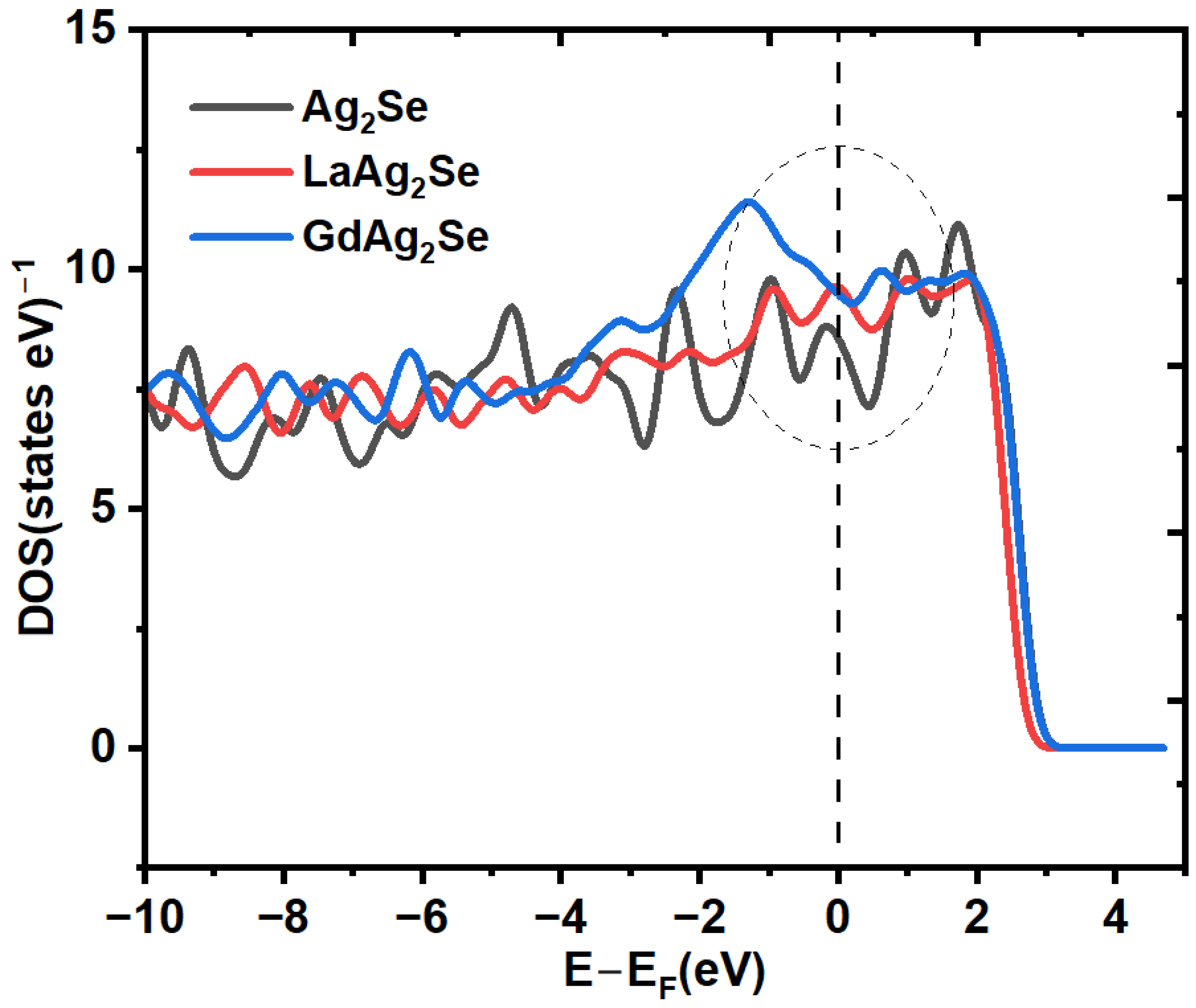
Figure 2 compares the total density of states (DOS) of pristine, La-doped, and Gd-doped Ag2Se, with the energy scale referenced to the Fermi level (EF = 0). Pristine β-Ag2Se shows a finite DOS at EF together with well-defined features across the valence region, consistent with its narrow-gap semimetallic nature and the strong hybridization between Ag-4d and Se-4p states that governs charge transport in the low-temperature phase [27]. La incorporation preserves the overall DOS profile of β-Ag2Se but slightly decreases the DOS intensity in the immediate area of EF. This moderate redistribution of spectral weight indicates that La mainly perturbs the local electronic environment rather than introducing a substantial number of new states at the Fermi level. As a result, only a modest increase in carrier availability and electronic conductivity is anticipated, in line with the relatively limited improvement in the measured electronic and catalytic response of La-containing Ag2Se. By contrast, Gd-doped Ag2Se exhibits a clear enhancement of the DOS around EF. The additional states originate from the interaction of Gd-derived levels with the Ag–Se framework, leading to a higher density of accessible states at energies directly relevant for charge transfer [28]. The increased DOS at EF implies a higher carrier concentration and improved electronic conductivity, providing a microscopic explanation for the more pronounced enhancement of electron-driven processes observed for Gd-modified Ag2Se.

3.2. Extended X-Ray Absorption Fine Structure (EXAFS)

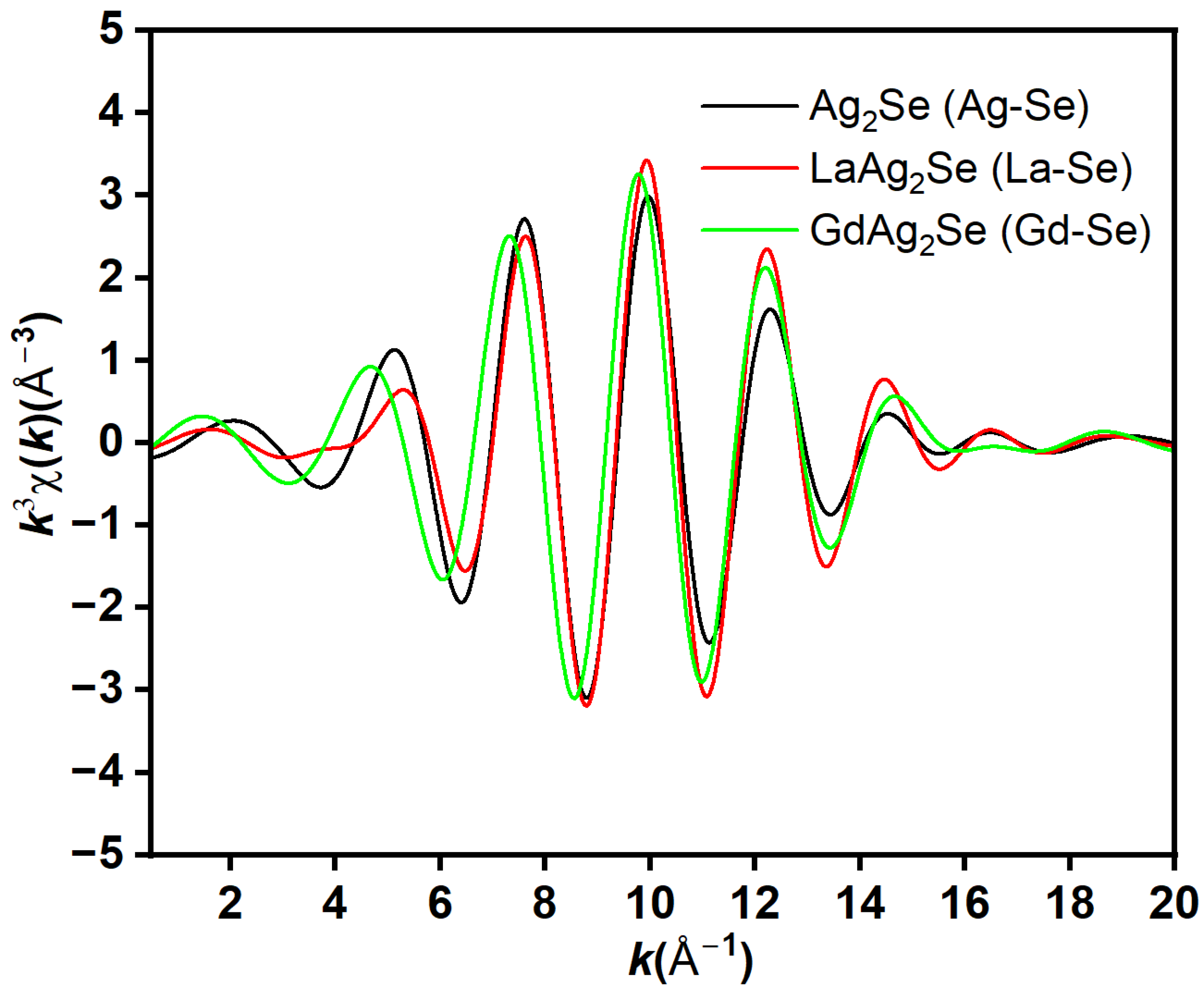
The k3-weighted EXAFS functions k3χ(k) of Ag2Se, LaAg2Se, and GdAg2Se (Figure 3) display comparable oscillation frequencies, suggesting that the fundamental local coordination around Se remains intact with the incorporation of La and Gd. Distinct differences in amplitude and phase of the oscillations are evident. In comparison to pristine Ag2Se, LaAg2Se and GdAg2Se exhibit a modulation of peak intensities within the 6–12 Å−1 range, indicating alterations in the back-scattering strength and static/disorder factors of the nearest M-Se shell. The observed phase shift in the extrema in the doped samples compared to Ag2Se indicates a change in the average M-Se bond length due to the substitution of Ag with the larger La3+ and smaller Gd3+ cations [29].
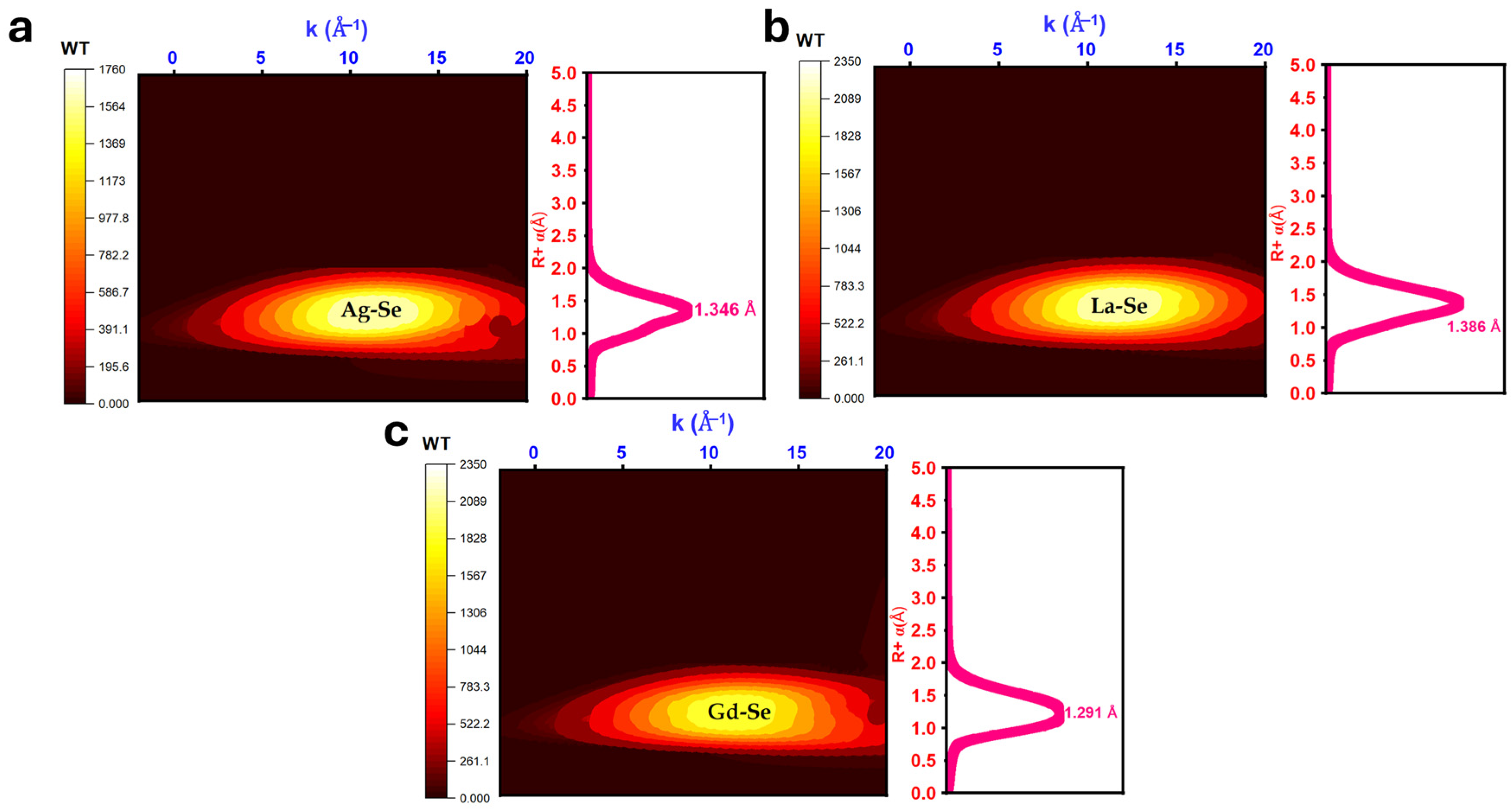
The wavelet transform (WT) analysis quantifies these trends (Figure 4a–c). All three samples exhibit a prominent WT intensity lobe at low R′ (~1–2 Å) and intermediate k (~7–10 Å−1), which corresponds to the first M-Se scattering shell. The maxima of the corresponding WT radial profiles are observed at R′~1.346 Å for Ag-Se, 1.386 Å for La-Se, and 1.291 Å for Gd-Se. While these values are phase-uncorrected and thus underestimate the absolute M-Se bond distances, the relative shifts hold significance. The substitution results in a slight shift in the maximum to higher R′, which aligns with a modest elongation of the La-Se bond attributed to the larger ionic radius of La3+. In contrast, Gd substitution causes the maximum to shift to lower R′, suggesting a contracted Gd-Se bond. The increased WT intensity observed in the doped samples, especially in GdAg2Se, indicates a more significant scattering contribution and a more distinct local M-Se environment. Overall, the combined k-space and WT analyses confirm that lanthanide doping does not disrupt the Ag2Se framework but subtly tunes the local M-Se bond lengths and scattering strength: La results in a marginally expanded M-Se coordination, whereas Gd leads to a more contracted configuration. The observed local structural distortions align with the distinct electronic structures derived from DFT and are anticipated to affect the charge-transfer properties and catalytic behavior addressed in subsequent sections [30].

3.3. Optical Properties

3.3.1. Dielectric Function

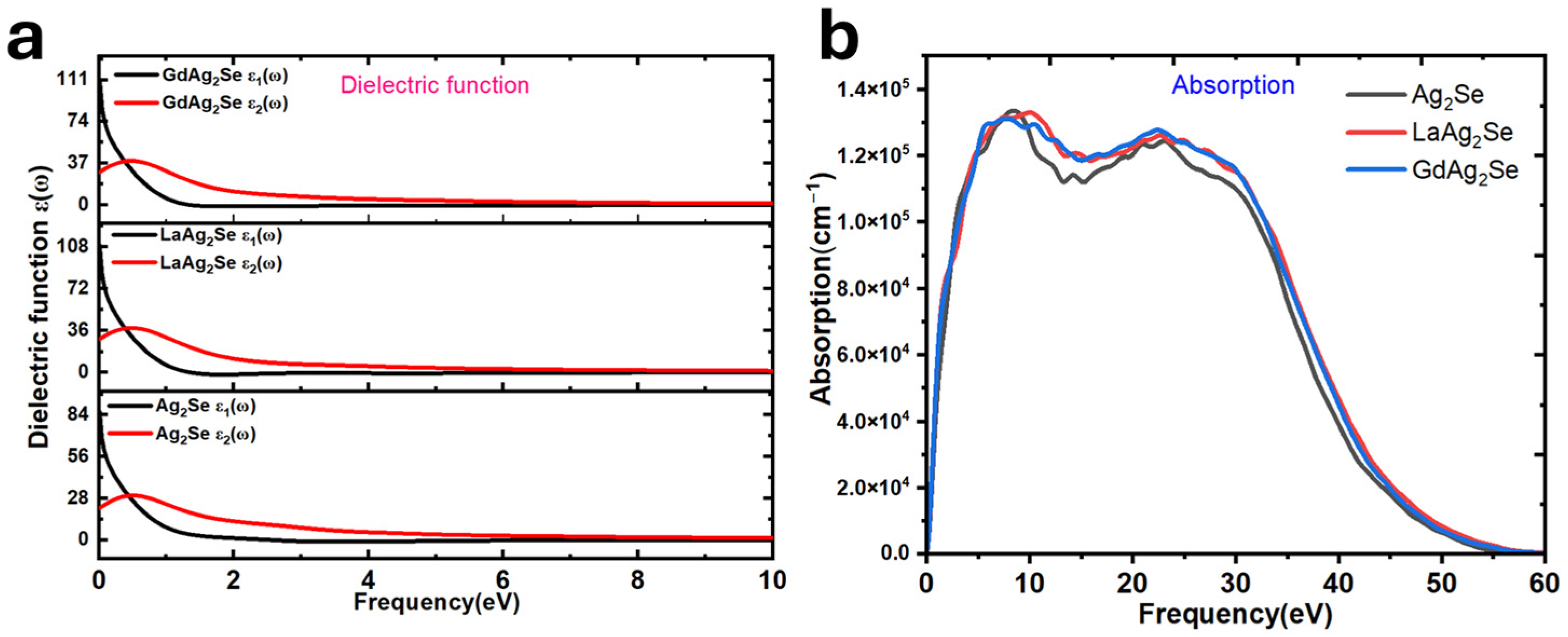
Figure 5a illustrates the real (ε1) and imaginary (ε2) components of the dielectric function for pure Ag2Se and La- and Gd-doped Ag2Se within the low-energy spectrum (0–10 eV). Pristine Ag2Se has a high static dielectric constant ε1(0) that diminishes swiftly with rising photon energy, indicating significant low-energy polarization linked to Ag–Se bonding. The ε2 spectrum has a significant low-energy peak resulting from interband transitions mostly influenced by Ag-4d and Se-4p states. The inclusion of La and Gd steadily enhances both ε1 and ε2 at low energies. The static dielectric constant ascends in the sequence Ag2Se < LaAg2Se < GdAg2Se, signifying enhanced electrical polarizability due to rare-earth doping. Correspondingly, ε2 demonstrates heightened intensity in the doped systems, with GdAg2Se displaying the most pronounced response, indicative of augmented low-energy optical transitions. At elevated photon energies, the dielectric functions of all systems diminish and converge, signifying that rare-earth replacement predominantly alters the low-energy dielectric response while maintaining the overall dispersion characteristics of the Ag2Se host [31].

3.3.2. Absorption

α(ω) = ω/c [2ε2(ω)/{ε1(ω)2 + ε2(ω)2}1/2]1/2
α(ω) is the optical absorption coefficient, ω is the angular frequency of the incident photon, c is the speed of light in vacuum, and ε1(ω) and ε2(ω) are the real and imaginary parts of the complex dielectric function, respectively. All samples exhibit significant absorption exceeding 1 × 105 cm−1 in the visible/near-UV region (Figure 5b), with peaks near (1.2–1.3) × 105 cm−1. The doped compounds consistently exhibit higher intensity than pristine Ag2Se, with LaAg2Se peaking at approximately 1.30–1.32 × 105 cm−1, and GdAg2Se achieving slightly elevated values of around 1.32–1.34 × 105 cm−1. In addition, the absorption spectra display a significant initial peak in the 7–8 eV range across all systems. The low-energy peak arises from interband transitions mostly influenced by Ag-4d/Se-4p hybridized states in pure Ag2Se. The integration of La and Gd results in a modest upward shift and increased intensity of this peak, signifying a dopant-induced alteration of the local electronic structure. The augmented absorption intensity indicates the incorporation of additional permitted transitions and improved polarization. The effect is more significant for GdAg2Se, aligning with its greater electronic disturbance noted in ELF and charge-density-difference investigations [32]. The enhanced absorption in the doped systems correlates with the increased dielectric response and indicates a greater number of permitted optical transitions facilitated by La and Gd. Doping significantly enhances dielectric strength and light absorption, with Gd exhibiting the most notable effect [33].

3.3.3. Reflectivity

R(ω) = (n + ik − 1)/(n + ik + 1)
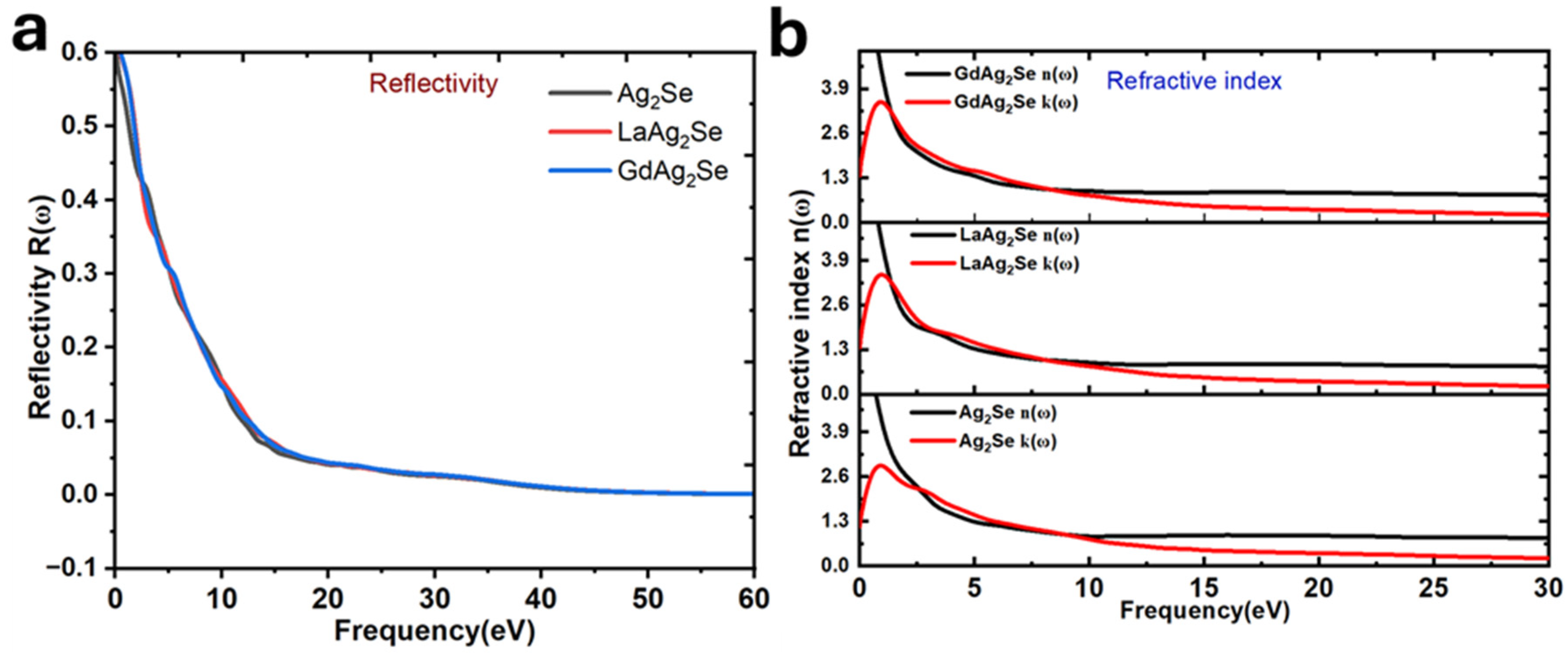
R(ω) is the reflectivity as a function of angular frequency ω, n is the real part of the complex refractive index, and k is the extinction coefficient (imaginary part of the refractive index). Reflectivity refers to the ability of a surface to reflect light or other electromagnetic waves. It is a critical parameter in various fields, including optics, materials science, and environmental studies, influencing phenomena such as visibility, energy efficiency, and thermal dynamics. All three samples exhibit a high reflectivity near 0.60 at low photon energy, followed by a steady decrease as photon frequency increases (Figure 6a). The reflectivity decreases to below 0.30 in the range of 8–10 eV and approaches nearly zero beyond 20 eV, signifying minimal reflection in the high-energy region. The curves for La- and Gd-doping closely align with the behavior of pristine Ag2Se, remaining slightly elevated in the low-energy region (<10 eV). This indicates that lanthanide substitution marginally improves optical reflection at low photon energies [34].

3.3.4. Refractive Index (n, k)

n(ω) = [1/2(ε1 + (ε12 + ε22)1/2)]1/2
k(ω) = [1/2(−ε1 + (ε12 + ε22)1/2)]1/2
n(ω) is the refractive index, k(ω) is the extinction coefficient, and ε1 and ε2 are the real and imaginary parts of the complex dielectric function, respectively. The refractive index plots indicate that the highest n values occur at low energies, peaking at approximately 3.8–4.0, followed by a continuous decline to around 1.0–1.2 at higher frequencies (Figure 6b). The extinction coefficient k attains a maximum near 2.5–3.0 before decreasing with energy. GdAg2Se exhibits the most significant peak in both n and k, followed by LaAg2Se, consistent with previous dielectric and absorption observations. The results indicate that Gd substitution marginally enhances light–matter interaction in the low-energy regime relative to pristine Ag2Se [35].

3.3.5. Optical Conductivity

σ(ω) = σ1(ω) + σ2(ω)
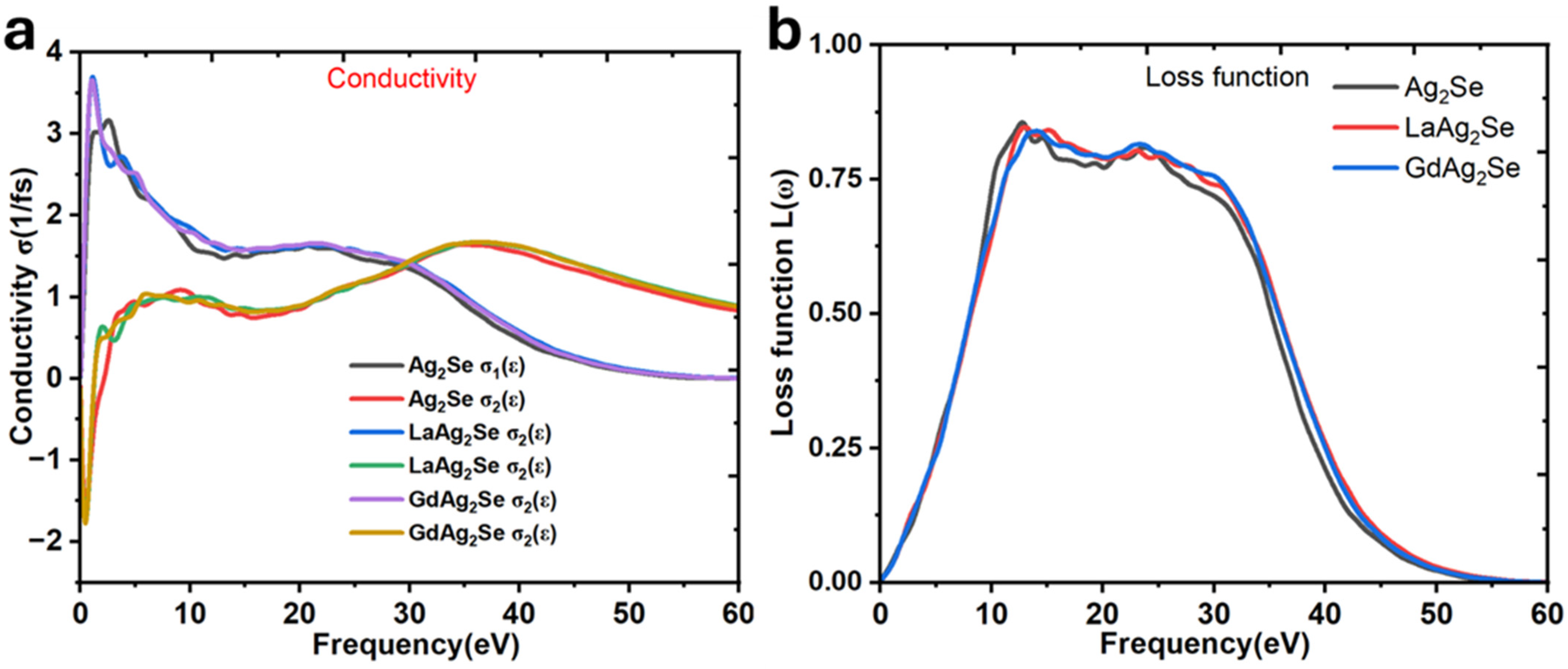
σ(ω) is the complex optical conductivity, while σ1(ω) and σ2(ω) represent its real and imaginary parts, respectively. The optical conductivity spectra for all samples exhibit a pronounced increase at low energy, attaining initial peaks near 3.0–3.5 (1/fs) within the initial few electron-volts (Figure 7a). Subsequent to this peak, σ exhibits a gradual decline, ultimately stabilizing at a moderate plateau between 1.5 and 2.0 (1/fs) within the mid-energy range of approximately 20 to 40 eV. The trend observed in lanthanide doping is consistent, with the early-energy maximum becoming more pronounced in GdAg2Se, suggesting that Gd enhances the low-energy electronic response. At elevated photon energies, all systems exhibit comparable conductivity values approaching approximately 1.0 (1/fs) [31].

3.3.6. Energy Loss Function

L(ω) =π−1 Im(ε(ω)−1) = ε2(ω)/ε1(ω)2 + ε2(ω)2
L(ω) is the electron energy loss function, ε(ω) is the complex dielectric function, Im denotes the imaginary part, and ε1(ω) and ε2(ω) are the real and imaginary parts of the dielectric function, respectively. The loss function curves demonstrate a distinct maximum near 0.80–0.85 at approximately 15–20 eV, aligning with the bulk plasmon resonance of Ag2Se (Figure 7b). Both doped materials exhibit comparable peak positions and intensities, with GdAg2Se and LaAg2Se positioned slightly above pristine Ag2Se, indicating a marginally enhanced collective electron oscillation. For energies exceeding approximately 25 eV, all samples exhibit a gradual decline towards zero, as anticipated. The impact of lanthanide substitution on the loss function is nuanced yet aligns with the minor enhancements noted in other optical properties [36].
In instances where direct experimental optical data exist, the computed optical response demonstrates strong qualitative agreement. The absorption coefficient magnitude (approximately 105 cm−1) and the prominent low-energy absorption features align with those documented for Ag2Se-based materials, while the semimetallic optical behavior at low photon energies corresponds with experimentally observed transport properties [37,38]. Despite the scarcity of comprehensive experimental optical spectra for rare-earth-doped β-Ag2Se, the anticipated increase in dielectric strength and absorption intensity with the incorporation of La and Gd aligns with trends reported in chemically modified Ag-Se systems, thereby reinforcing the validity of the current computational predictions [18,39].
Although the overall lattice constants remained unchanged upon La3+ and Gd3+ doping, this is expected for the low dopant concentration used in our DFT supercell. Heterovalent substitution primarily induces local structural distortions rather than the overall crystal lattice expansion or contraction because the Ag2Se framework can accommodate the dopant-induced charge imbalance and vacancy formation without substantial modification of the macroscopic unit-cell dimensions. Consistent with this behavior, Gd3+ produces a stronger local contraction of the Ag–Se coordination environment than La3+, which directly associates with the larger perturbations observed in the electronic density and optical response [40,41].

4. Conclusions

This research demonstrates that the incorporation of La and Gd into low-temperature Ag2Se alters the local coordination and electronic environment while maintaining the orthorhombic host structure. EXAFS and wavelet analysis indicated minor yet systematic alterations in the first M–Se shell, with La exhibiting slight expansion and Gd demonstrating slight contraction of the M–Se distance, aligning with their ionic radii and the electronic characteristics observed from ELF and charge density maps. The structural adjustments result in quantifiable optical differences: both doped systems exhibit an enhanced dielectric response, increased light absorption (up to approximately 1.32–1.34 × 105 cm−1), and elevated refractive index and conductivity in the low-energy range, with Gd demonstrating the most significant effect. The preservation of plasmon resonance and the overall optical profile of Ag2Se indicates that rare-earth elements modulate rather than disrupt the electronic and optical characteristics of the host. Rare-earth doping provides an effective method to enhance charge distribution and optical activity in Ag2Se. The findings indicate that Gd serves as an effective strategy for enhancing low-energy optical response, emphasizing its potential for future infrared and optoelectronic applications.

Author Contributions

S.P.S.: Conceptualization, Writing—review and editing, Writing—original draft, Visualization, Validation, Supervision, Software, Methodology, Investigation, Formal analysis, Data curation; S.C.: Validation, Resources, Project administration, Investigation, Funding acquisition. All authors have read and agreed to the published version of the manuscript.

Funding

This research was supported by the National Research Foundation of Korea (NRF-2023R1A2C1003669) and the Korea Environmental Industry & Technology Institute (KEITI) through “Technology Development Project for Biological Hazards Management in Indoor Air” Project, funded by Korea Ministry of Environment (MOE) (G232021010381).

Data Availability Statement

The original contributions presented in this study are included in the article. Further inquiries can be directed to the corresponding authors.

Acknowledgments

The authors gratefully acknowledge the high-performance computing (HPC) resources provided by Gachon University.

Conflicts of Interest

The authors declare that they have no known competing financial interests or personal relationships that could have appeared to influence the work reported in this paper. The funders had no role in the design of the study; in the collection, analyses, or interpretation of data; in the writing of the manuscript; or in the decision to publish the results.

References

  1. Yang, D.; Shi, X.-L.; Li, M.; Nisar, M.; Mansoor, A.; Chen, S.; Chen, Y.; Li, F.; Ma, H.; Liang, G.X.; et al. Flexible power generators by Ag2Se thin films with record-high thermoelectric performance. Nat. Commun. 2024, 15, 923. [Google Scholar] [CrossRef] [PubMed]
  2. Zheng, Y.; Yang, D.; Zhang, M.; Jia, Y.; Li, J.; Gou, W.; Wang, Y.; Melzi, B.; Yan, Y.; Tang, X. Rapid low-temperature densification of Ag2Se bulk material: Mass transfer through the dissociative adsorption reaction of Ag protrusions and Se saturated vapor. Nanotechnology 2024, 35, 315702. [Google Scholar] [CrossRef]
  3. Lim, K.H.; Xia, Y.; Xu, L.; Zhao, M.; Li, M.; Cheng, Y.; Mao, J.; Wang, S.; Chen, L.; Tsang, S.W. Thermoelectric performance in Ag2Se nanocomposites: The role of interstitial Ag and Pb orbital hybridization. Chem. Eng. J. 2025, 511, 162265. [Google Scholar] [CrossRef]
  4. Lasiw, J.; Kamwanna, T.; Pinitsoontorn, S. Fast, Simple, and Cost-Effective Fabrication of High-Performance Thermoelectric Ag2Se through Low-Temperature Hot-Pressing. ChemNanoMat 2024, 10, e202400319. [Google Scholar] [CrossRef]
  5. Lu, J.; Gao, L.; Song, S.; Li, H.; Niu, G.; Chen, H.; Qian, T.; Ding, H.; Lin, X.; Du, S. Honeycomb AgSe monolayer nanosheets for studying two-dimensional dirac nodal line fermions. ACS Appl. Nano Mater. 2021, 4, 8845–8850. [Google Scholar] [CrossRef]
  6. Liu, B.; Luo, M.; Liu, Z.; Guo, Y.; Fan, T.; Ming, C.; Li, Z.; Zhou, Z.; Qiu, P.; Chen, L. Ag2Se Polymorphs: Structure Determination and Variations in Thermoelectric Properties. Chem. Mater. 2025, 37, 9277–9285. [Google Scholar] [CrossRef]
  7. Biswas, R.K.; Pati, S.K. Computational approach to enhance thermoelectric performance of Ag 2 Se by S and Te substitutions. Phys. Chem. Chem. Phys. 2024, 26, 9340–9349. [Google Scholar] [CrossRef]
  8. Li, W.; Huang, L.; Li, X.; Li, H.; Li, L.; Huang, W. Adsorption of Gd3+ in water by N, S Co-doped La-based metal organic frameworks: Experimental and theoretical calculation. J. Solid State Chem. 2023, 321, 123864. [Google Scholar] [CrossRef]
  9. Aslandukov, A.; Jurzick, P.L.; Bykov, M.; Aslandukova, A.; Chanyshev, A.; Laniel, D.; Yin, Y.; Akbar, F.I.; Khandarkhaeva, S.; Fedotenko, T. Stabilization Of The CN35− Anion In Recoverable High-pressure Ln3O2 (CN3)(Ln= La, Eu, Gd, Tb, Ho, Yb) Oxoguanidinates. Angew. Chemie Int. Ed. 2023, 62, e202311516. [Google Scholar] [CrossRef]
  10. Kröger, F.A.; Vink, H.J. Relations between the Concentrations of Imperfections in Crystalline Solids. In Solid State Physics; Seitz, F., Turnbull, D., Eds.; Solid State Physics; Academic Press: Amsterdam, The Netherlands, 1956; Volume 3, pp. 307–435. [Google Scholar]
  11. Yatsenko, A.V.; Gloriozov, I.P.; Zhokhova, N.I.; Paseshnichenko, K.A.; Aslanov, L.A.; Ustynyuk, Y.A. Structure of lanthanide nitrates in solution and in the solid state: DFT modelling of hydration effects. J. Mol. Liq. 2021, 323, 115005. [Google Scholar] [CrossRef]
  12. Martinez-Flores, C.; Bolivar-Pineda, L.M.; Basiuk, V.A. Lanthanide bisphthalocyanine single-molecule magnets: A DFT survey of their geometries and electronic properties from lanthanum to lutetium. Mater. Chem. Phys. 2022, 287, 126271. [Google Scholar] [CrossRef]
  13. Zheng, B.; Fan, J.; Chen, B.; Qin, X.; Wang, J.; Wang, F.; Deng, R.; Liu, X. Rare-Earth Doping in Nanostructured Inorganic Materials. Chem. Rev. 2022, 122, 5519–5603. [Google Scholar] [CrossRef]
  14. Wang, D.; Xie, T.; Peng, Q.; Li, Y. Ag, Ag2S, and Ag2Se Nanocrystals:  Synthesis, Assembly, and Construction of Mesoporous Structures. J. Am. Chem. Soc. 2008, 130, 4016–4022. [Google Scholar] [CrossRef]
  15. Cao, T.; Shi, X.-L.; Hu, B.; Liu, S.; Lyu, W.; Li, M.; Wang, S.; Chen, W.; Liu, W.-D.; Moshwan, R.; et al. Indium-Doping Advances High-Performance Flexible Ag2Se Thin Films. Adv. Sci. 2025, 12, 2500364. [Google Scholar] [CrossRef] [PubMed]
  16. Zhao, J.-Y.; Chen, G.; Gu, Y.-P.; Cui, R.; Zhang, Z.-L.; Yu, Z.-L.; Tang, B.; Zhao, Y.-F.; Pang, D.-W. Ultrasmall Magnetically Engineered Ag2Se Quantum Dots for Instant Efficient Labeling and Whole-Body High-Resolution Multimodal Real-Time Tracking of Cell-Derived Microvesicles. J. Am. Chem. Soc. 2016, 138, 1893–1903. [Google Scholar] [CrossRef]
  17. Huang, W.; Zhu, Y.; Liu, Y.; Tao, S.; Yang, C.; Diao, Q.; Hong, Z.; Han, H.; Liu, L.; Xu, W. Long-range ordering and local structural disordering of BiAgSe 2 and BiAgSeTe thermoelectrics. Phys. Chem. Chem. Phys. 2021, 23, 24328–24335. [Google Scholar] [CrossRef]
  18. Azam, S.; Irfan, M.; Omran, S.B.; Khenata, R.; Adil, M.; Gul, B.; Muhammad, S.; Khan, G.; Haq, B.U.; Vu, T. V Electronic band structure and optical characteristic of silver lanthanide XAgSe2 (X= Eu and Er) dichalcogenides: Insight from DFT computations. Inorg. Chem. Commun. 2021, 129, 108586. [Google Scholar] [CrossRef]
  19. Smerigan, A.; Hoffman, A.S.; Ostervold, L.; Hong, J.; Perez-Aguillar, J.; Caine, A.C.; Greenlee, L.; Bare, S.R. Advanced EXAFS analysis techniques applied to the L-edges of the lanthanide oxides. Appl. Crystallogr. 2024, 57, 1913–1923. [Google Scholar] [CrossRef] [PubMed]
  20. Smerigan, A.; Biswas, S.; Vila, F.D.; Hong, J.; Perez-Aguilar, J.; Hoffman, A.S.; Greenlee, L.; Getman, R.B.; Bare, S.R. Aqueous Structure of Lanthanide–EDTA Coordination Complexes Determined by a Combined DFT/EXAFS Approach. Inorg. Chem. 2023, 62, 14523–14532. [Google Scholar] [CrossRef]
  21. Arif, H.; Tahir, M.B.; Sagir, M.; Alrobei, H.; Alzaid, M.; Ullah, S.; Hussien, M. Effect of potassium on the structural, electronic, and optical properties of CsSrF3 fluro perovskite: First-principles computation with GGA-PBE. Optik 2022, 259, 168741. [Google Scholar] [CrossRef]
  22. Shi, B.X.; Nicholls, R.J.; Yates, J.R. Accurate and efficient structure factors in ultrasoft pseudopotential and projector augmented wave DFT. Phys. Rev. B 2023, 108, 115112. [Google Scholar] [CrossRef]
  23. Ahmad, S.; Khan, A.Z. Investigation of Optoelectronic and Thermoelectric Properties of Gd-Doped Sr2MgGe2O7: A DFT+ U+ SOC Study for Exploring High-Performance LED Phosphors. J. Phys. Chem. Solids 2025, 207, 112898. [Google Scholar] [CrossRef]
  24. Sun, H.; Jiang, H. Combined DFT and wave function theory approach to excited states of lanthanide luminescent materials: A case study of LaF3: Ce3+. J. Chin. Chem. Soc. 2023, 70, 604–617. [Google Scholar] [CrossRef]
  25. Theprattanakorn, D.; Kaewmaraya, T.; Pinitsoontorn, S. Boosting thermoelectric efficiency of Ag2Se through cold sintering process with Ag nano-precipitate formation. Int. J. Miner. Metall. Mater. 2024, 31, 2760–2769. [Google Scholar] [CrossRef]
  26. Gale, J.D. Simulating the Crystal Structures and Properties of Ionic Materials From Interatomic Potentials. Rev. Mineral. Geochem. 2001, 42, 37–62. [Google Scholar] [CrossRef]
  27. Kim, J.; Hwang, A.; Lee, S.-H.; Jhi, S.-H.; Lee, S.; Park, Y.C.; Kim, S.; Kim, H.-S.; Doh, Y.-J.; Kim, J.; et al. Quantum Electronic Transport of Topological Surface States in β-Ag2Se Nanowire. ACS Nano 2016, 10, 3936–3943. [Google Scholar] [CrossRef]
  28. Kong, B.; Zeng, T.-X.; Wu, Y.-G.; Fu, Z.-J.; Zhou, Z.-W. Ab initio GGA+ U investigations of the electronic properties and magnetic orderings in Mn, Gd doped ZB/WZ structural CdSe. Comput. Mater. Sci. 2018, 142, 14–24. [Google Scholar] [CrossRef]
  29. Finzel, J.; Sanroman Gutierrez, K.M.; Hoffman, A.S.; Resasco, J.; Christopher, P.; Bare, S.R. Limits of Detection for EXAFS Characterization of Heterogeneous Single-Atom Catalysts. ACS Catal. 2023, 13, 6462–6473. [Google Scholar] [CrossRef]
  30. Kompch, A.; Sahu, A.; Notthoff, C.; Ott, F.; Norris, D.J.; Winterer, M. Localization of Ag dopant atoms in CdSe nanocrystals by reverse Monte Carlo analysis of EXAFS spectra. J. Phys. Chem. C 2015, 119, 18762–18772. [Google Scholar] [CrossRef]
  31. Vu, T.V.; Lavrentyev, A.A.; Gabrelian, B.V.; Parasyuk, O.V.; Ocheretova, V.A.; Khyzhun, O.Y. Electronic structure and optical properties of Ag2HgSnSe4: First-principles DFT calculations and X-ray spectroscopy studies. J. Alloys Compd. 2018, 732, 372–384. [Google Scholar] [CrossRef]
  32. Selvam, S.P.; Cho, S. EXAFS and spectroscopic insights into Mn, Tc, and Re-doped phthalocyanines: A multifaceted DFT study of electronic and optical properties. Surf. Interfaces 2025, 56, 105610. [Google Scholar] [CrossRef]
  33. Ranjan, P.; Kumar, P.; Surolia, P.K.; Chakraborty, T. Structure, electronic and optical properties of chalcopyrite semiconductor AgTiX2 (X= S, Se, Te): A density functional theory study. Thin Solid Film. 2021, 717, 138469. [Google Scholar] [CrossRef]
  34. Ullah, S.; Din, H.U.; Murtaza, G.; Ouahrani, T.; Khenata, R.; Omran, S. Bin Structural, electronic and optical properties of AgXY2 (X= Al, Ga, in and Y= S, Se, Te). J. Alloys Compd. 2014, 617, 575–583. [Google Scholar] [CrossRef]
  35. Chang, Y.H.R.; Jiang, J.; Yeoh, K.H.; Tuh, M.H.; Chiew, F.H. Prediction of stable silver selenide-based energy materials sustained by rubidium selenide alloying. New J. Chem. 2022, 46, 22050–22063. [Google Scholar] [CrossRef]
  36. Tse, G. The electronic, optical, and vibrational properties of Ag3X (X= S, Se) with density functional theory. Mod. Phys. Lett. B 2023, 37, 2350034. [Google Scholar] [CrossRef]
  37. Kadim, A.M.; Abass, K.H. AP01038 Ag2Se Nanoparticles Synthesis by Co-Precipitation Method: Characterization and Antimicrobial Evaluation. Iraqi J. Appl. Phys. 2025, 21, 528–534. [Google Scholar]
  38. Ji, D.; Li, B.; Li, X.; AlTakrori, H.H.; Thirumalraj, B.; Rezeq, M.; Cantwell, W.; Zheng, L. Ultrahigh Seebeck Coefficient and Power Factor in Low-Temperature Fused Ag2Se Films via Superionic-Driven Plastic Deformation. Adv. Sci. 2025, 12, e08381. [Google Scholar] [CrossRef]
  39. Ding, Q.; Zhao, J.; Zhang, H.; Li, C.; Sun, M.; Chen, C.; Lin, H.; Xu, C.; Kuang, H.; Xu, L. Enantiomeric NIR-II Emitting Rare-Earth-Doped Ag2Se Nanoparticles with Differentiated In Vivo Imaging Efficiencies. Angew. Chem. 2022, 134, e202210370. [Google Scholar] [CrossRef]
  40. Xu, P.; Wang, H.; Ren, L.; Tu, B.; Wang, W.; Fu, Z. Theoretical study on composition-dependent properties of ZnO·nAl2O3 spinels. Part II: Mechanical and thermophysical. J. Am. Ceram. Soc. 2021, 104, 6455–6466. [Google Scholar] [CrossRef]
  41. Xu, P.; Wang, H.; Ren, L.; Tu, B.; Wang, W.; Fu, Z. Theoretical study on composition-dependent properties of ZnO·nAl2O3 spinels. Part I: Optical and dielectric. J. Am. Ceram. Soc. 2021, 104, 5099–5109. [Google Scholar] [CrossRef]
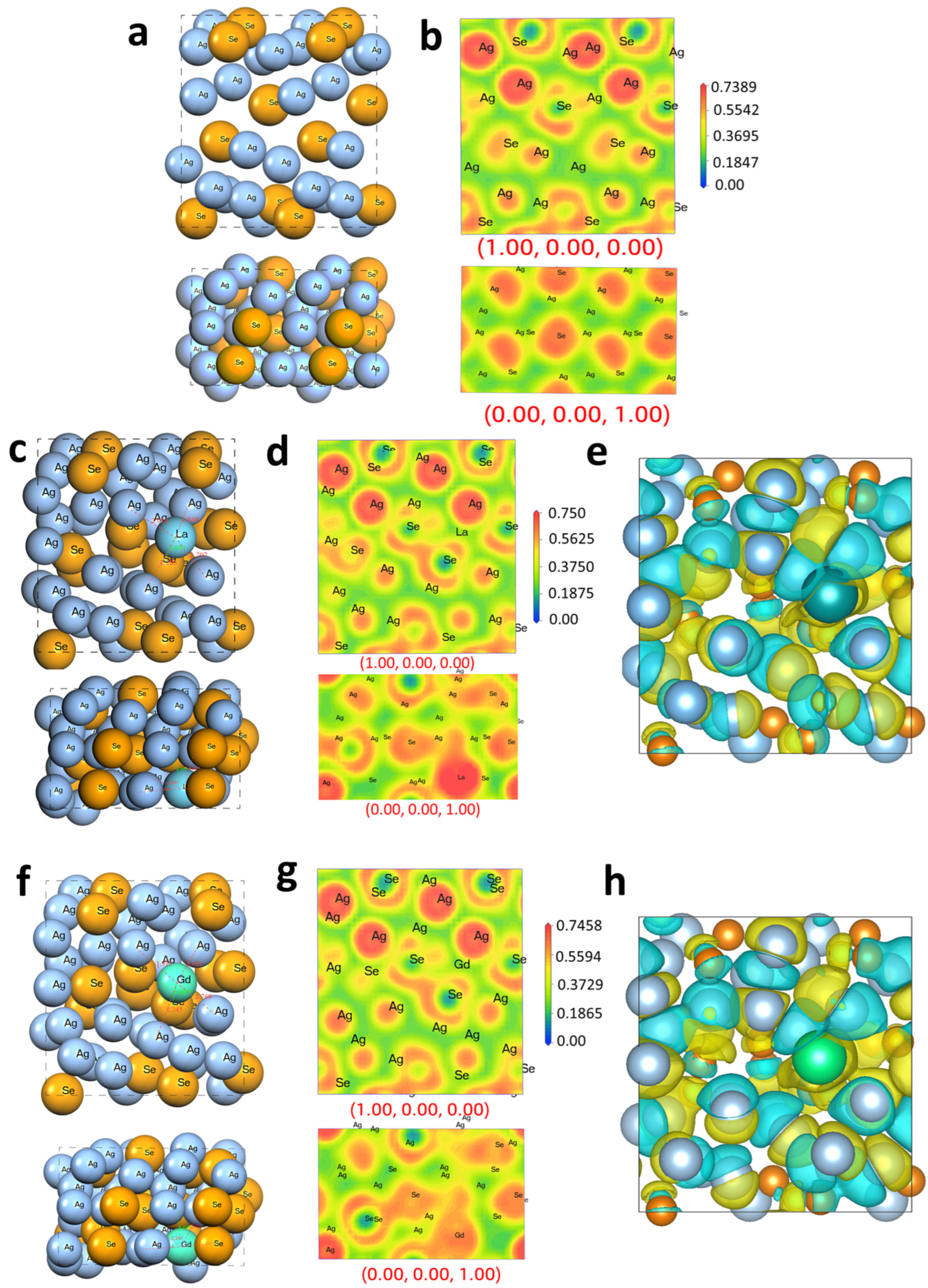
Figure 1. (a,c,f) Relaxed crystal structure of orthorhombic Ag2Se, LaAg2Se and GdAg2Se viewed along the (100) and (001) directions, showing the arrangement of Ag and Se atoms in the low-temperature phase (bond lengths are in Å), (b,d,g) Corresponding electron localization function (ELF) plots recorded at (100) and (001) planes. Higher ELF values (red/yellow) indicate increased electron localization around Se and locally around La or Gd, confirming dopant-induced charge redistribution. Note the enhanced localization at La-Se and especially Gd-Se regions relative to Ag-Se. (e) and (h) Charge-density-difference isosurfaces highlighting the polarization produced by La and Gd doping, respectively. The isosurface value of ±0.039 e Å−3 was applied to visualize the polarization effectively, where positive and negative values are associated with the charge accumulation and depletion as configured in VESTA. Enhanced charge accumulation at the dopant-Se interface indicates partial hybridization between La/Gd 4f–5d and Se 4p orbitals, leading to locally modified bonding states within the Ag2Se host lattice.
Crystals 16 00004 g001
Figure 2. Total density of states (DOS) of pristine Ag2Se and its La- and Gd-doped counterparts obtained from first-principles calculations. The Fermi level is set to 0 eV (vertical dashed line), and the near EF region is indicated by a dashed circle.
Crystals 16 00004 g002
Figure 3. k3-weighted EXAFS χ(k) spectra of Ag2Se, LaAg2Se and GdAg2Se. The spectra show comparable oscillation patterns with dopant-induced variations in peak amplitude and phase, indicating subtle changes in the nearest M–Se coordination environment upon La and Gd incorporation.
Crystals 16 00004 g003
Figure 4. Wavelet transform magnitude plots and corresponding radial profiles for (a) Ag-Se, (b) La-Se, and (c) Gd-Se. The main intensity lobe occurs at low R′ and intermediate k, corresponding to the first M-Se coordination shell. The peak positions (Ag–Se~1.346 Å, La–Se~1.386 Å, and Gd–Se~1.291 Å) indicate a slight bond expansion for La and contraction for Gd relative to pristine Ag2Se.
Crystals 16 00004 g004
Figure 5. (a) Real and imaginary components of the dielectric function ε(ω) for Ag2Se, LaAg2Se, and GdAg2Se showing enhanced low-energy response in the doped systems, (b) Optical absorption spectra indicating increased absorption intensity for La and Gd substitution compared to pristine Ag2Se.
Crystals 16 00004 g005
Figure 6. (a) Calculated reflectivity spectra of Ag2Se, LaAg2Se and GdAg2Se showing a gradual decrease in R(ω) with increasing photon energy, (b) Refractive index and extinction coefficient plots indicating enhanced low-energy optical response for the doped systems.
Crystals 16 00004 g006
Figure 7. (a) Optical conductivity σ(ω) of Ag2Se, LaAg2Se and GdAg2Se showing enhanced low-energy response for the doped systems, (b) Energy loss function spectra displaying a common plasmon resonance feature with slightly increased intensity for La and Gd substitution.
Crystals 16 00004 g007
Disclaimer/Publisher’s Note: The statements, opinions and data contained in all publications are solely those of the individual author(s) and contributor(s) and not of MDPI and/or the editor(s). MDPI and/or the editor(s) disclaim responsibility for any injury to people or property resulting from any ideas, methods, instructions or products referred to in the content.