Article

Calculation and Simulation of the Mechanical Properties and Surface Structures for η′ Precipitate in Al-Zn-Mg-Cu Alloys

by
Jian-Gang Yao
1,*,
Ming-Chun Zhao
1,2 and
Deng-Feng Yin
1,2
1
College of Technology and Date, Yantai Nanshan University, Yantai 265713, China
2
School of Materials and Science, Central South University, Changsha 410083, China
*
Author to whom correspondence should be addressed.
Crystals 2026, 16(1), 33; https://doi.org/10.3390/cryst16010033 (registering DOI)
Submission received: 30 November 2025 / Revised: 28 December 2025 / Accepted: 29 December 2025 / Published: 30 December 2025
(This article belongs to the Section Crystalline Metals and Alloys)

Abstract

Existing experiments have shown that in Al-Zn-Mg-Cu alloys, solute Cu, when substituting for Al atoms, can enter the interior of η precipitate, changing its composition significantly, but the mechanical properties of the η compound containing dissolved Cu has not yet been explored. In this study, we conducted a theoretical prediction to investigate the effect of dissolved Cu on the mechanical properties of the η compound (Al4Mg2Zn3). The results indicate that Cu, substituted for Al, tends to reduce the volume, increase the hardness, and raise the Debye temperature of the η crystal. Although dissolved Cu weakly increases the brittleness of the crystal, the η still retains its ductile nature. Additionally, we simulated the surface structure of the (0001) surface and discovered that there are five distinct surface terminations, namely Al1, Al2, Mg1, Mg2, and Zn. Exact calculations reveal that the surface energies of different terminations are influenced not only by the electronic structure of the surface atoms but also by the distance between the surface layer and the sub-surface layer of the corresponding surface supercell.

1. Introduction

The 7xxx (Al-Zn-Mg-Cu) alloy is characterized by its low density and high strength, making it widely used in aerospace and rail transit applications [1,2,3,4,5]. As an age-hardening alloy, it can precipitate a large number of fine and dispersed η nanoparticles during peak aging. These precipitates effectively hinder dislocation movement, which results in tensile strength and yield strength exceeding 500 MPa in most 7xxx alloys [6,7,8]. Currently, ultra-high strength aluminum alloys with yield strengths above 600–650 MPa have also been developed, this research is primarily performed based on the Al-Zn-Mg-Cu alloys [9,10]. Compared to precipitates such as the L12 phase in other series of Al alloys, the η phase has a more complex atomic structure, and its composition varies widely, ranging from MgZn2 [11,12], Mg2Zn3Al4 [13,14], Mg2Zn5−xAl2þx [15], Mg2Zn5Al2, and Mg2Zn7Al [16] to Mg4Zn11Al [17]. This has led to differing reports regarding its composition and structure. Cao et al. used high-resolution transmission electron microscopy (HRTEM) in conjunction with first-principles calculations to confirm its structure [18]. They found that the composition of the η phase conforms to the Al4Mg2Zn3 stoichiometry and exhibits a hexagonal structure with the lowest formation energy. Specifically, the interface structure derived from the calculated η structure is consistent with the experimental HAADF-STEM characterization at the peak-aging state.
Nevertheless, the composition of the η phase is not completely in conformity with a specific stoichiometry, and its components tend to vary with the added elements, such as Cu, and heat treatment conditions. Cu is an important alloying element in the 7xxx series alloys. It not only enhances alloy strength through solid solution strengthening but also synergistically interacts with Mg and Zn to promote the precipitation and refinement of strengthening phases. Furthermore, it can increase the number density and improve the thermal stability of precipitates such as the η phase. Existing experiments have shown that certain Cu atoms can enter the interior of the bulk η , substituting any atoms, including Al, Mg, and Zn [19]. This inevitably has a profound influence on its thermodynamic properties. However, quantitative research on this effect remains unclear so far, and it is challenging to explore this change experimentally.
Additionally, Cao et al. seem to have omitted a type of Mg-termination in the constructed η (0001)/Al (111) interface supercell [18], suggesting a missing investigation of the surface structure of the η phase. In fact, no reports regarding the exploration of the surface properties of intermetallic η could be found up to now.
In this study, we address two key issues using first-principles calculations. First, we investigate the elastic properties of Cu-doped η phase, focusing specifically on the substitution of Al sites by solute Cu atoms. Secondly, we conduct an in-depth analysis of the (0001) surface of the η phase, exploring its structure, stability, and electronic properties. It is hoped that our findings will provide a valuable reference for further research on the Al/ η interface properties of 7xxx (Al-Zn-Mg-Cu) alloys.

2. Calculation Methods

All calculations were performed using the VASP (version 5.4) code [20] with periodic boundary conditions and a plane-wave basis set. The electron–ion interactions were described using the projector augmented wave (PAW) method within the frozen-core approximation [21].
Before calculating the elastic and surface properties, we first evaluated various exchange–correlation functionals to assess their accuracy in predicting lattice properties of the bulk material. The functionals tested included the local-density approximation (LDA) [22], the generalized gradient approximation (GGA) with the Perdew–Wang-91 (PW91) functional [23], and the Perdew–Burke–Ernzerhof (PBE) functional [24]. This evaluation was performed by fitting energy–volume data to Murnaghan’s equation of state. Based on this comparison, the PBE functional was selected for all subsequent calculations.
Convergence tests were also conducted for both k-mesh density and plane-wave cutoff energy. For the elastic calculations, a 14 × 14 × 5 k-point grid was employed, while a 7 × 4 × 1 grid was used for structure relaxation of the (Al4Mg2Zn3) (0001) surface supercells. A plane-wave cutoff energy of 450 eV was applied throughout this work, which was found to be sufficient for the system under investigation. The convergence criteria for structural optimization were set to 10−5 eV/atom for total energy changes and 0.01 eV/Å for the Hellmann–Feynman forces per atom.

3. Results and Discussion

3.1. Elastic Properties for η (Al4Mg2Zn3) with Solubilized Cu Atom

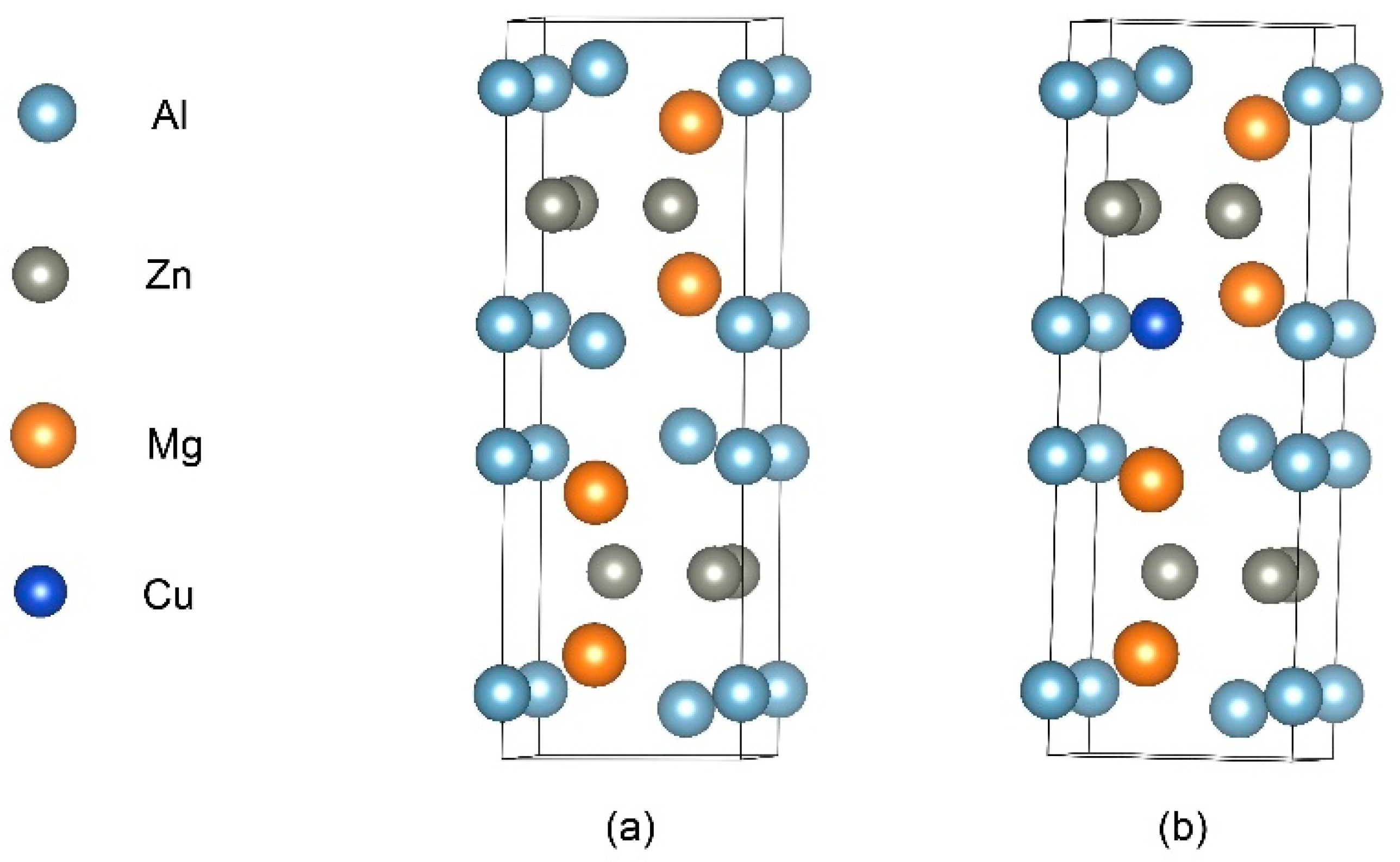
The pure η crystal, which has a hexagonal structure (space group: P63/mmc) as reported by Cao et al. [18], is shown in Figure 1a. This phase (Al4Mg2Zn3) is a typical layered structure crystal, whose unit cell comprises two units of Al/Mg/Zn/Mg/Al atomic layers. These two units exhibit a centrosymmetric structure. This lamellar structure underlies its role as the key strengthening phase in Al-Zn-Mg-Cu alloys, impeding dislocation cutting through the layers and thus producing a significant precipitation strengthening effect. Copper (Cu) can substitute for aluminum (Al) atoms at two different sites. However, as predicted by Cao et al., the Al2 site, as labeled in Figure 1b, is more likely to be occupied by Cu [19]. In this study, we only consider the changes in elastic properties when Cu is located at the Al2 site. Note that the symmetry of the η crystal decreases when Cu is solubilized, and its calculated elastic constants will differ from those of the pure η crystal. The η crystal (hexagonal structure) corresponds to five independent elastic constants: C 11 , C 12 , C 13 , C 33 , and C 44 . However, when Cu is located at the Al2 site, the space group changes to P3m1 (trigonal structure). Due to this change in symmetry, the independent elastic constants become C 11 , C 12 , C 13 , C 14 , C 33 , and C 44 .
The mechanical properties of a given crystal are related to its bulk modulus ( B ), shear modulus ( G ), and Young’s modulus ( E ). Here, we employed the Hill model [25,26] to perform the relevant calculations. Both the bulk modulus ( B ) and shear modulus ( G ) can be obtained by averaging the results calculated from the Voigt ( B V / G V ) and Reuss ( B R / G R ) models. The formulas for calculating them are shown as Equations (1)–(4) for the pure η , and Equations (6)–(9) for the Cu-doped η , due to their different symmetries. Young’s modulus ( E ) can be derived from Equation (5). In addition, the elastic constants ( C 11 , C 12 , C 13 , C 33 and C 44 ) for the pure crystal and ( C 11 , C 12 , C 13 , C 33 , and C 44 ) for the crystal with the dissolved Cu were first calculated before determining B , G , and E . All calculated values are presented in Table 1 and Table 2.
B V = 1 9 [ 2 ( C 11 + C 12 ) C 33 + 4 C 13 ]
G V = 1 30 ( 7 C 11 5 C 12 4 C 13 + 2 C 33 + 12 C 44 )
B R = ( C 11 + C 12 ) C 33 2 C 13 2 C 11 + C 12 4 C 13 + 2 C 33
G R = [ 5 ( C 11 + C 12 ) 2 C 13 2 ] C 44 C 66 [ 6 B V C 44 C 66 + ( C 33 ( C 11 + C 12 ) 2 C 13 2 ) ( C 44 + C 66 ) ]
E = 9 B G 3 B + G
B V = 1 9 ( 2 C 11 + 2 C 12 + 4 C 13 + C 33 )
G V = 1 30 ( 7 C 11 5 C 12 4 C 13 + 2 C 33 + 12 C 44 )
B R = ( C 11 + 2 C 12 ) C 33 2 C 13 2 C 11 + C 12 4 C 13 + 2 C 33
G R = 15 2 2 C 11 + 2 C 12 + 4 C 13 + C 33 C 33 ( C 11 + C 12 ) 2 C 13 2 + 3 C 11 3 C 12 + 6 C 44 C 44 ( C 11 C 12 ) 2 C 14 2
ν = 3 B 2 G 2 ( 3 B + G )
Assessing the stability of a crystal is a prerequisite for performing various calculations. Given this, stability criteria are also provided [27], as seen in Equations (11)–(13) for pure η , and Equations (14)–(17) for Cu-doped η .
C 11 > C 12
2 C 13 2 < C 33 ( C 11 + C 12 )
C 44 > 0
C 11 C 12 > 0
2 C 13 2 < C 33 ( C 11 + C 12 )
2 C 14 2 < C 44 ( C 11 C 12 )
C 44 > 0
Based on the calculated results obtained from the above equations, it is evident that both the pure and Cu-doped crystals exhibit structural stability. This finding also confirms the accuracy of the lattice structure characterized by Cao et al. [18].
Generally, the hardness of a crystal is closely related to its shear modulus ( G ) and Young’s modulus ( E ) [28]. Typically, higher values of these moduli correspond to greater hardness. Additionally, there is a linear relationship between the elastic constants C 44 of a crystal and its hardness. Crystals with higher hardness usually have larger values of the constant C 44 . As shown in Table 1 and Table 2, the entrance of Cu to the crystal increases its hardness. This is attributed to the comparatively larger values of G , E , and C 44 obtained for the Cu-solubilized crystal. High-modulus η precipitates are more effective at hindering dislocations, thereby enhancing alloy strength significantly.
According to Pugh’s criterion, if the G / B is larger than 0.57~0.6, the corresponding material should be brittle. Otherwise, it exhibits ductility [29]. It is clear that the η compounds investigated here, whether Cu is solubilized or not, are ductile materials. The entrance of Cu atoms only reduces the degree of ductility to varying extents, but it cannot fundamentally change the essential ductility. In fact, these results are also verified by the Poisson’s ratio, as shown in Equation (10), where a material with a Poisson’s ratio value of approximately 1/3 is generally regarded as ductile.
The Debye temperature, as an important representation of the material properties for a given compound, is closely associated with several physical quantities, such as the interparticle potential between atoms and the bulk modulus of crystals. Hence, we calculated the Debye temperature based on the expression below [30].
Θ D = h k B [ 3 n 4 π ( N A ρ M ) ] 1 3 v m
where h is the Planck constant, N A is the Avogadro number, M is the molecular weight, and ρ is the density. The average sound velocity v m is defined as follows [31]:
v m = [ 1 3 ( 2 v s 3 + 1 v l 3 ) ] 1 3
v s = ( G ρ ) 1 2
v l = ( B + 3 G 4 ) 1 2
where B is the bulk modulus, G is the shear modulus, v l is the compressional velocity, and v s is the shear sound velocity.
The values of the Debye temperature for pure and Cu-doped η are, as we predicted using the above equations, 322.6 K and 338.6 K, respectively.
As we know, a higher Debye temperature reveals stronger interactions between atoms in a crystal [32]. Clearly, solubilized Cu enhances these interactions, which can be attributed to changes in volume. According to the calculated results, the unit cell volumes of the crystal before and after Cu doping are 332.60 Å3 and 316.66 Å3, respectively. The substitution of Al by solute Cu reduces the volume of the crystal and strengthens the interactions between all atoms, thereby keeping the lower Coulomb energy of the corresponding crystal. This is characterized by the higher hardness and Debye temperature of the crystal with the solubilized Cu atom, as analyzed in the above discussion.

3.2. Surface Properties of (0001) Surface for η (Al4Mg2Zn3) Crystal

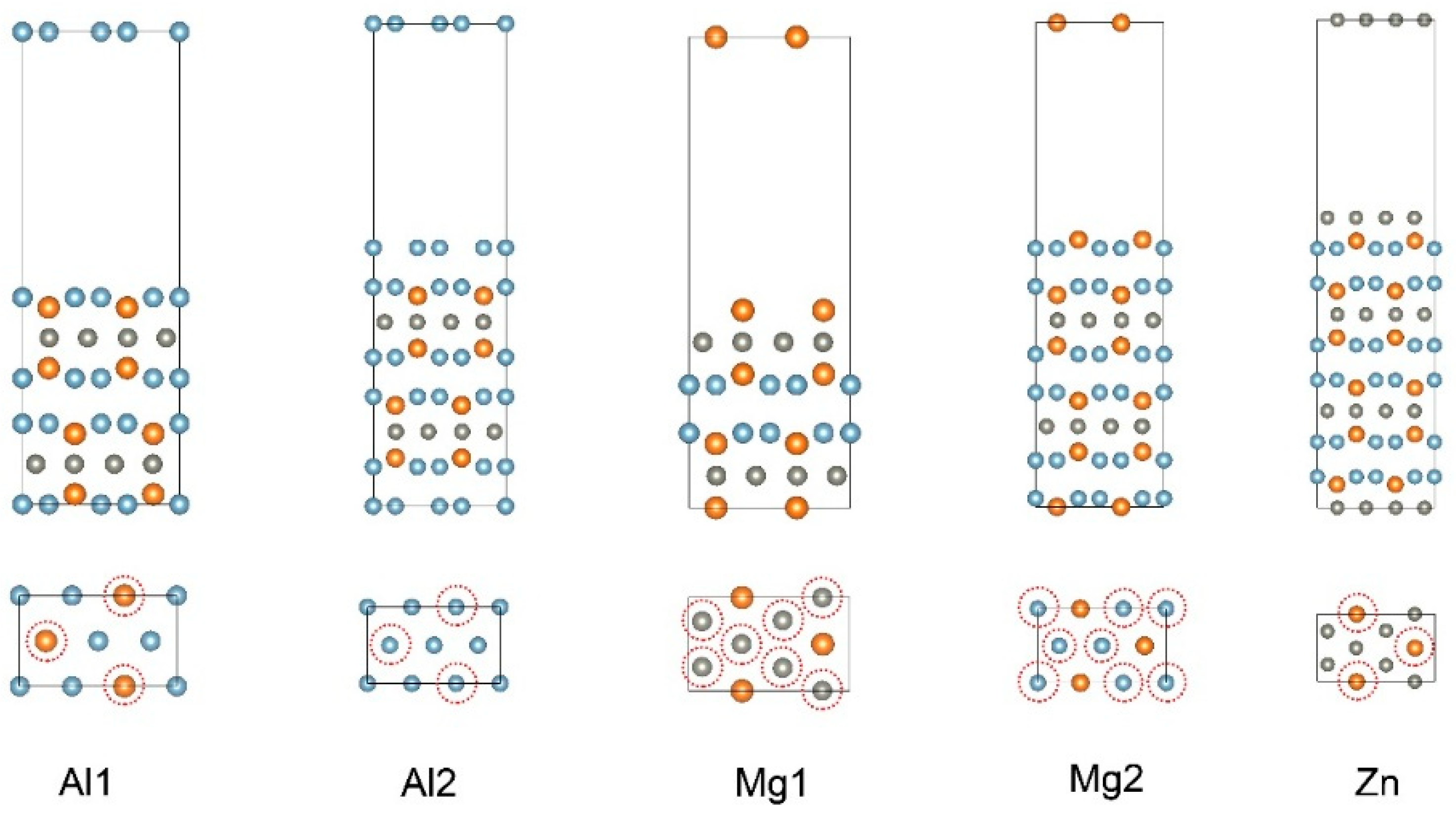
As shown in Figure 2, η (0001) surface has five types of terminations, which are labeled as Al-1, Al-2, Mg-1, Mg-2, and Zn terminations. Here, we used Equation (22) to calculate their surface energies [33,34].
E s u r f ( X ) = E c l e + E r e l ( X )
where E c l e and E r e l ( X ) are the cleaved energy and relaxed energy, respectively. X denotes the Al-1, Al-2, Mg-1, Mg-2, and Zn terminations.
Cleaved energy E c l e is given as follows:
E c l e = [ E s l a b u n r e l ( A l 1 ) + E s l a b u n r e l ( A l 2 ) + E s l a b u n r e l ( M g 1 ) + E s l a b u n r e l ( M g 2 ) + E s l a b u n r e l ( Z n ) 12 E b u l k ] / 10
where E s l a b u n r e l ( A l 1 ) , E s l a b u n r e l ( A l 2 ) , E s l a b u n r e l ( M g 1 ) , E s l a b u n r e l ( M g 2 ) , and E s l a b u n r e l ( Z n ) are the static energies without structure relaxation of a surface supercell with different surface terminations, respectively. E b u l k denotes the free energy of a η unit cell. 12 indicates that the total number of all Al, Mg, and Zn atoms included in these five surface supercells is 60 times the atomic numbers for a η unit cell, while 10 shows that five non-stoichiometric supercells have ten surfaces in total.
Relaxed energy E r e l ( X ) is defined as Equations (3)–(24).
E r e l ( X ) = [ E s l a b r e l ( X ) E s l a b u n r e l ( X ) ] / 2
where E s l a b r e l ( X ) is the energy after structure relaxation (including reconstructions) for a given surface supercell, and 2 indicates that each non-stoichiometric supercell has two surfaces.
The surface energies of different surface terminations were calculated using the above equations, and the values are shown in Table 3. It can be seen that the Al1 termination has a relatively large surface energy, exceeding 0.8 J/m2, while the Al2 termination exhibits the smallest surface energy, around 0.37 J/m2. These results are likely related to several factors. Firstly, the interlayer spacing d12 between the surface and sub-surface layers of the corresponding surface supercell significantly influences the surface energy, as shown in Table 3. The fundamental origin of surface energy is associated with unpaired electrons at the surface layer. When sub-surface atoms are positioned unusually close to the surface, as indicated by a small interlayer spacing d12, their electrons effectively contribute to the surface electron count, thereby increasing the surface energy. This effect is evident for the Al1 termination (d12 = 0.03) and is even more pronounced for the Mg2 termination, which exhibits the smallest interlayer spacing (d12 = 0.009). In other words, under the condition of the same surface layer atoms, the surface energy is relevant to the distance between layers.
Additionally, the electronic structure of the outermost layer also affects the surface energy. For example, although the first layer of the Zn termination has more atoms, its surface energy is relatively small, around 0.5 J/m2. This can be attributed to the closed-shell configuration of the Zn atom, which appears to have fewer unpaired electrons compared to the Al atom.
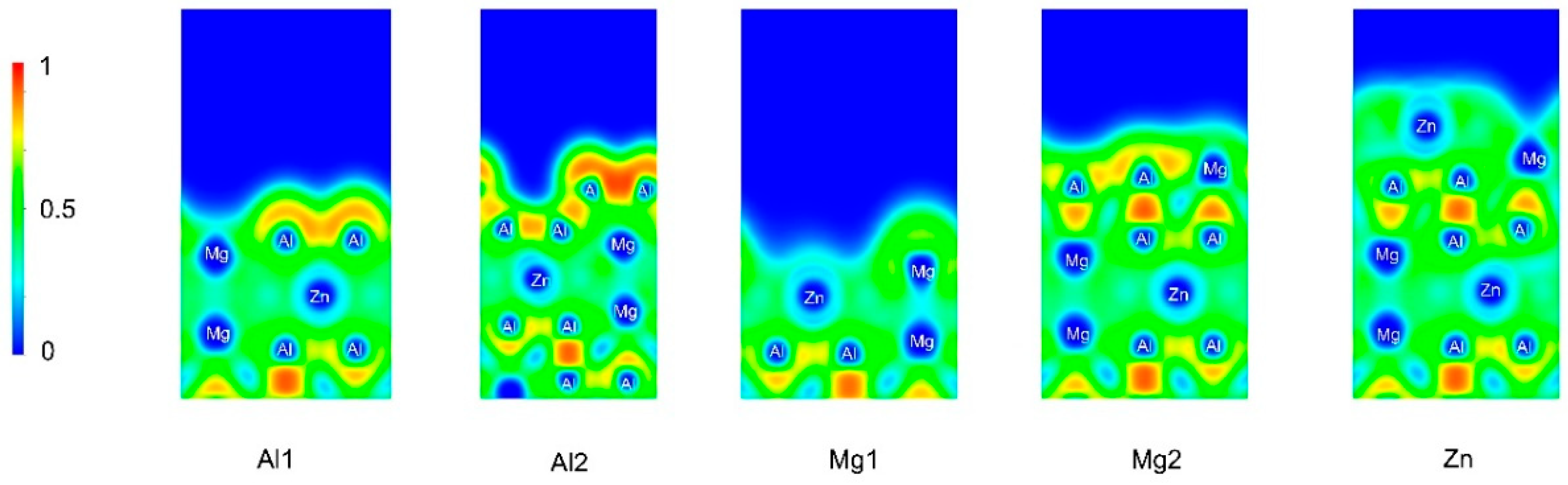
The electron localization function (ELF) was also calculated for different surface terminations, as defined by Equation (25) [35,36,37], to visualize the surface electronic structure.
E L F ( r ) = 1 1 + D ( r ) D h ( r ) 2
where D ( r ) is the degree of localized electrons in the actual system, while D h ( r ) is the kinetic energy density of a homogeneous electron gas.
D ( r ) = 1 2 i Δ φ i ( r ) 2 1 8 Δ ρ ( r ) 2 ρ ( r )
D h ( r ) = 3 10 ( 3 π 2 ) 2 3 ρ ( r ) 5 3
Here, D ( r ) represents the degree of localized electrons in the actual system, while D h ( r ) corresponds to the kinetic energy density of a homogeneous electron gas. These quantities are defined by Equations (26) and (27), respectively, where ρ ( r ) and ρ ( r ) denote the electron density and electron wave functions.
As shown in Figure 3, the characteristic of metallic bonding can be observed in the interior of the supercell, indicating that metallic bonds play a central role in these compounds. However, the congregative effect of electrons around surface atoms is easily observed, corresponding to ELF values exceeding 0.8 and indicating the presence of surface states. This feature is particularly evident for the Al1 and Mg2 terminations.

4. Conclusions

From the perspective of the effect of solute Cu atoms on the elastic modulus of η precipitates, the present work confirms that Cu is beneficial for improving the strength of 7xxx series alloys. The results showed that the dissolved Cu atom is seen to occupy Al sites, thereby weakening the ductility slightly. However, the η compound remains ductile rather than brittle. Solute Cu tends to reduce the volume, but increases the hardness and Debye temperature.
The (0001) surface has five different surface terminations, i.e., Al1, Al2, Mg1, Mg2, and Zn. Among these, the Al1 and Mg2 terminations exhibit relatively higher surface energies, while the Al2 and Zn terminations have lower values. The electronic structure of the surface atoms and the distance between the surface layer and the sub-surface layer of the corresponding surface supercell have non-negligible influences on the surface energies of different terminations. This analysis lays the foundation for further construction of reasonable Al/ η interface structures.

Author Contributions

Methodology, J.-G.Y.; software, J.-G.Y.; formal analysis, J.-G.Y.; investigation, J.-G.Y.; data curation, J.-G.Y. and M.-C.Z.; writing—original draft preparation, J.-G.Y.; writing—review and editing, M.-C.Z.; supervision, D.-F.Y.; project administration, D.-F.Y.; funding acquisition, M.-C.Z. All authors have read and agreed to the published version of the manuscript.

Funding

This research was funded by Natural Science Foundation of Shandong province (No. ZR2023ME181, No. ZR2019MEM025) and the Science and Technology Planning Project of Longkou City (No. 2021KJJH025).

Data Availability Statement

The original contributions presented in this study are included in the article. Further inquiries can be directed to the corresponding author.

Conflicts of Interest

The authors declare no conflicts of interest.

References

  1. Zhang, J.; Song, B.; Wei, Q.; Bourell, D.; Shi, Y. A review of selective laser melting of aluminum alloys: Processing, microstructure property and developing trends. J. Mater. Sci. Technol. 2019, 35, 270–284. [Google Scholar] [CrossRef]
  2. Imran, M.; Khan, A.A. Characterization of Al-7075 metal matrix composites: A review. J. Mater. Res. Technol. 2019, 8, 3347–3356. [Google Scholar] [CrossRef]
  3. Umamrao, A.C.; Vasu, V.; Govindarajum, M.; Srinadh, K.S. Stress corrosion cracking behavior of 7xxx aluminum alloys. A literature review. Trans. Nonferrous Met. Soc. China 2016, 26, 1447–1471. [Google Scholar]
  4. Jia, H.; Liu, Y.; Zha, M.; Jin, S.; Wang, H. Research progress on 7xxx series wrought aluminum alloys. J. Mater. Heat Treat. 2025, 46, 1–15. [Google Scholar]
  5. Kvvssn, V.; Butt, M.; Laieghi, H.; Uddin, Z.; Salamci, E.; Kim, D.B.; Kizil, H. Recent progress in additive manufacturing of 7XXX aluminum alloys. Int. J. Adv. Manuf. Technol. 2025, 137, 4353–4399. [Google Scholar] [CrossRef]
  6. Hou, Y.; Liang, C.; Li, Z.; Zhao, G.; Zhang, C. Effects of artificial aging on microstructure, mechanical properties and stress corrosion cracking of a novel high strength 7A99 Al alloy. Mater. Sci. Eng. A 2020, 780, 139–217. [Google Scholar] [CrossRef]
  7. Zhou, L.; Chen, K.; Chen, S.; Ding, Y.; Fan, S. Correlation between stress corrosion cracking resistance and grain-boundary precipitates of a new generation high Zn-containing 7056 aluminum alloy by non-isothermal aging and re-aging heat treatment. J. Alloys Compd. 2021, 850, 156717. [Google Scholar] [CrossRef]
  8. Zang, J.; Xing, Q.; Chen, J.; Dai, S. Aging precipitation behavior of 800 MPa grade ultrahigh strength aluminum alloy. J. Mater. Eng. 2021, 49, 71–77. [Google Scholar]
  9. Guo, X.; Li, H.; Xue, P.; Pan, Z.; Xu, R.; Ni, D.; Ma, Z. Microstructure and mechanical properties of 600 MPa grade ultra-high strength aluminum alloy fabricated by wire-arc additive manufacturing. J. Mater. Sci. Technol. 2023, 149, 56–66. [Google Scholar] [CrossRef]
  10. Azarniya, A.; Taheri, A.K.; Taheri, K.K. Recent advances in ageing of 7xxx series aluminum alloys: A physical metallurgy perspective. J. Alloys Compd. 2019, 781, 945–983. [Google Scholar] [CrossRef]
  11. Mondolfo, L.F.; Gjostein, N.A.; Levinson, D.W. Structural changes during the aging in an Al-Mg-Zn alloy. JOM 1956, 8, 1378–1385. [Google Scholar] [CrossRef]
  12. GjØnnes, J.; Simensens, C.J. An electron microscope investigation of the microstructure in an aluminum-zinc-magnesium alloy. Acta Metall. 1970, 18, 881–890. [Google Scholar] [CrossRef]
  13. Kverneland, A.; Hansen, V.; Vincent, R.; Gjonnes, K.; Gjonnes, J. Structure analysis of embedded nano-sized particles by precession electron diffraction: H′-precipitate in an Al-Zn-Mg alloy as example. Ultramicroscopy 2006, 106, 492–502. [Google Scholar] [CrossRef]
  14. Xu, X.; Zheng, J.; Li, Z.; Luo, R.; Chen, B. Precipitation in an Al-Zn-Mg-Cu alloy during isothermal aging: Atomic-scale HAADF-STEM investigation. Mater. Sci. Eng. A 2017, 691, 60–70. [Google Scholar] [CrossRef]
  15. Li, X.Z.; Hansen, V.; Jennes, J.G.; Wallenberg, L.R. HREM study and structure modeling of the h′ phase the hardening precipitate in commercial Al-Zn-Mg alloys. Acta Mater. 1999, 47, 2651–2659. [Google Scholar] [CrossRef]
  16. Larsen, H.B.; Thorkilden, G.; Natland, S.; Pattison, P. Average crystal structure(s) of the embedded metastable η′-phase in the Al-Mg-Zn system. Philos. Mag. 2014, 94, 1719–1743. [Google Scholar] [CrossRef]
  17. Auld, J.H.; Cousland, S.M. The structure of the metastable η′ phase in aluminium-zinc-magnesium alloys. J. Aust. Inst. Met. 1974, 19, 194–199. [Google Scholar]
  18. Cao, F.; Liu, Z.; Jiang, Y.; Chen, B.; Wang, Y.; Hu, T. Experimental and DFT characterization of η′ nano-phase and its interfaces in Al-Zn-Mg-Cu alloys. Acta Mater. 2019, 164, 207–219. [Google Scholar] [CrossRef]
  19. Cao, F. Stabilizing Design of η′ Nano-Precipitates in 7XXX Al Alloys Based on Interfacial Control. Ph.D. Thesis, Central South University, Changsha, China, 2019. [Google Scholar]
  20. Kresse, G.; Furthmüller, J. Efficient iterative schemes for ab initio total-energy calculations using a plane-wave basis set. Phys. Rev. B 1996, 54, 11169–11186. [Google Scholar] [CrossRef]
  21. Kresse, G.; Joubert, J. From ultrasoft pseudopotentials to the projector augmented wave method. Phys. Rev. B 1999, 59, 1758–1775. [Google Scholar] [CrossRef]
  22. Ceperley, D.M.; Alder, B.J. Ground state of the electron gas by a stochastic method. Phys. Rev. Lett. 1980, 45, 566–569. [Google Scholar] [CrossRef]
  23. Perdew, J.P.; Chevary, J.A.; Vosko, S.H.; Jackson, K.A.; Pederson, M.R.; Singh, D.J.; Fiolhais, C. Atoms, molecules, solids, and surfaces: Applications of the generalized gradient approximation for exchange and correlation. Phys. Rev. B 1992, 46, 6671–6687. [Google Scholar] [CrossRef] [PubMed]
  24. Perdew, J.P.; Burke, K.M.; Ernzerhof, M. Generalized gradient approximation made simple. Phys. Rev. Lett. 1996, 77, 3865–3868. [Google Scholar] [CrossRef]
  25. Hill, R. The Elastic Behaviour of a Crystalline Aggregate. Proc. Phys. Soc. Sect. A 1952, 65, 349–354. [Google Scholar] [CrossRef]
  26. Jang, S.H.; Chichibu, S.F. Impacts of point defect distributions on the surface morphology of GaN films. J. Appl. Phys. 2012, 112, 073503. [Google Scholar] [CrossRef]
  27. Mouhat, F.; Coudert, F.X. Necessary and sufficient elastic stability conditions in various crystal systems. Phys. Rev. B 2014, 90, 224104. [Google Scholar] [CrossRef]
  28. Chen, K.Y.; Zhao, L.R.; John, R.; Zbroja, R.C.; Sham, T.K.; Wong, P.C.; Mitlin, D.; Weatherly, G.C. Oxidative degradation of a Ni–16Mo–7Cr–4Fe alloy: Stress and temperature effects. J. Phys. D Appl. Phys. 2003, 36, 2725–2732. [Google Scholar] [CrossRef]
  29. Pugh, S.F. Relations between the elastic moduli and the plastic properties of polycrystalline pure metals. Philos. Mag. 1954, 45, 823–843. [Google Scholar] [CrossRef]
  30. Anderson, O.L. A simplified method for calculating the Debye temperature from elastic constants. J. Phys. Chem. Solids 1963, 24, 909–917. [Google Scholar] [CrossRef]
  31. Yan, S.; Wang, Y.; Tao, F.; Ren, J. Comprehensive investigation of structural, electronic, elastic and thermodynamic properties for Ti-Mo alloys: A first-principles study. J. Phys. Chem. A 2022, 126, 8771–8781. [Google Scholar] [CrossRef]
  32. Hu, W.C.; Liu, Y.; Li, D.J.; Zeng, X.Q.; Xu, C.S. First-principles study of the structural, electronic, and optical properties of orthorhombic Bi2GeO5. Comput. Mater. Sci. 2014, 83, 27–33. [Google Scholar] [CrossRef]
  33. Brik, M.G.; Ma, C.G.; Krasnenko, V. First-principles calculations of the structural, electronic and optical properties of CuGaS2 and CuInS2 after the substitution of Zn for Cu. Surf. Sci. 2013, 608, 146–151. [Google Scholar] [CrossRef]
  34. Heifets, E.; Eglitis, R.I.; Kotomin, E.A.; Maier, J.; Borstel, G. Ab initio modeling of the (001) surface of cubic and tetragonal barium titanate. Phys. Rev. B 2001, 64, 235417. [Google Scholar] [CrossRef]
  35. Becke, A.D.; Edgecombe, K.E. A Simple Measure of Electron Localization in Atomic and Molecular Systems. J. Chem. Phys. 1990, 92, 5397–5403. [Google Scholar] [CrossRef]
  36. Savin, A.; Nesper, R.; Wengert, S.; Fässler, T.F. ELF: The Electron Localization Function. Angew. Chem. Int. Ed. Engl. 1997, 36, 1808–1832. [Google Scholar] [CrossRef]
  37. Tsirelson, V.; Stash, A. Determination of the electron localization function from electron density. Chem. Phys. Lett. 2002, 351, 142–148. [Google Scholar] [CrossRef]
Figure 1. Conventional unit cells of pure η (Al4Mg2Zn3) (a) and η with solute Cu atom (b).
Crystals 16 00033 g001
Figure 2. Calculation models of the five non-stoichiometric surfaces of the η (0001) surface. Al1, Al2, Mg1, Mg2, and Zn denote the different surface terminations for the (0001) surface, respectively. The pictures below are the surface and sub-surface (dotted circles) layers of supercells.
Crystals 16 00033 g002
Figure 3. Electron localization function of different surface terminations for η (0001) surface (on (100) plane).
Crystals 16 00033 g003
Table 1. The elastic constants for η crystal before and after Cu dissolved.
CompoundsC11C12C13C14C33C44
pure95.3927.3044.78 76.0918.62
Cu-dissolved107.4832.0543.99−2.03994.7820.11
Table 2. The elastic modulus for η crystal before and after Cu dissolved.
CompoundsBGEG/Bν
Pure55.6223.0560.770.410.32
Cu-dissolved61.1527.2471.150.450.31
Table 3. The surface energy Esurf (J/m2) and the distance d12 (relative distance) between the surface layer and the sub-surface layer.
Al1Al2Mg1Mg2Zn
d120.030.060.040.0090.04
Esurf0.820.370.700.760.50
Disclaimer/Publisher’s Note: The statements, opinions and data contained in all publications are solely those of the individual author(s) and contributor(s) and not of MDPI and/or the editor(s). MDPI and/or the editor(s) disclaim responsibility for any injury to people or property resulting from any ideas, methods, instructions or products referred to in the content.