Abstract
A new double perovskite compound with nominal composition YMgRuO is synthesized by the floating zone technique. X-ray diffraction measurements reveal a monoclinic crystal structure with space group and monoclinic angle = 90.178(1) as crystallographically expected for a double perovskite. A composition of YMgRuO is revealed by our single crystal X-ray diffraction measurement. The magnetic susceptibility of this compound does not show indications of magnetic ordering down to the lowest temperature. A Curie–Weiss fit for the paramagnetic part above 300 K yields an effective moment that indicates an S = 1 Ru state. We attribute the occurrence of the S = 1 state and the lack of magnetic order to the presence of the -site disorder.
1. Introduction
Ru materials with a 4d configuration have recently attracted considerable interest due to theoretical models that propose unconventional magnetism arising from an interplay of spin–orbit coupling (SOC), superexchange and electron correlations [1,2,3]. Large crystal field and SOC in these materials might lead to a J = 0 ground state, which is expected to show only temperature-independent Van Vleck-type magnetism. In cubic KRuCl, the J = 0 ground state has been observed, indicating the unquenched orbital angular momentum in this compound [4]. In this type of material, the superexchange energy scale is comparable to the SOC, and therefore excitations between the J = 0 ground state and J = 1 triplon excited states are possible [5]. And new interesting magnetic ground states might appear in these materials [1,2,3,5,6,7]. Several Ru systems have been already studied in the past [8,9,10,11,12,13].
Compounds with a double perovskite structure are interesting because a face-centered cubic structure could induce bond-dependent frustration in spin–orbit coupled excitonic states [5,14]. In order to investigate the magnetic properties related to isolated Ru ions in the perovskite structure, a B-site ordered structure with Ru as the only magnetic ion is necessary. Several Ru double perovskite compounds have been already synthesized [15]. For LaRuO (with the -ions Mg, Co, Ni and Zn), a double perovskite structure has been found [15,16,17]. (B-site ordering depends on the synthesis conditions [15,18,19]). For LaMgRuO, the effective paramagnetic moment was found to be somewhat larger than calculated for a spin-only S = 1 localized electron configuration for a low spin state: = 3.22 and = K [15,20]. Possibly, the formation of Ru-4d bands could be responsible for these deviations [15,20]. Also for LaZnRuO, a similar behavior with = 3.24 and = K was observed [20]. For both compounds, the magnetic susceptibility deviates from Curie–Weiss behavior below about 250 K [20].
Here, we report the crystal growth, structure, and properties of a new double perovskite with the nominal composition YMgRuO that cannot be synthesized at ambient pressure and high-temperature conditions.
2. Results and Discussion
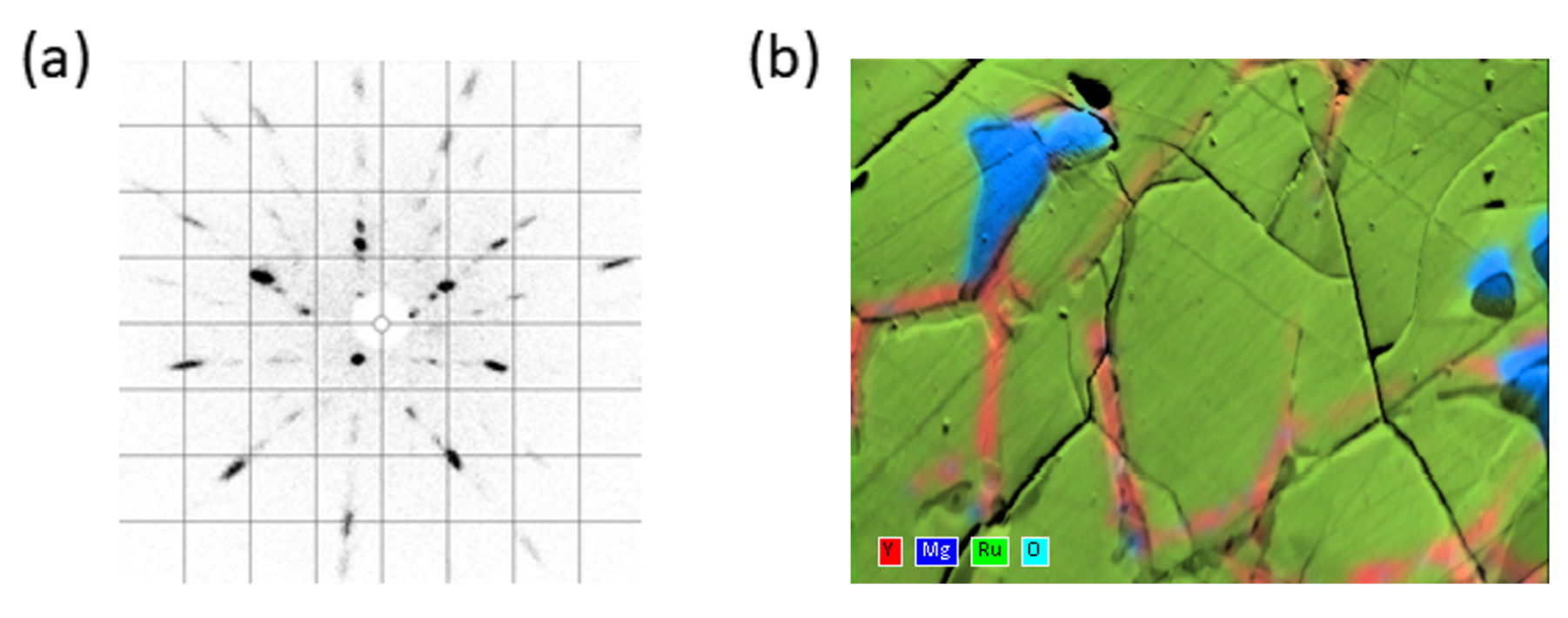
Single crystals of YMgRuO were grown by the floating zone technique—see Figure 1a for a Laue diffraction pattern of an as-grown crystal. The starting materials YO, RuO and MgO were mixed in stoichiometric amounts with 100% RuO excess for a compensation of RuO evaporation (see also other ruthenate growth reports, e.g., ref. [21] and references therein). This mixture was thoroughly ground and pressed into rods of ∼5 mm in diameter. These rods were sintered in air at 1100 C for 24 h. The subsequent floating zone growth was performed at a growth rate of 15 mm/h under an O/Ar atmosphere of 10 bar (with a ratio of 1:10) at a temperature of about 1800 C. Despite the large excess of RuO, the fast growth rate was still necessary to cope with the heavy evaporation of RuO during crystal growth.
Figure 1.
(a) Laue diffraction pattern of an as-grown YMgRuO crystal. (b) EDX map showing inclusions of YO and MgO assigned by EBSD pattern evaluation.
Attempts to synthesize polycrystalline YMgRuO samples using a conventional solid state synthesis route failed. For these polycrystalline samples, stoichiometic amounts of YO, MgO, and RuO were mixed and first reacted at 950 C for 24 h followed by sintering at 1200 C for 48 h. However, powder X-ray diffraction measurements did not show any evidence for a YMgRuO phase in these powder samples. Instead, an YRuO pyrochlore phase [22] was found, together with impurity phases of YO and MgO.
An electron back-scatter diffraction (EBSD) measurement of a part of the as-grown boule shows a homogeneous phase distribution with grains of the monoclinic YMgRuO majority phase and the YO and MgO phases at the grain boundaries, see Figure 1b. It was possible to extract single crystalline grains of up to ≈30–40 m dimension from the floating zone grown crystal, which could be used for further measurements.
The composition of the as-grown polycrystalline material was analyzed using wavelength dispersive X-ray (WDX) on an electron microprobe. The following ratios were obtained for the atomic concentrations of the metals—Y:Mg:Ru = 2.00(1):0.85(1):1.11(1). The oxygen concentration was not determined. Moreover, the composition was found to be homogeneous within each grain of YMgRuO.
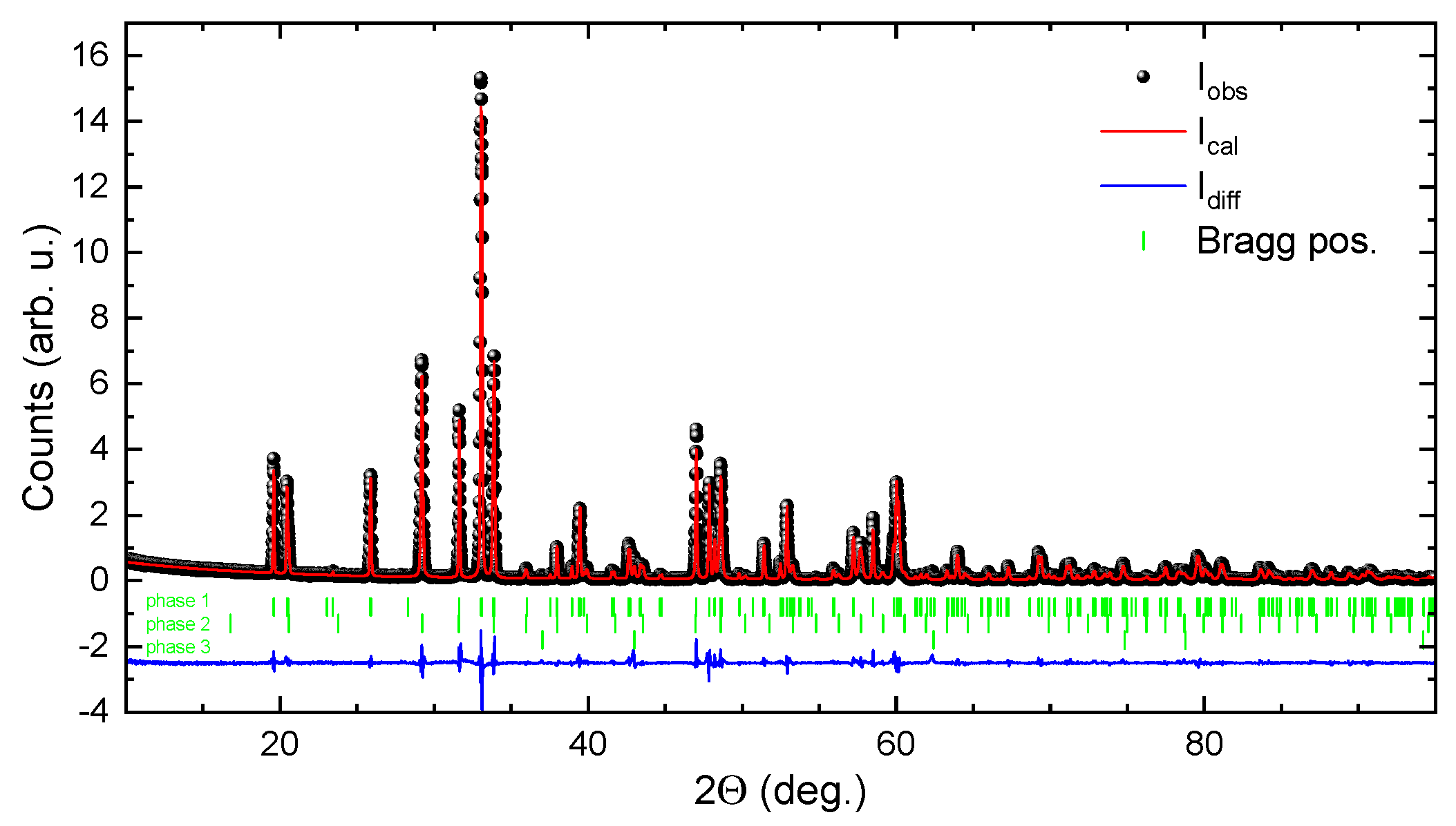
Powder X-ray diffraction measurements of a crushed crystal reveal the appearance of YO and MgO impurity phases with a volume fraction of 22.5(1)% and 7.1(3)% respectively, see Figure 2. Nonetheless, the ∼70% majority phase of YMgRuO could be refined properly. The obtained lattice constants and structural parameters are listed in Table 1. A refinement of the occupancies of Ru and Mg at the two B-sites reveals a composition of YMgRuO which is close to the composition of YMgRuO indicated by the WDX measurements.
Figure 2.
Powder X-ray diffraction pattern of YMgRuO (phase 1) together with impurity phases of YO (phase 2) and MgO (phase 3); = .
Table 1.
Refinement results of powder X-ray diffraction measurements of a powderized crystal of YMgRuO with space group (R:8.55%, wR:12.08%). The obtained composition is YMgRuO. There was no indication of a Y deficiency. The oxygen content was not refined. For the atomic positions of the light oxygen ions and for the isotropic displacement parameters of all atoms, the results of our single crystal X-ray diffraction measurements (of sample B) were used.
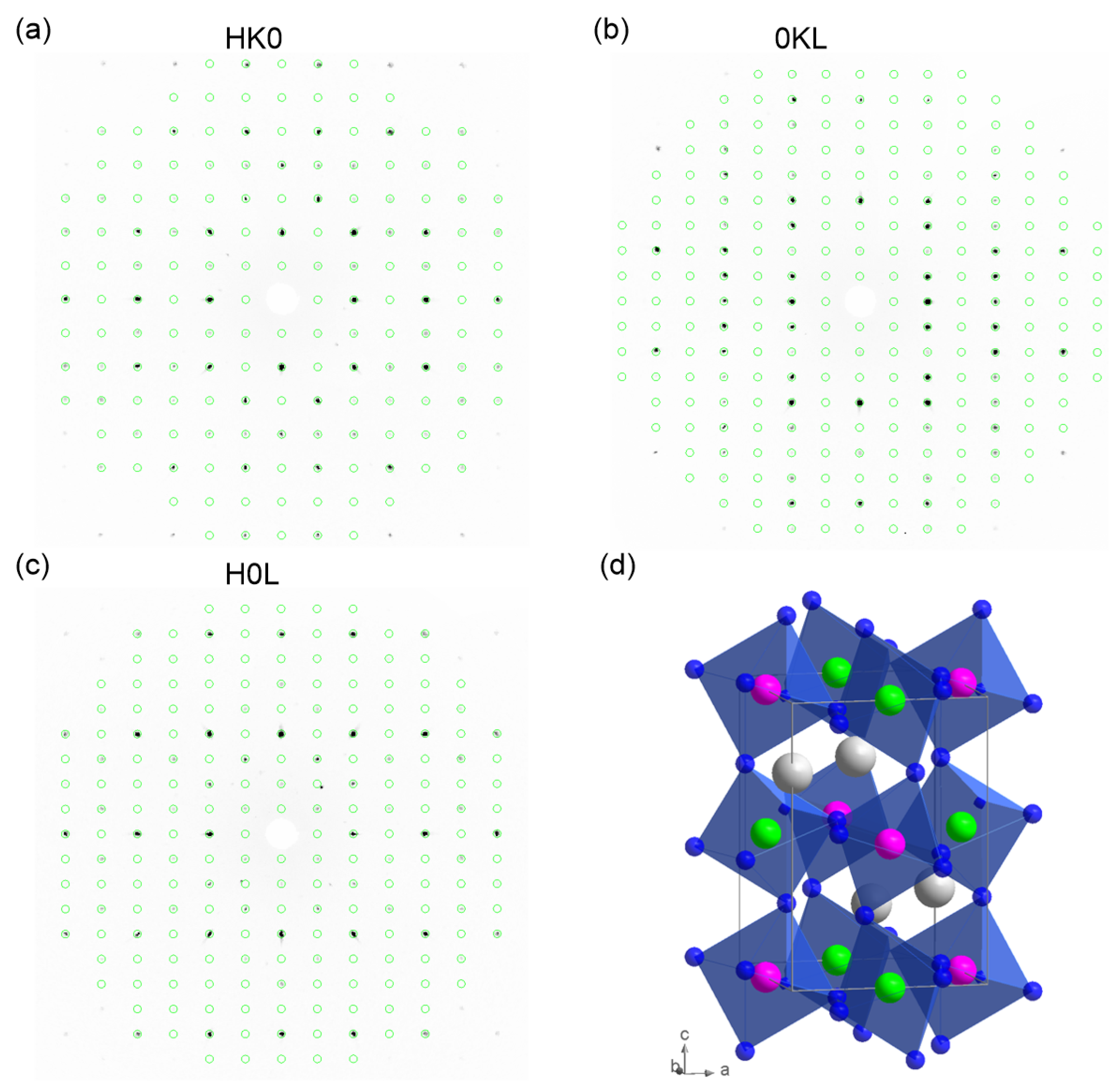
For an accurate structural analysis, two single crystals with dimensions of the order of 10 m were prepared from the original as-grown crystal (sample A and B). Single crystal X-ray diffraction scattering intensities are shown in Figure 3a–c. For sample A, 4677 reflections were collected up to 2 = 55.8 with a redundancy of 9.10 and an internal R value of 4.02%, whereas 32,124 reflections were collected up to 2 = 90.3 with a redundancy of 17.89 and an internal R value of 4.74% for sample B. Both measured single crystals show the expected monoclinic twinning for monoclinic systems (with a monoclinic angle = 90.178(1)) with twin fractions of close to 50%, see Table 2. The finally obtained crystal structure is that of a double perovskite as shown in Figure 3d.
Figure 3.
(a–c) X-ray scattering intensities (displayed in a black/white representation) within , and planes of reciprocal space (for the measurement of sample B). Green circles indicate the positions for expected Bragg reflections according to space group . (d) Crystal structure of YMgRuO; white/green/magenta/blue spheres: Y/B//oxygen ions; the B-site is predominantly occupied by Ru and the -site, mainly by Mg.
Table 2.
Crystallographic and structural refinement data of two single crystal X-ray diffraction measurements of YMgRuO (sample A and sample B). The crystallographic software Jana2006 was used for the structural refinement [23]; : unobserved reflections () were used in the refinement. Note that the lattice parameters determined by single crystal X-ray diffraction are not as reliable as the lattice constants determined by powder X-ray diffraction listed in Table 1 because of poorer resolution and monoclinic twinning.
An initial refinement of the occupancies of Ru versus Mg at both of the two B-sites reveals compositions of YMgRuO for sample A and YMgRuO for sample B. From the composition YMgRuO one would nominally expect a Ru 3.74+ oxidation state appearing in this double perovskite compound. But chemically, a Ru oxidation state is expected for these growth conditions. In order to obtain the rather stable Ru oxidation state, there would have to be nominally a 5% Y-deficiency of in YMgRuO which would be in agreement with (i) the appearance of an YO impurity phase in the as-grown crystal, (ii) with somewhat enhanced atomic displacement parameters of the Y ions observed in the refinement and, on the other hand, also (iii) with the compact 113-perovskite structure that does not allow for interstitial sites for excess oxygen. Therefore, the Y occupancy is also refined in a subsequent step. Indeed, this refinement yields compositions of YMgRuO (sample A) and YMgRuO (sample B) that exhibit Y deficiencies. (Due to the refinement of the Y occupancy, an improvement of the R-values could be achieved—e.g., for sample B, the weighted R-value decreased from 5.41% to 5.09%. Furthermore, the -site disorder was also altered—e.g., the Ru1 occupancy decreased from 0.770(2) to 0.709(4) and the Mg1 occupancy increased from 0.623(2) to 0.661(3) for sample B. On the other hand, the other structural parameters x, y, z and the twin fractions remained very stable). The finally obtained structural parameters and refinement results are listed in Table 2, Table 3 and Table 4. These finally obtained compositions would be consistent with a Ru oxidation state, assuming the presence of oxygen deficiencies , i.e., the occupancy of the oxygen ions should be 98.73% and 97.78% for samples A and B, respectively. (Otherwise, there would be a small admixture of Ru ions for = 0). We did not refine the occupancies of the oxygen ions and set their occupancies to 100% within the refinement since then there would be too many free parameters together with the scale factor. The refined compositions YMgRuO and YMgRuO for the two samples are very roughly consistent with each other. Why the -site mixing for these two single crystals is larger than for the powder sample is unclear. One reason could be that the two single crystals originate from a less-ordered part of the as-grown boule. Another possibility would be that single crystal X-ray diffraction gives more accurate results.
Table 3.
Refinement results of single crystal X-ray diffraction measurements of YMgRuO (sample A). Note that the lattice parameters determined by single crystal X-ray diffraction are not as reliable as the lattice constants determined by powder X-ray diffraction. Therefore, only the values in Table 1 should be used.
Table 4.
Refinement results of single crystal X-ray diffraction measurements of YMgRuO (sample B). Note that the lattice parameters determined by single crystal X-ray diffraction are not as reliable as the lattice constants determined by powder X-ray diffraction. Therefore, only the values in Table 1 should be used.
Due to the presence of -site mixing, the bond valence sum (BVS) formalism seems not very reliable to determine the Ru oxidation state since the so-called Ru-O distances are only a (weighted) average of Ru-O and Mg-O distances due to the -site disorder. Note that the ionic radii of Mg ions is about 0.1 Å larger than that of the Ru ions. And as expected, the formal BVS of Ru ions is lower than for a Ru ion, i.e., 3.522(9)+ for Ru1, and correspondingly, these BVS values are somewhat larger than expected for a Mg ion, i.e., 2.378(6)+ for Mg1.
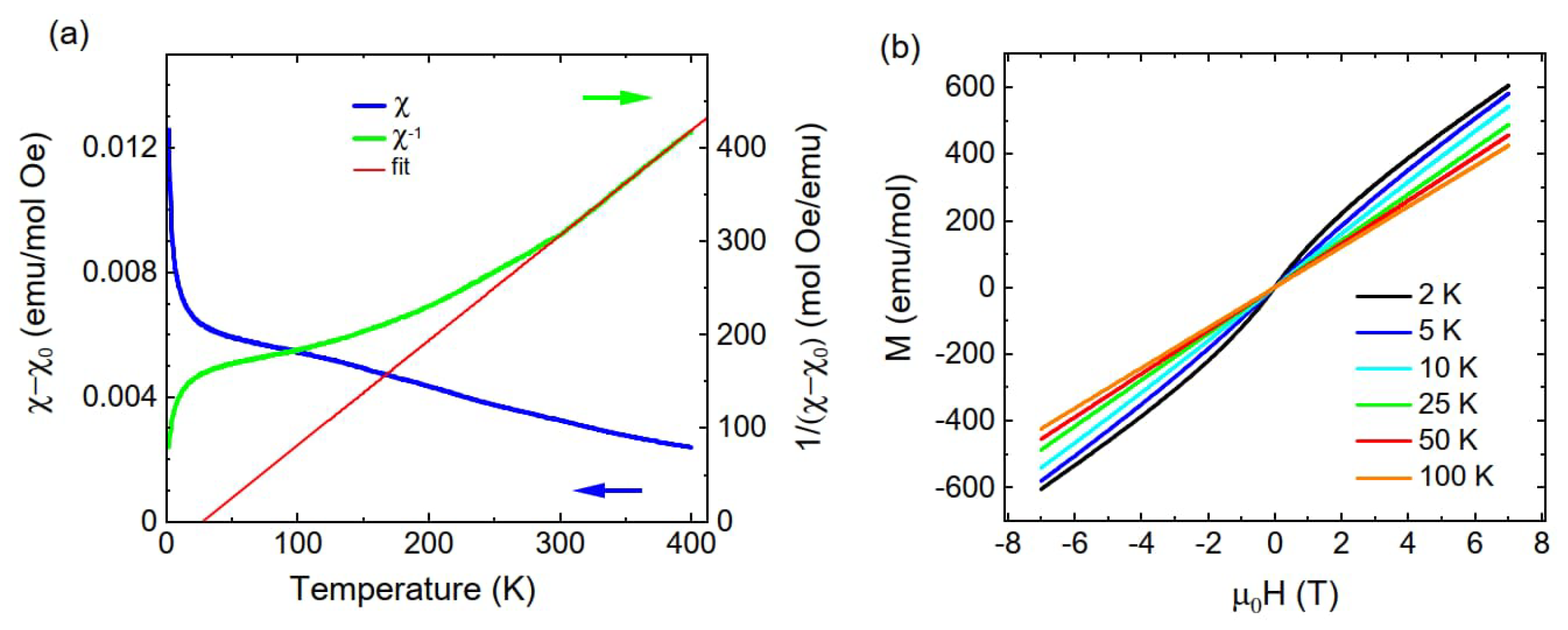
The temperature dependence of magnetic susceptibility for the nominal composition of YMgRuO is shown in Figure 4a. The behavior of resembles that of LaMgRuO and LaZnRuO [15,20]. There is no clear evidence for any magnetic order in YMgRuO. In Figure 4a, the inverse magnetic susceptibility is also plotted. As expected for Curie–Weiss behavior, a rather linear regime can be observed above 300 K (as compared to 250 K in LaMgRuO and LaZnRuO [15,20]). A Curie–Weiss fit yields an effective moment of 2.67(35) per formula unit, which is only slightly less than the expected spin-only value for a S = 1 system. This result corroborates that the Ru ions are in a S = 1 Ru oxidation state. Note that is also not temperature independent as would be expected for a system. Finally, the Weiss-temperature amounts to 27.6(2.8) K, which is indicative for ferromagnetic exchange interactions. This is different from LaMgRuO and LaZnRuO where a negative Weiss temperature was observed and might be either related to smaller bond angles due to the small size of the Y ions (the Ru-O-Mg bond angles amount to 143.0(1) in YMgRuO) or to a higher degree of -site disorder in our sample. This significant amount of -site disorder (observed by precise single crystal X-ray diffraction measurements) is also very likely responsible for the lack of magnetic order and also for the S = 1 state due to clustering of Ru at the microscopic level since it leads to a very significant amount of Ru-O-Ru exchange paths instead of the separation of the RuO octahedra by Mg ions in a hypothetical crystal with perfect -site order.
Figure 4.
(a) The temperature dependence of magnetic susceptibility and inverse susceptibility of YMgRuO ( was obtained from the Curie–Weiss fit, and is plotted in order to visualize the linear behavior of the corresponding inverse susceptibility between 300 K and 400 K). (b) Magnetization measured at different temperatures of YMgRuO.
Isothermal magnetization measurements of YMgRuO are shown in Figure 4b. At 2 K, the magnetization shows an S-shaped field dependence, which could be explained by the presence of ferromagnetic exchange interactions in this compound, indicated by the positive Weiss temperature.
3. Materials and Methods
YMgRuO crystals were grown in an optical floating zone furnace (HKZ from Scientific Instruments Dresden GmbH, Dresden, Germany) equipped with a Xe lamp. The synthesis temperature was of the order of ≈1800 C. As starting materials, RuO (Aldrich 99.9%), YO (Alfa Aesar 99.9%) and MgO (Alfa Aesar 99.95%) were used.
Powder X-ray diffraction (XRD) measurements were performed on a powder X-ray diffractometer (Bruker D8 Discover A25, Bruker AXS GmbH, Karlsruhe, Germany) (Cu radiation) diffractometer at room temperature.
Single crystal X-ray diffraction (XRD) measurements were performed on a single crystal X-ray diffractometer (Bruker D8, Bruker AXS GmbH, Karlsruhe, Germany) with a bent graphite monochromator for about 3 times the intensity enhancement that is equipped with a Photon III CMOS area detector (Mo radiation).
The magnetization and susceptibility measurements were performed using a Magnetic Property Measuring System (MPMS), Quantum Design, San Diego, CA, USA.
Wavelength dispersive X-ray analysis was performed on an electron microprobe (Cameca, SX100, Munich, Germany). Electron backscatter diffraction (EBSD) measurements were realized on a scanning electron microscope (JSM-7800F, Jeol (Germany GmbH), Munich, Germany) equipped with an EBSD system (CrystAlign, Bruker Nano GmbH, Berlin, Germany).
4. Conclusions
Single crystals of a new double perovskite—YMgRuO—could be synthesized with the floating zone technique. The fact that the solid state synthesis of powder samples of the nominal composition YMgRuO entirely failed might indicate that the synthesis conditions (c,p,T) reached within the growth chamber could be important for the successful growth of this phase. Due to inclusions of YO and MgO impurity phases, only crystal sizes of up to ∼40 m could be prepared from the as-grown boule. Powder and single crystal X-ray diffraction measurements indicate a monoclinic crystal structure with space group and a monoclinic angle = 90.178(1). In addition, these measurements indicate a small excess of Ru and non-negligible -site mixing in this compound. Single crystal X-ray diffraction measurements reveal a composition of YMgRuO for one of these crystals. The magnetic susceptibility of this double perovskite resembles that of LaMgRuO or LaZnRuO. There is no clear indication for any long-range magnetic order in this material. Also, no Van Vleck-type temperature-independent magnetism—as expected for a system—can be observed in this compound. Instead, the effective moment obtained from a Curie–Weiss fit is indicative for a S = 1 Ru state. This could be probably the consequence of the -site disorder, which induces a large amount of Ru-O-Ru exchange paths like in single perovskites as, for example, SrRuO. In contrast to LaMgRuO or LaZnRuO, the Weiss constant is positive, indicating ferromagnetic exchange interactions in YMgRuO.
Author Contributions
Project management: A.C.K. and L.H.T.; crystal growth: S.R. and A.C.K.; magnetization and powder XRD measurements: S.R. and A.C.K.; single crystal XRD measurements: A.C.K.; EDX/WDX/EBSD measurements: U.B.; manuscript writing: S.R. and A.C.K. with contributions from the other authors. All authors have read and agreed to the published version of the manuscript.
Funding
The research was partly supported by the Deutsche Forschungsgemeinschaft through SFB1143 (project number 247310070).
Data Availability Statement
The data that support the findings of this study are available upon reasonable request.
Conflicts of Interest
The authors declare no conflict of interest.
References
- Khaliullin, G. Excitonic Magnetism in Van Vleck–type d4 Mott Insulators. Phys. Rev. Lett. 2013, 111, 197201. [Google Scholar] [CrossRef]
- Meetei, O.N.; Cole, W.S.; Randeria, M.; Trivedi, N. Novel magnetic state in d4 Mott insulators. Phys. Rev. B 2015, 91, 054412. [Google Scholar] [CrossRef]
- Takayama, T.; Chaloupka, J.; Smerald, A.; Khaliullin, G.; Takagi, H. Spin–Orbit-Entangled Electronic Phases in 4d and 5d Transition-Metal Compounds. J. Phys. Soc. Jpn. 2021, 90, 062001. [Google Scholar] [CrossRef]
- Takahashi, H.; Suzuki, H.; Bertinshaw, J.; Bette, S.; Mühle, C.; Nuss, J.; Dinnebier, R.; Yaresko, A.; Khaliullin, G.; Gretarsson, H.; et al. Nonmagnetic J = 0 State and Spin-Orbit Excitations in K2RuCl6. Phys. Rev. Lett. 2021, 127, 227201. [Google Scholar] [CrossRef]
- Chaloupka, J.; Khaliullin, G. Highly frustrated magnetism in relativistic d4 Mott insulators: Bosonic analog of the Kitaev honeycomb model. Phys. Rev. B 2019, 100, 224413. [Google Scholar] [CrossRef]
- Anisimov, P.S.; Aust, F.; Khaliullin, G.; Daghofer, M. Nontrivial Triplon Topology and Triplon Liquid in Kitaev-Heisenberg-type Excitonic Magnets. Phys. Rev. Lett. 2019, 122, 177201. [Google Scholar] [CrossRef]
- Kaushal, N.; Soni, R.; Nocera, A.; Alvarez, G.; Dagotto, E. BCS-BEC crossover in a (t2g)4 excitonic magnet. Phys. Rev. B 2020, 101, 245147. [Google Scholar] [CrossRef]
- Khalifah, P.; Osborn, R.; Huang, Q.; Zandbergen, H.W.; Jin, R.; Liu, Y.; Mandrus, D.; Cava, R.J. Orbital Ordering Transition in La4Ru2O10. Science 2002, 297, 2237. [Google Scholar] [CrossRef]
- Wu, H.; Hu, Z.; Burnus, T.; Denlinger, J.D.; Khalifah, P.G.; Mandrus, D.G.; Jang, L.Y.; Hsieh, H.H.; Tanaka, A.; Liang, K.S.; et al. Orbitally Driven Spin-Singlet Dimerization in S = 1 La4Ru2O10. Phys. Rev. Lett. 2006, 96, 256402. [Google Scholar] [CrossRef]
- Jain, J.; Krautloher, M.; Porras, J.; Ryu, G.H.; Chen, D.P.; Abernathy, D.L.; Park, J.T.; Ivanov, A.; Chaloupka, J.; Khaliullin, G.; et al. Higgs mode and its decay in a two-dimensional antiferromagnet. Nat. Phys. 2017, 13, 163. [Google Scholar] [CrossRef]
- Miura, Z.; Sato, M.; Yamakawa, Y.; Habaguchi, T.; Ōno, Y. Structural Transition of Li2RuO3 Induced by Molecular-Orbit Formation. J. Phys. Soc. Jpn. 2009, 78, 094706. [Google Scholar] [CrossRef]
- Kumar, R.; Dey, T.; Ette, P.M.; Ramesha, K.; Chakraborty, A.; Dasgupta, I.; Orain, J.C.; Baines, C.; Tóth, S.; Shahee, A.; et al. Unconventional magnetism in the 4d4-based S = 1 honeycomb system Ag3LiRu2O6. Phys. Rev. B 2019, 99, 054417. [Google Scholar] [CrossRef]
- Takayama, T.; Blankenhorn, M.; Bertinshaw, J.; Haskel, D.; Bogdanov, N.A.; Kitagawa, K.; Yaresko, A.N.; Krajewska, A.; Bette, S.; McNally, G.; et al. Competing spin-orbital singlet states in the 4d4 honeycomb ruthenate Ag3LiRu2O6. Phys. Rev. Res. 2022, 4, 043079. [Google Scholar] [CrossRef]
- Kimchi, I.; Vishwanath, A. Kitaev-Heisenberg models for iridates on the triangular, hyperkagome, kagome, fcc, and pyrochlore lattices. Phys. Rev. B 2014, 89, 014414. [Google Scholar] [CrossRef]
- Dass, R.I.; Yan, J.Q.; Goodenough, J.B. Ruthenium double perovskites: Transport and magnetic properties. Phys. Rev. B 2004, 69, 094416. [Google Scholar] [CrossRef]
- Battle, P.D.; Frost, J.R.; Kim, S.H. Magnetic Properties of La2CuTi1−xRuxO6 and LaZnRu06. J. Mater. Chem. 1995, 5, 1003. [Google Scholar] [CrossRef]
- Choy, J.H.; Kim, J.Y.; Hwang, S.H.; Kim, S.J.; Demazeau, G. Soft XAFS study on the 4d electronic structure of ruthenium in complex perovskite oxide. Int. J. Inorg. Mater. 2000, 2, 61. [Google Scholar] [CrossRef]
- Seinen, P.; van Berkel, F.; Groen, W.; Ijdo, D. The ordered perovskite system Ln2NiRuO6. Mater. Res. Bull. 1987, 22, 535. [Google Scholar] [CrossRef]
- Battle, P.; Jones, C. The crystal structure of Ln2NiRuO6. Mater. Res. Bull. 1987, 22, 1623. [Google Scholar] [CrossRef]
- Yoshii, K.; Ikeda, N.; Mizumaki, M. Magnetic and dielectric properties of the ruthenium double perovskites La2MRuO6 (M = Mg, Co, Ni, and Zn). Phys. Stat. Sol. 2008, 203, 2812. [Google Scholar] [CrossRef]
- Li, Z.; Liu, C.F.; Skoulatos, M.; Tjeng, L.; Komarek, A. Floating zone growth of Ba-substituted ruthenate Sr2−xBaxRuO4. J. Cryst. Growth 2015, 427, 94. [Google Scholar] [CrossRef]
- Kennedy, B.J. Structure refinement of Y2Ru2O7 by neutron powder diffraction. Acta Cryst. 1995, C51, 790–792. [Google Scholar] [CrossRef]
- Petricek, V.; Dusek, M.; Palatinus, L. Crystallographic Computing System JANA2006: General features. Z. Kristallogr. 2014, 229, 345–352. [Google Scholar]
Disclaimer/Publisher’s Note: The statements, opinions and data contained in all publications are solely those of the individual author(s) and contributor(s) and not of MDPI and/or the editor(s). MDPI and/or the editor(s) disclaim responsibility for any injury to people or property resulting from any ideas, methods, instructions or products referred to in the content. |
© 2023 by the authors. Licensee MDPI, Basel, Switzerland. This article is an open access article distributed under the terms and conditions of the Creative Commons Attribution (CC BY) license (https://creativecommons.org/licenses/by/4.0/).